EP2429182A2 - Procédé destiné à flouter des données personnelles d'une caméra - Google Patents
Procédé destiné à flouter des données personnelles d'une caméra Download PDFInfo
- Publication number
- EP2429182A2 EP2429182A2 EP11180889A EP11180889A EP2429182A2 EP 2429182 A2 EP2429182 A2 EP 2429182A2 EP 11180889 A EP11180889 A EP 11180889A EP 11180889 A EP11180889 A EP 11180889A EP 2429182 A2 EP2429182 A2 EP 2429182A2
- Authority
- EP
- European Patent Office
- Prior art keywords
- camera
- user
- images
- personal data
- interface
- Prior art date
- Legal status (The legal status is an assumption and is not a legal conclusion. Google has not performed a legal analysis and makes no representation as to the accuracy of the status listed.)
- Withdrawn
Links
- 238000000034 method Methods 0.000 title claims abstract description 19
- 230000000873 masking effect Effects 0.000 title 1
- 238000012545 processing Methods 0.000 claims abstract description 12
- 238000005259 measurement Methods 0.000 claims description 16
- 238000011156 evaluation Methods 0.000 claims description 7
- 238000013480 data collection Methods 0.000 description 5
- 238000013475 authorization Methods 0.000 description 4
- 230000007935 neutral effect Effects 0.000 description 4
- 230000008569 process Effects 0.000 description 4
- 230000008901 benefit Effects 0.000 description 3
- 230000006870 function Effects 0.000 description 3
- 230000007246 mechanism Effects 0.000 description 3
- 230000009467 reduction Effects 0.000 description 3
- 238000013459 approach Methods 0.000 description 2
- 230000005540 biological transmission Effects 0.000 description 2
- 230000008859 change Effects 0.000 description 2
- 238000012937 correction Methods 0.000 description 2
- 230000006735 deficit Effects 0.000 description 2
- 238000003745 diagnosis Methods 0.000 description 2
- 238000005516 engineering process Methods 0.000 description 2
- 238000007619 statistical method Methods 0.000 description 2
- 238000003860 storage Methods 0.000 description 2
- 241000287107 Passer Species 0.000 description 1
- 230000004913 activation Effects 0.000 description 1
- 230000002776 aggregation Effects 0.000 description 1
- 238000004220 aggregation Methods 0.000 description 1
- 230000003321 amplification Effects 0.000 description 1
- 238000004458 analytical method Methods 0.000 description 1
- 230000000903 blocking effect Effects 0.000 description 1
- 238000004891 communication Methods 0.000 description 1
- 238000007405 data analysis Methods 0.000 description 1
- 230000001419 dependent effect Effects 0.000 description 1
- 238000013461 design Methods 0.000 description 1
- 238000001514 detection method Methods 0.000 description 1
- 230000000694 effects Effects 0.000 description 1
- 230000007613 environmental effect Effects 0.000 description 1
- 230000003203 everyday effect Effects 0.000 description 1
- 238000010348 incorporation Methods 0.000 description 1
- 230000010354 integration Effects 0.000 description 1
- 238000011835 investigation Methods 0.000 description 1
- 230000004807 localization Effects 0.000 description 1
- 238000012423 maintenance Methods 0.000 description 1
- 238000004519 manufacturing process Methods 0.000 description 1
- 238000003199 nucleic acid amplification method Methods 0.000 description 1
- 230000003287 optical effect Effects 0.000 description 1
- 238000012805 post-processing Methods 0.000 description 1
- 238000003672 processing method Methods 0.000 description 1
- 230000001681 protective effect Effects 0.000 description 1
- 230000011218 segmentation Effects 0.000 description 1
- 230000003068 static effect Effects 0.000 description 1
- 230000002123 temporal effect Effects 0.000 description 1
- 238000012546 transfer Methods 0.000 description 1
- 230000009466 transformation Effects 0.000 description 1
- 238000000844 transformation Methods 0.000 description 1
- 238000010200 validation analysis Methods 0.000 description 1
- 230000000007 visual effect Effects 0.000 description 1
- 238000012800 visualization Methods 0.000 description 1
Images



Classifications
-
- H—ELECTRICITY
- H04—ELECTRIC COMMUNICATION TECHNIQUE
- H04N—PICTORIAL COMMUNICATION, e.g. TELEVISION
- H04N5/00—Details of television systems
- H04N5/76—Television signal recording
- H04N5/765—Interface circuits between an apparatus for recording and another apparatus
- H04N5/77—Interface circuits between an apparatus for recording and another apparatus between a recording apparatus and a television camera
- H04N5/772—Interface circuits between an apparatus for recording and another apparatus between a recording apparatus and a television camera the recording apparatus and the television camera being placed in the same enclosure
-
- G—PHYSICS
- G08—SIGNALLING
- G08G—TRAFFIC CONTROL SYSTEMS
- G08G1/00—Traffic control systems for road vehicles
- G08G1/01—Detecting movement of traffic to be counted or controlled
- G08G1/017—Detecting movement of traffic to be counted or controlled identifying vehicles
-
- H—ELECTRICITY
- H04—ELECTRIC COMMUNICATION TECHNIQUE
- H04N—PICTORIAL COMMUNICATION, e.g. TELEVISION
- H04N21/00—Selective content distribution, e.g. interactive television or video on demand [VOD]
- H04N21/40—Client devices specifically adapted for the reception of or interaction with content, e.g. set-top-box [STB]; Operations thereof
- H04N21/41—Structure of client; Structure of client peripherals
- H04N21/422—Input-only peripherals, i.e. input devices connected to specially adapted client devices, e.g. global positioning system [GPS]
- H04N21/4223—Cameras
-
- H—ELECTRICITY
- H04—ELECTRIC COMMUNICATION TECHNIQUE
- H04N—PICTORIAL COMMUNICATION, e.g. TELEVISION
- H04N21/00—Selective content distribution, e.g. interactive television or video on demand [VOD]
- H04N21/40—Client devices specifically adapted for the reception of or interaction with content, e.g. set-top-box [STB]; Operations thereof
- H04N21/43—Processing of content or additional data, e.g. demultiplexing additional data from a digital video stream; Elementary client operations, e.g. monitoring of home network or synchronising decoder's clock; Client middleware
- H04N21/44—Processing of video elementary streams, e.g. splicing a video clip retrieved from local storage with an incoming video stream or rendering scenes according to encoded video stream scene graphs
- H04N21/44008—Processing of video elementary streams, e.g. splicing a video clip retrieved from local storage with an incoming video stream or rendering scenes according to encoded video stream scene graphs involving operations for analysing video streams, e.g. detecting features or characteristics in the video stream
-
- H—ELECTRICITY
- H04—ELECTRIC COMMUNICATION TECHNIQUE
- H04N—PICTORIAL COMMUNICATION, e.g. TELEVISION
- H04N21/00—Selective content distribution, e.g. interactive television or video on demand [VOD]
- H04N21/40—Client devices specifically adapted for the reception of or interaction with content, e.g. set-top-box [STB]; Operations thereof
- H04N21/43—Processing of content or additional data, e.g. demultiplexing additional data from a digital video stream; Elementary client operations, e.g. monitoring of home network or synchronising decoder's clock; Client middleware
- H04N21/44—Processing of video elementary streams, e.g. splicing a video clip retrieved from local storage with an incoming video stream or rendering scenes according to encoded video stream scene graphs
- H04N21/4402—Processing of video elementary streams, e.g. splicing a video clip retrieved from local storage with an incoming video stream or rendering scenes according to encoded video stream scene graphs involving reformatting operations of video signals for household redistribution, storage or real-time display
- H04N21/440227—Processing of video elementary streams, e.g. splicing a video clip retrieved from local storage with an incoming video stream or rendering scenes according to encoded video stream scene graphs involving reformatting operations of video signals for household redistribution, storage or real-time display by decomposing into layers, e.g. base layer and one or more enhancement layers
-
- H—ELECTRICITY
- H04—ELECTRIC COMMUNICATION TECHNIQUE
- H04N—PICTORIAL COMMUNICATION, e.g. TELEVISION
- H04N21/00—Selective content distribution, e.g. interactive television or video on demand [VOD]
- H04N21/40—Client devices specifically adapted for the reception of or interaction with content, e.g. set-top-box [STB]; Operations thereof
- H04N21/45—Management operations performed by the client for facilitating the reception of or the interaction with the content or administrating data related to the end-user or to the client device itself, e.g. learning user preferences for recommending movies, resolving scheduling conflicts
- H04N21/454—Content or additional data filtering, e.g. blocking advertisements
- H04N21/4542—Blocking scenes or portions of the received content, e.g. censoring scenes
-
- H—ELECTRICITY
- H04—ELECTRIC COMMUNICATION TECHNIQUE
- H04N—PICTORIAL COMMUNICATION, e.g. TELEVISION
- H04N23/00—Cameras or camera modules comprising electronic image sensors; Control thereof
- H04N23/60—Control of cameras or camera modules
- H04N23/61—Control of cameras or camera modules based on recognised objects
- H04N23/611—Control of cameras or camera modules based on recognised objects where the recognised objects include parts of the human body
-
- H—ELECTRICITY
- H04—ELECTRIC COMMUNICATION TECHNIQUE
- H04N—PICTORIAL COMMUNICATION, e.g. TELEVISION
- H04N5/00—Details of television systems
- H04N5/222—Studio circuitry; Studio devices; Studio equipment
- H04N5/262—Studio circuits, e.g. for mixing, switching-over, change of character of image, other special effects ; Cameras specially adapted for the electronic generation of special effects
- H04N5/272—Means for inserting a foreground image in a background image, i.e. inlay, outlay
-
- H—ELECTRICITY
- H04—ELECTRIC COMMUNICATION TECHNIQUE
- H04N—PICTORIAL COMMUNICATION, e.g. TELEVISION
- H04N9/00—Details of colour television systems
- H04N9/79—Processing of colour television signals in connection with recording
- H04N9/80—Transformation of the television signal for recording, e.g. modulation, frequency changing; Inverse transformation for playback
- H04N9/82—Transformation of the television signal for recording, e.g. modulation, frequency changing; Inverse transformation for playback the individual colour picture signal components being recorded simultaneously only
- H04N9/8205—Transformation of the television signal for recording, e.g. modulation, frequency changing; Inverse transformation for playback the individual colour picture signal components being recorded simultaneously only involving the multiplexing of an additional signal and the colour video signal
- H04N9/8227—Transformation of the television signal for recording, e.g. modulation, frequency changing; Inverse transformation for playback the individual colour picture signal components being recorded simultaneously only involving the multiplexing of an additional signal and the colour video signal the additional signal being at least another television signal
-
- H—ELECTRICITY
- H04—ELECTRIC COMMUNICATION TECHNIQUE
- H04N—PICTORIAL COMMUNICATION, e.g. TELEVISION
- H04N9/00—Details of colour television systems
- H04N9/79—Processing of colour television signals in connection with recording
- H04N9/80—Transformation of the television signal for recording, e.g. modulation, frequency changing; Inverse transformation for playback
- H04N9/82—Transformation of the television signal for recording, e.g. modulation, frequency changing; Inverse transformation for playback the individual colour picture signal components being recorded simultaneously only
- H04N9/8205—Transformation of the television signal for recording, e.g. modulation, frequency changing; Inverse transformation for playback the individual colour picture signal components being recorded simultaneously only involving the multiplexing of an additional signal and the colour video signal
- H04N9/8233—Transformation of the television signal for recording, e.g. modulation, frequency changing; Inverse transformation for playback the individual colour picture signal components being recorded simultaneously only involving the multiplexing of an additional signal and the colour video signal the additional signal being a character code signal
Definitions
- the present invention relates to a method for disregarding personal data of a camera and relates to the task of restricting the visibility of personal data in the collection, processing and disclosure of image data or to prevent.
- the defacing of personal data in the images of a camera is carried out according to the invention either in the form of anonymization, i. the personal data are changed in images so that the data is no longer assigned to a person, or in the form of a pseudonymization, in which personal data in the image are so encrypted that they are subjectively not recognizable in the encrypted image, but by an authorized user can be restored if necessary.
- a camera is typically a photographic device which acquires static or moving images by means of an electronic image sensor, processes them via an integrated electronic circuit and provides the result of this processing via at least one interface, which is usually digital today.
- Cameras which capture images by means of a photographic film have in recent years increasingly been replaced by cameras with an electronic image sensor; they are not the subject of the invention and are not taken into consideration in the further embodiments.
- signals or data output by the image sensor are processed first. This can be done, for example, by means of analog signal amplification and digitization, as well as by means of further linear or non-linear transformations, for example for gamma correction, for black level correction, for white balance or for color interpolation for color image sensors eg with Bayer sensor, cf. patent US3971065 , In the remainder of the text, the term "original image” is used synonymously for the image that is thus made available to a downstream functional unit in or outside the camera in digital, modifiable form.
- the term "camera” is used interchangeably with modern cameras that offer the possibility of analyzing contents of images by means of an integrated digital processing unit.
- Many commercially available cameras and video cameras for the consumer market fall into this category, as well as various HW and SW components in multifunctional devices (mobile phones, notebooks, game consoles, etc.) and so-called “smart cameras”. While in the former types the main function is still in image capture, e.g. Smart cameras and cameras for game consoles predominantly to generate captured images abstract or pictorial results or control signals, subsequently "measurement results”.
- camera system used in the text is used in a superordinate sense; it comprises in each case one or more cameras and technical equipment for their operation, their configuration and for the application-specific transmission and aggregation of images or measurement results.
- Cameras are used in a wide variety of application fields, such as security technology, traffic management, automation-supported attention analysis, as well as in the field of ambient assisted living.
- license plate number Personal data in images captured by cameras or image sequences are above all recognizable faces and readable license plates (hereinafter referred to as "license plate number").
- the explicit goal in many cases is to capture suitable personal identification features in high quality in order to prevent or understand infringements of the law or criminal acts.
- the current state of the art camera systems also offer the ability to anonymize or pseudonymize image data in normal operation already in the camera or in an early image transfer subsequent step, but also provide with such protection camera systems equipped with appropriate parameter setting by a trained and appropriate authorized users the ability to view personal images of the cameras, at least during the setting process, for service and diagnosis or due to inadequate security precautions, and thus to store and further process.
- at least persons entrusted with the system have the technical possibility of obtaining personal data.
- This accessibility of data by technical personnel is partly also in conflict with legal requirements or with the interests of exclusive access for actually authorized persons, e.g. the executive.
- the object of the present invention is to change captured images already within a camera in such a way that an abuse of personal data can be prevented as reliably as possible.
- the invention achieves the stated object according to the invention in that a processing unit makes personal data in original images captured by the image sensor of the camera unrecognizable in every user-configurable configuration within the camera, and only in this way altered images or images derived therefrom as result images in one stores memory accessible to the user or outputs via an interface accessible to the user.
- a user is to be understood as a natural person who uses a camera system and has authorization to take measurements with the camera system or to evaluate specific measurement results of the camera system or make changes to the camera system.
- the described security mechanisms defined for "one" user do not necessarily refer to each user. Whether the defacing invention relates to any user, or only to a specific group of users ("user group") depends on the application and will be described in detail with reference to various implementation examples.
- the manufacturer is a natural or legal person who manufactures or configures a camera or a camera system for a specific purpose.
- FIG. 1 shows an captured by a camera 1 by means of image sensor 2 original image 3, of which a personal information to a motor vehicle 4 in the form of the license plate 5 is clearly readable.
- Systems whose function is based on the capture and processing of such images are used, for example, to identify identity in the event of traffic violations.
- the license plate number is also suitable in other applications as a unique tracking feature, for example, to determine the movement of vehicles at an intersection, eg PCT / AT2009 / 000432 , or to accomplish the detection of travel times and itineraries based on the determination of the same license plate or on the basis of a signature of the license plate number at different measurement sites in the road network.
- FIG. 1 also shows another example image in which a user 6 can recognize a person 7 on a protective path.
- the face 8 of the person is visible, so that an identification of the person based on the present image can not be excluded.
- a collection of personal data is given.
- FIG. 2 points to the picture examples FIG. 1
- Two possible scenarios for an application in which by means of a camera system violations in red light 9 for motor vehicles 4 or for passers 7 are to be detected automatically. Personal data should not be collected in the case study, however, the vehicle driver or the passer-by should be informed directly about his or her misconduct via a suitable display 10.
- the signal "red" of the traffic light control via a digital input 11 is guided to the camera. If the camera detects the unauthorized passage when the red phase is upright, then the activation signal for the display is switched via a digital output 12 of the camera 1 and an output image 13 is output via an interface 14.
- cameras 1 have one or more physical interfaces, e.g. USB, Firewire, Ethernet, WLAN or Bluetooth.
- a physical digital interface may functionally include one or more software interfaces, e.g. one or more socket connections.
- the term interface is used synonymously for a software interface of an unspecified physical interface.
- Such interfaces can additionally or alternatively to digital inputs and digital outputs in different camera systems application-specific also be used to different information (eg signals, tables, database entries) of external functional units (eg other sensors, external controllers, database server) in the measurement data analysis and to be taken into account in the evaluation (eg wanted list with license plates of stolen vehicles).
- information eg signals, tables, database entries
- external functional units eg other sensors, external controllers, database server
- the evaluation algorithm operates on the basis of the evaluation and tracking of the license plate 5 or by a segmentation of persons 7 in the image. Since the measuring task is merely to promptly indicate to the road user his own misconduct, but moreover, no personal data collection is to be made, given the current state of the art collection and processing of personal data is more of a problem than a technical advantage dar. It plays in the case of data protection, a subordinate role, whether the image processing that detects the violation case, in a processing unit 15 of the camera 1 itself or in an external device 16 accomplished, since the camera 1 is not protected against direct access to original images 3. Accordingly, a user 6 has the practical possibility of choosing the configuration of the camera such that original images 3 or personal measurement results, e.g. read license plate 5, can be viewed, archived and further processed. In order to mitigate this problem, the needs of data protection can be met in the given case, mainly only by restrictive work instructions for user 6, but not entirely by means of technical limitations.
- State-of-the-art cameras offer various adjustment options, which enable the trained, authorized user 6, in any case, from Image sensor 2 detected original images 3 via an interface 14 or accessible via a memory accessible to him (eg SD card, built-in hard disk) 18.
- Image sensor 2 detected original images 3 via an interface 14 or accessible via a memory accessible to him (eg SD card, built-in hard disk) 18.
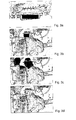
- FIG. 3 shows various measures to anonymise personal data in captured images according to the current state of the art.
- Figure 3c shows an image whose contents have been changed by an image processing algorithm. Image areas that are evaluated as critical by the algorithm are automatically rendered unrecognizable. According to the current state of the art, however, there are no evaluation methods that are able to reliably locate and hide all personal data in a real complex scene, as shown in this example, over time and place, and all others To leave details.
- the camera according to the invention has integrated protection mechanisms which prevent a user 6 under specification of the application in each operating state direct observation of personal data in the image.
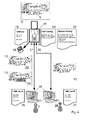
- FIG. 4 shows such protection mechanisms on an implementation example.
- a system for localization and evaluation of license plate 5 is designed so that no personal data is output via an interface A 17.
- the communication between a user 6 and the camera takes place exclusively via this interface A 17.
- the camera 1 transmits an authentication request, in the implementation example a TAN code request using a TAN code list 19 stored in the camera
- the authorized user receives via the interface A only after correct indication of the TAN code access to all relevant configuration options of the system, but without getting in the course of his activity direct access to captured by the sensor original images 3.
- at least one user configuration 20 is stored in the camera, which can be changed by the user 6, and at least one second system definition 21, which can be changed by any user.
- this system definition given by the manufacturer also contains those parameter settings which describe the clearing of the image data that is secure in the sense of the underlying application.
- the camera 1 is configured so that at least one interface A 17 in the result image 13 all found symbols on the license plate 5 are replaced by neutral placeholder 22. Since in the present application an image output only takes place when a license plate has actually been detected and after remaining image contents can be darkened, for example, by the incorporation of an optical daylight blocking filter, in the case example further measures, such as the resolution reduction of remaining image areas, are dispensed with ,
- a pseudonymization of personal data may be used instead of anonymisation.
- personal data is not made unrecognizable by resolution reduction or neutral placeholder, but by a suitable encryption 23 of image content for a user 6.
- a suitable encryption 23 of image content for a user 6. Has e.g. each camera via an individual key 24, so each installed device only authorized for data collection users 28 encrypted image areas of this camera again reconstruct.
- encrypted contents can also be stored as separate data records if required. This is e.g. This is useful if low-resolution overview images without identifiable personal data are to be archived during the measurement and only certain contents with potentially relevant personal data are to be stored in full quality, but pseudonymised.
- a further realization possibility according to the invention also consists of system integration over at least two interfaces A and B, e.g. the images are anomimized only at interface A 17, which is provided for maintenance and configuration, while not anonymized image material is transmitted via at least one further interface B 25, which are connected to an authorized data receiver.
- TAN code groups are assigned and queried (eg interface A: TAN code list 26 with TAN codes 001-100 for a non-data collection authorized user 6, interface B: TAN code list 27 with TAN codes 101-200 for one Data Acquisition Authorized Users 28) and these are only disclosed to the respective authorized user group.
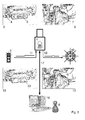
- FIG. 5 shows for the application in FIG. 2 an implementation of the invention.
- the camera 1 is configured so that each personal data in the image are automatically anonymized.
- symbols found in the license plate are replaced by neutral wildcards. 22.
- the use of blur operators or a scene-adapted reduction of the resolution will change all images of the camera so that a subjective determination of personal data from the image material output by the camera Data is no longer possible.
- several measures eg placeholders for detected symbols, blur operator for other image areas
- the camera determines significant, personal image content from the undisturbed original image 3 for the measurement task, e.g. To determine the temporal movement sequence of the vehicle on the basis of the license plate in detail or to determine the contour characteristics of persons in the captured image with the highest possible accuracy.
- the camera stores neither evaluated original images 3, nor does it deliver personal data via the interface 17.
- the system configuration also allows the user to make a location-based configuration on the camera and observe anonymized images in real time to best adjust the system.
- Anonymized result images 13 can in this case also be archived, forwarded and subsequently inspected, in order, e.g. to be able to derive statistical statements about site-specific potential hazards.
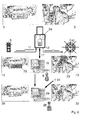
- FIG. 6 shows a further advantageous realization variant of the invention.
- personal data is collected.
- these should be transmitted in a pseudonymized manner and, if necessary, be accessible only at a downstream workstation 29 for those users 28 in whose area of responsibility the collection of these data lies.
- personal data in the Image not replaced by neutral placeholder, but with the inclusion of a key stored in the camera 24 made unrecognizable. In this way it is avoided that a user group not entrusted with the data collection has a visually interpretable impression on personal data.
- This pseudonymization in the camera 1 makes it possible, in particular, to implement systems in which the impairment of the personal sphere of randomly recorded people is reduced to a required minimum.
- a camera system for example, as a safety-related device, it can be designed in such a way that exclusively pseudonymized images 23 are generated and temporarily stored in everyday operation.
- a user authorized to collect data 28 at a downstream workstation 29 selectively analyzes precisely that decrypted image material 30 that has been recorded and recorded in the relevant time frame.
- camera systems according to the invention can be configured with the existence of a corresponding data protection approval by the manufacturer so that they continue to provide only anonymized measurement results for the primary user and provide pseudonymized images accompanying the process for exclusive use by these authorized authorities.
Landscapes
- Engineering & Computer Science (AREA)
- Multimedia (AREA)
- Signal Processing (AREA)
- Physics & Mathematics (AREA)
- General Physics & Mathematics (AREA)
- Databases & Information Systems (AREA)
- Studio Devices (AREA)
- Collating Specific Patterns (AREA)
Applications Claiming Priority (1)
| Application Number | Priority Date | Filing Date | Title |
|---|---|---|---|
| AT0151010A AT510352A1 (de) | 2010-09-13 | 2010-09-13 | Kamera für die unkenntlichmachung personenbezogener daten |
Publications (2)
| Publication Number | Publication Date |
|---|---|
| EP2429182A2 true EP2429182A2 (fr) | 2012-03-14 |
| EP2429182A3 EP2429182A3 (fr) | 2014-01-08 |
Family
ID=44785359
Family Applications (1)
| Application Number | Title | Priority Date | Filing Date |
|---|---|---|---|
| EP11180889.5A Withdrawn EP2429182A3 (fr) | 2010-09-13 | 2011-09-12 | Procédé destiné à flouter des données personnelles d'une caméra |
Country Status (2)
| Country | Link |
|---|---|
| EP (1) | EP2429182A3 (fr) |
| AT (1) | AT510352A1 (fr) |
Cited By (7)
| Publication number | Priority date | Publication date | Assignee | Title |
|---|---|---|---|---|
| EP2873227A4 (fr) * | 2012-07-13 | 2016-03-23 | Intel Corp | Gestion basée sur le contexte destinée à des applications sécurisées de réalité augmentée |
| WO2016180460A1 (fr) * | 2015-05-11 | 2016-11-17 | Deutsche Telekom Ag | Mécanisme de commande de confidentialité inter au dispositif pour des dispositifs intelligents pouvant être portés |
| WO2018099689A1 (fr) * | 2016-11-30 | 2018-06-07 | Robert Bosch Gmbh | Caméra de surveillance d'une zone de surveillance et dispositif de surveillance ainsi que procédé de surveillance d'une zone de surveillance |
| EP4036777A1 (fr) | 2021-01-29 | 2022-08-03 | Daniel Nikola | Dispositif et procédé de collecte d'au moins une image tout en préservant l'anonymat de chaque personne enregistrée |
| WO2022225587A1 (fr) * | 2021-04-19 | 2022-10-27 | Western Digital Technologies, Inc. | Système de mémoire respectant la vie privée |
| DE102014207439B4 (de) * | 2014-04-17 | 2025-03-27 | IDnow GmbH | Maskierung von sensiblen Daten bei der Benutzer-Identifikation |
| DE102024112630A1 (de) * | 2024-05-06 | 2025-11-06 | Diehl Aerospace Gmbh | Kameramodul zur Ausgabe zensierter Kamerabilder ohne Zugang zu unzensierten Originalbildern |
Citations (1)
| Publication number | Priority date | Publication date | Assignee | Title |
|---|---|---|---|---|
| US3971065A (en) | 1975-03-05 | 1976-07-20 | Eastman Kodak Company | Color imaging array |
Family Cites Families (6)
| Publication number | Priority date | Publication date | Assignee | Title |
|---|---|---|---|---|
| US5940140A (en) * | 1996-09-10 | 1999-08-17 | Ultimatte Corporation | Backing luminance non-uniformity compensation in real-time compositing systems |
| US6067399A (en) * | 1998-09-02 | 2000-05-23 | Sony Corporation | Privacy mode for acquisition cameras and camcorders |
| JP2002305704A (ja) * | 2001-04-05 | 2002-10-18 | Canon Inc | 画像記録システム及び方法 |
| US20070242852A1 (en) * | 2004-12-03 | 2007-10-18 | Interdigital Technology Corporation | Method and apparatus for watermarking sensed data |
| US9426387B2 (en) * | 2005-07-01 | 2016-08-23 | Invention Science Fund I, Llc | Image anonymization |
| DE102008018026A1 (de) * | 2008-04-09 | 2009-10-22 | Siemens Aktiengesellschaft | Verfahren zur Wahrung von Persönlichkeitsrechten bei einer Erfassung von Aufnahmen von Personen |
-
2010
- 2010-09-13 AT AT0151010A patent/AT510352A1/de not_active Application Discontinuation
-
2011
- 2011-09-12 EP EP11180889.5A patent/EP2429182A3/fr not_active Withdrawn
Patent Citations (1)
| Publication number | Priority date | Publication date | Assignee | Title |
|---|---|---|---|---|
| US3971065A (en) | 1975-03-05 | 1976-07-20 | Eastman Kodak Company | Color imaging array |
Cited By (12)
| Publication number | Priority date | Publication date | Assignee | Title |
|---|---|---|---|---|
| EP2873227A4 (fr) * | 2012-07-13 | 2016-03-23 | Intel Corp | Gestion basée sur le contexte destinée à des applications sécurisées de réalité augmentée |
| US9509941B2 (en) | 2012-07-13 | 2016-11-29 | Intel Corporation | Context based management for secure augmented reality applications |
| US9948659B2 (en) | 2012-07-13 | 2018-04-17 | Intel Corporation | Context based management for secure augmented reality applications |
| DE102014207439B4 (de) * | 2014-04-17 | 2025-03-27 | IDnow GmbH | Maskierung von sensiblen Daten bei der Benutzer-Identifikation |
| WO2016180460A1 (fr) * | 2015-05-11 | 2016-11-17 | Deutsche Telekom Ag | Mécanisme de commande de confidentialité inter au dispositif pour des dispositifs intelligents pouvant être portés |
| WO2018099689A1 (fr) * | 2016-11-30 | 2018-06-07 | Robert Bosch Gmbh | Caméra de surveillance d'une zone de surveillance et dispositif de surveillance ainsi que procédé de surveillance d'une zone de surveillance |
| US10956752B2 (en) | 2016-11-30 | 2021-03-23 | Robert Bosch Gmbh | Camera for monitoring a monitored area and monitoring device, and method for monitoring a monitored area |
| EP4036777A1 (fr) | 2021-01-29 | 2022-08-03 | Daniel Nikola | Dispositif et procédé de collecte d'au moins une image tout en préservant l'anonymat de chaque personne enregistrée |
| WO2022225587A1 (fr) * | 2021-04-19 | 2022-10-27 | Western Digital Technologies, Inc. | Système de mémoire respectant la vie privée |
| US11593520B2 (en) | 2021-04-19 | 2023-02-28 | Western Digital Technologies, Inc. | Privacy enforcing memory system |
| CN116917960A (zh) * | 2021-04-19 | 2023-10-20 | 西部数据技术公司 | 隐私实施存储器系统 |
| DE102024112630A1 (de) * | 2024-05-06 | 2025-11-06 | Diehl Aerospace Gmbh | Kameramodul zur Ausgabe zensierter Kamerabilder ohne Zugang zu unzensierten Originalbildern |
Also Published As
| Publication number | Publication date |
|---|---|
| AT510352A1 (de) | 2012-03-15 |
| EP2429182A3 (fr) | 2014-01-08 |
Similar Documents
| Publication | Publication Date | Title |
|---|---|---|
| DE102007059346B4 (de) | Verfahren und Vorrichtung zur Erfassung einer Geschwindigkeitsübertretung eines Fahrzeugs | |
| EP2429182A2 (fr) | Procédé destiné à flouter des données personnelles d'une caméra | |
| DE102005018301B4 (de) | Datenübertragungsvorrichtung | |
| DE112013003833T5 (de) | Vorrichtung, Verfahren und Computerprogramm zum Steuern der gemeinsamen Nutzung von Sensoren | |
| DE112021001385T5 (de) | Verfahren und system zum sammeln und verwalten von fahrzeugdaten | |
| DE102020004792A1 (de) | Verfahren und Vorrichtung zur Erkennung und Meldung von Parkunfällen für Fahrzeuge | |
| EP2469497A1 (fr) | Procédé d'enregistrement d'image de véhicules | |
| DE102018213268A1 (de) | Verfahren zur anwendung in einem fahrzeug | |
| WO2018188937A1 (fr) | Procédé pour la collecte de données | |
| DE102017105174A1 (de) | Verfahren zum Erzeugen von Trainingsdaten für die Überwachung einer Gefahrenquelle | |
| EP2290628B1 (fr) | Procédé de vidéosurveillance de pièces | |
| EP4222725B1 (fr) | Procédé pour fournir un dégagement pour l'utilisation d'une bande d'arrêt d'urgence au moyen d'un système de surveillance, et système de surveillance | |
| AT524959A4 (de) | Datenerfassung im Fahrzeug | |
| EP3994676A1 (fr) | Procédé, programme informatique et dispositif de traitement de données enregistrées par un véhicule automobile, et fourniture de paramètres pour un tel traitement | |
| DE102018006747A1 (de) | Verfahren zur Auswertung von Daten aus einem Fahrzeug | |
| EP2505540A1 (fr) | Dispositif de surveillance d'accès doté d'au moins une unité vidéo | |
| DE102017214773A1 (de) | Unfalldatenspeicherung an Bord eines Kraftfahrzeugs | |
| DE102018008683A1 (de) | Verfahren zum Ermöglichen der Identifizierung eines rücksichtslosen Fahrers eines Straßenfahrzeugs, System, Computerprogramm, computerlesbares Medium und Fahrzeug | |
| EP2603905B1 (fr) | Procédé et dispositif de détection et de vérification de tentatives de manipulation sur un terminal de distribution automatique | |
| DE102018133445A1 (de) | Verfahren und Vorrichtung zum Überwachen eines Insassen eines Fahrzeugs sowie System zur Analyse der Wahrnehmung von Objekten | |
| DE102018201071A1 (de) | Verfahren und System zum Authentifizieren eines Fahrzeugführers für die Benutzung eines Fahrzeugs | |
| EP3757961A1 (fr) | Procédé, programme informatique et dispositif de détermination une distance de véhicule pour un intervalle temporel d'observation | |
| EP3396918B1 (fr) | Capteur, appareil et procédé de préparation privative de données de capteur | |
| WO2009124819A1 (fr) | Procédé de protection des droits de la personnalité lors de l'acquisition de prises de vue de personnes | |
| DE102020200757A1 (de) | Verfahren und System zum Aufbau einer Datenbank für Entwicklungsleistungen eines automatischen Fahrbetriebs von Fahrzeugen |
Legal Events
| Date | Code | Title | Description |
|---|---|---|---|
| AK | Designated contracting states |
Kind code of ref document: A2 Designated state(s): AL AT BE BG CH CY CZ DE DK EE ES FI FR GB GR HR HU IE IS IT LI LT LU LV MC MK MT NL NO PL PT RO RS SE SI SK SM TR |
|
| AX | Request for extension of the european patent |
Extension state: BA ME |
|
| PUAI | Public reference made under article 153(3) epc to a published international application that has entered the european phase |
Free format text: ORIGINAL CODE: 0009012 |
|
| PUAL | Search report despatched |
Free format text: ORIGINAL CODE: 0009013 |
|
| AK | Designated contracting states |
Kind code of ref document: A3 Designated state(s): AL AT BE BG CH CY CZ DE DK EE ES FI FR GB GR HR HU IE IS IT LI LT LU LV MC MK MT NL NO PL PT RO RS SE SI SK SM TR |
|
| AX | Request for extension of the european patent |
Extension state: BA ME |
|
| RIC1 | Information provided on ipc code assigned before grant |
Ipc: H04N 21/2187 20110101ALI20131203BHEP Ipc: H04N 5/77 20060101ALI20131203BHEP Ipc: H04N 5/272 20060101ALI20131203BHEP Ipc: H04N 5/232 20060101AFI20131203BHEP Ipc: H04N 21/235 20110101ALI20131203BHEP |
|
| STAA | Information on the status of an ep patent application or granted ep patent |
Free format text: STATUS: THE APPLICATION IS DEEMED TO BE WITHDRAWN |
|
| 18D | Application deemed to be withdrawn |
Effective date: 20140401 |