EP2432055B1 - Composition de matériau actif positif et électrode positive pour dispositif électrochimique et dispositif électrochimique l'incluant - Google Patents
Composition de matériau actif positif et électrode positive pour dispositif électrochimique et dispositif électrochimique l'incluant Download PDFInfo
- Publication number
- EP2432055B1 EP2432055B1 EP11176013.8A EP11176013A EP2432055B1 EP 2432055 B1 EP2432055 B1 EP 2432055B1 EP 11176013 A EP11176013 A EP 11176013A EP 2432055 B1 EP2432055 B1 EP 2432055B1
- Authority
- EP
- European Patent Office
- Prior art keywords
- carbon
- active material
- positive active
- material composition
- based additive
- Prior art date
- Legal status (The legal status is an assumption and is not a legal conclusion. Google has not performed a legal analysis and makes no representation as to the accuracy of the status listed.)
- Active
Links
Images
Classifications
-
- H—ELECTRICITY
- H01—ELECTRIC ELEMENTS
- H01M—PROCESSES OR MEANS, e.g. BATTERIES, FOR THE DIRECT CONVERSION OF CHEMICAL ENERGY INTO ELECTRICAL ENERGY
- H01M4/00—Electrodes
- H01M4/02—Electrodes composed of, or comprising, active material
- H01M4/62—Selection of inactive substances as ingredients for active masses, e.g. binders, fillers
-
- H—ELECTRICITY
- H01—ELECTRIC ELEMENTS
- H01M—PROCESSES OR MEANS, e.g. BATTERIES, FOR THE DIRECT CONVERSION OF CHEMICAL ENERGY INTO ELECTRICAL ENERGY
- H01M4/00—Electrodes
- H01M4/02—Electrodes composed of, or comprising, active material
- H01M4/62—Selection of inactive substances as ingredients for active masses, e.g. binders, fillers
- H01M4/624—Electric conductive fillers
- H01M4/625—Carbon or graphite
-
- C—CHEMISTRY; METALLURGY
- C01—INORGANIC CHEMISTRY
- C01B—NON-METALLIC ELEMENTS; COMPOUNDS THEREOF; METALLOIDS OR COMPOUNDS THEREOF NOT COVERED BY SUBCLASS C01C
- C01B32/00—Carbon; Compounds thereof
-
- H—ELECTRICITY
- H01—ELECTRIC ELEMENTS
- H01G—CAPACITORS; CAPACITORS, RECTIFIERS, DETECTORS, SWITCHING DEVICES, LIGHT-SENSITIVE OR TEMPERATURE-SENSITIVE DEVICES OF THE ELECTROLYTIC TYPE
- H01G11/00—Hybrid capacitors, i.e. capacitors having different positive and negative electrodes; Electric double-layer [EDL] capacitors; Processes for the manufacture thereof or of parts thereof
- H01G11/22—Electrodes
- H01G11/30—Electrodes characterised by their material
- H01G11/32—Carbon-based
-
- H—ELECTRICITY
- H01—ELECTRIC ELEMENTS
- H01G—CAPACITORS; CAPACITORS, RECTIFIERS, DETECTORS, SWITCHING DEVICES, LIGHT-SENSITIVE OR TEMPERATURE-SENSITIVE DEVICES OF THE ELECTROLYTIC TYPE
- H01G9/00—Electrolytic capacitors, rectifiers, detectors, switching devices, light-sensitive or temperature-sensitive devices; Processes of their manufacture
- H01G9/004—Details
- H01G9/04—Electrodes or formation of dielectric layers thereon
- H01G9/042—Electrodes or formation of dielectric layers thereon characterised by the material
-
- H—ELECTRICITY
- H01—ELECTRIC ELEMENTS
- H01M—PROCESSES OR MEANS, e.g. BATTERIES, FOR THE DIRECT CONVERSION OF CHEMICAL ENERGY INTO ELECTRICAL ENERGY
- H01M4/00—Electrodes
- H01M4/02—Electrodes composed of, or comprising, active material
- H01M4/13—Electrodes for accumulators with non-aqueous electrolyte, e.g. for lithium-accumulators; Processes of manufacture thereof
-
- H—ELECTRICITY
- H01—ELECTRIC ELEMENTS
- H01M—PROCESSES OR MEANS, e.g. BATTERIES, FOR THE DIRECT CONVERSION OF CHEMICAL ENERGY INTO ELECTRICAL ENERGY
- H01M10/00—Secondary cells; Manufacture thereof
- H01M10/05—Accumulators with non-aqueous electrolyte
- H01M10/052—Li-accumulators
-
- Y—GENERAL TAGGING OF NEW TECHNOLOGICAL DEVELOPMENTS; GENERAL TAGGING OF CROSS-SECTIONAL TECHNOLOGIES SPANNING OVER SEVERAL SECTIONS OF THE IPC; TECHNICAL SUBJECTS COVERED BY FORMER USPC CROSS-REFERENCE ART COLLECTIONS [XRACs] AND DIGESTS
- Y02—TECHNOLOGIES OR APPLICATIONS FOR MITIGATION OR ADAPTATION AGAINST CLIMATE CHANGE
- Y02E—REDUCTION OF GREENHOUSE GAS [GHG] EMISSIONS, RELATED TO ENERGY GENERATION, TRANSMISSION OR DISTRIBUTION
- Y02E60/00—Enabling technologies; Technologies with a potential or indirect contribution to GHG emissions mitigation
- Y02E60/10—Energy storage using batteries
-
- Y—GENERAL TAGGING OF NEW TECHNOLOGICAL DEVELOPMENTS; GENERAL TAGGING OF CROSS-SECTIONAL TECHNOLOGIES SPANNING OVER SEVERAL SECTIONS OF THE IPC; TECHNICAL SUBJECTS COVERED BY FORMER USPC CROSS-REFERENCE ART COLLECTIONS [XRACs] AND DIGESTS
- Y02—TECHNOLOGIES OR APPLICATIONS FOR MITIGATION OR ADAPTATION AGAINST CLIMATE CHANGE
- Y02E—REDUCTION OF GREENHOUSE GAS [GHG] EMISSIONS, RELATED TO ENERGY GENERATION, TRANSMISSION OR DISTRIBUTION
- Y02E60/00—Enabling technologies; Technologies with a potential or indirect contribution to GHG emissions mitigation
- Y02E60/13—Energy storage using capacitors
Definitions
- This disclosure relates to a positive active material composition for an energy storage device, a positive electrode, and an energy storage device.
- Lithium rechargeable batteries have drawn attention as a power source for small portable electronic devices. Since they use an organic electrolyte, they have about twice the discharge voltage of conventional batteries using an alkali aqueous solution, and accordingly have high energy density.
- lithium-transition element composite oxides being capable of intercalating lithium such as LiCoO 2 , LiMn 2 O 4 , LiNi 1-x Co x O 2 (0 ⁇ x ⁇ 1), and so on have been researched.
- the negative active material may include various shapes of carbonaceous materials that are capable of intercalating/deintercalating lithium, such as artificial or natural graphite, and hard carbon.
- non-carbon-based negative active materials such as Si, considering stability, are currently being researched.
- US2009/0142665 discloses a non-carbon-based material on which nano-fibre-shaped carbon having an oxygen-included functional group is grown as an active material for a rechargeable lithium battery.
- JP2004-039443 discloses an active material comprising an electron-conducting material and a conduction assistant.
- One embodiment provides a positive active material composition for an energy storage device having excellent high rate and cycle-life characteristics.
- Another embodiment provides a positive electrode for an energy storage device fabricated using the composition.
- Yet another embodiment provides an energy storage device including a positive electrode fabricated using the composition.
- FT-IR infrared spectroscopy
- a positive electrode for an energy storage device includes a current collector; and a positive active material layer formed on the current collector and including the positive active material composition.
- an energy storage device includes the positive electrode.
- the energy storage device may be a rechargeable lithium battery or a capacitor.
- a positive active material composition prepared according to one embodiment of this disclosure provides an energy storage device having excellent high rate and cycle-life characteristics.
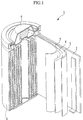
- FIG. 1 is a schematic view showing the representative structure of a rechargeable lithium battery according to one embodiment.
- a positive active material composition includes a carbon-based additive, a positive active material, a conductive material, and a binder.
- the peak area ratio of the hydroxyl group and the enol group bonded with the carbon-based additive is 0.5 to 10
- the specific surface area of the carbon-based additive is increased and the adsorption and desorption speed of ions may be increased, and consequently high rate charge/discharge characteristics may be improved and the reaction with an electrolyte is decreased to improve the cycle-life characteristic.
- the peak area signifies an integral area.
- acidic functional groups are increasingly bonded with the surface of the carbon-based additive, the activity of the functional group becomes higher.
- the charge/discharge reaction proceeds, more side reactions occur due to the attack of lithium ions, and an electrolyte decomposition reaction is promoted. Therefore, more gas is generated from the electrolyte decomposition reaction and self-discharge may occur, which may lead to degradation of the cycle-life characteristic.
- the electrolyte decomposition reaction may be promoted.
- the electrolyte decomposition reaction of the functional group bonded with the surface of the carbon-based additive may increase the specific surface area of the carbon-based additive as functional groups are bonded therewith, and as the area contacting the electrolyte is increased due to the increased specific surface area, the decomposition reaction of an electrolyte occurs more actively. Since much gas is emitted due to the electrolyte decomposition reaction, current is consumed and the produced gas causes a physical short of an active material and a conductive material and thus an internal conduction network may become weak, which may eventually lead to a drastic deterioration of the cycle-life characteristic.
- the specific surface area is increased because functional groups are bonded with the surface of the carbon-based additive, and the increased specific surface area may hardly improve the adsorption/desorption speed.
- the acidic functional group exists on the surface of the carbon-based additive, the acidic functional group clogs micropores of the carbon-based additive so as to suppress solvated ions from going in and out through micropores, suppress the ions from being adsorbed, and let dissolved ions go in and out through mesopores. Thus, ion adsorption is induced and adsorption and desorption speeds are increased.
- an energy storage device is fabricated using a positive active material composition including the carbon-based additive bonded with a functional group on the surface, an output improvement effect originating from the increase in the adsorption and desorption speeds may be acquired without deterioration in the cycle-life characteristic that may be caused by the gas generated from the reaction between the carbon-based additive and the electrolyte.
- the peak area ratio may be measured through a dry method using infrared spectroscopy (FT-IR: Fourier transform infrared spectroscopy) equipment.
- FT-IR infrared spectroscopy
- the FT-IR dry method may measure the peak area ratio in a dry room by mixing the carbon-based additive and a material that is obtained after passing through an infrared ray, manufacturing pellets, and letting light pass through the pellets.
- the pellets may be manufactured at a high pressure.
- the material that is obtained after passing through the infrared ray may be a material that does not absorb the wavelength of the infrared region, such as KBr, but is not limited thereto.
- the mixing ratio of the carbon-based additive and KBr may be from 0.3:99.7 to 2:98 in weight% ratio.
- the specific surface area of the carbon-based additive bonded with the functional group may range from 50m 2 /g to 3000m 2 /g, and according to one embodiment, it may range from 100m 2 /g to 2500 m 2 /g.
- the specific surface area of the carbon-based additive is less than 50m 2 /g, the effect of improving the adsorption/desorption speed of lithium ions is weak, and when it exceeds 3000m 2 /g, there is a concern that the electrolyte decomposition reaction may be accelerated.
- the carbon-based additive may include at least one element other than carbon in a content of less than 15wt%, and according to one embodiment, it may include at least one element other than carbon in a content of 1wt% to 13wt% (i.e. carbon in a content of 87wt% to 99wt%). In short, the carbon-based additive according to one embodiment includes carbon in a content of more than 85wt%.
- the at least one element other than carbon may be hydrogen, oxygen, nitrogen, or sulfur.
- the carbon-based additive comes to have an excessive amount of functional groups and the excessive amount of functional groups may readily produce a gas.
- the pKa of the carbon-based additive may range from 3 to 50, and according to one embodiment, it may range from 3 to 25.
- the content of the carbon-based additive in the positive active material composition may be less than 30wt% based on the total weight of the positive active material composition, or it may range from 1 to 30wt%.
- the content of the carbon-based additive may fall in the range, and the mixing ratio of the carbon-based additive and the positive active material may range from 1:99 to 49:51 in weight ratio.
- the mixing ratio of the carbon-based additive and the positive active material falls in the range, the acquired output and capacity characteristics may be excellent.
- the carbon-based additive may include a carbon-based material having a specific surface area of 100m 2 /g to 2500m 2 /g.
- Examples of the carbon-based material whose specific surface area falls in the range include activated carbon, carbide-derived carbon (CDC), carbon nanotubes, carbon nanofiber, expansion carbon, and a combination thereof.
- the carbide-derived carbon is carbon obtained by performing heat treatment on a carbide such as TiC and SiC.
- the carbon nanotubes are single wall nanotubes, multi-wall nanotubes, or a combination thereof.
- the electrolyte When the carbon-based material has a specific surface area in the range, the electrolyte is excellently retained. Thus, a sufficient electrolyte environment may be sustained around an active material in an electrode and a quick ion transfer environment may be formed. Therefore, a high rate characteristic may be improved. Also, since the electrolyte retention capability prevents the electrolyte from being dried up in the electrode and sustains the ion transfer environment around an active material while a charge and discharge cycle proceeds, it improves the cycle-life.
- the carbon-based additive may be prepared by performing a surface treatment in a method selected from the group consisting of ion beam treatment, plasma treatment, ozone treatment, acid treatment, and a combination thereof, and performing a heat treatment.
- a functional group is bonded with the surface of the carbon-based material.
- a carbon-based material is dried, and the dried carbon-based material is allowed to stand for 1 hour to 10 hours in a condition of generating ozone in a content of 5g/hr to 20g/hr in a concentration of 3mg/l to 10mg/l.
- the acid treatment process may be performed by impregnating a carbon-based material with acid.
- the available acid includes nitric acid, hydrochloric acid, sulfuric acid, hydrofluoric acid, and a combination thereof.
- the acid may be used in the form of an aqueous solution.
- the heat treatment process may include transferring a surface-treated carbon material into a furnace and performing a heat treatment at a temperature of 230°C to 350°C for 10 minutes to 5 hours.
- the temperature for the heat-treatment may be from 230°C to 270° C.
- the heat treatment process may be performed by increasing a temperature at an increasing rate of 1°C/min to 10°C/min from room temperature to 230°C to 350°C.
- any one capable of increasing the temperature in the above-described condition may be used.
- the heat treatment process may be performed in an inert atmosphere such as one of nitrogen or argon.
- the positive active material may include lithiated intercalation compounds that reversibly intercalate and deintercalate lithium ions.
- the positive active material include a composite oxide including at least one selected from the group consisting of cobalt, manganese, and nickel, as well as lithium. In one embodiment, the following lithium-containing compounds may be used.
- Li a A 1-b X b D 2 (0.90 ⁇ a ⁇ 1.8, 0 ⁇ b ⁇ 0.5); Li a A 1-b X b O 2-c D c (0.90 ⁇ a ⁇ 1.8, 0 ⁇ b ⁇ 0.5, 0 ⁇ c ⁇ 0.05); Li a E 2-b X b O 4-c D c (0.90 ⁇ a ⁇ 1.8, 0 ⁇ b ⁇ 0.5, 0 ⁇ c ⁇ 0.05); Li a Ni 1-b-c Co b X c D ⁇ (0.90 ⁇ a ⁇ 1.8, 0 ⁇ b ⁇ 0.5, 0 ⁇ c ⁇ 0.05, 0 ⁇ ⁇ ⁇ 2); Li a Ni 1-b-c Co b X c O 2-a T ⁇ (0.90 ⁇ a ⁇ 1.8, 0 ⁇ b ⁇ 0.5, 0 ⁇ c ⁇ 0.05, 0
- A is selected from the group consisting of Ni, Co, Mn, and a combination thereof;
- X is selected from the group consisting of Al, Ni, Co, Mn, Cr, Fe, Mg, Sr, V, a rare earth element, and a combination thereof;
- D is selected from the group consisting of O, F, S, P, and a combination thereof;
- E is selected from the group consisting of Co, Mn, and a combination thereof;
- T is selected from the group consisting of F, S, P, and a combination thereof;
- G is selected from the group consisting of Al, Cr, Mn, Fe, Mg, La, Ce, Sr, V, and a combination thereof;
- Q is selected from the group consisting of Ti, Mo, Mn, and a combination thereof;
- Z is selected from the group consisting of Cr, V, Fe, Sc, Y, and a combination thereof;
- J is selected from the group consisting of V, Cr, Mn, Co, Ni, Cu, and a
- the positive active material may include the positive active material with the coating layer, or a compound of the active material and the active material coated with the coating layer.
- the coating layer may include at least one coating element compound selected from the group consisting of an oxide of the coating element and a hydroxide of the coating element, an oxyhydroxide of the coating element, an oxycarbonate of the coating element, and a hydroxycarbonate of the coating element.
- the compound for the coating layer may be either amorphous or crystalline.
- the coating element included in the coating layer may be selected from the group consisting of Mg, Al, Co, K, Na, Ca, Si, Ti, V, Sn, Ge, Ga, B, As, Zr, and combinations thereof.
- the coating process may include any conventional processes as long as it does not causes any side effects on the properties of the positive active material (e.g., spray coating, immersing), which is well known to persons having ordinary skill in this art, so a detailed description thereof is omitted.
- the positive active material may be included in an amount of 90 to 40wt% based on a solid entire weight of the positive active material composition.
- the binder improves binding properties of the positive active material particles to each other and to a current collector.
- the binder include at least one selected from the group consisting of polyvinyl alcohol, carboxylmethyl cellulose, hydroxypropyl cellulose, diacetyl cellulose, polyvinyl chloride, carboxylated polyvinyl chloride, polyvinyl fluoride, an ethylene oxide-containing polymer, polyvinyl pyrrolidone, polyurethane, polytetrafluoroethylene, polyvinylidene fluoride, polyethylene, polypropylene, styrene-butadiene rubber, acrylated styrene-butadiene rubber, an epoxy resin, nylon, and the like, but is not limited thereto.
- the binder may be included in an amount of 5wt% to 10wt% based on the entire solid weight of the positive active material composition.
- the conductive material improves electrical conductivity of a positive electrode.
- Any electrically conductive material can be used as a conductive agent unless it causes a chemical change.
- the conductive material include natural graphite, artificial graphite, carbon black, acetylene black, ketjen black, a carbon fiber, a metal powder or metal fiber of copper, nickel, aluminum, silver, and the like, or a conductive material such as a polyphenylene derivative may be mixed with at least one of the conductive materials.
- the conductive material may be included in an amount of 1wt% to 10wt% based on the entire solid weight of the positive active material composition.
- Such a positive active material composition may be applied to an energy storage device.
- the energy storage device may be any one being capable of operating at from 2V to 5V, for example a rechargeable lithium battery or a capacitor.
- the rechargeable lithium battery When the positive active material composition is applied to a rechargeable lithium battery, the rechargeable lithium battery includes a positive electrode, a negative electrode, and an electrolyte.
- the positive electrode is fabricated using the positive active material composition, and includes a current collector and a positive active material layer.
- the current collector may include Al, but is not limited thereto.
- the positive active material layer may be fabricated by coating the positive active material composition, which is mixed in an organic solvent such as N-methyl pyrrolidone, on a current collector.
- the positive electrode manufacturing method is well known and thus is not described in detail in the present specification.
- the negative electrode may include a current collector and a negative active material layer disposed on the current collector, and the negative active material layer includes a negative active material.
- the negative active material includes a material that reversibly intercalates/deintercalates lithium ions, a lithium metal, a lithium metal alloy, a material being capable of doping and dedoping lithium, or a transition metal oxide.
- the material that reversibly intercalates/deintercalates lithium ions includes a carbon material.
- the carbon material may be any generally-used carbon-based negative active material for a lithium ion rechargeable battery.
- Examples of the carbon material include crystalline carbon, amorphous carbon, and a mixture thereof.
- the crystalline carbon may be non-shaped, or sheet, flake, spherical, or fiber shaped natural graphite or artificial graphite.
- the amorphous carbon may be a soft carbon, a hard carbon, mesophase pitch carbide, fired coke, and the like.
- lithium metal alloy includes lithium and a metal selected from the group consisting of Na, K, Rb, Cs, Fr, Be, Mg, Ca, Sr, Si, Sb, Pb, In, Zn, Ba, Ra, Ge, Al, and Sn.
- Examples of the material being capable of doping and dedoping lithium include Si, SiO x (0 ⁇ x ⁇ 2), a Si-Q alloy (where Q is an element selected from the group consisting of an alkaline metal, an alkaline-earth metal, a group 13 element, a group 14 element, a transition element, a rare earth element, and combinations thereof, and is not Si), Sn, SnO 2 , a Sn-R alloy (where R is an element selected from the group consisting of an alkaline metal, an alkaline-earth metal, a group 13 element, a group 14 element, a transition element, a rare earth element, and combinations thereof, and is not Sn), and mixtures thereof.
- the elements Q and R are the same or different, and are independently selected from the group consisting of Mg, Ca, Sr, Ba, Ra, Sc, Y, Ti, Zr, Hf, Rf, V, Nb, Ta, Db, Cr, Mo, W, Sg, Tc, Re, Bh, Fe, Pb, Ru, Os, Hs, Rh, Ir, Pd, Pt, Cu, Ag, Au, Zn, Cd, B, Al, Ga, Sn, In, Ti, Ge, P, As, Sb, Bi, S, Se, Te, Po, and a combination thereof.
- transition metal oxide examples include vanadium oxide, lithium vanadium oxide, and the like.
- the negative active material may be included in an amount of 95wt% to 99wt% based on the total weight of the negative active material layer.
- the negative active material layer includes a binder, and optionally a conductive material.
- the negative active material layer may include 1wt% to 5wt% of a binder based on the total weight of the negative active material layer.
- the negative active material layer further includes a conductive material, it may include 90wt% to 98wt% of the negative active material, 1wt% to 5wt% of the binder, and 1wt% to 5wt% of the conductive material.
- the binder improves properties for binding active material particles with one another and with a current collector.
- the binder may include a non-water-soluble binder, a water-soluble binder, or a combination thereof.
- non-water-soluble binder examples include polyvinylchloride, carboxylated polyvinylchloride, polyvinylfluoride, an ethylene oxide-containing polymer, polyvinylpyrrolidone, polyurethane, polytetrafluoroethylene, polyvinylidene fluoride, polyethylene, polypropylene, polyamideimide, polyimide, and a combination thereof.
- the water-soluble binder includes a styrene-butadiene rubber, an acrylated styrene-butadiene rubber, polyvinyl alcohol, sodium polyacrylate, a copolymer including propylene and a C2 to C8 olefin, a copolymer of (meth)acrylic acid and (meth)acrylic acid alkyl ester, or a combination thereof.
- a cellulose-based compound may be further used to provide viscosity.
- the cellulose-based compound includes one or more of carboxylmethyl cellulose, hydroxypropylmethyl cellulose, methyl cellulose, or alkaline metal salts thereof.
- the alkaline metal may be sodium (Na), potassium (K), or lithium (Li).
- the cellulose-based compound may be included in an amount of 0.1 to 3 parts by weight based on 100 parts by weight of the binder.
- the conductive material may be any conductive material that is generally used for a rechargeable lithium battery.
- the conductive material include a carbon-based material such as natural graphite, artificial graphite, carbon black, acetylene black, ketjen black, carbon fiber, and the like; a metal-based material including a metal powder or a metal fiber including copper, nickel, aluminum, silver, and the like; a conductive polymer such as polyphenylene derivative, and the like; or a mixture thereof.
- the current collector includes a copper foil, a nickel foil, a stainless steel foil, a titanium foil, a nickel foam, a copper foam, a polymer substrate coated with a conductive metal, or combinations thereof.
- the non-aqueous electrolyte includes a non-aqueous organic solvent and a lithium salt.
- the non-aqueous organic solvent serves as a medium for transmitting ions taking part in the electrochemical reaction of a battery.
- the non-aqueous organic solvent may include a carbonate-based, ester-based, ether-based, ketone-based, alcohol-based, or aprotic solvent.
- the carbonate-based solvent may include dimethyl carbonate (DMC), diethyl carbonate (DEC), dipropyl carbonate (DPC), methylpropyl carbonate (MPC), ethylpropyl carbonate (EPC), methylethyl carbonate (MEC), ethylene carbonate (EC), propylene carbonate (PC), butylene carbonate (BC), and the like.
- ester-based solvent may include methyl acetate, ethyl acetate, n-propyl acetate, dimethyl acetate, methylpropionate, ethylpropionate, ⁇ -butyrolactone, decanolide, valerolactone, mevalonolactone, caprolactone, and the like.
- ether-based solvent examples include dibutyl ether, tetraglyme, diglyme, dimethoxyethane, 2-methyltetrahydrofuran, tetrahydrofuran, and the like
- examples of the ketone-based solvent include cyclohexanone and the like.
- Examples of the alcohol-based solvent include ethyl alcohol, isopropyl alcohol, and the like
- examples of the aprotic solvent include nitriles such as R-CN (where R is a C2 to C20 linear, branched, or cyclic hydrocarbon, a double bond, an aromatic ring, or an ether bond), amides such as dimethylformamide, dioxolanes such as 1,3-dioxolane, sulfolanes, and the like.
- the non-aqueous organic solvent may be used singularly or in a mixture.
- the mixture ratio can be controlled in accordance with a desirable battery performance.
- the carbonate-based solvent may include a mixture of a cyclic carbonate and a chain carbonate.
- the cyclic carbonate and the chain carbonate are mixed together in a volume ratio of 1:1 to 1:9.
- the electrolyte performance may be enhanced.
- non-aqueous organic electrolyte may further include the mixture of a carbonate-based solvent and an aromatic hydrocarbon-based solvent.
- the carbonate-based solvent and the aromatic hydrocarbon-based solvent may be mixed together in a volume ratio ranging from 1:1 to 30:1.
- the aromatic hydrocarbon-based organic solvent may be represented by the following Chemical Formula 1.
- R 1 to R 6 are independently selected from the group consisting of hydrogen, a halogen, a C1 to C10 alkyl group, a C1 to C10 haloalkyl group, and a combination thereof.
- the aromatic hydrocarbon-based organic solvent may include, but is not limited to, at least one selected from benzene, fluorobenzene, 1,2-difluorobenzene, 1,3-difluorobenzene, 1,4-difluorobenzene, 1,2,3-trifluorobenzene, 1,2,4-trifluorobenzene, chlorobenzene, 1,2-dichlorobenzene, 1,3-dichlorobenzene, 1,4-dichlorobenzene, 1,2,3-trichlorobenzene, 1,2,4-trichlorobenzene, iodobenzene, 1,2-diiodobenzene, 1,3-diiodobenzene, 1,4-diiodobenzene, 1,2,3-triiodobenzene, 1,2,4-triiodobenzene, toluene, fluorotoluene, 1,2-difluorotoluen
- the non-aqueous electrolyte may further include vinylene carbonate, an ethylene carbonate-based compound of the following Chemical Formula 2, or a combination thereof in order to improve cycle-life.
- R 7 and R 8 are independently selected from the group consisting of hydrogen, a halogen, a cyano group (CN), a nitro group (NO 2 ), and a C1 to C5 fluoroalkyl group, provided that at least either of R 7 and R 8 is selected from the group consisting of a halogen, a cyano group (CN), a nitro group (NO 2 ), and a C1 to C5 fluoroalkyl group, and both R 7 and R 8 are not hydrogen.
- Examples of the ethylene carbonate-based compound include difluoroethylene carbonate, chloroethylene carbonate, dichloroethylene carbonate, bromoethylene carbonate, dibromoethylene carbonate, nitroethylene carbonate, cyanoethylene carbonate, fluoroethylene carbonate, and the like.
- the use amount of the additive for improving cycle-life may be adjusted within an appropriate range.
- the lithium salt is dissolved in an organic solvent, supplies lithium ions in the battery, operates basic operation of a rechargeable lithium battery, and improves lithium ion transport between positive and negative electrodes.
- the lithium salt include at least one supporting salt selected from LiPF 6 , LiBF 4 , LiSbF 6 , LiAsF 6 , LiCF 3 SO 3 , LiN(SO 2 C 2 F 5 ) 2 , Li(CF 3 SO 2 ) 2 N, LiC 4 F 9 SO 3 , LiClO 4 , LiAlO 4 , LiAlCl 4 , LiN(C x F 2x+1 SO 2 )(C y F 2y+1 SO 2 ) (where x and y are natural numbers), LiCl, LiI, and LiB(C 2 O 4 ) 2 (lithium bisoxalato borate, LiBOB).
- the lithium salt may be used in a concentration ranging from 0.1 M to 2.0 M. When the lithium salt is included at the above concentration range, electrolyte
- the rechargeable lithium battery may further include a separator between the negative electrode and the positive electrode, as needed.
- suitable separator materials include polyethylene, polypropylene, polyvinylidene fluoride, and multi-layers thereof, such as a polyethylene/polypropylene double-layered separator, a polyethylene/polypropylene/polyethylene triple-layered separator, and a polypropylene/polyethylene/polypropylene triple-layered separator.
- FIG. 1 provides a schematic view showing the representative structure of a rechargeable lithium battery according to one embodiment.
- the rechargeable lithium battery 1 includes a battery case 5 including a positive electrode 2, a negative electrode 4, and a separator 3 interposed between the positive electrode 2 and the negative electrode 4, an electrolyte solution impregnated therein, and a sealing member 6 sealing the battery case 5.
- a carbon-based additive was prepared through a hydrogen reduction process by adding an activated carbon having a specific surface area of 1500m 2 /g in a mixed solution (1:1:1 volume ratio) of nitric acid, hydrochloric acid, and distilled water, performing the process for 5 hours, rinsing the acquired product with distilled water, and drying the acquired product at a temperature of 120°C.
- 10g of activated carbon having a specific surface area of 1500m 2 /g was added to 1000ml of a solution of sulfuric acid : nitric acid (3:1 volume ratio), processed for 5 hours, rinsed with distilled water, and dried at a temperature of 120°C.
- a carbon-based additive was prepared by putting the acquired product into a furnace of which the temperature was controlled to increase at a rate of 1°C/min until the temperature reached 250°C, and performing heat treatment in a nitrogen inert atmosphere at 250°C for 3 hours.
- a positive active material slurry was prepared by mixing 85wt% of a mixture of LiCoO 2 and the prepared carbon-based additive, 5wt% of ketjen black conductive material, and 10wt% of polyvinylidene fluoride in an N-methylpyrrolidone solvent.
- the mixing ratio of the LiCoO 2 and the carbon-based additive was 80:20 in weight ratio.
- a positive electrode was fabricated in a typical method of coating an aluminum foil with the positive active material slurry.
- a pouch-type half-cell was manufactured using the positive electrode, a lithium metal counter electrode, and an electrolyte solution.
- an electrolyte solution a mixed solvent (3:3:1 volume ratio) of ethylene carbonate including 1.3M LiPF 6 dissolved therein, dimethyl carbonate, and diethyl carbonate was used.
- Activated carbon having a specific surface area of 1500m 2 /g was allowed to stand for 30 minutes and treated with ozone in a condition that the ozone was generated in a concentration of 5mg/l in an amount of 10g/hr.
- a carbon-based additive was prepared by performing heat treatment on the ozone-treated activated carbon in a furnace of which the temperature was controlled to increase at a rate of 1°C/min in a nitrogen inert atmosphere to 250°C for 2 hours.
- a half-cell was manufactured according to the same method of Example 1, except that the carbon-based additive prepared according to the above process was prepared.
- a carbon-based additive was prepared according to the same method of Example 1 using activated carbon whose specific surface area was 2500m 2 /g.
- a half-cell was manufactured according to the same method of Example 1 using the above-prepared carbon-based additive.
- a carbon-based additive was prepared according to the same method of Example 1, except that multi-wall nanotubes (MWNT) having a specific surface area of 350m 2 /g were used instead of activated carbon.
- MWNT multi-wall nanotubes
- a half-cell was manufactured according to the same method of Example 1, except that the above-prepared carbon-based additive was used.
- a carbon-based additive was prepared according to the same method of Example 1, except that carbide-derived carbon (CDC) having a specific surface area of 800m 2 /g, which was prepared according to a method disclosed in Nanotechnology for Energy, A.J. Drexel Nanotechnology Institute, and Dept. Materials Science & Engineering, Drexel University, Philadelphia, Nano-Forum, November 14, 2006 , was used instead of activated carbon.
- CDC carbide-derived carbon
- a half-cell was manufactured according to the same method of Example 1, except that the above-prepared carbon-based additive was used.
- a positive active material slurry was prepared by mixing 85wt% of LiCoO 2 , 5wt% of ketjen black conductive material, and 10wt% of polyvinylidene fluoride in an N-methylpyrrolidone solvent.
- a positive electrode was fabricated by coating an aluminum foil with the positive active material slurry.
- a pouch-type half-cell was manufactured using the positive electrode, a lithium metal counter electrode, and an electrolyte.
- an electrolyte a mixed solvent (3:3:1 volume ratio) of ethylene carbonate including 1.3M of LiPF 6 dissolved therein, dimethyl carbonate, and diethyl carbonate was used.
- a half-cell was manufactured according to the same method of Example 1 using a carbon-based additive prepared by performing heat treatment to activated carbon whose specific surface area was 1500m 2 /g and in a nitrogen inert atmosphere at 1200°C for 5 hours. Through the heat treatment process, all the functional groups were removed from the surface of the carbon-based additive.
- a half-cell was manufactured according to the same method of Example 1, except that soft carbon was used instead of carbon-based additive.
- a half-cell was manufactured according to the same method of Example 1, except that graphite was used instead of the carbon-based additive.
- the measurement methods were as follows.
- Pellets were manufactured by mixing 1wt% of a carbon-based additive and 99wt% of KBr.
- the integral area of the hydroxyl group peak and the integral area of the enol group peak were measured, and a peak area ratio was obtained.
- the peak area ratio is presented in the following Table 1.
- Element analysis was performed using 10mg of a carbon-based additive and an automatic element analyzer (Product name: EA 1110 CHNS-O, produced by CE Instruments, and the analysis was performed after reduction at 1800°C).
- the weight% of carbon is shown in the following Table 1. Excluding the weight% of carbon shown in the following Table 1, the weight% of elements other than carbon included in the carbon-based additive is obtained.
- Specific surface area was obtained using 20mg of the carbon-based additive through a nitrogen adsorption/desorption (BET) test.
- a half-cell was charged/discharged one time at 1C, and then 5C charge, 1C discharge, 10C charge, 1C discharge, 20C charge, 1C discharge, 50C charge, and 1C discharge were performed. Subsequently, 1C charge, 1C discharge, 1C charge, 5C discharge, 1C charge, 10C discharge, 1C charge, 20C discharge, 1C charge, and 50C discharge were performed again.
- the carbon content ranges from 93wt% to 98wt%. Therefore, it may be seen that the carbon-based additives includes elements other than carbon in the contents of 7wt% to 2wt%. From this result, the amount of functional groups including oxygen or hydrogen and existing in the carbon-based additive other than carbon may be estimated.
- the carbon content exceeds 99wt%. Therefore, it may be estimated that most of the carbon-based additives include carbon and the carbon-based additives scarcely include functional groups.
- the carbon-based additive of Comparative Example 1 had a capacity retention rate of 5%, which indicates that the cycle-life characteristic is remarkably deteriorated.
- the carbon content of a carbon-based additive is lower than 90wt%, for example, when the amount of functional groups bonded with the surface is large, gas emission occurs due to a side reaction during an electrochemical reaction and thus the pouch-type battery is swollen. As a result, the cycle-life characteristic is seriously deteriorated.
- the carbon-based additives of Examples 1 to 5 had excellent high power characteristics, and as activated carbon positioned around an active material had pores and a large surface area, a sufficient electrolyte solution environment may be sustained around the active material and thereby a quick ion transfer environment is formed based on high power.
- the electrolyte refilling capability of the carbon-based additives prevents the electrolyte from being dried out, which may occur as cycles are repeated, and sustains the ion transfer environment around the active material. Therefore, it also improves the cycle-life characteristic.
- Example 1 when the carbon-based additive of Example 1 is compared with that of Comparative Example 1, it may be seen that although the same activated carbon was used, a carbon-based additive including a more appropriate functional group on the surface was advantageous for high power.
Landscapes
- Chemical & Material Sciences (AREA)
- Engineering & Computer Science (AREA)
- Power Engineering (AREA)
- Chemical Kinetics & Catalysis (AREA)
- Electrochemistry (AREA)
- General Chemical & Material Sciences (AREA)
- Materials Engineering (AREA)
- Microelectronics & Electronic Packaging (AREA)
- Organic Chemistry (AREA)
- Manufacturing & Machinery (AREA)
- Inorganic Chemistry (AREA)
- Battery Electrode And Active Subsutance (AREA)
- Secondary Cells (AREA)
Claims (13)
- Composition de matière active positive pour un dispositif de stockage d'énergie, comprenant :un additif à base de carbone incluant un groupe hydroxyle (-OH) et un groupe énol (-C=C-OH) sur la surface, ayant un rapport de surface maximal (OH/C=COH) d'une surface maximale du groupe hydroxyle dans une région de 3300 à 3650 cm-1 et d'une surface maximale du groupe énol dans une région de 1600 cm-1 à 1620 cm-1 d'un spectre de spectroscopie infrarouge (FT-IR) compris dans la plage allant de 0,5 à 10, ayant une surface spécifique de 50 m2/g à 3000 m2/g et ayant une teneur en carbone supérieure à 85 % en poids ;une matière active positive ;une matière conductrice ; etun liant.
- Composition de matière active positive selon la revendication 1, dans laquelle la teneur de l'additif à base de carbone est inférieure à 30 % en poids, par rapport au poids total de la composition de matière active positive.
- Composition de matière active positive selon la revendication 1 ou 2, dans laquelle la teneur de l'additif à base de carbone est comprise dans la plage allant de 1 % en poids à 30 % en poids, par rapport au poids total de la composition de matière active positive.
- Composition de matière active positive selon l'une quelconque des revendications 1 à 3, dans laquelle l'additif à base de carbone est un additif choisi dans le groupe constitué par un charbon actif, un carbone dérivé de carbure (CDC), des nanotubes de carbone, des nanofibres de carbone, un carbone d'expansion et des combinaisons de ceux-ci.
- Composition de matière active positive selon l'une quelconque des revendications 1 à 4, dans laquelle l'additif à base de carbone est préparé par le biais d'un procédé choisi dans le groupe constitué par un procédé par faisceau ionique, un procédé de plasma, un procédé de traitement à l'ozone, un procédé de traitement acide et une combinaison de ceux-ci.
- Composition de matière active positive selon l'une quelconque des revendications 1 à 5, dans laquelle l'additif à base de carbone a une surface spécifique comprise dans la plage allant de 100 m2/g à 2500 m2/g.
- Composition de matière active positive selon l'une quelconque des revendications 1 à 6, dans laquelle l'additif à base de carbone comprend du carbone dans une plage allant de 87 % en poids à 99 % en poids.
- Composition de matière active positive selon l'une quelconque des revendications 1 à 6, dans laquelle l'additif à base de carbone comprend au moins un élément autre que le carbone dans une plage de 1 % en poids à 13 % en poids.
- Électrode positive pour un dispositif de stockage d'énergie, comprenant :un collecteur de courant ; etune couche de matière active positive formée sur le collecteur de courant,dans laquelle la couche de matière active positive est selon l'une quelconque des revendications 1 à 8.
- Dispositif de stockage d'énergie, comprenant :une électrode positive selon la revendication 9.
- Dispositif de stockage d'énergie selon la revendication 10, comprenant en outre :une électrode négative incluant une matière active négative ; etun électrolyte non aqueux.
- Dispositif de stockage d'énergie selon l'une quelconque des revendications 10 à 11, dans lequel le dispositif de stockage d'énergie est une batterie au lithium rechargeable.
- Dispositif de stockage d'énergie selon la revendication 10, dans lequel le dispositif de stockage d'énergie est un condensateur.
Applications Claiming Priority (2)
| Application Number | Priority Date | Filing Date | Title |
|---|---|---|---|
| US38312210P | 2010-09-15 | 2010-09-15 | |
| US13/047,739 US8647768B2 (en) | 2010-09-15 | 2011-03-14 | Positive active material composition and positive electrode for electrochemical device, and electrochemical device including the same |
Publications (3)
| Publication Number | Publication Date |
|---|---|
| EP2432055A2 EP2432055A2 (fr) | 2012-03-21 |
| EP2432055A3 EP2432055A3 (fr) | 2014-05-14 |
| EP2432055B1 true EP2432055B1 (fr) | 2016-03-16 |
Family
ID=44503628
Family Applications (1)
| Application Number | Title | Priority Date | Filing Date |
|---|---|---|---|
| EP11176013.8A Active EP2432055B1 (fr) | 2010-09-15 | 2011-07-29 | Composition de matériau actif positif et électrode positive pour dispositif électrochimique et dispositif électrochimique l'incluant |
Country Status (5)
| Country | Link |
|---|---|
| US (1) | US8647768B2 (fr) |
| EP (1) | EP2432055B1 (fr) |
| JP (1) | JP5659102B2 (fr) |
| KR (1) | KR101181823B1 (fr) |
| CN (1) | CN102403508B (fr) |
Families Citing this family (10)
| Publication number | Priority date | Publication date | Assignee | Title |
|---|---|---|---|---|
| US8977294B2 (en) | 2007-10-10 | 2015-03-10 | Apple Inc. | Securely locating a device |
| EE200900080A (et) * | 2009-10-26 | 2011-06-15 | Tartu �likool | Kihiline aktuaator |
| US8971924B2 (en) | 2011-05-23 | 2015-03-03 | Apple Inc. | Identifying and locating users on a mobile network |
| US10715380B2 (en) | 2011-05-23 | 2020-07-14 | Apple Inc. | Setting a reminder that is triggered by a target user device |
| US9104896B2 (en) | 2012-06-04 | 2015-08-11 | Apple Inc. | System and method for remotely initiating lost mode on a computing device |
| EP2736094B1 (fr) | 2012-11-22 | 2016-06-29 | Samsung SDI Co., Ltd. | Couche de matériau actif positif pour batterie au lithium rechargeable, séparateur pour batterie au lithium rechargeable et batterie au lithium rechargeable comprenant au moins un de ceux-ci |
| KR102214826B1 (ko) * | 2013-07-31 | 2021-02-10 | 삼성전자주식회사 | 복합 양극 활물질, 이를 포함하는 리튬 전지, 및 이의 제조방법 |
| WO2015056760A1 (fr) * | 2013-10-17 | 2015-04-23 | 日本ケミコン株式会社 | Carbone électroconducteur, matériau d'électrode contenant ledit carbone, électrode utilisant ledit matériau d'électrode et dispositif de stockage d'énergie équipé de ladite électrode |
| WO2016064532A1 (fr) * | 2014-10-22 | 2016-04-28 | Cabot Corporation | Additifs de carbone pour électrodes négatives |
| KR20220159010A (ko) * | 2021-05-25 | 2022-12-02 | 주식회사 엘지에너지솔루션 | 양극 첨가제 및 이를 함유하는 리튬 이차전지용 양극 |
Family Cites Families (17)
| Publication number | Priority date | Publication date | Assignee | Title |
|---|---|---|---|---|
| JP3223523B2 (ja) | 1991-05-30 | 2001-10-29 | 松下電器産業株式会社 | 非水電解液二次電池 |
| JP3555213B2 (ja) | 1995-02-09 | 2004-08-18 | 宇部興産株式会社 | 非水二次電池 |
| JPH0927344A (ja) | 1995-07-11 | 1997-01-28 | Sony Corp | 非水電解液二次電池 |
| JP2001110418A (ja) | 1999-10-13 | 2001-04-20 | Toyota Central Res & Dev Lab Inc | リチウム二次電池用正極およびそれを用いたリチウム二次電池 |
| JP2002008657A (ja) | 2000-06-23 | 2002-01-11 | Asahi Glass Co Ltd | 二次電源用負極材、二次電源及び負極材の製造法 |
| US6517972B1 (en) | 2000-09-29 | 2003-02-11 | Telcordia Technologies, Inc. | High energy density hybrid battery/supercapacitor system |
| JP2003168420A (ja) * | 2001-11-29 | 2003-06-13 | Denso Corp | リチウム電池用電極およびリチウム電池 |
| JP2004067498A (ja) * | 2002-06-13 | 2004-03-04 | Kashima Oil Co Ltd | 活性炭およびそれを用いた電気二重層キャパシタ |
| JP2004039443A (ja) | 2002-07-03 | 2004-02-05 | Mitsubishi Electric Corp | 電池およびその製造方法 |
| JP2005347164A (ja) | 2004-06-04 | 2005-12-15 | Toyota Motor Corp | リチウム二次電池およびリチウム二次電池用正極 |
| JP2006219305A (ja) * | 2005-02-08 | 2006-08-24 | Jfe Chemical Corp | 多孔質炭素材料の製造方法およびその製造装置 |
| JP2007042602A (ja) | 2005-07-06 | 2007-02-15 | Bridgestone Corp | ポリマー電池 |
| KR100793606B1 (ko) | 2006-02-20 | 2008-01-10 | 주식회사 엘지화학 | 전극 첨가제 및 이를 포함하는 리튬 이차 전지 |
| JP4878881B2 (ja) | 2006-03-17 | 2012-02-15 | 日本ゴア株式会社 | 電気二重層キャパシタ用電極および電気二重層キャパシタ |
| KR100786850B1 (ko) | 2006-11-21 | 2007-12-20 | 삼성에스디아이 주식회사 | 리튬 이차 전지용 양극 및 이를 포함하는 리튬 이차 전지 |
| JP2009026508A (ja) | 2007-07-18 | 2009-02-05 | Nissin Electric Co Ltd | 蓄電デバイス |
| KR100913178B1 (ko) * | 2007-11-22 | 2009-08-19 | 삼성에스디아이 주식회사 | 리튬 이차 전지용 활물질 및 이를 포함하는 리튬 이차 전지 |
-
2011
- 2011-03-14 US US13/047,739 patent/US8647768B2/en active Active
- 2011-03-17 KR KR1020110023873A patent/KR101181823B1/ko active Active
- 2011-07-29 EP EP11176013.8A patent/EP2432055B1/fr active Active
- 2011-08-01 CN CN201110222719.6A patent/CN102403508B/zh active Active
- 2011-08-01 JP JP2011168137A patent/JP5659102B2/ja active Active
Also Published As
| Publication number | Publication date |
|---|---|
| KR101181823B1 (ko) | 2012-09-11 |
| US8647768B2 (en) | 2014-02-11 |
| EP2432055A2 (fr) | 2012-03-21 |
| US20120064405A1 (en) | 2012-03-15 |
| KR20120028796A (ko) | 2012-03-23 |
| JP5659102B2 (ja) | 2015-01-28 |
| CN102403508B (zh) | 2015-01-07 |
| JP2012064566A (ja) | 2012-03-29 |
| EP2432055A3 (fr) | 2014-05-14 |
| CN102403508A (zh) | 2012-04-04 |
Similar Documents
| Publication | Publication Date | Title |
|---|---|---|
| EP2432055B1 (fr) | Composition de matériau actif positif et électrode positive pour dispositif électrochimique et dispositif électrochimique l'incluant | |
| EP2385574B1 (fr) | Matériau actif positif pour batterie au lithium rechargeable et batterie au lithium rechargeable le comprenant | |
| EP2450986B1 (fr) | Matériau actif négatif pour batterie au lithium rechargeable et batterie au lithium rechargeable l'incluant | |
| EP2432050B1 (fr) | Matériau actif négatif pour batterie au lithium rechargeable et batterie au lithium rechargeable l'incluant | |
| EP2385573B1 (fr) | Electrode négative pous système de stockage d'énergie électrique et batterie le comprennant | |
| EP3709399A1 (fr) | Électrode négative pour batterie secondaire au lithium et batterie secondaire au lithium la comprenant | |
| US8524394B2 (en) | Negative electrode and negative active material for rechargeable lithium battery, and rechargeable lithium battery including same | |
| KR20220002228A (ko) | 리튬 이차 전지용 양극 및 이를 포함하는 리튬 이차 전지 | |
| EP2403045B1 (fr) | Électrode positive pour batterie au lithium rechargeable avec haute tension et batterie au lithium rechargeable la comprenant | |
| EP2626931A1 (fr) | Matériau actif négatif pour batterie au lithium rechargeable et batterie au lithium rechargeable l'incluant | |
| KR101693296B1 (ko) | 양극 활물질 및 그 제조 방법과 상기 양극 활물질을 포함하는 리튬 이차 전지 | |
| CN102403493A (zh) | 用于可再充电锂电池的正极和包括其的可再充电锂电池 | |
| EP2660905B1 (fr) | Matériau actif positif pour batterie au lithium rechargeable et batterie au lithium rechargeable | |
| EP3531490A1 (fr) | Batterie secondaire au lithium | |
| EP2405509A2 (fr) | Matériau actif négatif pour batterie au lithium rechargeable et batterie au lithium rechargeable | |
| US9005815B2 (en) | Negative active material for rechargeable lithium battery, method of preparing same, and rechargeable lithium battery | |
| US20120183853A1 (en) | Positive Active Material for Rechargeable Lithium Battery, Method of Manufacturing the Same and Rechargeable Lithium Battery Using the Same | |
| US9023532B2 (en) | Positive active material composition for rechargeable lithium battery, positive electrode for rechargeable lithium battery including the positive active material composition, and rechargeable lithium battery including the positive active material composition | |
| US9419270B2 (en) | Positive electrode for rechargeable lithium battery and rechargeable lithium battery | |
| EP4239710A1 (fr) | Électrode négative pour batterie au lithium rechargeable et batterie au lithium rechargeable la comprenant | |
| EP3550655A2 (fr) | Batterie secondaire au lithium |
Legal Events
| Date | Code | Title | Description |
|---|---|---|---|
| PUAI | Public reference made under article 153(3) epc to a published international application that has entered the european phase |
Free format text: ORIGINAL CODE: 0009012 |
|
| AK | Designated contracting states |
Kind code of ref document: A2 Designated state(s): AL AT BE BG CH CY CZ DE DK EE ES FI FR GB GR HR HU IE IS IT LI LT LU LV MC MK MT NL NO PL PT RO RS SE SI SK SM TR |
|
| AX | Request for extension of the european patent |
Extension state: BA ME |
|
| 17P | Request for examination filed |
Effective date: 20120329 |
|
| PUAL | Search report despatched |
Free format text: ORIGINAL CODE: 0009013 |
|
| AK | Designated contracting states |
Kind code of ref document: A3 Designated state(s): AL AT BE BG CH CY CZ DE DK EE ES FI FR GB GR HR HU IE IS IT LI LT LU LV MC MK MT NL NO PL PT RO RS SE SI SK SM TR |
|
| AX | Request for extension of the european patent |
Extension state: BA ME |
|
| RIC1 | Information provided on ipc code assigned before grant |
Ipc: H01M 4/62 20060101AFI20140410BHEP Ipc: H01G 9/04 20060101ALI20140410BHEP Ipc: H01M 4/13 20100101ALI20140410BHEP |
|
| REG | Reference to a national code |
Ref country code: DE Ref legal event code: R079 Ref document number: 602011023978 Country of ref document: DE Free format text: PREVIOUS MAIN CLASS: H01M0004620000 Ipc: H01G0011320000 |
|
| RIC1 | Information provided on ipc code assigned before grant |
Ipc: H01M 10/052 20100101ALN20150723BHEP Ipc: H01G 11/32 20130101AFI20150723BHEP Ipc: H01M 4/62 20060101ALI20150723BHEP Ipc: H01M 4/13 20100101ALI20150723BHEP |
|
| GRAP | Despatch of communication of intention to grant a patent |
Free format text: ORIGINAL CODE: EPIDOSNIGR1 |
|
| INTG | Intention to grant announced |
Effective date: 20150907 |
|
| GRAS | Grant fee paid |
Free format text: ORIGINAL CODE: EPIDOSNIGR3 |
|
| GRAA | (expected) grant |
Free format text: ORIGINAL CODE: 0009210 |
|
| AK | Designated contracting states |
Kind code of ref document: B1 Designated state(s): AL AT BE BG CH CY CZ DE DK EE ES FI FR GB GR HR HU IE IS IT LI LT LU LV MC MK MT NL NO PL PT RO RS SE SI SK SM TR |
|
| REG | Reference to a national code |
Ref country code: GB Ref legal event code: FG4D |
|
| REG | Reference to a national code |
Ref country code: CH Ref legal event code: EP |
|
| REG | Reference to a national code |
Ref country code: IE Ref legal event code: FG4D |
|
| REG | Reference to a national code |
Ref country code: AT Ref legal event code: REF Ref document number: 781855 Country of ref document: AT Kind code of ref document: T Effective date: 20160415 |
|
| REG | Reference to a national code |
Ref country code: DE Ref legal event code: R096 Ref document number: 602011023978 Country of ref document: DE |
|
| REG | Reference to a national code |
Ref country code: FR Ref legal event code: PLFP Year of fee payment: 6 |
|
| REG | Reference to a national code |
Ref country code: NL Ref legal event code: MP Effective date: 20160316 |
|
| REG | Reference to a national code |
Ref country code: LT Ref legal event code: MG4D |
|
| PG25 | Lapsed in a contracting state [announced via postgrant information from national office to epo] |
Ref country code: FI Free format text: LAPSE BECAUSE OF FAILURE TO SUBMIT A TRANSLATION OF THE DESCRIPTION OR TO PAY THE FEE WITHIN THE PRESCRIBED TIME-LIMIT Effective date: 20160316 Ref country code: NO Free format text: LAPSE BECAUSE OF FAILURE TO SUBMIT A TRANSLATION OF THE DESCRIPTION OR TO PAY THE FEE WITHIN THE PRESCRIBED TIME-LIMIT Effective date: 20160616 Ref country code: HR Free format text: LAPSE BECAUSE OF FAILURE TO SUBMIT A TRANSLATION OF THE DESCRIPTION OR TO PAY THE FEE WITHIN THE PRESCRIBED TIME-LIMIT Effective date: 20160316 Ref country code: GR Free format text: LAPSE BECAUSE OF FAILURE TO SUBMIT A TRANSLATION OF THE DESCRIPTION OR TO PAY THE FEE WITHIN THE PRESCRIBED TIME-LIMIT Effective date: 20160617 |
|
| REG | Reference to a national code |
Ref country code: AT Ref legal event code: MK05 Ref document number: 781855 Country of ref document: AT Kind code of ref document: T Effective date: 20160316 |
|
| PG25 | Lapsed in a contracting state [announced via postgrant information from national office to epo] |
Ref country code: NL Free format text: LAPSE BECAUSE OF FAILURE TO SUBMIT A TRANSLATION OF THE DESCRIPTION OR TO PAY THE FEE WITHIN THE PRESCRIBED TIME-LIMIT Effective date: 20160316 Ref country code: RS Free format text: LAPSE BECAUSE OF FAILURE TO SUBMIT A TRANSLATION OF THE DESCRIPTION OR TO PAY THE FEE WITHIN THE PRESCRIBED TIME-LIMIT Effective date: 20160316 Ref country code: LV Free format text: LAPSE BECAUSE OF FAILURE TO SUBMIT A TRANSLATION OF THE DESCRIPTION OR TO PAY THE FEE WITHIN THE PRESCRIBED TIME-LIMIT Effective date: 20160316 Ref country code: LT Free format text: LAPSE BECAUSE OF FAILURE TO SUBMIT A TRANSLATION OF THE DESCRIPTION OR TO PAY THE FEE WITHIN THE PRESCRIBED TIME-LIMIT Effective date: 20160316 Ref country code: SE Free format text: LAPSE BECAUSE OF FAILURE TO SUBMIT A TRANSLATION OF THE DESCRIPTION OR TO PAY THE FEE WITHIN THE PRESCRIBED TIME-LIMIT Effective date: 20160316 |
|
| PG25 | Lapsed in a contracting state [announced via postgrant information from national office to epo] |
Ref country code: PL Free format text: LAPSE BECAUSE OF FAILURE TO SUBMIT A TRANSLATION OF THE DESCRIPTION OR TO PAY THE FEE WITHIN THE PRESCRIBED TIME-LIMIT Effective date: 20160316 Ref country code: EE Free format text: LAPSE BECAUSE OF FAILURE TO SUBMIT A TRANSLATION OF THE DESCRIPTION OR TO PAY THE FEE WITHIN THE PRESCRIBED TIME-LIMIT Effective date: 20160316 Ref country code: IS Free format text: LAPSE BECAUSE OF FAILURE TO SUBMIT A TRANSLATION OF THE DESCRIPTION OR TO PAY THE FEE WITHIN THE PRESCRIBED TIME-LIMIT Effective date: 20160716 |
|
| PG25 | Lapsed in a contracting state [announced via postgrant information from national office to epo] |
Ref country code: ES Free format text: LAPSE BECAUSE OF FAILURE TO SUBMIT A TRANSLATION OF THE DESCRIPTION OR TO PAY THE FEE WITHIN THE PRESCRIBED TIME-LIMIT Effective date: 20160316 Ref country code: AT Free format text: LAPSE BECAUSE OF FAILURE TO SUBMIT A TRANSLATION OF THE DESCRIPTION OR TO PAY THE FEE WITHIN THE PRESCRIBED TIME-LIMIT Effective date: 20160316 Ref country code: RO Free format text: LAPSE BECAUSE OF FAILURE TO SUBMIT A TRANSLATION OF THE DESCRIPTION OR TO PAY THE FEE WITHIN THE PRESCRIBED TIME-LIMIT Effective date: 20160316 Ref country code: SM Free format text: LAPSE BECAUSE OF FAILURE TO SUBMIT A TRANSLATION OF THE DESCRIPTION OR TO PAY THE FEE WITHIN THE PRESCRIBED TIME-LIMIT Effective date: 20160316 Ref country code: CZ Free format text: LAPSE BECAUSE OF FAILURE TO SUBMIT A TRANSLATION OF THE DESCRIPTION OR TO PAY THE FEE WITHIN THE PRESCRIBED TIME-LIMIT Effective date: 20160316 Ref country code: PT Free format text: LAPSE BECAUSE OF FAILURE TO SUBMIT A TRANSLATION OF THE DESCRIPTION OR TO PAY THE FEE WITHIN THE PRESCRIBED TIME-LIMIT Effective date: 20160718 Ref country code: SK Free format text: LAPSE BECAUSE OF FAILURE TO SUBMIT A TRANSLATION OF THE DESCRIPTION OR TO PAY THE FEE WITHIN THE PRESCRIBED TIME-LIMIT Effective date: 20160316 |
|
| REG | Reference to a national code |
Ref country code: DE Ref legal event code: R097 Ref document number: 602011023978 Country of ref document: DE |
|
| PG25 | Lapsed in a contracting state [announced via postgrant information from national office to epo] |
Ref country code: BE Free format text: LAPSE BECAUSE OF FAILURE TO SUBMIT A TRANSLATION OF THE DESCRIPTION OR TO PAY THE FEE WITHIN THE PRESCRIBED TIME-LIMIT Effective date: 20160316 Ref country code: IT Free format text: LAPSE BECAUSE OF FAILURE TO SUBMIT A TRANSLATION OF THE DESCRIPTION OR TO PAY THE FEE WITHIN THE PRESCRIBED TIME-LIMIT Effective date: 20160316 |
|
| PLBE | No opposition filed within time limit |
Free format text: ORIGINAL CODE: 0009261 |
|
| STAA | Information on the status of an ep patent application or granted ep patent |
Free format text: STATUS: NO OPPOSITION FILED WITHIN TIME LIMIT |
|
| PG25 | Lapsed in a contracting state [announced via postgrant information from national office to epo] |
Ref country code: DK Free format text: LAPSE BECAUSE OF FAILURE TO SUBMIT A TRANSLATION OF THE DESCRIPTION OR TO PAY THE FEE WITHIN THE PRESCRIBED TIME-LIMIT Effective date: 20160316 |
|
| 26N | No opposition filed |
Effective date: 20161219 |
|
| PG25 | Lapsed in a contracting state [announced via postgrant information from national office to epo] |
Ref country code: BG Free format text: LAPSE BECAUSE OF FAILURE TO SUBMIT A TRANSLATION OF THE DESCRIPTION OR TO PAY THE FEE WITHIN THE PRESCRIBED TIME-LIMIT Effective date: 20160616 |
|
| REG | Reference to a national code |
Ref country code: CH Ref legal event code: PL |
|
| PG25 | Lapsed in a contracting state [announced via postgrant information from national office to epo] |
Ref country code: MC Free format text: LAPSE BECAUSE OF FAILURE TO SUBMIT A TRANSLATION OF THE DESCRIPTION OR TO PAY THE FEE WITHIN THE PRESCRIBED TIME-LIMIT Effective date: 20160316 |
|
| PG25 | Lapsed in a contracting state [announced via postgrant information from national office to epo] |
Ref country code: CH Free format text: LAPSE BECAUSE OF NON-PAYMENT OF DUE FEES Effective date: 20160731 Ref country code: LI Free format text: LAPSE BECAUSE OF NON-PAYMENT OF DUE FEES Effective date: 20160731 |
|
| REG | Reference to a national code |
Ref country code: IE Ref legal event code: MM4A |
|
| PG25 | Lapsed in a contracting state [announced via postgrant information from national office to epo] |
Ref country code: SI Free format text: LAPSE BECAUSE OF FAILURE TO SUBMIT A TRANSLATION OF THE DESCRIPTION OR TO PAY THE FEE WITHIN THE PRESCRIBED TIME-LIMIT Effective date: 20160316 |
|
| REG | Reference to a national code |
Ref country code: FR Ref legal event code: PLFP Year of fee payment: 7 |
|
| PG25 | Lapsed in a contracting state [announced via postgrant information from national office to epo] |
Ref country code: IE Free format text: LAPSE BECAUSE OF NON-PAYMENT OF DUE FEES Effective date: 20160729 |
|
| PG25 | Lapsed in a contracting state [announced via postgrant information from national office to epo] |
Ref country code: LU Free format text: LAPSE BECAUSE OF NON-PAYMENT OF DUE FEES Effective date: 20160729 |
|
| PG25 | Lapsed in a contracting state [announced via postgrant information from national office to epo] |
Ref country code: CY Free format text: LAPSE BECAUSE OF FAILURE TO SUBMIT A TRANSLATION OF THE DESCRIPTION OR TO PAY THE FEE WITHIN THE PRESCRIBED TIME-LIMIT Effective date: 20160316 Ref country code: HU Free format text: LAPSE BECAUSE OF FAILURE TO SUBMIT A TRANSLATION OF THE DESCRIPTION OR TO PAY THE FEE WITHIN THE PRESCRIBED TIME-LIMIT; INVALID AB INITIO Effective date: 20110729 |
|
| PG25 | Lapsed in a contracting state [announced via postgrant information from national office to epo] |
Ref country code: MT Free format text: LAPSE BECAUSE OF NON-PAYMENT OF DUE FEES Effective date: 20160731 Ref country code: MK Free format text: LAPSE BECAUSE OF FAILURE TO SUBMIT A TRANSLATION OF THE DESCRIPTION OR TO PAY THE FEE WITHIN THE PRESCRIBED TIME-LIMIT Effective date: 20160316 Ref country code: TR Free format text: LAPSE BECAUSE OF FAILURE TO SUBMIT A TRANSLATION OF THE DESCRIPTION OR TO PAY THE FEE WITHIN THE PRESCRIBED TIME-LIMIT Effective date: 20160316 |
|
| REG | Reference to a national code |
Ref country code: FR Ref legal event code: PLFP Year of fee payment: 8 |
|
| PG25 | Lapsed in a contracting state [announced via postgrant information from national office to epo] |
Ref country code: AL Free format text: LAPSE BECAUSE OF FAILURE TO SUBMIT A TRANSLATION OF THE DESCRIPTION OR TO PAY THE FEE WITHIN THE PRESCRIBED TIME-LIMIT Effective date: 20160316 |
|
| P01 | Opt-out of the competence of the unified patent court (upc) registered |
Effective date: 20230528 |
|
| PGFP | Annual fee paid to national office [announced via postgrant information from national office to epo] |
Ref country code: GB Payment date: 20250626 Year of fee payment: 15 |
|
| PGFP | Annual fee paid to national office [announced via postgrant information from national office to epo] |
Ref country code: FR Payment date: 20250623 Year of fee payment: 15 |
|
| PGFP | Annual fee paid to national office [announced via postgrant information from national office to epo] |
Ref country code: DE Payment date: 20250624 Year of fee payment: 15 |