EP2433131B1 - Particules pour SERS à longueur d'onde longue, procédée de fabrication et procédée de marquage d'un matériau - Google Patents
Particules pour SERS à longueur d'onde longue, procédée de fabrication et procédée de marquage d'un matériau Download PDFInfo
- Publication number
- EP2433131B1 EP2433131B1 EP10778274.0A EP10778274A EP2433131B1 EP 2433131 B1 EP2433131 B1 EP 2433131B1 EP 10778274 A EP10778274 A EP 10778274A EP 2433131 B1 EP2433131 B1 EP 2433131B1
- Authority
- EP
- European Patent Office
- Prior art keywords
- particle
- ses
- particles
- sers
- active
- Prior art date
- Legal status (The legal status is an assumption and is not a legal conclusion. Google has not performed a legal analysis and makes no representation as to the accuracy of the status listed.)
- Active
Links
- 0 CN=CC*=C* Chemical compound CN=CC*=C* 0.000 description 1
Images




Classifications
-
- G—PHYSICS
- G01—MEASURING; TESTING
- G01N—INVESTIGATING OR ANALYSING MATERIALS BY DETERMINING THEIR CHEMICAL OR PHYSICAL PROPERTIES
- G01N33/00—Investigating or analysing materials by specific methods not covered by groups G01N1/00 - G01N31/00
- G01N33/48—Biological material, e.g. blood, urine; Haemocytometers
- G01N33/50—Chemical analysis of biological material, e.g. blood, urine; Testing involving biospecific ligand binding methods; Immunological testing
- G01N33/53—Immunoassay; Biospecific binding assay; Materials therefor
- G01N33/531—Production of immunochemical test materials
- G01N33/532—Production of labelled immunochemicals
-
- G—PHYSICS
- G01—MEASURING; TESTING
- G01N—INVESTIGATING OR ANALYSING MATERIALS BY DETERMINING THEIR CHEMICAL OR PHYSICAL PROPERTIES
- G01N21/00—Investigating or analysing materials by the use of optical means, i.e. using sub-millimetre waves, infrared, visible or ultraviolet light
- G01N21/62—Systems in which the material investigated is excited whereby it emits light or causes a change in wavelength of the incident light
- G01N21/63—Systems in which the material investigated is excited whereby it emits light or causes a change in wavelength of the incident light optically excited
- G01N21/65—Raman scattering
- G01N21/658—Raman scattering enhancement Raman, e.g. surface plasmons
-
- G—PHYSICS
- G01—MEASURING; TESTING
- G01N—INVESTIGATING OR ANALYSING MATERIALS BY DETERMINING THEIR CHEMICAL OR PHYSICAL PROPERTIES
- G01N33/00—Investigating or analysing materials by specific methods not covered by groups G01N1/00 - G01N31/00
- G01N33/26—Oils; Viscous liquids; Paints; Inks
- G01N33/28—Oils, i.e. hydrocarbon liquids
Definitions
- the present application is directed toward Surface Enhanced Raman Spectroscopy methods and particles and more particularly toward particles which enhance Raman scattering at long wavelengths.
- the vast majority of the incident photons are elastically scattered without a change in frequency. This is termed Rayleigh scattering.
- the energy of some of the incident photons (approximately 1 in every 10 7 incident photons) is coupled into distinct vibrational modes of the molecule's bonds.
- Such coupling causes some of the incident light to be inelastically scattered by the molecule with a range of frequencies that differ from the range of the incident light. This is termed the Raman effect.
- the Raman effect By plotting the frequency of such inelastically scattered light against its intensity, the unique Raman spectrum of the molecule or material under observation is obtained. Analysis of the Raman spectrum of an unknown sample can yield information about the sample's molecular composition.
- the intensity of Raman scattered radiation can be significantly increased by bringing the Raman-active molecule(s) or materials in very close proximity (for example ⁇ 20 ⁇ ) to certain types of nanostructured metal surfaces.
- molecules adsorbed to roughened gold, silver or copper or other free electron metal surfaces can experience million-fold increases in Raman intensity.;
- This effect called surface enhanced Raman scattering and alternately surface enhanced Raman spectroscopy (in both cases referred to as SERS)can be observed with metal colloidal particles, metal films on dielectric substrates, with ordered or disordered metal particle arrays, and on a variety of other nanoscopic, mesoscopic, microscopic, or macroscopic surfaces.
- SERS surface enhanced spectroscopic
- SES surface enhanced spectroscopic
- Representative SES techniques include, but are not limited to surface enhanced Raman spectroscopy (SERS) and surface enhanced resonance Raman spectroscopy (SERRS).
- SERS or SERRS the metal or other enhancing surface will couple electromagnetically to incident electromagnetic radiation and create a locally amplified electromagnetic field that leads to 10 2 - to 10 9 -fold or greater increases in the Raman scattering of a SERS active molecule situated on or near the enhancing surface.
- the SERS tags comprise a SERS-active core, a reporter molecule immobilized on the surface of the core and an encapsulating material that is disposed over the core and the reporter molecule.
- the core particles are selected from a large variety of particle types and shapes including spherical particles and nanorods.
- the particles can be filled or hollow particles.
- the reporter molecules are not particularly limited and include IR-absorbing compounds.
- Raman scattering occurs when a molecule is illuminated with incident light.
- the incident light source is a monochromatic laser.
- the correct selection of the incident laser wavelength can be an important consideration for Raman spectroscopy. For instance, many samples, especially those of an organic or biological nature will be (or contain) fluorescent species. Exciting these samples with a laser in the green (532 nm) may promote fluorescence, which will swamp any underlying Raman spectrum to such an extent that it is no longer detectable.
- Raman spectroscopy techniques such as SERS and SERRS often feature the use of a laser in the red, for example, 633 nm or near infrared (NIR), for example, 785 nm or 1064 nm portions of the spectrum. Since these sources have somewhat lower photon energy that green or shorter wavelength sources, a red or NIR laser may not promote the electronic transitions which will resulting in fluorescence, resulting in Raman scattering which is easier to detect.
- NIR near infrared
- the suitability of a particle-based enhancing surface for use at longer wavelengths can be improved by making the particle larger, because larger particles typically exhibit plasmon bands shifter further into the NIR relative to smaller particles.
- Many SES active taggants are designed for use or dispersion in fluids, and thus are best implemented with particles or tags that are sized and have a suitable density to remain suspended in the selected liquid without settling. Therefore, the design of particles that may be interrogated at longer, eye-safe wavelengths and are also suspendable in a liquid is particularly problematic.
- the present invention is directed toward overcoming one or more of the problems discussed above.
- One embodiment includes a particle comprising a surface enhanced spectroscopy (SES) - active core and a SES-active reporter molecule associated with the SES- active core wherein said particle has a measurable SES spectrum when excited by incident light having a wavelength of at least 1400 nm.
- the particle of this embodiment may include an SES-active core which supports plasmon resonance at a wavelength of at least 1400 nm.
- the particle may comprise an anisotropic core.
- the particle may include but is not limited to implementations with hollow cores, hollow rod cores, hollow Cu rod cores, interlocking nanoring cores, a core of one or more hollow shell, or a core comprising an aggregate of nanoparticles.
- the particle may be suspendable in a liquid solvent.
- Particle suspension may be improved or achieved in any suitable manor, for example, an organic coating may be applied, surrounding other particle structures.
- the particle may include an SES-active reporter molecule which is resonant at one or more wavelengths greater than or equal to 1400 nm.
- the reporter molecule may be, but is not limited to, a transition metal complex, a transition octahedral metal d 8 complex, an aromatic (AZP) compound or an intervalence transfer complex.
- An alternative embodiment includes a method of manufacturing a particle as described above which particle produces a measurable SES spectrum when excited by incident light having a wavelength of at least 1400 nm.
- An alternative embodiment includes a method of tagging a material comprising providing a particle as described above which has a measurable SES spectrum when excited by incident light having a wavelength of at least 1400 nm and associating the particle with a material of interest.
- An alternative embodiment includes a detection system comprising a particle as described above and a detector having an illumination source providing illumination at a wavelength of at least 1400 nm.
- taggants are materials, substances, molecules, ions, polymers, nanoparticles, microparticles, or other matter, incorporated into, onto or otherwise associated with objects for the purposes of identification or quantitation. More specifically, taggants are used in activities and products including but not limited to detection, analysis, and/or quantification measurements related to brand security, brand protection, trademark protection, product security, product identification, brand diversion, barcoding, grey market remediation, friend-or-foe analysis, product life cycle analysis, counterfeiting, anti-counterfeiting, forensic analysis of authenticity, authentication, biometrics, object tracking, chain-of-custody analysis, product tampering, anti-smuggling, smuggling detection, supply-chain tracking, product tracking, lost revenue recovery, product serialization, serialized authentication, freshness tracking, sell-by date tracking, use-by date tracking, and standoff detection or identification.
- Taggants can be added to all forms of matter, including but not limited to solids, liquids, gases, gels, foams, semi-solids, glasses, plasmas, liquid crystals, amorphous and magnetically-ordered solids, superconductors, superfluids, Bose-Einstein condensates, and supersolids.
- taggants to liquids, and in particular liquid hydrocarbons such as fuel, diesel oil, gasoline, kerosene, ethanol, biodiesel, methanol, crude oil, fuel additives, etc. is recognized to be useful for the reasons described above.
- liquid hydrocarbons such as fuel, diesel oil, gasoline, kerosene, ethanol, biodiesel, methanol, crude oil, fuel additives, etc.
- the addition of a taggant allows protection against counterfeiting, or use of the hydrocarbon in an improper setting (i.e. brand diversion).
- the ability to measure the concentration of a taggant in a hydrocarbon allows a determination of purity: if the concentration is lower than added, it suggests that the sample has been tampered with (for example by addition of a less valuable hydrocarbon).
- this tampering can be at the level of a 1-5%, so highly accurate and precise measurements of taggants are required.
- Measuring taggant concentration can also be invaluable for process monitoring, where crude oil (for example) is often mixed with mud, steam, water, and other impurities, and where knowledge of the actual oil concentration impacts how selected processes are carried out.
- crude oil for example
- mud, steam, water, and other impurities and where knowledge of the actual oil concentration impacts how selected processes are carried out.
- a tagged fuel allows operators to know which fuel is at which location at which time.
- taggant also provides insurance against legal liability.
- legal liability For example, the absence of taggant in a spilled sample of oil or gasoline allows fuel owners who have added taggant to their oil or gasoline to be exempt from liability.
- known taggants results in insufficient precision, detection accuracy or other problems.
- Taggants can be also used for a variety of other liquids, including but not limited to liquid medications, liquid pharmaceuticals, and liquid medicines. Taggants can also be used to assist in process monitoring for other liquids. For instance, the growth of e. coli bacteria could be followed using a taggant. Likewise, taggants could be used to monitor consumption of material, e.g. fuel in tank. This could be true for a liquid or a solid fuel.
- Taggants can also be useful for tracking of solid materials, e.g. bulk chemicals and materials, powders, mixtures, polymers, etc.
- taggants could be used to materials thought be used in the development of explosives.
- Taggants can also be used to track plants and other things, e.g. animals.
- Taggants can also be used track molecules, biomolecules, macromolecules, biopolymers, cells, and macromoleculer assemblies, in other words for any number of life science applications, including but not limited to in vitro and in vivo diagnostics. In these applications, taggants are typically referred to as "optical detection labels” or “optical quantition labels”. For the same reasons described above, taggants/labels that can be used at long excitation wavelengths would be useful in tracking of other liquids, solids, living objects, and for life science applications.
- SES surface-enhanced spectroscopy
- SERS surface-enhanced spectroscopy
- suitable materials fall in two categories: nano-/microscale and macroscopic.
- nano-/microscale For example, certain sizes and shapes of Ag and Au nanoparticles, and aggregates thereof, are known to support SERS.
- macroscopic SERS substrates have been described in the literature, including electrodes, evaporated films, Langmuir-Blodgett films, 2-dimensional planar arrays, and so forth.
- Known prior art tagging methods which utilize SERS-active tags typically include a reporter molecule or dye with known SERS-active characteristics.
- a known SERS-active chemical can be added as a dye to mark fuel and a subsequent SERS spectrum obtained when the SERS-active dye is associated with a SERS-active metal particle or substrate.
- SES surface-enhanced spectroscopy
- Representative SES techniques include but are not limited to SERS, SERRS and others.
- SERS surface-enhanced spectroscopy
- SERRS surface-enhanced spectroscopy
- SEF surface-enhanced fluorescence
- SEHRS surface-enhanced hyper Raman scattering
- SEHRRS surface-enhanced hyper Raman resonance scattering
- SHG surface-enhanced second harmonic generation
- SEIRA surface-enhanced infrared absorption reflectance
- SETDI surface-enhanced laser desorption ionization
- Plasmon enhancement is also a method to increase the efficiency of solar cells.
- SES includes the above listed and any related or similar spectroscopic technique.
- SERS-active nanoparticle is a SERS nanotag, as described in US Patents No. 6,514,767 , No. 6,861,263 , No. 7,443,489 and elsewhere. All matters disclosed in US Patents No. 6,514,767 , No. 6,861,263 and No. 7,443,489 are incorporated herein in their entirety for all matters disclosed therein.
- a reporter molecule is adsorbed to a SERS-active surface, and both the SERS-active surface and the reporter are encapsulated, typically with silica.
- a silica coating prevents the adsorbed molecule from diffusing away, and also prevents other molecules from adsorbing to the surface. This imparts a level of robustness and environmental insensitivity to the SERS nanotag particles that is, for many applications, a desirable feature.
- a typical SERS nanotag may be excited by incident radiation in the red or NIR portions of the electromagnetic spectrum, for example incident light at 633 nm. As described above, Raman scattering efficiency decreases as the wavelength of the incident light increases.
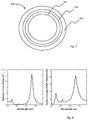
- a typical SERS nanotag may be fabricated as the three-component nanoscale particle 200 illustrated in Figure 2 .
- the first component is a generally spherical SERS-enhancing metal core 202.
- the core may be, but is not limited to, a solid gold (Au) sphere of about 90 nm diameter, but other metals, shapes and sizes are possible.
- the role of the core 202 is to couple electromagnetically to incident laser radiation and create a locally amplified electromagnetic field that leads to 10 2 - to 10 9 -fold increases in Raman scattering intensity.
- the second component is a SES active "reporter," 204, a molecule or other spectroscopically active material in close proximity (and ideally adsorbed) to the core surface.
- the output in a SERS experiment is the fingerprint-like vibrational spectrum of the reporter, the intensity of which is proportional to polarizability.
- the third component of a conventional short-wavelength tag is an encapsulant 206.
- the encapsulant is SiO 2 , a polymer, or other suitable material.
- the primary roles of the encapsulant 206 are to prevent the reporter 204 from diffusing away the core surface, and to prevent other species (that could generate confounding fingerprints) from reaching the surface.
- known SERS nanotags are excited using laser light in the red or near infrared portions of the spectrum.
- Raman lasers emitting at 633 nm, 785 nm or 1064 nm are commercially available and suitable for use with conventional SERS active particles. As illustrated in Fig. 1 , these wavelengths are not eye-safe. As defined herein, any excitation wavelength of less than 1400 nm is not "eye-safe.” Wavelengths of greater than 1400 nm are defined as eye-safe. In particular, commercially available lasers emitting at 1432 nm and about 1550 nm are defined as eye-safe.
- SERS nanotags as described in the US Patents No. 6,514,767 , No. 6,861,263 , No. 7,443,489 are not suitable for use with an eye-safe laser source of reasonable power because Raman scattering efficiency using the core configurations and reporter types disclosed therein are dramatically reduced at longer, eye-safe, wavelengths.
- many taggant embodiments require tags or particles that may be suspended for a selected period of time, or indefinitely, in a liquid matrix. Eye-safe excitation favors larger particles, while suitability for long-term suspended dispersal in a liquid matrix favors smaller particles. Accordingly, the design of a suspendable, SERS tag that can be used at eye-safe wavelengths is particularly problematic.
- SERS taggants useful at eye-safe excitation wavelengths for example about 1432 nm and about 1550 nm cannot be underestimated. There is currently no literature describing SERS at such wavelengths.
- the bulk of any type of SES enhancement comes from electromagnetic resonances due to the localized surface plasmon of the metal surface.
- the surface plasmon of individual particles is located near 400 and 530 nm, respectively.
- the plasmon may be shifted further into the red and infrared.
- Spherical Au does not support significant plasmon resonances at 1550 nm, even when heavily aggregated.
- An alternative embodiment of particle that may be efficiently excited at eye-safe wavelengths incorporates novel reporter molecules either with a conventional spherical core, or with an anisotropic core. It is important to note that the goal of a SES active particle or taggant that may be excited at eyesafe wavelengths may be achieved with a novel core configuration, a novel reporter or a combination of these techniques.
- Hollow particles may be prepared which feature cores of reduced mass while retaining most of the optical properties of larger cores.
- a hollow metal rod is expected to have a plasmon resonance in the Near-IR.
- Au nanotubes have been synthesized by galvanic replacement starting with Ag rods.
- This particular example shows a shift of the Au plasmon to 750 nm. Constructing nanotubes with Cu should shift the Plasmon band further toward longer wavelengths.
- Gold Nanotubes have also been prepared by fusing of Au nanospheres. Alignment of Cobalt Nanoparticles as Templates, Adam M. Schwartzberg, Tammy Y. Olson, Chad E. Talley, and Jin Z. Zhang J. Phys. Chem. C, 2007, 111 (44), 16080-16082• DOI: 10.1021/jp076034b • Publication Date (Web): 05 October 2007 .
- tubes could be made directly by deposition of a metal, for example AU, Ag or Cu on the interior of a template such as an anodically grown alumina membrane or an array of glass tubes. The membrane would then be dissolved, resulting in a freed metal nanotube.
- a metal for example AU, Ag or Cu
- a template such as an anodically grown alumina membrane or an array of glass tubes. The membrane would then be dissolved, resulting in a freed metal nanotube.
- a protective layer 304 such as silica or another metal oxide can be grown or deposited on the exterior of the structure to provide isolation from the environment.
- an organic molecule or organic coating 306 can be attached to the protective layer 304 to provide improved solubility in non-polar solvents.
- An alternative anisotropic core configuration which may be suitable for eye-safe SERS particles features a core of interlocking nanorings.
- the preparation of interlocked gold rings can be accomplished by the use of an organic catenane template.
- a polymeric catenane may be prepared as shown in Fig. 4 by derivatizing a tetracoordinate metal-ligand complex with an amino polyacrylate polymer, followed by the amidation of the ester groups with excess ethylenediamine, as described in C. O. Dietrich-Buchecker, J.-P. Sauvage, J. P. Kintzinger, Tetrahedron Lett. 1983, 24, 5095 ; C. O.
- the size of the rings can be governed by the molecular weight of the polymer.
- the polyaminated catenane can then be used as the template for the formation of the gold rings.
- Small monofunctionalized gold nanoparticles can be covalently attached to the amino groups of the polymer, forming a string of nanoparticles; D. Qiu, J. G. Worden, J. Trullinger, Q Huo, J. Am. Chem. Soc. 2005, 127, 8008 . Growth of gold around the nanoparticle string would yield interlocked gold rings. Decomplexation from the Cu atom may be done before or after the gold growth.
- galvanic replacement can be used to create hollow Au nanoparticles from Ag nanoparticle templates.
- Au rings 500 can be created from Ag nanoprisms 502.
- Ag nanoprisms are flat Ag nanoparticles that vary in shape from triangles to hexagons to disks.
- Au ions are introduced to the Ag nanoprism solution, the Ag is replaced with Au, creating hollow rings of Au that are shaped like the starting template.
- Hollow spherical particles may be made by following a growth template-shell approach.
- the growth template may be non-metallic (polystyrene, silica, etc.) in which case the shell is added to the exterior by a seeded growth mechanism.
- First small seed colloids (often Au) are attached to the exterior of a silica or polymer bead. Additional Au is then grown resulting in a continuous shell. Because the shell can be prepared with some pores, the growth template particle is then readily removed by dissolving the growth template with the appropriate chemical.
- Tam et al. have prepared relatively large hollow particles with plasmon resonances at 1900 nm.
- a similar growth template-shell approach as described above with respect to spheres can be taken with non-spherical cores.
- One example of this type of particle has a hematite core, a 9.8 nm Au shell and extinction maximum at 1250 nm.
- Nonorice A Hybrid Plasmonic Nanostructure, Hui Wang, Daniel W. Brandl, Fei Le, Peter Nordlander, and Harold J. Halas Nano Lett., 2006, 6 (4), 827-832• DOI: 10.1021/n1060209w • Publication Date (Web): 11 March 2006 .
- a SERS active nanoparticle core having finely tuned plasmon characteristics may thus be comprised of multiple shells.
- the SERS enhancing core may include both the metal being used for plasmonics, as well as layers (such as dielectrics) that may be used as spacers to create well-defined gaps between metal layers.
- a SERS enhancing core 700 comprised of multiple metal shells 702, 704 should provide additional SERS enhancement and the ability to tune the plasmon resonance to the infrared.
- the electromagnetic field experienced between the metallic layers should be similar to that found in the junctions between two adjacent particles, as the optical response of both systems is driven by the interaction of two distinct plasmons. By controlling the thickness and composition of each layer, precise tuning of the optical response should be possible.
- the inner shell could consist of any of the hollow core-shell particles described above.
- a reporter-doped dielectric layer 706, such as silica or a polymer, could then be grown over this particle.
- a reporter molecule such as an aromatic thiol can be bound to the shell, and then a silica layer can be grown over it through the Stöber process.
- the dielectric layer 606 would then be modified for the growth of the outer shell.
- a silica dielectric layer the same process as described above for a single shell particle can be used.
- Au seed particles can be bound to the polymer electrostatically as described by Sanles-Sobrido, et al., JACS. 2009, 131, 2699-2705 , which would then be used for subsequent seed-mediated growth of the metallic shell.
- Layer thickness has a greater impact on optical behavior for multi-shell particles than for solid metals. This is demonstrated by the extinction profiles of Au shells over hematite cores, which are observed to be red-shifted approximately 200 nm as Au shells increase from 9.3 to 27.5 nm. Using existing methods, the thinnest gold shells will be partially defined by the size and density of Au nanoparticle 'primer' coatings, and are likely to be almost 10 nm. However, thicker shells may be etched to define a relatively thin final construct. An etchant such as KCN may be used in conjunction with real-time monitoring of the extinction profile, and quenched at the desired endpoint.
- KCN etchant
- inorganic or polymer shells or layers may be used to control the gap between two metal shells.
- chemically resistant SiO 2 shells that are just 2-3 nm in thickness have been fabricated over a metal core.
- Deposition of another metal layer over these shells will both push the plasmon response further into the NIR, and create a well-defined gap between the two metals, similar to the creation of nanoparticle aggregates.
- Raman reporter By embedding a Raman reporter within this layer, a major increase in electromagnetic enhancement is expected.
- Dielectric spacer thickness has even more impact on the plasmon response of the overall enhancing core, so ideally the dielectric layers will be grown and etched with 1 nm precision.
- Likely candidates for dielectric spacer development are layers of polymer with alternating charge.
- Such layer-by-layer (LBL) deposition strategies should allow for sub-nanometer control of shell thickness
- a major advantage of core-shell nanoparticles is that the growth template may be selectively removed.
- SiO 2 growth-template cores can be removed with HF etching, and the subsequent void replaced with reporter molecule or other lower density materials to enhance the ability of these particles to remain suspended in a liquid matrix.
- Use of mixed Au/Ag shells (or other alloys) also allows the preparation of perforated shells by selective Ag etching, facilitating template removal/replacement.
- the formation of Au nanoparticles has been demonstrated on the inner surface of an otherwise hollow silica shell, which may be followed by insertion of Raman-active materials. It is possible to expand on this method, and allow large excesses of reporter to diffuse within the shell, followed by further metal growth to seal the reporter inside.
- the possible addition of another SES enhancing metal core inside this construct could further enhance SERS response at eye-safe wavelengths.
- the overall performance of a SES active particle may be affected by controlling the aggregation, or assembly of isotropic or anisotropic particles. For example, dramatic differences have been shown in the extinction profiles between gold nanorods that are aligned end-to-end versus side-by-side.
- Au and Ag are the predominantly discussed metals for SES active particle cores.
- Au and Ag have traditionally received the most attention because the plasmon response of these materials matches well with standard red excitation wavelengths and these materials are reasonably stable.
- Alternative materials such as Cu, should possess excellent plasmonic properties for excitation at longer, eye-safe wavelengths, but CU is very prone to oxidation.
- SES enhancing materials exist which may be used to anisotropic enhancing cores, including but not limited to Pd, Pt, Co and similar metals. These alternative core materials might possess interesting extinction profiles in the NIR, or be useful templates for additional coatings.
- the suitability of a SES active particle for effective excitation at eyesafe wavelengths may also be determined by the SES active reporter chosen, or a combination of the reporter and enhancing core configuration.
- resonant reporters suitable for particles that may be excited at eye-safe wavelengths may be based on transition metal complexes, where three types of reporter-centered resonance are possible at about 1550 nm.
- transition octahedral metal d 8 complexes e.g. Ni 2+ salts
- metal-to-ligand-charge transfer (MLCT) optical transitions or the converse LMCT transitions, where in both cases electron density is partly delocalized between metal and ligand molecular orbitals, are also known in transition metal chemistry (an example of the former being [Ru(bpy) 3 ] 2+ ). These transitions involve orbitals of Indeed (M) and ungerade (L) symmetry and are therefore allowed, and can have ⁇ values in the 5,000-50,000 M -1 cm -1 range. In transition metal complexes, these transitions are typically in the visible range of wavelengths. MLCT or LMCT transitions between reporters and enhancing cores may be found near 1550 nm.
- Figs. 9A, 9B and 9C show the SERS spectra of 4,4'azopyridine (AZP) and 1,2-bis(4-pyridyl)ethylene (BPE) SERS nanotags at 3 different excitation wavelengths: 785 nm, 1064 nm and 1546 nm. Both types of SERS nanotags have 90 nm gold cores.
- AZP and BPE have very similar molecular structure, as shown below, including the same size of conjugated path and same binding groups to metal.
- the obvious difference between the two reporter molecules is the nature of the group bridging the aromatic rings, which results in different energy levels of their HOMO and LUMO orbitals, as it is demonstrated by the different color of these compounds.
- the unusually high enhancement for AZP tags at longer wavelengths as shown by comparing the scattering intensity graphed in Fig 9A , corresponding to 785 nm excitation and 9B, corresponding to 1064 nm excitation with 9C corresponding to 1546 nm excitation may be due to the metal-to-ligand or ligand-to-metal charge transfer between AZP and the metal, made possible by its characteristic molecular orbital energies.
- aromatic azo type compounds that may be equally efficient as reporter molecules at eyesafe wavelengths include but are not limited to 4,4'-diethynylazobenzene, 4-(4-quinolylazo)pyridine, 4-(4-ethynylphenylazo)pyridine, 5-(4-pyridylazo)imidazole, 3-(4-pyridylazo)thiophene, 5-(4-pyridylazo)thiazole and similar compounds.
- a third interesting transition metal complex includes mixed-valence or intervalence transfer (IT) complexes, which exhibit very intense, broad absorbances in the near-IR/IR region of the spectrum. These absorbances result from electrons being shared across two or more metals brigded by an organic ligand like -CN or pyrazine. This smearing of electron density leads to high polarizabilty, a key factor for Raman emission.
- Simple examples of mixed-valence compounds include the classic Creutz-Taube ion, for which a resonance Raman spectrum in solution using 1320 nm excitation has been published and the even simpler Prussian Blue.
- a series of mixed-valence transition metal compounds with intense IT bands in the near IR may be suitable for reporters in SES tags useful at eyesafe wavelengths.
- These include complexes containing 2-6 Ru, Os, or Fe metal ions, with ligands chosen so that they will adsorb to the enhancing metal core surfaces.
- This molecule has an ⁇ at ⁇ max (1280 nm) of 4600 M -1 cm -1 that clearly extends out beyond 1500 nm, and has four free carboxylates that can be used to anchor it to metal surfaces.
- a series of mixed-valent, olefin-linked ferrocenes that exhibit ⁇ at ⁇ max between 1500 and 1800 nm of approximately 2000 M -1 cm -1 , introducing -SH or -NH 2 groups to induce binding to an enhancing metal core may also be made.
- mixed-valence complexes of the general structure shown below are described in ( Angew. Chem. Int. Ed.
- BL is a conjugated bridge ligand that includes pyrazine, 4,4'bipyridyl, 1,2-bis(4-pyridyl)ethylene, 1,4-bis(4-pyridyl)benzene, 1,4-Bis-[(4-pyridyl)ethenyl]benzene, acetylene, diacetylene, triacetylene, tetracetylene, 1,2-diethynylbenzene, 4,4'-diethynyl-biphenyl, 4,4"diethynyl-p-terphenyl, 4-ethynylpyridine, 4-(4-ethynylphenyl)pyridine, 1-(4-pyridyl)-2-(4-ethyn
- L n are mono- or multi-dentate ligands that complete the coordination sphere of the metal and contain functional groups that may bind to the metal core, including 2,2'-dipyridyl, 2,2'-bipyridine-4,4'-dicarboxylic acid, 2,2':6',2"-terpyridine, 1,10-phenanthrolin-5-amine, and similar compounds.
- SERS tags that may be excited at relatively long, eyesafe wavelengths are useful since the laser devices used to detect such tags are exceptionally safe.
- instrumentation can range in complexity from handheld apparatus, for example night vision binoculars, to more elaborate instrumentation that is mounted in a stationary position or even on a moving vehicle for many uses, including but not limited to night-time battle. In all cases, these instruments use near-IR detection in the form of a heat differential between objects or locations.
- the particles described herein that emit SERS signatures at longer infrared wavelengths may be detected by instruments for SERS-based night vision or hybrid instruments that detect both heat and SERS signatures.
- An alternative embodiment includes a method of manufacturing a particle as described above which particle produces a measurable SES spectrum when excited by incident light having a wavelength of at least 1400 nm.
- An alternative embodiment includes a detection system comprising a particle as described above and a detector having an illumination source providing illumination at a wavelength of at least 1400 nm.
- An alternative embodiment includes a method of tagging a material comprising providing a particle as described above which has a measurable SES spectrum when excited by incident light having a wavelength of at least 1400 nm and associating the particle with a material of interest.
- a particle as described above which has a measurable SES spectrum when excited by incident light having a wavelength of at least 1400 nm and associating the particle with a material of interest.
- the tracked object can be made of solid, liquid, or gas phase material or any combination of phases.
- the material can be a discrete solid object, such as a container, pill, or piece of jewelry, or a continuous or granular material, such as paint, ink, fuel, or extended piece of, e.g., textile, paper, or plastic, in which case the particles are typically distributed throughout the material.
- Examples of specific materials or objects that can be tagged with the eye-safe particles disclosed herein, or into which the particles can be incorporated include, but are not limited to:
- the eye-safe particles disclosed herein can be associated with the material in any way that maintains their association, at least until the particles are read.
- the particles can be incorporated during production or associated with a finished product. Because they are so small, the particles are unlikely to have a detrimental effect on either the manufacturing process or the finished product.
- the particles can be associated with or attached to the material via any chemical or physical means that does not inherently interfere with particle functionality.
- particles can be mixed with and distributed throughout a liquid-based substance such as paint, oil, or ink and then applied to a surface. They can be wound within fibers of a textile, paper, or other fibrous or woven product, or trapped between layers of a multi-layer label.
- the particles can be incorporated during production of a polymeric or slurried material and bound during polymerization or drying of the material. Additionally, the surfaces of the particles can be chemically derivatized with functional groups of any desired characteristic, for covalent or non-covalent attachment to the material.
- the particles can be applied manually by, e.g., a pipette, or automatically by a pipette, spray nozzle, or the like. Particles can be applied in solution in a suitable solvent (e.g., ethanol), which then evaporates.
- a suitable solvent e.g., ethanol
- the particles may be applied to a document or other item in an ink or other marking material.
- Inks include, but are not limited to flexographic ink, lithographic ink, silkscreen ink, gravure ink, bleeding ink, coin reactive ink, erasable ink, pen reactive ink, heat reactive ink, visible infrared ink, optically variable ink, and penetrating ink. photochromic ink, solvent/chemical reactive ink, thermochromic ink, and water fugitive ink.
- a PSP may also be applied in electrophotographic and ink jet printing machines and other systems including offset lithography, letterpress, gravure, heliogravure, xerography, photography, silk-screening systems, systems for imagewise deposition of discrete quantities of a marking material on a substrate surface, such as paint, chemical, and film deposition systems; and systems for integration of colorant materials in an exposed surface of a fibrous substrate, such as textile printing systems.
- tags may be included or utilized along with the disclosed tags for a particular item or documents.
- One such additional security feature may be a separate security ink, such as bleeding ink, coin reactive ink, erasable ink, pen reactive ink, heat reactive ink, visible infrared ink, optically variable ink, penetrating ink. photochromic ink, solvent/chemical reactive ink, thermochromic ink or water fugitive ink.
- the tags may be applied as part of the ink, or in a separate step.
- non-ink based security features which may be utilized in addition to the disclosed tags for document or item marking include the use of an ascending serial number (horizontal and/or vertical format), bar code and numerals, colored fibers, embedded security thread, face-back optical registration design (transparent register), foil imprints, holograms, latent impressions, micro printing, optical variable devices (OVD), planchettes, raised marks, segmented security threads, and watermarks.
- the disclosed particles may be applied by coating an image, including but not limited to a hologram image, made with toner or ink compositions known in the art, as with an overcoat varnish, or a starch overcoat.
- an image including but not limited to a hologram image, made with toner or ink compositions known in the art, as with an overcoat varnish, or a starch overcoat.
- the particles may be applied to additional feature, such as the thread or the foil.
- Single tags may be considered to represent a bit of data that may be changeable according to the methods described herein.
- groups of distinguishable eye-safe particles disclosed herein may be applied to constitute an "alphabet" and combined as words or encoded information, which may be selectively variable, or variable over time.
- the excitation source and detector can be physically remote from the object being verified.
- a suitable waveguide e.g., optical fiber
- the disclosed particles can be used in locations in which it is difficult to place conventional light sources or detectors.
- the nature of Raman scattering and laser-based monochromatic excitation is such that it is not necessary to place the excitation source in close proximity to the Raman-active species.
- the eye-safe particles disclosed herein are amenable for use with all known forms of Raman spectrometers, including some more recent implementations, including spatially offset Raman, Raman absorption spectrometers, instruments to measure Raman optical activity, and so forth provided these devices are configured to emit light at a suitably long wavelength.
- eye-safe particles Another characteristic of eye-safe particles is that the measurement of their spectra does not need to be strictly confined to "line of sight" detection, as with, e.g., fluorescent tags. Thus their spectrum can be acquired without removing the particles from the tagged object, provided that the material is partially transparent to both the excitation wavelength and the Raman photon. For example, water has negligible Raman activity and does not absorb visible radiation, allowing the particles disclosed herein in water to be detected.
- the eye-safe particles can also be detected when embedded in, e.g., clear plastic, paper, or certain inks.
- the disclosed particles also allow for quantitative verification, because the signal intensity is an approximately linear function of the number of analyte molecules.
- the measured signal intensity reflects the number or density of particles. If the particles are added at a known concentration, the measured signal intensity can be used to detect undesired dilution of liquid or granular materials.
Landscapes
- Health & Medical Sciences (AREA)
- Immunology (AREA)
- Life Sciences & Earth Sciences (AREA)
- Engineering & Computer Science (AREA)
- Molecular Biology (AREA)
- Biomedical Technology (AREA)
- Chemical & Material Sciences (AREA)
- Hematology (AREA)
- Urology & Nephrology (AREA)
- Biotechnology (AREA)
- Microbiology (AREA)
- Cell Biology (AREA)
- Food Science & Technology (AREA)
- Medicinal Chemistry (AREA)
- Physics & Mathematics (AREA)
- Analytical Chemistry (AREA)
- Biochemistry (AREA)
- General Health & Medical Sciences (AREA)
- General Physics & Mathematics (AREA)
- Pathology (AREA)
- Investigating, Analyzing Materials By Fluorescence Or Luminescence (AREA)
Claims (8)
- Particule comprenant :un coeur actif en spectroscopie exaltée de surface (SES) qui comprend une tige creuse ; etune molécule rapportrice active en SES associée audit coeur actif en SES, ladite molécule rapportrice active en SES comprenant au moins un composé parmi la 4,4'-azopyridine, le 4,4'-diéthynylazobenzène, la 4-(4-quinolylazo)pyridine, la 4-(4-éthynylphénylazo)pyridine, le 5-(4-pyridylazo)imidazole, le 3-(4-pyridylazo)-thiophène, et le 5-(4-pyridylazo)thiazole ;ladite particule ayant un spectre de SES mesurable quand elle est excitée par une lumière incidente ayant une longueur d'onde d'au moins 1400 nm.
- Particule de la revendication 1 dans laquelle le coeur actif en SES comprend une tige creuse de Cu.
- Particule de la revendication 1 comprenant en outre un revêtement organique entourant la particule.
- Procédé de marquage d'un matériau comprenant :l'obtention d'une particule selon l'une quelconque des revendications 1 à 3 ; etl'association de la particule avec un matériau d'intérêt.
- Procédé de marquage d'un matériau de la revendication 4, comprenant en outre l'obtention d'un spectre de SES à partir de la particule en association avec le matériau d'intérêt à l'aide d'une source de lumière émettant une lumière ayant une longueur d'onde d'au moins 1400 nm.
- Système de détection comprenant :une particule selon l'une quelconque des revendications 1 à 3 ; etun détecteur comprenant une source d'éclairage fournissant un éclairage ayant une longueur d'onde d'au moins 1400 nm.
- Procédé de fabrication d'une particule selon l'une quelconque des revendications 1 à 3 comprenant :l'obtention d'un coeur métallique actif en spectroscopie exaltée de surface (SES) qui comprend une tige creuse, etl'association d'un rapporteur actif en SES qui comprend au moins un composé parmi la 4,4'-azopyridine, le 4,4'-diéthynylazobenzène, la 4-(4-quinolylazo)pyridine, la 4-(4-éthynylphénylazo)pyridine, le 5-(4-pyridylazo)-imidazole, le 3-(4-pyridylazo)thiophène et le 5-(4-pyridylazo)thiazole avec ledit coeur métallique actif en SES,ladite particule ayant un spectre de SES mesurable quand elle est excitée par une lumière incidente.ayant une longueur d'onde d'au moins 1400 nm.
- Procédé de fabrication d'une particule de la revendication 7 dans lequel la particule peut être mise en suspension dans un solvant liquide, et/ou comprenant en outre l'entourage de l'encapsulant avec un revêtement organique.
Applications Claiming Priority (3)
| Application Number | Priority Date | Filing Date | Title |
|---|---|---|---|
| US17928109P | 2009-05-18 | 2009-05-18 | |
| US18159809P | 2009-05-27 | 2009-05-27 | |
| PCT/US2010/035300 WO2010135354A1 (fr) | 2009-05-18 | 2010-05-18 | Particules et procédés pour sers à longueur d'onde longue |
Publications (3)
| Publication Number | Publication Date |
|---|---|
| EP2433131A1 EP2433131A1 (fr) | 2012-03-28 |
| EP2433131A4 EP2433131A4 (fr) | 2014-12-31 |
| EP2433131B1 true EP2433131B1 (fr) | 2016-07-06 |
Family
ID=43126474
Family Applications (2)
| Application Number | Title | Priority Date | Filing Date |
|---|---|---|---|
| EP10778272.4A Withdrawn EP2433121A4 (fr) | 2009-05-18 | 2010-05-18 | Etiquettes sers thermiquement stables |
| EP10778274.0A Active EP2433131B1 (fr) | 2009-05-18 | 2010-05-18 | Particules pour SERS à longueur d'onde longue, procédée de fabrication et procédée de marquage d'un matériau |
Family Applications Before (1)
| Application Number | Title | Priority Date | Filing Date |
|---|---|---|---|
| EP10778272.4A Withdrawn EP2433121A4 (fr) | 2009-05-18 | 2010-05-18 | Etiquettes sers thermiquement stables |
Country Status (9)
| Country | Link |
|---|---|
| US (2) | US9239327B2 (fr) |
| EP (2) | EP2433121A4 (fr) |
| CN (1) | CN102803966A (fr) |
| DK (1) | DK2433131T3 (fr) |
| ES (1) | ES2596218T3 (fr) |
| HU (1) | HUE031119T2 (fr) |
| PL (1) | PL2433131T3 (fr) |
| PT (1) | PT2433131T (fr) |
| WO (2) | WO2010135354A1 (fr) |
Families Citing this family (52)
| Publication number | Priority date | Publication date | Assignee | Title |
|---|---|---|---|---|
| US8873038B2 (en) * | 2010-10-27 | 2014-10-28 | The Board Of Trustees Of The University Of Illinois | Tailored raman spectrocopic probes for ultrasensitive and highly multiplexed assays |
| AR086842A1 (es) | 2011-06-02 | 2014-01-29 | Fab Nac Moneda Y Timbre Es | Uso de marcadores raman para autentificacion de documentos de seguridad |
| US9267889B1 (en) * | 2011-10-12 | 2016-02-23 | Stc.Unm | High efficiency light absorbing and light emitting nanostructures |
| US9057712B1 (en) | 2011-10-27 | 2015-06-16 | Copilot Ventures Fund Iii Llc | Methods of delivery of encapsulated perfluorocarbon taggants |
| US8840029B2 (en) * | 2012-01-18 | 2014-09-23 | Spectra Systems Corporation | Multi wavelength excitation/emission authentication and detection scheme |
| DE102013016134A1 (de) | 2013-09-27 | 2015-04-02 | Giesecke & Devrient Gmbh | Wertdokument und Verfahren zur Überprüfung des Vorliegens desselben |
| DE102013016121A1 (de) | 2013-09-27 | 2015-04-02 | Giesecke & Devrient Gmbh | Wertdokument und Verfahren zur Überprüfung des Vorliegens desselben |
| FR3018474B1 (fr) | 2014-03-13 | 2019-05-10 | Oberthur Fiduciaire Sas | Document de securite et particules synthetiques |
| WO2015171561A1 (fr) | 2014-05-05 | 2015-11-12 | The Regents Of The University Of California | Détermination de la connectivité d'un réservoir de fluide à l'aide de sondes à nanofils |
| GB201418483D0 (en) * | 2014-10-17 | 2014-12-03 | Johnson Matthey Plc | Analytical method and composition |
| CN104458698B (zh) * | 2014-12-09 | 2017-03-29 | 山东大学 | 一种固相微萃取与表面增强拉曼联用检测有机污染物的方法 |
| CN105181673B (zh) * | 2015-09-25 | 2018-11-09 | 潍坊医学院 | 一种丙硫醇的检测方法 |
| CN105482803B (zh) * | 2015-11-26 | 2017-10-03 | 东南大学 | 一种荧光‑sers双模式超分辨成像探针及其制备方法和使用方法 |
| US11471940B2 (en) * | 2016-12-01 | 2022-10-18 | The Regents Of The University Of California | Methods of producing cobalt nanoparticles and hollow gold nanospheres and kits for practicing same |
| US20180171782A1 (en) * | 2016-12-15 | 2018-06-21 | Saudi Arabian Oil Company | Detecting a multi-modal tracer in a hydrocarbon reservoir |
| US12109620B2 (en) * | 2018-01-10 | 2024-10-08 | Seoul National University R&Db Foundation | Plasmonic nanoparticles with intra-nanogap produced by dealloying, method for preparing the same and use thereof |
| KR102582064B1 (ko) * | 2018-07-11 | 2023-09-25 | 한국과학기술연구원 | 근적외선 흡수 염료 함유 나노입자, 이의 제조방법, 및 이의 용도 |
| US10808529B2 (en) | 2018-10-15 | 2020-10-20 | Saudi Arabian Oil Company | Surface logging wells using depth-tagging of cuttings |
| KR102764096B1 (ko) * | 2018-12-20 | 2025-02-05 | 현대자동차주식회사 | 탄소 담지체가 없는 연료전지용 촉매의 제조방법 |
| EP3685864A1 (fr) | 2019-01-22 | 2020-07-29 | Fabrica Nacional De Moneda Y Timbre - Real Casa De La Moneda | Utilisation de particules à base de feldspath comme marqueur de sécurité |
| WO2020171010A1 (fr) * | 2019-02-20 | 2020-08-27 | 隆夫 福岡 | Procédé pour la représentation d'information numérique |
| CA3133682A1 (fr) | 2019-03-15 | 2020-09-24 | Saudi Arabian Oil Company | Synthese en masse de nanomateriaux janus |
| EP4335544A3 (fr) | 2019-05-29 | 2024-06-12 | Saudi Arabian Oil Company | Synthèse d'écoulement de nanoparticules polymères |
| US11566165B2 (en) | 2019-05-30 | 2023-01-31 | Saudi Arabian Oil Company | Polymers and nanoparticles for flooding |
| WO2021011755A1 (fr) | 2019-07-16 | 2021-01-21 | Saudi Arabian Oil Company | Dispositifs microfluidiques polyvalents pour analyse chimique optique rapide sur site |
| US11549922B2 (en) | 2019-07-24 | 2023-01-10 | Saudi Arabian Oil Company | Tracer analysis |
| US11248455B2 (en) | 2020-04-02 | 2022-02-15 | Saudi Arabian Oil Company | Acoustic geosteering in directional drilling |
| EP4158144A1 (fr) | 2020-05-26 | 2023-04-05 | Saudi Arabian Oil Company | Guidage géologique dans un forage directionnel |
| WO2021240195A1 (fr) | 2020-05-26 | 2021-12-02 | Saudi Arabian Oil Company | Mandrin instrumenté pour forage à tube spiralé |
| US12000277B2 (en) | 2020-05-26 | 2024-06-04 | Saudi Arabian Oil Company | Water detection for geosteering in directional drilling |
| US11422285B2 (en) | 2020-06-17 | 2022-08-23 | Saudi Arabian Oil Company | Nanofluidic chips as micromodels for carbonate reservoirs |
| US11427742B2 (en) | 2020-08-24 | 2022-08-30 | Saudi Arabian Oil Company | Fluorescent dye loaded polymeric taggants for depth determination in drilling wells |
| US11773715B2 (en) * | 2020-09-03 | 2023-10-03 | Saudi Arabian Oil Company | Injecting multiple tracer tag fluids into a wellbore |
| US11660595B2 (en) | 2021-01-04 | 2023-05-30 | Saudi Arabian Oil Company | Microfluidic chip with multiple porosity regions for reservoir modeling |
| US11534759B2 (en) | 2021-01-22 | 2022-12-27 | Saudi Arabian Oil Company | Microfluidic chip with mixed porosities for reservoir modeling |
| EP4314485A1 (fr) | 2021-04-01 | 2024-02-07 | Saudi Arabian Oil Company | Systèmes de commande et procédés d'identification de déblais de forage |
| EP4067102A1 (fr) | 2021-04-02 | 2022-10-05 | Kaunas University of Technology | Dispositif optique doté de réseaux de diffuseurs ordonnés pour une identité sécurisée et son procédé de fabrication |
| US12110448B2 (en) | 2021-11-09 | 2024-10-08 | Saudi Arabian Oil Company | Multifunctional fluorescent tags for subterranean applications |
| US11796517B2 (en) | 2021-11-09 | 2023-10-24 | Saudi Arabian Oil Company | Multifunctional magnetic tags for mud logging |
| US12140582B2 (en) | 2021-11-09 | 2024-11-12 | Saudi Arabian Oil Company | Multifunctional polysaccharide-based mud logging barcode tracers |
| US12440821B2 (en) | 2021-12-13 | 2025-10-14 | Saudi Arabian Oil Company | Method for tracing subterranean formations with oil-soluble organic molecular tracers and extracting them of from oil phases |
| US11999855B2 (en) | 2021-12-13 | 2024-06-04 | Saudi Arabian Oil Company | Fluorescent dye molecules having hydrophilicity and hydrophobicity for tracer applications |
| US11725139B2 (en) | 2021-12-13 | 2023-08-15 | Saudi Arabian Oil Company | Manipulating hydrophilicity of conventional dye molecules for water tracer applications |
| US12253467B2 (en) | 2021-12-13 | 2025-03-18 | Saudi Arabian Oil Company | Determining partition coefficients of tracer analytes |
| US12000278B2 (en) | 2021-12-16 | 2024-06-04 | Saudi Arabian Oil Company | Determining oil and water production rates in multiple production zones from a single production well |
| US12188350B2 (en) | 2022-06-08 | 2025-01-07 | Saudi Arabian Oil Company | Fluorescent dye oil tracer compositions |
| AR130228A1 (es) | 2022-08-23 | 2024-11-20 | Sicpa Holding Sa | Composición de tinta de seguridad y característica de seguridad legible por máquina derivada de la misma |
| US11846179B1 (en) | 2022-09-21 | 2023-12-19 | Saudi Arabian Oil Company | Covalent organic frameworks as tracers for fluorescent upstream imaging |
| AU2024338248A1 (en) * | 2023-09-06 | 2026-04-16 | Sicpa Holding Sa | Uv-vis curable security inks comprising tags and security features obtained thereof |
| AU2024338310A1 (en) * | 2023-09-06 | 2026-04-16 | Sicpa Holding Sa | Uv-vis curable security inks comprising tags and security features obtained thereof |
| US11987596B1 (en) | 2024-01-02 | 2024-05-21 | King Faisal University | Polyelectrochromism of electronically weakly coupled 4,4′-divinylazoarylene-bridged two Ru(CO)Cl(PiPr3)2 entities |
| CN117969487A (zh) * | 2024-01-29 | 2024-05-03 | 福州大学 | 一种浮选过程中矿物颗粒表面化学性质在线检测方法 |
Family Cites Families (27)
| Publication number | Priority date | Publication date | Assignee | Title |
|---|---|---|---|---|
| GB9609793D0 (en) * | 1996-05-10 | 1996-07-17 | Ciba Geigy Ag | Pigment compositions |
| US7192778B2 (en) * | 1999-10-06 | 2007-03-20 | Natan Michael J | Surface enhanced spectroscopy-active composite nanoparticles |
| US8497131B2 (en) * | 1999-10-06 | 2013-07-30 | Becton, Dickinson And Company | Surface enhanced spectroscopy-active composite nanoparticles comprising Raman-active reporter molecules |
| JP4786096B2 (ja) | 1999-10-06 | 2011-10-05 | サーロメッド・インコーポレーテッド | 表面増強分光法−活性複合体ナノ粒子 |
| WO2002079764A1 (fr) | 2001-01-26 | 2002-10-10 | Nanoplex Technologies, Inc. | Nanoparticules sandwich a spectrometrie active exaltees de surface |
| US20060040286A1 (en) * | 2001-03-28 | 2006-02-23 | Nanosphere, Inc. | Bio-barcode based detection of target analytes |
| US6970239B2 (en) * | 2002-06-12 | 2005-11-29 | Intel Corporation | Metal coated nanocrystalline silicon as an active surface enhanced Raman spectroscopy (SERS) substrate |
| GB0216197D0 (en) * | 2002-07-12 | 2002-08-21 | Univ Strathclyde | Serrs active particles |
| US7585349B2 (en) * | 2002-12-09 | 2009-09-08 | The University Of Washington | Methods of nanostructure formation and shape selection |
| US20040191921A1 (en) * | 2003-02-21 | 2004-09-30 | Stuart Farquharson | Simultaneous chemical separation and surface-enhanced raman spectral detection |
| CN1444045A (zh) * | 2003-04-15 | 2003-09-24 | 吉林大学 | 表面增强拉曼散射标记免疫检测法 |
| US7101530B2 (en) * | 2003-05-06 | 2006-09-05 | Air Products And Chemicals, Inc. | Hydrogen storage by reversible hydrogenation of pi-conjugated substrates |
| US7588827B2 (en) * | 2003-08-18 | 2009-09-15 | Emory University | Surface enhanced Raman spectroscopy (SERS)-active composite nanoparticles, methods of fabrication thereof, and methods of use thereof |
| US20080241262A1 (en) * | 2004-03-29 | 2008-10-02 | The University Of Houston System | Nanoshells and Discrete Polymer-Coated Nanoshells, Methods For Making and Using Same |
| JP2008501982A (ja) * | 2004-06-07 | 2008-01-24 | ウェイン エー ワイマー | 表面増強ラマン分光(sers)用基板表面の製造方法及びシステム、及びそれを用いた装置 |
| US7485471B1 (en) * | 2004-12-17 | 2009-02-03 | Intel Corporation | Detection of enhanced multiplex signals by surface enhanced Raman spectroscopy |
| US8003408B2 (en) * | 2005-12-29 | 2011-08-23 | Intel Corporation | Modification of metal nanoparticles for improved analyte detection by surface enhanced Raman spectroscopy (SERS) |
| JP2009533673A (ja) * | 2006-04-13 | 2009-09-17 | コーニンクレッカ フィリップス エレクトロニクス エヌ ヴィ | 表面増強共鳴ラマン分光法 |
| US7659977B2 (en) * | 2006-04-21 | 2010-02-09 | Intel Corporation | Apparatus and method for imaging with surface enhanced coherent anti-stokes raman scattering (SECARS) |
| CN101467045A (zh) * | 2006-06-15 | 2009-06-24 | 皇家飞利浦电子股份有限公司 | 通过测定结合和未结合的标记增加分析物检测的专一性 |
| US20080152534A1 (en) * | 2006-12-21 | 2008-06-26 | Jingwu Zhang | Self-assembling raman-active nanoclusters |
| US8540899B2 (en) | 2007-02-07 | 2013-09-24 | Esionic Es, Inc. | Liquid composite compositions using non-volatile liquids and nanoparticles and uses thereof |
| EP2134642B1 (fr) * | 2007-04-02 | 2016-02-24 | Emory University | Marqueurs de nanoparticules de SERS et procédée de détection spectroscopique de tumeurs |
| WO2009020680A2 (fr) * | 2007-05-04 | 2009-02-12 | Stanford University | Imagerie moléculaire d'êtres vivants utilisant la spectroscopie raman et des nanoparticules raman étiquetées |
| ES2535717T3 (es) * | 2007-06-06 | 2015-05-14 | Becton, Dickinson And Company | Colorantes del infrarrojo cercano como indicadores de la dispersión raman potenciada en la superficie |
| EP2040075A1 (fr) * | 2007-09-24 | 2009-03-25 | Julius-Maximilians-Universität Würzburg | Composés et marqueurs pour la diffusion Raman de surface améliorée |
| US10724903B2 (en) * | 2008-05-23 | 2020-07-28 | Nanyang Technological University | Polymer encapsulated particles as surface enhanced Raman scattering probes |
-
2010
- 2010-05-18 EP EP10778272.4A patent/EP2433121A4/fr not_active Withdrawn
- 2010-05-18 HU HUE10778274A patent/HUE031119T2/en unknown
- 2010-05-18 PT PT107782740T patent/PT2433131T/pt unknown
- 2010-05-18 US US13/319,648 patent/US9239327B2/en active Active
- 2010-05-18 ES ES10778274.0T patent/ES2596218T3/es active Active
- 2010-05-18 PL PL10778274T patent/PL2433131T3/pl unknown
- 2010-05-18 CN CN2010800277936A patent/CN102803966A/zh active Pending
- 2010-05-18 DK DK10778274.0T patent/DK2433131T3/en active
- 2010-05-18 WO PCT/US2010/035300 patent/WO2010135354A1/fr not_active Ceased
- 2010-05-18 WO PCT/US2010/035296 patent/WO2010135351A1/fr not_active Ceased
- 2010-05-18 US US13/319,624 patent/US9207234B2/en active Active
- 2010-05-18 EP EP10778274.0A patent/EP2433131B1/fr active Active
Also Published As
| Publication number | Publication date |
|---|---|
| PL2433131T3 (pl) | 2017-01-31 |
| PT2433131T (pt) | 2016-09-09 |
| CN102803966A (zh) | 2012-11-28 |
| EP2433131A4 (fr) | 2014-12-31 |
| US20120057165A1 (en) | 2012-03-08 |
| WO2010135351A1 (fr) | 2010-11-25 |
| EP2433121A1 (fr) | 2012-03-28 |
| ES2596218T3 (es) | 2017-01-05 |
| US9239327B2 (en) | 2016-01-19 |
| US20120062886A1 (en) | 2012-03-15 |
| EP2433121A4 (fr) | 2016-04-13 |
| HUE031119T2 (en) | 2017-06-28 |
| WO2010135354A1 (fr) | 2010-11-25 |
| EP2433131A1 (fr) | 2012-03-28 |
| US9207234B2 (en) | 2015-12-08 |
| DK2433131T3 (en) | 2016-10-24 |
Similar Documents
| Publication | Publication Date | Title |
|---|---|---|
| EP2433131B1 (fr) | Particules pour SERS à longueur d'onde longue, procédée de fabrication et procédée de marquage d'un matériau | |
| CN102906552B (zh) | 波长选择性表面增强拉曼散射纳米标签 | |
| Zhou et al. | Multiplexed SERS barcodes for anti-counterfeiting | |
| Wang et al. | Nanomaterial-based barcodes | |
| WO2010138914A1 (fr) | Particules ou substances actives en spectroscopie sers et leurs utilisations | |
| US7192778B2 (en) | Surface enhanced spectroscopy-active composite nanoparticles | |
| CA2748271C (fr) | Particules programmees de spectroscopie exaltee de surface | |
| Pilot et al. | Surface-enhanced Raman spectroscopy: Principles, substrates, and applications | |
| Rana et al. | A solvatochromic aluminum-1, 8-naphthalimide complex 2D nanostructure as a versatile probe for Sudan III detection and forensic analysis | |
| Chaisrikhwun et al. | Engineering Gap‐Enhanced Raman Tags for High‐Performance Security Inks: A Focus on Raman Tag Density and Stability | |
| Wanga et al. | Nanomaterials-based barcode |
Legal Events
| Date | Code | Title | Description |
|---|---|---|---|
| PUAI | Public reference made under article 153(3) epc to a published international application that has entered the european phase |
Free format text: ORIGINAL CODE: 0009012 |
|
| 17P | Request for examination filed |
Effective date: 20111202 |
|
| AK | Designated contracting states |
Kind code of ref document: A1 Designated state(s): AL AT BE BG CH CY CZ DE DK EE ES FI FR GB GR HR HU IE IS IT LI LT LU LV MC MK MT NL NO PL PT RO SE SI SK SM TR |
|
| DAX | Request for extension of the european patent (deleted) | ||
| RAP1 | Party data changed (applicant data changed or rights of an application transferred) |
Owner name: CABOT SECURITY MATERIALS INC. |
|
| REG | Reference to a national code |
Ref country code: DE Ref legal event code: R079 Ref document number: 602010034527 Country of ref document: DE Free format text: PREVIOUS MAIN CLASS: G01N0033566000 Ipc: G01N0021650000 |
|
| RAP1 | Party data changed (applicant data changed or rights of an application transferred) |
Owner name: SICPA HOLDING SA |
|
| A4 | Supplementary search report drawn up and despatched |
Effective date: 20141128 |
|
| RIC1 | Information provided on ipc code assigned before grant |
Ipc: G01N 33/532 20060101ALI20141124BHEP Ipc: G01N 21/65 20060101AFI20141124BHEP Ipc: G01N 33/28 20060101ALI20141124BHEP |
|
| GRAJ | Information related to disapproval of communication of intention to grant by the applicant or resumption of examination proceedings by the epo deleted |
Free format text: ORIGINAL CODE: EPIDOSDIGR1 |
|
| GRAP | Despatch of communication of intention to grant a patent |
Free format text: ORIGINAL CODE: EPIDOSNIGR1 |
|
| INTG | Intention to grant announced |
Effective date: 20151023 |
|
| INTG | Intention to grant announced |
Effective date: 20160202 |
|
| RIN1 | Information on inventor provided before grant (corrected) |
Inventor name: DOERING, WILLIAM E. Inventor name: PIOTTI, MARCELO EDUARDO Inventor name: FREEMAN, RICHARD GRIFFITH Inventor name: TAM, FELICIA Inventor name: NATAN, MICHAEL J. |
|
| GRAS | Grant fee paid |
Free format text: ORIGINAL CODE: EPIDOSNIGR3 |
|
| GRAA | (expected) grant |
Free format text: ORIGINAL CODE: 0009210 |
|
| RIN1 | Information on inventor provided before grant (corrected) |
Inventor name: TAM, FELICIA Inventor name: NATAN, MICHAEL J. Inventor name: FREEMAN, RICHARD GRIFFITH Inventor name: DOERING, WILLIAM E. Inventor name: PIOTTI, MARCELO EDUARDO |
|
| AK | Designated contracting states |
Kind code of ref document: B1 Designated state(s): AL AT BE BG CH CY CZ DE DK EE ES FI FR GB GR HR HU IE IS IT LI LT LU LV MC MK MT NL NO PL PT RO SE SI SK SM TR |
|
| REG | Reference to a national code |
Ref country code: GB Ref legal event code: FG4D |
|
| REG | Reference to a national code |
Ref country code: AT Ref legal event code: REF Ref document number: 811061 Country of ref document: AT Kind code of ref document: T Effective date: 20160715 Ref country code: CH Ref legal event code: EP |
|
| REG | Reference to a national code |
Ref country code: IE Ref legal event code: FG4D |
|
| REG | Reference to a national code |
Ref country code: DE Ref legal event code: R096 Ref document number: 602010034527 Country of ref document: DE |
|
| REG | Reference to a national code |
Ref country code: PT Ref legal event code: SC4A Ref document number: 2433131 Country of ref document: PT Date of ref document: 20160909 Kind code of ref document: T Free format text: AVAILABILITY OF NATIONAL TRANSLATION Effective date: 20160902 |
|
| REG | Reference to a national code |
Ref country code: NL Ref legal event code: FP |
|
| REG | Reference to a national code |
Ref country code: DK Ref legal event code: T3 Effective date: 20161021 |
|
| REG | Reference to a national code |
Ref country code: SE Ref legal event code: TRGR |
|
| REG | Reference to a national code |
Ref country code: LT Ref legal event code: MG4D |
|
| REG | Reference to a national code |
Ref country code: ES Ref legal event code: FG2A Ref document number: 2596218 Country of ref document: ES Kind code of ref document: T3 Effective date: 20170105 |
|
| PG25 | Lapsed in a contracting state [announced via postgrant information from national office to epo] |
Ref country code: LT Free format text: LAPSE BECAUSE OF FAILURE TO SUBMIT A TRANSLATION OF THE DESCRIPTION OR TO PAY THE FEE WITHIN THE PRESCRIBED TIME-LIMIT Effective date: 20160706 Ref country code: IS Free format text: LAPSE BECAUSE OF FAILURE TO SUBMIT A TRANSLATION OF THE DESCRIPTION OR TO PAY THE FEE WITHIN THE PRESCRIBED TIME-LIMIT Effective date: 20161106 Ref country code: NO Free format text: LAPSE BECAUSE OF FAILURE TO SUBMIT A TRANSLATION OF THE DESCRIPTION OR TO PAY THE FEE WITHIN THE PRESCRIBED TIME-LIMIT Effective date: 20161006 Ref country code: FI Free format text: LAPSE BECAUSE OF FAILURE TO SUBMIT A TRANSLATION OF THE DESCRIPTION OR TO PAY THE FEE WITHIN THE PRESCRIBED TIME-LIMIT Effective date: 20160706 Ref country code: HR Free format text: LAPSE BECAUSE OF FAILURE TO SUBMIT A TRANSLATION OF THE DESCRIPTION OR TO PAY THE FEE WITHIN THE PRESCRIBED TIME-LIMIT Effective date: 20160706 |
|
| REG | Reference to a national code |
Ref country code: RO Ref legal event code: EPE |
|
| PG25 | Lapsed in a contracting state [announced via postgrant information from national office to epo] |
Ref country code: LV Free format text: LAPSE BECAUSE OF FAILURE TO SUBMIT A TRANSLATION OF THE DESCRIPTION OR TO PAY THE FEE WITHIN THE PRESCRIBED TIME-LIMIT Effective date: 20160706 |
|
| REG | Reference to a national code |
Ref country code: GR Ref legal event code: EP Ref document number: 20160402447 Country of ref document: GR Effective date: 20170117 |
|
| REG | Reference to a national code |
Ref country code: DE Ref legal event code: R097 Ref document number: 602010034527 Country of ref document: DE |
|
| REG | Reference to a national code |
Ref country code: FR Ref legal event code: PLFP Year of fee payment: 8 |
|
| PG25 | Lapsed in a contracting state [announced via postgrant information from national office to epo] |
Ref country code: EE Free format text: LAPSE BECAUSE OF FAILURE TO SUBMIT A TRANSLATION OF THE DESCRIPTION OR TO PAY THE FEE WITHIN THE PRESCRIBED TIME-LIMIT Effective date: 20160706 |
|
| PLBE | No opposition filed within time limit |
Free format text: ORIGINAL CODE: 0009261 |
|
| STAA | Information on the status of an ep patent application or granted ep patent |
Free format text: STATUS: NO OPPOSITION FILED WITHIN TIME LIMIT |
|
| PG25 | Lapsed in a contracting state [announced via postgrant information from national office to epo] |
Ref country code: SK Free format text: LAPSE BECAUSE OF FAILURE TO SUBMIT A TRANSLATION OF THE DESCRIPTION OR TO PAY THE FEE WITHIN THE PRESCRIBED TIME-LIMIT Effective date: 20160706 Ref country code: SM Free format text: LAPSE BECAUSE OF FAILURE TO SUBMIT A TRANSLATION OF THE DESCRIPTION OR TO PAY THE FEE WITHIN THE PRESCRIBED TIME-LIMIT Effective date: 20160706 |
|
| 26N | No opposition filed |
Effective date: 20170407 |
|
| REG | Reference to a national code |
Ref country code: HU Ref legal event code: AG4A Ref document number: E031119 Country of ref document: HU |
|
| PGFP | Annual fee paid to national office [announced via postgrant information from national office to epo] |
Ref country code: NL Payment date: 20170421 Year of fee payment: 8 |
|
| PGFP | Annual fee paid to national office [announced via postgrant information from national office to epo] |
Ref country code: IE Payment date: 20170421 Year of fee payment: 8 Ref country code: RO Payment date: 20170503 Year of fee payment: 8 Ref country code: CZ Payment date: 20170425 Year of fee payment: 8 |
|
| PG25 | Lapsed in a contracting state [announced via postgrant information from national office to epo] |
Ref country code: LU Free format text: LAPSE BECAUSE OF NON-PAYMENT OF DUE FEES Effective date: 20170531 Ref country code: SI Free format text: LAPSE BECAUSE OF FAILURE TO SUBMIT A TRANSLATION OF THE DESCRIPTION OR TO PAY THE FEE WITHIN THE PRESCRIBED TIME-LIMIT Effective date: 20160706 |
|
| PGFP | Annual fee paid to national office [announced via postgrant information from national office to epo] |
Ref country code: PT Payment date: 20170502 Year of fee payment: 8 Ref country code: BE Payment date: 20170424 Year of fee payment: 8 |
|
| PGFP | Annual fee paid to national office [announced via postgrant information from national office to epo] |
Ref country code: HU Payment date: 20170516 Year of fee payment: 8 |
|
| PG25 | Lapsed in a contracting state [announced via postgrant information from national office to epo] |
Ref country code: MC Free format text: LAPSE BECAUSE OF FAILURE TO SUBMIT A TRANSLATION OF THE DESCRIPTION OR TO PAY THE FEE WITHIN THE PRESCRIBED TIME-LIMIT Effective date: 20160706 |
|
| PG25 | Lapsed in a contracting state [announced via postgrant information from national office to epo] |
Ref country code: LU Free format text: LAPSE BECAUSE OF NON-PAYMENT OF DUE FEES Effective date: 20170518 |
|
| REG | Reference to a national code |
Ref country code: FR Ref legal event code: PLFP Year of fee payment: 9 |
|
| PGFP | Annual fee paid to national office [announced via postgrant information from national office to epo] |
Ref country code: MT Payment date: 20170522 Year of fee payment: 8 |
|
| PG25 | Lapsed in a contracting state [announced via postgrant information from national office to epo] |
Ref country code: AL Free format text: LAPSE BECAUSE OF FAILURE TO SUBMIT A TRANSLATION OF THE DESCRIPTION OR TO PAY THE FEE WITHIN THE PRESCRIBED TIME-LIMIT Effective date: 20160706 Ref country code: PL Free format text: LAPSE BECAUSE OF NON-PAYMENT OF DUE FEES Effective date: 20170518 |
|
| REG | Reference to a national code |
Ref country code: DK Ref legal event code: EBP Effective date: 20180531 Ref country code: NL Ref legal event code: MM Effective date: 20180601 |
|
| REG | Reference to a national code |
Ref country code: BE Ref legal event code: FP Effective date: 20161005 Ref country code: BE Ref legal event code: MM Effective date: 20180531 |
|
| PG25 | Lapsed in a contracting state [announced via postgrant information from national office to epo] |
Ref country code: PT Free format text: LAPSE BECAUSE OF NON-PAYMENT OF DUE FEES Effective date: 20181119 Ref country code: CZ Free format text: LAPSE BECAUSE OF NON-PAYMENT OF DUE FEES Effective date: 20180518 Ref country code: RO Free format text: LAPSE BECAUSE OF NON-PAYMENT OF DUE FEES Effective date: 20180518 Ref country code: HU Free format text: LAPSE BECAUSE OF NON-PAYMENT OF DUE FEES Effective date: 20180519 |
|
| REG | Reference to a national code |
Ref country code: IE Ref legal event code: MM4A |
|
| PG25 | Lapsed in a contracting state [announced via postgrant information from national office to epo] |
Ref country code: NL Free format text: LAPSE BECAUSE OF NON-PAYMENT OF DUE FEES Effective date: 20180601 Ref country code: IE Free format text: LAPSE BECAUSE OF NON-PAYMENT OF DUE FEES Effective date: 20180518 |
|
| PG25 | Lapsed in a contracting state [announced via postgrant information from national office to epo] |
Ref country code: DK Free format text: LAPSE BECAUSE OF NON-PAYMENT OF DUE FEES Effective date: 20180531 Ref country code: BE Free format text: LAPSE BECAUSE OF NON-PAYMENT OF DUE FEES Effective date: 20180531 |
|
| REG | Reference to a national code |
Ref country code: AT Ref legal event code: UEP Ref document number: 811061 Country of ref document: AT Kind code of ref document: T Effective date: 20160706 |
|
| PG25 | Lapsed in a contracting state [announced via postgrant information from national office to epo] |
Ref country code: BG Free format text: LAPSE BECAUSE OF NON-PAYMENT OF DUE FEES Effective date: 20190430 |
|
| PG25 | Lapsed in a contracting state [announced via postgrant information from national office to epo] |
Ref country code: CY Free format text: LAPSE BECAUSE OF NON-PAYMENT OF DUE FEES Effective date: 20160706 |
|
| PG25 | Lapsed in a contracting state [announced via postgrant information from national office to epo] |
Ref country code: MK Free format text: LAPSE BECAUSE OF FAILURE TO SUBMIT A TRANSLATION OF THE DESCRIPTION OR TO PAY THE FEE WITHIN THE PRESCRIBED TIME-LIMIT Effective date: 20160706 |
|
| PG25 | Lapsed in a contracting state [announced via postgrant information from national office to epo] |
Ref country code: MT Free format text: LAPSE BECAUSE OF NON-PAYMENT OF DUE FEES Effective date: 20180518 |
|
| P01 | Opt-out of the competence of the unified patent court (upc) registered |
Effective date: 20230523 |
|
| PGFP | Annual fee paid to national office [announced via postgrant information from national office to epo] |
Ref country code: DE Payment date: 20250423 Year of fee payment: 16 |
|
| PGFP | Annual fee paid to national office [announced via postgrant information from national office to epo] |
Ref country code: GB Payment date: 20250423 Year of fee payment: 16 Ref country code: ES Payment date: 20250602 Year of fee payment: 16 |
|
| PGFP | Annual fee paid to national office [announced via postgrant information from national office to epo] |
Ref country code: IT Payment date: 20250423 Year of fee payment: 16 |
|
| PGFP | Annual fee paid to national office [announced via postgrant information from national office to epo] |
Ref country code: FR Payment date: 20250423 Year of fee payment: 16 |
|
| PGFP | Annual fee paid to national office [announced via postgrant information from national office to epo] |
Ref country code: GR Payment date: 20250424 Year of fee payment: 16 |
|
| PGFP | Annual fee paid to national office [announced via postgrant information from national office to epo] |
Ref country code: CH Payment date: 20250601 Year of fee payment: 16 |
|
| PGFP | Annual fee paid to national office [announced via postgrant information from national office to epo] |
Ref country code: AT Payment date: 20250424 Year of fee payment: 16 |
|
| PGFP | Annual fee paid to national office [announced via postgrant information from national office to epo] |
Ref country code: TR Payment date: 20250428 Year of fee payment: 16 |
|
| PGFP | Annual fee paid to national office [announced via postgrant information from national office to epo] |
Ref country code: SE Payment date: 20250423 Year of fee payment: 16 |