EP2435525B1 - Compositions adhésives polyoléfiniques - Google Patents
Compositions adhésives polyoléfiniques Download PDFInfo
- Publication number
- EP2435525B1 EP2435525B1 EP09771633.6A EP09771633A EP2435525B1 EP 2435525 B1 EP2435525 B1 EP 2435525B1 EP 09771633 A EP09771633 A EP 09771633A EP 2435525 B1 EP2435525 B1 EP 2435525B1
- Authority
- EP
- European Patent Office
- Prior art keywords
- adhesive
- wax
- mpa
- less
- viscosity
- Prior art date
- Legal status (The legal status is an assumption and is not a legal conclusion. Google has not performed a legal analysis and makes no representation as to the accuracy of the status listed.)
- Not-in-force
Links
Images
Classifications
-
- C—CHEMISTRY; METALLURGY
- C09—DYES; PAINTS; POLISHES; NATURAL RESINS; ADHESIVES; COMPOSITIONS NOT OTHERWISE PROVIDED FOR; APPLICATIONS OF MATERIALS NOT OTHERWISE PROVIDED FOR
- C09J—ADHESIVES; NON-MECHANICAL ASPECTS OF ADHESIVE PROCESSES IN GENERAL; ADHESIVE PROCESSES NOT PROVIDED FOR ELSEWHERE; USE OF MATERIALS AS ADHESIVES
- C09J5/00—Adhesive processes in general; Adhesive processes not provided for elsewhere, e.g. relating to primers
- C09J5/06—Adhesive processes in general; Adhesive processes not provided for elsewhere, e.g. relating to primers involving heating of the applied adhesive
-
- C—CHEMISTRY; METALLURGY
- C09—DYES; PAINTS; POLISHES; NATURAL RESINS; ADHESIVES; COMPOSITIONS NOT OTHERWISE PROVIDED FOR; APPLICATIONS OF MATERIALS NOT OTHERWISE PROVIDED FOR
- C09J—ADHESIVES; NON-MECHANICAL ASPECTS OF ADHESIVE PROCESSES IN GENERAL; ADHESIVE PROCESSES NOT PROVIDED FOR ELSEWHERE; USE OF MATERIALS AS ADHESIVES
- C09J123/00—Adhesives based on homopolymers or copolymers of unsaturated aliphatic hydrocarbons having only one carbon-to-carbon double bond; Adhesives based on derivatives of such polymers
- C09J123/02—Adhesives based on homopolymers or copolymers of unsaturated aliphatic hydrocarbons having only one carbon-to-carbon double bond; Adhesives based on derivatives of such polymers not modified by chemical after-treatment
- C09J123/10—Homopolymers or copolymers of propene
- C09J123/14—Copolymers of propene
- C09J123/142—Copolymers of propene at least partially crystalline copolymers of propene with other olefins
-
- C—CHEMISTRY; METALLURGY
- C08—ORGANIC MACROMOLECULAR COMPOUNDS; THEIR PREPARATION OR CHEMICAL WORKING-UP; COMPOSITIONS BASED THEREON
- C08L—COMPOSITIONS OF MACROMOLECULAR COMPOUNDS
- C08L23/00—Compositions of homopolymers or copolymers of unsaturated aliphatic hydrocarbons having only one carbon-to-carbon double bond; Compositions of derivatives of such polymers
- C08L23/02—Compositions of homopolymers or copolymers of unsaturated aliphatic hydrocarbons having only one carbon-to-carbon double bond; Compositions of derivatives of such polymers not modified by chemical after-treatment
-
- C—CHEMISTRY; METALLURGY
- C08—ORGANIC MACROMOLECULAR COMPOUNDS; THEIR PREPARATION OR CHEMICAL WORKING-UP; COMPOSITIONS BASED THEREON
- C08L—COMPOSITIONS OF MACROMOLECULAR COMPOUNDS
- C08L23/00—Compositions of homopolymers or copolymers of unsaturated aliphatic hydrocarbons having only one carbon-to-carbon double bond; Compositions of derivatives of such polymers
- C08L23/02—Compositions of homopolymers or copolymers of unsaturated aliphatic hydrocarbons having only one carbon-to-carbon double bond; Compositions of derivatives of such polymers not modified by chemical after-treatment
- C08L23/04—Homopolymers or copolymers of ethene
- C08L23/06—Polyethylene
-
- C—CHEMISTRY; METALLURGY
- C08—ORGANIC MACROMOLECULAR COMPOUNDS; THEIR PREPARATION OR CHEMICAL WORKING-UP; COMPOSITIONS BASED THEREON
- C08L—COMPOSITIONS OF MACROMOLECULAR COMPOUNDS
- C08L2666/00—Composition of polymers characterized by a further compound in the blend, being organic macromolecular compounds, natural resins, waxes or and bituminous materials, non-macromolecular organic substances, inorganic substances or characterized by their function in the composition
- C08L2666/02—Organic macromolecular compounds, natural resins, waxes or and bituminous materials
-
- C—CHEMISTRY; METALLURGY
- C08—ORGANIC MACROMOLECULAR COMPOUNDS; THEIR PREPARATION OR CHEMICAL WORKING-UP; COMPOSITIONS BASED THEREON
- C08L—COMPOSITIONS OF MACROMOLECULAR COMPOUNDS
- C08L51/00—Compositions of graft polymers in which the grafted component is obtained by reactions only involving carbon-to-carbon unsaturated bonds; Compositions of derivatives of such polymers
- C08L51/003—Compositions of graft polymers in which the grafted component is obtained by reactions only involving carbon-to-carbon unsaturated bonds; Compositions of derivatives of such polymers grafted on to macromolecular compounds obtained by reactions only involving unsaturated carbon-to-carbon bonds
-
- C—CHEMISTRY; METALLURGY
- C08—ORGANIC MACROMOLECULAR COMPOUNDS; THEIR PREPARATION OR CHEMICAL WORKING-UP; COMPOSITIONS BASED THEREON
- C08L—COMPOSITIONS OF MACROMOLECULAR COMPOUNDS
- C08L51/00—Compositions of graft polymers in which the grafted component is obtained by reactions only involving carbon-to-carbon unsaturated bonds; Compositions of derivatives of such polymers
- C08L51/06—Compositions of graft polymers in which the grafted component is obtained by reactions only involving carbon-to-carbon unsaturated bonds; Compositions of derivatives of such polymers grafted on to homopolymers or copolymers of aliphatic hydrocarbons containing only one carbon-to-carbon double bond
-
- C—CHEMISTRY; METALLURGY
- C08—ORGANIC MACROMOLECULAR COMPOUNDS; THEIR PREPARATION OR CHEMICAL WORKING-UP; COMPOSITIONS BASED THEREON
- C08L—COMPOSITIONS OF MACROMOLECULAR COMPOUNDS
- C08L91/00—Compositions of oils, fats or waxes; Compositions of derivatives thereof
- C08L91/06—Waxes
Definitions
- This invention relates to polyolefin adhesive compositions and articles made therefrom, and more particularly to polyolefin adhesive compositions having a fast set time.
- Hot melt adhesive is a thermoplastic polymer system applied in a molten state.
- the molten adhesives are applied to a substrate and then placed in contact with another substrate.
- the adhesive cools and solidifies to form a bond between the substrates.
- Hot melt adhesives are widely used in the packaging industry, for example, to seal and close cartons or to laminate multilayer papers.
- the HMA should have good adhesion over a wide temperature range, e.g. at low temperatures for packaging applications in the frozen-goods sector, and a low viscosity melt to facilitate application to the substrate, especially for automatic processing.
- a heated reservoir in which it is maintained as a melt for example, typically at 177°C (350°F) in the prior art, for an extended period of time
- the adhesive should have oxidative resistance and good thermal stability, which is also called "pot life.”
- the HMA should have a moderate to long open time, defined as the time span between adhesive application to a first substrate and assembly of the parts to be joined. On the other hand, a fast set time is required to quickly build up bond strength on fast-running packaging machines.
- the characteristic set time is defined as the time needed for the hot melt adhesive to solidify to the point where it possesses enough bond strength to form bonds to give substrate fiber tear when pulled apart, e.g., the bond is sufficiently strong such that sealed substrates will not pop open upon exit from the compression section on a packaging line. The bond may continue to build additional strength upon further cooling; however, compression is no longer required to maintain adhesion between the substrate surfaces.
- the set time is referred to as the duration of the application of adhering pressure, which is generally at least equal to or greater than the characteristic set time of the HMA.
- thermoplastic polymers particularly ethylene-based polymers such as ethylene-vinyl acetate copolymers (EVA) have traditionally been used in HMA, but often the adhesive formulation requires substantial use of low molecular weight ingredients such as wax and tackifier to adjust the viscosity and glass transition temperature to useful ranges.
- EVA formulations are typically exemplified by a wax with either a low molecular weight or a low crystallization temperature.
- An HMA for packaging applications such as case and carton sealing is typically composed of a polymer, a tackifier or diluent, and a wax.
- the polymer has largely influenced the flow and mechanical properties: (a) viscosity and rheology characteristics, (b) cohesive strength, (c) flexibility, and (d) adhesive strength.
- the viscosity of the polymer has typically been a few orders of magnitude higher than the viscosity of the wax.
- Low viscosity wax has been used to reduce the high viscosity of the polymer and resin to ensure efficient mixing. This viscosity reduction is particularly important during the application stage where a low viscosity HMA is required to pump the molten adhesive from the storage tank to the application area and to ensure proper surface wetting when applied.
- packaging adhesives comprise primarily petroleum-derived waxes such as paraffin and microcrystalline wax, and synthesis wax such as Fischer-Tropsch waxes.
- the lower molecular weight of paraffin wax is the primary choice when formulating low application temperature adhesives.
- the waxes used also generally have a crystallization temperature of less than 100°C. Due to high molecular weight of the base polymer, low molecular weight wax is necessary to reduce the viscosity of the HMA to an applicable range. Large amounts of wax are also required for set time control since wax helps control the set time. However, in certain polymers, large amounts of wax can form large segregated domains or migrate onto the bonding surface. The large difference in the molecular weight between the polymer and the wax has contributed to the wax migration.
- HMA attributes required for short set time, good bonding strength, cohesive strength and low viscosity are generally against each other.
- Generally selecting optimum performance is a matter of trading off one property against another, for example, reducing set time decreases adhesion at low temperature. It is challenging to obtain the desired balance among set time, bonding strength and low viscosity.
- Most prior art adhesives are optimized either for good adhesion, while sacrificing set time, or for a fast set time, while sacrificing adhesion at low temperatures.
- hot melt adhesive compositions e.g. packaging grades
- good balance is achieved by selection of specific base polymers and wax blends. Adding polyethylene wax above certain levels to a polyolefin base polymer reduces set times, but at high levels can also cause a dramatic reduction in adhesion, which is sometimes referred to in terms of fiber tear (FT). This deleterious effect on adhesion may be due to surface migration of the wax.
- FT fiber tear
- higher molecular weight waxes can exhibit slower surface migration relative to lower molecular weight analogs and hence better adhesion.
- the set times are longer when the adhesives are formulated with these relatively higher molecular weight waxes.
- Blends of two or more waxes of different molecular weights i.e., one with a relatively low weight average molecular weight (Mw) and another with a relatively high Mw, allow the formulation of adhesives of polyolefin base polymer exhibiting both improved adhesion performance and improved (reduced) set times.
- U.S. discloses a hot melt adhesive composition consisting essentially of: (a) 30-70 wt% of an ethylene copolymer having about 6 to about 30 wt% of a C4 to C20 ⁇ -olefin produced in the presence of a catalyst composition comprising a metallocene and having an Mw of from about 20,000 to about 100,000; and (b) a hydrocarbon tackifier.
- Tse et al, U.S. 5,548,014 claims a hot melt adhesive composition comprising a blend of ethylene/ ⁇ -olefin copolymers wherein the first copolymer has an Mw from about 20,000 to about 39,000 and the second copolymer has a Mw from about 40,000 to about 100,000.
- Each of the hot melt adhesives exemplified comprises a blend of copolymers, contains 45 wt% copolymer, with at least one of the copolymers having a polydispersity greater than 2.5. Furthermore, the lowest density copolymer exemplified has a specific gravity of 0.894 g/cm 3 , and the ARISTOWAX 165 used in the examples has a melting temperature from 68 to 74°C.
- US 2004/0138392 discloses adhesive compositions comprising a copolymer of propylene and 1,9-decadiene copolymer, and a combination of two waxes having different average weight molecular weights.
- EP 0 886 656 discloses a hot melt adhesive comprising (a) from 5 to 95 weight of at least one interpolymer which is homogeneous ethylene/ ⁇ -olefin interpolymer, the ⁇ -olefin being selected from the group consisting of 1-butene, 1-hexene, 4-methyl-1-pentene, 1-pentene, 1-heptene and 1-octene characterized as having a density from 0.850 to 0.885 g/cm 3 , and a molecular weight distribution Mw/Mn from 1.5 to 2.5; (b) from 5 to 95 wt% of at least one tackifier; (c) from 0 to about 90 wt% of at least one plasticizer; and (d) from 0 to 90 wt% of at least one wax.
- EP 0 886 656 also stated that waxes useful in the adhesives of its invention include paraffin waxes, microcrystalline waxes, Fischer-Tropsch, polyethylene and by-products of poly
- composition having utility as an adhesive, especially a hot melt adhesive, comprising at least one polyolefin base polymer and at least two wax components, as further defined in the attached claims.
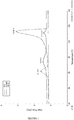
- Figure 1 shows DSC curves for the adhesive composition according to the embodiment of Example HMA3 and also for the neat PP2 propylene/hexene copolymer and PEwax1, indicating the copolymer crystallization temperature is higher in the HMA formulation due to the presence of the wax.
- polymer refers to high molecular weight molecules comprising repeating units, generally having a weight average molecular weight of at least about 5000 g/mol.
- molecular weight refers to the weight average molecular weight in g/mol unless otherwise specified.
- the weight average molecular weight, viscosity and crystallization temperature of the base polymer used herein refer to the weight average molecular weight, viscosity and crystallization temperature of the blend of all base polymer components used in the adhesive or hot melt adhesive (HMA) mixture.
- HMA hot melt adhesive
- a polymer or oligomer when referred to as comprising an olefin, the olefin present in the polymer or oligomer is the polymerized or oligomerized form of the olefin, respectively.
- the use of the term “polymer” is meant to encompass homopolymers and copolymers.
- copolymer is used herein to include any polymer having two or more monomers. That is, in the case of a propylene copolymer, at least one other comonomer is polymerized with the propylene to make the copolymer.
- an adhesive comprising a polyolefin polymer as the base polymer and from 1 to 15 wt% of at least two wax components, wherein the at least two wax components comprise a first and a second wax components having a difference in their respective weight average molecular weights of at least 1000 g/mole, wherein a weight ratio of the first and second wax components is from 10:90 to 90:10, and wherein the adhesive has the following properties: (a) at least 50% fiber tear at 25°C using Inland paper board as a substrate; and (b) a set time of less than 2 seconds.
- the Brookfield viscosity of the first wax component at 190°C is from about 100 mPa•s or less, and the Brookfield viscosity of the second wax component at 190°C is from about 190 mPa•s or more.
- the adhesive also has a viscosity at 177°C of from about 500 to about 2000 mPa•s, or from about 700 to about 1100 mPa•s.
- viscosity values given herein refer to the zero-shear viscosity, i.e., the viscosity at the limit of low shear rate, based upon extrapolation from measurements at 190°C using a BROOKFIELD viscometer or similar instrument at low shear rates, e.g., within the range of about 0.01 to about 10 1/s.
- the adhesive may comprise 2 to 15 wt%, 3 to 15 wt%, 4 to 15 wt%, 5 to 15 wt%, and 6 to 15 wt% of the at least two wax components.
- said adhesive is a hot melt adhesive.
- Hot melt adhesives are adhesives that are typically solid (or exhibit glass like cold flow) at use temperature (such as room temperature, e.g. 23°C) and molten at application temperatures such as 120°C or more (preferably 130°C or more, preferably 140°C or more, preferably 160°C or more).
- the invention is directed to an adhesive composition, as disclosed in U.S. Application No. 12/472,022, filed May 26, 2009 comprising at least about 50 wt% polypropylene and a wax, wherein the polypropylene has an Mw of from 10,000 to 100,000 g/mol and a branching index (g') of (1) from 0.4 to 0.98 measured at the Mz of the polypropylene when the polypropylene has an Mw of 10,000 to 60,000, or (2) from 0.4 to 0.95 measured at the Mz of the polypropylene when the polypropylene has an Mw of 10,000 to 100,000, wherein the adhesive composition has a Dot T-Peel of about 1 Newton or more, and a Dot Set Time of less than about 3 seconds, and wherein the at least two wax components comprise a first and a second wax component wherein Mw wax1 is less than about 4000, for example, from about 450 to 4000 g/mole or from about 500 to 4000 g/mole, and Mw wax2 is above
- the adhesive comprises at least 80 wt% of the polyolefin base polymer (based on the total weight of the adhesive and wherein the polyolefin base polymer weight is exclusive of any functionalized polyolefin and the wax components), and the polyolefin base polymer is a propylene copolymer comprising at least 80 wt% of units derived from propylene and from about 2 to about 15 wt% of units derived from at least one C 4 to C 10 alpha-olefin, wherein the copolymer has an Mw of less than 100,000 g/mol and a heat of fusion between about 10 and about 70 J/g.
- the propylene copolymer comprises about 2 wt% to about 25 wt%, preferably about 2 wt% to about 15 wt%, preferably from 6 wt% to 12 wt%, of units derived from said at least one C 4 to C 10 alpha-olefin.
- said at least one alpha-olefin has 6 to 8 carbon atoms and more preferably comprises hexene-1.
- said copolymer has an Mw of less than 80,000, such as less than 50,000 g/mol.
- said copolymer has an Mw/Mn of between 1.5 and 10, such as between 1.5 and 9 or between 1.8 and 7 or between 1.8 and 4.
- said copolymer has a heat of fusion between about 10 and about 60 J/g, such as between about 20 and about 60 J/g.
- the polyolefin base polymer alternatively or additionally comprises polypropylene having a weight average molecular weight of from 10,000 to 100,000 and a branching index (g') from 0.4 to 0.95 measured at the Mz of the polypropylene.
- the set time is greater than about 1 second, from about 1.5 seconds to about 3 seconds, or from about 1.5 to about 2.5 seconds.
- at least one of the wax components has one or more of the following characteristics: substantially linear; a viscosity greater than about 190 mPa•s at 190°C; a peak melting point greater than about 100°C; a weight average molecular weight equal to or great than about 5000 g/mol; the wax is a polymer; the wax comprises polyethylene, and/or the wax imparts a set time improvement of about 33% or more compared to a reference composition prepared with the same polymer compositions and a SASOL C80 wax.
- Substantially linear is defined as a g'vis of 0.99 or greater.
- the Brookfield viscosity of the first wax component at 190°C is from about 100 mPa•s or less, for example from 60 to 100 mPa•s
- the Brookfield viscosity of the second wax component at 190°C is from about 190 mPa•s or more, for example from 190 to 10,000 mPa•s. Unless otherwise stated all viscosities described herein are Brookfield viscosity determined as described in the Experimental section.
- the weight ratio of the first wax to the second wax is within a range from about 10:90 to about 90:10, from about 25:75 to about 75:25, or from about 40:60 to about 60:40.
- the adhesive comprises a copolymer of propylene with at least one C 4 to C 10 alpha-olefin such as butene-1, hexene-1, and octane-1, wherein the copolymer has a molecular weight of less than 100,000 g/mol and a heat of fusion between about 10 and about 70 J/g.
- the mixture when used as an adhesive, and in particular as a hot melt adhesive, the mixture in one embodiment exhibits a novel and advantageous combination of properties including at least 5% fiber tear at -18°C and at least 50% fiber tear at 25°C using Inland paper board as a substrate, a viscosity of less than 50,000 mPa•s at 190°C, a set time of less than 2 seconds and improved mechanical properties such as a toughness of at least 3.4 megajoule/m 3 or more when the viscosity at 190°C is less than 1000 mPa•s; a toughness of 7 megajoule/m 3 or more and an elongation of 100% or more when viscosity at 190°C is in a range from 1000 to 10,000 mPa•s; and a toughness greater than 14 megajoule/m 3 and an elongation of 400% or more when the viscosity at 190°C is greater than 10,000 mPa•s.
- the adhesive comprising a polyolefin base polymer, from 1 to 10 wt% of at least one functionalized polyolefin; and from 1 to 15 wt% of at least two wax components, wherein the copolymer has a zero-shear viscosity at 190°C of 1500 mPa•s or less, preferably 1000 mPa•s or less.
- the adhesives typically contain at least 80 wt% of the base polymer, or stated differently, a total of no more than 20 wt%, such as no more than 15 wt%, of other components including the functionalized polyolefin and the at least two wax components.
- the base polyolefin polymer can include polyethylene, ethylene copolymer such as ethylene/alpha-olefin copolymers and ethylene vinyl acetate; natural rubber or block copolymer elastomers (for example, styrene-isoprene-styrene block copolymers, styrene-butadiene-styrene block copolymers, and styrene-butadiene random copolymers); acrylics (such as interpolymers of butyl acrylate, 2-ethyl hexyl acrylate, and methyl methacrylate); and polypropylene such as polypropylene homopolymers and polypropylene copolymers; and amorphous polyolefins, and the like, amorphous C 3 and greater ⁇ -olefins, such as atactic polypropylene, propylene copolymers having ethylene or higher order ⁇ -
- base polymer components for use in formulating hot melt adhesives of embodiments of the invention are propylene homo- and co-polymers and mixtures thereof, especially propylene copolymers.
- the propylene copolymer component of this embodiment comprises at least 80%, preferably at least 85% by weight of units derived from propylene.
- the maximum concentration of propylene-derived units in the copolymer component is 98%, preferably 95%, more preferably 90% by weight of the copolymer.
- the copolymer component contains from 1 to 20% by weight, preferably from about 2% to about 15% by weight, more preferably about 6% to about 12% by weight of units derived from at least one C 6 to C 10 alpha-olefin.
- the copolymer comprises about 90 wt% of propylene-derived units and about 10 wt% of units derived from said at least one C 6 to C 10 alpha-olefin.
- Preferred C 6 to C 10 alpha-olefins are those having 6 to 8 carbon atoms, with the most preferred alpha-olefin being hexene-1.
- the copolymer of this embodiment can contain small amounts, generally less than 10% by weight of units derived from other comonomers, such as ethylene, C 4 and C 5 alpha-olefins and C 11 to C 20 alpha-olefins, but preferably the copolymer consists essentially of units derived from propylene and one or more C 6 to C 10 alpha-olefins, i.e., the copolymer is free of other deliberately added monomer derivatives or stated differently, the copolymer comprises a total of at least 98 or 99 wt% of the propylene and C 6 to C 10 alpha-olefin(s) units.
- the present copolymer embodiment has a heat of fusion as determined by differential scanning calorimetry (DSC) between about 10 and about 70 J/g, for example between about 10 and about 60 J/g, such as from about 20 to about 50 J/g, such as between about 20 and about 40 J/g.
- the copolymer typically has a melting point of less than 130°C, or preferably less than 120°C. This melting point is due to crystallizable propylene sequences, preferably of isotactic polypropylene.
- the semi-crystalline copolymer has stereoregular propylene sequences long enough to crystallize, preferably predominately isotactic polypropylene.
- stereoregular propylene sequences is consistent with the substantially random statistical copolymerization. It is well known that sequence length and distribution are related to the copolymerization reactivity ratios. By substantially random, we mean copolymer for which the product of the reactivity ratios is 2 or less. In stereoblock structures, the average length of polypropylene sequences is greater than that of substantially random copolymers with a similar composition. Prior art polymers with stereoblock structure have a distribution of polypropylene sequences consistent with these blocky structures rather than a random substantially statistical distribution. The reactivity ratios and sequence distribution of the polymer can be determined by C-13 NMR which locates the comonomer residues in relation to the neighboring propylene residues. This is according to the procedures described in the article by H. Kakugo, Y Naito, K. Mizunama and T. Miyatake in Macromolecules (1982), pages 1150-1152 .
- the weight average molecular weight (Mw) in g/mol of the copolymer of this embodiment is preferably less than 100,000 and typically less than 80,000, such as less than 70,000, less than 60,000 and less than 50,000.
- the weight average molecular weight of the copolymer is at least 5,000, such as at least 10,000, at least 15,000, at least 20,000, at least 25,000, at least 30,000, at least 35,000 and at least 40,000.
- the ratio of the weight average molecular weight (Mw) of the copolymer to the number average molecular weight (Mn) of the copolymer is between 1.5 and 9, such as between 1.5 and 7 or between 1.8 and 4.
- the semi-crystalline copolymer has a viscosity of less than 50,000 mPa•s, for example less than 25,000 mPa•s, such as less than 10,000 mPa•s, for example less than 5,000 mPa•s, typically less than 1,000 mPa•s measured at 190°C using a Brookfield viscometer.
- the base polymers comprise long chain branched molecular structures. Degree of long chain branch can be measured using a branching index as defined below. The value of branching index is less than one for branched polymers, and lower value indicates higher level of branching. Preferably, the base polymer has viscosity average branching index of 0.98 or less, more preferably 0.96 or less.
- the hot melt adhesives comprise only one propylene copolymer.
- a blend of two or more propylene copolymers can be used in HMAs.
- one component can be a low viscosity/high crystalline propylene copolymer and another component can be a high viscosity/low crystalline propylene copolymer.
- High viscosity/low crystalline component provides the HMAs with good cohesive strength, surface wetting and flexibility, while low viscosity/high crystalline propylene copolymer will enhance the crystallization and shorten the set time.
- Combination of two different components provides opportunity to further improve adhesive performance. The percent of each component in the adhesives depends on the requirements of end use.
- the base polymer component of the adhesive composition consists essentially of a blend of two or more propylene copolymers.
- Such blends may be produced by mixing the two or more polymers together, by connecting reactors together in series to make reactor blends, by connecting reactors together in parallel to make reactor blends or by using more than one catalyst in the same reactor to produce multiple species of polymer.
- the polymers can be mixed together prior to being mixed into the adhesive blend with the wax blend, functionalized polyolefin or other components, or may be mixed in the adhesive blending operation.
- Polypropylene may be prepared by any conventional synthesis processes.
- polypropylene is prepared utilizing one or more catalysts, which are typically metallocene catalysts.
- catalysts typically metallocene catalysts.
- polymer compositions containing amorphous and semi-crystalline components may be prepared in a multi-reactor or multistage polymerization to yield desired property balance.
- aPP-g-scPP branch structures may be produced in-situ in a continuous solution reactor.
- At least one catalyst is selected as being capable of producing essentially atactic polypropylene (aPP), and at least one other catalyst, e.g., a second catalyst, is selected as being capable of producing semi-crystalline (scPP) polypropylene, preferably isotactic polypropylene (iPP) under the polymerization conditions utilized.
- aPP essentially atactic polypropylene
- a second catalyst is selected as being capable of producing semi-crystalline (scPP) polypropylene, preferably isotactic polypropylene (iPP) under the polymerization conditions utilized.
- the hot melt adhesives comprise impact copolymers.
- Impact copolymers are defined to be a physical or reactor blend of isotactic PP and an elastomer such as an ethylene-propylene rubber.
- the base polymer components used in the adhesives of the invention may, as an alternative or in addition to the propylene copolymer component, comprise at least one ethylene polymer, and may comprise a blend of two or more polymers.
- ethylene polymer refers to homopolymers, copolymers and terpolymers of ethylene.
- the ethylene polymers have a density of 0.91 g/cm 3 or less, as determined by ASTM D1505 (preferably from above 0.84 to less than 0.910 g/cm 3 ), and a melt index (MI) of 200 dg/min or more (preferably 500 dg/min or more), as determined by ASTM D1238 (190°C, 2.16 kg).
- the ethylene polymer is a copolymer of ethylene and at least one C 3 to C 12 ⁇ -olefin, preferably C 4 to C 8 ⁇ -olefins.
- the amount of C 3 to C 12 ⁇ -olefin present in the ethylene copolymer ranges from 2 wt% to 45 wt% in one embodiment, and from 10 wt% to 30 wt% in another embodiment, and from 15 wt% to 25 wt% in yet another embodiment, and from 20 wt% to 30 wt% in yet another embodiment.
- the weight average molecular weight of preferred ethylene polymers ranges from 10,000 to 800,000 g/mole in one embodiment, and from 20,000 to 400,000 g/mole in another embodiment, from 20,000 to 100,000 g/mole in another embodiment.
- the 1% secant flexural modulus (ASTM D790) of preferred ethylene polymers ranges from 5 to 100 MPa in one embodiment, and from 10 MPa to 50 MPa in another embodiment.
- preferred ethylene polymers that are useful in compositions of the present invention have a melting temperature of from 0 to 120°C in one embodiment, and from 10 to 100°C in another embodiment.
- the degree of crystallinity of preferred ethylene polymers is between 3 and 70%.
- the ethylene polymers preferably have a peak crystallization temperature of 0°C or more, more preferably 10°C.
- Particularly preferred ethylene copolymer useful in the present invention are synthesized using a single-site catalyst, such as a metallocene catalyst, and comprise copolymers of ethylene and higher ⁇ -olefins such as propylene, 1-butene, 1-hexene and 1-octene, and which contain enough of one or more of these comonomer units to yield a density between 0.84 and 0.91 g/cm 3 in one embodiment.
- the molecular weight distribution (M w /M n ) of desirable plastomers ranges from 1.5 to 5 in one embodiment, and from 2.0 to 4 in another embodiment.
- Preferred ethylene polymer also includes low density polyethylene ("LDPE") prepared at high pressure using free radical initiators, or in gas phase processes using Ziegler-Natta or vanadium catalysts.
- LDPE typically has a density in the range of 0.916-0.940 g/cm 3 .
- Relatively higher density LDPE typically in the range of 0.928 to 0.940 g/cm 3 , is sometimes referred to as medium density polyethylene ("MDPE").
- HDPE has a density of greater than 0.940 g/cm 3 , and is generally prepared with Ziegler-Natta catalysts.
- Very low density polyethylene (“VLDPE”) is also included.
- VLDPEs can be produced by a number of different processes yielding polymers with different properties, but can be generally described as polyethylene having a density less than 0.916 g/cm 3 , typically 0.890 to 0.915 g/cm 3 or 0.900 to 0.915 g/cm 3 .
- the ethylene copolymers include elastomers (EP(D)M).
- EP(D)M elastomers
- the comonomer content typically ranges from 10 to 30 wt% and density ranges from 0.910 to 0.860 g/cc.
- they are ultra-low-density polyethylene copolymers made using metallocene catalysts.
- the uniform comonomer insertion results in low-density plastomer exhibiting both plastic and elastomeric behavior.
- plastomers are lower in density, tensile strength, flexural modulus, hardness, and melting point. They exhibit higher elongation and toughness and are substantially higher in clarity, with very low haze values at lower densities.
- the EPDM has a Mooney viscosity ML (1+4)@125°C of less than 100.
- the base polymers for the inventive adhesive compositions include metallocene polyethylenes (mPE's) or metallocene polypropylenes (mPP's).
- mPE's metallocene polyethylenes
- mPP's metallocene polypropylenes
- the mPE and mPP homopolymers or copolymers are typically produced using mono- or bis-cyclopentadienyl transition metal catalysts in combination with an activator of alumoxane and/or a non-coordinating anion in solution, slurry, high pressure or gas phase.
- the catalyst and activator may be supported or unsupported and the cyclopentadienyl rings may be substituted or unsubstituted.
- the base polymer is present in the adhesive composition at 50 wt% or more based on the total weight of the adhesive composition, preferably 70 wt% or more, even more preferably 80 wt% or more.
- the polymer component of the adhesive composition comprises a blend of two or more copolymers. Such blends may be produced by mixing the two or more polymers together, by connecting reactors together in series to make reactor blends, by connecting reactors together in parallel to make reactor blends or by using more than one catalyst in the same reactor to produce multiple species of polymer.
- the polymers can be mixed together prior to being mixed into the adhesive blend with the at least two wax components, functionalized polyolefin or other components, or may be mixed in the adhesive blending operation.
- ethylene copolymers have one or more polar monomers, such as vinyl acetate or other vinyl esters of monocarboxylic acids, or acrylic or methacrylic acid or their esters with methanol, ethanol or other alcohols. Included are ethylene vinyl acetate, ethylene methyl acrylate, ethylene n-butyl acrylate, ethylene acrylic acid, ethylene methacrylate, ethylene 2-ethylhexylacrylate, ethylene octane, ethylene butene and mixtures and blends thereof. Ethylene n-butyl acrylate and ethylene vinyl acetate, as well as mixtures thereof, are particularly preferred.
- polar monomers such as vinyl acetate or other vinyl esters of monocarboxylic acids, or acrylic or methacrylic acid or their esters with methanol, ethanol or other alcohols. Included are ethylene vinyl acetate, ethylene methyl acrylate, ethylene n-butyl acrylate, ethylene acrylic acid, ethylene
- the base polymer consists essentially of non-polar monomers, i.e., it is free of deliberately added non-polar monomers or contains less than 1 wt% of polar monomer derived units. In an embodiment, the base polymer comprises at least 98 or at least 99 wt% non-polar monomer derived units.
- the base polymer and the at least two wax components of the adhesive composition are blended with a functionalized polyolefin such that the resulting adhesive composition comprises a nonzero amount, e.g., about 0.005 or 0.01 wt%, up to 10 wt% of the functionalized polyolefin, preferably from 1 to 6 wt%, for example, from 1.5 to 4 wt%.
- the functional group (typically an unsaturated acid or anhydride) is preferably present in the adhesive composition at about 0.1 wt% to about 10 wt%, preferably at about 0.5 wt% to about 7 wt%, even more preferably at about 1 to about 4 wt%, based upon the total weight of the copolymer or other base polymer, at least two wax components and the functionalized polyolefin.
- the functionalized polyolefin comprises from 1 to 6 wt%, of the adhesive, for example, from 1.5 to 4 wt% of the adhesive.
- the functionalized polyolefin has an acid number from 10 to 100, for example, from 20 to 60. Acid number is determined according to ASTM D974. In one embodiment the functionalized polyolefin comprises maleated polypropylene.
- unsaturated acids or anhydrides include any unsaturated organic compound containing at least one double bond and at least one carbonyl group.
- Representative acids include carboxylic acids, anhydrides, esters and their salts, both metallic and non-metallic.
- Examples include maleic, fumaric, acrylic, methacrylic, itaconic, crotonic, alpha-methyl crotonic, and cinnamic acids as well as their anhydrides, esters and salt derivatives.
- Particularly preferred functional groups include maleic acid and maleic anhydride. Maleic anhydride is particularly preferred.
- the unsaturated acid or anhydride derived unit is preferably present in the functionalized polyolefin at about 2 wt% to about 10 wt%, preferably at about 2 wt% to about 5 wt%, even more preferably at about 1 to about 4 wt%, based upon the total weight of the polyolefin which is functionalized and the unsaturated acid or anhydride.
- the functionalized polyolefin component has an acid number from 10 to 100, for example, from 20 to 60.
- the functionalized polyolefin is maleated polypropylene or propylene copolymer.
- the functionalized polyolefin has a weight average molecular weight of 10,000 g/mol or more, more preferably, 20,000 g/mol or more.
- the viscosity of the functionalized polyolefin is typically 100 mPa•s or more at 190°C.
- the functionalized polyolefin can be amorphous or semi-crystalline polymer, preferably having a degree of crystallinity of 70 wt% or less as measured by DSC.
- the functionalized polyolefin is miscible with the base polymer.
- the mixture of the functionalized polyolefin and the base polymer has a homogeneous morphology.
- the molecular weight and crystallinity of the functioned polyolefin are compatible with the crystalline segments of the base polymer so they can be co-crystallized.
- homogeneous blend is meant a composition having substantially one morphological phase in the same state. For example a blend of two polymers where one polymer is miscible with another polymer is said to be homogeneous in the solid state. Such morphology is determined using scanning electron microscopy.
- miscible is meant that that the blend of two or more polymers exhibits single-phase behavior for the glass transition temperature, e.g. the Tg would exist as a single, sharp transition temperature on the DMTA trace.
- two separate transition temperatures would be observed for an immiscible blend, typically corresponding to the temperatures for each of the individual components of the blend.
- a polymer blend is miscible when there is one Tg indicated on the DMTA trace.
- the functionalized polyolefin component that may be added to the polyolefin base polymer can alternatively be or additionally include a functionalized wax.
- the Dynamic Mechanical Thermal Analysis (DMTA) test provides information about the small-strain mechanical response (relaxation behavior) of a sample as a function of temperature over a temperature range that includes the glass transition region and the viscoelastic region prior to melting.
- samples are tested using TA Instruments DMA 2980.
- a solid rectangular compression molded plaque is placed between two aluminum plates and periodic deformation is applied to the sample at a frequency of 1 Hz and amplitude of 20 m.
- the sample is initially cooled to -130°C then heated to 60°C at a heating rate of 3°C/min.
- the periodic deformation is applied at a frequency of 1 Hz and strain amplitude of 0.05%.
- the sample is cooled to -130°C and then heated to 60°C at a rate of 2°C/min.
- the output of these DMTA experiments is the storage modulus (E') and loss modulus (E").
- the storage modulus measures the elastic response or the ability of the material to store energy
- the loss modulus measures the viscous response or the ability of the material to dissipate energy.
- Tan-delta is the ratio of E"/E' and gives a measure of the damping ability of the material.
- the beginning of the broad glass transition (b- relaxation) is identified as the extrapolated tangent to the tan-delta peak.
- the peak temperature and area under the peak are also measured to more fully characterize the transition from glassy to viscoelastic region.
- the glass transition temperature is the peak temperature associated with the b- relaxation peak.
- Another embodiment disclosed herein is directed to an adhesive, alternatively or in addition to having one or more of the characteristics of the adhesive composition summarized above, comprising a polyolefin base polymer and from 1 to 15 wt% of at least two wax components, based on the total weight of the polyolefin base polymer and the at least two wax components, wherein the at least two wax components comprise a first and a second wax component having a difference in their respective weight average molecular weight of at least 1000 g/mole (preferably at least 2000g/mole) wherein a weight ratio of the first and second waxes is from 10:90 to 90:10.
- the adhesive has the following properties: (a) at least 50% (preferably at least 60%, preferably at least 70%, preferably at least 80%) fiber tear at 25°C using Inland paper board as a substrate; and (b) a set time of less than 2 seconds (preferably between 0.5 and 1.5 seconds).
- the adhesive composition comprises from 1 to 10 wt% of at least one functionalized polyolefin, and in another embodiment the polyolefin base polymer is alternatively or additionally functionalized.
- the adhesive also has a viscosity at 177°C of from about 500 to about 2000 mPa•s (preferably from about 700 to about 1100 mPa•s).
- the at least two wax components can be blended prior to addition to the polyolefin base polymer wherein the wax blend is bimodal, e.g., a blend of two or more waxes with different molecular weights.
- the at least two wax components comprise from 6 to 15 wt% of the adhesive or from 8 to 15 wt% of the adhesive.
- the at least two wax components comprise at least one wax component that has a molecular weight up to 150% of the molecular weight of the polyolefin base polymer, and/or a molecular weight at least 15% of the weight average molecular weight of the polyolefin base polymer, for example, from 15% to 150% of the molecular weight of the polyolefin base polymer.
- the crystallization temperature of at least one wax component in the at least two wax components is greater than 110°C.
- the polyolefin base polymer in the adhesive blend has a crystallization temperature at least 10°C greater than the Tc of the neat polyolefin base polymer (preferably at least 15°C greater, preferably at least 20°C greater).
- the adhesive composition exhibits a fiber tear at 2°C of about 20% or greater.
- the adhesive composition is substantially free of tackifier; preferably, tackifier is present at less than 0.1 wt%, based upon the weight of the composition, preferably at 0 wt%.
- the inventive hot melt adhesives comprise at least two wax components wherein each wax component has a different weight average molecular weight.
- Waxes are critical to reduce the viscosity of the adhesive and more importantly help control the set time of the adhesive through the crystallization mechanism.
- the first and second wax components having different molecular weights can be selected for a synergistic balance of set time reduction, improved surface wetting and adhesion, improved tensile strength, and the like.
- the difference between the molecular weights of the two wax components in an embodiment is sufficiently large that the migration rates to the adhesive surface are different.
- the first wax component is not functionalized
- the second wax component is not functionalized
- the first wax component is functionalized
- the second wax component is functionalized
- both the first and second wax components are functionalized.
- the difference between the weight average molecular weight of the first wax component (Mw wax1 ) and the weight average molecular weight of the second wax component (Mw wax2 ) is at least about 1000 g/mole, at least about 2000 g/mole, at least about 3000 g/mole, at least about 4000 g/mole, at least about 5000 g/mole, at least about 6000 g/mole, at least about 7000 g/mole, at least about 8000 g/mole, at least about 9000 g/mole, or at least about 10,000 g/mole.
- Mw wax1 is less than about 4000 g/mole, from about 450 to 4000 g/mole, from about 500 to 4000 g/mole, from about 1000 to about 3500 g/mole, from about 1500 to 3500 g/mole, from about 2000 to 3500 g/mole or from 2500 to 3500 g/mole.
- Mw wax2 is above about 5000 g/mole, from about 5000 to 20,000 g/mole, from about 6000 to 18000 g/mole, or from about 8000 to about 16000 g/mole.
- the difference between the Brookfield viscosity at 190°C of the first wax component and the Brookfield viscosity at 190°C of the second wax component is at least about 70 mPa•s, at least about 80 mPa•s, at least about 90 mPa•s, or at least about 100 mPa•s.
- the Brookfield viscosity of the first wax component at 190°C is from about 100 mPa•s or less, from about 60 to 100 mPa•s, or from about 60 to about 90 mPa•s.
- the Brookfield viscosity of the second wax component at 190°C is from about 190 mPa•s or more, from 190 to 10,000 mPa•s, from 200 to 5,000 mPa•s, or from 200 to 1000 mPa•s.
- a weight ratio of the first wax component to the second wax component is within a range from about 10:90 to about 90:10, from about 25:75 to about 75:25, from about 40:60 to about 60:40, from about 45:55 to about 55:45, or about 50:50.
- the proportions of the first and second wax components are selected depending on the desirability of the property being enhanced because of the base polymer properties or the packaging application: for example, if the set time is more important, a relatively greater proportion of the low molecular weight wax component can be used, or if the adhesion is more important relatively more of the high molecular weight can be used.
- an adhesive alternatively or in addition to having one or more of the characteristics of the adhesive composition summarized above, comprising a polyolefin base polymer and from 1 to 15 wt% of said at least two wax components, based on the total weight of the polyolefin base polymer and at least two wax components, wherein the at least two components comprise at least one wax component that has a weight average molecular weight at least 8% (preferably at least 10%, preferably at least 15%, preferably at least 20%) of the weight average molecular weight of the polyolefin base polymer and a crystallization temperature greater than that of the polyolefin base polymer and greater than 100°C, whereby the wax component increases the crystallization temperature of the polyolefin base polymer in the adhesive mixture as determined by differential scanning calorimetry.
- the adhesive composition comprises from 1 to 10 wt% of at least one functionalized polyolefin, and in another embodiment the polyolefin base polymer is alternatively or
- Nonlimiting examples of waxes which can be employed as either or both of the relatively low molecular weight first wax component and the relatively high molecular weight second wax component, include petroleum based and synthetic waxes.
- Waxes suitable for use in the present invention include paraffin waxes, microcrystalline waxes, polyethylene waxes, polypropylene waxes, by-product polyethylene waxes, Fischer-Tropsch waxes, oxidized Fischer-Tropsch waxes and functionalized waxes such as hydroxy stearamide waxes and fatty amide waxes and combinations of thereof.
- the wax components may be of the same or different types of waxes, and may be miscible or immiscible. It is common in the art to use the terminology synthetic high melting point waxes to include high density low molecular weight polyethylene waxes, by-product polyethylene waxes and Fischer-Tropsch waxes, which are useful herein.
- Modified waxes such as vinyl acetate modified, maleic anhydride modified, oxidized waxes and other polar waxes may also be used in an embodiment as previously mentioned.
- the functionalized wax component is a single component but serves a dual function as both the functionalized polyolefin component and one or more of the wax components.
- the adhesive is essentially free of modified waxes, i.e., it is free of deliberately added modified waxes or contains less than 1 wt% of modified waxes.
- the wax component comprises less than 2 wt% or less than 1 wt% modified waxes by weight of the total wax components.
- the wax components are paraffin waxes, microcrystalline waxes, Fischer-Tropsch synthetic waxes, and polyethylene waxes, all of which are a blend of linear and branched hydrocarbons.
- Paraffin waxes are complex mixtures of many substances. They mainly consist of saturated hydrocarbons.
- Microcrystalline waxes are a type of wax produced by dewaxing petrolatum, as part of the petroleum refining process.
- Microcrystalline wax contains a higher percentage of isoparaffinic (branched) hydrocarbons and naphthenic hydrocarbons as compared with paraffin wax. It is characterized by the fineness of its crystals in contrast to the larger crystal of paraffin wax. It consists of high molecular weight saturated aliphatic hydrocarbons, and has a high melting point.
- Typical microcrystalline wax crystal structure is small and thin, making the wax crystals relatively more flexible than paraffin wax crystals.
- Polyolefin waxes typically have a weight average molecular weight of from 500 to 20,000 g/mol and can be produced by thermal degradation of high molecular weight branched polyolefin polymers or by direct polymerization of olefins.
- the first wax component has a weight average molecular weight of from 1,000 to 10,000, from 2,000 to 10,000, from 3,000 to 10,000, from 4,000 to 10,000, from 5,000 to 10,000, from 6,000 to 10,000, from 7,000 to 10,000, from 8,000 to 10,000, and from 9,000 to 10,000; and the second wax component has a weight average molecular weight of from 1,000 to 20,000, from 2,000 to 20,000, from 3,000 to 20,000, from 4,000 to 20,000, from 5,000 to 20,000, from 6,000 to 20,000, from 7,000 to 20,000, from 8,000 to 20,000, from 9,000 to 20,000, from 10,000 to 20,000, and from 15,000 to 20,000.
- Suitable polymerization processes include, for example, high-pressure technologies, in which the olefins, generally ethylene, are reacted free-radically under high pressures and temperatures to form branched waxes, and also low-pressure or Ziegler processes, in which ethylene and/or higher 1-olefins are polymerized using organometallic catalysts.
- Polyethylene waxes produced using metallocene catalyst have a narrower molecular weight distribution, more uniform incorporation of comonomer, and lower melting points, in comparison to the Ziegler-Natta technology.
- the high molecular weight second wax component comprises a metallocene polyethylene wax.
- the polyethylene wax has an Mw of from about 2,000 to about 20,000 g/mol, a molecular weight distribution Mw/Mn, which is also referred to as the polydispersity index, of from about 2 to 10, a viscosity at 190°C of from 50 to 1000 mPa•s, a melting temperature range of from about 120 to 131°C for a homopolymer and from about 100 to 126°C for a copolymer, and a density of from 0.90 to 0.97 g/cm 3 .
- Low molecular weight polyethylene waxes are commercially available under the trade designations LICOWAX and LICOCENE from Clariant, PETROLITE C-4040 and POLYWAX 1000, 2000, and 3000 from Baker Petrolite Corporation (Sugarland, Texas); low molecular weight by-product polyethylene waxes under the trade designation MARCUS 100, 200 and 300, from Marcus Chemical Co., a Division of H.R.D. Corp. (Houston, Texas); are also available commercially from Honeywell Corporation, or Eastman Corporation.
- Fischer-Tropsch waxes can be produced by Fischer-Tropsch synthesis including e.g., a catalyzed chemical reaction in which a mixture of carbon monoxide and hydrogen synthesis gas is converted into liquid hydrocarbons of various lengths.
- Fischer-Tropsch waxes are commercially available, for example, under the trade designations PARAFLINT H-1, H-4 and H-8 from Sasol-SA/Moore & Munger (Shelton, Connecticut), and BARECO PX-105, from Baker Petrolite Corporation (Sugar land, Texas).
- the wax components have a mettler drop point of 110°C or more, as determined by ASTM D3954, a congealing point of 110°C or more, as determined by ASTM D938, or a melting temperature of 110°C or more, as determined by ASTM D3418-03.
- the polyolefin waxes present in an embodiment of the hot melt compositions of the invention preferably have a ring & ball softening point of between 90°C and 160°C, and a viscosity at 170°C of between 50 and 30,000 mPa•s.
- the at least two wax components may be blended to form a wax blend wherein the wax blend has a viscosity at 140°C of between about 100 mPa•s and about 10,000 mPa•s and softening point defined by one or more of the following: Mettler drop point as determined by ASTM-D3954-94 greater than 110°C; congealing point as determined by ASTM D-938 greater than 110°C; ring and ball softening point as determined by ASTM E-28 greater than 110°C; or peak melt temperature as determined by DSC greater than 110°C.
- Mettler drop point as determined by ASTM-D3954-94 greater than 110°C
- congealing point as determined by ASTM D-938 greater than 110°C
- ring and ball softening point as determined by ASTM E-28 greater than 110°C
- peak melt temperature as determined by DSC greater than 110°C.
- One or both of the wax components in one embodiment have a crystallization temperature of 90°C or more, preferably 100°C or more, and more preferably 110°C or more.
- the crystallization temperature of the wax component(s) is higher than that of the base polymer.
- a high crystallization temperature relative to that of the neat base polymer can facilitate earlier crystallization of the base polymer upon rapid cooling from the melt.
- the wax component(s) preferably increases the crystallization temperature of the base polymer in the melt of adhesive relative to the neat base polymer by itself, for example, by providing nucleation sites for copolymer crystallization.
- the crystallization temperature of the wax components and base polymer can be determined either neat or in a blend by differential scanning calorimetry (DSC), according to ASTM D3418-03.
- the crystallization curve of the base polymer shifts when the DSC data are collected for the adhesive blend containing a small amount of the high-crystallization-temperature wax component(s), i.e. the base polymer crystallizes from the melt of adhesive at a higher temperature than the neat base polymer.
- the adhesive composition exhibits at least two peaks when subjected to DSC cooling, with a first (highest) crystallization point (Tc) of at least 90°C, corresponding to a crystallization of the high-crystallization-temperature wax component(s), and at least a second crystallization point of at least 40°C.
- Tc highest crystallization point
- the difference between the first and second crystallization temperatures in one embodiment is at least 20°C. All the crystallization temperatures are determined using the same DSC procedure according to ASTM D 3418-03.
- the high-crystallization-temperature wax component(s) is the first ingredient to solidify as the molten adhesive cools.
- the order of crystallization among the components in the adhesive upon cooling can be determined using DSC.
- the difference between the melting and crystallization peak temperatures (Tm - Tc) of the adhesive composition i.e., the supercooling range, is less than 40°C, preferably less than 30°C, more preferably less than 20°C. Where there are multiple crystallization peaks in the adhesive composition, the highest peak crystallization temperature is used for the supercooling calculation.
- the adhesive comprises a wax component(s) that has a molecular weight at least 8% of the molecular weight of the base copolymer.
- the wax component(s) has a molecular weight that is sufficient to inhibit migration to the interface of the adhesive with the substrate, which can weaken the interfacial bonding.
- the weight average molecular weight of the wax is 3000 g/mol or more.
- the viscosity ratio of one or both of the wax components to the base copolymer is important in one embodiment to promote wax dispersion in the base polymer and uniform crystallite distribution that can affect the set time of the adhesive.
- the ratio of the weight average molecular weight of the wax component(s) to that of the base copolymer is at least 0.08, preferably at least 0.10, preferably at least 0.15, preferably at least 0.20, preferably at least 0.3, preferably at least 0.4, preferably at least 0.5.
- ratio of the weight average molecular weight of the wax component(s) to that of the base copolymer is 1.5 or less, 1.25 or less, 1.0 or less, 0.8, or less, 0.6 or less, 0.4 or less, 0.20 or less, 0.15 or less, and 0.10 or less.
- the range of ratios of the weight average molecular weight of the wax component(s) to that of the base copolymer is from 0.15 to 1.5, 0.15 to 0.5.
- the neat wax has a viscosity at 190°C of at least 50 mPa•s, preferably at least 100 mPa•s.
- the wax component(s) has a viscosity at 190°C of no more than 3000 mPa•s, preferably no more than 2000 mPa•s, even more preferably no more than 1000 mPa•s.
- the high molecular weight second wax component has a unique characteristic of relatively high viscosity combined with relatively high crystallinity, for example, the viscosity at 190°C is 190 mPa•s or more and Tc is 100°C or more, such as 105°C or more; 110°C or more; and 115°C or more.
- a ratio of the weight average molecular weight of at least the second wax component (Mw wax2 ) to the weight average molecular weight of the polyolefin base polymer (Mw polymer ) is at least about 0.08 or at least about 0.15, and in particular embodiments, 0.08 ⁇ (Mw wax2 / Mw polymer ) ⁇ 1.5; 0.15 ⁇ (Mw wax2 / Mw polymer ) ⁇ 1.5; 0.08 ⁇ (Mw wax2 / Mw polymer ) ⁇ 0.25; or 0.10 ⁇ (Mw wax2 / Mw polymer ) ⁇ 0.20.
- the crystallization temperature of the second wax component may be higher than the crystallization temperature of the polymer, as determined by differential scanning calorimetry (DSC) according to ASTM D3418-03, such that the second wax component solidifies first and acts as a nucleating agent for the polyolefin base polymer in the composition.
- DSC differential scanning calorimetry
- the inventive hot melt adhesives comprise at least one polypropylene wax.
- Polypropylene waxes include both homo-polypropylenes and propylene copolymers.
- the polypropylene wax has a ring & ball softening point of between 80°C and 165°C, a peak melting temperature of from 80°C to 165°C as determined by DSC according to ASTM D3814-03, a Brookfield viscosity, measured at a temperature of 170°C, of between 20 and 40,000 mPa•s.
- tackifiers may be used in an embodiment of the adhesives of this invention.
- suitable tackifiers include, but are not limited to, aliphatic hydrocarbon resins, aromatic modified aliphatic hydrocarbon resins, hydrogenated polycyclopentadiene resins, polycyclopentadiene resins, gum rosins, gum rosin esters, wood rosins, wood rosin esters, tall oil rosins, tall oil rosin esters, polyterpenes, aromatic modified polyterpenes, terpene phenolics, aromatic modified hydrogenated polycyclopentadiene resins, hydrogenated aliphatic resin, hydrogenated aliphatic aromatic resins, hydrogenated terpenes and modified terpenes, hydrogenated rosin acids, and hydrogenated rosin esters.
- the tackifier is hydrogenated.
- the tackifier is non-polar, by which is meant that the tackifier is substantially free of monomers having polar groups.
- the polar groups are not present, however if present, they comprise not more than 5 wt%, preferably not more than 2 wt%, even more preferably no more than 0.5 wt%, of the tackifier.
- the tackifier has a softening point (Ring and Ball, as measured by ASTM E-28) of 80°C to 150°C, preferably 100°C to 130°C.
- the resin is liquid and has a ring and ball softening point of between 10°C and 70°C.
- the tackifier if present, is typically present at about 1 to about 15 wt%, such as about 2 to about 10 wt%, for example about 3 to about 5 wt%, based upon the weight of the adhesive blend.
- Preferred hydrocarbon resins for use as tackifiers or modifiers include:
- Suitable commercially available tackifiers include ESCOREZ® 1000, 2000 and 5000 series hydrocarbon resins, ECR-373, OPPERATM PR 100, 101, 102, 103, 104, 105, 106, 111, 112, 115, and 120, available from ExxonMobil Chemical Company, ARKONTM M series, ARKON P series and SUPER ESTERTM rosin esters available from Arakawa Chemical Company of Japan, SYLVARESTM phenol modified styrene- ⁇ methyl styrene resins, styrenated terpene resins, ZONATAC terpene-aromatic resins, and terpene phenolic resins available from Arizona Chemical Company of Jacksonville, Fla., SYLVATACTM and SYLVALITETM rosin esters available from Arizona Chemical Company, NORSOLENETM aliphatic aromatic resins available from Cray Valley of France, DERTOPHENETM terpene phenolic resins available from DRT Chemical Company of
- the adhesive composition is essentially free of added tackifier, e.g. the adhesive composition contains less than 0.1 wt% tackifier.
- the adhesive can include 15% by weight or less, or 10% by weight or less, or 5% by weight or less of one or more additives selected from plasticizers, oils, stabilizers, antioxidants, pigments, dyestuffs, antiblock additives, polymeric additives, defoamers, preservatives, thickeners, adhesion promoters, rheology modifiers, humectants, fillers, surfactants, processing aids, cross-linking agents, neutralizing agents, flame retardants, fluorescing agents, compatibilizers, antimicrobial agents, nucleating agent and water.
- additives selected from plasticizers, oils, stabilizers, antioxidants, pigments, dyestuffs, antiblock additives, polymeric additives, defoamers, preservatives, thickeners, adhesion promoters, rheology modifiers, humectants, fillers, surfactants, processing aids, cross-linking agents, neutralizing agents, flame retardants, fluorescing agents, compatibilizer
- Exemplary oils may include aliphatic naphthenic oils, white oils, and combinations thereof, for example.
- the phthalates may include di-iso- undecyl phthalate (DIUP), di-iso-nonylphthalate (DINP), dioctylphthalates (DOP), combinations thereof, or derivatives thereof.
- Exemplary polymeric additives include homo poly-alpha-olefins, copolymers of alpha-olefins, copolymers and terpolymers of diolefins, elastomers, polyesters, block copolymers including diblocks and triblocks, ester polymers, alkyl acrylate polymers, and acrylate polymers.
- Exemplary plasticizers may include mineral oils, polybutenes, phthalates, and combinations thereof.
- anti-oxidants include alkylated phenols, hindered phenols, and phenol derivatives, such as t-butyl hydroquinone, butylated hydroxyanisole, polybutylated bisphenol, butylated hydroxy toluene (BHT), alkylated hydroquinone, 2,6-di-tert-butyl-paracresol, 2,5-di-tert-aryl hydroquinone, octadecyl-3-(3,5-di-tert-butyl-4-hydroxy phenyl), tetrakis-(methylene-(3,5-di-(tert)-butyl-4-hydrocinnamate)) methane (IRGANOX 1010), etc.
- IRGANOX 1010 tetrakis-(methylene-(3,5-di-(tert)-butyl-4-hydrocinnamate) methane
- the adhesive composition comprises from 0.01 to 3 wt% of an antioxidant, preferably from0.05 to 2 wt%.
- Exemplary fillers include silica, diatomaceous earth, calcium carbonate, iron oxide, hydrogenated castor oil, fumed silica, precipitated calcium carbonate, hydrophobic treated fumed silicas, hydrophobic precipitated calcium carbonates, talc, zinc oxides, polyvinyl chloride powders, fungicides, graphite, carbon black, asphalt, carbon fillers, clay, mica, fibers, titanium dioxide, cadmium sulfide, asbestos, wood fluor, polyethylene powder, chopped fibers, bubbles, beads, thixotropes, bentonite, calcium sulfate, calcium oxide, magnesium oxide, and combinations or derivates thereof.
- Exemplary surfactants include vinyl- containing or mercapto-containing polyorganosiloxanes, macromonomers with vinyl terminated polydimethyl siloxane, and combinations or derivatives thereof.
- adhesion promoters include silanes, titanates, organosylane, acrylics, acids, anhydrides, epoxy resins, hardening agents, polyamides, methylacrylates, epoxies, phenolic resins, polyisobutylene, aminoalkyl, mercaptoalkyl, epoxyalkyl, ureidoalkyl, carboxy, acrylate and isocyanurate functional silanes, mercaptopropyltrimethoxysilane, glycidoxpropyltrimethoxysilane, aminopropyltriethoxysilane, aminoethylaminopropyltrimethoxysilane, ureidopropyltrimethyloxysilane, bis-gamma-trimethoxysilyl-propylurea, 1,3,5-tris-gamma- trimethoxysilylpropylisocyanurate, bis-gamma-trimethoxysilylpropylmaleate
- crosslinking agents include oxime crosslinkers, alkoxysilanes, epoxyalkylalkoxysilanes, amido silanes, aminosilanes, enoxysilanes, tetraethoxysilanes, methyltrimethoxy silane, vinyl trimethoxysilane, glycidoxypropyltrimethoxsilane, vinyl tris-isopropenoxysilane, methyl tris-isopropenoxysilane, methyl tris-cyclohexylaminosilane, methyl tris-secondarybutylaminosilane, polyisocyanates, and combinations or derivatives thereof.
- organic solvents include aliphatic solvents, cycloaliphatic solvents, mineral spirits, aromatic solvents, hexane, cyclohexane, benzene, toluene, xylene, and combinations or derivatives thereof.
- Exemplary stabilizers include hindered phenols, sulfur phenols, phosphorous-containing phenols, 1,3,5-trimethyl-2,4,6-tris(3-5-di-tert-butyl-4-hydroxybenzyl)benzene, pentaerythritol tetrakis-3(3,5-di-tert-butyl-4-hydroxyphenyl)propionate, n-octadecyl-3(3,5-di-tert-butyl-4- hydroxyphenyl) propionate, 4,4'-methylenebis(4-methyl-6-tert butylphenol), 4,4'-thiobis(6-tertbutyl-o-cresol), 2,6-di-tert-butylphenol, 6-(4-hydroxyphenoxy)-2,4-bis(n-ocytlthio)-1,3,5-triazine, 2,4,6-tris(4-hydroxy-3,5-di-tert-butyl-phen
- the adhesives comprise a nucleating agent, preferably present at 50 to 4000 ppm based on total weight of the adhesive composition.
- nucleating agents include: HYPERFORM (e.g. HPN-68 and MILLAD additives (e.g., MILLAD 3988) from Milliken Chemicals, Spartanburg, S.C. and organophosphates such as, for example, NA-11 and NA-21 from Amfine Chemicals, Allendale, N.J.
- the wax is the only nucleating agent present in the adhesive blend.
- the peak melting temperature of the adhesive composition is 120°C or less, preferably 110°C or less.
- Low melting temperature allows the adhesives to be applied at low application temperature.
- the adhesive is a low application temperature hot melt adhesive, i.e., an adhesive that can be applied to a substrate surface at a temperature of less than 150°C (302°F) and then used to bond the substrate to a second substrate surface.
- Such adhesives do not require heating to temperatures greater than 150°C (302°F) to sufficiently reduce viscosity for application.
- the low application temperature adhesives comprise a propylene copolymer with a melting temperature of 105°C or less, a functionalized propylene polymer and a wax component.
- Adhesive compositions containing the copolymers according to one embodiment exhibit a novel and advantageous balance of properties including: at least 20% fiber tear at -18°C, and at least 50% fiber tear at 25°C using Inland paper board as a substrate, a set time of less than 2 seconds, a viscosity of less than 50,000 mPa•s at 190°C and a toughness of greater than 3.4 megajoule/m 3 when the viscosity at 190°C is less than 1000 mPa•s; a toughness of greater than 7 megajoule/m 3 and an elongation of 100% or more when viscosity at 190°C is in a range from 1000 to 10,000 mPa•s; and a toughness of greater than 14 megajoule/m 3 and an elongation of 400% or more when the viscosity at 190°C is greater than 10,000 mPa•s.
- the adhesive compositions have a Shear Adhesion Fail Temperature (SAFT) of at least 100°C, a viscosity of less than 25,000 mPa•s, such as less than 10,000 mPa•s, for example less than 5,000 mPa•s, typically less than 1,000 mPa•s at 190°C, and a set time of less than 2 seconds.
- SAFT Shear Adhesion Fail Temperature
- the adhesive compositions have a Dot T-Peel adhesion of at least 8 newtons for adhesion between a fiber board and a fabric substrate at room temperature (25°C) and a Dot T-Peel adhesion of at least 8 newtons for adhesion between two polyethylene terephthalate (PET) films at room temperature (25°C) and at 40°C.
- adhesive test specimens are created by bonding the substrates together with a dot of about 0.3 grams of molten adhesive and compressing the bond with a 500-gram weight.
- the dot size is controlled by the adhesive volume such that the compressed disk which forms gives a uniform circle just inside the dimensions of the substrates.
- the specimens for substrate fiber tear testing are prepared using the same procedure as that described above.
- the bond specimens are placed in a freezer or refrigerator to obtain the desired test temperature.
- the specimens are aged at ambient conditions. The bonds are separated by hand and a determination made as to the type of failure observed. The amount of substrate fiber tear is expressed herein as a percentage. All the fiber tear tests are conducted using Inland paper board as the substrate.
- Inland Paper Board is a high performance box board obtained from Inland Paper Board and Packaging Company of Rome, Georgia. It is characterized as a #56 virgin high performance paper board stock.
- Set time (also referred to as characteristic set time or dot set time) is defined as the time it takes for a compressed adhesive substrate construct to fasten together enough to give substrate fiber tear when pulled apart, and thus the bond is sufficiently strong to remove the compression.
- These set times are measured by trial and error by placing a molten dot of adhesive on to a file folder substrate taped to a flat table. Three seconds later, a file folder tab (2.5 cm x 7.6 cm (1 inch by 3 inch)) is placed upon the dot and compressed with a 500-gram weight. The weight is allowed to sit for a predetermined time period from about 0.5 to about 10 seconds. The construct thus formed is pulled apart to check for a bonding level good enough to produce substrate fiber tear. The procedure is repeated several instances while holding the compression for different periods, and the set time is recorded as the minimum time required for this good bonding to occur. Standards are used to calibrate the process.
- Dot T-Peel is determined according to ASTM D 1876, except that the specimen is produced by combining two 2.54 cm x 7.62 cm (1 inch by 3 inch) substrate cut outs with a dot of adhesive with a volume that, when compressed under a 500 gram weight occupies about 6.45 cm 2 of area (1 square inch). Once made, all the specimens are pulled apart in side-by-side testing at a rate of 5.1 cm (2 in.) per minute by a machine (such as an Instron) that records the destructive force of the insult being applied. The maximum force achieved for each sample tested is recorded and averaged, thus producing the average maximum force, which is reported as the Dot T-Peel.
- Peel Strength (modified ASTM D1876): Substrates measuring 25 x 76 mm (1 x 3 inches) are heat sealed with 130 ⁇ m (5 mil) adhesive film at 135°C for 1 to 2 seconds and 0.28 MPa (40 psi) pressure. Bond specimens are peeled back in a tensile tester at a constant crosshead speed of 51 mm /min (2 in./min). The average force required to peel the bond (5 specimens) apart is recorded.
- Open time is determined according to ASTM D4497.
- Shore A hardness is measured according to ASTM 2240. An air cooled dot of adhesive was subjected to the needle and the deflection was recorded from the scale.
- Adhesive melt viscosity and viscosity profiles vs. temperature are measured using a Brookfield digital viscometer and a number 27 spindle according to ASTM D-3236.
- SAFT modified ASTM D 4498-00 measures the ability of a bond to withstand an elevated temperature rising at 5.5°C (10°F)/15 min., under a constant force that pulls the bond in the shear mode. Bonds are formed in the manner described above on Kraft paper (2.5 cm x 7.6 cm (1 inch by 3 inch)). The test specimens are suspended vertically in an oven at room temperature with a 500-gram load attached to the bottom. The temperatures at which the weight falls is recorded (when the occasional sample reaches temperatures above the oven capacity > 129°C (265°F) it is terminated and averaged in with the other samples at termination temperature).
- Peel Adhesion Failure Temperature is determined using the following procedure modified according to the procedure of TAPPI T814 PM-77. Two sheets of 15.2 cm by 30.5 cm (6" ⁇ 12") Kraft paper are laminated together with a 25 mm (one inch) strip of molten adhesive heated to 177°C. The laminated sheet is trimmed and cut into 25 mm (1-inch) wide strips. These strips are placed in an oven with a 100-gram of weight hanging in a peel mode. The oven temperature is increased at a rate of 30°C per hour. The samples are hung from a switch that trips when the samples fail to record the temperature of failure.
- PFT Peel Adhesion Failure Temperature
- Cloud point is determined by heating the adhesive blends to 121 °C and applying a small bead (approximately 1 gram) of the molten adhesive to the bulb of an ASTM thermometer. The temperature at which the molten adhesive clouds over is then noted.
- Heat resistance measures the temperature at which the adhesive starts to fail.
- Hot melt adhesives generally need heat resistance of 54°C ( ⁇ 130°F) or above such that sealed cases, cartons or trays will not have heat related failure in summer time during transportation or warehouse storage.
- the Institute of Packaging Professionals (IOPP) heat stress test is used to measure the resistance of an adhesive to bond failure at elevated temperatures. The procedure is described in the IOPP Technical Journal, Winter 1992, pages 7-9 . The IOPP test is reported as the highest temperature at which the adhesive passes, or the temperature at which a majority of repeated testing passes, e.g. at least 4 passes out of 5.
- the inventive hot melt adhesive compositions in one embodiment have IOPP heat resistance (4 passes out of 5) of 54°C or more, preferably 60°C or more, more preferably 70°C or more.
- Tensile strength is defined as the maximum tensile stress. Tensile strength is also called as ultimate strength. Toughness is defined as the ability of polymer to absorb applied energy before breaking. The area under the stress-strain curve is used as a measure of the toughness.
- Creep resistance is determined according to ASTM D-2293
- Density is determined according to ASTM D792 at 25°C.
- heterogeneous blend is meant a composition having two or more morphological phases in the same state.
- heterogeneous blend is defined to include co-continuous blends where the blend components are separately visible, but it is unclear which is the continuous phase and which is the discontinuous phase.
- SEM scanning electron microscopy
- AFM atomic force microscopy
- continuous phase is meant the matrix phase in a heterogeneous blend.
- discontinuous phase is meant the dispersed phase in a heterogeneous blend.
- One advantageous heterogeneous blend comprises the lower crystallinity base polymer component in the continuous phase and the higher crystallinity wax in the dispersed phase.
- the sizes of the individual domains of the dispersed phase are very small with the smallest length dimension for the dispersed phase typically being less than 2 ⁇ m, such as less than 1 ⁇ m.
- the dispersed phase has a uniform distribution in the continuous phase.
- the color of polymers and their blends is measured using Gardner index (Gardner color scale) according to ASTM D 1544-04. Gardner Delta 212 color comparator is used. The samples are melted at a set temperature and aged for a specified period of time prior to measurement.
- the adhesives of this invention can be used in any adhesive application, including but not limited to, disposables, packaging, laminates, pressure sensitive adhesives, tapes, labels, wood binding, paper binding, non-wovens, road marking, reflective coatings, and the like.
- Preferred substrates include wood, paper, cardboard, plastic, thermoplastic, rubber, metal, metal foil (such as aluminum foil and tin foil), metallized surfaces, cloth, non-wovens (particularly polypropylene spun bonded fibers or non-wovens), spunbonded fibers, cardboard, stone, plaster, glass (including silicon oxide (SiO x ) coatings applied by evaporating silicon oxide onto a film surface), foam, rock, ceramics, films, polymer foams (such as polyurethane foam), substrates coated with inks, dyes, pigments, PVDC and the like or combinations thereof.
- SiO x silicon oxide
- Additional preferred substrates include polyethylene, polypropylene, polyacrylates, acrylics, polyethylene terephthalate, or any of the polymers listed above as suitable for blends. Any of the above substrates, and/or the polymers of this invention, may be corona discharge treated, flame treated, electron beam irradiated, gamma irradiated, microwaved, or silanized.
- the adhesives of this invention can be used in a packaging article.
- the packaging article may be useful as a carton, container, crate, case, corrugated case, or tray, for example. More particularly, the packaging article may be useful as a cereal product, cracker product, beer packaging, frozen food product, paper bag, drinking cup, milk carton, juice carton, drinking cup, or as a container for shipping produce, just to name a few exemplary uses.
- the packaging article is formed by applying an adhesive composition to at least a portion of one or more packaging elements.
- the packaging elements may be formed from paper, paperboard, containerboard, tagboard, corrugated board, chipboard, kraft, cardboard, fiberboard, plastic resin, metal, metal alloys, foil, film, plastic film, laminates, sheeting, or any combination thereof.
- the adhesive composition may be used to bind or bond two or more packaging elements together wherein the packaging elements are formed from the same or different type of materials.
- the packaging elements may be individually formed from paper, paperboard, containerboard, tagboard, corrugated board, chipboard, kraft, cardboard, fiberboard, plastic resin, metal, metal alloys, foil, film, plastic film, laminates, sheeting, or any combination thereof.
- the one or more packaging elements may also be individually coated using paper, foil, metal, metal alloys, polyethylene, polypropylene, polyester, polyethylene terephthalate, polyvinyl chloride, polyvinylidine chloride, polyvinyl acetate, polyamides, homopolymers thereof, and combinations and copolymers thereof.
- the present propylene copolymer When used in a packaging adhesive application, in an embodiment the present propylene copolymer typically has a viscosity of less than 1500 mPa•s at 190°C as measured using Brookfield digital viscometer; a tensile strength of at least 1.38 MPa (200 psi), preferably at least 2.76 MPa (400 psi), more preferably at least 4.14 MPa (600 psi); an elongation of at least 30%, preferably at least 80%, more preferably at least 120%; and a toughness of 3.4 megajoule/m 3 or more.
- the adhesive composition may also be formulated in an embodiment to have a viscosity of less than 1000 mPa•s at 190°C; a tensile strength of at least 2 MPa (300 psi), preferably at least 3.4 MPa (500 psi), more preferably at least 4.8 MPa (700 psi); and an elongation of at least 30%, preferably at least 80%, more preferably at least 120%.
- the adhesive composition may also be formulated in an embodiment to have fiber tear of greater than 80% at room temperature, and have fiber tear of greater than 80% at -18°C, and have fiber tear of greater than 80% at 20°C.
- the adhesive composition is also formulated to have a set time of less than 2 seconds, preferably from 1 to 2 seconds.
- the formulated adhesive composition in an embodiment may also has a PAFT of at least 60°C, preferably at least of 80°C; a SAFT of at least 70°C, preferably at least of 100°C; and/or a cloud point of 275°C or less, preferably 130°C or less.
- the adhesive has the following properties:
- said adhesive has a viscosity of less than 25,000 mPa•s, such as less than 10,000 mPa•s, for example less than 5,000 mPa•s, typically less than 1,000 mPa•s at 190°C.
- said adhesive has a toughness of at least 3.4 megajoule/m 3 when the viscosity at 190°C is less than 1000 mPa•s; a toughness of at least 7 megajoule/m 3 and an elongation of at least 100% when viscosity at 190°C is in a range from 1000 to 10,000 mPa•s; and a toughness greater than 14 megajoule/m 3 and an elongation of at least 400% when the viscosity at 190°C is greater than 10,000 mPa•s.
- said adhesive has a characteristic set time of less than 2 seconds, typically between 1 and 2 seconds.
- the adhesive has a Dot T-Peel adhesion of at least 8 newtons for adhesion between a fiber board and a fabric substrate at room temperature and a Dot T-Peel adhesion of at least 8 newtons for adhesion between two polyethylene terephthalate (PET) films at room temperature (25°C) and at 40°C.
- PET polyethylene terephthalate
- a method of sealing cartons comprising maintaining a reservoir of molten hot melt adhesive, applying the hot melt adhesive from the reservoir to a first substrate, placing a second substrate in contact with the adhesive applied to the first substrate, and applying adhering pressure for a period of time about equal to or greater than the characteristic set time of the adhesive.
- the method is characterized by introducing the hot melt adhesive described above into the reservoir.
- the time period for application of the adhering pressure is less than 4 seconds, less than 3 seconds, less than 2.5 seconds, less than 2 seconds or less than 1.5 seconds, for example, from about 0.5 to about 1.5 or to about 2 seconds, or from about 1 second to about 1.5 or to about 2 seconds.
- the reservoir maintenance is at a temperature less than 190°C, preferably less than 180°C, preferably less than 170°C, preferably less than 160°C, preferably less than 150°C.
- the adhesive has at least 5% of fiber tear at -18°C using Inland paper board as a substrate.
- One formulation of the adhesive composition comprises at least 80 percent by weight of the propylene copolymer, up to 10 percent by weight of one or more tackifiers, up to 10 percent by weight of one or more waxes, and up to 15 percent by weight of one or more additives.
- Another typical formulation of the adhesive composition comprises at least 85 percent by weight of the propylene copolymer, up to 5 percent by weight of the wax, up to 5 percent by weight of functionalized polyolefin and up to 10 percent by weight of one or more additives.
- Yet another typical formulation of the adhesive composition comprises at least 90 percent by weight of the propylene copolymer, up to 5 percent by weight functionalized polyolefin, up to 5 percent by weight of one or more waxes, up to 5 percent by weight of one or more additives.
- the adhesives of this invention can be used in disposable articles.
- "disposable articles” refer to articles that are not meant for extended use. A typical life span of a disposable article can be a single use for any given period of time to multiple uses that last from seconds to days, to even weeks or longer periods of use.
- disposable articles are formed by attaching a first disposable element to at least a portion of a second disposable element using an adhesive composition.
- Disposable elements may be formed from nonwoven fabrics, nonwoven webs, non-elastic nonwoven fabrics, elastic nonwoven fabrics, necked-bonded laminates, stretch-bonded laminates, spunbond- meltblown- spunbond laminates, polypropylene spunbonded layers, polyethylene layers, combination polyethylene and polypropylene spunbonded layers, elastic strands, styrene-isoprene-styrene, styrene-butadiene-styrene, styrene- ethylene/propylene-styrene, styrene-co-butadiene-styrene, polyurethane, woven fabrics, polypropylene, polyester, body fluid impermeable backsheets, body fluid impermeable layers, body fluid permeable layers, body fluid permeable covers, absorbents, tissues, elastomeric materials, superabsorbent polymers, polyolefin films, polyester films, polyvinylchloride films, polyvinyl
- Exemplary disposable articles may include diapers, training pants, sanitary napkins, panty liners, incontinent wear, bed pads, surgical gowns, surgical drapes, rodent traps, hook and loop fasteners, garments, medical garments, swimwear, or combinations thereof.
- the propylene copolymer for disposable adhesive applications preferably has a viscosity of less than 10,000 mPa•s at 190°C; has tensile strength of at least 5.5 MPa (800 psi), preferably at least 6.9 MPa (1,000 psi), more preferably at least 8.3 MPa (1,200 psi); has an elongation of at least 100%, preferably at least 200%, more preferably at least 300%; and has a toughness of 3.4 megajoule/m 3 or more.
- the adhesive composition is preferably also formulated to have a viscosity of less than 10,000 mPa•s at 190°C; has tensile strength of at least 6.9 MPa (1000 psi), preferably at least 10.3 MPa (1500 psi), more preferably at least 13.8 MPa (2000 psi); have an elongation of at least 100%, preferably at least 200%, more preferably at least 300%.
- the adhesive composition is preferably formulated to have a PAFT of 30°C or more, and preferably a PAFT of from 30°C to 110°C.
- the adhesive composition also has a SAFT of 50°C or more, and preferably up to 200°C.
- the adhesive composition used in the disposable article preferably has a peel strength (as measured according to ASTM D 1876) of from 90 to 625 g/cm or from 265 to 625 g/cm or from 15 to 450 g/cm.
- the peel strength of the adhesive composition is 90 to 1000 g/cm, alternately 200 to 900 g/cm.
- the adhesive composition has a creep resistance of from 70% to 95% at 38°C.
- the disposable article is a diaper having two different types of adhesive compositions.
- the first adhesive composition can be an elastic attachment type adhesive and the second type of adhesive can be a construction type adhesive, sometimes referred to as a core and chassis adhesive. It is advantageous to utilize one adhesive composition for both the elastic attachment adhesive and the construction adhesive because the use of two adhesives on the same diaper poses problems for the diaper manufacturer, which must ensure that the right adhesive is used in the correct melt tank and is applied to the correct place on the diaper. Accordingly, an adhesive that is capable of performing both types of bonding functions is highly desirable.
- Elastic attachment adhesives bond elastic materials to disposable elements.
- Diapers have elastic bands on the legs and/or the waist of the diaper, and typically include a disposable element such as an elastic band attached to a second disposable element, which is the portion of the diaper forming the leg opening or waist.
- the adhesive composition is used to attach the elastic band to the second disposable element, which is usually a fluid-impermeable barrier layer.
- An elastic attachment adhesive primarily exhibits high creep resistance to ensure that the elastic, when under stress, does not move relative to the surface of the second disposable element or become partially or fully detached. Should the elastic move or become detached, the resulting loss of fit could result in inconvenience, waste, embarrassment, discomfort, and associated health and safety problems.
- elasticized areas can be formed by adhesively bonding non- elastic nonwoven fabrics together with at least one elastic strand disposed in the middle.
- the elasticized area is a laminated structure including a nonwoven substrate, at least one elastic strand and a hot-melt adhesive composition, which binds the nonwoven substrate and the at least one elastic strand to one another.
- the nonwoven substrate is selected from the group consisting of a necked- bonded laminate, a stretch-bonded laminate, a spunbond-meltblown-spunbond laminate, a polypropylene spunbonded layer, and a polyethylene layer in combination with a polypropylene spunbonded layer, or a combination thereof.
- the elastic strand is selected from the group comprising styrene- isoprene-styrene, styrene-butadiene-styrene, styrene- ethylene/propylene- styrene, styrene/ethylene-co-butadiene/styrene, polyurethane, and combinations thereof.
- Another method of forming the elasticized areas includes adhesively bonding an elastic nonwoven fabric together with a non-elastic nonwoven fabric.
- a hot-melt adhesive composition binds a first nonwoven elastic substrate and a second nonwoven substrate to one another.
- the first nonwoven elastic substrate is selected from the group including a necked-bonded laminate, a stretch-bonded laminate, a polypropylene spunbonded layer, a polyethylene layer in combination with a polypropylene spunbonded layer, a styrene-isoprene-styrene strand, a styrene-butadiene-styrene strand, a styrene-ethylene/propylene-styrene strand, a styrene/ethylene-co-butadiene/styrene strand, and a polyurethane strand.
- the second nonwoven substrate is selected from the group including a necked-bonded laminate, a stretch-bonded laminate, a spunbond-meltblown-spunbond laminate, a polypropylene spunbonded layer, a polyethylene layer in combination with a polypropylene spunbonded layer, a styrene-isoprene-styrene strand, a styrene-butadiene-styrene strand, a styrene-ethylene/propylene-styrene strand, a styrene/ethylene-co- butadiene/styrene strand, and a polyurethane strand.
- Elastic attachment adhesives preferably function at body temperature under high peel stress or high shear stress for long periods of time, so that the adhesives should exhibit high peel strength and high shear strength.
- the propylene copolymer for elastic attachment adhesive applications preferably has a viscosity in a range of 2000 to 25,000 mPa•s at 190°C; has tensile strength of at least 5.5 MPa (800 psi), preferably at least 6.9 MPa (1000 psi), more preferably at least 8.3 MPa (1200 psi); has an elongation of at least 200%, preferably at least 400%, more preferably at least 600%; and has a toughness of 7 megajoule or more.
- the adhesive composition is also preferably formulated to have a viscosity of less than 25,000 mPa•s at 190°C as measured using Brookfield digital viscometer; has tensile strength of at least 6.9 MPa (1000 psi), preferably at least 10.3 MPa (1500 psi), more preferably at least 13.8 MPa (2000 psi); have an elongation of at least 400%, preferably at least 600%, more preferably at least 800%.
- the adhesives described herein can be used in woodworking processes.
- a woodworking process involves forming a woodworking article by applying an adhesive composition to at least a portion of a structural element.
- the structural element can include a variety of materials, which include, but are not limited to wood or plywood, or plastic or veneer.
- the structural element can also include lumber, wood, fiberboard, plasterboard, gypsum, wallboard, plywood, PVC, melamine, polyester, impregnated paper and sheetrock.
- a woodworking process can be used to form indoor furniture, outdoor furniture, trim, molding, doors, sashes, windows, millwork and cabinetry, for example.
- the propylene copolymer for woodworking adhesive applications preferably has a viscosity of less than 25,000 mPa•s at 190°C; has tensile strength of at least 5520 kPa (800 psi), preferably at least 6.89 MPa (1000 psi), more preferably at least 8.27 MPa (1200 psi); has an elongation of at least 200%, preferably at least 400%, more preferably at least 600%, and has a toughness of 7 megajoule or more.
- the adhesive composition is also preferably formulated to have a viscosity of less than 25,000 mPa•s at 190°C; has tensile strength of at least 6.89 MPa (1000 psi), preferably at least 10.34 MPa (1500 psi), more preferably at least 13.79 MPa (2000 psi); have an elongation of at least 200%, preferably at least 400%, more preferably at least 600%.
- the adhesive composition has an open time of 3 seconds or more.
- the adhesive composition has an open time of 20 seconds or more. More preferably, the adhesive composition has an open time of 60 seconds or more.
- the adhesive composition has a set time of 5 minute or less, preferably 3 minutes or less, more preferably 2 minutes or less.
- One typical formulation of the adhesive includes at least 70 percent by weight of the base polymer, up to 10 percent by weight of one or more functionalized polyolefins, up to 10 percent by weight of one or more waxes, up to 15 percent by weight of one or more tackifiers, and up to 10 percent by weight of one or more additives.
- the present invention also provides the following embodiments:
- the hexene-1 content was determined using C-13 NMR.
- preparation of a polymer for C-13 NMR analysis about 0.2-0.3 grams of polymer was dissolved in about 3 ml of deuterated tetrachloroethane in a 10-mm diameter NMR tube at about 120°C, then the sample solution was placed into an NMR spectrometer with the probe temperature set to 120°C.
- Spectral data were collected for at least four hours using an observe pulse angle of less than 90 degrees, ungated proton decoupling and a delay time long enough to allow adequate quantification of the NMR signals of interest.
- Peak melting point, Tm, (also referred to as melting point), peak crystallization temperature, Tc, (also referred to as crystallization temperature), glass transition temperature (Tg), heat of fusion ( ⁇ Hf or Hf), and percent crystallinity were determined using the following differential scanning calorimetric (DSC) procedure according to ASTM D3418-03.
- DSC data were obtained using a TA Instruments model Q100 machine. Samples weighing approximately 5-10 mg were sealed in an aluminum hermetic sample pan. The DSC data were recorded by first gradually heating the sample to 200°C at a rate of 10°C/minute.
- the sample was kept at 200°C for 2 minutes, then cooled to -90°C at a rate of 10°C/minute, followed by an isothermal for 2 minutes and heating to 200°C at 10°C/minute. Both the first and second cycle thermal events were recorded. Areas under the endothermic peaks were measured and used to determine the heat of fusion and the percent of crystallinity. The percent crystallinity is calculated using the formula, [area under the melting peak (Joules/gram) / B (Joules/gram)] * 100, where B is the heat of fusion for the 100% crystalline homopolymer of the major monomer component.
- Molecular weights (number average molecular weight (Mn), weight average molecular weight (Mw), and z-average molecular weight (Mz)) were determined using a Polymer Laboratories Model 220 high temperature SEC with on-line differential refractive index (DRI), light scattering (LS), and viscometer (VIS) detectors. It used three Polymer Laboratories PLgel 10 m Mixed-B columns for separation using a flow rate of 0.54 ml/min and a nominal injection volume of 300 ⁇ L. The detectors and columns are contained in an oven maintained at 135°C. The light scattering detector is a high temperature miniDAWN (Wyatt Technology, Inc.).
- the primary components are an optical flow cell, a 30 mW, 690 nm laser diode light source, and an array of three photodiodes placed at collection angles of 45°, 90°, and 135°.
- the stream emerging from the SEC columns is directed into the miniDAWN optical flow cell and then into the DRI detector.
- the DRI detector is an integral part of the Polymer Laboratories SEC.
- the viscometer is a high temperature viscometer purchased from Viscotek Corporation and comprising four capillaries arranged in a Wheatstone bridge configuration with two pressure transducers. One transducer measures the total pressure drop across the detector, and the other, positioned between the two sides of the bridge, measures a differential pressure.
- the viscometer is inside the SEC oven, positioned after the DRI detector.
- Solvent for the SEC experiment was prepared by adding 6 grams of butylated hydroxy toluene (BHT) as an antioxidant to a 4 liter bottle of 1,2,4 trichlorobenzene (TCB) (Aldrich Reagent grade) and waiting for the BHT to solubilize.
- BHT butylated hydroxy toluene
- TCB 1,2,4 trichlorobenzene
- the TCB mixture was then filtered through a 0.7 micron glass pre-filter and subsequently through a 0.1 micron Teflon filter. There was an additional online 0.7 micron glass pre-filter/0.22 micron Teflon filter assembly between the high pressure pump and SEC columns.
- the TCB was then degassed with an online degasser (Phenomenex, Model DG-4000) before entering the SEC.
- Polymer solutions were prepared by placing dry polymer in a glass container, adding the desired amount of TCB, then heating the mixture at 160°C with continuous agitation for about 2 hours. All quantities were measured gravimetrically.
- the TCB densities used to express the polymer concentration in mass/volume units were 1.463 g/ml at room temperature and 1.324 g/ml at 135°C.
- the injection concentration ranged from 1.0 to 2.0 mg/ml, with lower concentrations being used for higher molecular weight samples.
- the branching index in the Examples was measured using SEC with an on-line viscometer (SEC-VIS) and is reported as g' at each molecular weight in the SEC trace.
- M v viscosity-average molecular weight
- ⁇ 1 KM v ⁇ , K and ⁇ were measured values for linear polymers and should be obtained on the same SEC-DRI-LS-VIS instrument as the one used for branching index measurement.
- Linear character for C11 and above monomers is confirmed by GPC analysis using a MALLS detector.
- the NMR should not indicate branching greater than that of the co-monomer (i.e. if the comonomer is butene, branches of greater than two carbons should not be present).
- the GPC should not show branches of more than one carbon atom.
- All of the propylene copolymers used in the hot melt adhesive composition examples were prepared using the following procedure.
- the polymerizations were performed in a liquid filled, single-stage continuous reactor using mixed metallocene catalyst systems.
- the reactor was a 0.5-liter stainless steel autoclave reactor and was equipped with a stirrer, a water cooling/steam heating element with a temperature controller, and a pressure controller.
- Solvents, propylene, and comonomers (such as 1-hexene and 1-octene) were first purified by passing through a three-column purification system.
- the purification system consisted of an OXICLEAR column (Model # RGP-R1-500 from Labclear) followed by a 5A and a 3A molecular sieve columns.
- the catalyst was rac-dimethylsilylbis(2-methyl-4-phenylindenyl) zirconium dimethyl (obtained from Basell) pre-activated with N,N-dimethylanilinium tetrakis (pentafluorophenyl) borate (obtained from Albemarle) at a molar ratio of about 1:1 in toluene.
- the catalyst solution was kept in an inert atmosphere with ⁇ 1.5 ppm water content and was fed into reactor by a metering pump through a separated line. Catalyst and monomer contacts took place in the reactor.
- TNOA tri-n-octyl aluminum
- the reactor was first cleaned by continuously pumping solvent (e.g., hexane) and scavenger through the reactor system for at least one hour at a maximum allowed temperature (about 150°C). After cleaning, the reactor was heated/cooled to the desired temperature using a water/steam mixture flowing through the reactor jacket and controlled at a set pressure with controlled solvent flow. Monomers and catalyst solutions were then fed into the reactor when a steady state of operation was reached. An automatic temperature control system was used to control and maintain the reactor at a set temperature. Onset of polymerization activity was determined by observations of a viscous product and lower temperature of water-steam mixture.
- solvent e.g., hexane
- scavenger e.g., hexane
- the reactor was lined out by continuing operation of the system under the established condition for a time period of at least five times of mean residence time prior to sample collection.
- the resulting mixture containing mostly solvent, polymer and unreacted monomers, was collected in a collection box after the system reached a steady state operation.
- the collected samples were first air-dried in a hood to evaporate most of the solvent, and then dried in a vacuum oven at a temperature of about 90°C for about 12 hours. The vacuum oven dried samples were weighed to obtain yields. All the reactions were carried out at a pressure of about 2.41 MPa-g.
- the detailed polymerization conditions and some product properties are listed in Table 1.
- Homo- polypropylene (h-PP) and homo-polyethylene (PEwax1, PEwax2 and PEwax3) were prepared using the same general procedure as that for base polymer components PP1 to PP7.
- the catalyst used for PE wax was bis(cyclopentadienyl)zirconium dimethyl pre-activated with N,N-dimethylanilinium tetrakis (pentafluorophenyl) borate.
- Table 2 Prepared Wax/h-PP Component Examples Wax/h-PP h-PP PEwax1 PEwax2 PEwax3 Tm (C) 132.36 128.55 131.5 131.8 Tc (C) 95.48 112.97 115.9 115.0 Heat of fusion (J/g) 84.96 253.5 250 250.9 Viscosity @190 C (mPa•s) 172.9 192 2783 1007 Mn, LS (kg/mol) 9.4 3.5 7.2 4.6 Mw, LS (kg/mol) 16.9 5.2 12.5 8.6 Mz, LS (kg/mol) 37.6 9.0 34.2 14.7
- Base polymer components PP1 to PP7 were then formulated into hot melt adhesives.
- the base polymer components listed in Table 1 were formulated with a wax, a functionalized polyolefin and an antioxidant for packaging adhesive application.
- the waxes had molecular weights ranging from 10.4 to 18.7% that of the respective base polymers. All of these samples were blended with 0.9 wt% of Irganox 1010. The blending was carried out at low shear mixing at elevated temperature of about 177°C.
- IRGANOX 1010 is a phenolic antioxidant available from Ciba-Geigy.
- MAPP40 is a maleic anhydride modified polypropylene, having an acid number of 50, a viscosity of 300 mPa•s at 190°C, and a softening point of 149°C, available from Chusei, USA.
- AC 596 is polypropylene-maleic anhydride copolymer from Honeywell, having a viscosity at 190°C of less than 400 mPa•s, and Mettler drop point of 143°C.
- POLYWAX 3000 from Baker Petrolite is fully saturated homopolymers of ethylene that have high degrees of linearity and crystallinity.
- This synthetic wax has narrow molecular weight distributions, a viscosity of 130 mPa•s at temperature of 149°C, a crystallization temperature of 112.7°C and a melting temperature of 129°C.
- LICOCENE PE 5301 is metallocene catalyst based polyethylene wax available from Clariant, having a density of 0.96-0.98 g/cm 3 , a drop point of 128°C-133°C, a crystallization temperature of 112.9°C and a viscosity of about 350 mPa•s at 140°C.
- LICOWAX PE 130 is a high density polyethylene wax from Clariant, having a viscosity of about 350 mPa•s at temperature of 140°C, a density of 0.96-0.98 g/cm 3 , a crystallization temperature of 113°C and a drop point of 127°C-132°C.
- SASOL C80 wax is a Fischer-Tropsch wax obtained from Moore and Munger, having a viscosity of 3.3 mPa•s at 170°C and a crystallization temperature of 72.7°C.
- Licocene 7502 is polypropylene wax from Clariant, having a viscosity of about 1800 mPa.s at 170°C and a softening point of about 165°C.
- Inland Paper Board was used as the substrate in all of the adhesion tests, and is a high performance box board obtained from Inland Paper Board and Packaging Company of Rome, Georgia. It is characterized as a #56 virgin high performance paper board stock. The formulation and tested results are listed in Table 3.
- Table 3 Hot Melt Adhesive Examples Hot Melt Adhesive HMA1 HMA2 HMA3 HMA4 HMA5 HMA6 Base polymer component PP6 PP5 PP2 PP5 PP1 PP5 Base polymer component (wt%) 88.1 86.1 91.08 91.06 91.06 82.6 Wax 1 Polywax 3000 Clariant PE5301 PE-wax Clariant PE130 Licocene PE 5301 Clariant PE5301 Wax 1 (wt%) 8 10 6.01 6.03 6.00 9.59 Wax 2 Licocene 7502 Wax 2 (wt%) 4.07 MAPP 40 (wt%) 3 3 2.09 2.03 2.02 2.88 Irganox 1010 (wt%) 0.9 0.9 0.9 0.88 0.92 0.86 Viscosity, 177°C (mPa•s) 635 708 Viscosity, 190°C (mPa•s) 505 550 Set Time (s) 1.5 1.5 1.75 1.75 1.75 1.75 Fiber
- the formulated adhesives have good fiber tear at all three temperatures and a below 2-second set time.
- Examples HMA1 to HMA6 demonstrate that well balanced adhesive performance was achieved through the combination of base polymer components and waxes.
- the adhesive compositions listed in Table 3 were subjected to DSC thermal analysis.
- the DSC traces of the cooling cycle for HMA3, the neat base polymer PP2 and the neat PE-wax, are shown in the Figure.
- the DSC of HMA3 composition showed two crystallization peaks during the cooling cycle, with a first (highest) crystallization point (Tc) at 111.3°C and a second crystallization point at 73.8°C.
- the first peak is attributed to wax crystallization and the second peak is attributed to base polymer crystallization.
- the Tc of the first peak, 111.3°C is close to the Tc of the neat wax, 113°C.
- HMA7 to HMA11 in Table 4 demonstrated the use of two propylene polymer components to provide the base polymer with an overall comonomer content and molecular weight according to embodiments of the invention.
- HMAs typically are relatively low in molecular weight or viscosity, but this can compromise cohesive strength. Blending two or more polymers provides the opportunity to improve cohesive strength without increasing the viscosity of the HMA.
- Table 4 Hot Melt Adhesive Examples Hot Melt Adhesive HMA7 HMA8 HMA9 HMA10 HMA11 Base polymer 1 PP3 PP3 PP7 PP3 PP7 Base polymer 1 (wt%) 51.57 51.56 36.09 41.08 34.1 Base polymer 2 h-PP h-PP PP4 PP4 PP4 Base polymer 2 (wt%) 34.39 34.39 51.99 44.97 51.99 Wax Polywax 3000 Clariant PE5301 Clariant PE5301 Polywax 3000 Polywax 3000 Wax (wt%) 10 10 8 9.99 10 AC 596 (wt%) 3.124 3.123 3.01 3.05 3.01 IRGANOX 1010 (wt%) 0.901 0.9 0.9 0.9 0.9 Set Time(s) 1.75 1.75 1.75 1.5 1.5 Fiber tear at room temperature (%) 88 88 87 75 49 Fiber tear at 2°C (%) 73 78 35 45 12 Fiber tear at -18°C (%) 44 44 6 2
- the polymer blend of PP7 and PP4 had a viscosity at 190°C of 852 mPa•s, a heat of fusion of 54.3 J/g and a crystallization temperature of 73.7°C.
- the polymer blend of PP3 and PP4 (HMA10) had a viscosity at 190°C of 735 mPa•s, a heat of fusion of 48.5 J/g and a crystallization temperature of 69.6°C. All of these samples were blended with about 0.9 wt% of IRGANOX 1010. The blending was carried out at low shear mixing at elevated temperature of about 177°C.
- the Inland board was used as the substrate for all of the adhesion tests. All of the formulated adhesives have good fiber tear at three temperatures and a sub 2-second set time.
- base polymer PP8 was a propylene/hexene copolymer produced in two continuous stirred tank reactors in series.
- the reactors were operated under a pressure of 1.17 MPa(gauge) (170 psig).
- the temperature of the lead reactor was controlled by removing heat in a pump-around heat exchanger.
- the temperature of the tail reactor was also controlled by removing heat in a pump-around heat exchanger.
- the residence time of the feed in the lead reactor was 66 minutes, and the residence time in the tail reactor was 57 minutes.
- Propylene and 1-hexene were combined with hexane to form the feed solution to the lead reactor.
- a 15 wt% solution of tri-n-octyl aluminum (TNOA) in hexane (obtained from Albemarle) was introduced into this stream before entering into the lead reactor.
- Catalyst and activator entered the lead reactor from a separate port on the lead reactor.
- Two separate catalyst solutions were prepared, one comprising a mixture of di(p-triethylsilylphenyl)methylene] (cyclopentadienyl) (3,8-di-t-butylfluorenyl)hafnium dimethyl in toluene, and the other comprising a mixture of rac-dimethylsilyl bis(2-methyl-4-phenylindenyl) zirconium dimethyl in toluene.
- TNOA tri-n-octyl aluminum
- the activator feed stream was made up of a 0.28 wt% solution of N,N-dimethylanilinium tetrakis(pentafluorophenyl) borate in toluene.
- the catalyst and activator feed lines were configured to mix in line upstream of the lead reactor. Additional propylene and hexane (without 1-hexene) were added to the tail reactor. Molten polymer was recovered from solution via three flash stages, each with a preheater.
- the first stage (0.48 MPa (gauge) (70 psig)) polymer contained about 30% solvent and the second stage (0.034MPa (gauge) (5 psig)) incorporated about 5-10% solvent while the third stage (5.5Pa (0.8 psia)) incorporated about 100 ppm volatiles. Following devolatization, polymer was collected into a holdup day-tank for production of large samples.
- Examples HMA12 to HMA16 in Table 5 demonstrated the use of bimodal wax blend components in PP8 to provide the adhesive formulation with a balance of rapid set time and high adhesion according to embodiments of the invention.
- the use of relatively higher molecular weight waxes detracts from a short set time, whereas the use of relatively lower molecular weight waxes detracts from high adhesion.
- HMA17 and HMA18 used a single wax for comparison.
- HMA13 to HMA17 show the performance of a composition containing 10 to 15 wt% of a blend of the POLYWAX 3000 with the high molecular weight polyethylene waxes PEwax2 and PEwax3. The bimodal wax-containing compositions exhibited improved overall performance, i.e., low set time and high adhesion.
Landscapes
- Chemical & Material Sciences (AREA)
- Organic Chemistry (AREA)
- Crystallography & Structural Chemistry (AREA)
- Adhesives Or Adhesive Processes (AREA)
Claims (15)
- Adhésif comprenant un polymère de base polyoléfinique et de 1 à 15 % en poids d'au moins deux constituants cireux, rapporté au poids total du polymère de base polyoléfinique et des au moins deux constituants cireux, les au moins deux constituants cireux comprenant un premier constituant cireux et un deuxième constituant cireux, un poids moléculaire moyen en poids du deuxième constituant cireux (Mwcire2) étant supérieur d'au moins 1000 g/mol à un poids moléculaire moyen en poids du premier constituant cireux (Mwcire1), le polymère de base polyoléfinique étant un copolymère de propylène essentiellement composé d'au moins 80 % en poids de motifs dérivés du propylène et de 1 % en poids à 20 % en poids de motifs dérivés de l'hexène-1, le copolymère de propylène comprenant un total d'au moins 98 % en poids des motifs de propylène et d'hexène-1, le copolymère de propylène ayant une chaleur de fusion comprise entre 10 et 70 J/g.
- Adhésif de la revendication 1, l'adhésif ayant les propriétés suivantes :(a) une déchirure des fibres d'au moins 50 % à 25 ° C en utilisant du carton Inland comme substrat ; et(c) un temps de prise de moins de 3 secondes.
- Adhésif de l'une quelconque des revendications 1 ou 2, comprenant en outre de 1 à 10 % en poids d'au moins une polyoléfine fonctionnalisée.
- Adhésif de la revendication 3, dans lequel ladite polyoléfine fonctionnalisée représente de 1 à 6 % en poids de l'adhésif.
- Adhésif des revendications 3 ou 4, dans lequel ladite polyoléfine fonctionnalisée a un indice d'acide de 2 à 100.
- Adhésif de l'une quelconque des revendications 1 à 5, l'adhésif comprenant au moins 80 % en poids du polymère de base polyoléfinique, le polymère de base polyoléfinique comprenant de 2 à 15 % en poids de motifs dérivés de l'hexène-1, le copolymère ayant un poids moléculaire de moins de 100 000 g/mol.
- Adhésif de l'une quelconque des revendications 1 à 6, dans lequel le copolymère de propylène comprend de 6 % en poids à 12 % en poids de motifs dérivés de l'hexène-1.
- Adhésif de l'une quelconque des revendications 1 à 7, dans lequel le copolymère a un poids moléculaire moyen en poids d'au moins 10 000 et de moins de 50 000 g/mol.
- Adhésif de l'une quelconque des revendications 1 à 8, dans lequel lesdits au moins deux constituants cireux représentent de 6 à 15 % en poids de l'adhésif.
- Adhésif de l'une quelconque des revendications 1 à 9, dans lequel Mwcire1 est inférieur à 4000 g/mol et Mwcire2 est supérieur à 5000 g/mol.
- Adhésif de l'une quelconque des revendications 1 à 10, dans lequel Mwcire1 vaut 450 à 4000 g/mol et Mwcire2 vaut 5000 à 20 000 g/mol.
- Adhésif de l'une quelconque des revendications 1 à 11, dans lequel un rapport pondéral entre le premier constituant cireux et le deuxième constituant cireux dans les au moins deux constituants cireux est de 10:90 à 90:10.
- Adhésif de l'une quelconque des revendications 1 à 12, dans lequel un rapport pondéral entre le premier constituant cireux et le deuxième constituant cireux dans les au moins deux constituants cireux est de 30:70 à 70:30.
- Adhésif de l'une quelconque des revendications 1 à 13, dans lequel le premier constituant cireux a une viscosité Brookfield à 190 °C de 100 mPa·s ou moins et le deuxième constituant cireux a une viscosité à 190 °C de 190 mPa·s ou plus.
- Adhésif de l'une quelconque des revendications 1 à 14, ledit adhésif ayant une température de rupture adhésive sous cisaillement (SAFT) d'au moins 100 °C.
Applications Claiming Priority (3)
| Application Number | Priority Date | Filing Date | Title |
|---|---|---|---|
| US12/472,022 US8431642B2 (en) | 2008-06-09 | 2009-05-26 | Polyolefin adhesive compositions and articles made therefrom |
| US12/616,637 US8242198B2 (en) | 2008-06-09 | 2009-11-11 | Polyolefin adhesive compositions |
| PCT/US2009/067328 WO2010138142A1 (fr) | 2009-05-26 | 2009-12-09 | Compositions adhésives polyoléfiniques |
Publications (2)
| Publication Number | Publication Date |
|---|---|
| EP2435525A1 EP2435525A1 (fr) | 2012-04-04 |
| EP2435525B1 true EP2435525B1 (fr) | 2017-03-15 |
Family
ID=43222993
Family Applications (1)
| Application Number | Title | Priority Date | Filing Date |
|---|---|---|---|
| EP09771633.6A Not-in-force EP2435525B1 (fr) | 2009-05-26 | 2009-12-09 | Compositions adhésives polyoléfiniques |
Country Status (4)
| Country | Link |
|---|---|
| US (1) | US8242198B2 (fr) |
| EP (1) | EP2435525B1 (fr) |
| CN (1) | CN102439106B (fr) |
| WO (1) | WO2010138142A1 (fr) |
Families Citing this family (42)
| Publication number | Priority date | Publication date | Assignee | Title |
|---|---|---|---|---|
| EP2569374B1 (fr) * | 2010-05-10 | 2017-08-23 | Dow Global Technologies LLC | Système d'accélérateur d'adhésion et son procédé de production |
| EP3312248B1 (fr) * | 2010-05-10 | 2020-10-14 | Dow Global Technologies LLC | Système de promoteur d'adhésion et son procédé de production |
| JP5788973B2 (ja) * | 2010-05-10 | 2015-10-07 | ダウ グローバル テクノロジーズ エルエルシー | 接着促進剤系、及びその製造方法 |
| WO2011142946A1 (fr) * | 2010-05-10 | 2011-11-17 | Dow Global Technologies Llc | Système promoteur d'adhérence, et son procédé de production |
| US9376597B2 (en) * | 2010-11-19 | 2016-06-28 | Henkel Ag & Co. Kgaa | Adhesive composition and use thereof |
| EP2640792B1 (fr) | 2010-11-19 | 2019-01-02 | Henkel AG & Co. KGaA | Compositions adhésives et leurs utilisations |
| BR112013024365A8 (pt) * | 2011-03-24 | 2018-02-06 | Henkel US IP LLC | Adesivo para laminação de filme extensível |
| US9469791B2 (en) | 2011-04-28 | 2016-10-18 | Adherent Laboratories, Inc. | Polyolefin based hot melt adhesive composition |
| WO2013003197A1 (fr) | 2011-06-27 | 2013-01-03 | H.B. Fuller Company | Composition adhésive thermofusible modifiée par un initiateur de radicaux libres incluant du polyéthylène fonctionnalisé et un polymère de propylène-alpha-oléfine |
| EP2723824A1 (fr) | 2011-06-27 | 2014-04-30 | H. B. Fuller Company | Polymères de propylène et d'alpha-oléfine, compositions adhésives thermofusibles contenant des polymères de propylène et d'alpha-oléfine et articles en contenant |
| US9505957B2 (en) | 2012-03-09 | 2016-11-29 | Exxonmobil Chemical Patents Inc. | Polyolefin adhesive compositions comprising nucleating agents for improved set time |
| CN104736653B (zh) * | 2012-10-12 | 2017-07-21 | 埃克森美孚化学专利公司 | 包含用于改进的固化时间的成核剂的聚烯烃粘合剂组合物 |
| US9593235B2 (en) | 2013-02-15 | 2017-03-14 | H.B. Fuller Company | Reaction product of propylene polymer and wax, graft copolymers derived from polypropylene polymer and wax, hot melt adhesive compositions including the same, and methods of using and making the same |
| US9267060B2 (en) | 2013-02-15 | 2016-02-23 | H.B. Fuller Company | Reaction product of propylene polymer and wax, graft copolymers derived from polypropylene polymer and wax, hot melt adhesive compositions including the same, and methods of using and making the same |
| US10494551B2 (en) * | 2013-03-12 | 2019-12-03 | Henkel IP & Holding GmbH | Adhesive compostions with wide service temperature window and use thereof |
| KR101864520B1 (ko) * | 2013-11-25 | 2018-06-04 | 바셀 폴리올레핀 이탈리아 에스.알.엘 | 폴리올레핀계 핫 멜트 접착제 조성물 |
| US10308740B2 (en) | 2014-02-07 | 2019-06-04 | Eastman Chemical Company | Amorphous propylene-ethylene copolymers |
| US10723824B2 (en) | 2014-02-07 | 2020-07-28 | Eastman Chemical Company | Adhesives comprising amorphous propylene-ethylene copolymers |
| US11267916B2 (en) | 2014-02-07 | 2022-03-08 | Eastman Chemical Company | Adhesive composition comprising amorphous propylene-ethylene copolymer and polyolefins |
| US10696765B2 (en) | 2014-02-07 | 2020-06-30 | Eastman Chemical Company | Adhesive composition comprising amorphous propylene-ethylene copolymer and propylene polymer |
| US9428598B2 (en) | 2014-02-07 | 2016-08-30 | Eastman Chemical Company | Amorphous propylene-ethylene copolymers |
| US10647795B2 (en) | 2014-02-07 | 2020-05-12 | Eastman Chemical Company | Adhesive composition comprising amorphous propylene-ethylene copolymer and polyolefins |
| CN105197344A (zh) | 2014-06-25 | 2015-12-30 | 艾尔戴克斯国际公司 | 承载结构 |
| WO2016026121A1 (fr) * | 2014-08-21 | 2016-02-25 | Dow Global Technologies Llc | Compositions adhésives comprenant des polymères à base d'oléfine fonctionnalisée de faible poids moléculaire |
| MX2017005898A (es) | 2014-11-07 | 2017-06-27 | Fuller H B Co | Composiciones adhesivas termofusibles que incluyen polimero de propileno semicristalino y cera y articulos que incluyen las mismas. |
| MX384008B (es) | 2015-03-02 | 2025-03-14 | Henkel Ag & Co Kgaa | Laminados extensibles. |
| US20160256592A1 (en) * | 2015-03-02 | 2016-09-08 | The Procter & Gamble Company | Stretch laminates |
| CN104863011B (zh) * | 2015-04-30 | 2016-08-17 | 句容市鼎盛纸箱包装有限公司 | 一种纸箱包装防皱处理方法 |
| US10160888B2 (en) | 2015-09-30 | 2018-12-25 | RexTac LLC. | Propylene-based amorphous poly-alpha-olefins (APAOs) formulated with hexene-1 monomer containing amorphous poly-alpha-olefins for use in hot melt adhesives |
| CA3008121C (fr) | 2015-12-16 | 2023-05-02 | Airdex Corporation | Structure portante |
| US20170292047A1 (en) | 2016-04-12 | 2017-10-12 | Rextac Llc | Hexene-1 Containing Amorphous Polyalphaolefins For Improved Hot Melt Adhesives |
| US10752815B2 (en) | 2016-04-12 | 2020-08-25 | Rextac Llc | Low molecular weight butene-1-co-hexene-1 amorphous poly alpha olefins for hot-melt adhesives with enhanced properties |
| WO2018005949A1 (fr) | 2016-07-01 | 2018-01-04 | H.B. Fuller Company | Composition adhésive thermofusible à base de polymère de propylène présentant un temps de durcissement rapide et articles comprenant cette composition |
| EP3498798A1 (fr) * | 2017-12-12 | 2019-06-19 | Sika Technology Ag | Colle thermofusible à base de polyoléfine et son utilisation pour le collage de plaques en mousse plastique |
| EP3498799B1 (fr) | 2017-12-14 | 2020-11-04 | Borealis AG | Polyethylene et cire de propylene comme adhesif thermofusible |
| WO2020023567A1 (fr) * | 2018-07-26 | 2020-01-30 | The Procter & Gamble Company | Noyaux absorbants comprenant un matériau d'immobilisation de polymère superabsorbant |
| US11707548B2 (en) | 2018-10-09 | 2023-07-25 | The Procter & Gamble Company | Absorbent article comprising a lotion resistant polymeric filler composition |
| EP3893828A1 (fr) | 2018-12-10 | 2021-10-20 | The Procter & Gamble Company | Fixation adhésive pour article absorbant |
| FR3101635B1 (fr) * | 2019-10-08 | 2022-03-11 | Arkema France | Composition de polymère thermoplastique pour construction d’articles 3D |
| EP3892246B1 (fr) * | 2020-04-08 | 2024-06-19 | The Procter & Gamble Company | Procédé d'application d'une composition polymère et articles absorbants comprenant une telle composition |
| CN112980367A (zh) * | 2021-02-05 | 2021-06-18 | 青岛双瑞海洋环境工程股份有限公司 | 用于牺牲阳极电化学性能测试的密封剂及封装结构 |
| CN121941731A (zh) | 2023-09-19 | 2026-04-28 | 博里利斯有限责任公司 | 聚烯烃组合物 |
Family Cites Families (83)
| Publication number | Priority date | Publication date | Assignee | Title |
|---|---|---|---|---|
| GB1538057A (en) | 1975-08-13 | 1979-01-10 | Exxon Research Engineering Co | Petroleum resins |
| US4345349A (en) * | 1981-07-30 | 1982-08-24 | National Starch And Chemical Corporation | Adhesive for perfect bound books and method of using same |
| US5324800A (en) | 1983-06-06 | 1994-06-28 | Exxon Chemical Patents Inc. | Process and catalyst for polyolefin density and molecular weight control |
| ZA844157B (en) | 1983-06-06 | 1986-01-29 | Exxon Research Engineering Co | Process and catalyst for polyolefin density and molecular weight control |
| US4540753A (en) | 1983-06-15 | 1985-09-10 | Exxon Research & Engineering Co. | Narrow MWD alpha-olefin copolymers |
| CA1268753A (fr) | 1985-06-21 | 1990-05-08 | Exxon Chemical Patents, Inc. | Catalyseur de polymerisation sur support |
| US5055438A (en) | 1989-09-13 | 1991-10-08 | Exxon Chemical Patents, Inc. | Olefin polymerization catalysts |
| US5153157A (en) | 1987-01-30 | 1992-10-06 | Exxon Chemical Patents Inc. | Catalyst system of enhanced productivity |
| US5198401A (en) | 1987-01-30 | 1993-03-30 | Exxon Chemical Patents Inc. | Ionic metallocene catalyst compositions |
| IL85097A (en) | 1987-01-30 | 1992-02-16 | Exxon Chemical Patents Inc | Catalysts based on derivatives of a bis(cyclopentadienyl)group ivb metal compound,their preparation and their use in polymerization processes |
| US5384299A (en) | 1987-01-30 | 1995-01-24 | Exxon Chemical Patents Inc. | Ionic metallocene catalyst compositions |
| US5241025A (en) | 1987-01-30 | 1993-08-31 | Exxon Chemical Patents Inc. | Catalyst system of enhanced productivity |
| US5264405A (en) | 1989-09-13 | 1993-11-23 | Exxon Chemical Patents Inc. | Monocyclopentadienyl titanium metal compounds for ethylene-α-olefin-copolymer production catalysts |
| PL276385A1 (en) | 1987-01-30 | 1989-07-24 | Exxon Chemical Patents Inc | Method for polymerization of olefines,diolefins and acetylene unsaturated compounds |
| US5017714A (en) | 1988-03-21 | 1991-05-21 | Exxon Chemical Patents Inc. | Silicon-bridged transition metal compounds |
| US5001205A (en) | 1988-06-16 | 1991-03-19 | Exxon Chemical Patents Inc. | Process for production of a high molecular weight ethylene α-olefin elastomer with a metallocene alumoxane catalyst |
| US5026756A (en) * | 1988-08-03 | 1991-06-25 | Velsicol Chemical Corporation | Hot melt adhesive composition |
| US4960295A (en) * | 1988-09-27 | 1990-10-02 | Eschem Inc. | Two-shot hot-melt bookbinding |
| US5548014A (en) | 1989-09-13 | 1996-08-20 | Exxon Chemical Patents Inc. | Blends of ethylene copolymers for hot melt adhesives |
| DD300443A5 (de) | 1989-09-13 | 1992-06-11 | Exxon Chemical Patents Inc | Heissschmelzklebstoff |
| US5066741A (en) | 1990-03-22 | 1991-11-19 | The Dow Chemical Company | Process for preparation of syndiotactic vinyl aromatic polymers |
| US5763549A (en) | 1989-10-10 | 1998-06-09 | Fina Technology, Inc. | Cationic metallocene catalysts based on organoaluminum anions |
| ATE120768T1 (de) | 1989-10-30 | 1995-04-15 | Fina Technology | Herstellung von metallocenkatalysatoren für olefinpolymerisation. |
| GB8925685D0 (en) | 1989-11-14 | 1990-01-04 | Exxon Chemical Patents Inc | Resin use for tackification |
| IL96810A0 (en) | 1990-01-02 | 1991-09-16 | Exxon Chemical Patents Inc | Supported ionic metallocene catalysts for olefin polymerization and methods for the preparation thereof |
| US5171793A (en) | 1990-02-22 | 1992-12-15 | Exxon Chemical Patents Inc. | Hydrogenated resins, adhesive formulations and process for production of resins |
| PL166690B1 (pl) | 1990-06-04 | 1995-06-30 | Exxon Chemical Patents Inc | Sposób wytwarzania polimerów olefin PL |
| RU2118203C1 (ru) | 1990-06-22 | 1998-08-27 | Экксон Кэмикал Пейтентс Инк. | Каталитическая система для получения полиолефинов и композиция, используемая для полимеризации олефинов |
| JP3115595B2 (ja) | 1990-07-24 | 2000-12-11 | 三井化学株式会社 | α―オレフィンの重合触媒及びそれを用いたポリ―α―オレフィンの製造方法 |
| US5189192A (en) | 1991-01-16 | 1993-02-23 | The Dow Chemical Company | Process for preparing addition polymerization catalysts via metal center oxidation |
| US5206197A (en) | 1991-03-04 | 1993-04-27 | The Dow Chemical Company | Catalyst composition for preparation of syndiotactic vinyl aromatic polymers |
| US5721185A (en) | 1991-06-24 | 1998-02-24 | The Dow Chemical Company | Homogeneous olefin polymerization catalyst by abstraction with lewis acids |
| GB9205841D0 (en) | 1992-03-18 | 1992-04-29 | Exxon Chemical Patents Inc | Hydrocarbon resins,processes for their manufacture and adhesive compositions containing such resins |
| US5240894A (en) | 1992-05-18 | 1993-08-31 | Exxon Chemical Patents Inc. | Method for making and using a supported metallocene catalyst system |
| US5434115A (en) | 1992-05-22 | 1995-07-18 | Tosoh Corporation | Process for producing olefin polymer |
| ES2137266T3 (es) | 1992-07-01 | 1999-12-16 | Exxon Chemical Patents Inc | Catalizadores de polimerizacion de olefinas a base de metales de transicion. |
| JPH07509752A (ja) | 1992-08-05 | 1995-10-26 | エクソン・ケミカル・パテンツ・インク | オレフィン重合用の担持されたイオン遷移金属触媒 |
| KR100329889B1 (ko) | 1993-05-13 | 2002-12-06 | 엑손 케미칼 패턴츠 인코포레이티드 | 좁은조성분포를갖는에틸렌공중합체,그의제조방법및용도 |
| DE4328571C1 (de) | 1993-08-25 | 1994-10-27 | Daimler Benz Ag | Aufsteller zum Halten eines Flügels in verschiedenen Öffnungsstellungen relativ zu seinem Rahmen |
| US6034159A (en) * | 1995-01-06 | 2000-03-07 | H.B. Fuller Licensing & Financing, Inc. | Fast setting multipurpose bookbinding adhesive with excellent flexibility |
| EP0728773B1 (fr) | 1995-02-21 | 1998-11-04 | Mitsubishi Chemical Corporation | Catalyseurs de polymérisation d'oléfines et procédé pour la préparation des polymères d'oléfine utilisant ces catalyseurs |
| US5696213A (en) | 1995-04-21 | 1997-12-09 | Exxon Chemical Patents Inc. | Ethylene-α-olefin-diolefin elastomers solution polymerization process |
| WO1997022639A1 (fr) | 1995-12-19 | 1997-06-26 | Exxon Chemical Patents Inc. | Procede de polymerisation en solution a haute temperature |
| ID17196A (id) | 1996-03-14 | 1997-12-11 | Dow Chemical Co | Bahan-bahan perekat yang mengandung polimer-polimer olefin |
| US6107430A (en) * | 1996-03-14 | 2000-08-22 | The Dow Chemical Company | Low application temperature hot melt adhesive comprising ethylene α-olefin |
| CA2256555A1 (fr) | 1996-06-20 | 1997-12-24 | Minnesota Mining And Manufacturing Company | Compositions adhesives d'alpha-olefines |
| DE69822797T2 (de) | 1997-01-30 | 2005-03-10 | Mitsui Chemicals, Inc. | Heissschmelzklebstoffzusammensetzungen |
| EP0975641A4 (fr) | 1997-04-03 | 2003-03-12 | Univ Colorado State Res Found | Compositions a anions monoheteroborane polyhalogenes |
| AR012582A1 (es) | 1997-04-14 | 2000-11-08 | Dow Global Technologies Inc | Composiciones polimericas de elongacion mejorada y formulaciones adhesivas de fusion en caliente que incluyen dicha composicion |
| US6117962A (en) | 1997-12-10 | 2000-09-12 | Exxon Chemical Patents Inc. | Vinyl-containing stereospecific polypropylene macromers |
| WO2000005306A1 (fr) | 1998-07-22 | 2000-02-03 | Goyo Paper Working Co., Ltd. | Composition thermofusible hydrodispersable, papier hydrofuge utilisant cette composition, et production de cette composition |
| AR023992A1 (es) | 1999-10-22 | 2002-09-04 | Univation Tech Llc | Metodos para introducir catalizadores multiples en un reactor en fase de gas o de suspension y un metodo para controlar un producto de polimerizacion producido usando dos o mas catalizadores |
| US6399722B1 (en) | 1999-12-01 | 2002-06-04 | Univation Technologies, Llc | Solution feed of multiple catalysts |
| MXPA02006199A (es) | 1999-12-22 | 2003-10-15 | Exxon Chemical Patents Inc | Composiciones adhesivas a base de polipropileno. |
| KR100400876B1 (ko) | 2000-10-27 | 2003-10-08 | 성일화학 (주) | 전자부품용 핫멜트 조성물 |
| US6872784B2 (en) | 2000-12-29 | 2005-03-29 | Kimberly-Clark Worldwide, Inc. | Modified rubber-based adhesives |
| US20020123538A1 (en) * | 2000-12-29 | 2002-09-05 | Peiguang Zhou | Hot-melt adhesive based on blend of amorphous and crystalline polymers for multilayer bonding |
| US6657009B2 (en) * | 2000-12-29 | 2003-12-02 | Kimberly-Clark Worldwide, Inc. | Hot-melt adhesive having improved bonding strength |
| TWI318574B (fr) | 2001-03-21 | 2009-12-21 | Shiseido Co Ltd | |
| US20020193474A1 (en) * | 2001-06-14 | 2002-12-19 | Daily Jeffrey Daniel | Hot melt adhesive composition |
| US7220801B2 (en) | 2001-06-22 | 2007-05-22 | Exxonmobil Chemical Patents Inc. | Metallocene-produced very low density polyethylenes or linear low density polyethylenes as impact modifiers |
| US6906160B2 (en) | 2001-11-06 | 2005-06-14 | Dow Global Technologies Inc. | Isotactic propylene copolymer fibers, their preparation and use |
| US6943215B2 (en) | 2001-11-06 | 2005-09-13 | Dow Global Technologies Inc. | Impact resistant polymer blends of crystalline polypropylene and partially crystalline, low molecular weight impact modifiers |
| US6927256B2 (en) | 2001-11-06 | 2005-08-09 | Dow Global Technologies Inc. | Crystallization of polypropylene using a semi-crystalline, branched or coupled nucleating agent |
| US6960635B2 (en) | 2001-11-06 | 2005-11-01 | Dow Global Technologies Inc. | Isotactic propylene copolymers, their preparation and use |
| US20040045666A1 (en) * | 2002-09-06 | 2004-03-11 | Lie-Zhong Gong | Hot melt adhesive and use thereof |
| CN100588663C (zh) * | 2002-10-15 | 2010-02-10 | 埃克森美孚化学专利公司 | 用于烯烃聚合的多催化剂体系和由其生产的聚合物 |
| US7541402B2 (en) * | 2002-10-15 | 2009-06-02 | Exxonmobil Chemical Patents Inc. | Blend functionalized polyolefin adhesive |
| US7223822B2 (en) | 2002-10-15 | 2007-05-29 | Exxonmobil Chemical Patents Inc. | Multiple catalyst and reactor system for olefin polymerization and polymers produced therefrom |
| WO2004046214A2 (fr) * | 2002-10-15 | 2004-06-03 | Exxonmobil Chemical Patents Inc. | Systeme catalyseur multiple pour la polymerisation d'olefines et polymeres ainsi produits |
| US7550528B2 (en) * | 2002-10-15 | 2009-06-23 | Exxonmobil Chemical Patents Inc. | Functionalized olefin polymers |
| US8618219B2 (en) * | 2002-10-15 | 2013-12-31 | Exxonmobil Chemical Patents Inc. | Propylene copolymers for adhesive applications |
| US8653169B2 (en) * | 2002-10-15 | 2014-02-18 | Exxonmobil Chemical Patents Inc. | Propylene copolymers for adhesive applications |
| US7700707B2 (en) | 2002-10-15 | 2010-04-20 | Exxonmobil Chemical Patents Inc. | Polyolefin adhesive compositions and articles made therefrom |
| EP1615980A1 (fr) * | 2003-03-20 | 2006-01-18 | Exxonmobil Chemical Patents Inc. | Compositions adhesives et procede de selection correspondant |
| US7645829B2 (en) * | 2004-04-15 | 2010-01-12 | Exxonmobil Chemical Patents Inc. | Plasticized functionalized propylene copolymer adhesive composition |
| KR101200341B1 (ko) | 2004-08-25 | 2012-11-12 | 미쓰이 가가쿠 가부시키가이샤 | 수지 조성물 및 이것으로부터 얻어지는 필름 |
| DE102004048536B4 (de) * | 2004-10-06 | 2008-09-18 | Clariant Produkte (Deutschland) Gmbh | Verwendung von Heißschmelzmassen in Straßenmarkierungen |
| EP1802699B1 (fr) | 2004-10-13 | 2011-07-27 | ExxonMobil Chemical Patents Inc. | Compositions elastomeres issues de melange de reacteur |
| US7476710B2 (en) * | 2004-12-17 | 2009-01-13 | Exxonmobil Chemical Patents Inc. | Heterogeneous polymer blends and molded articles therefrom |
| CN101080461B (zh) * | 2004-12-17 | 2010-09-22 | 埃克森美孚化学专利公司 | 多相聚合物共混物和由此制备的模制品 |
| US7750078B2 (en) * | 2005-12-07 | 2010-07-06 | Exxonmobil Chemical Patents Inc. | Systems and methods used for functionalization of polymeric material and polymeric materials prepared therefrom |
| US8431642B2 (en) * | 2008-06-09 | 2013-04-30 | Exxonmobil Chemical Patents Inc. | Polyolefin adhesive compositions and articles made therefrom |
-
2009
- 2009-11-11 US US12/616,637 patent/US8242198B2/en not_active Expired - Fee Related
- 2009-12-09 CN CN200980159447.0A patent/CN102439106B/zh not_active Expired - Fee Related
- 2009-12-09 WO PCT/US2009/067328 patent/WO2010138142A1/fr not_active Ceased
- 2009-12-09 EP EP09771633.6A patent/EP2435525B1/fr not_active Not-in-force
Non-Patent Citations (1)
| Title |
|---|
| None * |
Also Published As
| Publication number | Publication date |
|---|---|
| US20100059178A1 (en) | 2010-03-11 |
| CN102439106A (zh) | 2012-05-02 |
| US8242198B2 (en) | 2012-08-14 |
| WO2010138142A1 (fr) | 2010-12-02 |
| EP2435525A1 (fr) | 2012-04-04 |
| CN102439106B (zh) | 2015-03-25 |
Similar Documents
| Publication | Publication Date | Title |
|---|---|---|
| EP2435525B1 (fr) | Compositions adhésives polyoléfiniques | |
| US8283400B2 (en) | Polyolefin adhesive compositions | |
| US9051404B2 (en) | Propylene copolymers for adhesive applications | |
| US8653169B2 (en) | Propylene copolymers for adhesive applications | |
| US8431643B2 (en) | Polyolefin adhesive compositions and method of making thereof | |
| WO2011059431A1 (fr) | Compositions adhésives à base de polyoléfine | |
| US9260636B2 (en) | Adhesive compositions and methods | |
| US20110054117A1 (en) | Polyolefin Adhesive Compositions and Method of Making Thereof | |
| US11267916B2 (en) | Adhesive composition comprising amorphous propylene-ethylene copolymer and polyolefins | |
| WO2014105244A1 (fr) | Compositions adhésives comprenant des polymères à base d'éthylène et des polymères à base de propylène | |
| US10696765B2 (en) | Adhesive composition comprising amorphous propylene-ethylene copolymer and propylene polymer | |
| US20180282451A1 (en) | Adhesive composition comprising amorphous propylene-ethylene copolymer and polyolefins | |
| EP3635047A1 (fr) | Copolymères amorphes de propylène-éthylène | |
| EP3635048A1 (fr) | Composition adhésive comprenant un copolymère de propylène-éthylène amorphe et un polymère de propylène | |
| WO2018227041A1 (fr) | Composition adhésive comprenant des copolymères amorphes de propylène/éthylène et des polyoléfines | |
| WO2018227038A1 (fr) | Composition adhésive comprenant un copolymère de propylène-éthylène amorphe et un polymère de propylène | |
| WO2020030565A1 (fr) | Composition à base de copolymère statistique de propylène multimodal appropriée en tant que composition adhésive thermofusible | |
| US20210277290A1 (en) | Propylene random copolymer based hot melt adhesive composition | |
| WO2018227040A1 (fr) | Copolymères amorphes de propylène-éthylène |
Legal Events
| Date | Code | Title | Description |
|---|---|---|---|
| PUAI | Public reference made under article 153(3) epc to a published international application that has entered the european phase |
Free format text: ORIGINAL CODE: 0009012 |
|
| 17P | Request for examination filed |
Effective date: 20111110 |
|
| AK | Designated contracting states |
Kind code of ref document: A1 Designated state(s): AT BE BG CH CY CZ DE DK EE ES FI FR GB GR HR HU IE IS IT LI LT LU LV MC MK MT NL NO PL PT RO SE SI SK SM TR |
|
| DAX | Request for extension of the european patent (deleted) | ||
| 17Q | First examination report despatched |
Effective date: 20151030 |
|
| GRAP | Despatch of communication of intention to grant a patent |
Free format text: ORIGINAL CODE: EPIDOSNIGR1 |
|
| RIC1 | Information provided on ipc code assigned before grant |
Ipc: C08L 23/02 20060101ALI20161012BHEP Ipc: C09J 123/02 20060101AFI20161012BHEP Ipc: C09J 123/14 20060101ALI20161012BHEP Ipc: C08L 51/06 20060101ALI20161012BHEP Ipc: C08L 23/06 20060101ALI20161012BHEP Ipc: C08L 51/00 20060101ALI20161012BHEP Ipc: C08L 91/06 20060101ALI20161012BHEP Ipc: C09J 5/06 20060101ALI20161012BHEP |
|
| INTG | Intention to grant announced |
Effective date: 20161026 |
|
| STAA | Information on the status of an ep patent application or granted ep patent |
Free format text: STATUS: GRANT OF PATENT IS INTENDED |
|
| GRAS | Grant fee paid |
Free format text: ORIGINAL CODE: EPIDOSNIGR3 |
|
| GRAA | (expected) grant |
Free format text: ORIGINAL CODE: 0009210 |
|
| STAA | Information on the status of an ep patent application or granted ep patent |
Free format text: STATUS: THE PATENT HAS BEEN GRANTED |
|
| AK | Designated contracting states |
Kind code of ref document: B1 Designated state(s): AT BE BG CH CY CZ DE DK EE ES FI FR GB GR HR HU IE IS IT LI LT LU LV MC MK MT NL NO PL PT RO SE SI SK SM TR |
|
| REG | Reference to a national code |
Ref country code: GB Ref legal event code: FG4D Ref country code: CH Ref legal event code: EP |
|
| REG | Reference to a national code |
Ref country code: IE Ref legal event code: FG4D |
|
| REG | Reference to a national code |
Ref country code: AT Ref legal event code: REF Ref document number: 875552 Country of ref document: AT Kind code of ref document: T Effective date: 20170415 |
|
| REG | Reference to a national code |
Ref country code: DE Ref legal event code: R096 Ref document number: 602009044786 Country of ref document: DE |
|
| REG | Reference to a national code |
Ref country code: NL Ref legal event code: FP |
|
| REG | Reference to a national code |
Ref country code: LT Ref legal event code: MG4D |
|
| PG25 | Lapsed in a contracting state [announced via postgrant information from national office to epo] |
Ref country code: LT Free format text: LAPSE BECAUSE OF FAILURE TO SUBMIT A TRANSLATION OF THE DESCRIPTION OR TO PAY THE FEE WITHIN THE PRESCRIBED TIME-LIMIT Effective date: 20170315 Ref country code: NO Free format text: LAPSE BECAUSE OF FAILURE TO SUBMIT A TRANSLATION OF THE DESCRIPTION OR TO PAY THE FEE WITHIN THE PRESCRIBED TIME-LIMIT Effective date: 20170615 Ref country code: HR Free format text: LAPSE BECAUSE OF FAILURE TO SUBMIT A TRANSLATION OF THE DESCRIPTION OR TO PAY THE FEE WITHIN THE PRESCRIBED TIME-LIMIT Effective date: 20170315 Ref country code: FI Free format text: LAPSE BECAUSE OF FAILURE TO SUBMIT A TRANSLATION OF THE DESCRIPTION OR TO PAY THE FEE WITHIN THE PRESCRIBED TIME-LIMIT Effective date: 20170315 Ref country code: GR Free format text: LAPSE BECAUSE OF FAILURE TO SUBMIT A TRANSLATION OF THE DESCRIPTION OR TO PAY THE FEE WITHIN THE PRESCRIBED TIME-LIMIT Effective date: 20170616 |
|
| REG | Reference to a national code |
Ref country code: AT Ref legal event code: MK05 Ref document number: 875552 Country of ref document: AT Kind code of ref document: T Effective date: 20170315 |
|
| PG25 | Lapsed in a contracting state [announced via postgrant information from national office to epo] |
Ref country code: SE Free format text: LAPSE BECAUSE OF FAILURE TO SUBMIT A TRANSLATION OF THE DESCRIPTION OR TO PAY THE FEE WITHIN THE PRESCRIBED TIME-LIMIT Effective date: 20170315 Ref country code: LV Free format text: LAPSE BECAUSE OF FAILURE TO SUBMIT A TRANSLATION OF THE DESCRIPTION OR TO PAY THE FEE WITHIN THE PRESCRIBED TIME-LIMIT Effective date: 20170315 Ref country code: BG Free format text: LAPSE BECAUSE OF FAILURE TO SUBMIT A TRANSLATION OF THE DESCRIPTION OR TO PAY THE FEE WITHIN THE PRESCRIBED TIME-LIMIT Effective date: 20170615 |
|
| PG25 | Lapsed in a contracting state [announced via postgrant information from national office to epo] |
Ref country code: AT Free format text: LAPSE BECAUSE OF FAILURE TO SUBMIT A TRANSLATION OF THE DESCRIPTION OR TO PAY THE FEE WITHIN THE PRESCRIBED TIME-LIMIT Effective date: 20170315 Ref country code: ES Free format text: LAPSE BECAUSE OF FAILURE TO SUBMIT A TRANSLATION OF THE DESCRIPTION OR TO PAY THE FEE WITHIN THE PRESCRIBED TIME-LIMIT Effective date: 20170315 Ref country code: CZ Free format text: LAPSE BECAUSE OF FAILURE TO SUBMIT A TRANSLATION OF THE DESCRIPTION OR TO PAY THE FEE WITHIN THE PRESCRIBED TIME-LIMIT Effective date: 20170315 Ref country code: RO Free format text: LAPSE BECAUSE OF FAILURE TO SUBMIT A TRANSLATION OF THE DESCRIPTION OR TO PAY THE FEE WITHIN THE PRESCRIBED TIME-LIMIT Effective date: 20170315 Ref country code: EE Free format text: LAPSE BECAUSE OF FAILURE TO SUBMIT A TRANSLATION OF THE DESCRIPTION OR TO PAY THE FEE WITHIN THE PRESCRIBED TIME-LIMIT Effective date: 20170315 Ref country code: SK Free format text: LAPSE BECAUSE OF FAILURE TO SUBMIT A TRANSLATION OF THE DESCRIPTION OR TO PAY THE FEE WITHIN THE PRESCRIBED TIME-LIMIT Effective date: 20170315 |
|
| REG | Reference to a national code |
Ref country code: FR Ref legal event code: PLFP Year of fee payment: 9 |
|
| PG25 | Lapsed in a contracting state [announced via postgrant information from national office to epo] |
Ref country code: SM Free format text: LAPSE BECAUSE OF FAILURE TO SUBMIT A TRANSLATION OF THE DESCRIPTION OR TO PAY THE FEE WITHIN THE PRESCRIBED TIME-LIMIT Effective date: 20170315 Ref country code: PT Free format text: LAPSE BECAUSE OF FAILURE TO SUBMIT A TRANSLATION OF THE DESCRIPTION OR TO PAY THE FEE WITHIN THE PRESCRIBED TIME-LIMIT Effective date: 20170717 Ref country code: IS Free format text: LAPSE BECAUSE OF FAILURE TO SUBMIT A TRANSLATION OF THE DESCRIPTION OR TO PAY THE FEE WITHIN THE PRESCRIBED TIME-LIMIT Effective date: 20170715 Ref country code: PL Free format text: LAPSE BECAUSE OF FAILURE TO SUBMIT A TRANSLATION OF THE DESCRIPTION OR TO PAY THE FEE WITHIN THE PRESCRIBED TIME-LIMIT Effective date: 20170315 |
|
| REG | Reference to a national code |
Ref country code: DE Ref legal event code: R097 Ref document number: 602009044786 Country of ref document: DE |
|
| PLBE | No opposition filed within time limit |
Free format text: ORIGINAL CODE: 0009261 |
|
| STAA | Information on the status of an ep patent application or granted ep patent |
Free format text: STATUS: NO OPPOSITION FILED WITHIN TIME LIMIT |
|
| PG25 | Lapsed in a contracting state [announced via postgrant information from national office to epo] |
Ref country code: DK Free format text: LAPSE BECAUSE OF FAILURE TO SUBMIT A TRANSLATION OF THE DESCRIPTION OR TO PAY THE FEE WITHIN THE PRESCRIBED TIME-LIMIT Effective date: 20170315 |
|
| 26N | No opposition filed |
Effective date: 20171218 |
|
| PG25 | Lapsed in a contracting state [announced via postgrant information from national office to epo] |
Ref country code: SI Free format text: LAPSE BECAUSE OF FAILURE TO SUBMIT A TRANSLATION OF THE DESCRIPTION OR TO PAY THE FEE WITHIN THE PRESCRIBED TIME-LIMIT Effective date: 20170315 |
|
| REG | Reference to a national code |
Ref country code: CH Ref legal event code: PL |
|
| REG | Reference to a national code |
Ref country code: IE Ref legal event code: MM4A |
|
| PG25 | Lapsed in a contracting state [announced via postgrant information from national office to epo] |
Ref country code: MT Free format text: LAPSE BECAUSE OF NON-PAYMENT OF DUE FEES Effective date: 20171209 Ref country code: LU Free format text: LAPSE BECAUSE OF NON-PAYMENT OF DUE FEES Effective date: 20171209 |
|
| REG | Reference to a national code |
Ref country code: BE Ref legal event code: MM Effective date: 20171231 |
|
| PG25 | Lapsed in a contracting state [announced via postgrant information from national office to epo] |
Ref country code: IE Free format text: LAPSE BECAUSE OF NON-PAYMENT OF DUE FEES Effective date: 20171209 |
|
| PG25 | Lapsed in a contracting state [announced via postgrant information from national office to epo] |
Ref country code: LI Free format text: LAPSE BECAUSE OF NON-PAYMENT OF DUE FEES Effective date: 20171231 Ref country code: BE Free format text: LAPSE BECAUSE OF NON-PAYMENT OF DUE FEES Effective date: 20171231 Ref country code: CH Free format text: LAPSE BECAUSE OF NON-PAYMENT OF DUE FEES Effective date: 20171231 |
|
| PG25 | Lapsed in a contracting state [announced via postgrant information from national office to epo] |
Ref country code: MC Free format text: LAPSE BECAUSE OF FAILURE TO SUBMIT A TRANSLATION OF THE DESCRIPTION OR TO PAY THE FEE WITHIN THE PRESCRIBED TIME-LIMIT Effective date: 20170315 Ref country code: HU Free format text: LAPSE BECAUSE OF FAILURE TO SUBMIT A TRANSLATION OF THE DESCRIPTION OR TO PAY THE FEE WITHIN THE PRESCRIBED TIME-LIMIT; INVALID AB INITIO Effective date: 20091209 |
|
| PG25 | Lapsed in a contracting state [announced via postgrant information from national office to epo] |
Ref country code: CY Free format text: LAPSE BECAUSE OF NON-PAYMENT OF DUE FEES Effective date: 20170315 |
|
| PG25 | Lapsed in a contracting state [announced via postgrant information from national office to epo] |
Ref country code: MK Free format text: LAPSE BECAUSE OF FAILURE TO SUBMIT A TRANSLATION OF THE DESCRIPTION OR TO PAY THE FEE WITHIN THE PRESCRIBED TIME-LIMIT Effective date: 20170315 |
|
| PGFP | Annual fee paid to national office [announced via postgrant information from national office to epo] |
Ref country code: NL Payment date: 20191127 Year of fee payment: 11 |
|
| PGFP | Annual fee paid to national office [announced via postgrant information from national office to epo] |
Ref country code: FR Payment date: 20191122 Year of fee payment: 11 |
|
| PG25 | Lapsed in a contracting state [announced via postgrant information from national office to epo] |
Ref country code: TR Free format text: LAPSE BECAUSE OF FAILURE TO SUBMIT A TRANSLATION OF THE DESCRIPTION OR TO PAY THE FEE WITHIN THE PRESCRIBED TIME-LIMIT Effective date: 20170315 |
|
| PGFP | Annual fee paid to national office [announced via postgrant information from national office to epo] |
Ref country code: GB Payment date: 20191126 Year of fee payment: 11 |
|
| PGFP | Annual fee paid to national office [announced via postgrant information from national office to epo] |
Ref country code: DE Payment date: 20201112 Year of fee payment: 12 |
|
| PGFP | Annual fee paid to national office [announced via postgrant information from national office to epo] |
Ref country code: IT Payment date: 20201222 Year of fee payment: 12 |
|
| REG | Reference to a national code |
Ref country code: NL Ref legal event code: MM Effective date: 20210101 |
|
| GBPC | Gb: european patent ceased through non-payment of renewal fee |
Effective date: 20201209 |
|
| PG25 | Lapsed in a contracting state [announced via postgrant information from national office to epo] |
Ref country code: NL Free format text: LAPSE BECAUSE OF NON-PAYMENT OF DUE FEES Effective date: 20210101 |
|
| PG25 | Lapsed in a contracting state [announced via postgrant information from national office to epo] |
Ref country code: FR Free format text: LAPSE BECAUSE OF NON-PAYMENT OF DUE FEES Effective date: 20201231 |
|
| PG25 | Lapsed in a contracting state [announced via postgrant information from national office to epo] |
Ref country code: GB Free format text: LAPSE BECAUSE OF NON-PAYMENT OF DUE FEES Effective date: 20201209 |
|
| REG | Reference to a national code |
Ref country code: DE Ref legal event code: R119 Ref document number: 602009044786 Country of ref document: DE |
|
| PG25 | Lapsed in a contracting state [announced via postgrant information from national office to epo] |
Ref country code: DE Free format text: LAPSE BECAUSE OF NON-PAYMENT OF DUE FEES Effective date: 20220701 |
|
| PG25 | Lapsed in a contracting state [announced via postgrant information from national office to epo] |
Ref country code: IT Free format text: LAPSE BECAUSE OF NON-PAYMENT OF DUE FEES Effective date: 20211209 |