EP2436441B1 - Catalyseur pour la purification de gaz d'échappement - Google Patents
Catalyseur pour la purification de gaz d'échappement Download PDFInfo
- Publication number
- EP2436441B1 EP2436441B1 EP10780611.9A EP10780611A EP2436441B1 EP 2436441 B1 EP2436441 B1 EP 2436441B1 EP 10780611 A EP10780611 A EP 10780611A EP 2436441 B1 EP2436441 B1 EP 2436441B1
- Authority
- EP
- European Patent Office
- Prior art keywords
- catalytic layer
- slurry
- alkaline
- catalyst
- earth metal
- Prior art date
- Legal status (The legal status is an assumption and is not a legal conclusion. Google has not performed a legal analysis and makes no representation as to the accuracy of the status listed.)
- Active
Links
Images

Classifications
-
- B—PERFORMING OPERATIONS; TRANSPORTING
- B01—PHYSICAL OR CHEMICAL PROCESSES OR APPARATUS IN GENERAL
- B01J—CHEMICAL OR PHYSICAL PROCESSES, e.g. CATALYSIS OR COLLOID CHEMISTRY; THEIR RELEVANT APPARATUS
- B01J37/00—Processes, in general, for preparing catalysts; Processes, in general, for activation of catalysts
- B01J37/02—Impregnation, coating or precipitation
- B01J37/024—Multiple impregnation or coating
- B01J37/0244—Coatings comprising several layers
-
- B—PERFORMING OPERATIONS; TRANSPORTING
- B01—PHYSICAL OR CHEMICAL PROCESSES OR APPARATUS IN GENERAL
- B01D—SEPARATION
- B01D53/00—Separation of gases or vapours; Recovering vapours of volatile solvents from gases; Chemical or biological purification of waste gases, e.g. engine exhaust gases, smoke, fumes, flue gases, aerosols
- B01D53/34—Chemical or biological purification of waste gases
- B01D53/92—Chemical or biological purification of waste gases of engine exhaust gases
- B01D53/94—Chemical or biological purification of waste gases of engine exhaust gases by catalytic processes
- B01D53/9445—Simultaneously removing carbon monoxide, hydrocarbons or nitrogen oxides making use of three-way catalysts [TWC] or four-way-catalysts [FWC]
- B01D53/945—Simultaneously removing carbon monoxide, hydrocarbons or nitrogen oxides making use of three-way catalysts [TWC] or four-way-catalysts [FWC] characterised by a specific catalyst
-
- B—PERFORMING OPERATIONS; TRANSPORTING
- B01—PHYSICAL OR CHEMICAL PROCESSES OR APPARATUS IN GENERAL
- B01J—CHEMICAL OR PHYSICAL PROCESSES, e.g. CATALYSIS OR COLLOID CHEMISTRY; THEIR RELEVANT APPARATUS
- B01J23/00—Catalysts comprising metals or metal oxides or hydroxides, not provided for in group B01J21/00
- B01J23/38—Catalysts comprising metals or metal oxides or hydroxides, not provided for in group B01J21/00 of noble metals
- B01J23/54—Catalysts comprising metals or metal oxides or hydroxides, not provided for in group B01J21/00 of noble metals combined with metals, oxides or hydroxides provided for in groups B01J23/02 - B01J23/36
- B01J23/56—Platinum group metals
- B01J23/58—Platinum group metals with alkali- or alkaline earth metals
-
- B—PERFORMING OPERATIONS; TRANSPORTING
- B01—PHYSICAL OR CHEMICAL PROCESSES OR APPARATUS IN GENERAL
- B01J—CHEMICAL OR PHYSICAL PROCESSES, e.g. CATALYSIS OR COLLOID CHEMISTRY; THEIR RELEVANT APPARATUS
- B01J37/00—Processes, in general, for preparing catalysts; Processes, in general, for activation of catalysts
- B01J37/02—Impregnation, coating or precipitation
- B01J37/0215—Coating
- B01J37/0219—Coating the coating containing organic compounds
-
- B—PERFORMING OPERATIONS; TRANSPORTING
- B01—PHYSICAL OR CHEMICAL PROCESSES OR APPARATUS IN GENERAL
- B01D—SEPARATION
- B01D2255/00—Catalysts
- B01D2255/10—Noble metals or compounds thereof
- B01D2255/102—Platinum group metals
- B01D2255/1021—Platinum
-
- B—PERFORMING OPERATIONS; TRANSPORTING
- B01—PHYSICAL OR CHEMICAL PROCESSES OR APPARATUS IN GENERAL
- B01D—SEPARATION
- B01D2255/00—Catalysts
- B01D2255/10—Noble metals or compounds thereof
- B01D2255/102—Platinum group metals
- B01D2255/1023—Palladium
-
- B—PERFORMING OPERATIONS; TRANSPORTING
- B01—PHYSICAL OR CHEMICAL PROCESSES OR APPARATUS IN GENERAL
- B01D—SEPARATION
- B01D2255/00—Catalysts
- B01D2255/10—Noble metals or compounds thereof
- B01D2255/102—Platinum group metals
- B01D2255/1025—Rhodium
-
- B—PERFORMING OPERATIONS; TRANSPORTING
- B01—PHYSICAL OR CHEMICAL PROCESSES OR APPARATUS IN GENERAL
- B01D—SEPARATION
- B01D2255/00—Catalysts
- B01D2255/20—Metals or compounds thereof
- B01D2255/204—Alkaline earth metals
- B01D2255/2042—Barium
-
- B—PERFORMING OPERATIONS; TRANSPORTING
- B01—PHYSICAL OR CHEMICAL PROCESSES OR APPARATUS IN GENERAL
- B01D—SEPARATION
- B01D2255/00—Catalysts
- B01D2255/20—Metals or compounds thereof
- B01D2255/206—Rare earth metals
- B01D2255/2065—Cerium
-
- B—PERFORMING OPERATIONS; TRANSPORTING
- B01—PHYSICAL OR CHEMICAL PROCESSES OR APPARATUS IN GENERAL
- B01D—SEPARATION
- B01D2255/00—Catalysts
- B01D2255/20—Metals or compounds thereof
- B01D2255/207—Transition metals
- B01D2255/20715—Zirconium
-
- B—PERFORMING OPERATIONS; TRANSPORTING
- B01—PHYSICAL OR CHEMICAL PROCESSES OR APPARATUS IN GENERAL
- B01D—SEPARATION
- B01D2255/00—Catalysts
- B01D2255/40—Mixed oxides
- B01D2255/407—Zr-Ce mixed oxides
-
- B—PERFORMING OPERATIONS; TRANSPORTING
- B01—PHYSICAL OR CHEMICAL PROCESSES OR APPARATUS IN GENERAL
- B01D—SEPARATION
- B01D2255/00—Catalysts
- B01D2255/90—Physical characteristics of catalysts
- B01D2255/902—Multilayered catalyst
- B01D2255/9022—Two layers
-
- F—MECHANICAL ENGINEERING; LIGHTING; HEATING; WEAPONS; BLASTING
- F01—MACHINES OR ENGINES IN GENERAL; ENGINE PLANTS IN GENERAL; STEAM ENGINES
- F01N—GAS-FLOW SILENCERS OR EXHAUST APPARATUS FOR MACHINES OR ENGINES IN GENERAL; GAS-FLOW SILENCERS OR EXHAUST APPARATUS FOR INTERNAL-COMBUSTION ENGINES
- F01N2370/00—Selection of materials for exhaust purification
- F01N2370/02—Selection of materials for exhaust purification used in catalytic reactors
-
- F—MECHANICAL ENGINEERING; LIGHTING; HEATING; WEAPONS; BLASTING
- F01—MACHINES OR ENGINES IN GENERAL; ENGINE PLANTS IN GENERAL; STEAM ENGINES
- F01N—GAS-FLOW SILENCERS OR EXHAUST APPARATUS FOR MACHINES OR ENGINES IN GENERAL; GAS-FLOW SILENCERS OR EXHAUST APPARATUS FOR INTERNAL-COMBUSTION ENGINES
- F01N2510/00—Surface coverings
- F01N2510/06—Surface coverings for exhaust purification, e.g. catalytic reaction
-
- F—MECHANICAL ENGINEERING; LIGHTING; HEATING; WEAPONS; BLASTING
- F01—MACHINES OR ENGINES IN GENERAL; ENGINE PLANTS IN GENERAL; STEAM ENGINES
- F01N—GAS-FLOW SILENCERS OR EXHAUST APPARATUS FOR MACHINES OR ENGINES IN GENERAL; GAS-FLOW SILENCERS OR EXHAUST APPARATUS FOR INTERNAL-COMBUSTION ENGINES
- F01N2510/00—Surface coverings
- F01N2510/06—Surface coverings for exhaust purification, e.g. catalytic reaction
- F01N2510/068—Surface coverings for exhaust purification, e.g. catalytic reaction characterised by the distribution of the catalytic coatings
- F01N2510/0684—Surface coverings for exhaust purification, e.g. catalytic reaction characterised by the distribution of the catalytic coatings having more than one coating layer, e.g. multi-layered coatings
-
- Y—GENERAL TAGGING OF NEW TECHNOLOGICAL DEVELOPMENTS; GENERAL TAGGING OF CROSS-SECTIONAL TECHNOLOGIES SPANNING OVER SEVERAL SECTIONS OF THE IPC; TECHNICAL SUBJECTS COVERED BY FORMER USPC CROSS-REFERENCE ART COLLECTIONS [XRACs] AND DIGESTS
- Y02—TECHNOLOGIES OR APPLICATIONS FOR MITIGATION OR ADAPTATION AGAINST CLIMATE CHANGE
- Y02T—CLIMATE CHANGE MITIGATION TECHNOLOGIES RELATED TO TRANSPORTATION
- Y02T10/00—Road transport of goods or passengers
- Y02T10/10—Internal combustion engine [ICE] based vehicles
- Y02T10/12—Improving ICE efficiencies
Definitions
- the present invention relates to an exhaust gas-purifying catalyst.
- Many exhaust gas-purifying catalysts contain a precious metal as a catalytic metal.
- the precious metal plays a role in accelerating oxidation reactions of HC and CO and reduction reactions of NO X .
- the precious metal has a problem that they are susceptible to poisoning by HC in the exhaust gas.
- NO X reduction reaction on the precious metal becomes difficult to occur. Therefore, a catalyst comprising the precious metal sometimes shows an insufficient NO X purification efficiency specifically under a rich atmosphere in which an HC concentration in the exhaust gas is high.
- Patent Literature 1 Jpn. Pat. Appln. KOKAI Publication No. 11-207183
- D1 EP 2 368 630 A1 , which is an Art. 54(3) EPC document, discloses exhaust gas catalysts, wherein a second catalyst layer 20B is typically free from an alumina doped with an alkaline-earth metal element. When contained in the second catalyst layer the content is smaller than that in the first catalyst layer 20A of D1. However, D1 fails to describe a distinct range.
- D2 EP 0 941 757 A2 discloses two layer catalysts for treating exhaust gases (example series 3 of D2). However, D2 fails to describe or suggest a method of doping alumina with an alkaline-earth metal.
- An object of the present invention is to provide a technique by which excellent exhaust gas purification performances can be achieved.
- an exhaust gas-purifying catalyst comprising: a substrate, a first catalytic layer facing the substrate and comprising at least one precious metal selected from the group consisting of palladium and platinum and alumina doped with an alkaline-earth metal element, the alkaline-earth metal element substituting for a part of atoms that constitute a crystal lattice of the alumina and/or being positioned in a void between these atoms; and a second catalytic layer facing the substrate with the first catalytic layer interposed therebetween or intervening between the substrate and the first catalytic layer, the second catalytic layer comprising rhodium and alumina doped with an alkaline-earth metal element, and the alkaline-earth metal element substituting for a part of atoms that constitute a crystal lattice of the alumina and/or being positioned in a void between these atoms, wherein a ratio of a total mass of pal
- the composite oxide means that a plurality of oxides forms a solid solution rather than that a plurality of oxides is merely mixed physically.
- the "alkaline-earth metal” encompasses beryllium and magnesium.
- FIG. 1 is a cross-sectional drawing schematically showing the exhaust gas-purifying catalyst according to one embodiment of the present invention.
- the exhaust gas-purifying catalyst 1 comprises a substrate 10 and a catalytic layer 20.
- the catalytic layer 20 comprises a first catalytic layer 20A formed on the substrate 10 and a second catalytic layer 20B formed on the first catalytic layer 20A.
- the substrate 10 for example, a monolith honeycomb type substrate is used.
- the substrate is made of a ceramic such as cordierite.
- the first catalytic layer 20A comprises at least one precious metal selected from the group consisting of palladium and platinum, and alumina doped with the alkaline-earth metal element.
- the first catalytic layer 20A comprises at least one of palladium and platinum as the precious metal.
- the first catalytic layer 20A may further comprise the precious metal other than palladium and platinum.
- the first catalytic layer 20A may further comprise rhodium as the precious metal.
- the first catalytic layer 20A comprises only at least one of palladium and platinum as the precious metal.
- the precious metal comprised in the first catalytic layer 20A is typically supported on the alumina doped with the alkaline-earth metal element.
- the precious metal plays a role of catalyzing, for example, oxidation reactions of HC and CO and a reduction reaction of NO x .
- the alumina doped with the alkaline-earth metal element has a structure in which the alkaline-earth metal element is positioned inside of each alumina particle.
- the alkaline-earth metal element may substitute for a part of atoms that constitute crystal lattices of the alumina, or may be positioned in voids between these atoms.
- a part of the alkaline-earth metal element may substitute for a part of the atoms that constitute the crystal lattices of the alumina and another part of the alkaline-earth metal element may be positioned in the voids between these atoms.
- the alkaline-earth metal element doped in alumina plays a role of suppressing HC poisoning of the precious metal comprised in the first catalytic layer 20A.
- the alkaline-earth metal element for example, barium, calcium, strontium, beryllium, magnesium, or a combination of two or more of these is used.
- barium is used as the alkaline-earth metal element.
- the amount of the alkaline-earth metal element to be doped in alumina is adjusted to the range of, for example, from 0.1% by mass to 20% by mass, typically the range of from 1% by mass to 10% by mass based on the mass of the alumina.
- the amount is too low, suppression of HC poisoning of the precious metal may become insufficient.
- the amount is too high, it is possible that the heat resistance of the alumina is decreased, and the precious metal may coagulate easily. As a result, the exhaust gas purification performance of the exhaust gas-purifying catalyst 1 may be decreased.
- the content of the alkaline-earth metal element per unit volume of the substrate 10 is 0.1 g/L or more, typically 1 g/L or more.
- the content is 50 g/L or less, typically 20 g/L or less.
- the exhaust gas purification performance of the exhaust gas-purifying catalyst 1 may be reduced.
- the second catalytic layer 20B faces the substrate 10 across the first catalytic layer 20A.
- the second catalytic layer 20B comprises rhodium and alumina doped with the alkaline-earth metal element.
- the second catalytic layer 20B comprises rhodium as a precious metal.
- the ratio of the mass of rhodium comprised in the second catalytic layer 20B to the total mass of all precious metals comprised in the second catalytic layer 20B is higher than that of the first catalytic layer 20A.
- the second catalytic layer 20B may further comprise a precious metal other than rhodium.
- the second catalytic layer 20B may, for example, further comprise at least one of palladium and platinum as a precious metal.
- the ratio of the total mass of palladium and platinum comprised in the second catalytic layer 20B to the total mass of all precious metals comprised in the second catalytic layer 20B is lower than that of the first catalytic layer 20A.
- the second catalytic layer 20B typically comprises only rhodium or only rhodium and platinum as the precious metal.
- the precious metal comprised in the second catalytic layer 20B is typically supported on the alumina doped with the alkaline-earth metal element.
- the precious metal plays a role of catalyzing, for example, oxidation reactions of HC and CO and a reduction reaction of NO x .
- the alkaline-earth metal element doped in alumina plays a role of suppressing HC poisoning of the precious metal comprised in the second catalytic layer 20B.
- the alkaline-earth metal element for example, barium, calcium, strontium, beryllium, magnesium or a combination of two or more of these is used.
- barium is used as the alkaline-earth metal element.
- the alkaline-earth metal element comprised in the second catalytic layer 20B may be identical to or may be different from that comprised in the first catalytic layer 20A.
- the amount of the alkaline-earth metal element to be doped in alumina is adjusted to the range of, for example, 0.1% by mass to 20% by mass, typically the range of from 1% by mass to 10% by mass based on the mass of alumina.
- the amount is too low, the suppression of HC poisoning of the precious metal may become insufficient.
- the amount is too high, it is possible that the heat resistance of the alumina is decreased, and the precious metal may coagulate easily. As a result, the exhaust gas purification performance of the exhaust gas-purifying catalyst 1 may be decreased.
- the ratio of the total mass of all alkaline-earth metal elements comprised in the second catalytic layer 20B to the total mass of all precious metals comprised in the second catalytic layer 20B (hereinafter also referred to as "second mass ratio") is lower than the ratio of the total mass of all alkaline-earth metal elements comprised in the first catalytic layer 20A to the total mass of all precious metals comprised in the first catalytic layer 20A (hereinafter also referred to as "first mass ratio").
- the ratio R of the second mass ratio to the first mass ratio is, for example, 0.95 or less, typically 0.9 or less.
- the ratio R is typically 0.001 or more. When the ratio R is too high or too low, the exhaust gas purification performance of the exhaust gas-purifying catalyst 1 may be reduced.
- the content of the second alkaline-earth metal element per unit volume of the substrate 10 is 0.05 g/L or more, typically 0.5 g/L or more.
- the content is 10 g/L or less, typically 5 g/L or less.
- the exhaust gas purification performance of the exhaust gas-purifying catalyst 1 may be reduced.
- alumina doped with the alkaline-earth metal element is used as the material for both catalytic layers 20A and 20B.
- particularly excellent exhaust gas purification performances can be achieved as compared with, for example, the case where the alkaline-earth metal element is added in salt form.
- the alkaline-earth metal element can be distributed at high uniformity in the structure of the alumina.
- the alkaline-earth metal element doped on the alumina and the catalyst metal supported on the alumina are in close proximity with each other. Namely, in this case, the alkaline-earth metal element contacts the catalyst metal more easily than when a mixture of alumina and a salt of an alkaline-earth metal element are used. Therefore, in this case, HC poisoning of the catalyst metal can be suppressed more efficiently. Therefore, by using the alumina doped with the alkaline-earth metal element, excellent exhaust gas purification performance can be achieved.
- the alumina doped with the alkaline-earth metal element is prepared, for example, as follows. Namely, at first, a mixed aqueous solution comprising aluminum nitrate, a carbonate of an alkaline-earth metal element and citric acid is prepared. Then, hydrazine is added to this mixed aqueous solution. Thereafter, the reaction system is heated under stirring to give a precipitate. The precipitate is filtered off, and the obtained filtration cake is dried. The obtained solid is then fired. By such means, the alumina doped with the alkaline-earth metal element is obtained.
- the uniformity of distribution of the alkaline-earth metal element in each of the first catalytic layer 20A and the second catalytic layer 20B is evaluated as follows.
- a method of evaluating the uniformity of distribution of the alkaline-earth metal element in the first catalytic layer 20A will be first described.
- C Al,AE is a covariance of the intensity I Al,i and the intensity I AE,i
- ⁇ Al is the standard deviation of the intensity I Al,i
- ⁇ AE is the standard deviation of the intensity I AE,i
- the covariance C Al,AE and the standard deviations ⁇ Al and ⁇ AE are given by the following formulae (2) to (4), respectively.
- I Al,av is the arithmetic average value of the intensity I Al,i given by the following formula (5)
- I AE,av is the arithmetic average value of the intensity I AE,i given by the following formula (6).
- the correlation coefficient ⁇ Al,AE represented by the formula (1) serves as an index that shows the correlation between the distribution of aluminum and the distribution of the alkaline-earth metal element in the first catalytic layer 20A. Namely, when the alkaline-earth metal element is distributed relatively uniformly in the first catalytic layer 20A, the correlation coefficient ⁇ Al,AE is a large positive value of 1 or less. On the other hand, when the alkaline-earth metal element is distributed relatively ununiformly the first catalytic layer 20A, the correlation coefficient ⁇ Al,AE is a small value close to 0.
- the uniformity of distribution of the alkaline-earth metal element in the second catalytic layer 20B can be similarly evaluated.
- the correlation coefficient ⁇ Al,AE thus obtained serves as an index that shows the correlation between the distribution of aluminum and the distribution of the alkaline-earth metal element the second catalytic layer 20B. Namely, when the alkaline-earth metal element is distributed relatively uniformly in the second catalytic layer 20B, the correlation coefficient ⁇ Al,AE is a large positive value of 1 or less. On the other hand, when the alkaline-earth metal element is distributed relatively ununiformly the second catalytic layer 20B, the correlation coefficient ⁇ Al,AE is a small positive value close to 0.
- the correlation coefficient ⁇ Al,AE the uniformity of distribution of the alkaline-earth metal element in catalytic layers 20A and 20B can be evaluated.
- the correlation coefficient ⁇ Al,AE of catalytic layers 20A and 20B is a large positive value of 1 or less. That is, in the case of the exhaust gas-purifying catalyst 1, the alkaline-earth metal element is relatively uniformly distributed in both of catalytic layers 20A and 20B.
- the correlation coefficient ⁇ Al,AE of the first catalytic layer 20A is preferably 0.61 or more, more preferably 0.70 or more, still more preferably 0.77 or more.
- the correlation coefficient ⁇ Al,AE of the second catalytic layer 20B is preferably 0.61 or more, more preferably 0.70 or more, still more preferably 0.77 or more.
- At least one of catalytic layer 20A and catalytic layer 20B may further comprise an oxygen storage material.
- the oxygen storage material for example, cerium oxide, zirconium oxide, or a composite oxide thereof is used.
- rare earth oxides such as praseodymium oxide, transition metal oxides such as iron oxide and manganese oxide, or composite oxides thereof may also be used as the oxygen storage material.
- mixtures of the above-mentioned compound may also be used as the oxygen storage material.
- a composite oxide of cerium oxide and zirconium oxide is used as the oxygen storage material.
- At least one of catalytic layer 20A and catalytic layer 20B may further comprise a rare earth element.
- the rare earth element has a function of improving the NO X purification performance of the exhaust gas-purifying catalyst 1 without decreasing the HC purification performance thereof.
- the rare earth element also has a function of improving the thermal resistance of the exhaust gas-purifying catalyst 1. Further, the rare earth element has a function of suppressing a decrease in oxygen storage performance of the oxygen storage materials.
- the rare earth element for example, neodymium, lanthanum, praseodymium or yttrium can be used. These rare earth elements can be introduced, for example, as constituent components of the oxygen storage materials.
- At least one of catalytic layer 20A and catalytic layer 20B may further comprise zeolite.
- Zeolite has a high specific surface area and is excellent in performance of adsorbing HC in exhaust gas. Therefore, the HC purification performance of the exhaust gas-purifying catalyst 1 can further be improved by incorporating zeolite.
- At least one of catalytic layer 20A and catalytic layer 20B may further comprise a binder.
- the binder plays a rule to improve the durability of the exhaust gas-purifying catalyst 1 by strengthening the bonding between a plurality of particles that constitute at least one of catalytic layer 20A and catalytic layer 20B.
- the binder for example, an alumina sol, a titania sol or a silica sol is used.
- the exhaust gas-purifying catalyst 1 may further comprise additional layer besides catalytic layers 20A and 20B. By employing such embodiments, various types of performance to be required for the exhaust gas-purifying catalyst 1 can be adjusted.
- the exhaust gas-purifying catalyst 1 is produced, for example, as follows.
- a slurry comprising at least one precious metal selected from the group consisting of palladium and platinum, and alumina doped with the alkaline-earth metal element (hereinafter also referred to as "first slurry") is prepared.
- the first slurry is applied to a substrate, which is subjected to drying and firing.
- the first catalytic layer 20A is obtained.
- a palladium salt such as palladium nitrate or a palladium complex
- platinum for example, a platinum complex such as dinitrodiamine platinum nitrate or platinum salt is used as a material for the above-mentioned first slurry.
- both palladium and platinum are used as the first catalyst metal, for example, a mixture of a palladium salt such as palladium nitrate or a palladium complex and a platinum complex such as dinitrodiamine platinum nitrate or a platinum salt is used as the material of the above-mentioned first slurry.
- a slurry comprising rhodium and alumina doped with the alkaline-earth metal element (hereinafter also referred to as "second slurry") is prepared.
- the second slurry is applied to the first catalytic layer 20A, which is subjected to drying and firing.
- the second catalytic layer 20B is obtained.
- a rhodium salt such as rhodium nitrate or a rhodium complex
- a precious metal comprised in the second catalytic layer 20B for example, a mixture of a rhodium salt such as rhodium nitrate or a rhodium complex and a platinum complex such as dinitrodiamine platinum nitrate or a platinum salt is used as the material of the above-mentioned second slurry.
- the exhaust gas-purifying catalyst 1 is obtained as described above.
- At least one of the first slurry and the second slurry is preferably further comprise citric acid.
- citric acid By using citric acid, the correlation coefficient ⁇ Al,AE in at least one of catalytic layer 20A and catalytic layer 20B can be further improved.
- the present inventors consider as follows. Namely, the present inventors consider that citric acid stabilized a molecular structure of alumina, thereby aggregation of the alkaline earth metal is further suppressed.
- FIG. 2 is a cross-sectional drawing schematically showing an exhaust gas-purifying catalyst according to another embodiment.
- the exhaust gas-purifying catalyst 1 shown in FIG. 2 has a constitution similar to that of the exhaust gas-purifying catalyst which has been described with reference to FIG. 1 , except that a stacking sequence of the first catalytic layer 20A and the second catalytic layer 20B is reversed.
- the present inventors have found that the exhaust gas-purifying catalyst 1 with the constitution shown in FIG. 1 is useful for, particularly purification of NO x .
- the present inventors have also found that the exhaust gas-purifying catalyst 1 with the constitution shown in FIG. 2 is useful for, particularly purification of HC. Consequently, optimal exhaust gas purification performance according to the application of the exhaust gas-purifying catalyst 1 can be achieved by changing the stacking sequence of catalytic layers 20A and 20B. Examples
- Alumina doped with 10% by mass of barium was prepared. Hereinafter, this is referred to as "Ba alumina BA1".
- CZ oxide A composite oxide of cerium oxide and zirconium oxide was prepared.
- the molar ratio of the cerium element to zirconium element was 7: 3.
- this composite oxide is referred to as "CZ oxide”.
- slurry S1 50 g of Ba alumina BA1, 50 g of CZ oxide, an aqueous solution of palladium nitrate containing 0.5 g of palladium, and 2 g of citric acid were mixed to prepare a slurry.
- the slurry is referred to as "slurry S1".
- the slurry S1 was then applied to the above-mentioned substrate. This was then dried at 250°C for 1 hour, followed by firing at 500°C for 1 hour. Thus, the first catalytic layer 20A of which the raw material was the slurry S1 was formed on the substrate.
- Alumina doped with 1.0% by mass of barium was prepared. Hereinafter, this is referred to as "Ba alumina BA2".
- a composite oxide of zirconium oxide and cerium oxide was prepared.
- the molar ratio of zirconium element to cerium element in the composite oxide was 3/7.
- the composite oxide is referred to as "ZC oxide”.
- slurry S2 50 g of Ba alumina BA2, 50 g of ZC oxide, an aqueous solution of rhodium nitrate containing 0.5 g of rhodium, and 2 g of citric acid were mixed to prepare a slurry.
- the slurry is referred to as "slurry S2".
- the slurry S2 was then applied to the first catalytic layer 20A of which the raw material was the slurry S1. This was then dried at 250°C for 1 hour, followed by firing at 500°C for 1 hour. Thus, the second catalytic layer 20B of which the raw material was the slurry S2 was formed on the first catalytic layer 20A of which the raw material was the slurry S1.
- catalyst C1 an exhaust gas-purifying catalyst
- slurry S3 45 g of alumina, 50 g of CZ oxide, 8.5 g of barium sulfate, an aqueous solution of palladium nitrate containing 0.5 g of palladium, and 2 g of citric acid were mixed to prepare a slurry.
- the slurry is referred to as "slurry S3".
- catalyst C2 an exhaust gas-purifying catalyst was produced in a similar manner to that for the catalyst C1, except that the slurry S3 was used instead of the slurry S1.
- the catalyst is referred to as "catalyst C2".
- the ratio of the mass of barium to the total mass of the mass of alumina and the mass of barium in the first catalytic layer 20A was 10% by mass.
- slurry S4 49.5 g of alumina, 50 g of ZC oxide, 0.93 g of barium acetate, an aqueous solution of rhodium nitrate containing 0.5 g of rhodium, and 2 g of citric acid were mixed to prepare a slurry.
- slurry S4 49.5 g of alumina, 50 g of ZC oxide, 0.93 g of barium acetate, an aqueous solution of rhodium nitrate containing 0.5 g of rhodium, and 2 g of citric acid.
- catalyst C3 an exhaust gas-purifying catalyst was produced in a similar manner to that for the catalyst C1, except that the slurry S4 was used instead of the slurry S2.
- the catalyst is referred to as "catalyst C3".
- the ratio of the mass of barium to the total mass of the mass of alumina and the mass of barium in the second catalytic layer 20B was 1.0% by mass.
- slurry S5 49.5 g of alumina, 50 g of ZC oxide, 0.85 g of barium sulfate, an aqueous solution of rhodium nitrate containing 0.5 g of rhodium, and 2 g of citric acid were mixed to prepare a slurry.
- slurry S5 49.5 g of alumina, 50 g of ZC oxide, 0.85 g of barium sulfate, an aqueous solution of rhodium nitrate containing 0.5 g of rhodium, and 2 g of citric acid.
- an exhaust gas-purifying catalyst was produced in a similar manner to that for the catalyst C1, except that the slurry S3 was used instead of the slurry S1 and the slurry S5 was used instead of the slurry S2.
- the catalyst is referred to as "catalyst C4".
- the ratio of the mass of barium to the total mass of the mass of alumina and the mass of barium in the first catalytic layer 20A was 10% by mass.
- the ratio of the mass of barium to the total mass of the mass of alumina and the mass of barium in the second catalytic layer 20B was 1.0% by mass.
- the column “the amount of the precious metal” describes the mass of the precious metal per unit volume of the substrate (g/L).
- the column “the introduction form” describes the induction form of the alkaline-earth metal element.
- the column “the amount of the alkaline-earth metal element” describes the mass of the alkaline-earth metal element per unit volume of the substrate (g/L).
- the column “the mass ratio” described the mass ratio of the alkaline-earth metal element to the precious metal.
- the correlation coefficient ⁇ Al,Ba each of the first catalytic layer 20A and the second catalytic layer 20B was calculated.
- a correlation coefficient P Al,Ba each of the first catalytic layer 20A and the second catalytic layer 20B possessed by the catalyst C1 was calculated.
- the correlation coefficients ⁇ Al,Ba each of the catalytic layers 20A and 20B possessed by the catalyst C1 is a large positive value close to 1. Namely, in the case of the catalyst C1, it was found that the alkaline-earth metal element was relatively uniformly distributed in the both catalytic layers 20A and 20B. On the other hand, the correlation coefficient ⁇ Al,Ba of at least one of the catalytic layer 20A and the catalytic layer 20B possessed by the catalysts C2 to C4 showed a relatively small value. Namely, in the case of the catalysts C2 to C4, it was found that the alkaline-earth metal element was relatively ununiformly distributed in at least one of the catalytic layer 20A and the catalytic layer 20B.
- the exhaust gas purification performance was evaluated for each of the catalysts C1 to C4.
- E is the combined value of the emissions of the respective exhaust gases by JC08 mode
- E C is the measurement value of the emission of each exhaust gas by JC08C mode
- E H is the measurement value of the emission of each exhaust gas by JC08H mode.
- the catalyst C1 had more excellent HC, CO, and NO x purification performance as compared to that of the catalysts C2 to C4. Namely, it is found that excellent exhaust gas purification performance can be achieved by using alumina doped with the alkaline-earth metal element in both of the first catalytic layer 20A and the second catalytic layer 20B.
- An exhaust gas-purifying catalyst was produced in a similar manner to that for the catalyst C1, except that the slurry S2 was used instead of the slurry S1 as a material of the first catalytic layer 20A and the slurry S1 was used instead of the slurry S2 as a material of the second catalytic layer 20B.
- the catalyst is referred to as "catalyst C5".
- a slurry was prepared in a similar manner to that for the slurry S1, except that a dinitrodiamine platinum nitrate solution containing 0.5 g of platinum was used instead of the palladium nitrate solution containing 0.5 g of palladium.
- the slurry is referred to as "slurry S6".
- Catalyst C6 An exhaust gas-purifying catalyst was produced in a similar manner to that for the catalyst C1, except that the slurry S6 was used instead of the slurry S1.
- the catalyst is referred to as "catalyst C6".
- a slurry was prepared in a similar manner to that for the slurry S1, except that a mixed solution of a palladium nitrate solution containing 0.25 g of palladium and a dinitrodiamine platinum nitrate solution containing 0.25 g of platinum was used instead of the palladium nitrate solution containing 0.5 g of palladium.
- the slurry is referred to as "slurry S7".
- Catalyst C7 An exhaust gas-purifying catalyst was produced in a similar manner to that for the catalyst C1, except that the slurry S7 was used instead of the slurry S1.
- the catalyst is referred to as "catalyst C7".
- a slurry was prepared in a similar manner to that for the slurry S2, except that a mixed solution of a rhodium nitrate solution containing 0.25 g of rhodium and a dinitrodiamine platinum nitrate solution containing 0.25 g of platinum was used instead of the rhodium nitrate solution containing 0.5 g of rhodium.
- slurry S8 the slurry S8.
- Catalyst C8 An exhaust gas-purifying catalyst was produced in a similar manner to that for the catalyst C1, except that the slurry S8 was used instead of the slurry S2.
- the catalyst is referred to as "catalyst C8".
- Alumina doped with 20% by mass of barium was prepared. Hereinafter, this is referred to as "Ba alumina BA3".
- a slurry was prepared in a similar manner to that for the slurry S1, except that 250 g of Ba alumina BA3 was used instead of 50 g of Ba alumina BA1.
- the slurry is referred to as "slurry S9".
- Alumina doped with 0.1% by mass of barium was prepared. Hereinafter, this is referred to as "Ba alumina BA4".
- a slurry was prepared in a similar manner to that for the slurry S2, except that 50 g of Ba alumina BA4 was used instead of 50 g of Ba alumina BA2.
- the slurry is referred to as "slurry S10".
- Catalyst C9 An exhaust gas-purifying catalyst was produced in a similar manner to that for the catalyst C1, except that the slurry S9 was used instead of slurry S1 and the slurry S10 was used instead of the slurry S2.
- the catalyst is referred to as "catalyst C9".
- a slurry was prepared in a similar manner to that for slurry S1, except that 50 g of Ba alumina BA3 was used instead of 50 g of Ba alumina BA1.
- the slurry is referred to as "slurry S11".
- Alumina doped with 18% by mass of barium was prepared. Hereinafter, this is referred to as "Ba alumina BA5".
- a slurry was prepared in a similar manner to that for the slurry S2, except that 50 g of Ba alumina BA5 was used instead of 50 g of Ba alumina BA2.
- the slurry is referred to as "slurry S12".
- Catalyst C10 An exhaust gas-purifying catalyst was produced in a similar manner to that for the catalyst C1, except that the slurry S11 was used instead of slurry S1 and the slurry S12 was used instead of the slurry S2.
- the catalyst is referred to as "catalyst C10".
- Catalyst C11 An exhaust gas-purifying catalyst was produced in a similar manner to that for the catalyst C10, except that the slurry S2 was used instead of the slurry S12.
- the catalyst is referred to as "catalyst C11".
- a slurry was prepared in a similar manner to that for the slurry S2, except that 50 g of Ba alumina BA1 was used instead of 50 g of Ba alumina BA2.
- the slurry is referred to as "slurry S13".
- Catalyst C12 An exhaust gas-purifying catalyst was produced in a similar manner to that for the catalyst C10, except that the slurry S13 was used instead of the slurry S12.
- the catalyst is referred to as "catalyst C12".
- Alumina doped with 21% by mass of barium was prepared. Hereinafter, this is referred to as "Ba alumina BA6".
- a slurry was prepared in a similar manner to that for the slurry S1, except that 250 g of Ba alumina BA6 was used instead of 50 g of Ba alumina BA1.
- the slurry is referred to as "slurry S14".
- Alumina doped with 0.05% by mass of barium was prepared. Hereinafter, this is referred to as "Ba alumina BA7".
- a slurry was prepared in a similar manner to that for the slurry S2, except that 50 g of Ba alumina BA7 was used instead of 50 g of Ba alumina BA2.
- the slurry is referred to as "slurry S15".
- An exhaust gas-purifying catalyst was produced in a similar manner to that for the catalyst C1, except that the slurry S14 was used instead of slurry S1 and the slurry S15 was used instead of the slurry S2.
- the catalyst is referred to as "catalyst C13".
- Alumina doped with 10% by mass of strontium was prepared. Hereinafter, this is referred to as "Sr alumina SA1".
- a slurry was prepared in a similar manner to that for the slurry S1, except that 50 g of Sr alumina SA1 was used instead of 50 g of Ba alumina BA1.
- the slurry is referred to as "slurry S16".
- Alumina doped with 1.0% by mass of strontium was prepared. Hereinafter, this is referred to as "Sr alumina SA2".
- a slurry was prepared in a similar manner to that for the slurry S2, except that 50 g of Sr alumina SA2 was used instead of 50 g of Ba alumina BA2.
- the slurry is referred to as "slurry S17".
- An exhaust gas-purifying catalyst was produced in a similar manner to that for the catalyst C1, except that the slurry S16 was used instead of slurry S1 and the slurry S17 was used instead of the slurry S2.
- the catalyst is referred to as "catalyst C14".
- Ca alumina CA1 Alumina doped with 10% by mass of calcium was prepared. Hereinafter, this is referred to as "Ca alumina CA1".
- a slurry was prepared in a similar manner to that for the slurry S1, except that 50 g of Ca alumina CA1 was used instead of 50 g of Ba alumina BA1.
- the slurry is referred to as "slurry S18".
- Alumina doped with 1.0% by mass of calcium was prepared. Hereinafter, this is referred to as "Ca alumina CA2".
- a slurry was prepared in a similar manner to that for the slurry S2, except that 50 g of Ca alumina CA2 was used instead of 50 g of Ba alumina BA2.
- the slurry is referred to as "slurry S19".
- Catalyst C15 An exhaust gas-purifying catalyst was produced in a similar manner to that for the catalyst C1, except that the slurry S18 was used instead of slurry S1 and the slurry S19 was used instead of the slurry S2.
- the catalyst is referred to as "catalyst C15".
- Alumina doped with 10% by mass of magnesium was prepared. Hereinafter, this is referred to as "Mg alumina MA1".
- a slurry was prepared in a similar manner to that for the slurry S1, except that 50 g of Mg alumina MA1 was used instead of 50 g of Ba alumina BA1.
- the slurry is referred to as "slurry S20".
- Alumina doped with 1.0% by mass of magnesium was prepared. Hereinafter, this is referred to as "Mg alumina MA2".
- a slurry was prepared in a similar manner to that for the slurry S2, except that 50 g of Mg alumina MA2 was used instead of 50 g of Ba alumina BA2.
- the slurry is referred to as "slurry S21".
- Catalyst C16 An exhaust gas-purifying catalyst was produced in a similar manner to that for the catalyst C1, except that the slurry S20 was used instead of slurry S1 and the slurry S21 was used instead of the slurry S2.
- the catalyst is referred to as "catalyst C16".
- CZYP oxide A composite oxide of cerium oxide, zirconium oxide, yttrium oxide, and praseodymium oxide was prepared.
- the composite oxide is referred to as "CZYP oxide”.
- a slurry was prepared in a similar manner to that for the slurry S1, except that 50 g of CZYP oxide was used instead of 50 g of CZ oxide.
- the slurry is referred to as "slurry S22".
- a composite oxide of zirconium oxide, cerium oxide, lanthanum oxide, and neodymium oxide was prepared.
- the molar ratio of the zirconium element, cerium element, lanthanum element, and neodymium element in the composite oxide was 7:1:1:1.
- the composite oxide is referred to as "ZCLN oxide”.
- a slurry was prepared in a similar manner to that for slurry S2, except that 50 g of ZCLN oxide was used instead of 50 g of ZC oxide.
- the slurry is referred to as "slurry S23".
- Catalyst C17 An exhaust gas-purifying catalyst was produced in a similar manner to that for the catalyst C1, except that the slurry S22 was used instead of slurry S1 and the slurry S23 was used instead of the slurry S2.
- the catalyst is referred to as "catalyst C17".
- Alumina doped with 22% by mass of barium was prepared. Hereinafter, this is referred to as "Ba alumina BA8".
- a slurry was prepared in a similar manner to that for the slurry S1, except that 50 g of Ba alumina BA8 was used instead of 50 g of Ba alumina BA1.
- the slurry is referred to as "slurry S24”.
- a slurry was prepared in a similar manner to that for the slurry S2, except that 50 g of Ba alumina BA8 was used instead of 50 g of Ba alumina BA2.
- the slurry is referred to as "slurry S25".
- An exhaust gas-purifying catalyst was produced in a similar manner to that for the catalyst C1, except that the slurry S24 was used instead of slurry S1 and the slurry S25 was used instead of the slurry S2.
- the slurry is referred to as "catalyst C18".
- Alumina doped with 23% by mass of barium was prepared. Hereinafter, this is referred to as "Ba alumina BA9".
- a slurry was prepared in a similar manner to that for the slurry S2, except that 50 g of Ba alumina BA9 was used instead of 50 g of Ba alumina BA2.
- the slurry is referred to as "slurry S26".
- An exhaust gas-purifying catalyst was produced in a similar manner to that for the catalyst C18, except that the slurry S26 was used instead of the slurry S25 as a material for the second catalytic layer 20B.
- the catalyst is referred to as "catalyst C19".
- a slurry was prepared in a similar manner to that for the slurry S1, except that citric acid was not added.
- the slurry is referred to as "slurry S27".
- slurry S28 A slurry was prepared in a similar manner to that for the slurry S2, except that citric acid was not added.
- the slurry is referred to as "slurry S28".
- Catalyst C20 An exhaust gas-purifying catalyst was produced in a similar manner to that for the catalyst C1, except that the slurry S27 was used instead of slurry S1 and the slurry S28 was used instead of the slurry S2.
- the catalyst is referred to as "catalyst C20".
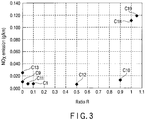
- FIG 3 is a graph showing an example of the above-mentioned relationship between the ratio R and the emission of NO x .
Landscapes
- Chemical & Material Sciences (AREA)
- Engineering & Computer Science (AREA)
- Chemical Kinetics & Catalysis (AREA)
- Materials Engineering (AREA)
- Organic Chemistry (AREA)
- Health & Medical Sciences (AREA)
- Combustion & Propulsion (AREA)
- Biomedical Technology (AREA)
- Environmental & Geological Engineering (AREA)
- Analytical Chemistry (AREA)
- General Chemical & Material Sciences (AREA)
- Oil, Petroleum & Natural Gas (AREA)
- Catalysts (AREA)
- Exhaust Gas Treatment By Means Of Catalyst (AREA)
- Exhaust Gas After Treatment (AREA)
Claims (8)
- Catalyseur de purification des gaz d'échappement comprenant :un substrat ;une première couche catalytique faisant face au substrat et comprenant au moins un métal précieux choisi dans le groupe constitué de palladium et de platine et d'alumine dopée avec un élément métallique alcalino-terreux, l'élément métallique alcalino-terreux remplaçant une partie des atomes qui constituent un réseau cristallin de l'alumine et/ou étant positionné dans un vide entre ces atomes ; etune deuxième couche catalytique faisant face au substrat avec la première couche catalytique interposée entre eux ou intervenant entre le substrat et la première couche catalytique, la deuxième couche catalytique comprenant du rhodium et de l'alumine dopée avec un élément métallique alcalino-terreux, et l'élément métallique alcalino-terreux remplaçant une partie des atomes qui constituent un réseau cristallin de l'alumine et/ou étant positionné dans un vide entre ces atomes,où le rapport de la masse totale de palladium et de platine compris dans la première couche catalytique sur la masse totale de tous les métaux précieux compris dans la première couche catalytique est supérieur au rapport de la masse totale de palladium et de platine compris dans la deuxième couche catalytique sur la masse totale de tous les métaux précieux compris dans la deuxième couche catalytique,le rapport de la masse de rhodium compris dans la première couche catalytique sur la masse totale de tous les métaux précieux compris dans la première couche catalytique est inférieur au rapport de la masse de rhodium compris dans la deuxième couche catalytique sur la masse totale de tous les métaux précieux compris dans la deuxième couche catalytique,le rapport de la masse totale de tous les éléments métalliques alcalino-terreux compris dans la première couche catalytique sur la masse totale de tous les métaux précieux compris dans la première couche catalytique est supérieur au rapport de la masse totale de tous les éléments métalliques alcalino-terreux compris dans la deuxième couche catalytique sur la masse totale de tous les métaux précieux compris dans la deuxième couche catalytique, la teneur en éléments métalliques alcalino-terreux de la première couche catalytique par capacité volumétrique du substrat se trouve dans la plage allant de 0,1 à 50 g/L, et la teneur en éléments alcalino-terreux de la deuxième couche catalytique par capacité volumétrique du substrat se trouve dans la plage allant de 0,05 à 10 g/L.
- Catalyseur de purification des gaz d'échappement selon la revendication 1, dans lequel la deuxième couche catalytique fait face au substrat avec la première couche catalytique interposée entre eux.
- Catalyseur de purification des gaz d'échappement selon la revendication 1, dans lequel la deuxième couche catalytique intervient entre le substrat et la première couche catalytique.
- Catalyseur de purification des gaz d'échappement selon l'une quelconque des revendications 1 à 3, dans lequel la deuxième couche catalytique comprend en outre du platine.
- Catalyseur de purification des gaz d'échappement selon l'une quelconque des revendications 1 à 4, dans lequel le rapport de la masse totale de tous les éléments métalliques alcalino-terreux compris dans la deuxième couche catalytique sur la masse totale de tous les métaux précieux compris dans la deuxième couche catalytique est de 0,001 à 0,9 fois le rapport de la masse totale de tous les éléments métalliques alcalino-terreux compris dans la première couche catalytique sur la masse totale de tous les métaux précieux compris dans la première couche catalytique.
- Catalyseur de purification des gaz d'échappement selon l'une quelconque des revendications 1 à 5, dans lequel une quantité de dopage de l'élément métallique alcalino-terreux dans chacune des première et deuxième couches catalytiques se trouve dans la plage allant de 0,1% à 20% en masse par rapport à la masse d'alumine dopée avec l'élément métallique alcalino-terreux.
- Catalyseur de purification des gaz d'échappement selon l'une quelconque des revendications 1 à 6, dans lequel la première couche catalytique comprend uniquement du palladium et/ou du platine comme métal précieux, et la deuxième couche catalytique comprend uniquement du rhodium ou uniquement du rhodium et du platine comme métal précieux.
- Catalyseur de purification des gaz d'échappement selon l'une quelconque des revendications 1 à 7, dans lequel au moins l'un de l'élément métallique alcalino-terreux compris dans la première couche catalytique et de l'élément métallique alcalino-terreux compris dans la deuxième couche catalytique est du baryum.
Applications Claiming Priority (2)
| Application Number | Priority Date | Filing Date | Title |
|---|---|---|---|
| JP2009127310 | 2009-05-27 | ||
| PCT/JP2010/059016 WO2010137657A1 (fr) | 2009-05-27 | 2010-05-27 | Catalyseur pour la purification de gaz d'échappement |
Publications (3)
| Publication Number | Publication Date |
|---|---|
| EP2436441A1 EP2436441A1 (fr) | 2012-04-04 |
| EP2436441A4 EP2436441A4 (fr) | 2013-07-31 |
| EP2436441B1 true EP2436441B1 (fr) | 2017-06-14 |
Family
ID=43222762
Family Applications (1)
| Application Number | Title | Priority Date | Filing Date |
|---|---|---|---|
| EP10780611.9A Active EP2436441B1 (fr) | 2009-05-27 | 2010-05-27 | Catalyseur pour la purification de gaz d'échappement |
Country Status (5)
| Country | Link |
|---|---|
| US (1) | US8580706B2 (fr) |
| EP (1) | EP2436441B1 (fr) |
| JP (1) | JP5337875B2 (fr) |
| CN (1) | CN102448606B (fr) |
| WO (1) | WO2010137657A1 (fr) |
Families Citing this family (23)
| Publication number | Priority date | Publication date | Assignee | Title |
|---|---|---|---|---|
| JP5323093B2 (ja) * | 2008-12-19 | 2013-10-23 | 株式会社キャタラー | 排ガス浄化用触媒 |
| EP2444152A4 (fr) | 2009-06-16 | 2013-07-31 | Cataler Corp | Catalyseur de purification de gaz d'échappement, matière en poudre et procédé pour la production d'un catalyseur de purification de gaz d'échappement |
| EP2774671B1 (fr) * | 2011-10-31 | 2020-10-28 | N.E. Chemcat Corporation | Catalyseur de purification de gaz d'échappement |
| US10464052B2 (en) * | 2012-11-12 | 2019-11-05 | Basf Se | Oxidation catalyst and method for its preparation |
| GB201220912D0 (en) | 2012-11-21 | 2013-01-02 | Johnson Matthey Plc | Oxidation catalyst for treating the exhaust gas of a compression ignition engine |
| JP5942893B2 (ja) * | 2013-02-21 | 2016-06-29 | マツダ株式会社 | 排気ガス浄化用触媒の製造方法 |
| JP6073732B2 (ja) * | 2013-04-02 | 2017-02-01 | 株式会社キャタラー | 排ガス浄化用触媒 |
| EP3045226B1 (fr) * | 2015-01-19 | 2024-08-21 | Umicore AG & Co. KG | Catalyseur à triple voies à double interrupteur présentant une stabilité au vieillissement améliorée |
| JP6288113B2 (ja) * | 2016-01-12 | 2018-03-07 | マツダ株式会社 | パティキュレートフィルタ |
| JP6742751B2 (ja) * | 2016-02-19 | 2020-08-19 | 株式会社キャタラー | 排ガス浄化用触媒材料及び排ガス浄化用触媒 |
| US10695752B2 (en) * | 2016-02-25 | 2020-06-30 | Cataler Corporation | Exhaust-gas purifying catalyst and manufacturing method therefor |
| EP3581269B1 (fr) * | 2017-04-11 | 2022-09-28 | Cataler Corporation | Catalyseur pour la purification de gaz d'échappement et procédé de preparation |
| JP6925856B2 (ja) * | 2017-04-28 | 2021-08-25 | 株式会社キャタラー | 排ガス浄化用触媒 |
| US20200030776A1 (en) * | 2018-07-27 | 2020-01-30 | Johnson Matthey Public Limited Company | Twc catalysts containing high dopant support |
| EP3849700A1 (fr) * | 2018-09-13 | 2021-07-21 | BASF Corporation | Catalyseur de conversion à trois voies dans des applications d'essence et de gaz naturel |
| JP7171751B2 (ja) * | 2018-09-28 | 2022-11-15 | ユミコア日本触媒株式会社 | 排ガス浄化触媒、排ガスの浄化方法、及び排ガス浄化触媒の製造方法 |
| JP6990161B2 (ja) * | 2018-10-04 | 2022-02-15 | 株式会社キャタラー | 排ガス浄化用触媒 |
| JP7315164B2 (ja) | 2019-03-29 | 2023-07-26 | 株式会社キャタラー | 触媒材料 |
| JP7450346B2 (ja) * | 2019-06-20 | 2024-03-15 | 株式会社キャタラー | メタン浄化用触媒材料 |
| JP6997838B1 (ja) * | 2020-08-07 | 2022-01-18 | 株式会社キャタラー | 排ガス浄化用触媒 |
| WO2023017258A1 (fr) * | 2021-08-13 | 2023-02-16 | Johnson Matthey Public Limited Company | Synthèse de nanoparticules métalliques assistée par un composé organique contenant du soufre pour application de catalyse à trois voies |
| CN118647454A (zh) * | 2022-01-25 | 2024-09-13 | 庄信万丰(上海)化工有限公司 | 用于制造汽油颗粒过滤器的方法 |
| JP7764287B2 (ja) * | 2022-03-15 | 2025-11-05 | トヨタ自動車株式会社 | 排ガス浄化用触媒 |
Family Cites Families (20)
| Publication number | Priority date | Publication date | Assignee | Title |
|---|---|---|---|---|
| EP0630356A4 (fr) * | 1992-03-12 | 1995-06-14 | Vista Chemical | Preparation d'alumine stabilisee presentant une resistance accrue a la perte de superficie aux temperatures elevees. |
| US5597771A (en) * | 1993-06-25 | 1997-01-28 | Engelhard Corporation | Layered catalyst composite |
| JP4067120B2 (ja) * | 1996-02-21 | 2008-03-26 | エイエスイーシー・マニュファクチュアリング | 排気転化触媒のための高度に分散した実質的に均一な混合した金属―酸化物複合担体 |
| US5948723A (en) * | 1996-09-04 | 1999-09-07 | Engelhard Corporation | Layered catalyst composite |
| DE69728341T2 (de) * | 1996-10-07 | 2004-12-30 | Kabushiki Kaisha Toyota Chuo Kenkyusho | Verbundoxid, Verbundoxidträger und Katalysator |
| US6348430B1 (en) * | 1997-06-20 | 2002-02-19 | Degussa Ag | Exhaust gas treatment catalyst for internal combustion engines with two catalytically active layers on a carrier structure |
| JP3827838B2 (ja) | 1997-11-20 | 2006-09-27 | ダイハツ工業株式会社 | 排気ガス浄化用触媒 |
| KR100326747B1 (ko) * | 1998-03-09 | 2002-03-13 | 하나와 요시카즈 | 산소 과잉 배기 가스의 정화 장치 |
| US20020048542A1 (en) * | 1999-04-02 | 2002-04-25 | Michel Deeba | Catalytic trap and methods of making and using the same |
| US6294140B1 (en) * | 1999-04-23 | 2001-09-25 | Degussa Ag | Layered noble metal-containing exhaust gas catalyst and its preparation |
| US6764665B2 (en) * | 2001-10-26 | 2004-07-20 | Engelhard Corporation | Layered catalyst composite |
| KR100781670B1 (ko) * | 2006-08-16 | 2007-12-03 | 희성촉매 주식회사 | 극소량의 로듐 또는 로듐을 포함하지 않는 내연기관배기가스 정화용 촉매 |
| US20080044330A1 (en) * | 2006-08-21 | 2008-02-21 | Shau-Lin Franklin Chen | Layered catalyst composite |
| US7550124B2 (en) * | 2006-08-21 | 2009-06-23 | Basf Catalysts Llc | Layered catalyst composite |
| US7517510B2 (en) * | 2006-08-21 | 2009-04-14 | Basf Catalysts Llc | Layered catalyst composite |
| US7754171B2 (en) * | 2007-02-02 | 2010-07-13 | Basf Corporation | Multilayered catalyst compositions |
| JP4858463B2 (ja) * | 2007-04-27 | 2012-01-18 | マツダ株式会社 | 排気ガス浄化用触媒およびその製造方法 |
| US8007750B2 (en) * | 2007-07-19 | 2011-08-30 | Basf Corporation | Multilayered catalyst compositions |
| DE102007046158B4 (de) * | 2007-09-27 | 2014-02-13 | Umicore Ag & Co. Kg | Verwendung eines katalytisch aktiven Partikelfilters zur Entfernung von Partikeln aus dem Abgas von mit überwiegend stöchiometrischem Luft/Kraftstoff-Gemisch betriebenen Verbrennungsmotoren |
| JP5323093B2 (ja) * | 2008-12-19 | 2013-10-23 | 株式会社キャタラー | 排ガス浄化用触媒 |
-
2010
- 2010-05-27 WO PCT/JP2010/059016 patent/WO2010137657A1/fr not_active Ceased
- 2010-05-27 EP EP10780611.9A patent/EP2436441B1/fr active Active
- 2010-05-27 CN CN201080022779.7A patent/CN102448606B/zh active Active
- 2010-05-27 JP JP2011516056A patent/JP5337875B2/ja active Active
-
2011
- 2011-11-22 US US13/301,859 patent/US8580706B2/en active Active
Non-Patent Citations (1)
| Title |
|---|
| None * |
Also Published As
| Publication number | Publication date |
|---|---|
| WO2010137657A1 (fr) | 2010-12-02 |
| EP2436441A1 (fr) | 2012-04-04 |
| JP5337875B2 (ja) | 2013-11-06 |
| US8580706B2 (en) | 2013-11-12 |
| EP2436441A4 (fr) | 2013-07-31 |
| US20120065058A1 (en) | 2012-03-15 |
| CN102448606A (zh) | 2012-05-09 |
| CN102448606B (zh) | 2014-03-26 |
| JPWO2010137657A1 (ja) | 2012-11-15 |
Similar Documents
| Publication | Publication Date | Title |
|---|---|---|
| EP2436441B1 (fr) | Catalyseur pour la purification de gaz d'échappement | |
| US8318632B2 (en) | Exhaust gas purification catalyst | |
| JP5232401B2 (ja) | 排ガス浄化用触媒 | |
| KR101432330B1 (ko) | 배출 가스 정화용 촉매 | |
| US8039418B2 (en) | Exhaust gas-purifying catalyst | |
| EP2436442B1 (fr) | Procédé de preparation d'un catalyseur de purification de gaz d'échappement | |
| EP1729872B1 (fr) | Catalyseur d'accumulation des oxydes d'azote | |
| EP2444152A1 (fr) | Catalyseur de purification de gaz d'échappement, matière en poudre et procédé pour la production d'un catalyseur de purification de gaz d'échappement | |
| EP1332787B1 (fr) | Catalyseur pour la purification de gaz d'échappement | |
| US20080045404A1 (en) | Catalyst containing little or no rhodium for purifying exhaust gases of internal combustion engine | |
| EP2078562B1 (fr) | Catalyseur d'épuration de gaz d'échappement | |
| US7989387B2 (en) | Process for producing metal oxide particle and exhaust gas purifying catalyst | |
| US8940657B2 (en) | Exhaust emission control catalyst | |
| US8680004B2 (en) | Exhaust gas-purifying catalyst | |
| US10099204B2 (en) | Exhaust gas-purifying catalyst | |
| WO2010110298A1 (fr) | Catalyseur de purification des gaz d'échappement | |
| EP0922485A2 (fr) | Catalyseur pour purifier de gaz d'échappement d'un moteur à combustion | |
| US20260070043A1 (en) | Exhaust gas purification catalyst | |
| KR20030091347A (ko) | 저 팔라듐 함량의 삼원촉매 제조방법 |
Legal Events
| Date | Code | Title | Description |
|---|---|---|---|
| PUAI | Public reference made under article 153(3) epc to a published international application that has entered the european phase |
Free format text: ORIGINAL CODE: 0009012 |
|
| 17P | Request for examination filed |
Effective date: 20111124 |
|
| AK | Designated contracting states |
Kind code of ref document: A1 Designated state(s): AL AT BE BG CH CY CZ DE DK EE ES FI FR GB GR HR HU IE IS IT LI LT LU LV MC MK MT NL NO PL PT RO SE SI SK SM TR |
|
| DAX | Request for extension of the european patent (deleted) | ||
| A4 | Supplementary search report drawn up and despatched |
Effective date: 20130702 |
|
| RIC1 | Information provided on ipc code assigned before grant |
Ipc: B01J 37/02 20060101ALI20130626BHEP Ipc: F01N 3/10 20060101ALI20130626BHEP Ipc: B01J 23/58 20060101AFI20130626BHEP Ipc: B01D 53/94 20060101ALI20130626BHEP |
|
| 17Q | First examination report despatched |
Effective date: 20160223 |
|
| GRAP | Despatch of communication of intention to grant a patent |
Free format text: ORIGINAL CODE: EPIDOSNIGR1 |
|
| INTG | Intention to grant announced |
Effective date: 20170223 |
|
| GRAS | Grant fee paid |
Free format text: ORIGINAL CODE: EPIDOSNIGR3 |
|
| GRAA | (expected) grant |
Free format text: ORIGINAL CODE: 0009210 |
|
| AK | Designated contracting states |
Kind code of ref document: B1 Designated state(s): AL AT BE BG CH CY CZ DE DK EE ES FI FR GB GR HR HU IE IS IT LI LT LU LV MC MK MT NL NO PL PT RO SE SI SK SM TR |
|
| REG | Reference to a national code |
Ref country code: GB Ref legal event code: FG4D |
|
| REG | Reference to a national code |
Ref country code: CH Ref legal event code: EP Ref country code: AT Ref legal event code: REF Ref document number: 900437 Country of ref document: AT Kind code of ref document: T Effective date: 20170615 |
|
| REG | Reference to a national code |
Ref country code: IE Ref legal event code: FG4D |
|
| REG | Reference to a national code |
Ref country code: DE Ref legal event code: R096 Ref document number: 602010042990 Country of ref document: DE |
|
| REG | Reference to a national code |
Ref country code: NL Ref legal event code: MP Effective date: 20170614 |
|
| REG | Reference to a national code |
Ref country code: LT Ref legal event code: MG4D |
|
| PG25 | Lapsed in a contracting state [announced via postgrant information from national office to epo] |
Ref country code: FI Free format text: LAPSE BECAUSE OF FAILURE TO SUBMIT A TRANSLATION OF THE DESCRIPTION OR TO PAY THE FEE WITHIN THE PRESCRIBED TIME-LIMIT Effective date: 20170614 Ref country code: ES Free format text: LAPSE BECAUSE OF FAILURE TO SUBMIT A TRANSLATION OF THE DESCRIPTION OR TO PAY THE FEE WITHIN THE PRESCRIBED TIME-LIMIT Effective date: 20170614 Ref country code: HR Free format text: LAPSE BECAUSE OF FAILURE TO SUBMIT A TRANSLATION OF THE DESCRIPTION OR TO PAY THE FEE WITHIN THE PRESCRIBED TIME-LIMIT Effective date: 20170614 Ref country code: LT Free format text: LAPSE BECAUSE OF FAILURE TO SUBMIT A TRANSLATION OF THE DESCRIPTION OR TO PAY THE FEE WITHIN THE PRESCRIBED TIME-LIMIT Effective date: 20170614 Ref country code: NO Free format text: LAPSE BECAUSE OF FAILURE TO SUBMIT A TRANSLATION OF THE DESCRIPTION OR TO PAY THE FEE WITHIN THE PRESCRIBED TIME-LIMIT Effective date: 20170914 Ref country code: GR Free format text: LAPSE BECAUSE OF FAILURE TO SUBMIT A TRANSLATION OF THE DESCRIPTION OR TO PAY THE FEE WITHIN THE PRESCRIBED TIME-LIMIT Effective date: 20170915 |
|
| REG | Reference to a national code |
Ref country code: AT Ref legal event code: MK05 Ref document number: 900437 Country of ref document: AT Kind code of ref document: T Effective date: 20170614 |
|
| PG25 | Lapsed in a contracting state [announced via postgrant information from national office to epo] |
Ref country code: LV Free format text: LAPSE BECAUSE OF FAILURE TO SUBMIT A TRANSLATION OF THE DESCRIPTION OR TO PAY THE FEE WITHIN THE PRESCRIBED TIME-LIMIT Effective date: 20170614 Ref country code: SE Free format text: LAPSE BECAUSE OF FAILURE TO SUBMIT A TRANSLATION OF THE DESCRIPTION OR TO PAY THE FEE WITHIN THE PRESCRIBED TIME-LIMIT Effective date: 20170614 Ref country code: BG Free format text: LAPSE BECAUSE OF FAILURE TO SUBMIT A TRANSLATION OF THE DESCRIPTION OR TO PAY THE FEE WITHIN THE PRESCRIBED TIME-LIMIT Effective date: 20170914 Ref country code: NL Free format text: LAPSE BECAUSE OF FAILURE TO SUBMIT A TRANSLATION OF THE DESCRIPTION OR TO PAY THE FEE WITHIN THE PRESCRIBED TIME-LIMIT Effective date: 20170614 |
|
| PG25 | Lapsed in a contracting state [announced via postgrant information from national office to epo] |
Ref country code: SK Free format text: LAPSE BECAUSE OF FAILURE TO SUBMIT A TRANSLATION OF THE DESCRIPTION OR TO PAY THE FEE WITHIN THE PRESCRIBED TIME-LIMIT Effective date: 20170614 Ref country code: AT Free format text: LAPSE BECAUSE OF FAILURE TO SUBMIT A TRANSLATION OF THE DESCRIPTION OR TO PAY THE FEE WITHIN THE PRESCRIBED TIME-LIMIT Effective date: 20170614 Ref country code: RO Free format text: LAPSE BECAUSE OF FAILURE TO SUBMIT A TRANSLATION OF THE DESCRIPTION OR TO PAY THE FEE WITHIN THE PRESCRIBED TIME-LIMIT Effective date: 20170614 Ref country code: EE Free format text: LAPSE BECAUSE OF FAILURE TO SUBMIT A TRANSLATION OF THE DESCRIPTION OR TO PAY THE FEE WITHIN THE PRESCRIBED TIME-LIMIT Effective date: 20170614 Ref country code: CZ Free format text: LAPSE BECAUSE OF FAILURE TO SUBMIT A TRANSLATION OF THE DESCRIPTION OR TO PAY THE FEE WITHIN THE PRESCRIBED TIME-LIMIT Effective date: 20170614 |
|
| PG25 | Lapsed in a contracting state [announced via postgrant information from national office to epo] |
Ref country code: IS Free format text: LAPSE BECAUSE OF FAILURE TO SUBMIT A TRANSLATION OF THE DESCRIPTION OR TO PAY THE FEE WITHIN THE PRESCRIBED TIME-LIMIT Effective date: 20171014 Ref country code: SM Free format text: LAPSE BECAUSE OF FAILURE TO SUBMIT A TRANSLATION OF THE DESCRIPTION OR TO PAY THE FEE WITHIN THE PRESCRIBED TIME-LIMIT Effective date: 20170614 Ref country code: PL Free format text: LAPSE BECAUSE OF FAILURE TO SUBMIT A TRANSLATION OF THE DESCRIPTION OR TO PAY THE FEE WITHIN THE PRESCRIBED TIME-LIMIT Effective date: 20170614 Ref country code: IT Free format text: LAPSE BECAUSE OF FAILURE TO SUBMIT A TRANSLATION OF THE DESCRIPTION OR TO PAY THE FEE WITHIN THE PRESCRIBED TIME-LIMIT Effective date: 20170614 |
|
| REG | Reference to a national code |
Ref country code: DE Ref legal event code: R097 Ref document number: 602010042990 Country of ref document: DE |
|
| PLBE | No opposition filed within time limit |
Free format text: ORIGINAL CODE: 0009261 |
|
| STAA | Information on the status of an ep patent application or granted ep patent |
Free format text: STATUS: NO OPPOSITION FILED WITHIN TIME LIMIT |
|
| PG25 | Lapsed in a contracting state [announced via postgrant information from national office to epo] |
Ref country code: DK Free format text: LAPSE BECAUSE OF FAILURE TO SUBMIT A TRANSLATION OF THE DESCRIPTION OR TO PAY THE FEE WITHIN THE PRESCRIBED TIME-LIMIT Effective date: 20170614 |
|
| REG | Reference to a national code |
Ref country code: FR Ref legal event code: PLFP Year of fee payment: 9 |
|
| 26N | No opposition filed |
Effective date: 20180315 |
|
| PG25 | Lapsed in a contracting state [announced via postgrant information from national office to epo] |
Ref country code: SI Free format text: LAPSE BECAUSE OF FAILURE TO SUBMIT A TRANSLATION OF THE DESCRIPTION OR TO PAY THE FEE WITHIN THE PRESCRIBED TIME-LIMIT Effective date: 20170614 |
|
| REG | Reference to a national code |
Ref country code: CH Ref legal event code: PL |
|
| GBPC | Gb: european patent ceased through non-payment of renewal fee |
Effective date: 20180527 |
|
| REG | Reference to a national code |
Ref country code: BE Ref legal event code: MM Effective date: 20180531 |
|
| PG25 | Lapsed in a contracting state [announced via postgrant information from national office to epo] |
Ref country code: MC Free format text: LAPSE BECAUSE OF FAILURE TO SUBMIT A TRANSLATION OF THE DESCRIPTION OR TO PAY THE FEE WITHIN THE PRESCRIBED TIME-LIMIT Effective date: 20170614 |
|
| REG | Reference to a national code |
Ref country code: IE Ref legal event code: MM4A |
|
| PG25 | Lapsed in a contracting state [announced via postgrant information from national office to epo] |
Ref country code: LI Free format text: LAPSE BECAUSE OF NON-PAYMENT OF DUE FEES Effective date: 20180531 Ref country code: CH Free format text: LAPSE BECAUSE OF NON-PAYMENT OF DUE FEES Effective date: 20180531 |
|
| PG25 | Lapsed in a contracting state [announced via postgrant information from national office to epo] |
Ref country code: LU Free format text: LAPSE BECAUSE OF NON-PAYMENT OF DUE FEES Effective date: 20180527 |
|
| PG25 | Lapsed in a contracting state [announced via postgrant information from national office to epo] |
Ref country code: IE Free format text: LAPSE BECAUSE OF NON-PAYMENT OF DUE FEES Effective date: 20180527 Ref country code: GB Free format text: LAPSE BECAUSE OF NON-PAYMENT OF DUE FEES Effective date: 20180527 |
|
| PG25 | Lapsed in a contracting state [announced via postgrant information from national office to epo] |
Ref country code: BE Free format text: LAPSE BECAUSE OF NON-PAYMENT OF DUE FEES Effective date: 20180531 |
|
| PG25 | Lapsed in a contracting state [announced via postgrant information from national office to epo] |
Ref country code: MT Free format text: LAPSE BECAUSE OF NON-PAYMENT OF DUE FEES Effective date: 20180527 |
|
| PG25 | Lapsed in a contracting state [announced via postgrant information from national office to epo] |
Ref country code: TR Free format text: LAPSE BECAUSE OF FAILURE TO SUBMIT A TRANSLATION OF THE DESCRIPTION OR TO PAY THE FEE WITHIN THE PRESCRIBED TIME-LIMIT Effective date: 20170614 |
|
| PG25 | Lapsed in a contracting state [announced via postgrant information from national office to epo] |
Ref country code: PT Free format text: LAPSE BECAUSE OF FAILURE TO SUBMIT A TRANSLATION OF THE DESCRIPTION OR TO PAY THE FEE WITHIN THE PRESCRIBED TIME-LIMIT Effective date: 20170614 Ref country code: HU Free format text: LAPSE BECAUSE OF FAILURE TO SUBMIT A TRANSLATION OF THE DESCRIPTION OR TO PAY THE FEE WITHIN THE PRESCRIBED TIME-LIMIT; INVALID AB INITIO Effective date: 20100527 |
|
| PG25 | Lapsed in a contracting state [announced via postgrant information from national office to epo] |
Ref country code: MK Free format text: LAPSE BECAUSE OF NON-PAYMENT OF DUE FEES Effective date: 20170614 Ref country code: CY Free format text: LAPSE BECAUSE OF FAILURE TO SUBMIT A TRANSLATION OF THE DESCRIPTION OR TO PAY THE FEE WITHIN THE PRESCRIBED TIME-LIMIT Effective date: 20170614 |
|
| PG25 | Lapsed in a contracting state [announced via postgrant information from national office to epo] |
Ref country code: AL Free format text: LAPSE BECAUSE OF FAILURE TO SUBMIT A TRANSLATION OF THE DESCRIPTION OR TO PAY THE FEE WITHIN THE PRESCRIBED TIME-LIMIT Effective date: 20170614 |
|
| PGFP | Annual fee paid to national office [announced via postgrant information from national office to epo] |
Ref country code: FR Payment date: 20250430 Year of fee payment: 16 |
|
| PGFP | Annual fee paid to national office [announced via postgrant information from national office to epo] |
Ref country code: DE Payment date: 20250704 Year of fee payment: 16 |
|
| REG | Reference to a national code |
Ref country code: DE Ref legal event code: R082 Ref document number: 602010042990 Country of ref document: DE Representative=s name: BLUMBACH ZINNGREBE PATENTANWAELTE PARTG MBB, DE |