EP2436712A1 - Schlagzähigkeitsmodifikatoren für Epoxidharzzusammensetzungen - Google Patents
Schlagzähigkeitsmodifikatoren für Epoxidharzzusammensetzungen Download PDFInfo
- Publication number
- EP2436712A1 EP2436712A1 EP10186073A EP10186073A EP2436712A1 EP 2436712 A1 EP2436712 A1 EP 2436712A1 EP 10186073 A EP10186073 A EP 10186073A EP 10186073 A EP10186073 A EP 10186073A EP 2436712 A1 EP2436712 A1 EP 2436712A1
- Authority
- EP
- European Patent Office
- Prior art keywords
- formula
- impact modifier
- composition
- groups
- epoxy resin
- Prior art date
- Legal status (The legal status is an assumption and is not a legal conclusion. Google has not performed a legal analysis and makes no representation as to the accuracy of the status listed.)
- Withdrawn
Links
- 239000000203 mixture Substances 0.000 title claims abstract description 87
- 229920000647 polyepoxide Polymers 0.000 title claims abstract description 50
- 239000003822 epoxy resin Substances 0.000 title claims description 46
- 229920000642 polymer Polymers 0.000 claims abstract description 59
- 229920002635 polyurethane Polymers 0.000 claims abstract description 24
- 239000004814 polyurethane Substances 0.000 claims abstract description 24
- 239000007787 solid Substances 0.000 claims abstract description 21
- 239000004848 polyfunctional curative Substances 0.000 claims abstract description 20
- 239000003795 chemical substances by application Substances 0.000 claims abstract description 15
- 125000000217 alkyl group Chemical group 0.000 claims abstract description 10
- 125000003118 aryl group Chemical group 0.000 claims abstract description 8
- 239000002131 composite material Substances 0.000 claims abstract description 8
- 238000010438 heat treatment Methods 0.000 claims abstract description 8
- 238000002156 mixing Methods 0.000 claims abstract description 8
- 238000002360 preparation method Methods 0.000 claims abstract description 8
- 230000004913 activation Effects 0.000 claims abstract description 6
- 125000001931 aliphatic group Chemical group 0.000 claims abstract description 6
- 239000000758 substrate Substances 0.000 claims abstract description 5
- IQPQWNKOIGAROB-UHFFFAOYSA-N isocyanate group Chemical group [N-]=C=O IQPQWNKOIGAROB-UHFFFAOYSA-N 0.000 claims abstract description 4
- 239000004609 Impact Modifier Substances 0.000 claims description 89
- GYZLOYUZLJXAJU-UHFFFAOYSA-N diglycidyl ether Chemical compound C1OC1COCC1CO1 GYZLOYUZLJXAJU-UHFFFAOYSA-N 0.000 claims description 41
- KAKZBPTYRLMSJV-UHFFFAOYSA-N Butadiene Chemical compound C=CC=C KAKZBPTYRLMSJV-UHFFFAOYSA-N 0.000 claims description 26
- IISBACLAFKSPIT-UHFFFAOYSA-N bisphenol A Chemical compound C=1C=C(O)C=CC=1C(C)(C)C1=CC=C(O)C=C1 IISBACLAFKSPIT-UHFFFAOYSA-N 0.000 claims description 25
- LNEPOXFFQSENCJ-UHFFFAOYSA-N haloperidol Chemical compound C1CC(O)(C=2C=CC(Cl)=CC=2)CCN1CCCC(=O)C1=CC=C(F)C=C1 LNEPOXFFQSENCJ-UHFFFAOYSA-N 0.000 claims description 18
- 238000000034 method Methods 0.000 claims description 15
- 150000002118 epoxides Chemical group 0.000 claims description 14
- 229930185605 Bisphenol Natural products 0.000 claims description 13
- 125000004432 carbon atom Chemical group C* 0.000 claims description 13
- 229920001577 copolymer Polymers 0.000 claims description 12
- 125000003700 epoxy group Chemical group 0.000 claims description 10
- 239000004850 liquid epoxy resins (LERs) Substances 0.000 claims description 10
- 239000011159 matrix material Substances 0.000 claims description 8
- 125000003178 carboxy group Chemical group [H]OC(*)=O 0.000 claims description 7
- ISWSIDIOOBJBQZ-UHFFFAOYSA-N phenol group Chemical group C1(=CC=CC=C1)O ISWSIDIOOBJBQZ-UHFFFAOYSA-N 0.000 claims description 7
- NLHHRLWOUZZQLW-UHFFFAOYSA-N Acrylonitrile Chemical compound C=CC#N NLHHRLWOUZZQLW-UHFFFAOYSA-N 0.000 claims description 5
- 125000001495 ethyl group Chemical group [H]C([H])([H])C([H])([H])* 0.000 claims description 2
- 125000003055 glycidyl group Chemical group C(C1CO1)* 0.000 claims description 2
- 125000002496 methyl group Chemical group [H]C([H])([H])* 0.000 claims description 2
- 125000001997 phenyl group Chemical group [H]C1=C([H])C([H])=C(*)C([H])=C1[H] 0.000 claims description 2
- 239000007788 liquid Substances 0.000 abstract description 21
- 229920005989 resin Polymers 0.000 abstract description 15
- 239000011347 resin Substances 0.000 abstract description 15
- 239000012948 isocyanate Substances 0.000 abstract description 8
- 150000002513 isocyanates Chemical class 0.000 abstract description 6
- 239000003607 modifier Substances 0.000 abstract 6
- BKQXUNGELBDWLS-UHFFFAOYSA-N 9,9-diphenylfluorene Chemical compound C1=CC=CC=C1C1(C=2C=CC=CC=2)C2=CC=CC=C2C2=CC=CC=C21 BKQXUNGELBDWLS-UHFFFAOYSA-N 0.000 abstract 2
- 230000001747 exhibiting effect Effects 0.000 abstract 1
- -1 Germany Substances 0.000 description 22
- 229910052500 inorganic mineral Inorganic materials 0.000 description 20
- 235000010755 mineral Nutrition 0.000 description 20
- 239000011707 mineral Substances 0.000 description 18
- 235000013824 polyphenols Nutrition 0.000 description 18
- 125000002887 hydroxy group Chemical group [H]O* 0.000 description 16
- 150000008442 polyphenolic compounds Chemical class 0.000 description 15
- PXKLMJQFEQBVLD-UHFFFAOYSA-N bisphenol F Chemical compound C1=CC(O)=CC=C1CC1=CC=C(O)C=C1 PXKLMJQFEQBVLD-UHFFFAOYSA-N 0.000 description 14
- 239000004743 Polypropylene Substances 0.000 description 13
- 238000001723 curing Methods 0.000 description 13
- 125000005442 diisocyanate group Chemical group 0.000 description 13
- 229920005862 polyol Polymers 0.000 description 12
- 239000004593 Epoxy Substances 0.000 description 11
- RRAMGCGOFNQTLD-UHFFFAOYSA-N hexamethylene diisocyanate Chemical compound O=C=NCCCCCCN=C=O RRAMGCGOFNQTLD-UHFFFAOYSA-N 0.000 description 11
- 150000003077 polyols Chemical class 0.000 description 11
- 150000003573 thiols Chemical class 0.000 description 11
- 239000005057 Hexamethylene diisocyanate Substances 0.000 description 10
- 239000000853 adhesive Substances 0.000 description 10
- 230000001070 adhesive effect Effects 0.000 description 10
- 238000006243 chemical reaction Methods 0.000 description 10
- 229920001971 elastomer Polymers 0.000 description 10
- 125000002924 primary amino group Chemical group [H]N([H])* 0.000 description 10
- 150000003254 radicals Chemical class 0.000 description 10
- 239000005060 rubber Substances 0.000 description 10
- 230000009477 glass transition Effects 0.000 description 9
- 229920001400 block copolymer Polymers 0.000 description 8
- 229920000909 polytetrahydrofuran Polymers 0.000 description 8
- UPMLOUAZCHDJJD-UHFFFAOYSA-N 4,4'-Diphenylmethane Diisocyanate Chemical compound C1=CC(N=C=O)=CC=C1CC1=CC=C(N=C=O)C=C1 UPMLOUAZCHDJJD-UHFFFAOYSA-N 0.000 description 7
- 239000004604 Blowing Agent Substances 0.000 description 7
- 150000001768 cations Chemical class 0.000 description 7
- 239000007795 chemical reaction product Substances 0.000 description 7
- 239000011258 core-shell material Substances 0.000 description 7
- QGBSISYHAICWAH-UHFFFAOYSA-N dicyandiamide Chemical compound NC(N)=NC#N QGBSISYHAICWAH-UHFFFAOYSA-N 0.000 description 7
- IXQGCWUGDFDQMF-UHFFFAOYSA-N 2-Ethylphenol Chemical compound CCC1=CC=CC=C1O IXQGCWUGDFDQMF-UHFFFAOYSA-N 0.000 description 6
- LYCAIKOWRPUZTN-UHFFFAOYSA-N Ethylene glycol Chemical compound OCCO LYCAIKOWRPUZTN-UHFFFAOYSA-N 0.000 description 6
- 150000001412 amines Chemical class 0.000 description 6
- 229940106691 bisphenol a Drugs 0.000 description 6
- 150000001875 compounds Chemical class 0.000 description 6
- 150000002148 esters Chemical class 0.000 description 6
- NIMLQBUJDJZYEJ-UHFFFAOYSA-N isophorone diisocyanate Chemical compound CC1(C)CC(N=C=O)CC(C)(CN=C=O)C1 NIMLQBUJDJZYEJ-UHFFFAOYSA-N 0.000 description 6
- 239000000463 material Substances 0.000 description 6
- QWVGKYWNOKOFNN-UHFFFAOYSA-N o-cresol Chemical compound CC1=CC=CC=C1O QWVGKYWNOKOFNN-UHFFFAOYSA-N 0.000 description 6
- 150000002989 phenols Chemical class 0.000 description 6
- 239000005056 polyisocyanate Substances 0.000 description 6
- 229920001228 polyisocyanate Polymers 0.000 description 6
- YWFPGFJLYRKYJZ-UHFFFAOYSA-N 9,9-bis(4-hydroxyphenyl)fluorene Chemical compound C1=CC(O)=CC=C1C1(C=2C=CC(O)=CC=2)C2=CC=CC=C2C2=CC=CC=C21 YWFPGFJLYRKYJZ-UHFFFAOYSA-N 0.000 description 5
- PEDCQBHIVMGVHV-UHFFFAOYSA-N Glycerine Chemical compound OCC(O)CO PEDCQBHIVMGVHV-UHFFFAOYSA-N 0.000 description 5
- 239000005058 Isophorone diisocyanate Substances 0.000 description 5
- 229910000831 Steel Inorganic materials 0.000 description 5
- 239000003054 catalyst Substances 0.000 description 5
- 239000000945 filler Substances 0.000 description 5
- 229920001451 polypropylene glycol Polymers 0.000 description 5
- 239000000047 product Substances 0.000 description 5
- 239000010959 steel Substances 0.000 description 5
- 239000000126 substance Substances 0.000 description 5
- 229920001187 thermosetting polymer Polymers 0.000 description 5
- NXXYKOUNUYWIHA-UHFFFAOYSA-N 2,6-Dimethylphenol Chemical compound CC1=CC=CC(C)=C1O NXXYKOUNUYWIHA-UHFFFAOYSA-N 0.000 description 4
- KUAUJXBLDYVELT-UHFFFAOYSA-N 2-[[2,2-dimethyl-3-(oxiran-2-ylmethoxy)propoxy]methyl]oxirane Chemical compound C1OC1COCC(C)(C)COCC1CO1 KUAUJXBLDYVELT-UHFFFAOYSA-N 0.000 description 4
- XMTQQYYKAHVGBJ-UHFFFAOYSA-N 3-(3,4-DICHLOROPHENYL)-1,1-DIMETHYLUREA Chemical compound CN(C)C(=O)NC1=CC=C(Cl)C(Cl)=C1 XMTQQYYKAHVGBJ-UHFFFAOYSA-N 0.000 description 4
- VPWNQTHUCYMVMZ-UHFFFAOYSA-N 4,4'-sulfonyldiphenol Chemical class C1=CC(O)=CC=C1S(=O)(=O)C1=CC=C(O)C=C1 VPWNQTHUCYMVMZ-UHFFFAOYSA-N 0.000 description 4
- PMMYEEVYMWASQN-DMTCNVIQSA-N Hydroxyproline Chemical compound O[C@H]1CN[C@H](C(O)=O)C1 PMMYEEVYMWASQN-DMTCNVIQSA-N 0.000 description 4
- 239000004721 Polyphenylene oxide Substances 0.000 description 4
- PPBRXRYQALVLMV-UHFFFAOYSA-N Styrene Chemical compound C=CC1=CC=CC=C1 PPBRXRYQALVLMV-UHFFFAOYSA-N 0.000 description 4
- ZJCCRDAZUWHFQH-UHFFFAOYSA-N Trimethylolpropane Chemical compound CCC(CO)(CO)CO ZJCCRDAZUWHFQH-UHFFFAOYSA-N 0.000 description 4
- 238000007792 addition Methods 0.000 description 4
- 125000004122 cyclic group Chemical group 0.000 description 4
- XXOYNJXVWVNOOJ-UHFFFAOYSA-N fenuron Chemical compound CN(C)C(=O)NC1=CC=CC=C1 XXOYNJXVWVNOOJ-UHFFFAOYSA-N 0.000 description 4
- ACCCMOQWYVYDOT-UHFFFAOYSA-N hexane-1,1-diol Chemical compound CCCCCC(O)O ACCCMOQWYVYDOT-UHFFFAOYSA-N 0.000 description 4
- 229920002521 macromolecule Polymers 0.000 description 4
- 238000005259 measurement Methods 0.000 description 4
- 229910052751 metal Inorganic materials 0.000 description 4
- 239000002184 metal Substances 0.000 description 4
- BMLIZLVNXIYGCK-UHFFFAOYSA-N monuron Chemical compound CN(C)C(=O)NC1=CC=C(Cl)C=C1 BMLIZLVNXIYGCK-UHFFFAOYSA-N 0.000 description 4
- KJFMBFZCATUALV-UHFFFAOYSA-N phenolphthalein Chemical compound C1=CC(O)=CC=C1C1(C=2C=CC(O)=CC=2)C2=CC=CC=C2C(=O)O1 KJFMBFZCATUALV-UHFFFAOYSA-N 0.000 description 4
- 229920000570 polyether Polymers 0.000 description 4
- 229920001223 polyethylene glycol Polymers 0.000 description 4
- 229920006395 saturated elastomer Polymers 0.000 description 4
- RIOQSEWOXXDEQQ-UHFFFAOYSA-N triphenylphosphine Chemical compound C1=CC=CC=C1P(C=1C=CC=CC=1)C1=CC=CC=C1 RIOQSEWOXXDEQQ-UHFFFAOYSA-N 0.000 description 4
- DKCPKDPYUFEZCP-UHFFFAOYSA-N 2,6-di-tert-butylphenol Chemical compound CC(C)(C)C1=CC=CC(C(C)(C)C)=C1O DKCPKDPYUFEZCP-UHFFFAOYSA-N 0.000 description 3
- HIXDQWDOVZUNNA-UHFFFAOYSA-N 2-(3,4-dimethoxyphenyl)-5-hydroxy-7-methoxychromen-4-one Chemical compound C=1C(OC)=CC(O)=C(C(C=2)=O)C=1OC=2C1=CC=C(OC)C(OC)=C1 HIXDQWDOVZUNNA-UHFFFAOYSA-N 0.000 description 3
- HHRACYLRBOUBKM-UHFFFAOYSA-N 2-[(4-tert-butylphenoxy)methyl]oxirane Chemical compound C1=CC(C(C)(C)C)=CC=C1OCC1OC1 HHRACYLRBOUBKM-UHFFFAOYSA-N 0.000 description 3
- NBOCQTNZUPTTEI-UHFFFAOYSA-N 4-[4-(hydrazinesulfonyl)phenoxy]benzenesulfonohydrazide Chemical compound C1=CC(S(=O)(=O)NN)=CC=C1OC1=CC=C(S(=O)(=O)NN)C=C1 NBOCQTNZUPTTEI-UHFFFAOYSA-N 0.000 description 3
- 229920003319 Araldite® Polymers 0.000 description 3
- LCFVJGUPQDGYKZ-UHFFFAOYSA-N Bisphenol A diglycidyl ether Chemical compound C=1C=C(OCC2OC2)C=CC=1C(C)(C)C(C=C1)=CC=C1OCC1CO1 LCFVJGUPQDGYKZ-UHFFFAOYSA-N 0.000 description 3
- 241000579895 Chlorostilbon Species 0.000 description 3
- 239000002202 Polyethylene glycol Substances 0.000 description 3
- 229920002396 Polyurea Polymers 0.000 description 3
- 229920000469 amphiphilic block copolymer Polymers 0.000 description 3
- 230000015572 biosynthetic process Effects 0.000 description 3
- 235000013877 carbamide Nutrition 0.000 description 3
- 239000002666 chemical blowing agent Substances 0.000 description 3
- KRKNYBCHXYNGOX-UHFFFAOYSA-N citric acid Chemical compound OC(=O)CC(O)(C(O)=O)CC(O)=O KRKNYBCHXYNGOX-UHFFFAOYSA-N 0.000 description 3
- 238000010276 construction Methods 0.000 description 3
- 239000003085 diluting agent Substances 0.000 description 3
- 239000010976 emerald Substances 0.000 description 3
- 229910052876 emerald Inorganic materials 0.000 description 3
- RTZKZFJDLAIYFH-UHFFFAOYSA-N ether Substances CCOCC RTZKZFJDLAIYFH-UHFFFAOYSA-N 0.000 description 3
- 125000000524 functional group Chemical group 0.000 description 3
- RAXXELZNTBOGNW-UHFFFAOYSA-N imidazole Chemical class C1=CNC=N1 RAXXELZNTBOGNW-UHFFFAOYSA-N 0.000 description 3
- 238000004519 manufacturing process Methods 0.000 description 3
- 150000002739 metals Chemical class 0.000 description 3
- 239000000178 monomer Substances 0.000 description 3
- 238000005580 one pot reaction Methods 0.000 description 3
- 239000013500 performance material Substances 0.000 description 3
- 239000000049 pigment Substances 0.000 description 3
- 239000004014 plasticizer Substances 0.000 description 3
- 229920000058 polyacrylate Polymers 0.000 description 3
- 229920000768 polyamine Polymers 0.000 description 3
- 238000006116 polymerization reaction Methods 0.000 description 3
- 239000003381 stabilizer Substances 0.000 description 3
- 238000003756 stirring Methods 0.000 description 3
- 125000001424 substituent group Chemical group 0.000 description 3
- 238000006467 substitution reaction Methods 0.000 description 3
- 239000003981 vehicle Substances 0.000 description 3
- GAFWRUXZGSUTHS-UHFFFAOYSA-N (3-chloro-4-methylphenyl)urea Chemical compound CC1=CC=C(NC(N)=O)C=C1Cl GAFWRUXZGSUTHS-UHFFFAOYSA-N 0.000 description 2
- OHLKMGYGBHFODF-UHFFFAOYSA-N 1,4-bis(isocyanatomethyl)benzene Chemical compound O=C=NCC1=CC=C(CN=C=O)C=C1 OHLKMGYGBHFODF-UHFFFAOYSA-N 0.000 description 2
- SBJCUZQNHOLYMD-UHFFFAOYSA-N 1,5-Naphthalene diisocyanate Chemical compound C1=CC=C2C(N=C=O)=CC=CC2=C1N=C=O SBJCUZQNHOLYMD-UHFFFAOYSA-N 0.000 description 2
- OVSKIKFHRZPJSS-UHFFFAOYSA-N 2,4-D Chemical compound OC(=O)COC1=CC=C(Cl)C=C1Cl OVSKIKFHRZPJSS-UHFFFAOYSA-N 0.000 description 2
- METWAQRCMRWDAW-UHFFFAOYSA-N 2,6-diethylphenol Chemical compound CCC1=CC=CC(CC)=C1O METWAQRCMRWDAW-UHFFFAOYSA-N 0.000 description 2
- STMDPCBYJCIZOD-UHFFFAOYSA-N 2-(2,4-dinitroanilino)-4-methylpentanoic acid Chemical compound CC(C)CC(C(O)=O)NC1=CC=C([N+]([O-])=O)C=C1[N+]([O-])=O STMDPCBYJCIZOD-UHFFFAOYSA-N 0.000 description 2
- RUGWIVARLJMKDM-UHFFFAOYSA-N 2-(oxiran-2-ylmethoxymethyl)furan Chemical compound C1OC1COCC1=CC=CO1 RUGWIVARLJMKDM-UHFFFAOYSA-N 0.000 description 2
- GNNHGXRETBSBMR-UHFFFAOYSA-N 2-(pentadec-3-enoxymethyl)oxirane Chemical compound CCCCCCCCCCCC=CCCOCC1CO1 GNNHGXRETBSBMR-UHFFFAOYSA-N 0.000 description 2
- AOBIOSPNXBMOAT-UHFFFAOYSA-N 2-[2-(oxiran-2-ylmethoxy)ethoxymethyl]oxirane Chemical compound C1OC1COCCOCC1CO1 AOBIOSPNXBMOAT-UHFFFAOYSA-N 0.000 description 2
- WJQOZHYUIDYNHM-UHFFFAOYSA-N 2-tert-Butylphenol Chemical compound CC(C)(C)C1=CC=CC=C1O WJQOZHYUIDYNHM-UHFFFAOYSA-N 0.000 description 2
- QZWKEPYTBWZJJA-UHFFFAOYSA-N 3,3'-Dimethoxybenzidine-4,4'-diisocyanate Chemical compound C1=C(N=C=O)C(OC)=CC(C=2C=C(OC)C(N=C=O)=CC=2)=C1 QZWKEPYTBWZJJA-UHFFFAOYSA-N 0.000 description 2
- PLIKAWJENQZMHA-UHFFFAOYSA-N 4-aminophenol Chemical compound NC1=CC=C(O)C=C1 PLIKAWJENQZMHA-UHFFFAOYSA-N 0.000 description 2
- NIXOWILDQLNWCW-UHFFFAOYSA-M Acrylate Chemical compound [O-]C(=O)C=C NIXOWILDQLNWCW-UHFFFAOYSA-M 0.000 description 2
- NLZUEZXRPGMBCV-UHFFFAOYSA-N Butylhydroxytoluene Chemical compound CC1=CC(C(C)(C)C)=C(O)C(C(C)(C)C)=C1 NLZUEZXRPGMBCV-UHFFFAOYSA-N 0.000 description 2
- VTYYLEPIZMXCLO-UHFFFAOYSA-L Calcium carbonate Chemical compound [Ca+2].[O-]C([O-])=O VTYYLEPIZMXCLO-UHFFFAOYSA-L 0.000 description 2
- 239000005494 Chlorotoluron Substances 0.000 description 2
- FBPFZTCFMRRESA-FSIIMWSLSA-N D-Glucitol Natural products OC[C@H](O)[C@H](O)[C@@H](O)[C@H](O)CO FBPFZTCFMRRESA-FSIIMWSLSA-N 0.000 description 2
- FBPFZTCFMRRESA-JGWLITMVSA-N D-glucitol Chemical compound OC[C@H](O)[C@@H](O)[C@H](O)[C@H](O)CO FBPFZTCFMRRESA-JGWLITMVSA-N 0.000 description 2
- 239000005510 Diuron Substances 0.000 description 2
- 229920013646 Hycar Polymers 0.000 description 2
- QIGBRXMKCJKVMJ-UHFFFAOYSA-N Hydroquinone Chemical compound OC1=CC=C(O)C=C1 QIGBRXMKCJKVMJ-UHFFFAOYSA-N 0.000 description 2
- 229920002121 Hydroxyl-terminated polybutadiene Polymers 0.000 description 2
- SIKJAQJRHWYJAI-UHFFFAOYSA-N Indole Chemical class C1=CC=C2NC=CC2=C1 SIKJAQJRHWYJAI-UHFFFAOYSA-N 0.000 description 2
- YNAVUWVOSKDBBP-UHFFFAOYSA-N Morpholine Chemical class C1COCCN1 YNAVUWVOSKDBBP-UHFFFAOYSA-N 0.000 description 2
- IPRJXAGUEGOFGG-UHFFFAOYSA-N N-butylbenzenesulfonamide Chemical compound CCCCNS(=O)(=O)C1=CC=CC=C1 IPRJXAGUEGOFGG-UHFFFAOYSA-N 0.000 description 2
- FQYUMYWMJTYZTK-UHFFFAOYSA-N Phenyl glycidyl ether Chemical compound C1OC1COC1=CC=CC=C1 FQYUMYWMJTYZTK-UHFFFAOYSA-N 0.000 description 2
- GLUUGHFHXGJENI-UHFFFAOYSA-N Piperazine Chemical class C1CNCCN1 GLUUGHFHXGJENI-UHFFFAOYSA-N 0.000 description 2
- NQRYJNQNLNOLGT-UHFFFAOYSA-N Piperidine Chemical class C1CCNCC1 NQRYJNQNLNOLGT-UHFFFAOYSA-N 0.000 description 2
- KYQCOXFCLRTKLS-UHFFFAOYSA-N Pyrazine Chemical class C1=CN=CC=N1 KYQCOXFCLRTKLS-UHFFFAOYSA-N 0.000 description 2
- KAESVJOAVNADME-UHFFFAOYSA-N Pyrrole Chemical class C=1C=CNC=1 KAESVJOAVNADME-UHFFFAOYSA-N 0.000 description 2
- SMWDFEZZVXVKRB-UHFFFAOYSA-N Quinoline Chemical class N1=CC=CC2=CC=CC=C21 SMWDFEZZVXVKRB-UHFFFAOYSA-N 0.000 description 2
- UIIMBOGNXHQVGW-UHFFFAOYSA-M Sodium bicarbonate Chemical compound [Na+].OC([O-])=O UIIMBOGNXHQVGW-UHFFFAOYSA-M 0.000 description 2
- 239000004809 Teflon Substances 0.000 description 2
- 229920006362 Teflon® Polymers 0.000 description 2
- UKLDJPRMSDWDSL-UHFFFAOYSA-L [dibutyl(dodecanoyloxy)stannyl] dodecanoate Chemical compound CCCCCCCCCCCC(=O)O[Sn](CCCC)(CCCC)OC(=O)CCCCCCCCCCC UKLDJPRMSDWDSL-UHFFFAOYSA-L 0.000 description 2
- 239000002318 adhesion promoter Substances 0.000 description 2
- 150000001298 alcohols Chemical class 0.000 description 2
- 125000003277 amino group Chemical group 0.000 description 2
- HAMNKKUPIHEESI-UHFFFAOYSA-N aminoguanidine Chemical class NNC(N)=N HAMNKKUPIHEESI-UHFFFAOYSA-N 0.000 description 2
- 239000000440 bentonite Substances 0.000 description 2
- 229910000278 bentonite Inorganic materials 0.000 description 2
- SVPXDRXYRYOSEX-UHFFFAOYSA-N bentoquatam Chemical compound O.O=[Si]=O.O=[Al]O[Al]=O SVPXDRXYRYOSEX-UHFFFAOYSA-N 0.000 description 2
- CDQSJQSWAWPGKG-UHFFFAOYSA-N butane-1,1-diol Chemical compound CCCC(O)O CDQSJQSWAWPGKG-UHFFFAOYSA-N 0.000 description 2
- YCIMNLLNPGFGHC-UHFFFAOYSA-N catechol Chemical compound OC1=CC=CC=C1O YCIMNLLNPGFGHC-UHFFFAOYSA-N 0.000 description 2
- JXCGFZXSOMJFOA-UHFFFAOYSA-N chlorotoluron Chemical compound CN(C)C(=O)NC1=CC=C(C)C(Cl)=C1 JXCGFZXSOMJFOA-UHFFFAOYSA-N 0.000 description 2
- 230000007797 corrosion Effects 0.000 description 2
- 238000005260 corrosion Methods 0.000 description 2
- GUJOJGAPFQRJSV-UHFFFAOYSA-N dialuminum;dioxosilane;oxygen(2-);hydrate Chemical compound O.[O-2].[O-2].[O-2].[Al+3].[Al+3].O=[Si]=O.O=[Si]=O.O=[Si]=O.O=[Si]=O GUJOJGAPFQRJSV-UHFFFAOYSA-N 0.000 description 2
- 239000012975 dibutyltin dilaurate Substances 0.000 description 2
- 235000014113 dietary fatty acids Nutrition 0.000 description 2
- 239000000975 dye Substances 0.000 description 2
- 150000002170 ethers Chemical class 0.000 description 2
- 239000000194 fatty acid Substances 0.000 description 2
- 229930195729 fatty acid Natural products 0.000 description 2
- 235000011187 glycerol Nutrition 0.000 description 2
- 150000002357 guanidines Chemical class 0.000 description 2
- 239000012760 heat stabilizer Substances 0.000 description 2
- 150000002390 heteroarenes Chemical class 0.000 description 2
- 125000004464 hydroxyphenyl group Chemical group 0.000 description 2
- 150000002460 imidazoles Chemical class 0.000 description 2
- 239000003112 inhibitor Substances 0.000 description 2
- AWJUIBRHMBBTKR-UHFFFAOYSA-N isoquinoline Chemical class C1=NC=CC2=CC=CC=C21 AWJUIBRHMBBTKR-UHFFFAOYSA-N 0.000 description 2
- NLYAJNPCOHFWQQ-UHFFFAOYSA-N kaolin Chemical compound O.O.O=[Al]O[Si](=O)O[Si](=O)O[Al]=O NLYAJNPCOHFWQQ-UHFFFAOYSA-N 0.000 description 2
- 239000004816 latex Substances 0.000 description 2
- 229920000126 latex Polymers 0.000 description 2
- 239000004611 light stabiliser Substances 0.000 description 2
- 230000007774 longterm Effects 0.000 description 2
- 239000012764 mineral filler Substances 0.000 description 2
- 229910052901 montmorillonite Inorganic materials 0.000 description 2
- JAYXSROKFZAHRQ-UHFFFAOYSA-N n,n-bis(oxiran-2-ylmethyl)aniline Chemical compound C1OC1CN(C=1C=CC=CC=1)CC1CO1 JAYXSROKFZAHRQ-UHFFFAOYSA-N 0.000 description 2
- CLCWCGOCHZSFQE-UHFFFAOYSA-N n,n-bis(oxiran-2-ylmethyl)cyclohexanamine Chemical compound C1OC1CN(C1CCCCC1)CC1CO1 CLCWCGOCHZSFQE-UHFFFAOYSA-N 0.000 description 2
- 239000003921 oil Substances 0.000 description 2
- 150000002891 organic anions Chemical class 0.000 description 2
- 239000012766 organic filler Substances 0.000 description 2
- 239000002245 particle Substances 0.000 description 2
- 238000009527 percussion Methods 0.000 description 2
- 229920003023 plastic Polymers 0.000 description 2
- 239000004033 plastic Substances 0.000 description 2
- OLBCVFGFOZPWHH-UHFFFAOYSA-N propofol Chemical compound CC(C)C1=CC=CC(C(C)C)=C1O OLBCVFGFOZPWHH-UHFFFAOYSA-N 0.000 description 2
- GHMLBKRAJCXXBS-UHFFFAOYSA-N resorcinol Chemical compound OC1=CC=CC(O)=C1 GHMLBKRAJCXXBS-UHFFFAOYSA-N 0.000 description 2
- VYPSYNLAJGMNEJ-UHFFFAOYSA-N silicon dioxide Inorganic materials O=[Si]=O VYPSYNLAJGMNEJ-UHFFFAOYSA-N 0.000 description 2
- 235000012239 silicon dioxide Nutrition 0.000 description 2
- 239000002904 solvent Substances 0.000 description 2
- 239000000600 sorbitol Substances 0.000 description 2
- 239000004094 surface-active agent Substances 0.000 description 2
- 239000013008 thixotropic agent Substances 0.000 description 2
- 229920000428 triblock copolymer Polymers 0.000 description 2
- IMNIMPAHZVJRPE-UHFFFAOYSA-N triethylenediamine Chemical compound C1CN2CCN1CC2 IMNIMPAHZVJRPE-UHFFFAOYSA-N 0.000 description 2
- XFVUECRWXACELC-UHFFFAOYSA-N trimethyl oxiran-2-ylmethyl silicate Chemical compound CO[Si](OC)(OC)OCC1CO1 XFVUECRWXACELC-UHFFFAOYSA-N 0.000 description 2
- 150000003672 ureas Chemical class 0.000 description 2
- JOYRKODLDBILNP-UHFFFAOYSA-N urethane group Chemical group NC(=O)OCC JOYRKODLDBILNP-UHFFFAOYSA-N 0.000 description 2
- 125000000391 vinyl group Chemical group [H]C([*])=C([H])[H] 0.000 description 2
- 229920002554 vinyl polymer Chemical group 0.000 description 2
- HSINOMROUCMIEA-FGVHQWLLSA-N (2s,4r)-4-[(3r,5s,6r,7r,8s,9s,10s,13r,14s,17r)-6-ethyl-3,7-dihydroxy-10,13-dimethyl-2,3,4,5,6,7,8,9,11,12,14,15,16,17-tetradecahydro-1h-cyclopenta[a]phenanthren-17-yl]-2-methylpentanoic acid Chemical class C([C@@]12C)C[C@@H](O)C[C@H]1[C@@H](CC)[C@@H](O)[C@@H]1[C@@H]2CC[C@]2(C)[C@@H]([C@H](C)C[C@H](C)C(O)=O)CC[C@H]21 HSINOMROUCMIEA-FGVHQWLLSA-N 0.000 description 1
- DTGGJUIFYJXAJI-OBGWFSINSA-N (e)-2-cyano-3-[4-(n-phenylanilino)phenyl]prop-2-enoic acid Chemical compound C1=CC(/C=C(C(=O)O)\C#N)=CC=C1N(C=1C=CC=CC=1)C1=CC=CC=C1 DTGGJUIFYJXAJI-OBGWFSINSA-N 0.000 description 1
- 0 *c(cc1)cc2c1-c1ccc(*)cc1C2(c(cc1*)cc(*)c1O)c(cc1*)cc(*)c1O Chemical compound *c(cc1)cc2c1-c1ccc(*)cc1C2(c(cc1*)cc(*)c1O)c(cc1*)cc(*)c1O 0.000 description 1
- MHYXPAGFFCSTCJ-UHFFFAOYSA-N 1,2-bis(2-isocyanatopropan-2-yl)naphthalene Chemical compound C1=CC=CC2=C(C(C)(C)N=C=O)C(C(C)(N=C=O)C)=CC=C21 MHYXPAGFFCSTCJ-UHFFFAOYSA-N 0.000 description 1
- VZXTWGWHSMCWGA-UHFFFAOYSA-N 1,3,5-triazine-2,4-diamine Chemical compound NC1=NC=NC(N)=N1 VZXTWGWHSMCWGA-UHFFFAOYSA-N 0.000 description 1
- HUFIHLDYTVSJID-UHFFFAOYSA-N 1,3,5-tris(isocyanatomethyl)benzene Chemical compound O=C=NCC1=CC(CN=C=O)=CC(CN=C=O)=C1 HUFIHLDYTVSJID-UHFFFAOYSA-N 0.000 description 1
- BCMCBBGGLRIHSE-UHFFFAOYSA-N 1,3-benzoxazole Chemical class C1=CC=C2OC=NC2=C1 BCMCBBGGLRIHSE-UHFFFAOYSA-N 0.000 description 1
- RTTZISZSHSCFRH-UHFFFAOYSA-N 1,3-bis(isocyanatomethyl)benzene Chemical compound O=C=NCC1=CC=CC(CN=C=O)=C1 RTTZISZSHSCFRH-UHFFFAOYSA-N 0.000 description 1
- PCHXZXKMYCGVFA-UHFFFAOYSA-N 1,3-diazetidine-2,4-dione Chemical compound O=C1NC(=O)N1 PCHXZXKMYCGVFA-UHFFFAOYSA-N 0.000 description 1
- ROHUXHMNZLHBSF-UHFFFAOYSA-N 1,4-bis(isocyanatomethyl)cyclohexane Chemical compound O=C=NCC1CCC(CN=C=O)CC1 ROHUXHMNZLHBSF-UHFFFAOYSA-N 0.000 description 1
- LGLNTUFPPXPHKF-UHFFFAOYSA-N 1,4-diisocyanato-2,3,5,6-tetramethylbenzene Chemical compound CC1=C(C)C(N=C=O)=C(C)C(C)=C1N=C=O LGLNTUFPPXPHKF-UHFFFAOYSA-N 0.000 description 1
- ALQLPWJFHRMHIU-UHFFFAOYSA-N 1,4-diisocyanatobenzene Chemical compound O=C=NC1=CC=C(N=C=O)C=C1 ALQLPWJFHRMHIU-UHFFFAOYSA-N 0.000 description 1
- 229940008841 1,6-hexamethylene diisocyanate Drugs 0.000 description 1
- LTIKIBFTASQKMM-UHFFFAOYSA-N 1-[bis(4-isocyanatophenyl)methyl]-4-isocyanatobenzene Chemical compound C1=CC(N=C=O)=CC=C1C(C=1C=CC(=CC=1)N=C=O)C1=CC=C(N=C=O)C=C1 LTIKIBFTASQKMM-UHFFFAOYSA-N 0.000 description 1
- ICLCCFKUSALICQ-UHFFFAOYSA-N 1-isocyanato-4-(4-isocyanato-3-methylphenyl)-2-methylbenzene Chemical compound C1=C(N=C=O)C(C)=CC(C=2C=C(C)C(N=C=O)=CC=2)=C1 ICLCCFKUSALICQ-UHFFFAOYSA-N 0.000 description 1
- YKPXTMAQTAVHDA-UHFFFAOYSA-N 1-methylcyclohexa-3,5-diene-1,3-diol Chemical compound CC1(O)CC(O)=CC=C1 YKPXTMAQTAVHDA-UHFFFAOYSA-N 0.000 description 1
- WWCSTJWKTAXUGJ-UHFFFAOYSA-N 1943-97-1 Chemical compound C1=CC(O)=CC=C1C1(C=2C=CC(O)=CC=2)C(C2C3CCC2)CC3C1 WWCSTJWKTAXUGJ-UHFFFAOYSA-N 0.000 description 1
- HYZJCKYKOHLVJF-UHFFFAOYSA-N 1H-benzimidazole Chemical class C1=CC=C2NC=NC2=C1 HYZJCKYKOHLVJF-UHFFFAOYSA-N 0.000 description 1
- KJUGUADJHNHALS-UHFFFAOYSA-N 1H-tetrazole Substances C=1N=NNN=1 KJUGUADJHNHALS-UHFFFAOYSA-N 0.000 description 1
- MZEGJNMYXWIQFF-UHFFFAOYSA-N 2,5-diisocyanato-1,1,3-trimethylcyclohexane Chemical compound CC1CC(N=C=O)CC(C)(C)C1N=C=O MZEGJNMYXWIQFF-UHFFFAOYSA-N 0.000 description 1
- BBBUAWSVILPJLL-UHFFFAOYSA-N 2-(2-ethylhexoxymethyl)oxirane Chemical compound CCCCC(CC)COCC1CO1 BBBUAWSVILPJLL-UHFFFAOYSA-N 0.000 description 1
- XKZQKPRCPNGNFR-UHFFFAOYSA-N 2-(3-hydroxyphenyl)phenol Chemical compound OC1=CC=CC(C=2C(=CC=CC=2)O)=C1 XKZQKPRCPNGNFR-UHFFFAOYSA-N 0.000 description 1
- YSUQLAYJZDEMOT-UHFFFAOYSA-N 2-(butoxymethyl)oxirane Chemical compound CCCCOCC1CO1 YSUQLAYJZDEMOT-UHFFFAOYSA-N 0.000 description 1
- KUBDPQJOLOUJRM-UHFFFAOYSA-N 2-(chloromethyl)oxirane;4-[2-(4-hydroxyphenyl)propan-2-yl]phenol Chemical compound ClCC1CO1.C=1C=C(O)C=CC=1C(C)(C)C1=CC=C(O)C=C1 KUBDPQJOLOUJRM-UHFFFAOYSA-N 0.000 description 1
- JPEGUDKOYOIOOP-UHFFFAOYSA-N 2-(hexoxymethyl)oxirane Chemical compound CCCCCCOCC1CO1 JPEGUDKOYOIOOP-UHFFFAOYSA-N 0.000 description 1
- MBVGJZDLUQNERS-UHFFFAOYSA-N 2-(trifluoromethyl)-1h-imidazole-4,5-dicarbonitrile Chemical compound FC(F)(F)C1=NC(C#N)=C(C#N)N1 MBVGJZDLUQNERS-UHFFFAOYSA-N 0.000 description 1
- WNISWKAEAPQCJQ-UHFFFAOYSA-N 2-[(2-nonylphenoxy)methyl]oxirane Chemical compound CCCCCCCCCC1=CC=CC=C1OCC1OC1 WNISWKAEAPQCJQ-UHFFFAOYSA-N 0.000 description 1
- CUFXMPWHOWYNSO-UHFFFAOYSA-N 2-[(4-methylphenoxy)methyl]oxirane Chemical compound C1=CC(C)=CC=C1OCC1OC1 CUFXMPWHOWYNSO-UHFFFAOYSA-N 0.000 description 1
- HSDVRWZKEDRBAG-UHFFFAOYSA-N 2-[1-(oxiran-2-ylmethoxy)hexoxymethyl]oxirane Chemical class C1OC1COC(CCCCC)OCC1CO1 HSDVRWZKEDRBAG-UHFFFAOYSA-N 0.000 description 1
- BWSQKOKULIALEW-UHFFFAOYSA-N 2-[2-[4-fluoro-3-(trifluoromethyl)phenyl]-3-[2-(piperidin-3-ylamino)pyrimidin-4-yl]imidazol-4-yl]acetonitrile Chemical compound FC1=C(C=C(C=C1)C=1N(C(=CN=1)CC#N)C1=NC(=NC=C1)NC1CNCCC1)C(F)(F)F BWSQKOKULIALEW-UHFFFAOYSA-N 0.000 description 1
- NDLNTMNRNCENRZ-UHFFFAOYSA-N 2-[2-hydroxyethyl(octadecyl)amino]ethanol Chemical compound CCCCCCCCCCCCCCCCCCN(CCO)CCO NDLNTMNRNCENRZ-UHFFFAOYSA-N 0.000 description 1
- HIGURUTWFKYJCH-UHFFFAOYSA-N 2-[[1-(oxiran-2-ylmethoxymethyl)cyclohexyl]methoxymethyl]oxirane Chemical compound C1OC1COCC1(COCC2OC2)CCCCC1 HIGURUTWFKYJCH-UHFFFAOYSA-N 0.000 description 1
- CDAWCLOXVUBKRW-UHFFFAOYSA-N 2-aminophenol Chemical compound NC1=CC=CC=C1O CDAWCLOXVUBKRW-UHFFFAOYSA-N 0.000 description 1
- MVRPPTGLVPEMPI-UHFFFAOYSA-N 2-cyclohexylphenol Chemical compound OC1=CC=CC=C1C1CCCCC1 MVRPPTGLVPEMPI-UHFFFAOYSA-N 0.000 description 1
- OTLDNWAMLMBKHT-UHFFFAOYSA-N 2-ethyl-6-propan-2-ylphenol Chemical compound CCC1=CC=CC(C(C)C)=C1O OTLDNWAMLMBKHT-UHFFFAOYSA-N 0.000 description 1
- LHODKIWWSBRCNQ-UHFFFAOYSA-N 2-hydroxy-N-[2-[2-(2-hydroxyphenyl)-4,5-dihydroimidazol-1-yl]ethyl]benzamide Chemical compound Oc1ccccc1C(=O)NCCN1CCN=C1c1ccccc1O LHODKIWWSBRCNQ-UHFFFAOYSA-N 0.000 description 1
- QTWJRLJHJPIABL-UHFFFAOYSA-N 2-methylphenol;3-methylphenol;4-methylphenol Chemical compound CC1=CC=C(O)C=C1.CC1=CC=CC(O)=C1.CC1=CC=CC=C1O QTWJRLJHJPIABL-UHFFFAOYSA-N 0.000 description 1
- FUOZJYASZOSONT-UHFFFAOYSA-N 2-propan-2-yl-1h-imidazole Chemical compound CC(C)C1=NC=CN1 FUOZJYASZOSONT-UHFFFAOYSA-N 0.000 description 1
- UYEMGAFJOZZIFP-UHFFFAOYSA-N 3,5-dihydroxybenzoic acid Chemical class OC(=O)C1=CC(O)=CC(O)=C1 UYEMGAFJOZZIFP-UHFFFAOYSA-N 0.000 description 1
- AMUBKBXGFDIMDJ-UHFFFAOYSA-N 3-heptyl-1,2-bis(9-isocyanatononyl)-4-pentylcyclohexane Chemical compound CCCCCCCC1C(CCCCC)CCC(CCCCCCCCCN=C=O)C1CCCCCCCCCN=C=O AMUBKBXGFDIMDJ-UHFFFAOYSA-N 0.000 description 1
- WJIOHMVWGVGWJW-UHFFFAOYSA-N 3-methyl-n-[4-[(3-methylpyrazole-1-carbonyl)amino]butyl]pyrazole-1-carboxamide Chemical compound N1=C(C)C=CN1C(=O)NCCCCNC(=O)N1N=C(C)C=C1 WJIOHMVWGVGWJW-UHFFFAOYSA-N 0.000 description 1
- QXUHBZADGFKYEF-UHFFFAOYSA-N 4,5-bis(hept-1-enyl)-3,6-bis(9-isocyanatononyl)cyclohexene Chemical compound CCCCCC=CC1C(CCCCCCCCCN=C=O)C=CC(CCCCCCCCCN=C=O)C1C=CCCCCC QXUHBZADGFKYEF-UHFFFAOYSA-N 0.000 description 1
- WOCGGVRGNIEDSZ-UHFFFAOYSA-N 4-[2-(4-hydroxy-3-prop-2-enylphenyl)propan-2-yl]-2-prop-2-enylphenol Chemical compound C=1C=C(O)C(CC=C)=CC=1C(C)(C)C1=CC=C(O)C(CC=C)=C1 WOCGGVRGNIEDSZ-UHFFFAOYSA-N 0.000 description 1
- PVFQHGDIOXNKIC-UHFFFAOYSA-N 4-[2-[3-[2-(4-hydroxyphenyl)propan-2-yl]phenyl]propan-2-yl]phenol Chemical compound C=1C=CC(C(C)(C)C=2C=CC(O)=CC=2)=CC=1C(C)(C)C1=CC=C(O)C=C1 PVFQHGDIOXNKIC-UHFFFAOYSA-N 0.000 description 1
- CXXSQMDHHYTRKY-UHFFFAOYSA-N 4-amino-2,3,5-tris(oxiran-2-ylmethyl)phenol Chemical compound C1=C(O)C(CC2OC2)=C(CC2OC2)C(N)=C1CC1CO1 CXXSQMDHHYTRKY-UHFFFAOYSA-N 0.000 description 1
- OAMHYUFAZBQLPK-UHFFFAOYSA-N 5,6-di(propan-2-ylidene)cyclohexa-1,3-diene Chemical compound CC(C)=C1C=CC=CC1=C(C)C OAMHYUFAZBQLPK-UHFFFAOYSA-N 0.000 description 1
- MKALOVJHPRAZRE-UHFFFAOYSA-N 5-phenylpenta-2,4-dienoic acid;prop-2-enoic acid Chemical compound OC(=O)C=C.OC(=O)C=CC=CC1=CC=CC=C1 MKALOVJHPRAZRE-UHFFFAOYSA-N 0.000 description 1
- PJMDLNIAGSYXLA-UHFFFAOYSA-N 6-iminooxadiazine-4,5-dione Chemical compound N=C1ON=NC(=O)C1=O PJMDLNIAGSYXLA-UHFFFAOYSA-N 0.000 description 1
- RGCKGOZRHPZPFP-UHFFFAOYSA-N Alizarin Natural products C1=CC=C2C(=O)C3=C(O)C(O)=CC=C3C(=O)C2=C1 RGCKGOZRHPZPFP-UHFFFAOYSA-N 0.000 description 1
- 241001136792 Alle Species 0.000 description 1
- 239000005995 Aluminium silicate Substances 0.000 description 1
- 244000226021 Anacardium occidentale Species 0.000 description 1
- 239000004156 Azodicarbonamide Substances 0.000 description 1
- ROFVEXUMMXZLPA-UHFFFAOYSA-N Bipyridyl Chemical class N1=CC=CC=C1C1=CC=CC=N1 ROFVEXUMMXZLPA-UHFFFAOYSA-N 0.000 description 1
- GIXXQTYGFOHYPT-UHFFFAOYSA-N Bisphenol P Chemical compound C=1C=C(C(C)(C)C=2C=CC(O)=CC=2)C=CC=1C(C)(C)C1=CC=C(O)C=C1 GIXXQTYGFOHYPT-UHFFFAOYSA-N 0.000 description 1
- 101100510326 Caenorhabditis elegans tpa-1 gene Proteins 0.000 description 1
- 241000871495 Heeria argentea Species 0.000 description 1
- KDXKERNSBIXSRK-UHFFFAOYSA-N Lysine Natural products NCCCCC(N)C(O)=O KDXKERNSBIXSRK-UHFFFAOYSA-N 0.000 description 1
- 239000004472 Lysine Substances 0.000 description 1
- VVQNEPGJFQJSBK-UHFFFAOYSA-N Methyl methacrylate Chemical compound COC(=O)C(C)=C VVQNEPGJFQJSBK-UHFFFAOYSA-N 0.000 description 1
- 229920001730 Moisture cure polyurethane Polymers 0.000 description 1
- 229920000459 Nitrile rubber Polymers 0.000 description 1
- BPQQTUXANYXVAA-UHFFFAOYSA-N Orthosilicate Chemical compound [O-][Si]([O-])([O-])[O-] BPQQTUXANYXVAA-UHFFFAOYSA-N 0.000 description 1
- ZCQWOFVYLHDMMC-UHFFFAOYSA-N Oxazole Chemical class C1=COC=N1 ZCQWOFVYLHDMMC-UHFFFAOYSA-N 0.000 description 1
- PCNDJXKNXGMECE-UHFFFAOYSA-N Phenazine Chemical class C1=CC=CC2=NC3=CC=CC=C3N=C21 PCNDJXKNXGMECE-UHFFFAOYSA-N 0.000 description 1
- 229920000538 Poly[(phenyl isocyanate)-co-formaldehyde] Polymers 0.000 description 1
- 239000004952 Polyamide Substances 0.000 description 1
- 239000004698 Polyethylene Substances 0.000 description 1
- CZPWVGJYEJSRLH-UHFFFAOYSA-N Pyrimidine Chemical class C1=CN=CN=C1 CZPWVGJYEJSRLH-UHFFFAOYSA-N 0.000 description 1
- XSQUKJJJFZCRTK-UHFFFAOYSA-N Urea Chemical compound NC(N)=O XSQUKJJJFZCRTK-UHFFFAOYSA-N 0.000 description 1
- XTXRWKRVRITETP-UHFFFAOYSA-N Vinyl acetate Chemical compound CC(=O)OC=C XTXRWKRVRITETP-UHFFFAOYSA-N 0.000 description 1
- 229920004482 WACKER® Polymers 0.000 description 1
- 239000002253 acid Substances 0.000 description 1
- 150000001252 acrylic acid derivatives Chemical class 0.000 description 1
- 229920000122 acrylonitrile butadiene styrene Polymers 0.000 description 1
- 238000007259 addition reaction Methods 0.000 description 1
- 230000002411 adverse Effects 0.000 description 1
- 230000032683 aging Effects 0.000 description 1
- 229910052782 aluminium Inorganic materials 0.000 description 1
- XAGFODPZIPBFFR-UHFFFAOYSA-N aluminium Chemical compound [Al] XAGFODPZIPBFFR-UHFFFAOYSA-N 0.000 description 1
- WNROFYMDJYEPJX-UHFFFAOYSA-K aluminium hydroxide Chemical compound [OH-].[OH-].[OH-].[Al+3] WNROFYMDJYEPJX-UHFFFAOYSA-K 0.000 description 1
- 235000012211 aluminium silicate Nutrition 0.000 description 1
- 150000001410 amidinium cations Chemical class 0.000 description 1
- 150000003868 ammonium compounds Chemical class 0.000 description 1
- 150000001448 anilines Chemical class 0.000 description 1
- 125000000129 anionic group Chemical group 0.000 description 1
- 150000001450 anions Chemical class 0.000 description 1
- 150000001491 aromatic compounds Chemical class 0.000 description 1
- 125000000751 azo group Chemical group [*]N=N[*] 0.000 description 1
- XOZUGNYVDXMRKW-AATRIKPKSA-N azodicarbonamide Chemical compound NC(=O)\N=N\C(N)=O XOZUGNYVDXMRKW-AATRIKPKSA-N 0.000 description 1
- 235000019399 azodicarbonamide Nutrition 0.000 description 1
- VCCBEIPGXKNHFW-UHFFFAOYSA-N biphenyl-4,4'-diol Chemical group C1=CC(O)=CC=C1C1=CC=C(O)C=C1 VCCBEIPGXKNHFW-UHFFFAOYSA-N 0.000 description 1
- JRPRCOLKIYRSNH-UHFFFAOYSA-N bis(oxiran-2-ylmethyl) benzene-1,2-dicarboxylate Chemical compound C=1C=CC=C(C(=O)OCC2OC2)C=1C(=O)OCC1CO1 JRPRCOLKIYRSNH-UHFFFAOYSA-N 0.000 description 1
- OHJMTUPIZMNBFR-UHFFFAOYSA-N biuret Chemical compound NC(=O)NC(N)=O OHJMTUPIZMNBFR-UHFFFAOYSA-N 0.000 description 1
- NTXGQCSETZTARF-UHFFFAOYSA-N buta-1,3-diene;prop-2-enenitrile Chemical compound C=CC=C.C=CC#N NTXGQCSETZTARF-UHFFFAOYSA-N 0.000 description 1
- 239000006227 byproduct Substances 0.000 description 1
- 229910000019 calcium carbonate Inorganic materials 0.000 description 1
- BRPQOXSCLDDYGP-UHFFFAOYSA-N calcium oxide Chemical compound [O-2].[Ca+2] BRPQOXSCLDDYGP-UHFFFAOYSA-N 0.000 description 1
- 239000000292 calcium oxide Substances 0.000 description 1
- ODINCKMPIJJUCX-UHFFFAOYSA-N calcium oxide Inorganic materials [Ca]=O ODINCKMPIJJUCX-UHFFFAOYSA-N 0.000 description 1
- QXJJQWWVWRCVQT-UHFFFAOYSA-K calcium;sodium;phosphate Chemical compound [Na+].[Ca+2].[O-]P([O-])([O-])=O QXJJQWWVWRCVQT-UHFFFAOYSA-K 0.000 description 1
- 239000004202 carbamide Substances 0.000 description 1
- 150000001718 carbodiimides Chemical class 0.000 description 1
- 150000001735 carboxylic acids Chemical class 0.000 description 1
- 235000020226 cashew nut Nutrition 0.000 description 1
- 239000004359 castor oil Substances 0.000 description 1
- 235000019438 castor oil Nutrition 0.000 description 1
- 230000015556 catabolic process Effects 0.000 description 1
- 239000000919 ceramic Substances 0.000 description 1
- 229910001919 chlorite Inorganic materials 0.000 description 1
- 229910052619 chlorite group Inorganic materials 0.000 description 1
- QBWCMBCROVPCKQ-UHFFFAOYSA-N chlorous acid Chemical compound OCl=O QBWCMBCROVPCKQ-UHFFFAOYSA-N 0.000 description 1
- 239000004927 clay Substances 0.000 description 1
- 239000000470 constituent Substances 0.000 description 1
- 229930003836 cresol Natural products 0.000 description 1
- 150000001896 cresols Chemical class 0.000 description 1
- 229910052906 cristobalite Inorganic materials 0.000 description 1
- QSAWQNUELGIYBC-UHFFFAOYSA-N cyclohexane-1,2-dicarboxylic acid Chemical compound OC(=O)C1CCCCC1C(O)=O QSAWQNUELGIYBC-UHFFFAOYSA-N 0.000 description 1
- 238000000354 decomposition reaction Methods 0.000 description 1
- 230000006735 deficit Effects 0.000 description 1
- 238000006731 degradation reaction Methods 0.000 description 1
- 230000001419 dependent effect Effects 0.000 description 1
- 230000001627 detrimental effect Effects 0.000 description 1
- GDVKFRBCXAPAQJ-UHFFFAOYSA-A dialuminum;hexamagnesium;carbonate;hexadecahydroxide Chemical compound [OH-].[OH-].[OH-].[OH-].[OH-].[OH-].[OH-].[OH-].[OH-].[OH-].[OH-].[OH-].[OH-].[OH-].[OH-].[OH-].[Mg+2].[Mg+2].[Mg+2].[Mg+2].[Mg+2].[Mg+2].[Al+3].[Al+3].[O-]C([O-])=O GDVKFRBCXAPAQJ-UHFFFAOYSA-A 0.000 description 1
- 239000012973 diazabicyclooctane Substances 0.000 description 1
- 150000001991 dicarboxylic acids Chemical class 0.000 description 1
- IMHDGJOMLMDPJN-UHFFFAOYSA-N dihydroxybiphenyl Natural products OC1=CC=CC=C1C1=CC=CC=C1O IMHDGJOMLMDPJN-UHFFFAOYSA-N 0.000 description 1
- 239000000539 dimer Substances 0.000 description 1
- VICYBMUVWHJEFT-UHFFFAOYSA-N dodecyltrimethylammonium ion Chemical compound CCCCCCCCCCCC[N+](C)(C)C VICYBMUVWHJEFT-UHFFFAOYSA-N 0.000 description 1
- 239000010459 dolomite Substances 0.000 description 1
- 229910000514 dolomite Inorganic materials 0.000 description 1
- 239000003925 fat Substances 0.000 description 1
- 150000004665 fatty acids Chemical class 0.000 description 1
- 239000010433 feldspar Substances 0.000 description 1
- GNBHRKFJIUUOQI-UHFFFAOYSA-N fluorescein Chemical compound O1C(=O)C2=CC=CC=C2C21C1=CC=C(O)C=C1OC1=CC(O)=CC=C21 GNBHRKFJIUUOQI-UHFFFAOYSA-N 0.000 description 1
- 239000011521 glass Substances 0.000 description 1
- ZEMPKEQAKRGZGQ-XOQCFJPHSA-N glycerol triricinoleate Natural products CCCCCC[C@@H](O)CC=CCCCCCCCC(=O)OC[C@@H](COC(=O)CCCCCCCC=CC[C@@H](O)CCCCCC)OC(=O)CCCCCCCC=CC[C@H](O)CCCCCC ZEMPKEQAKRGZGQ-XOQCFJPHSA-N 0.000 description 1
- VOZRXNHHFUQHIL-UHFFFAOYSA-N glycidyl methacrylate Chemical compound CC(=C)C(=O)OCC1CO1 VOZRXNHHFUQHIL-UHFFFAOYSA-N 0.000 description 1
- 150000002334 glycols Chemical class 0.000 description 1
- 238000013007 heat curing Methods 0.000 description 1
- KWLMIXQRALPRBC-UHFFFAOYSA-L hectorite Chemical compound [Li+].[OH-].[OH-].[Na+].[Mg+2].O1[Si]2([O-])O[Si]1([O-])O[Si]([O-])(O1)O[Si]1([O-])O2 KWLMIXQRALPRBC-UHFFFAOYSA-L 0.000 description 1
- 229910000271 hectorite Inorganic materials 0.000 description 1
- 125000005842 heteroatom Chemical group 0.000 description 1
- 150000002429 hydrazines Chemical class 0.000 description 1
- 238000005984 hydrogenation reaction Methods 0.000 description 1
- 229910001701 hydrotalcite Inorganic materials 0.000 description 1
- 229960001545 hydrotalcite Drugs 0.000 description 1
- 229910052900 illite Inorganic materials 0.000 description 1
- 238000011065 in-situ storage Methods 0.000 description 1
- PZOUSPYUWWUPPK-UHFFFAOYSA-N indole Chemical class CC1=CC=CC2=C1C=CN2 PZOUSPYUWWUPPK-UHFFFAOYSA-N 0.000 description 1
- RKJUIXBNRJVNHR-UHFFFAOYSA-N indolenine Chemical class C1=CC=C2CC=NC2=C1 RKJUIXBNRJVNHR-UHFFFAOYSA-N 0.000 description 1
- 239000004615 ingredient Substances 0.000 description 1
- ZFSLODLOARCGLH-UHFFFAOYSA-N isocyanuric acid Chemical compound OC1=NC(O)=NC(O)=N1 ZFSLODLOARCGLH-UHFFFAOYSA-N 0.000 description 1
- 229910052622 kaolinite Inorganic materials 0.000 description 1
- 239000000395 magnesium oxide Substances 0.000 description 1
- CPLXHLVBOLITMK-UHFFFAOYSA-N magnesium oxide Inorganic materials [Mg]=O CPLXHLVBOLITMK-UHFFFAOYSA-N 0.000 description 1
- AXZKOIWUVFPNLO-UHFFFAOYSA-N magnesium;oxygen(2-) Chemical compound [O-2].[Mg+2] AXZKOIWUVFPNLO-UHFFFAOYSA-N 0.000 description 1
- 125000005397 methacrylic acid ester group Chemical group 0.000 description 1
- GDOPTJXRTPNYNR-UHFFFAOYSA-N methyl-cyclopentane Natural products CC1CCCC1 GDOPTJXRTPNYNR-UHFFFAOYSA-N 0.000 description 1
- 239000010445 mica Substances 0.000 description 1
- 229910052618 mica group Inorganic materials 0.000 description 1
- KKZJGLLVHKMTCM-UHFFFAOYSA-N mitoxantrone Chemical compound O=C1C2=C(O)C=CC(O)=C2C(=O)C2=C1C(NCCNCCO)=CC=C2NCCNCCO KKZJGLLVHKMTCM-UHFFFAOYSA-N 0.000 description 1
- 229960001156 mitoxantrone Drugs 0.000 description 1
- 150000002763 monocarboxylic acids Chemical class 0.000 description 1
- YWFWDNVOPHGWMX-UHFFFAOYSA-N n,n-dimethyldodecan-1-amine Chemical compound CCCCCCCCCCCCN(C)C YWFWDNVOPHGWMX-UHFFFAOYSA-N 0.000 description 1
- 239000012802 nanoclay Substances 0.000 description 1
- 239000002105 nanoparticle Substances 0.000 description 1
- NXPPAOGUKPJVDI-UHFFFAOYSA-N naphthalene-1,2-diol Chemical compound C1=CC=CC2=C(O)C(O)=CC=C21 NXPPAOGUKPJVDI-UHFFFAOYSA-N 0.000 description 1
- VGIBGUSAECPPNB-UHFFFAOYSA-L nonaaluminum;magnesium;tripotassium;1,3-dioxido-2,4,5-trioxa-1,3-disilabicyclo[1.1.1]pentane;iron(2+);oxygen(2-);fluoride;hydroxide Chemical compound [OH-].[O-2].[O-2].[O-2].[O-2].[O-2].[F-].[Mg+2].[Al+3].[Al+3].[Al+3].[Al+3].[Al+3].[Al+3].[Al+3].[Al+3].[Al+3].[K+].[K+].[K+].[Fe+2].O1[Si]2([O-])O[Si]1([O-])O2.O1[Si]2([O-])O[Si]1([O-])O2.O1[Si]2([O-])O[Si]1([O-])O2.O1[Si]2([O-])O[Si]1([O-])O2.O1[Si]2([O-])O[Si]1([O-])O2.O1[Si]2([O-])O[Si]1([O-])O2.O1[Si]2([O-])O[Si]1([O-])O2 VGIBGUSAECPPNB-UHFFFAOYSA-L 0.000 description 1
- 229920003986 novolac Polymers 0.000 description 1
- IOQPZZOEVPZRBK-UHFFFAOYSA-N octan-1-amine Chemical compound CCCCCCCCN IOQPZZOEVPZRBK-UHFFFAOYSA-N 0.000 description 1
- OXUCOTSGWGNWGC-UHFFFAOYSA-N octane Chemical compound CCCCCCC[CH2-] OXUCOTSGWGNWGC-UHFFFAOYSA-N 0.000 description 1
- 238000006384 oligomerization reaction Methods 0.000 description 1
- 150000002892 organic cations Chemical class 0.000 description 1
- HXSACZWWBYWLIS-UHFFFAOYSA-N oxadiazine-4,5,6-trione Chemical group O=C1ON=NC(=O)C1=O HXSACZWWBYWLIS-UHFFFAOYSA-N 0.000 description 1
- QQWAKSKPSOFJFF-UHFFFAOYSA-N oxiran-2-ylmethyl 2,2-dimethyloctanoate Chemical compound CCCCCCC(C)(C)C(=O)OCC1CO1 QQWAKSKPSOFJFF-UHFFFAOYSA-N 0.000 description 1
- XRQKARZTFMEBBY-UHFFFAOYSA-N oxiran-2-ylmethyl benzoate Chemical compound C=1C=CC=CC=1C(=O)OCC1CO1 XRQKARZTFMEBBY-UHFFFAOYSA-N 0.000 description 1
- 125000000913 palmityl group Chemical group [H]C([*])([H])C([H])([H])C([H])([H])C([H])([H])C([H])([H])C([H])([H])C([H])([H])C([H])([H])C([H])([H])C([H])([H])C([H])([H])C([H])([H])C([H])([H])C([H])([H])C([H])([H])C([H])([H])[H] 0.000 description 1
- BJTHLILARPDLEJ-UHFFFAOYSA-N phenazine 1,3-thiazole Chemical class c1cscn1.c1ccc2nc3ccccc3nc2c1 BJTHLILARPDLEJ-UHFFFAOYSA-N 0.000 description 1
- UDKSLGIUCGAZTK-UHFFFAOYSA-N phenyl pentadecane-1-sulfonate Chemical compound CCCCCCCCCCCCCCCS(=O)(=O)OC1=CC=CC=C1 UDKSLGIUCGAZTK-UHFFFAOYSA-N 0.000 description 1
- QCDYQQDYXPDABM-UHFFFAOYSA-N phloroglucinol Chemical compound OC1=CC(O)=CC(O)=C1 QCDYQQDYXPDABM-UHFFFAOYSA-N 0.000 description 1
- 229960001553 phloroglucinol Drugs 0.000 description 1
- 150000004714 phosphonium salts Chemical group 0.000 description 1
- 229910052615 phyllosilicate Inorganic materials 0.000 description 1
- 229920002587 poly(1,3-butadiene) polymer Polymers 0.000 description 1
- 229920000962 poly(amidoamine) Polymers 0.000 description 1
- 229920002647 polyamide Polymers 0.000 description 1
- 229920001748 polybutylene Polymers 0.000 description 1
- 239000004417 polycarbonate Substances 0.000 description 1
- 229920000515 polycarbonate Polymers 0.000 description 1
- 238000006068 polycondensation reaction Methods 0.000 description 1
- 229920005906 polyester polyol Polymers 0.000 description 1
- 229920000573 polyethylene Polymers 0.000 description 1
- 229920000582 polyisocyanurate Polymers 0.000 description 1
- 229920001955 polyphenylene ether Polymers 0.000 description 1
- 229920005749 polyurethane resin Polymers 0.000 description 1
- 230000001681 protective effect Effects 0.000 description 1
- 150000003222 pyridines Chemical class 0.000 description 1
- 230000001698 pyrogenic effect Effects 0.000 description 1
- 150000003235 pyrrolidines Chemical class 0.000 description 1
- 239000010453 quartz Substances 0.000 description 1
- 150000003242 quaternary ammonium salts Chemical group 0.000 description 1
- 238000010526 radical polymerization reaction Methods 0.000 description 1
- 239000011541 reaction mixture Substances 0.000 description 1
- 150000003349 semicarbazides Chemical class 0.000 description 1
- 230000035939 shock Effects 0.000 description 1
- 150000004760 silicates Chemical class 0.000 description 1
- 125000005624 silicic acid group Chemical class 0.000 description 1
- 229910000030 sodium bicarbonate Inorganic materials 0.000 description 1
- 235000017557 sodium bicarbonate Nutrition 0.000 description 1
- 238000003860 storage Methods 0.000 description 1
- 230000035882 stress Effects 0.000 description 1
- 239000013589 supplement Substances 0.000 description 1
- 238000010557 suspension polymerization reaction Methods 0.000 description 1
- 239000010435 syenite Substances 0.000 description 1
- 229920003051 synthetic elastomer Polymers 0.000 description 1
- 239000005061 synthetic rubber Substances 0.000 description 1
- 239000000454 talc Substances 0.000 description 1
- 229910052623 talc Inorganic materials 0.000 description 1
- 150000003512 tertiary amines Chemical class 0.000 description 1
- 238000010998 test method Methods 0.000 description 1
- 150000003536 tetrazoles Chemical class 0.000 description 1
- 229920001169 thermoplastic Polymers 0.000 description 1
- BRNULMACUQOKMR-UHFFFAOYSA-N thiomorpholine Chemical class C1CSCCN1 BRNULMACUQOKMR-UHFFFAOYSA-N 0.000 description 1
- RUELTTOHQODFPA-UHFFFAOYSA-N toluene 2,6-diisocyanate Chemical compound CC1=C(N=C=O)C=CC=C1N=C=O RUELTTOHQODFPA-UHFFFAOYSA-N 0.000 description 1
- 238000004642 transportation engineering Methods 0.000 description 1
- 239000013638 trimer Substances 0.000 description 1
- KGLSETWPYVUTQX-UHFFFAOYSA-N tris(4-isocyanatophenoxy)-sulfanylidene-$l^{5}-phosphane Chemical compound C1=CC(N=C=O)=CC=C1OP(=S)(OC=1C=CC(=CC=1)N=C=O)OC1=CC=C(N=C=O)C=C1 KGLSETWPYVUTQX-UHFFFAOYSA-N 0.000 description 1
- 229920006305 unsaturated polyester Polymers 0.000 description 1
- AVWRKZWQTYIKIY-UHFFFAOYSA-M urea-1-carboxylate Chemical compound NC(=O)NC([O-])=O AVWRKZWQTYIKIY-UHFFFAOYSA-M 0.000 description 1
- 238000005406 washing Methods 0.000 description 1
- 239000010456 wollastonite Substances 0.000 description 1
- 229910052882 wollastonite Inorganic materials 0.000 description 1
Classifications
-
- C—CHEMISTRY; METALLURGY
- C08—ORGANIC MACROMOLECULAR COMPOUNDS; THEIR PREPARATION OR CHEMICAL WORKING-UP; COMPOSITIONS BASED THEREON
- C08G—MACROMOLECULAR COMPOUNDS OBTAINED OTHERWISE THAN BY REACTIONS ONLY INVOLVING UNSATURATED CARBON-TO-CARBON BONDS
- C08G18/00—Polymeric products of isocyanates or isothiocyanates
- C08G18/06—Polymeric products of isocyanates or isothiocyanates with compounds having active hydrogen
- C08G18/08—Processes
- C08G18/10—Prepolymer processes involving reaction of isocyanates or isothiocyanates with compounds having active hydrogen in a first reaction step
-
- C—CHEMISTRY; METALLURGY
- C08—ORGANIC MACROMOLECULAR COMPOUNDS; THEIR PREPARATION OR CHEMICAL WORKING-UP; COMPOSITIONS BASED THEREON
- C08G—MACROMOLECULAR COMPOUNDS OBTAINED OTHERWISE THAN BY REACTIONS ONLY INVOLVING UNSATURATED CARBON-TO-CARBON BONDS
- C08G18/00—Polymeric products of isocyanates or isothiocyanates
- C08G18/06—Polymeric products of isocyanates or isothiocyanates with compounds having active hydrogen
- C08G18/28—Polymeric products of isocyanates or isothiocyanates with compounds having active hydrogen characterised by the compounds used containing active hydrogen
- C08G18/40—High-molecular-weight compounds
- C08G18/48—Polyethers
- C08G18/4854—Polyethers containing oxyalkylene groups having four carbon atoms in the alkylene group
-
- C—CHEMISTRY; METALLURGY
- C08—ORGANIC MACROMOLECULAR COMPOUNDS; THEIR PREPARATION OR CHEMICAL WORKING-UP; COMPOSITIONS BASED THEREON
- C08L—COMPOSITIONS OF MACROMOLECULAR COMPOUNDS
- C08L63/00—Compositions of epoxy resins; Compositions of derivatives of epoxy resins
Definitions
- the present invention relates to the field of impact modifiers and to the field of impact resistant epoxy resin compositions.
- Polymers have long been used as materials. However, certain polymers have the problem that in the case of sudden impact stress, the polymer matrix breaks, i. that their impact resistance is low. In particular polymer matrices based on epoxy resins are very strong but are often not very impact resistant. Therefore, it has been tried for some time to improve the impact resistance with the aid of various impact modifiers.
- liquid rubbers By the use of chemically reactive groups, such as hydroxyl, carboxyl, vinyl or amino groups such liquid rubbers are chemically incorporated into the matrix.
- chemically reactive groups such as hydroxyl, carboxyl, vinyl or amino groups
- liquid rubbers are chemically incorporated into the matrix.
- butadiene / acrylonitrile copolymers which are terminated with hydroxyl, carboxyl, vinyl or amino groups, which were offered by BF Goodrich, or Noveon, under the trade name Hycar® and now available under the new trade name Hypro TM from Nanoresins AG, Germany, and Emerald Performance Materials LLC, respectively. It was also found here that the glass transition temperature is adversely affected by these liquid rubbers.
- Object of the present invention is therefore to overcome the weaknesses of the prior art and in particular to provide new impact modifiers available, on the one hand both at room temperature and at low temperatures very efficiently increase the impact resistance of the Epoxidharzklebstoffes, and on the other hand to increased glass transition temperatures of Heat cured epoxy resin compositions lead.
- the impact modifiers can be produced in a simple manner and are widely used.
- the impact modifier containing epoxide groups according to claim 4 can be prepared by simple further reaction from impact modifiers according to claim 1.
- an “impact modifier” is meant in this document an addition to an epoxy resin matrix, which is already at low
- a measure of the effectiveness as impact modifier offers percussion peeling, or the fracture energy, as they can be determined from measurements according to ISO 11343.
- polymer in the present document comprises on the one hand a collective of chemically uniform, but differing in terms of degree of polymerization, molecular weight and chain length macromolecules, which was prepared by a polyreaction (polymerization, polyaddition, polycondensation).
- polyreaction polymerization, polyaddition, polycondensation
- the term also encompasses derivatives of such a collective of macromolecules from polyreactions, compounds which have been obtained by reactions, such as additions or substitutions, of functional groups on given macromolecules and which may be chemically uniform or chemically nonuniform.
- prepolymers ie reactive oligomeric pre-adducts whose functional groups are involved in the construction of macromolecules.
- polyurethane polymer encompasses all polymers which are prepared by the so-called diisocyanate-polyaddition process. This also includes those polymers which are almost or completely free of urethane groups.
- polyurethane polymers are polyether-polyurethanes, polyester-polyurethanes, polyether-polyureas, polyureas, polyester-polyureas, polyisocyanurates and polycarbodiimides (US Pat. Houben-Weyl, "Methods of Organic Chemistry", Thieme Verlag, Stuttgart, 1987, Volume E20, page 1561 ).
- Substance names beginning with "poly”, such as polyamine, polyol, polyisocyanate, polymercaptans or polyglycidyl ethers, in the present document refer to substances which formally contain two or more of the functional groups occurring in their name per molecule.
- molecular weight in the present document denotes the molecular weight average M n .
- Room temperature is understood in the present document to mean a temperature of 25 ° C.
- the polyurethane polymer ( PU1 ) on which Y 1 is based-that is to say the polyurethane polymer of the formula Y 1 [NCO] n - can be prepared from at least one polyisocyanate, in particular a diisocyanate or triisocyanate, and from at least one amine-terminated polymer (Q PM ) -, thiol or hydroxyl groups and / or from one, optionally substituted, polyphenol (Q PP ) produce.
- Suitable diisocyanates or triisocyanates are, for example, aliphatic, cycloaliphatic, aromatic or araliphatic diisocyanates or triisocyanates.
- Suitable aromatic diisocyanates or triisocyanates are, for example, monomeric di- or triisocyanates, such as 2,4- and 2,6-toluene diisocyanate, and any desired mixtures of these isomers (TDI), 4,4'-, 2,4'- and 2,2'- Diphenylmethane diisocyanate and any mixtures of these isomers (MDI), mixtures of MDI and MDI homologs (polymeric MDI or PMDI), 1,3- and 1,4-phenylene diisocyanate, 2,3,5,6-tetramethyl-1,4-diisocyanatobenzene , Naphthalene-1,5-diisocyanate (NDI), 3,3'-dimethyl-4,4'-diisocyanatodiphenyl (TODI), dianisidine diisocyanate (DADI), 1,3,5-tris- (isocyanatomethyl) -benzene, tris (4-isocyana
- Suitable aliphatic diisocyanates or triisocyanates are, for example, monomeric di- or triisocyanates, such as 1,4-tetramethylene diisocyanate.
- 2-methylpentamethylene-1,5-diisocyanate, 1,6-hexamethylene diisocyanate (HDI), 2,2,4- and 2,4,4-trimethyl-1,6-hexamethylene diisocyanate (TMDI), 1,10-decamethylene diisocyanate, 1 , 12-Dodecamethylene diisocyanate, lysine and Lysinesterdiisocyanat, cyclohexane-1,3- and -1,4-diisocyanate, 1-methyl-2,4- and -2,6-diisocyanatocyclohexane and any mixtures of these isomers (HTDI or H 6 TDI ), 1-isocyanato-3,3,5-trimethyl-5-isocyanatomethylcyclohexane ( is
- Particularly suitable oligomers of a monomeric diisocyanate are the oligomers of HDI, IPDI and TDI. Such oligomers are in practice usually mixtures of substances having different degrees of oligomerization and / or chemical structures.
- They preferably have an average NCO functionality of 2.1 to 4.0 and in particular contain isocyanurate, iminooxadiazinedione, uretdione, urethane, biuret , Allophanate, carbodiimide, uretonimine or oxadiazinetrione groups.
- they Preferably, they have a low content of monomeric diisocyanates.
- HDI biurets for example, Desmodur ® N 100 and Desmodur ® N 3200 (from Bayer), Tolonate ® HDB and Tolonate ® HDB-LV (Rhodia) and Duranate ® 24A-1 00 (by Asahi Kasei); HDI-Isocyanurates such as Desmodur ® N 3300, Desmodur ® N 3600 and Desmodur ® N 3790 BA (Bayer), Tolonate ® HDT, Tolonate ® HDT LV and Tolonate ® HDT-LV2 (from Rhodia), Duranate ® TPA-1 00 and Duranate THA-1 ® 00 (by Asahi Kasei) and Coronate HX ® (from Nippon Polyurethane); HDI uretdiones, for example Desmodur ® N 3400 (Bayer); HDI Iminooxadiazindiones, for example Desmodur ® N 3400 (Ba
- polymers with terminal amino, thiol or hydroxyl groups (Q PM )
- polymers (Q PM ) with two or three terminal amino, thiol or hydroxyl groups are suitable.
- suitable polymers are in particular those, as they are for example in WO 2008/049857 A1 , in particular as polymers Q PM on page 7, line 25 to page 11, line 20, the contents of which are hereby incorporated by reference in particular.
- the polymers having terminal amino, thiol or hydroxyl groups advantageously have an equivalent weight of from 300 to 6000, in particular from 600 to 4000, preferably from 700 to 2200 g / equivalent of NCO-reactive groups.
- Suitable polymers with terminal amino, thiol or hydroxyl groups are, in particular, polyoxyalkylene polyols, also called polyether polyols, hydroxy-terminated polybutadiene polyols, styrene-acrylonitrile-grafted polyether polyols, polyhydroxy-terminated acrylonitrile / butadiene copolymers, polyester polyols and polycarbonate polyols.
- amphiphilic block copolymers which have at least one hydroxyl group, in particular those sold under the trade name Fortegra TM, in particular Fortegra TM 100, by Dow Chemical be proved.
- polymers (Q PM ) of di- or higher-functional polyols having OH equivalent weights of from 300 to 6,000 g / OH equivalent, in particular from 600 to 4,000 g / OH equivalent, preferably from 700 to 2200 g / OH equivalent, are advantageous.
- the polyols selected from the group consisting of polyethylene glycols, polypropylene glycols, polyethylene glycol-polypropylene glycol block co-polymers, polybutylene glycols, hydroxyl-terminated polybutadienes, hydroxyl-terminated butadiene / acrylonitrile copolymers, hydroxyl-terminated synthetic rubbers, their hydrogenation products and mixtures of these polyols.
- polytetramethylene ether glycol As polymers with terminal amino, thiol or hydroxyl groups (Q PM ) , polytetramethylene ether glycol (PTMEG), also called polytetrahydrofuran, is usually preferred.
- PTMEG polytetramethylene ether glycol
- Such polytetramethylene ether glycols are commercially available from BASF under the trade name PolyTHF®. Polytetramethylene ether glycols having a molecular weight between 1500 and 2500 g / mol are particularly preferred.
- polyphenol As polyphenol (Q PP ) are particularly suitable bis-, tris- and tetraphenols. These are understood to mean not only pure phenols, but optionally also substituted phenols. The type of substitution can be very diverse. In particular, this is understood to mean a substitution directly on the aromatic nucleus to which the phenolic OH group is bonded. Phenols are furthermore not only understood as mononuclear aromatics, but also as polynuclear or condensed aromatics or heteroaromatics which have the phenolic OH group directly on the aromatic or heteroaromatic compounds.
- the bis- and trisphenols are particularly suitable.
- the polyphenol ( QPP ) is a bisphenol of formula (IV), which will be described in more detail later in this document.
- the polyurethane polymer (PU1), based on the Y 1, is a polymer.
- the radical Y 1 has a molecular weight between 2,000 and 10,000 g / mol. If the molecular weight is less than 2000 g / mol, the mode of action as an impact modifier is only slightly pronounced, if the molecular weight is greater than 10,000 g / mol, in particular greater than 25,000 g / mol, the impact modifier is very highly viscous, which is above all leads to problems in its processability.
- the polyurethane polymer (PU1) of the formula Y 1 [NCO] n is preferably prepared from HDI and polytetramethylene ether glycol, in particular with a molecular weight between 1700 and 2100 g / mol.
- the polyurethane polymer (PU1) is prepared from at least one diisocyanate or triisocyanate and from a polymer having terminal amino, thiol or hydroxyl groups (Q PM ) .
- the preparation of the polyurethane polymer (PU1) is carried out in a manner known to those skilled in the polyurethane art, in particular by using the diisocyanate or triisocyanate in a stoichiometric excess with respect to the amino, thiol or hydroxyl groups of the polymer (Q PM ) .
- the polyurethane polymer (PU1) is prepared from at least one diisocyanate or triisocyanate and from a polymer (Q PM ) having terminal amino, thiol or hydroxyl groups and from an optionally substituted polyphenol (Q PP ) .
- a polymer (Q PM ) having terminal amino, thiol or hydroxyl groups and from an optionally substituted polyphenol (Q PP ) for the preparation of the polyurethane polymer (PU1) from at least one diisocyanate or triisocyanate as well as from a polymer (Q PM ) with terminal amino, thiol or hydroxyl groups and / or from an optionally substituted polyphenol (Q PP ) different possibilities are available.
- a mixture of at least one polyphenol (Q PP ) and at least one polymer (Q PM ) is reacted with at least one diisocyanate or triisocyanate in an excess of isocyanate.
- At least one polyphenol (Q PP ) is reacted with at least one diisocyanate or triisocyanate in an isocyanate excess and then with at least one polymer (Q PP ) in deficit.
- At least one polymer (Q PM ) is reacted with at least one diisocyanate or triisocyanate in excess isocyanate and subsequently with at least one polyphenol (Q PP ) .
- the three methods lead to isocyanate-terminated polyurethane polymers (PU1) , which may differ in the sequence of their building blocks with the same composition. All three methods are suitable, but the "2-Step Method II" is preferred.
- the equivalence ratio of polymer Q PM / polyphenol Q PP is preferably greater than 1.50 and the equivalence ratio polyisocyanate / (polyphenol Q PP + polymer Q PM ) preferably greater than 1.20.
- the polyurethane polymer (PU1) preferably has elastic character and exhibits a glass transition temperature Tg of less than 0 ° C.
- the impact modifier of the formula (I) can be prepared in a process in which an n-isocyanate-terminated linear or branched polyurethane polymer (PU1) of the formula Y 1 [NCO] n with a bisphenol of the formula (IV) in a ratio of the number phenolic Groups to number NCO groups of 2 or greater than 2, in particular between 2 and 2.5, is reacted.
- PU1 n-isocyanate-terminated linear or branched polyurethane polymer
- Bisphenols of the formula (IV) are known in principle. The production is for example US 5,304,688 A disclosed, the content of which is hereby incorporated by reference in its entirety.
- the present invention also relates to epoxy groups having impact modifier of the formula (II).
- R 4 is a divalent aliphatic or mononuclear aromatic or a dinuclear aromatic radical.
- radical R 4 has the formula (III) wherein R 5 and R 6 each independently represent H or a methyl or an ethyl or a phenyl group.
- the epoxy groups having impact modifiers of the formula (II) can be obtained in a simple manner from an impact modifier of the formula (I) by reaction with a digylcidyl ether.
- the impact modifier of formula (I) is an intermediate for the epoxy group-containing impact modifier of formula (11).
- the production of the epoxy groups impact modifier of the formula (11) by a method in which an impact modifier of formula (I), as described above in detail, with a diglycidyl ether of the formula (V) in a ratio of the number glycidyl Groups to number of phenolic groups of 2 or greater than 2, in particular between 2 and 10, preferably between 2.1 and 8, is reacted.
- Particularly preferred diglycidyl ethers of the formula (V) are so-called epoxy liquid resins of the formula (AI) and solid epoxy resins of the formula (A-II).
- substituents R '"and R""independently of one another are either H or CH 3 .
- index r stands for a value from 0 to 1.
- r stands for a value of less than 0.2.
- the index s stands for a value of> 1, in particular> 1.5, in particular from 2 to 12.
- Such solid epoxy resins are commercially available, for example, from Dow or Huntsman or Hexion.
- Examples of such liquid epoxy resins are Araldite® GY 250, Araldite® PY 304, Araldite® GY 282 (Huntsman, or Hexion) or DER TM 331 or DER TM 330 (Dow) or DER TM 332 (Dow) or Epikote 828 (Hexion).
- the diglycidyl ether of the formula (V) is preferably an epoxy liquid resin, in particular a diglycidyl ether of bisphenol A (DGEBA), of bisphenol F and of bisphenol A / F.
- DGEBA diglycidyl ether of bisphenol A
- the diglycidyl ether of formula (V) is a diglycidyl ether extended with a bisphenol, especially a bisphenol of formula (IV), as just described above.
- a diglycidyl ether, especially a diglycidyl ether of bisphenol-A (DGEBA) or of bisphenol-F with a bisphenol are reacted at elevated temperature. It is advantageous that such a bisphenol-extended diglycidyl ether with non-extended diglycidyl ether is used.
- Both the impact modifiers of the formula (I) and the epoxy groups having impact modifiers of the formula (II) are typically liquid at room temperature. They are especially highly viscous, but still fluent. It has been shown that they have in particular honey-like flow behavior.
- both the impact modifiers of the formula (I) and the epoxy groups having impact modifiers of the formula (II) are effective as impact modifier, ie they cause addition to an epoxy resin matrix even at low surcharges of 0.1 - 50 wt. %, in particular from 0.5 to 40 wt .-%, a significant increase in toughness.
- the present invention also relates to the use of an impact modifier of the formula (I) or (II) for increasing the impact resistance of an epoxy resin matrix.
- epoxy liquid resin or solid epoxy resin (A) in particular, the previously described as suitable for the diglycidyl ether of formula (V) suitably described epoxy liquid resins or solid epoxy resins.
- epoxy liquid resin or solid epoxy resin (A) are liquid epoxy resin, in particular diglycidyl ether of bisphenol-A (DGEBA), bisphenol-F and bisphenol-A / F.
- DGEBA diglycidyl ether of bisphenol-A
- bisphenol-F bisphenol-F
- bisphenol-A / F bisphenol-A / F.
- the proportion of epoxy resin (A) is preferably 10 to 85% by weight, in particular 15 to 70% by weight, preferably 15 to 60% by weight, of the weight of the composition.
- the proportion of impact modifier of the formula (I) or (II) is preferably 1-45% by weight, in particular 3-35% by weight, of the weight of the composition.
- the composition is a two-component epoxy resin composition that consists of two components, a first component (K1) and a second component (K2).
- the first component (K1) comprises at least the liquid epoxy resin or solid epoxy resin (A) and the impact modifier of the Formula (I) or (II).
- the second component (K2) comprises at least one hardener (B) for epoxy resins.
- the first component (K1) and the second component (K2) are each stored in an individual container.
- the two components are mixed together and the reactive components react with each other to crosslink the composition.
- Such two-component epoxy resin compositions are already at low temperatures, typically between 0 ° to 100 ° C, in particular at room temperature, curable.
- curing takes place by an addition reaction between hardener and the compounds having epoxide groups present in the composition.
- the amount of curing agent in the entire composition is such that the epoxy-reactive groups are in a stoichiometric ratio to the epoxide groups.
- the curing agent (B) for epoxy resins is a curing agent (B-1) for epoxy resins which is activated by elevated temperature.
- the composition is a thermosetting epoxy resin composition.
- elevated temperature in this document is meant a temperature above 100 ° C, in particular between 110 ° C and 200 ° C.
- the hardener (B-1) for epoxy resins which is activated by elevated temperature, is preferably a hardener which is selected from the group consisting of dicyandiamide, guanamines, guanidines, aminoguanidines and their derivatives. Also possible are accelerating effective curing agents, such as substituted ureas, such as 3-chloro-4-methylphenylurea (chlorotoluron), or phenyl-dimethylureas, in particular p-chlorophenyl-N, N-dimethylurea (monuron), 3-phenyl-1,1 dimethylurea (fenuron) or 3,4-dichlorophenyl-N, N-dimethylurea (diuron).
- substituted ureas such as 3-chloro-4-methylphenylurea (chlorotoluron)
- phenyl-dimethylureas in particular p-chlorophenyl-N, N-dimethyl
- compounds of the class of imidazoles such as 2-isopropylimidazole or 2-hydroxy-N- (2- (2- (2-hydroxyphenyl) -4,5-dihydroimidazol-1-yl) ethyl) benzamide and amine complexes can be used ,
- Hardener B-1 is preferably a hardener which is selected from the group consisting of dicyandiamide, guanamine, guanidines, aminoguanidines and derivatives thereof; substituted ureas, in particular 3-chloro-4-methylphenylurea (chlorotoluron), or phenyl-dimethylureas, in particular p-chlorophenyl-N, N-dimethylurea (monuron), 3-phenyl-1,1-dimethylurea (Fenuron), 3,4 Dichlorophenyl N, N-dimethylurea (diuron), as well as imidazoles and amine complexes.
- hardener B-1 is dicyandiamide.
- the total amount of curing agent (B-1) for epoxy resins activated by elevated temperature is 0.5-12% by weight, preferably 1-8% by weight, based on the weight of the total composition.
- composition further comprises at least one impact modifier (SM) which is different from the impact modifiers already described, ie impact modifiers of the formula (I) or (II).
- SM impact modifier
- the additional impact modifiers (SM) may be solid or liquid.
- this impact modifier is a liquid rubber (SM1) which is a carboxyl- or epoxide-terminated acrylonitrile / butadiene copolymer or a derivative thereof.
- SM1 liquid rubber
- Such liquid rubbers are commercially available, for example, under the name Hypro TM (formerly Hycar®) CTBN and CTBNX and ETBN from Nanoresins AG, Germany, and Emerald Performance Materials LLC).
- the derivatives are in particular epoxy-containing elastomer-modified prepolymers, as under the product line Polydis®, preferably from the product line Polydis® 36 .., by the company Struktol® (Schill + Seilacher Group, Germany) or under the product line Albipox (Nanoresins, Germany) are commercially available suitable.
- the impact modifier (SM) is a polyacrylate liquid rubber (SM1) which is completely miscible with liquid epoxy resins and segregates to microdroplets only when the epoxy resin matrix is cured.
- SM1 polyacrylate liquid rubber
- Such polyacrylate liquid rubbers are available, for example, under the designation 20208-XPA from Rohm and Haas.
- liquid rubbers can also be used, in particular mixtures of carboxyl- or epoxide-terminated acrylonitrile / butadiene copolymers or derivatives thereof with epoxide-terminated polyurethane prepolymers.
- the impact modifier (SM) is a solid impact modifier which is an organic ion-exchanged layered mineral.
- the ion-exchanged layered mineral may be either a cation-exchanged layered mineral or an anion-exchanged layered mineral.
- the cation-exchanged layered mineral is obtained here from a layered mineral in which at least a part of the cations is replaced by organic
- a layer mineral is a layered silicate.
- the layer mineral is preferably a phyllosilicate, as used in US Pat US 6,197,849 Column 2, line 38 to column 3, line 5 are described, in particular a bentonite.
- Layer minerals such as kaolinite or a montmorillonite or a hectorite or an illite have proven to be particularly suitable.
- At least part of the cations of the layered mineral are replaced by organic cations.
- organic cations are n-octylammonium, trimethyldodecylammonium, dimethyldodecylammonium or bis (hydroxyethyl) octadecylammonium or similar derivatives of amines which can be obtained from natural fats and oils; or guanidinium cations or amidinium cations; or cations of the N-substituted derivatives of pyrrolidine, piperidine, piperazine, morpholine, thiomorpholine; or cations of 1,4-diazobicyclo [2.2.2] octane (DABCO) and 1-azobicyclo [2.2.2] octane; or cations of N-substituted derivatives of pyridine, pyrrole, imidazole, oxazole, pyrimidine, quinoline, is
- Cyclic ammonium compounds are characterized by increased thermal stability compared to linear ammonium compounds, as the thermal Hoffmann degradation can not occur in them.
- Preferred cation-exchanged layered minerals are known to the person skilled in the art under the term Organoclay or Nanoclay and are commercially available, for example, under the group names Tixogel® or Nanofil® (Southern Chemistry), Cloisite® (Southern Clay Products) or Nanomer® (Nanocor Inc.) or Garmite® (Rockwood) available.
- the anion-exchanged layered mineral is obtained here from a layered mineral in which at least some of the anions have been exchanged for organic anions.
- An example of such an anion-exchanged layered mineral is a hydrotalcite in which at least a portion of the carbonate anions of the intermediate layers have been replaced by organic anions.
- composition simultaneously contains a cation-exchanged layered mineral and an anion-exchanged layered mineral.
- the impact modifier (SM) is a solid impact modifier which is a block copolymer (SM2) .
- the block copolymer (SM2) is obtained from an anionic or controlled radical polymerization of methacrylic acid ester with at least one further monomer having an olefinic double bond.
- Preferred monomers having an olefinic double bond are those in which the double bond is conjugated directly with a heteroatom or with at least one further double bond.
- monomers are suitable which are selected from the group comprising styrene, butadiene, acrylonitrile and vinyl acetate.
- Preferred are Acrylate-Styrene-Acrylic Acid (ASA) Copolymers, available, for example, under the name GELOY 1020 from GE Plastics.
- block copolymers are block copolymers of methyl methacrylate, styrene and butadiene.
- Such block copolymers are available, for example, as triblock copolymers under the group name SBM from Arkema.
- the impact modifier (SM) is a core-shell polymer (SM3) .
- Core-shell polymers consist of an elastic core polymer and a rigid shell polymer.
- Particularly suitable core-shell polymers consist of a core (core) of elastic acrylate or butadiene polymer which wraps around a rigid shell of a rigid thermoplastic polymer. This core-shell structure is formed either spontaneously by demixing a block copolymer or is given by the polymerization as latex or suspension polymerization with subsequent grafting.
- Preferred core-shell polymers are so-called MBS polymers which are commercially available under the trade name Clearstrength TM from Atofina, Paraloid TM from Rohm and Haas or F-35 1 TM from Zeon.
- core-shell polymer particles which are already present as a dried polymer latex.
- core-shell polymer particles which are already present as a dried polymer latex.
- examples of these are GENIOPERL M23A from Wacker with polysiloxane core and acrylate shell, radiation-crosslinked rubber particles of the NEP series, manufactured by Eliokem or Nanoprene from Lanxess or Paraloid EXL from Rohm and Haas.
- nano-sized silicates in Epoxid Matiix as offered under the trade name Nonopox Nanoresins AG, Germany.
- the impact modifier (SM) is a reaction product (SM4) of a carboxylated solid nitrile rubber with excess epoxy resin.
- SM impact modifier
- EP 0 308 664 A1 in particular formula (I), especially page 5, line 14 to page 13, line 24; EP 0 338 985 A1 .
- EP 0 353 190 A1 are particularly suitable as impact modifier (SM) optionally present in the composition.
- WO 00/20483 A1 in particular formula (I), especially page 8, line 18 to page 12, line 2; WO 01/94492 A1 , in particular the reaction products designated as D) and E), especially page 10, line 15 to page 14, line 22; WO 03/078163 A1 , in particular the acrylate-terminated polyurethane resin designated B), especially page 14, line 6 to page 14, line 35; WO 2005/007766 A1 , in particular formula (I) or (II), especially page 4, line 5 to page 11 to line 20; EP 1 728 825 A1 , in particular formula (I), especially page 3, line 21 to page 4 to line 47; WO 2006/052726 A1 , in particular that designated as b) amphiphilic block copolymer, especially page 6, line 17 to page 9, line 10; WO 2006/052729 A1 , in particular that designated as b) amphiphilic block copolymer, especially page 6, line 25 to page 10, line 2; TJ Hermel-Davidock et
- SM further impact modifier
- VI formula (VI) containing epoxide groups
- R 7 is a divalent radical of a carboxyl-terminated butadiene / acrylonitrile copolymer (CTBN) after removal of the terminal carboxyl groups.
- CTBN carboxyl-terminated butadiene / acrylonitrile copolymer
- R 7 is a radical as obtained by formal removal of the carboxyl groups of a carboxyl group-terminated butadiene / acrylonitrile copolymer CTBN commercially available under the name Hypro® CTBN from Noveon.
- R 7 is a bivalent radical of the formula (VI ').
- R 0 here stands for a linear or branched alkylene radical having 1 to 6 C atoms, in particular 5 C atoms, which is optionally substituted by unsaturated groups.
- the substituent R 0 is a radical of the formula (VI-a).
- the index q ' stands for a value between 40 and 100, in particular between 50 and 90.
- the terms b and c the structural elements which originate from butadiene and a the structural element which originates from acrylonitrile.
- the indices x, m ', and p' in turn represent values which describe the relationship of the structural elements a, b and c to one another.
- the index x stands for values of 0.05 - 0.3, the index m 'for values of 0.5 - 0.8, the index p for values of 0.1 - 0.2 with the assumption that the sum of x, m' and p equals 1.
- formula (VI ') is to be understood as a simplified illustration.
- the blocks a, b and c may each be arranged randomly, alternately or block by block to each other.
- formula (VI ') is not necessarily a triblock copolymer.
- the impact modifier of the formula (VI) is prepared by reacting a carboxyl-terminated butadiene / acrylonitrile copolymer (CTBN), in particular of the formula (VII), with a diglycidyl ether of the formula (V) in a stoichiometric excess of the diglycidyl ether, ie Ratio of glycidyl ether groups to COOH groups is.
- CBN carboxyl-terminated butadiene / acrylonitrile copolymer
- V diglycidyl ether of the formula (V) in a stoichiometric excess of the diglycidyl ether, ie Ratio of glycidyl ether groups to COOH groups is.
- the production of the impact modifier of the formula (II) having epoxide groups and of the impact modifier of the formula (VI) having epoxide groups takes place simultaneously with one another.
- an impact modifier of the formula (I) is prepared as described above , then in a further step the carboxyl- terminated butadiene / acrylonitrile copolymer (CTBN), at most a small amount of bisphenol of the formula (IV), and the diglycidyl ether of the formula (V) was added.
- CBN carboxyl- terminated butadiene / acrylonitrile copolymer
- a catalyst for ester formation The reaction is carried out by heating the reaction mixture.
- reaction products are also formed in such a one-pot reaction.
- the type and amount of such by-products can be influenced in particular via the stoichiometry. Preferably, this is chosen so that the amount of these discussed in the previous section reaction products is as large as possible.
- the proportion of the above-described impact modifier of the formula (I) or (II) different impact modifier (SM) is preferably 1-45 wt .-%, in particular 3-35 wt .-%, by weight of the composition.
- Impact modifier (s) of formula (I) or (II) greater than the amount of other of impact modifier (s) of the formula (I) or (II) different impact modifier (s) (SM) .
- composition may, of course, include other ingredients.
- these are filler (F), epoxy-bearing reactive diluents (G) and catalysts, stabilizers, in particular heat and / or light stabilizers, thixotropic agents, plasticizers, solvents, mineral or organic fillers, blowing agents, dyes and pigments, corrosion inhibitors, surfactants, defoamers and adhesion promoters.
- the fillers (F) are preferably mica, talc, kaolin, wollastonite, feldspar, syenite, chlorite, bentonite, montmorillonite, calcium carbonate (precipitated or ground), dolomite, quartz, silicic acids (pyrogenic or precipitated), cristobalite, Calcium oxide, aluminum hydroxide, magnesium oxide, ceramic hollow spheres, glass hollow spheres, organic hollow spheres, glass spheres, color pigments.
- Filler (F) is meant to mean both the organic coated and the uncoated commercially available and known to those skilled forms.
- the total proportion of the total filler (F) is 3-50% by weight, preferably 5-35% by weight, in particular 5-25% by weight, based on the weight of the total composition.
- hexanediol diglycidyl ethers cresyl glycidyl ethers, p- tert -butylphenyl glycidyl ethers, polypropylene glycol diglycidyl ethers and polyethylene glycol diglycidyl ethers.
- the total proportion of the epoxide group-carrying reactive diluent (G) is 0.1 to 20% by weight, preferably 1 to 8% by weight, based on the weight of the total composition.
- composition may contain further constituents, in particular catalysts, stabilizers, in particular heat and / or light stabilizers, Thixotropic agents, plasticizers, solvents, mineral or organic fillers, blowing agents, dyes and pigments, corrosion inhibitors, surfactants, defoamers and adhesion promoters include.
- plasticizers are phenol-alkylsulfonic acid esters or benzenesulfonic acid-N-butylamide, such as are commercially available as Mesamoll® or Dellatol BBS from Bayer.
- Particularly suitable stabilizers are optionally substituted phenols, such as butylhydroxytoluene (BHT) or Wingstay® T (elixirs), sterically hindered amines or N-oxyl compounds such as TEMPO (Evonik).
- BHT butylhydroxytoluene
- Wingstay® T elixirs
- TEMPO N-oxyl compounds
- the composition further contains at least one physical or chemical blowing agent, in particular in an amount of 0.1-3% by weight, based on the weight of the composition.
- Preferred blowing agents are chemical blowing agents which release a gas on heating, in particular to a temperature of 100 to 200 ° C.
- exothermic blowing agents such as azo compounds, hydrazine derivatives, semicarbazides or tetrazoles.
- exothermic blowing agents such as azo compounds, hydrazine derivatives, semicarbazides or tetrazoles.
- azodicarbonamide and oxy-bis (benzenesulfonyl hydrazide) which release energy during decomposition.
- endothermic blowing agents such as, for example, sodium bicarbonate / citric acid mixtures.
- Such chemical blowing agents are available, for example, under the name Celogen TM from Chemtura.
- physical blowing agents such as those sold under the trade name ExpanCel TM from Akzo Nobel.
- blowing agents are those available under the trade name Expancel TM from Akzo Nobel or Celogen TM from Chemtura.
- the present invention also relates to a cured composition obtained from a composition in advance by mixing the curing agent (B) for epoxy resins with the liquid epoxy resin or solid epoxy resin (A) and the impact modifier.
- thermosetting epoxy resin composition the curing is carried out by heating the composition to a temperature which is above the heat activation of the thermally activatable hardener (B-1) .
- This temperature curing temperature is preferably a temperature of 100-220 ° C, preferably 120-200 ° C.
- composition is ideal as an adhesive and is used to bond at least two substrates.
- the present invention relates to a composite.
- This composite is obtained in a first embodiment from adhering at least two substrates by means of a blended composition, the blended composition in turn being prepared by blending the epoxy resin hardener (B) with the epoxy Liquid resin or solid epoxy resin (A) and the impact modifier as described previously.
- the composite is obtained in a second embodiment from adhering at least two substrates of a composition as described above and heating the composition to a temperature which is above the heat activation of the thermally activatable hardener (B-1) .
- Such composites are especially automobiles or attached or built-in modules for vehicles. Furthermore, the novel compositions are not only suitable for the automotive industry but also for other applications. Particularly noteworthy are related applications in transport engineering such as ships, trucks, buses or rail vehicles or in the construction of consumer goods such as washing machines
- compositions described are characterized by a high impact resistance after curing and a glass transition temperature of more as 100 ° C, in particular of more than 120 ° C, sometimes even more than 130 ° C, from.
- compositions described are particularly suitable as adhesives.
- Such an adhesive has wide uses.
- hereby adhesives are feasible, which are characterized by high impact strength, both at higher temperatures and especially at low temperatures, in particular between 0 ° C to -40 ° C.
- the composition is also suitable for the bonding of heat-stable materials.
- Heat-stable materials are materials which are dimensionally stable at a curing temperature of 100-220 ° C., preferably 120-200 ° C., at least during the curing time.
- these are metals and plastics such as ABS, polyamide, polyphenylene ethers, composite materials such as SMC, unsaturated polyester GRP, epoxy or acrylate composites.
- Preferred is the application in which at least one material is a metal.
- Particularly preferred use is the bonding of the same or different metals, especially in the shell in the automotive industry.
- the preferred metals are, above all, steel, in particular electrolytically galvanized, hot-dip galvanized, oiled steel, Bonazink-coated steel, and subsequently phosphated steel, and aluminum, in particular in the variants typically occurring in the automobile industry.
- Such an adhesive is in particular first contacted with the materials to be bonded at a temperature of between 10 ° C and 80 ° C, in particular between 10 ° C and 60 ° C, and later cured at a temperature of typically 100-220 ° C, preferably 120-200 ° C.
- thermosetting epoxy resin composition is its use as a thermosetting structural adhesive in vehicle construction.
- a sample of the composition was pressed between two Teflon papers to a layer thickness of 2 mm. Subsequently, the composition was for 20 minutes, resp. 30 minutes, cured at 180 ° C. The Teflon papers were removed and the test specimens to DIN standard were punched out in the hot state. The specimens were measured after 1 day storage under standard conditions at a pulling speed of 2 mm / min.
- the tensile strength (“ZF 20 , 180 ° C ", or "ZF 30 , 180 ° C ”) was determined according to DIN EN ISO 527.
- test specimens were produced from the described composition and with electrolytically galvanized DC04 steel (eloZn) with the dimensions 90 ⁇ 20 ⁇ 0.8 mm, while the adhesive surface was 20 ⁇ 30 mm with a layer thickness of 0.3 mm. Hardened for 30 min. At 180 ° C.
- the measurement of the SchlagJlarbeit was carried out in each case at room temperature and at -30 ° C.
- the impact velocity was 2 m / s.
- the fracture energy ( BE ) in joules is the area under the measurement curve (from 25% to 90%, according to ISO 11343).
Landscapes
- Chemical & Material Sciences (AREA)
- Health & Medical Sciences (AREA)
- Chemical Kinetics & Catalysis (AREA)
- Medicinal Chemistry (AREA)
- Polymers & Plastics (AREA)
- Organic Chemistry (AREA)
- Epoxy Resins (AREA)
Abstract
Die vorliegende Erfindung betrifft neuartige Schlagzähigkeitsmodifikatoren für Epoxidharzzusammensetzungen. Sie zeichnen sich insbesondere dadurch aus, dass sie zu ausgehärteten Epoxidharzzusammensetzungen mit erhöhter Glasübergangstemperatur sowie hoher Festigkeit führen. Insbesondere führen sie auch zu ausgeprägter Tieftemperaturschlagzähigkeitserhöhung.
Description
- Die vorliegende Erfindung betrifft das Gebiet der Schlagzähigkeitsmodifikatoren sowie das Gebiet von schlagzähen Epoxidharzzusammensetzungen.
- Polymere werden seit langem als Werkstoffe eingesetzt. Gewisse Polymere weisen jedoch das Problem auf, dass bei schlagartiger Schlagbeanspruchung die Polymermatrix bricht, d.h. dass ihre Schlagzähigkeit gering ist. Insbesondere Polymermatrices basierend auf Epoxidharzen sind zwar sehr fest sind aber vielfach nicht sehr schlagzäh. Deshalb wurde schon länger versucht, die Schlagzähigkeit mit Hilfe diverser Schlagzähigkeitsmodifikatoren zu verbessern.
- Dies wurde beispielsweise in
EP-A-0 308 664 mit der Verwendung von speziellen Umsetzungsprodukten eines in Epoxidharzen löslichen oder dispergierbaren elastomeren Prepolymeren mit endständigen Isocyanatgruppen mit einem Polyphenol oder Aminophenol versucht. Es zeigte sich jedoch, dass diese Umsetzungsprodukte aufgrund der eingesetzten Menge von Polyphenolen eine grosse Menge an unumgesetzten Polyphenolen aufweisen, und dies sich vor allem nachteilig auf die Mechanik auswirkt. Es hat sich zudem gezeigt, dass mittels des Einsatzes derartiger Schlagzähigkeitsmodifikatoren zu erniedrigten Glasübergangstemperaturen (Tg) sowie verringerter Langzeitalterung führt. - Weiterhin wurde schon seit langem versucht, die Schlagzähigkeit durch den Zusatz von speziellen Copolymeren, welche als sogenannte Flüssigkautschuke bezeichnet werden, zu erhöhen. Durch die Verwendung von chemisch reaktiven Gruppen, wie Hydroxyl-, Carboxyl-, Vinyl- oder Amino-Gruppen sind derartige Flüssigkautschuke chemisch in die Matrix einbaubar. So existieren beispielsweise seit langem reaktive Flüssigkautschuke Butadien/Acrylonitil-Copolymere, welche mit Hydroxyl-, Carboxyl-, Vinyl- oder Amino-Gruppen terminiert sind, welche von der Firma B.F. Goodrich, beziehungsweise Noveon, unter dem Handelsnamen Hycar® angeboten wurden und nun unter dem neuen Handelsnamen Hypro™ von Nanoresins AG, Deutschland, bzw. Emerald Performance Materials LLC erhältlich sind. Es zeigte sich auch hier, dass die Glasübergangstemperatur durch diese Flüssigkautschuke nachteilig beeinflusst wird.
- Eine hohe Glasübergangstemperatur ist jedoch für viele Anwendungen insbesondere bei Verklebungen, welche hohen Temperaturen ausgesetzt sind, notwendig. Weiterhin ist eine verringerte Glasübergangstemperatur auch nachteilig bei Verklebungen, welche unter Dauerlast stehen, weil sie dann -auch bei Temperaturen weit unter der Glasübergangstemperatur- zum Kriechen neigen und deshalb langfristig zu einem Versagen des Verbundes führen.
- Aufgabe der vorliegenden Erfindung ist es daher, die Schwächen des Standes der Technik zu überwinden und insbesondere neue Schlagzähigkeitsmodifikatoren zur Verfügung zu stellen, die einerseits sowohl bei Raumtemperatur als auch bei tiefen Temperaturen sehr effizient die Schlagzähigkeit des Epoxidharzklebstoffes erhöhen, und andererseits zu erhöhten Glasübergangstemperaturen der durch Hitze ausgehärteten Epoxidharzzusammensetzungen führen.
- Es hat sich überraschenderweise gezeigt, dass Schlagzähigkeitsmodifikatoren gemäss der Ansprüche 1 und 4 diese Probleme in unerwarteter Art und Weise lösen.
- Die Schlagzähigkeitsmodifikatoren lassen sich in einfacher Art und Weise herstellen und sind breit einsetzbar. Insbesondere lässt sich der Epoxidgruppen aufweisende Schlagzähigkeitsmodifikator gemäss Anspruch 4 durch einfache Weiterreaktion aus Schlagzähigkeitsmodifikatoren gemäss Anspruch 1 herstellen.
- Es hat sich weiterhin als besonders vorteilhaft gezeigt, wenn die erfindungsgemässen Schlagzähigkeitsmodifikatoren in Kombination mit weiteren Schlagzähigkeitsmodifikatoren, insbesondere mit bekannten Butadien/Acrylonitil-Copolymeren bzw. deren Reaktionsprodukten mit Diglycidylethern eingesetzt werden.
- Es hat sich weiterhin in sehr überraschender Art und Weise gezeigt, dass die erfindungsgemässen Schlagzähigkeitsmodifikatoren insbesondere bei tiefen Temperaturen (z.B. -30 C) zu erstaunlich hohen Schlagzähigkeiten führen.
- Weitere Aspekte der Erfindung sind Gegenstand weiterer unabhängiger Ansprüche. Besonders bevorzugte Ausführungsformen der Erfindung sind Gegenstand der abhängigen Ansprüche.
- Die vorliegende Erfindung betrifft in einem ersten Aspekt einen Schlagzähigkeitsmodifikator der Formel (I)

Y1 für einen n-wertigen Rest eines mit Isocyanatgruppen terminierten linearen oder verzweigten Polyurethanpolymeren (PU1) nach dem Entfernen der endständigen Isocyanatgruppen steht;
R1 je für H oder eine Alkylgruppe mit 1 bis 6 C-Atomen steht;
R2 je für H oder eine Alkylgruppe mit 1 bis 6 C-Atomen steht;
R3 je für H oder eine Alkylgruppe mit 1 bis 6 C-Atomen steht; sowie n = 2 oder 3 oder 4 ist. - Unter einem "Schlagzähigkeitsmodifikator" wird in diesem Dokument ein Zusatz zu einer Epoxidharzmatrix verstanden, der bereits bei geringen
- Zuschlägen von 0.1 - 50 Gew.-%, insbesondere von 0.5 - 40 Gew.-%, eine deutliche Zunahme der Zähigkeit bewirkt und somit in der Lage ist, höhere Schlag- oder Stossbeanspruchung aufzunehmen, bevor die Matrix einreisst oder bricht. Ein Mass für die Wirksamkeit als Schlagzähigkeitsmodifikator bietet Schlagschälarbeit, bzw. die Bruchenergie, wie sie aus Messungen gemäss ISO 11343 bestimmt werden können.
- Die gestrichelten Linien in den Formeln dieses Dokumentes stellen jeweils die Bindung zwischen dem jeweiligen Substituenten und dem dazugehörigen Molekülrest dar.
- Der Begriff "Polymer" umfasst im vorliegenden Dokument einerseits ein Kollektiv von chemisch einheitlichen, sich aber in Bezug auf Polymerisationsgrad, Molmasse und Kettenlänge unterscheidenden Makromolekülen, das durch eine Polyreaktion (Polymerisation, Polyaddition, Polykondensation) hergestellt wurde. Der Begriff umfasst andererseits auch Derivate eines solchen Kollektivs von Makromolekülen aus Polyreaktionen, Verbindungen also, die durch Umsetzungen, wie beispielsweise Additionen oder Substitutionen, von funktionellen Gruppen an vorgegebenen Makromolekülen erhalten wurden und die chemisch einheitlich oder chemisch uneinheitlich sein können. Der Begriff umfasst im Weiteren auch sogenannte Prepolymere, das heisst reaktive oligomere Voraddukte, deren funktionelle Gruppen am Aufbau von Makromolekülen beteiligt sind.
- Der Begriff "Polyurethanpolymer" umfasst sämtliche Polymere, welche nach dem sogenannten Diisocyanat-Polyadditions-Verfahren hergestellt werden. Dies schliesst auch solche Polymere ein, die nahezu oder gänzlich frei sind von Urethangruppen. Beispiele für Polyurethanpolymere sind Polyether-Polyurethane, Polyester-Polyurethane, Polyether-Polyharnstoffe, Polyharnstoffe, Polyester-Polyharnstoffe, Polyisocyanurate und Polycarbodiimide (Houben-Weyl, "Methoden der organischen Chemie", Thieme Verlag, Stuttgart, 1987, Band E20, Seite 1561).
- Mit "Poly" beginnende Substanznamen wie Polyamin, Polyol, Polyisocyanat, Polymerkaptane oder Polyglycidylether bezeichnen im vorliegenden Dokument Substanzen, die formal zwei oder mehr der in ihrem Namen vorkommenden funktionellen Gruppen pro Molekül enthalten.
- Der Begriff "Molekulargewicht" bezeichnet im vorliegenden Dokument das Molekulargewichtsmittel Mn.
- Als Raumtemperatur wird im vorliegenden Dokument eine Temperatur von 25°C verstanden.
- Die fett markierten Bezeichnungen wie PU1, QPM, QPP, A, B, K1, K2, B-1, SM, SM1, SM2, SM3, SM4, CTBN, F, G oder dergleichen im vorliegenden Dokument dienen lediglich für das bessere Leseverständnis und Identifizierung.
- Bevorzugt stehen R1 und/oder R2 und/oder R3 für H. Als besonders bevorzugt gilt, wenn R1 = R2 = R3= H ist.
- Das Polyurethanpolymer (PU1), auf dem Y1 basiert-das heisst das Polyurethanpolymer der Formel Y1[NCO]n - lässt sich aus mindestens einem Polyisocyanat, insbesondere einem Diisocyanat oder Triisocyanat, sowie aus mindestens einem Polymeren (QPM) mit endständigen Amino-, Thiol- oder Hydroxylgruppen und / oder aus einem, gegebenenfalls substituierten, Polyphenol (QPP) herstellen.
- Geeignete Diisocyanate oder Triisocyanate sind beispielsweise aliphatische, cycloaliphatische, aromatische oder araliphatische Diisocyanate oder Triisocyanate.
- Als aromatische Diisocyanate oder Triisocyanate eignen sich beispielsweise monomere Di- oder Triisocyanate wie 2,4- und 2,6-Toluylendiisocyanat und beliebige Gemische dieser Isomeren (TDI), 4,4'-, 2,4'- und 2,2'-Diphenylmethandiisocyanat und beliebige Gemische dieser Isomeren (MDI), Gemische aus MDI und MDI-Homologen (polymeres MDI oder PMDI), 1,3- und 1,4-Phenylendiisocyanat, 2,3,5,6-Tetramethyl-1,4-diisocyanatobenzol, Naphthalin-1,5-diisocyanat (NDI), 3,3'-Dimethyl-4,4'-diisocyanatodiphenyl (TODI), Dianisidindiisocyanat (DADI), 1,3,5-Tris-(isocyanatomethyl)-benzol, Tris-(4-isocyanatophenyl)-methan, Tris-(4-isocyanatophenyl)-thiophosphat, sowie beliebige Mischungen der vorgenannten Isocyanate. Bevorzugt sind MDI und TDI.
- Als aliphatische Diisocyanate oder Triisocyanate eignen eignen sich beispielsweise monomere Di- oder Triisocyanate wie 1,4-Tetramethylendiisocyanat, 2-Methylpentamethylen-1,5-diisocyanat, 1,6-Hexamethylendiisocyanat (HDI), 2,2,4- und 2,4,4-Trimethyl-1,6-hexamethylendiisocyanat (TMDI), 1,10-Decamethylendiisocyanat, 1,12-Dodecamethylendiisocyanat, Lysin- und Lysinesterdiisocyanat, Cyclohexan-1,3- und -1,4-diisocyanat, 1-Methyl-2,4- und -2,6-diisocyanatocyclohexan und beliebige Gemische dieser Isomeren (HTDI oder H6TDI), 1-Isocyanato-3,3,5-trimethyl-5-isocyanatomethyl-cyclohexan (=Isophorondiisocyanat oder IPDI), Perhydro-2,4'- und -4,4'-diphenylmethandiisocyanat (HMDI oder H12MDI), 1,4-Diisocyanato-2,2,6-trimethylcyclohexan (TMCDI), 1,3-und 1,4-Bis-(isocyanatomethyl)-cyclohexan, m- und p-Xylylendiisocyanat (m- und p-XDI), m- und p-Tetramethyl-1,3- und -1,4-xylylendiisocyanat (m- und p-TMXDI), Bis-(1-Isocyanato-1-methylethyl)-naphthalin, Dimer- und Trimerfettsäureisocyanate wie 3,6-Bis-(9-isocyanatononyl)-4,5-di-(1-heptenyl)-cyclohexen (Dimeryldiisocyanat), α,α,α',α',α",α"-Hexamethyl-1,3,5-mesitylentriisocyanat, sowie beliebige Mischungen der vorgenannten Isocyanate. Bevorzugt sind HDI und IPDI.
- Als Polyisocyanat geeignet ist in einer weiteren Ausführungsform ein Polyisocyanat in der Form eines monomeren Di- oder Triisocyanates oder eines Oligomeren eines monomeren Diisocyanates, wobei als monomeres Di- oder Triisocyanat beispielsweise die vorgenannten aromatischen und aliphatischen Di-und Triisocyanate geeignet sind. Als Oligomer eines monomeren Diisocyanates geeignet sind insbesondere die Oligomere von HDI, IPDI und TDI. Solche Oligomere stellen in der Praxis üblicherweise Gemische von Substanzen mit unterschiedlichen Oligomerisationsgraden und/oder chemischen Strukturen dar. Vorzugsweise weisen sie eine mittlere NCO-Funktionalität von 2.1 bis 4.0 auf und enthalten insbesondere Isocyanurat-, Iminooxadiazindion-, Uretdion-, Urethan-, Biuret-, Allophanat-, Carbodiimid-, Uretonimin- oder Oxadiazintrion-Gruppen. Bevorzugt weisen sie einen niedrigen Gehalt an monomeren Diisocyanaten auf. Kommerziell erhältliche Typen sind insbesondere HDI-Biurete, beispielsweise Desmodur® N 100 und Desmodur® N 3200 (von Bayer), Tolonate® HDB und Tolonate® HDB-LV (von Rhodia) sowie Duranate® 24A-1 00 (von Asahi Kasei); HDI-Isocyanurate, beispielsweise Desmodur® N 3300, Desmodur® N 3600 und Desmodur® N 3790 BA (von Bayer), Tolonate® HDT, Tolonate® HDT-LV und Tolonate® HDT-LV2 (von Rhodia), Duranate® TPA-1 00 und Duranate® THA-1 00 (von Asahi Kasei) sowie Coronate® HX (von Nippon Polyurethane); HDI-Uretdione, beispielsweise Desmodur® N 3400 (von Bayer); HDI-Iminooxadiazindione, beispielsweise Desmodur® XP 2410 (von Bayer); HDI-Allophanate, beispielsweise Desmodur® VP LS 2102 (von Bayer); IPDI-Isocyanurate, beispielsweise Desmodur® Z 4470 (von Bayer) und Vestanat® T1890/100 (von Evonik); TDI-Oligomere, beispielsweise Desmodur® IL (von Bayer); sowie gemischte Isocyanurate auf Basis TDI / HDI, zum Beispiel Desmodur® HL (von Bayer).
- Als Polymere mit endständigen Amino-, Thiol- oder Hydroxylgruppen (QPM) sind insbesondere Polymere (QPM) mit zwei oder drei endständigen Amino-, Thiol- oder Hydroxylgruppen geeignet.
- Als derartige geeignete Polymere (QPM) gelten insbesondere diejenigen, wie sie beispielsweise in
WO 2008/049857 A1 , insbesondere als Polymere QPM auf Seite 7, Zeile 25 bis Seite 11, Zeile 20, deren Inhalt hiermit insbesondere durch Bezugnahme eingeschlossen wird, offenbart sind. - Die Polymere mit endständigen Amino-, Thiol- oder Hydroxylgruppen (QPM) weisen vorteilhaft ein Equivalenzgewicht von 300 - 6000, insbesondere von 600 - 4000, bevorzugt von 700 - 2200 g/Equivalent NCO-reaktiver Gruppen auf.
- Als Polymere mit endständigen Amino-, Thiol- oder Hydroxylgruppen (QPM) eignen sich insbesondere Polyoxyalkylenpolyole, auch Polyetherpolyole genannt, Hydroxyterminierte Polybutadienpolyole, Styrol-Acrylnitril gepfropfte Polyetherpolyole, Polyhydroxyterminierte Acrylnitril/Butadien-Copolymere, Polyesterpolyole sowie Polycarbonatpolyole.
- Weiterhin besonders geeignet als Polymere mit endständigen Amino-, Thiol- oder Hydroxylgruppen (QPM) haben sich amphiphile Blockcopolymere, welche mindestens eine Hydroxylgruppe aufweisen, insbesondere solche, wie sie unter dem Handelsnamen Fortegra™, insbesondere Fortegra™ 100, von Dow Chemical, vertrieben werden, erwiesen.
- Vorteilhaft sind diese Polymere (QPM) di- oder höherfunktioneller Polyole mit OH-Equivalentsgewichten von 300 bis 6'000 g/OH-Equivalent, insbesondere von 600 bis 4000 g/OH-Equivalent, vorzugsweise 700 - 2200 g/OH-Equivalent. Weiterhin vorteilhaft sind die Polyole ausgewählt aus der Gruppe bestehend aus Polyethylenglycolen, Polypropylenglycolen, Polyethylenglycol-Polypropylenglycol-Block-Co-polymeren, Polybutylenglycolen, hydroxylterminierten Polybutadienen, hydroxylterminierten Butadien/Acrylnitril-Copolymeren, hydroxylterminierten synthetischen Kautschuken, deren Hydrierungsprodukten und Gemischen dieser genannten Polyole.
- Als Polymere mit endständigen Amino-, Thiol- oder Hydroxylgruppen (QPM) meist bevorzugt Polytetramethylenetherglykol (PTMEG), auch Polytetrahydrofuran genannt. Derartige Polytetramethylenetherglykole sind kommerziell bei BASF unter dem Handelsnamen PolyTHF® erhältlich. Besonders bevorzugt sind Polytetramethylenetherglykole mit einem Molekulargewicht zwischen 1500 und 2500 g/mol.
- Als Polyphenol (QPP) sind insbesondere geeignet Bis-, Tris- und Tetraphenole. Hierunter werden nicht nur reine Phenole, sondern gegebenenfalls auch substituierte Phenole verstanden. Die Art der Substitution kann sehr vielfältig sein. Insbesondere wird hierunter eine Substitution direkt am aromatischen Kern, an den die phenolische OH-Gruppe gebunden ist, verstanden. Unter Phenolen werden weiterhin nicht nur einkernige Aromaten, sondern auch mehrkernige oder kondensierte Aromaten oder Heteroaromaten verstanden, welche die phenolische OH-Gruppe direkt am Aromaten beziehungsweise Heteroaromaten aufweisen.
- Besonders eignen sich die Bis- und Trisphenole. Als Bisphenole oder Trisphenole sind beispielsweise geeignet 1,4-Dihydroxybenzol, 1,3-Dihydroxybenzol, 1,2-Dihydroxybenzol, 1,3-Dihydroxytoluol, 3,5-Dihydroxybenzoate, 2,2-Bis(4-hydroxyphenyl)propan (=Bisphenol-A), Bis(4-hydroxyphenyl)methan (=Bisphenol-F), Bis(4-hydroxyphenyl)sulfon (=Bisphenol-S), Naphtoresorcin, Dihydroxynaphthalin, Dihydroxyanthrachinon, Dihydroxy-biphenyl, 3,3-bis(p-hydroxyphenyl)phthalide, 5,5-Bis(4-hydroxyphenyl)hexahydro-4,7-methanoindan, Phenolpthalein, Fluorescein, 4,4'-[bis-(hydroxyphenyl)-1,3-Phenylenebis-(1-Methyl-ethyliden)] (=Bisphenol-M), 4,4'-[bis-(hydroxyphenyl)-1,4-Phenylenebis-(1-Methyl-ethyliden)] (=Bisphenol-P), 2,2'-Diallyl-bisphenol-A, Diphenole und Dikresole hergestellt durch Umsetzung von Phenolen oder Kresolen mit Diisopropylidenbenzol, Phloroglucin, Gallsäureester, Phenol- oder Kresolnovolacke mit ―OH-Funktionalität von 2.0 bis 3.5 sowie alle Isomeren der vorgenannten Verbindungen.
- In einer Ausführungsform ist das Polyphenol (QPP) ein Bisphenol der Formel (IV), welches im Detail weiter hinten in diesem Dokument beschrieben wird.
- Das Polyurethanpolymer (PU1), auf dem Y1 basiert, ist ein Polymer. Insbesondere weist der Rest Y1 ein Molekulargewicht zwischen 2'000 und 10'000 g/mol auf. Ist das Molekulargewicht kleiner als 2000 g/mol ist die Wirkungsweise als Schlagzähigkeitsmodifikator nur geringfügig ausgeprägt, ist das Molekulargewicht grösser als 10'000 g/mol, insbesondere grösser als 25'000 g/mol, ist der Schlagzähigkeitsmodifikator sehr hoch viskos, was vor allem zu Problemen in dessen Verarbeitbarkeit führt.
- Bevorzugt wird das Polyurethanpolymer (PU1) der Formel Y1[NCO]n aus HDI und Polytetramethylenetherglykol, insbesondere mit einem Molekulargewicht zwischen 1700 und 2100 g/mol, hergestellt.
- In einer ersten Ausführungsform wird das Polyurethanpolymer (PU1) aus mindestens einem Diisocyanat oder Triisocyanat sowie aus einem Polymeren mit endständigen Amino-, Thiol- oder Hydroxylgruppen (QPM) hergestellt. Die Herstellung des Polyurethanpolymers (PU1) erfolgt in einer dem Polyurethan-Fachmann bekannten Art und Weise, insbesondere, indem das Diisocyanat oder Triisocyanat in einem stöchiometrischen Überschuss in Bezug auf die Amino-, Thiol- oder Hydroxylgruppen des Polymeren (QPM) eingesetzt wird.
- In einer zweiten Ausführungsform wird das Polyurethanpolymer (PU1) aus mindestens einem Diisocyanat oder Triisocyanat sowie aus einem Polymeren (QPM) mit endständigen Amino-, Thiol- oder Hydroxylgruppen sowie aus einem, gegebenenfalls substituierten, Polyphenol (QPP) hergestellt. Zur Herstellung des Polyurethanpolymers (PU1) aus mindestens einem Diisocyanat oder Triisocyanat sowie aus einem Polymeren (QPM) mit endständigen Amino-, Thiol- oder Hydroxylgruppen und / oder aus einem, gegebenenfalls substituierten, Polyphenol (QPP) stehen unterschiedliche Möglichkeiten zur Verfügung.
- In einem ersten Verfahren, "Eintopfverfahren" genannt, wird eine Mischung von mindestens einem Polyphenol (QPP) und mindestens einem Polymeren (QPM) mit mindestens einem Diisocyanat oder Triisocyanat in einem Isocyanatüberschuss umgesetzt.
- In einem zweiten Verfahren, "2-Schrittverfahren I" genannt, wird mindestens ein Polyphenol (QPP) mit mindestens einem Diisocyanat oder Triisocyanat in einem Isocyanatüberschuss und anschliessend mit mindestens einem Polymeren (QPP) in Unterschuss umgesetzt.
- Im dritten Verfahren schliesslich, "2-Schrittverfahren II" genannt, wird mindestens ein Polymer (QPM) mit mindestens einem Diisocyanat oder Triisocyanat in einem Isocyanatüberschuss und anschliessend mit mindestens einem Polyphenol (QPP) in Unterschuss umgesetzt.
- Die drei Verfahren führen zu Isocyanat-terminierten Polyurethanpolymeren (PU1), die sich bei gleicher Zusammensetzung in der Sequenz ihrer Bausteine unterscheiden können. Es sind alle drei Verfahren geeignet, jedoch ist das "2-Schrittverfahren II" bevorzugt.
- Werden die beschriebenen Isocyanat-endständigen Polyurethanpolymeren (PU1) aus difunktionellen Komponenten aufgebaut, zeigte sich, dass das Equivalenz-Verhältnis Polymer QPM /Polyphenol QPP bevorzugt grösser als 1.50 und das Equivalenz-Verhältnis Polyisocyanat/(Polyphenol QPP + Polymer QPM ) bevorzugt grösser als 1.20 ist.
- Wird die durchschnittliche Funktionalität der verwendeten Komponenten grösser als 2, so erfolgt eine raschere Molekulargewichtserhöhung als im rein difunktionellen Fall. Für den Fachmann ist klar, dass die Grenzen der möglichen Equivalenz-Verhältnisse stark davon abhängen, ob entweder das gewählte Polymer (QPM), das Polyphenol (QPP) das Polyisocyanat oder mehrere der genannten Komponenten eine Funktionalität >2 besitzen. Je nach dem können unterschiedliche Equivalenz-Verhältnisse eingestellt werden, deren Grenzen durch die Viskosität der resultierenden Polymere bestimmt wird und die experimentell von Fall zu Fall bestimmt werden müssen.
- Das Polyurethanpolymer (PU1) weist bevorzugt elastischen Charakter auf und zeigt eine Glasumwandlungstemperatur Tg von kleiner als 0°C.
- Der Schlagzähigkeitsmodifikator der Formel (I) kann in einem Verfahren hergestellt werden, bei dem ein mit n Isocyanatgruppen terminiertes lineares oder verzweigtes Polyurethanpolymer (PU1) der Formel Y1[NCO]n mit einem Bisphenol der Formel (IV) in einem Verhältnis der Anzahl phenolischen Gruppen zu Anzahl NCO-Gruppen von 2 oder grösser als 2, insbesondere zwischen 2 und 2.5, umgesetzt wird.
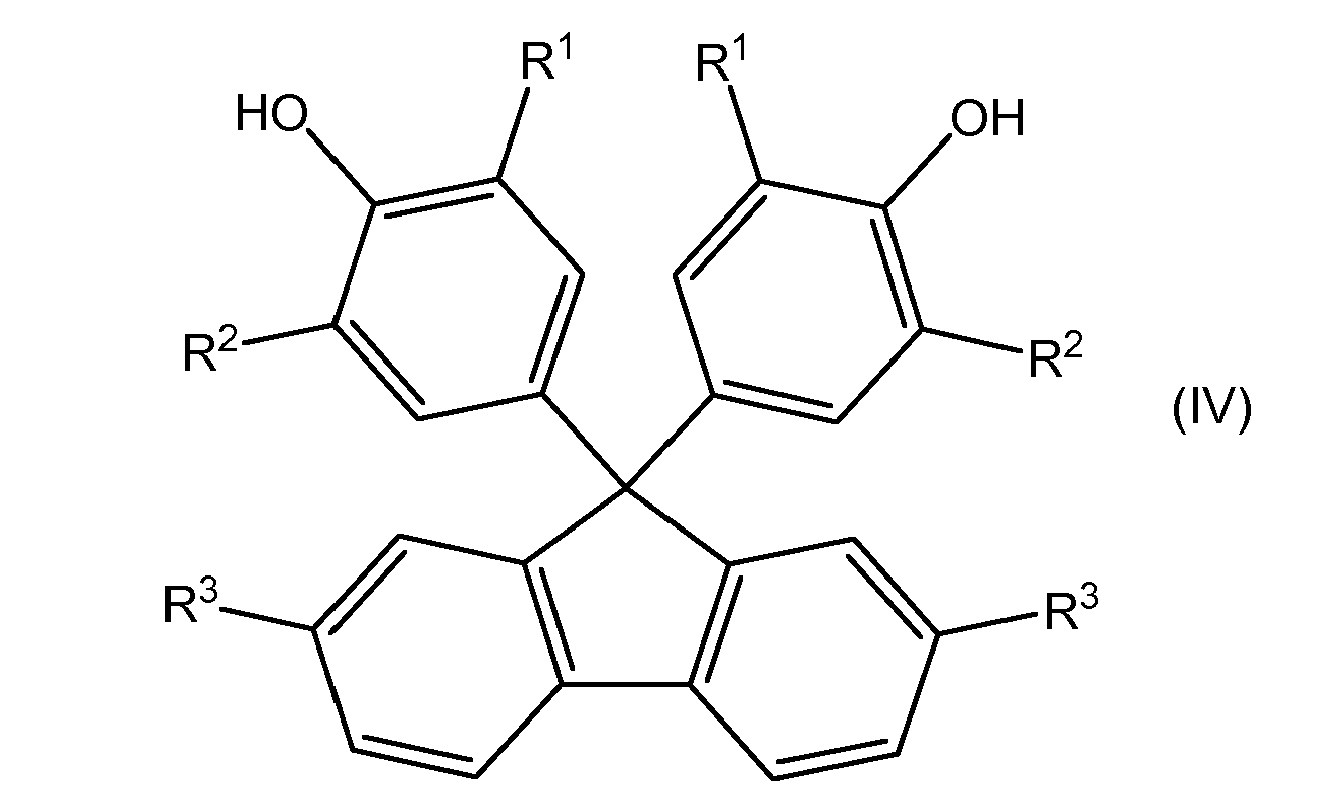
- Bisphenole der Formel (IV) sind grundsätzlich bekannt. Die Herstellung ist beispielsweise
US 5,304,688 A offenbart, deren Inhalt hiermit durch Referenz vollumfänglich miteingeschlossen wird. - Als Bisphenol der Formel (IV) ist besonders geeignet ein Bisphenol, welches ausgewählt ist aus der Gruppe bestehend aus 4,4'-(2,7-diethyl-9H-fluorene-9,9-diyl)bis(2,6-diethylphenol), 4,4'-(2,7-diethyl-9H-fluorene-9,9-diyl)bis-(2,6-diisopropylphenol), 4,4'-(2,7-diethyl-9H-fluorene-9,9-diyl)bis(2,6-di-tert-butylphenol), 4,4'-(2,7-diethyl-9H-fluorene-9,9-diyl)bis(2-ethyl-6-isopropylphenol), 4,4'-(2,7-diethyl-9H-fluorene-9,9-diyl)bis(2-ethylphenol), 4,4'-(2,7-diethyl-9H-fluorene-9,9-diyl)bis(2-methylphenol), 4,4'-(2,7-diethyl-9H-fluorene-9,9-diyl)diphenol, 4,4'-(2,7-dimethyl-9H-fluorene-9,9-diyl)bis(2,6-diisopropylphenol), 4,4'-(2,7-dimethyl-9H-fluorene-9,9-diyl)bis(2,6-dimethylphenol), 4,4'-(2,7-dimethyl-9H-fluorene-9,9-diyl)bis(2,6-di-tert-butylphenol), 4,4'-(2,7-dimethyl-9H-fluorene-9,9-diyl)bis(2-ethylphenol), 4,4'-(2,7-dimethyl-9H-fluorene-9,9-diyl)bis(2-methylphenol), 4,4'-(2,7-dimethyl-9H-fluorene-9,9-diyl)bis(2-tert-butylphenol), 4,4'-(2,7-dimethyl-9H-fluorene-9,9-diyl)diphenol, 4,4'-(9H-fluorene-9,9-diyl)bis(2,6-diethylphenol), 4,4'-(9H-fluorene-9,9-diyl)bis(2,6-diisopropylphenol), 4,4'-(9H-fluorene-9,9-diyl)bis(2,6-dimethylphenol), 4,4'-(9H-fluorene-9,9-diyl)bis(2,6-di-tert-butylphenol), 4,4'-(9H-fluorene-9,9-diyl)bis(2-cyclohexylphenol), 4,4'-(9H-fluorene-9,9-diyl)bis(2-ethylphenol), 4,4'-(9H-fluorene-9,9-diyl)bis(2-methylphenol), 4,4'-(9H-fluorene-9,9-diyl)bis(2-tert-butylphenol) and 4,4'-(9H-fluorene-9,9-diyl)diphenol.
- Bevorzugtes Bisphenol der Formel (IV) ist 4,4'-(9H-fluorene-9,9-diyl)diphenol (=4,4'-(9H-Fluoren-9-yliden)bisphenol = 9,9-Bis(4-hydroxyphenyl)fluoren)).
- In einem weiteren Aspekt betrifft die vorliegende Erfindung auch Epoxidgruppen aufweisende Schlagzähigkeitsmodifikatoren der Formel (II).

- Hierbei steht R4 steht für einen zweiwertigen aliphatischen oder einkernigen aromatischen oder einen zweikernigen aromatischen Rest.
- Die Reste Y1, R1, R2, R3 sowie der Index n wurden bereits vorgängig für den Schlagzähigkeitsmodifikator der Formel (I) definiert und deren bevorzugten Ausführungsformen im Detail erörtert.
- Als besonders bevorzugt gilt, dass der Rest R4 die Formel (III) aufweist

- Die Epoxidgruppen aufweisende Schlagzähigkeitsmodifikatoren der Formel (II) lassen sich in einfacher Art und Weise aus einem Schlagzähigkeitsmodifikator der Formel (I) durch Umsetzung mit einem Digylcidylether erhalten. Somit stellt der Schlagzähigkeitsmodifikator der Formel (I) ein Zwischenprodukt für den Epoxidgruppen aufweisenden Schlagzähigkeitsmodifikator der Formel (11) dar.
- Konkret erfolgt die Herstellung des Epoxidgruppen aufweisenden Schlagzähigkeitsmodifikator der Formel (11) durch ein Verfahren, in welchem ein Schlagzähigkeitsmodifikator der Formel (I), wie er vorgängig im Detail beschreiben wurde, mit einem Diglycidylether der Formel (V) in einem Verhältnis der Anzahl Glycidyl-Gruppen zu Anzahl phenolischer Gruppen von 2 oder grösser als 2, insbesondere zwischen 2 und 10, bevorzugt zwischen 2.1 und 8, umgesetzt wird.

- Als Diglycidylether der Formel (V) gelten insbesondere
- Diglycidylether von difunktionellen gesättigten oder ungesättigten, verzweigten oder unverzweigten, zyklischen oder offenkettigen C2 - C30 Alkolen, wie beispielsweise Ethylenglykol-, Butandiol-, Hexandiol-, Oktandiolgylcidylether, Cyclohexandimethanoldigylcidylether, Neopentylglycoldiglycidylether;
- Diglycidylether von difunktionellen, nieder- bis hochmolekularen Polyetherpolyolen wie beispielsweise Polyethylenglycol-diglycidylether, Polypropyleneglycol-diglycidylether;
- Diglycidylether von difunktionellen Diphenolen, wie sie bereits für die Polyphenole (QPP) vorgängig besprochen wurden.
- Besonders bevorzugt als Diglycidylether der Formel (V) sind sogenannte Epoxid-Flüssigharze der Formel (A-I) und Epoxid-Festharze der Formel (A-II).


- Hierbei stehen die Substituenten R'" und R"" unabhängig voneinander entweder für H oder CH3.
- Weiterhin steht der Index r für einen Wert von 0 bis 1. Bevorzugt steht r für einen Wert von kleiner als 0.2.
- Weiterhin steht der Index s für einen Wert von >1, insbesondere > 1.5, insbesondere von 2 bis 12.
- Der Term "unabhängig voneinander" in der Definition von Gruppen und Resten bedeutet in diesem Dokument jeweils, dass mehrere vorkommende aber in den Formeln gleich bezeichnete Gruppen jeweils unterschiedliche Bedeutungen aufweisen können.
- Verbindungen der Formel (A-II) mit einem Index s zwischen 1 und 1.5 werden vom Fachmann als Semisolid-Epoxidharze bezeichnet. Für die hier vorliegende Erfindung werden sie ebenfalls als Festharze betrachtet. Bevorzugt als sind jedoch Epoxid-Festharze im engeren Sinn, d.h. wo der Index s einen Wert von > 1.5 aufweist.
- Derartige Epoxid-Festharze sind kommerziell erhältlich beispielsweise von Dow oder Huntsman oder Hexion. Solche Epoxid-Flüssigharze sind beispielsweise als Araldite® GY 250, Araldite® PY 304, Araldite® GY 282 (Huntsman, bzw. Hexion) oder D.E.R.™ 331 oder D.E.R.™ 330 (Dow) oder D.E.R.™ 332 (Dow) oder Epikote 828 (Hexion) erhältlich.
- Bevorzugt handelt es beim Diglycidylether der Formel (V) um einen Epoxid-Flüssigharz, insbesondere um einen Diglycidylether von Bisphenol-A (DGEBA), von Bisphenol-F sowie von Bisphenol-A/F.
- In einer Ausführungsform ist der Diglycidylether der Formel (V) ein mit einem Bisphenol, insbesondere ein Bisphenol der Formel (IV), verlängerter Diglycidylether, wie sie gerade vorgängig beschrieben wurden. Eine derartige Verlängerung erfolgt insbesondere, wenn ein Diglycidylether, insbesondere ein Diglycidylether von Bisphenol-A (DGEBA) oder von Bisphenol-F mit einem Bisphenol bei erhöhter Temperatur umgesetzt werden. Es ist vorteilhaft, dass ein derartiger Bisphenol-verlängerter Diglycidylether mit nicht verlängertem Diglycidylether eingesetzt wird.
- Die Umsetzung zwischen Schlagzähigkeitsmodifikator der Formel (I) und dem Diglycidylether der Formel (V) bei Temperaturen über 100°C, insbesondere bei Temperaturen zwischen 110 und 200°C.
- Sowohl die Schlagzähigkeitsmodifikatoren der Formel (I) als auch die Epoxidgruppen aufweisenden Schlagzähigkeitsmodifikatoren der Formel (II) sind bei Raumtemperatur typischerweise flüssig. Sie sind insbesondere hochviskos, aber immer noch fliessfähig. Es hat sich gezeigt, dass sie insbesondere honigartiges Fliessverhalten aufweisen.
- Es hat sich weiterhin gezeigt, dass sowohl die Schlagzähigkeitsmodifikatoren der Formel (I) als auch die Epoxidgruppen aufweisenden Schlagzähigkeitsmodifikatoren der Formel (II) als Schlagzähigkeitsmodifikator wirksam sind, d.h. sie bewirken als Zusatz zu einer Epoxidharzmatrix bereits bei geringen Zuschlägen von 0.1 - 50 Gew.-%, insbesondere von 0.5 - 40 Gew.-%, eine deutliche Zunahme der Zähigkeit.
- Somit betrifft die vorliegende Erfindung auch die Verwendung eines Schlagzähigkeitsmodifikators der Formel (I) oder (II) zur Erhöhung der Schlagzähigkeit einer Epoxidharzmatrix.
- Somit stellt in einem weiteren Aspekt der vorliegenden Erfindung eine Zusammensetzung dar, welche umfasst:
- mindestens ein Epoxid-Flüssigharz oder Epoxid-Festharz (A);
- mindestens ein Schlagzähigkeitsmodifikator der Formel (I) oder (11)
- mindestens einen Härter (B) für Epoxidharze.
- Als Epoxid-Flüssigharz oder Epoxid-Festharz (A) gelten insbesondere die bereits vorgängig als für den Diglycidylether der Formel (V) geeignet beschriebenen Epoxid-Flüssigharze oder Epoxid-Festharze.
- Meist bevorzugt als Epoxid-Flüssigharz oder Epoxid-Festharz (A) sind Epoxid-Flüssigharz, insbesondere Diglycidylether von Bisphenol-A (DGEBA), von Bisphenol-F sowie von Bisphenol-A/F.
- Der Anteil an Epoxidharzes (A) beträgt vorzugsweise 10 - 85 Gew.-%, insbesondere 15 - 70 Gew.-%, bevorzugt 15 - 60 Gew.-%, am Gewicht der Zusammensetzung.
- Der Anteil an Schlagzähigkeitsmodifikator der Formel (I) oder (11) beträgt vorzugsweise 1 - 45 Gew.-%, insbesondere 3 - 35 Gew.-%, am Gewicht der Zusammensetzung.
- Als Härter (B) für Epoxidharze gelten in einer Ausführungsform insbesondere Polyamine, Polymerkaptane, Polyamidoamine, Aminofunktionelle Polyamin/Polyepoxid-Addukte, wie sie dem Fachmann als Härter bestens bekannt sind. In dieser Ausführungsform stellt die Zusammensetzung eine zweikomponentige Epoxidharzzusammensetzung dar, welche aus zwei Komponenten, d.h. einer ersten Komponente (K1) und einer zweiten Komponente (K2) besteht. Die erste Komponente (K1) umfasst zumindest das Epoxid-Flüssigharz oder Epoxid-Festharz (A) sowie den Schlagzähigkeitsmodifikator der Formel (I) oder (II). Die zweite Komponente (K2) umfasst zumindest einen Härter (B) für Epoxidharze. Die erste Komponente (K1) und die zweite Komponente (K2) werden je in einem individuellen Behälter aufbewahrt. Erst beim Zeitpunkt des erwünschten Gebrauchs werden die zwei Komponenten miteinander gemischt und die reaktiven Bestandteile reagieren miteinander und führen so zu einer Vernetzung der Zusammensetzung. Derartige zweikomponentige Epoxidharzzusammensetzungen sind bereits bei tiefen Temperaturen, typischerweise zwischen 0° bis 100°C, insbesondere bei Raumtemperatur, aushärtbar. In dieser Ausführungsform erfolgt die Härtung durch eine Additionsreaktion zwischen Härter und der in der Zusammensetzung vorhanden Epoxidgruppen aufweisenden Verbindungen. Somit ist es in dieser Ausführungsform besonders vorteilhaft, wenn die Menge des Härters in der gesamten Zusammensetzung so bemessen ist, dass die Epoxid-reaktiven Gruppen in einem stöchiometrischen Verhältnis zu den Epoxid-Gruppen stehen.
- In einer weiteren und bevorzugten Ausführungsform stellt der Härter (B) für Epoxidharze ein Härter (B-1) für Epoxidharze dar, welcher durch erhöhte Temperatur aktiviert wird, dar. In dieser Ausführungsform stellt die Zusammensetzung eine hitzehärtende Epoxidharzzusammensetzung dar.
- Unter "erhöhter Temperatur" wird in diesem Dokument eine Temperatur über 100°C, insbesondere zwischen 110°C und 200°C, verstanden.
- Beim Härter (B-1) für Epoxidharze, welcher durch erhöhte Temperatur aktiviert wird, handelt es sich hierbei vorzugsweise um einen Härter, welcher ausgewählt ist aus der Gruppe bestehend aus Dicyandiamid, Guanamine, Guanidine, Aminoguanidine und deren Derivate. Weiterhin möglich sind beschleunigend wirksame Härter, wie substituierte Harnstoffe, wie beispielsweise 3-Chlor-4-Methylphenylharnstoff (Chlortoluron), oder Phenyl-Dimethylharnstoffe, insbesondere p-Chlorphenyl-N,N-dimethylharnstoff (Monuron), 3-Phenyl-1,1-dimethylharnstoff (Fenuron) oder 3,4-Dichlorphenyl-N,N-dimethylharnstoff (Diuron). Weiterhin können Verbindungen der Klasse der Imidazole, wie 2-Isopropylimidazol oder 2-Hydroxy-N-(2-(2-(2-hydroxyphenyl)-4,5-dihydroimidazol-1-yl)ethyl)benzamid und Amin-Komplexe eingesetzt werden.
- Bevorzugt handelt es sich beim Härter B-1 um einen Härter, welcher ausgewählt ist aus der Gruppe bestehend aus Dicyandiamid, Guanamine, Guanidine, Aminoguanidine und deren Derivate; substituierte Harnstoffe, insbesondere 3-Chlor-4-Methylphenylharnstoff (Chlortoluron), oder Phenyl-Dimethylharnstoffe, insbesondere p-Chlorphenyl-N,N-dimethylharnstoff (Monuron), 3-Phenyl-1,1-dimethylharnstoff (Fenuron), 3,4-Dichlorphenyl-N,N-dimethylharnstoff(Diuron), sowie Imidazole und Amin-Komplexe.
- Besonders bevorzugt als Härter B-1 ist Dicyandiamid.
- Vorteilhaft beträgt der Gesamtanteil des Härters (B-1) für Epoxidharze, welcher durch erhöhte Temperatur aktiviert wird, 0.5 - 12 Gewichts-%, vorzugsweise 1 - 8 Gewichts-%, bezogen auf das Gewicht der gesamten Zusammensetzung.
- Bevorzugt ist, dass die Zusammensetzung weiterhin mindestens einen Schlagzähigkeitsmodifikator (SM) umfasst, welcher verschieden von den bereits beschriebenen Schlagzähigkeitsmodifikatoren, d.h. Schlagzähigkeitsmodifikatoren der Formel (I) oder (II), ist.
- Die zusätzlichen Schlagzähigkeitsmodifikatoren (SM) können fest oder flüssig sein.
- In einer Ausführungsform ist dieser Schlagzähigkeitsmodifikatoren (SM) ein Flüssigkautschuk (SM1), welcher ein carboxyl- oder epoxidterminiertes Acrylnitril/Butadien-Copolymer oder ein Derivat davon ist. Derartige Flüssigkautschuke sind beispielsweise unter dem unter dem Namen Hypro™(früher Hycar®) CTBN und CTBNX und ETBN von Nanoresins AG, Deutschland, bzw. Emerald Performance Materials LLC) kommerziell erhältlich. Als Derivate sind insbesondere Epoxidgruppen aufweisende Elastomer-modifizierte Prepolymere, wie sie unter der Produktelinie Polydis®, vorzugsweise aus der Produktelinie Polydis® 36.., von der Firma Struktol® (Schill+Seilacher Gruppe, Deutschland) oder unter der Produktelinie Albipox (Nanoresins, Deutschland) kommerziell vertrieben werden, geeignet.
- In einer weiteren Ausführungsform ist der Schlagzähigkeitsmodifikator (SM) ein Polyacrylatflüssigkautschuk (SM1), der mit flüssigen Epoxidharzen vollständig mischbar ist und sich erst beim Aushärten der Epoxidharzmatrix zu Mikrotröpfchen entmischt. Derartige Polyacrylatflüssigkautschuke sind beispielsweise unter der Bezeichnung 20208-XPA von Rohm und Haas erhältlich.
- Es ist dem Fachmann klar, dass natürlich auch Mischungen von Flüssigkautschuken verwendet werden können, insbesondere Mischungen von carboxyl-oder epoxidterminiertes Acrylnitril/Butadien-Copolymeren oder Derivaten davon mit epoxidterminierten Polyurethanprepolymeren.
- In einer weiteren Ausführungsform ist der Schlagzähigkeitsmodifikator (SM) ein fester Schlagzähigkeitsmodifikator, welcher ein organisches lonen-getauschtes Schichtmineral ist.
- Das lonen-getauschte Schichtmineral kann entweder ein Kationen-getauschtes Schichtmineral oder ein Anionen-getauschtes Schichtmineral sein.
- Das Kationen-getauschte Schichtmineral wird hierbei erhalten aus einem Schichtmineral, bei welchem zumindest ein Teil der Kationen durch organische
- Kationen ausgetauscht worden sind. Beispiele für derartige Kationen-getauschte Schichtmineralien sind insbesondere diejenigen, welche in
US 5,707,439 oder inUS 6,197,849 erwähnt sind. Ebenso ist dort das Verfahren zur Herstellung dieser Kationen-getauschten Schichtminerale beschrieben. Bevorzugt als Schichtmineral ist ein Schichtsilikat. Insbesondere bevorzugt handelt es sich beim Schichtmineral um ein Phyllosilikat, wie sie inUS 6,197,849 Spalte 2, Zeile 38 bis Spalte 3, Zeile 5 beschrieben sind, insbesondere um einen Bentonit. Als besonders geeignet haben sich Schichtmineral wie Kaolinit oder ein Montmorillionit oder ein Hectorit oder ein Illit gezeigt. - Zumindest ein Teil der Kationen des Schichtminerals wird durch organische Kationen ersetzt. Beispiele für derartige Kationen sind n-Octylammonium, Trimethyldodecylammonium, Dimethyldodecylammonium oder Bis(hydroxyethyl)-octadecylammonium oder ähnliche Derivate von Aminen, die aus natürlichen Fetten und Ölen gewonnen werden können; oder Guanidinium Kationen oder Amidiniumkationen; oder Kationen der N-substituierten Derivate von Pyrrolidin, Piperidin, Piperazin, Morpholin, Thiomorpholin; oder Kationen von 1,4-Diazobicyclo[2.2.2]octan (DABCO) und 1-Azobicyclo[2.2.2]octan; oder Kationen von N-substituierten Derivaten von Pyridin, Pyrrol, Imidazol, Oxazol, Pyrimidin, Chinolin, Isochinoilin, Pyrazin, Indol, Bezimidazol, Benzoxaziol, Thiazol Phenazin und 2,2'-Bipyridin. Weiterhin sind geeignet cyclische Amidiniumkationen, insbesondere solche, wie sie in
US 6,197,849 in Spalte 3 Zeile 6 bis Spalte 4 Zeile 67 offenbart werden. Cyclische Ammoniumverbindungen zeichnen sich gegenüber linearen Ammoniumverbindungen durch eine erhöhte Thermostabilität aus, da der thermische Hoffmann - Abbau bei ihnen nicht auftreten kann. - Bevorzugte Kationen-getauschte Schichtminerale sind dem Fachmann unter dem Term Organoclay oder Nanoclay bekannt und sind kommerziell zum Beispiel unter den Gruppennamen Tixogel® oder Nanofil® (Südchemie), Cloisite® (Southern Clay Products) oder Nanomer® (Nanocor Inc.) oder Garmite® (Rockwood) erhältlich.
- Das Anionen-getauschte Schichtmineral wird hierbei erhalten aus einem Schichtmineral, bei welchem zumindest ein Teil der Anionen durch organische Anionen ausgetauscht worden sind. Ein Beispiel für ein derartig Anionen-getauschtes Schichtmineral ist ein Hydrotalcit, bei dem zumindest ein Teil der Carbonat-Anionen der Zwischenschichten durch organische Anionen ausgetauscht wurden.
- Es ist durchaus auch möglich, dass die Zusammensetzung gleichzeitig ein Kationen-getauschtes Schichtmineral und ein Anionen-getauschtes Schichtmineral enthält.
- In einer weiteren Ausführungsform ist der Schlagzähigkeitsmodifikator (SM) ein fester Schlagzähigkeitsmodifikator, welcher ein Blockcopolymer (SM2), ist. Das Blockcopolymer (SM2) wird erhalten aus einer anionischen oder kontrollierten radikalischen Polymerisation von Methacrylsäureester mit mindestens einem weiteren eine olefinisch Doppelbindung aufweisenden Monomeren. Als eine olefinische Doppelbindung aufweisende Monomere sind insbesondere solche bevorzugt, bei denen die Doppelbindung unmittelbar mit einem Heteroatom oder mit mindestens einer weiteren Doppelbindung konjugiert ist. Insbesondere sind Monomere geeignet, welche ausgewählt sind aus der Gruppe umfassend Styrol, Butadien, Acrylnitril und Vinylacetat. Bevorzugt sind Acrylat-Styrol-Acrylsäure (ASA) Copolymere, erhältlich z.B. unter dem Namen GELOY 1020 von GE Plastics.
- Besonders bevorzugte Blockcopolymere (SM2) sind Blockcopolymere aus Methacrylsäuremethylester, Styrol und Butadien. Derartige Blockcopolymere sind beispielsweise als Triblockcopolymere unter der Gruppenbezeichnung SBM bei Arkema erhältlich.
- In einer weiteren Ausführungsform ist der Schlagzähigkeitsmodifikator (SM) ein Core-Shell Polymer (SM3). Core-Shell-Polymere bestehen aus einem elastischen Kernpolymer und einem starren Schalen-Polymer. Insbesondere geeignete Core-Shell-Polymere bestehen aus einem Kern (Core) aus elastischem Acrylat- oder Butadien-Polymer, den eine starre Schale (Shell) eines starren thermoplastischen Polymers umhüllt. Diese Core-Shell Struktur bildet sich entweder spontan durch Entmischen eines Blockcopolymeren oder ist durch die Polymerisationsführung als Latex oder Suspensions-polymerisation mit nachfolgender Pfropfung vorgegeben. Bevorzugte Core-Shell-Polymere sind sogenannte MBS Polymere, welche kommerziell unter dem Handelsnamen Clearstrength™ von Atofina, Paraloid™ von Rohm and Haas oder F-35 1™ von Zeon erhältlich sind.
- Besonders bevorzugt sind Core-Shell Polymerpartikel, die bereits als getrockneter Polymerlatex vorliegen. Beispiele hierfür sind GENIOPERL M23A von Wacker mit Polysiloxankern und Acrylatschale, strahlungsvernetzte Kautschukpartikel der NEP Reihe, hergestellt von Eliokem oder Nanoprene von Lanxess oder Paraloid EXL von Rohm und Haas.
- Weitere vergleichbare Beispiele für Core-Shell-Polymere werden unter dem Namen Albidur™ von Nanoresins AG, Deutschland, angeboten.
- Ebenso geeignet sind nanosklaige Silikate in Epoxid-Matiix, wie sie unter dem Handelnamen Nonopox von Nanoresins AG, Deutschland, angeboten werden.
- In einer weiteren Ausführungsform ist der Schlagzähigkeitsmodifikator (SM) ein Umsetzungsprodukt (SM4) eines carboxylierten festen Nitrilkautschuks mit überschüssigem Epoxidharz.
- Besonders geeignet als in der Zusammensetzung gegebenenfalls vorhandenem Schlagzähigkeitsmodifikator (SM) sind jene, wie sie in den folgenden Artikel bzw. Patentschriften, deren Inhalt hiermit durch Referenz miteingeschlossen wird, offenbart sind:
EP 0 308 664 A1 , insbesondere Formel (I), besonders Seite 5, Zeile 14 bis Seite 13, Zeile 24;EP 0 338 985 A1 ,EP 0 353 190 A1 ,WO 00/20483 A1 WO 01/94492 A1 WO 03/078163 A1 WO 2005/007766 A1 , insbesondere Formel (I) oder (II), besonders Seite 4, Zeile 5 bis Seite 11 bis Zeile 20;EP 1 728 825 A1 , insbesondere Formel (I), besonders Seite 3, Zeile 21 bis Seite 4 bis Zeile 47;WO 2006/052726 A1 , insbesondere das als b) bezeichnete amphiphilic block copolymer, besonders Seite 6, Zeile 17 bis Seite 9, Zeile 10;WO 2006/052729 A1 , insbesondere das als b) bezeichnete amphiphilic block copolymer, besonders Seite 6, Zeile 25 bis Seite 10, Zeile 2; T.J. Hermel-Davidock et al., J.Polym. Sci. Part B: Polym. Phys. 2007, 45, 3338-3348, insbesondere die ambiphilen Blockcopolymere, besonders Seite 3339, 2. Spalte bis 3341 2.Spalte;WO 2004/055092 A1 , insbesondere Formel (I), besonders Seite 7, Zeile 28 bis Seite 13 bis Zeile 15;.WO 2005/007720 A1 , insbesondere Formel (I), besonders Seite 8, Zeile 1 bis Seite 17 bis Zeile 10;WO 2007/020266 A1 , insbesondere Formel (I), besonders Seite 3, Zeile 1 bis Seite 11 bis Zeile 6,US 2009/0264558 A1 , insbesondere Formel (I),US 2009/0288766 A1 , insbesondere Formel (I) und (II),US 2010/0009196 A1 , insbesondere Formel (I),US 2010/0035041 A1 , insbesondere Formel (I),US 2010/0087588 A1 , insbesondere Formel (I), (II) und (XI),US 2010/0048828 A1 , insbesondere Formel (I), (II) und (XI),US 2010/0184924 A1 , insbesondere Formel (I), (II) und (XI),US 2010/0087567 A1 , insbesondere Formel (I),WO 2010/007150 A1 , insbesondere Formel (I), sowieDE-A-2 123 033 ,US 2008/0076886 A1 ,WO 2008/016889 undWO 2007/025007 . - Es hat sich gezeigt, dass in der Zusammensetzung vorteilhaft mehrere Schlagzähigkeitsmodifikator vorhanden sind, insbesondere auch mehrere Schlagzähigkeitsmodifikatoren (SM).
- Als besonders vorteilhaft hat sich gezeigt, dass ein derartiger weiterer Schlagzähigkeitsmodifikator (SM) ein Epoxidgruppenden aufweisender Schlagzähigkeitsmodifikator der Formel (VI) ist.

- Hierbei steht R7 für einen zweiwertigen Rest eines Carboxylgruppen-terminierten Butadien/Acrylonitril-Copolymers (CTBN) nach Entfernung der terminalen Carboxylgruppen. Der Rest R4 wurde bereits vorgängig definiert und beschrieben.
- Insbesondere steht R7 für einen Rest, wie er durch formelle Entfernung der Carboxyl-Gruppen eines unter dem Namen Hypro® CTBN von Noveon kommerziell vertriebenen Carboxylgruppen-terminierten Butadien/Acrylonitril-Copolymers CTBN, erhalten wird. Bevorzugt R7 für einen zweiwertigen Rest der Formel (VI').

- R0 steht hierbei für einen linearen oder verzweigten Alkylenrest mit 1 bis 6 C-Atomen, insbesondere mit 5 C-Atomen, welcher gegebenenfalls mit ungesättigten Gruppen substituiert ist. In einer besonders zu erwähnende Ausführungsform stellt der Substituent R0 einen Rest der Formel (VI-a) dar.

- Weiterhin steht der Index q' für einen Wert zwischen 40 und 100, insbesondere zwischen 50 und 90. Weiterhin stellen die Bezeichnungen b und c die Strukturelemente, welche von Butadien stammen und a das Strukturelement, welches von Acrylonitril stammt, dar. Die Indices x, m', und p' stellen ihrerseits Werte dar, die das Verhältnis der Strukturelement a, b und c zueinander beschreiben. Der Index x steht für Werte von 0.05 - 0.3, der Index m' für Werte von 0.5 - 0.8, der Index p für Werte von 0.1 - 0.2 mit der Voraussetzung, dass die Summe von x, m' und p gleich 1 ist.
- Dem Fachmann ist klar, dass die in Formel (VI') gezeigte Struktur als vereinfachte Darstellung zu verstehen sind. Somit können die Bausteine a, b und c jeweils zufällig, abwechselnd oder blockweise zueinander angeordnet sein. Insbesondere stellt somit Formel (VI') nicht zwangsläufig ein Triblock-Copolymer dar.
- Die Herstellung des Schlagzähigkeitsmodifikator der Formel (VI) erfolgt durch die Umsetzung eines Carboxylgruppen-terminierten Butadien/Acrylonitril-Copolymers (CTBN) insbesondere der Formel (VII), mit einem Diglycidylether der Formel (V) in einem stöchiometrischen Überschuss des Diglycidylethers, d.h. dass das Verhältnis der Glycidylether-Gruppen zu COOH-Gruppen


- Bei dieser Umsetzung erfolgt eine Esterbildung. Derartige Umsetzungen von Epoxiden, bzw. Glycidylethern, mit Carbonsäuren sind dem Fachmann bekannt sowie die Reaktionsbedingungen hierfür. Insbesondere werden höhere Temperaturen, typischerweise bei Temperaturen von 100°C, bevorzugt um 140°C, und gegebenenfalls Katalysatoren eingesetzt und vorzugsweise unter Schutzgas. Beispiele für derartige Katalysatoren für die Esterbildung sind Triphenylphosphin, tertiäre Amine, quaternäre Phosphoniumsalze oder quaternäre Ammoniumsalze.
- Es hat sich gezeigt, dass es vorteilhaft ist, mehrere Schlagzähigkeitsmodifikatoren (SM) kombiniert einzusetzen.
- In einer besonders bevorzugten Ausführungsform erfolgt die Herstellung des Epoxidgruppen aufweisenden Schlagzähigkeitsmodifikators der Formel (II) und des Epoxidgruppenden aufweisenden Schlagzähigkeitsmodifikators der Formel (VI) gleichzeitig miteinander. Hierbei wird in einem ersten Schritt ein Schlagzähigkeitsmodifikator der Formel (I), wie vorgängig beschrieben hergestellt, anschliessend wird in einem weiteren Schritt das Carboxylgruppenterminierte Butadien/Acrylonitril-Copolymers (CTBN), allenfalls eine geringe Menge Bisphenol der Formel (IV), und der Diglycidylether der Formel (V) zugegeben. Anschliessend erfolgt vorzugsweise die Zugabe eines Katalysators für die Esterbildung. Die Umsetzung erfolgt durch Aufheizen der Reaktionsmischung. Falls noch Bisphenol der Formel (IV) zugegeben wird, wird zusätzlich zu dem Epoxidgruppen aufweisenden Schlagzähigkeitsmodifikator der Formel (II) und dem Epoxidgruppenden aufweisenden Schlagzähigkeitsmodifikator der Formel (VI) im Wesentlichen auch noch ein Bisphenol-verlängerter Diglycidylether in situ gebildet, wie es bereits bei der Diskussion des Diglycidylethers der Formel (V) beschrieben wurde. Dies ist besonders vorteilhaft.
- Es ist dem Fachmann klar, dass in einer derartigen Eintopfreaktion auch noch andere Reaktionsprodukte gebildet werden. Die Art und Menge derartiger Nebenprodukte kann insbesondere über die Stöchiometrie beeinflusst werden. Bevorzugt wird diese so gewählt, dass die Menge dieser im vorherigen Abschnitt besprochenen Reaktionsprodukte möglichst gross ist.
- Der Anteil des vorgängig beschriebenen von Schlagzähigkeitsmodifikator der Formel (I) oder (II) verschiedenen Schlagzähigkeitsmodifikators (SM) beträgt vorzugsweise 1 - 45 Gew.-%, insbesondere 3 - 35 Gew.-%, am Gewicht der Zusammensetzung.
- Es hat sich gezeigt, dass es vorteilhaft ist, mehrere Schlagzähigkeitsmodifikatoren (SM) kombiniert einzusetzen.
- Es ist weiterhin bevorzugt, dass die Menge an
- Schlagzähigkeitsmodifikator(en) der Formel (I) oder (II) grösser als die Menge an weiteren von Schlagzähigkeitsmodifikator(en) der Formel (I) oder (II) verschiedenen Schlagzähigkeitsmodifikator(en) (SM) ist.
- Die Zusammensetzung kann selbstverständlich noch andere Bestandteile umfassen. Insbesondere sind dies Füllstoff (F), Epoxidgruppen-tragende Reaktivverdünner (G) sowie Katalysatoren, Stabilisatoren, insbesondere Hitze- und/oder Lichtstabilisatoren, Thixotropiermittel, Weichmacher, Lösungsmittel, mineralische oder organische Füllstoffe, Treibmittel, Farbstoffe und Pigmente, Korrosionsschutzmittel, Tenside, Entschäumer und Haftvermittler umfassen.
- Bei den Füllstoffen (F) handelt es sich hierbei bevorzugt um Glimmer, Talk, Kaolin, Wollastonit, Feldspat, Syenith, Chlorit, Bentonit, Montmorillonit, Calciumcarbonat (gefällt oder gemahlen), Dolomit, Quarz, Kieselsäuren (pyrogen oder gefällt), Cristobalit, Calciumoxid, Aluminiumhydroxid, Magnesiumoxid, Keramikhohlkugeln, Glashohlkugeln, organische Hohlkugeln, Glaskugeln, Farbpigmente. Als Füllstoff (F) sind sowohl die organisch beschichteten als auch die unbeschichteten kommerziell erhältlichen und dem Fachmann bekannten Formen gemeint.
- Vorteilhaft beträgt der Gesamtanteil des gesamten Füllstoffs (F) 3 - 50 Gewichts-%, vorzugsweise 5 - 35 Gewichts-%, insbesondere 5 - 25 Gewichts-%, bezogen auf das Gewicht der gesamten Zusammensetzung.
- Bei den Epoxidgruppen-tragenden Reaktivverdünnern (G) handelt es sich insbesondere um:
- Glycidylether von monofunktionellen gesättigten oder ungesättigten, verzweigten oder unverzweigten, zyklischen oder offenkettigen C4 - C30 Alkoholen, insbesondere ausgewählt aus der Gruppe bestehend aus Butanolglycidylether, Hexanolglycidylether, 2-Ethylhexanolglycidylether, Allylglycidylether, Tetrahydrofurfuryl- und Furfurylglycidylether, Trimethoxysilylglycidylether.
- Glycidylether von difunktionellen gesättigten oder ungesättigten, verzweigten oder unverzweigten, zyklischen oder offenkettigen C2 - C30 - Alkolen, insbesondere ausgewählt aus der Gruppe bestehend aus Ethylenglykol-, Butandiol-, Hexandiol-, Oktandiolgylcidylether, Cyclohexandimethanoldigylcidylether und Neopentylglycoldiglycidylether.
- Glycidylether von tri- oder polyfunktionellen, gesättigten oder ungesättigten, verzweigten oder unverzweigten, zyklischen oder offenkettigen Akoholen wie epoxidiertes Rhizinusöl, epoxidiertes Trimethylolpropan, epoxidiertes Pentaerythrol oder Polyglycidylether von aliphatischen Polyolen wie Sorbitol, Glycerin oder Trimethylolpropan.
- Glycidylether von Phenol- und Anilinverbindungen insbesondere ausgewählt aus der Gruppe bestehend aus Phenylglycidylether, Kresylglycidylether, p-tert.-Butylphenylglycidylether, Nonylphenolglycidylether, 3-n-Pentadecenyl-glycidylether (aus Cashewnuss-Schalen-Öl), N,N-Diglycidylanilin und Triglycdiyl von p-Aminophenol.
- Epoxidierte Amine wie N, N-Diglycidylcyclohexylamin.
- Epoxidierte Mono- oder Dicarbonsäuren insbesondere ausgewählt aus der Gruppe bestehend aus Neodecansäure-glycidylester, Methacrylsäureglycidylester, Benzoesäureglycidylester, Phthalsäure-, Tetra- und Hexahydrophthalsäurediglycidylester und Diglycidylester von dimeren Fettsäuren sowie Terephthalsäure- und Trimelitsäuregylcidylester.
- Epoxidierte di- oder trifunktionelle, nieder- bis hochmolekulare Polyetherpolyole, insbesondere Polyethylenglycol-diglycidylether oder Polypropyleneglycol-diglycidylether.
- Besonders bevorzugt sind Hexandioldiglycidylether, Kresylglycidylether, p-tert.-Butylphenylglycidylether, Polypropylenglycoldiglycidylether und Polyethylenglycoldiglycidylether.
- Vorteilhaft beträgt der Gesamtanteil des epoxidgruppentragenden Reaktivverdünners (G) 0.1 - 20 Gewichts-%, vorzugsweise 1 - 8 Gewichts-%, bezogen auf das Gewicht der gesamten Zusammensetzung.
- Die Zusammensetzung kann weitere Bestandteile, insbesondere Katalysatoren, Stabilisatoren, insbesondere Hitze- und/oder Lichtstabilisatoren, Thixotropiermittel, Weichmacher, Lösungsmittel, mineralische oder organische Füllstoffe, Treibmittel, Farbstoffe und Pigmente, Korrosionsschutzmittel, tenside, Entschäumer und Haftvermittler umfassen.
- Als Weichmacher eignen sich insbesondere Phenol-Alkylsulfonsäureester oder Benzolsulfonsäure-N-butylamid, wie sie als Mesamoll® bzw. Dellatol BBS von Bayer kommerziell erhältlich sind.
- Als Stabilisatoren eignen sich insbesondere gegebenenfalls substituierte Phenole, wie Butylhydroxytoluol (BHT) oder Wingstay® T (Elikem), sterisch gehinderte Amine oder N-Oxylverbindungen wie TEMPO (Evonik).
- In einer besonders bevorzugten Ausführungsform enthält die Zusammensetzung weiterhin mindestens ein physikalisches oder chemisches Treibmittel, insbesondere in einer Menge von 0.1 - 3 Gewichts-%, bezogen auf das Gewicht der Zusammensetzung. Bevorzugte Treibmittel sind chemische Treibmittel, welche beim Erhitzen, insbesondere auf eine Temperatur von 100 bis 200 °C ein Gas freisetzen.
- Es kann sich hierbei um exotherme Treibmittel handeln, wie beispielsweise Azoverbindungungen, Hydrazinderivate, Semicarbazide oder Tetrazole handeln. Bevorzugt sind Azodicarbonamid und Oxy-bis (Benzenesulfonyl-hydrazid), die bei der Zersetzung Energie freisetzen. Weiterhin geeignet sind auch endotherme Treibmittel, wie beispielsweise Natriumbicarbonat/Zitronensäure - Mischungen. Derartige chemische Treibmittel sind beispielsweise unter dem Namen Celogen™ der Firma Chemtura erhältlich. Ebenfalls geeignet sind physikalische Treib¬mittel, wie sie unter dem Handelsnamen ExpanCel™ der Firma Akzo Nobel vertrieben werden.
- Besonders geeignete Treibmittel sind solche, wie sie unter dem Handelsnamen Expancel™ der Firma Akzo Nobel oder Celogen™ der Firma Chemtura erhältlich sind.
- In einer Ausführungsform, nämlich der zweikomponentige Epoxidharzzusammensetzung, erfolgt nach dem Mischen der ersten Komponente (K1) und der zweiten Komponente (K2) eine Reaktion, welches zum Aushärten der Zusammensetzung führt. Somit betrifft die vorliegende Erfindung auch eine ausgehärtete Zusammensetzung, welche aus einer Zusammensetzung vorgängig durch Mischen des Härters (B) für Epoxidharze mit dem Epoxid-Flüssigharz oder Epoxid-Festharz (A) und dem Schlagzähigkeitsmodifikator erhalten wird.
- In einer weiteren Ausführungsform, nämlich der hitzehärtende Epoxidharzzusammensetzung, erfolgt die Aushärtung durch Erhitzen der Zusammensetzung auf eine Temperatur, welche über der Hitzeaktivierung des thermisch aktivierbaren Härters (B-1) liegt. Diese Temperatur Aushärtetemperatur ist vorzugsweise eine Temperatur von 100 - 220 °C, vorzugsweise 120 - 200°C.
- Die Zusammensetzung eignet sich bestens als Klebstoff und werden zum Verkleben von mindestens zwei Substraten verwendet.
- Somit betrifft die vorliegende Erfindung in einem weiteren Aspekt einen Verbundkörper dar. Dieser Verbundkörper wird in einer ersten Ausführungsform erhalten aus einem Verkleben von mindestens zwei Substraten mittels einer gemischten Zusammensetzung, wobei die gemischte Zusammensetzung ihrerseits durch Mischung des Härters (B) für Epoxidharze mit dem Epoxid-Flüssigharz oder Epoxid-Festharz (A) und dem Schlagzähigkeitsmodifikator, wie vorgängig beschrieben erhalten wurde.
- Der Verbundkörper wird in einer zweiten Ausführungsform erhalten aus einem Verkleben von mindestens zwei Substraten einer Zusammensetzung, wie vorgängig beschrieben, und einem Erhitzen der Zusammensetzung auf eine Temperatur, welche über der Hitzeaktivierung des thermisch aktivierbaren Härters (B-1) liegt.
- Derartige Verbundkörper sind insbesondere Automobile oder An- oder Einbaumodule für Fahrzeuge. Ferner eignen sich die erfindungsgemässen Zusammensetzungen nicht nur für den Automobilbau sondern auch für andere Anwendungsgebiete. Besonders zu erwähnen sind verwandte Anwendungen im Transportmittelbau wie Schiffe, Lastwagen, Busse oder Schienenfahrzeuge oder im Bau von Gebrauchsgütern wie beispielsweise Waschmaschinen
- Die beschriebenen Zusammensetzungen zeichnen sich nach Aushärtung durch eine hohe Schlagzähigkeit sowie eine Glasübergangstemperatur von mehr als 100°C, insbesondere von mehr als 120°C, bisweilen sogar von mehr als 130°C, aus.
- Es hat sich gezeigt, dass sich die beschriebenen Zusammensetzungen besonders als Klebstoffe eignen. Ein derartiger Klebstoff weist breite Einsatzmöglichkeiten auf. Insbesondere sind hiermit Klebstoffe realisierbar, die sich durch eine hohe Schlagzähigkeit, sowohl bei höheren Temperaturen und vor allem bei tiefen Temperaturen, insbesondere zwischen 0°C bis -40°C auszeichnen. Im Falle des bevorzugten Einsatzes als hitzehärtender einkomponentiger Klebstoff eignet sich die Zusammensetzung auch für das Verkleben von hitzestabilen Materialien. Unter hitzestabilen Materialien werden Materialien verstanden, welche bei einer Aushärtetemperatur von 100 - 220 °C, vorzugsweise 120 - 200°C zumindest während der Aushärtezeit formstabil sind. Insbesondere handelt es sich hierbei um Metalle und Kunststoffe wie ABS, Polyamid, Polyphenylenether, Verbundmaterialien wie SMC, ungesättigte Polyester GFK, Epoxid- oder Acrylatverbundwerkstoffe. Bevorzugt ist die Anwendung, bei der zumindest ein Material ein Metall ist. Als besonders bevorzugte Verwendung gilt das Verkleben von gleichen oder verschiedenen Metallen, insbesondere im Rohbau in der Automobilindustrie. Die bevorzugten Metalle sind vor allem Stahl, insbesondere elektrolytisch verzinkter, feuerverzinkter, beölter Stahl, Bonazink-beschichteter Stahl, und nachträglich phosphatierter Stahl, sowie Aluminium insbesondere in den im Autobau typischerweise vorkommenden Varianten.
- Mit einem Klebstoff basierend auf einer erfindungsgemässen hitzehärtenden Zusammensetzung ist es möglich, die gewünschte Kombination von hoher Crashfestigkeit sowohl hoher als auch tiefer Einsatztemperatur zu erreichen.
- Ein solcher Klebstoff wird insbesondere zuerst mit den zu verklebenden Materialien bei einer Temperatur von zwischen 10° C und 80°C, insbesondere zwischen 10°C und 60°C, kontaktiert und später ausgehärtet bei einer Temperatur von typischerweise 100 - 220 °C, vorzugsweise 120 - 200°C.
- Es hat sich gezeigt, dass sowohl bei Raumtemperatur als auch bei tiefen Temperaturen, insbesondere bei -30°C, sehr hohe Bruchenergien erreicht werden können. So sind Bruchenergien (BE) (für Details zur Messung wird auf den Teil "Beispiele" verwiesen) bei Raumtemperaturen von mehr als 15 J, zuweilen von mehr als 17 J, und bei -30° von mehr als 10 J, zuweilen von mehr als 11 J, zugänglich. Diese sehr gute Tieftemperaturschlagzähigkeit ist umso erstaunlicher, als dass üblicherweise eine Erhöhung der Glasübergangstemperatur der ausgehärteten Epoxidharzzusammensetzung einhergeht mit einer Erniedrigung der Tieftemperaturschalgzähigkeit.
- Eine besonders bevorzugte Verwendung der erfindungsgemässen hitzehärtenden Epoxidharzzusammensetzung ist dessen Verwendung als hitzehärtender Rohbauklebstoff im Fahrzeugbau.
- 110.0 g PolyTHF®2000 (BASF) und 20.8 g Hexamethylenediisocyanat (HDI) wurden zusammen mit 0.05 g Dibutylzinndilaurat (DBTL) in einem Gefäss gemischt. Nach dem Mischen bei 60°C unter Vakuum wurde ein NCO-Gehalt von 4.1 % gemessen. Zu dem so gebildeten NCO-terminierten Polyurethapolymer wurde 35.4 g 4,4'-(9H-Fluoren-9-yliden)bisphenol (Aldrich) zugegeben und bei 135°C unter Vakuum weitergerührt, bis kein NCO mehr messbar war.
- Zu 160 g des Schlagzähigkeitsmodifikators (Bsp. 1 ) wurden 80 g Hypro™CTBNX 1300x18 (Emerald Performance Materials) und 20 g 4,4'-(9H-Fluoren-9-yliden)bisphenol (Aldrich) sowie 360 g Epoxid-Flüssigharz D.E.R. 332 (Dow) zugegeben und unter Vakuum bei 135°C gerührt, bis sich das 4,4'-(9H-Fluoren-9-yliden)bisphenol vollständig gelöst hatte. Anschliessend wurde auf 120°C abgekühlt und ein Epoxidgehalt von 3.28 eq/kg gemessen. Nun wurde 0.12 g Triphenylphosphin zugegeben und unter Rühren zur Reaktion gebracht, bis ein Epoxidgehalt von 3.1 eq/kg gemessen wurde. Es resultierte ein viskoses klares gelbliches Harz.
- Es wurden die Klebstoffzusammensetzung Z1 gemäss Tabelle 1 wie folgt hergestellt:
- In einem Planetenmischer werden alle Komponenten ausser Dicyandiamid vorgelegt und bei 90 - 100°C im Vakuum eine Stunde gerührt, dann wird Dicyandiamid zugeben und nach weiteren 10 Minuten Rühren in Kartuschen abgefüllt.
- Eine Probe der Zusammensetzung wurde zwischen zwei Teflonpapieren auf eine Schichtdicke von 2 mm verpresst. Anschliessend wurde die Zusammensetzung während 20 Minuten, resp. 30 Minuten, bei 180°C gehärtet. Die Teflonpapiere wurden entfernt und die Probekörper nach DIN-Norm wurden im heissen Zustand ausgestanzt. Die Prüfkörper wurden nach 1 Tag Lagerung unter Normklima mit einer Zuggeschwindigkeit von 2 mm/min gemessen.
- Die Zugfestigkeit ("ZF20 , 180°C", bzw. "ZF30 , 180°C") wurde gemäss DIN EN ISO 527 bestimmt.
- Die Probekörper wurden aus der beschriebenen Zusammensetzung und mit elektrolytisch verzinktem DC04 Stahl (eloZn) mit dem Mass 90 x 20 x 0.8 mm hergestellt, dabei betrug die Klebfläche 20 x 30 mm bei einer Schichtdicke von 0.3mm. Gehärtet wurde 30 Min. bei 180°C. Die Messung der Schlagschälarbeit erfolgte jeweils bei Raumtemperatur und bei minus 30°C. Die Schlaggeschwindigkeit betrug 2 m/s. Als Bruchenergie (BE) in Joule wird die Fläche unter der Messkurve (von 25% bis 90%, gemäss ISO 11343) angegeben.
- Die Resultate dieser Prüfungen wurden in Tabelle 1 angegeben.
Tabelle 1. Zusammensetzung und Resultate. Z1 D.E.R. 332 (Epoxid-Flüssigharz, Dow) [g] 27.0 Polypox R7 (tert-Butylphenyl-glycidylether, UPPC) [g] 18.0 2 [g] 168.0 Harnstoffbeschleuniger [g] 0.54 Dicyandiamid [g] 11.9 Füllstoffmischung [g] 74.7 ZF20' 180°C [MPa] 32.6 ZF30' 180°C [M Pa] 33.6 BE bei 23°C [J] 17.9 BE bei -30°C [J] 11.5
Claims (17)
- Schlagzähigkeitsmodifikator der Formel (I)

Y1 für einen n-wertigen Rest eines mit Isocyanatgruppen terminierten linearen oder verzweigten Polyurethanpolymeren (PU1) nach dem Entfernen der endständigen Isocyanatgruppen steht;
R1 je für H oder eine Alkylgruppe mit 1 bis 6 C-Atomen steht;
R2 je für H oder eine Alkylgruppe mit 1 bis 6 C-Atomen steht;
R3 je für H oder eine Alkylgruppe mit 1 bis 6 C-Atomen steht; sowie n = 2, 3 oder 4 ist. - Schlagzähigkeitsmodifikator gemäss Anspruch 1, dadurch gekennzeichnet, dass R1 = R2 = R3 = H ist.
- Schlagzähigkeitsmodifikator gemäss Anspruch 1 oder 2, dadurch gekennzeichnet, dass der Rest Y1 ein Molekulargewicht zwischen 2'000 und 10'000 g/mol aufweist.
- Epoxidgruppen aufweisender Schlagzähigkeitsmodifikator der Formel (II)

Y1 für einen n-wertigen Rest eines mit Isocyanatgruppen terminierten linearen oder verzweigten Polyurethanpolymeren PU1 nach dem Entfernen der endständigen Isocyanatgruppen steht;
R1 je für H oder eine Alkylgruppe mit 1 bis 6 C-Atomen steht;
R2 je für H oder eine Alkylgruppe mit 1 bis 6 C-Atomen steht;
R3 je für H oder eine Alkylgruppe mit 1 bis 6 C-Atomen steht;
R4 für einen zweiwertigen aliphatischen oder einkernigen aromatischen oder einen zweikernigen aromatischen Rest steht; und n = 2, 3 oder 4 ist. - Epoxidgruppen aufweisender Schlagzähigkeitsmodifikator gemäss Anspruch 4, dadurch gekennzeichnet, dass R4 die Formel (III) aufweist

- Epoxidgruppen aufweisender Schlagzähigkeitsmodifikator gemäss Anspruch 4 oder 5, dadurch gekennzeichnet, dass R1 = R2 = R3 = H ist.
- Verfahren der Herstellung eines Schlagzähigkeitsmodifikators gemäss einem der Ansprüche 1 bis 3, dadurch gekennzeichnet, dass ein mit n Isocyanatgruppen terminiertes lineares oder verzweigtes Polyurethanpolymer (PU1) der Formel Y1[NCO]n mit einem Bisphenol der Formel (IV)

- Verfahren der Herstellung eines Epoxidgruppen aufweisenden Schlagzähigkeitsmodifikators gemäss einem der Ansprüche 4 bis 6, dadurch gekennzeichnet, dass ein Schlagzähigkeitsmodifikator der Formel (I) gemäss einem der Ansprüche 1 bis 3 mit einem Diglycidylether der Formel (V)

- Zusammensetzung umfassend- mindestens ein Epoxid-Flüssigharz oder Epoxid-Festharz (A);- mindestens ein Schlagzähigkeitsmodifikator der Formel (I) oder (11) gemäss einem der Ansprüche 1 bis 6- mindestens einen Härter (B) für Epoxidharze.
- Zusammensetzung gemäss Anspruch 9, dadurch gekennzeichnet, dass die Zusammensetzung weiterhin mindestens einen Schlagzähigkeitsmodifikator (SM) umfasst, welcher verschieden vom Schlagzähigkeitsmodifikator gemäss einem der Ansprüche 1 bis 6, ist.
- Zusammensetzung gemäss Anspruch 10, dadurch gekennzeichnet, dass der weitere Schlagzähigkeitsmodifikator (SM) ein Epoxidgruppenden aufweisender Schlagzähigkeitsmodifikator der Formel (VI) ist

R4 für einen zweiwertigen aliphatischen oder einkernigen aromatischen oder einen zweikernigen aromatischen Rest steht; R7 für einen zweiwertigen Rest eines Carboxylgruppen-terminierten Butadien/Acrylonitril-Copolymers (CTBN) nach Entfernung der terminalen Carboxylgruppen steht. - Zusammensetzung gemäss Anspruch 11, dadurch gekennzeichnet, dass R7 für einen zweiwertigen Rest der Formel (VI') steht


mit der Massgabe, dass die Summe von x, m' und p gleich 1 ist, wobei die Bezeichnungen b und c die Strukturelemente, welche von Butadien stammen und a das Strukturelement, welches von Acrylonitril stammt, darstellen
und wobei die gestrichelten Linien die Anbindungsstellen darstellen. - Zusammensetzung gemäss einem der Ansprüche 9 bis 12, dadurch gekennzeichnet, dass der Härter (B) für Epoxidharze, ein Härter (B-1) für Epoxidharze ist, welcher durch erhöhte Temperatur aktiviert wird.
- Ausgehärtete Zusammensetzung erhalten aus einer Zusammensetzung gemäss einem der Ansprüche 9 bis 12, durch Mischen des Härters (B) für Epoxidharze mit dem Epoxid-Flüssigharz oder Epoxid-Festharz (A) und dem Schlagzähigkeitsmodifikator.
- Ausgehärtete Zusammensetzung erhalten aus der Erhitzung einer Zusammensetzung gemäss Anspruch 13 auf eine Temperatur, welche über der Hitzeaktivierung des thermisch aktivierbaren Härters (B-1)liegt.
- Verwendung eines Schlagzähigkeitsmodifikators gemäss einem der Ansprüche 1 bis 6 zur Erhöhung der Schlagzähigkeit einer Epoxidharzmatrix.
- Verbundkörper erhalten aus einem Verkleben von mindestens zwei Substraten mittels
entweder
einer gemischten Zusammensetzung, wobei die gemischte Zusammensetzung durch Mischung des Härters (B) für Epoxidharze mit dem Epoxid-Flüssigharz oder Epoxid-Festharz (A) und dem Schlagzähigkeitsmodifikator aus einer Zusammensetzung gemäss einem der Ansprüche 9 bis 12 erhalten wurde,
oder
einer Zusammensetzung gemäss Anspruch 13 und einem Erhitzen der Zusammensetzung auf eine Temperatur, welche über der Hitzeaktivierung des thermisch aktivierbaren Härters (B-1) liegt.
Priority Applications (2)
| Application Number | Priority Date | Filing Date | Title |
|---|---|---|---|
| EP10186073A EP2436712A1 (de) | 2010-10-01 | 2010-10-01 | Schlagzähigkeitsmodifikatoren für Epoxidharzzusammensetzungen |
| PCT/EP2011/067225 WO2012042058A1 (de) | 2010-10-01 | 2011-10-03 | Schlagzähigkeitsmodifikatoren für epoxidharzzusammensetzungen |
Applications Claiming Priority (1)
| Application Number | Priority Date | Filing Date | Title |
|---|---|---|---|
| EP10186073A EP2436712A1 (de) | 2010-10-01 | 2010-10-01 | Schlagzähigkeitsmodifikatoren für Epoxidharzzusammensetzungen |
Publications (1)
| Publication Number | Publication Date |
|---|---|
| EP2436712A1 true EP2436712A1 (de) | 2012-04-04 |
Family
ID=43479917
Family Applications (1)
| Application Number | Title | Priority Date | Filing Date |
|---|---|---|---|
| EP10186073A Withdrawn EP2436712A1 (de) | 2010-10-01 | 2010-10-01 | Schlagzähigkeitsmodifikatoren für Epoxidharzzusammensetzungen |
Country Status (2)
| Country | Link |
|---|---|
| EP (1) | EP2436712A1 (de) |
| WO (1) | WO2012042058A1 (de) |
Cited By (2)
| Publication number | Priority date | Publication date | Assignee | Title |
|---|---|---|---|---|
| WO2016196448A1 (en) * | 2015-06-02 | 2016-12-08 | Dow Global Technologies Llc | Blocked polyurethane tougheners for epoxy adhesives |
| CN109715690A (zh) * | 2016-09-15 | 2019-05-03 | 日清纺控股株式会社 | 树脂组合物和使用该树脂组合物的导热性软质片材以及散热结构 |
Citations (32)
| Publication number | Priority date | Publication date | Assignee | Title |
|---|---|---|---|---|
| DE2123033A1 (de) | 1971-02-11 | 1972-08-24 | Du Pont | Epoxy haltige Polymermasse |
| EP0203828A1 (de) * | 1985-05-30 | 1986-12-03 | Minnesota Mining And Manufacturing Company | Epoxydharzhärter, Härtungsverfahren und diesen Härter enthaltende Zusammensetzung |
| EP0308664A1 (de) | 1987-08-26 | 1989-03-29 | Ciba-Geigy Ag | Modifizierte Epoxidharze |
| EP0325058A1 (de) * | 1987-12-23 | 1989-07-26 | Minnesota Mining And Manufacturing Company | Epoxydharzzusammensetzung |
| EP0338985A2 (de) | 1988-04-18 | 1989-10-25 | Ciba-Geigy Ag | Modifizierte Epoxidharze |
| EP0353190A2 (de) | 1988-07-28 | 1990-01-31 | Ciba-Geigy Ag | Flexibilisatorkombinationen für Epoxidharze |
| US5304688A (en) | 1993-04-13 | 1994-04-19 | The Dow Chemical Company | Process for the preparation of bishydroxy aromatic compounds |
| US5707439A (en) | 1995-04-03 | 1998-01-13 | General Electric Company | Layered minerals and compositions comprising the same |
| WO2000020483A2 (de) | 1998-10-06 | 2000-04-13 | Henkel Teroson Gmbh | Schlagfeste epoxidharz-zusammensetzungen |
| DE19858921A1 (de) * | 1998-12-19 | 2000-06-21 | Henkel Teroson Gmbh | Schlagfeste Epoxidharz-Zusammensetzungen |
| US6197849B1 (en) | 1998-02-20 | 2001-03-06 | Vantico Inc. | Organophilic phyllosilicates |
| WO2001094492A1 (de) | 2000-04-10 | 2001-12-13 | Henkel Kommanditgesellschaft Auf Aktien | Schlagfeste epoxidharz-zusammensetzungen |
| WO2003078163A1 (en) | 2002-03-15 | 2003-09-25 | Henkel Kommanditgesellchaft Auf Aktien | Epoxy adhesive having improved impact resistance |
| WO2004055092A1 (de) | 2002-12-17 | 2004-07-01 | Sika Technology Ag | Hitze-härtbare epoxidharzzusammensetzung mit verbesserter tieftemperatur-schlagzähigkeit |
| WO2005007766A1 (en) | 2003-07-07 | 2005-01-27 | Dow Global Technologies Inc. | Adhesive epoxy composition and process for applying it |
| WO2005007720A1 (de) | 2003-07-16 | 2005-01-27 | Sika Technology Ag | Hitzehärtende zusammensetzungen mit tieftemperatur-schlagzähigkeitsmodifikatoren |
| WO2006052729A1 (en) | 2004-11-10 | 2006-05-18 | Dow Global Technologies Inc. | Amphiphilic block copolymer-toughened epoxy resins |
| WO2006052726A1 (en) | 2004-11-10 | 2006-05-18 | Dow Global Technologies, Inc. | Amphiphilic block copolymer-modified epoxy resins and adhesives made therefrom |
| EP1728825A1 (de) | 2005-06-02 | 2006-12-06 | Dow Global Technologies Inc. | Schlagzähigkeitsmodifikator für Strukturklebstoff auf Epoxid Basis |
| WO2007020266A1 (de) | 2005-08-16 | 2007-02-22 | Sika Technology Ag | Aminogruppen-terminierte zähigkeitsverbesserer und deren folgeprodukte und verwendungen |
| WO2007025007A1 (en) | 2005-08-24 | 2007-03-01 | Henkel Kommanditgesellschaft Auf Aktien | Epoxy compositions having improved impact resistance |
| WO2008016889A1 (en) | 2006-07-31 | 2008-02-07 | Henkel Ag & Co. Kgaa | Curable epoxy resin-based adhesive compositions |
| US20080076886A1 (en) | 2006-09-26 | 2008-03-27 | Loctite (R&D) Limited | Novel adducts and curable compositions using same |
| EP1916270A1 (de) * | 2006-10-24 | 2008-04-30 | Sika Technology AG | Hitzehärtende Epoxidharzzusammensetzung mit blockiertem Polyurethanprepolymer |
| WO2008049857A1 (de) | 2006-10-24 | 2008-05-02 | Sika Technology Ag | Blockierte polyurethanprepolymere und hitzehärtende epoxidharzzusammensetzungen |
| US20090288766A1 (en) | 2006-10-24 | 2009-11-26 | Sika Technology Ag | Heat-curable epoxy resin composition containing one blocked and one epoxide-terminated polyurethane prepolymer |
| WO2010007150A2 (de) | 2008-07-18 | 2010-01-21 | Sika Technology Ag | Auf amphiphilen block-copolymer basierende reaktionsprodukte und deren verwendung als schlagzähigkeitsmodifikator |
| US20100035041A1 (en) | 2006-10-24 | 2010-02-11 | Sika Technology Ag | Derivatized solid epoxy resin and uses thereof |
| US20100048828A1 (en) | 2006-12-22 | 2010-02-25 | Sika Technology Ag | Ester pre-extended epoxy-terminated viscosifiers and method for producing the same |
| US20100087588A1 (en) | 2006-12-22 | 2010-04-08 | Sika Technology Ag | Hydroxy Ester Pre-Extended Epoxy-Terminated Viscosifiers and Method for Producing the Same |
| US20100087567A1 (en) | 2007-03-20 | 2010-04-08 | Sika Technology Ag | Epoxy group-terminated polymers, the compositions thereof and the use thereof as impact resistance modifiers |
| US20100184924A1 (en) | 2006-12-22 | 2010-07-22 | Sika Technology Ag | Amide or Thioester Pre-Extended Epoxy-Terminated Viscosifiers and Method for Producing the Same |
-
2010
- 2010-10-01 EP EP10186073A patent/EP2436712A1/de not_active Withdrawn
-
2011
- 2011-10-03 WO PCT/EP2011/067225 patent/WO2012042058A1/de not_active Ceased
Patent Citations (34)
| Publication number | Priority date | Publication date | Assignee | Title |
|---|---|---|---|---|
| DE2123033A1 (de) | 1971-02-11 | 1972-08-24 | Du Pont | Epoxy haltige Polymermasse |
| EP0203828A1 (de) * | 1985-05-30 | 1986-12-03 | Minnesota Mining And Manufacturing Company | Epoxydharzhärter, Härtungsverfahren und diesen Härter enthaltende Zusammensetzung |
| EP0308664A1 (de) | 1987-08-26 | 1989-03-29 | Ciba-Geigy Ag | Modifizierte Epoxidharze |
| EP0325058A1 (de) * | 1987-12-23 | 1989-07-26 | Minnesota Mining And Manufacturing Company | Epoxydharzzusammensetzung |
| EP0338985A2 (de) | 1988-04-18 | 1989-10-25 | Ciba-Geigy Ag | Modifizierte Epoxidharze |
| EP0353190A2 (de) | 1988-07-28 | 1990-01-31 | Ciba-Geigy Ag | Flexibilisatorkombinationen für Epoxidharze |
| US5304688A (en) | 1993-04-13 | 1994-04-19 | The Dow Chemical Company | Process for the preparation of bishydroxy aromatic compounds |
| US5707439A (en) | 1995-04-03 | 1998-01-13 | General Electric Company | Layered minerals and compositions comprising the same |
| US6197849B1 (en) | 1998-02-20 | 2001-03-06 | Vantico Inc. | Organophilic phyllosilicates |
| WO2000020483A2 (de) | 1998-10-06 | 2000-04-13 | Henkel Teroson Gmbh | Schlagfeste epoxidharz-zusammensetzungen |
| DE19858921A1 (de) * | 1998-12-19 | 2000-06-21 | Henkel Teroson Gmbh | Schlagfeste Epoxidharz-Zusammensetzungen |
| WO2001094492A1 (de) | 2000-04-10 | 2001-12-13 | Henkel Kommanditgesellschaft Auf Aktien | Schlagfeste epoxidharz-zusammensetzungen |
| WO2003078163A1 (en) | 2002-03-15 | 2003-09-25 | Henkel Kommanditgesellchaft Auf Aktien | Epoxy adhesive having improved impact resistance |
| WO2004055092A1 (de) | 2002-12-17 | 2004-07-01 | Sika Technology Ag | Hitze-härtbare epoxidharzzusammensetzung mit verbesserter tieftemperatur-schlagzähigkeit |
| WO2005007766A1 (en) | 2003-07-07 | 2005-01-27 | Dow Global Technologies Inc. | Adhesive epoxy composition and process for applying it |
| WO2005007720A1 (de) | 2003-07-16 | 2005-01-27 | Sika Technology Ag | Hitzehärtende zusammensetzungen mit tieftemperatur-schlagzähigkeitsmodifikatoren |
| WO2006052729A1 (en) | 2004-11-10 | 2006-05-18 | Dow Global Technologies Inc. | Amphiphilic block copolymer-toughened epoxy resins |
| WO2006052726A1 (en) | 2004-11-10 | 2006-05-18 | Dow Global Technologies, Inc. | Amphiphilic block copolymer-modified epoxy resins and adhesives made therefrom |
| EP1728825A1 (de) | 2005-06-02 | 2006-12-06 | Dow Global Technologies Inc. | Schlagzähigkeitsmodifikator für Strukturklebstoff auf Epoxid Basis |
| WO2007020266A1 (de) | 2005-08-16 | 2007-02-22 | Sika Technology Ag | Aminogruppen-terminierte zähigkeitsverbesserer und deren folgeprodukte und verwendungen |
| WO2007025007A1 (en) | 2005-08-24 | 2007-03-01 | Henkel Kommanditgesellschaft Auf Aktien | Epoxy compositions having improved impact resistance |
| WO2008016889A1 (en) | 2006-07-31 | 2008-02-07 | Henkel Ag & Co. Kgaa | Curable epoxy resin-based adhesive compositions |
| US20080076886A1 (en) | 2006-09-26 | 2008-03-27 | Loctite (R&D) Limited | Novel adducts and curable compositions using same |
| US20090264558A1 (en) | 2006-10-24 | 2009-10-22 | Sika Technology Ag | Capped polyurethane prepolymers and heat-curable epoxy resin compositions |
| WO2008049857A1 (de) | 2006-10-24 | 2008-05-02 | Sika Technology Ag | Blockierte polyurethanprepolymere und hitzehärtende epoxidharzzusammensetzungen |
| EP1916270A1 (de) * | 2006-10-24 | 2008-04-30 | Sika Technology AG | Hitzehärtende Epoxidharzzusammensetzung mit blockiertem Polyurethanprepolymer |
| US20090288766A1 (en) | 2006-10-24 | 2009-11-26 | Sika Technology Ag | Heat-curable epoxy resin composition containing one blocked and one epoxide-terminated polyurethane prepolymer |
| US20100009196A1 (en) | 2006-10-24 | 2010-01-14 | Sika Technology Ag | Heat-curable epoxy resin composition comprising a blocked polyurethane prepolymer |
| US20100035041A1 (en) | 2006-10-24 | 2010-02-11 | Sika Technology Ag | Derivatized solid epoxy resin and uses thereof |
| US20100048828A1 (en) | 2006-12-22 | 2010-02-25 | Sika Technology Ag | Ester pre-extended epoxy-terminated viscosifiers and method for producing the same |
| US20100087588A1 (en) | 2006-12-22 | 2010-04-08 | Sika Technology Ag | Hydroxy Ester Pre-Extended Epoxy-Terminated Viscosifiers and Method for Producing the Same |
| US20100184924A1 (en) | 2006-12-22 | 2010-07-22 | Sika Technology Ag | Amide or Thioester Pre-Extended Epoxy-Terminated Viscosifiers and Method for Producing the Same |
| US20100087567A1 (en) | 2007-03-20 | 2010-04-08 | Sika Technology Ag | Epoxy group-terminated polymers, the compositions thereof and the use thereof as impact resistance modifiers |
| WO2010007150A2 (de) | 2008-07-18 | 2010-01-21 | Sika Technology Ag | Auf amphiphilen block-copolymer basierende reaktionsprodukte und deren verwendung als schlagzähigkeitsmodifikator |
Non-Patent Citations (1)
| Title |
|---|
| HERMEL-DAVIDOCK ET AL., J.POLYM. SCI. PART B: POLYM. PHYS., vol. 45, 2007, pages 3338 - 3348 |
Cited By (8)
| Publication number | Priority date | Publication date | Assignee | Title |
|---|---|---|---|---|
| WO2016196448A1 (en) * | 2015-06-02 | 2016-12-08 | Dow Global Technologies Llc | Blocked polyurethane tougheners for epoxy adhesives |
| CN107646043A (zh) * | 2015-06-02 | 2018-01-30 | 陶氏环球技术有限责任公司 | 用于环氧粘合剂的封闭的聚氨酯增韧剂 |
| US20180163104A1 (en) * | 2015-06-02 | 2018-06-14 | Dow Global Technologies Llc | Blocked polyurethane tougheners for epoxy adhesives |
| US20210371717A1 (en) * | 2015-06-02 | 2021-12-02 | Ddp Specialty Electronic Materials Us, Llc | Blocked polyurethane tougheners for epoxy adhesives |
| CN116891712A (zh) * | 2015-06-02 | 2023-10-17 | Ddp特种电子材料美国有限责任公司 | 用于环氧粘合剂的封闭的聚氨酯增韧剂 |
| CN109715690A (zh) * | 2016-09-15 | 2019-05-03 | 日清纺控股株式会社 | 树脂组合物和使用该树脂组合物的导热性软质片材以及散热结构 |
| CN109715690B (zh) * | 2016-09-15 | 2021-06-25 | 日清纺控股株式会社 | 树脂组合物和使用该树脂组合物的导热性软质片材以及散热结构 |
| US11225548B2 (en) | 2016-09-15 | 2022-01-18 | Nisshinbo Holdings Inc. | Resin composition, heat-conductive flexible sheet using same, and heat dissipation structure |
Also Published As
| Publication number | Publication date |
|---|---|
| WO2012042058A1 (de) | 2012-04-05 |
Similar Documents
| Publication | Publication Date | Title |
|---|---|---|
| EP3265499B1 (de) | Verbesserte tieftemperaturschlagzähigkeit in ptmeg basierenden polyurethan-schlagzähigkeitsmodifikatoren | |
| EP2084203B1 (de) | Hitzehärtende epoxidharzzusammensetzung mit blockiertem polyurethanprepolymer | |
| EP2060592B1 (de) | Hitzehärtende Epoxidharzzusammensetzung enthaltend nichtaromatische Harnstoffe als Beschleuniger | |
| EP2084200B1 (de) | Derivatisiertes epoxid-festharz und dessen verwendungen | |
| EP2084199B1 (de) | Blockierte polyurethanprepolymere und hitzehärtende epoxidharzzusammensetzungen | |
| EP2161274B1 (de) | Silan-/Harnstoff-Verbindung als hitzeaktivierbarer Härter für Epoxidharzzusammensetzungen | |
| EP2128182A1 (de) | Hitzehärtende Epoxidharzzusammensetzung enthaltend einen Beschleuniger mit Heteroatomen | |
| EP1916272A1 (de) | Hitzehärtende Epoxidharzzusammensetzung enthaltend ein blockiertes und ein epoxidterminiertes Polyurethanprepolymer | |
| EP2145924A1 (de) | Auf amphiphilen Block-Copolymer basierende Reaktionsprodukte und deren Verwendung als Schlagzähigkeitsmodifikator | |
| EP3677611B1 (de) | Hitzehärtende epoxidharzzusammensetzung mit tiefer aushärtungstemperatur und guter lagerstabilität | |
| EP2182025B1 (de) | Hitzehärtende Epoxidharzzusammensetzungen einsetzbar als Rohbauklebstoff oder Strukturschaum | |
| EP2110397A1 (de) | Auf amphiphilen Block-Copolymer basierendes Polyurethan-Polymer und dessen Verwendung als Schlagzähigkeitsmodifikator | |
| EP3700958B1 (de) | Hitzehärtende epoxidharzzusammensetzung mit hoher lagerstabilität | |
| EP4067405A1 (de) | Hitzehärtende epoxidharzzusammensetzung geeignet für vorhärtungsverfahren ohne zusätzliche metallverbindungstechniken | |
| EP3497164A1 (de) | Blockierte polyurethan-schlagzähigkeitsmodifikatoren zur verbesserung der schlagzähigkeit einkomponentiger tieftemperaturhärtender epoxidklebstoffe | |
| EP2274359B1 (de) | Aktivator für epoxidharzzusammensetzungen | |
| WO2012042058A1 (de) | Schlagzähigkeitsmodifikatoren für epoxidharzzusammensetzungen | |
| EP2113525A1 (de) | Aktivator für Epoxidharzzusammensetzungen | |
| EP3418312A1 (de) | Verfahren zur verbindung von formkörpern durch injektion einer einkomponentigen hitzehärtenden epoxidharzzusammensetzung in hohlräume | |
| CH699848A2 (de) | Aktivator für epoxidharzzusammensetzungen. | |
| WO2018029313A1 (de) | Verfahren zur herstellung blockierter polyurethan-schlagzähigkeitsmodifikatoren zur verbesserung der schlagzähigkeit einkomponentiger epoxidklebstoffe |
Legal Events
| Date | Code | Title | Description |
|---|---|---|---|
| PUAI | Public reference made under article 153(3) epc to a published international application that has entered the european phase |
Free format text: ORIGINAL CODE: 0009012 |
|
| AK | Designated contracting states |
Kind code of ref document: A1 Designated state(s): AL AT BE BG CH CY CZ DE DK EE ES FI FR GB GR HR HU IE IS IT LI LT LU LV MC MK MT NL NO PL PT RO RS SE SI SK SM TR |
|
| AX | Request for extension of the european patent |
Extension state: BA ME |
|
| STAA | Information on the status of an ep patent application or granted ep patent |
Free format text: STATUS: THE APPLICATION IS DEEMED TO BE WITHDRAWN |
|
| 18D | Application deemed to be withdrawn |
Effective date: 20121005 |