EP2436739B1 - Behandlungslösung zur Tintenstrahlaufzeichnung, wasserbasierter Tintensatz zur Tintenstrahlaufzeichnung, Tintenstrahlaufzeichnungsverfahren und Tintenstrahlaufzeichnungsvorrichtung - Google Patents
Behandlungslösung zur Tintenstrahlaufzeichnung, wasserbasierter Tintensatz zur Tintenstrahlaufzeichnung, Tintenstrahlaufzeichnungsverfahren und Tintenstrahlaufzeichnungsvorrichtung Download PDFInfo
- Publication number
- EP2436739B1 EP2436739B1 EP11180604.8A EP11180604A EP2436739B1 EP 2436739 B1 EP2436739 B1 EP 2436739B1 EP 11180604 A EP11180604 A EP 11180604A EP 2436739 B1 EP2436739 B1 EP 2436739B1
- Authority
- EP
- European Patent Office
- Prior art keywords
- ink
- treatment solution
- water
- jet recording
- based ink
- Prior art date
- Legal status (The legal status is an assumption and is not a legal conclusion. Google has not performed a legal analysis and makes no representation as to the accuracy of the status listed.)
- Active
Links
Images

Classifications
-
- B—PERFORMING OPERATIONS; TRANSPORTING
- B41—PRINTING; LINING MACHINES; TYPEWRITERS; STAMPS
- B41J—TYPEWRITERS; SELECTIVE PRINTING MECHANISMS, i.e. MECHANISMS PRINTING OTHERWISE THAN FROM A FORME; CORRECTION OF TYPOGRAPHICAL ERRORS
- B41J2/00—Typewriters or selective printing mechanisms characterised by the printing or marking process for which they are designed
- B41J2/005—Typewriters or selective printing mechanisms characterised by the printing or marking process for which they are designed characterised by bringing liquid or particles selectively into contact with a printing material
- B41J2/01—Ink jet
- B41J2/21—Ink jet for multi-colour printing
- B41J2/2107—Ink jet for multi-colour printing characterised by the ink properties
- B41J2/2114—Ejecting specialized liquids, e.g. transparent or processing liquids
-
- B—PERFORMING OPERATIONS; TRANSPORTING
- B41—PRINTING; LINING MACHINES; TYPEWRITERS; STAMPS
- B41J—TYPEWRITERS; SELECTIVE PRINTING MECHANISMS, i.e. MECHANISMS PRINTING OTHERWISE THAN FROM A FORME; CORRECTION OF TYPOGRAPHICAL ERRORS
- B41J2/00—Typewriters or selective printing mechanisms characterised by the printing or marking process for which they are designed
- B41J2/005—Typewriters or selective printing mechanisms characterised by the printing or marking process for which they are designed characterised by bringing liquid or particles selectively into contact with a printing material
- B41J2/01—Ink jet
- B41J2/21—Ink jet for multi-colour printing
-
- C—CHEMISTRY; METALLURGY
- C09—DYES; PAINTS; POLISHES; NATURAL RESINS; ADHESIVES; COMPOSITIONS NOT OTHERWISE PROVIDED FOR; APPLICATIONS OF MATERIALS NOT OTHERWISE PROVIDED FOR
- C09D—COATING COMPOSITIONS, e.g. PAINTS, VARNISHES OR LACQUERS; FILLING PASTES; CHEMICAL PAINT OR INK REMOVERS; INKS; CORRECTING FLUIDS; WOODSTAINS; PASTES OR SOLIDS FOR COLOURING OR PRINTING; USE OF MATERIALS THEREFOR
- C09D11/00—Inks
- C09D11/30—Inkjet printing inks
- C09D11/32—Inkjet printing inks characterised by colouring agents
- C09D11/322—Pigment inks
-
- C—CHEMISTRY; METALLURGY
- C09—DYES; PAINTS; POLISHES; NATURAL RESINS; ADHESIVES; COMPOSITIONS NOT OTHERWISE PROVIDED FOR; APPLICATIONS OF MATERIALS NOT OTHERWISE PROVIDED FOR
- C09D—COATING COMPOSITIONS, e.g. PAINTS, VARNISHES OR LACQUERS; FILLING PASTES; CHEMICAL PAINT OR INK REMOVERS; INKS; CORRECTING FLUIDS; WOODSTAINS; PASTES OR SOLIDS FOR COLOURING OR PRINTING; USE OF MATERIALS THEREFOR
- C09D11/00—Inks
- C09D11/30—Inkjet printing inks
- C09D11/40—Ink-sets specially adapted for multi-colour inkjet printing
-
- C—CHEMISTRY; METALLURGY
- C09—DYES; PAINTS; POLISHES; NATURAL RESINS; ADHESIVES; COMPOSITIONS NOT OTHERWISE PROVIDED FOR; APPLICATIONS OF MATERIALS NOT OTHERWISE PROVIDED FOR
- C09D—COATING COMPOSITIONS, e.g. PAINTS, VARNISHES OR LACQUERS; FILLING PASTES; CHEMICAL PAINT OR INK REMOVERS; INKS; CORRECTING FLUIDS; WOODSTAINS; PASTES OR SOLIDS FOR COLOURING OR PRINTING; USE OF MATERIALS THEREFOR
- C09D11/00—Inks
- C09D11/54—Inks based on two liquids, one liquid being the ink, the other liquid being a reaction solution, a fixer or a treatment solution for the ink
-
- B—PERFORMING OPERATIONS; TRANSPORTING
- B41—PRINTING; LINING MACHINES; TYPEWRITERS; STAMPS
- B41J—TYPEWRITERS; SELECTIVE PRINTING MECHANISMS, i.e. MECHANISMS PRINTING OTHERWISE THAN FROM A FORME; CORRECTION OF TYPOGRAPHICAL ERRORS
- B41J11/00—Devices or arrangements of selective printing mechanisms, e.g. ink-jet printers or thermal printers, for supporting or handling copy material in sheet or web form
- B41J11/0015—Devices or arrangements of selective printing mechanisms, e.g. ink-jet printers or thermal printers, for supporting or handling copy material in sheet or web form for treating before, during or after printing or for uniform coating or laminating the copy material before or after printing
-
- B—PERFORMING OPERATIONS; TRANSPORTING
- B41—PRINTING; LINING MACHINES; TYPEWRITERS; STAMPS
- B41J—TYPEWRITERS; SELECTIVE PRINTING MECHANISMS, i.e. MECHANISMS PRINTING OTHERWISE THAN FROM A FORME; CORRECTION OF TYPOGRAPHICAL ERRORS
- B41J2/00—Typewriters or selective printing mechanisms characterised by the printing or marking process for which they are designed
- B41J2/005—Typewriters or selective printing mechanisms characterised by the printing or marking process for which they are designed characterised by bringing liquid or particles selectively into contact with a printing material
- B41J2/01—Ink jet
- B41J2/135—Nozzles
- B41J2/165—Prevention or detection of nozzle clogging, e.g. cleaning, capping or moistening for nozzles
- B41J2/16505—Caps, spittoons or covers for cleaning or preventing drying out
- B41J2/16508—Caps, spittoons or covers for cleaning or preventing drying out connected with the printer frame
-
- B—PERFORMING OPERATIONS; TRANSPORTING
- B41—PRINTING; LINING MACHINES; TYPEWRITERS; STAMPS
- B41J—TYPEWRITERS; SELECTIVE PRINTING MECHANISMS, i.e. MECHANISMS PRINTING OTHERWISE THAN FROM A FORME; CORRECTION OF TYPOGRAPHICAL ERRORS
- B41J2/00—Typewriters or selective printing mechanisms characterised by the printing or marking process for which they are designed
- B41J2/005—Typewriters or selective printing mechanisms characterised by the printing or marking process for which they are designed characterised by bringing liquid or particles selectively into contact with a printing material
- B41J2/01—Ink jet
- B41J2/21—Ink jet for multi-colour printing
- B41J2/2107—Ink jet for multi-colour printing characterised by the ink properties
-
- B—PERFORMING OPERATIONS; TRANSPORTING
- B41—PRINTING; LINING MACHINES; TYPEWRITERS; STAMPS
- B41M—PRINTING, DUPLICATING, MARKING, OR COPYING PROCESSES; COLOUR PRINTING
- B41M5/00—Duplicating or marking methods; Sheet materials for use therein
- B41M5/0011—Pre-treatment or treatment during printing of the recording material, e.g. heating, irradiating
- B41M5/0017—Application of ink-fixing material, e.g. mordant, precipitating agent, on the substrate prior to printing, e.g. by ink-jet printing, coating or spraying
Definitions
- the present invention relates to a treatment solution for ink-jet recording, a water-based ink set for ink-jet recording, an ink-jet recording method, and an ink-jet recording apparatus.
- the ink-jet recording is carried out in some cases by using a treatment solution (process liquid) blended with polyallylamine (PAA) in order to improve the optical density (OD value) of a recorded image recorded with a water-based ink based on the use of a pigment ink (see, for example, Japanese Patent Application Laid-open No. 11-314449 ).
- PAA which is contained in the treatment solution as described above, can aggregate the pigment contained in the water-based ink on the recording medium. As a result, the optical density (OD value) of the recorded image is improved.
- the treatment solution which contains PAA
- the treatment solution which contains PAA
- the treatment solution involves such a problem that the storage stability is insufficient in the low temperature environment and the high temperature environment.
- an object of the present teaching is to provide a treatment solution for ink-jet recording which makes it possible to improve the optical density (OD value) of a recorded image and which is excellent in the storage stability as well.
- a treatment solution used for ink-jet recording including a quaternary alkylammonium salt represented by general formula (1) and water:
- a water-based ink set for ink-jet recording including: a water-based ink for ink-jet recording which contains a pigment, water, and a water-soluble organic solvent; and the treatment solution of the first aspect.
- an ink-jet recording method for performing recording on a recording medium including: applying, to the recording medium, the treatment solution of the water-based ink set for ink-jet recording of the second aspect; and discharging, to the recording medium, the water-based ink of the water-based ink set for ink-jet recording.
- an ink-jet recording apparatus including: an ink set accommodating section in which the water-based ink set for ink-jet recording of the second aspect is accommodated; a treatment solution applying mechanism which applies, to the recording medium, the treatment solution of the water-based ink set; and an ink discharge mechanism which discharges, to the recording medium, the water-based ink of the water-based ink set.
- the invention further provides use of a solution comprising a quaternary alkylammonium salt represented by general formula (1) and water, as a treatment solution for inkjet recording: wherein R 1 to R 4 and X - are as defined above.
- the treatment solution for ink-jet recording according to the present teaching makes it possible to improve the optical density (OD value) of the recorded image, and the treatment solution for ink-jet recording according to the present teaching is excellent in the storage stability as well.
- the treatment solution (process liquid) of the present teaching is the treatment solution to be used for the ink-jet recording, which contains the quaternary alkylammonium salt represented by the general formula (1) and water.
- the treatment solution of the present teaching may contain other components other than the quaternary alkylammonium salt represented by the general formula (1) and water.
- the quaternary alkylammonium cation is produced from the quaternary alkylammonium salt represented by the general formula (1).
- the quaternary alkylammonium cation has, for example, such a function that a pigment contained in a water-based ink, which is negatively charged, is aggregated when the treatment solution and the water-based ink are brought in contact with each other on a recording medium. Accordingly, it is possible to improve the optical density (OD value) of the recorded image. Further, the treatment solution of the present teaching does not cause the phase separation even when the treatment solution is thawed after the freezing, and the color of the treatment solution of the present teaching is not changed even when the treatment solution is in the high temperature environment, because the treatment solution of the present teaching contains the quaternary alkylammonium salt represented by the general formula (1).
- R 1 to R 3 are alkyl groups each having a number of carbon atom or atoms of 1 to 3.
- the alkyl group having the number of carbon atom or atoms of 1 to 3 may have a straight chain or a branched chain, which is exemplified by methyl group, ethyl group, n-propyl group, and isopropyl group.
- each of R 1 to R 3 is preferably alkyl group having a number of carbon atom or atoms of 1 or 2, i.e., methyl group or ethyl group.
- R 1 to R 3 may be identical with each other or different from each other.
- R 1 to R 3 are alkyl groups each having a number of carbon atom or atoms of 1 to 3 as short carbon chains, it is possible to obtain the high solubility in water.
- R 4 is an alkyl group having a number of carbon atoms of 8 to 16.
- the alkyl group having the number of carbon atoms of 8 to 16 is exemplified, for example, by octyl group, nonyl group, lauryl group (dodecyl group), tetradecyl group, and hexadecyl group.
- the alkyl group having the number of carbon atoms of 8 to 16 may have a straight chain or a branched chain.
- R 4 is preferably an alkyl group having a number of carbon atoms of 8 to 12.
- the alkyl group having the number of carbon atoms of 8 to 12 may have a straight chain or a branched chain.
- X- is an anion which is any one of inorganic acid ion, organic acid ion, and hydroxide ion.
- the inorganic acid ion and the organic acid ion are exemplified, for example, by methyl sulfate ion, ethyl sulfate ion, sulfate ion, nitrate ion, acetate ion, dicarboxylate (for example, malate and itaconate) ion, and tricarboxylate (for example, citrate) ion.
- the dicarboxylate ion or the tricarboxylate ion is a counter ion of two or three quaternary alkylammonium ions.
- the quaternary alkylammonium salt in which X - is any one of the inorganic acid ion, the organic acid ion, and the hydroxide ion in the general formula (1), is available with ease, and the quaternary alkylammonium salt hardly corrodes the metal member which is brought in contact with the treatment solution in the ink-jet recording apparatus.
- the quaternary alkylammonium salt represented by the general formula (1) may be prepared in a self-complete manner.
- any commercially available product may be used as the quaternary alkylammonium salt represented by the general formula (1).
- the commercially available product is exemplified, for example, by "Catiogen (trade name) ES-OW” and “Catiogen (trade name) ES-L” produced by Dai-ichi Kogyo Seiyaku Co., Ltd.
- the blending amount (as converted into the active ingredient amount) of the quaternary alkylammonium salt represented by the general formula (1) is not less than 1 % by weight with respect to the total amount of the treatment solution.
- the blending amount (as converted into the active ingredient amount) is not less than 1 % by weight, it is possible to further improve the optical density (OD value) of the recorded image.
- the blending amount (as converted into the active ingredient amount) is more preferably 1 % by weight to 20 % by weight, much more preferably 4 % by weight to 15 % by weight, and especially preferably 10 % by weight to 15 % by weight.
- the term "as converted into the active ingredient amount” means the amount of the quaternary alkylammonium salt itself represented by the general formula (1) except for water, for example, when an aqueous solution of the quaternary alkylammonium salt represented by the general formula (1) is used.
- the water, which is used for the treatment solution is ion exchange water or pure water.
- the blending amount of water with respect to the total amount of the treatment solution may be, for example, the balance of those of the other components.
- the treatment solution may further contain a water-soluble organic solvent.
- a water-soluble organic solvent Those having been hitherto known can be used as the water-soluble organic solvent.
- the water-soluble organic solvent is exemplified, for example, by polyhydric alcohol, polyhydric alcohol derivative, alcohol, amide, ketone, ketoalcohol (ketone alcohol), ether, nitrogen-containing solvent, sulfur-containing solvent, propylene carbonate, ethylene carbonate, and 1,3-dimethyl-2-imidazolidinone.
- the polyhydric alcohol is exemplified, for example, by glycerol, ethylene glycol, propylene glycol, butylene glycol, hexylene glycol, diethylene glycol, triethylene glycol, polyethylene glycol, dipropylene glycol, tripropylene glycol, polypropylene glycol, trimethylolpropane, 1,5-pentanediol, and 1,2,6-hexanetriol.
- the polyhydric alcohol derivative is exemplified, for example, by ethylene glycol methyl ether, ethylene glycol ethyl ether, ethylene glycol n-propyl ether, ethylene glycol n-butyl ether, diethylene glycol methyl ether, diethylene glycol ethyl ether, diethylene glycol n-propyl ether, diethylene glycol n-butyl ether, diethylene glycol n-hexyl ether, triethylene glycol methyl ether, triethylene glycol ethyl ether, triethylene glycol n-propyl ether, triethylene glycol n-butyl ether, propylene glycol methyl ether, propylene glycol ethyl ether, propylene glycol n-propyl ether, propylene glycol n-butyl ether, dipropylene glycol methyl ether, dipropylene glycol ethyl ether, dipropylene glycol
- the alcohol is exemplified, for example, by methyl alcohol, ethyl alcohol, n-propyl alcohol, isopropyl alcohol, n-butyl alcohol, sec-butyl alcohol, isobutyl alcohol, tert-butyl alcohol, and benzyl alcohol.
- the amide is exemplified, for example, by dimethylformamide and dimethylacetoamide.
- the ketone is exemplified, for example, by acetone.
- the ketoalcohol is exemplified, for example, by diacetone alcohol.
- the ether is exemplified, for example, by tetrahydrofuran and dioxane.
- the nitrogen-containing solvent is exemplified, for example, by pyrrolidone, 2-pyrrolidone, N-methyl-2-pyrrolidone, cyclohexylpyrrolidone, and triethanolamine.
- the sulfur-containing solvent is exemplified, for example, by thiodiethanol, thiodiglycol, thiodiglycerol, sulforan, and dimethylsulfoxide.
- the blending amount of the water-soluble organic solvent with respect to the total amount of the treatment solution is not specifically limited.
- One type of the water-soluble organic solvent may be used singly, or two or more types of the water-soluble organic solvents may be used in combination.
- the treatment solution may further contain a conventionally known additive, if necessary.
- the additive is exemplified, for example, by surfactant, pH-adjusting agent, viscosity-adjusting agent, surface tension-adjusting agent, antioxidizing agent, and fungicide.
- the viscosity-adjusting agent is exemplified, for example, by polyvinyl alcohol, cellulose, and water-soluble resin.
- the treatment solution can be prepared, for example, by mixing the quaternary alkylammonium salt represented by the general formula (1), water, and optionally other additive components uniformly or homogeneously by any conventionally known method.
- water-based ink for ink-jet recording (hereinafter simply referred to as "water-based ink” or “ink” in some cases), which is usable together with the treatment solution of the present teaching, is not specifically limited. It is possible to use, for example, the water-based ink as explained below in relation to the water-based ink set for ink-jet recording.
- the water-based ink set of the present teaching resides in a water-based ink set for ink-jet recording including a water-based ink for ink-jet recording and a treatment solution; wherein the water-based ink is a water-based ink containing a pigment, water, and a water-soluble organic solvent; and the treatment solution is the treatment solution of the present teaching.
- the water-based ink set of the present teaching in which the pigment ink and the treatment solution of the present teaching are combined, makes it possible to improve the optical density (OD value) of the recorded image, and the water-based ink set of the present teaching is excellent in the storage stability of the treatment solution as well.
- the pigment is exemplified, for example, by carbon black, inorganic pigments, and organic pigments.
- the carbon black is exemplified, for example, by furnace black, lamp black, acetylene black, and channel black.
- the inorganic pigment may be exemplified, for example, by titanium oxide, inorganic pigments based on iron oxide, and inorganic pigments based on carbon black.
- the organic pigment is exemplified, for example, by azo-pigments such as azo lake, insoluble azo-pigment, condensed azo-pigment, chelate azo-pigment and the like; polycyclic pigments such as phthalocyanine pigment, perylene and perynon pigments, anthraquinone pigment, quinacridone pigment, dioxadine pigment, thioindigo pigment, isoindolinone pigment, quinophthalone pigment and the like; dye lake pigments such as basic dye type lake pigment, acid dye type lake pigment and the like; nitro pigments; nitroso pigments; and aniline black daylight fluorescent pigment. Any other pigment is also usable provided that the pigment is dispersible in the water phase.
- azo-pigments such as azo lake, insoluble azo-pigment, condensed azo-pigment, chelate azo-pigment and the like
- polycyclic pigments such as phthalocyanine pigment, perylene and perynon pigments
- Specified examples of the pigments as described above include, for example, C. I. Pigment Blacks 1, 6, and 7; C. I. Pigment Yellows 1, 2, 3, 12, 13, 14, 15, 16, 17, 55, 78, 150, 151, 154, 180, 185, and 194; C. I. Pigment Oranges 31 and 43; C. I. Pigment Reds 2, 3, 5, 6, 7, 12, 15, 16, 48, 48:1, 53:1, 57, 57:1, 112, 122, 123, 139, 144, 146, 149, 166, 168, 175, 176, 177, 178, 184, 185, 190, 202, 221, 222, 224, and 238; C. I. Pigment Violet 196; C. I. Pigment Blues 1, 2, 3, 15, 15:1, 15:2, 15:3, 15:4, 16, 22, and 60; and C. I. Pigment Greens 7 and 36.
- the pigment may be any self-dispersible pigment.
- the self-dispersible pigment is dispersible in water without using any dispersing agent, for example, owing to the fact that at least one of the hydrophilic functional group and the salt thereof including, for example, carbonyl group, hydroxyl group, carboxylic acid group, sulfonic acid group, and phosphoric acid group is introduced into the pigment particles by the chemical bond directly or with any other group intervening therebetween.
- Those usable as the self-dispersible pigment include, for example, those in which the pigment is treated or processed in accordance with any method described, for example, in Japanese Patent Application Laid-open No. 8-3498 , Japanese Patent Application Laid-open No.
- the raw material for the self-dispersible pigment it is possible to use any one of inorganic pigments and organic pigments.
- the pigment which is suitable to perform the treatment as described above, includes, for example, carbon blacks such as "MA8" and "MA100” produced by Mitsubishi Chemical Corporation and "Color Black FW200" produced by Degussa.
- any commercially available product may be used for the self-dispersible pigment.
- the commercially available product includes, for example, "CAB-O-JET (trade name) 200", “CAB-O-JET (trade name) 250C", “CAB-O-JET (trade name) 260M”, “CAB-O-JET (trade name) 270Y”, “CAB-O-JET (trade name) 300", “CAB-O-JET (trade name) 400", “CAB-O-JET (trade name) 450C", “CAB-O-JET (trade name) 465M”, and “CAB-O-JET (trade name) 470Y” produced by Cabot Specialty Chemicals; "BONJET (trade name) BLACK CW-2” and “BONJET (trade name) BLACK CW-3” produced by Orient Chemical Industries, Ltd.; and “LIOJET (trade name) WD BLACK 002C” produced by Toyo Ink Mfg. Co., Ltd.
- the blending amount of the solid content of the pigment with respect to the total amount of the water-based ink is not specifically limited, which can be appropriately determined depending on, for example, the desired optical density and the coloration or colorfulness.
- the pigment solid content amount is, for example, 0.1 % by weight to 20 % by weight, preferably 1 % by weight to 10 % by weight, and more preferably 2 % by weight to 8 % by weight.
- the water-based ink may further contain, for example, a dye as the colorant in addition to the pigment.
- the water which is used for the water-based ink, is ion exchange water or pure water.
- the blending amount (water ratio) of water with respect to the total amount of the water-based ink is, for example, 10 % by weight to 90 % by weight and preferably 40 % by weight to 80 % by weight.
- the water ratio may be the balance of those of the other components.
- the water-soluble organic solvent which is usable for the water-based ink, includes, for example, humectant (a moistening agent) which prevents the water-based ink from being dried at the nozzle forward end portion of the ink-jet head, and a penetrant (permeating agent) which adjusts the drying speed on the recording medium.
- humectant a moistening agent
- penetrant permeating agent
- the humectant is not specifically limited, which includes, for example, lower alcohols such as methyl alcohol, ethyl alcohol, n-propyl alcohol, isopropyl alcohol, n-butyl alcohol, sec-butyl alcohol, and tert-butyl alcohol; amides such as dimethylformamide and dimethylacetamide; ketones such as acetone; ketoalcohols (ketone alcohols) such as diacetone alcohol; ethers such as tetrahydrofuran and dioxane; polyhydric alcohols such as polyalkylene glycols, alkylene glycols, and glycerol; 2-pyrrolidone; N-methyl-2-pyrrolidone; and 1,3-dimethyl-2-imidazolidinone.
- lower alcohols such as methyl alcohol, ethyl alcohol, n-propyl alcohol, isopropyl alcohol, n-butyl alcohol, sec-butyl alcohol, and tert-butyl
- the polyalkylene glycol includes, for example, polyethylene glycol and polypropylene glycol.
- the alkylene glycol includes, for example, ethylene glycol, propylene glycol, butylene glycol, diethylene glycol, triethylene glycol, dipropylene glycol, tripropylene glycol, thiodiglycol, and hexylene glycol.
- One type of the humectant as described above may be used singly, or two or more types of the humectants as described above may be used in combination.
- polyhydric alcohols such as alkylene glycol and glycerol.
- the blending amount of the moistening agent with respect to the total amount of the water-based ink is, for example, 0 % by weight to 95 % by weight, preferably 5 % by weight to 80 % by weight, and more preferably 5 % by weight to 50 % by weight.
- the penetrant includes, for example, glycol ether compounds.
- the glycol ether compound includes, for example, ethylene glycol methyl ether, ethylene glycol ethyl ether, ethylene glycol n-propyl ether, diethylene glycol methyl ether, diethylene glycol ethyl ether, diethylene glycol n-propyl ether, diethylene glycol n-butyl ether, diethylene glycol n-hexyl ether, triethylene glycol methyl ether, triethylene glycol ethyl ether, triethylene glycol n-propyl ether, triethylene glycol n-butyl ether, propylene glycol methyl ether, propylene glycol ethyl ether, propylene glycol n-propyl ether, propylene glycol n-butyl ether, dipropylene glycol methyl ether, dipropylene glycol ethyl ether, dipropylene glycol n
- the blending amount of the penetrant with respect to the total amount of the water-based ink is, for example, 0 % by weight to 20 % by weight, preferably 0.1 % by weight to 15 % by weight, and more preferably 0.5 % by weight to 10 % by weight.
- the water-based ink may further contain conventionally known additives, if necessary.
- the additive includes, for example, surfactants, pH-adjusting agents, viscosity-adjusting agents, surface tension-adjusting agents, and fungicides.
- the viscosity-adjusting agent includes, for example, polyvinyl alcohol, cellulose, and water-soluble resin.
- the water-based ink can be prepared, for example, such that the pigment, water, the water-soluble organic solvent, and optionally other additive components are mixed uniformly or homogeneously by any conventionally known method, and undissolved matters are removed by a filter or the like.
- the water-based ink set for ink-jet recording can be also provided as an ink cartridge.
- an ink cartridge of the present teaching has an ink accommodating section and a treatment solution accommodating section, wherein the water-based ink of the present teaching is accommodated in the ink accommodating section, and the treatment solution of the present teaching is accommodated in the treatment solution accommodating section.
- the ink cartridge of the present teaching may have an accommodating section for accommodating any water-based ink other than the water-based ink of the present teaching.
- the ink cartridge of the present teaching may be an ink cartridge assembly wherein the water-based ink cartridge and the treatment solution cartridge, which are formed distinctly and independently, are assembled.
- the ink cartridge of the present teaching may be an integrated type ink cartridge which is partitioned in its interior so that the ink accommodating section and the treatment solution accommodating section are formed.
- a conventionally known main body can be used as the main body of the ink cartridge of the present teaching.
- the ink-jet recording method resides in an ink-jet recording method for performing recording by using a water-based ink set for ink-jet recording including a treatment solution and a water-based ink for ink-jet recording; the ink-jet recording method including a step of applying the treatment solution to a recording medium; and a recording step of discharging the water-based ink onto the recording medium in accordance with an ink-jet recording system to perform the recording; wherein the water-based ink set for ink-jet recording of the present teaching is used as the water-based ink set.
- the ink-jet recording apparatus resides in an ink-jet recording apparatus including an ink set accommodating section, a treatment solution applying mechanism, and an ink discharge mechanism; wherein the water-based ink set for ink-jet recording of the present teaching is accommodated in the ink set accommodating section; the treatment solution, which constitutes the water-based ink set, is applied to a recording medium by the treatment solution applying mechanism; and the water-based ink, which constitutes the water-based ink set, is discharged to the recording medium by the ink discharge mechanism.
- the ink-jet recording method of the present teaching can be carried out, for example, by using the ink-jet recording apparatus of the present teaching.
- the recording includes, for example, the printing of letters, the printing of images, and the printing.
- An ink-jet recording apparatus 1 shown in Fig. 1 includes, as main constitutive elements, an ink cartridge assembly 2, an ink discharge mechanism (ink-jet head) 3, a head unit 4, a carriage 5, a driving unit 6, a platen roller 7, and a purge unit 8.
- the ink cartridge assembly 2 includes a treatment solution cartridge 2a, and four water-based ink cartridges 2b.
- the treatment solution cartridge 2a contains the treatment solution of the present teaching.
- Each of the four water-based ink cartridges 2b contains each one color of the four color water-based inks of yellow, magenta, cyan, and black. At least one of the four color water-based inks contains the pigment as the colorant.
- the ink cartridge assembly 2 and the head unit 4 are carried on the carriage 5.
- the driving unit 6 reciprocatively moves the carriage 5 in the straight line direction.
- any conventionally known unit see, for example, Japanese Patent Application Laid-open No. 2008-246821 ) can be used as the driving unit 6.
- the platen roller 7 extends in the reciprocating direction of the carriage 5, and the platen roller 7 is arranged opposingly to the ink-jet head 3.
- the recording paper P is fed from a paper feed cassette (not shown) which is provided at a side portion or a lower portion of the ink-jet recording apparatus 1.
- the recording paper P is introduced into the space between the ink-jet head 3 and the platen roller 7.
- the treatment solution is applied (discharged) from the ink-jet head 3 to the introduced recording paper P.
- the purge unit 8 sucks any defective ink containing, for example, the bubble allowed to stay in the ink-jet head 3.
- any conventionally known unit see, for example, Japanese Patent Application Laid-open No. 2008-246821 ) can be used as the purge unit 8.
- a wiper member 20 is arranged adjacently to the purge unit 8 at the position disposed on the side of the platen roller 7 in relation to the purge unit 8.
- the wiper member 20 is formed to have a spatula-shaped form.
- the wiper member 20 wipes out the nozzle-formed surface of the ink-jet head 3 in accordance with the movement of the carriage 5.
- a cap 18 is provided to cover the plurality of nozzles of the ink-jet head 3 which is returned to the reset position when the recording is completed, in order to prevent the treatment solution and the water-based inks from being dried.
- the ink cartridge assembly 2 is carried on one carriage 5 together with the head unit 4 in the ink-jet recording apparatus 1 of this embodiment.
- the respective cartridges of the ink cartridge assembly 2 may be carried on any carriage distinct from that for the head unit 4, in the ink-jet recording apparatus.
- the respective cartridges of the ink cartridge assembly 2 may be arranged and fixed in the ink-jet recording apparatus, without being carried on the carriage 5.
- the respective cartridges of the ink cartridge assembly 2 are connected to the head unit 4 carried on the carriage 5 via tubes or the like.
- the treatment solution and the water-based inks are supplied from the respective cartridges of the ink cartridge assembly 2 to the head unit 4.
- the ink-jet recording which uses the ink-jet recording apparatus 1 described above, is carried out, for example, as follows.
- the treatment solution of the present teaching is applied or coated (discharged) to the recording paper P from the ink-jet head 3.
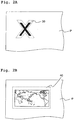
- the treatment solution may be applied to either an entire surface or a part of the recording surface of the recording paper P.
- the application portion is the recording portion of the recording surface of the recording paper P at least subjected to the recording with the water-based ink.
- the size of the application portion is larger than the recording portion. For example, as shown in Fig.
- the water-based ink is discharged from the ink-jet head 3 to the application portion of the treatment solution of the recording paper P.
- the time, which elapses from the discharge of the treatment solution to the discharge of the water-based ink, is not specifically limited.
- the discharge of the water-based ink may be carried out within the same scanning together with the discharge of the treatment solution.
- the treatment solution and the water-based ink are brought in contact with each other on the recording paper P, and thus the optical density (OD value) of the recorded image is improved.
- the ink discharge mechanism also serves as the treatment solution applying mechanism.
- the present teaching is not limited thereto.
- the application of the treatment solution may be carried out in accordance with any system including, for example, the stamp application, the brush application, and the roller application.
- the treatment solution of the present teaching can be applied in accordance with any system including, for example, the ink discharge mechanism, the stamp application, the brush application, and the roller application, because the treatment solution of the present teaching is excellent in the storage stability.
- the water-based ink is discharged after applying the treatment solution to the recording paper P beforehand. Accordingly, for example, it is possible to enhance the aggregation efficiency of the pigment contained in the water-based ink.
- the present teaching is not limited thereto.
- the treatment solution may be applied after discharging the water-based ink to the recording paper P beforehand.
- the application of the treatment solution to the recording paper P and the discharge of the water-based ink may be performed simultaneously.
- the recording paper P which has been subjected to the recording as described above, is discharged from the ink-jet recording apparatus 1.
- the paper feed mechanism and the paper discharge mechanism for the recording paper P are omitted from the illustration.
- the serial type ink-jet head is adopted.
- the ink-jet recording apparatus may be an apparatus which adopts a line type ink-jet head.
- the line type ink-jet recording apparatus is an ink-jet recording apparatus which uses a line type ink-jet head having a recording width of not less than the width of the recording medium and which is capable of collectively performing the recording in the widthwise direction of the recording medium in a state in which the ink-jet head is fixed.
- the recording is performed while moving the ink-jet head itself in the widthwise direction of the recording surface of the recording medium.
- the line type ink-jet recording apparatus has the recording speed which is extremely faster than that of the serial type ink-jet recording apparatus described above.
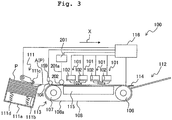
- the ink-jet recording apparatus 100 of this embodiment includes, as main constitutive elements, a treatment solution cartridge 201, a treatment solution coating mechanism (coating roller) 202, four ink cartridges 101, four ink discharge mechanisms (line type ink-jet heads) 102, a paper feed unit 111, a paper discharge unit 112, a belt transport mechanism 113, and a control unit 116 which controls the entire ink-jet recording apparatus 100.
- the paper feed unit 111 is arranged on one side (left side in Fig. 3 ) of the belt transport mechanism 113.
- the paper discharge unit 112 is arranged on the other side (right side in Fig. 3 ) of the belt transport mechanism 113.
- the paper feed unit 111 includes a recording paper stocker 111a and a pickup roller 111c.
- the recording paper stocker 111a accommodates the sheets of the recording paper P therein in a stacked state, which has an opening formed at the upper surface thereof.
- the recording paper stocker 111a is arranged in a state of being inclined toward the downstream side in the recording paper transport direction X (right side in Fig.
- a support plate 111b which is urged by a spring 111d in the direction directed from the bottom surface toward the upper opening, is arranged in the recording paper stocker 111 a.
- the recording paper P is stacked on the support plate 111b.
- the pickup roller 111c is driven by a placement motor (not shown). Accordingly, the sheets of the recording paper P, which are stacked in the recording paper stocker 111a, are picked up (taken out) one by one from the top, and the picked up recording paper P is fed to the downstream side.
- a recording paper detection sensor 159 is arranged just downstream from the paper feed unit 111.
- the recording paper detection sensor 159 detects whether or not the fed recording paper P arrives at the recording waiting position A positioned just upstream (on the left side in Fig. 3 ) in the recording paper transport direction X from the belt transport mechanism 113.
- the fed recording paper P passes through the recording waiting position A, and the recording paper P is transported to the belt transport mechanism 113.
- the belt transport mechanism 113 includes two belt rollers 106, 107, a transport belt 108, a platen 115, and a transport motor (not shown).
- the transport belt 108 is an endless belt which is wound around so that the transport belt 108 is applied between the two belt rollers 106, 107.
- the outer surface of the transport belt 108 is designated as an outer circumferential surface 108a.
- the platen 115 is arranged at the position opposed to an coating roller 202 and the four line type ink-jet heads 102 as described later on in the area surrounded by the transport belt 108.
- the platen 115 supports the transport belt 108 so that the transport belt 108 is not flexibly bent downwardly in the area opposed to the coating roller 202 and the four line type ink-jet heads 102.
- a nip roller 104 is arranged at the position opposed to the belt roller 107.
- the nip roller 104 presses the recording paper P against the outer circumferential surface 108a when the recording paper P, which is transported to the belt transport mechanism 113, is placed on the outer circumferential surface 108a.
- the transport motor rotates the belt roller 106
- the transport belt 108 is driven (rotated). Accordingly, the transport belt 108 transports the pressed recording paper P toward the paper discharge unit 112, while adhesively holding the pressed recording paper P.
- An exfoliating mechanism 114 is provided just downstream from the transport belt 108.
- the exfoliating mechanism 114 is constructed such that the recording paper P, which is adhesively stuck to the outer circumferential surface 108a, is exfoliated from the outer circumferential surface 108, and the recording paper P is fed toward the paper discharge unit 112.
- the ink set for the ink-jet recording apparatus 100 is formed with four water-based ink cartridges 101 and a treatment solution cartridge 201 which are formed distinctly and independently.
- a supply tube 201a which supplies the treatment solution to the coating roller 202, extends from the treatment solution cartridge 201.
- the treatment solution is supplied to the coating roller 202 via the supply tube 201a.
- the four ink cartridges 101 have the line type ink-jet heads 102 at the lower ends thereof respectively.
- Each of the four ink cartridges 101 includes each one color of four color water-based inks of yellow, magenta, cyan, and black. At least one of the four color water-based inks contains the pigment as the colorant.
- the four ink cartridges 101 and the coating roller 202 are fixed while being aligned over the belt transport mechanism 113 in the recording paper transport direction X.
- the coating roller 202 is arranged on the upstream side as compared with the four ink cartridges 101 in the recording paper transport direction X.
- the ink-jet recording which uses the ink-jet recording apparatus 100, is carried out, for example, as follows. At first, when the recording paper P, which is transported by the transport belt 108, passes just under the coating roller 202, then the coating roller 202 is brought in contact with the recording paper P, and the coating roller 202 is rotated. The treatment solution, which is supplied from the treatment solution cartridge 201, is coated by the coating roller 202 to the upper surface of the recording paper P, while rotating the coating roller 202. Subsequently, the recording paper P, to which the treatment solution has been coated, passes under the line type ink-jet heads 102.
- the water-based inks are discharged to the application portion of the treatment solution of the recording paper P.
- the treatment solution and the water-based ink are brought in contact each other on the recording paper P, and thus the optical density (OD value) of the recorded image is improved.
- Each of the ink-jet recording apparatus 1 shown in Fig. 1 and the ink-jet recording apparatus 100 shown in Fig. 3 may include a metal member which is brought in contact with the treatment solution.
- the anion X - of the quaternary alkylammonium salt represented by the general formula (1) is at least one of the inorganic acid ion, the organic acid ion, and the hydroxide ion, and no halide ion is contained. Therefore, the treatment solution of the present teaching hardly corrodes the metal member.
- Examples of the metal member may include, for example, a flow passage for the treatment solution inside the ink-jet head 3, or a flow passage inside the ink cartridge assembly 2 in the ink-jet recording apparatus 1 shown in Fig.1 , or the coating roller 202 in the ink-jet recording apparatus 100 shown in Fig. 3 , etc.
- the material of the metal member may include, for example, a nickel-containing ally (nickel alloy) such as 42 alloy, invar, permalloy, etc.
- Respective components of treatment solution compositions (Tables 2 and 3) were mixed uniformly or homogeneously to obtain Treatment solutions 1 to 26.
- An ink solvent was obtained by uniformly mixing components except for a dispersion of self-dispersible carbon black in water in relation to a water-based ink composition (Table 1). Subsequently, the ink solvent was added to the water dispersion of the self-dispersible carbon black, followed by being mixed uniformly. After that, an obtained mixture was filtrated through a cellulose acetate type membrane filter (pore size: 3.00 ⁇ m) produced by Toyo Roshi Kaisha, Ltd. Thus, a water-based ink for ink-jet recording was obtained.
- Treatment solutions 1 to 26 described above were used in combination with the water-based ink for ink-jet recording, and (a) the optical density (OD value) of the recorded image was evaluated in accordance with the following method. Further, (b) the separation after the thawing of the treatment solution was evaluated in accordance with the following method.
- a digital multifunction machine DCP-330C produced by Brother Industries, Ltd., which carried an ink-jet printer, was used to prepare an evaluation sample by recording a black single color patch at a resolution of 600 dpi x 600 dpi on the regular paper by using the water-based ink for ink-jet recording described above.
- the optical density (OD value) of the evaluation sample was measured by using a spectrophotometer Spectrolino produced by Gretag Macbeth (light source: D 50 , field angle: 2°, filter: Status T), and the evaluation was made in accordance with the following evaluation criterion.
- the measurement result of the optical density (OD value) is the average value of those obtained by performing the measurement five times.
- the treatment solution was frozen and stored at -20 °C, and then the treatment solution was thawed at the ordinary temperature.
- the separation after the thawing was evaluated in accordance with the following evaluation criterion.
- compositions and the evaluation results of the treatment solutions of Examples 1 and 2 and Comparative Examples 1 to 4 are shown in Tables 2 and 3.
- Table 2 a result of (a) evaluation of the optical density (OD value) of the recorded image, which was obtained with only the water-based ink for ink-jet recording without applying the treatment solution to the regular paper, is shown as a "Reference”.
- the optical density (OD value) of the recorded image was approximately at the same degree as that of the Reference in Comparative Example 1 wherein the quaternary alkylammonium salt, in which R 4 was the methyl group having the number of carbon atom of 1 in the general formula (1), was used for the treatment solution. According to the comparison between Examples 1 and 2 and Comparative Example 1, it has been revealed that the optical density (OD value) of the recorded image is improved when the alkyl group of R 4 has the number of carbon atoms of not less than 8.
- Comparative Example 4 wherein polyallylamine was blended to the treatment solution in place of the quaternary alkylammonium salt.
- the color-change was not observed even when the treatment solutions were stored in a high temperature environment in the case of Examples 1 and 2.
- the color of the treatment solution was changed when the treatment solution was stored in a high temperature environment in the case of Comparative Example 4.
- Comparative Example 4 it has been revealed that the storage stability is improved in the low temperature environment and the high temperature environment when the quaternary alkylammonium salt of the present teaching is used for the treatment solution.
- the treatment solution for ink-jet recording of the present teaching makes it possible to improve the optical density (OD value) of the recorded image, and the treatment solution for ink-jet recording of the present teaching is excellent in the storage stability as well.
- the way of use of the treatment solution of the present teaching is not specifically limited.
- the treatment solution of the present teaching is widely applicable to various types of ink-jet recording.
Landscapes
- Chemical & Material Sciences (AREA)
- Life Sciences & Earth Sciences (AREA)
- Engineering & Computer Science (AREA)
- Materials Engineering (AREA)
- Wood Science & Technology (AREA)
- Organic Chemistry (AREA)
- Chemical Kinetics & Catalysis (AREA)
- Ink Jet Recording Methods And Recording Media Thereof (AREA)
- Ink Jet (AREA)
- Inks, Pencil-Leads, Or Crayons (AREA)
Claims (13)
- Behandlungslösung, die zum Tintenstrahlaufzeichnen verwendet wird, mit einem quartären Alkylammoniumsalz, das durch eine allgemeine Formel (1) dargestellt ist, und Wasser:
 wobei R1 bis R3 Alkylgruppen sind, die jeweils 1 bis 3 Kohlenstoffatome haben, und die identisch miteinander sind oder sich voneinander unterscheiden;R4 eine Alkylgruppe mit 8 bis 16 Kohlenstoffatomen ist; jede der Alkylgruppen von R1 bis R4 eine nichtsubstituierte Alkylgruppe ist und eine gerade Kette oder eine verzweigte Kette hat;X- entweder ein anorganisches Säureion, ein organisches Säureion oder ein Hydroxidion ist; unddie Behandlungslösung keinen Farbstoff enthält.
 - Behandlungslösung gemäß Anspruch 1, wobeiR1 bis R3 Alkylgruppen sind, die jeweils 1 oder 2 Kohlenstoffatome haben; undR4 eine Alkylgruppe mit 8 bis 12 Kohlenstoffatomen ist.
- Behandlungslösung gemäß Anspruch 1 oder 2, wobei das quartäre Alkylammoniumsalz, das durch die allgemeine Formel (1) dargestellt ist, mit nicht weniger als 1 % im Gewicht der Behandlungslösung enthalten ist.
- Behandlungslösung gemäß einem der vorherigen Ansprüche,wobei (a) R1 und R2 Methyl sind, R3 Ethyl ist, R4 Octyl ist und X- ein Ethylsulfation ist, oder (b) R1 und R2 Methyl sind, R3 Ethyl ist, R4 Lauryl ist und X- ein Ethylsulfation ist.
- Tintensatz auf Wasserbasis zum Tintenstrahlaufzeichnen, mit:einer Tinte auf Wasserbasis zum Tintenstrahlaufzeichnen, die ein Pigment, Wasser und ein wasserlösliches, organisches Lösungsmittel enthält; undder Behandlungslösung gemäß einem der Ansprüche 1 bis 4.
- Tintenstrahlaufzeichnungsverfahren zum Durchführen eines Aufzeichnens an einem Aufzeichnungsmedium, wobei das Verfahren folgendes aufweist:Aufbringen der Behandlungslösung des Tintensatzes auf Wasserbasis zum Tintenstrahlaufzeichnen gemäß Anspruch 5 auf das Aufzeichnungsmedium; undAuslassen der Tinte auf Wasserbasis des Tintensatzes auf Wasserbasis zum Tintenstrahlaufzeichnen auf das Aufzeichnungsmedium.
- Tintenstrahlaufzeichnungsverfahren gemäß Anspruch 6, wobei die Tinte auf Wasserbasis auf das Aufzeichnungsmedium ausgelassen wird, nachdem die Behandlungslösung auf das Aufzeichnungsmedium aufgebracht wurde.
- Tintenstrahlaufzeichnungsgerät mit:einem Tintensatzaufnahmebereich, in dem der Tintensatz auf Wasserbasis zum Tintenstrahlaufzeichnen gemäß Anspruch 5 aufgenommen ist;einem Behandlungslösungsaufbringungsmechanismus, der auf das Aufzeichnungsmedium die Behandlungslösung des Tintensatzes auf Wasserbasis aufbringt; undeinem Tintenauslassmechanismus, der auf das Aufzeichnungsmedium die Tinte auf Wasserbasis des Tintensatzes auf Wasserbasis auslässt.
- Tintenstrahlaufzeichnungsgerät gemäß Anspruch 8, wobei der Behandlungslösungsaufbringungsmechanismus ein Behandlungslösungsauslassmechanismus ist, der die Behandlungslösung auf das Aufzeichnungsmedium auslässt, oder ein Behandlungslösungsauftragsmechanismus, der die Behandlungslösung auf das Aufzeichnungsmedium beschichtet.
- Tintenstrahlaufzeichnungsgerät gemäß Anspruch 8 oder 9, des Weiteren mit einem Metallelement, das mit der Behandlungslösung in Kontakt gebracht wird.
- Tintenstrahlaufzeichnungsgerät gemäß Anspruch 10, wobei der Behandlungslösungsaufbringungsmechanismus das Metallelement aufweist, das mit der Behandlungslösung in Kontakt gebracht wird.
- Tintenstrahlaufzeichnungsgerät gemäß Anspruch 10 oder 11, wobei das Metallelement eine Nickellegierung aufweist.
- Verwendung einer Lösung, die ein quartäres Alkylammoniumsalz, das durch eine allgemeine Formel (1) dargestellt ist, und Wasser aufweist, als eine Behandlungslösung zum Tintenstrahlaufzeichnen:

Applications Claiming Priority (2)
| Application Number | Priority Date | Filing Date | Title |
|---|---|---|---|
| JP2010223246 | 2010-09-30 | ||
| JP2011152644A JP5740793B2 (ja) | 2010-09-30 | 2011-07-11 | インクジェット記録用の処理液、インクジェット記録用水性インクセット、インクジェット記録方法およびインクジェット記録装置 |
Publications (2)
| Publication Number | Publication Date |
|---|---|
| EP2436739A1 EP2436739A1 (de) | 2012-04-04 |
| EP2436739B1 true EP2436739B1 (de) | 2017-01-18 |
Family
ID=44674465
Family Applications (1)
| Application Number | Title | Priority Date | Filing Date |
|---|---|---|---|
| EP11180604.8A Active EP2436739B1 (de) | 2010-09-30 | 2011-09-08 | Behandlungslösung zur Tintenstrahlaufzeichnung, wasserbasierter Tintensatz zur Tintenstrahlaufzeichnung, Tintenstrahlaufzeichnungsverfahren und Tintenstrahlaufzeichnungsvorrichtung |
Country Status (3)
| Country | Link |
|---|---|
| US (1) | US8690304B2 (de) |
| EP (1) | EP2436739B1 (de) |
| JP (1) | JP5740793B2 (de) |
Families Citing this family (4)
| Publication number | Priority date | Publication date | Assignee | Title |
|---|---|---|---|---|
| JP2012076359A (ja) * | 2010-09-30 | 2012-04-19 | Brother Industries Ltd | インクジェット記録用の処理液、インクジェット記録用水性インクセット、インクジェット記録方法およびインクジェット記録装置 |
| US8944581B2 (en) * | 2012-11-15 | 2015-02-03 | Brother Kogyo Kabushiki Kaisha | Water-based ink for ink-jet recording, ink cartridge, ink-jet recording apparatus, and ink-jet recording method |
| JP6984154B2 (ja) | 2017-03-31 | 2021-12-17 | ブラザー工業株式会社 | インクセット及び記録方法 |
| JP7151132B2 (ja) | 2018-03-30 | 2022-10-12 | ブラザー工業株式会社 | 画像記録用処理剤、インクと画像記録用処理剤のセット及び記録方法 |
Family Cites Families (21)
| Publication number | Priority date | Publication date | Assignee | Title |
|---|---|---|---|---|
| JP2711098B2 (ja) | 1987-09-10 | 1998-02-10 | 株式会社リコー | インクジェット記録方法 |
| US5609671A (en) | 1994-06-20 | 1997-03-11 | Orient Chemical Industries, Ltd. | Water-based pigment ink and process for producing the same |
| JP3405817B2 (ja) | 1994-06-20 | 2003-05-12 | オリヱント化学工業株式会社 | 水性顔料インキ及びその製造方法 |
| JPH0820162A (ja) * | 1994-07-08 | 1996-01-23 | Canon Inc | 液体組成物、インクセット及びこれを用いた画像形成方法 |
| JP3461202B2 (ja) * | 1994-07-08 | 2003-10-27 | キヤノン株式会社 | 液体組成物、インクセット及びインクジェット記録方法 |
| JPH0881611A (ja) * | 1994-07-11 | 1996-03-26 | Canon Inc | 液体組成物、インクセット及びこれを用いた画像形成方法と装置 |
| JP3904120B2 (ja) * | 1996-04-16 | 2007-04-11 | セイコーエプソン株式会社 | 二液を用いたインクジェット記録方法に用いられる反応液およびそれを用いたインクジェット記録方法 |
| US5837045A (en) | 1996-06-17 | 1998-11-17 | Cabot Corporation | Colored pigment and aqueous compositions containing same |
| JPH11130975A (ja) * | 1997-10-29 | 1999-05-18 | Hakkooru Chemical Kk | 隠ぺい性の優れた蛍光性有機白色顔料組成物 |
| JPH11314449A (ja) | 1998-05-07 | 1999-11-16 | Canon Inc | 画像形成方法 |
| US6786588B2 (en) * | 2001-03-23 | 2004-09-07 | Ricoh Company Limited | Pretreatment liquid for recording material and image recording method using the pretreatment liquid |
| JP2004131559A (ja) * | 2002-10-09 | 2004-04-30 | Brother Ind Ltd | インクジェット記録用水性インク |
| JP2004276253A (ja) * | 2003-03-12 | 2004-10-07 | Seiko Epson Corp | 印刷前処理液及びこれを用いた画像記録方法 |
| US7192472B2 (en) * | 2003-09-18 | 2007-03-20 | E. I. Du Pont De Nemours And Company | Inkjet ink composition |
| US20070052783A1 (en) * | 2003-09-29 | 2007-03-08 | Toshiki Taguchi | Ink for inkjet printing ink set for inkjet printing inkjet recording material and producing method for inkjet recording material and inkjet recording method |
| JP4963783B2 (ja) * | 2003-11-07 | 2012-06-27 | 株式会社リコー | インクセット、処理液、記録液、画像記録装置 |
| WO2006066132A2 (en) | 2004-12-17 | 2006-06-22 | Cabot Corporation | Method of preparing oxidized modified pigments and inkjet ink compositions comprising the same |
| BRPI0618100B1 (pt) | 2005-10-31 | 2018-03-27 | Cabot Corporation | Corantes modificados e composições de tinta para jatos de tinta compreendendo corantes modificados |
| JP4544174B2 (ja) * | 2006-02-14 | 2010-09-15 | 富士ゼロックス株式会社 | インクジェット用液体組成物、インクジェット用インクセット、インクジェット用液体組成物タンク、インクジェット用インクタンク、インクジェット記録方法、並びに、インクジェット記録装置 |
| JP2008246821A (ja) | 2007-03-30 | 2008-10-16 | Brother Ind Ltd | 前処理液、インクセット、インクジェット記録装置およびインクジェット記録方法 |
| JP5318619B2 (ja) | 2009-03-19 | 2013-10-16 | Ntn株式会社 | 焼結金属軸受 |
-
2011
- 2011-07-11 JP JP2011152644A patent/JP5740793B2/ja active Active
- 2011-09-08 EP EP11180604.8A patent/EP2436739B1/de active Active
- 2011-09-09 US US13/228,825 patent/US8690304B2/en active Active
Non-Patent Citations (1)
| Title |
|---|
| None * |
Also Published As
| Publication number | Publication date |
|---|---|
| JP5740793B2 (ja) | 2015-07-01 |
| US20120081459A1 (en) | 2012-04-05 |
| EP2436739A1 (de) | 2012-04-04 |
| US8690304B2 (en) | 2014-04-08 |
| JP2012091491A (ja) | 2012-05-17 |
Similar Documents
| Publication | Publication Date | Title |
|---|---|---|
| JP4737260B2 (ja) | インクジェット記録方法、前処理液、インクセット | |
| JP5232689B2 (ja) | インクジェット記録方法、インクジェット記録用前処理液およびインク組成物 | |
| JP5297865B2 (ja) | インクジェット記録方法およびインクジェット記録用前処理液 | |
| US8602545B2 (en) | Treatment solution for ink-jet recording, water-based ink set for ink-jet recording, ink-jet recording method and ink-jet recording apparatus | |
| US8500267B2 (en) | Water-based ink for ink-jet recording, ink cartridge, ink-jet recording apparatus and method for producing water-based ink for ink-jet recording | |
| US8757787B2 (en) | Treatment solution for ink-jet recording, water-based ink set for ink-jet recording, ink-jet recording method and ink-jet recording apparatus | |
| EP2436739B1 (de) | Behandlungslösung zur Tintenstrahlaufzeichnung, wasserbasierter Tintensatz zur Tintenstrahlaufzeichnung, Tintenstrahlaufzeichnungsverfahren und Tintenstrahlaufzeichnungsvorrichtung | |
| JP4737259B2 (ja) | インクジェット記録方法、前処理液、インクセット | |
| JP2010274561A (ja) | インクジェット記録方法、前処理液、インクセットおよびインクジェット記録装置 | |
| EP2354198B1 (de) | Behandlungsflüssigkeit für Tintenstrahlaufzeichnung | |
| US8888266B2 (en) | Ink for ink-jet recording, ink-jet recording method, and ink-jet recording apparatus | |
| US9206325B2 (en) | Water-based ink for ink-jet recording, water-based ink set for ink-jet recording, and treatment agent | |
| US8342671B2 (en) | Water-based coloring material, water-based ink for ink-jet recording, ink-jet recording method, and ink-jet recording apparatus | |
| JP6300084B2 (ja) | インクジェット記録用水性インク及びインクカートリッジ | |
| US8672464B2 (en) | Treatment liquid for ink-jet recording, ink set, and ink-jet recording method | |
| JP5716517B2 (ja) | インクジェット記録用処理液、インクセット、インクジェット記録方法、およびインクジェット記録装置 | |
| US10077371B2 (en) | Ink set and recording method | |
| JP5445765B2 (ja) | インクジェット記録用の処理液、インクセットおよびインクジェット記録方法 | |
| US8684508B2 (en) | Treatment solution for ink-jet recording, water-based ink set for ink-jet recording, ink-jet recording method and ink-jet recording apparatus | |
| US9732245B2 (en) | Water-based ink for ink-jet recording and ink cartridge |
Legal Events
| Date | Code | Title | Description |
|---|---|---|---|
| PUAI | Public reference made under article 153(3) epc to a published international application that has entered the european phase |
Free format text: ORIGINAL CODE: 0009012 |
|
| AK | Designated contracting states |
Kind code of ref document: A1 Designated state(s): AL AT BE BG CH CY CZ DE DK EE ES FI FR GB GR HR HU IE IS IT LI LT LU LV MC MK MT NL NO PL PT RO RS SE SI SK SM TR |
|
| AX | Request for extension of the european patent |
Extension state: BA ME |
|
| 17P | Request for examination filed |
Effective date: 20121002 |
|
| GRAP | Despatch of communication of intention to grant a patent |
Free format text: ORIGINAL CODE: EPIDOSNIGR1 |
|
| RIC1 | Information provided on ipc code assigned before grant |
Ipc: B41J 2/00 20060101ALI20160728BHEP Ipc: C09D 11/322 20140101ALI20160728BHEP Ipc: C09D 11/54 20140101ALI20160728BHEP Ipc: C09D 11/40 20140101ALI20160728BHEP Ipc: C09D 11/00 20140101AFI20160728BHEP |
|
| INTG | Intention to grant announced |
Effective date: 20160817 |
|
| STAA | Information on the status of an ep patent application or granted ep patent |
Free format text: STATUS: GRANT OF PATENT IS INTENDED |
|
| GRAS | Grant fee paid |
Free format text: ORIGINAL CODE: EPIDOSNIGR3 |
|
| GRAA | (expected) grant |
Free format text: ORIGINAL CODE: 0009210 |
|
| STAA | Information on the status of an ep patent application or granted ep patent |
Free format text: STATUS: THE PATENT HAS BEEN GRANTED |
|
| AK | Designated contracting states |
Kind code of ref document: B1 Designated state(s): AL AT BE BG CH CY CZ DE DK EE ES FI FR GB GR HR HU IE IS IT LI LT LU LV MC MK MT NL NO PL PT RO RS SE SI SK SM TR |
|
| REG | Reference to a national code |
Ref country code: GB Ref legal event code: FG4D |
|
| REG | Reference to a national code |
Ref country code: CH Ref legal event code: EP |
|
| REG | Reference to a national code |
Ref country code: AT Ref legal event code: REF Ref document number: 862910 Country of ref document: AT Kind code of ref document: T Effective date: 20170215 |
|
| REG | Reference to a national code |
Ref country code: IE Ref legal event code: FG4D |
|
| REG | Reference to a national code |
Ref country code: DE Ref legal event code: R096 Ref document number: 602011034432 Country of ref document: DE |
|
| REG | Reference to a national code |
Ref country code: NL Ref legal event code: MP Effective date: 20170118 |
|
| REG | Reference to a national code |
Ref country code: LT Ref legal event code: MG4D |
|
| REG | Reference to a national code |
Ref country code: AT Ref legal event code: MK05 Ref document number: 862910 Country of ref document: AT Kind code of ref document: T Effective date: 20170118 |
|
| PG25 | Lapsed in a contracting state [announced via postgrant information from national office to epo] |
Ref country code: NL Free format text: LAPSE BECAUSE OF FAILURE TO SUBMIT A TRANSLATION OF THE DESCRIPTION OR TO PAY THE FEE WITHIN THE PRESCRIBED TIME-LIMIT Effective date: 20170118 |
|
| PG25 | Lapsed in a contracting state [announced via postgrant information from national office to epo] |
Ref country code: LT Free format text: LAPSE BECAUSE OF FAILURE TO SUBMIT A TRANSLATION OF THE DESCRIPTION OR TO PAY THE FEE WITHIN THE PRESCRIBED TIME-LIMIT Effective date: 20170118 Ref country code: HR Free format text: LAPSE BECAUSE OF FAILURE TO SUBMIT A TRANSLATION OF THE DESCRIPTION OR TO PAY THE FEE WITHIN THE PRESCRIBED TIME-LIMIT Effective date: 20170118 Ref country code: IS Free format text: LAPSE BECAUSE OF FAILURE TO SUBMIT A TRANSLATION OF THE DESCRIPTION OR TO PAY THE FEE WITHIN THE PRESCRIBED TIME-LIMIT Effective date: 20170518 Ref country code: FI Free format text: LAPSE BECAUSE OF FAILURE TO SUBMIT A TRANSLATION OF THE DESCRIPTION OR TO PAY THE FEE WITHIN THE PRESCRIBED TIME-LIMIT Effective date: 20170118 Ref country code: NO Free format text: LAPSE BECAUSE OF FAILURE TO SUBMIT A TRANSLATION OF THE DESCRIPTION OR TO PAY THE FEE WITHIN THE PRESCRIBED TIME-LIMIT Effective date: 20170418 Ref country code: GR Free format text: LAPSE BECAUSE OF FAILURE TO SUBMIT A TRANSLATION OF THE DESCRIPTION OR TO PAY THE FEE WITHIN THE PRESCRIBED TIME-LIMIT Effective date: 20170419 |
|
| REG | Reference to a national code |
Ref country code: FR Ref legal event code: PLFP Year of fee payment: 7 |
|
| PG25 | Lapsed in a contracting state [announced via postgrant information from national office to epo] |
Ref country code: LV Free format text: LAPSE BECAUSE OF FAILURE TO SUBMIT A TRANSLATION OF THE DESCRIPTION OR TO PAY THE FEE WITHIN THE PRESCRIBED TIME-LIMIT Effective date: 20170118 Ref country code: AT Free format text: LAPSE BECAUSE OF FAILURE TO SUBMIT A TRANSLATION OF THE DESCRIPTION OR TO PAY THE FEE WITHIN THE PRESCRIBED TIME-LIMIT Effective date: 20170118 Ref country code: RS Free format text: LAPSE BECAUSE OF FAILURE TO SUBMIT A TRANSLATION OF THE DESCRIPTION OR TO PAY THE FEE WITHIN THE PRESCRIBED TIME-LIMIT Effective date: 20170118 Ref country code: BG Free format text: LAPSE BECAUSE OF FAILURE TO SUBMIT A TRANSLATION OF THE DESCRIPTION OR TO PAY THE FEE WITHIN THE PRESCRIBED TIME-LIMIT Effective date: 20170418 Ref country code: PT Free format text: LAPSE BECAUSE OF FAILURE TO SUBMIT A TRANSLATION OF THE DESCRIPTION OR TO PAY THE FEE WITHIN THE PRESCRIBED TIME-LIMIT Effective date: 20170518 Ref country code: PL Free format text: LAPSE BECAUSE OF FAILURE TO SUBMIT A TRANSLATION OF THE DESCRIPTION OR TO PAY THE FEE WITHIN THE PRESCRIBED TIME-LIMIT Effective date: 20170118 Ref country code: SE Free format text: LAPSE BECAUSE OF FAILURE TO SUBMIT A TRANSLATION OF THE DESCRIPTION OR TO PAY THE FEE WITHIN THE PRESCRIBED TIME-LIMIT Effective date: 20170118 Ref country code: ES Free format text: LAPSE BECAUSE OF FAILURE TO SUBMIT A TRANSLATION OF THE DESCRIPTION OR TO PAY THE FEE WITHIN THE PRESCRIBED TIME-LIMIT Effective date: 20170118 |
|
| REG | Reference to a national code |
Ref country code: DE Ref legal event code: R097 Ref document number: 602011034432 Country of ref document: DE |
|
| PG25 | Lapsed in a contracting state [announced via postgrant information from national office to epo] |
Ref country code: RO Free format text: LAPSE BECAUSE OF FAILURE TO SUBMIT A TRANSLATION OF THE DESCRIPTION OR TO PAY THE FEE WITHIN THE PRESCRIBED TIME-LIMIT Effective date: 20170118 Ref country code: CZ Free format text: LAPSE BECAUSE OF FAILURE TO SUBMIT A TRANSLATION OF THE DESCRIPTION OR TO PAY THE FEE WITHIN THE PRESCRIBED TIME-LIMIT Effective date: 20170118 Ref country code: SK Free format text: LAPSE BECAUSE OF FAILURE TO SUBMIT A TRANSLATION OF THE DESCRIPTION OR TO PAY THE FEE WITHIN THE PRESCRIBED TIME-LIMIT Effective date: 20170118 Ref country code: EE Free format text: LAPSE BECAUSE OF FAILURE TO SUBMIT A TRANSLATION OF THE DESCRIPTION OR TO PAY THE FEE WITHIN THE PRESCRIBED TIME-LIMIT Effective date: 20170118 Ref country code: IT Free format text: LAPSE BECAUSE OF FAILURE TO SUBMIT A TRANSLATION OF THE DESCRIPTION OR TO PAY THE FEE WITHIN THE PRESCRIBED TIME-LIMIT Effective date: 20170118 |
|
| PLBE | No opposition filed within time limit |
Free format text: ORIGINAL CODE: 0009261 |
|
| STAA | Information on the status of an ep patent application or granted ep patent |
Free format text: STATUS: NO OPPOSITION FILED WITHIN TIME LIMIT |
|
| PG25 | Lapsed in a contracting state [announced via postgrant information from national office to epo] |
Ref country code: DK Free format text: LAPSE BECAUSE OF FAILURE TO SUBMIT A TRANSLATION OF THE DESCRIPTION OR TO PAY THE FEE WITHIN THE PRESCRIBED TIME-LIMIT Effective date: 20170118 Ref country code: SM Free format text: LAPSE BECAUSE OF FAILURE TO SUBMIT A TRANSLATION OF THE DESCRIPTION OR TO PAY THE FEE WITHIN THE PRESCRIBED TIME-LIMIT Effective date: 20170118 |
|
| 26N | No opposition filed |
Effective date: 20171019 |
|
| PG25 | Lapsed in a contracting state [announced via postgrant information from national office to epo] |
Ref country code: SI Free format text: LAPSE BECAUSE OF FAILURE TO SUBMIT A TRANSLATION OF THE DESCRIPTION OR TO PAY THE FEE WITHIN THE PRESCRIBED TIME-LIMIT Effective date: 20170118 |
|
| REG | Reference to a national code |
Ref country code: CH Ref legal event code: PL |
|
| PG25 | Lapsed in a contracting state [announced via postgrant information from national office to epo] |
Ref country code: MC Free format text: LAPSE BECAUSE OF FAILURE TO SUBMIT A TRANSLATION OF THE DESCRIPTION OR TO PAY THE FEE WITHIN THE PRESCRIBED TIME-LIMIT Effective date: 20170118 |
|
| REG | Reference to a national code |
Ref country code: IE Ref legal event code: MM4A |
|
| REG | Reference to a national code |
Ref country code: BE Ref legal event code: MM Effective date: 20170930 |
|
| PG25 | Lapsed in a contracting state [announced via postgrant information from national office to epo] |
Ref country code: LU Free format text: LAPSE BECAUSE OF NON-PAYMENT OF DUE FEES Effective date: 20170908 |
|
| PG25 | Lapsed in a contracting state [announced via postgrant information from national office to epo] |
Ref country code: IE Free format text: LAPSE BECAUSE OF NON-PAYMENT OF DUE FEES Effective date: 20170908 Ref country code: LI Free format text: LAPSE BECAUSE OF NON-PAYMENT OF DUE FEES Effective date: 20170930 Ref country code: CH Free format text: LAPSE BECAUSE OF NON-PAYMENT OF DUE FEES Effective date: 20170930 |
|
| REG | Reference to a national code |
Ref country code: FR Ref legal event code: PLFP Year of fee payment: 8 |
|
| PG25 | Lapsed in a contracting state [announced via postgrant information from national office to epo] |
Ref country code: BE Free format text: LAPSE BECAUSE OF NON-PAYMENT OF DUE FEES Effective date: 20170930 |
|
| PG25 | Lapsed in a contracting state [announced via postgrant information from national office to epo] |
Ref country code: MT Free format text: LAPSE BECAUSE OF NON-PAYMENT OF DUE FEES Effective date: 20170908 |
|
| PG25 | Lapsed in a contracting state [announced via postgrant information from national office to epo] |
Ref country code: HU Free format text: LAPSE BECAUSE OF FAILURE TO SUBMIT A TRANSLATION OF THE DESCRIPTION OR TO PAY THE FEE WITHIN THE PRESCRIBED TIME-LIMIT; INVALID AB INITIO Effective date: 20110908 |
|
| PG25 | Lapsed in a contracting state [announced via postgrant information from national office to epo] |
Ref country code: CY Free format text: LAPSE BECAUSE OF NON-PAYMENT OF DUE FEES Effective date: 20170118 |
|
| PG25 | Lapsed in a contracting state [announced via postgrant information from national office to epo] |
Ref country code: MK Free format text: LAPSE BECAUSE OF FAILURE TO SUBMIT A TRANSLATION OF THE DESCRIPTION OR TO PAY THE FEE WITHIN THE PRESCRIBED TIME-LIMIT Effective date: 20170118 |
|
| PG25 | Lapsed in a contracting state [announced via postgrant information from national office to epo] |
Ref country code: TR Free format text: LAPSE BECAUSE OF FAILURE TO SUBMIT A TRANSLATION OF THE DESCRIPTION OR TO PAY THE FEE WITHIN THE PRESCRIBED TIME-LIMIT Effective date: 20170118 |
|
| PG25 | Lapsed in a contracting state [announced via postgrant information from national office to epo] |
Ref country code: AL Free format text: LAPSE BECAUSE OF FAILURE TO SUBMIT A TRANSLATION OF THE DESCRIPTION OR TO PAY THE FEE WITHIN THE PRESCRIBED TIME-LIMIT Effective date: 20170118 |
|
| P01 | Opt-out of the competence of the unified patent court (upc) registered |
Effective date: 20230529 |
|
| PGFP | Annual fee paid to national office [announced via postgrant information from national office to epo] |
Ref country code: DE Payment date: 20250808 Year of fee payment: 15 |
|
| PGFP | Annual fee paid to national office [announced via postgrant information from national office to epo] |
Ref country code: GB Payment date: 20250814 Year of fee payment: 15 |
|
| PGFP | Annual fee paid to national office [announced via postgrant information from national office to epo] |
Ref country code: FR Payment date: 20250808 Year of fee payment: 15 |