EP2436741A1 - Matériau adhésif redécollable - Google Patents
Matériau adhésif redécollable Download PDFInfo
- Publication number
- EP2436741A1 EP2436741A1 EP10780478A EP10780478A EP2436741A1 EP 2436741 A1 EP2436741 A1 EP 2436741A1 EP 10780478 A EP10780478 A EP 10780478A EP 10780478 A EP10780478 A EP 10780478A EP 2436741 A1 EP2436741 A1 EP 2436741A1
- Authority
- EP
- European Patent Office
- Prior art keywords
- adhesive
- interface
- layer
- adhesive material
- peel strength
- Prior art date
- Legal status (The legal status is an assumption and is not a legal conclusion. Google has not performed a legal analysis and makes no representation as to the accuracy of the status listed.)
- Granted
Links
Images




Classifications
-
- C—CHEMISTRY; METALLURGY
- C09—DYES; PAINTS; POLISHES; NATURAL RESINS; ADHESIVES; COMPOSITIONS NOT OTHERWISE PROVIDED FOR; APPLICATIONS OF MATERIALS NOT OTHERWISE PROVIDED FOR
- C09J—ADHESIVES; NON-MECHANICAL ASPECTS OF ADHESIVE PROCESSES IN GENERAL; ADHESIVE PROCESSES NOT PROVIDED FOR ELSEWHERE; USE OF MATERIALS AS ADHESIVES
- C09J7/00—Adhesives in the form of films or foils
- C09J7/40—Adhesives in the form of films or foils characterised by release liners
-
- C—CHEMISTRY; METALLURGY
- C09—DYES; PAINTS; POLISHES; NATURAL RESINS; ADHESIVES; COMPOSITIONS NOT OTHERWISE PROVIDED FOR; APPLICATIONS OF MATERIALS NOT OTHERWISE PROVIDED FOR
- C09J—ADHESIVES; NON-MECHANICAL ASPECTS OF ADHESIVE PROCESSES IN GENERAL; ADHESIVE PROCESSES NOT PROVIDED FOR ELSEWHERE; USE OF MATERIALS AS ADHESIVES
- C09J7/00—Adhesives in the form of films or foils
- C09J7/20—Adhesives in the form of films or foils characterised by their carriers
-
- B—PERFORMING OPERATIONS; TRANSPORTING
- B32—LAYERED PRODUCTS
- B32B—LAYERED PRODUCTS, i.e. PRODUCTS BUILT-UP OF STRATA OF FLAT OR NON-FLAT, e.g. CELLULAR OR HONEYCOMB, FORM
- B32B7/00—Layered products characterised by the relation between layers; Layered products characterised by the relative orientation of features between layers, or by the relative values of a measurable parameter between layers, i.e. products comprising layers having different physical, chemical or physicochemical properties; Layered products characterised by the interconnection of layers
- B32B7/04—Interconnection of layers
- B32B7/06—Interconnection of layers permitting easy separation
-
- C—CHEMISTRY; METALLURGY
- C09—DYES; PAINTS; POLISHES; NATURAL RESINS; ADHESIVES; COMPOSITIONS NOT OTHERWISE PROVIDED FOR; APPLICATIONS OF MATERIALS NOT OTHERWISE PROVIDED FOR
- C09J—ADHESIVES; NON-MECHANICAL ASPECTS OF ADHESIVE PROCESSES IN GENERAL; ADHESIVE PROCESSES NOT PROVIDED FOR ELSEWHERE; USE OF MATERIALS AS ADHESIVES
- C09J201/00—Adhesives based on unspecified macromolecular compounds
-
- C—CHEMISTRY; METALLURGY
- C09—DYES; PAINTS; POLISHES; NATURAL RESINS; ADHESIVES; COMPOSITIONS NOT OTHERWISE PROVIDED FOR; APPLICATIONS OF MATERIALS NOT OTHERWISE PROVIDED FOR
- C09J—ADHESIVES; NON-MECHANICAL ASPECTS OF ADHESIVE PROCESSES IN GENERAL; ADHESIVE PROCESSES NOT PROVIDED FOR ELSEWHERE; USE OF MATERIALS AS ADHESIVES
- C09J7/00—Adhesives in the form of films or foils
- C09J7/20—Adhesives in the form of films or foils characterised by their carriers
- C09J7/22—Plastics; Metallised plastics
-
- C—CHEMISTRY; METALLURGY
- C09—DYES; PAINTS; POLISHES; NATURAL RESINS; ADHESIVES; COMPOSITIONS NOT OTHERWISE PROVIDED FOR; APPLICATIONS OF MATERIALS NOT OTHERWISE PROVIDED FOR
- C09J—ADHESIVES; NON-MECHANICAL ASPECTS OF ADHESIVE PROCESSES IN GENERAL; ADHESIVE PROCESSES NOT PROVIDED FOR ELSEWHERE; USE OF MATERIALS AS ADHESIVES
- C09J7/00—Adhesives in the form of films or foils
- C09J7/30—Adhesives in the form of films or foils characterised by the adhesive composition
-
- C—CHEMISTRY; METALLURGY
- C09—DYES; PAINTS; POLISHES; NATURAL RESINS; ADHESIVES; COMPOSITIONS NOT OTHERWISE PROVIDED FOR; APPLICATIONS OF MATERIALS NOT OTHERWISE PROVIDED FOR
- C09J—ADHESIVES; NON-MECHANICAL ASPECTS OF ADHESIVE PROCESSES IN GENERAL; ADHESIVE PROCESSES NOT PROVIDED FOR ELSEWHERE; USE OF MATERIALS AS ADHESIVES
- C09J7/00—Adhesives in the form of films or foils
- C09J7/40—Adhesives in the form of films or foils characterised by release liners
- C09J7/403—Adhesives in the form of films or foils characterised by release liners characterised by the structure of the release feature
-
- G—PHYSICS
- G09—EDUCATION; CRYPTOGRAPHY; DISPLAY; ADVERTISING; SEALS
- G09F—DISPLAYING; ADVERTISING; SIGNS; LABELS OR NAME-PLATES; SEALS
- G09F9/00—Indicating arrangements for variable information in which the information is built-up on a support by selection or combination of individual elements
-
- C—CHEMISTRY; METALLURGY
- C09—DYES; PAINTS; POLISHES; NATURAL RESINS; ADHESIVES; COMPOSITIONS NOT OTHERWISE PROVIDED FOR; APPLICATIONS OF MATERIALS NOT OTHERWISE PROVIDED FOR
- C09J—ADHESIVES; NON-MECHANICAL ASPECTS OF ADHESIVE PROCESSES IN GENERAL; ADHESIVE PROCESSES NOT PROVIDED FOR ELSEWHERE; USE OF MATERIALS AS ADHESIVES
- C09J2203/00—Applications of adhesives in processes or use of adhesives in the form of films or foils
- C09J2203/318—Applications of adhesives in processes or use of adhesives in the form of films or foils for the production of liquid crystal displays
-
- C—CHEMISTRY; METALLURGY
- C09—DYES; PAINTS; POLISHES; NATURAL RESINS; ADHESIVES; COMPOSITIONS NOT OTHERWISE PROVIDED FOR; APPLICATIONS OF MATERIALS NOT OTHERWISE PROVIDED FOR
- C09J—ADHESIVES; NON-MECHANICAL ASPECTS OF ADHESIVE PROCESSES IN GENERAL; ADHESIVE PROCESSES NOT PROVIDED FOR ELSEWHERE; USE OF MATERIALS AS ADHESIVES
- C09J2301/00—Additional features of adhesives in the form of films or foils
- C09J2301/10—Additional features of adhesives in the form of films or foils characterized by the structural features of the adhesive tape or sheet
- C09J2301/12—Additional features of adhesives in the form of films or foils characterized by the structural features of the adhesive tape or sheet by the arrangement of layers
- C09J2301/124—Additional features of adhesives in the form of films or foils characterized by the structural features of the adhesive tape or sheet by the arrangement of layers the adhesive layer being present on both sides of the carrier, e.g. double-sided adhesive tape
-
- C—CHEMISTRY; METALLURGY
- C09—DYES; PAINTS; POLISHES; NATURAL RESINS; ADHESIVES; COMPOSITIONS NOT OTHERWISE PROVIDED FOR; APPLICATIONS OF MATERIALS NOT OTHERWISE PROVIDED FOR
- C09J—ADHESIVES; NON-MECHANICAL ASPECTS OF ADHESIVE PROCESSES IN GENERAL; ADHESIVE PROCESSES NOT PROVIDED FOR ELSEWHERE; USE OF MATERIALS AS ADHESIVES
- C09J2301/00—Additional features of adhesives in the form of films or foils
- C09J2301/10—Additional features of adhesives in the form of films or foils characterized by the structural features of the adhesive tape or sheet
- C09J2301/12—Additional features of adhesives in the form of films or foils characterized by the structural features of the adhesive tape or sheet by the arrangement of layers
- C09J2301/124—Additional features of adhesives in the form of films or foils characterized by the structural features of the adhesive tape or sheet by the arrangement of layers the adhesive layer being present on both sides of the carrier, e.g. double-sided adhesive tape
- C09J2301/1242—Additional features of adhesives in the form of films or foils characterized by the structural features of the adhesive tape or sheet by the arrangement of layers the adhesive layer being present on both sides of the carrier, e.g. double-sided adhesive tape the opposite adhesive layers being different
-
- C—CHEMISTRY; METALLURGY
- C09—DYES; PAINTS; POLISHES; NATURAL RESINS; ADHESIVES; COMPOSITIONS NOT OTHERWISE PROVIDED FOR; APPLICATIONS OF MATERIALS NOT OTHERWISE PROVIDED FOR
- C09J—ADHESIVES; NON-MECHANICAL ASPECTS OF ADHESIVE PROCESSES IN GENERAL; ADHESIVE PROCESSES NOT PROVIDED FOR ELSEWHERE; USE OF MATERIALS AS ADHESIVES
- C09J2301/00—Additional features of adhesives in the form of films or foils
- C09J2301/10—Additional features of adhesives in the form of films or foils characterized by the structural features of the adhesive tape or sheet
- C09J2301/16—Additional features of adhesives in the form of films or foils characterized by the structural features of the adhesive tape or sheet by the structure of the carrier layer
-
- Y—GENERAL TAGGING OF NEW TECHNOLOGICAL DEVELOPMENTS; GENERAL TAGGING OF CROSS-SECTIONAL TECHNOLOGIES SPANNING OVER SEVERAL SECTIONS OF THE IPC; TECHNICAL SUBJECTS COVERED BY FORMER USPC CROSS-REFERENCE ART COLLECTIONS [XRACs] AND DIGESTS
- Y10—TECHNICAL SUBJECTS COVERED BY FORMER USPC
- Y10T—TECHNICAL SUBJECTS COVERED BY FORMER US CLASSIFICATION
- Y10T428/00—Stock material or miscellaneous articles
- Y10T428/28—Web or sheet containing structurally defined element or component and having an adhesive outermost layer
- Y10T428/2848—Three or more layers
Definitions
- the present invention relates to an adhesive material, which can be used for bonding two members (i.e. adherends) and has removability enabling detachment after bonding, and an image display device using the adhesive material.
- a light transmitting protective member is often disposed at light exit side of an image display unit for the purpose of protecting a surface of an image display unit or giving a touch panel function, etc.
- a gap i.e. an air layer
- light emitted from the image display unit causes an occurrence of interface reflection in the interface of the air layer, leading to a great loss of emitted light before it reaches a user.
- a method of filling voids of a light transmitting protective member and an image display unit with an adhesive sheet to ensure visibility and prevent scattering at the time of breakage is suggested.
- the first problem to be solved is reliability of an adhesive surface. Specifically, if there is a defect in a bonding interface between an adherend and an adhesive sheet, problems like foaming or detachment arise in the interface.
- Such phenomenon involves aggregation of air present inside, wherein the aggregation is caused by, as a nucleus, a bonding distortion or a defect in an adhesive sheet or in a bonding interface with an adherend under high temperature (high humidity) condition or a dramatic temperature change, and as a result, an adhesive sheet having abnormal cohesiveness or adhesiveness caused by environmental change does not withstand gas pressure of aggregated air, yielding an occurrence of foaming or detachment.
- an adhesive material used for such purpose may be required to have removability (i.e. reworkability).
- Patent Document 1 discloses a liquid crystal display integrated type transparent touch panel in which a transparent repeeling sheet is mounted entirely on the bottom surface of a fixed electrode member of a transparent touch panel and the top surface of a liquid crystal display, and a sheet which is formed of a gel sheet of a transparent polymer adhesive as the transparent repeeling sheet.
- Patent Document 2 discloses a double-sided adhesive sheet which is characterized in that a touch panel side transparent adhesive layer is formed on the one face of the transparent base material and a display device side transparent adhesive layer is formed on the other face, and that the sheet is constructed to be redetachable from the display surface of the display device along with the touch panel. Specifically, it discloses a constitution that the 180° peel adhesive strength of the touch panel side transparent adhesive layer is set to be larger than that of the display device side transparent adhesive layer so that redetachment from the display surface of the display device along with the touch panel can be achieved.
- Patent Document 3 discloses a double-sided adhesive sheet which is constituted so as to be redetachable from at least either of the touch panel or the display surface of the display device, and which, in addition, is characterized by having optical isotropy, wherein the removability is obtained by having smaller adhesiveness of an adhesive layer in a display device side against a display surface of a display device compared to adhesiveness of an adhesive layer in a touch panel side against bonding surface of a touch panel.
- object of the invention is, in relation to an adhesive material used for bonding two members (i.e. adherends), to provide a new adhesive material whereby removability and reliability of an adhesive surface with respect to detachment and occurrence of foaming, etc. can be obtained.
- an adhesive material to be used for bonding two adherends and having an interface referred to as an "internal detachment interface"
- an adhesive material with a constitution that an internal detachment interface is included in the inside between the adhesive layers i.e. an adhesive material with a constitution that an internal detachment interface is included in the inside between the adhesive layers.
- a detachable interface (internal detachment interface) is included in the inside of the adhesive material, i.e. not on a bonding surface between the adhesive material and adherends. Therefore, regardless of the internal detachment interface, reliability of the adhesive surface with respect to the adherends, e.g. bonding force with the adherends on an adhesive surface, can be increased. Also, a defect which causes detachment or occurrence of foaming can be reduced. As a result, both the removability and the reliability of an adhesive surface can be obtained.
- the adhesive material 101 (referred to as the "present adhesive material 101") relating to the first embodiment has, as illustrated in FIG. 1 , at least two layers of the adhesive layers 101 a and 101 b and it has a constitution that a detachable interface (: the internal detachment interface 101 g), which is different from bonding surfaces of the adhesive material with the adherends, is provided between the adhesive layers 101 a and 101b.
- a detachable interface (: the internal detachment interface 101 g), which is different from bonding surfaces of the adhesive material with the adherends
- the interlayer peel strength of the adhesive layers 101 a and 101 b is set to be lower than the peel strength of the bonding surface between the adherend X and the adhesive layer 101 a and the peel strength of the bonding surface between the adherend Y and the adhesive layer 101b so as to have the internal detachment interface 101g between the adhesive layers 101 a and 101 b.
- a known release agent is coated on a surface of one side or both sides of the adhesive layers 101 a and 101 b or a low surface tension component like silicone modified acrylate or fluoroalkyl modified acrylate is added to the adhesive layer in one side to lower the surface tension.
- a difference in surface tension is given between the adhesive layers 101 a and 101 b so that an interface between the adhesive layers 101 a and 101 b is provided as the internal detachment interface 101 g.
- At least one of the adhesive layers 101 a and 101 b is produced as a transparent adhesive sheet having different adhesive property between the inside and the outside and the peel strength between the adhesive layers 101 a and 101 b is adjusted to have the interface provided as the internal detachment interface 101g.
- the transparent adhesive sheet having different adhesive property between the inside and the outside as disclosed in JP-A No. 2006-299053 can be produced according to the specifications in the paragraphs [0008] to [0039] thereof.
- a greater amount of UV light in the range of 200 nm to 280 nm (in particular 254 nm) is irradiated on a surface which is desired to have lower adhesiveness compared to a surface on the other side.
- cross-linking is further promoted than the surface on the other side to yield a harder surface, and thus adhesiveness can be reduced more.
- a resin containing (meth)acrylic acid ester copolymer polymer and the hydrogen abstraction type fluorescent initiator is molded into a sheet shape and a different amount of UV irradiation with wavelength of 254 nm is applied on the inside and outside surface of the sheet.
- a resin containing (meth)acrylic acid ester copolymer polymer and the hydrogen abstraction type fluorescent initiator is molded into a sheet shape and a different amount of UV irradiation with wavelength of 254 nm is applied on the inside and outside surface of the sheet.
- the surface of one side of a sheet is irradiated with UV light with wavelength of 254 nm and with UV light with wavelength of 365 nm while the surface of the other side of a sheet is irradiated with UV light with wavelength of 365 nm but not with UV light with wavelength of 254 nm.
- the present adhesive material 101 prefferably has a constitution that the internal detachment interface 101 g is provided between two layers of the adhesive layers 101 a and 101b. Lamination of a layer other than those, for example, lamination of another layer on the outer side of the adhesive layers 101 a and 101 b can be optionally carried out. A release film may be also laminated as described below.
- the adhesive material 102 (referred to as the "adhesive material 102") relating to the second embodiment has at least two layers of the adhesive layers 102a and 102b and at least one layer of 102d which is different from the adhesive layers, and it has a constitution that one interface of the interfaces between the layer 102d and the adhesive layers 102a and 102b is provided as an internal detachment interface.
- it can have at least two layers of the adhesive layers 102a and 102b and at least one layer of the substrate layer 102d and has a constitution that a detachable interface (: the internal detachment interface 102g), which is different from bonding surfaces of the adhesive material with the adherends, is provided between the substrate layer 102d and at least one layer of the adhesive layer 102a.
- a detachable interface (: the internal detachment interface 102g)
- it can be constructed by having the substrate layer 102d between two adhesive layers 102a and 102b and forming the internal detachment interface 102g between the substrate layer 102d and the adhesive layer 102a.
- the peel strength of the substrate layer 102d and the adhesive layer 102a is set to be lower than any one of the peel strength of the adherend X and the adhesive layer 102a, the peel strength of the adherend Y and the adhesive layer 102b, and the peel strength of the substrate layer 102d and the adhesive layer 102b so that the internal detachment interface 102g can be provided between the substrate layer 102d and the adhesive layer 102a:
- a transparent polymer sheet can be appropriately selected and used, for example.
- the transparent polymer sheet include polyesters like polyethylene terephthalate and polyethylene naphthalate, acrylates, vinyl chlorides, polycarbonates, polystyrenes, polyurethanes, and various polyolefins like polyethylene and polypropylene as well as a material having TAC film as a main component.
- Thickness of the substrate layer 102d is preferably 15 ⁇ m to 200 ⁇ m, and more preferably 25 ⁇ m to 100 ⁇ m from the viewpoint of processability and cost.
- a release layer may be formed on a surface of the substrate layer 102d, that is an interface with the adhesive layer 102a, for example.
- the release layer may be formed by coating with a coating material which is produced by dissolving resins such as a silicone resin, a fluoro resin, an amino alkyd resin, a polyester resin, a paraffin wax, an acryl resin, a urethane resin, a melamine resin, a urea resin, a urea-melamine resin, a cellulose resin or a benzoguanamine resin, and a surfactant alone or mixture thereof as a main component in an organic solvent or water by a common printing like gravure printing, screen printing, and off-set printing followed by drying (or curing in case of curable coating film such as a thermocurable resin, a UV-curable resin, an electron beam-curable resin, and a radiation-curable resin).
- the release treatment is preferably carried out by using silicone, a fluorine compound, and an alkyl resin type release treatment agent.
- the peel strength of the release layer can be adjusted by controlling the skeleton, addition amount or a cross-linking level and the like of a resin which constitutes the release layer, e.g. a silicone compound, or by controlling the polarity difference or fluidity characteristics among the resins which constitute two sides to be bonded, with an aid of an additive or a resin composition and the like.
- a resin which constitutes the release layer e.g. a silicone compound
- Thickness of the release layer is not specifically limited. It may be formed to obtain 0.1 ⁇ m to 2 ⁇ m or so, for example. When it is smaller than 0.1 ⁇ m, peeling is difficult to achieve. On the other hand, when it is larger than 2 ⁇ m, the peeling may occur too easily so that it can be released before transfer or cost increases, and therefore undesirable.
- a means for forming the internal detachment interface 102g between the substrate layer 102d and the adhesive layer 102a is not limited to the means described above for forming a release layer on surface of the substrate layer 102d which serves as an interface with the adhesive layer 102a.
- the adhesive layer 102a can be formed by selecting an adhesive having relatively low adhesiveness against the material which constitutes the substrate layer 102d. Selecting appropriate adhesives to inhibit adhesiveness on a certain material belongs to common knowledge of a skilled person in the art. It is known that a resin film having low polarity like polypropylene and the like has a relatively small tendency for inhibiting adhesiveness with acrylic adhesives.
- the surface of the substrate layer 102d that is opposite to the internal detachment interface 102g does not need any special treatment.
- various physical or chemical treatments like a blast treatment, a corona treatment, a plasma treatment, a flame treatment, and a primer treatment and the like may be carried out for the purpose of improving adhesiveness with the adhesive layer 102b.
- a method of producing the adhesive material 102 include a method of forming an adhesive layer by flow-casting an acrylic adhesive composition solution on surfaces of a polyethylene terephthalate film that are either treated or untreated with a release agent, wherein the film is prepared by peeling a surface of one side and forming a release layer thereon.
- the adhesive material 102 is an adhesive material having two adhesive layers and one substrate layer and a constitution that an internal detachable interface is provided between the substrate layer and the adhesive layer, it may optionally have an additional layer. As illustrated in FIG. 3 , for example, it may have a constitution that three layers of the adhesive layers 102a, 102b, and 102c and two layers of the substrate layers 102d and 102e are included, two layers of the substrate layers 102d and 102e are provided between two layers of the adhesive layers 102a and 102b, one adhesive layer 102c is provided between two layers of the substrate layers 102d and 102e, and the interface between the adhesive layer 102c and one side of the substrate layer 102d (102e) is the internal detachment interface 102g. Further, a release film may be laminated as described below.
- the release agent layer 102h is formed instead of the substrate layer 102d and a detachable interface (: the internal detachment interface 102g), which is different from bonding surfaces of the adhesive material with the adherends, is provided between the release agent layer 102h and at least one layer of the adhesive layer 102a.
- the release agent layer 102h may be formed by coating with a coating material which is produced by dissolving resins such as a silicone resin, a fluoro resin, an amino alkyd resin, a polyester resin, a paraffin wax, an acryl resin, a urethane resin, a melamine resin, a urea resin, a urea-melamine resin, a cellulose resin or a benzoguanamine resin, and a surfactant alone or mixture thereof as a main component in an organic solvent or water by a common printing like gravure printing, screen printing, and off-set printing followed by drying (or curing in case of curable coating film such as a thermocurable resin, a UV-curable resin, an electron beam-curable resin, and a radiation-curable resin).
- resins such as a silicone resin, a fluoro resin, an amino alkyd resin, a polyester resin, a paraffin wax, an acryl resin, a urethane resin, a melamine resin,
- the release agent layer 102h is preferably formed by silicone, a fluorine compound, and an alkyl resin and the like.
- the peel strength of the release agent layer 102h can be adjusted by controlling the skeleton, addition amount or a cross-linking level of a resin which constitutes the release agent layer 102h; e.g. a silicone compound of a resin constituting the release agent layer 102h, or by controlling the polarity difference or fluidity characteristics among the resins which constitute two sides to be bonded, with an aid of an additive or a resin composition and the like.
- Thickness of the release agent layer 102h is not specifically limited. It may be formed to obtain 0.1 ⁇ m to 500 ⁇ m or so, for example. When it is the same or greater than 0.1 ⁇ m, peeling may easily occur. On the other hand, when it is the same or less than 500 ⁇ m, release before transfer can be prevented and it is also desirable from the viewpoint of cost.
- the adhesive material 103 (referred to as the "present adhesive material 103") relating to the third embodiment has, as illustrated in FIG. 4 , at least two layers of the adhesive layers 103a and 103b and at least two layers of the substrate layers 103c and 103d, and it has a constitution that a detachable interface (: the internal detachment interface 103g), which is different from bonding surfaces of the adhesive material with the adherends, is provided between the substrate layer 103c and the substrate layer 103d.
- a detachable interface (: the internal detachment interface 103g)
- the peel strength of the substrate layer 103c and the substrate layer 103d is set to be lower than any of the peel strength of the adherend X and the adhesive layer 103a, the peel strength of the adherend Y and the adhesive layer 103b, the peel strength of the substrate layer 103c and the adhesive layer 103a, and the peel strength of the substrate layer 103d and the adhesive layer 103b.
- the peel strength of them is adjusted by co-extruding a resin having relatively large difference in SP value (compatibility parameter), co-extruding a resin added with a suitable additive, or controlling the glass transition temperature of a liquid phase resin composition constituting one substrate layer and coating the liquid phase resin composition on a surface of the other substrate followed by curing.
- polyethylene and polymethyl methacrylate are co-extruded to produce a substrate which consists of two layers with two kinds of resins and an adhesive layer is formed on both surfaces of the substrate.
- a liquid phase active energy ray-curable resin composition is coated on a film substrate like polyethylene terephthalate and the like and the composition is cured by irradiation of active energy ray to produce a substrate layer which consists of two layers with two kinds of resins and an adhesive layer is formed on both surfaces of the substrate.
- the present adhesive material 103 it is required for the present adhesive material 103 to have two layers of the adhesive layers 103a and 103b and two layers of the substrate layers 103c and 103d and a constitution that the internal detachment interface 103g is provided in the interface between the substrate layer 103c and the substrate layer 103d. It may have an additional layer. Further, a release film may be laminated as described below.
- the adhesive material 104 (referred to as the "present adhesive material 104") relating to the fourth embodiment is, although not being illustrated, an adhesive material with a release film (in the following examples, referred to as an "adhesive sheet laminate") which has a constitution that the release film 104a is laminated on one surface side of any of the present adhesive material 101 to the present adhesive material 103 and an optional substrate 104c is laminated on the other surface side.
- the peel strength of the internal detachment interface (101g, 102g, and 103g) is greater than the peel strength of the interface with the release film 104a (also referred to as "release interface") but lower than the peel strength of the adherend and a surface exposed by redetachment the release film 104a.
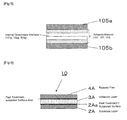
- the adhesive material 105 (referred to as the "present adhesive material 105") relating to the fifth embodiment is, as illustrated in FIG. 5 , an adhesive sheet laminate (in the following examples, referred to as an "adhesive sheet laminate") which has a constitution that the release films 105a and 105b are laminated on one surface side of any of the present adhesive material 101 to the present adhesive material 103.
- the peel strength of the internal detachment interface (101 g, 102g, and 103g) is greater than the peel strength of the interface with the release films 105a and 105b (also referred to as "release interface") but lower than the peel strength of the adherend and a surface exposed by redetachment the release films 105a and 105b.
- the peel strength of the interface between the release film 105a and the adhesive material (the present adhesive materials 101, 102, and 103) (also referred to as "release interface”) is different from the peel strength of the release interface between the release film 105b and the adhesive material (the present adhesive materials 101, 102, and 103).
- (B) / (A) above is from 1.5 to 2.5. Further, it is particularly preferable that (C) / (B) above is from 1.5 to 5.0.
- composition of the adhesives which constitute each adhesive layer can be optionally selected.
- the glass transition temperature of a polymer constituting the adhesive layer or amount of a polar component or cohesive component may be modified or an addition amount of a cross-linking agent can be modified. It can be also adjusted by suitably adding a tackifier, etc.
- Examples of a base polymer (i.e. major agent) which constitutes the adhesive layer include polymers of acryls, silicones, rubbers, polyurethanes, and polyesters as a major agent of adhesive. Of these, from the viewpoint of transparency, durability, and cost; polymers of acryls, in particular an acrylic acid ester polymer (including copolymers thereof), are used as a base polymer (i.e. main agent). It is preferable that the adhesive layer is formed by cross-linking by using a heat cross-linking agent or UV cross-linking agent and the like.
- acrylic monomers or methacrylic monomers used in polymerization of the acrylic acid ester polymers include, for example, 2-ethylhexyl acrylate, n-octyl acrylate, n-butyl acrylate, isodecyl acrylate, ethyl ethacrylate and the like.
- a cross-linking monomer like hydroxyethyl acrylate, acrylic acid, itaconic acid, glycidyl acrylate, glycidyl methacrylate, methylol acrylamide, and maleic anhydride or a highly cohesive monomer or a monomer having a functional group like methyl methacrylate, methyl acrylate, acrylamide, acrylonitirle, methacrylonitrile, vinyl acetate, styrene, fluoro acrylate, and silicone acrylate may be suitably added.
- polymerization treatment using these monomers known polymerization methods such as solution polymerization, emulsion polymerization, massive polymerization or suspension polymerization may be adopted.
- a polymerization initiator such as a thermal polymerization initiator and a photopolymerization initiator may be used depending on the polymerization method to obtain an acrylic acid ester copolymer.
- the weight average molecular weight of the acrylic acid ester copolymer is preferably as high as possible within the range that the processability is not impaired. It is preferably in the range of 100,000 to 1,000,000. When the molecular weight is too low, fluidity becomes too high, yielding an insufficient cohesive property. As a result, there is a tendency that the holding property and adhesiveness to an adherend are impaired. Further, the glass transition temperature (theoretical Tg) of the acrylic acid ester copolymer is preferably in the range of -70°C to 0°C, and more preferably in the range of -55°C to 0°C.
- a material with excessively low theoretical Tg has little content of a highly cohesive component or a highly polar component in the polymer, and therefore it tends to have a poor holding property or adhesiveness to an adherend.
- theoretical Tg is too high, it is undesirable in that a bonding property and pressure sensitive adhesiveness at room temperature are impaired.
- a modifying agent like silane coupling agent, various stabilizing agents like anti-oxidant, deterioration preventing agent, and UV absorbing agent, and a tackifier, etc. may be appropriately added to control physical properties.
- the 90° peel strength of the internal detachment interface (101 g, 102g, and 103g) is preferably from 0.01 N/50 mm to 7 N/50 mm and more preferably 0.02 N/50 mm to 5 N/50 mm.
- the peel strength is the same or less than 7 N/50 mm, redetachment property of a plate-like member having substantially no flexibility such as an image display unit or surface protection member of an image display device is not lowered even after the member is integrated.
- the 90° peel strength for the internal detachment interface (101 g, 102g, and 103g) can be determined as follows: an adhesive material is prepared as a test strip with width of 50 mm, one side of the internal detachment interface is fixed while the other side is pulled and peeled off at peeling speed of 300 mm/min at 90° angle, and the stress applied for the peeling was measured. Specifically, when an internal detachment interface is present between a substrate and an adhesive layer, the adhesive layer is fixed on a soda lime glass plate and the substrate layer is pulled at peeling speed of 300 mm/min at 90° angle to determine the stress. Further, when an internal detachment interface is present between two substrates, one substrate is fixed on a soda lime glass plate and the other substrate is pulled at peeling speed of 300 mm/min at 90° angle to determine the stress.
- the 90° peel strength of the adhesive material of the present invention (for example, the present adhesive materials 101 to 105) compared to an adherend is, at peeling speed of 5 mm/min, preferably 3 N/25 mm or more, and more preferably 5 N/25 mm or more.
- the 90° peel strength of the adhesive material of the present invention with an adherend can be obtained by assuming an adherend as a glass plate (soda lime glass).
- the 90° peel strength against a glass plate (soda lime glass) can be obtained as follows: by using an adhesive material (test strip) with width of 25 mm, an adhesive side which is exposed by peeling the release film is bonded onto a glass plate (soda lime glass), the strip is then pulled and peeled off at peeling speed of 5 mm/min at 90° angle, and the stress applied for the peeling was measured.
- the present adhesive material 101 to the present adhesive material 103 are prepared with a material with excellent transparency
- the present adhesive material 101 to the present adhesive material 103 can be preferably used as an adhesive material to assemble various image display devices. Specifically, by placing the adhesive material of the invention (the present adhesive material 101 to the present adhesive material 103) between any two optical members selected from a transparent covering material, a touch panel material, and an image display device and closely integrating them, an image display device can be produced.
- this image display device has the internal detachment interface (101g, 102g, and 103g) that can be detached from a side different from the bonding surfaces between an adhesive material and an adherend, detachment from the internal detachment interface that is present inside of the adhesive material can be achieved instead of detachment from an interface between the optical member and the adhesive material.
- each of the transparent covering material, tough panel material, and image display device can be used again. Further, even after bonding a transparent covering material and an image display device to each other, repair and exchange, etc. that are needed as a result of erroneous bonding or use for a long period of time can be carried out.
- the 90° peel strength of each interface (A) to (C) in the adhesive sheet laminate obtained from the Examples 1 to 4 and the Comparative examples 1 to 5 was obtained as follows: a surface side of a sample for evaluation having 50 mm wide, which is opposite to a surface side to be measured (i.e. it indicates an opposite interface (B) side if an interface (A) is measured), is fixed on a hard base member, a tip of a redetachable peeling layer is peeled off, fixed on an elongation apparatus (i.e. peeling apparatus), and pulled at peel speed of 300 mm/min in 90° direction with respect to an unpeeled portion of the test sample to peel off the layer, and the elongation strength is measured by using a load cell and the peel strength of each interface is calculated.
- the order of measurement it was measured in an order of high detachability, i.e. from the interfaces (A), (B), to (C).
- a substrate layer at the interface (B) side of an the adhesive sheet laminate is fixed on a hard base member by using a double-sided tape (No. 5000, manufactured by Nitto Denko) while the substrate layer remains in unpeeled state, and the measurement is carried out by pulling the substrate layer in the interface (A) side.
- a double-sided tape No. 5000, manufactured by Nitto Denko
- an adhesive surface obtained by peeling the substrate layer in the interface (A) side was fixed on a soda lime glass.
- DIAFOIL S-100 manufactured by Mitsubishi Plastics, Inc.
- the 90° peel, strength of each of the interfaces (A) and (B) in the adhesive sheet laminate obtained from the Examples 1 to 4 and the Comparative examples 1 to 5 against the glass surface was obtained as follows: an adhesive surface obtained by peeling the release film of a sample for evaluation having width of 25 mm was applied to a soda lime glass by roll compression for 5 sec with pressure of 2 kgf under the condition of 65% RH at 23°C, the support layer of the other interface or the interface (C) is pulled, and applied with a new support film (trade name: DIAFOIL S-1 00, manufactured by Mitsubishi Plastics, Inc.) having thickness of 38 ⁇ m by roll compression. After that, pressure forming treatment was carried out for 15 min under the condition including 0.35 MPa at 40°C.
- the support film was pulled at peeling speed of 5 mm/min in the 90° direction to peel the layer.
- the 90° peel strength of the adhesive sheet laminate against glass was determined.
- the symbol "*" in the table means that the interface with glass is a redetachable interface and the peel strength of corresponding interface was measured.
- the adhesive sheet laminate obtained from the Examples 1 to 4 and the Comparative examples 1 to 5 was cut to have a size of 90 mm x 90 mm.
- An adhesive surface obtained by peeling the release film in the interface A side was applied to a soda lime glass (100 mm x 100 mm x thickness of 3 mm) by roll compression for 5 sec with pressure of 2 kgf under the condition of 65% RH at 23°C.
- an adhesive surface obtained by peeling the release film in the other interface B side was overlaid with a glass plate (100 mm x 100 mm x thickness of 3 mm) and compressed by roll compression for 5 sec with pressure of 2 kgf under the condition of 65% RH at 23°C.
- a sample for evaluation i.e. glass laminate sample
- the adhesive sheet laminate 110 of the Example 1 for example, when the release film 4A is peeled off and the laminate is bonded to a soda lime glass plate to measure the bonding force, the adhesive layer 3A is brought into contact with the glass plate so that the interface between them becomes an interface for evaluation.
- the interface measured is indicated as "bonding surface (A)" in view of the counterpart (A) which is in contact with the glass plate. The same shall apply for others herein below.
- the blade tip of a scraper is pushed and squeezed into the interface (C) of the sample for evaluation of the Example (i.e. glass laminate sample), and then occurrence of any detachment was observed.
- the blade tip of a cutter is pushed and squeezed into the interface with the glass for a sample for evaluation of the Comparative example (i.e. glass laminate sample), and then occurrence of any detachment was observed. Removability was evaluated according to the following criteria.
- the sample for evaluation as prepared above i.e. glass laminate sample
- the adhesive sheets 10 to 40 and the substrate sheets 50 and 60 were produced in advance as follows.
- an acrylic resin copolymer diluted in toluene and cyclohexane (trade name: POLYTHICK AH310-S, manufactured by Sanyo Chemical Ind. Ltd., solid concentration of 37%), 10 g of a curing agent (trade name: POLYTHICK SC-75, manufactured by Sanyo Chemical Ind. Ltd.) was added and mixed to produce a solution for an adhesive layer (referred to as "adhesive composition 1A").
- a silicone-based peeling agent was coated to form the peel treatment-subjected surface 2Aa.
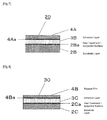
- the adhesive composition 1A was coated until the thickness becomes 50 ⁇ m after drying. By drying for 3 min at 80°C, the adhesive layer 3A was formed. By laminating the release film 4A (trade name: E7006, manufactured by TOYOBO, Co., Ltd., thickness of 38 ⁇ m) on the surface of the adhesive layer 3A, the adhesive sheet 10 was produced ( FIG. 6 ).
- the adhesive sheet 20 was produced in the same manner as the adhesive sheet 10 except that on one surface of a bi-axially elongated polyethylene terephthalate film having thickness of 100 ⁇ m, a silicone-based peeling agent was coated to form the peel treatment-subjected surface 2Ba, the adhesive composition 1A was coated on the peel treatment-subjected surface 2Ba of a resulting transparent substrate sheet (referred to as "substrate layer 2B") until the thickness becomes 25 ⁇ m after drying, and the adhesive layer 3B was formed by drying for 3 min at 80°C ( FIG. 7 ).
- SK DYNE 1451 (trade name, manufactured by Soken Chemical & Engineering Co., Ltd., solid concentration of 30%)
- a curing agent trade name: L-45, manufactured by Soken Chemical & Engineering Co., Ltd.
- promoter-S trade name, manufactured by Soken Chemical & Engineering Co., Ltd.
- a silicone-based peeling agent was coated to form the peel treatment-subjected surface 2Ca.
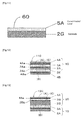
- the adhesive composition 1 B was coated until the thickness becomes 50 ⁇ m after drying. By drying for 3 min at 80°C, the adhesive layer 3C was formed. By laminating the release film 4B (trade name: MRF25, manufactured by Mitsubishi Plastics Inc., thickness of 25 ⁇ m) on the surface of the adhesive layer 3C, the adhesive sheet 30 was produced ( FIG. 8 ).
- the adhesive sheet 40 was produced in the same manner as the adhesive sheet 10 except that a transparent resin sheet (referred to as "substrate layer 2D") consisting of a bi-axially elongated polyethylene terephthalate film having thickness of 75 ⁇ m was used instead of the substrate layer 2A ( FIG. 9 ).
- substrate layer 2D a transparent resin sheet
- FIG. 9 a transparent resin sheet
- Low density linear chain polyethylene (LLDPE, trade name: NUCG-5472, manufactured by Nippon Unicar Company Limited) and ethylene-acrylic acid copolymer resin (EAA, trade name: Yukalon EAA, manufactured by Mitsubishi Petro-Chemical Co., Ltd.) were separately melted and then co-extruded to produce the substrate sheet 50 having thickness of 40 ⁇ m which consists of the substrate layer 2F consisting of low density linear chain polyethylene having thickness of 20 ⁇ m and the substrate layer 2E consisting of ethylene-acrylic acid copolymer having thickness of 20 ⁇ m ( FIG. 10 ).
- LLDPE Low density linear chain polyethylene
- EAA ethylene-acrylic acid copolymer resin
- substrate layer 2G On one surface of a transparent resin sheet (referred to as "substrate layer 2G") consisting of a bi-axially' elongated polyethylene terephthalate film having thickness of 50 ⁇ m (without any peeling treatment), an active energy ray-curable resin composition (1 kg of UV7510B (trade name) manufactured by Nippon Synthetic Chemical Industry Co., Ltd. and 20 g of a photopolymerization initiator, IRGACURE 184 (trade name), manufactured by Ciba Specialty Chemicals) was coated to thickness of 25 ⁇ m. By irradiating UV ray with an accumulated light quantity of 600 mJ/cm 2 by using a high pressure mercury lamp, the coated film was cured to form the cured product layer 5A. Accordingly, the substrate sheet 60 with thickness of 75 ⁇ m was produced ( FIG. 11 ).
- an active energy ray-curable resin composition (1 kg of UV7510B (trade name) manufactured by Nippon Synthetic Chemical Industry Co., Ltd. and 20
- the adhesive composition 1A was coated until the thickness becomes 60 ⁇ m after drying. By drying for 3 min at 80°C, the adhesive layer 3E was formed.
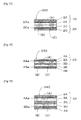
- the peel treatment-subjected surface 4Ba of the release film 4B (trade name: MRF25, manufactured by Mitsubishi Plastics Inc., thickness of 25 ⁇ m) was overlaid and laminated to produce the adhesive sheet laminate 110 (total thickness of 175 ⁇ m) ( FIG. 12 ).
- the 90° peel strength of each interface including the interface (A) between the release film 4A and the adhesive layer 3A, the interface (C) between the adhesive layer 3A and the substrate layer 2A, and the interface (B) between the adhesive layer 3E and the release film 4B was measured.
- the 90° peel strength (A) of the interface (A) between the release film 4A and the adhesive layer 3A is a measured value of 90° peel strength when the release film 4A is peeled off from the adhesive layer 3A
- the 90° peel strength (C) of the interface (C) between the adhesive layer 3A and the substrate layer 2A is a measured value of 90° peel strength when the adhesive layer 3A is peeled off from the substrate layer 2A
- the 90° peel strength (B) of the interface (B) between the adhesive layer 3E and the release film 4B is a measured value of 90° peel strength when the release film 4B is peeled off from the adhesive layer 3A.
- the adhesive sheet laminate 120 (total thickness of 175 ⁇ m) was produced ( FIG. 13 ).
- the 90° peel strength of each interface including the interface (A) between the release film 4A and the adhesive layer 3B, the interface (C) between the adhesive layer 3B and the substrate layer 2B, and the interface (B) between the adhesive layer 3A and the substrate layer 2A was measured.
- the 90° peel strength (A) of the interface (A) between the release film 4A and the adhesive layer 3B is a measured value of 90° peel strength when the release film 4A is peeled off from the adhesive layer 3B
- the 90° peel strength (C) of the interface (C) between the adhesive layer 3B and the substrate layer 2B is a measured value of 90° peel strength when the adhesive layer 3B is peeled off from the substrate layer 2B
- the 90° peel strength (B) of the interface (B) between the adhesive layer 3A and the substrate layer 2A is a measured value of 90° peel strength when the adhesive layer 3A is peeled off from the substrate layer 2A.
- the adhesive composition 1C was melt-extruded to have the thickness of 85 ⁇ m and to form the adhesive composition layer 3f.
- the peel treatment-subjected surface 4Ca of the release film 4C (trade name: K1571, manufactured by TOYOBO, Co., Ltd., thickness of 50 ⁇ m) was laminated and compressed against the adhesive composition layer 3f.
- the adhesive surface of the adhesive sheet 10 which is exposed by peeling the release film 4A was overlaid and laminated to obtain a laminate.
- the adhesive composition layer 3f was cured by cross-linking. Accordingly, the adhesive sheet laminate 130 (total thickness of 175 ⁇ m) was produced as the adhesive layer 3F ( FIG. 14 ).
- the 90° peel strength of each interface including the interface (A) between the substrate layer 2A and the adhesive layer 3A, the interface (B) between the adhesive layer 3F and the release film 4C, and the interface (C) between the substrate layer 2F and the substrate layer 2E was measured.
- the 90° peel strength (A) of the interface (A) between the substrate layer 2A and the adhesive layer 3A is a measured value of 90° peel strength when the adhesive layer 3A is peeled off from the substrate layer 2A
- the 90° peel strength (B) of the interface (B) between the adhesive layer 3F and the release film 4C is a measured value of 90° peel strength when the release film 4C is peeled off from the adhesive layer 3F
- the 90° peel strength (C) of the interface (C) between the substrate layer 2F and the substrate layer 2E is a measured value of 90° peel strength when the substrate layer 2E is peeled off from the substrate layer 2F.
- the adhesive composition 1C which has been prepared in the same manner as the Example 3 was extruded and coated to have the thickness of 50 ⁇ m and to form the adhesive composition layer 3g.
- the release film 4A (trade name: E7006, manufactured by TOYOBO, Co., Ltd., thickness of 38 ⁇ m) was laminated while the release film 4D (trade name: MRF75, manufactured by Mitsubishi Plastics Inc., thickness of 75 ⁇ m) was laminated on the surface of the adhesive composition layer 3g in the substrate layer 2D side to obtain a laminate (total thickness of 175 ⁇ m).
- the adhesive composition layer 3g, 3g was cured by cross-linking. Accordingly, the adhesive sheet laminate 140 (total thickness of 175 ⁇ m) was produced as the adhesive layer 3G, 3G ( FIG. 15 ).
- the 90° peel strength of each interface including the interface (A) between the adhesive layer 3G and the release film 4A, the interface (B) between the adhesive layer 3G and the release film 4D, and the interface (C) between the substrate layer 2D and the cured product layer 5A was measured.
- the 90° peel strength (A) of the interface (A) between the adhesive layer 3G and the release film 4A is a measured value of 90° peel strength when the release film 4A is peeled off from the adhesive layer 3G
- the 90° peel strength (B) of the interface (B) between the adhesive layer 3G and the release film 4D is a measured value of 90° peel strength when the release film 4D is peeled off from the adhesive layer 3G
- the 90° peel strength (C) of the interface (C) between the substrate layer 2D and the cured product layer 5A is a measured value of 90° peel strength when the cured product layer 5A is peeled off from the substrate layer 2D.
- the adhesive layer solution (herein below referred to as "adhesive composition 1D") obtained by adding and mixing 2.4 g of a curing agent E-AX (trade name, manufactured by Soken Chemical & Engineering Co., Ltd.) to 1 kg of SK DYNE 2094 (trade name, manufactured by Soken Chemical & Engineering Co., Ltd., solid concentration of 30%) was coated on the release treatment-subjected surface of the release film 4A (trade name: E7006, manufactured by TOYOBO, Co., Ltd., thickness of 38 ⁇ m) until the thickness becomes 50 ⁇ m after drying. By drying for 3 min at 80°C, the adhesive layer 3J was formed.
- a thermoplastic fluoro resin i.e.
- the adhesive composition 1A was coated to have the thickness of 100 ⁇ m.
- the adhesive layer 3A was formed.
- the adhesive sheet laminate 150 (total thickness of 175 ⁇ m) was produced ( FIG. 22 ).
- the 90° peel strength of each interface including the interface (A) between the release film 4A and the adhesive layer 3J, the interface (C) between the adhesive layer 3J and the ETFE sheet 7A, and the interface (B) between the adhesive layer 3A and the release film 4B was measured.
- the 90° peel strength (A) of the interface (A) between the release film 4A and the adhesive layer 3J is a measured value of 90° peel strength when the release film 4A is peeled off from the adhesive layer 3J
- the 90° peel strength (C) of the interface (C) between the adhesive layer 3J and the ETFE sheet 7A is a measured value of 90° peel strength when the adhesive layer 3J is peeled off from the ETFE sheet 7A
- the 90° peel strength (B) of the interface (B) between the adhesive layer 3A and the release film 4B is a measured value of 90° peel strength when the release film 4B is peeled off from the adhesive layer 3A.
- the value of the 90° peel strength (A) was 0.38 N/50 mm
- the value of the 90° peel strength (B) was 0.5 N/50 mm
- the value of the 90° peel strength (C) was 0.9 N/50 mm.
- the adhesion force of the adhesive layer 3A on glass was 7.0 N/25 mm.
- a silicone-based peeling agent was coated to form the peel treatment-subjected surface 2Ca.
- the adhesive composition 1C prepared in the same manner as the Example 3 was melt-extruded to have the thickness of 175 ⁇ m and to form the adhesive composition layer 3f.
- the release film 4B (trade name: MRF25, manufactured by Mitsubishi Plastics Inc., thickness of 25 ⁇ m) was laminated and compressed via the adhesive composition layer 3f to obtain a laminate.
- the adhesive composition layer 3f was cured by cross-linking. Accordingly, the adhesive sheet laminate 210 (total thickness of 175 ⁇ m) was produced as the adhesive layer 3F ( FIG. 16 ).
- the adhesive layer 3C in the adhesive sheet 30, which is exposed by peeling the release film 4B was overlaid and laminated to produce the adhesive sheet laminate 220 (total thickness of 100 ⁇ m) ( FIG. 17 ).
- the adhesive sheet laminate 230 was produced in the same manner as the Example 1 ( FIG. 18 ).
- the adhesive composition 1 D was coated and dried until the thickness becomes 50 ⁇ m after drying to form the adhesive layer 3H.
- the release film 4B (trade name: MRF25, manufactured by Mitsubishi Plastics Inc., thickness of 25 ⁇ m) was laminated and compressed onto the adhesive layer 3H to obtain the adhesive sheet laminate 240 (total thickness of 175 ⁇ m) ( FIG. 19 ).
- the substrate layer 2J having thickness of 75 ⁇ m which consists of a biaxially elongated polyethylene terephthalate film, a redetachable adhesive layer 31 having thickness of 25 ⁇ m and the protective film 6A were laminated.
- the adhesive layer 3A which is exposed by peeling the release film 4a in the adhesive sheet 10, was compressed to form a laminate.
- the adhesive sheet laminate 250 (total thickness of 150 ⁇ m) was produced ( FIG. 20 ).
- Example 1 Example 2 Example 3 Example 4 Example 5 (A) (B) (C) (A) (B) (C) (A) (B) (C) (A) (B) (C) (A) (B) (C) (A) (B) (C) (A) (B) (C) (C) (A) (B) (C) (C) (C) (C) (C) (C) (C) (C) (C) (C) (C) Interlayer peel strength (N/50mm) 0.34 0.41 0.52 0.34 0.44 1.02 0.39 0.85 3.10 0.36 0.41 0.60 0.38 0.50 0.90 Glass adhesion force (N/25mm) 10 (Adhesive surface (A)) 9.4 (Adhesive surface (A)) 7.9 (Adhesive surface (B)) 8.1 (Adhesive surface (A)) 7.0 (Adhesive surface (A)) Durably ⁇ ⁇ ⁇ ⁇ ⁇ Removability ⁇ ⁇ ⁇ ⁇
- the adhesive sheet obtained from the Examples 1 to 5 showed easy redetachment and excellent redetachment workability after it is fromed into a glass laminate, and exhibited no significant change in appearance according to the durability test.
- the adhesive sheet laminate 210 obtained from the Comparative example 1 has no detachable interface and, as being strongly adhered on glass, a crack appeared at the time of separating the glass, and therefore exhibited poor reworkability.
- adhesion force between the adhesive sheet and glass is relatively weak.
- the adhesive sheet laminate 230 obtained from the Comparative example 3 has no detachable interface, it showed poor removability similar to the Comparative example 1.
- the adhesive sheet laminate 240 obtained from the Comparative example 4 was redetachable in accordance with foaming of the adhesive layer 3H by heating.
- the adhesive sheet laminate 250 obtained from the Comparative example 5 was redetachable when the redetachable adhesive side is slowly pulled and peeled off from the glass.
- the adhesion force is weak and tiny detachment was found in the interface between the glass and the redetachable adhesive layer interface.
- the glass laminate obtained from the Comparative example 6 it was cumbersome to remove air bubbles present in the liquid of adhesive at the time of filling adhesive. Further, although the durability of the glass laminate was excellent, adhesion was so strong that removability was rather poor.
Landscapes
- Chemical & Material Sciences (AREA)
- Organic Chemistry (AREA)
- Physics & Mathematics (AREA)
- General Physics & Mathematics (AREA)
- Engineering & Computer Science (AREA)
- Theoretical Computer Science (AREA)
- Adhesive Tapes (AREA)
- Laminated Bodies (AREA)
- Adhesives Or Adhesive Processes (AREA)
- Devices For Indicating Variable Information By Combining Individual Elements (AREA)
Applications Claiming Priority (2)
| Application Number | Priority Date | Filing Date | Title |
|---|---|---|---|
| JP2009126292 | 2009-05-26 | ||
| PCT/JP2010/058600 WO2010137523A1 (fr) | 2009-05-26 | 2010-05-21 | Matériau adhésif redécollable |
Publications (3)
| Publication Number | Publication Date |
|---|---|
| EP2436741A1 true EP2436741A1 (fr) | 2012-04-04 |
| EP2436741A4 EP2436741A4 (fr) | 2014-01-15 |
| EP2436741B1 EP2436741B1 (fr) | 2018-10-24 |
Family
ID=43222633
Family Applications (1)
| Application Number | Title | Priority Date | Filing Date |
|---|---|---|---|
| EP10780478.3A Not-in-force EP2436741B1 (fr) | 2009-05-26 | 2010-05-21 | Matériau adhésif redécollable |
Country Status (7)
| Country | Link |
|---|---|
| US (1) | US20120064338A1 (fr) |
| EP (1) | EP2436741B1 (fr) |
| JP (3) | JP5514817B2 (fr) |
| KR (2) | KR101505416B1 (fr) |
| CN (1) | CN102439105B (fr) |
| TW (1) | TWI495705B (fr) |
| WO (1) | WO2010137523A1 (fr) |
Cited By (1)
| Publication number | Priority date | Publication date | Assignee | Title |
|---|---|---|---|---|
| DE102013204837B4 (de) | 2013-03-19 | 2023-04-06 | Herma Gmbh | Mehrlagiges Laminat und seine Verwendung |
Families Citing this family (44)
| Publication number | Priority date | Publication date | Assignee | Title |
|---|---|---|---|---|
| EP2341112B1 (fr) | 2008-10-15 | 2014-09-03 | Mitsubishi Plastics, Inc. | Feuille adhésive transparente et dispositif d'affichage d'image |
| WO2010137523A1 (fr) * | 2009-05-26 | 2010-12-02 | 三菱樹脂株式会社 | Matériau adhésif redécollable |
| KR101585270B1 (ko) * | 2010-03-16 | 2016-01-13 | (주)엘지하우시스 | 점착 필름 및 터치패널 |
| JP5571995B2 (ja) * | 2010-03-31 | 2014-08-13 | リンテック株式会社 | 両面粘着シートおよびタッチパネル付き表示装置 |
| JP5865064B2 (ja) * | 2011-11-22 | 2016-02-17 | ニッタ株式会社 | 光学用アクリル系粘着シートおよびこれを用いた光学部材の取り外し方法 |
| US9221231B2 (en) | 2011-11-22 | 2015-12-29 | Samsung Display Co., Ltd. | Acrylate based adhesive composition for optical use, acrylate based adhesive sheet for optical use, and method for separating optical component using the same |
| US9574111B2 (en) | 2012-01-18 | 2017-02-21 | Mitsubishi Plastics, Inc. | Transparent double-sided adhesive sheet for image display device and image display device using the same |
| EP2816090B1 (fr) | 2012-01-18 | 2016-10-26 | Mitsubishi Plastics, Inc. | Dispositif d'affichage d'images utilisant une feuille adhésive double face transparente |
| US9441141B2 (en) | 2012-01-18 | 2016-09-13 | Mitsubishi Plastics, Inc. | Transparent double-sided adhesive sheet for image display device and image display device using the same |
| KR101908290B1 (ko) * | 2012-04-03 | 2018-10-16 | 동우 화인켐 주식회사 | 양면 점착 시트 및 이를 구비한 화상 표시 장치 |
| JP2014051599A (ja) * | 2012-09-07 | 2014-03-20 | Osaka Sealing Printing Co Ltd | 粘着テープ |
| KR101423106B1 (ko) * | 2012-09-28 | 2014-07-25 | 인산디지켐 주식회사 | 다기능성 복합 구조 폼 테이프의 제조 방법 및 제조 장치 |
| JP6322278B2 (ja) * | 2014-02-18 | 2018-05-09 | シャープ株式会社 | 積層フィルム及びフィルム貼り付け方法 |
| JP6353662B2 (ja) * | 2014-02-18 | 2018-07-04 | 東京応化工業株式会社 | 接着剤積層体及びその利用 |
| JP6366381B2 (ja) * | 2014-06-27 | 2018-08-01 | キヤノン株式会社 | トナーの製造方法 |
| JP6241547B2 (ja) | 2014-07-01 | 2017-12-06 | 三菱ケミカル株式会社 | 光学装置構成用部材のリサイクル方法および光学装置構成用積層体のリワーク性評価方法 |
| KR20170072198A (ko) * | 2014-10-23 | 2017-06-26 | 린텍 가부시키가이샤 | 점착제, 점착 시트 및 표시체 |
| JP6534841B2 (ja) * | 2015-03-31 | 2019-06-26 | 株式会社フジシール | 蓋用ラベル及び包装体 |
| WO2017154226A1 (fr) * | 2016-03-09 | 2017-09-14 | 三菱樹脂株式会社 | Film adhésif et son procédé de production |
| JP6825316B2 (ja) * | 2016-03-30 | 2021-02-03 | Dic株式会社 | 粘着テープ及び物品 |
| DE202016102816U1 (de) | 2016-05-27 | 2016-09-15 | Sen Hao Wu | Wiederverwendbare Klebefolie |
| EP3293606B1 (fr) * | 2016-09-09 | 2020-12-30 | Samsung Display Co., Ltd. | Dispositif d'affichage et procédé de fabrication d'un dispositif électronique l'utilisant |
| CN108062176B (zh) * | 2016-11-09 | 2021-07-09 | 东友精细化工有限公司 | 触摸传感器层叠体及其制造方法 |
| CN109082241A (zh) * | 2017-06-13 | 2018-12-25 | 麦克赛尔控股株式会社 | 双面粘着胶带、及薄膜部件与支承部件的层叠体 |
| JP7139141B2 (ja) * | 2017-06-13 | 2022-09-20 | マクセル株式会社 | 両面粘着テープ、及び薄膜部材と支持部材との積層体 |
| US10369774B2 (en) | 2017-06-30 | 2019-08-06 | Microsoft Technology Licensing, Llc | Thermally conductive de-bonding aid |
| JP6931741B2 (ja) * | 2017-08-25 | 2021-09-08 | スリーエム イノベイティブ プロパティズ カンパニー | 損傷のない取り外しを可能にする接着性物品 |
| JP7237063B2 (ja) | 2017-08-25 | 2023-03-10 | スリーエム イノベイティブ プロパティズ カンパニー | 損傷のない取り外しを可能にする接着性物品 |
| KR102366313B1 (ko) | 2017-09-08 | 2022-02-23 | 삼성디스플레이 주식회사 | 보호 필름, 표시 모듈, 표시 장치, 표시 모듈 제조 방법 및 표시 장치 제조 방법 |
| WO2019142905A1 (fr) * | 2018-01-18 | 2019-07-25 | 王子ホールディングス株式会社 | Feuille adhésive double face et feuille adhésive double face pourvue d'une feuille antiadhésive |
| CN111615543A (zh) * | 2018-01-18 | 2020-09-01 | 王子控股株式会社 | 双面粘合片和带剥离片的双面粘合片 |
| TWI785203B (zh) * | 2018-02-05 | 2022-12-01 | 美商3M新設資產公司 | 可調整大小的傢俱墊 |
| US11084955B2 (en) | 2018-07-23 | 2021-08-10 | Microsoft Technology Licensing, Llc | Pressure sensitive adhesive with thermally conductive release tab |
| KR102305576B1 (ko) | 2018-10-16 | 2021-09-27 | 주식회사 엘지화학 | 다층 점착 필름 |
| KR102305579B1 (ko) | 2018-11-06 | 2021-09-27 | 주식회사 엘지화학 | Oca 필름용 점착 조성물, 및 그로부터 제조된 oca 필름 및 터치 스크린 패널 |
| TWI699424B (zh) * | 2019-01-30 | 2020-07-21 | 南亞塑膠工業股份有限公司 | 一種oca光學膠的離型薄膜及其製造方法 |
| CN110028911A (zh) * | 2019-04-23 | 2019-07-19 | 武汉友发包装科技有限公司 | 一种双面胶带及其生产方法 |
| CN115210332B (zh) * | 2020-03-31 | 2024-11-08 | 三菱化学株式会社 | 双面粘合片、图像显示装置用层叠体和图像显示装置 |
| KR102776785B1 (ko) * | 2020-04-22 | 2025-03-11 | 삼성디스플레이 주식회사 | 표시 장치 및 표시 장치의 제조 방법 |
| CN113696523A (zh) * | 2021-09-01 | 2021-11-26 | 苍南县如潮文具有限公司 | 一种双面胶带的制造方法及制造装置 |
| TWI790881B (zh) | 2021-12-30 | 2023-01-21 | 財團法人工業技術研究院 | 雙面膠及多層結構體 |
| KR102657629B1 (ko) * | 2022-03-08 | 2024-04-12 | 소윤섭 | 재밀봉이 가능한 음료용기용 리드필름 및 그 제조방법 |
| JP2023141828A (ja) * | 2022-03-24 | 2023-10-05 | 藤森工業株式会社 | 粘着フィルム |
| CN115895473B (zh) * | 2022-11-16 | 2025-04-04 | 盐城匡特新材料科技有限公司 | 一种防水型耐点冲击吸收丙烯酸泡棉胶带及其制备方法 |
Family Cites Families (30)
| Publication number | Priority date | Publication date | Assignee | Title |
|---|---|---|---|---|
| JPS5233673U (fr) * | 1975-08-29 | 1977-03-09 | ||
| JPH03170573A (ja) * | 1989-11-30 | 1991-07-24 | Fuji Photo Film Co Ltd | 両面接着テープ |
| JPH0478241U (fr) * | 1990-11-16 | 1992-07-08 | ||
| JPH0741736A (ja) * | 1993-07-30 | 1995-02-10 | New Oji Paper Co Ltd | 基材レス両面粘着シート |
| JPH10260395A (ja) | 1997-03-19 | 1998-09-29 | Nissha Printing Co Ltd | 液晶表示ディスプレイ一体型透明タッチパネル |
| JP2001075494A (ja) * | 1999-09-02 | 2001-03-23 | Seiko Instruments Inc | 表示装置及びそれに用いる積層両面テープ |
| US6521309B1 (en) * | 1999-11-11 | 2003-02-18 | Tyco Adhesives Lp | Double-sided single-liner pressure-sensitive adhesive tape |
| EP1422602A4 (fr) * | 2001-08-30 | 2010-10-27 | Nissha Printing | Structure de montage pour panneau tactile transparent amovible, et feuille de montage utilisee a cet effet |
| JP2003081817A (ja) * | 2001-09-07 | 2003-03-19 | Sekisui Chem Co Ltd | 貼付剤 |
| JP2003177241A (ja) * | 2001-12-10 | 2003-06-27 | Fujimori Kogyo Co Ltd | 光学用積層体、粘着剤転写テープ、および光学用積層体の製造法 |
| JP3880418B2 (ja) | 2002-02-21 | 2007-02-14 | 日東電工株式会社 | 両面粘着シートおよびタッチパネルの表示装置への貼着固定方法 |
| JP2003301146A (ja) * | 2002-04-09 | 2003-10-21 | Big Technos Kk | 層間剥離両面テープ |
| JP4151828B2 (ja) * | 2002-05-29 | 2008-09-17 | 日東電工株式会社 | 両面粘着シートおよびタッチパネル付き表示装置 |
| JP4493273B2 (ja) * | 2003-01-29 | 2010-06-30 | 日東電工株式会社 | 両面粘着シートおよびタッチパネル付き表示装置 |
| JP2004300231A (ja) * | 2003-03-31 | 2004-10-28 | Nitto Denko Corp | 熱剥離性両面粘着シート、被着体の加工方法および電子部品 |
| JP4515118B2 (ja) * | 2004-03-12 | 2010-07-28 | 日東電工株式会社 | 透明両面粘着テープ又はシート及びタッチパネル |
| FR2877349B1 (fr) * | 2004-11-04 | 2007-04-27 | Rescoll Sarl Soc | Procede d'assemblage de deux substrats par collage, procede de demontage de cet assemblage colle par migration |
| JP2006169354A (ja) * | 2004-12-15 | 2006-06-29 | Oji Paper Co Ltd | 感圧接着シート |
| JP5364226B2 (ja) * | 2005-02-21 | 2013-12-11 | 日東電工株式会社 | 粘着剤組成物、両面粘着テープおよび接着方法 |
| JP4916435B2 (ja) * | 2005-03-29 | 2012-04-11 | リンテック株式会社 | 再剥離性粘着シート、その製造方法及び再剥離性粘着シート積層体 |
| JP2006299053A (ja) | 2005-04-20 | 2006-11-02 | Mitsubishi Plastics Ind Ltd | 透明粘着シート |
| JP4875357B2 (ja) * | 2005-12-19 | 2012-02-15 | リンテック株式会社 | 両面粘着テープ |
| JP5085145B2 (ja) * | 2006-03-15 | 2012-11-28 | 日東電工株式会社 | 両面粘着テープ又はシート、および液晶表示装置 |
| JP2008007535A (ja) * | 2006-06-27 | 2008-01-17 | Oji Paper Co Ltd | 両面粘着シートおよび剥離シート付き両面粘着シート |
| JP2008120864A (ja) * | 2006-11-09 | 2008-05-29 | Dainippon Ink & Chem Inc | 両面粘着シート、タッチパネル用モジュールおよびその製造方法 |
| JP5235294B2 (ja) * | 2006-11-10 | 2013-07-10 | 日東電工株式会社 | 加熱発泡型再剥離性アクリル系粘着テープ又はシート |
| JP2008144116A (ja) * | 2006-12-13 | 2008-06-26 | Nitto Denko Corp | 両面粘着シートおよび液晶表示装置 |
| JP5305595B2 (ja) * | 2007-01-10 | 2013-10-02 | 日東電工株式会社 | 熱接着シート |
| JP5171425B2 (ja) * | 2007-10-22 | 2013-03-27 | 日東電工株式会社 | 加熱発泡型再剥離性アクリル系粘着テープ又はシート、及び剥離方法 |
| WO2010137523A1 (fr) * | 2009-05-26 | 2010-12-02 | 三菱樹脂株式会社 | Matériau adhésif redécollable |
-
2010
- 2010-05-21 WO PCT/JP2010/058600 patent/WO2010137523A1/fr not_active Ceased
- 2010-05-21 KR KR1020117029225A patent/KR101505416B1/ko not_active Expired - Fee Related
- 2010-05-21 US US13/320,830 patent/US20120064338A1/en not_active Abandoned
- 2010-05-21 CN CN201080021967.8A patent/CN102439105B/zh active Active
- 2010-05-21 EP EP10780478.3A patent/EP2436741B1/fr not_active Not-in-force
- 2010-05-21 JP JP2011516001A patent/JP5514817B2/ja not_active Expired - Fee Related
- 2010-05-21 KR KR1020147005487A patent/KR101723375B1/ko not_active Expired - Fee Related
- 2010-05-26 TW TW099116790A patent/TWI495705B/zh active
-
2013
- 2013-12-26 JP JP2013268824A patent/JP2014132078A/ja active Pending
-
2015
- 2015-06-01 JP JP2015111169A patent/JP2016006176A/ja active Pending
Cited By (1)
| Publication number | Priority date | Publication date | Assignee | Title |
|---|---|---|---|---|
| DE102013204837B4 (de) | 2013-03-19 | 2023-04-06 | Herma Gmbh | Mehrlagiges Laminat und seine Verwendung |
Also Published As
| Publication number | Publication date |
|---|---|
| KR101723375B1 (ko) | 2017-04-05 |
| WO2010137523A1 (fr) | 2010-12-02 |
| JP2014132078A (ja) | 2014-07-17 |
| JP5514817B2 (ja) | 2014-06-04 |
| CN102439105B (zh) | 2015-04-15 |
| JP2016006176A (ja) | 2016-01-14 |
| KR20120023065A (ko) | 2012-03-12 |
| EP2436741A4 (fr) | 2014-01-15 |
| US20120064338A1 (en) | 2012-03-15 |
| TW201105765A (en) | 2011-02-16 |
| JPWO2010137523A1 (ja) | 2012-11-15 |
| KR101505416B1 (ko) | 2015-03-25 |
| TWI495705B (zh) | 2015-08-11 |
| KR20140048313A (ko) | 2014-04-23 |
| CN102439105A (zh) | 2012-05-02 |
| EP2436741B1 (fr) | 2018-10-24 |
Similar Documents
| Publication | Publication Date | Title |
|---|---|---|
| EP2436741B1 (fr) | Matériau adhésif redécollable | |
| EP2341112B1 (fr) | Feuille adhésive transparente et dispositif d'affichage d'image | |
| CN102046746B (zh) | 丙烯酸类压敏胶粘带或胶粘片 | |
| JP6679239B2 (ja) | 粘着シート | |
| CN102325851B (zh) | 可拉伸剥离的粘合带 | |
| TWI595066B (zh) | 光學壓感黏著片、光學膜及顯示裝置 | |
| JP6140491B2 (ja) | 両面粘着シート及び携帯電子機器 | |
| JP5547538B2 (ja) | 透明粘着シートおよび画像表示装置 | |
| US20130101819A1 (en) | Double-sided adhesive tape | |
| WO2010122942A1 (fr) | Ruban adhésif ou feuille adhésive sensible à la pression acrylique expansible à la chaleur et repelable | |
| CN102140315A (zh) | 粘合带和粘合带的使用方法 | |
| CN102017177A (zh) | 太阳能电池面板用粘合片、使用该粘合片的太阳能电池面板及使用该粘合片的太阳能电池面板的制造方法 | |
| JP2017149980A (ja) | 両面粘着シート及び携帯電子機器 | |
| KR20190003644A (ko) | 박리 라이너 부착 점착 시트 | |
| WO2016084948A1 (fr) | Feuille adhésive | |
| JP2011063701A (ja) | 粘着剤組成物の製造方法、粘着フィルムの製造方法、粘着剤用原料組成物及び粘着フィルム | |
| JP2004010647A (ja) | セパレータ付き感圧型接着シート及び光学部材組立体並びにその組立方法 | |
| KR20080023250A (ko) | 광 흡수 성질을 지니는 lc 디스플레이를 제조 또는결합시키기 위한 양면 감압 접착 테이프 | |
| JP2014095091A (ja) | 粘着剤組成物の製造方法、粘着フィルムの製造方法、粘着剤用原料組成物及び粘着フィルム | |
| KR20100056936A (ko) | 무기재 양면점착테이프 및 이의 라미네이션 방법 |
Legal Events
| Date | Code | Title | Description |
|---|---|---|---|
| PUAI | Public reference made under article 153(3) epc to a published international application that has entered the european phase |
Free format text: ORIGINAL CODE: 0009012 |
|
| 17P | Request for examination filed |
Effective date: 20111208 |
|
| AK | Designated contracting states |
Kind code of ref document: A1 Designated state(s): AL AT BE BG CH CY CZ DE DK EE ES FI FR GB GR HR HU IE IS IT LI LT LU LV MC MK MT NL NO PL PT RO SE SI SK SM TR |
|
| DAX | Request for extension of the european patent (deleted) | ||
| A4 | Supplementary search report drawn up and despatched |
Effective date: 20131212 |
|
| RIC1 | Information provided on ipc code assigned before grant |
Ipc: G09F 9/00 20060101ALI20131206BHEP Ipc: C09J 7/02 20060101AFI20131206BHEP Ipc: C09J 201/00 20060101ALI20131206BHEP |
|
| STAA | Information on the status of an ep patent application or granted ep patent |
Free format text: STATUS: EXAMINATION IS IN PROGRESS |
|
| 17Q | First examination report despatched |
Effective date: 20170510 |
|
| RAP1 | Party data changed (applicant data changed or rights of an application transferred) |
Owner name: MITSUBISHI CHEMICAL CORPORATION |
|
| RAP1 | Party data changed (applicant data changed or rights of an application transferred) |
Owner name: MITSUBISHI CHEMICAL CORPORATION |
|
| REG | Reference to a national code |
Ref country code: DE Ref legal event code: R079 Ref document number: 602010054615 Country of ref document: DE Free format text: PREVIOUS MAIN CLASS: C09J0007020000 Ipc: C09J0007200000 |
|
| GRAP | Despatch of communication of intention to grant a patent |
Free format text: ORIGINAL CODE: EPIDOSNIGR1 |
|
| STAA | Information on the status of an ep patent application or granted ep patent |
Free format text: STATUS: GRANT OF PATENT IS INTENDED |
|
| RIC1 | Information provided on ipc code assigned before grant |
Ipc: C09J 7/20 20180101AFI20180509BHEP Ipc: G09F 9/00 20060101ALI20180509BHEP Ipc: C09J 201/00 20060101ALI20180509BHEP |
|
| INTG | Intention to grant announced |
Effective date: 20180608 |
|
| GRAS | Grant fee paid |
Free format text: ORIGINAL CODE: EPIDOSNIGR3 |
|
| GRAA | (expected) grant |
Free format text: ORIGINAL CODE: 0009210 |
|
| STAA | Information on the status of an ep patent application or granted ep patent |
Free format text: STATUS: THE PATENT HAS BEEN GRANTED |
|
| AK | Designated contracting states |
Kind code of ref document: B1 Designated state(s): AL AT BE BG CH CY CZ DE DK EE ES FI FR GB GR HR HU IE IS IT LI LT LU LV MC MK MT NL NO PL PT RO SE SI SK SM TR |
|
| REG | Reference to a national code |
Ref country code: GB Ref legal event code: FG4D |
|
| REG | Reference to a national code |
Ref country code: CH Ref legal event code: EP |
|
| REG | Reference to a national code |
Ref country code: IE Ref legal event code: FG4D |
|
| REG | Reference to a national code |
Ref country code: DE Ref legal event code: R096 Ref document number: 602010054615 Country of ref document: DE Ref country code: AT Ref legal event code: REF Ref document number: 1056645 Country of ref document: AT Kind code of ref document: T Effective date: 20181115 |
|
| REG | Reference to a national code |
Ref country code: NL Ref legal event code: MP Effective date: 20181024 |
|
| REG | Reference to a national code |
Ref country code: LT Ref legal event code: MG4D |
|
| REG | Reference to a national code |
Ref country code: AT Ref legal event code: MK05 Ref document number: 1056645 Country of ref document: AT Kind code of ref document: T Effective date: 20181024 |
|
| PG25 | Lapsed in a contracting state [announced via postgrant information from national office to epo] |
Ref country code: NL Free format text: LAPSE BECAUSE OF FAILURE TO SUBMIT A TRANSLATION OF THE DESCRIPTION OR TO PAY THE FEE WITHIN THE PRESCRIBED TIME-LIMIT Effective date: 20181024 |
|
| PG25 | Lapsed in a contracting state [announced via postgrant information from national office to epo] |
Ref country code: AT Free format text: LAPSE BECAUSE OF FAILURE TO SUBMIT A TRANSLATION OF THE DESCRIPTION OR TO PAY THE FEE WITHIN THE PRESCRIBED TIME-LIMIT Effective date: 20181024 Ref country code: LV Free format text: LAPSE BECAUSE OF FAILURE TO SUBMIT A TRANSLATION OF THE DESCRIPTION OR TO PAY THE FEE WITHIN THE PRESCRIBED TIME-LIMIT Effective date: 20181024 Ref country code: NO Free format text: LAPSE BECAUSE OF FAILURE TO SUBMIT A TRANSLATION OF THE DESCRIPTION OR TO PAY THE FEE WITHIN THE PRESCRIBED TIME-LIMIT Effective date: 20190124 Ref country code: FI Free format text: LAPSE BECAUSE OF FAILURE TO SUBMIT A TRANSLATION OF THE DESCRIPTION OR TO PAY THE FEE WITHIN THE PRESCRIBED TIME-LIMIT Effective date: 20181024 Ref country code: IS Free format text: LAPSE BECAUSE OF FAILURE TO SUBMIT A TRANSLATION OF THE DESCRIPTION OR TO PAY THE FEE WITHIN THE PRESCRIBED TIME-LIMIT Effective date: 20190224 Ref country code: BG Free format text: LAPSE BECAUSE OF FAILURE TO SUBMIT A TRANSLATION OF THE DESCRIPTION OR TO PAY THE FEE WITHIN THE PRESCRIBED TIME-LIMIT Effective date: 20190124 Ref country code: LT Free format text: LAPSE BECAUSE OF FAILURE TO SUBMIT A TRANSLATION OF THE DESCRIPTION OR TO PAY THE FEE WITHIN THE PRESCRIBED TIME-LIMIT Effective date: 20181024 Ref country code: ES Free format text: LAPSE BECAUSE OF FAILURE TO SUBMIT A TRANSLATION OF THE DESCRIPTION OR TO PAY THE FEE WITHIN THE PRESCRIBED TIME-LIMIT Effective date: 20181024 Ref country code: HR Free format text: LAPSE BECAUSE OF FAILURE TO SUBMIT A TRANSLATION OF THE DESCRIPTION OR TO PAY THE FEE WITHIN THE PRESCRIBED TIME-LIMIT Effective date: 20181024 Ref country code: PL Free format text: LAPSE BECAUSE OF FAILURE TO SUBMIT A TRANSLATION OF THE DESCRIPTION OR TO PAY THE FEE WITHIN THE PRESCRIBED TIME-LIMIT Effective date: 20181024 |
|
| PG25 | Lapsed in a contracting state [announced via postgrant information from national office to epo] |
Ref country code: GR Free format text: LAPSE BECAUSE OF FAILURE TO SUBMIT A TRANSLATION OF THE DESCRIPTION OR TO PAY THE FEE WITHIN THE PRESCRIBED TIME-LIMIT Effective date: 20190125 Ref country code: SE Free format text: LAPSE BECAUSE OF FAILURE TO SUBMIT A TRANSLATION OF THE DESCRIPTION OR TO PAY THE FEE WITHIN THE PRESCRIBED TIME-LIMIT Effective date: 20181024 Ref country code: AL Free format text: LAPSE BECAUSE OF FAILURE TO SUBMIT A TRANSLATION OF THE DESCRIPTION OR TO PAY THE FEE WITHIN THE PRESCRIBED TIME-LIMIT Effective date: 20181024 Ref country code: PT Free format text: LAPSE BECAUSE OF FAILURE TO SUBMIT A TRANSLATION OF THE DESCRIPTION OR TO PAY THE FEE WITHIN THE PRESCRIBED TIME-LIMIT Effective date: 20190224 |
|
| REG | Reference to a national code |
Ref country code: DE Ref legal event code: R097 Ref document number: 602010054615 Country of ref document: DE |
|
| PG25 | Lapsed in a contracting state [announced via postgrant information from national office to epo] |
Ref country code: DK Free format text: LAPSE BECAUSE OF FAILURE TO SUBMIT A TRANSLATION OF THE DESCRIPTION OR TO PAY THE FEE WITHIN THE PRESCRIBED TIME-LIMIT Effective date: 20181024 Ref country code: CZ Free format text: LAPSE BECAUSE OF FAILURE TO SUBMIT A TRANSLATION OF THE DESCRIPTION OR TO PAY THE FEE WITHIN THE PRESCRIBED TIME-LIMIT Effective date: 20181024 Ref country code: IT Free format text: LAPSE BECAUSE OF FAILURE TO SUBMIT A TRANSLATION OF THE DESCRIPTION OR TO PAY THE FEE WITHIN THE PRESCRIBED TIME-LIMIT Effective date: 20181024 |
|
| PG25 | Lapsed in a contracting state [announced via postgrant information from national office to epo] |
Ref country code: RO Free format text: LAPSE BECAUSE OF FAILURE TO SUBMIT A TRANSLATION OF THE DESCRIPTION OR TO PAY THE FEE WITHIN THE PRESCRIBED TIME-LIMIT Effective date: 20181024 Ref country code: EE Free format text: LAPSE BECAUSE OF FAILURE TO SUBMIT A TRANSLATION OF THE DESCRIPTION OR TO PAY THE FEE WITHIN THE PRESCRIBED TIME-LIMIT Effective date: 20181024 Ref country code: SM Free format text: LAPSE BECAUSE OF FAILURE TO SUBMIT A TRANSLATION OF THE DESCRIPTION OR TO PAY THE FEE WITHIN THE PRESCRIBED TIME-LIMIT Effective date: 20181024 Ref country code: SK Free format text: LAPSE BECAUSE OF FAILURE TO SUBMIT A TRANSLATION OF THE DESCRIPTION OR TO PAY THE FEE WITHIN THE PRESCRIBED TIME-LIMIT Effective date: 20181024 |
|
| PLBE | No opposition filed within time limit |
Free format text: ORIGINAL CODE: 0009261 |
|
| STAA | Information on the status of an ep patent application or granted ep patent |
Free format text: STATUS: NO OPPOSITION FILED WITHIN TIME LIMIT |
|
| 26N | No opposition filed |
Effective date: 20190725 |
|
| PG25 | Lapsed in a contracting state [announced via postgrant information from national office to epo] |
Ref country code: SI Free format text: LAPSE BECAUSE OF FAILURE TO SUBMIT A TRANSLATION OF THE DESCRIPTION OR TO PAY THE FEE WITHIN THE PRESCRIBED TIME-LIMIT Effective date: 20181024 |
|
| REG | Reference to a national code |
Ref country code: CH Ref legal event code: PL |
|
| GBPC | Gb: european patent ceased through non-payment of renewal fee |
Effective date: 20190521 |
|
| PG25 | Lapsed in a contracting state [announced via postgrant information from national office to epo] |
Ref country code: MC Free format text: LAPSE BECAUSE OF FAILURE TO SUBMIT A TRANSLATION OF THE DESCRIPTION OR TO PAY THE FEE WITHIN THE PRESCRIBED TIME-LIMIT Effective date: 20181024 Ref country code: LI Free format text: LAPSE BECAUSE OF NON-PAYMENT OF DUE FEES Effective date: 20190531 Ref country code: CH Free format text: LAPSE BECAUSE OF NON-PAYMENT OF DUE FEES Effective date: 20190531 |
|
| REG | Reference to a national code |
Ref country code: BE Ref legal event code: MM Effective date: 20190531 |
|
| PG25 | Lapsed in a contracting state [announced via postgrant information from national office to epo] |
Ref country code: LU Free format text: LAPSE BECAUSE OF NON-PAYMENT OF DUE FEES Effective date: 20190521 |
|
| PG25 | Lapsed in a contracting state [announced via postgrant information from national office to epo] |
Ref country code: TR Free format text: LAPSE BECAUSE OF FAILURE TO SUBMIT A TRANSLATION OF THE DESCRIPTION OR TO PAY THE FEE WITHIN THE PRESCRIBED TIME-LIMIT Effective date: 20181024 |
|
| PG25 | Lapsed in a contracting state [announced via postgrant information from national office to epo] |
Ref country code: IE Free format text: LAPSE BECAUSE OF NON-PAYMENT OF DUE FEES Effective date: 20190521 Ref country code: GB Free format text: LAPSE BECAUSE OF NON-PAYMENT OF DUE FEES Effective date: 20190521 |
|
| PG25 | Lapsed in a contracting state [announced via postgrant information from national office to epo] |
Ref country code: BE Free format text: LAPSE BECAUSE OF NON-PAYMENT OF DUE FEES Effective date: 20190531 |
|
| PG25 | Lapsed in a contracting state [announced via postgrant information from national office to epo] |
Ref country code: FR Free format text: LAPSE BECAUSE OF NON-PAYMENT OF DUE FEES Effective date: 20190531 |
|
| PG25 | Lapsed in a contracting state [announced via postgrant information from national office to epo] |
Ref country code: CY Free format text: LAPSE BECAUSE OF FAILURE TO SUBMIT A TRANSLATION OF THE DESCRIPTION OR TO PAY THE FEE WITHIN THE PRESCRIBED TIME-LIMIT Effective date: 20181024 |
|
| PG25 | Lapsed in a contracting state [announced via postgrant information from national office to epo] |
Ref country code: MT Free format text: LAPSE BECAUSE OF FAILURE TO SUBMIT A TRANSLATION OF THE DESCRIPTION OR TO PAY THE FEE WITHIN THE PRESCRIBED TIME-LIMIT Effective date: 20181024 Ref country code: HU Free format text: LAPSE BECAUSE OF FAILURE TO SUBMIT A TRANSLATION OF THE DESCRIPTION OR TO PAY THE FEE WITHIN THE PRESCRIBED TIME-LIMIT; INVALID AB INITIO Effective date: 20100521 |
|
| PG25 | Lapsed in a contracting state [announced via postgrant information from national office to epo] |
Ref country code: MK Free format text: LAPSE BECAUSE OF FAILURE TO SUBMIT A TRANSLATION OF THE DESCRIPTION OR TO PAY THE FEE WITHIN THE PRESCRIBED TIME-LIMIT Effective date: 20181024 |
|
| P01 | Opt-out of the competence of the unified patent court (upc) registered |
Effective date: 20230522 |
|
| PGFP | Annual fee paid to national office [announced via postgrant information from national office to epo] |
Ref country code: DE Payment date: 20240328 Year of fee payment: 15 |
|
| REG | Reference to a national code |
Ref country code: DE Ref legal event code: R119 Ref document number: 602010054615 Country of ref document: DE |
|
| PG25 | Lapsed in a contracting state [announced via postgrant information from national office to epo] |
Ref country code: DE Free format text: LAPSE BECAUSE OF NON-PAYMENT OF DUE FEES Effective date: 20251202 |