EP2437269A1 - Verfahren zur verbindungskonfiguration eines brennstoffs für ein nuklearkraftwerk - Google Patents
Verfahren zur verbindungskonfiguration eines brennstoffs für ein nuklearkraftwerk Download PDFInfo
- Publication number
- EP2437269A1 EP2437269A1 EP10780049A EP10780049A EP2437269A1 EP 2437269 A1 EP2437269 A1 EP 2437269A1 EP 10780049 A EP10780049 A EP 10780049A EP 10780049 A EP10780049 A EP 10780049A EP 2437269 A1 EP2437269 A1 EP 2437269A1
- Authority
- EP
- European Patent Office
- Prior art keywords
- assemblies
- fuel elements
- new
- fuel
- spent fuel
- Prior art date
- Legal status (The legal status is an assumption and is not a legal conclusion. Google has not performed a legal analysis and makes no representation as to the accuracy of the status listed.)
- Granted
Links
Images






Classifications
-
- G—PHYSICS
- G21—NUCLEAR PHYSICS; NUCLEAR ENGINEERING
- G21C—NUCLEAR REACTORS
- G21C19/00—Arrangements for treating, for handling, or for facilitating the handling of, fuel or other materials which are used within the reactor, e.g. within its pressure vessel
- G21C19/20—Arrangements for introducing objects into the pressure vessel; Arrangements for handling objects within the pressure vessel; Arrangements for removing objects from the pressure vessel
- G21C19/205—Interchanging of fuel elements in the core, i.e. fuel shuffling
-
- G—PHYSICS
- G21—NUCLEAR PHYSICS; NUCLEAR ENGINEERING
- G21D—NUCLEAR POWER PLANT
- G21D3/00—Control of nuclear power plant
- G21D3/001—Computer implemented control
- G21D3/002—Core design; core simulations; core optimisation
-
- G—PHYSICS
- G21—NUCLEAR PHYSICS; NUCLEAR ENGINEERING
- G21D—NUCLEAR POWER PLANT
- G21D3/00—Control of nuclear power plant
- G21D3/001—Computer implemented control
- G21D3/004—Fuel shuffle simulation; fuel shuffle optimisation
-
- Y—GENERAL TAGGING OF NEW TECHNOLOGICAL DEVELOPMENTS; GENERAL TAGGING OF CROSS-SECTIONAL TECHNOLOGIES SPANNING OVER SEVERAL SECTIONS OF THE IPC; TECHNICAL SUBJECTS COVERED BY FORMER USPC CROSS-REFERENCE ART COLLECTIONS [XRACs] AND DIGESTS
- Y02—TECHNOLOGIES OR APPLICATIONS FOR MITIGATION OR ADAPTATION AGAINST CLIMATE CHANGE
- Y02E—REDUCTION OF GREENHOUSE GAS [GHG] EMISSIONS, RELATED TO ENERGY GENERATION, TRANSMISSION OR DISTRIBUTION
- Y02E30/00—Energy generation of nuclear origin
- Y02E30/30—Nuclear fission reactors
Definitions
- the invention relates to a method for joint configuration design of fuel elements/assemblies, and more particularly relates to a method for joint configuration design of nuclear power plant fuel elements/assemblies so as to improve the fuel utilization.
- Nuclear power is a new energy which has been paid more and more attention since the first nuclear power plant was built in 1950s. According to statistics, about 441 nuclear power plants have been built in more than 30 countries and regions in the world by the end of 2002, and the generation capacity is about 360 million kilowatts. Now about 40 nuclear power plants are being built and about 60 nuclear power plants are to be built. After completion, the generation capacity will be up to 500 million kilowatts which will take up about 20% of the world's total generating capacity at that time.
- Uranium or plutonium are generally utilized as nuclear fuel in the nuclear reactor, wherein, the fission chain reaction is conducted in a controlled manner and then fission energy is produced continuously from a special atomic boiler for doing work.
- the fuel elements/assemblies loaded in the first reactor core (it is the core of the first cycle for the reactor type refueling when shutdown) generally are all new fuel elements/assemblies.
- There three enrichments for the new fuel assemblies are generally used.
- a method for optimizing the arrangement of the enrichments and quantity of the first reactor core according to the reactivity distribution in the equilibrium cycle is provided in the patent (application No. 200510071705.3 ) of Westinghouse Company, so as to save uranium resources and reach the equilibrium cycle more quickly.
- the first reactor core configuration design is entirely independent and all the fuel assemblies loaded are still new, except that the range of the enrichments is wider, the types of the new fuel assemblies are more and a low-leakage loading patterns is utilized.
- the enrichments of the new fuel assemblies in use are generally much higher than that of nature uranium (for example, the smallest enrichment of the new fuel assemblies used in the first reactor core of Daya Bay Nuclear Power Station is 1.8% that is much higher than that of natural uranium with value of 0.71 %), and there is no suitable alternative in the first core for the spent fuel assemblies that can not be used any longer by the operating units, resulting in small scope of application and less practical value to other reactor types, and just saving the cost of the new fuel assemblies with natural enrichment for the boiling water reactor which has small effect compared with the cost of the first core.
- the first reactor core configuration design is still completely independent, and just the spent fuel assemblies that can not be used by the operating units any longer is loaded, such that there is no interaction and effect on the reactor core configuration design of the units that have been running.
- An objective of this invention is aimed to the disadvantage that, in the prior art, among several units of the same reactor type with interchangeable fuel elements/assemblies, the configuration design of the nuclear fuel elements/assemblies in reactor core is relatively independent and lack of unified coordinate optimization, and the fuel burnup is low, and then to provide a method for joint configuration design of nuclear power plant fuel elements/assemblies.
- a technical solution utilized in this invention to solve its technical problem is providing a method for joint configuration design of nuclear power plant fuel elements/assemblies, comprising steps implemented in fuel elements/assemblies joint configuration design conducted between at least one operating unit and at least one new starting unit with the first core:
- the spent fuel elements/assemblies having burned once and the spent fuel elements/assemblies having burned twice described herein are defined by the roughly reactivity after the fuel elements/assemblies have burned once and twice respectively, rather than by the real loaded times.
- the method for obtaining and using the spent fuel elements/assemblies in reserve having burned once which is mentioned in steps (S1), (S2) and (S3) also comprises the method for obtaining and using the spent fuel elements/assemblies having burned once, the spent fuel elements/assemblies having burned twice and the spent fuel elements/assemblies having burned more times in such reactor core.
- the method for joint configuration design of nuclear power plant fuel elements/assemblies of the present invention between the steps (S2) and (S3) further comprises storage of the spent fuel elements/assemblies in reserve having burned once which are obtained from step (S2) in the spent fuel pool or spent fuel storage container, so as to satisfy the requirements of transportation safely after storage, that is storing the spent fuel elements/assemblies having burned once and the spent fuel elements/assemblies having burned twice in step (S2) (with respect to the reactor type refueling when shutdown), and the spent fuel elements/assemblies having burned partially (with respect to the reactor type refueling when non-shutdown), once the requirements for transportation comprising the criticality safety, radiation shielding, cooling and so on are satisfied, the spent fuel elements/assemblies in reserve to be used are transported from the operating units to the new starting units with the first cores by the transporting container of spent fuel.
- the arrangement of the first reactor core of the at least one new starting unit is based on the refueling mode in which the at least one operating units are added with the new fuel elements/assemblies before or after.
- the spent fuel elements/assemblies having burned once and the new fuel elements/assemblies are arranged alternatively in the reactor core of the at least one operating unit or in the first reactor core of the new starting unit, such that the new fuel elements/assemblies are arranged around the spent fuel elements/assemblies having burned once.
- Such alternative arrangement can improve the burnup of the spent fuel elements/assemblies having burned once in the present cycle, improve the discharge burnup, and improve the fuel efficiency.
- the step (S3) also comprises arranging a scheduled number of spent fuel elements/assemblies having burned twice taken from the at least one operating unit into the first reactor core of the new starting unit.
- step (S1) for at least one operating unit, 1 ⁇ 29 new fuel assemblies are added to the at least one operating unit, based on the equilibrium cycle or transition cycle reactor core configuration design; wherein, with respect to the reactor core with 157 fuel assemblies, 1 ⁇ 29 new fuel assemblies are added to the at least one operating unit, such that number of the new fuel assemblies is up to 101; the reactor core with more fuel assemblies can be added with more new fuel assemblies; with respect to the reactor type refueling when non-shutdown, the addition means loading more new fuel assemblies during a period of time.
- 1, 4, 5, 8, 9, 12, 13, 16, 17, 20, 21, 24, 25, 28 or 29 new fuel assemblies are added to the at least one operating unit.
- the method of adding fuel elements/assemblies is applicable to the reactor core having the central fuel assembly and showing a quarter-symmetry. The added quantity varies correspondingly with respect to the reactor core showing other symmetry or in other refueling modes.
- step (S1) the reactor cores of the at least one operating unit have 157 fuel assemblies;
- the first reactor cores of the at least one new starting unit comprise 80 ⁇ 100 new fuel assemblies, 30 ⁇ 49 spent fuel assemblies having burned once and the rest spent fuel assemblies having burned twice.
- the long-term operating units described herein are the units refueling every 18 months or every 24 months; the short-term operating units described herein are the units refueling quarter or third of the fuel assemblies every year.
- the new fuel assemblies are with relatively high enrichments equal to that of the new fuel assemblies used in the equilibrium cycle.
- the technical solution of the present invention is about a design for nuclear fuel elements/assemblies configuration conducted jointly by several units with interchangeable fuel elements/assemblies.
- the first core of the new starting units may totally use the fuel elements/assemblies with relatively high enrichments which are identical or equivalent to the equilibrium cycle enrichments.
- a part of new fuel elements/assemblies with relatively high enrichments may be put into one or more operating units for combustion, such that the new fuel elements/assemblies loaded in the operating units is much more than when such method is not implemented, and then considerable spent fuel elements/assemblies having burned once are obtained.
- spent fuel elements/assemblies having burned twice may be provided by the operating units additionally (taking the reactor core with 157 fuel assemblies refueling every 18 months for example). From the considerable obtained spent fuel elements/assemblies having burned once and spent fuel elements/assemblies having burned twice, the spent fuel elements/assemblies with the desired quantity and burnup may be selected to construct the first reactor cores of the new starting units together with new fuel elements/assemblies with relatively high enrichments.
- the average discharge burnup of the operating units added with new fuel elements/assemblies and the first reactor cores of the new starting units is higher than that of the equilibrium cycle (generally, the average discharge burnup of the first reactor cores of the new starting unit is less than 50% of that of the equilibrium cycle).
- the reactor core with 157 fuel assemblies of pressurized-water reactor (PWR) nuclear power plant refueling every 18 months is taken as an example for illustration, wherein, the reactor core comprises the new fuel elements/assemblies, the spent fuel elements/assemblies having burned once and the spent fuel elements/assemblies having burned twice.
- the spent fuel elements/assemblies having burned once and the spent fuel elements/assemblies having burned twice described herein are defined by the roughly reactivity after the fuel elements/assemblies have burned once and twice respectively, rather than by the real loaded times.
- the method for obtaining and using the spent fuel elements/assemblies in reserve having burned once which is mentioned in steps (S1), (S2) and (S3) also comprises the method for obtaining and using the spent fuel elements/assemblies having burned once, the spent fuel elements/assemblies having burned twice and the spent fuel elements/assemblies having burned more times in such reactor core.
- refueling mode of the operating units involved in the method for the joint configuration of nuclear power plant fuel elements/assemblies according to the present invention there is no restriction for the refueling mode of the operating units involved in the method for the joint configuration of nuclear power plant fuel elements/assemblies according to the present invention, and a variety of refueling mode may be implemented directly in the first cores of the new starting units.
- the method is suitable for the reactor types both with refueling when shutdown and with refueling when non-shutdown, and also for PWR, BWR, DUR, and HTR.
- FIG. 13 is the schematic diagram of joint configuration of nuclear power plant fuel assemblies with only one new starting unit with the first core.
- the arrows in the figure just indicate the transfer of the spent fuel elements/assemblies having burned once and the spent fuel elements/assemblies having burned twice. While the new fuel elements/assemblies are purchased from suppliers.
- the twelfth cycle of operating unit NO.1, the fourteenth cycle of operating unit NO.1 and the second cycle of new starting unit NO.1 shown in FIG. 13 are all in the known equilibrium cycle refueling every 18 months in which 72 new fuel assemblies loaded.
- the other two cycles that is the thirteenth cycle of operating unit NO.1 and the first cycle of new starting unit NO.1 are both in the mode refueling every 18 months in which 88 new fuel assemblies loaded.
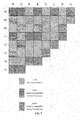
- FIG. 1 shows the equilibrium cycle of the operating units refueling every 18 months.
- 72 new fuel assemblies with an enrichment of 4.45% are added to each cycle.
- the reactor core comprises 72 new fuel assemblies, 69 spent fuel assemblies having burned once and 16 spent fuel assemblies having burned twice.
- the reactor core configuration design is in symmetry of quarter rotation, and what shown in the figure is one quarter of the reactor core. Because of the single fuel assembly at the center of the reactor core, the quantity of the new fuel assemblies is not equal to that of the spent fuel assemblies having burned once.
- 72 spent fuel assemblies having burned once and 69 spent fuel assemblies having burned twice are obtained, as shown in FIG. 15 .
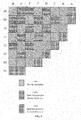
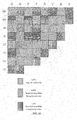
- the first reactor core of the new starting unit is to be constructed according to the loading mode with 88 new fuel assemblies as shown in FIG. 9 in which there are 88 new fuel assemblies, 41 spent fuel assemblies having burned once and 28 spent fuel assemblies having burned twice. So the first reactor core of the new starting unit requires 88 new fuel assemblies, 41 spent fuel assemblies having burned once and 28 spent fuel assemblies having burned twice. As shown in FIG. 17 , 41 spent fuel assemblies having burned once and 28 spent fuel assemblies having burned twice are respectively selected from 50 spent fuel assemblies having burned once and 66 spent fuel assemblies having burned twice obtained for reserve. Together with 88 new fuel assemblies, they are used to construct the first reactor core of the new starting unit. Or as shown in FIG. 2 and FIG.
- the quantity of the new fuel assemblies additionally added and the loading mode of the first reactor cores of the new starting units may be adjusted based on the quantity of the first cores of new starting units and of the flexibility cycles ready to run in the operating units which are involved in the method for joint configuration design of nuclear power plant fuel elements/assemblies.
- 80, 81, 84, 85, 88, 89, 92 or 93 new fuel assemblies may be added, referring to the loading patterns as shown in FIG. 2 ⁇ FIG.12 respectively.
- the in-in-out loading mode mentioned above is the fuel elements/assemblies loading mode in which new fuel elements/assemblies are placed in the central places during the first burning cycle of the fuel elements/assemblies, in the central places during the second burning cycle of the fuel elements/assemblies, and in the peripheral places during the third burning cycle of the fuel elements/assemblies.
- the in-out-in loading mode (able to lower the temperature difference at the outlet of the reactor core) is the fuel elements/assemblies loading mode in which new fuel elements/assemblies are placed in the central places during the first burning cycle of the fuel elements/assemblies, in the peripheral places during the second burning cycle of the fuel elements/assemblies, and in the central places again during the third burning cycle of the fuel elements/assemblies.
- the spent fuel elements/assemblies having burned are different from the new fuel elements/assemblies.
- the spent fuel elements/assemblies themselves have strong radiation and decay heat
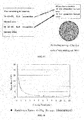
- FIG. 18 shows the decay heat of a single fuel element/assembly as a function of cooling time.
- the decay heat decreases rapidly in the early phase, and slowly in the later phase.
- the decay heat after one-year cooling is less than 6.1kW, while the actual average decay heat after one-year cooling of the spent fuel elements/assemblies is less than 4kW.
- Table 1 Container Technical Requirements Owner Model The Number of Loaded Spent Fuel Assemblies Maximum Heat Load (kW) Maximum Average heat load of the Spent Fuel Assemblies (kW per one) Total Weight (t) GE IF-3000 7 68-70 9.7-10 60.7 BNG.
- NTL-14 5 45 9 85 Lehrer LK-80 12 100 8.3 100 TN TN-12/2(A/B) 12 93/70 7.8/5.8 102/104 NAC NLI-10 10 70 7 97 TN TN-17/2 7 43 6.1 81 PNTL EXCELLOX-3A 5 30 6 72 PNTL EXCELLOX-4 7 40 5.7 92 OCL HZ-75T 7 40 5.7 82 TN TN-13 12 64 5.3 105 GNS CASTOR-S1 6 30 5 79-82
- the average discharge burnup of the operating units and the first reactor cores of the new starting units is 17% higher than that of the 18-month equilibrium cycle in the prior art (generally, the average discharge burnup of the first circle of the new starting unit is less than 50% of that of the equilibrium cycle).
- the first reactor core of every new starting unit in the method for joint configuration design of nuclear power plant fuel elements/assemblies may save about 200,000 pounds of natural uranium, about 32 tons SWU (separative work units) of separative work, about fabrications of 63 fuel assemblies, and about post-processes of 63 spent fuel elements/assemblies, resulting in the total savings of about $ 69.63 million which take up 23.4% of the total fuel costs of the first core.
- the cost savings may vary as the model, the reactor type, the joint configuration of the nuclear power plant fuel elements/assemblies and the price of natural uranium and separation work.
- the joint configuration of the nuclear power plant fuel elements/assemblies can be implemented continuously (as shown in FIG. 14 ).
- the arrows in the figure just indicate the transfer of the spent fuel elements/assemblies having burned once, and the spent fuel elements/assemblies having burned twice are from what accumulated in the long-term running process of the operating units, and the new fuel elements/assemblies are purchased from fuel suppliers.
- the operating units implementing the joint configuration of the nuclear power plant fuel elements/assemblies may utilize 18-month refueling mode, 12-month refueling mode with quarter of fuel assemblies changed, 12-month refueling mode with third of fuel assemblies changed or other refueling modes.
- the first reactor cores of the new starting units may construct their first reactor cores directly based on the requirements of the needed refueling mode, so as to attain 18-month refueling mode, 12-month refueling mode with quarter of fuel assemblies changed, 12-month refueling mode with third of fuel assemblies changed or other refueling modes directly.
- the operating units in 18-month refueling mode have the advantage of high available rate but the average discharge burnup of fuel is relatively low.
- the operating units in 12-month refueling mode with quarter of fuel assemblies changed have the advantage of high average discharge burnup of fuel. 12 spent fuel assemblies having burned once which are original arranged in the peripheral place of the operating units in 18-month refueling mode (as shown in FIG. 1 ) are replaced by the spent fuel assemblies having burned twice.
- the excess spent fuel assemblies having burned once for reverse and a part of the spent fuel assemblies that can not be used in the operating units refueling every 18 months but can be used in the operating units refueling every year with quarter of fuel assemblies changed are arranged into the reactor core of the operating units refueling every year with quarter of fuel assemblies changed for continuously combusting, so as to reduce the quantity of the new fuel assemblies required in the operating units refueling every year with quarter of fuel assemblies changed and to improve total fuel efficiency. So when the fuel elements/assemblies joint configuration is conducted by the reactor core of the operating units in long-term refueling mode and that in short-term refueling mode, the disadvantage of lower fuel efficiency of the operating units in long-term refueling mode can be partially compensated.
- the joint configuration design described above also can be applied to the units refueling when non-shutdown.
- HTR high temperature gas cooled reactor
- New fuel elements with relatively high enrichments same or similar to that in the equilibrium cycle are added additionally and gradually into the HTR units, and a large number of spent fuel elements with different burnups are discharged gradually for reverse; and then the spent fuel elements with different burnup having been discharged and in reserve and the new fuel elements with relatively high enrichments are mixed and loaded into the first core of the new starting units.
- the first cores of the new starting units may not use the fuel elements with a relatively low enrichment any longer wherein the discharge burnup is higher than that in the equilibrium cycle, so as to improve fuel efficiency significantly and save fuel costs.
- a number of spent fuel elements/assemblies may be obtained from other operating units by the method for joint configuration design of nuclear power plant fuel elements/assemblies, as a result, the method for joint configuration design of nuclear power plant fuel elements/assemblies can also improve the ability of units to resist risk of fuel damage.
Landscapes
- Physics & Mathematics (AREA)
- Engineering & Computer Science (AREA)
- Plasma & Fusion (AREA)
- General Engineering & Computer Science (AREA)
- High Energy & Nuclear Physics (AREA)
- Monitoring And Testing Of Nuclear Reactors (AREA)
Applications Claiming Priority (2)
| Application Number | Priority Date | Filing Date | Title |
|---|---|---|---|
| CN200910107548A CN101847450B (zh) | 2009-05-27 | 2009-05-27 | 一种核电站燃料联合配置方法 |
| PCT/CN2010/073041 WO2010135968A1 (zh) | 2009-05-27 | 2010-05-21 | 一种核电站燃料联合配置方法 |
Publications (3)
| Publication Number | Publication Date |
|---|---|
| EP2437269A1 true EP2437269A1 (de) | 2012-04-04 |
| EP2437269A4 EP2437269A4 (de) | 2014-04-02 |
| EP2437269B1 EP2437269B1 (de) | 2015-07-01 |
Family
ID=42772032
Family Applications (1)
| Application Number | Title | Priority Date | Filing Date |
|---|---|---|---|
| EP10780049.2A Active EP2437269B1 (de) | 2009-05-27 | 2010-05-21 | Verfahren für eine übergreifende brennstoffkonfiguration für kernkraftwerke |
Country Status (4)
| Country | Link |
|---|---|
| US (1) | US8953733B2 (de) |
| EP (1) | EP2437269B1 (de) |
| CN (1) | CN101847450B (de) |
| WO (1) | WO2010135968A1 (de) |
Families Citing this family (13)
| Publication number | Priority date | Publication date | Assignee | Title |
|---|---|---|---|---|
| CN103106939B (zh) * | 2013-01-15 | 2014-07-02 | 西安交通大学 | 一种利用压水堆嬗变长寿命高放核素的方法 |
| CN103400619B (zh) * | 2013-07-03 | 2016-05-04 | 中国核电工程有限公司 | 一种先进的1/4堆芯年换料装载方法 |
| US10818403B2 (en) * | 2016-03-29 | 2020-10-27 | Nuscale Power, Llc | Inter-module fuel shuffling |
| JP7278984B2 (ja) * | 2020-02-25 | 2023-05-22 | 日立Geニュークリア・エナジー株式会社 | 軽水炉の炉心及び燃料集合体の装荷方法 |
| CN111695246A (zh) * | 2020-05-26 | 2020-09-22 | 国家核安保技术中心 | 核材料衡算方法、装置、设备及计算机存储介质 |
| CN113658730A (zh) * | 2021-07-06 | 2021-11-16 | 广东核电合营有限公司 | 核电站二次中子源组件定位方法、装置、设备及存储介质 |
| CN114242283B (zh) * | 2021-12-22 | 2024-12-31 | 中国核动力研究设计院 | 一种压水堆堆芯24个月换料周期燃料装载方法 |
| CN114818280B (zh) * | 2022-04-07 | 2025-05-09 | 岭澳核电有限公司 | 基于乏燃料组件的cpr1000机组换料方法、装置及乏燃料组件 |
| CN115239161A (zh) * | 2022-07-28 | 2022-10-25 | 中国核动力研究设计院 | 一种压水堆核电厂初始堆芯燃料组件的装载方法 |
| CN115376712A (zh) * | 2022-08-03 | 2022-11-22 | 上海核工程研究设计院有限公司 | 一种非能动核电厂长周期平衡循环的燃料管理方法及堆芯 |
| CN115274163B (zh) * | 2022-08-05 | 2024-02-13 | 中国核动力研究设计院 | 一种压水堆核电厂堆芯的燃料组件管理方法 |
| CN120674122B (zh) * | 2025-08-22 | 2025-11-04 | 华能核能技术研究院有限公司 | 多模块球床式高温气冷堆的核燃料管理方法和装置 |
| CN121862472A (zh) * | 2026-03-18 | 2026-04-14 | 中广核清洁能源科技(上海)有限公司 | 一种反应堆堆芯排布方法及反应堆压力装置 |
Family Cites Families (16)
| Publication number | Priority date | Publication date | Assignee | Title |
|---|---|---|---|---|
| US3503849A (en) * | 1966-01-07 | 1970-03-31 | Atomic Power Dev Ass Inc | Method of replacing subassemblies in nuclear reactors |
| US3432389A (en) * | 1966-07-25 | 1969-03-11 | Combustion Eng | Core design for nuclear reactor |
| SE324412B (de) * | 1966-12-16 | 1970-06-01 | Atomenergi Ab | |
| US3904048A (en) * | 1968-12-02 | 1975-09-09 | Asea Ab | Device for refueling a nuclear reactor having a core comprising a plurality of fuel assemblies |
| DE2236780A1 (de) * | 1972-07-26 | 1974-02-07 | Siemens Ag | Verfahren zum errichten und betreiben von mindestens zwei kernreaktoren |
| US4040902A (en) * | 1975-04-03 | 1977-08-09 | General Atomic Company | Method for axially shuffling fuel elements in a nuclear reactor |
| GB1559436A (en) * | 1977-05-14 | 1980-01-16 | Timofeev A V | Others nuclear reactors |
| US4451427A (en) * | 1978-02-03 | 1984-05-29 | Combustion Engineering, Inc. | In-core fuel management for nuclear reactor |
| JPS6166988A (ja) | 1984-09-11 | 1986-04-05 | 株式会社東芝 | 燃料の装荷方法 |
| US5631939A (en) * | 1994-09-09 | 1997-05-20 | Hitachi, Ltd. | Initial core of nuclear power plant |
| JP4021519B2 (ja) * | 1996-06-03 | 2007-12-12 | ゼネラル・エレクトリック・カンパニイ | 原子炉炉心に燃料を供給する方法 |
| JP2004144757A (ja) * | 2003-11-28 | 2004-05-20 | Toshiba Corp | 原子炉の炉心 |
| CN1760990B (zh) * | 2004-10-15 | 2011-11-30 | 西屋电气有限责任公司 | 改进的首次堆芯燃料组件布置和实现上述布置的方法 |
| CN1328730C (zh) * | 2004-12-03 | 2007-07-25 | 大亚湾核电运营管理有限责任公司 | 压水堆核电站反应堆堆芯装载方法 |
| JP2006234396A (ja) * | 2005-02-22 | 2006-09-07 | Nuclear Fuel Ind Ltd | 原子炉燃料の運用方法 |
| CN101206930B (zh) * | 2006-12-22 | 2011-06-15 | 深圳中广核工程设计有限公司 | 多堆联合核燃料循环利用方法 |
-
2009
- 2009-05-27 CN CN200910107548A patent/CN101847450B/zh active Active
-
2010
- 2010-05-21 EP EP10780049.2A patent/EP2437269B1/de active Active
- 2010-05-21 WO PCT/CN2010/073041 patent/WO2010135968A1/zh not_active Ceased
- 2010-05-21 US US13/322,551 patent/US8953733B2/en active Active
Also Published As
| Publication number | Publication date |
|---|---|
| EP2437269B1 (de) | 2015-07-01 |
| CN101847450A (zh) | 2010-09-29 |
| WO2010135968A1 (zh) | 2010-12-02 |
| EP2437269A4 (de) | 2014-04-02 |
| CN101847450B (zh) | 2012-10-03 |
| US8953733B2 (en) | 2015-02-10 |
| US20120069948A1 (en) | 2012-03-22 |
Similar Documents
| Publication | Publication Date | Title |
|---|---|---|
| EP2437269B1 (de) | Verfahren für eine übergreifende brennstoffkonfiguration für kernkraftwerke | |
| EP0871958B1 (de) | Spalt-brut-kernreaktor | |
| Fridman et al. | Pu recycling in a full Th-MOX PWR core. Part I: Steady state analysis | |
| Gabrielli et al. | ASTRID-like fast reactor cores for burning plutonium and minor actinides | |
| WO2008077297A1 (fr) | Procédé utilisant un cycle de combustible nucléaire combiné pour multiples réacteurs | |
| Ohashi et al. | Modular high temperature reactor (Modular HTR) contributing the global environment protection | |
| Lee et al. | i-SMR Core Design Option Study with Gadolinium Nitride Coating Burnable Absorber | |
| McMahon et al. | Reload light water reactor core designs for an ultralong operating cycle | |
| Gregg et al. | Effect of highly enriched/highly burnt UO2 fuels on fuel cycle costs, radiotoxicity, and nuclear design parameters | |
| Dekusar et al. | Feasibility studies of BN-800 type reactor with (Pu-Th) O2 fuel for effective incineration of minor actinides | |
| Dwijayanto et al. | Evaluating the Use of Graphite and BeO Moderators for Micro Molten Salt Reactor | |
| Grouiller et al. | Fuel Cycle interfaces with the ASTRID core | |
| McMahon et al. | Modeling and design of a reload PWR core for a 48-month fuel cycle | |
| Semchenkov et al. | Advanced fuel cycles for WWER-1000 reactors | |
| Flocard et al. | Incineration of PWR actinide waste to launch a low waste thorium-based energy production with ADSs | |
| Choi et al. | Design Characteristics of the Energy Multiplier Module (EM2) | |
| Cockey | Actinide transmutation in the advanced liquid metal reactor (ALMR) | |
| Ghrayeb et al. | Burnup performance of Sodium-cooled fast reactor by utilizing Thorium-based fuels | |
| Ponomarev-Stepnoy et al. | Burning of Weapon-Grade Plutonium In VVer and Htgr Reactors | |
| Kosourov et al. | WWER-1000 fuel cycles: current situation and outlook | |
| Kodochigov et al. | Possibility of different fuel cycles usage in GT-MHR | |
| Kim et al. | Neutronic Self-sustainability of a Breed-and-Burn Fast Reactor Using Super-Simple Fuel Recycling | |
| Kumar et al. | Physics Design of Advanced Heavy Water Reactor | |
| Nagano et al. | Basic evaluation on nuclear characteristics of BWR high burnup MOX fuel and core | |
| Meteleva | Spent fuel management in Ukraine and spent fuel data tracking |
Legal Events
| Date | Code | Title | Description |
|---|---|---|---|
| PUAI | Public reference made under article 153(3) epc to a published international application that has entered the european phase |
Free format text: ORIGINAL CODE: 0009012 |
|
| 17P | Request for examination filed |
Effective date: 20111220 |
|
| AK | Designated contracting states |
Kind code of ref document: A1 Designated state(s): AL AT BE BG CH CY CZ DE DK EE ES FI FR GB GR HR HU IE IS IT LI LT LU LV MC MK MT NL NO PL PT RO SE SI SK SM TR |
|
| DAX | Request for extension of the european patent (deleted) | ||
| A4 | Supplementary search report drawn up and despatched |
Effective date: 20140303 |
|
| RIC1 | Information provided on ipc code assigned before grant |
Ipc: G21D 3/00 20060101ALN20140225BHEP Ipc: G21C 19/20 20060101AFI20140225BHEP |
|
| REG | Reference to a national code |
Ref country code: DE Ref legal event code: R079 Ref document number: 602010025608 Country of ref document: DE Free format text: PREVIOUS MAIN CLASS: G21C0003300000 Ipc: G21C0019200000 |
|
| RIC1 | Information provided on ipc code assigned before grant |
Ipc: G21D 3/00 20060101ALN20141202BHEP Ipc: G21C 19/20 20060101AFI20141202BHEP |
|
| RIC1 | Information provided on ipc code assigned before grant |
Ipc: G21C 19/20 20060101AFI20141209BHEP Ipc: G21D 3/00 20060101ALN20141209BHEP |
|
| RIC1 | Information provided on ipc code assigned before grant |
Ipc: G21C 19/20 20060101AFI20141218BHEP Ipc: G21D 3/00 20060101ALN20141218BHEP |
|
| RIN1 | Information on inventor provided before grant (corrected) |
Inventor name: MA, ZIRONG |
|
| GRAP | Despatch of communication of intention to grant a patent |
Free format text: ORIGINAL CODE: EPIDOSNIGR1 |
|
| INTG | Intention to grant announced |
Effective date: 20150327 |
|
| RAP1 | Party data changed (applicant data changed or rights of an application transferred) |
Owner name: CHINA NUCLEAR POWER TECHNOLOGY RESEARCH INSTITUTE Owner name: CHINA NUCLEAR POWER ENGINEERING COMPANY LTD. Owner name: CHINA GUANGDONG NUCLEAR POWER HOLDING CORPORATION |
|
| GRAS | Grant fee paid |
Free format text: ORIGINAL CODE: EPIDOSNIGR3 |
|
| GRAA | (expected) grant |
Free format text: ORIGINAL CODE: 0009210 |
|
| AK | Designated contracting states |
Kind code of ref document: B1 Designated state(s): AL AT BE BG CH CY CZ DE DK EE ES FI FR GB GR HR HU IE IS IT LI LT LU LV MC MK MT NL NO PL PT RO SE SI SK SM TR |
|
| REG | Reference to a national code |
Ref country code: GB Ref legal event code: FG4D |
|
| REG | Reference to a national code |
Ref country code: AT Ref legal event code: REF Ref document number: 734382 Country of ref document: AT Kind code of ref document: T Effective date: 20150715 Ref country code: CH Ref legal event code: EP |
|
| REG | Reference to a national code |
Ref country code: IE Ref legal event code: FG4D |
|
| REG | Reference to a national code |
Ref country code: DE Ref legal event code: R096 Ref document number: 602010025608 Country of ref document: DE |
|
| REG | Reference to a national code |
Ref country code: AT Ref legal event code: MK05 Ref document number: 734382 Country of ref document: AT Kind code of ref document: T Effective date: 20150701 |
|
| REG | Reference to a national code |
Ref country code: NL Ref legal event code: MP Effective date: 20150701 |
|
| REG | Reference to a national code |
Ref country code: LT Ref legal event code: MG4D |
|
| PG25 | Lapsed in a contracting state [announced via postgrant information from national office to epo] |
Ref country code: LV Free format text: LAPSE BECAUSE OF FAILURE TO SUBMIT A TRANSLATION OF THE DESCRIPTION OR TO PAY THE FEE WITHIN THE PRESCRIBED TIME-LIMIT Effective date: 20150701 Ref country code: GR Free format text: LAPSE BECAUSE OF FAILURE TO SUBMIT A TRANSLATION OF THE DESCRIPTION OR TO PAY THE FEE WITHIN THE PRESCRIBED TIME-LIMIT Effective date: 20151002 Ref country code: LT Free format text: LAPSE BECAUSE OF FAILURE TO SUBMIT A TRANSLATION OF THE DESCRIPTION OR TO PAY THE FEE WITHIN THE PRESCRIBED TIME-LIMIT Effective date: 20150701 Ref country code: FI Free format text: LAPSE BECAUSE OF FAILURE TO SUBMIT A TRANSLATION OF THE DESCRIPTION OR TO PAY THE FEE WITHIN THE PRESCRIBED TIME-LIMIT Effective date: 20150701 Ref country code: NO Free format text: LAPSE BECAUSE OF FAILURE TO SUBMIT A TRANSLATION OF THE DESCRIPTION OR TO PAY THE FEE WITHIN THE PRESCRIBED TIME-LIMIT Effective date: 20151001 |
|
| PG25 | Lapsed in a contracting state [announced via postgrant information from national office to epo] |
Ref country code: PT Free format text: LAPSE BECAUSE OF FAILURE TO SUBMIT A TRANSLATION OF THE DESCRIPTION OR TO PAY THE FEE WITHIN THE PRESCRIBED TIME-LIMIT Effective date: 20151102 Ref country code: HR Free format text: LAPSE BECAUSE OF FAILURE TO SUBMIT A TRANSLATION OF THE DESCRIPTION OR TO PAY THE FEE WITHIN THE PRESCRIBED TIME-LIMIT Effective date: 20150701 Ref country code: ES Free format text: LAPSE BECAUSE OF FAILURE TO SUBMIT A TRANSLATION OF THE DESCRIPTION OR TO PAY THE FEE WITHIN THE PRESCRIBED TIME-LIMIT Effective date: 20150701 Ref country code: IS Free format text: LAPSE BECAUSE OF FAILURE TO SUBMIT A TRANSLATION OF THE DESCRIPTION OR TO PAY THE FEE WITHIN THE PRESCRIBED TIME-LIMIT Effective date: 20151101 Ref country code: PL Free format text: LAPSE BECAUSE OF FAILURE TO SUBMIT A TRANSLATION OF THE DESCRIPTION OR TO PAY THE FEE WITHIN THE PRESCRIBED TIME-LIMIT Effective date: 20150701 Ref country code: AT Free format text: LAPSE BECAUSE OF FAILURE TO SUBMIT A TRANSLATION OF THE DESCRIPTION OR TO PAY THE FEE WITHIN THE PRESCRIBED TIME-LIMIT Effective date: 20150701 Ref country code: SE Free format text: LAPSE BECAUSE OF FAILURE TO SUBMIT A TRANSLATION OF THE DESCRIPTION OR TO PAY THE FEE WITHIN THE PRESCRIBED TIME-LIMIT Effective date: 20150701 |
|
| REG | Reference to a national code |
Ref country code: DE Ref legal event code: R097 Ref document number: 602010025608 Country of ref document: DE |
|
| PG25 | Lapsed in a contracting state [announced via postgrant information from national office to epo] |
Ref country code: IT Free format text: LAPSE BECAUSE OF FAILURE TO SUBMIT A TRANSLATION OF THE DESCRIPTION OR TO PAY THE FEE WITHIN THE PRESCRIBED TIME-LIMIT Effective date: 20150701 Ref country code: SK Free format text: LAPSE BECAUSE OF FAILURE TO SUBMIT A TRANSLATION OF THE DESCRIPTION OR TO PAY THE FEE WITHIN THE PRESCRIBED TIME-LIMIT Effective date: 20150701 Ref country code: DK Free format text: LAPSE BECAUSE OF FAILURE TO SUBMIT A TRANSLATION OF THE DESCRIPTION OR TO PAY THE FEE WITHIN THE PRESCRIBED TIME-LIMIT Effective date: 20150701 Ref country code: CZ Free format text: LAPSE BECAUSE OF FAILURE TO SUBMIT A TRANSLATION OF THE DESCRIPTION OR TO PAY THE FEE WITHIN THE PRESCRIBED TIME-LIMIT Effective date: 20150701 Ref country code: EE Free format text: LAPSE BECAUSE OF FAILURE TO SUBMIT A TRANSLATION OF THE DESCRIPTION OR TO PAY THE FEE WITHIN THE PRESCRIBED TIME-LIMIT Effective date: 20150701 |
|
| PLBE | No opposition filed within time limit |
Free format text: ORIGINAL CODE: 0009261 |
|
| STAA | Information on the status of an ep patent application or granted ep patent |
Free format text: STATUS: NO OPPOSITION FILED WITHIN TIME LIMIT |
|
| REG | Reference to a national code |
Ref country code: FR Ref legal event code: PLFP Year of fee payment: 7 |
|
| PG25 | Lapsed in a contracting state [announced via postgrant information from national office to epo] |
Ref country code: RO Free format text: LAPSE BECAUSE OF FAILURE TO SUBMIT A TRANSLATION OF THE DESCRIPTION OR TO PAY THE FEE WITHIN THE PRESCRIBED TIME-LIMIT Effective date: 20150701 |
|
| 26N | No opposition filed |
Effective date: 20160404 |
|
| PG25 | Lapsed in a contracting state [announced via postgrant information from national office to epo] |
Ref country code: BE Free format text: LAPSE BECAUSE OF NON-PAYMENT OF DUE FEES Effective date: 20160531 Ref country code: SI Free format text: LAPSE BECAUSE OF FAILURE TO SUBMIT A TRANSLATION OF THE DESCRIPTION OR TO PAY THE FEE WITHIN THE PRESCRIBED TIME-LIMIT Effective date: 20150701 |
|
| REG | Reference to a national code |
Ref country code: DE Ref legal event code: R119 Ref document number: 602010025608 Country of ref document: DE |
|
| PG25 | Lapsed in a contracting state [announced via postgrant information from national office to epo] |
Ref country code: BE Free format text: LAPSE BECAUSE OF FAILURE TO SUBMIT A TRANSLATION OF THE DESCRIPTION OR TO PAY THE FEE WITHIN THE PRESCRIBED TIME-LIMIT Effective date: 20150701 Ref country code: LU Free format text: LAPSE BECAUSE OF FAILURE TO SUBMIT A TRANSLATION OF THE DESCRIPTION OR TO PAY THE FEE WITHIN THE PRESCRIBED TIME-LIMIT Effective date: 20160521 |
|
| REG | Reference to a national code |
Ref country code: CH Ref legal event code: PL |
|
| PG25 | Lapsed in a contracting state [announced via postgrant information from national office to epo] |
Ref country code: LI Free format text: LAPSE BECAUSE OF NON-PAYMENT OF DUE FEES Effective date: 20160531 Ref country code: CH Free format text: LAPSE BECAUSE OF NON-PAYMENT OF DUE FEES Effective date: 20160531 |
|
| REG | Reference to a national code |
Ref country code: IE Ref legal event code: MM4A |
|
| PG25 | Lapsed in a contracting state [announced via postgrant information from national office to epo] |
Ref country code: DE Free format text: LAPSE BECAUSE OF NON-PAYMENT OF DUE FEES Effective date: 20161201 |
|
| REG | Reference to a national code |
Ref country code: FR Ref legal event code: PLFP Year of fee payment: 8 |
|
| PG25 | Lapsed in a contracting state [announced via postgrant information from national office to epo] |
Ref country code: IE Free format text: LAPSE BECAUSE OF NON-PAYMENT OF DUE FEES Effective date: 20160521 |
|
| PG25 | Lapsed in a contracting state [announced via postgrant information from national office to epo] |
Ref country code: NL Free format text: LAPSE BECAUSE OF FAILURE TO SUBMIT A TRANSLATION OF THE DESCRIPTION OR TO PAY THE FEE WITHIN THE PRESCRIBED TIME-LIMIT Effective date: 20150701 |
|
| REG | Reference to a national code |
Ref country code: FR Ref legal event code: PLFP Year of fee payment: 9 |
|
| PG25 | Lapsed in a contracting state [announced via postgrant information from national office to epo] |
Ref country code: SM Free format text: LAPSE BECAUSE OF FAILURE TO SUBMIT A TRANSLATION OF THE DESCRIPTION OR TO PAY THE FEE WITHIN THE PRESCRIBED TIME-LIMIT Effective date: 20150701 Ref country code: CY Free format text: LAPSE BECAUSE OF FAILURE TO SUBMIT A TRANSLATION OF THE DESCRIPTION OR TO PAY THE FEE WITHIN THE PRESCRIBED TIME-LIMIT Effective date: 20150701 Ref country code: HU Free format text: LAPSE BECAUSE OF FAILURE TO SUBMIT A TRANSLATION OF THE DESCRIPTION OR TO PAY THE FEE WITHIN THE PRESCRIBED TIME-LIMIT; INVALID AB INITIO Effective date: 20100521 |
|
| PG25 | Lapsed in a contracting state [announced via postgrant information from national office to epo] |
Ref country code: MT Free format text: LAPSE BECAUSE OF NON-PAYMENT OF DUE FEES Effective date: 20160531 Ref country code: MK Free format text: LAPSE BECAUSE OF FAILURE TO SUBMIT A TRANSLATION OF THE DESCRIPTION OR TO PAY THE FEE WITHIN THE PRESCRIBED TIME-LIMIT Effective date: 20150701 Ref country code: TR Free format text: LAPSE BECAUSE OF FAILURE TO SUBMIT A TRANSLATION OF THE DESCRIPTION OR TO PAY THE FEE WITHIN THE PRESCRIBED TIME-LIMIT Effective date: 20150701 Ref country code: MC Free format text: LAPSE BECAUSE OF FAILURE TO SUBMIT A TRANSLATION OF THE DESCRIPTION OR TO PAY THE FEE WITHIN THE PRESCRIBED TIME-LIMIT Effective date: 20150701 |
|
| PG25 | Lapsed in a contracting state [announced via postgrant information from national office to epo] |
Ref country code: BG Free format text: LAPSE BECAUSE OF FAILURE TO SUBMIT A TRANSLATION OF THE DESCRIPTION OR TO PAY THE FEE WITHIN THE PRESCRIBED TIME-LIMIT Effective date: 20150701 |
|
| PG25 | Lapsed in a contracting state [announced via postgrant information from national office to epo] |
Ref country code: AL Free format text: LAPSE BECAUSE OF FAILURE TO SUBMIT A TRANSLATION OF THE DESCRIPTION OR TO PAY THE FEE WITHIN THE PRESCRIBED TIME-LIMIT Effective date: 20150701 |
|
| PGFP | Annual fee paid to national office [announced via postgrant information from national office to epo] |
Ref country code: GB Payment date: 20250530 Year of fee payment: 16 |
|
| PGFP | Annual fee paid to national office [announced via postgrant information from national office to epo] |
Ref country code: FR Payment date: 20250530 Year of fee payment: 16 |