EP2437335A1 - Aktivmaterial für eine batterie, batterie mit wasserfreiem elektrolyt und batteriepackung - Google Patents
Aktivmaterial für eine batterie, batterie mit wasserfreiem elektrolyt und batteriepackung Download PDFInfo
- Publication number
- EP2437335A1 EP2437335A1 EP09845221A EP09845221A EP2437335A1 EP 2437335 A1 EP2437335 A1 EP 2437335A1 EP 09845221 A EP09845221 A EP 09845221A EP 09845221 A EP09845221 A EP 09845221A EP 2437335 A1 EP2437335 A1 EP 2437335A1
- Authority
- EP
- European Patent Office
- Prior art keywords
- composite oxide
- titanium composite
- active material
- aqueous electrolyte
- monoclinic
- Prior art date
- Legal status (The legal status is an assumption and is not a legal conclusion. Google has not performed a legal analysis and makes no representation as to the accuracy of the status listed.)
- Withdrawn
Links
- 239000011149 active material Substances 0.000 title claims abstract description 50
- 239000011255 nonaqueous electrolyte Substances 0.000 title claims description 53
- 239000010936 titanium Substances 0.000 claims abstract description 146
- 239000002131 composite material Substances 0.000 claims abstract description 141
- 229910052719 titanium Inorganic materials 0.000 claims abstract description 126
- RTAQQCXQSZGOHL-UHFFFAOYSA-N Titanium Chemical compound [Ti] RTAQQCXQSZGOHL-UHFFFAOYSA-N 0.000 claims abstract description 122
- 238000000034 method Methods 0.000 claims abstract description 34
- GWEVSGVZZGPLCZ-UHFFFAOYSA-N Titan oxide Chemical compound O=[Ti]=O GWEVSGVZZGPLCZ-UHFFFAOYSA-N 0.000 claims abstract description 27
- 238000004736 wide-angle X-ray diffraction Methods 0.000 claims abstract description 27
- 229910052796 boron Inorganic materials 0.000 claims description 14
- 230000001681 protective effect Effects 0.000 claims description 13
- 239000002245 particle Substances 0.000 claims description 11
- 239000005001 laminate film Substances 0.000 claims description 9
- RSNHXDVSISOZOB-UHFFFAOYSA-N lithium nickel Chemical compound [Li].[Ni] RSNHXDVSISOZOB-UHFFFAOYSA-N 0.000 claims description 4
- KLARSDUHONHPRF-UHFFFAOYSA-N [Li].[Mn] Chemical compound [Li].[Mn] KLARSDUHONHPRF-UHFFFAOYSA-N 0.000 claims description 3
- 229910001416 lithium ion Inorganic materials 0.000 description 41
- 239000012071 phase Substances 0.000 description 37
- HBBGRARXTFLTSG-UHFFFAOYSA-N Lithium ion Chemical compound [Li+] HBBGRARXTFLTSG-UHFFFAOYSA-N 0.000 description 32
- 229910010455 TiO2 (B) Inorganic materials 0.000 description 29
- 239000006258 conductive agent Substances 0.000 description 19
- 239000011230 binding agent Substances 0.000 description 18
- 239000012535 impurity Substances 0.000 description 18
- -1 titanium oxide compound Chemical class 0.000 description 18
- OGIDPMRJRNCKJF-UHFFFAOYSA-N titanium oxide Inorganic materials [Ti]=O OGIDPMRJRNCKJF-UHFFFAOYSA-N 0.000 description 17
- 230000003247 decreasing effect Effects 0.000 description 15
- 238000009792 diffusion process Methods 0.000 description 15
- 230000000052 comparative effect Effects 0.000 description 14
- 229910052744 lithium Inorganic materials 0.000 description 14
- WHXSMMKQMYFTQS-UHFFFAOYSA-N Lithium Chemical compound [Li] WHXSMMKQMYFTQS-UHFFFAOYSA-N 0.000 description 12
- 239000002033 PVDF binder Substances 0.000 description 12
- 239000007773 negative electrode material Substances 0.000 description 12
- 229920002981 polyvinylidene fluoride Polymers 0.000 description 12
- 239000013078 crystal Substances 0.000 description 11
- VEXZGXHMUGYJMC-UHFFFAOYSA-N Hydrochloric acid Chemical compound Cl VEXZGXHMUGYJMC-UHFFFAOYSA-N 0.000 description 10
- 229910052782 aluminium Inorganic materials 0.000 description 10
- XAGFODPZIPBFFR-UHFFFAOYSA-N aluminium Chemical compound [Al] XAGFODPZIPBFFR-UHFFFAOYSA-N 0.000 description 10
- 239000011888 foil Substances 0.000 description 10
- 238000002441 X-ray diffraction Methods 0.000 description 9
- 238000010438 heat treatment Methods 0.000 description 9
- 238000005259 measurement Methods 0.000 description 9
- KMTRUDSVKNLOMY-UHFFFAOYSA-N Ethylene carbonate Chemical compound O=C1OCCO1 KMTRUDSVKNLOMY-UHFFFAOYSA-N 0.000 description 8
- MCMNRKCIXSYSNV-UHFFFAOYSA-N Zirconium dioxide Chemical compound O=[Zr]=O MCMNRKCIXSYSNV-UHFFFAOYSA-N 0.000 description 8
- 229910052751 metal Inorganic materials 0.000 description 8
- 239000002184 metal Substances 0.000 description 8
- 239000002994 raw material Substances 0.000 description 8
- 239000002002 slurry Substances 0.000 description 8
- 229910000838 Al alloy Inorganic materials 0.000 description 7
- OKTJSMMVPCPJKN-UHFFFAOYSA-N Carbon Chemical compound [C] OKTJSMMVPCPJKN-UHFFFAOYSA-N 0.000 description 7
- 238000001514 detection method Methods 0.000 description 7
- 239000011521 glass Substances 0.000 description 7
- 239000007788 liquid Substances 0.000 description 7
- 239000000126 substance Substances 0.000 description 7
- WEVYAHXRMPXWCK-UHFFFAOYSA-N Acetonitrile Chemical compound CC#N WEVYAHXRMPXWCK-UHFFFAOYSA-N 0.000 description 6
- OIFBSDVPJOWBCH-UHFFFAOYSA-N Diethyl carbonate Chemical compound CCOC(=O)OCC OIFBSDVPJOWBCH-UHFFFAOYSA-N 0.000 description 6
- XEEYBQQBJWHFJM-UHFFFAOYSA-N Iron Chemical compound [Fe] XEEYBQQBJWHFJM-UHFFFAOYSA-N 0.000 description 6
- 229910020470 K2Ti4O9 Inorganic materials 0.000 description 6
- 239000004698 Polyethylene Substances 0.000 description 6
- CKFRRHLHAJZIIN-UHFFFAOYSA-N cobalt lithium Chemical compound [Li].[Co] CKFRRHLHAJZIIN-UHFFFAOYSA-N 0.000 description 6
- 150000002500 ions Chemical class 0.000 description 6
- 230000014759 maintenance of location Effects 0.000 description 6
- 229920000573 polyethylene Polymers 0.000 description 6
- RUOJZAUFBMNUDX-UHFFFAOYSA-N propylene carbonate Chemical compound CC1COC(=O)O1 RUOJZAUFBMNUDX-UHFFFAOYSA-N 0.000 description 6
- XLYOFNOQVPJJNP-UHFFFAOYSA-N water Substances O XLYOFNOQVPJJNP-UHFFFAOYSA-N 0.000 description 6
- 239000004743 Polypropylene Substances 0.000 description 5
- 229920001940 conductive polymer Polymers 0.000 description 5
- 229910052802 copper Inorganic materials 0.000 description 5
- 239000010949 copper Substances 0.000 description 5
- 239000003792 electrolyte Substances 0.000 description 5
- 238000010348 incorporation Methods 0.000 description 5
- 229910052742 iron Inorganic materials 0.000 description 5
- 229910052749 magnesium Inorganic materials 0.000 description 5
- 239000011777 magnesium Substances 0.000 description 5
- 239000000463 material Substances 0.000 description 5
- 238000002156 mixing Methods 0.000 description 5
- 239000003960 organic solvent Substances 0.000 description 5
- 239000002861 polymer material Substances 0.000 description 5
- 229920001155 polypropylene Polymers 0.000 description 5
- 239000007774 positive electrode material Substances 0.000 description 5
- 238000002360 preparation method Methods 0.000 description 5
- 238000010298 pulverizing process Methods 0.000 description 5
- 229910052710 silicon Inorganic materials 0.000 description 5
- 239000000243 solution Substances 0.000 description 5
- 229910052725 zinc Inorganic materials 0.000 description 5
- 239000011701 zinc Substances 0.000 description 5
- SECXISVLQFMRJM-UHFFFAOYSA-N N-Methylpyrrolidone Chemical compound CN1CCCC1=O SECXISVLQFMRJM-UHFFFAOYSA-N 0.000 description 4
- WYURNTSHIVDZCO-UHFFFAOYSA-N Tetrahydrofuran Chemical compound C1CCOC1 WYURNTSHIVDZCO-UHFFFAOYSA-N 0.000 description 4
- 239000006230 acetylene black Substances 0.000 description 4
- 238000001354 calcination Methods 0.000 description 4
- 230000000694 effects Effects 0.000 description 4
- 230000005611 electricity Effects 0.000 description 4
- JBTWLSYIZRCDFO-UHFFFAOYSA-N ethyl methyl carbonate Chemical compound CCOC(=O)OC JBTWLSYIZRCDFO-UHFFFAOYSA-N 0.000 description 4
- 229910052748 manganese Inorganic materials 0.000 description 4
- 239000011572 manganese Substances 0.000 description 4
- NUJOXMJBOLGQSY-UHFFFAOYSA-N manganese dioxide Chemical compound O=[Mn]=O NUJOXMJBOLGQSY-UHFFFAOYSA-N 0.000 description 4
- 239000000203 mixture Substances 0.000 description 4
- 239000008188 pellet Substances 0.000 description 4
- 229920001343 polytetrafluoroethylene Polymers 0.000 description 4
- 239000004810 polytetrafluoroethylene Substances 0.000 description 4
- 239000000843 powder Substances 0.000 description 4
- 239000002243 precursor Substances 0.000 description 4
- 239000011164 primary particle Substances 0.000 description 4
- 229920005989 resin Polymers 0.000 description 4
- 239000011347 resin Substances 0.000 description 4
- GEWWCWZGHNIUBW-UHFFFAOYSA-N 1-(4-nitrophenyl)propan-2-one Chemical compound CC(=O)CC1=CC=C([N+]([O-])=O)C=C1 GEWWCWZGHNIUBW-UHFFFAOYSA-N 0.000 description 3
- LCKIEQZJEYYRIY-UHFFFAOYSA-N Titanium ion Chemical compound [Ti+4] LCKIEQZJEYYRIY-UHFFFAOYSA-N 0.000 description 3
- 238000010306 acid treatment Methods 0.000 description 3
- 229920001971 elastomer Polymers 0.000 description 3
- 238000004993 emission spectroscopy Methods 0.000 description 3
- 239000010439 graphite Substances 0.000 description 3
- 229910002804 graphite Inorganic materials 0.000 description 3
- 238000004519 manufacturing process Methods 0.000 description 3
- 239000012046 mixed solvent Substances 0.000 description 3
- PXHVJJICTQNCMI-UHFFFAOYSA-N nickel Substances [Ni] PXHVJJICTQNCMI-UHFFFAOYSA-N 0.000 description 3
- 229920000642 polymer Polymers 0.000 description 3
- 239000005060 rubber Substances 0.000 description 3
- 238000007789 sealing Methods 0.000 description 3
- 239000002904 solvent Substances 0.000 description 3
- 239000011800 void material Substances 0.000 description 3
- WNXJIVFYUVYPPR-UHFFFAOYSA-N 1,3-dioxolane Chemical compound C1COCO1 WNXJIVFYUVYPPR-UHFFFAOYSA-N 0.000 description 2
- XTHFKEDIFFGKHM-UHFFFAOYSA-N Dimethoxyethane Chemical compound COCCOC XTHFKEDIFFGKHM-UHFFFAOYSA-N 0.000 description 2
- YCKRFDGAMUMZLT-UHFFFAOYSA-N Fluorine atom Chemical compound [F] YCKRFDGAMUMZLT-UHFFFAOYSA-N 0.000 description 2
- UQSXHKLRYXJYBZ-UHFFFAOYSA-N Iron oxide Chemical compound [Fe]=O UQSXHKLRYXJYBZ-UHFFFAOYSA-N 0.000 description 2
- 229910001246 LixFePO4 Inorganic materials 0.000 description 2
- 229910015226 LixMn2-yNiyO4 Inorganic materials 0.000 description 2
- 229910015329 LixMn2O4 Inorganic materials 0.000 description 2
- 229910015280 LixMn2−yNiyO4 Inorganic materials 0.000 description 2
- 229910015706 LixMnyCo1-yO2 Inorganic materials 0.000 description 2
- 229910015702 LixMnyCo1−yO2 Inorganic materials 0.000 description 2
- 229920003171 Poly (ethylene oxide) Polymers 0.000 description 2
- XUIMIQQOPSSXEZ-UHFFFAOYSA-N Silicon Chemical compound [Si] XUIMIQQOPSSXEZ-UHFFFAOYSA-N 0.000 description 2
- NXPZICSHDHGMGT-UHFFFAOYSA-N [Co].[Mn].[Li] Chemical compound [Co].[Mn].[Li] NXPZICSHDHGMGT-UHFFFAOYSA-N 0.000 description 2
- PFYQFCKUASLJLL-UHFFFAOYSA-N [Co].[Ni].[Li] Chemical compound [Co].[Ni].[Li] PFYQFCKUASLJLL-UHFFFAOYSA-N 0.000 description 2
- ZYXUQEDFWHDILZ-UHFFFAOYSA-N [Ni].[Mn].[Li] Chemical compound [Ni].[Mn].[Li] ZYXUQEDFWHDILZ-UHFFFAOYSA-N 0.000 description 2
- 239000002390 adhesive tape Substances 0.000 description 2
- 229910045601 alloy Inorganic materials 0.000 description 2
- 239000000956 alloy Substances 0.000 description 2
- 230000015572 biosynthetic process Effects 0.000 description 2
- 229910052792 caesium Inorganic materials 0.000 description 2
- 238000004364 calculation method Methods 0.000 description 2
- 239000006229 carbon black Substances 0.000 description 2
- 239000003575 carbonaceous material Substances 0.000 description 2
- 238000003795 desorption Methods 0.000 description 2
- JKWMSGQKBLHBQQ-UHFFFAOYSA-N diboron trioxide Chemical compound O=BOB=O JKWMSGQKBLHBQQ-UHFFFAOYSA-N 0.000 description 2
- NJLLQSBAHIKGKF-UHFFFAOYSA-N dipotassium dioxido(oxo)titanium Chemical compound [K+].[K+].[O-][Ti]([O-])=O NJLLQSBAHIKGKF-UHFFFAOYSA-N 0.000 description 2
- 238000007599 discharging Methods 0.000 description 2
- 238000004090 dissolution Methods 0.000 description 2
- 238000001035 drying Methods 0.000 description 2
- 238000011049 filling Methods 0.000 description 2
- 239000011737 fluorine Substances 0.000 description 2
- 229910052731 fluorine Inorganic materials 0.000 description 2
- BHEPBYXIRTUNPN-UHFFFAOYSA-N hydridophosphorus(.) (triplet) Chemical compound [PH] BHEPBYXIRTUNPN-UHFFFAOYSA-N 0.000 description 2
- 238000009776 industrial production Methods 0.000 description 2
- 238000003780 insertion Methods 0.000 description 2
- 230000037431 insertion Effects 0.000 description 2
- 238000000691 measurement method Methods 0.000 description 2
- 229920002239 polyacrylonitrile Polymers 0.000 description 2
- 229910052700 potassium Inorganic materials 0.000 description 2
- BWHMMNNQKKPAPP-UHFFFAOYSA-L potassium carbonate Chemical compound [K+].[K+].[O-]C([O-])=O BWHMMNNQKKPAPP-UHFFFAOYSA-L 0.000 description 2
- 238000003825 pressing Methods 0.000 description 2
- 239000000047 product Substances 0.000 description 2
- 229910052708 sodium Inorganic materials 0.000 description 2
- 239000011734 sodium Substances 0.000 description 2
- 239000007787 solid Substances 0.000 description 2
- 238000003746 solid phase reaction Methods 0.000 description 2
- 238000003756 stirring Methods 0.000 description 2
- 238000003860 storage Methods 0.000 description 2
- HXJUTPCZVOIRIF-UHFFFAOYSA-N sulfolane Chemical compound O=S1(=O)CCCC1 HXJUTPCZVOIRIF-UHFFFAOYSA-N 0.000 description 2
- 238000003786 synthesis reaction Methods 0.000 description 2
- YLQBMQCUIZJEEH-UHFFFAOYSA-N tetrahydrofuran Natural products C=1C=COC=1 YLQBMQCUIZJEEH-UHFFFAOYSA-N 0.000 description 2
- 235000010215 titanium dioxide Nutrition 0.000 description 2
- 238000005406 washing Methods 0.000 description 2
- VAYTZRYEBVHVLE-UHFFFAOYSA-N 1,3-dioxol-2-one Chemical compound O=C1OC=CO1 VAYTZRYEBVHVLE-UHFFFAOYSA-N 0.000 description 1
- JWUJQDFVADABEY-UHFFFAOYSA-N 2-methyltetrahydrofuran Chemical compound CC1CCCO1 JWUJQDFVADABEY-UHFFFAOYSA-N 0.000 description 1
- VYZAMTAEIAYCRO-UHFFFAOYSA-N Chromium Chemical compound [Cr] VYZAMTAEIAYCRO-UHFFFAOYSA-N 0.000 description 1
- RYGMFSIKBFXOCR-UHFFFAOYSA-N Copper Chemical compound [Cu] RYGMFSIKBFXOCR-UHFFFAOYSA-N 0.000 description 1
- QPLDLSVMHZLSFG-UHFFFAOYSA-N Copper oxide Chemical compound [Cu]=O QPLDLSVMHZLSFG-UHFFFAOYSA-N 0.000 description 1
- 239000005751 Copper oxide Substances 0.000 description 1
- BWGNESOTFCXPMA-UHFFFAOYSA-N Dihydrogen disulfide Chemical compound SS BWGNESOTFCXPMA-UHFFFAOYSA-N 0.000 description 1
- 229910000733 Li alloy Inorganic materials 0.000 description 1
- 229910002986 Li4Ti5O12 Inorganic materials 0.000 description 1
- 229910015608 LiNi0.82Co0.15Al0.03O2 Inorganic materials 0.000 description 1
- 229910014167 LiNi1-YCOYO2 Inorganic materials 0.000 description 1
- 229910014940 LiNi1−yCoyO2 Inorganic materials 0.000 description 1
- 229910016717 LixCoPO4 Inorganic materials 0.000 description 1
- 229910016601 LixFe1-yMnyPO4 Inorganic materials 0.000 description 1
- 229910016625 LixFe1−yMnyPO4 Inorganic materials 0.000 description 1
- 229910003007 LixMnO2 Inorganic materials 0.000 description 1
- 229910014212 LixNi1-yCoyO2 Inorganic materials 0.000 description 1
- 229910014322 LixNi1−yCoyO2 Inorganic materials 0.000 description 1
- 229910014715 LixTiO2 Inorganic materials 0.000 description 1
- FYYHWMGAXLPEAU-UHFFFAOYSA-N Magnesium Chemical compound [Mg] FYYHWMGAXLPEAU-UHFFFAOYSA-N 0.000 description 1
- 229910020293 Na2Ti3O7 Inorganic materials 0.000 description 1
- 239000004677 Nylon Substances 0.000 description 1
- NPYPAHLBTDXSSS-UHFFFAOYSA-N Potassium ion Chemical compound [K+] NPYPAHLBTDXSSS-UHFFFAOYSA-N 0.000 description 1
- FKNQFGJONOIPTF-UHFFFAOYSA-N Sodium cation Chemical compound [Na+] FKNQFGJONOIPTF-UHFFFAOYSA-N 0.000 description 1
- NINIDFKCEFEMDL-UHFFFAOYSA-N Sulfur Chemical compound [S] NINIDFKCEFEMDL-UHFFFAOYSA-N 0.000 description 1
- 229910009866 Ti5O12 Inorganic materials 0.000 description 1
- HCHKCACWOHOZIP-UHFFFAOYSA-N Zinc Chemical compound [Zn] HCHKCACWOHOZIP-UHFFFAOYSA-N 0.000 description 1
- FKQOMXQAEKRXDM-UHFFFAOYSA-N [Li].[As] Chemical compound [Li].[As] FKQOMXQAEKRXDM-UHFFFAOYSA-N 0.000 description 1
- XHCLAFWTIXFWPH-UHFFFAOYSA-N [O-2].[O-2].[O-2].[O-2].[O-2].[V+5].[V+5] Chemical compound [O-2].[O-2].[O-2].[O-2].[O-2].[V+5].[V+5] XHCLAFWTIXFWPH-UHFFFAOYSA-N 0.000 description 1
- WEVMDWQCQITELQ-UHFFFAOYSA-N [O-]B(O)O.[Li+].F.F.F.F Chemical compound [O-]B(O)O.[Li+].F.F.F.F WEVMDWQCQITELQ-UHFFFAOYSA-N 0.000 description 1
- USHGRFXQYJEHII-UHFFFAOYSA-M [O-]P(O)(O)=O.[Li+].F.F.F.F.F.F Chemical compound [O-]P(O)(O)=O.[Li+].F.F.F.F.F.F USHGRFXQYJEHII-UHFFFAOYSA-M 0.000 description 1
- 239000003929 acidic solution Substances 0.000 description 1
- 230000002378 acidificating effect Effects 0.000 description 1
- 239000013543 active substance Substances 0.000 description 1
- 239000003513 alkali Substances 0.000 description 1
- 239000012670 alkaline solution Substances 0.000 description 1
- 238000004458 analytical method Methods 0.000 description 1
- 239000002585 base Substances 0.000 description 1
- 229910052810 boron oxide Inorganic materials 0.000 description 1
- NCMHKCKGHRPLCM-UHFFFAOYSA-N caesium(1+) Chemical compound [Cs+] NCMHKCKGHRPLCM-UHFFFAOYSA-N 0.000 description 1
- 229910052799 carbon Inorganic materials 0.000 description 1
- 230000015556 catabolic process Effects 0.000 description 1
- 150000001768 cations Chemical class 0.000 description 1
- 229920002678 cellulose Polymers 0.000 description 1
- 239000001913 cellulose Substances 0.000 description 1
- 150000005678 chain carbonates Chemical class 0.000 description 1
- 239000003795 chemical substances by application Substances 0.000 description 1
- 229910052804 chromium Inorganic materials 0.000 description 1
- 239000011651 chromium Substances 0.000 description 1
- 238000004140 cleaning Methods 0.000 description 1
- 239000000571 coke Substances 0.000 description 1
- 238000013329 compounding Methods 0.000 description 1
- 150000001875 compounds Chemical class 0.000 description 1
- 229910000431 copper oxide Inorganic materials 0.000 description 1
- 238000012937 correction Methods 0.000 description 1
- 238000005336 cracking Methods 0.000 description 1
- 150000005676 cyclic carbonates Chemical class 0.000 description 1
- 150000004292 cyclic ethers Chemical class 0.000 description 1
- 230000007812 deficiency Effects 0.000 description 1
- 238000006731 degradation reaction Methods 0.000 description 1
- 230000000593 degrading effect Effects 0.000 description 1
- 238000013461 design Methods 0.000 description 1
- UKGZHELIUYCPTO-UHFFFAOYSA-N dicesium;oxygen(2-);titanium(4+) Chemical compound [O-2].[O-2].[O-2].[Ti+4].[Cs+].[Cs+] UKGZHELIUYCPTO-UHFFFAOYSA-N 0.000 description 1
- IEJIGPNLZYLLBP-UHFFFAOYSA-N dimethyl carbonate Chemical compound COC(=O)OC IEJIGPNLZYLLBP-UHFFFAOYSA-N 0.000 description 1
- 150000002170 ethers Chemical class 0.000 description 1
- 238000000605 extraction Methods 0.000 description 1
- 238000007716 flux method Methods 0.000 description 1
- 230000004927 fusion Effects 0.000 description 1
- 238000009499 grossing Methods 0.000 description 1
- 239000011810 insulating material Substances 0.000 description 1
- 239000013067 intermediate product Substances 0.000 description 1
- RUTXIHLAWFEWGM-UHFFFAOYSA-H iron(3+) sulfate Chemical compound [Fe+3].[Fe+3].[O-]S([O-])(=O)=O.[O-]S([O-])(=O)=O.[O-]S([O-])(=O)=O RUTXIHLAWFEWGM-UHFFFAOYSA-H 0.000 description 1
- 239000011244 liquid electrolyte Substances 0.000 description 1
- 239000001989 lithium alloy Substances 0.000 description 1
- GELKBWJHTRAYNV-UHFFFAOYSA-K lithium iron phosphate Chemical compound [Li+].[Fe+2].[O-]P([O-])([O-])=O GELKBWJHTRAYNV-UHFFFAOYSA-K 0.000 description 1
- MHCFAGZWMAWTNR-UHFFFAOYSA-M lithium perchlorate Chemical compound [Li+].[O-]Cl(=O)(=O)=O MHCFAGZWMAWTNR-UHFFFAOYSA-M 0.000 description 1
- 229910003002 lithium salt Inorganic materials 0.000 description 1
- 159000000002 lithium salts Chemical class 0.000 description 1
- SWAIALBIBWIKKQ-UHFFFAOYSA-N lithium titanium Chemical compound [Li].[Ti] SWAIALBIBWIKKQ-UHFFFAOYSA-N 0.000 description 1
- QSZMZKBZAYQGRS-UHFFFAOYSA-N lithium;bis(trifluoromethylsulfonyl)azanide Chemical compound [Li+].FC(F)(F)S(=O)(=O)[N-]S(=O)(=O)C(F)(F)F QSZMZKBZAYQGRS-UHFFFAOYSA-N 0.000 description 1
- 238000012423 maintenance Methods 0.000 description 1
- 238000010303 mechanochemical reaction Methods 0.000 description 1
- 229910052759 nickel Inorganic materials 0.000 description 1
- 229910000480 nickel oxide Inorganic materials 0.000 description 1
- 239000004745 nonwoven fabric Substances 0.000 description 1
- 229920001778 nylon Polymers 0.000 description 1
- 230000003287 optical effect Effects 0.000 description 1
- 230000010355 oscillation Effects 0.000 description 1
- AHKZTVQIVOEVFO-UHFFFAOYSA-N oxide(2-) Chemical compound [O-2] AHKZTVQIVOEVFO-UHFFFAOYSA-N 0.000 description 1
- GNRSAWUEBMWBQH-UHFFFAOYSA-N oxonickel Chemical compound [Ni]=O GNRSAWUEBMWBQH-UHFFFAOYSA-N 0.000 description 1
- SOQBVABWOPYFQZ-UHFFFAOYSA-N oxygen(2-);titanium(4+) Chemical class [O-2].[O-2].[Ti+4] SOQBVABWOPYFQZ-UHFFFAOYSA-N 0.000 description 1
- 238000005191 phase separation Methods 0.000 description 1
- 229920000767 polyaniline Polymers 0.000 description 1
- 229920000128 polypyrrole Polymers 0.000 description 1
- 229910001414 potassium ion Inorganic materials 0.000 description 1
- 230000001737 promoting effect Effects 0.000 description 1
- 238000011160 research Methods 0.000 description 1
- 230000000717 retained effect Effects 0.000 description 1
- 238000000926 separation method Methods 0.000 description 1
- 239000010703 silicon Substances 0.000 description 1
- 239000011863 silicon-based powder Substances 0.000 description 1
- 238000005245 sintering Methods 0.000 description 1
- 229910001415 sodium ion Inorganic materials 0.000 description 1
- GROMGGTZECPEKN-UHFFFAOYSA-N sodium metatitanate Chemical compound [Na+].[Na+].[O-][Ti](=O)O[Ti](=O)O[Ti]([O-])=O GROMGGTZECPEKN-UHFFFAOYSA-N 0.000 description 1
- 238000001179 sorption measurement Methods 0.000 description 1
- 229920003048 styrene butadiene rubber Polymers 0.000 description 1
- 239000000758 substrate Substances 0.000 description 1
- 239000011593 sulfur Substances 0.000 description 1
- 229910052717 sulfur Inorganic materials 0.000 description 1
- 229920003002 synthetic resin Polymers 0.000 description 1
- 239000000057 synthetic resin Substances 0.000 description 1
- TXEYQDLBPFQVAA-UHFFFAOYSA-N tetrafluoromethane Chemical class FC(F)(F)F TXEYQDLBPFQVAA-UHFFFAOYSA-N 0.000 description 1
- 150000003608 titanium Chemical class 0.000 description 1
- 239000004408 titanium dioxide Substances 0.000 description 1
- 229910052723 transition metal Inorganic materials 0.000 description 1
- 150000003624 transition metals Chemical class 0.000 description 1
- 238000001291 vacuum drying Methods 0.000 description 1
- 229910001935 vanadium oxide Inorganic materials 0.000 description 1
Images


Classifications
-
- H—ELECTRICITY
- H01—ELECTRIC ELEMENTS
- H01M—PROCESSES OR MEANS, e.g. BATTERIES, FOR THE DIRECT CONVERSION OF CHEMICAL ENERGY INTO ELECTRICAL ENERGY
- H01M4/00—Electrodes
- H01M4/02—Electrodes composed of, or comprising, active material
- H01M4/36—Selection of substances as active materials, active masses, active liquids
- H01M4/48—Selection of substances as active materials, active masses, active liquids of inorganic oxides or hydroxides
- H01M4/485—Selection of substances as active materials, active masses, active liquids of inorganic oxides or hydroxides of mixed oxides or hydroxides for inserting or intercalating light metals, e.g. LiTi2O4 or LiTi2OxFy
-
- Y—GENERAL TAGGING OF NEW TECHNOLOGICAL DEVELOPMENTS; GENERAL TAGGING OF CROSS-SECTIONAL TECHNOLOGIES SPANNING OVER SEVERAL SECTIONS OF THE IPC; TECHNICAL SUBJECTS COVERED BY FORMER USPC CROSS-REFERENCE ART COLLECTIONS [XRACs] AND DIGESTS
- Y02—TECHNOLOGIES OR APPLICATIONS FOR MITIGATION OR ADAPTATION AGAINST CLIMATE CHANGE
- Y02E—REDUCTION OF GREENHOUSE GAS [GHG] EMISSIONS, RELATED TO ENERGY GENERATION, TRANSMISSION OR DISTRIBUTION
- Y02E60/00—Enabling technologies; Technologies with a potential or indirect contribution to GHG emissions mitigation
- Y02E60/10—Energy storage using batteries
Definitions
- the present invention relates to an active material for batteries, a non-aqueous electrolyte battery and a battery pack.
- TiO 2 (B) a titanium oxide having a monoclinic ⁇ -type structure
- Patent Literatures 1 to 3 a spinel-type lithium titanate (Li 4 Ti 5 O 12 ) that has been actually used since before, the number of lithium ions that can be inserted and desorbed per a unit chemical formula is three. Therefore, the number of lithium ions that can be inserted and desorbed per one titanium ion was 3/5, and 0.6 was the theoretical maximum. In this regard, the number of lithium ions in TiO 2 (B), which can be inserted and released per a titanium ion is 1.0 at the maximum. Therefore, TiO 2 (B) has a property that the theoretical capacity is as high as about 335 mAh/g.
- Patent Literature 1 or Patent Literature 2 the practical electrode capacity of TiO 2 (B) is from about 170 to 200 mAh/g, and this is significantly lower than the theoretical capacity.
- the present invention aims at providing an active material for batteries comprising TiO 2 (B) in which the conductivity of lithium ion has been increased, a non-aqueous electrolyte battery comprising this active material as a negative electrode active material, which has a high capacity and excellent large-current performance, and a battery pack comprising a plurality of the non-aqueous electrolyte batteries.
- a non-aqueous electrolyte battery comprising:
- an active material for batteries that contributes to a high capacity and excellent large-current performance, a non-aqueous electrolyte battery having a high capacity and excellent large-current performance, and a battery pack comprising a plurality of the non-aqueous electrolyte batteries can be provided.
- the active material for batteries of the embodiment comprises a titanium composite oxide.
- the titanium composite oxide has a structure wherein when the integral intensity of the monoclinic ⁇ -type titanium composite oxide is I 1 , the integral intensity of at least one sub-phase is I 2 and I 1 is 100, the relative value of I 2 with respect to I 1 is 30 or less.
- the titanium composite oxide has a crystallite diameter of 5 nm or more as calculated from the main peak of the monoclinic ⁇ -type titanium composite oxide obtained with the wideangle X-ray diffraction method.
- a powder (sample) obtained by pulverizing the titanium composite oxide is filled in a holder having a depth of 0.2 mm of a glass sample plate.
- the surface of the sample filled in the glass sample plate is smoothed by sufficiently impressing with a finger by using a glass plate from outside.
- attention is paid so that the sample is filled sufficiently in the holder part, and care is taken not to cause insufficient filling of the sample (cracking, voids).
- the sample is filled by an amount that is equivalent to the depth of the glass holder (0.2 mm), and care is taken not to cause concaves and convexes from the base surface of the glass holder due to excess and deficiency of the amount to be filled.
- the following method is more preferable for excluding declination of the diffraction ray peak position and change in the intensity ratio due to the method for filling in the glass sample plate. Namely, a pressure of about 250 MPa is applied to the above-mentioned sample for 15 minutes to prepare a pressurized powder pellet having a diameter of 10 mm and a thickness of about 2 mm, and then the surface of the pellet is measured.
- the measurement can be performed, for example, under the following conditions.
- a sample is filled in a standard glass holder having a diameter of 25 mm, and a measurement is performed by a wideangle X-ray diffraction method.
- the measurement apparatus and conditions are shown below.
- crystallite diameter (crystallite size) of the titanium composite oxide can be calculated by using the Scherrer's equation shown below for the half width of the main peak of the TiO 2 (B) obtained with the wideangle X-ray diffraction method.
- the integral intensity can be obtained as follows. With respect to the X-ray diffraction profile after the measurement, a smoothing treatment and a background-removal treatment are conducted continuously. With respect to the obtained profile, peak separation is performed by applying the pseudo-Voigt function, and the peak surface area of K ⁇ l is defined as the integral intensity.
- the crystal structure of the monoclinic titanium dioxide is represented as TiO 2 (B).
- the crystal structure represented by TiO 2 (B) belongs to mainly a space group C2/m, and shows the tunnel structure as exemplified in FIG. 8 .
- the specific crystal structure of TiO 2 (B) is described in the document of R. Marchand, L. Brohan, M. Tournoux, Material Research.
- the crystal structure represented by TiO 2 (B) has a structure in which a titanium ion 53 and an oxide ion 52 constitute each of backbone structure parts 51a, and the backbone structure parts 51a are disposed alternately.
- a void part 51b is formed between the backbone structure parts 51a.
- the void part 51b can be a host site for intercalate (insertion) of different atom species.
- TiO 2 (B) also has host sites that can store and release different atom species on the crystal surface. TiO 2 (B) can store and release lithium ions reversibly by insertion and desorption of the lithium ions on these host sites.
- TiO 2 (B) has one Ti 4+ per a chemical formula, it is theoretically possible to insert one lithium ion at the maximum between the layers. Therefore, the titanium oxide compound having a crystal structure of TiO 2 (B) can be represented by the general formula Li x TiO 2 (0 ⁇ x ⁇ 1). In this case, a theoretical capacity of 335 mAh/g that is almost twice as large as those of the titanium dioxides described in the above-mentioned Patent Literatures 1 and 2 can be obtained.
- TiO 2 (B) is a low temperature metastable phase that presents at a temperature lower than about 500°C, at least one sub-phase selected from anatase-type TiO 2 and H 2 Ti 8 O 17 is easily incorporated as an impurity phase during the synthesis. Since the impurity phase inhibits diffusion of lithium ions, the lithium ion conductivity of TiO 2 (B) is decreased. As a result, it is difficult to stably achieve a high capacity of 240 mAh/g or more in conventional TiO 2 (B).
- TiO 2 (B) has a relatively low conductivity of lithium ion since it has a low diffusion velocity of lithium ions according to a factor other than the presence of impurity phases. It is considered that TiO 2 (B) has a conductivity of lithium ion, which is about two digit or more lower than that of, for example, a lithium-cobalt composite oxide that is used as a positive electrode active material.
- a non-aqueous electrolyte battery comprising a combination of TiO 2 (B) as a negative electrode active material and a lithium-cobalt composite oxide as a positive electrode active material limits to the low diffusion of the lithium ions in TiO 2 (B) in the adsorption and desorption of the lithium ions between the positive electrode and negative electrode, the large-current performance is decreased.
- the diffusion velocity of lithium ions means a combination of the intra-particle diffusion and particle boundary diffusion of the active material.
- Such a titanium composite oxide can improve the ion conductivity of lithium since the amount of the impurity phase that inhibits diffusion of lithium ions is decreased, or is substantially zero. As a result, a high electric capacity that is inherent to TiO 2 (B) can be derived.
- the titanium composite oxide has a large crystallite diameter, i.e., a crystallite diameter of 5 nm or more as calculated from the main peak of TiO 2 (B) obtained with the wideangle X-ray diffraction method.
- a crystallite diameter of 5 nm or more as calculated from the main peak of TiO 2 (B) obtained with the wideangle X-ray diffraction method.
- the diffusion control of the lithium ions in the negative electrode against the positive electrode can be relaxed by the titanium composite oxide that has a high diffusion velocity of lithium ions, whereby the large-current performance can be improved.
- the ion conductivity and large-current performance of the titanium composite oxide can be improved by adjusting the crystallite diameter of the titanium composite oxide to 5 nm or more.
- a more preferable crystallite diameter of the titanium composite oxide is 20 nm or more.
- the upper limit of the crystallite diameter of the titanium composite oxide is 300 nm.
- the titanium composite oxide does not comprise impurity phases but has a structure that is substantially consisting of TiO 2 (B) that is a main phase. Therefore, the titanium composite oxide also comprises a state in which the impurity phase is at the detection limit or less, namely, zero.
- the titanium composite oxide has a primary particle diameter of from 30 nm to 3 ⁇ m.
- the primary particle diameter is 30 nm or more, handling becomes easy in industrial production.
- the primary particle diameter is 3 ⁇ m or less, the diffusion distance of the lithium ions in a solid is shorten, whereby the large-current performance can be improved.
- the upper limit of the more preferable primary particle diameter is 1 ⁇ m.
- the titanium composite oxide has a specific surface area of from 5 to 50m 2 /g.
- the specific surface area is 5m 2 /g or more, storage and release sites for the lithium ions can be ensured sufficiently.
- the specific surface area is 50m 2 /g or less, handling becomes easy in industrial production.
- the titanium composite oxide comprises at least one element selected from P and B, and the at least one element is contained by an amount of from 0.01% to 3% by weight in total with respect to the total amount of the titanium composite oxide and the at least one element. It is preferable that the titanium composite oxide comprising the at least one element is in the form of particles, and the at least one element is present as an oxide inside of the particles or on the surfaces of the particles of the titanium composite oxide.
- Such a titanium composite oxide comprising at least one element selected from P and B can further decrease incorporation of an impurity phase, and can improve crystallinity to increase the crystallite diameter. As a result, a titanium composite oxide from which a capacity of 240 mAh/g or more can be taken out stably can be obtained.
- the content of at least one element is lower than 0.01% by weight, the effect of increasing crystallinity becomes small. If the content of at least one element exceeds 3% by weight, the amounts of impurity phases: P 2 O 5 and B 2 O 3 are increased, and the electrical capacity may be decreased.
- P is preferable since it has higher effects mentioned above than those of B.
- the content of the at least one element selected from P and B can be measured by an ICP emission spectroscopy.
- the measurement of the content of the above-mentioned element by the ICP emission spectroscopy can be performed, for example, by the following method.
- a battery is disassembled in a discharging state, an electrode (for example, a negative electrode) is removed, and the negative electrode layer thereof is deactivated in water.
- a titanium composite oxide in the negative electrode layer is extracted.
- the treatment for extraction can be performed by, for example, removing a conductive agent and a binder in the negative electrode layer by a heating treatment in the air.
- the extracted titanium composite oxide is measured off in a container, and subjected to acidic dissolution or alkaline dissolution to provide a measurement solution.
- the measurement solution is subjected to ICP emission spectroscopy in a measurement apparatus (for example, an SPS-1500V, manufactured by SII Nanotechology) to measure the content of the above-mentioned element.
- the titanium composite oxide is allowed to comprise impurities other than the at least one element selected from P and B that is unavoidable in the production, by 1,000 ppm or less by weight.
- an alkaline titanate compound such as Na 2 Ti 3 O 7 , K 2 Ti 4 O 9 and Cs 2 Ti 5 O 12 is prepared as a starting raw material.
- the alkaline titanate compound can be synthesized by mixing a substance comprising Ti and a substance comprising an alkaline element such as Na, K and Cs at a predetermined ratio according to a general solid-phase reaction method.
- the procedure and crystal form for the synthesis of the starting raw material are not specifically limited.
- potassium titanate of K 2 Ti 4 O 9 can be synthesized by, for example, a flux method.
- the starting raw material is washed with pure water sufficiently to remove impurities from the alkaline titanate compound, and subjected to an acid treatment to exchange alkali cations to protons.
- the respective sodium ion, potassium ion and cesium ion in sodium titanate, potassium titanate and cesium titanate can be exchanged for proton without degrading the crystal structures.
- the proton exchange by an acid treatment is performed by, for example, adding hydrochloric acid having a concentration of 1 M to the starting raw material. It is desirable that the acid treatment is kept performed until the proton exchange is completed sufficiently.
- the pH may be adjusted by adding an alkaline solution or acidic solution to the solution. After completion of the proton exchange, washing with pure water is performed again.
- the starting raw material is pulverized in a ball mill in advance before the proton exchange.
- smooth proton exchange can be executed.
- the condition for the pulverization can be performed by using a zirconia ball having a diameter of about from 10 to 15 mm per a container of 100 cm 2 , and rotating the zirconia ball at a rate of rotation of from 600 to 1,000 rpm for 1 to 3 hours. Pulverization for 1 hour or less is not preferable since the starting raw material is not pulverized sufficiently. Alternatively, pulverization for a long time as 3 hours or more is not preferable since a mechanochemical reaction proceeds and causes phase separation into compounds that are different from the objective product.
- Smoother proton exchange can be executed by, for example, performing the proton exchange while applying oscillation such as ultrasonic, whereby a proton-exchanged form in a preferable state can be obtained.
- the product in which the proton exchange has been completed is washed with water and dried, whereby a proton-exchanged form as an intermediate product is synthesized.
- the proton-exchanged form is then heat-treated to produce a titanium composite oxide comprising TiO 2 (B) as a main phase.
- a preferable heating temperature is from 250 to 500°C.
- the heating temperature is lower than 250°C, the crystallinity is decreased significantly, the incorporation amount of the impurity phase of H 2 Ti 8 C 17 is increased, and the electronic capacity is decreased.
- the heating temperature exceeds 500°C, the crystallinity is improved, and the H 2 Ti 8 O 17 phase that is the impurity phase is also decreased, whereas the incorporation amount of the anatase-type TiO 2 phase that is other impurity phase is increased, whereby the electronic capacity may be decreased.
- a more preferable heating temperature is from 300 to 400°C.
- the time for the heating treatment may be from 30 minutes to 24 hours.
- a more preferable time for the heating treatment is from 1 to 3 hours at a temperature from 300 to 400°C.
- the above-mentioned alkaline titanate compound to which the at least one element selected from P and B has been added may also be used as the starting raw material.
- the starting raw material can be synthesized by mixing a substance to be at least one element mentioned above, a substance comprising Ti, and a substance comprising alkaline elements such as Na, K and Cs at a predetermined ratio according to a general solid-phase reaction method.
- the addition amount of the at least one element is preferably from 0.01% to 3% by weight in total with respect to the total amount of the obtained titanium composite oxide and the above-mentioned at least one element.
- the above-mentioned at least one element acts as a sintering aid during the heating treatment, and thus an impurity phase such as H 2 Ti 8 O 17 becomes hard to remain.
- an impurity phase such as H 2 Ti 8 O 17 becomes hard to remain.
- the active material for batteries according to the embodiment can be used for not only the negative electrode mentioned below but also for a positive electrode, and when the active material is applied to either of the electrodes, it contributes to increasing of the capacity of the active material and the improvement of the large-current performance for use in a battery.
- metal lithium, lithium alloys or carbon-based material such as graphite and coke can be used for an active material for the negative electrode as a counter electrode.
- the non-aqueous electrolyte battery according to the embodiment comprises an outer case, a positive electrode housed in the outer case, a negative electrode housed in the outer case so as to spatially apart from the positive electrode through, for example, a separator, and comprising an active material, and a non-aqueous electrolyte that is filled in the outer case.
- the outer case is made of a laminate film having a thickness of 0.5 mm or less.
- a metal container having a thickness of 1.0 mm or less is used for the outer case. It is more preferable that the metal container has a thickness of 0.5 mm or less.
- Examples of the form of the outer case may include a flat type (thin type), a square type, a cylindrical type, a coin type, a button type and the like.
- Examples of the outer case may include outer cases for small batteries that are installed in portable electronic devices and the like, and outer cases for large batteries that are installed in two- or four-wheeled vehicles and the like according to the battery size.
- the laminate film a multilayer film comprising resin layers and a metal layer that is interposed therebetween is used.
- the metal layer is preferably an aluminum foil or aluminum alloy foil for weight saving.
- the resin layer include polymer materials such as polypropylene (PP), polyethylene (PE), nylon and polyethylene telephthalate (PET).
- the laminate film can be formed into the shape of the outer case by sealing by thermal fusion bonding.
- the metal container is made of aluminum, an aluminum alloy or the like.
- the aluminum alloy alloys comprising an element such as magnesium, zinc and silicon are preferable.
- the alloy comprises a transition metal such as iron, copper, nickel and chromium, the amount thereof is preferably adjusted to 100 ppm or less.
- the negative electrode comprises a current collector, and a negative electrode layer(s) formed on one surface or both surfaces of the current collector and comprising an active material, a conductive agent and a binder.
- an active material for batteries comprising the above-mentioned titanium composite oxide.
- the titanium composite oxide has a crystallite diameter of 5 nm or more as calculated from the main peak of the monoclinic ⁇ -type titanium composite oxide obtained with the wideangle X-ray diffraction method.
- such an active material has a high diffusion velocity of lithium ions and a high ion conductivity of lithium.
- the non-aqueous electrolyte battery in which a negative electrode comprising a negative electrode layer containing this active material is incorporated can improve the large-current performance.
- the conductive agent improves the current collecting performance of the active material, and suppresses the contact resistance with the current collector.
- Examples of the conductive agent include acetylene black, carbon black or graphite.
- the binder can bind the active material and the conductive agent.
- the binder include polytetrafluoroethylene (PTFE), polyvinylidene fluoride (PVdF), fluorine-based rubbers or styrene-butadiene rubbers.
- the active material, conductive agent and binder in the negative electrode layer are incorporated in the percentages of from 70% to 96% by weight, from 2% to 28% by weight and from 2% to 28% by weight, respectively.
- the amount of the conductive agent is lower than 2% by weight, the current collecting performance of the negative electrode layer is decreased, whereby the large-current performance of the non-aqueous electrolyte battery may be decreased.
- the amount of the binder is lower than 2% by weight, the binding property between the negative electrode layer and the current collector is decreased, whereby the cycle property may be decreased.
- the current collector is preferably an aluminum foil or an aluminum alloy foil comprising elements such as Mg, Ti, Zn, Mn, Fe, Cu and Si, which is electrochemically stable at a potential range that is higher than 1.0 V vs Li/Li + .
- the negative electrode is prepared, for example, by suspending the active material, conductive agent and binder in a general solvent to prepare a slurry, applying the slurry on a current collector and drying, and subjecting the current collector to pressing.
- the negative electrode may be prepared by forming the active material, conductive agent and binder into pellets to form a negative electrode layer, and forming the negative electrode layer on the current collector.
- the positive electrode comprises a current collector, and a positive electrode layer(s) formed on one surface or both surfaces of the current collector and comprising an active material, a conductive agent and a binder.
- the active material for example, an oxide, a polymer and the like can be used.
- polymer for example, conductive polymer materials such as polyaniline and polypyrrole, or disulfide-based polymer materials can be used.
- conductive polymer materials such as polyaniline and polypyrrole, or disulfide-based polymer materials can be used.
- sulfur (S) and carbon fluorides can also be used as the active material.
- Preferable active materials may include lithium-manganese composite oxides (Li x Mn 2 O 4 ), lithium-nickel composite oxides (Li x NiO 2 ), lithium-cobalt composite oxides (Li x CoO 2 ), lithium-nickel-cobalt composite oxides (Li x Ni 1-y Co y O 2 ), spinel-type lithium-manganese-nickel composite oxides (Li x Mn 2-y Ni y O 4 ), lithium-manganese-cobalt composite oxides (Li x Mn y Co 1-y O 2 ) or lithium phosphate iron (Li x FePO 4 ), which have a high positive electrode voltage. It is preferable that x and y are 0 ⁇ x ⁇ 1 and 0 ⁇ y ⁇ 1, respectively.
- active materials are lithium-cobalt composite oxides or lithium-manganese-composite oxides. Since these active materials have high ion conductivity, diffusion of the lithium ion in the positive electrode active material is hard to be a rate-controlling step when combined with the above-mentioned negative electrode active material. Therefore, the active materials are excellent in compatibility with the lithium-titanium composite oxide in the negative electrode active material.
- the conductive agent enhances the current collecting performance of the active material to suppress the contact resistance with the current collector.
- the conducive agent include carbonaceous materials such as acetylene black, carbon black or graphite.
- the binder binds the active material and the conductive agent.
- the binder include polytetrafluoroethylene (PTFE), polyvinylidene fluoride (PVdF) or fluorine-based rubbers.
- the active material, conductive agent and binder in the positive electrode layer are incorporated in the percentages of from 80% to 95% by weight, from 3% to 18% by weight and from 2% to 17% by weight, respectively.
- the amount of the conductive agent By adjusting the amount of the conductive agent to 3% by weight or more, the above-mentioned effect can be exerted.
- the amount of the conductive agent By adjusting the amount of the conductive agent to 18% by weight or less, degradation of the non-aqueous electrolyte on the surface of the non-aqueous electrolyte under storage at a high temperature can be decreased.
- By adjusting the amount of the binder to 2% by weight or more sufficient positive electrode intensity can be obtained.
- the amount of the binder By adjusting the amount of the binder to 17% by weight or less, the incorporation amount of the binder, which is an insulating material in the positive electrode, can be decreased, whereby the internal resistance can be decreased.
- the current collector is, for example, an aluminum foil or an aluminum alloy foil comprising elements such as Mg, Ti, Zn, Mn, Fe, Cu and Si.
- the positive electrode is prepared, for example, by suspending the active material, conductive agent and binder in a general solvent to prepare a slurry, applying the slurry on a current collector and drying, and subjecting the current collector to pressing.
- the positive electrode may be prepared by forming the active material, conductive agent and binder into pellets to form a positive electrode layer, and forming the positive electrode layer on the current collector.
- non-aqueous electrolyte may include liquid non-aqueous electrolytes that are prepared by dissolving an electrolyte in an organic solvent, gel-like non-aqueous electrolytes obtained by compounding a liquid electrolyte and a polymer material.
- liquid non-aqueous electrolyte is prepared by dissolving an electrolyte in an organic solvent at a concentration of from 0.5 to 2.5 mol/L.
- Examples of the electrolyte may include lithium salts such as lithium perchlorate (LiClO 4 ), lithium phosphate hexafluoride (LiPF 6 ), lithium borate tetrafluoride (LiBF 4 ), lithium arsenic hexafluoride (LiAsF 6 ), lithium trifluorometasulfonate (LiCF 3 SO 3 ) and lithium bistrifluoromethylsulfonylimito [LiN(CF 3 SO 2 ) 2 ], or mixtures thereof. Electrolytes that are hardly oxidized even at a high potential are preferable, and LiPF 6 is the most preferable.
- LiPF 6 is the most preferable.
- organic solvent examples include cyclic carbonates such as propylene carbonate (PC), ethylene carbonate (EC) and vinylene carbonate; chain carbonates such as diethyl carbonate (DEC), dimethyl carbonate (DMC) and methyl ethyl carbonate (MEC); cyclic ethers such as tetrahydrofuran (THF), 2methyltetrahydrofuran (2MeTHF) and dioxolane (DOX); chain ethers such as dimethoxyethane (DME) and diethoethane (DEE); or ⁇ -butyrolactone (GBL), acetonitrile (AN) and sulfolane (SL).
- cyclic carbonates such as propylene carbonate (PC), ethylene carbonate (EC) and vinylene carbonate
- chain carbonates such as diethyl carbonate (DEC), dimethyl carbonate (DMC) and methyl ethyl carbonate (MEC)
- cyclic ethers such as
- polymer material examples include polyvinylidene fluoride (PVdF), polyacrylonitrile (PAN) and polyethylene oxide (PEO).
- PVdF polyvinylidene fluoride
- PAN polyacrylonitrile
- PEO polyethylene oxide
- Preferable organic solvents are mixed solvents that are obtained by mixing at least two or more selected from the group consisting of propylene carbonate (PC), ethylene carbonate (EC) and (diethyl carbonate [DEC]), or ⁇ -butyrolactone (GBL).
- PC propylene carbonate
- EC ethylene carbonate
- DEC diethyl carbonate
- GBL ⁇ -butyrolactone
- the separator may include porous films comprising polyethylene, polypropylene, cellulose or polyvinylidene fluoride (PVdF), or nonwoven fabrics made of synthetic resins.
- a preferable porous film is made of polyethylene or polypropylene, and the film can improve safeness since it can be molten at a certain temperature to block a current.
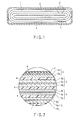
- FIG. 1 is a cross-sectional view of a thin-type non-aqueous electrolyte battery
- FIG. 2 is an enlarged cross-sectional view of the part A in FIG. 1 .
- the respective drawings are schematic drawings for explaining on and promoting understanding toward the invention, and although some of the shape, size, ratio and the like thereof are different from those of an actual apparatus, these can be suitably modified in design with referring to the following explanations and known techniques.
- a flat, spiral electrode group 1 is housed in a sac-like outer case 2 composed of a laminate film comprising two resin layers and an aluminum foil interposed therebetween.
- the flat, spiral electrode group 1 is formed by winding-up a laminate in which a negative electrode 3, a separator 4, a positive electrode 5 and a separator 4 are laminated in this order from the outer side in a spiral shape and subjecting the laminate to press forming.
- the negative electrode 3 on the outermost shell has a constitution in which a negative electrode layer 3b is formed on one surface on the inner surface side of a negative electrode current collector 3a.
- Other negative electrodes 3 are constituted by forming negative electrode layers 3b on the both surfaces of a negative electrode current collector 3a.
- the active material in the negative electrode layer 3b comprises a titanium composite oxide.
- the titanium composite oxide has a crystallite diameter of 5 nm or more as calculated from the main peak of the monoclinic ⁇ -type titanium composite oxide obtained with the wideangle X-ray diffraction method.
- a positive electrode 5 is constituted by forming positive electrode layers 3b on the both surfaces of a positive electrode current collector 5a.
- a negative electrode terminal 6 is connected to the negative electrode current collector 3a of the negative electrode 3 of the outermost shell, and a positive electrode terminal 7 is connected to the positive electrode current collector 5a of the positive electrode 5 on the inner side.
- These negative electrode terminal 6 and positive electrode terminal 7 are extended outward from the opening of the sac-like outer case 2.
- a liquid non-aqueous electrolyte is injected from the opening of the sac-like outer case 2.
- the negative electrode terminal is made of a material having electric stability and conductivity at a potential against a lithium ion metal in the range of 1.0 to 3.0 V vs Li/Li + . Specific examples may include aluminum, or aluminum alloys comprising elements such as Mg, Ti, Zn, Mn, Fe, Cu and Si.
- the negative electrode terminal is preferably composed of the same material as that of the negative electrode current collector so as to decrease contact resistance against the negative electrode current collector.
- the positive electrode terminal is made of a material having electrical stability and conductivity of a potential against a lithium ion metal in the range of 3.0 to 4.25 V vs Li/Li + . Specific examples may include aluminum, or aluminum alloys comprising elements such as Mg, Ti, Zn, Mn, Fe, Cu and Si.
- the positive electrode terminal is preferably composed of the same material as that of the positive electrode current collector so as to decrease a contact resistance against the positive electrode current collector.
- the battery pack of the embodiment has a plurality of the above-mentioned non-aqueous electrolyte batteries (unit cells), and the respective unit cells are disposed electrically in series, in parallel, or in series and parallel.
- Such a battery pack has excellent cycle property.
- the titanium composite oxide included in the negative electrode active material comprises little incorporation of an impurity phase and has high crystallinity, a non-aqueous electrolyte battery using this titanium composite oxide can improve the large-current performance and charge-discharge cycle performance.
- the battery pack incorporating a plurality of such batteries can improve the charge-discharge cycle performance even charging and discharging are performed under a large current.
- the flat-type non-aqueous electrolyte battery shown in FIG. 1 is used as a unit cell.
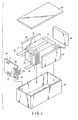
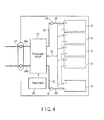
- a plurality of unit cells 21 are stacked so that a negative electrode terminal 6 and positive electrode terminal 7 that are extended to outside are aligned in the same direction, and are bound by an adhesive tape 22 to constitute a battery module 23. As shown in FIG. 4 , the unit cells 21 are connected electrically in series with each other.
- a printed wiring board 24 is disposed opposing to the side surface of the unit cells 21 from which the negative electrode terminal 6 and positive electrode terminal 7 are extended. As shown in FIG. 4 , a thermistor 25, a protective circuit 26, and a terminal 27 for carrying a current to an external device are mounted on the printed wiring board 24. In addition, an insulating board (not depicted) is attached to the surface of the protective circuit substrate 24 opposing to the battery module 23 so as to avoid unnecessary connection with the wiring of the battery module 23.
- a positive electrode-side lead 28 is connected to the positive electrode terminal 7 that is positioned at the lowermost layer of the battery module 23, and the tip thereof is inserted to and electrically connected to a positive electrode-side connector 29 of the printed wiring board 24.
- a negative electrode-side lead 30 is connected to the negative electrode terminal 6 that is positioned at the uppermost layer of the battery module 23, and the tip thereof is inserted to and electrically connected to a negative electrode-side connector 31 of the printed wiring board 24.
- These connectors 29 and 31 are connected to a protective circuit 26 through wirings 32 and 33 that are formed on the printed wiring board 24.
- the thermistor 25 is used for detecting the temperature of the unit cells 21, and the detection signal thereof is sent to the protective circuit 26.
- the protective circuit 26 can break a plus-side wiring 34a and a minus-side wiring 34b between the protective circuit 26 and the terminal 27 for carrying a current to an external device under a predetermined condition.
- the predetermined condition refers to, for example, the time at which the detection temperature of the thermistor 25 reaches a predetermined temperature or more. Furthermore, the predetermined condition refers to the time at which the over-charge, over-discharge, over-current or the like of the unit cells 21 is detected. The detection of over-charge or the like is performed on each unit cell 21 or the entirety of the unit cells 21.
- a battery voltage When detection is performed on each unit cell 21, a battery voltage may be detected, or a positive electrode potential or negative electrode potential may be detected. In the latter case, a lithium electrode that is used as a reference electrode is inserted into each unit cell 21.
- wirings 35 for detection of a voltage are connected to the respective unit cells 21, and detection signals are sent to the protective circuit 26 through these wirings 35.
- Protective sheets 36 made of a rubber or resin are disposed respectively on the three side surfaces of the battery module 23 except for the side surface from which the positive electrode terminal 7 and negative electrode terminal 6 protrude.
- the battery module 23 is housed in a housing container 37 together with the respective protective sheets 36 and the printed wiring board 24.
- the protective sheets 36 are disposed respectively on the both inner surfaces in the longitudinal side direction and the inner surface in the short side direction of the housing container 37, and the printed wiring board 24 is disposed on the inner surface on the opposite side in the short side direction.
- the battery module 23 is positioned in a space surrounded by the protective sheets 36 and the printed wiring board 24.
- a lid 38 is attached to the upper surface of the housing container 37.
- the battery module 23 may be fixed by using a heat shrink tape instead of the adhesive tape 22.
- the protective sheets are disposed on both side surfaces of the battery module, the battery module is wound around a heat shrink tape, and the heat shrink tape is shrank by heating to bind the battery module.
- the unit cells 21 may be connected in parallel, or series connection and parallel connection may be combined so as to increase a battery capacity. Assembled battery packs may further be connected in series or parallel.
- the embodiment of the battery pack is suitably changed according to use.
- Preferable use of the battery pack is one in which excellent cycle performance is shown when a large current is drawn.
- Specific examples may include uses in power sources for digital cameras, and in-car uses in two or four-wheeled hybrid battery automobiles, two or four-wheeled battery automobiles, motor assisted bicycles and the like.
- in-car uses are preferable.
- a non-aqueous electrolyte battery having excellent high temperature property can be obtained by using a mixing solvent obtained by mixing at least two or more selected from the group consisting of propylene carbonate (PC), ethylene carbonate (EC) and diethyl carbonate (DEC), or a non-aqueous electrolyte comprising ⁇ -butyrolactone (GBL).
- PC propylene carbonate
- EC ethylene carbonate
- DEC diethyl carbonate
- GBL non-aqueous electrolyte comprising ⁇ -butyrolactone
- a battery pack comprising a battery module comprising a plurality of such non-aqueous electrolyte batteries is specifically preferable for in-car uses.
- a lithium-nickel composite oxide (LiNi 0.82 Co 0.15 Al 0.03 O 2 ) powder as a positive electrode active material 90% by weight of a lithium-nickel composite oxide (LiNi 0.82 Co 0.15 Al 0.03 O 2 ) powder as a positive electrode active material, 5% by weight of acetylene black as a conductive agent, and 5% by weight of polyvinylidene fluoride (PVdF) were added to N-methylpyrrolidone (NMP) and mixed to provide a slurry, and the slurry was applied on both surfaces of a current collector composed of an aluminum foil having a thickness of 15 ⁇ m, dried and pressed to prepare a positive electrode having an electrode density of 3.15 g/cm 3 .
- NMP N-methylpyrrolidone
- potassium carbonate (K 2 CO 3 ) and an anatase-type titanium oxide (TiO 2 ) were mixed, and calcined at 1,000°C for 24 hours to synthesize K 2 Ti 4 O 9 .
- the obtained K 2 Ti 4 O 9 was dry-grinded with zirconia balls to adjust the granularity, and washed with pure water to provide a proton exchange precursor.
- the obtained proton exchange precursor was put into a hydrochloric acid solution having a concentration of 1 M, and subjected to ultrasonic stirring in an environment at 25°C for 1 hour. This operation was repeated 12 times, in which hydrochloric acid was replaced in each case, and thereafter cleaning was performed to provide a proton exchange form.
- the obtained proton exchange form was subjected to calcination in the air at 350°C for 3 hours to produce a titanium composite oxide.
- the crystallite diameter and the intensity ratio of the main peak were measured.
- the crystallite diameter of the titanium composite oxide was obtained according to the above-mentioned calculation method from the half width of the X-ray diffraction peak of the plane (110) having a diffraction angle (2 ⁇ ) of about 24.8° of the monoclinic ⁇ -type titanium composite oxide.
- the crystallite diameter of the titanium composite oxide was 15 nm. Meanwhile, in the calculation of the half width of the diffraction peak, it is necessary to correct the line width according to the optical system of the diffraction apparatus, and a standard silicon powder was used for this correction.
- the positive electrode, a separator composed of a porous film made of polyethylene having a thickness of 25 ⁇ m, the negative electrode and a separator were sequentially laminated in this order, and wound-up in a spiral shape. This was heat-pressed at 90°C to prepare a flat, spiral electrode group having a width of 30 mm and a thickness of 3.0 mm.
- the obtained electrode group was housed in a pack composed of a laminate film, and subjected to vacuum drying at 80°C for 24 hours.
- the laminate film is constituted by forming polypropylene layers on both surfaces of an aluminum foil having a thickness of 40 ⁇ m, and the total thickness thereof is 0.1 mm.
- Ethylene carbonate (EC) and ethyl methyl carbonate (EMC) were mixed at a volume ratio of 1:2 to provide a mixed solvent.
- LiPF 6 as an electrolyte was dissolved by 1 M in the mixed solvent to prepare a liquid non-aqueous electrolyte.
- the liquid non-aqueous electrolyte was injected into the laminate film pack housing the electrode group, and the pack was completely sealed off by heat sealing to produce a non-aqueous electrolyte secondary battery having the structure as shown in FIG. 1 and having a width of 35 mm, a thickness of 3.2 mm and a height of 65 mm.
- Titanium composite oxides were synthesized in a similar method to that of Example 1, except that the calcination temperature of the proton exchange form was changed to those described in the following Table 1.
- Non-aqueous electrolyte secondary batteries were produced in a similar method to that of Example 1, except that these titanium composite oxides were used as negative electrode active substances.
- the relative values of the integral intensity and the crystallite diameters of the titanium composite oxides that were used in Examples 2 to 6 and Comparative Example 1 shown in the following Table 1 were calculated from a wideangle X-ray diffraction pattern using Cu-K ⁇ , which was prepared in a similar manner to that in Example 1.
- the X-ray diffraction pattern of the titanium composite oxide used in Comparative Example 1 is shown in FIG. 6 .
- single electrodes were prepared from the negative electrodes that were used for the batteries of Examples 1 to 6 and Comparative Example 1 and a counter electrode composed of a lithium metal.
- Lithium ions were stored (charged) in the negative electrode of the single electrode up to 1 V (Li/Li + ) at a current value of 0.1 mA/cm 2 , and lithium ions were released up to 3 V (Li/Li + ) at a current value of 0.1 mA/cm 2 .
- the discharged amount of electricity at that time was converted to an amount of electricity per a unit weight of lithium titanate that was an active material for the negative electrode.
- the converted values are shown in the following Table 1 as negative electrode capacities.
- Example 1 Calcination temperature (°C) Relative value of integral intensity Crystallite diameter (nm) Negative electrode capacity (mAh/g) Capacity retention rate (%) Comparative Example 1 250 51 9 158 70 Example 1 350 23 15 210 85 Example 2 300 30 10 205 84 Example 3 400 20 17 220 87 Example 4 450 17 20 220 87 Example 5 500 12 25 215 85 Example 6 600 10 30 210 84
- the batteries of Examples 1 to 6 for which titanium composite oxides each having a relative value of the integral intensity of 30 or less and a crystallite diameter of 5 nm or more were used as negative electrode active materials show higher negative electrode capacities and higher capacity retention rates (fine large-current performances) than those of the battery of Comparative Example 1 for which a titanium composite oxide in which any one of the above-mentioned relative value of the integral intensity and crystallite diameter was out of the above-mentioned range was used as a negative electrode active material.
- a non-aqueous electrolyte secondary battery was prepared in a similar manner to that of Example 1, except that the titanium composite oxide synthesized by the following method was used as a negative electrode active material.
- K 2 Ti 4 O 9 Phosphorous oxide (P 2 O 5 ), boron oxide (B 2 O 3 ), potassium carbonate (K 2 CO 3 ) and anatase-type titanium oxide (TiO 2 ) were mixed, and calcined at 1,000°C for 24 hours to provide K 2 Ti 4 O 9 comprising P and B.
- the obtained K 2 Ti 4 O 9 was dry-grinded with zirconia balls to adjust the granularity, and washed with pure water to provide a proton exchange precursor.
- the obtained proton exchange precursor was put into a hydrochloric acid solution having a concentration of 1 M, and ultrasonic stirring was performed under an environment of 25°C for 1 hour.
- the amounts of P and B in the obtained titanium composite oxide were measured by the above-mentioned ICP analysis. As a result, the amounts of P and B were 0.230% by weight and 0.010% by weight, respectively.
- the wideangle X-ray diffraction pattern of the obtained titanium composite oxide using Cu-K ⁇ is shown in FIG. 7 .
- the relative value of the integral intensity of the main peak that presents the range of 2 ⁇ 25.1 to 25.5° attributed to the anatase-type TiO 2 and H 2 Ti 8 O 17 , respectively, when the peak integral intensity at 3.59 ⁇ (2 ⁇ : 24.8°) that is the main peak of the monoclinic ⁇ -type titanium composite oxide is 100, and the crystallite diameter of the titanium composite oxide were obtained in similar manners to those of Example 1.
- the relative value of the integral intensity and the crystallite diameter were 3 or less and 25 nm, respectively.
- Titanium composite oxides were synthesized in a similar manner to that of Example 7, except that the amounts of P and B (amounts with respect to the total amount of the titanium composite oxide and P and B) were in the ratios shown in the following Table 2.
- Non-aqueous electrolyte secondary batteries were produced in a similar manner to that of Example 1, except that these titanium composite oxides were used as negative electrode active materials.
- the relative values of the integral intensity and crystallite diameters of the titanium composite oxides used for Examples 8 to 16 and Comparative Example 2 shown in the following Table 2 were calculated from wideangle X-ray diffraction patterns using Cu-K ⁇ , which were prepared in a similar manner to that of Example 1.
- single electrodes were prepared from the negative electrodes that were used for the batteries of Examples 7 to 16 and Comparative Example 2 and a counter electrode composed of a lithium metal.
- Lithium ions were stored (charged) in the negative electrode of the single electrode up to 1 V (Li/Li + ) at a current value of 0.1 mA/cm 2 , and lithium ions were released up to 3 V (Li/Li + ) at a current value of 0.1 mA/cm 2 .
- the discharged amount of electricity at that time was converted to an amount of electricity per a unit weight of lithium titanate that was an active material for the negative electrode.
- the converted values are shown in the following Table 2 as negative electrode capacities.
- Example 7 0.230 0.010 0.240 350 ⁇ 3 25 254 91
- Example 8 0.010 - 0.010 350 7 15 225 89
- Example 9 0.050 - 0.050 350 5 17 230 90
- Example 10 0.100 - 0.100 350 ⁇ 3 18 241
- Example 11 0.230 - 0.230 350 ⁇ 3 22 253 93
- Example 12 1.051 - 1.051 400 ⁇ 3 27 243 94
- Example 13 2.953 - 2.953 400 ⁇ 3 20 210 92
- Comparative Example 2 4.931 - 4.931 400 36 9 138 69
- Example 14 0.225 0.023 0.248 350 ⁇ 3 25 248 91
- Example 15 0.228 0.250 0.478 350 ⁇ 3 27 244 92
- Example 16 - 0.245 0.2
- the batteries of Examples 7 to 16 for which titanium composite oxides each comprising a predetermined amount of at least one element selected from P and B and having a relative value of the integral intensity of 30 or less and a crystallite diameter of 5 nm or more were used as negative electrode active materials show higher negative electrode capacities and higher capacity retention rates (fine large-current performances) than those of the battery of Comparative Example 2 for which a titanium composite oxide in which the content of the element (P) exceeded 3% by weight was used as a negative electrode active material. Furthermore, it is understood that the batteries of Examples 7 to 16 show further higher capacity retention rates (fine large-current performances) than those of the batteries of Examples 1 to 6 that were free from the above-mentioned elements (P, B).
Landscapes
- Chemical & Material Sciences (AREA)
- Inorganic Chemistry (AREA)
- Chemical Kinetics & Catalysis (AREA)
- Electrochemistry (AREA)
- General Chemical & Material Sciences (AREA)
- Battery Electrode And Active Subsutance (AREA)
- Sealing Battery Cases Or Jackets (AREA)
- Secondary Cells (AREA)
- Battery Mounting, Suspending (AREA)
- Connection Of Batteries Or Terminals (AREA)
Applications Claiming Priority (1)
| Application Number | Priority Date | Filing Date | Title |
|---|---|---|---|
| PCT/JP2009/059800 WO2010137154A1 (ja) | 2009-05-28 | 2009-05-28 | 電池用活物質、非水電解質電池および電池パック |
Publications (2)
| Publication Number | Publication Date |
|---|---|
| EP2437335A1 true EP2437335A1 (de) | 2012-04-04 |
| EP2437335A4 EP2437335A4 (de) | 2015-08-05 |
Family
ID=43222295
Family Applications (1)
| Application Number | Title | Priority Date | Filing Date |
|---|---|---|---|
| EP09845221.2A Withdrawn EP2437335A4 (de) | 2009-05-28 | 2009-05-28 | Aktivmaterial für eine batterie, batterie mit wasserfreiem elektrolyt und batteriepackung |
Country Status (5)
| Country | Link |
|---|---|
| US (1) | US8647774B2 (de) |
| EP (1) | EP2437335A4 (de) |
| JP (1) | JP5017492B2 (de) |
| CN (1) | CN102362376B (de) |
| WO (1) | WO2010137154A1 (de) |
Cited By (2)
| Publication number | Priority date | Publication date | Assignee | Title |
|---|---|---|---|---|
| EP2738843A4 (de) * | 2011-07-29 | 2015-04-29 | Doshisha | Negativelektrodenmaterial für lithiumionenbatterien mit einem oberflächenfluorierten b- titandioxidpulver, herstellungsverfahren dafür und lithiumionenbatterie damit |
| EP3082182A1 (de) * | 2015-03-13 | 2016-10-19 | Kabushiki Kaisha Toshiba | Aktives material, batterie mit nichtwässrigem elektrolyt, batteriemodul, batteriepack und fahrzeug |
Families Citing this family (14)
| Publication number | Priority date | Publication date | Assignee | Title |
|---|---|---|---|---|
| JP5100892B2 (ja) * | 2009-07-31 | 2012-12-19 | 株式会社東芝 | 非水電解質電池、それに用いる活物質、その製造方法、チタン酸アルカリ化合物の製造方法、及び電池パック |
| JP5450159B2 (ja) * | 2010-02-25 | 2014-03-26 | チタン工業株式会社 | 電極用酸化チタン系化合物及びそれを用いたリチウム二次電池 |
| JP5586549B2 (ja) | 2011-09-14 | 2014-09-10 | 株式会社東芝 | 電池用活物質、非水電解質電池および電池パック |
| JP5586553B2 (ja) * | 2011-09-22 | 2014-09-10 | 株式会社東芝 | 活物質及びその製造方法、非水電解質電池及び電池パック |
| JP5694245B2 (ja) * | 2012-07-12 | 2015-04-01 | 株式会社東芝 | 活物質、非水電解質電池および電池パック |
| JP6222433B2 (ja) * | 2013-08-08 | 2017-11-01 | 日本電気硝子株式会社 | 蓄電デバイス用負極活物質の製造方法 |
| JP5807730B1 (ja) * | 2015-03-04 | 2015-11-10 | 宇部興産株式会社 | 蓄電デバイスの電極用チタン酸リチウム粉末および活物質材料、並びにそれを用いた電極シートおよび蓄電デバイス |
| JP6567447B2 (ja) * | 2016-03-15 | 2019-08-28 | 株式会社東芝 | リチウムイオン二次電池用活物質、負極、非水電解質電池、電池パック、及び車両 |
| JP6696689B2 (ja) * | 2016-03-16 | 2020-05-20 | 株式会社東芝 | 活物質、電極、非水電解質電池、電池パック、及び車両 |
| JP6612804B2 (ja) | 2017-03-22 | 2019-11-27 | 株式会社東芝 | 活物質、電極、二次電池、電池パック、及び車両 |
| JP6659643B2 (ja) | 2017-09-20 | 2020-03-04 | 株式会社東芝 | 活物質、活物質複合材料、電極、二次電池、電池パック及び車両 |
| JP7027363B2 (ja) * | 2018-09-19 | 2022-03-01 | 株式会社東芝 | リチウム亜鉛二次電池、電池パック、車両及び定置用電源 |
| WO2020059185A1 (en) | 2018-09-19 | 2020-03-26 | Kabushiki Kaisha Toshiba | Lithium zinc secondary battery, battery pack, vehicle, and stationary power supply |
| CN113488728B (zh) * | 2021-07-02 | 2022-06-28 | 横店集团东磁股份有限公司 | 一种圆柱形电池 |
Family Cites Families (13)
| Publication number | Priority date | Publication date | Assignee | Title |
|---|---|---|---|---|
| JP2004152579A (ja) * | 2002-10-30 | 2004-05-27 | Matsushita Electric Ind Co Ltd | リチウムイオン電池およびリチウムイオン電池パック |
| WO2006033069A2 (en) * | 2004-09-20 | 2006-03-30 | High Power Lithium Sa | Energy storage device |
| CN1838471A (zh) * | 2005-03-24 | 2006-09-27 | 株式会社东芝 | 电池组及车辆 |
| JP4439456B2 (ja) * | 2005-03-24 | 2010-03-24 | 株式会社東芝 | 電池パック及び自動車 |
| JP4977375B2 (ja) * | 2006-02-15 | 2012-07-18 | Necエナジーデバイス株式会社 | リチウムイオン電池およびそれを用いた組電池 |
| FR2902577B1 (fr) | 2006-06-20 | 2009-04-24 | Commissariat Energie Atomique | Accumulateur lithium-ion comprenant tio2-b comme materiau actif d'electrode negative |
| JP5093643B2 (ja) | 2006-11-02 | 2012-12-12 | 独立行政法人産業技術総合研究所 | リチウム二次電池活物質及びその製造方法、並びにそれを用いたリチウム二次電池 |
| JP5095179B2 (ja) * | 2006-11-10 | 2012-12-12 | 株式会社東芝 | 非水電解質電池、リチウムチタン複合酸化物および電池パック |
| JP5612857B2 (ja) | 2007-08-30 | 2014-10-22 | 石原産業株式会社 | チタン酸化合物及びその製造方法並びに該チタン酸化合物を含む電極活物質、電極活物質を用いてなる蓄電デバイス |
| JP5205923B2 (ja) * | 2007-11-08 | 2013-06-05 | 三菱化学株式会社 | 非水電解質二次電池用電極材、非水電解質二次電池用電極及びそれを用いた非水電解質二次電池 |
| JP2010055855A (ja) * | 2008-08-27 | 2010-03-11 | Mitsubishi Chemicals Corp | 非水電解質二次電池用電極材、非水電解質二次電池用電極及びそれを用いた非水電解質二次電池 |
| JP2010123401A (ja) * | 2008-11-19 | 2010-06-03 | Mitsubishi Chemicals Corp | 非水電解質二次電池用電極材、非水電解質二次電池用電極及びそれを用いた非水電解質二次電池 |
| JP5017336B2 (ja) * | 2009-08-26 | 2012-09-05 | 株式会社東芝 | 非水電解質電池用活物質、非水電解質電池および電池パック |
-
2009
- 2009-05-28 JP JP2011515810A patent/JP5017492B2/ja not_active Expired - Fee Related
- 2009-05-28 EP EP09845221.2A patent/EP2437335A4/de not_active Withdrawn
- 2009-05-28 WO PCT/JP2009/059800 patent/WO2010137154A1/ja not_active Ceased
- 2009-05-28 CN CN200980158315.6A patent/CN102362376B/zh active Active
-
2011
- 2011-11-28 US US13/305,043 patent/US8647774B2/en not_active Expired - Fee Related
Non-Patent Citations (1)
| Title |
|---|
| See references of WO2010137154A1 * |
Cited By (3)
| Publication number | Priority date | Publication date | Assignee | Title |
|---|---|---|---|---|
| EP2738843A4 (de) * | 2011-07-29 | 2015-04-29 | Doshisha | Negativelektrodenmaterial für lithiumionenbatterien mit einem oberflächenfluorierten b- titandioxidpulver, herstellungsverfahren dafür und lithiumionenbatterie damit |
| EP3082182A1 (de) * | 2015-03-13 | 2016-10-19 | Kabushiki Kaisha Toshiba | Aktives material, batterie mit nichtwässrigem elektrolyt, batteriemodul, batteriepack und fahrzeug |
| US9812704B2 (en) | 2015-03-13 | 2017-11-07 | Kabushiki Kaisha Toshiba | Active material, nonaqueous electrolyte battery, and battery pack |
Also Published As
| Publication number | Publication date |
|---|---|
| JP5017492B2 (ja) | 2012-09-05 |
| CN102362376B (zh) | 2014-03-05 |
| US20120129016A1 (en) | 2012-05-24 |
| EP2437335A4 (de) | 2015-08-05 |
| JPWO2010137154A1 (ja) | 2012-11-12 |
| WO2010137154A1 (ja) | 2010-12-02 |
| CN102362376A (zh) | 2012-02-22 |
| US8647774B2 (en) | 2014-02-11 |
Similar Documents
| Publication | Publication Date | Title |
|---|---|---|
| US8647774B2 (en) | Non-aqueous electrolytic batteries containing an active material including a monoclinic B-type titanium composite oxide | |
| US8409755B2 (en) | Active material for batteries, non-aqueous electrolyte battery, and battery pack | |
| KR101384018B1 (ko) | 비수 전해질 전지용 부극 활물질, 그 제조 방법, 비수 전해질 전지 및 전지 팩 | |
| US8673500B2 (en) | Active material for batteries, non-aqueous electrolyte battery, and battery pack | |
| JP5321847B2 (ja) | 活物質及びその製造方法、非水電解質電池及び電池パック | |
| CN101373830A (zh) | 非水电解质二次电池用负极材料及其制造方法、以及非水电解质二次电池和电池组 | |
| EP3067321B1 (de) | Aktivmaterial, batterie mit nichtwässrigem elektrolyten, batteriepack und batteriemodul | |
| CN103545495A (zh) | 活性材料、非水电解质电池和电池组 | |
| JP5468098B2 (ja) | 電池用活物質、非水電解質電池および電池パック | |
| CN103022497A (zh) | 活性材料及其制造方法、非水电解质电池和电池组 | |
| JP4966347B2 (ja) | 負極活物質、非水電解質電池及び電池パック | |
| US8722251B2 (en) | Active material, nonaqueous electrolyte battery and battery pack | |
| WO2023079639A1 (ja) | 電極、電池、及び電池パック | |
| CN116114078B (zh) | 电极、电池及电池组 | |
| JP5596077B2 (ja) | 電池用活物質の製造方法、電池用活物質、非水電解質電池および電池パック | |
| EP2879212B1 (de) | Aktiver stoff für zelle, zelle mit wasserfreiem analyt und zellenpack | |
| JP5567056B2 (ja) | 非水電解質電池及び電池パック | |
| CN103943840B (zh) | 电池用活性物质、非水电解质电池以及电池包 | |
| JP2014222667A (ja) | 非水電解質電池用活物質、非水電解質電池および電池パック | |
| CN103825012A (zh) | 电池用活性物质、非水电解质电池及电池包 | |
| JP2014067731A (ja) | 非水電解質電池および電池パック |
Legal Events
| Date | Code | Title | Description |
|---|---|---|---|
| PUAI | Public reference made under article 153(3) epc to a published international application that has entered the european phase |
Free format text: ORIGINAL CODE: 0009012 |
|
| 17P | Request for examination filed |
Effective date: 20111209 |
|
| AK | Designated contracting states |
Kind code of ref document: A1 Designated state(s): AT BE BG CH CY CZ DE DK EE ES FI FR GB GR HR HU IE IS IT LI LT LU LV MC MK MT NL NO PL PT RO SE SI SK TR |
|
| DAX | Request for extension of the european patent (deleted) | ||
| RA4 | Supplementary search report drawn up and despatched (corrected) |
Effective date: 20150703 |
|
| RIC1 | Information provided on ipc code assigned before grant |
Ipc: H01M 2/20 20060101ALI20150629BHEP Ipc: H01M 4/48 20100101AFI20150629BHEP Ipc: H01M 10/36 20100101ALI20150629BHEP |
|
| STAA | Information on the status of an ep patent application or granted ep patent |
Free format text: STATUS: THE APPLICATION IS DEEMED TO BE WITHDRAWN |
|
| 18D | Application deemed to be withdrawn |
Effective date: 20160202 |