EP2437448B1 - Procédé de traitement de symboles de données OFDM reçues et récepteur de bande de base OFDM - Google Patents
Procédé de traitement de symboles de données OFDM reçues et récepteur de bande de base OFDM Download PDFInfo
- Publication number
- EP2437448B1 EP2437448B1 EP10186152.4A EP10186152A EP2437448B1 EP 2437448 B1 EP2437448 B1 EP 2437448B1 EP 10186152 A EP10186152 A EP 10186152A EP 2437448 B1 EP2437448 B1 EP 2437448B1
- Authority
- EP
- European Patent Office
- Prior art keywords
- noise
- data symbols
- time
- frequency
- normalized
- Prior art date
- Legal status (The legal status is an assumption and is not a legal conclusion. Google has not performed a legal analysis and makes no representation as to the accuracy of the status listed.)
- Not-in-force
Links
- 238000000034 method Methods 0.000 title claims abstract description 20
- 238000012545 processing Methods 0.000 title claims abstract description 10
- 238000010606 normalization Methods 0.000 claims abstract description 34
- 238000004891 communication Methods 0.000 claims abstract description 19
- 230000005540 biological transmission Effects 0.000 claims abstract description 16
- 239000011159 matrix material Substances 0.000 claims description 16
- 238000012546 transfer Methods 0.000 claims description 6
- 239000013598 vector Substances 0.000 description 9
- 238000010586 diagram Methods 0.000 description 5
- 230000001413 cellular effect Effects 0.000 description 2
- 239000002131 composite material Substances 0.000 description 2
- 125000004122 cyclic group Chemical group 0.000 description 2
- 238000005562 fading Methods 0.000 description 2
- 230000002452 interceptive effect Effects 0.000 description 2
- 230000006978 adaptation Effects 0.000 description 1
- 238000013459 approach Methods 0.000 description 1
- 238000012937 correction Methods 0.000 description 1
- 230000001186 cumulative effect Effects 0.000 description 1
- 238000004519 manufacturing process Methods 0.000 description 1
- 230000002085 persistent effect Effects 0.000 description 1
- 230000010363 phase shift Effects 0.000 description 1
- WIUGDTDEQHIWAS-UHFFFAOYSA-N sodium;[3-[[3-[(2-bromoacetyl)amino]phenoxy]-hydroxyphosphoryl]oxy-5-(5-methyl-2,4-dioxopyrimidin-1-yl)oxolan-2-yl]methyl [3-[(2-bromoacetyl)amino]phenyl] hydrogen phosphate Chemical compound [Na+].O=C1NC(=O)C(C)=CN1C1OC(COP(O)(=O)OC=2C=C(NC(=O)CBr)C=CC=2)C(OP(O)(=O)OC=2C=C(NC(=O)CBr)C=CC=2)C1 WIUGDTDEQHIWAS-UHFFFAOYSA-N 0.000 description 1
Images


Classifications
-
- H—ELECTRICITY
- H04—ELECTRIC COMMUNICATION TECHNIQUE
- H04L—TRANSMISSION OF DIGITAL INFORMATION, e.g. TELEGRAPHIC COMMUNICATION
- H04L27/00—Modulated-carrier systems
- H04L27/26—Systems using multi-frequency codes
- H04L27/2601—Multicarrier modulation systems
- H04L27/2647—Arrangements specific to the receiver only
-
- H—ELECTRICITY
- H04—ELECTRIC COMMUNICATION TECHNIQUE
- H04L—TRANSMISSION OF DIGITAL INFORMATION, e.g. TELEGRAPHIC COMMUNICATION
- H04L25/00—Baseband systems
- H04L25/02—Details ; arrangements for supplying electrical power along data transmission lines
- H04L25/0202—Channel estimation
-
- H—ELECTRICITY
- H04—ELECTRIC COMMUNICATION TECHNIQUE
- H04L—TRANSMISSION OF DIGITAL INFORMATION, e.g. TELEGRAPHIC COMMUNICATION
- H04L27/00—Modulated-carrier systems
- H04L27/26—Systems using multi-frequency codes
- H04L27/2601—Multicarrier modulation systems
- H04L27/2647—Arrangements specific to the receiver only
- H04L27/2655—Synchronisation arrangements
-
- H—ELECTRICITY
- H04—ELECTRIC COMMUNICATION TECHNIQUE
- H04L—TRANSMISSION OF DIGITAL INFORMATION, e.g. TELEGRAPHIC COMMUNICATION
- H04L27/00—Modulated-carrier systems
- H04L27/26—Systems using multi-frequency codes
- H04L27/2601—Multicarrier modulation systems
- H04L27/2647—Arrangements specific to the receiver only
- H04L27/2655—Synchronisation arrangements
- H04L27/2689—Link with other circuits, i.e. special connections between synchronisation arrangements and other circuits for achieving synchronisation
- H04L27/2691—Link with other circuits, i.e. special connections between synchronisation arrangements and other circuits for achieving synchronisation involving interference determination or cancellation
-
- H—ELECTRICITY
- H04—ELECTRIC COMMUNICATION TECHNIQUE
- H04L—TRANSMISSION OF DIGITAL INFORMATION, e.g. TELEGRAPHIC COMMUNICATION
- H04L27/00—Modulated-carrier systems
- H04L27/26—Systems using multi-frequency codes
- H04L27/2601—Multicarrier modulation systems
- H04L27/2647—Arrangements specific to the receiver only
- H04L27/2655—Synchronisation arrangements
- H04L27/2689—Link with other circuits, i.e. special connections between synchronisation arrangements and other circuits for achieving synchronisation
- H04L27/2695—Link with other circuits, i.e. special connections between synchronisation arrangements and other circuits for achieving synchronisation with channel estimation, e.g. determination of delay spread, derivative or peak tracking
Definitions
- the invention relates to a method for processing received data symbols in an orthogonal frequency division multiplexing (OFDM) transmission scheme, and also relates to an OFDM baseband receiver.
- OFDM orthogonal frequency division multiplexing
- Orthogonal frequency division multiplexing has been widely adopted for a variety of wireless communication standards, such as WLAN IEEE 802.11 a/g, DAB, TDMB, DVB-T, WiMax, and also 3GPP LTE. Due to its potential for low complexity receiver implementation, OFDM is particularly attractive for high-data rate transmission.
- the transmission bandwidth is split into equidistantly spaced orthogonal sub-bands of identical width. Orthogonality is maintained under the prerequisite that the duration of the channel impulse response does not exceed the duration of the guard interval, and if the radio propagation channel conditions vary slowly enough. Both requirements are satisfied by proper selection of system parameters, such as subcarrier spacing and guard interval duration.
- y k , l h k , l ⁇ x k , l + n k , l
- x is a transmitted symbol
- h is a complex fading coefficient
- n is a random noise sample
- y is the corresponding received symbol
- k is the OFDM subcarrier index
- l is the OFDM symbol index.
- the noise sample is characterized by the noise variance ⁇ n 2 .
- x is a vector of transmitted symbol
- H is a matrix of complex fading coefficients
- n is a random noise sample vector
- y is the corresponding received symbol vector.
- the random noise vector is characterized by its covariance matrix ⁇ nn .
- regions in the time-frequency plane may be assigned to different users.
- the 3GPP LTE standard employs this kind of orthogonal frequency division multiple access (OFDMA) in the downlink, i.e. the transmission direction from a base station to a terminal.
- OFDMA orthogonal frequency division multiple access
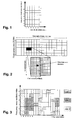
- each element in the time-frequency plane is referred to as a resource element, and the entire time-frequency plane is divided into so-called resource blocks, which are rectangles of 12 subcarriers in frequency direction times 6 or 7 (depending on the cyclic prefix duration mode) OFDM symbols in time direction, as illustrated in Fig. 2 .
- a resource block as a whole is assigned to a specific user.
- resource blocks may also be unused, i.e., not allocated to any user.
- the LTE standard describes a cellular network, where a supplied area is split into cells, each cell being equipped with a base station which serves the mobile stations in that cell.
- a base station is referred to as an "evolved Node B" (eNB)
- UE user equipment
- a simplified scheme of such a network is shown in Fig. 4 .
- a communication terminal 1 is located in cell 4A near the border to an adjacent cell 4B.
- Terminal 1 is served by a base station 2.
- Terminal 1 will also receive signals transmitted by base station 3 of cell 4B that are, however, intended for another terminal (not shown) which is located in cell 4B.
- the frequency re-use factor is 1, which means that any mobile station will experience interference from neighboring cells in the network.
- the interference from a neighboring cell depends on the patterns of used and non-used resource blocks in the adjacent cells.
- a resource block allocation as depicted in Fig. 3 to be valid in cell 4A, and a different resource block allocation, not shown, to be valid in the neighboring cell 4B.
- resource blocks with resource block index 5 and slot indices 5 and 6 are allocated to user 1 (terminal 1 in Fig. 4 ).
- the communication channel towards an interfering base station is time variant and frequency selective.
- the composite of noise and interference is generally varying both in time and frequency directions.
- a number of parameter estimation tasks need to be performed, e.g., time synchronization estimation, frequency synchronization estimation, channel estimation, interference level estimation, Doppler spread estimation, power delay profile estimation, feedback information estimation.
- Many existing OFDM receiver implementations are designed for a noise level which is constant across the employed frequency band.
- the data demodulation and parameter estimation algorithms should take into account the characteristics of noise and interference.
- LLR log likelihood ratio
- Equation (3) applies to the single-input-single output (SISO) case, i.e. where there is one transmit antenna and one receive antenna.
- SISO single-input-single output
- the covariance matrix in this equation contains noise variances corresponding to all receive antennas on the main diagonal, and also the respective noise co-variances on the side diagonals. Assuming that all co-variances are zero, this equation describes what is known as maximum-ratio combining: Received symbols of all antennas are normalized by the respective noise variances and multiplied by corresponding channel amplitudes. When the side diagonals in the covariance matrix are non-zero, the equation describes optimum combining even in presence of noise correlation between receive antennas.
- reference symbols are multiplexed into the time-frequency plane such as illustrated in Fig. 5 .
- Reference symbols are data symbols which are known at the receiver and are used for parameter estimation tasks.
- a number of parameter estimation tasks may be carried out using simple scalar products of vectors.
- the angle of the scalar product s provides information on the residual frequency offset.
- this scalar product may serve as a frequency offset estimator used for frequency tracking.
- the absolute value of the computed scalar product provides a reliability figure on the estimation result, namely the angle.
- LTE supports a number of link adaptation methods, in order to provide a certain quality of service (QoS) to mobile users.
- the modulation and coding scheme i.e., the modulation alphabet (QPSK, 16-QAM, or 64-QAM) and the coding rate are adapted to the given link conditions, in order to meet a targeted maximum packet error rate.
- a mobile station sends a proposal for the choice of a modulation and coding scheme to the base station (channel quality indication - CQI).
- channel quality indication - CQI channel quality indication
- MIMO transmission mode utilizing implicit beam-forming via precoding, which allows improved utilization of the spatial channel dimension.
- the mobile station sends a proposal for the number of transmission layers (rank indication - RI) and best precoding matrix (precoding matrix index - PMI).
- the mobile station obtains all this feedback information based on an assessment of the channel conditions and sends its proposals to the base station.
- all this feedback information is computed based on the signal-to-noise ratio which will be obtained after equalization.
- the patent application US 2009/0046772 A1 discloses a method for processing received OFDM data symbols and a corresponding receiver, wherein time and frequency selective level estimations of combined noise and interference and channel estimations are determined from received symbols, for data demodulation and parameter estimation processing.
- the object of the invention is to provide an OFDM baseband receiver architecture which supports frequency selective noise estimation, and especially frequency selective soft-metric weighting for interference limited environments.
- a more general object of the invention is to suggest an OFDM baseband receiver architecture and reception method with improved estimation performance and reduced computational complexity which directly translates into reduced costs, both in terms of manufacturing and power consumption.
- a method for processing received data symbols in an orthogonal frequency division multiplexing (OFDM) transmission scheme which comprises determining noise level estimations and channel estimations from the received symbols, for both data demodulation and decoding and parameter estimation tasks.
- the step of determining noise level estimations comprises estimating time and frequency selective levels of combined noise and interference, and the method further comprises computing noise normalization values for a respective time-frequency region of the time-frequency plane that applies in the transmission scheme employed, from said time and frequency selective noise plus interference levels, applying said noise normalization values to the received data symbols to obtain normalized data symbols, applying said noise normalization values to the channel estimates, to obtain normalized channel estimates, determining communication parameter estimates from said normalized channel estimates, and determining demodulated and decoded data from said normalized data symbols using said normalized channel estimates.
- OFDM orthogonal frequency division multiplexing
- the communication parameter determining step may comprise time offset estimation, frequency offset estimation, Doppler spread estimation, power delay profile estimation and feedback information including at least one of channel state information (CQI), rank index (RI), and precoding matrix index (PMI).
- CQI channel state information
- RI rank index
- PMI precoding matrix index
- the invention also provides an orthogonal frequency division multiplexing (OFDM) baseband receiver that uses the above method for demodulating and decoding data, and for estimating communication parameters.
- OFDM orthogonal frequency division multiplexing
- the OFDM baseband receiver of the invention supports centralized time and frequency selective consideration of the noise plus interference level by time and frequency selective estimation of noise and interference levels and computation of time and frequency selective normalization values based upon estimated levels of cumulative noise and interference.
- the computed normalization values are applied to corresponding (in the time-frequency plane) received noisy data symbols and estimated channel transfer function values such that the noise variance on normalized data symbols is constant across the time-frequency plane.
- the normalized data symbols and corresponding normalized channel transfer functions can be used for the joint task of equalization and log likelihood ratio computation.
- the normalized channel transfer functions can be used to compute feedback information, i.e., estimate of channel rank, best precoding matrix, and proposed modulation and coding scheme.
- the normalized channel transfer functions can also be used for parameter estimations such as frequency offset estimation, time offset estimation, Doppler spread estimation, power delay profile estimation, in particular in algorithms employing scalar products of vectors.
- the invention treats interference as non-constant both in time and frequency direction.
- the invention advantageously employs a centralized approach to consider time-frequency selective interference in multiple algorithms such as data equalization and multiple parameter estimation tasks.
- the invention offers a performance advantage when compared with conventional OFDM receiver architectures which treat interference as a constant in the frequency direction. Also, the invention offers a complexity advantage when compared to conventional receiver architectures in which time/frequency selective interference is treated separately in the several data demodulation and parameter estimation algorithms employed. Thus, the invention provides a unified architecture of a low complexity OFDM receiver for high performance in presence of time-variant and frequency-selective interference. In particular in scenarios of severe time-frequency selective interference, a considerable performance advantage will be obtained over receivers where further parameter estimations such as time offset estimation and frequency offset estimation are performed using channel estimates without compensating for the time/frequency selective variance of noise plus interference.
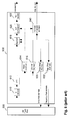
- Fig. 6 shows a simplified block diagram of an exemplary conventional LTE baseband receiver.
- blocks of the received signal are processed via fast Fourier transform (FFT), at 612, to convert received time domain symbols into frequency domain.
- FFT fast Fourier transform
- a number of processed FFT blocks form a time-frequency plane consisting of received data symbols and reference symbols.
- Channel estimation, at 616, and noise level estimation, at 614, is typically performed based on reference symbols.
- Data symbols and corresponding channel estimates are equalized, at 618, and then log likelihood values are computed, at 620, and fed into a deinterleaving/decoding unit 622 which obtain decoded data from the equalized and scaled symbols.
- Data bits output from forward error correcting (FEC) decoder 622 include control bits and payload bits.
- FEC forward error correcting
- Channel estimates from 616 are also fed into time offset estimator 630 and frequency offset estimator 632 to compute time and frequency offset estimates, respectively, that are used for time and frequency tracking loops between an analog RF front-end 500 and baseband receiver 600.
- This frequency and time tracking is performed to improve both inter-symbol interference (ISI), and inter-carrier interference (ICI).
- ISI is introduced by poor time tracking, whereas a good time synchronization ensures correct removal of the guard interval (GI) which is also known as a cyclic prefix (CP).
- GI guard interval
- CP cyclic prefix
- ICI is introduced by poor frequency tracking, i.e. the carrier frequency may shift due to temperature variations etc.
- the channel estimates from 616 and the noise level estimate from 614 are fed into a feedback information estimator 640, which computes feedback information (FBI) that is returned to the base station.
- Feedback information in particular are channel state information (CQI), a rank index (RI) which indicates the rank of the channel matrix which in turn is an indication of the number of receive antennas that supply assessable signals, and a precoding matrix index (PMI) which are required for channel state information reporting to the base station.
- CQI channel state information
- RI rank index
- PMI precoding matrix index
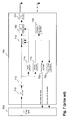
- Fig. 7 shows another known implementation of an LTE baseband receiver which derives feedback information such as PMI, RI, and CQI based on intermediate results that are available in equalizer 718.
- noise level estimation is performed on a per-OFDM-symbol basis, yielding a result which describes the average noise level across the frequency band.
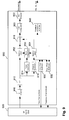
- Fig. 8 shows an OFDM baseband receiver according to an exemplary embodiment of the invention.
- the OFDM baseband receiver comprises guard interval (GI) removal means 810, means 812 for fast Fourier transform to provide frequency domain symbols, means 816 for estimating the channel transfer function, means 814 for estimating the composite level of noise and interference, means 818 for equalizing data symbols, means 820 for computing log likelihood ratios, means 822 for decoding softbits to provide decoded data bits, means 830 for time offset estimation, means for frequency offset estimation 832, and means 840 for feedback information computation.
- GI guard interval
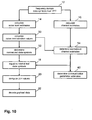
- the method for processing received signals in an OFDM baseband receiver according to the invention is summarized in Fig. 10 .
- the frequency domain data symbols which are output by FFT block 812 are used to calculate noise plus interference level estimates, at 14, and channel estimates, at 16.
- noise normalization values are calculated from the noise plus interference level estimates obtained in step 14. These noise normalization values are, on the one hand applied to the received data symbols to obtain normalized data symbols, in step 52, and on the other hand to the channel estimates output by block 816 to obtain normalized channel estimates, in step 54.
- the normalized data symbols from step 52 and the normalized channel estimates from step 54 then are used further to demodulate and decode data. Especially, the normalized data symbols from step 52 are equalized in step 18 using the normalized channel estimates.
- LLR values i.e. soft-bits
- the normalized channel estimates from step 54 are used for parameter estimation, at step 60.
- Parameters estimated in step 60 are e.g. time and frequency offset estimates, respectively, that are used for time and frequency tracking loops between a digital baseband receiver such as 800, 900 and an analog RF front-end such as 500 in an OFDM receiver arrangement.
- Other parameters are feedback information such as CQI, PMI, and RI which a mobile station sends to the serving base station for optimizing communication conditions, as explained above in the introductory part..
- Noise level estimator means 814 computes a plurality of noise level estimates, which may generally be different in time and frequency direction. These noise level estimates are used to obtain noise normalization values g or G, at 850.
- g 1 / ⁇ n 2 , with ⁇ n 2 being the estimated noise variance applied for a time/frequency region of received data symbols.
- G diag( g 1 ... g R ), where R is the number of receive antennas, or to additionally compensate for noise correlation between receive antennas:
- noise normalization values from 850 are applied to both, received data symbols, at 852, and to the computed channel estimates, at 854, which is expressed as follows:
- Equalizer 818 has no extra input for a noise level estimate, so its internal implementation is simplified as compared to conventional equalizers 618, 718 of Figs. 6 and 7 .
- LLR computation means 820 The output from equalizer 818 is fed directly into LLR computation means 820, so LLR computation means 820 has no extra input for a noise level estimate which simplifies its internal implementation as compared to conventional LLR computation means 620, 720 of Figs. 6 and 7 .
- Normalized channel estimation data from 854 are fed into feedback information estimator 840, so feedback information estimator 840 has no extra input for a noise level estimate which simplifies its internal implementation as compared to conventional feedback information estimator 640, 740 of Figs. 6 and 7 .
- normalized channel estimation data from 854 are fed into time offset estimator 830 and frequency offset estimator 832.
- time and frequency offset estimators 830, 832 of the invention use the normalized channel estimation data from 854, thus obtaining an improved estimation performance in presence of frequency-selective interference.
- Fig. 9 shows a second embodiment of the invention.
- the baseband receiver of Fig. 9 may comprise a first switching means which selectively couples the output of channel estimator 916 or the output of channel normalization unit 954 with time offset estimator 930, and a second switching means which selectively couples the output of channel estimator 916 or the output of channel normalization unit 954 with frequency offset estimator 932.
- time and frequency offset estimators 930 and 932 respectively, can selectively provide an initial estimate based on channel estimation results from 916, and an improved estimate using normalized channel estimation results from 954.
- OFDM baseband receiver according to the invention that has been described with reference to Figs. 8 and 9 both provide a robust frequency and time tracking, which considerably contributes to reduce both ISI, and ICI in interference limited environments which are likely to occur in LTE communication schemes, especially in mobile applications.
Landscapes
- Engineering & Computer Science (AREA)
- Computer Networks & Wireless Communication (AREA)
- Signal Processing (AREA)
- Power Engineering (AREA)
- Radio Transmission System (AREA)
Claims (12)
- Procédé de traitement de symboles de données reçus dans un principe de transmission à multiplexage par répartition orthogonale de la fréquence OFDM, comprenant :la détermination d'estimations (14) de niveaux de bruit et d'estimations (16) de canal à partir des symboles reçus en vue d'un traitement de démodulation de données et d'estimation de paramètres,
dans lequell'étape (14) de détermination d'estimations de niveaux de bruit comprend l'estimation des niveaux sélectifs en temps et en fréquence de bruit et d'interférences combinés, et en ce que le procédé comprend en outre :le calcul (50) de valeurs de normalisation g ou G de bruit pour une zone respective temps - fréquence du plan temps - fréquence qui s'applique dans le principe de transmission utilisé à partir desdits niveaux de bruit et interférences sélectifs en temps et en fréquence,l'application (52) desdites valeurs de normalisation de bruit aux symboles de données reçus afin de récupérer des symboles de données normalisés,l'application (54) desdites valeurs de normalisation de bruit aux estimations de canal afin de récupérer des estimations de canal normalisées,la détermination (60) d'estimations de paramètres de communication à partir desdites estimations de canal normalisées, etla détermination (18, 20, 22) de données démodulées et décodées à partir desdits symboles de données normalisés en utilisant lesdites estimations de canal normalisées. - Procédé selon la revendication 1, dans lequel ladite étape de calcul (50) de valeurs de normalisation de bruit comprend la récupération de valeurs de normalisation de bruit g pour des symboles de données reçus en provenance d'une antenne unique de réception conformément à


- Procédé selon la revendication 2, dans lequel ladite étape de calcul (50) de valeurs de normalisation de bruit comprend la récupération de valeurs de normalisation de bruit G pour des symboles de données reçus en provenance d'une pluralité d'antennes de réception conformément à G = diag (g1 ... gR) où R est le nombre d'antennes de réception.
- Procédé selon la revendication 1, dans lequel ladite étape de calcul (50) de valeurs de normalisation de bruit comprend la récupération de valeurs de normalisation de bruit G pour des symboles de données reçus qui ont été reçus en provenance d'une pluralité d'antennes de réception comme l'inverse de la factorisation de Cholesky de la matrice de covariance de bruit Φnn conformément à G = chol (Φnn)-1 avec

- Procédé selon l'une quelconque des revendications précédentes, dans lequel lesdites étapes d'application de valeurs calculées de normalisation de bruit g ou G à des symboles reçus correspondants de données brutes et à des valeurs estimées de fonction de transfert de canal sont effectuées de telle sorte que la variance du bruit sur des symboles de données normalisés est constante sur tout le plan temps - fréquence.
- Procédé selon l'une quelconque des revendications précédentes, dans lequel ladite étape de détermination de paramètres de communication (60) comprend la détermination d'au moins un des paramètres suivants: d'estimations de décalage dans le temps, d'estimations de décalage en fréquence, d'estimations de l'étalement Doppler, d'estimations du profil de retard de puissance, d'estimations d'informations sur l'état de canal CQI, d'estimations de l'index de rang RI, et d'estimations de l'index de matrice de pré codage PMI.
- Récepteur en bande de base à multiplexage par répartition orthogonale de la fréquence OFDM, comprenant :un moyen (814 ; 914) permettant d'estimer un niveau de bruit, et un moyen (816 ; 916) permettant d'estimer des conditions sur le canal à partir de symboles reçus,des moyens (818, 820, 822 ; 918, 920, 922) permettant de démoduler et de décoder des données, ainsi que des moyens (830, 832, 840; 930, 932, 940) permettant d'estimer des paramètres de communication en utilisant ledit niveau de bruit et lesdites estimations de canal,
dans lequelledit moyen d'estimation de niveau de bruit (814 ; 914) fonctionne pour estimer des niveaux sélectifs en temps et en fréquence de bruit et d'interférences combinés, et dans lequel le récepteur en bande de base comprend en outre :un moyen (850 ; 950) permettant de calculer des valeurs de normalisation de bruit g ou G pour une zone respective temps - fréquence du plan temps - fréquence du principe de transmission par multiplexage OFDM utilisé, à partir desdits niveaux de bruit et interférences sélectifs en temps et en fréquence,un moyen (852 ; 952) permettant d'appliquer lesdites valeurs de normalisation de bruit aux symboles de données reçus afin d'obtenir des symboles de données normalisées, etun moyen (854 ; 954) permettant d'appliquer lesdites valeurs de normalisation de bruit aux estimations de canal afin d'obtenir des estimations normalisées de canal,
et dans lequel :lesdites moyens d'estimation de paramètres (830, 832, 840 ; 930, 932, 940) fonctionnent pour déterminer des paramètres de communication à partir desdites estimations normalisées de canal, etlesdites moyens de démodulation et de décodage (818, 820, 822 ; 918, 920, 922) fonctionnent pour déterminer les données transmises à partir desdits symboles normalisés de données en utilisant lesdites estimations normalisées de canal. - Récepteur en bande de base selon la revendication 7, qui reçoit des symboles de données dérivés d'une antenne unique de réception et dans lequel ledit moyen de calcul de valeurs de normalisation de bruit (850 ; 950) est conçu pour déterminer des valeurs de normalisation de bruit g pour les symboles de données reçus, conformément à


- Récepteur en bande de base selon la revendication 8, qui reçoit des symboles de données dérivés d'une pluralité d'antennes de réception et dans lequel ledit moyen de calcul de valeurs de normalisation de bruit (850 ; 950) est conçu pour déterminer des valeurs de normalisation de bruit G pour les symboles de données reçus conformément à G = diag (g1 ... gR) où R et le nombre d'antennes de réception.
- Récepteur en bande de base selon la revendication 7, qui reçoit des symboles de données dérivés d'une pluralité d'antennes de réception et dans lequel ledit moyen de calcul de valeurs de normalisation de bruit (850 ; 950) est conçu pour déterminer des valeurs de normalisation de bruit G pour les symboles de données reçus comme l'inverse de la factorisation de Cholesky de la matrice de covariance de bruit Φnn conformément à G = chol (Φnn)-1 avec

- Récepteur en bande de base selon l'une quelconque des revendications 7 à 10, comprenant un moyen d'estimation de décalage dans le temps (830 ; 930), un moyen d'estimation de décalage en fréquence (832 ; 932) et un moyen d'estimation d'informations de retour (840 ; 940), lesdites informations en retour comprenant au moins une des informations suivantes: d'informations sur l'état de canal CQI, d'index de rang RI et d'index de matrice de pré codage PMI.
- Récepteur en bande de base selon la revendication 11, comprenant en outre un premier moyen de commutation qui couple sélectivement une sortie dudit moyen d'estimation de canal (916) ou une sortie dudit moyen (954) pour récupérer des estimations normalisées de canal avec ledit moyen d'estimation de décalage dans le temps (930), ainsi qu'un second moyen de commutation qui couple sélectivement une sortie dudit moyen d'estimation de canal (916) ou une sortie dudit moyen (954) permettant de récupérer des estimations normalisées de canal avec ledit moyen d'estimation de décalage en fréquence (932).
Priority Applications (3)
| Application Number | Priority Date | Filing Date | Title |
|---|---|---|---|
| EP10186152.4A EP2437448B1 (fr) | 2010-10-01 | 2010-10-01 | Procédé de traitement de symboles de données OFDM reçues et récepteur de bande de base OFDM |
| US13/246,887 US8605841B2 (en) | 2010-10-01 | 2011-09-28 | Method for processing received OFDM data symbols and OFDM baseband receiver |
| CN201110304721.8A CN102447656B (zh) | 2010-10-01 | 2011-10-10 | 用于处理被接收ofdm数据符号的方法和ofdm基带接收器 |
Applications Claiming Priority (1)
| Application Number | Priority Date | Filing Date | Title |
|---|---|---|---|
| EP10186152.4A EP2437448B1 (fr) | 2010-10-01 | 2010-10-01 | Procédé de traitement de symboles de données OFDM reçues et récepteur de bande de base OFDM |
Publications (2)
| Publication Number | Publication Date |
|---|---|
| EP2437448A1 EP2437448A1 (fr) | 2012-04-04 |
| EP2437448B1 true EP2437448B1 (fr) | 2013-06-26 |
Family
ID=43797886
Family Applications (1)
| Application Number | Title | Priority Date | Filing Date |
|---|---|---|---|
| EP10186152.4A Not-in-force EP2437448B1 (fr) | 2010-10-01 | 2010-10-01 | Procédé de traitement de symboles de données OFDM reçues et récepteur de bande de base OFDM |
Country Status (3)
| Country | Link |
|---|---|
| US (1) | US8605841B2 (fr) |
| EP (1) | EP2437448B1 (fr) |
| CN (1) | CN102447656B (fr) |
Families Citing this family (30)
| Publication number | Priority date | Publication date | Assignee | Title |
|---|---|---|---|---|
| US8675792B2 (en) * | 2011-09-07 | 2014-03-18 | Intel Mobile Communications GmbH | Method of Doppler spread estimation |
| WO2013083833A1 (fr) * | 2011-12-09 | 2013-06-13 | St-Ericsson Sa | Estimation d'un décalage en fréquence dans des dispositifs de communication |
| GB2490191B (en) * | 2012-01-23 | 2014-01-08 | Renesas Mobile Corp | Method, processing system and computer program for calculating a noise covariance estimate |
| US8891491B2 (en) | 2012-06-15 | 2014-11-18 | Intel Mobile Communications GmbH | Method of processing signals and a signal processor |
| US9461757B2 (en) * | 2013-06-26 | 2016-10-04 | Intel IP Corporation | Method and device for processing a signal based on a first and a second covariance measure |
| US9184878B2 (en) * | 2013-10-17 | 2015-11-10 | Cisco Technology, Inc. | Non-disruptive network noise measurement |
| US9432234B2 (en) * | 2014-04-09 | 2016-08-30 | Broadcom Corporation | Frequency interleaving and de-interleaving for OFDM modulation |
| WO2016127367A1 (fr) * | 2015-02-12 | 2016-08-18 | 华为技术有限公司 | Dispositif de communication, système de communication, procédé d'envoi de signal et procédé de réception de signaux |
| US9729221B2 (en) * | 2015-06-26 | 2017-08-08 | Intel IP Corporation | Method for feedback reporting and a mobile communications device |
| JP6540295B2 (ja) * | 2015-07-09 | 2019-07-10 | 富士通株式会社 | 適応等化回路、ディジタルコヒーレント受信器および適応等化方法 |
| US10237781B2 (en) * | 2016-02-19 | 2019-03-19 | Zte Corporation | Channel quality estimation for link adaptation within interference limited systems |
| WO2018014967A1 (fr) * | 2016-07-22 | 2018-01-25 | Huawei Technologies Duesseldorf Gmbh | Procédé d'obtention de valeurs d'étalonnage de liaison montante, procédé d'étalonnage, et terminal et station de base correspondants |
| US10879928B2 (en) | 2016-10-24 | 2020-12-29 | Marvell Asia Pte, Ltd. | Scaling of log-likelihood ratios (LLR) based on long training field (LTF) |
| CN106533590B (zh) * | 2017-01-13 | 2019-05-21 | 西安电子科技大学 | 基于接收端evm的上行链路信道质量测量方法 |
| EP3591919A1 (fr) * | 2018-07-05 | 2020-01-08 | Nxp B.V. | Communication de signal comportant une fenêtre de décodage |
| US10979151B2 (en) | 2019-05-22 | 2021-04-13 | At&T Intellectual Property I, L.P. | Multidimensional grid sampling for radio frequency power feedback |
| US11824637B2 (en) | 2019-05-22 | 2023-11-21 | At&T Intellectual Property I, L.P. | Generating wireless reference signals in a different domain for transmission |
| US10886991B2 (en) * | 2019-05-22 | 2021-01-05 | At&T Intellectual Property I, L.P. | Facilitating sparsity adaptive feedback in the delay doppler domain in advanced networks |
| US11050530B2 (en) | 2019-06-27 | 2021-06-29 | At&T Intellectual Property I, L.P. | Generating wireless reference signals in a different domain for transmission with a collapsed time-frequency grid |
| JP7431950B2 (ja) | 2019-10-16 | 2024-02-15 | ホアウェイ・テクノロジーズ・カンパニー・リミテッド | 干渉を動的に低減するためのデバイスおよび方法 |
| CN111371720B (zh) * | 2020-02-28 | 2022-04-29 | 重庆邮电大学 | 一种基于fpga的正交频分复用接收机优化方法 |
| DE102020202890B3 (de) * | 2020-03-06 | 2021-07-08 | Continental Automotive Gmbh | Verfahren und Kommunikationsvorrichtung zum Kompensieren von Doppler-Effekten in empfangenen drahtlosen Kommunikationssignalen |
| CN115715455A (zh) * | 2020-05-28 | 2023-02-24 | 哲库科技有限公司 | 无线通信中的多输入多输出mimo检测 |
| EP4084358B1 (fr) * | 2021-04-29 | 2025-05-14 | Nxp B.V. | Unité de récepteur sans fil, circuit de correcteur de phase spatiale pour modulation d'amplitude correcteur et procédé associé |
| CN113543303B (zh) * | 2021-06-30 | 2022-10-21 | 紫光展锐(重庆)科技有限公司 | 一种同步方法、装置、芯片及模组设备 |
| CN115243316B (zh) * | 2022-07-22 | 2025-02-14 | 厦门大学 | 一种LoRa网络数据聚合的实现方法与装置 |
| CN118250127B (zh) * | 2022-12-23 | 2025-12-16 | 锐捷网络股份有限公司 | 一种信干噪比确定方法、装置、电子设备和存储介质 |
| US20240405831A1 (en) * | 2023-06-02 | 2024-12-05 | Qualcomm Incorporated | Preprocessing-based precoding |
| US20260045973A1 (en) * | 2024-08-07 | 2026-02-12 | Indian Institute of Technology Kharagpur | Mimo receiver using time-frequency channel estimates for next generation wireless communication systems |
| CN119011355B (zh) * | 2024-10-22 | 2025-01-24 | 北京理工大学 | 基于多重高能导频的mimo-ofdm水声通信多普勒估计方法及装置 |
Family Cites Families (7)
| Publication number | Priority date | Publication date | Assignee | Title |
|---|---|---|---|---|
| US6563885B1 (en) * | 2001-10-24 | 2003-05-13 | Texas Instruments Incorporated | Decimated noise estimation and/or beamforming for wireless communications |
| US7835460B2 (en) * | 2005-10-27 | 2010-11-16 | Qualcomm Incorporated | Apparatus and methods for reducing channel estimation noise in a wireless transceiver |
| WO2007064179A1 (fr) * | 2005-12-03 | 2007-06-07 | Samsung Electronics Co., Ltd. | Procede et appareil d'elimination de signaux d'interference entre cellules voisines dans un systeme d'acces multiple par repartition orthogonale de la frequence |
| CN101232474B (zh) * | 2006-08-28 | 2013-08-28 | 三星电子株式会社 | 宽带无线接入系统中的接收装置和方法 |
| US7792226B2 (en) * | 2007-08-16 | 2010-09-07 | Motorola, Inc. | Method and apparatus for carrier power and interference-noise estimation in space division multiple access and multiple-input/multiple-output wireless communication systems |
| EP2031760B1 (fr) * | 2007-08-31 | 2014-02-26 | Mitsubishi Electric R&D Centre Europe B.V. | Procédé d'évaluation dans un système de communication, le niveau de bruit d'interférence affectant les signaux reçus d'un ensemble de symboles de pilote reçus |
| US8130849B2 (en) * | 2008-09-16 | 2012-03-06 | Telefonaktiebolaget Lm Ericsson (Publ) | Maximum A posteriori interference estimation in a wireless communication system |
-
2010
- 2010-10-01 EP EP10186152.4A patent/EP2437448B1/fr not_active Not-in-force
-
2011
- 2011-09-28 US US13/246,887 patent/US8605841B2/en not_active Expired - Fee Related
- 2011-10-10 CN CN201110304721.8A patent/CN102447656B/zh not_active Expired - Fee Related
Also Published As
| Publication number | Publication date |
|---|---|
| US8605841B2 (en) | 2013-12-10 |
| EP2437448A1 (fr) | 2012-04-04 |
| US20120082274A1 (en) | 2012-04-05 |
| CN102447656B (zh) | 2014-10-22 |
| CN102447656A (zh) | 2012-05-09 |
Similar Documents
| Publication | Publication Date | Title |
|---|---|---|
| EP2437448B1 (fr) | Procédé de traitement de symboles de données OFDM reçues et récepteur de bande de base OFDM | |
| US8416759B1 (en) | Carrier frequency offset and doppler frequency estimation and correction for OFDMA and SC-FDMA | |
| US9461849B2 (en) | Channel estimation and interference cancellation for virtual MIMO demodulation | |
| CN101375567B (zh) | 采用递归滤波的信道估计方法和具有干扰感知解调的多载波接收器 | |
| US7206606B2 (en) | Wireless communication including diversity transmission and reception | |
| US8559994B2 (en) | Multi-antenna scheduling system and method | |
| US20100027608A1 (en) | Scrambled multicarrier transmission | |
| US8250422B2 (en) | Receiving device, receiving method, program and wireless communication system | |
| US10644904B2 (en) | System and method for channel estimation | |
| EP2534870A1 (fr) | Estimation de canal et détection de données dans un système de communication sans fil en présence de brouillage entre cellules | |
| WO2009026050A1 (fr) | Procédé et appareil pour estimer le bruit dû aux brouillages et la puissance d'un signal porteur dans des systèmes de communication sans fil à accès multiple par répartition spatiale et des systèmes de communication sans fil à entrées multiples/sorties multiples | |
| Manchón et al. | Interference cancellation based on divergence minimization for MIMO-OFDM receivers | |
| Zhou et al. | A blind single antenna interference cancellation algorithm for asynchronous OFDM communication systems | |
| Suzuki et al. | Adaptive Decision Feedback Channel Estimation Using Terminal Speed for SC-FDE MIMO | |
| Jain et al. | Engineering Universe for scientific Research and management | |
| Zhou et al. | Training sequence reduction for the least mean square-blind joint maximum likelihood sequence estimation co-channel interference cancellation algorithm in OFDM systems | |
| Jang et al. | Iterative receiver with enhanced spatial covariance matrix estimation in asynchronous interference environment for 3GPP LTE MIMO-OFDMA system | |
| HK1126585B (en) | Multi-antenna scheduling system and method | |
| HK1126585A (en) | Multi-antenna scheduling system and method |
Legal Events
| Date | Code | Title | Description |
|---|---|---|---|
| PUAI | Public reference made under article 153(3) epc to a published international application that has entered the european phase |
Free format text: ORIGINAL CODE: 0009012 |
|
| 17P | Request for examination filed |
Effective date: 20110523 |
|
| AK | Designated contracting states |
Kind code of ref document: A1 Designated state(s): AL AT BE BG CH CY CZ DE DK EE ES FI FR GB GR HR HU IE IS IT LI LT LU LV MC MK MT NL NO PL PT RO RS SE SI SK SM TR |
|
| AX | Request for extension of the european patent |
Extension state: BA ME |
|
| RIC1 | Information provided on ipc code assigned before grant |
Ipc: H04L 25/02 20060101AFI20121221BHEP Ipc: H04L 27/26 20060101ALI20121221BHEP |
|
| GRAP | Despatch of communication of intention to grant a patent |
Free format text: ORIGINAL CODE: EPIDOSNIGR1 |
|
| GRAS | Grant fee paid |
Free format text: ORIGINAL CODE: EPIDOSNIGR3 |
|
| GRAA | (expected) grant |
Free format text: ORIGINAL CODE: 0009210 |
|
| AK | Designated contracting states |
Kind code of ref document: B1 Designated state(s): AL AT BE BG CH CY CZ DE DK EE ES FI FR GB GR HR HU IE IS IT LI LT LU LV MC MK MT NL NO PL PT RO RS SE SI SK SM TR |
|
| REG | Reference to a national code |
Ref country code: GB Ref legal event code: FG4D |
|
| REG | Reference to a national code |
Ref country code: CH Ref legal event code: EP |
|
| REG | Reference to a national code |
Ref country code: AT Ref legal event code: REF Ref document number: 619105 Country of ref document: AT Kind code of ref document: T Effective date: 20130715 |
|
| REG | Reference to a national code |
Ref country code: IE Ref legal event code: FG4D |
|
| REG | Reference to a national code |
Ref country code: DE Ref legal event code: R096 Ref document number: 602010008021 Country of ref document: DE Effective date: 20130822 |
|
| PG25 | Lapsed in a contracting state [announced via postgrant information from national office to epo] |
Ref country code: NO Free format text: LAPSE BECAUSE OF FAILURE TO SUBMIT A TRANSLATION OF THE DESCRIPTION OR TO PAY THE FEE WITHIN THE PRESCRIBED TIME-LIMIT Effective date: 20130926 Ref country code: LT Free format text: LAPSE BECAUSE OF FAILURE TO SUBMIT A TRANSLATION OF THE DESCRIPTION OR TO PAY THE FEE WITHIN THE PRESCRIBED TIME-LIMIT Effective date: 20130626 Ref country code: SI Free format text: LAPSE BECAUSE OF FAILURE TO SUBMIT A TRANSLATION OF THE DESCRIPTION OR TO PAY THE FEE WITHIN THE PRESCRIBED TIME-LIMIT Effective date: 20130626 Ref country code: FI Free format text: LAPSE BECAUSE OF FAILURE TO SUBMIT A TRANSLATION OF THE DESCRIPTION OR TO PAY THE FEE WITHIN THE PRESCRIBED TIME-LIMIT Effective date: 20130626 Ref country code: GR Free format text: LAPSE BECAUSE OF FAILURE TO SUBMIT A TRANSLATION OF THE DESCRIPTION OR TO PAY THE FEE WITHIN THE PRESCRIBED TIME-LIMIT Effective date: 20130927 Ref country code: SE Free format text: LAPSE BECAUSE OF FAILURE TO SUBMIT A TRANSLATION OF THE DESCRIPTION OR TO PAY THE FEE WITHIN THE PRESCRIBED TIME-LIMIT Effective date: 20130626 |
|
| REG | Reference to a national code |
Ref country code: AT Ref legal event code: MK05 Ref document number: 619105 Country of ref document: AT Kind code of ref document: T Effective date: 20130626 |
|
| REG | Reference to a national code |
Ref country code: LT Ref legal event code: MG4D |
|
| PG25 | Lapsed in a contracting state [announced via postgrant information from national office to epo] |
Ref country code: HR Free format text: LAPSE BECAUSE OF FAILURE TO SUBMIT A TRANSLATION OF THE DESCRIPTION OR TO PAY THE FEE WITHIN THE PRESCRIBED TIME-LIMIT Effective date: 20130626 Ref country code: RS Free format text: LAPSE BECAUSE OF FAILURE TO SUBMIT A TRANSLATION OF THE DESCRIPTION OR TO PAY THE FEE WITHIN THE PRESCRIBED TIME-LIMIT Effective date: 20130626 Ref country code: BG Free format text: LAPSE BECAUSE OF FAILURE TO SUBMIT A TRANSLATION OF THE DESCRIPTION OR TO PAY THE FEE WITHIN THE PRESCRIBED TIME-LIMIT Effective date: 20130926 |
|
| REG | Reference to a national code |
Ref country code: NL Ref legal event code: VDEP Effective date: 20130626 |
|
| PG25 | Lapsed in a contracting state [announced via postgrant information from national office to epo] |
Ref country code: LV Free format text: LAPSE BECAUSE OF FAILURE TO SUBMIT A TRANSLATION OF THE DESCRIPTION OR TO PAY THE FEE WITHIN THE PRESCRIBED TIME-LIMIT Effective date: 20130626 |
|
| PG25 | Lapsed in a contracting state [announced via postgrant information from national office to epo] |
Ref country code: AT Free format text: LAPSE BECAUSE OF FAILURE TO SUBMIT A TRANSLATION OF THE DESCRIPTION OR TO PAY THE FEE WITHIN THE PRESCRIBED TIME-LIMIT Effective date: 20130626 Ref country code: CY Free format text: LAPSE BECAUSE OF FAILURE TO SUBMIT A TRANSLATION OF THE DESCRIPTION OR TO PAY THE FEE WITHIN THE PRESCRIBED TIME-LIMIT Effective date: 20130821 Ref country code: CZ Free format text: LAPSE BECAUSE OF FAILURE TO SUBMIT A TRANSLATION OF THE DESCRIPTION OR TO PAY THE FEE WITHIN THE PRESCRIBED TIME-LIMIT Effective date: 20130626 Ref country code: EE Free format text: LAPSE BECAUSE OF FAILURE TO SUBMIT A TRANSLATION OF THE DESCRIPTION OR TO PAY THE FEE WITHIN THE PRESCRIBED TIME-LIMIT Effective date: 20130626 Ref country code: SK Free format text: LAPSE BECAUSE OF FAILURE TO SUBMIT A TRANSLATION OF THE DESCRIPTION OR TO PAY THE FEE WITHIN THE PRESCRIBED TIME-LIMIT Effective date: 20130626 Ref country code: BE Free format text: LAPSE BECAUSE OF FAILURE TO SUBMIT A TRANSLATION OF THE DESCRIPTION OR TO PAY THE FEE WITHIN THE PRESCRIBED TIME-LIMIT Effective date: 20130626 Ref country code: PT Free format text: LAPSE BECAUSE OF FAILURE TO SUBMIT A TRANSLATION OF THE DESCRIPTION OR TO PAY THE FEE WITHIN THE PRESCRIBED TIME-LIMIT Effective date: 20131028 Ref country code: IS Free format text: LAPSE BECAUSE OF FAILURE TO SUBMIT A TRANSLATION OF THE DESCRIPTION OR TO PAY THE FEE WITHIN THE PRESCRIBED TIME-LIMIT Effective date: 20131026 |
|
| PG25 | Lapsed in a contracting state [announced via postgrant information from national office to epo] |
Ref country code: ES Free format text: LAPSE BECAUSE OF FAILURE TO SUBMIT A TRANSLATION OF THE DESCRIPTION OR TO PAY THE FEE WITHIN THE PRESCRIBED TIME-LIMIT Effective date: 20131007 Ref country code: RO Free format text: LAPSE BECAUSE OF FAILURE TO SUBMIT A TRANSLATION OF THE DESCRIPTION OR TO PAY THE FEE WITHIN THE PRESCRIBED TIME-LIMIT Effective date: 20130626 Ref country code: NL Free format text: LAPSE BECAUSE OF FAILURE TO SUBMIT A TRANSLATION OF THE DESCRIPTION OR TO PAY THE FEE WITHIN THE PRESCRIBED TIME-LIMIT Effective date: 20130626 Ref country code: PL Free format text: LAPSE BECAUSE OF FAILURE TO SUBMIT A TRANSLATION OF THE DESCRIPTION OR TO PAY THE FEE WITHIN THE PRESCRIBED TIME-LIMIT Effective date: 20130626 |
|
| PG25 | Lapsed in a contracting state [announced via postgrant information from national office to epo] |
Ref country code: CY Free format text: LAPSE BECAUSE OF FAILURE TO SUBMIT A TRANSLATION OF THE DESCRIPTION OR TO PAY THE FEE WITHIN THE PRESCRIBED TIME-LIMIT Effective date: 20130626 |
|
| RAP2 | Party data changed (patent owner data changed or rights of a patent transferred) |
Owner name: INTEL MOBILE COMMUNICATIONS GMBH |
|
| PG25 | Lapsed in a contracting state [announced via postgrant information from national office to epo] |
Ref country code: DK Free format text: LAPSE BECAUSE OF FAILURE TO SUBMIT A TRANSLATION OF THE DESCRIPTION OR TO PAY THE FEE WITHIN THE PRESCRIBED TIME-LIMIT Effective date: 20130626 |
|
| PLBE | No opposition filed within time limit |
Free format text: ORIGINAL CODE: 0009261 |
|
| STAA | Information on the status of an ep patent application or granted ep patent |
Free format text: STATUS: NO OPPOSITION FILED WITHIN TIME LIMIT |
|
| PG25 | Lapsed in a contracting state [announced via postgrant information from national office to epo] |
Ref country code: MC Free format text: LAPSE BECAUSE OF FAILURE TO SUBMIT A TRANSLATION OF THE DESCRIPTION OR TO PAY THE FEE WITHIN THE PRESCRIBED TIME-LIMIT Effective date: 20130626 Ref country code: IT Free format text: LAPSE BECAUSE OF FAILURE TO SUBMIT A TRANSLATION OF THE DESCRIPTION OR TO PAY THE FEE WITHIN THE PRESCRIBED TIME-LIMIT Effective date: 20130626 |
|
| 26N | No opposition filed |
Effective date: 20140327 |
|
| REG | Reference to a national code |
Ref country code: DE Ref legal event code: R097 Ref document number: 602010008021 Country of ref document: DE Effective date: 20140327 |
|
| REG | Reference to a national code |
Ref country code: IE Ref legal event code: MM4A |
|
| PG25 | Lapsed in a contracting state [announced via postgrant information from national office to epo] |
Ref country code: IE Free format text: LAPSE BECAUSE OF NON-PAYMENT OF DUE FEES Effective date: 20131001 |
|
| PGFP | Annual fee paid to national office [announced via postgrant information from national office to epo] |
Ref country code: GB Payment date: 20141001 Year of fee payment: 5 Ref country code: FR Payment date: 20141008 Year of fee payment: 5 |
|
| PG25 | Lapsed in a contracting state [announced via postgrant information from national office to epo] |
Ref country code: SM Free format text: LAPSE BECAUSE OF FAILURE TO SUBMIT A TRANSLATION OF THE DESCRIPTION OR TO PAY THE FEE WITHIN THE PRESCRIBED TIME-LIMIT Effective date: 20130626 |
|
| REG | Reference to a national code |
Ref country code: CH Ref legal event code: PL |
|
| PG25 | Lapsed in a contracting state [announced via postgrant information from national office to epo] |
Ref country code: TR Free format text: LAPSE BECAUSE OF FAILURE TO SUBMIT A TRANSLATION OF THE DESCRIPTION OR TO PAY THE FEE WITHIN THE PRESCRIBED TIME-LIMIT Effective date: 20130626 |
|
| PG25 | Lapsed in a contracting state [announced via postgrant information from national office to epo] |
Ref country code: CH Free format text: LAPSE BECAUSE OF NON-PAYMENT OF DUE FEES Effective date: 20141031 Ref country code: MK Free format text: LAPSE BECAUSE OF FAILURE TO SUBMIT A TRANSLATION OF THE DESCRIPTION OR TO PAY THE FEE WITHIN THE PRESCRIBED TIME-LIMIT Effective date: 20130626 Ref country code: LU Free format text: LAPSE BECAUSE OF NON-PAYMENT OF DUE FEES Effective date: 20131001 Ref country code: HU Free format text: LAPSE BECAUSE OF FAILURE TO SUBMIT A TRANSLATION OF THE DESCRIPTION OR TO PAY THE FEE WITHIN THE PRESCRIBED TIME-LIMIT; INVALID AB INITIO Effective date: 20101001 Ref country code: LI Free format text: LAPSE BECAUSE OF NON-PAYMENT OF DUE FEES Effective date: 20141031 |
|
| PG25 | Lapsed in a contracting state [announced via postgrant information from national office to epo] |
Ref country code: MT Free format text: LAPSE BECAUSE OF FAILURE TO SUBMIT A TRANSLATION OF THE DESCRIPTION OR TO PAY THE FEE WITHIN THE PRESCRIBED TIME-LIMIT Effective date: 20130626 |
|
| REG | Reference to a national code |
Ref country code: FR Ref legal event code: CD Owner name: INTEL DEUTSCHLAND GMBH, DE Effective date: 20160126 |
|
| REG | Reference to a national code |
Ref country code: GB Ref legal event code: 732E Free format text: REGISTERED BETWEEN 20160204 AND 20160210 |
|
| GBPC | Gb: european patent ceased through non-payment of renewal fee |
Effective date: 20151001 |
|
| PG25 | Lapsed in a contracting state [announced via postgrant information from national office to epo] |
Ref country code: GB Free format text: LAPSE BECAUSE OF NON-PAYMENT OF DUE FEES Effective date: 20151001 |
|
| REG | Reference to a national code |
Ref country code: FR Ref legal event code: ST Effective date: 20160630 |
|
| PG25 | Lapsed in a contracting state [announced via postgrant information from national office to epo] |
Ref country code: FR Free format text: LAPSE BECAUSE OF NON-PAYMENT OF DUE FEES Effective date: 20151102 |
|
| PGFP | Annual fee paid to national office [announced via postgrant information from national office to epo] |
Ref country code: DE Payment date: 20160927 Year of fee payment: 7 |
|
| REG | Reference to a national code |
Ref country code: DE Ref legal event code: R119 Ref document number: 602010008021 Country of ref document: DE |
|
| PG25 | Lapsed in a contracting state [announced via postgrant information from national office to epo] |
Ref country code: DE Free format text: LAPSE BECAUSE OF NON-PAYMENT OF DUE FEES Effective date: 20180501 |
|
| PG25 | Lapsed in a contracting state [announced via postgrant information from national office to epo] |
Ref country code: AL Free format text: LAPSE BECAUSE OF FAILURE TO SUBMIT A TRANSLATION OF THE DESCRIPTION OR TO PAY THE FEE WITHIN THE PRESCRIBED TIME-LIMIT Effective date: 20130626 |