EP2439082A2 - Pneu avec renfort de sommet métallique - Google Patents
Pneu avec renfort de sommet métallique Download PDFInfo
- Publication number
- EP2439082A2 EP2439082A2 EP11183928A EP11183928A EP2439082A2 EP 2439082 A2 EP2439082 A2 EP 2439082A2 EP 11183928 A EP11183928 A EP 11183928A EP 11183928 A EP11183928 A EP 11183928A EP 2439082 A2 EP2439082 A2 EP 2439082A2
- Authority
- EP
- European Patent Office
- Prior art keywords
- tire
- metallic cords
- carcass
- previous
- belt structure
- Prior art date
- Legal status (The legal status is an assumption and is not a legal conclusion. Google has not performed a legal analysis and makes no representation as to the accuracy of the status listed.)
- Withdrawn
Links
Images



Classifications
-
- B—PERFORMING OPERATIONS; TRANSPORTING
- B60—VEHICLES IN GENERAL
- B60C—VEHICLE TYRES; TYRE INFLATION; TYRE CHANGING; CONNECTING VALVES TO INFLATABLE ELASTIC BODIES IN GENERAL; DEVICES OR ARRANGEMENTS RELATED TO TYRES
- B60C9/00—Reinforcements or ply arrangement of pneumatic tyres
- B60C9/18—Structure or arrangement of belts or breakers, crown-reinforcing or cushioning layers
-
- B—PERFORMING OPERATIONS; TRANSPORTING
- B60—VEHICLES IN GENERAL
- B60C—VEHICLE TYRES; TYRE INFLATION; TYRE CHANGING; CONNECTING VALVES TO INFLATABLE ELASTIC BODIES IN GENERAL; DEVICES OR ARRANGEMENTS RELATED TO TYRES
- B60C15/00—Tyre beads, e.g. ply turn-up or overlap
- B60C15/06—Flipper strips, fillers, or chafing strips and reinforcing layers for the construction of the bead
-
- B—PERFORMING OPERATIONS; TRANSPORTING
- B60—VEHICLES IN GENERAL
- B60C—VEHICLE TYRES; TYRE INFLATION; TYRE CHANGING; CONNECTING VALVES TO INFLATABLE ELASTIC BODIES IN GENERAL; DEVICES OR ARRANGEMENTS RELATED TO TYRES
- B60C9/00—Reinforcements or ply arrangement of pneumatic tyres
- B60C9/0007—Reinforcements made of metallic elements, e.g. cords, yarns, filaments or fibres made from metal
-
- Y—GENERAL TAGGING OF NEW TECHNOLOGICAL DEVELOPMENTS; GENERAL TAGGING OF CROSS-SECTIONAL TECHNOLOGIES SPANNING OVER SEVERAL SECTIONS OF THE IPC; TECHNICAL SUBJECTS COVERED BY FORMER USPC CROSS-REFERENCE ART COLLECTIONS [XRACs] AND DIGESTS
- Y10—TECHNICAL SUBJECTS COVERED BY FORMER USPC
- Y10T—TECHNICAL SUBJECTS COVERED BY FORMER US CLASSIFICATION
- Y10T152/00—Resilient tires and wheels
- Y10T152/10—Tires, resilient
- Y10T152/10495—Pneumatic tire or inner tube
- Y10T152/10765—Characterized by belt or breaker structure
- Y10T152/10774—Consisting of only one ply
Definitions
- the present invention relates to a tire, and more particularly, to a radial runflat passenger tire or a high performance tire with low rolling resistance and high durability, and to a method of manufacturing such a tire.
- a pneumatic tire typically includes a pair of axially separated inextensible beads.
- a circumferentially disposed bead filler apex extends radially outward from each respective bead.
- At least one carcass ply extends between the two beads.
- the carcass ply has axially opposite end portions, each of which is turned up around a respective bead and secured thereto.
- Tread rubber and sidewall rubber is located axially and radially outward, respectively, of the carcass ply.
- a belt structure is typically disposed between the carcass ply and the tread rubber.
- the bead area is one part of the tire that contributes a substantial amount to the rolling resistance of the tire, due to cyclical flexure which also leads to heat buildup.
- the flexure and heating in the bead region can be especially problematic, leading to separation of mutually adjacent components that have disparate properties, such as the respective moduli of elasticity.
- the ply turnup ends may be prone to separation from adjacent structural elements of the tire.
- a conventional ply may be reinforced with materials such as nylon, polyester, rayon, and/or metal, which have much greater stiffness (i.e., modulus of elasticity) than the adjacent rubber compounds of which the bulk of the tire is made.
- modulus of elasticity i.e., modulus of elasticity
- the difference in elastic modulus of mutually adjacent tire elements may lead to separation when the tire is stressed and deformed during use.
- a variety of structural design approaches have been used to control separation of tire elements in the bead regions of a tire.
- one method has been to provide a "flipper" surrounding the bead and the bead filler.
- the flipper works as a spacer that keeps the ply from making direct contact with the inextensible beads, allowing some degree of relative motion between the ply, where it turns upward under the bead, and the respective beads.
- a flipper may reduce disparities of strain on the ply and on the adjacent rubber components of the tire (e.g., the filler apex, the sidewall rubber, in the bead region, and the elastomeric portions of the ply itself).
- a chipper is a circumferentially deployed metal or fabric layer that is disposed within the bead region in the portion of the tire where the bead fits onto the wheel rim. More specifically, the chipper lies inward of the wheel rim (i.e., toward the bead) and outward (i.e., radially outward, relative to the bead viewed in cross section) of the portion of the ply that turns upward around the bead. Chippers serve to stiffen, and increase the resistance to flexure of, the adjacent rubber material, which itself is typically adjacent to the turnup ply endings.
- the invention relates to a tire in accordance with claim 1 and to a method in accordance with claim 15.
- a pneumatic tire in accordance with a preferred embodiment of the present invention includes a carcass having at least one reinforced ply, a tread disposed radially outward of the carcass, and a belt structure disposed radially between the carcass and the tread.
- the belt structure includes a single woven layer of crimped metallic cords extending in the radial or axial direction and in the circumferential direction. Instead of a woven layer, a crimped layer may be used which is however more difficult to manufacture and apply.
- the crimped metallic cords have crimp angles between 10°- and 60°-.
- the crimped metallic cords have straight lengths between the crimp angles.
- the straight lengths are between 0.8 mm and 20.0 mm.
- the woven layer has between 10 epi to 18 epi (ends per 2.54 cm).
- the crimped metallic cords each comprise a monofilament.
- the crimped metallic cords each comprise twisted metallic filaments.
- the tire is a pneumatic tire such as a radial runflat passenger tire.
- the tire is a pneumatic high performance tire.
- the crimped metallic cords are constructed of steel.
- the crimped metallic cords are constructed of titanium, aluminum, or a metallic alloy comprising for instance at least one element selected from the group consisting of Fe, Cu, Al, Zn, Sn and Ti.
- Apex means an elastomeric filler located radially above the bead core and between the plies and the turnup ply.
- Annular means formed like a ring.
- Carcass means the tire structure apart from the belt structure, tread, undertread, and sidewall rubber over the plies, but including the beads.
- “Circumferential” means lines or directions extending along the perimeter of the surface of the annular tire parallel to the Equatorial Plane (EP) and perpendicular to the axial direction.
- Core means one of the reinforcement strands which a reinforcement structure of a tire comprises.
- Cord angle means the acute angle, left or right in a plan view of the tire, formed by a cord with respect to the equatorial plane.
- the “cord angle” is measured in a cured but uninflated tire.
- Fiber is a unit of matter, either natural or man-made that forms the basic element of filaments.
- Ring and radially are used to mean directions radially toward or away from the axis of rotation of the tire.
- FIG. 1 shows an example tire 10 for use with a reinforcing structure in accordance with the present invention.
- the example tire 10 has a tread 12, an inner liner 23, a belt structure 16 comprising belts 18, 20, a carcass 22 with a preferably single carcass ply 14, two sidewalls 15,17, and two bead regions 24a, 24b comprising bead filler apexes 26a, 26b and beads 28a, 28b.
- the example tire 10 is suitable, for example, for mounting on a rim of a passenger vehicle.
- the carcass ply 14 includes a pair of axially opposite end portions 30a, 30b, each of which is secured to a respective one of the beads 28a, 28b.
- Each axial end portion 30a or 30b of the carcass ply 14 is turned up and around the respective bead 28a, 28b to a position sufficient to anchor each axial end portion 30a, 30b, as seen in detail in FIG. 2 .
- the carcass ply 14 may be a rubberized ply having a plurality of substantially parallel carcass reinforcing members made of such material as polyester, rayon, or similar suitable organic polymeric compounds.
- the carcass ply 14 engages the axial outer surfaces of two flippers 32a, 32b.
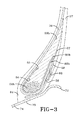
- FIG. 3 shows, in cross-sectional view, the bead region of another example tire for use with a reinforcing structures in accordance with the present invention.
- a carcass ply 50 wraps around a bead 52b and is separated from the bead by a flipper 54.
- the flipper 54 may be a layer of LENO weave fabric disposed around the bead 52b and inward of a portion of the carcass ply 50 which turns up under the bead.
- the LENO weave fabric flipper 54 may have physical properties (such as shearing modulus of elasticity) intermediate to those of a rigid metal bead 52b and a less rigid carcass ply 50.
- the LENO weave fabric flipper 54 therefore may serve as an active strain-relieving layer separating the bead 52b from the carcass ply 50.
- the carcass ply 50 may be reinforced with metal, as is conventional in the tire art.
- the example tire of FIG. 3 also may have a LENO weave fabric chipper 56 located in the bead area for reinforcing the bead area and stabilizing the axially inwardmost part of the sidewall 57.
- the LENO weave flipper 54 and chipper 56, along with the patch 58 uniting them, are discussed separately below, and then in operational conjunction with one another.
- the LENO weave fabric flipper 54 wraps around the bead 52b and extends radially outward into the sidewall regions of the example tire.
- the axially inward portion 55 of LENO weave fabric flipper 54 terminates within the bead-filler apex 59b.
- the axially outward portion 60b of the LENO weave fabric flipper 54 lies radially beyond a turnup end 62b, which itself is located radially beyond the radially outermost reach of the chipper 56 (discussed separately below).
- the axially outwardmost portions 62b of the turnup end 62b of the carcass ply 50 may extend radially outward about 15-30 millimeters beyond the top of a wheel rim flange 72 of a wheel rim 70.
- the LENO weave fabric flipper 54 is deployed about the bead 52b which is itself circumferentially disposed within the example tire.
- An axially inward portion 55 of the LENO weave fabric flipper 54 extends radially outward from the bead 52b to a location approximately axially adjacent to the top of the wheel rim flange 72 of the wheel rim 70.
- the LENO weave fabric flipper 54 extends radially outward from the bead 52b to an end 60b above the wheel rim flange 72.
- the radially outermost reach of the end 60b of the LENO weave fabric flipper 54 may extend between about 7-15 millimeters beyond the radially outermost reach of the turnup end 62b.
- the LENO weave fabric flipper 54 may be termed "active" because it actively absorbs (i.e. during tire deflection) differential strains between the relatively rigid bead 52b and the relatively less rigid carcass ply 50.
- the LENO weave fabric chipper 56 is disposed adjacent to the portion of the carcass ply 50 that is wrapped around the bead 52b. More specifically, the LENO weave fabric chipper 56 is disposed on the opposite side of the portion of the carcass ply 50 from the LENO weave fabric flipper 54. The axially inwardmost portion of the LENO weave fabric chipper 56 lies in the portion of the bead region that, when the tire is mounted on the wheel rim 70, would lie closest to a circularly cylindrical part 74 of the wheel rim.
- the axially and radially outwardmost portion of the LENO weave fabric chipper 56 lies in the portion of the bead region that, when the tire is mounted on the wheel rim 70, would lie axially inward of the circular portion of the wheel rim 70, being separated from the circular portion of the wheel rim by tire rubber such as a toe guard 64.
- the LENO weave fabric chipper 56 is disposed circumferentially about the radially inwardmost portion of the carcass ply 50 where the carcass ply turns up under the bead 52b.
- the LENO weave fabric chipper 56 may extend radially outward, being more or less parallel with the turned up end 62b of the carcass ply 50.
- the LENO weave fabric chipper 56 protects the portion of the carcass ply 50 that wraps around the bead 52b from the strains in the rubber that separates the LENO weave fabric chipper from the wheel rim 70.
- the LENO weave fabric chipper 56 reinforces the bead area and stabilizes the radially inwardmost part of the sidewall 57.
- the LENO weave fabric chipper 56 may absorb deformation in a way that minimizes the transmission of stress-induced shearing strains that arise inward from the wheel rim 70, through the toe guard 64, to the turned up portion 62b of the carcass ply 50, where the LENO weave fabric chipper is most immediately adjacent to the rigid bead 52b.
- the patch 58 shown in FIG. 3 is circumferentially disposed about the bead 52b in such a way as to overlie the radially outermost regions 68 of the chipper 56 and the turned up ends 62b of the carcass ply 50.
- the patch 58 performs a function similar to that of those of the LENO weave fabric chipper 56 and the active LENO weave fabric flipper 54. More specifically, the patch 58 may absorb shearing stresses in the rubber parts which might otherwise induce separation of the flexible rubber from the less flexible material of the LENO weave fabric chipper 56 and the carcass ply 50.
- the patch 58 may, for example, be made of nylon fabric.
- the radially outwardmost portion 67 of the patch 58 may reach to a minimum level such as extending by at least 5 mm above the upper end 60b of the flipper 54, and preferably 10-15 mm above.
- the radially inwardmost portion of the patch 58 may overlap about 10 mm with the LENO weave fabric chipper 56.
- the net effect of the incorporation of the LENO weave fabric flipper 54 and the LENO weave fabric chipper 56 is to provide strain buffers that relieve or absorb differential shearing strains that otherwise, were the flippers and chippers not present, could lead to separation of the adjacent materials that have disparate shearing moduli of elasticity. Furthermore, this reinforced construction may increase durability of the tire by means of the incorporation of a smaller number of components than for standard constructions with gum strips.
- the belts 18, 20 of the conventional belt structure 16 are replaced with a preferably single woven structure 200 of crimped metal cords 210 ( Fig. 4 ).
- the metal may be steel, titanium, or any other suitable metal or alloy.
- the woven structure 200 may reduce tire rolling resistance and improve tire durability by replacing the classical two belts 18, 20 with a thinner single woven metal structure 200.
- the cords 210 may be either monofilaments or twisted cords made of multiple filaments.
- the cords may be crimped, with the crimp configuration being optimized (length and angle) to reproduce appropriate shear and circumferential stiffness.
- the structure 200 may also be a knitted structure.
- the crimp configuration may have straight lengths L of between 0.8 mm and 20.0 mm and crimp angles ⁇ of between 10° and 60° ( Figs. 4 and 5 ).
- annular ring of the woven steel belt may be formed such that the woven structure 200 may slip over or is applied over the carcass 14 in a one step process. This improves efficiency and cost compared to conventionally building and cutting two plies (18, 20) in opposite directions to form an opposed belt angle structure.
- a tire with the structure 200 in accordance with the present invention may thus dissipate strain energy at the edges of the structure at the juncture points 220 of the woven structure.
- the structure 200 may be treated with an adhesion promoter, such as brass.
- an adhesion promoter such as brass.
- the selection of materials for the adhesion promoter may depend upon the materials selected for use in the tire.
- a structure 200 in accordance with the present invention produces excellent rolling resistance performance and durability in a pneumatic tire 10.
- This structure 200 thus enhances the performance of the pneumatic tire 10, even though the complexities of the structure and behavior of the pneumatic tire are such that no complete and satisfactory theory has been propounded.
- a pneumatic tire has certain essential structural elements.
- An important structural element is the belt structure, typically made up of many flexible, high modulus cords of natural textile, synthetic polymer, glass fiber, or fine hard drawn steel embedded in, and bonded to, a matrix of low modulus polymeric material, usually natural or synthetic rubber.
- the flexible, high modulus cords are usually disposed as a single layer. Tire manufacturers throughout the industry cannot predict the effect of different twists of belt ply cords on noise characteristics, handling, durability, comfort, etc. in pneumatic tires.
- the structure (i.e., twist, cord construction, weave, etc.) of the belt ply or plies of a pneumatic tire is modified with the intent to improve one functional property of the pneumatic tire, a number of other functional properties may be unacceptably degraded.
- the interaction between the belt ply and the apex, carcass, and tread may also unacceptably affect the functional properties of the pneumatic tire.
- a modification of the belt ply or plies may not even improve that one functional property because of these complex interrelationships.
Landscapes
- Engineering & Computer Science (AREA)
- Mechanical Engineering (AREA)
- Tires In General (AREA)
- Ropes Or Cables (AREA)
- Tyre Moulding (AREA)
Applications Claiming Priority (1)
| Application Number | Priority Date | Filing Date | Title |
|---|---|---|---|
| US12/899,846 US20120085474A1 (en) | 2010-10-07 | 2010-10-07 | Pneumatic tire with a woven metallic reinforcement |
Publications (2)
| Publication Number | Publication Date |
|---|---|
| EP2439082A2 true EP2439082A2 (fr) | 2012-04-11 |
| EP2439082A3 EP2439082A3 (fr) | 2012-09-12 |
Family
ID=44759520
Family Applications (1)
| Application Number | Title | Priority Date | Filing Date |
|---|---|---|---|
| EP11183928A Withdrawn EP2439082A3 (fr) | 2010-10-07 | 2011-10-05 | Pneu avec renfort de sommet métallique |
Country Status (4)
| Country | Link |
|---|---|
| US (1) | US20120085474A1 (fr) |
| EP (1) | EP2439082A3 (fr) |
| CN (1) | CN102442162A (fr) |
| BR (1) | BRPI1105269A2 (fr) |
Cited By (1)
| Publication number | Priority date | Publication date | Assignee | Title |
|---|---|---|---|---|
| EP3081396B1 (fr) * | 2015-03-31 | 2020-06-17 | The Goodyear Tire & Rubber Company | Construction mono-courroie bidirectionnelle pour un pneumatique |
Families Citing this family (7)
| Publication number | Priority date | Publication date | Assignee | Title |
|---|---|---|---|---|
| US9849734B2 (en) * | 2014-10-31 | 2017-12-26 | The Goodyear Tire & Rubber Company | Pneumatic tire with a three dimensional component |
| WO2016099881A1 (fr) * | 2014-12-16 | 2016-06-23 | Bridgestone Americas Tire Operations, Llc | Pneu doté d'une construction de talon surmoulée |
| FR3033285A1 (fr) * | 2015-03-04 | 2016-09-09 | Michelin & Cie | Pneumatique comprenant un tricot et des elements de renfort |
| US20160288574A1 (en) * | 2015-03-31 | 2016-10-06 | The Goodyear Tire & Rubber Company | Crown reinforcement for a pneumatic tire |
| CN107685598B (zh) * | 2017-08-22 | 2020-06-19 | 江苏兴达钢帘线股份有限公司 | 一种编织钢丝带束层结构及其应用 |
| CN109109573B (zh) * | 2018-10-11 | 2023-09-26 | 哈尔滨泰铭科技有限公司 | 一种具有钢丝圈和胎体编织骨架材料的橡胶轮胎结构及其制造方法 |
| CN110194029B (zh) * | 2019-06-26 | 2023-08-15 | 青岛双星轮胎工业有限公司 | 钢丝胎体ht轮胎及其制造工艺 |
Family Cites Families (9)
| Publication number | Priority date | Publication date | Assignee | Title |
|---|---|---|---|---|
| US5386860A (en) * | 1992-10-21 | 1995-02-07 | The Goodyear Tire & Rubber Company | Cut resistant tire |
| CA2100538A1 (fr) * | 1992-10-21 | 1994-04-22 | Johnny Dale Ii Massie | Pneu resistant aux coupures |
| US6273161B1 (en) * | 1998-05-28 | 2001-08-14 | Tokyo Rope Mfg. Co., Ltd. | Tire with single wire steel belt cord |
| DE60103432T2 (de) * | 2000-02-17 | 2005-06-02 | Sumitomo Electric Industries, Ltd. | Luftreifen |
| CN101326324B (zh) * | 2005-12-13 | 2012-10-31 | 住友橡胶工业株式会社 | 金属帘线、橡胶-帘线复合体以及使用该复合体的充气轮胎 |
| DE102006056921A1 (de) * | 2006-12-02 | 2008-06-05 | Continental Aktiengesellschaft | Fahrzeugluftreifen für Personenkraftwagen in Radialbauart mit einem einlagigen Gürtel |
| DE102007009101B4 (de) * | 2007-02-24 | 2021-03-04 | Continental Reifen Deutschland Gmbh | Fahrzeugluftreifen |
| JP2009068150A (ja) * | 2007-09-14 | 2009-04-02 | Bridgestone Corp | ゴム物品補強用スチール織物 |
| US20110220263A1 (en) * | 2010-03-11 | 2011-09-15 | Michiels Danny F | Pattern coated cap ply for tire construction |
-
2010
- 2010-10-07 US US12/899,846 patent/US20120085474A1/en not_active Abandoned
-
2011
- 2011-09-30 CN CN2011102970564A patent/CN102442162A/zh active Pending
- 2011-10-04 BR BRPI1105269A patent/BRPI1105269A2/pt not_active IP Right Cessation
- 2011-10-05 EP EP11183928A patent/EP2439082A3/fr not_active Withdrawn
Non-Patent Citations (1)
| Title |
|---|
| None |
Cited By (1)
| Publication number | Priority date | Publication date | Assignee | Title |
|---|---|---|---|---|
| EP3081396B1 (fr) * | 2015-03-31 | 2020-06-17 | The Goodyear Tire & Rubber Company | Construction mono-courroie bidirectionnelle pour un pneumatique |
Also Published As
| Publication number | Publication date |
|---|---|
| US20120085474A1 (en) | 2012-04-12 |
| CN102442162A (zh) | 2012-05-09 |
| BRPI1105269A2 (pt) | 2015-12-15 |
| EP2439082A3 (fr) | 2012-09-12 |
Similar Documents
| Publication | Publication Date | Title |
|---|---|---|
| US7992611B2 (en) | Pneumatic tire with a leno weave flipper or chipper | |
| EP3015285B1 (fr) | Pneu avec un composant tridimensionnel | |
| US6659148B1 (en) | Bead reinforcing structure for radial truck tires | |
| US10071603B2 (en) | Lightweight tire | |
| EP2835276A1 (fr) | Pneumatique ayant un hachoir ou languette renforcé(e) | |
| US20120085474A1 (en) | Pneumatic tire with a woven metallic reinforcement | |
| EP2439084B1 (fr) | Pneu avec tissu tricoté en tant que structure de renfort | |
| EP2463124A2 (fr) | Pneu | |
| US20100018626A1 (en) | Pneumatic tire with a polyketone chipper and/or flipper | |
| EP3459762A1 (fr) | Pneumatique | |
| JPWO2006003742A1 (ja) | 空気入りタイヤ | |
| EP3081396B1 (fr) | Construction mono-courroie bidirectionnelle pour un pneumatique | |
| EP2165860B1 (fr) | Structure de renfort pour pneus | |
| EP2165861B1 (fr) | Structure de renfort de bandage pour pneus | |
| EP3075570B1 (fr) | Armature de sommet pour pneumatique | |
| WO2019230401A1 (fr) | Pneu | |
| EP3081395A1 (fr) | Armature en continu de sommet pour pneumatique | |
| US20220169078A1 (en) | Hybrid cord and tyre with such cord | |
| WO2000032424A1 (fr) | Structure de renforcement du talon d'un pneumatique radial de camion | |
| EP3176005A1 (fr) | Construction mono-courroie bidirectionnelle pour un pneumatique | |
| JP4761866B2 (ja) | 空気入りタイヤ |
Legal Events
| Date | Code | Title | Description |
|---|---|---|---|
| AK | Designated contracting states |
Kind code of ref document: A2 Designated state(s): AL AT BE BG CH CY CZ DE DK EE ES FI FR GB GR HR HU IE IS IT LI LT LU LV MC MK MT NL NO PL PT RO RS SE SI SK SM TR |
|
| AX | Request for extension of the european patent |
Extension state: BA ME |
|
| PUAI | Public reference made under article 153(3) epc to a published international application that has entered the european phase |
Free format text: ORIGINAL CODE: 0009012 |
|
| PUAL | Search report despatched |
Free format text: ORIGINAL CODE: 0009013 |
|
| AK | Designated contracting states |
Kind code of ref document: A3 Designated state(s): AL AT BE BG CH CY CZ DE DK EE ES FI FR GB GR HR HU IE IS IT LI LT LU LV MC MK MT NL NO PL PT RO RS SE SI SK SM TR |
|
| AX | Request for extension of the european patent |
Extension state: BA ME |
|
| RIC1 | Information provided on ipc code assigned before grant |
Ipc: B60C 15/06 20060101ALI20120809BHEP Ipc: B60C 9/00 20060101ALI20120809BHEP Ipc: B60C 9/18 20060101AFI20120809BHEP |
|
| STAA | Information on the status of an ep patent application or granted ep patent |
Free format text: STATUS: THE APPLICATION IS DEEMED TO BE WITHDRAWN |
|
| 18D | Application deemed to be withdrawn |
Effective date: 20130313 |