EP2442547A2 - Équipement utilisateur et procédé pour la fourniture d'un service à réalité améliorée - Google Patents
Équipement utilisateur et procédé pour la fourniture d'un service à réalité améliorée Download PDFInfo
- Publication number
- EP2442547A2 EP2442547A2 EP11183744A EP11183744A EP2442547A2 EP 2442547 A2 EP2442547 A2 EP 2442547A2 EP 11183744 A EP11183744 A EP 11183744A EP 11183744 A EP11183744 A EP 11183744A EP 2442547 A2 EP2442547 A2 EP 2442547A2
- Authority
- EP
- European Patent Office
- Prior art keywords
- information
- tag
- target object
- azimuth
- user equipment
- Prior art date
- Legal status (The legal status is an assumption and is not a legal conclusion. Google has not performed a legal analysis and makes no representation as to the accuracy of the status listed.)
- Withdrawn
Links
Images








Classifications
-
- H—ELECTRICITY
- H04—ELECTRIC COMMUNICATION TECHNIQUE
- H04N—PICTORIAL COMMUNICATION, e.g. TELEVISION
- H04N1/00—Scanning, transmission or reproduction of documents or the like, e.g. facsimile transmission; Details thereof
- H04N1/32—Circuits or arrangements for control or supervision between transmitter and receiver or between image input and image output device, e.g. between a still-image camera and its memory or between a still-image camera and a printer device
- H04N1/32101—Display, printing, storage or transmission of additional information, e.g. ID code, date and time or title
-
- G—PHYSICS
- G06—COMPUTING OR CALCULATING; COUNTING
- G06T—IMAGE DATA PROCESSING OR GENERATION, IN GENERAL
- G06T11/00—Two-dimensional [2D] image generation
- G06T11/60—Creating or editing images; Combining images with text
-
- G—PHYSICS
- G06—COMPUTING OR CALCULATING; COUNTING
- G06T—IMAGE DATA PROCESSING OR GENERATION, IN GENERAL
- G06T11/00—Two-dimensional [2D] image generation
- G06T11/60—Creating or editing images; Combining images with text
- G06T11/65—Creating or editing images; Combining images with text on geographic maps
-
- G—PHYSICS
- G06—COMPUTING OR CALCULATING; COUNTING
- G06T—IMAGE DATA PROCESSING OR GENERATION, IN GENERAL
- G06T19/00—Manipulating three-dimensional [3D] models or images for computer graphics
- G06T19/006—Mixed reality
-
- H—ELECTRICITY
- H04—ELECTRIC COMMUNICATION TECHNIQUE
- H04N—PICTORIAL COMMUNICATION, e.g. TELEVISION
- H04N1/00—Scanning, transmission or reproduction of documents or the like, e.g. facsimile transmission; Details thereof
- H04N1/00127—Connection or combination of a still picture apparatus with another apparatus, e.g. for storage, processing or transmission of still picture signals or of information associated with a still picture
- H04N1/00204—Connection or combination of a still picture apparatus with another apparatus, e.g. for storage, processing or transmission of still picture signals or of information associated with a still picture with a digital computer or a digital computer system, e.g. an internet server
- H04N1/00244—Connection or combination of a still picture apparatus with another apparatus, e.g. for storage, processing or transmission of still picture signals or of information associated with a still picture with a digital computer or a digital computer system, e.g. an internet server with a server, e.g. an internet server
-
- H—ELECTRICITY
- H04—ELECTRIC COMMUNICATION TECHNIQUE
- H04N—PICTORIAL COMMUNICATION, e.g. TELEVISION
- H04N2101/00—Still video cameras
-
- H—ELECTRICITY
- H04—ELECTRIC COMMUNICATION TECHNIQUE
- H04N—PICTORIAL COMMUNICATION, e.g. TELEVISION
- H04N2201/00—Indexing scheme relating to scanning, transmission or reproduction of documents or the like, and to details thereof
- H04N2201/0077—Types of the still picture apparatus
- H04N2201/0084—Digital still camera
-
- H—ELECTRICITY
- H04—ELECTRIC COMMUNICATION TECHNIQUE
- H04N—PICTORIAL COMMUNICATION, e.g. TELEVISION
- H04N2201/00—Indexing scheme relating to scanning, transmission or reproduction of documents or the like, and to details thereof
- H04N2201/32—Circuits or arrangements for control or supervision between transmitter and receiver or between image input and image output device, e.g. between a still-image camera and its memory or between a still-image camera and a printer device
- H04N2201/3201—Display, printing, storage or transmission of additional information, e.g. ID code, date and time or title
- H04N2201/3225—Display, printing, storage or transmission of additional information, e.g. ID code, date and time or title of data relating to an image, a page or a document
- H04N2201/3245—Display, printing, storage or transmission of additional information, e.g. ID code, date and time or title of data relating to an image, a page or a document of image modifying data, e.g. handwritten addenda, highlights or augmented reality information
-
- H—ELECTRICITY
- H04—ELECTRIC COMMUNICATION TECHNIQUE
- H04N—PICTORIAL COMMUNICATION, e.g. TELEVISION
- H04N2201/00—Indexing scheme relating to scanning, transmission or reproduction of documents or the like, and to details thereof
- H04N2201/32—Circuits or arrangements for control or supervision between transmitter and receiver or between image input and image output device, e.g. between a still-image camera and its memory or between a still-image camera and a printer device
- H04N2201/3201—Display, printing, storage or transmission of additional information, e.g. ID code, date and time or title
- H04N2201/3273—Display
Definitions
- the following description relates to a user equipment and a method for providing an augmented reality (AR) service, and more particularly, to a user equipment and a method for providing a service in which a user may generate AR tag information based on an azimuth.
- AR augmented reality
- Augmented reality is one field of a virtual reality technology and refers to a computer graphic technology for combining an image of a real world environment with a virtual object or virtual information. Unlike a general virtual reality technology which provides virtual objects in a virtual space, the AR technology combines the real world environment with the virtual object or information, thereby adding supplementary information that may be difficult to obtain in the real world environment.
- the AR technology may apply a filter to the identified objects in an image of the real world environment to filter a target virtual object or virtual information sought by the user from the real environment.
- the conventional AR service may provide basic information through AR technology using global positioning system (GPS) information of an object. That is, the conventional AR service may provide the same information even if there is a change in a location of a user looking at the object.
- GPS global positioning system
- Exemplary embodiments of the present invention provide a user equipment and a method for providing an augmented reality (AR) service in which an AR tag may be generated based on an azimuth toward an object viewed by a user.
- AR augmented reality
- Exemplary embodiments of the present invention provide a user equipment to provide an AR service including a photographing unit to capture an image of a target object, an information collecting unit to collect contextual information of the captured image of the target object, the contextual information including location information of the photographing unit and a first azimuth information between the target object and the photographing unit, a tag generating unit to generate an AR tag of a first direction, the AR tag corresponding to the contextual information, and a display unit to display the image of the target object and the AR tag.
- Exemplary embodiments of the present invention provide a user equipment to provide an AR service including a photographing unit to capture an image of a target object, an information collecting unit to collect contextual information of the captured image of the target object, the contextual information including location information of the photographing unit and image data of the target object, a communication unit to transmit the collected contextual information to an AR management server and to receive AR information of the target object from the AR management server, in which the AR management server stores the AR information of the target object based on azimuth information of the captured image, a tag generating unit to generate an AR tag using AR information corresponding to a first azimuth between the target object and the photographing unit, and a display unit to display the captured image of the target object and the generated AR tag.
- Exemplary embodiments of the present invention provide a method for providing an AR service including capturing an image of a target object using a camera, collecting contextual information including location information of the captured image of the target object and a first azimuth information between the target object and the camera, generating an AR tag corresponding to the contextual information, and displaying the captured image of the target object and the generated AR tag.
- Exemplary embodiments of the present invention provide a method for providing an AR service including capturing an image of a target object, collecting contextual information including location information of a camera capturing the target obj ect from the terminal and image data of the target object from the image, transmitting the collected contextual information to an AR management server to store AR information of the target object for a first azimuth, receiving the AR information of the target object from the AR management server, generating an AR tag using the AR information corresponding to the first azimuth between the target object and the camera, and displaying the captured image of the target object and the AR tag.
- FIG. 1 is a block diagram illustrating a first user equipment to provide an augmented reality (AR) service according to an exemplary embodiment of the invention.
- AR augmented reality
- FIG. 2 is a block diagram illustrating a second user equipment to provide an AR service according to an exemplary embodiment of the invention.
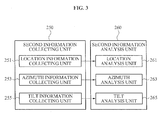
- FIG. 3 is a block diagram illustrating a second information collecting unit and a second information analysis unit according to an exemplary embodiment of the invention.
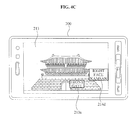
- FIG. 4A , FIG. 4B , and FIG. 4C are views illustrating an AR tag displayed on a second display unit according to an exemplary embodiment of the invention.
- FIG. 5 is a view illustrating a method for displaying AR information by touching an AR tag according to an exemplary embodiment of the invention.
- FIG. 6 is a view illustrating a method for displaying AR information of an AR tag by moving a second user equipment according to an exemplary embodiment of the invention.
- FIG. 7 is a block diagram of an AR management server according to an exemplary embodiment of the invention.
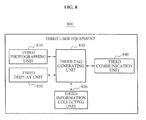
- FIG. 8 is a block diagram of a third user equipment to provide an AR service according to an exemplary embodiment of the invention.
- FIG. 9 is a block diagram of a fourth user equipment to provide an AR service according to an exemplary embodiment of the invention.
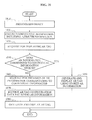
- FIG. 10 is a flowchart illustrating a method for providing an AR service in a user equipment according to an exemplary embodiment of the invention.
- FIG. 11 is a flowchart illustrating a method for providing an AR service in a user equipment according to an exemplary embodiment of the invention.
- FIG. 1 is a block diagram illustrating a first user equipment 100 to provide an augmented reality (AR) service according to an exemplary embodiment of the invention.
- AR augmented reality
- the first user equipment 100 may be a portable device, such as a smartphone, a cellular phone, a laptop computer, tablet computer, and the like. As shown in FIG. 1 , the first equipment 100 includes a first photographing unit 110, a first information collecting unit 120, a first tag generating unit 130, and a first display unit 140.
- the first photographing unit 110 may photograph or capture an image of a target object, and may be, for example, an embedded camera or an external camera.
- the obtained image may be processed into a displayable signal by the first photographing unit 110 or by a separate image processor.
- the first information collecting unit 120 may collect contextual information including information about a current location of the first user equipment 100, location information of the target object photographed or captured by the first photographing unit 110, direction information currently viewed by the first photographing unit 110, and azimuth information between the first user equipment 100 and the target object. Further, the location information, direction information, azimuth information, and the like, may be collected from data associated with the captured image, the user equipment, or other source.
- the azimuth information may include a numeric value of an azimuth between the first user equipment 100 and the target object. In an example, azimuth may reference an angle measured up from the horizon. That is, the azimuth information may include an angle from a reference point on the user equipment 100 to the target object, measured relative to the horizon.
- the reference point on the user equipment 100 may be defined as an upper point, edge, or surface, or lower point, edge, or surface, or may be defined from a focal lens of the photographing unit 110.
- the first tag generating unit 130 may generate an AR tag corresponding to contextual information collected by the first information collecting unit 120.
- the contextual information may include location information, direction information, and azimuth information.
- the AR tag may be generated in the form or shape of a window to display AR information of the target object. Accordingly, the AR tag may be generated based on an azimuth used to photograph or capture the target object.
- the AR information of the target object may be stored for one or more contextual information in the first user equipment 100 or in an AR management server (not shown).
- the first display unit 140 may display a generated AR tag such that the AR tag may be overlaid on the target object.
- FIG. 2 is a block diagram illustrating a second user equipment 200 to provide an AR service according to an exemplary embodiment of the invention.
- FIG. 3 is a detailed block diagram illustrating a second information collecting unit and a second information analysis unit according to an exemplary embodiment of the invention.
- the second user equipment 200 includes a second user interface (UI) unit 210, a second storage unit 220, a second photographing unit 230, a second image processing unit 240, a second information collecting unit 250, a second information analysis unit 260, a second communication processing unit 270, a second communication unit 275, a second tag generating unit 280, and a second control unit 290.
- UI user interface
- the second UI unit 210 may provide a user with the ability to interface with the user equipment 200, and may include a second user input unit 211 and a second display unit 213.
- the second user input unit 211 may be a manipulation panel to receive an input of a user command, and may include various interfaces.
- interfaces may include a button to photograph or capture a target object, a direction key, a touch panel, and the like.
- a user may make a request to display an AR tag based on an azimuth by manipulating the second user input unit 211.
- the second user input unit 211 may sense a touch direction of the user. More specifically, if the user touches the AR tag with multiple faces displayed on the second display unit 213 and drags the AR tag to rotate to view a different face of the AR tag, the second user input unit 211 may sense the touch and the drag motion.
- the second display unit 213 may display the processed image. If the user equipment 200 provides a touch-based input method, the second display unit 213 may display a UI of a touch panel.
- the second storage unit 220 may store a program used to enable an operation of the user equipment 200, various data and information, and the like. Also, the second storage unit 220 may store AR information of a target object mapped to contextual information of the target object.
- the second photographing unit 230 may photograph or capture an image of the target object to obtain image data.
- second photographing unit 230 includes an embedded camera or an external camera.
- the second image processing unit 240 may analyze the image obtained by the second photographing unit 230, and may process the image into a displayable signal using the analysis result.
- the second image processing unit 240 may be an image processor.
- the second information collecting unit 250 may collect contextual information including information related to a location, a tilt position, and an azimuth of the user equipment 200, which may be collected from data associated with the captured image, the user equipment, or other source.
- the second information collecting unit 250 may include a location information collecting unit 251, an azimuth information collecting unit 253, and a tilt information collecting unit 255.
- the location information collecting unit 251 may collect location information about a current location of the user equipment 200 and direction information about a direction toward a target object currently viewed by the second photographing unit 230. Also, the location information collecting unit 251 may further collect location information of the target object. In an example, the location information collecting unit 251 may sense and collect a current location using a global positioning system (GPS), a location-based service (LBS), and the like. Further, the location information collecting unit 251 may also sense and collect a direction using a digital compass. The location information and the direction information collected by the location information collecting unit 251 may be provided to a location analysis unit 261.
- GPS global positioning system
- LBS location-based service
- the location information and the direction information collected by the location information collecting unit 251 may be provided to a location analysis unit 261.
- the azimuth information collecting unit 253 may collect azimuth information about an azimuth between the user equipment 200 and the target object.
- the azimuth information collected by the azimuth information collecting unit 253 may be provided to an azimuth analysis unit 263.
- the tilt information collecting unit 255 may collect tilt information about a tilt of the user equipment 200.
- the tilt information may be information about the tilt position of the user equipment 200.
- the user equipment 200 may be frequently tilted in various directions by manipulation of a user before the user equipment 200 photographs or captures the target object.
- the tilt information collecting unit 255 may sense and collect tilt information, for example, using a six-axis motion sensor including a three-axis Gyroscope sensor and a three-axis (x, y, z) acceleration sensor.
- the tilt information collected by the tilt information collecting unit 255 may be provided to a tilt analysis unit 265.
- the tilt information may be optionally collected.
- the second information analysis unit 260 may analyze information collected by the second information collection unit 250 using a processible signal.
- the second information analysis 260 may include a location analysis unit 261, an azimuth analysis unit 263, and a tilt analysis unit 265.
- the location analysis unit 261 may analyze the location information and the direction information collected by the location information collection unit 251 using a processible signal.
- the azimuth analysis unit 263 may analyze the azimuth information collected by the azimuth information collection unit 253 using a processible signal.
- the tilt analysis unit 265 may analyze the tilt information collected by the tilt information collection unit 255 using a processible signal.
- the second communication processing unit 270 may convert the analyzed contextual information and image data of the target object into data based on a transmission protocol by the second control unit 290.
- the second communication unit 275 may transmit data inputted from the second communication processing unit 270 to an AR management server 700 via a communication network 10. Also, the second communication unit 275 may receive AR information corresponding to contextual information from the AR management server 700.
- the AR management server 700 may store AR information corresponding to different contextual information. The AR management server 700 is described below with reference to FIG. 7 .
- the second communication processing unit 270 may convert the received AR information into data available in the second user equipment 200.
- the second tag generating unit 280 may generate an AR tag corresponding to contextual information collected by the second information collecting unit 250. More specifically, the AR tag is generated using AR information converted by the second communication processing unit 270. The AR tag may be generated in a form of a window to display AR information of the target object. The second tag generating unit 280 may generate an AR tag to display both AR information and contextual information of the target object.
- the second tag generating unit 280 may generate an AR tag having one or more faces along a contour of the target object. AR information based on an azimuth between the target object and the second photographing unit 230 may be displayed on one or more faces of the AR tag. For example, if the target object is a building, the second tag generating unit 280 may generate an AR tag of a three-dimensional stereoscopic cube, and if the target object is a sphere, the second tag generating unit 280 may generate a spherical AR tag.
- the second display unit 213 may display an AR tag generated by the second tag generating unit 280.
- the second control unit 290 may control an operation of the second user equipment 200.
- the second control unit 290 may request the AR management server 700 to provide AR information of the target object corresponding to contextual information by transmitting the analyzed contextual information and image data of the object to the AR management server 700.
- the second control unit 290 may check whether AR information corresponding to contextual information is stored in the second storage unit 220. If AR information corresponding to contextual information is stored in the second storage unit 220, the second control unit 290 may control the second tag generating unit 280 to generate an AR tag using the AR information stored in the second storage unit 220. If AR information corresponding to contextual information is not stored in the second storage unit 220, the second control unit 290 may request the AR management server 700 to transmit the AR information.
- FIG. 4A , FIG. 4B , and FIG. 4C are views illustrating an AR tag displayed on the second display unit according to an exemplary embodiment of the invention.
- the second display unit 213 may display the target object'Namdaemun'. If the user equipment 200 receives a user request to display an AR tag of 'Namdaemun' at a current location, the second information collecting unit 250 may collect contextual information including location information about the current location, direction information, azimuth information, and tilt information. The second information analysis unit 260 may analyze the collected contextual information, and the second tag generating unit 280 may generate AR tag 213a using AR information corresponding to the contextual information. The AR information corresponding to the contextual information may be stored in the second storage unit 220 or may be provided from the AR management server 700.
- the second tag generating unit 280 may generate AR tag 213b using AR information corresponding to contextual information of the moved location. That is, different AR tags of the same target object based on different azimuths may be generated and displayed.
- the second tag generating unit 280 may further generate a cubic AR tag 213c having six faces. The same or different AR information may be displayed on each face of the AR tag 213c. If different AR information is displayed, the second user equipment 200 may receive AR information corresponding to one or more azimuths from the AR management server 700. Accordingly, the user may check AR information of the target object generated at a different azimuth using the AR tag 213c.
- the second tag generating unit 280 may generate AR tag 214d corresponding to a right face of the target object at a current location of the user. More specifically, because the right face of the target object is not shown or is partially shown at the current location of the user, the AR tag 214d may be displayed at an angle.
- the user may set or preset an azimuth range visible to the user, and the second tag generating unit 280 may generate AR tags corresponding to azimuths within the set range.
- the AR tag 214d corresponding to the right face of the target object may be displayed.
- FIG. 5 is a view illustrating a method for displaying AR information by touching an AR tag according to an exemplary embodiment of the invention.
- the second tag generating unit 280 may generate a stereoscopic AR tag 500 of a cubic shape having multiple faces.
- the second tag generating unit 280 may display different AR information depending on an azimuth toward the target object on one or more faces of the AR tag 500.
- AR information corresponding to an azimuth between a current location of the second user equipment 200 and the target object may be displayed on a first face 510 of the AR tag 500.
- the displayed AR tag 500 may be displayed and may also be rotated in various directions, including upward, downward, left and right directions.
- the second user input unit 211 may sense the touched face 520 and/or the touch direction of the user, respectively.
- the second tag generating unit 280 may enable AR information corresponding to a second azimuth of the target object to be displayed in a frontal direction by rotating the AR tag 500 to either the face that has been selected by a touch and/or rotating the AR tag 500 according to the touch direction inputted by the user.
- the AR tag 500 may be rotated according to the sensed touched face 520 as illustrated in FIG. 5 and/or by touching and dragging the AR tag 500 to rotate in the touch direction so that the user may see the face 520 as the front view.
- the second tag generating unit 280 may generate a sub-view and may enable an azimuth and/or a direction of currently displayed AR information of the AR tag 500 to be checked using a compass arrow of the sub-view to indicate such information. That is, the compass arrow of the sub-view may show an azimuth and/or direction.
- FIG. 6 is a view illustrating a method for displaying AR information of an AR tag by moving the second user equipment 200 according to an exemplary embodiment of the invention.
- the second tag generating unit 280 may generate an AR tag of a target object as a cubic AR tag 600 having multiple faces. If movement of the AR tag 600 is difficult or undesirable and the second user equipment 200 photographing or capturing the target object is rotated in an arbitrary direction, the second tag generating unit 280 may generate an AR tag corresponding to an azimuth toward the target object viewed in the rotated direction relative to the target object.
- the second tag generating unit 280 may enable AR information corresponding to a right face 610 of the AR tag 600, or the second face, to be displayed in a frontal direction. Accordingly, the second tag generating unit 280 may provide a target view sought by the user by directly rotating the AR tag 600 in upward, downward, left and right directions.
- FIG. 7 is a block diagram of the AR management server 700 according to an exemplary embodiment of the invention.
- the AR management server 700 may store and manage AR tag information generated by one or more user equipments, together with contextual information.
- the AR management server 700 may include a database (DB) 710, a server communication unit 720, a transmit/receive processing unit 730, an information processing unit 740, and a server control unit 750.
- DB database
- the DB 710 may store and manage AR information of a target object mapped to one or more contextual information. Accordingly, AR information of the same target object may be stored and managed for one or more contextual information collected through photographing or capturing a target object.
- the contextual information may include information about a location and a direction used to photograph or capture the target object, and location information, azimuth information and tilt information of the target object.
- the azimuth information may be stored as a reference range. For example, if the stored AR information is information corresponding to an azimuth of 200°, 200° ⁇ ⁇ ( ⁇ is an error) may be stored in the DB 710 as azimuth information corresponding to AR information.
- the azimuth range may be manually set by a user or an operator or may be automatically set by the server control unit 750.
- the AR information stored in the DB 710 may be shared by one or more user equipments.
- the server communication unit 720 may communicate with one or more user equipments including the second user equipment 200 via a communication network. Hereinafter, description is made taking the second user equipment 200 as an example.
- the server communication unit 720 may receive a signal to request provisioning of AR information and may receive contextual information from the second user equipment 200.
- the server communication unit 720 may further receive image data of the target object.
- the transmit/receive processing unit 730 may determine whether the received AR information and the received contextual information is available. More specifically, the transmit/receive processing unit 730 may determine whether an error has occurred in receiving the AR information and the contextual information or whether the received AR information and the contextual information contains improper information. If the AR information and the contextual information is available, the transmit/receive processing unit 730 may provide the signal and the contextual information to the information processing unit 740.
- the information processing unit 740 may search the DB 710 for AR information corresponding to location information among contextual information.
- the information processing unit 740 may include a search information generating unit 741 and an information searching unit 743.
- the search information generating unit 741 may set search information for a query to the DB 710.
- the search information may be used with respect to a search regarding whether AR information corresponding to location information among the received contextual information is stored in the DB 710.
- the search information generating unit 741 may set search information by processing the contextual information inputted from the transmit/receive processing unit 730, and may generate the search information in the type of a header.
- the search information may be location information of the second user equipment 200.
- the information searching unit 743 may search the DB 710 using the search information and may extract AR information corresponding to location information.
- the server control unit 750 may check AR information corresponding to azimuth information of contextual information.
- the server control unit 750 may control the transmit/receive processing unit 730 and the server communication unit 720 to provide AR information corresponding to azimuth information to the second user equipment 200. If azimuth information corresponding to the extracted AR information is stored as an azimuth range, the server control unit 750 may provide AR information corresponding to an azimuth range closest to the azimuth information of the contextual information.
- the server control unit 750 may configure an AR tag using AR information corresponding to azimuth information and may provide AR tag configuration data to the second user equipment 200. If contextual information except azimuth information is received from the second user equipment 200, the server control unit 750 may configure a basic AR tag and may provide AR tag configuration data to the second user equipment 200.
- the transmit/receive processing unit 730 may convert AR information corresponding to azimuth information into data depending on a transmission protocol.
- the server communication unit 720 may transmit the converted AR information to the second user equipment 200.
- the second user equipment 200 may process the AR information of the target obj ect being photographed or captured to generate an AR tag and may display the AR tag on the second display unit 213.
- FIG. 8 is a block diagram of a third user equipment 800 to provide an AR service according to an exemplary embodiment of the invention.
- the third user equipment 800 may include a third photographing unit 810, a third information collecting unit 820, a third tag generating unit 830, a third communication unit 840, and a third display unit 850.
- the third photographing unit 810, the third information collecting unit 820, the third tag generating unit 830, and the third display unit 850 of FIG. 8 are similar, respectively, to the first photographing unit 110, the first information collecting unit 120, the first tag generating unit 130, and the first display unit 140 of FIG. 1 , and thus, detailed description thereof is omitted herein.
- the third communication unit 840 may request an AR management server 700 (not shown in FIG. 8 ) to provide AR information of a target object by transmitting, to the AR management server 700, contextual information including location information, direction information and azimuth information. More specifically, the contextual information may include current location of the third user equipment 800 collected by the third information collecting unit 820, location information of the target object photographed or captured by the third photographing unit 810, direction information about a direction toward the target object viewed by the third photographing unit 810, and azimuth information between the third user equipment 800 and the target object. Also, the third communication unit 840 may receive AR information of the target object from the AR management server 700. The AR management server 700 may store the AR information of the target object based on an azimuth. Accordingly, the AR management server 700 may transmit part or all of the stored AR information of the target object to the third user equipment 800.
- the third tag generating unit 830 may generate an AR tag using AR information corresponding to azimuth information between the target object and the third photographing unit 810 among the received AR information of the target object.
- FIG. 9 is a block diagram of a fourth user equipment 900 to provide an AR service according to an exemplary embodiment of the invention.
- the fourth user equipment 900 may include a fourth UI unit 910, a fourth storage unit 920, a fourth photographing unit 930, a fourth image processing unit 940, a fourth information collecting unit 950, a fourth information analysis unit 960, a fourth communication processing unit 970, a fourth communication unit 975, a fourth tag generating unit 980, and a fourth control unit 990.
- the operation of the fourth storage unit 920, the fourth photographing unit 930, and the fourth image processing unit 940 of FIG. 9 is significantly similar to the operation of a second storage unit 220, a second photographing unit 230, and a second image processing unit 240 of FIG. 2 . Accordingly, detailed description thereof is omitted herein.
- the fourth UI unit 910 may provide an interface between a user and the user equipment 900, to receive user input and to display a response to the received user input. Further, the fourth UI unit 910 may include a fourth user input unit 911 and a fourth display unit 913.
- the fourth storage unit 920 may store a program used to enable an operation of the user equipment 900, various data and information, and the like.
- the fourth photographing unit 930 may photograph or capture an image of a target object to obtain image data of the target object, and may be, for example, an embedded camera or an external camera.
- the fourth image processing unit 940 may analyze an image obtained from the fourth photographing unit 930, and may process the image into a displayable signal using the analysis result.
- the fourth information collecting unit 950 may collect contextual information including information related to a location, a tilt position, and an azimuth of the user equipment 900. In an example, the fourth information collecting unit 950 may collect azimuth information if a request to display an AR tag based on an azimuth is received from a user.
- the fourth information analysis unit 960 may analyze information collected by the fourth information collection unit 950 using a processible signal similar to the second information analysis unit 260 in FIG. 2 and FIG. 3 . Thus, further discussion thereof will be omitted herein.
- the fourth communication processing unit 970 may convert location information, direction information and image data of the target object into data based on a transmission protocol, by the control of the fourth control unit 990.
- the fourth communication unit 975 may transmit data inputted from the fourth communication processing unit 970 to an AR management server (not shown in FIG. 9 ) via a communication network (not shown in FIG. 9 ). Also, the fourth communication unit 975 may receive at least one AR information of the target object from the AR management server.
- the AR management server may store the target object AR information corresponding to one or more contextual information. More specifically, the AR management server may store AR information corresponding to different azimuths.
- the fourth communication processing unit 970 may convert the received AR information into data available in the fourth user equipment 900.
- the fourth tag generating unit 980 may generate the AR tag corresponding to contextual information collected by the fourth information collecting unit 950 using AR information converted by the fourth communication processing unit 970. If a user requests the AR tag to be displayed based on an azimuth, the fourth tag generating unit 980 may generate the AR tag using AR information corresponding to the azimuth collected by the fourth information collecting unit 950.
- the generated AR tag may be displayed in the image of a UI described with reference to FIG. 4A , FIG. 4B , FIG. 4C , FIG. 5 , and FIG. 6 .
- the fourth display unit 913 may display the AR tag generated by the fourth tag generating unit 980.
- the fourth control unit 990 may control the entire operation of the fourth user equipment 900.
- the fourth control unit 990 may request the AR management server to provide AR information of a target object by transmitting various information, including location information, direction information, and image data of the target object to the AR management server.
- the fourth control unit 990 may control the fourth information collecting unit 950 to collect the azimuth information. If the azimuth information is collected, the fourth control unit 990 may extract AR information corresponding to the azimuth collected by the fourth information collecting unit 950 among one or more AR information received from the AR management server, and may provide the AR information to the fourth tag generating unit 980.
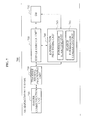
- FIG. 10 is a flowchart illustrating a method for providing an AR service in a user equipment according to an exemplary embodiment of the invention.
- One or more operations of the method of FIG. 10 may be performed by a control unit or a processor of the first user equipment 100 of FIG. 1 or the second user equipment 200 of FIG. 2 without limitation thereto.
- a user may photograph or capture an image of a target object using a camera to obtain image data of the target object.
- the user equipment may collect contextual information related to the target object.
- the contextual information may include at least one of location information of the user equipment by which the target object was photographed or captured, azimuth information between the target object and the camera, and tilt information of the user equipment.
- the user equipment may receive a request for displaying an AR tag from the user.
- the user equipment may check whether AR information corresponding to the contextual information is stored in a memory of the user equipment.
- the user equipment may generate and display an AR tag corresponding to the collected contextual information using AR information stored in the memory, in operation 1050. Accordingly, different AR tags depending on an azimuth between the user and the target object may be provided to the user.
- the user equipment may request an AR management server to provide AR information corresponding to the contextual information in operation 1060.
- the user equipment may transmit the image data of the target object obtained in operation 1010 and the contextual information collected in operation 1020 to the AR management server, in operation 1060.
- the user equipment may receive AR tag configuration data including AR information corresponding to the contextual information from the AR management server.
- the user equipment may generate and display an AR tag using the received AR tag configuration data including AR information. If the user equipment receives AR information in operation 1070, the user equipment may generate an AR tag using the AR information.
- FIG. 11 is a flowchart illustrating a method for providing an AR service in a user equipment according to an exemplary embodiment of the invention.
- Each operation of the method of FIG. 11 may be performed by a control unit or a processor of the third user equipment 800 or the fourth user equipment 900.
- a user may photograph or capture an image of a target object using a camera to obtain image data of the target object.
- the user equipment may collect contextual information related to the target object.
- the contextual information may include at least one of location information, direction information, and tilt information of the user equipment that photographed or captured the target object.
- aspects are not limited thereto such that, for example, the tilt information may be omitted.
- the user equipment may receive a request for displaying an AR tag from the user.
- the user equipment may request an AR management server to provide AR information corresponding to the collected contextual information.
- the user equipment may transmit the image data of the target object obtained in operation 1110 and the contextual information collected in operation 1120 to the AR management server, in operation 1160.
- the user equipment may receive at least one AR information corresponding to the contextual information from the AR management server. For example, if different AR information of the same target object based on an azimuth is stored in the AR management server, the user equipment may receive part or all of the stored AR information of the target object.
- the user equipment may generate and display the AR tag using the at least one received AR information, in operation1170. If the received AR information is plural in number, the user equipment may generate the AR tag using AR information having a high frequency or accuracy.
- the user equipment may collect azimuth information between the target object and the camera, in operation 1180.
- the user equipment may extract AR information corresponding to the collected azimuth information among the at least one collected AR information.
- the user equipment may generate and display the AR tag using the extracted AR information.
- the user equipment may display AR information of the target object corresponding to a different azimuth in a frontal direction by rotating the AR tag to a face touched by the user or by rotating the AR tag in the sensed touch direction.
- the AR tag displayed in operation 1080 of FIG. 10 or in operation 1195of FIG. 11 may be similar to the AR tag of FIG. 6 . Accordingly, if the user rotates the user equipment in an arbitrary direction, the user equipment may enable AR information corresponding to an azimuth toward the object viewed in the arbitrary direction to be displayed in a frontal direction. More specifically, in an example, referring to FIG. 6 , if the user equipment originally facing the first face is rotated in the right direction to face the second face, the second face may be viewed as the front facing direction.
- a user equipment and a method provides an augmented reality (AR) service in which an AR tag may be selectively provided based on an azimuth toward an object viewed by a user, so that the user may see the targeted information.
- AR augmented reality
- a user equipment and a method provides an AR service in which a three-dimensional stereoscopic AR tag may be provided and the AR tag may be rotated according to the received user input, so that different AR information of a target object, including AR information provided at a different view, may be provided without movement of a user to physically rotate.
- a user equipment and a method provides an AR service in which a user may rotate a user equipment in an arbitrary direction to provide AR information of a target object corresponding to the rotated direction.
- different AR information depending on an azimuth between a location of a user and the target object may be provided.
- This feature may contribute to provisioning of a three-dimensional stereoscopic AR tag, and may enable various applications as described herein without limitation.
- a cubic AR tag is displayed in the same direction as an inner wall of a building, a user may see the inside of the building from the outside of the building. It may be possible by matching each face of the AR tag having six faces with each face of the building interior, and displaying each face of the building interior on each corresponding face of the AR tag. If the user sees one face of the building through a camera of the user equipment from outside of the building, the front face of the AR tag facing toward the user (first face) among a number of available of faces of the AR tag, may be transparently displayed. In addition, the other three faces of the AR tag, that is, right side face, a left side face and a rear face, of the building may be stereoscopically displayed. Also, if pictures displayed through the AR tag are updated using a moving picture camera in real time, it is possible to recognize the condition of the inside of the building from the outside of the building in real time.
- the exemplary embodiments of the present invention consider information of tilt angles as well, including horizontal and/or vertical angles, that is, information about a tilt of a user equipment as well as an azimuth, the user may be provided with AR tags corresponding to the various angles. Also, if including height information, AR tags may be displayed in a spatial arrangement rather than in a horizontal arrangement, thereby providing a realistic view. Accordingly, the user may see an AR tag viewed in a horizontal direction, and also may see nearby AR tags located in a three-dimensional spatial arrangement in various directions and various angles if the user looks up at the target object or looks down on the target object through a camera.
- an AR tag may be used as a sign or a notice. For example, if an imagery sign or notice is displayed as an AR tag based on a location and a corresponding direction where a user stands, the sign or notice may not be displayed to a user located in the opposite direction to the user, thereby avoiding confusion. In an example, a confusion involving a traffic sign may be avoided if the stop sign is shown to the user facing the stop sign and not to the other persons that has passed the stop sign or to those who are driving on a freeway intersecting the street with the stop sign.
- a user equipment may display an azimuth between the target object and the user equipment in real time using a sensor.
- the user may use an AR tag generated at the specific location recommended by an expert. More specifically, the user may locate a camera and photograph or capture the target object with an azimuth recommended by the expert.
- the AR tag generated by the expert may show camera setting information and azimuth information used to photograph or capture the object.
- a user equipment may provide an AR tag having a constellation overlay on the AR tag, a constellation that is observed at a user location based on an azimuth toward the night sky viewed by the user.
- the user equipment may overlay the constellation having added time information on the AR tag. Accordingly, the user may observe information related to the constellation with eyes of the user.
- the user equipment may display an AR tag based on an azimuth at a current location. Accordingly, at the current location a user may recognize whether an exit displayed in a frontal direction is a front gate or a back gate through the AR tag.
- the user equipment may provide information about a direction to a trail at a current location.
- the user equipment may provide information about a shelter or nearby topography through an AR tag.
- the user equipment may display a location where a car may be parked using an AR tag.
- the user equipment may guide the user to an exit or entrance of a building.
- the user equipment may display various shapes of an AR tag as well as a various content of the AR tag depending on an azimuth. Accordingly, the user may easily recognize the AR tag and the azimuth.
- the user equipment may provide AR information of the AR tag displayed based on an azimuth, and also may provide common information of the AR tag regardless of an azimuth. The providing of the information may be applicable if the user sees a map.
- tags may be generated on celestial bodies and planets. Because other planets as well as the earth move in an orbit and rotate about an axis, the displayed face may change with time. In this instance, the user may set a tag on a desired face.
- the user equipment may display an AR tag on various faces, for example, the floor, the ceiling, and the roof of a building, and the like, depending on an azimuth. This may be useful in a mural, and information for a floor map of a large sized building.
- the exemplary embodiments according to the present invention may be recorded in non-transitory computer-readable media including program instructions to implement various operations embodied by a computer.
- the media may also include, alone or in combination with the program instructions, data files, data structures, and the like.
- the media and program instructions may be those specially designed and constructed for the purposes of the present invention, or they may be of the kind well-known and available to those having skill in the computer software arts.
- non-transitory computer-readable media examples include magnetic media, such as hard disks, floppy disks, and magnetic tape; optical media, such as CD ROM disks and DVD; magneto-optical media, such as optical disks; and hardware devices that are specially configured to store and perform program instructions, such as read-only memory (ROM), random access memory (RAM), flash memory, and the like.
- program instructions include both machine code, such as produced by a compiler, and files containing higher level code that may be executed by the computer using an interpreter.
- the described hardware devices may be configured to act as one or more software modules in order to perform the operations of the above-described embodiments of the present invention.
- An augmented reality (AR) service including a photographing unit to capture an image of a target object, an information collecting unit to collect contextual information of the captured image of the target object, a tag generating unit to generate an AR tag of a first direction, the AR tag corresponding to the contextual information, and a display unit to display the image of the target object and the AR tag.
- AR augmented reality
- a method for providing an AR service including capturing an image of a target object with a camera, collecting contextual information including location information of the captured image of the target object and a first azimuth information between the target object and the camera, generating an AR tag corresponding to the contextual information, and displaying the captured image of the target object and the generated AR tag.
Landscapes
- Engineering & Computer Science (AREA)
- General Physics & Mathematics (AREA)
- Multimedia (AREA)
- General Engineering & Computer Science (AREA)
- Signal Processing (AREA)
- Physics & Mathematics (AREA)
- Theoretical Computer Science (AREA)
- Computer Graphics (AREA)
- Computer Hardware Design (AREA)
- Software Systems (AREA)
- Computing Systems (AREA)
- User Interface Of Digital Computer (AREA)
- Studio Devices (AREA)
- Processing Or Creating Images (AREA)
- Telephonic Communication Services (AREA)
Applications Claiming Priority (1)
| Application Number | Priority Date | Filing Date | Title |
|---|---|---|---|
| KR1020100100008A KR101260576B1 (ko) | 2010-10-13 | 2010-10-13 | Ar 서비스를 제공하기 위한 사용자 단말기 및 그 방법 |
Publications (2)
| Publication Number | Publication Date |
|---|---|
| EP2442547A2 true EP2442547A2 (fr) | 2012-04-18 |
| EP2442547A3 EP2442547A3 (fr) | 2013-08-07 |
Family
ID=44799693
Family Applications (1)
| Application Number | Title | Priority Date | Filing Date |
|---|---|---|---|
| EP11183744.9A Withdrawn EP2442547A3 (fr) | 2010-10-13 | 2011-10-04 | Équipement utilisateur et procédé pour la fourniture d'un service à réalité améliorée |
Country Status (5)
| Country | Link |
|---|---|
| US (1) | US8823855B2 (fr) |
| EP (1) | EP2442547A3 (fr) |
| JP (1) | JP2012084146A (fr) |
| KR (1) | KR101260576B1 (fr) |
| CN (1) | CN102568012A (fr) |
Cited By (2)
| Publication number | Priority date | Publication date | Assignee | Title |
|---|---|---|---|---|
| EP2860606A4 (fr) * | 2012-06-12 | 2015-12-16 | Sony Corp | Dispositif de traitement d'informations, procédé de traitement d'informations, et programme associé |
| CN108595520A (zh) * | 2013-07-05 | 2018-09-28 | 华为技术有限公司 | 一种生成多媒体文件的方法和装置 |
Families Citing this family (98)
| Publication number | Priority date | Publication date | Assignee | Title |
|---|---|---|---|---|
| CA2900177C (fr) | 2015-08-11 | 2024-02-13 | J.J. Mackay Canada Limited | Renovation d'un parcometre pour espace unique |
| US8513832B2 (en) | 2007-03-30 | 2013-08-20 | Ips Group Inc. | Power supply unit |
| WO2010071972A1 (fr) | 2008-12-23 | 2010-07-01 | J.J.Mackay Canada Limited | Parcmètre sans fil basse puissance et réseau de parcmètres |
| US9420251B2 (en) | 2010-02-08 | 2016-08-16 | Nikon Corporation | Imaging device and information acquisition system in which an acquired image and associated information are held on a display |
| KR101317532B1 (ko) * | 2010-10-13 | 2013-10-15 | 주식회사 팬택 | 마커 또는 마커리스를 융합하는 증강현실 장치 및 방법 |
| CA2756489C (fr) | 2011-03-03 | 2023-09-26 | J.J. Mackay Canada Limited | Parcometre avec methode de paiement sans contact |
| US8935259B2 (en) | 2011-06-20 | 2015-01-13 | Google Inc | Text suggestions for images |
| JP2014531644A (ja) * | 2011-09-08 | 2014-11-27 | インテル・コーポレーション | 撮像されるオブジェクトの特徴に基づく拡張現実 |
| KR101407670B1 (ko) * | 2011-09-15 | 2014-06-16 | 주식회사 팬택 | 증강현실 기반 모바일 단말과 서버 및 그 통신방법 |
| US9606992B2 (en) * | 2011-09-30 | 2017-03-28 | Microsoft Technology Licensing, Llc | Personal audio/visual apparatus providing resource management |
| JP6121647B2 (ja) | 2011-11-11 | 2017-04-26 | ソニー株式会社 | 情報処理装置、情報処理方法およびプログラム |
| KR20130053535A (ko) * | 2011-11-14 | 2013-05-24 | 한국과학기술연구원 | 무선 통신 디바이스를 이용한 건물 내부의 증강현실 투어 플랫폼 서비스 제공 방법 및 장치 |
| CN104067316B (zh) | 2011-11-23 | 2017-10-27 | 奇跃公司 | 三维虚拟和增强现实显示系统 |
| EP2803064A4 (fr) | 2012-01-09 | 2015-11-18 | Nokia Technologies Oy | Procédé et appareil pour créer une architecture destinée à fournir un contenu en réalité mixte |
| KR20130097554A (ko) * | 2012-02-24 | 2013-09-03 | 주식회사 팬택 | 증강 현실 서비스를 위한 유해성 검증 시스템, 장치 및 방법 |
| KR20130118820A (ko) * | 2012-04-20 | 2013-10-30 | 삼성전자주식회사 | 증강현실 서비스를 위한 미디어 파일의 제공 방법 및 장치 |
| EP2672458A3 (fr) * | 2012-06-06 | 2017-04-26 | Samsung Electronics Co., Ltd | Terminal, appareil et procédé pour fournir un service de réalité augmentée |
| CN103677229A (zh) * | 2012-09-13 | 2014-03-26 | 昆达电脑科技(昆山)有限公司 | 手势结合扩增实境的图标控制方法 |
| US9317972B2 (en) * | 2012-12-18 | 2016-04-19 | Qualcomm Incorporated | User interface for augmented reality enabled devices |
| IL301489B2 (en) | 2013-01-15 | 2024-08-01 | Magic Leap Inc | A system for scanning electromagnetic imaging radiation |
| CN104851124B (zh) * | 2014-02-19 | 2018-12-14 | 中国园林博物馆北京筹备办公室 | 基于增强现实的造园交互系统 |
| JP2015184778A (ja) * | 2014-03-20 | 2015-10-22 | コニカミノルタ株式会社 | 拡張現実表示システム、拡張現実情報生成装置、拡張現実表示装置、サーバー、拡張現実情報生成プログラム、拡張現実表示プログラムおよび拡張現実情報のデータ構造 |
| US20170140457A1 (en) * | 2014-03-24 | 2017-05-18 | Pioneer Corporation | Display control device, control method, program and storage medium |
| KR101601921B1 (ko) * | 2014-06-09 | 2016-03-11 | 한상선 | 제품증강현실 시스템 |
| US10049477B1 (en) * | 2014-06-27 | 2018-08-14 | Google Llc | Computer-assisted text and visual styling for images |
| CN104202520A (zh) * | 2014-08-28 | 2014-12-10 | 苏州佳世达电通有限公司 | 资讯传递方法及资讯传递系统 |
| US10216996B2 (en) * | 2014-09-29 | 2019-02-26 | Sony Interactive Entertainment Inc. | Schemes for retrieving and associating content items with real-world objects using augmented reality and object recognition |
| US9697432B2 (en) | 2014-12-09 | 2017-07-04 | International Business Machines Corporation | Generating support instructions by leveraging augmented reality |
| EP3062142B1 (fr) | 2015-02-26 | 2018-10-03 | Nokia Technologies OY | Appareil pour un dispositif d'affichage proche |
| US9471954B2 (en) * | 2015-03-16 | 2016-10-18 | International Business Machines Corporation | Video sequence assembly |
| CN107407490B (zh) * | 2015-04-07 | 2020-02-21 | 三菱电机株式会社 | 空调机的维护支持系统 |
| JP6077068B1 (ja) * | 2015-07-30 | 2017-02-08 | 株式会社オプティム | 拡張現実システム、および拡張現実方法 |
| CN106445088B (zh) * | 2015-08-04 | 2020-05-22 | 上海宜维计算机科技有限公司 | 现实增强的方法及系统 |
| CA3178273C (fr) | 2015-08-11 | 2026-02-03 | J.J. Mackay Canada Limited | Parcometre pour espace unique |
| CN113220116A (zh) | 2015-10-20 | 2021-08-06 | 奇跃公司 | 改变可穿戴设备用户输入模式的系统和方法及可穿戴系统 |
| JP6065084B2 (ja) * | 2015-10-30 | 2017-01-25 | ソニー株式会社 | 情報処理装置、情報処理方法およびプログラム |
| US10055895B2 (en) | 2016-01-29 | 2018-08-21 | Snap Inc. | Local augmented reality persistent sticker objects |
| KR102438052B1 (ko) | 2016-03-31 | 2022-08-29 | 매직 립, 인코포레이티드 | 포즈들 및 멀티-dof 제어기들을 사용하는 3d 가상 객체들과 상호작용들 |
| CN106095075B (zh) * | 2016-05-31 | 2019-12-10 | 深圳市元征科技股份有限公司 | 一种信息处理方法及增强现实设备 |
| CN106097258A (zh) * | 2016-05-31 | 2016-11-09 | 深圳市元征科技股份有限公司 | 一种影像处理方法及增强现实设备 |
| CN105892062A (zh) * | 2016-06-24 | 2016-08-24 | 北京邮电大学 | 天文观测设备 |
| KR101983727B1 (ko) * | 2016-07-04 | 2019-06-04 | 주식회사 그래픽코드 | 증강현실 가상 스튜디오 시스템 및 그 구현 방법 |
| US10650552B2 (en) | 2016-12-29 | 2020-05-12 | Magic Leap, Inc. | Systems and methods for augmented reality |
| EP3343267B1 (fr) | 2016-12-30 | 2024-01-24 | Magic Leap, Inc. | Appareil de découplage de lumière polychromatique, affichages proches de l' il le comprenant et procédé de découplage de lumière polychromatique |
| US11145122B2 (en) | 2017-03-09 | 2021-10-12 | Samsung Electronics Co., Ltd. | System and method for enhancing augmented reality (AR) experience on user equipment (UE) based on in-device contents |
| KR102857458B1 (ko) | 2017-04-19 | 2025-09-09 | 매직 립, 인코포레이티드 | 웨어러블 시스템을 위한 멀티모달 임무 실행 및 텍스트 편집 |
| US10037343B1 (en) * | 2017-06-14 | 2018-07-31 | Civic Resource Group International Incorporated | Sector-based retrieval of information associated with geographic locations |
| KR101952283B1 (ko) * | 2017-06-28 | 2019-04-29 | 주식회사 조유 | 위치 기반의 정보 제공용 단말기 및 이를 이용한 정보 제공 시스템 |
| US10578870B2 (en) | 2017-07-26 | 2020-03-03 | Magic Leap, Inc. | Exit pupil expander |
| JP7282090B2 (ja) | 2017-12-10 | 2023-05-26 | マジック リープ, インコーポレイテッド | 光学導波管上の反射防止性コーティング |
| CN111712751B (zh) | 2017-12-20 | 2022-11-01 | 奇跃公司 | 用于增强现实观看设备的插入件 |
| EP4415355A3 (fr) | 2018-03-15 | 2024-09-04 | Magic Leap, Inc. | Correction d'image due à la déformation de composants d'un dispositif de visualisation |
| CN108509593A (zh) * | 2018-03-30 | 2018-09-07 | 联想(北京)有限公司 | 一种显示方法及电子设备、存储介质 |
| CN108924475B (zh) * | 2018-05-14 | 2021-08-13 | 南京水动力信息科技有限公司 | 多谱段增强现实深水检修可视化专家系统 |
| US10599928B2 (en) | 2018-05-22 | 2020-03-24 | International Business Machines Corporation | Method and system for enabling information in augmented reality applications |
| JP7650662B2 (ja) | 2018-05-30 | 2025-03-25 | マジック リープ, インコーポレイテッド | 小型の可変焦点構成 |
| CN112601975B (zh) | 2018-05-31 | 2024-09-06 | 奇跃公司 | 雷达头部姿势定位 |
| US10825424B2 (en) | 2018-06-05 | 2020-11-03 | Magic Leap, Inc. | Homography transformation matrices based temperature calibration of a viewing system |
| US11199719B2 (en) | 2018-06-13 | 2021-12-14 | Magic Leap, Inc. | System and method for qualifying a multi-layered optical stack for an optical projection system |
| WO2020010097A1 (fr) | 2018-07-02 | 2020-01-09 | Magic Leap, Inc. | Modulation d'intensité de pixel en utilisant la modification de valeurs de gain |
| US11510027B2 (en) | 2018-07-03 | 2022-11-22 | Magic Leap, Inc. | Systems and methods for virtual and augmented reality |
| US11856479B2 (en) | 2018-07-03 | 2023-12-26 | Magic Leap, Inc. | Systems and methods for virtual and augmented reality along a route with markers |
| JP7374981B2 (ja) | 2018-07-10 | 2023-11-07 | マジック リープ, インコーポレイテッド | クロス命令セットアーキテクチャプロシージャ呼出のためのスレッドウィービング |
| US11598651B2 (en) | 2018-07-24 | 2023-03-07 | Magic Leap, Inc. | Temperature dependent calibration of movement detection devices |
| WO2020023543A1 (fr) | 2018-07-24 | 2020-01-30 | Magic Leap, Inc. | Dispositif de visualisation à intégrant un joint anti-poussière |
| EP4650919A3 (fr) | 2018-08-02 | 2026-01-21 | Magic Leap, Inc. | Système de visualisation avec compensation de distance interpupillaire sur la base du mouvement de la tête |
| EP3830631A4 (fr) | 2018-08-03 | 2021-10-27 | Magic Leap, Inc. | Correction de dérive basée sur une pose non fusionnée d'une pose fusionnée d'un totem dans un système d'interaction d'utilisateur |
| JP7487176B2 (ja) | 2018-08-22 | 2024-05-20 | マジック リープ, インコーポレイテッド | 患者視認システム |
| CN113196138B (zh) | 2018-11-16 | 2023-08-25 | 奇跃公司 | 用于保持图像清晰度的图像尺寸触发的澄清 |
| JP7543274B2 (ja) | 2018-12-21 | 2024-09-02 | マジック リープ, インコーポレイテッド | 導波管内の全内部反射を助長するための空気ポケット構造 |
| CA3031936A1 (en) | 2019-01-30 | 2020-07-30 | J.J. Mackay Canada Limited | Spi keyboard module for a parking meter and a parking meter having an spi keyboard module |
| JP7515489B2 (ja) | 2019-02-06 | 2024-07-12 | マジック リープ, インコーポレイテッド | 複数のプロセッサによって発生される総熱を限定するための標的意図ベースのクロック速度の決定および調節 |
| EP3939030B1 (fr) | 2019-03-12 | 2025-10-29 | Magic Leap, Inc. | Enregistrement d'un contenu local entre des premier et second visualiseurs de réalité augmentée |
| CN120812326A (zh) | 2019-05-01 | 2025-10-17 | 奇跃公司 | 内容提供系统和方法 |
| WO2020242047A1 (fr) * | 2019-05-30 | 2020-12-03 | Samsung Electronics Co., Ltd. | Procédé et appareil d'acquisition de données d'un objet virtuel dans une réalité augmentée |
| WO2021021670A1 (fr) | 2019-07-26 | 2021-02-04 | Magic Leap, Inc. | Systèmes et procédés de réalité augmentée |
| US11048760B1 (en) * | 2019-07-31 | 2021-06-29 | Splunk Inc. | Techniques for placing content in and applying layers in an extended reality environment |
| EP3973515A4 (fr) | 2019-08-22 | 2022-10-26 | Samsung Electronics Co., Ltd. | Création de contenu dans un environnement de réalité augmentée |
| KR102728007B1 (ko) | 2019-08-22 | 2024-11-11 | 삼성전자 주식회사 | 증강 현실 환경에서의 콘텐트 생성 |
| CN114616821B (zh) | 2019-10-28 | 2023-03-24 | 奇跃公司 | 用于虚拟对象呈现的边缘检测和平滑处理 |
| US12033081B2 (en) | 2019-11-14 | 2024-07-09 | Magic Leap, Inc. | Systems and methods for virtual and augmented reality |
| EP4058979A4 (fr) | 2019-11-15 | 2023-01-11 | Magic Leap, Inc. | Système de visualisation à utiliser dans un environnement chirurgical |
| CN113034697A (zh) * | 2019-12-24 | 2021-06-25 | 北京车和家信息技术有限公司 | 对目标设备进行增强现实展示的方法、装置及系统 |
| US11200646B2 (en) | 2020-01-15 | 2021-12-14 | Magic Leap, Inc. | Compensation for deformation in head mounted display systems |
| CN111625091B (zh) * | 2020-05-14 | 2021-07-20 | 佳都科技集团股份有限公司 | 基于ar眼镜的标签叠加方法及装置 |
| JP7562700B2 (ja) | 2020-05-20 | 2024-10-07 | マジック リープ, インコーポレイテッド | コヒーレントコンテキストを用いた、ピース毎の漸次的かつ持続的な較正 |
| US11756081B2 (en) * | 2020-06-12 | 2023-09-12 | International Business Machines Corporation | Rendering privacy aware advertisements in mixed reality space |
| CN112068703B (zh) * | 2020-09-07 | 2021-11-16 | 北京字节跳动网络技术有限公司 | 目标物体的控制方法、装置、电子设备及存储介质 |
| WO2022060507A1 (fr) | 2020-09-17 | 2022-03-24 | Magic Leap, Inc. | Étalonnage de caméra simultané et ajustement de faisceau |
| WO2022066486A1 (fr) | 2020-09-23 | 2022-03-31 | Magic Leap, Inc. | Étalonnage conjoint de caméra et d'unité de mesure inertielle |
| US12277264B2 (en) | 2020-11-18 | 2025-04-15 | Magic Leap, Inc. | Eye tracking based video transmission and compression |
| US12519921B2 (en) | 2020-12-04 | 2026-01-06 | Magic Leap, Inc. | Miscalibration detection for virtual reality and augmented reality systems |
| JP7781161B2 (ja) | 2020-12-14 | 2025-12-05 | マジック リープ, インコーポレイテッド | エピポーラ制約を使用したバンドル調節 |
| EP4268193A4 (fr) | 2020-12-22 | 2024-11-20 | Magic Leap, Inc. | Étalonnage pour systèmes de réalité virtuelle ou augmentée |
| WO2022169938A1 (fr) | 2021-02-04 | 2022-08-11 | Magic Leap, Inc. | Compréhension de scène à l'aide de grilles d'occupation |
| JP7445620B2 (ja) * | 2021-03-31 | 2024-03-07 | 本田技研工業株式会社 | 情報提供方法、プログラム及び情報提供装置 |
| US12444148B2 (en) | 2021-09-08 | 2025-10-14 | Magic Leap, Inc. | Camera calibration using depth sensor data |
| KR102471180B1 (ko) * | 2021-11-23 | 2022-11-28 | 이은령 | 증강현실 콘텐츠 서비스를 제공하는 시스템 및 서비스 제공 방법 |
Family Cites Families (16)
| Publication number | Priority date | Publication date | Assignee | Title |
|---|---|---|---|---|
| JP3419650B2 (ja) | 1997-06-02 | 2003-06-23 | 株式会社日立製作所 | 地図表示方法 |
| WO2000073888A1 (fr) | 1999-05-27 | 2000-12-07 | International Business Machines Corporation | Icones tridimentionnelles redimensionnable de maniere dynamique pour interfaces de fenetrage, d'exploration ou interfaces utilisateur graphiques |
| JP2002169640A (ja) | 2000-11-30 | 2002-06-14 | Sony Corp | 情報処理装置および方法、並びに記録媒体 |
| JP3893983B2 (ja) | 2002-01-17 | 2007-03-14 | ソニー株式会社 | 情報提供装置及び情報提供方法、記憶媒体、並びにコンピュータ・プログラム |
| KR100651508B1 (ko) | 2004-01-30 | 2006-11-29 | 삼성전자주식회사 | 증강현실을 이용한 지역 정보 제공 방법 및 이를 위한지역 정보 서비스 시스템 |
| JP4363642B2 (ja) * | 2004-07-02 | 2009-11-11 | 富士フイルム株式会社 | 地図表示システム及びデジタルカメラ |
| JP4810395B2 (ja) * | 2006-10-31 | 2011-11-09 | 株式会社東芝 | 医用画像生成装置及びその方法 |
| JP2008131217A (ja) | 2006-11-20 | 2008-06-05 | Funai Electric Co Ltd | 携帯機器 |
| KR100983912B1 (ko) | 2008-04-04 | 2010-09-27 | 한국과학기술연구원 | 증강 현실 기법을 이용한 정보처리 장치 및 정보 입력,검색방법 |
| JP2010231741A (ja) | 2009-03-30 | 2010-10-14 | Nec Corp | 電子タグ作成表示システム、電子タグ作成表示装置およびそれらの方法 |
| KR101561913B1 (ko) * | 2009-04-17 | 2015-10-20 | 엘지전자 주식회사 | 이동 단말기의 영상 표시 방법 및 그 장치 |
| KR100968837B1 (ko) | 2010-01-20 | 2010-07-09 | (주)테슬라시스템 | 촬영된 객체에 대한 정보를 제공하는 휴대용 카메라 시스템 |
| KR101180278B1 (ko) | 2010-02-25 | 2012-09-07 | 연세대학교 산학협력단 | 증강 현실을 이용한 사용자 설명서 제공 단말기, 서버 및 방법 |
| KR101002030B1 (ko) | 2010-04-30 | 2010-12-16 | (주)올라웍스 | 단말 장치로 입력되는 입력 영상 및 상기 입력 영상에 관련된 정보를 이용하여 증강 현실을 제공하기 위한 방법, 단말 장치 및 컴퓨터 판독 가능한 기록 매체 |
| KR101688155B1 (ko) * | 2010-10-25 | 2016-12-20 | 엘지전자 주식회사 | 이동 단말기의 정보 처리 장치 및 그 방법 |
| US8698843B2 (en) * | 2010-11-02 | 2014-04-15 | Google Inc. | Range of focus in an augmented reality application |
-
2010
- 2010-10-13 KR KR1020100100008A patent/KR101260576B1/ko active Active
-
2011
- 2011-08-18 US US13/212,969 patent/US8823855B2/en active Active
- 2011-09-20 CN CN2011102804742A patent/CN102568012A/zh active Pending
- 2011-10-04 EP EP11183744.9A patent/EP2442547A3/fr not_active Withdrawn
- 2011-10-05 JP JP2011220789A patent/JP2012084146A/ja active Pending
Non-Patent Citations (1)
| Title |
|---|
| None |
Cited By (3)
| Publication number | Priority date | Publication date | Assignee | Title |
|---|---|---|---|---|
| EP2860606A4 (fr) * | 2012-06-12 | 2015-12-16 | Sony Corp | Dispositif de traitement d'informations, procédé de traitement d'informations, et programme associé |
| CN108595520A (zh) * | 2013-07-05 | 2018-09-28 | 华为技术有限公司 | 一种生成多媒体文件的方法和装置 |
| CN108595520B (zh) * | 2013-07-05 | 2022-06-10 | 华为技术有限公司 | 一种生成多媒体文件的方法和装置 |
Also Published As
| Publication number | Publication date |
|---|---|
| KR101260576B1 (ko) | 2013-05-06 |
| US20120092528A1 (en) | 2012-04-19 |
| JP2012084146A (ja) | 2012-04-26 |
| EP2442547A3 (fr) | 2013-08-07 |
| CN102568012A (zh) | 2012-07-11 |
| US8823855B2 (en) | 2014-09-02 |
| KR20120038316A (ko) | 2012-04-23 |
Similar Documents
| Publication | Publication Date | Title |
|---|---|---|
| US8823855B2 (en) | User equipment and method for providing augmented reality (AR) service | |
| US10354407B2 (en) | Camera for locating hidden objects | |
| US10445945B2 (en) | Directional and X-ray view techniques for navigation using a mobile device | |
| US10896327B1 (en) | Device with a camera for locating hidden object | |
| CN110478901B (zh) | 基于增强现实设备的交互方法及系统 | |
| US9888215B2 (en) | Indoor scene capture system | |
| US9269196B1 (en) | Photo-image-based 3D modeling system on a mobile device | |
| EP3359918B1 (fr) | Systèmes et procédés d'orientation d'un utilisateur dans un affichage de carte | |
| EP2418621B1 (fr) | Appareil et procédé pour fournir des informations de réalité améliorées | |
| Sankar et al. | Capturing indoor scenes with smartphones | |
| EP3467790B1 (fr) | Dispositif de traitement d'informations, procédé de traitement d'informations, et support de stockage | |
| US20130321461A1 (en) | Method and System for Navigation to Interior View Imagery from Street Level Imagery | |
| EP3772217A1 (fr) | Appareil de commande de sortie, terminal d'affichage, système de commande à distance, procédé de commande et support d'enregistrement | |
| EP2672459A1 (fr) | Appareil et procédé permettant de fournir des informations de réalité augmentée à l'aide de carte tridimensionnelle | |
| US20170069122A1 (en) | Method, system and recording medium for providing augmented reality service and file distribution system | |
| KR101600456B1 (ko) | 공간 정보를 제공하기 위한 증강 현실 제공 방법과 시스템, 그리고 기록 매체 및 파일 배포 시스템 | |
| KR101286866B1 (ko) | Ar 태그 정보를 생성하는 사용자 단말기 및 그 방법, 그리고, 시스템 | |
| US20240087157A1 (en) | Image processing method, recording medium, image processing apparatus, and image processing system | |
| KR20220085150A (ko) | 확장현실 기반 지능형 건설현장 관리 지원 시스템 서버 및 방법 | |
| KR101155761B1 (ko) | 증강 현실에서 위치 정보를 표시하는 방법 및 장치 | |
| KR20190047922A (ko) | 혼합현실을 이용한 정보 공유 시스템 | |
| KR101902131B1 (ko) | 시뮬레이션 파노라마 실내영상 제작 시스템 | |
| JP4673861B2 (ja) | 情報表示システム及び情報表示方法 | |
| US12621356B2 (en) | Communication control server, communication system, and communication control method | |
| CN108062786B (zh) | 以三维信息模型为基础的综合感知定位技术应用系统 |
Legal Events
| Date | Code | Title | Description |
|---|---|---|---|
| PUAI | Public reference made under article 153(3) epc to a published international application that has entered the european phase |
Free format text: ORIGINAL CODE: 0009012 |
|
| AK | Designated contracting states |
Kind code of ref document: A2 Designated state(s): AL AT BE BG CH CY CZ DE DK EE ES FI FR GB GR HR HU IE IS IT LI LT LU LV MC MK MT NL NO PL PT RO RS SE SI SK SM TR |
|
| AX | Request for extension of the european patent |
Extension state: BA ME |
|
| PUAL | Search report despatched |
Free format text: ORIGINAL CODE: 0009013 |
|
| AK | Designated contracting states |
Kind code of ref document: A3 Designated state(s): AL AT BE BG CH CY CZ DE DK EE ES FI FR GB GR HR HU IE IS IT LI LT LU LV MC MK MT NL NO PL PT RO RS SE SI SK SM TR |
|
| AX | Request for extension of the european patent |
Extension state: BA ME |
|
| RIC1 | Information provided on ipc code assigned before grant |
Ipc: H04N 101/00 20060101ALI20130704BHEP Ipc: G06T 11/60 20060101ALI20130704BHEP Ipc: H04N 1/32 20060101AFI20130704BHEP Ipc: G06T 19/00 20110101ALI20130704BHEP Ipc: H04N 1/00 20060101ALI20130704BHEP |
|
| STAA | Information on the status of an ep patent application or granted ep patent |
Free format text: STATUS: THE APPLICATION IS DEEMED TO BE WITHDRAWN |
|
| 18D | Application deemed to be withdrawn |
Effective date: 20140208 |