EP2443219B1 - Procédé pour la production d'huile de pin brute par lavage du savon avec élimination de carbonate de calcium - Google Patents
Procédé pour la production d'huile de pin brute par lavage du savon avec élimination de carbonate de calcium Download PDFInfo
- Publication number
- EP2443219B1 EP2443219B1 EP20110758348 EP11758348A EP2443219B1 EP 2443219 B1 EP2443219 B1 EP 2443219B1 EP 20110758348 EP20110758348 EP 20110758348 EP 11758348 A EP11758348 A EP 11758348A EP 2443219 B1 EP2443219 B1 EP 2443219B1
- Authority
- EP
- European Patent Office
- Prior art keywords
- soap
- tall oil
- brine
- calcium carbonate
- black liquor
- Prior art date
- Legal status (The legal status is an assumption and is not a legal conclusion. Google has not performed a legal analysis and makes no representation as to the accuracy of the status listed.)
- Active
Links
Images



Classifications
-
- C—CHEMISTRY; METALLURGY
- C11—ANIMAL OR VEGETABLE OILS, FATS, FATTY SUBSTANCES OR WAXES; FATTY ACIDS THEREFROM; DETERGENTS; CANDLES
- C11B—PRODUCING, e.g. BY PRESSING RAW MATERIALS OR BY EXTRACTION FROM WASTE MATERIALS, REFINING OR PRESERVING FATS, FATTY SUBSTANCES, e.g. LANOLIN, FATTY OILS OR WAXES; ESSENTIAL OILS; PERFUMES
- C11B13/00—Recovery of fats, fatty oils or fatty acids from waste materials
- C11B13/005—Recovery of fats, fatty oils or fatty acids from waste materials of residues of the fabrication of wood-cellulose (in particular tall-oil)
-
- C—CHEMISTRY; METALLURGY
- C11—ANIMAL OR VEGETABLE OILS, FATS, FATTY SUBSTANCES OR WAXES; FATTY ACIDS THEREFROM; DETERGENTS; CANDLES
- C11B—PRODUCING, e.g. BY PRESSING RAW MATERIALS OR BY EXTRACTION FROM WASTE MATERIALS, REFINING OR PRESERVING FATS, FATTY SUBSTANCES, e.g. LANOLIN, FATTY OILS OR WAXES; ESSENTIAL OILS; PERFUMES
- C11B13/00—Recovery of fats, fatty oils or fatty acids from waste materials
- C11B13/02—Recovery of fats, fatty oils or fatty acids from waste materials from soap stock
-
- Y—GENERAL TAGGING OF NEW TECHNOLOGICAL DEVELOPMENTS; GENERAL TAGGING OF CROSS-SECTIONAL TECHNOLOGIES SPANNING OVER SEVERAL SECTIONS OF THE IPC; TECHNICAL SUBJECTS COVERED BY FORMER USPC CROSS-REFERENCE ART COLLECTIONS [XRACs] AND DIGESTS
- Y02—TECHNOLOGIES OR APPLICATIONS FOR MITIGATION OR ADAPTATION AGAINST CLIMATE CHANGE
- Y02W—CLIMATE CHANGE MITIGATION TECHNOLOGIES RELATED TO WASTEWATER TREATMENT OR WASTE MANAGEMENT
- Y02W30/00—Technologies for solid waste management
- Y02W30/50—Reuse, recycling or recovery technologies
- Y02W30/74—Recovery of fats, fatty oils, fatty acids or other fatty substances, e.g. lanolin or waxes
Definitions
- the invention relates to the production of crude tall oil from black liquor soap, and particularly to a method that removes calcium and lignates with an alkaline wash.
- Tall oil is an important by-product of the Kraft process for pulping wood, especially wood derived from pine trees. It is usually seen as a resinous, oily liquid and comprises a mixture of rosin acids and fatty acids and may be used in soaps, emulsions, lubricants, fuels and in other applications.
- CTO One important, less refined form of tall oil is referred to as CTO (crude tall oil).
- CTO contains rosins, unsaponifiable sterols, resin acids (such as abietic acid), fatty acids (such as palmitic, oleic and linoleic acids), fatty alcohols, other sterols, and other alkyl hydrocarbon derivatives.
- the fatty acid fraction of tall oil is referred to as TOFA (tall oil fatty acids) and is of significant interest in many applications such as in production of soaps and lubricants.
- TOFA chemical derivatives such as esters
- Other components of CTO such as tall oil rosin, certain sterols, and so forth, are valuable for other uses..
- Crude tall oil is obtained by separating black liquor soap from black liquor obtained Kraft process.
- a black liquor soap (or tall oil soap) is separated from the black liquor, and further processed by acidulation.
- Acidulation of tall oil soap is treatment with a mineral for example sulfuric acid, to yield a CTO stream and a "spent acid” stream. Washing this black liquor soap prior to acidulation is thought to allow more efficient separation of CTO after acidulation; alkaline tall oil plant brine has been employed as the washing medium. This alkaline tall oil plant is produced by adjusting the pH of the spent acid.
- Calcium sulfate build-up is very undesirable; if left unchecked, calcium sulfate plugs process equipment.
- calcium sulfate accumulation makes it necessary to shut decanters down frequently for cleaning.
- large amounts of calcium sulfate also require shutdown to clean the system. Therefore, calcium sulfate issues appear to have caused soap washing to be abandoned by most, if not all, applicable industry.
- the lignin and insoluble inorganics entrain crude tall oil during separation, reducing the efficiency of such systems.
- U.S. Pat. No. 3,575,952 describes a process to wash crude tall oil soap with alkaline tall oil plant brine for the purpose of removing lignin. There is no teaching regarding calcium deposits. This patent teaches that the brine should be at a pH of at least about 8 and preferably 10-14.
- U.S. Pat. No. 4,248,769 describes a process to wash crude tall oil soap with an alkaline tall oil plant brine in order to remove lignin, where the wash mixture is cooled from 60-80°C to 35-50°C (140-176°F to 95-122°F). There is no teaching regarding calcium deposits.
- U.S. Pat. No. 5,164,480 describes an electrolytic tall oil soap acidulation process. It discloses that lignates and calcium ions at too high a level may interfere with the process, so pretreatment of the soap is recommended.
- the pretreatment method is not detailed. There is mention that pretreatment may comprise precipitation, filtration, or precipitation and filtration. In any case, it is "some" (apparently a quite low level of) calcium ions present in the soap and not an insoluble calcium compound (at any level, much less a high level) that is described or of concern here. See, for example, the discussion on the presence of calcium carbonate in the soap given below.
- Krumbein "Efficient Tall Oil Plant Can Benefit Kraft Mills," Southern Pulp and Paper, Aug. 1984, pp. 36-38 ) discusses reasons for tall oil soap washing. Although the process described does address removal of lignin and to a limited extent the direct removal of calcium sulfate. However, one skilled in the art would recognize that this process would result in calcium increasing by the fortified brine going to a weak liquor system that returns black liquor to the wash process. Clarification of fortified brine is not discussed.
- Vuorikari The Occurrence of Foreign Cations in Black Liquor, Soap and Tall Oil Acidulation Systems," Naval Stores Review, Jul/Aug 1992, pp. 4-10 ) describes a process similar to that in U.S. Pat. No. 4,248,769 (see above) and provides much discussion as to calcium compounds in some systems. It states that soap washing with alkaline tall oil plant brine There is no mention of clarification of fortified brine, but there is some discussion of where unclarified fortified brine may be sent in the black liquor system.
- tall oil may be used as a fuel component.
- WO 2009/131510 describes washing tall oil to remove lignin and calcium, soaps prior to using the tall oil in diesel fuel. It teaches that this washing is needed to remove lignin and calcium soaps remaining after acidulation of tall oil soap that then end up in the CTO. These contaminants in the CTO interfere with catalysts used in making diesel.
- the first step of the method comprises combining black liquor soap, comprising tall oil soap, lignates, and inorganic solids (including calcium carbonate), with an alkaline wash medium at a temperature within the range of 25°C to 100°C.
- the alkaline wash medium has a pH from 10 to 14 and a lower concentration of lignates and inorganic solids than the black liquor soap.
- the resulting mixture comprises washed tall oil soap, fortified brine, lignates, and calcium carbonate.
- the next step of our method is to separate the tall oil soap from the fortified brine, lignates, and calcium carbonate, by centrifugation, decantation, filtration, settling, or a combination of these techniques, or other techniques in the art.
- the next step of the method is acidulation of the tall oil soap to form crude tall oil, which is isolated, and a spent acid mixture.
- at least a portion of the alkaline brine is returned for use as alkaline wash medium.
- black liquor soap in a method for producing crude tall oil from black liquor soap, black liquor soap can be successfully washed with an alkaline medium while avoiding process upsets caused by calcium sulfate accumulation in, or downstream from, an acidulation unit. Separation of washed tall oil soap from fortified brine, lignates, and calcium carbonate and isolation of calcium carbonate and lignates from the fortified brine prevents calcium and lignate accumulation when the brine is recycled to the plant's weak liquor system.
- Our invention relates to a method for producing crude tall oil from black liquor soap while removing calcium and lignin/lignates.
- Black liquor soap is washed with an alkaline wash media to form a tall oil soap portion and a fortified brine portion (also called extract or wash filtrate), containing lignin or lignates, and insoluble inorganic species, including calcium carbonate.
- Tall oil soap is then separated from fortified brine, lignates, and calcium carbonate.
- calcium carbonate and lignates are isolated from fortified brine. With this option, the fortified brine (containing black liquor) can be recycled to a weak liquor system without allowing calcium or lignate deposits to accumulate. Deposits of calcium and lignates can cause costly shutdowns to clean equipment.
- Black liquor soap used for the inventive method is conveniently obtained directly from paper mills as a by-product.
- "Kraft plant” refers to a location where the Kraft process itself is run, including its liquor systems, but does not include tall oil processing (such as tall oil soap washing and acidulation). Suitable black liquor soap can come from a single mill, but it is more often a composite from multiple mill sources. The content of the soap varies, but contains crude tall oil soap, water, calcium carbonate, lignates, and entrained black liquor.
- black liquor soap is washed (combined) with an alkaline wash medium.
- the alkaline wash medium has a pH from 10 to 14, preferably from 10 to 13. The particular pH range used will depend on the desired outcomes for calcium removal, lignates removal, crude tall oil yield, higher heating values of the fortified brine, and other factors.
- the alkaline wash media also has a lower concentration of lignates and inorganic solids than the black liquor soap.
- the black liquor soap and alkaline wash medium are combined at a temperature within the range of 25°C to 100°C.
- the resulting mixture comprises washed tall oil soap, fortified brine, lignates, and calcium carbonate.
- the alkaline wash medium is preferably an aqueous process stream from the plant.
- the alkaline wash medium is generated by neutralizing spent sulfuric acid from an acidulation process.
- the spent acid mixture is neutralized with sodium hydroxide or another strong base to give the alkaline wash medium.
- the alkaline wash preferably has a low content of suspended solids, a low content of tall oil, and dissolved sodium sulfate resulting from neutralization.
- the alkaline wash medium is also referred to as "clean alkaline brine,” "alkaline tall oil plant brine,” “alkalized spent acid,” “neutralized spent acid,” or similar terms.
- the pH of the alkaline wash medium is preferably from 11 to 13, more preferably from 11.5 to 13.
- the pH of the alkaline wash medium is preferably from 11 to 13, more preferably from 11.5 to 13.
- the alkaline wash medium has a lower concentration of lignates and inorganic solids than the black liquor soap, as one objective of soap washing is to lower the content of these materials in the tall oil soap.
- the lignates content of the alkaline wash medium is less than 1.0 wt.%, more preferably 0.01 to 0.9 wt.%.
- the level of filterable inorganic solids in the alkaline wash medium is preferably less than 200 ppm, more preferably 10 to 175 ppm.
- the amount of alkaline wash medium used will depend on whether it is more desirable to maximize calcium removal, lignates removal, tall oil yield, or other factors. Preferably, however, the amount of alkaline wash medium is within the range of 1 to 60 wt.%, more preferably 10 to 50 wt.%, and most preferably 10 to 40 wt.% based on the combined amounts of black liquor soap and alkaline wash medium. For maximum calcium removal, 25 to 40 wt.% is preferred. For maximizing the yield of crude tall oil and minimizing acid consumption during acidulation, a lower proportion of alkaline wash medium, e.g., 10 to 25 wt.% based on the combined amounts of black liquor soap and alkaline wash medium, may be more desirable.
- the black liquor soap and alkaline wash medium are combined at a t emperature within the range of 25°C to 100°C (77-212°F), preferably from 55 to 95°C (131-203°F), and more preferably from 55 to 80°C (131-176°F).
- the residence time for the washing process is up to 72 h, or 8 to 40 h, or 8 to 24h. These times are approximate and may be reduced with improved mixing or separation techniques.
- the mixture resulting from the combination of the black liquor soap and alkaline wash medium comprises washed tall oil soap, fortified brine, lignates, and calcium carbonate. Washed tall oil soap is separated from the fortified brine, lignates, and calcium carbonate. Separation of the washed tall oil soap can be accomplished by any desired technique, including centrifuging, decanting, filtering, settling, their equivalents, or combinations of these. The separation methods provide, in one or more steps, the washed tall oil soap, a solid phase comprising calcium carbonate, and a liquid phase comprising fortified brine.
- Formified brine is filtrate (washings) or at least a major component of filtrate that results from black liquor soap washing. It is sometimes called tall oil soap wash filtrate, wash filtrate, or extract brine. Fortified brine usually has a relatively high lignate and/or energy content compared to the alkaline wash medium (hence, "fortified”). It may be clarified and still be considered fortified brine. Usually, fortified brine is the liquid phase that remains after solids comprising calcium carbonate have been removed. The solids comprise mostly calcium carbonate but may also include a minor proportion of undissolved lignates.
- Suitable centrifuges useful for performing the required separation include scroll-type (decanting) centrifuges and ejecting-disc stack types, such as those manufactured by Alfa-Laval and others. Centrifugation can employ more than one type of centrifuge. Decanting centrifuges are useful for removing most of the solids ahead of ejecting-disc stack centrifuges, if both types are employed.
- Ejecting-disc stack centrifuges can be used to separate solids and two liquid phases from each other in a single, continuous process using high centrifugal force. Denser solids are forced outward against the rotating bowl wall, while the less-dense liquid phases form concentric inner layers. The liquid-liquid interface position is adjusted to ensure that the separation takes place with maximum efficiency.
- the disc stack in an ejecting type centrifuge produces two clarified liquid phases that overflow close to the rotating axis, in the outlet area on top of the bowl. The liquid phases then flow into separate chambers. Each separated liquid phase then leaves the bowl due to the force of gravity or by means of a paring disc, which is a special-pumping device. The chambers are isolated from each other to prevent cross-contamination.
- a fortified brine that has reduced calcium content compared with the black liquor soap can be returned to a weak black liquor system. This avoids build-up of calcium carbonate (and potential fouling) in the plant's black liquor inventory and evaporation system. It also helps to avoid shutdowns or down time due to calcium sulfate precipitation further downstream in the acidulation unit.
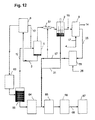
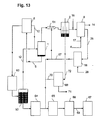
- the fortified brine following its separation from calcium carbonate-containing solids, is transferred to a weak black liquor storage unit of the plant. As shown in Figs. 11-13 , the brine sent there ultimately is concentrated and sent to a recovery boiler for recapture of inorganic salts.
- calcium carbonate-containing solids are combined with water to separate calcium carbonate from the more water-soluble lignates (see Figs. 11-13 ).
- the recovered calcium carbonate is then preferably sent to a lime kiln where it is thermally decomposed to calcium oxide (lime) and carbon dioxide.
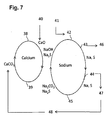
- the calcium oxide is then used to convert (“causticize”) sodium carbonate obtained from the recovery boiler to the sodium hydroxide needed for the digestion process (see Fig. 7 ).
- the lignate-containing aqueous phase resulting from water washing the calcium carbonate-containing solids can be concentrated to recover lignates either in solid or concentrated aqueous form.
- the lignates are useful components of a biofuel.
- the mixture resulting from combination of the black liquor soap and alkaline wash medium is separated by centrifugation, decantation, filtration, settling, or a combination of these techniques to provide, in addition to the washed tall oil soap, an unclarified, fortified brine phase (see Figs. 12 and 13 ).
- This phase contains fortified brine, lignates, and calcium carbonate.
- Fig 12 illustrates an embodiment where unclarified, fortified brine phase is sent to a transfer point in the Kraft plant that is downstream from a multi-effect evaporator system and upstream from a recovery boiler in the plant's liquor system. Because the calcium in this unclarified, fortified brine phase is not returned to weak black liquor storage, it cannot become re-entrained in black liquor soap, and it is effectively purged from the system. The calcium carbonate thus goes to the recovery boiler and is recovered with other inorganics.
- the transfer point is upstream from or directly into either a liquid concentrator or a direct contact evaporator (and upstream from the recovery boiler).
- the unclarified, fortified brine is clarified by settling, centrifuging, filtering, or combinations of these techniques phase to remove calcium carbonate.
- the resulting clarified, fortified brine is then sent to a transfer point in the Kraft plant that is downstream from a multi-effect evaporator system and upstream from a recovery boiler in the plant's liquor system, as described above.
- the calcium carbonate stays suspended in the fortified brine and may be injected into, for example, the strong liquor system going to the liquor concentrators and then to the recovery boiler(s).
- the calcium carbonate would calcine at the high temperature into carbon dioxide and calcium oxide. If later entering a dissolving tank, this calcium oxide would hydrate to calcium hydroxide and may become a reactant along with the sodium carbonate in the green liquor to form sodium hydroxide.
- Some of the calcium carbonate may also be purged as part of the green liquor dregs or as slaker rejects. This would essentially piggyback the calcium carbonate to the Kraft calcium cycle without actually separating it and pumping it there as a separate entity. This might be a significantly less expensive alternative to a new unit operation that removes the calcium carbonate from the fortified brine, and it may be most applicable in mills that process their own soap and that do not have the high calcium carbonate mass flows associated in the fortified brine as in mills that process a significant amount of tall oil soap from other suppliers.
- Acidification of the washed tall oil soap gives crude tall oil, which is isolated, and a spent acid mixture.
- the acidification is conveniently performed in an acidulation unit that includes an acidulation unit 8 (sometimes identified as a "degas tank reactor").
- the washed tall oil soap is preferably combined with water, a surfactant (preferably a polynaphthalene sulfonate), and other well-known additives that facilitate neutralization and separation of the spent aqueous acid from the crude tall oil product.
- the soap and additives are combined with a mineral acid, usually concentrated (93-98%) sulfuric acid, and steam is advantageously used to maintain an acidulation temperature in the range of 195°F to 217°F (90°C to 103°C). Acidification converts the soap to crude tall oil.
- the product mixture also includes aqueous acidic sodium sulfate brine, precipitated lignin, and may contain other sulfate salts.
- Crude tall oil isolated as described above can be distilled and sold for use as is. It can also be fractionated to recover tall oil fatty acids (TOFA), tall oil resin (TOR), and other useful components, including a light cut comprising mostly palmitic acid, an intermediate cut of combined TOFA and TOR, and a bottom fraction known as pitch.
- TOFA tall oil fatty acids
- TOR tall oil resin
- CTO, TOFA, TOR, and other components are useful in many end-use applications, including, e.g., bio-lubricants, rubber compounding, alkyd resins, mining or oilfield chemicals, fuels, road construction, adhesives, inks, coatings, and personal care.
- the remainder i.e., the portion not used for soap washing
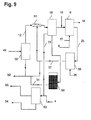
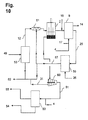
- the remainder is combined with fortified brine and sent to the plant's weak black liquor system (see, e.g., Figs. 8-10 ) .
- the remainder is sent to the transfer point described above that is downstream from the multi-effect evaporator system and upstream from the recovery boiler (see, e.g., Figs. 11-13 ).
- inventive methods can be performed in whole or in part as batch, semi-batch, semi-continuous or continuous processes.
- Fortified brine obtained from the inventive methods may be used as, or at least to produce, a biofuel, preferably a lignate-based biofuel.
- the biofuel is conveniently made from fortified brine by reducing its water content by evaporation or other well-known methods.
- a low calcium carbonate content in biofuels is usually preferred, so clarification of fortified brine (for example) may be performed if desired.
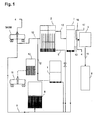
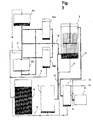
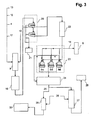
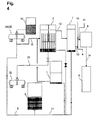
- Black liquor soap was received from the host mill 1 and was supplied to rake tank 2 along with black liquor soap received from other suppliers in tank trucks and rail cars.
- the role of tank 2 is discussed below. Reference to Figs. 1-3 may be helpful.
- the soap entered rake tank 2 near the bottom of the tank on the side opposite the outlet ports on the tank.
- additional liquor separated from the soap and formed pockets of liquor within the viscous soap bed.
- the liquor pockets tended to settle to the bottom of the tank.
- the rake tank 2 was equipped with a soap rake--a slowly rotating horizontal arm on which tines were vertically mounted to pass through the soap. The tines passed through the liquor pockets, and the black liquor drained to the bottom of the tank and formed a reservoir of black liquor. The depth of the black liquor reservoir was controlled so that the soap/liquor interface was maintained within a few inches of the bottom of the soap rake's lower tines.
- the liquor was pumped away intermittently either by operator intervention or based upon output of thermal dispersion sensors that detected whether they were in the soap layer or the liquor layer.
- the sensors were used to start and stop the liquor return pump to host mill weak black liquor storage tanks.
- Drained liquor may have contained high concentrations of soap at times because the water used to assist soap pumping dissolves a portion of the soap, and this solution drains to the bottom of the tank as well.
- the well-drained tall oil soap 13 overflowed at the top of rake tank 2 and was pumped to a soap feed tank 7 prior to being pumped to the acidulation unit 8 for acidulation.
- the combined residence time for the soap in the rake tank and the blend tank was approximately 24 hours, ranging from 8 to 72 hours depending upon the consumption rate and other operational issues.
- the soap feed tank 7 the soap was re-circulated and from there it was pumped to the acidulation unit 8 . A small amount of liquor was also drained from the bottom of this tank. This liquor was also returned to the host mill weak black liquor storage tanks 6.
- Soap was pumped using a positive displacement pump through a mass flow meter and was mixed with water 4 and a poly-naphthalene sulfonate (PNS) containing a dispersant 16 (ChemtreatTM TA 110 made by Chemtreat).
- PPS poly-naphthalene sulfonate
- the dispersant facilitates reaction with of crude tall oil soap with sulfuric acid and assists subsequent phase separation of the reaction products. Similar dispersants by various manufacturers are used widely throughout the industry.
- the mixture was pumped to an acidulation unit 8 where it was combined with concentrated sulfuric acid (93-98%) and sufficient steam to maintain an acidulation reaction temperature of between 195°F and 212°F (90°C to 100°C).
- a mixture comprising crude tall oil (CTO), spent acid (aqueous acidic sodium sulfate brine), precipitated lignin, calcium sulfate, magnesium sulfate, sand, and fiber was produced (in a continuous mode).
- CTO crude tall oil
- spent acid aqueous acidic sodium sulfate brine
- precipitated lignin calcium sulfate, magnesium sulfate, sand, and fiber was produced (in a continuous mode).
- reaction product mixture (at pH 2-4) flowed from the acidulation unit 8 to an agitated centrifuge feed tank tank 19 having level control.
- the mixture from the centrifuge feed tank tank 19 was then pumped to decanting (scoll) centrifuges 20 where precipitated solid material was separated out.
- the liquid mixture from the scroll centrifuges was sent to another agitated, level controlled collection tank 22.
- This liquid mixture comprised crude tall oil, acidic sodium sulfate brine and a small amount of finely divided, precipitated solid material.
- This mixture was then pumped to three high-capacity solids-ejecting centrifuges 23 (Alfa-Laval ® centrifuges) operated in parallel and on flow control.
- the crude tall oil and the acidic sodium sulfate brine were separated out and removed continuously.
- the crude tall oil was collected in a tank 9, and the "clean" spent acid (acidic sodium sulfate brine understood to have some impurities) was accumulated in "brine collection tank” tank 24.
- Solid material was accumulated internally on the periphery of the disk stack and ejected on a timed cycle in a "shoot" stream; the timed cycle was determined so as to prevent solids accumulation that would have resulted in excessive vibration of the centrifuges. This solid material was also directed to "brine collection tank” 24 with the clean spent acid (this being baseline operation). The solid material accumulated in the bottom of this tank.
- the clean spent acid from tank 24 (at about pH 3) was pH adjusted with caustic soda 26 (about 40% NaOH by weight in water) in a causitization unit 27 to about pH 12. Excess clean spent acid was pH adjusted similarly in neutralization unit 29 to about pH 6 for disposal.
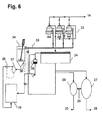
- a high-solids shoot stream from the ejecting centrifuges 23 was diverted away from flowing into brine collection tank 24 and collected in an agitated shoot collection tank 34. instead (see Fig. 6 ). About 10 gpm (40 L/min.) of the clean spent acid from the brine collection tank 24 was sent to the agitated shoot collection tank 34, and the resulting mixture was pumped into the feed to the scroll centrifuges where solids were removed.
- tall oil soap and "clean" alkaline tall oil plant brine mixture was allowed to settle in the rake tank 2.
- Fortified brine accumulated in the bottom of the rake tank 2, and the de-liquored soap at the top was pumped to the soap fee tank 7 supplying the acidulation system.
- the extract brine drained from the rake tank 2 bottom was sampled and accumulated in two rail cars for evaluation.
- the method of this invention does not appear to require deliberate cooling for washing black liquor soap. Temperatures in the various streams recited in this example were estimated to have all fallen in a range of about 110°F to 150°F (43.3°C to 65.6°C), unless otherwise noted; no deliberate cooling was employed in the soap washing itself (or mixing for this washing), and none of any significance should have occurred there.
- Example 1 the tall oil content of spent acid decreased to 0.65 wt.% from 1.05 wt.% (baseline).
- Heating value is a measure of lignin or lignate available in solution.
- the fortified brine solids content in Example 2 was about 21%, compared to 15% in the alkaline tall oil plant brine used for washing.
- the heating value of the fortified brine was about 4500 BTU/lb. (10467 kJ/kg) of dry solids compared to about 1000 BTU/lb. (2326 kJ/kg) of dry solids in the tall oil plant brine used for washing. This would suggest that lignin and other solids were removed from the soap during soap washing.
- the calcium sulfate mud accumulation was not much different during the trial than during the baseline period. Analysis of the soap supplying the reactor showed that the calcium content of this soap was about 45% lower during the trial period. As would be expected, the calcium content of the extract brine (about 7300 ppm) was much higher than in the corresponding alkaline tall oil plant brine. Typically, alkaline tall oil plant brine has much higher calcium levels than what was seen in this trial.
- the material precipitated to the bottom of the 2 soap rake tank was primarily calcium carbonate removed from the soap. About 99% of the calcium in the extract brine was as a precipitate layer at the bottom of this brine.
- the clean spent acid filterable solids determination was performed as described below.
- a 5.5-cm G6 Fisherbrand ® glass fiber filter circle that was maintained in a desiccator was added, and the Buchner filter and filter circle were accurately weighed on an analytical balance.
- the Buchner filter and the glass fiber filter circle were placed on a 500-mL Erlenmeyer filter flask connected to a vacuum source.
- the clean spent acid sample in the beaker was poured into the Buchner filter.
- the beaker was rinsed with de-ionized water several times, and the rinsings were also transferred into the Buchner filter.
- the liquid was allowed to completely pass through the filter circle and then the walls of the filter and filter pad were rinsed with de-ionized water (3 X 5-10 mL) to remove any water-soluble material.
- the filter pad in the Buchner filter was rinsed with anhydrous ethyl ether (3 x 10 mL). After each 10-mL ether rinse, the filter pad was allowed to drain until no free liquid was visible.
- the Buchner filter, filter circle and retained solids were placed in a drying oven for 2 h at 105°C.
- the Buchner filter, filter circle and retained solids were removed and allowed to cool for 30 min. in a desiccator and then weighed immediately the analytical balance.
- a dry porcelain crucible that was kept in a desiccator was weighed accurately. Then the glass fiber circle and dried sample were removed from the Buchner filter (from the total filterable solids determination above) and placed in the crucible. The crucible containing the glass fiber circle and filterable solids were placed in a muffle furnace at 750°C, and the organic material was allowed to burn off. After 4 h, the crucible and its contents were removed from the muffle furnace, placed in a desiccator and allowed to cool to room temperature for about 45 min. The crucible and the remaining contents were then accurately weighed.
- the procedures in the previous example are based upon using clean spent acid, but they can also be performed using alkaline tall oil plant brine.
- the brine is first acidified to pH 3 (the usual pH of clean spent acid) using reagent grade, concentrated hydrochloric acid, and then the steps as for the clean spent acid are performed as in the previous example.
- Subtracting the inorganic filterable solids then found from the (total) filterable solids gives the filterable organic solids.
- the filterable organics are often nearly all lignin and would correspond to the lignates in the alkaline tall oil plant brine (before acidification). A more accurate measure of lignates in the alkaline brine could be found by determining (total) filterable solids with and without first acidifying and calculating.
- the lignates (noting that the molecular weight of lignin and corresponding lignate ions are about the same) are determined by subtracting the (total) filterable solids of an unacidified sample from that of the acidified sample of the same alkaline brine.
- the results should be the same for filterable inorganic solids whether the testing is performed on an acidified or unacidified sample of alkaline tall oil plant brine, but to be on the safe side, the results from the unacidified sample are taken to be the most accurate.
Landscapes
- Chemical & Material Sciences (AREA)
- Life Sciences & Earth Sciences (AREA)
- Engineering & Computer Science (AREA)
- Wood Science & Technology (AREA)
- Chemical Kinetics & Catalysis (AREA)
- Oil, Petroleum & Natural Gas (AREA)
- Organic Chemistry (AREA)
- Paper (AREA)
- Fats And Perfumes (AREA)
- Detergent Compositions (AREA)
Claims (17)
- Procédé pour produire du tallol brut à partir de savon de liqueur noire tout en éliminant le calcium et les lignates, comprenant :(a) la combinaison d'un savon de liqueur noire comprenant du savon de tallol, des lignates, et des solides inorganiques comprenant du carbonate de calcium, avec un milieu de lavage alcalin, le milieu de lavage alcalin ayant un pH de 10 à 14 et une concentration de lignates et de solides inorganiques inférieure à celle du savon de liqueur noire, à une température située dans la plage allant de 25°C à 100°C, pour produire un mélange comprenant du savon de tallol lavé, de la saumure renforcée, des lignates, et du carbonate de calcium ;(b) la séparation du savon de tallol lavé d'avec la saumure renforcée, les lignates, et le carbonate de calcium ;(c) l'acidification du savon de tallol lavé isolé dans l'étape (b) pour donner du tallol brut et un mélange acide usé ; et(d) l'isolation du tallol brut.
- Procédé selon la revendication 1, comprenant en outre(e) l'ajustement du pH du mélange acide usé pour qu'il soit situé dans la plage de pH allant de 10 à 14, et le renvoi d'au moins une partie de celui-ci vers l'étape (a) en tant que milieu de lavage alcalin.
- Procédé selon la revendication 1, dans lequel la séparation dans l'étape (b) est effectuée par centrifugation, décantation, filtration, sédimentation, ou une combinaison de ces techniques, pour donner, en plus du savon de tallol lavé, une phase solide comprenant du carbonate de calcium, et une phase liquide comprenant de la saumure renforcée.
- Procédé selon la revendication 2, comprenant en outre le transfert de la saumure fortifiée vers une unité de stockage de liqueur noire pauvre.
- Procédé selon la revendication 2, comprenant en outre le lavage à l'eau de la phase solide pour donner du carbonate de calcium et une phase aqueuse de lignates.
- Procédé selon la revendication 4, comprenant en outre la conversion du carbonate de calcium en chaux pour utilisation dans un procédé Kraft.
- Procédé selon la revendication 4, comprenant en outre la récupération des lignates à partir de la phase aqueuse de lignates pour utilisation en tant que composant de biocarburant.
- Procédé selon la revendication 1, dans lequel la séparation dans l'étape (b) est effectuée par centrifugation, décantation, filtration, sédimentation, ou une combinaison de ces techniques, pour donner, en plus du savon de tallol lavé, une phase de saumure renforcée non clarifiée.
- Procédé selon la revendication 8, dans lequel la phase de saumure renforcée non clarifiée est envoyée à un point de transfert dans une installation Kraft qui est en aval d'un système d'évaporateur à effets multiples et en amont d'une chaudière de récupération dans le système de liqueur de l'installation.
- Procédé selon la revendication 9, dans lequel le point de transfert est en amont ou directement à l'intérieur soit d'un concentrateur de liqueur soit d'un évaporateur par contact direct et est en amont de la chaudière de récupération.
- Procédé selon la revendication 8, dans lequel la phase de saumure renforcée non clarifiée est clarifiée par centrifugation, décantation, filtration, sédimentation, ou une combinaison de ces techniques, pour que le carbonate de calcium soit éliminé et qu'une saumure renforcée clarifiée soit récupérée.
- Procédé selon la revendication 11, dans lequel la saumure renforcée clarifiée est envoyée vers un point de transfert dans une installation Kraft qui est en aval d'un système d'évaporateur à effets multiples et en amont d'une chaudière de récupération dans le système de liqueur de l'installation.
- Procédé selon la revendication 1, dans lequel la quantité de milieu de lavage alcalin est située dans la plage allant de 1 à 60 % en poids par rapport aux quantités combinées de savon de liqueur noire et de milieu de lavage alcalin.
- Procédé selon la revendication 1, dans lequel le milieu de lavage alcalin des étapes (a) et (d) a une teneur en lignates < 1,0 % en poids et une teneur en solides inorganiques filtrables < 200 ppm.
- Procédé selon la revendication 14, dans lequel le milieu de lavage alcalin a une teneur en lignates située dans la plage allant de 0,01 à 0,9 % en poids et une teneur en solides inorganiques filtrables située dans la plage allant de 10 à 175 ppm.
- Procédé selon la revendication 1, dans lequel l'étape (a) est effectuée à une température située dans la plage allant de 55°C à 95°C.
- Procédé selon la revendication 1, dans lequel le milieu de lavage alcalin a un pH situé dans la plage allant de 10,0 à 11,5.
Priority Applications (1)
| Application Number | Priority Date | Filing Date | Title |
|---|---|---|---|
| PL11758348T PL2443219T3 (pl) | 2010-09-10 | 2011-09-10 | Sposób wytwarzania surowego oleju talowego przez mycie mydła z usuwaniem węglanu wapnia |
Applications Claiming Priority (3)
| Application Number | Priority Date | Filing Date | Title |
|---|---|---|---|
| US38160310P | 2010-09-10 | 2010-09-10 | |
| US201161448893P | 2011-03-03 | 2011-03-03 | |
| PCT/US2011/051137 WO2012034112A1 (fr) | 2010-09-10 | 2011-09-10 | Procédé pour la production d'huile de pin brute par lavage du savon avec élimination de carbonate de calcium |
Publications (2)
| Publication Number | Publication Date |
|---|---|
| EP2443219A1 EP2443219A1 (fr) | 2012-04-25 |
| EP2443219B1 true EP2443219B1 (fr) | 2012-10-31 |
Family
ID=45810994
Family Applications (1)
| Application Number | Title | Priority Date | Filing Date |
|---|---|---|---|
| EP20110758348 Active EP2443219B1 (fr) | 2010-09-10 | 2011-09-10 | Procédé pour la production d'huile de pin brute par lavage du savon avec élimination de carbonate de calcium |
Country Status (9)
| Country | Link |
|---|---|
| US (1) | US8419897B2 (fr) |
| EP (1) | EP2443219B1 (fr) |
| CN (1) | CN103228771A (fr) |
| BR (1) | BR112013003975A2 (fr) |
| CA (1) | CA2806914C (fr) |
| CL (1) | CL2013000413A1 (fr) |
| PL (1) | PL2443219T3 (fr) |
| RU (1) | RU2528196C1 (fr) |
| WO (1) | WO2012034112A1 (fr) |
Families Citing this family (11)
| Publication number | Priority date | Publication date | Assignee | Title |
|---|---|---|---|---|
| WO2011140209A2 (fr) | 2010-05-04 | 2011-11-10 | The George Washington University | Procédés de production de fer et d'acier |
| WO2013082425A1 (fr) * | 2011-12-01 | 2013-06-06 | The George Washington University | Procédé de synthèse d'oxyde de calcium |
| RU2014145282A (ru) | 2012-05-14 | 2016-07-10 | Аризона Кемикал Компани, Ллс | Способ полунепрерывного подкисления |
| EP2935545B1 (fr) * | 2012-12-21 | 2020-08-19 | SunPine AB | Bioraffinage de tallöl brut |
| US9820613B2 (en) * | 2013-08-30 | 2017-11-21 | Frontline International, Inc. | Oil handling and monitoring device and system |
| SE1450683A1 (sv) | 2014-06-05 | 2015-12-06 | Stora Enso Oyj | Förfarande för utvinning av råtallolja |
| CA2961006C (fr) * | 2014-09-12 | 2019-08-13 | Arizona Chemical Company, Llc | Procede pour recuperer du tallol brut |
| SE538684C2 (sv) * | 2014-12-10 | 2016-10-18 | Göran Hofstedt Anders | Förfarande och anläggning för tvättning av råtallsåpa |
| CN104817962B (zh) * | 2015-04-07 | 2017-03-29 | 怀化市双阳林化有限公司 | 一种油木素分离方法 |
| US11034914B2 (en) * | 2018-05-01 | 2021-06-15 | Kraton Polymers Llc | Desulfurized black liquor soap compositions and processes for producing |
| CN115182186A (zh) * | 2022-08-01 | 2022-10-14 | 贵州赤天化纸业股份有限公司 | 一种环保节能的生活用纸纸浆的生产方法 |
Family Cites Families (34)
| Publication number | Priority date | Publication date | Assignee | Title |
|---|---|---|---|---|
| US2371307A (en) | 1945-03-13 | Purification of organic compounds | ||
| US2143345A (en) | 1935-04-11 | 1939-01-10 | West Virginia Pulp & Paper Com | Purification of tall oil |
| US2296952A (en) | 1939-12-30 | 1942-09-29 | Colgate Palmolive Peet Co | Chemical treatment of black liquor and tall oil |
| US2324012A (en) | 1940-05-10 | 1943-07-13 | Colgate Palmolive Peet Co | Extraction of organic materials |
| US2363694A (en) | 1940-07-05 | 1944-11-28 | Colgate Palmolive Peet Co | Hydrogenation of fatty acid soaps |
| US2389284A (en) | 1940-07-05 | 1945-11-20 | Colgate Palmolive Peet Co | Selectively hydrogenated tall oil and method of making same |
| US3575952A (en) | 1969-10-02 | 1971-04-20 | Scm Corp | Tall oil recovery |
| SE386693B (sv) | 1974-01-11 | 1976-08-16 | Skogsegarnas Ind Ab | Sett att forhindra eller begrensa utslepp av illaluktande och/eller sura svavelforbrenningsprodukter fran kemikalieregeneringsprocesser vid massaframstellning av ved medelst alkalisk uppslutning, varvid bildas... |
| US4142967A (en) * | 1975-09-15 | 1979-03-06 | Champion International Corporation | Process for enhancing recovery of tall oil soap from black liquor |
| US4154725A (en) * | 1978-02-21 | 1979-05-15 | Basf Wyandotte Corporation | Method of recovering tall oil from acidulation of raw tall oil soap |
| FI55519C (fi) * | 1978-04-05 | 1979-08-10 | Linotek Oy | Foerfarandet foer rening av fraon sulfatcellulosaprocess avskiljd raosaopa |
| US4299652A (en) * | 1978-07-31 | 1981-11-10 | Ebara Corporation | Process for recovery of pulp mill chemicals |
| US4238304A (en) * | 1979-08-30 | 1980-12-09 | Raybestos-Manhattan, Inc. | Method for improved recovery of tall oil from black liquors |
| US4524024A (en) * | 1983-02-10 | 1985-06-18 | The Badger Company, Inc. | Processes of recovering fatty acids and sterols from tall oil pitch |
| US4879369A (en) * | 1988-01-20 | 1989-11-07 | Westvaco Corporation | Method of removing lignin from tall oil |
| US5164480A (en) | 1991-08-20 | 1992-11-17 | Union Camp Corporation | Method for the manufacture of tall oils |
| RU2014282C1 (ru) * | 1992-07-31 | 1994-06-15 | Северный государственный научно-исследовательский и проектно-конструкторский геологический центр | Способ извлечения таллового лигнина из сточных вод производства сырого таллового масла |
| DE69324337T2 (de) * | 1992-12-23 | 2005-01-05 | ECC International Ltd., Theale, Reading | Verfahren zur Behandlung von Abfallsuspensionen |
| FI952176L (fi) * | 1995-05-05 | 1996-11-06 | Polargas Ab Oy | Suovan neutralointi |
| FI961930L (fi) * | 1996-05-07 | 1997-11-08 | Ahlstrom Machinery Oy | Menetelmä ja laitteisto alkalisen sellunvalmistusprosessin tehostamiseksi |
| CA2229973C (fr) * | 1997-02-21 | 2002-08-13 | Ahlstrom Machinery Oy | Methode pour empecher l'entartrage des evaporateurs de liqueur noire |
| FI105569B (fi) * | 1997-12-11 | 2000-09-15 | Polargas Ab Oy | Menetelmä mäntyöljyn valmistamiseksi |
| US6297353B1 (en) * | 1998-04-22 | 2001-10-02 | Harting, S.A. | Process for obtaining unsaponifiable compounds from black-liquor soaps, tall oil and their by-products |
| US6409882B1 (en) * | 1999-10-22 | 2002-06-25 | Westvaco Corporation | Tall oil refining improvement |
| US6589427B2 (en) * | 2001-02-28 | 2003-07-08 | Council Of Scientific & Industrial Research | Process for treatment of mixture of spent wash from distillery and black liquor from pulp and paper industry |
| MY129053A (en) * | 2001-06-06 | 2007-03-30 | Thermphos Trading Gmbh | Composition for inhibiting calcium salt scale |
| EP1302529A1 (fr) * | 2001-10-09 | 2003-04-16 | Linde AG | Séparation d'eau salée pendant la préparation de savon de tallol |
| US20030221804A1 (en) * | 2002-06-03 | 2003-12-04 | Lightner Gene E. | Lignins derived from black liquor |
| DE602004006514D1 (de) * | 2004-09-21 | 2007-06-28 | Linde Ag | Verfahren zur Gewinnung von Tallöl oder Tallölbrennstoff |
| EP1870445A1 (fr) * | 2006-06-21 | 2007-12-26 | Linde Aktiengesellschaft | Procédé de production de tall oil et utilisation d'une étape de chauffage lors de cette production |
| US7504478B2 (en) * | 2007-01-26 | 2009-03-17 | Nalco Company | Additives for increasing the separation yield of tall oil soap from black liquors |
| FI125590B (en) * | 2008-04-10 | 2015-12-15 | Neste Oyj | A process for the preparation of a composition for the preparation of pinosylvine and its compounds, a composition for the preparation of stilbene compounds, a process for the recovery of stilbene compounds, and fatty acid and resin acid esters of pinosylvine and its monomethyl ether |
| US8735637B2 (en) * | 2008-04-21 | 2014-05-27 | Sunpine Ab | Conversion of crude tall oil to renewable feedstock for diesel range fuel compositions |
| FI124508B (fi) * | 2009-02-27 | 2014-09-30 | Upm Kymmene Oyj | Menetelmä ja laitteisto polttoainekomponenttien valmistamiseksi raakamäntyöljystä |
-
2011
- 2011-09-10 WO PCT/US2011/051137 patent/WO2012034112A1/fr not_active Ceased
- 2011-09-10 RU RU2013104200/13A patent/RU2528196C1/ru not_active IP Right Cessation
- 2011-09-10 EP EP20110758348 patent/EP2443219B1/fr active Active
- 2011-09-10 PL PL11758348T patent/PL2443219T3/pl unknown
- 2011-09-10 CA CA2806914A patent/CA2806914C/fr not_active Expired - Fee Related
- 2011-09-10 CN CN2011800437427A patent/CN103228771A/zh active Pending
- 2011-09-10 BR BR112013003975A patent/BR112013003975A2/pt not_active Application Discontinuation
- 2011-11-22 US US13/302,471 patent/US8419897B2/en not_active Expired - Fee Related
-
2013
- 2013-02-08 CL CL2013000413A patent/CL2013000413A1/es unknown
Also Published As
| Publication number | Publication date |
|---|---|
| WO2012034112A1 (fr) | 2012-03-15 |
| PL2443219T3 (pl) | 2013-03-29 |
| CA2806914A1 (fr) | 2012-03-15 |
| BR112013003975A2 (pt) | 2016-07-12 |
| CA2806914C (fr) | 2015-04-21 |
| EP2443219A1 (fr) | 2012-04-25 |
| CN103228771A (zh) | 2013-07-31 |
| CL2013000413A1 (es) | 2013-08-30 |
| RU2528196C1 (ru) | 2014-09-10 |
| US8419897B2 (en) | 2013-04-16 |
| US20120123087A1 (en) | 2012-05-17 |
Similar Documents
| Publication | Publication Date | Title |
|---|---|---|
| EP2443219B1 (fr) | Procédé pour la production d'huile de pin brute par lavage du savon avec élimination de carbonate de calcium | |
| CA2454942C (fr) | Processus et dispositif de traitement de produits de queue | |
| CN103013557A (zh) | 一种油田和炼油厂用老化污油处理工艺 | |
| CA2359235A1 (fr) | Modification rheologique du decantat dans le traitement des mineraux | |
| CN103121780A (zh) | 一种污油泥处理方法 | |
| CN103739137A (zh) | 油田污油的无害化处理回收方法及装置 | |
| CA2361574C (fr) | Composition combustible recyclee a partir de flux de dechets | |
| US3575952A (en) | Tall oil recovery | |
| CN102071056A (zh) | 一种油田老化油回收处理装置 | |
| CN103113912A (zh) | 一种分离提取油砂中原油的方法 | |
| CN211814283U (zh) | 炼厂污油及浮渣减压脱水装置 | |
| CN201135791Y (zh) | 废白土萃取法提油装置 | |
| KR101451299B1 (ko) | 저회분 함량을 갖는 리그닌 입자의 제조방법 및 이에 의해 제조되는 저회분 함량을 갖는 리그닌 입자 | |
| US20170283738A1 (en) | Process for recovering crude tall oil | |
| CN114477690A (zh) | 一种赤泥协同油泥的清洗热解耦合系统及方法 | |
| CN104988337A (zh) | 一种余酸回收利用的石煤钒矿浸出工艺 | |
| CN221229984U (zh) | 一种新型己内酰胺生产装置 | |
| CN105670671B (zh) | 一种脱除煤焦油中喹啉不溶物的方法 | |
| RU2180909C1 (ru) | Способ получения топлива из нефтесодержащих отходов, топливо, полученное этим способом, способ получения топливной композиции и топливная композиция, полученная этим способом | |
| CN103818988A (zh) | 一种炼油污水处理系统回收污油的净化工艺 | |
| Konttinen | SEPARATION OF ALKALI-INSOLUBLE NON-PROCESS ELEMENTS FROM RECOVERY BOILER FLY ASH | |
| TIMS et al. | Selection of Sedimentation Equipment for the Bayer Process: An Overview of Past and Present Technology | |
| SE501877C2 (sv) | Förfarande för att fälla magnesium med aluminium vid grönlutsklarning | |
| Kinnarinen et al. | Filter cake washing: Recovery of sodium and removal of non-process elements from green liquor dregs | |
| CN103290714A (zh) | 一种再生纸板的生产方法 |
Legal Events
| Date | Code | Title | Description |
|---|---|---|---|
| PUAI | Public reference made under article 153(3) epc to a published international application that has entered the european phase |
Free format text: ORIGINAL CODE: 0009012 |
|
| 17P | Request for examination filed |
Effective date: 20111219 |
|
| AK | Designated contracting states |
Kind code of ref document: A1 Designated state(s): AL AT BE BG CH CY CZ DE DK EE ES FI FR GB GR HR HU IE IS IT LI LT LU LV MC MK MT NL NO PL PT RO RS SE SI SK SM TR |
|
| GRAP | Despatch of communication of intention to grant a patent |
Free format text: ORIGINAL CODE: EPIDOSNIGR1 |
|
| DAX | Request for extension of the european patent (deleted) | ||
| GRAS | Grant fee paid |
Free format text: ORIGINAL CODE: EPIDOSNIGR3 |
|
| GRAA | (expected) grant |
Free format text: ORIGINAL CODE: 0009210 |
|
| AK | Designated contracting states |
Kind code of ref document: B1 Designated state(s): AL AT BE BG CH CY CZ DE DK EE ES FI FR GB GR HR HU IE IS IT LI LT LU LV MC MK MT NL NO PL PT RO RS SE SI SK SM TR |
|
| REG | Reference to a national code |
Ref country code: GB Ref legal event code: FG4D Ref country code: CH Ref legal event code: EP |
|
| REG | Reference to a national code |
Ref country code: AT Ref legal event code: REF Ref document number: 582046 Country of ref document: AT Kind code of ref document: T Effective date: 20121115 |
|
| REG | Reference to a national code |
Ref country code: IE Ref legal event code: FG4D |
|
| REG | Reference to a national code |
Ref country code: SE Ref legal event code: TRGR |
|
| REG | Reference to a national code |
Ref country code: DE Ref legal event code: R096 Ref document number: 602011000387 Country of ref document: DE Effective date: 20121227 |
|
| REG | Reference to a national code |
Ref country code: NL Ref legal event code: T3 |
|
| REG | Reference to a national code |
Ref country code: LT Ref legal event code: MG4D |
|
| REG | Reference to a national code |
Ref country code: PL Ref legal event code: T3 |
|
| PG25 | Lapsed in a contracting state [announced via postgrant information from national office to epo] |
Ref country code: IS Free format text: LAPSE BECAUSE OF FAILURE TO SUBMIT A TRANSLATION OF THE DESCRIPTION OR TO PAY THE FEE WITHIN THE PRESCRIBED TIME-LIMIT Effective date: 20130228 Ref country code: LT Free format text: LAPSE BECAUSE OF FAILURE TO SUBMIT A TRANSLATION OF THE DESCRIPTION OR TO PAY THE FEE WITHIN THE PRESCRIBED TIME-LIMIT Effective date: 20121031 Ref country code: NO Free format text: LAPSE BECAUSE OF FAILURE TO SUBMIT A TRANSLATION OF THE DESCRIPTION OR TO PAY THE FEE WITHIN THE PRESCRIBED TIME-LIMIT Effective date: 20130131 Ref country code: HR Free format text: LAPSE BECAUSE OF FAILURE TO SUBMIT A TRANSLATION OF THE DESCRIPTION OR TO PAY THE FEE WITHIN THE PRESCRIBED TIME-LIMIT Effective date: 20121031 Ref country code: ES Free format text: LAPSE BECAUSE OF FAILURE TO SUBMIT A TRANSLATION OF THE DESCRIPTION OR TO PAY THE FEE WITHIN THE PRESCRIBED TIME-LIMIT Effective date: 20130211 |
|
| PG25 | Lapsed in a contracting state [announced via postgrant information from national office to epo] |
Ref country code: SI Free format text: LAPSE BECAUSE OF FAILURE TO SUBMIT A TRANSLATION OF THE DESCRIPTION OR TO PAY THE FEE WITHIN THE PRESCRIBED TIME-LIMIT Effective date: 20121031 Ref country code: GR Free format text: LAPSE BECAUSE OF FAILURE TO SUBMIT A TRANSLATION OF THE DESCRIPTION OR TO PAY THE FEE WITHIN THE PRESCRIBED TIME-LIMIT Effective date: 20130201 Ref country code: BE Free format text: LAPSE BECAUSE OF FAILURE TO SUBMIT A TRANSLATION OF THE DESCRIPTION OR TO PAY THE FEE WITHIN THE PRESCRIBED TIME-LIMIT Effective date: 20121031 Ref country code: LV Free format text: LAPSE BECAUSE OF FAILURE TO SUBMIT A TRANSLATION OF THE DESCRIPTION OR TO PAY THE FEE WITHIN THE PRESCRIBED TIME-LIMIT Effective date: 20121031 Ref country code: PT Free format text: LAPSE BECAUSE OF FAILURE TO SUBMIT A TRANSLATION OF THE DESCRIPTION OR TO PAY THE FEE WITHIN THE PRESCRIBED TIME-LIMIT Effective date: 20130228 |
|
| PG25 | Lapsed in a contracting state [announced via postgrant information from national office to epo] |
Ref country code: DK Free format text: LAPSE BECAUSE OF FAILURE TO SUBMIT A TRANSLATION OF THE DESCRIPTION OR TO PAY THE FEE WITHIN THE PRESCRIBED TIME-LIMIT Effective date: 20121031 Ref country code: RS Free format text: LAPSE BECAUSE OF FAILURE TO SUBMIT A TRANSLATION OF THE DESCRIPTION OR TO PAY THE FEE WITHIN THE PRESCRIBED TIME-LIMIT Effective date: 20121031 Ref country code: EE Free format text: LAPSE BECAUSE OF FAILURE TO SUBMIT A TRANSLATION OF THE DESCRIPTION OR TO PAY THE FEE WITHIN THE PRESCRIBED TIME-LIMIT Effective date: 20121031 Ref country code: SK Free format text: LAPSE BECAUSE OF FAILURE TO SUBMIT A TRANSLATION OF THE DESCRIPTION OR TO PAY THE FEE WITHIN THE PRESCRIBED TIME-LIMIT Effective date: 20121031 Ref country code: CZ Free format text: LAPSE BECAUSE OF FAILURE TO SUBMIT A TRANSLATION OF THE DESCRIPTION OR TO PAY THE FEE WITHIN THE PRESCRIBED TIME-LIMIT Effective date: 20121031 Ref country code: BG Free format text: LAPSE BECAUSE OF FAILURE TO SUBMIT A TRANSLATION OF THE DESCRIPTION OR TO PAY THE FEE WITHIN THE PRESCRIBED TIME-LIMIT Effective date: 20130131 |
|
| PG25 | Lapsed in a contracting state [announced via postgrant information from national office to epo] |
Ref country code: RO Free format text: LAPSE BECAUSE OF FAILURE TO SUBMIT A TRANSLATION OF THE DESCRIPTION OR TO PAY THE FEE WITHIN THE PRESCRIBED TIME-LIMIT Effective date: 20121031 |
|
| PLBE | No opposition filed within time limit |
Free format text: ORIGINAL CODE: 0009261 |
|
| STAA | Information on the status of an ep patent application or granted ep patent |
Free format text: STATUS: NO OPPOSITION FILED WITHIN TIME LIMIT |
|
| 26N | No opposition filed |
Effective date: 20130801 |
|
| REG | Reference to a national code |
Ref country code: DE Ref legal event code: R097 Ref document number: 602011000387 Country of ref document: DE Effective date: 20130801 |
|
| PG25 | Lapsed in a contracting state [announced via postgrant information from national office to epo] |
Ref country code: CY Free format text: LAPSE BECAUSE OF FAILURE TO SUBMIT A TRANSLATION OF THE DESCRIPTION OR TO PAY THE FEE WITHIN THE PRESCRIBED TIME-LIMIT Effective date: 20121031 |
|
| PG25 | Lapsed in a contracting state [announced via postgrant information from national office to epo] |
Ref country code: MC Free format text: LAPSE BECAUSE OF FAILURE TO SUBMIT A TRANSLATION OF THE DESCRIPTION OR TO PAY THE FEE WITHIN THE PRESCRIBED TIME-LIMIT Effective date: 20121031 |
|
| REG | Reference to a national code |
Ref country code: IE Ref legal event code: MM4A |
|
| PG25 | Lapsed in a contracting state [announced via postgrant information from national office to epo] |
Ref country code: IE Free format text: LAPSE BECAUSE OF NON-PAYMENT OF DUE FEES Effective date: 20130910 |
|
| REG | Reference to a national code |
Ref country code: CH Ref legal event code: PL |
|
| PG25 | Lapsed in a contracting state [announced via postgrant information from national office to epo] |
Ref country code: SM Free format text: LAPSE BECAUSE OF FAILURE TO SUBMIT A TRANSLATION OF THE DESCRIPTION OR TO PAY THE FEE WITHIN THE PRESCRIBED TIME-LIMIT Effective date: 20121031 |
|
| PG25 | Lapsed in a contracting state [announced via postgrant information from national office to epo] |
Ref country code: TR Free format text: LAPSE BECAUSE OF FAILURE TO SUBMIT A TRANSLATION OF THE DESCRIPTION OR TO PAY THE FEE WITHIN THE PRESCRIBED TIME-LIMIT Effective date: 20121031 Ref country code: MT Free format text: LAPSE BECAUSE OF FAILURE TO SUBMIT A TRANSLATION OF THE DESCRIPTION OR TO PAY THE FEE WITHIN THE PRESCRIBED TIME-LIMIT Effective date: 20121031 |
|
| PG25 | Lapsed in a contracting state [announced via postgrant information from national office to epo] |
Ref country code: CH Free format text: LAPSE BECAUSE OF NON-PAYMENT OF DUE FEES Effective date: 20140930 Ref country code: MK Free format text: LAPSE BECAUSE OF FAILURE TO SUBMIT A TRANSLATION OF THE DESCRIPTION OR TO PAY THE FEE WITHIN THE PRESCRIBED TIME-LIMIT Effective date: 20121031 Ref country code: LU Free format text: LAPSE BECAUSE OF NON-PAYMENT OF DUE FEES Effective date: 20130910 Ref country code: HU Free format text: LAPSE BECAUSE OF FAILURE TO SUBMIT A TRANSLATION OF THE DESCRIPTION OR TO PAY THE FEE WITHIN THE PRESCRIBED TIME-LIMIT; INVALID AB INITIO Effective date: 20110910 Ref country code: LI Free format text: LAPSE BECAUSE OF NON-PAYMENT OF DUE FEES Effective date: 20140930 |
|
| REG | Reference to a national code |
Ref country code: FR Ref legal event code: PLFP Year of fee payment: 6 |
|
| REG | Reference to a national code |
Ref country code: FR Ref legal event code: PLFP Year of fee payment: 7 |
|
| PGFP | Annual fee paid to national office [announced via postgrant information from national office to epo] |
Ref country code: GB Payment date: 20170927 Year of fee payment: 7 Ref country code: IT Payment date: 20170925 Year of fee payment: 7 |
|
| PGFP | Annual fee paid to national office [announced via postgrant information from national office to epo] |
Ref country code: NL Payment date: 20170926 Year of fee payment: 7 |
|
| REG | Reference to a national code |
Ref country code: FR Ref legal event code: PLFP Year of fee payment: 8 |
|
| PG25 | Lapsed in a contracting state [announced via postgrant information from national office to epo] |
Ref country code: AL Free format text: LAPSE BECAUSE OF FAILURE TO SUBMIT A TRANSLATION OF THE DESCRIPTION OR TO PAY THE FEE WITHIN THE PRESCRIBED TIME-LIMIT Effective date: 20121031 |
|
| PGFP | Annual fee paid to national office [announced via postgrant information from national office to epo] |
Ref country code: AT Payment date: 20180828 Year of fee payment: 8 |
|
| REG | Reference to a national code |
Ref country code: NL Ref legal event code: MM Effective date: 20181001 |
|
| GBPC | Gb: european patent ceased through non-payment of renewal fee |
Effective date: 20180910 |
|
| PG25 | Lapsed in a contracting state [announced via postgrant information from national office to epo] |
Ref country code: NL Free format text: LAPSE BECAUSE OF NON-PAYMENT OF DUE FEES Effective date: 20181001 |
|
| PG25 | Lapsed in a contracting state [announced via postgrant information from national office to epo] |
Ref country code: IT Free format text: LAPSE BECAUSE OF NON-PAYMENT OF DUE FEES Effective date: 20180910 |
|
| PG25 | Lapsed in a contracting state [announced via postgrant information from national office to epo] |
Ref country code: GB Free format text: LAPSE BECAUSE OF NON-PAYMENT OF DUE FEES Effective date: 20180910 |
|
| PGFP | Annual fee paid to national office [announced via postgrant information from national office to epo] |
Ref country code: PL Payment date: 20190822 Year of fee payment: 9 |
|
| REG | Reference to a national code |
Ref country code: AT Ref legal event code: MM01 Ref document number: 582046 Country of ref document: AT Kind code of ref document: T Effective date: 20190910 |
|
| PG25 | Lapsed in a contracting state [announced via postgrant information from national office to epo] |
Ref country code: AT Free format text: LAPSE BECAUSE OF NON-PAYMENT OF DUE FEES Effective date: 20190910 |
|
| PG25 | Lapsed in a contracting state [announced via postgrant information from national office to epo] |
Ref country code: PL Free format text: LAPSE BECAUSE OF NON-PAYMENT OF DUE FEES Effective date: 20200910 |
|
| PGFP | Annual fee paid to national office [announced via postgrant information from national office to epo] |
Ref country code: DE Payment date: 20240918 Year of fee payment: 14 Ref country code: FI Payment date: 20240918 Year of fee payment: 14 |
|
| PGFP | Annual fee paid to national office [announced via postgrant information from national office to epo] |
Ref country code: FR Payment date: 20240925 Year of fee payment: 14 |
|
| PGFP | Annual fee paid to national office [announced via postgrant information from national office to epo] |
Ref country code: SE Payment date: 20240919 Year of fee payment: 14 |
|
| PG25 | Lapsed in a contracting state [announced via postgrant information from national office to epo] |
Ref country code: FI Free format text: LAPSE BECAUSE OF NON-PAYMENT OF DUE FEES Effective date: 20250910 |