EP2444501A1 - Sensor - Google Patents
Sensor Download PDFInfo
- Publication number
- EP2444501A1 EP2444501A1 EP10188556A EP10188556A EP2444501A1 EP 2444501 A1 EP2444501 A1 EP 2444501A1 EP 10188556 A EP10188556 A EP 10188556A EP 10188556 A EP10188556 A EP 10188556A EP 2444501 A1 EP2444501 A1 EP 2444501A1
- Authority
- EP
- European Patent Office
- Prior art keywords
- scaffold
- bacteria
- dna
- rna
- ligands
- Prior art date
- Legal status (The legal status is an assumption and is not a legal conclusion. Google has not performed a legal analysis and makes no representation as to the accuracy of the status listed.)
- Withdrawn
Links
- 239000003814 drug Substances 0.000 claims abstract description 123
- 229940079593 drug Drugs 0.000 claims abstract description 122
- 238000000034 method Methods 0.000 claims abstract description 34
- 238000004519 manufacturing process Methods 0.000 claims abstract description 5
- 241000894006 Bacteria Species 0.000 claims description 135
- 230000008859 change Effects 0.000 claims description 90
- 239000003446 ligand Substances 0.000 claims description 87
- 150000001875 compounds Chemical class 0.000 claims description 85
- 239000002088 nanocapsule Substances 0.000 claims description 53
- 108020004414 DNA Proteins 0.000 claims description 40
- 238000006243 chemical reaction Methods 0.000 claims description 33
- 230000000845 anti-microbial effect Effects 0.000 claims description 31
- 208000015181 infectious disease Diseases 0.000 claims description 29
- 239000000758 substrate Substances 0.000 claims description 25
- 108090000765 processed proteins & peptides Proteins 0.000 claims description 24
- 230000015572 biosynthetic process Effects 0.000 claims description 23
- 239000011148 porous material Substances 0.000 claims description 23
- 102000004196 processed proteins & peptides Human genes 0.000 claims description 21
- -1 sulfates Chemical class 0.000 claims description 20
- 150000001413 amino acids Chemical class 0.000 claims description 19
- 239000003242 anti bacterial agent Substances 0.000 claims description 16
- 229940088710 antibiotic agent Drugs 0.000 claims description 16
- 239000002699 waste material Substances 0.000 claims description 16
- 108091036060 Linker DNA Proteins 0.000 claims description 14
- 201000010099 disease Diseases 0.000 claims description 14
- 208000037265 diseases, disorders, signs and symptoms Diseases 0.000 claims description 14
- 230000007613 environmental effect Effects 0.000 claims description 14
- 239000004599 antimicrobial Substances 0.000 claims description 12
- 229910052751 metal Inorganic materials 0.000 claims description 12
- 239000002184 metal Substances 0.000 claims description 12
- 230000002503 metabolic effect Effects 0.000 claims description 10
- 231100000614 poison Toxicity 0.000 claims description 10
- 239000003440 toxic substance Substances 0.000 claims description 10
- 108090000790 Enzymes Proteins 0.000 claims description 9
- 102000004190 Enzymes Human genes 0.000 claims description 9
- 241000700605 Viruses Species 0.000 claims description 9
- 125000000524 functional group Chemical group 0.000 claims description 9
- 241000233866 Fungi Species 0.000 claims description 8
- 230000008878 coupling Effects 0.000 claims description 7
- 238000010168 coupling process Methods 0.000 claims description 7
- 238000005859 coupling reaction Methods 0.000 claims description 7
- 235000000346 sugar Nutrition 0.000 claims description 7
- 150000008163 sugars Chemical class 0.000 claims description 7
- 230000000977 initiatory effect Effects 0.000 claims description 6
- 150000001298 alcohols Chemical class 0.000 claims description 5
- 244000052616 bacterial pathogen Species 0.000 claims description 5
- 230000014670 detection of bacterium Effects 0.000 claims description 4
- 102000053602 DNA Human genes 0.000 claims description 3
- 238000010511 deprotection reaction Methods 0.000 claims description 3
- 150000003839 salts Chemical class 0.000 claims description 3
- 108020004682 Single-Stranded DNA Proteins 0.000 claims description 2
- 239000000872 buffer Substances 0.000 claims description 2
- 239000003795 chemical substances by application Substances 0.000 claims description 2
- 230000003297 denaturating effect Effects 0.000 claims description 2
- 125000002524 organometallic group Chemical group 0.000 claims description 2
- 150000003467 sulfuric acid derivatives Chemical class 0.000 claims description 2
- 239000003053 toxin Substances 0.000 claims description 2
- 231100000765 toxin Toxicity 0.000 claims description 2
- 108700012359 toxins Proteins 0.000 claims description 2
- 238000000576 coating method Methods 0.000 description 47
- 208000035143 Bacterial infection Diseases 0.000 description 39
- 208000022362 bacterial infectious disease Diseases 0.000 description 39
- 230000001580 bacterial effect Effects 0.000 description 31
- 239000007943 implant Substances 0.000 description 31
- 239000000243 solution Substances 0.000 description 23
- 229910052709 silver Inorganic materials 0.000 description 22
- 239000004332 silver Substances 0.000 description 22
- 239000000463 material Substances 0.000 description 21
- 239000011248 coating agent Substances 0.000 description 19
- 239000000047 product Substances 0.000 description 15
- BQCADISMDOOEFD-UHFFFAOYSA-N Silver Chemical compound [Ag] BQCADISMDOOEFD-UHFFFAOYSA-N 0.000 description 12
- 229940100890 silver compound Drugs 0.000 description 12
- 150000003379 silver compounds Chemical class 0.000 description 12
- 230000003993 interaction Effects 0.000 description 11
- 108020000946 Bacterial DNA Proteins 0.000 description 10
- 108020004513 Bacterial RNA Proteins 0.000 description 10
- VYPSYNLAJGMNEJ-UHFFFAOYSA-N Silicium dioxide Chemical compound O=[Si]=O VYPSYNLAJGMNEJ-UHFFFAOYSA-N 0.000 description 10
- GWEVSGVZZGPLCZ-UHFFFAOYSA-N Titan oxide Chemical compound O=[Ti]=O GWEVSGVZZGPLCZ-UHFFFAOYSA-N 0.000 description 10
- 230000000295 complement effect Effects 0.000 description 10
- 230000001965 increasing effect Effects 0.000 description 10
- 239000011159 matrix material Substances 0.000 description 10
- 238000003379 elimination reaction Methods 0.000 description 9
- 239000000203 mixture Substances 0.000 description 9
- 239000007787 solid Substances 0.000 description 9
- 239000000126 substance Substances 0.000 description 9
- 230000007774 longterm Effects 0.000 description 8
- 230000007246 mechanism Effects 0.000 description 8
- 210000001519 tissue Anatomy 0.000 description 8
- 230000001960 triggered effect Effects 0.000 description 8
- 230000000844 anti-bacterial effect Effects 0.000 description 7
- 238000009792 diffusion process Methods 0.000 description 7
- 230000000694 effects Effects 0.000 description 7
- 230000008030 elimination Effects 0.000 description 7
- 150000004820 halides Chemical class 0.000 description 7
- 239000010936 titanium Substances 0.000 description 7
- 229910052719 titanium Inorganic materials 0.000 description 7
- FOIXSVOLVBLSDH-UHFFFAOYSA-N Silver ion Chemical compound [Ag+] FOIXSVOLVBLSDH-UHFFFAOYSA-N 0.000 description 6
- 230000008901 benefit Effects 0.000 description 6
- 239000010931 gold Substances 0.000 description 6
- 150000002500 ions Chemical class 0.000 description 6
- 239000002077 nanosphere Substances 0.000 description 6
- 239000002243 precursor Substances 0.000 description 6
- 230000008569 process Effects 0.000 description 6
- 230000018612 quorum sensing Effects 0.000 description 6
- XOLBLPGZBRYERU-UHFFFAOYSA-N tin dioxide Chemical compound O=[Sn]=O XOLBLPGZBRYERU-UHFFFAOYSA-N 0.000 description 6
- 206010034133 Pathogen resistance Diseases 0.000 description 5
- RTAQQCXQSZGOHL-UHFFFAOYSA-N Titanium Chemical compound [Ti] RTAQQCXQSZGOHL-UHFFFAOYSA-N 0.000 description 5
- PNEYBMLMFCGWSK-UHFFFAOYSA-N aluminium oxide Inorganic materials [O-2].[O-2].[O-2].[Al+3].[Al+3] PNEYBMLMFCGWSK-UHFFFAOYSA-N 0.000 description 5
- 238000001514 detection method Methods 0.000 description 5
- 230000006870 function Effects 0.000 description 5
- 229910052737 gold Inorganic materials 0.000 description 5
- 238000009396 hybridization Methods 0.000 description 5
- 230000002401 inhibitory effect Effects 0.000 description 5
- BASFCYQUMIYNBI-UHFFFAOYSA-N platinum Chemical compound [Pt] BASFCYQUMIYNBI-UHFFFAOYSA-N 0.000 description 5
- 239000000377 silicon dioxide Substances 0.000 description 5
- 150000003384 small molecules Chemical class 0.000 description 5
- 238000011282 treatment Methods 0.000 description 5
- 229910017089 AlO(OH) Inorganic materials 0.000 description 4
- 206010061218 Inflammation Diseases 0.000 description 4
- 239000012190 activator Substances 0.000 description 4
- 229910052797 bismuth Inorganic materials 0.000 description 4
- 230000006378 damage Effects 0.000 description 4
- 230000003247 decreasing effect Effects 0.000 description 4
- 239000012895 dilution Substances 0.000 description 4
- 238000010790 dilution Methods 0.000 description 4
- SZVJSHCCFOBDDC-UHFFFAOYSA-N ferrosoferric oxide Chemical compound O=[Fe]O[Fe]O[Fe]=O SZVJSHCCFOBDDC-UHFFFAOYSA-N 0.000 description 4
- 235000013305 food Nutrition 0.000 description 4
- 150000004676 glycans Chemical class 0.000 description 4
- PCHJSUWPFVWCPO-UHFFFAOYSA-N gold Chemical compound [Au] PCHJSUWPFVWCPO-UHFFFAOYSA-N 0.000 description 4
- FAHBNUUHRFUEAI-UHFFFAOYSA-M hydroxidooxidoaluminium Chemical compound O[Al]=O FAHBNUUHRFUEAI-UHFFFAOYSA-M 0.000 description 4
- 230000004054 inflammatory process Effects 0.000 description 4
- 239000007788 liquid Substances 0.000 description 4
- 230000004060 metabolic process Effects 0.000 description 4
- 229920000642 polymer Polymers 0.000 description 4
- 229920001282 polysaccharide Polymers 0.000 description 4
- 239000005017 polysaccharide Substances 0.000 description 4
- LIVNPJMFVYWSIS-UHFFFAOYSA-N silicon monoxide Chemical compound [Si-]#[O+] LIVNPJMFVYWSIS-UHFFFAOYSA-N 0.000 description 4
- 238000003786 synthesis reaction Methods 0.000 description 4
- HEMHJVSKTPXQMS-UHFFFAOYSA-M Sodium hydroxide Chemical compound [OH-].[Na+] HEMHJVSKTPXQMS-UHFFFAOYSA-M 0.000 description 3
- 238000013459 approach Methods 0.000 description 3
- 230000037358 bacterial metabolism Effects 0.000 description 3
- 230000032770 biofilm formation Effects 0.000 description 3
- JCXGWMGPZLAOME-UHFFFAOYSA-N bismuth atom Chemical compound [Bi] JCXGWMGPZLAOME-UHFFFAOYSA-N 0.000 description 3
- 238000009395 breeding Methods 0.000 description 3
- 230000001488 breeding effect Effects 0.000 description 3
- 210000002421 cell wall Anatomy 0.000 description 3
- 229910052681 coesite Inorganic materials 0.000 description 3
- 229910052802 copper Inorganic materials 0.000 description 3
- 239000010949 copper Substances 0.000 description 3
- 229910052593 corundum Inorganic materials 0.000 description 3
- 229910052906 cristobalite Inorganic materials 0.000 description 3
- 231100000135 cytotoxicity Toxicity 0.000 description 3
- 230000003013 cytotoxicity Effects 0.000 description 3
- 239000007789 gas Substances 0.000 description 3
- 230000035876 healing Effects 0.000 description 3
- 230000036541 health Effects 0.000 description 3
- 238000002513 implantation Methods 0.000 description 3
- 238000000338 in vitro Methods 0.000 description 3
- 230000002757 inflammatory effect Effects 0.000 description 3
- 230000005764 inhibitory process Effects 0.000 description 3
- 239000011859 microparticle Substances 0.000 description 3
- 239000002105 nanoparticle Substances 0.000 description 3
- 230000002441 reversible effect Effects 0.000 description 3
- 229910052682 stishovite Inorganic materials 0.000 description 3
- 238000001356 surgical procedure Methods 0.000 description 3
- 229910052905 tridymite Inorganic materials 0.000 description 3
- 230000000007 visual effect Effects 0.000 description 3
- 229910001845 yogo sapphire Inorganic materials 0.000 description 3
- RYGMFSIKBFXOCR-UHFFFAOYSA-N Copper Chemical compound [Cu] RYGMFSIKBFXOCR-UHFFFAOYSA-N 0.000 description 2
- 206010059866 Drug resistance Diseases 0.000 description 2
- LFQSCWFLJHTTHZ-UHFFFAOYSA-N Ethanol Chemical compound CCO LFQSCWFLJHTTHZ-UHFFFAOYSA-N 0.000 description 2
- 206010028980 Neoplasm Diseases 0.000 description 2
- 108091028043 Nucleic acid sequence Proteins 0.000 description 2
- 239000004793 Polystyrene Substances 0.000 description 2
- 241000191940 Staphylococcus Species 0.000 description 2
- 241000191963 Staphylococcus epidermidis Species 0.000 description 2
- 108010059993 Vancomycin Proteins 0.000 description 2
- 230000002378 acidificating effect Effects 0.000 description 2
- 230000002924 anti-infective effect Effects 0.000 description 2
- 230000003110 anti-inflammatory effect Effects 0.000 description 2
- 230000010065 bacterial adhesion Effects 0.000 description 2
- 239000011324 bead Substances 0.000 description 2
- 230000009286 beneficial effect Effects 0.000 description 2
- ZREIPSZUJIFJNP-UHFFFAOYSA-K bismuth subsalicylate Chemical compound C1=CC=C2O[Bi](O)OC(=O)C2=C1 ZREIPSZUJIFJNP-UHFFFAOYSA-K 0.000 description 2
- 229960000782 bismuth subsalicylate Drugs 0.000 description 2
- ZQUAVILLCXTKTF-UHFFFAOYSA-H bismuth;tripotassium;2-hydroxypropane-1,2,3-tricarboxylate Chemical compound [K+].[K+].[K+].[Bi+3].[O-]C(=O)CC(O)(CC([O-])=O)C([O-])=O.[O-]C(=O)CC(O)(CC([O-])=O)C([O-])=O ZQUAVILLCXTKTF-UHFFFAOYSA-H 0.000 description 2
- 230000005587 bubbling Effects 0.000 description 2
- CETPSERCERDGAM-UHFFFAOYSA-N ceric oxide Chemical compound O=[Ce]=O CETPSERCERDGAM-UHFFFAOYSA-N 0.000 description 2
- 229910000422 cerium(IV) oxide Inorganic materials 0.000 description 2
- AYTAKQFHWFYBMA-UHFFFAOYSA-N chromium dioxide Chemical compound O=[Cr]=O AYTAKQFHWFYBMA-UHFFFAOYSA-N 0.000 description 2
- 125000000113 cyclohexyl group Chemical group [H]C1([H])C([H])([H])C([H])([H])C([H])(*)C([H])([H])C1([H])[H] 0.000 description 2
- QDOXWKRWXJOMAK-UHFFFAOYSA-N dichromium trioxide Chemical compound O=[Cr]O[Cr]=O QDOXWKRWXJOMAK-UHFFFAOYSA-N 0.000 description 2
- 239000003651 drinking water Substances 0.000 description 2
- 235000020188 drinking water Nutrition 0.000 description 2
- 238000012377 drug delivery Methods 0.000 description 2
- 230000002255 enzymatic effect Effects 0.000 description 2
- 239000012634 fragment Substances 0.000 description 2
- 238000001727 in vivo Methods 0.000 description 2
- 230000036512 infertility Effects 0.000 description 2
- 229910052809 inorganic oxide Inorganic materials 0.000 description 2
- 230000002427 irreversible effect Effects 0.000 description 2
- 210000003127 knee Anatomy 0.000 description 2
- 238000007273 lactonization reaction Methods 0.000 description 2
- 239000004816 latex Substances 0.000 description 2
- 229920000126 latex Polymers 0.000 description 2
- 238000011068 loading method Methods 0.000 description 2
- 150000002739 metals Chemical class 0.000 description 2
- 239000004530 micro-emulsion Substances 0.000 description 2
- 230000007935 neutral effect Effects 0.000 description 2
- 108020004707 nucleic acids Proteins 0.000 description 2
- 102000039446 nucleic acids Human genes 0.000 description 2
- 150000007523 nucleic acids Chemical class 0.000 description 2
- 210000000056 organ Anatomy 0.000 description 2
- 239000007793 ph indicator Substances 0.000 description 2
- 239000000049 pigment Substances 0.000 description 2
- 229910052697 platinum Inorganic materials 0.000 description 2
- 229920002223 polystyrene Polymers 0.000 description 2
- 238000012545 processing Methods 0.000 description 2
- 230000035755 proliferation Effects 0.000 description 2
- 108090000623 proteins and genes Proteins 0.000 description 2
- 102000004169 proteins and genes Human genes 0.000 description 2
- 230000009467 reduction Effects 0.000 description 2
- 230000002829 reductive effect Effects 0.000 description 2
- CQLFBEKRDQMJLZ-UHFFFAOYSA-M silver acetate Chemical compound [Ag+].CC([O-])=O CQLFBEKRDQMJLZ-UHFFFAOYSA-M 0.000 description 2
- 229940071536 silver acetate Drugs 0.000 description 2
- 230000004083 survival effect Effects 0.000 description 2
- 239000012730 sustained-release form Substances 0.000 description 2
- 238000012360 testing method Methods 0.000 description 2
- 230000007704 transition Effects 0.000 description 2
- 238000002054 transplantation Methods 0.000 description 2
- MYPYJXKWCTUITO-LYRMYLQWSA-N vancomycin Chemical compound O([C@@H]1[C@@H](O)[C@H](O)[C@@H](CO)O[C@H]1OC1=C2C=C3C=C1OC1=CC=C(C=C1Cl)[C@@H](O)[C@H](C(N[C@@H](CC(N)=O)C(=O)N[C@H]3C(=O)N[C@H]1C(=O)N[C@H](C(N[C@@H](C3=CC(O)=CC(O)=C3C=3C(O)=CC=C1C=3)C(O)=O)=O)[C@H](O)C1=CC=C(C(=C1)Cl)O2)=O)NC(=O)[C@@H](CC(C)C)NC)[C@H]1C[C@](C)(N)[C@H](O)[C@H](C)O1 MYPYJXKWCTUITO-LYRMYLQWSA-N 0.000 description 2
- 229960003165 vancomycin Drugs 0.000 description 2
- MYPYJXKWCTUITO-UHFFFAOYSA-N vancomycin Natural products O1C(C(=C2)Cl)=CC=C2C(O)C(C(NC(C2=CC(O)=CC(O)=C2C=2C(O)=CC=C3C=2)C(O)=O)=O)NC(=O)C3NC(=O)C2NC(=O)C(CC(N)=O)NC(=O)C(NC(=O)C(CC(C)C)NC)C(O)C(C=C3Cl)=CC=C3OC3=CC2=CC1=C3OC1OC(CO)C(O)C(O)C1OC1CC(C)(N)C(O)C(C)O1 MYPYJXKWCTUITO-UHFFFAOYSA-N 0.000 description 2
- RTONKOFFKFVXAW-UHFFFAOYSA-N 6-(1H-indol-5-yl)-N-methyl-2-methylsulfonylpyrimidin-4-amine Chemical compound N1C=CC2=CC(=CC=C12)C1=CC(=NC(=N1)S(=O)(=O)C)NC RTONKOFFKFVXAW-UHFFFAOYSA-N 0.000 description 1
- 239000005725 8-Hydroxyquinoline Substances 0.000 description 1
- 241000203069 Archaea Species 0.000 description 1
- 208000034309 Bacterial disease carrier Diseases 0.000 description 1
- XMWRBQBLMFGWIX-UHFFFAOYSA-N C60 fullerene Chemical class C12=C3C(C4=C56)=C7C8=C5C5=C9C%10=C6C6=C4C1=C1C4=C6C6=C%10C%10=C9C9=C%11C5=C8C5=C8C7=C3C3=C7C2=C1C1=C2C4=C6C4=C%10C6=C9C9=C%11C5=C5C8=C3C3=C7C1=C1C2=C4C6=C2C9=C5C3=C12 XMWRBQBLMFGWIX-UHFFFAOYSA-N 0.000 description 1
- VEXZGXHMUGYJMC-UHFFFAOYSA-M Chloride anion Chemical compound [Cl-] VEXZGXHMUGYJMC-UHFFFAOYSA-M 0.000 description 1
- 108020004635 Complementary DNA Proteins 0.000 description 1
- 108020004394 Complementary RNA Proteins 0.000 description 1
- 238000000018 DNA microarray Methods 0.000 description 1
- 206010064687 Device related infection Diseases 0.000 description 1
- 241000588724 Escherichia coli Species 0.000 description 1
- 229910016697 EuO Inorganic materials 0.000 description 1
- 241000206602 Eukaryota Species 0.000 description 1
- 229920002444 Exopolysaccharide Polymers 0.000 description 1
- 206010016275 Fear Diseases 0.000 description 1
- KRHYYFGTRYWZRS-UHFFFAOYSA-M Fluoride anion Chemical compound [F-] KRHYYFGTRYWZRS-UHFFFAOYSA-M 0.000 description 1
- 241000224467 Giardia intestinalis Species 0.000 description 1
- 206010018910 Haemolysis Diseases 0.000 description 1
- ONIBWKKTOPOVIA-BYPYZUCNSA-N L-Proline Chemical compound OC(=O)[C@@H]1CCCN1 ONIBWKKTOPOVIA-BYPYZUCNSA-N 0.000 description 1
- RJQXTJLFIWVMTO-TYNCELHUSA-N Methicillin Chemical compound COC1=CC=CC(OC)=C1C(=O)N[C@@H]1C(=O)N2[C@@H](C(O)=O)C(C)(C)S[C@@H]21 RJQXTJLFIWVMTO-TYNCELHUSA-N 0.000 description 1
- 244000110797 Polygonum persicaria Species 0.000 description 1
- ONIBWKKTOPOVIA-UHFFFAOYSA-N Proline Natural products OC(=O)C1CCCN1 ONIBWKKTOPOVIA-UHFFFAOYSA-N 0.000 description 1
- 240000004808 Saccharomyces cerevisiae Species 0.000 description 1
- 241000295644 Staphylococcaceae Species 0.000 description 1
- 239000002253 acid Substances 0.000 description 1
- 230000009471 action Effects 0.000 description 1
- 125000003158 alcohol group Chemical group 0.000 description 1
- 125000000539 amino acid group Chemical group 0.000 description 1
- 150000005005 aminopyrimidines Chemical class 0.000 description 1
- 230000000181 anti-adherent effect Effects 0.000 description 1
- QVGXLLKOCUKJST-UHFFFAOYSA-N atomic oxygen Chemical compound [O] QVGXLLKOCUKJST-UHFFFAOYSA-N 0.000 description 1
- 239000003782 beta lactam antibiotic agent Substances 0.000 description 1
- 230000003115 biocidal effect Effects 0.000 description 1
- 230000008033 biological extinction Effects 0.000 description 1
- 239000012620 biological material Substances 0.000 description 1
- 230000033228 biological regulation Effects 0.000 description 1
- 210000001772 blood platelet Anatomy 0.000 description 1
- 210000004204 blood vessel Anatomy 0.000 description 1
- 210000000988 bone and bone Anatomy 0.000 description 1
- 239000006227 byproduct Substances 0.000 description 1
- 238000010804 cDNA synthesis Methods 0.000 description 1
- 238000001354 calcination Methods 0.000 description 1
- 201000011510 cancer Diseases 0.000 description 1
- 239000002775 capsule Substances 0.000 description 1
- 150000001718 carbodiimides Chemical class 0.000 description 1
- 229910052799 carbon Inorganic materials 0.000 description 1
- 125000004432 carbon atom Chemical group C* 0.000 description 1
- 210000004027 cell Anatomy 0.000 description 1
- 230000021164 cell adhesion Effects 0.000 description 1
- 239000004568 cement Substances 0.000 description 1
- 238000005119 centrifugation Methods 0.000 description 1
- 150000005829 chemical entities Chemical class 0.000 description 1
- UBEWDCMIDFGDOO-UHFFFAOYSA-N cobalt(II,III) oxide Inorganic materials [O-2].[O-2].[O-2].[O-2].[Co+2].[Co+3].[Co+3] UBEWDCMIDFGDOO-UHFFFAOYSA-N 0.000 description 1
- 239000002299 complementary DNA Substances 0.000 description 1
- 239000003184 complementary RNA Substances 0.000 description 1
- 239000000470 constituent Substances 0.000 description 1
- 238000011109 contamination Methods 0.000 description 1
- 230000001276 controlling effect Effects 0.000 description 1
- 239000013256 coordination polymer Substances 0.000 description 1
- 229920001795 coordination polymer Polymers 0.000 description 1
- 239000013058 crude material Substances 0.000 description 1
- ZSWFCLXCOIISFI-UHFFFAOYSA-N cyclopentadiene Chemical group C1C=CC=C1 ZSWFCLXCOIISFI-UHFFFAOYSA-N 0.000 description 1
- 231100000433 cytotoxic Toxicity 0.000 description 1
- 230000001472 cytotoxic effect Effects 0.000 description 1
- 230000034994 death Effects 0.000 description 1
- 238000000354 decomposition reaction Methods 0.000 description 1
- 230000003111 delayed effect Effects 0.000 description 1
- 230000036425 denaturation Effects 0.000 description 1
- 238000004925 denaturation Methods 0.000 description 1
- 230000008021 deposition Effects 0.000 description 1
- 238000013461 design Methods 0.000 description 1
- 230000027734 detection of oxygen Effects 0.000 description 1
- 238000003745 diagnosis Methods 0.000 description 1
- 238000001647 drug administration Methods 0.000 description 1
- 239000000975 dye Substances 0.000 description 1
- 238000005538 encapsulation Methods 0.000 description 1
- 206010015037 epilepsy Diseases 0.000 description 1
- 150000002148 esters Chemical class 0.000 description 1
- 230000002349 favourable effect Effects 0.000 description 1
- KTWOOEGAPBSYNW-UHFFFAOYSA-N ferrocene Chemical group [Fe+2].C=1C=C[CH-]C=1.C=1C=C[CH-]C=1 KTWOOEGAPBSYNW-UHFFFAOYSA-N 0.000 description 1
- 239000012530 fluid Substances 0.000 description 1
- 239000006260 foam Substances 0.000 description 1
- 239000003205 fragrance Substances 0.000 description 1
- 229910003472 fullerene Inorganic materials 0.000 description 1
- 238000007306 functionalization reaction Methods 0.000 description 1
- 150000002241 furanones Chemical class 0.000 description 1
- 239000000499 gel Substances 0.000 description 1
- 230000012010 growth Effects 0.000 description 1
- 229910052736 halogen Inorganic materials 0.000 description 1
- 150000002367 halogens Chemical class 0.000 description 1
- 238000010438 heat treatment Methods 0.000 description 1
- 230000008588 hemolysis Effects 0.000 description 1
- 125000002887 hydroxy group Chemical group [H]O* 0.000 description 1
- 229910052588 hydroxylapatite Inorganic materials 0.000 description 1
- 150000003949 imides Chemical class 0.000 description 1
- 239000012729 immediate-release (IR) formulation Substances 0.000 description 1
- 230000008105 immune reaction Effects 0.000 description 1
- 230000001939 inductive effect Effects 0.000 description 1
- 238000003780 insertion Methods 0.000 description 1
- 230000037431 insertion Effects 0.000 description 1
- 210000000936 intestine Anatomy 0.000 description 1
- 238000011835 investigation Methods 0.000 description 1
- JEIPFZHSYJVQDO-UHFFFAOYSA-N iron(III) oxide Inorganic materials O=[Fe]O[Fe]=O JEIPFZHSYJVQDO-UHFFFAOYSA-N 0.000 description 1
- 238000002386 leaching Methods 0.000 description 1
- 239000006249 magnetic particle Substances 0.000 description 1
- 206010025482 malaise Diseases 0.000 description 1
- 150000002697 manganese compounds Chemical class 0.000 description 1
- WPBNNNQJVZRUHP-UHFFFAOYSA-L manganese(2+);methyl n-[[2-(methoxycarbonylcarbamothioylamino)phenyl]carbamothioyl]carbamate;n-[2-(sulfidocarbothioylamino)ethyl]carbamodithioate Chemical compound [Mn+2].[S-]C(=S)NCCNC([S-])=S.COC(=O)NC(=S)NC1=CC=CC=C1NC(=S)NC(=O)OC WPBNNNQJVZRUHP-UHFFFAOYSA-L 0.000 description 1
- 238000002483 medication Methods 0.000 description 1
- 210000002901 mesenchymal stem cell Anatomy 0.000 description 1
- 239000002207 metabolite Substances 0.000 description 1
- 150000002736 metal compounds Chemical class 0.000 description 1
- 229960003085 meticillin Drugs 0.000 description 1
- 230000000813 microbial effect Effects 0.000 description 1
- 230000004048 modification Effects 0.000 description 1
- 238000012986 modification Methods 0.000 description 1
- 230000009456 molecular mechanism Effects 0.000 description 1
- 239000007908 nanoemulsion Substances 0.000 description 1
- 230000004770 neurodegeneration Effects 0.000 description 1
- 208000015122 neurodegenerative disease Diseases 0.000 description 1
- 231100000252 nontoxic Toxicity 0.000 description 1
- 230000003000 nontoxic effect Effects 0.000 description 1
- 150000002902 organometallic compounds Chemical class 0.000 description 1
- 238000010883 osseointegration Methods 0.000 description 1
- 230000004819 osteoinduction Effects 0.000 description 1
- 230000001151 other effect Effects 0.000 description 1
- 229910052760 oxygen Inorganic materials 0.000 description 1
- 239000001301 oxygen Substances 0.000 description 1
- 229960003540 oxyquinoline Drugs 0.000 description 1
- 239000002245 particle Substances 0.000 description 1
- XYJRXVWERLGGKC-UHFFFAOYSA-D pentacalcium;hydroxide;triphosphate Chemical compound [OH-].[Ca+2].[Ca+2].[Ca+2].[Ca+2].[Ca+2].[O-]P([O-])([O-])=O.[O-]P([O-])([O-])=O.[O-]P([O-])([O-])=O XYJRXVWERLGGKC-UHFFFAOYSA-D 0.000 description 1
- 230000035699 permeability Effects 0.000 description 1
- 239000013612 plasmid Substances 0.000 description 1
- 239000000843 powder Substances 0.000 description 1
- 230000002265 prevention Effects 0.000 description 1
- 125000002924 primary amino group Chemical group [H]N([H])* 0.000 description 1
- 125000004076 pyridyl group Chemical group 0.000 description 1
- MCJGNVYPOGVAJF-UHFFFAOYSA-N quinolin-8-ol Chemical compound C1=CN=C2C(O)=CC=CC2=C1 MCJGNVYPOGVAJF-UHFFFAOYSA-N 0.000 description 1
- 230000002285 radioactive effect Effects 0.000 description 1
- 230000036647 reaction Effects 0.000 description 1
- 230000001105 regulatory effect Effects 0.000 description 1
- 238000009877 rendering Methods 0.000 description 1
- 230000029058 respiratory gaseous exchange Effects 0.000 description 1
- 230000004044 response Effects 0.000 description 1
- 239000012047 saturated solution Substances 0.000 description 1
- 230000035945 sensitivity Effects 0.000 description 1
- 230000011664 signaling Effects 0.000 description 1
- 238000003980 solgel method Methods 0.000 description 1
- 230000001954 sterilising effect Effects 0.000 description 1
- 238000004659 sterilization and disinfection Methods 0.000 description 1
- 125000001424 substituent group Chemical group 0.000 description 1
- 125000001273 sulfonato group Chemical class [O-]S(*)(=O)=O 0.000 description 1
- 125000004354 sulfur functional group Chemical group 0.000 description 1
- 238000004381 surface treatment Methods 0.000 description 1
- 230000002459 sustained effect Effects 0.000 description 1
- 238000013268 sustained release Methods 0.000 description 1
- 230000009885 systemic effect Effects 0.000 description 1
- 150000003568 thioethers Chemical class 0.000 description 1
- 241001148471 unidentified anaerobic bacterium Species 0.000 description 1
- 230000001018 virulence Effects 0.000 description 1
- XLYOFNOQVPJJNP-UHFFFAOYSA-N water Substances O XLYOFNOQVPJJNP-UHFFFAOYSA-N 0.000 description 1
Images
Classifications
-
- C—CHEMISTRY; METALLURGY
- C07—ORGANIC CHEMISTRY
- C07H—SUGARS; DERIVATIVES THEREOF; NUCLEOSIDES; NUCLEOTIDES; NUCLEIC ACIDS
- C07H21/00—Compounds containing two or more mononucleotide units having separate phosphate or polyphosphate groups linked by saccharide radicals of nucleoside groups, e.g. nucleic acids
- C07H21/04—Compounds containing two or more mononucleotide units having separate phosphate or polyphosphate groups linked by saccharide radicals of nucleoside groups, e.g. nucleic acids with deoxyribosyl as saccharide radical
-
- C—CHEMISTRY; METALLURGY
- C12—BIOCHEMISTRY; BEER; SPIRITS; WINE; VINEGAR; MICROBIOLOGY; ENZYMOLOGY; MUTATION OR GENETIC ENGINEERING
- C12Q—MEASURING OR TESTING PROCESSES INVOLVING ENZYMES, NUCLEIC ACIDS OR MICROORGANISMS; COMPOSITIONS OR TEST PAPERS THEREFOR; PROCESSES OF PREPARING SUCH COMPOSITIONS; CONDITION-RESPONSIVE CONTROL IN MICROBIOLOGICAL OR ENZYMOLOGICAL PROCESSES
- C12Q1/00—Measuring or testing processes involving enzymes, nucleic acids or microorganisms; Compositions therefor; Processes of preparing such compositions
- C12Q1/02—Measuring or testing processes involving enzymes, nucleic acids or microorganisms; Compositions therefor; Processes of preparing such compositions involving viable microorganisms
- C12Q1/04—Determining presence or kind of microorganism; Use of selective media for testing antibiotics or bacteriocides; Compositions containing a chemical indicator therefor
-
- G—PHYSICS
- G01—MEASURING; TESTING
- G01N—INVESTIGATING OR ANALYSING MATERIALS BY DETERMINING THEIR CHEMICAL OR PHYSICAL PROPERTIES
- G01N33/00—Investigating or analysing materials by specific methods not covered by groups G01N1/00 - G01N31/00
- G01N33/48—Biological material, e.g. blood, urine; Haemocytometers
- G01N33/50—Chemical analysis of biological material, e.g. blood, urine; Testing involving biospecific ligand binding methods; Immunological testing
- G01N33/53—Immunoassay; Biospecific binding assay; Materials therefor
- G01N33/5308—Immunoassay; Biospecific binding assay; Materials therefor for analytes not provided for elsewhere, e.g. nucleic acids, uric acid, worms, mites
-
- G—PHYSICS
- G01—MEASURING; TESTING
- G01N—INVESTIGATING OR ANALYSING MATERIALS BY DETERMINING THEIR CHEMICAL OR PHYSICAL PROPERTIES
- G01N33/00—Investigating or analysing materials by specific methods not covered by groups G01N1/00 - G01N31/00
- G01N33/48—Biological material, e.g. blood, urine; Haemocytometers
- G01N33/50—Chemical analysis of biological material, e.g. blood, urine; Testing involving biospecific ligand binding methods; Immunological testing
- G01N33/53—Immunoassay; Biospecific binding assay; Materials therefor
- G01N33/543—Immunoassay; Biospecific binding assay; Materials therefor with an insoluble carrier for immobilising immunochemicals
- G01N33/54366—Apparatus specially adapted for solid-phase testing
- G01N33/54373—Apparatus specially adapted for solid-phase testing involving physiochemical end-point determination, e.g. wave-guides, FETS, gratings
Definitions
- the present invention relates to a scaffolded sensor, in particular to a scaffolded bacterial sensor, to prevent bacterial infections or detect bacteria in solutions.
- the infection rate for knee implants lies in the range of 1-2 %in contrast to 20 % for implantations of pacemakers. These infections occur frequently perioperatively by bacterial contamination of the surgical site. In general, an early infection is caused by the bacteria S . aureus, if delayed mostly low virulence organisms including S . epidermidis, are responsible. Bacteria in implants typically proliferate and cluster in multilayers of exopolysaccharides, widely known as so-called biofilms.
- biofilms allow bacteria to resist antimicrobial agents and immune reactions of the body. Therefore it is impossible to treat them with "normal" antibiotics. Leading to dramatic complications for the patient or death in the worst case and to higher infection rates in the future, also accompanied with high costs for the health system.
- Biofilms can lead to inflammatory host responses, due bacterial multiplication (septic failure) or aseptic failures caused by bacterial components (polysaccharides) and microparticles of bacterial or material debris.
- nano-structured containers for drug delivery by diffusion and/or dilution mechanisms.
- Such systems have been focused mainly on the treatment of neurodegenerative diseases, such as epilepsy or cancer tumors.
- neurodegenerative diseases such as epilepsy or cancer tumors.
- polymer-based vesicles as well as oxidic materials have been studied in order to obtain hollow nanospheres.
- Various nanospheres were tested for drug delivery made from Au, CuS or AlO(OH).
- oxidic systems such as CeO 2 , SnO 2 , SiO 2 -CaO, or TiO 2 were successfully tested for their biocompatibility, but beside good bio-qualities the introduction of antibacterial compounds presents a difficult task which cannot be solved by the known methods.
- oxide materials precursors based on polymer networks, have been studied to provide nanospheres containing silver ions with good stability and solubility. But although the silver ions show good results, the unsolved problem is still controlling the release of the drugs of nanospheres.
- a sensor for bacteria could initiate selective drug release.
- providing systems to detect and classify bacteria is difficult due to the large variety of bacteria and their differing metabolism, this was successful within in vitro tests, with multi-array electrochemical sensors or microcalorimetry via detection of oxygen consumption.
- oxygen consumption there exist not only oxygen consuming bacteria but also anaerobic bacteria e.g. rot-causing bacteria like P . vulgaris, P. pyocynea, G . lamblia which are not detectable by this method.
- DNA-chips have been found to be selective tools for the detection of matching base pairs. It has been found that single DNA strands form double-strands in a slight excess of target strands, even if a few mismatches were introduced.
- the sensor according to the invention detects the presence of bacteria, which triggers a conformational change of the intrinsically metastable scaffold to an energetically more stable conformation.
- a trigger for the conformational change of the scaffold can be the presence of bacteria, a virus, germs, moulds, fungus, metabolic or waste products, metabolic or waste product of any microbe or bacteria, peptides, amino acids, toxins, toxic substances, microbes, spores, disease-genes, any environmental change such as temperature, pH, ion concentration, magnetic influences, irradiation, such as UV-, IR-, ⁇ -, ⁇ -, ⁇ -, X-ray-radiation, microwaves, pressure, osmosis, concentration gradients etc.
- the sensor according to the invention could thus also be designated as “bacterial sensor”, “biochemical sensor” and/or “biophysical sensor”, preferably as "bacterial sensor”.
- Ligand as used therein is understood, that it can be as being a chemical entity which functions as a substituent, which can be attached or bound to a scaffolded sensor.
- Ligands can be either (unreactive) ligands, such as RNA-strands, DNA-strands, peptides, amino-acids, enzymes, substrates, complexes etc. to enable a hybridization whenever an at least partly matching complementary RNA-strand, DNA-strand, peptide, amino-acid, enzyme, substrate, complex etc. is present, or ligands which can react as particiate in a chemical reaction (reactive ligands).
- the ligands are selected from the group of reactive or non-reactive ligands, DNA-and/or RNA-strands, sugars, peptides, amino acids, enzyme-substrate-complexes, or enzymes or substrates, organometallic and coordination compounds, compound-filled containers, functionalized ligands, alcohols, indicators (e.g. pH-indicators which can change their colour due to a change of the pH-value).
- indicators e.g. pH-indicators which can change their colour due to a change of the pH-value.
- Any sterical demanding ligand can be attached to the scaffold either functionalized with functional groups, DNA and/or RNA, or any other metal or compound.
- a ligand is a reactive compound, a DNA and/or RNA-strand, to detect bacterial DNA and/or RNA or other bacterial compounds, metabolic or waste products, besides other detectable compounds such as sugars, peptides, peptide-PNAs, molecules, derivatives, amino acids, metal-complexes, metalorganic-compounds, enzyme-substrate complexes or parts of the latter which are equipped with either a functional group, specific for its type or any other structural design which enables the substrate to interact with any ligand of a scaffold according to the present invention.
- detectable compounds such as sugars, peptides, peptide-PNAs, molecules, derivatives, amino acids, metal-complexes, metalorganic-compounds, enzyme-substrate complexes or parts of the latter which are equipped with either a functional group, specific for its type or any other structural design which enables the substrate to interact with any ligand of a scaffold according to the present invention.
- the ligand can be sterically demanding or non-sterically demanding.
- locking-ligands describes a pair of ligands, that are attached to the scaffold and by mutual interaction hold the scaffold in an energetically unfavoured conformation.
- substrate is understood as being any substance e.g. DNA-, and/or RNA-strands, amino acids, peptides, sugars, bacterial components (polysaccharides) or microparticles of bacteria or material debris, metabolic or waste products, quorum sensing, toxic substances, disease-genes, enzyme-substrate complexes or any other compound, detectable with the scaffolded sensor.
- compound according to the present invention is understood as being a group of drugs, antibiotics, metal salts, e.g. sulfates, sulfides, sulfazines, sulfadiazines, indicators, denaturating agents, metalorganic complexes, buffers, alcohols, magnetic compounds, vesicles.
- metal salts e.g. sulfates, sulfides, sulfazines, sulfadiazines, indicators, denaturating agents, metalorganic complexes, buffers, alcohols, magnetic compounds, vesicles.
- container means a porous usually hollow nanocapsule made of an inert material, like for example fullerenes, inorganic oxides like silica, alumina, silica-alumina compounds etc. The manufacture of such container is described further below.
- nanocapsule is a porous nanocapsule, which has the possibility to change the pore size reversibly.
- polymer-based containers as well as oxidic materials have been studied in order to synthesize hollow nanocapsules.
- the outer shell of the nanocapsules provides an anti-bacterial activity, especially an anti-inflammatory and anti-infective activity when applied in coatings of implant devices implants, or surgical equipment and instruments, reservoirs for liquids or other material that should be sterile.
- the scaffold can be linked to drug-filled containers to trigger drug release to defeat the present bacteria.
- the presence or bacteria can be directly detected, which results in a conformational change of the metastable scaffold.
- the change into an energetically more stable conformation can be displayed and detected for example by a change in colour of the sensor, an emission of light (visible or non-visible), an increase of temperature, a release of chemicals, gaseous, liquid, smelling, bubbling or fluorescent, odorant, foul tasting.
- the release of chemicals can be a drug release from a container linked to the scaffold, to inhibit a bacterial infection, inflammatory, formation of biofilms and adhesions.
- the sensor enables to release exactly the amount of drugs necessary to fight the present bacteria, at their place of origin, without wasting drugs, risking inactivity due to slow or inhibited release from the container, affecting healthy tissue or risking bacteria resistance due to constant drug release.
- the antimicrobial system can detect bacteria and indicate the presence, by detectable or visible signals, e.g. changing color, or conductivity etc.
- a high sensitivity to the kind of bacteria is provided which enables an optimized medical treatment of the bacterial infection, and a short-term detection of the disease.
- implants can be provided with such inventive compounds, to inhibit infections directly and prevent inflammatory or rejections of implants, fixation devices, or organ transplantations, and prevent the formation of biofilms due to bacterial infection, to increase the survival rate and enhance the healing of patients.
- the scaffold of the sensor according to the present invention registers the presence of bacteria due to present substrates e.g. DNA-, and/or RNA-strands, amino acids, peptides, sugars, bacterial components (polysaccharides) or microparticles of bacteria or material debris, metabolic or waste products, quorum-sensing, toxic substances, disease-genes, enzyme-substrate complexes or any other compound, detectable with the scaffolded sensor.
- substrates e.g. DNA-, and/or RNA-strands, amino acids, peptides, sugars, bacterial components (polysaccharides) or microparticles of bacteria or material debris, metabolic or waste products, quorum-sensing, toxic substances, disease-genes, enzyme-substrate complexes or any other compound.
- the intrinsically metastable conformation of the scaffold is held in its unfavoured conformation unless the scaffold is triggered by any trigger, to undergo a change into an energetically more favoured conformation.
- the pairing of the locking-ligands either reactive or non-reactive ligands, forces the scaffold in its unfavoured position.
- the pairing or binding of the locking-ligands breaks whenever any substrate is present, due to a higher binding energy between the substrate and one of the locking-ligands.
- the pairing of the locking-ligands results from at least partly mismatching DNA and/or RNA-strands.
- any other substrate-sensitive ligand known to a skilled person can be applied.
- a conformational change to an energetically more favoured conformation can be triggered by a change in temperature, pH, ion-concentration in the environment, presence of different compounds such as, sugars, peptides, metabolic or waste products, substrates, amino-acids, enzymes, enzyme-substrate complexes, or any bacteria, virus, germ, mould, fungus etc.
- such a subsequent process can be the chemical reaction occurring between the freed ligand and another ligand attached to the scaffold, e.g. an elimination reaction, which results in eliminating ions or molecules e.g. leaving groups or halides of the other ligand bound to the scaffold. Due to the chemical reaction the more stable conformation is reached and stabilized.
- the elimination of ions or neutral molecules e.g.
- the conformational change of the scaffold due to the new binding to the substrates triggers an increased temperature of the sample resulting from releasing binding energy due to a higher binding energy of the new pairing.
- This has the beneficial effect that a change in temperature can be easily detected via thermistors etc., besides inhibiting a further infection of bacteria, which are highly temperature sensitive. Used for medical purposes, an increase in temperature supports the body's own defence mechanism, resulting in a more effective battle with bacterial infections.
- the bacterial infection can be inhibited, while further changes can also be initiated, if the sensor is equipped with e.g. a nanoporous drug-filled container, the release of the drug can be initiated due to increased pore sizes of the containers, based on the solutions tendency towards creating an equilibrium between the different concentrations.
- the eliminated small molecules can further trigger a pH-change of the sample, resulting in a change of colour, when indicators are either attached to the scaffold or released from a container linked to the scaffold.
- Chemical indicator reactions lead preferably to colour changes which can be easily detected and indicate therefore reliably the presence of the trigger.
- the eliminated small molecules can further react with other ligands, trigger the release of other compounds, e.g. attached indicator molecules (e.g. pH-indicator molecules which can change their colour due to a change of the pH-value) or drugs to prevent further bacterial infection. Therefore, the battle with bacteria can be directly initiated by the presence itself.
- attached indicator molecules e.g. pH-indicator molecules which can change their colour due to a change of the pH-value
- drugs e.g. pH-indicator molecules which can change their colour due to a change of the pH-value
- drugs e.g. pH-indicator molecules which can change their colour due to a change of the pH-value
- drugs e.g. pH-indicator molecules which can change their colour due to a change of the pH-value
- drugs e.g. pH-indicator molecules which can change their colour due to a change of the pH-value
- drugs e.g. pH-indicator molecules which can change their colour due to a change of the pH
- the conformational change triggers the release of compounds either directly or indirectly. Directly, via elimination of linked ligands, or indirectly via release from attached containers. Furthermore gases can also be released either directly or indirectly, which also initiates a colour change or taste of the sample, containing the sensor. Besides a colour change, also any other visual detectable change can be triggered, such as emission of light, fluorescence etc. Besides that, the release of ligands can defeat the environmental influence, which has caused the conformational change.
- Another embodiment of the present invention enables triggering of any substrate in solids, solutions etc. by providing a visual signal when the metastable conformation changes into an energetically more stable conformation. Therefore, visual signals can be a change in colour of the solution, solid, etc., the formation of gaseous bubbles, which indicates the presence of any substrate related to bacteria, virus, germ, spores, mould, disease-genes, toxic substances etc.
- a colour change, denaturation or any other indication for the presence of a detected substrate provides good protection against infections or illnesses.
- the scaffolded sensor is equipped with a container comprising a drug for triggering drug release, wherein the scaffold is intrinsically metastable.
- the presence of bacteria is detectable, which initiates the release of drugs from a container comprising a drug, to inhibit the formation of biofilms on e.g. implants, and especially infections of the detected bacteria.
- Such drug filled containers can comprise any drugs having an antimicrobial effect, or other effects on any disease imaginable by a skilled person.
- Inhibiting bacterial or virulent infections can be achieved by e.g. antibiotics, lactam-derivatives, metal derivates, of platinum, gold, bismuth, titanium, manganese, copper or silver compounds, such as silver nanoparticles, either functionalized with amino acid sequences, peptides or other derivatives effecting diseases, bacterial infects, virulent infects or other illnesses, peptides, sulfadiazines, or any such compounds known to a skilled person.
- drugs can be released from these containers, but also compounds to denature solutions or mark them as contaminated via release of coloured compounds, e.g. to indicate bacteria contaminated drinking water, to prevent consumption and illnesses caused by the bacterial infections.
- the release of compounds from the containers is triggered by the presence of bacteria and therefore only released when and as long as bacteria are present. Therefore, the released amount, which is necessary to battle with a bacterial infection can be extraordinarily reduced.
- the compound-filled containers are linked to a conformationally metastable scaffold.
- the metastable scaffold is forced into a less preferred conformation, which initiates a conformational change whenever bacteria are present.
- the change in conformation starts from a metastable conformation into a preferred stable conformation, which initiates the release of compounds from a container.
- the compound is directly released to provide either inhibition of further bacterial infections, indicate the presence of bacteria due to a change in colour, when the released compounds are indicators, keep the sensor in certain places, in case of a magnetic compound, provides an emission of light, when the compound is a fluorescent, increases the samples temperature when the compound reacts with a ligand attached to the scaffold, wherefrom binding energy is released, or undergoes a chemical reaction with compounds already present in the environment. Therefore, the release happens exactly where the bacteria are present, and it is ensured that as few as possible drugs are used to defeat a bacterial infection as the presence of bacteria is needed to release the drugs.
- the scaffolded sensor comprises at least one drug-filled container, which is linked to the conformationally metastable scaffold either by a linker or is directly bound. It depends on the kind of bacteria and the use if the containers are directly or indirectly bound to the scaffold. It is beneficial when the containers are equipped with tethers, via tethers a container can not only be linked to the scaffold but also to different surfaces. Such containers can therefore be attached e.g. to an implant material, either directly via such a surface tether or also on top of a previously deposited coating. Furthermore, containers can either be bound to the scaffold and also to a surface.
- the container can be implemented in a coating by attaching it via tethers onto or into a surface. In there, slow compound release is provided, to assure the inhibition of bacterial infection. Attached to the surface of a coating, especially an implant or fixation device, infections due to bacterial settling is inhibited. Such coatings can also be applied to any medical or sterile object, to provide bacterial-free equipment. If such a sensor is attached to any surface, the formation of biofilms is inhibited.
- the compounds encapsulated in the containers can inhibit the formation of biofilms due to the presence of bacteria. These compounds are released and prevent the colonization of the bacteria in such biofilms.
- other compounds either directly linked to the scaffold or encapsulated in the containers can be released to dissolve the biofilms, and battle with the present bacteria.
- the compounds can be released to dissolve these biofilms, migrate into the biofilm-matrix, set there and prevent further formation and eliminate the biofilm-matrix.
- functionalized containers can be filled with bacteria selective compounds. Whenever bacteria or biofilms are present the containers are separated by the conformational change of the scaffold, triggered by the bacteria, migrate into the biofilm-matrix, where they start to release the dissolving and antimicrobial compounds, directly in the matrix.
- biofilms allow bacteria to resist antimicrobial agents, due to their colonization and proliferation in the biofilms which protects them of the antimicrobial compounds, it is almost impossible to treat formed biofilms with normal methods after formation.
- the formation and therefore the infection rate can be extraordinarily decreased when biofilm-formation and proliferation of bacteria is inhibited.
- a surface coating without the sensor equipped with compound-filled containers can be directly embedded into a surface coating, either directly by application of mixed coatings, or via tethers. This is advantageous if implants are provided with such a coating, as it ensures that no inflammation or bacterial infection can occur after the surgery and accelerates the healing process.
- Such coatings can also be applied on surgery or medical equipment, or all compounds, which shall stay clean and aseptic.
- the invention beforehand provides a sensor, which comprises a scaffold that has a plurality of changeable conformations.
- the scaffold is forced into a metastable conformation, which can be changed between different more or less energetically preferred conformations.
- the scaffold is intrinsically conformational metastable, which can be changed in the presence of a trigger.
- the scaffold provides at least one metastable conformation and at least one conformational stable conformation.
- a scaffold might be a cyclohexane- or a ferrocene-derivate, or any compound which can undergo a conformational change, initiated by any environmental factor, such as pH, temperature, irradiation, such as UV-, IR-, ⁇ -, ⁇ -, ⁇ -, X-ray-radiation, microwaves etc., or the presence of an activator, intramolecular shifting, due to a reaction between bound ligands, which are linked to the scaffold, or an intermolecular shifting, resulting from a reaction between different molecules and certain ligands, bound to the scaffold.
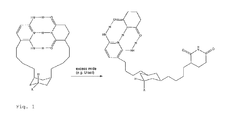
- Figure 1 shows schematically a sensor with a cyclohexane scaffold, forced into a conformational metastable state by functional groups.
- the conformational change of the scaffold can be reversible, preferably it is irreversible.
- the conformational change of the scaffold is easily initiated, while the amount of changed scaffolds depends on the intensity of the environmental change, which can easily be detected.
- Such conformational changes can also be detectable by a colour change of the sensor.
- the presence of bacterial DNA and/or RNA or any other compound related to bacterial presence triggers the scaffolded sensor to change its colour, preferred in a range of visible light and releases drugs from a container. So, in the presence of bacteria, the less preferred metastable conformation changes into a more stable conformation, which leads to a colour change to display the conformational change.
- the scaffold can trigger directly the release of chemicals to denature e.g. drinking water, food etc. to prevent infections due to consumption of bacteria contaminated food, drinks, etc.
- Another method, to prevent consumption of contaminated food is when the sensor detects bacteria and triggers release of smelling or bubbling gas, foul tasting, initiates a change in colour of the sensor composition, results in a change of colour of the solution, solid etc. which can be released from attached containers. Therefore, the attached sensor secures in an effective way that the contaminated food, water, drink etc. does not lead to a bacterial infection.
- the conformational change can also trigger a direct release of chemicals, either to defeat the present bacteria, or denature the solution, solid etc.
- the conformational change can trigger the relase of compound-filled containers, either functionalized to provide the release of compounds directly in, on or at coatings or adhesions, either do defeat the presence bacteria, denature the solution, solid etc. or to indicate the presence by a change of colour due to the release of indicators, dyes, pigments etc. which can be attached to the infected surface of a coating or adhesion.
- the senor can also detect the presence of other germs, virus, fungus, spores, mould, disease-genes, toxic substances or any other problem, which can cause illnesses, sicknesses or can affect human health.
- the scaffold of the sensor can be for example a cyclohexane- or a ferrocene-derivate or any skeletal structure to which different ligands can be bound, either reversible or irreversible.
- the scaffold provides a three-dimensional structure, with an ability to provide conformational changes.
- the scaffold itself is an inert compound, and shows good biocompatibility.
- the sensor according to the invention comprises a scaffold, which preferably provides a plurality of conformations, for example a cyclohexane-derivate.
- a scaffold which preferably provides a plurality of conformations, for example a cyclohexane-derivate.
- cyclohexane-derivates are quite unreactive und nontoxic and provide a plurality of different conformations, such as the chair, half-chair, envelope, twist or twist-boat or boat conformation. Only the twist form is isolable as - like the chair conformation - it represents a preferred energetic state, an energy minimum.
- the boat conformation does not suffer from angle strain but has a higher energy than the chair form due to steric strain resulting from the two axial 1,4-hydrogen atoms, in what is called the flagpole interaction.
- the torsional strain in the boat conformation has a maximum value because two of the carbon bonds are eclipsed. Compare this to the chair with all bonds staggered and complete absence of torsional strain and the twist-boat with 4 out 6 bonds partially eclipsed. In the half-chair conformation four carbon atoms are located on a plane in which two bonds are fully eclipsed.
- the boat and envelope forms are transition states between the twist forms and the twist and chair forms respectively, and are impossible to isolate.
- the twist-boat conformation is less stable than the chair conformation.
- the ring flipping process can now be described with more precision as taking place through a twist-boat conformation and through two half-chair transition states. Although not stable at ambient temperatures, all conformations can be stabilized when ligands are introduced.
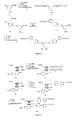
- An exemplary synthesis route of a cyclohexane scaffold with attached ligands is shown in Figure 5 .
- a ferrocene-derivate as scaffold.
- the ferrocene-derivate shows rotationally flexible cyclopentadiene rings, which can stand either in a staggered conformation or eclipsed conformation.
- the advantage of applying such scaffold-derivatives is that the conformation can change very easily, but can be stabilized by rotation-inhibiting ligands. Therefore the conformational change of the scaffolded sensor is initiated very easily by any change of the environmental factors.
- An exemplary synthesis route to a ferrocene scaffold with attached ligands is shown in Figure 6 .
- the change of the scaffold of the bacteria sensor can also be initiated by the presence of bacteria. It can also be initiated by bacterial cell wall constituents or other signalling molecules. Detection of bacteria can be effected via present DNA and/or RNA or any other bacterial compounds or products in the environment of the sensor.
- the scaffold of the sensor can be equipped with matching or mismatching, or at least partly mismatching DNA and/or RNA sequences, which have the function of detecting bacterial DNA and/or RNA fragments or sequences in the environment.
- the matching of the bacterial DNA and/or RNA sequences with DNA and/or RNA initiator-sequences linked to the scaffold trigger the conformational change of the scaffold. Therefore the detection of the bacteria in the environment of the sensor is directly initiated by the presence of bacteria and is detected without time loss.
- the matching of the bacterial DNA and/or RNA sequences with DNA and/or RNA initiator-sequences linked to the scaffold trigger the conformational change of the scaffold, while the conformational change triggers drug release from the containers. Therefore bacteria are detected and defeated in the same time, without any further test, diagnosis or any other treatment. So, the amount of drugs can be reduced to the actual necessary amount, the effectivity is increased as the drugs are directly released where needed, and the risk of breading drug-resistant bacteria, e.g. to antibiotics, is dramatically decreased, as the presence of the bacteria triggers the drug release.
- the scaffold of the sensor has ligands.
- ligands can be ligands, which can be attached to the scaffold. Suitable ligands have been described in the foregoing.
- tracing systems can be attached to the scaffold, to determine the effectivity of the sensor, which can be detected with any device known in the state of the art.
- the ligands can be axially arranged, so that the conformation of the scaffold is forced into the metastable conformation.
- the ligands can thereby force the scaffold into the metastable conformation by a bonding of the locking-ligands, e.g. matching, mismatching or partly mismatching DNA and/or RNA strands.
- a conformational change of the scaffold can be initiated by the breaking of the interactions of the locking-ligands. As they stabilize the metastable conformation of the scaffold, due to a release of the binding between the ligands the conformation can change to a more stable position, as the position of the ligands is rearranged and can flip into equatorial positions.
- the other ligands are in close proximity to each other. Therefore an intramolecular chemical reaction with another ligand nearby can occur, or intermolecular reaction with a ligand or any other compound, or activator present in the environment resulting in a more stable conformation of the scaffold.
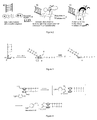
- the senor in the sense of the invention has a scaffold with at least one ligand and at least a partly mismatching pair of DNA and/or RNA strands as exemplified in Figure 2 .
- the scaffold of such a bacteria sensor is kept in an intrinsically metastable conformation by the interaction of at least two complementary strands of DNA and/or RNA, which show some degree of mismatching. In the presence of a fully matching complementary single-stranded sequence in solution or in the environment, a stronger interaction will result, a so-called hybridization of the DNA and/or RNA strands, thus breaking the intramolecular pairing of the mismatching DNA and/or RNA and initiate a conformational change.
- both DNA and/or RNA-strands will force other parts of the ring to be in close proximity and allow an intramolecular chemical reaction, releasing X (by-product).
- the two ligands, the DNA and/or RNA-strands are forced into more stable equatorial positions, initiating the release mechanism, as they place the conformation in the relevant conformation, in that way, that the elimination can proceed.
- a ligand attached to the scaffold is then a reactive ligand, which can be functionalized with an alcohol, halogen or any other leaving group.
- any kind of molecular recognition types e.g. peptides, small molecules and other types of nucleic acids can be applied.
- RNA-sequence every sequence known to a skilled person can be applied and attached to the scaffold of the sensor.
- Non-limiting examples are the sequences AAAAA and TTATT, but also better matching sequences, or other sequences, which are more convenient or cheaper.
- the sequence must be adapted to the kind of bacteria, which shall be detected.
- imide/aminopyrimidine systems can be attached, or sequences such as AAGGAGGTGA and/or GTTACGACTTCAC and the at least partly mismatching partner strand, e.g. mRBS-0 ((KFF) 3 K-(egl d ) 2 -AAGGAGGTGA), mRBS-1 ((KFF) 3 K-(egl)2-AAGGACGTGA), mRBS-2 ((KFF) 3 K-(egl)2-ACCGAGGTGA), 344 ((KFF) 3 K-(G e )-GCTGCCTCCCGT), 522 ((KFF) 3 K-(G)-TTACCGCGGCTG), 899 ((KFF) 3 K-(G)-GAGTTTTAACCTTG), 1489 ((KFF) 3 K-(G) GTTACGACTTCAC).
- mRBS-0 ((KFF) 3 K-(egl d ) 2 -AAGGAGGTGA), m
- the senor comprises at least one ligand, which is preferably a container.
- a container can be a drug-filled container.
- drug-filled containers can be provided with different antimicrobial compounds depending on the application area and the kind of bacteria, which shall be defeated.
- the compounds filled in such containers are only limited by their size and solubility. Beneficially, compounds with an antimicrobial effect are filled into the containers.
- metal salts can be used to inhibit bacterial infections, e.g. silver ions, such as silver sulfadiazines are filled into such containers. Silver compounds are due to their bacteria cytotoxicity highly appreciated.
- compositions comprising Pt, Cu, Bi, Au, Ti or mixtures thereof.
- antimicrobial silver, bismuth, copper, gold compositions are applied, e.g. Cu-salts, colloidal bismuth subcitrate (CBS), bismuth subsalicylate (BSS).
- silver nanoparticles of defined size were formed as a function of these amino acid sequences.
- Silver compounds may be engineered as a function of peptides, to inhibit bacterial infections.
- antimicrobial compounds formed with silver ions and peptide-based antibiotics, e. g. vancomycin are also applied in defeating bacteria.
- the implementation into containers is only limited by the size of the compounds therefore not every compound can be transported into the containers.
- the metal-derivatives used as antimicrobial drugs should further provide good binding properties to the bacterial cell wall molecules to certain polysaccharides or proteins, as they interfere by displacing essential ions, such as Ca 2+ , Zn 2+ from enzymes vital for bacterial respiration and growth.
- platinum-, gold-, manganese- compounds or even some peptides have also been successfully applied due to their binding properties toward silver ions, and the silver binding ones do indicate a preferential enrichment of proline and hydroxyl-containing amino acid residues.
- silver can remain for an extended period in the body without harming the tissue, which was successfully affirmed in long-term studies.
- silver compounds applied as nanoparticles or (nano-) powders were investigated.
- Silver metal compounds were applied in vivo subcutaneously, but the release from containers is more effective. The latter provide confined space for a silver compound and allow a slow and constant release of the latter via diffusion.
- the scaffold's conformational change is triggered by the presence of bacteria.
- the scaffold is functionalized with ligands, which can be DNA and/or RNA-strands or any other compound which can bind to amino DNA and/or RNA, sugars, enzyme-substrate complexes or parts thereof, amino acids, peptides or any other metabolic or waste product.
- the scaffold is kept in a metastable conformational state by the interaction of complementary strands of DNA and/or RNA, with some degree of mismatch. The partly mismatching DNA and/or RNA-strands force the conformation of the scaffold into an energetically unfavoured metastable conformation.
- the drugs are only released in presence of bacteria, to enable a final destruction of bacterial colonization and infection with a low risk of bacterial drug-resistance.
- the sensor can be modified in that way, that specific types of bacteria can be detected and indicated, e.g. by changing the colour, conductivity or pH of a solution.
- a sensor, equipped with a scaffold, sensitive to the presence of bacteria or any other virus, fungus, mould, disease-genes, toxic substances or any other germ can also prevent the formation of biofilms due to bacterial infection, and provide better healing of patents with implants, fixation devices or after transplantations.
- the drug release is stopped or slowed down, while drug release is increased in the presence of bacteria.
- bacterial DNA and/or RNA can trigger a conformational change of the scaffold, but also any bacterial compound, such as specific amino acid sequences or peptides, besides bacterial metabolites or waste products or quorum sensing molecules.
- the sensor triggers the conformational change of the scaffold, which initiates an intramolecular chemical reaction of the reactive or non-reactive ligands.
- a conformationally intrinsically unstable scaffold is kept in a metastable state by the interaction of complementary strands of DNA and/or RNA, with at least some degree of mismatch. In the presence of a fully matching complementary single-stranded sequence in solution, a stronger interaction will result, thus breaking the intramolecular pairing and trigger a conformational change.
- the spatially more appropriate equatorial positioning of both DNA and/or RNA, one of them now as a duplex with the foreign complementary sequence will force other parts of the ring to be in close proximity and allowing an intramolecular chemical reaction, releasing small molecules, e.g.
- halides or other leaving groups More specifically, such a reaction could be a lactonization, with alcohol or halides as leaving groups or a trans E2 elimination.
- This mechanism is not limited to DNA and/or RNA strands, any kind of molecular recognizable type, e.g. peptides, small molecules and other types of nucleic acids could be applied in this method.
- a conformational change of the scaffold can be initiated by the breaking of the interactions of the locking-ligands. As they stabilize the metastable conformation of the scaffold, due to a release of the binding between the ligands the conformation can change to a more stable position, as the position of the ligands is rearranged and can flip into equatorial positions. As a consequence of the conformational switch into a more stable conformation, the other ligands are in close proximity to each other. Therefore an intramolecular chemical reaction with another ligand nearby can occur, or intermolecular reaction with a ligand or any other compound, or activator present in the environment
- an intramolecular chemical reaction triggers drug release from the container.
- the conformational change of the scaffold is triggered, which initiates the intramolecular chemical reaction of ligands, bound to the scaffold.
- the intramolecular reaction of the ligands can trigger drug release from the containers. Therefore, only in the presence of bacteria the conformational change is triggered which leads to an intramolecular reaction of the ligands and a release of drugs from the drug-filled containers to inhibit a bacterial infection. Therefore drugs are only released when and as long as bacteria are present, which reduces the necessary amount of drugs to prevent a bacterial infection, but increases also the activity of defeating the bacteria. As the release of the drug from containers is supposed to occur over a longer time, is applied in a better controlled way and in higher yield, while the sensor do not lose its effectiveness, as environmental changes do not lead to a decomposition.
- Such sensors equipped with drug-filled containers can be also linked to surfaces, covalently surface-linked coatings, or applied in coatings and have the advantage that they can be loaded with drugs after their grafting to surface coatings.
- the active part of the coating can either be incorporated into a passive matrix or form a layered structure together with the passive matrix.
- Nanoscale containers can be integrated into these coatings, from which slow, sustained or immediate release of the drugs from the containers is possible. Therefore different coatings can be applied, depending on the application field.
- Such as classical coatings are possible, consisting of sol-gels or pigments, passive host-active guest-structures into which the containers are incorporated, coatings providing a passive matrix to incorporate the containers or layered coatings having containers linked via tethers onto their surface. Loading of drugs into the shell possessing containers is realized by controlled permeability properties, followed by the introduction of the drug-filled containers into the coating matrix.
- the distribution is of essence as only an equal distribution provides secure drug release for inhibiting bacterial infections. Therefore passive matrix structures or any other passive coating is advantageously applied, for keeping the drug-filled containers in a trapped state to assure drug release is only provided when the environment undergoes the initiating changes. The release of the encapsulated drugs is initiated when environmental changes occur, and the nanocontainers respond to this signal.
- such coatings can be applied to any surgical equipment, implant or fixation devices, or any other surface, which shall be prevented from bacterial infection. Especially when linked to any coating or surface long-term stability is provided, as the sensitive drugs filled in the containers are not harmed.
- sensors on surgical equipment e.g. can be chosen to take place before or after sterilization techniques, e. g. autoclaving, or any other technique to provide sterile equipment.
- sterilization techniques e.g. autoclaving
- a sensor, equipped with drug-filled containers shows no temperature-sensitiveness, even when antibiotics are provided in the drug-filled containers. Therefore, normal techniques to provide sterile equipment can be combined with coatings containing sensors or having sensors attached to the surface to prevent bacterial infections. A combination can lead to a lower infection rate in medical or surgical treatment or any other possible situation or device where sterility is needed.
- An additional advantage of drug administration via sensors with scaffold-linked containers is that drugs filled into these containers resist to environmental influences such as temperature and pressure (e.g. in autoclaves), enzymatic activity or acidic conditions (e.g. when administered orally), losses due to diffusion (e.g. when applied directly in coatings) or any other destruction imaginable in a human or animalistic metabolism, body, solution, better than crude material which is directly administered or applied.
- environmental influences such as temperature and pressure (e.g. in autoclaves), enzymatic activity or acidic conditions (e.g. when administered orally), losses due to diffusion (e.g. when applied directly in coatings) or any other destruction imaginable in a human or animalistic metabolism, body, solution, better than crude material which is directly administered or applied.
- Using sensors provide the advantage that the bacteria are directly detected and can be defeated by a release of the drugs from the drug-filled containers but provide also long-term stability, as they are very resistant to any environmental change.
- the senor has a container which is a porous nanocapsule filled with drugs.
- the sensor provides a scaffold linked to ligands, which can be at least one drug-filled container, which is a porous nanocapsule.
- the nanocapsules demand materials having stable properties in a long-term range without inducing inflammation, or being decomposed in acidic, basic or neutral milieus.
- the nanocapsules are obtainable according to different methods known from the state of the art.
- Such material precursors consist of different inorganic oxide materials, often provided with a functionalized surface with different functional groups or metals or tethers to link the nanocapsules to coatings or surfaces.
- the hollow nanocapsules can be synthesized based on polystyrene latex beads, which are coated by sol-gel methods with the inorganic oxidic or functionalized material precursor. Subsequently, the inner part consisting of inorganic polystyrene latex beads which is destroyed by heating, e.g. calcination. So, only the outer part remains, resulting in hollow, porous inorganic oxidic shells.
- An alternative route provides a SiO 2 precursor, with nanoscale cores. After the deposition of the oxidic precursor nanoemulsion onto the SiO 2 precursor the silica is dissolved with NaOH. An inorganic shell remains then as hollow nanocapsule with a porous structure. The particle size, the thickness of the shell and the size of the pores can be adjusted by the different synthetic conditions.
- Another method uses microemulsions, building up the inorganic shell at the interface between the two phases, and result also in hollow nanocapsules.
- the resulting nanocapsules are sinter-stable, thermostable and are not soluble to maintain the integrity of the system.
- the containers filled with drugs encapsulate and isolate them from foreign influences. Therefore, the drugs in the containers are long-term stable, in contrast to a direct application of drugs. Furthermore, the efficiency is increased as no losses appear due to metabolism e.g. or dilution.
- the nanocapsules can be equipped with tracing-systems, which can be a radioactive compound or any other compound to track the effectivity of the nanocapsules. Therefore on the outer shell, the nanocapsules can be functionalized further.
- the resulting nanocapsules obtained according to these methods are porous. Preferably the size of the pores lies in between 0.5 nm and 500 nm.
- the nanocapsules are high-temperature-stable containers, which provide hollow sphere encapsulation of drugs to inhibit bacterial infection in vivo or in vitro.
- Nanocapsules can easily be filled either during the processing using microemulsions, or after processing via a vacuum technique. The latter process is possible due to the porosity of the oxide materials used. Nanocapsules are placed under vacuum and then soaked with a saturated solution of the compound, which is desired to be loaded into the nanocapsules. Nanoporosity allows these compounds to be absorbed inside the capsules, which are then filtered off by centrifugation, rinsed and dried. Molecules as large as 8-hydroxyquinoline have been absorbed in this way. These hollow nanocapsules are filled with compounds which show preferably antimicrobial effects, e.g.
- any active component known to a person skilled in the art can be inserted.
- the insertion of the compound is only limited by the size of the pores of the porous nanocapsule.
- the nanocapsules provide confined space for a drug and allow a very slow release of the latter via diffusion through pores present in their shell.
- nanocapsule as used herein is a porous nanocapsule, which has the possibility to change the pore size reversibly.
- the outer shell of the nanocapsules provides an anti-bacterial activity, especially an anti-inflammatory and anti-infective activity when applied in coatings of implant devices implants, or surgical equipment and instruments, reservoirs for liquids or other material that should be sterile.
- the porosity of the nanocapsules can be influenced by the environment or solution surrounding the nanocapsules and the sensor.
- the pore size can either be changed by a conformational change of the scaffold of the sensor, initiated by the presence of foreign complementary DNA and/or RNA-strands, or other receptors such as bacterial amino acids, bacterial metabolism or waste products, peptides, by a change of the pH or conductivity due to the presence of bacteria or any other detectable change.
- the pores of the nanocapsule increase, to release a certain amount of drugs, but decrease and stop the release of drugs when the external influence (conformational change, pH or conductivity) disappears.
- the reversible opening and closing process of the pores guarantees that only a necessary amount of drugs is released to defeat the bacterial infection without risking bacterial resistance and wasting expensive drugs.
- the drug release results slowly and constantly, only as long as necessary and bacteria are present.
- a slow release enables the complete destruction of a bacterial population and inhibit infection and inflammation e.g. of tissue, implants, or solutions.
- porous shells of the nanocapsules allow a very slow release of the latter via diffusion through pores present in their shell.
- linkers e. g. PEG
- Such graftings can be attached to the nanocapsules, either all over the surface or only on one side of the nanocapsules.
- This can be realized e. g. by a Janus-type grafting method.
- This process consists in halfembedding the nanocapsules in a scaffold, such that the outside half can be functionalized with e. g. a surface tether or the linker to the sensor according to the present invention.
- the scaffold is then removed to set free the functionalized nanocapsules.
- linker molecules are proposed, depending on the kind of surface onto which the nanocapsules are grafted. For a titanium surface, an acid function, similar as for TiO 2 itself, will be needed in terminal position.
- the sensor can either be attached to an antimicrobial system, in the sense of the present invention the sensor can also be attached to other surfaces.
- the surface of the nanocapsules can be functionalized with antimicrobial metals, such as silver, gold, bismuth, titanium, platin.
- Inventive nanocapsules are attached to the implant material, either directly via a surface tether, on top of a previously deposited coating, or else embedded into a surface coating. In the first two cases, a surface tether is required.
- Such surfaces can also be metal surfaces, which are provided directly with a sensor, any coating known by a skilled person, or other application may provide the sensor directly in solutions. These metal-containing surfaces can be further functionalized with various groups, to provide even better antimicrobial effects.
- sulphur groups either as single tether or as tripod, will be suitable.
- the functionality depends on the coating.
- the adequate linker unit would best be a pyridyl moiety.
- the nanoporous containers can regulate the release of the encapsulated compound due to an exchange of fluids between two solutions of different concentrations by means of nanopores in the containers.
- the solutions have a tendency towards creating an equilibrium between the different concentrations which is influenced by the encapsulated compound.
- the encapsulated compound can be a functionalized silver compound, e.g. a silver sulfazidine.
- the scaffold changes its conformation, initiating a chemical reaction between the ligand, as described above.
- halides are eliminated, which triggers the release of the silver-compound via diffusion from the attached container. Therefore, the released amount can be regulated by the concentration of the halide, e.g. chloride, fluoride etc. in the presence of the scaffold, either increased or decreased via regulation of the concentration due to the formation tendency of the silver halide.
- the concentration of the halide e.g. chloride, fluoride etc. in the presence of the scaffold, either increased or decreased via regulation of the concentration due to the formation tendency of the silver halide.
- a sustained release is possible from the nanocapsules with a slow kinetic in accordance with the intensity of the bacterial infection. Therefore only a minimum of drugs is needed to defeat the infection, reducing costs and resources.
- the change in the pore size is induced by environmental factors.
- environmental factors When environmental factors undergo certain changes, the containers respond to these changes, by increasing or decreasing their pore size.
- Such factors can be a change in the pH, temperature, different compounds which correspond to the sensor or any other activator.
- the scaffolded sensor undergoes a conformational change affecting also the linked nanocapsule. Due to the close proximity of the ligands resulting in an intra- or intermolecular chemical reaction the container is affected by increasing its pore size to release the encapsulated drugs. Therefore the encapsulated drugs can be released to defeat the present bacteria.
- inorganic nanocontainers has the advantage that a decrease of pH, as e. g. induced by the presence of bacteria, can increase the pore size of the nanocapsules to enhance drug release.
- small TiO 2 -nanoparticles tend to agglomerate more if the pH sinks progressively from 10 to 2 13 .
- Such behaviour leads, in the case of hollow nanospheres of TiO 2 , to the formation of larger pores in the shell wall.
- Other applicable compounds are AlO(OH), SiO 2 , Al 2 O 3 , CeO 2 , Fe 2 O 3 , Fe 3 O 4 , Co 3 O 4 used as containers show a pH-dependency which remains a useful trigger for releasing drugs from drug-filled containers.
- the larger pores in the shell wall enable the release of the encapsulated drugs. Therefore in the presence of bacteria the drugs are released due to a change in the pH of the environment of any bacterial infected solution, solid, tissue or on any coating imaginable by a skilled person.
- the material applied for synthesis of nanocontainers is magnetic, as it enables tracking of the magnetic nanocontainers by a magnetic field, and therefore of the sensor, equipped with these containers.
- the containers can be equipped with magnetic particles, to provide magnetic properties.
- the magnetic properties allow concentration of nanocontainers for medical treatment e.g. to guarantee efficient reduction of bacterial or germ infections.
- carbodiimides mixed compounds like BaMF 4 or Pb 2 MF 6 , TbMnO 3 , HoMnO 3 , Ni 3 V 2 O 8 , can be applied, besides magnetic oxides, e.g. Fe 3 O 4 , Cr 2 O 3 , EuO, CrO 2 .
- the object of the present invention is further solved by a method for the manufacture of such a sensor comprising the following steps of
- the method according to this invention provides a metastable scaffold, functionalized with different groups to link further ligands, or ligands, binding sites or linkers or tethers to the scaffold.
- the functionalized scaffold can be bound to any coating.
- a passive matrix or can be incorporated in various coatings, attached via its binding sites.
- the ligands can be at least partly matching, fully matching or mismatching DNA and/or RNA-sequences or fragments, containers, either filled or empty, or any other detecting system, useful in the sense of the present invention.
- metastable scaffold can be coupled with linker-DNA and/or RNA, these sequences enable detection and tracking of bacterial DNA and/or RNA or other bacterial metabolism products or waste products, amino acids or peptides.
- the coupling with a second linker-DNA and/or RNA at least partly mismatching with the first linker-DNA and/or RNA forces the metastable scaffold in an energetically metastable conformational state via hybridization of the first and second DNA and/or RNA-strands.
- a deprotection step is proceeded to obtain a reactive scaffold with functional groups to bind it to coatings, further ligands, e.g. alcohols, esters, halides, sulfonates etc.
- the sensor according to the invention can be used for preventing infections of bacteria.
- bacterial infections can be detected and defeated in solutions, solids, tissue on implants, in and/or on coatings, of equipment, devices or any other application field imaginable where sterility is needed.
- the sensor triggers drug release when bacteria are present a bacterial infection is effectively defeated, as the release is focused on the spot, where bacterial infections occur, without loss of drugs via dilution or the risk of breeding drug-resistant bacteria.
- a further object of the present invention was to provide a method to prevent infections of bacteria with the antimicrobial system comprising the steps of
- the method to prevent bacterial infections provides an antimicrobial system, which is equipped with a scaffold which is coupled with at least one nanocapsule, filled with drugs, to defeat bacteria and a linker-DNA and/or RNA to detect bacteria in the environment.
- an antimicrobial system which is equipped with a scaffold which is coupled with at least one nanocapsule, filled with drugs, to defeat bacteria and a linker-DNA and/or RNA to detect bacteria in the environment.
- the intramolecular pairing of the matching, mismatching or at least partly mismatching DNA and/or RNA-strands breaks which triggers the conformational change of the scaffold by a chemical reaction of the scaffolds ligands, to stabilize the new conformation.
- the presence of bacteria provides bacterial DNA and/or RNA or at least bacterial metabolism or waste products, amino acids or peptides which can be detected by the pairing of the DNA and/or RNA-strands coupled to the scaffold.
- the DNA and/or RNA-pairing breaks, which releases the metastable, energetically unfavoured conformation of the metastable scaffold.
- the breakage of the DNA and/or RNA-pairing enables the conformational change, as the scaffold is not forced into the metastable conformation by the pairing of the DNA and/or RNA-strands. After the change different ligands can be in close proximity, which enables the chemical reaction of ligands, bound to the scaffold.
- This chemical reaction of the ligands leads further to a change of the pores of the drug-filled containers, preferably to an increase to enable the release of the encapsulated drugs via diffusion of the widening pores.
- the drugs are released, or new changes are initiated as long as drugs are needed to defeat the infection. After termination of the bacteria the drug release is stopped, to provide a secure inhibition of bacteria without the risk of breeding drug-resistant bacteria.
- an antimicrobial system prevents formation of biofilms. Coatings provided with attached or incorporated antimicrobial systems, which can be attached to any surface via linkers or tethers inhibit bacterial settlement and therefore the formation of drug-resistant biofilms.
- the antimicrobial system tracks bacteria before a biofilm formation can occur, or even in biofilms, triggering effective drugs to defeat the infection. To track bacteria with an antimicrobial system can even be affected by bacterial DNA and/or RNA, metabolism or waste products. Furthermore, after the formation of such biofilms, the antimicrobial system can be incorporate into these biofilms, triggering drug-release directly where bacteria are present.
- a further object of the present invention is the use of an antimicrobial system for the detection of bacteria in solution. Only the presence of bacteria triggers drug release from the antimicrobial system equipped with drug-filled reservoirs. As it can directly be applied though the drugs are only released in the presence of bacteria and not lost by dilution, or decomposed by chemical influences of the solution such as temperature or any other harmful environmental factor.
- antimicrobial system can be used to medicate bacterial infections in an effective and gentle way as less drugs are needed to defeat the bacterial infection than in other medications.
Landscapes
- Health & Medical Sciences (AREA)
- Chemical & Material Sciences (AREA)
- Life Sciences & Earth Sciences (AREA)
- Engineering & Computer Science (AREA)
- Molecular Biology (AREA)
- Immunology (AREA)
- Organic Chemistry (AREA)
- Biochemistry (AREA)
- Biotechnology (AREA)
- General Health & Medical Sciences (AREA)
- Hematology (AREA)
- Biomedical Technology (AREA)
- Urology & Nephrology (AREA)
- Microbiology (AREA)
- Analytical Chemistry (AREA)
- Physics & Mathematics (AREA)
- Genetics & Genomics (AREA)
- Zoology (AREA)
- Wood Science & Technology (AREA)
- Proteomics, Peptides & Aminoacids (AREA)
- Pathology (AREA)
- Food Science & Technology (AREA)
- Cell Biology (AREA)
- Medicinal Chemistry (AREA)
- General Physics & Mathematics (AREA)
- Bioinformatics & Cheminformatics (AREA)
- Biophysics (AREA)
- Toxicology (AREA)
- General Engineering & Computer Science (AREA)
- Tropical Medicine & Parasitology (AREA)
- Pharmaceuticals Containing Other Organic And Inorganic Compounds (AREA)
- Materials For Medical Uses (AREA)
- Medicines That Contain Protein Lipid Enzymes And Other Medicines (AREA)
- Measuring Or Testing Involving Enzymes Or Micro-Organisms (AREA)
- Apparatus Associated With Microorganisms And Enzymes (AREA)
Priority Applications (8)
| Application Number | Priority Date | Filing Date | Title |
|---|---|---|---|
| EP10188556A EP2444501A1 (de) | 2010-10-22 | 2010-10-22 | Sensor |
| CA2816223A CA2816223C (en) | 2010-10-22 | 2011-10-24 | Sensor with a scaffold having changeable conformations |
| CN201180061896.9A CN103403177B (zh) | 2010-10-22 | 2011-10-24 | 传感器 |
| PCT/EP2011/068563 WO2012052566A1 (en) | 2010-10-22 | 2011-10-24 | Sensor |
| EP11773016.8A EP2630250B1 (de) | 2010-10-22 | 2011-10-24 | Gerüsteter Sensor |
| KR1020137013050A KR101826724B1 (ko) | 2010-10-22 | 2011-10-24 | 센서 |
| US13/880,844 US9758545B2 (en) | 2010-10-22 | 2011-10-24 | Sensor with a scaffold having changeable conformations |
| BR112013009569-5A BR112013009569A2 (pt) | 2010-10-22 | 2011-10-24 | sensor com um suporte, método para a fabricação de um sensor, uso de um sensor, método para prevenir infecções de bactérias, uso de um sistema antimicrobiano |
Applications Claiming Priority (1)
| Application Number | Priority Date | Filing Date | Title |
|---|---|---|---|
| EP10188556A EP2444501A1 (de) | 2010-10-22 | 2010-10-22 | Sensor |
Publications (1)
| Publication Number | Publication Date |
|---|---|
| EP2444501A1 true EP2444501A1 (de) | 2012-04-25 |
Family
ID=43478696
Family Applications (2)
| Application Number | Title | Priority Date | Filing Date |
|---|---|---|---|
| EP10188556A Withdrawn EP2444501A1 (de) | 2010-10-22 | 2010-10-22 | Sensor |
| EP11773016.8A Active EP2630250B1 (de) | 2010-10-22 | 2011-10-24 | Gerüsteter Sensor |
Family Applications After (1)
| Application Number | Title | Priority Date | Filing Date |
|---|---|---|---|
| EP11773016.8A Active EP2630250B1 (de) | 2010-10-22 | 2011-10-24 | Gerüsteter Sensor |
Country Status (7)
| Country | Link |
|---|---|
| US (1) | US9758545B2 (de) |
| EP (2) | EP2444501A1 (de) |
| KR (1) | KR101826724B1 (de) |
| CN (1) | CN103403177B (de) |
| BR (1) | BR112013009569A2 (de) |
| CA (1) | CA2816223C (de) |
| WO (1) | WO2012052566A1 (de) |
Cited By (1)
| Publication number | Priority date | Publication date | Assignee | Title |
|---|---|---|---|---|
| WO2017196275A1 (en) * | 2016-05-11 | 2017-11-16 | Eti Gida Sanayi Ve Ticaret Anonim Sirketi | Production method for anti-microbial food packaging |
Families Citing this family (5)
| Publication number | Priority date | Publication date | Assignee | Title |
|---|---|---|---|---|
| WO2016176146A1 (en) * | 2015-04-26 | 2016-11-03 | The Trustees Of Princeton University | Surfaces comprising attached quorum sensing modulators |
| JP6852653B2 (ja) | 2017-11-07 | 2021-03-31 | トヨタ自動車株式会社 | 正極活物質およびフッ化物イオン電池 |
| JP6827915B2 (ja) * | 2017-12-18 | 2021-02-10 | タツタ電線株式会社 | 液体検知センサおよび液体検知装置 |
| CN113514106B (zh) * | 2021-07-14 | 2022-09-27 | 天津工业大学 | 一种同步测量温度、压力、湿度的多功能传感器的制备方法及其应用 |
| CN114487086B (zh) * | 2021-12-22 | 2024-08-13 | 山东师范大学 | 一种五价砷质谱探针及测定五价砷的电喷雾质谱检测方法 |
Citations (3)
| Publication number | Priority date | Publication date | Assignee | Title |
|---|---|---|---|---|
| US20030171711A1 (en) * | 2002-03-06 | 2003-09-11 | Rohr William L. | Closed-loop drug delivery system |
| WO2005098049A2 (en) * | 2004-03-25 | 2005-10-20 | California Institute Of Technology | Hybridization chain reaction |
| US7455911B2 (en) | 2002-10-25 | 2008-11-25 | Paul Hartman Ag | Anti-adhesive coating for treating bandages |
-
2010
- 2010-10-22 EP EP10188556A patent/EP2444501A1/de not_active Withdrawn
-
2011
- 2011-10-24 EP EP11773016.8A patent/EP2630250B1/de active Active
- 2011-10-24 BR BR112013009569-5A patent/BR112013009569A2/pt not_active Application Discontinuation
- 2011-10-24 WO PCT/EP2011/068563 patent/WO2012052566A1/en not_active Ceased
- 2011-10-24 CA CA2816223A patent/CA2816223C/en active Active
- 2011-10-24 KR KR1020137013050A patent/KR101826724B1/ko active Active
- 2011-10-24 CN CN201180061896.9A patent/CN103403177B/zh active Active
- 2011-10-24 US US13/880,844 patent/US9758545B2/en active Active
Patent Citations (3)
| Publication number | Priority date | Publication date | Assignee | Title |
|---|---|---|---|---|
| US20030171711A1 (en) * | 2002-03-06 | 2003-09-11 | Rohr William L. | Closed-loop drug delivery system |
| US7455911B2 (en) | 2002-10-25 | 2008-11-25 | Paul Hartman Ag | Anti-adhesive coating for treating bandages |
| WO2005098049A2 (en) * | 2004-03-25 | 2005-10-20 | California Institute Of Technology | Hybridization chain reaction |
Non-Patent Citations (4)
| Title |
|---|
| CHENG A K H ET AL: "Design and testing of aptamer-based electrochemical biosensors for proteins and small molecules", BIOELECTROCHEMISTRY, ELESEVIER, AMSTERDAM, NL, vol. 77, no. 1, 1 November 2009 (2009-11-01), pages 1 - 12, XP026667263, ISSN: 1567-5394, [retrieved on 20090505], DOI: 10.1016/J.BIOELECHEM.2009.04.007 * |
| JU YOUNG MIN ET AL: "A dexamethasone-loaded PLGA micirospheres/collagen scaffold composite for implantable glucose sensors", JOURNAL OF BIOMEDICAL MATERIALS RESEARCH, vol. 93A, no. 1, April 2010 (2010-04-01), pages 200 - 210, XP002619153 * |
| SONG JIE ET AL: "Functional self-assembling bolaamphiphilic polydiacetylenes as colorimetric sensor scaffolds.", JOURNAL OF THE AMERICAN CHEMICAL SOCIETY 14 JUL 2004 LNKD- PUBMED:15238003, vol. 126, no. 27, 14 July 2004 (2004-07-14), pages 8459 - 8465, XP002619152, ISSN: 0002-7863 * |
| XIAOLEI ZUO ET AL: "A Target-Responsive Electrochemical Aptamer Switch (TREAS) for Reagentless Detection of Nanomolar ATP", JOURNAL OF THE AMERICAN CHEMICAL SOCIETY, vol. 129, no. 5, 1 February 2007 (2007-02-01), pages 1042 - 1043, XP055160007, ISSN: 0002-7863, DOI: 10.1021/ja067024b * |
Cited By (1)
| Publication number | Priority date | Publication date | Assignee | Title |
|---|---|---|---|---|
| WO2017196275A1 (en) * | 2016-05-11 | 2017-11-16 | Eti Gida Sanayi Ve Ticaret Anonim Sirketi | Production method for anti-microbial food packaging |
Also Published As
| Publication number | Publication date |
|---|---|
| US20130266644A1 (en) | 2013-10-10 |
| CN103403177A (zh) | 2013-11-20 |
| EP2630250A1 (de) | 2013-08-28 |
| KR20130139294A (ko) | 2013-12-20 |
| CN103403177B (zh) | 2018-08-14 |
| WO2012052566A1 (en) | 2012-04-26 |
| BR112013009569A2 (pt) | 2020-09-08 |
| CA2816223C (en) | 2020-06-09 |
| US9758545B2 (en) | 2017-09-12 |
| CA2816223A1 (en) | 2012-04-26 |
| EP2630250B1 (de) | 2019-12-18 |
| KR101826724B1 (ko) | 2018-02-07 |
Similar Documents
| Publication | Publication Date | Title |
|---|---|---|
| Lu et al. | Medical applications based on supramolecular self-assembled materials from tannic acid | |
| Ocsoy et al. | Biomolecules incorporated metallic nanoparticles synthesis and their biomedical applications | |
| Natan et al. | From Nano to Micro: using nanotechnology to combat microorganisms and their multidrug resistance | |
| Xia et al. | Antibacterial and anti-inflammatory ZIF-8@ Rutin nanocomposite as an efficient agent for accelerating infected wound healing | |
| CA2816223C (en) | Sensor with a scaffold having changeable conformations | |
| Shimanovich et al. | Nanotechnology solutions to restore antibiotic activity | |
| Yang et al. | Functionalization of Ti substrate with pH‐responsive naringin‐ZnO nanoparticles for the reconstruction of large bony after osteosarcoma resection | |
| US20160287741A1 (en) | Metastable silver nanoparticle composites with color indicating properties | |
| Ovais et al. | Nanoantibiotics: Recent developments and future prospects | |
| WO2009012162A2 (en) | Antimicrobial constructs | |
| Mohammed et al. | ZnO, TiO2 and Ag nanoparticles impact against some species of pathogenic bacteria and yeast | |
| Xie et al. | Recent advances in prevention, detection and treatment in prosthetic joint infections of bioactive materials | |
| CN101355874B (zh) | 杀细胞的组合物和方法 | |
| Velusamy et al. | Surface engineered iron oxide nanoparticles as efficient materials for antibiofilm application | |
| Hoppens et al. | Ceragenin mediated selectivity of antimicrobial silver nanoparticles | |
| Namasivayam et al. | Enhanced antibiofilm activity of chitosan stabilized chemogenic silver nanoparticles against Escherichia coli | |
| Krok et al. | Modification of titanium implants using biofunctional nanodiamonds for enhanced antimicrobial properties | |
| Falcigno et al. | Metal-antimicrobial peptides combo: promising weapons to combat bacteria invaders | |
| Memar et al. | The antibacterial effect of ciprofloxacin loaded calcium carbonate (CaCO3) nanoparticles against the common bacterial agents of osteomyelitis | |
| Masadeh et al. | Synergistic effect of silver nanoparticles with antibiotics for eradication of pathogenic biofilms | |
| WO2008143812A4 (en) | Biologic devices for hemostasis | |
| Maged et al. | PLGA and PDMS-based in situ forming implants loaded with rosuvastatin and copper-selenium nanoparticles: A promising dual-effect formulation with augmented antimicrobial and cytotoxic activity in breast cancer cells | |
| KR101283454B1 (ko) | 서방형 방출이 가능한 수용성 약물 전달 시스템 | |
| US20190201349A1 (en) | Capsules and particles and uses thereof | |
| Santos et al. | Microbial synthesis of silver nanoparticles using bacterial supernatants from Brazilian stingless bees with antimicrobial activity |
Legal Events
| Date | Code | Title | Description |
|---|---|---|---|
| AK | Designated contracting states |
Kind code of ref document: A1 Designated state(s): AL AT BE BG CH CY CZ DE DK EE ES FI FR GB GR HR HU IE IS IT LI LT LU LV MC MK MT NL NO PL PT RO RS SE SI SK SM TR |
|
| AX | Request for extension of the european patent |
Extension state: BA ME |
|
| PUAI | Public reference made under article 153(3) epc to a published international application that has entered the european phase |
Free format text: ORIGINAL CODE: 0009012 |
|
| 17P | Request for examination filed |
Effective date: 20121025 |
|
| 17Q | First examination report despatched |
Effective date: 20130124 |
|
| STAA | Information on the status of an ep patent application or granted ep patent |
Free format text: STATUS: THE APPLICATION IS DEEMED TO BE WITHDRAWN |
|
| 18D | Application deemed to be withdrawn |
Effective date: 20150818 |