EP2444546A1 - Procédé de biomarquage de matériaux textiles - Google Patents
Procédé de biomarquage de matériaux textiles Download PDFInfo
- Publication number
- EP2444546A1 EP2444546A1 EP10188180A EP10188180A EP2444546A1 EP 2444546 A1 EP2444546 A1 EP 2444546A1 EP 10188180 A EP10188180 A EP 10188180A EP 10188180 A EP10188180 A EP 10188180A EP 2444546 A1 EP2444546 A1 EP 2444546A1
- Authority
- EP
- European Patent Office
- Prior art keywords
- biomarker
- textile
- biomarked
- yarn
- aqueous solution
- Prior art date
- Legal status (The legal status is an assumption and is not a legal conclusion. Google has not performed a legal analysis and makes no representation as to the accuracy of the status listed.)
- Withdrawn
Links
- 239000004753 textile Substances 0.000 title claims abstract description 99
- 239000000463 material Substances 0.000 title claims abstract description 56
- 238000000034 method Methods 0.000 title claims abstract description 44
- 239000000090 biomarker Substances 0.000 claims abstract description 89
- 239000007864 aqueous solution Substances 0.000 claims abstract description 26
- 239000004744 fabric Substances 0.000 claims abstract description 26
- 230000000694 effects Effects 0.000 claims abstract description 15
- 239000000758 substrate Substances 0.000 claims abstract description 13
- 239000000203 mixture Substances 0.000 claims abstract description 9
- 102000004169 proteins and genes Human genes 0.000 claims abstract description 9
- 108090000623 proteins and genes Proteins 0.000 claims abstract description 9
- 238000012360 testing method Methods 0.000 claims abstract description 8
- 238000011179 visual inspection Methods 0.000 claims abstract description 3
- 239000000243 solution Substances 0.000 claims description 37
- 241000208202 Linaceae Species 0.000 claims description 19
- 235000004431 Linum usitatissimum Nutrition 0.000 claims description 19
- 238000012545 processing Methods 0.000 claims description 19
- 238000004519 manufacturing process Methods 0.000 claims description 17
- 238000011282 treatment Methods 0.000 claims description 16
- 102000004190 Enzymes Human genes 0.000 claims description 15
- 108090000790 Enzymes Proteins 0.000 claims description 15
- 238000010521 absorption reaction Methods 0.000 claims description 14
- 102000016938 Catalase Human genes 0.000 claims description 13
- 108010053835 Catalase Proteins 0.000 claims description 13
- 238000006243 chemical reaction Methods 0.000 claims description 13
- 239000011942 biocatalyst Substances 0.000 claims description 12
- 108091005804 Peptidases Proteins 0.000 claims description 11
- 239000000126 substance Substances 0.000 claims description 11
- 102000003992 Peroxidases Human genes 0.000 claims description 10
- 239000004365 Protease Substances 0.000 claims description 10
- 102100037486 Reverse transcriptase/ribonuclease H Human genes 0.000 claims description 9
- 239000002752 cationic softener Substances 0.000 claims description 8
- 239000000314 lubricant Substances 0.000 claims description 8
- 238000001035 drying Methods 0.000 claims description 7
- 229920000742 Cotton Polymers 0.000 claims description 6
- 239000003795 chemical substances by application Substances 0.000 claims description 6
- 238000001514 detection method Methods 0.000 claims description 6
- 108040007629 peroxidase activity proteins Proteins 0.000 claims description 6
- 229920002994 synthetic fiber Polymers 0.000 claims description 6
- 150000001875 compounds Chemical class 0.000 claims description 5
- 238000005507 spraying Methods 0.000 claims description 5
- 239000004094 surface-active agent Substances 0.000 claims description 5
- 125000005233 alkylalcohol group Chemical group 0.000 claims description 4
- 238000005470 impregnation Methods 0.000 claims description 4
- 238000009974 package dyeing Methods 0.000 claims description 4
- 229920000642 polymer Polymers 0.000 claims description 4
- 210000002268 wool Anatomy 0.000 claims description 4
- 239000002759 woven fabric Substances 0.000 claims description 4
- 102000004316 Oxidoreductases Human genes 0.000 claims description 3
- 108090000854 Oxidoreductases Proteins 0.000 claims description 3
- 239000004480 active ingredient Substances 0.000 claims description 3
- 230000001046 anti-mould Effects 0.000 claims description 3
- 239000002546 antimould Substances 0.000 claims description 3
- 239000011230 binding agent Substances 0.000 claims description 3
- 238000004061 bleaching Methods 0.000 claims description 3
- 239000003431 cross linking reagent Substances 0.000 claims description 3
- 230000001050 lubricating effect Effects 0.000 claims description 3
- 238000009991 scouring Methods 0.000 claims description 3
- 238000004804 winding Methods 0.000 claims description 3
- KANAPVJGZDNSCZ-UHFFFAOYSA-N 1,2-benzothiazole 1-oxide Chemical compound C1=CC=C2S(=O)N=CC2=C1 KANAPVJGZDNSCZ-UHFFFAOYSA-N 0.000 claims description 2
- 239000004925 Acrylic resin Substances 0.000 claims description 2
- NOWKCMXCCJGMRR-UHFFFAOYSA-N Aziridine Chemical compound C1CN1 NOWKCMXCCJGMRR-UHFFFAOYSA-N 0.000 claims description 2
- 239000004971 Cross linker Substances 0.000 claims description 2
- 102000004157 Hydrolases Human genes 0.000 claims description 2
- 108090000604 Hydrolases Proteins 0.000 claims description 2
- 102000004195 Isomerases Human genes 0.000 claims description 2
- 108090000769 Isomerases Proteins 0.000 claims description 2
- 102000003960 Ligases Human genes 0.000 claims description 2
- 108090000364 Ligases Proteins 0.000 claims description 2
- 102000004317 Lyases Human genes 0.000 claims description 2
- 108090000856 Lyases Proteins 0.000 claims description 2
- 102000004357 Transferases Human genes 0.000 claims description 2
- 108090000992 Transferases Proteins 0.000 claims description 2
- 241001584775 Tunga penetrans Species 0.000 claims description 2
- 239000000853 adhesive Substances 0.000 claims description 2
- 230000001070 adhesive effect Effects 0.000 claims description 2
- 239000004599 antimicrobial Substances 0.000 claims description 2
- 235000014113 dietary fatty acids Nutrition 0.000 claims description 2
- 239000000194 fatty acid Substances 0.000 claims description 2
- 229930195729 fatty acid Natural products 0.000 claims description 2
- 150000004665 fatty acids Chemical class 0.000 claims description 2
- 238000007730 finishing process Methods 0.000 claims description 2
- 230000003472 neutralizing effect Effects 0.000 claims description 2
- 229920001522 polyglycol ester Polymers 0.000 claims description 2
- 239000011347 resin Substances 0.000 claims description 2
- 229920005989 resin Polymers 0.000 claims description 2
- 230000000717 retained effect Effects 0.000 claims description 2
- 238000002166 wet spinning Methods 0.000 claims description 2
- 230000003139 buffering effect Effects 0.000 claims 1
- 238000010438 heat treatment Methods 0.000 claims 1
- 230000002210 biocatalytic effect Effects 0.000 abstract description 3
- MHAJPDPJQMAIIY-UHFFFAOYSA-N Hydrogen peroxide Chemical compound OO MHAJPDPJQMAIIY-UHFFFAOYSA-N 0.000 description 15
- QTBSBXVTEAMEQO-UHFFFAOYSA-N Acetic acid Chemical compound CC(O)=O QTBSBXVTEAMEQO-UHFFFAOYSA-N 0.000 description 12
- 239000003153 chemical reaction reagent Substances 0.000 description 12
- 239000000047 product Substances 0.000 description 11
- 238000009987 spinning Methods 0.000 description 11
- WQGWDDDVZFFDIG-UHFFFAOYSA-N pyrogallol Chemical compound OC1=CC=CC(O)=C1O WQGWDDDVZFFDIG-UHFFFAOYSA-N 0.000 description 8
- 238000005516 engineering process Methods 0.000 description 6
- 239000000835 fiber Substances 0.000 description 5
- 239000012530 fluid Substances 0.000 description 5
- 239000008363 phosphate buffer Substances 0.000 description 5
- 102000053602 DNA Human genes 0.000 description 4
- 108020004414 DNA Proteins 0.000 description 4
- -1 amine salts Chemical class 0.000 description 4
- 238000013459 approach Methods 0.000 description 4
- 238000004043 dyeing Methods 0.000 description 4
- 239000003550 marker Substances 0.000 description 4
- XLYOFNOQVPJJNP-UHFFFAOYSA-N water Substances O XLYOFNOQVPJJNP-UHFFFAOYSA-N 0.000 description 4
- LKDMKWNDBAVNQZ-WJNSRDFLSA-N 4-[[(2s)-1-[[(2s)-1-[(2s)-2-[[(2s)-1-(4-nitroanilino)-1-oxo-3-phenylpropan-2-yl]carbamoyl]pyrrolidin-1-yl]-1-oxopropan-2-yl]amino]-1-oxopropan-2-yl]amino]-4-oxobutanoic acid Chemical compound OC(=O)CCC(=O)N[C@@H](C)C(=O)N[C@@H](C)C(=O)N1CCC[C@H]1C(=O)N[C@H](C(=O)NC=1C=CC(=CC=1)[N+]([O-])=O)CC1=CC=CC=C1 LKDMKWNDBAVNQZ-WJNSRDFLSA-N 0.000 description 3
- 241001465754 Metazoa Species 0.000 description 3
- 108700020962 Peroxidase Proteins 0.000 description 3
- 238000009960 carding Methods 0.000 description 3
- 239000000975 dye Substances 0.000 description 3
- 238000009940 knitting Methods 0.000 description 3
- 230000003287 optical effect Effects 0.000 description 3
- 229940079877 pyrogallol Drugs 0.000 description 3
- 238000009941 weaving Methods 0.000 description 3
- 244000025254 Cannabis sativa Species 0.000 description 2
- 235000012766 Cannabis sativa ssp. sativa var. sativa Nutrition 0.000 description 2
- 235000012765 Cannabis sativa ssp. sativa var. spontanea Nutrition 0.000 description 2
- IAZDPXIOMUYVGZ-UHFFFAOYSA-N Dimethylsulphoxide Chemical compound CS(C)=O IAZDPXIOMUYVGZ-UHFFFAOYSA-N 0.000 description 2
- 239000006057 Non-nutritive feed additive Substances 0.000 description 2
- 102000035195 Peptidases Human genes 0.000 description 2
- 239000004952 Polyamide Substances 0.000 description 2
- 230000000845 anti-microbial effect Effects 0.000 description 2
- 239000002216 antistatic agent Substances 0.000 description 2
- 235000009120 camo Nutrition 0.000 description 2
- 235000005607 chanvre indien Nutrition 0.000 description 2
- 238000010276 construction Methods 0.000 description 2
- 238000005034 decoration Methods 0.000 description 2
- 239000011487 hemp Substances 0.000 description 2
- 239000000543 intermediate Substances 0.000 description 2
- 102000039446 nucleic acids Human genes 0.000 description 2
- 108020004707 nucleic acids Proteins 0.000 description 2
- 150000007523 nucleic acids Chemical class 0.000 description 2
- 230000003647 oxidation Effects 0.000 description 2
- 238000007254 oxidation reaction Methods 0.000 description 2
- 229920002647 polyamide Polymers 0.000 description 2
- 229920000728 polyester Polymers 0.000 description 2
- 238000007639 printing Methods 0.000 description 2
- 230000002250 progressing effect Effects 0.000 description 2
- 239000011265 semifinished product Substances 0.000 description 2
- 230000000007 visual effect Effects 0.000 description 2
- 238000009736 wetting Methods 0.000 description 2
- 239000000080 wetting agent Substances 0.000 description 2
- DPALALUXJQTTFC-LAQRGFTBSA-N 4-[[(2S)-1-[[(2S)-1-[(2S)-2-[[(1S)-1-carboxy-2-phenylethyl]carbamoyl]pyrrolidin-1-yl]-1-oxopropan-2-yl]amino]-1-oxopropan-2-yl]amino]-4-oxobutanoic acid Chemical compound C[C@H](NC(=O)CCC(O)=O)C(=O)N[C@@H](C)C(=O)N1CCC[C@H]1C(=O)N[C@@H](Cc1ccccc1)C(O)=O DPALALUXJQTTFC-LAQRGFTBSA-N 0.000 description 1
- TYMLOMAKGOJONV-UHFFFAOYSA-N 4-nitroaniline Chemical compound NC1=CC=C([N+]([O-])=O)C=C1 TYMLOMAKGOJONV-UHFFFAOYSA-N 0.000 description 1
- 229920002972 Acrylic fiber Polymers 0.000 description 1
- 108090000531 Amidohydrolases Proteins 0.000 description 1
- 102000004092 Amidohydrolases Human genes 0.000 description 1
- 108010031396 Catechol oxidase Proteins 0.000 description 1
- 102000030523 Catechol oxidase Human genes 0.000 description 1
- 102000005575 Cellulases Human genes 0.000 description 1
- 108010084185 Cellulases Proteins 0.000 description 1
- 229920003043 Cellulose fiber Polymers 0.000 description 1
- MYMOFIZGZYHOMD-UHFFFAOYSA-N Dioxygen Chemical compound O=O MYMOFIZGZYHOMD-UHFFFAOYSA-N 0.000 description 1
- 241000196324 Embryophyta Species 0.000 description 1
- 108090000371 Esterases Proteins 0.000 description 1
- 241000219146 Gossypium Species 0.000 description 1
- RAXXELZNTBOGNW-UHFFFAOYSA-O Imidazolium Chemical compound C1=C[NH+]=CN1 RAXXELZNTBOGNW-UHFFFAOYSA-O 0.000 description 1
- 102000011782 Keratins Human genes 0.000 description 1
- 108010076876 Keratins Proteins 0.000 description 1
- 108010029541 Laccase Proteins 0.000 description 1
- 108090001060 Lipase Proteins 0.000 description 1
- 102000004882 Lipase Human genes 0.000 description 1
- 239000004367 Lipase Substances 0.000 description 1
- 229920000433 Lyocell Polymers 0.000 description 1
- 108010033272 Nitrilase Proteins 0.000 description 1
- 229920000297 Rayon Polymers 0.000 description 1
- 239000004902 Softening Agent Substances 0.000 description 1
- 230000002378 acidificating effect Effects 0.000 description 1
- NIXOWILDQLNWCW-UHFFFAOYSA-N acrylic acid group Chemical group C(C=C)(=O)O NIXOWILDQLNWCW-UHFFFAOYSA-N 0.000 description 1
- 230000004913 activation Effects 0.000 description 1
- 238000013019 agitation Methods 0.000 description 1
- 125000000217 alkyl group Chemical group 0.000 description 1
- 125000003368 amide group Chemical group 0.000 description 1
- 150000001412 amines Chemical class 0.000 description 1
- 238000004873 anchoring Methods 0.000 description 1
- 239000002518 antifoaming agent Substances 0.000 description 1
- QVGXLLKOCUKJST-UHFFFAOYSA-N atomic oxygen Chemical compound [O] QVGXLLKOCUKJST-UHFFFAOYSA-N 0.000 description 1
- 238000010923 batch production Methods 0.000 description 1
- 230000015572 biosynthetic process Effects 0.000 description 1
- 238000009954 braiding Methods 0.000 description 1
- 239000000872 buffer Substances 0.000 description 1
- 230000015556 catabolic process Effects 0.000 description 1
- 230000003197 catalytic effect Effects 0.000 description 1
- 239000003093 cationic surfactant Substances 0.000 description 1
- 239000011248 coating agent Substances 0.000 description 1
- 238000000576 coating method Methods 0.000 description 1
- 238000010924 continuous production Methods 0.000 description 1
- 238000006731 degradation reaction Methods 0.000 description 1
- 238000010586 diagram Methods 0.000 description 1
- 238000009792 diffusion process Methods 0.000 description 1
- 238000007865 diluting Methods 0.000 description 1
- 239000004205 dimethyl polysiloxane Substances 0.000 description 1
- 229910001882 dioxygen Inorganic materials 0.000 description 1
- 238000009826 distribution Methods 0.000 description 1
- 239000003995 emulsifying agent Substances 0.000 description 1
- 239000002657 fibrous material Substances 0.000 description 1
- 238000004079 fireproofing Methods 0.000 description 1
- 238000003205 genotyping method Methods 0.000 description 1
- 239000008187 granular material Substances 0.000 description 1
- 230000002209 hydrophobic effect Effects 0.000 description 1
- 230000001900 immune effect Effects 0.000 description 1
- 238000007689 inspection Methods 0.000 description 1
- 239000013067 intermediate product Substances 0.000 description 1
- 238000002372 labelling Methods 0.000 description 1
- 235000019421 lipase Nutrition 0.000 description 1
- 239000007788 liquid Substances 0.000 description 1
- 239000002184 metal Substances 0.000 description 1
- 238000002156 mixing Methods 0.000 description 1
- 239000002105 nanoparticle Substances 0.000 description 1
- 230000001590 oxidative effect Effects 0.000 description 1
- 239000001301 oxygen Substances 0.000 description 1
- 229910052760 oxygen Inorganic materials 0.000 description 1
- 230000035515 penetration Effects 0.000 description 1
- 239000000049 pigment Substances 0.000 description 1
- 238000007747 plating Methods 0.000 description 1
- 229920000435 poly(dimethylsiloxane) Polymers 0.000 description 1
- 229920000098 polyolefin Polymers 0.000 description 1
- 229920001296 polysiloxane Polymers 0.000 description 1
- 239000000843 powder Substances 0.000 description 1
- 238000002360 preparation method Methods 0.000 description 1
- 150000003242 quaternary ammonium salts Chemical class 0.000 description 1
- 239000004627 regenerated cellulose Substances 0.000 description 1
- 150000003839 salts Chemical class 0.000 description 1
- 238000012163 sequencing technique Methods 0.000 description 1
- ZNJHFNUEQDVFCJ-UHFFFAOYSA-M sodium;2-[4-(2-hydroxyethyl)piperazin-1-yl]ethanesulfonic acid;hydroxide Chemical compound [OH-].[Na+].OCCN1CCN(CCS(O)(=O)=O)CC1 ZNJHFNUEQDVFCJ-UHFFFAOYSA-M 0.000 description 1
- 239000002689 soil Substances 0.000 description 1
- 239000007787 solid Substances 0.000 description 1
- 239000002904 solvent Substances 0.000 description 1
- 238000001179 sorption measurement Methods 0.000 description 1
- 241000894007 species Species 0.000 description 1
- 238000003756 stirring Methods 0.000 description 1
- 239000011550 stock solution Substances 0.000 description 1
- 238000012956 testing procedure Methods 0.000 description 1
- 238000011144 upstream manufacturing Methods 0.000 description 1
- 238000012795 verification Methods 0.000 description 1
Images
Classifications
-
- D—TEXTILES; PAPER
- D06—TREATMENT OF TEXTILES OR THE LIKE; LAUNDERING; FLEXIBLE MATERIALS NOT OTHERWISE PROVIDED FOR
- D06M—TREATMENT, NOT PROVIDED FOR ELSEWHERE IN CLASS D06, OF FIBRES, THREADS, YARNS, FABRICS, FEATHERS OR FIBROUS GOODS MADE FROM SUCH MATERIALS
- D06M16/00—Biochemical treatment of fibres, threads, yarns, fabrics, or fibrous goods made from such materials, e.g. enzymatic
- D06M16/003—Biochemical treatment of fibres, threads, yarns, fabrics, or fibrous goods made from such materials, e.g. enzymatic with enzymes or microorganisms
-
- D—TEXTILES; PAPER
- D06—TREATMENT OF TEXTILES OR THE LIKE; LAUNDERING; FLEXIBLE MATERIALS NOT OTHERWISE PROVIDED FOR
- D06H—MARKING, INSPECTING, SEAMING OR SEVERING TEXTILE MATERIALS
- D06H1/00—Marking textile materials; Marking in combination with metering or inspecting
-
- D—TEXTILES; PAPER
- D06—TREATMENT OF TEXTILES OR THE LIKE; LAUNDERING; FLEXIBLE MATERIALS NOT OTHERWISE PROVIDED FOR
- D06M—TREATMENT, NOT PROVIDED FOR ELSEWHERE IN CLASS D06, OF FIBRES, THREADS, YARNS, FABRICS, FEATHERS OR FIBROUS GOODS MADE FROM SUCH MATERIALS
- D06M15/00—Treating fibres, threads, yarns, fabrics, or fibrous goods made from such materials, with macromolecular compounds; Such treatment combined with mechanical treatment
- D06M15/01—Treating fibres, threads, yarns, fabrics, or fibrous goods made from such materials, with macromolecular compounds; Such treatment combined with mechanical treatment with natural macromolecular compounds or derivatives thereof
- D06M15/15—Proteins or derivatives thereof
-
- D—TEXTILES; PAPER
- D06—TREATMENT OF TEXTILES OR THE LIKE; LAUNDERING; FLEXIBLE MATERIALS NOT OTHERWISE PROVIDED FOR
- D06M—TREATMENT, NOT PROVIDED FOR ELSEWHERE IN CLASS D06, OF FIBRES, THREADS, YARNS, FABRICS, FEATHERS OR FIBROUS GOODS MADE FROM SUCH MATERIALS
- D06M23/00—Treatment of fibres, threads, yarns, fabrics or fibrous goods made from such materials, characterised by the process
- D06M23/06—Processes in which the treating agent is dispersed in a gas, e.g. aerosols
Definitions
- the present invention relates to the field of textile materials and provide a method for biomarking such materials in order to allow identification, authentication or tracking of the materials and their manufacturers.
- the problem of identification, authentication or tracking of textile materials exists not only for finished articles and clothes, but also for intermediates and semi-finished products.
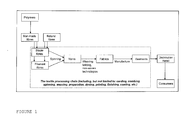
- the structure of the textile sector is formed by SMEs (>95%), the majority of which are commission companies specialised in one or few processes, receiving textile materials (yarns and/or fabrics and/or garments), applying the requested treatment and then sending the treated textiles back to their clients or, more often, to the next component of the textile and clothing supply chain, i.e. a weaver, dyer, printer, finisher, or to an end-user, i.e. garment maker, distributor, retailer, etc.
- markers directly integrated into the textile substrates are either fibres, yarns, fabrics or garments, either applied on a predetermined area or homogeneously distributed in all their parts, is probably a more attractive and effective approach to solve the above mentioned problems.
- the markers used for textile substrates must not degrade their properties, must be easy to apply, not detectable under normal visual or hand inspection but unequivocally detectable by means of appropriate portable or laboratory tools to allow goods being identified with certainty.
- Fluorescent or phosphorescent organic and inorganic dyes and pigments, ultraviolet emitting, near/mid infrared detectable compounds, magnetic or reflective nano-particles comprising metal tracers are some of the anti-counterfeit markers proposed for use onto textile substrates. These markers can be added to polymer melt or dope before spinning the fibres. Thus, intrinsically marked synthetic fibres can be produced and then transformed into yarns and fabrics to manufacture 100% marked textile goods, or blended in different proportions with other natural or synthetic fibres to manufacture textile goods containing variable proportions of marked fibres.
- already made natural and synthetic fibres can be treated at different processing stages (from sorting, carding, spinning to dyeing, printing and finishing) with suitable processing aids containing the marker in order to obtain an homogeneous distribution of the same onto the textile substrate and, consequently, onto the textile good produced therefrom.
- processing aids containing the marker in order to obtain an homogeneous distribution of the same onto the textile substrate and, consequently, onto the textile good produced therefrom.
- Interference with conventional textile auxiliaries, dyes, and finishing products must be avoided as it may impair aesthetic and functional properties of textile goods.
- Bio-based approaches have been proposed to produce counterfeit-proof textile products, to investigate frauds in the textile market (from fibres to garments), and to determine the authenticity as well as the origin of the textile materials.
- immunological techniques can be used to qualitatively and quantitatively identify the presence of different animal fibres in an article. The method is based upon the production and use of monoclonal antibodies to recognize the species specific sequences of the primary structure of keratin for identifying fibres from the different animal species ( EP 1 847 831 A1 ).
- DNA technology is currently being pursued to mark textiles for authenticating purposes.
- Appropriately selected DNA markers can be directly incorporated into various kinds of processing media and then applied onto textile substrates by means of conventional textile technologies to obtain marked textile products to be manufactured into different goods ( WO 2004/094713 A2 ; WO 2007/035581 A2 ).
- a method for authenticating textile articles by labelling with an optical reporter marker linked to a nucleic acid tag, detecting the optical reporter and then characterizing or verifying the nucleic acid sequencing, genotyping or like techniques has also been reported ( US 20080299559 ).
- the marker could be either solid or liquid and applied to a predetermined area of the garment. Textiles may have a label with the manufacturer name on it and may also be used as a region of the garment which the optical reporter marker is placed.
- the present invention describes a process designed to integrate biomarkers into textile substrates.
- the stage of application and related application conditions are selected so as to ensure stability and durability of the biomarker activity for the required shelf life and life time span.
- the biomarkers of the invention are proteins, preferably endowed with biocatalytic activity. Their presence is detected by means of specific activity tests resulting, more often but non exclusively, in colour changes of a solution containing a compound acting as substrate of the biocatalyst. Visual inspection of the reaction is generally sufficient as identification or authentication tool, but specific instruments, i.e. a UV/Vis spectrophotometer, can also be used to detect the presence of the biomarker.
- the biomarker carrier media can include aqueous solutions of polymers, adhesives, binders, cross-linking agents, textile auxiliaries, softeners, lubricants, textile finishes (antistatic, water-proof, softening, antimicrobial agents or the like).
- Application of the biomarker can be made preferably but not exclusively during finishing, more generally at any processing stage where a treatment under wet conditions can be carried out.
- the invention is directed to any kind of textile materials in form of loose fibres, tops, tow, sliver, yarn, fabric (woven, knitted, nonwoven, braided, etc.), garment.
- Textile materials can be made of natural or man-made (artificial, synthetic) fibres or their blends. End uses of biomarked textile products may comprise apparel, household, decoration, furnishing, industrial and technical textiles.
- the present invention relates to a method for biomarking a textile material, comprising the step of putting the said textile material into contact with an aqueous solution containing a biomarker substance for a time and in conditions sufficient to allow the said biomarker substance to be retained by the said textile material in a detectable amount, wherein the said biomarker substance is a protein that is preferably able to interact with a substrate that can undergo a detectable reaction upon contact with such a protein.
- the method of the invention is used to mark textile materials in any form and at any processing stage where a treatment under wet conditions can be carried out.
- Non limiting examples will be given herein below, which include textile materials from sliver to yarn, fabric and garment.
- the biomarker will be made to intimately adhere to the individual fibres constituting the textile material by means of current textile technologies.
- the intermediate and semi-finished biomarked textile materials of the invention thus obtained can be used to manufacture fully biomarked textile items or can be blended or otherwise included into other textile and non textile products thus endowing them with an effective biomarking function.
- End uses of biomarked textile materials can be apparel, household, decoration, furnishing, industrial and technical textiles.
- the biomarker of the invention is a protein preferably endowed with biocatalytic activity.
- Protein biocatalysts typically belong to the following classes: oxidoreductases, transferases, hydrolases, lyases, isomerases, ligases.
- Biocatalysts are commercially available products supplied in form of granules, powder or aqueous solution. Before use, the biocatalyst activity is tested as received by means of specific testing methods provided by the supplier or available from the scientific and technical literature. This allows determining the activity per unit weight or volume necessary to define the biomarkers concentration in the application medium.
- the biomarker is selected as a function of the kind of textile material to be treated (the biocatalyst must be inert against the polymeric textile material), of the processing step identified for its application (application conditions - i.e. pH, solvent, time, temperature, etc. - must not impair the biocatalyst activity), and taking into account the compatibility with other components of the application medium, i.e. textile auxiliaries and finishing products.
- Typical non compatible biocatalyst/textile combinations are: proteases on protein fibres (eg. wool and silk); cellulases on cellulosic fibres (cotton, linen, hemp, viscose, lyocell, etc.); lipases and esterases on polyester fibres; proteases and amidases on polyamide fibres; nitrilases on acrylic fibres. Under suitable ambient conditions (i.e. temperature, humidity) all these biocatalysts are able to hydrolyze the respective polymeric material constituting the fibres, thus leading to fibre degradation.
- oxidoreductases such as laccases and other polyphenol oxidases able to use air oxygen as co-substrate, must be avoided because their activation and reaction with the textile substrate may lead to colour change (more or less extensive browning of fibres).
- Biocatalysts suffer from exposition to high temperatures and/or extreme acidic or alkaline pHs for long times. To avoid any risk of loosing totally or partially the biocatalyst activity during application to textiles, the processing conditions under which the biomarker can be safely applied to the textile material are as follows:
- the compatibility of the biocatalyst with the other components of the application medium which may include textile auxiliaries (surfactants, wetting and levelling agents, salts, dyes, emulsifiers, lubricants, antifoam agents, etc.) and/or finishing products (softeners, antistatic, water-proof, soil release, antimicrobial, fire-proofing, agents; binders, polymers, cross-linking agents, etc.) is tested before application by mixing the required amount of biocatalyst with the other recipe components and then performing the activity testing procedure provided by the supplier or available from the scientific and technical literature. This allows determining the activity of the biomarker per unit weight or volume of application medium and, consequently, the amount of biomarker that will be transferred onto the textile material by pad-drying or exhaust processing conditions.
- textile auxiliaries surfactants, wetting and levelling agents, salts, dyes, emulsifiers, lubricants, antifoam agents, etc.
- finishing products softeners, antistatic
- An important advantage of the method of the invention is that the wide range of commercial protein biocatalysts available allows setting up a large number of unique biomarker/textile material combinations endowed with high specificity, thus making counterfeit of the biomarking method and of the biomarked textile material very difficult from one side and identification or verification of the same more straightforward from the other side.
- Embodiments of the invention have the advantage that textile materials can be conveniently and unequivocally marked at a selected processing step with a solution containing the biomarker prepared on purpose. The costs related to the biomarking process are very low because the biomarker is applied in catalytic amounts.
- Another advantage is that biomarking can be repeated several times along the manufacturing chain to ensure the required durability. The intrinsic aesthetic and functional properties and performance of the textile material are not affected by the presence of the biomarker which is not visible at the naked eye. Authentication techniques apply the concept of biosensing.
- Textile fibres that can be treated with the method of the invention include all natural (both plant and animal fibres, including but not limited to cotton, flax, hemp, wool, silk), man-made fibres (including but non limited to polyester, polyamide, acrylic, polyolefin, regenerated cellulose fibres) and their blends in any range of composition. Staple and continuous filament fibres are all included. Accordingly, two and three dimensional textile constructions obtained by carding, combing, spinning, weaving, knitting, nonwoven bonding, braiding, knotting, laying, and plating are possible materials for the inventive method.
- Methods of application comprise all, but not exclusively, the currently available technologies which bring fluids in close contact with the individual fibres forming the textile material thus favouring adsorption, adhesion and/or physical and/or chemical bonding of the active ingredients contained in the fluid onto the fibre surface or diffusion, penetration and anchoring in the fibre bulk.
- These technologies include but are not limited to batch processes, where both the fluid and the textile material move with respect to one another or only one of them (the fluid or the textile material) is moving and the other is stationary, as well as continuous processes generally comprising the impregnation of the textile material with a high concentrated solution of the processing aids made by padding, coating or spraying, followed by drying and fixation/curing steps.
- Natural and man-made staple fibres and their blends undergo a series of operations, such as opening, carding, combing, roving before being fed to the spinning machine to make the yarn. All these processes are performed under dry conditions, but wetting the fibrous materials with an aqueous solution containing auxiliaries like lubricating, softening, and antistatic agents may be required to lower the negative effects of fibre-fibre and fibre-machine friction and to reduce electrostatic charge building under the strong mechanical stresses caused by the process.
- spraying heads mounted on a drawing frame of a combing machine are fed with an aqueous solution containing the lubricant/antistatic agent and the biomarker.
- an aqueous solution containing the lubricant/antistatic agent and the biomarker.
- a peroxidase biomarker EC 1.11.1.7
- the solution is buffered at pH 6 with 0.1 M phosphate buffer.
- the running sliver is sprayed at room temperature in such a way that the wet pick up is 10-30 w%, preferably 20 w%, and the amount of active ingredients taken up by fibres is 1-5 w% for the lubricant and 0.1-1 w% for the biomarker.
- the spraying treatment results in a biomarked sliver which will end up with a biomarked yarn when fed to a spinning machine.
- Flax processing before spinning has specific features. Flax slivers undergo a series of doubling and drafting operations resulting in the production of a flax rove. The latter is scoured to eliminate non cellulosic substances and to help primary fibres to slide during spinning. Bleaching under oxidizing conditions at alkaline pH may also be performed.
- the flax rove is neutralized and the neutralizing solution discharged. Then, an aqueous solution containing a wetting agent and the biomarker is circulated from inside to outside of the perforated support onto which the rove is rolled.
- a solution containing 1-5 g/L, preferably 2-3 g/L, of a non-ionic alkyl alcohol ethoxylate surfactant and 1-10 g/L, preferably 4-6 g/L, of protease biomarker (EC 3.4.21.62) is heated at 30-60°C, preferably 40-50°C, and circulated in the machine containing the rolls of flax rove for 10-30 min, preferably 15-20 min.
- the material-to-liquor ratio is typically from 1:10 to 1:30.
- the optimum absorption level for the biomarker is in the range 0.1-1 w%.
- Wet spinning is a specific flax spinning process leading to yarns of remarkable quality and fineness.
- the spinning machine is equipped with a trough full of water located on top of each spinning head upstream to the drafting frame.
- the flax rove passes through it before entering the drafting frame.
- the water is substituted with an aqueous solution containing a wetting agent and the biomarker
- the rove passes through the aqueous solution contained in the basin thus picking up the solution containing the biomarker.
- the rove enters the drafting frame where the yarn is formed and collected on spools.
- the biomarked yarn thus produced comprises flax fibres with a biomarker strongly adhering to their surface and physically entrapped into the fibrous network.
- the impregnation trough is filled up with an aqueous solution containing catalase (EC 1.11.1.6) as biomarker (1-20 g/L, preferably 5-10 g/L), buffered at pH 7 with 50 mM phosphate buffer.
- the solution is maintained at room temperature.
- the level of the solution in the trough is controlled in order to ensure that the rove is always well immersed in the solution.
- Typical wet pick up values are 30-100 w%, preferably 50-80 w%.
- the optimum absorption level for the biomarker is in the range 0.1-1 w%.
- the biomarked rove is transformed into a biomarked yarn, which is collected on 100 g spools.
- the biomarked flax yarns coming from several spools are transferred onto packages of about 1 kg ready to be delivered to the knitter and/or weaver.
- a polyacrylic resin at 0.2-2 g/L, preferably 0.5-1 g/L, is added to the biomarker solution, together with a polyfunctional aziridine cross-linker at 0.5-4 w% of the resin weight, preferably 1.5-2.5 w%.
- the binding strength of the biomarker with fibres and its stability are enhanced under these application conditions.
- Biomarking can be executed on the yarn already rolled onto cones just before delivery to the weaver.
- a machine used to wrap up cones of flax yarn is equipped with humidifying units which are fed with an aqueous solution containing an antimould agent and the biomarker.
- the solution is forced to pass through the perforated cone from inside to outside at predetermined pressure and time.
- the process results in biomarked yarn which comprises fibres impregnated with the biomarker.
- the biomarker is a catalase (EC 1.11.1.6) at 1-10 g/L, preferably 3-6 g/L, buffered at pH 7 with 50 mM phosphate buffer. It is mixed with benzo-isothiazolinone as antimould agent at 0.1-2 g/L, preferably 0.5-1 g/L. Then the solution is applied to the cone in such a way that the wet pick up is 1-20 w%, preferably 5-10 w%, and the amount of biomarker taken up by the yarn is 0.1-5 w%. This treatment results in a biomarked yarn.
- Yarns made of natural or man-made fibres or their blends usually undergo a processing cycle comprising scouring, dyeing and finishing. Treatments are carried out on yarns in hank or cone form.
- hanks of up to 1 kg each are processed into cabinets of up to 800 kg capacity, working with a material-to-liquor ratio up to 1:15.
- Cones up to about 1.2 kg each are processed into package dyeing machines of up to 600 kg capacity, working with a material-to-liquor ratio up to 1:10.
- the yarn material is stationary while the fluid is flowing through the hank or cone at a controlled speed and for the number of cycles required by the treatment.
- Time-temperature processing diagrams are computer controlled and can be tailored to the properties of the material under processing.
- Yarn finishing typically consists in a wet treatment able to impart softness and lubricity to the material thus improving handle and reducing friction during subsequent weaving, knitting, etc.
- Most softeners are cationic surfactants which bind by electrostatic attraction to the negatively charged groups at the fibre surface. They are based on quaternary ammonium salts with one or two long alkyl chains. Others can be derived from imidazolium, substituted amine salts, or quaternary alkoxy ammonium salts. Silicone based compounds such as polydimethylsiloxane modified to contain amine or amide groups bind to the fibres and work by lubricating agents, thus imparting improved feel.
- a finishing bath is circulated in the cabinet or package dyeing machine.
- the processing cycle is started. The temperature is raised from ambient to about 40°C and kept stationary for 20 min while the solution is circulated in the machine.
- the biomarked yarn thus produced comprises fibres with the biomarker intimately adhering to their surface.
- Yarns are usually transferred from bobbins to other supports like cones of different sizes before the next processing stages like weaving or knitting.
- winding machines are used.
- the yarn coming from the unwinding unit is guided to pass onto the surface of a roller partially immersed in an aqueous solution of the biomarker.
- the yarn picks up the solution while passing onto the roller surface thus becoming impregnated with the biomarker.
- the amount of solution picked up depends on the kind of yarn, on its construction, on the speed of the roller, etc. Afterwards the biomarked yarn reaches the take up unit and is wrapped on the destination cone.
- the impregnating solution contains a non-ionic alkyl alcohol ethoxylate surfactant at 2-10 g/L, preferably 4-6 g/L, and peroxidase (EC 1.11.1.7) as the biomarker.
- concentration of the biomarker is about 2-40 g/L, preferably 10-20 g/L.
- the yarns passing onto the roller picks up an amount of solution of about 30-80 w%, preferably 40-60 w% before reaching the winding head.
- the optimum absorption level for the biomarker is in the range 0.1-2 w%.
- Woven or knitted fabrics are usually finished to impart on them the visual, physical, and aesthetic properties demanded by end-users and consumers.
- a softening treatment represents a general approach for finishing many types of textile articles. However, more specific finishing treatments can be performed such as: antimicrobial, anti-pilling, crease resist, wash and wear, antistatic, hydrophilic or hydrophobic finish, etc., depending on the kind of textile and end-use destination.
- the finishing treatment usually takes place as a separate operation after dyeing/printing. Finishes can be applied on fabrics by continuous (typically: padding techniques) or discontinuous processes (typically: exhaust techniques).
- a wool knitted fabric is subjected to a softening treatment in an overflow machine.
- the material-to-liquor ratio is from 1:10 to 1:30.
- the temperature is raised from ambient to about 40°C and kept stationary for 20 min while the solution is circulated in the machine. Then the bath is discharged, the fabric is removed and dried.
- the optimum absorption level for the biomarker is in the range 0.1-1 w%.
- the biomarked fabric thus produced comprises fibres with the biomarker intimately adhering to their surface.
- a flax woven fabric is subjected to a softening treatment in a jigger machine, which operates on open width by transferring the fabric back and forth from roller to roller via the medium of a softening solution located at the base of the machine.
- the softening bath solution contains a cationic softener at a concentration of 1-5 g/L, preferably 2-3 g/L, at pH 5 (adjusted with acetic acid), to which a protease biomarker (EC 3.4.21.62) is added at a concentration of 1-5 g/L, preferably 2-3 g/L.
- the material-to-liquor ratio is from 1:2 to 1:4.
- the number of passages can be two or more.
- the temperature is raised from ambient to about 40°C and kept stationary until completion of the selected number of passages. Then the bath is discharged, the fabric is removed and dried.
- the optimum absorption level for the biomarker is in the range 0.1-1 w%.
- the biomarked fabric thus produced comprises fibres with the biomarker intimately adhering to their surface.
- a cotton woven fabric is impregnated in a foulard with a solution containing a cationic softener at a concentration of 1-10 g/L, preferably 3-6 g/L, at pH 5 (adjusted with acetic acid), to which a protease biomarker (EC 3.4.21.62) is added at a concentration of 1-20 g/L, preferably 5-10 g/L.
- Typical wet pick up values are 30-100 w%, preferably 50-80 w%.
- the fabric passes through the drying unit operated under the conditions definedabove.
- the optimum absorption level for the biomarker is in the range 0.1-1 w%.
- the biomarked fabric thus produced comprises fibres with the biomarker intimately adhering to their surface.
- the following protocol refers to the detection of the bioactivity of any form of textile material biomarked with catalase biocatalyst (EC 1.11.1.6).
- a flax yarn biomarked with catalase is sampled in form of a small hank of about 1 g.
- An aqueous solution of hydrogen peroxide (H 2 O 2 ) in 50 mM phosphate buffer pH 7 is prepared by diluting the 30 w% stock solution from 30 to 200 times, preferably from 80 to 120 times, in order to have a H 2 O 2 concentration in the range of 0.2-1 w%.
- the test is carried out at room temperature.
- the biomarked flax hank is immersed into the H 2 O 2 solution.
- the catalase reaction follows the scheme: 2 H 2 O 2 ⁇ 2 H 2 O + O 2
- the oxygen gas formed by the reaction is released in form of bubbles as soon as the yarn is immersed in the H 2 O 2 solution.
- a non-biomarked yarn is immersed into the H 2 O 2 solution. No bubbles formation is observed under these circumstances.
- the protocol of this example refers to the detection of the bioactivity of any form of textile material biomarked with peroxidase biocatalyst (EC 1.11.1.7).
- a small hank of about 1 g of cotton yarn biomarked with peroxidase is prepared.
- a 1 w% solution of pyrogallol (1,2,3-trihydroxybenzene) in 0.1 M phosphate buffer pH 6 is prepared (Reagent A).
- a fixed volume of 30 w% H 2 O 2 solution (Reagent B) is diluted 100 times with water. The test is carried out at room temperature.
- the 1 g hank of biomarked yarn is immersed in 100 ml of Reagent A.
- the protocol of this example refers to the detection of the bioactivity of any form of textile material biomarked with protease biocatalyst (EC 3.4.21.62).
- a small piece of cotton fabric biomarked with protease having a size of 1 to 4 cm 2 , corresponding from about 10 to 100 mg of material, is cut and used for the test.
- a 100 mM HEPES NaOH buffer pH 7.5 is prepared (Reagent A).
- a 20 mM solution of N-Succinyl-Ala-Ala-Pro-Phe p-Nitroanilide solution is prepared in Dimethyl sulfoxide (Reagent B). The test is carried out at 37°C.
Landscapes
- Engineering & Computer Science (AREA)
- Textile Engineering (AREA)
- Chemical & Material Sciences (AREA)
- Life Sciences & Earth Sciences (AREA)
- Biochemistry (AREA)
- Microbiology (AREA)
- Chemical Kinetics & Catalysis (AREA)
- General Chemical & Material Sciences (AREA)
- Materials Engineering (AREA)
- Dispersion Chemistry (AREA)
- Chemical Or Physical Treatment Of Fibers (AREA)
Priority Applications (1)
| Application Number | Priority Date | Filing Date | Title |
|---|---|---|---|
| EP10188180A EP2444546A1 (fr) | 2010-10-20 | 2010-10-20 | Procédé de biomarquage de matériaux textiles |
Applications Claiming Priority (1)
| Application Number | Priority Date | Filing Date | Title |
|---|---|---|---|
| EP10188180A EP2444546A1 (fr) | 2010-10-20 | 2010-10-20 | Procédé de biomarquage de matériaux textiles |
Publications (1)
| Publication Number | Publication Date |
|---|---|
| EP2444546A1 true EP2444546A1 (fr) | 2012-04-25 |
Family
ID=43769110
Family Applications (1)
| Application Number | Title | Priority Date | Filing Date |
|---|---|---|---|
| EP10188180A Withdrawn EP2444546A1 (fr) | 2010-10-20 | 2010-10-20 | Procédé de biomarquage de matériaux textiles |
Country Status (1)
| Country | Link |
|---|---|
| EP (1) | EP2444546A1 (fr) |
Cited By (12)
| Publication number | Priority date | Publication date | Assignee | Title |
|---|---|---|---|---|
| CN103590244A (zh) * | 2013-11-26 | 2014-02-19 | 常熟常圣服饰有限公司 | 抗起球羊绒衫的生产方法 |
| WO2016100503A1 (fr) * | 2014-12-16 | 2016-06-23 | Apdn (B.V.I.) Inc. | Procédé et dispositif de marquage de matériaux fibreux |
| WO2017180302A1 (fr) * | 2016-04-11 | 2017-10-19 | Apdn (B.V.I.) Inc. | Procédé de marquage de produits cellulosiques |
| US9904734B2 (en) | 2013-10-07 | 2018-02-27 | Apdn (B.V.I.) Inc. | Multimode image and spectral reader |
| US9919512B2 (en) | 2012-10-10 | 2018-03-20 | Apdn (B.V.I.) Inc. | DNA marking of previously undistinguished items for traceability |
| US9963740B2 (en) | 2013-03-07 | 2018-05-08 | APDN (B.V.I.), Inc. | Method and device for marking articles |
| US10047282B2 (en) | 2014-03-18 | 2018-08-14 | Apdn (B.V.I.) Inc. | Encrypted optical markers for security applications |
| US10741034B2 (en) | 2006-05-19 | 2020-08-11 | Apdn (B.V.I.) Inc. | Security system and method of marking an inventory item and/or person in the vicinity |
| US10745825B2 (en) | 2014-03-18 | 2020-08-18 | Apdn (B.V.I.) Inc. | Encrypted optical markers for security applications |
| US10920274B2 (en) | 2017-02-21 | 2021-02-16 | Apdn (B.V.I.) Inc. | Nucleic acid coated submicron particles for authentication |
| US10995371B2 (en) | 2016-10-13 | 2021-05-04 | Apdn (B.V.I.) Inc. | Composition and method of DNA marking elastomeric material |
| CN113699773A (zh) * | 2021-08-24 | 2021-11-26 | 广东溢达纺织有限公司 | 筒纱是否存在内外色差的判断方法 |
Citations (9)
| Publication number | Priority date | Publication date | Assignee | Title |
|---|---|---|---|---|
| WO1987006383A1 (fr) * | 1986-04-09 | 1987-10-22 | Biotal Limited | Marquage d'articles qu'on desire authentifier |
| WO1998033162A1 (fr) * | 1997-01-27 | 1998-07-30 | Biocode, Inc. | Marquage de produits effectue en vue d'etablir leur identite, leur origine et leur destination |
| WO2004094713A2 (fr) | 2003-04-16 | 2004-11-04 | Applied Dna Sciences, Inc. | Systeme et procede de marquage de textiles au moyen d'acides nucleiques |
| EP1500741A1 (fr) * | 2003-07-21 | 2005-01-26 | Bartholdy-Consultadoria e Servicos Lda | Fibres marquées et procédés immunochimiques pour leur détection |
| WO2005060332A2 (fr) * | 2003-12-23 | 2005-07-07 | Valtion Teknillinen Tutkimuskeskus | Procede pour fabriquer des produits fibreux |
| WO2007035581A2 (fr) | 2005-09-17 | 2007-03-29 | Champion Thread Company | Procédé d’application de marqueur de textile et textile ainsi produit |
| EP1847831A1 (fr) | 2006-04-21 | 2007-10-24 | Consiglio Nazionale delle Ricerche | Procédé pour la détermination de la composition de fibres textiles |
| US20080299559A1 (en) | 2003-04-16 | 2008-12-04 | Thomas Kwok | Methods for authenticating articles with optical reporters |
| US20090286250A1 (en) * | 2006-05-19 | 2009-11-19 | James Arthur Hayward | Incorporating soluble security markers into cyanoacrylate solutions |
-
2010
- 2010-10-20 EP EP10188180A patent/EP2444546A1/fr not_active Withdrawn
Patent Citations (9)
| Publication number | Priority date | Publication date | Assignee | Title |
|---|---|---|---|---|
| WO1987006383A1 (fr) * | 1986-04-09 | 1987-10-22 | Biotal Limited | Marquage d'articles qu'on desire authentifier |
| WO1998033162A1 (fr) * | 1997-01-27 | 1998-07-30 | Biocode, Inc. | Marquage de produits effectue en vue d'etablir leur identite, leur origine et leur destination |
| WO2004094713A2 (fr) | 2003-04-16 | 2004-11-04 | Applied Dna Sciences, Inc. | Systeme et procede de marquage de textiles au moyen d'acides nucleiques |
| US20080299559A1 (en) | 2003-04-16 | 2008-12-04 | Thomas Kwok | Methods for authenticating articles with optical reporters |
| EP1500741A1 (fr) * | 2003-07-21 | 2005-01-26 | Bartholdy-Consultadoria e Servicos Lda | Fibres marquées et procédés immunochimiques pour leur détection |
| WO2005060332A2 (fr) * | 2003-12-23 | 2005-07-07 | Valtion Teknillinen Tutkimuskeskus | Procede pour fabriquer des produits fibreux |
| WO2007035581A2 (fr) | 2005-09-17 | 2007-03-29 | Champion Thread Company | Procédé d’application de marqueur de textile et textile ainsi produit |
| EP1847831A1 (fr) | 2006-04-21 | 2007-10-24 | Consiglio Nazionale delle Ricerche | Procédé pour la détermination de la composition de fibres textiles |
| US20090286250A1 (en) * | 2006-05-19 | 2009-11-19 | James Arthur Hayward | Incorporating soluble security markers into cyanoacrylate solutions |
Non-Patent Citations (1)
| Title |
|---|
| CORTEZ ET AL: "Transglutaminase mediated grafting of silk proteins onto wool fabrics leading to improved physical and mechanical properties", ENZYME AND MICROBIAL TECHNOLOGY, STONEHAM, MA, US, vol. 40, no. 7, 27 April 2007 (2007-04-27), pages 1698 - 1704, XP022059246, ISSN: 0141-0229, DOI: 10.1016/J.ENZMICTEC.2006.10.013 * |
Cited By (15)
| Publication number | Priority date | Publication date | Assignee | Title |
|---|---|---|---|---|
| US10741034B2 (en) | 2006-05-19 | 2020-08-11 | Apdn (B.V.I.) Inc. | Security system and method of marking an inventory item and/or person in the vicinity |
| US9919512B2 (en) | 2012-10-10 | 2018-03-20 | Apdn (B.V.I.) Inc. | DNA marking of previously undistinguished items for traceability |
| US9963740B2 (en) | 2013-03-07 | 2018-05-08 | APDN (B.V.I.), Inc. | Method and device for marking articles |
| US9904734B2 (en) | 2013-10-07 | 2018-02-27 | Apdn (B.V.I.) Inc. | Multimode image and spectral reader |
| US10282480B2 (en) | 2013-10-07 | 2019-05-07 | Apdn (B.V.I) | Multimode image and spectral reader |
| CN103590244A (zh) * | 2013-11-26 | 2014-02-19 | 常熟常圣服饰有限公司 | 抗起球羊绒衫的生产方法 |
| US10047282B2 (en) | 2014-03-18 | 2018-08-14 | Apdn (B.V.I.) Inc. | Encrypted optical markers for security applications |
| US10745825B2 (en) | 2014-03-18 | 2020-08-18 | Apdn (B.V.I.) Inc. | Encrypted optical markers for security applications |
| WO2016100503A1 (fr) * | 2014-12-16 | 2016-06-23 | Apdn (B.V.I.) Inc. | Procédé et dispositif de marquage de matériaux fibreux |
| US10760182B2 (en) | 2014-12-16 | 2020-09-01 | Apdn (B.V.I.) Inc. | Method and device for marking fibrous materials |
| WO2017180302A1 (fr) * | 2016-04-11 | 2017-10-19 | Apdn (B.V.I.) Inc. | Procédé de marquage de produits cellulosiques |
| US10519605B2 (en) | 2016-04-11 | 2019-12-31 | APDN (B.V.I.), Inc. | Method of marking cellulosic products |
| US10995371B2 (en) | 2016-10-13 | 2021-05-04 | Apdn (B.V.I.) Inc. | Composition and method of DNA marking elastomeric material |
| US10920274B2 (en) | 2017-02-21 | 2021-02-16 | Apdn (B.V.I.) Inc. | Nucleic acid coated submicron particles for authentication |
| CN113699773A (zh) * | 2021-08-24 | 2021-11-26 | 广东溢达纺织有限公司 | 筒纱是否存在内外色差的判断方法 |
Similar Documents
| Publication | Publication Date | Title |
|---|---|---|
| EP2444546A1 (fr) | Procédé de biomarquage de matériaux textiles | |
| CN103046202B (zh) | 一种仿棉衬布及其生产工艺 | |
| US20080163437A1 (en) | Cellulosic textiles treated with hyperbranched polyethyleneimine derivatives | |
| JP2014531524A (ja) | Bcf糸の染色及び処理方法 | |
| JP2014512459A (ja) | 撥水・撥油性bcf糸の製造方法 | |
| CN107206554A (zh) | 用于标记纤维质材料的方法和设备 | |
| CA2557142C (fr) | Procede pour la fourniture de fils composites amtimicrobiens, tissus composites et articles realises a partir de ceux-ci | |
| US10202723B2 (en) | Method of treating polyester textile | |
| US20120246842A1 (en) | Disperse dyeing of textile fibers | |
| WO2009129364A2 (fr) | Fonctionnalisation durable de fibres de polyolefines et tissus a gestion d’humidite et elimination d’odeurs | |
| US6497936B1 (en) | Method and apparatus for dyeing and treating yarns | |
| US20060088712A1 (en) | Method for improved dyeing of difficult to dye items, yarns, fabrics or articles | |
| EP1137837A1 (fr) | Coton a derivatisation anionique pour un lavage et un entretien facile | |
| KR20200071073A (ko) | 비-포름알데하이드 기술을 사용하는 코튼 원단의 내구성이 뛰어난 프레스 특성의 균형 향상 | |
| WO2013148295A2 (fr) | Teinture dispersée de fibres textiles | |
| EP1761670A2 (fr) | Procede pour modifier un polyamide | |
| Tusief et al. | Effect of different anti pilling agents to reduce pilling on polyester/cotton fabric | |
| WO2001053592A1 (fr) | Traitement de textiles | |
| US20150233048A1 (en) | Processes to make water and oil repellent bcf yarn | |
| HK40036613A (en) | Improving the balance of durable press properties of cotton fabrics using non-formaldehyde technology | |
| EP2898137A1 (fr) | Procédés de teinte et de traitement d'un fil bcf simple |
Legal Events
| Date | Code | Title | Description |
|---|---|---|---|
| AK | Designated contracting states |
Kind code of ref document: A1 Designated state(s): AL AT BE BG CH CY CZ DE DK EE ES FI FR GB GR HR HU IE IS IT LI LT LU LV MC MK MT NL NO PL PT RO RS SE SI SK SM TR |
|
| AX | Request for extension of the european patent |
Extension state: BA ME |
|
| PUAI | Public reference made under article 153(3) epc to a published international application that has entered the european phase |
Free format text: ORIGINAL CODE: 0009012 |
|
| 17P | Request for examination filed |
Effective date: 20121024 |
|
| RIC1 | Information provided on ipc code assigned before grant |
Ipc: D06M 23/06 20060101ALI20121114BHEP Ipc: D06M 15/15 20060101AFI20121114BHEP Ipc: D06M 16/00 20060101ALI20121114BHEP Ipc: D06H 1/00 20060101ALI20121114BHEP Ipc: G01N 33/36 20060101ALN20121114BHEP |
|
| GRAP | Despatch of communication of intention to grant a patent |
Free format text: ORIGINAL CODE: EPIDOSNIGR1 |
|
| STAA | Information on the status of an ep patent application or granted ep patent |
Free format text: STATUS: THE APPLICATION IS DEEMED TO BE WITHDRAWN |
|
| 18D | Application deemed to be withdrawn |
Effective date: 20130703 |