EP2444876A1 - Procédé et système pour la simulation d'un facteur humain dans des procédés d'assemblage - Google Patents
Procédé et système pour la simulation d'un facteur humain dans des procédés d'assemblage Download PDFInfo
- Publication number
- EP2444876A1 EP2444876A1 EP10382258A EP10382258A EP2444876A1 EP 2444876 A1 EP2444876 A1 EP 2444876A1 EP 10382258 A EP10382258 A EP 10382258A EP 10382258 A EP10382258 A EP 10382258A EP 2444876 A1 EP2444876 A1 EP 2444876A1
- Authority
- EP
- European Patent Office
- Prior art keywords
- dummy
- virtual
- physical
- positioning
- data
- Prior art date
- Legal status (The legal status is an assumption and is not a legal conclusion. Google has not performed a legal analysis and makes no representation as to the accuracy of the status listed.)
- Withdrawn
Links
Images
Classifications
-
- G—PHYSICS
- G06—COMPUTING OR CALCULATING; COUNTING
- G06F—ELECTRIC DIGITAL DATA PROCESSING
- G06F3/00—Input arrangements for transferring data to be processed into a form capable of being handled by the computer; Output arrangements for transferring data from processing unit to output unit, e.g. interface arrangements
- G06F3/01—Input arrangements or combined input and output arrangements for interaction between user and computer
- G06F3/03—Arrangements for converting the position or the displacement of a member into a coded form
Definitions
- the present invention relates to a system and corresponding method for effecting the simulation of the human factor in assembly processes, and more particularly, for the accessibility and ergonomics simulation used in the validation of assembly processes, especially in aircraft assembly lines.
- known information input elements comprise two possibilities: a peripheral element, typically a mouse, or a human dummy or model, being also possible the use of the two possibilities together.
- a peripheral element typically a mouse
- a human dummy or model being also possible the use of the two possibilities together.
- both the peripheral element and the human dummy are used as information input elements in the simulation of the human factor.
- these systems are expensive, time consuming and require the use of specific and intricate installations.
- the human factor by means of a human dummy or model nowadays is based on a motion system that captures in real time the position of several trackers located in a human dummy or model.
- a usual system comprises a cabling electronic mechanical system in the dummy or model.
- Another problem of these known systems is based on the location of the trackers within the human dummy or model, the optimum location not being obvious.
- Still another problem is that this system needs very long cables attaching each sensor used as a tracker to a central unit, which makes the overall system complicated and not optimised.
- One object of the present invention is a system for effecting the simulation of the human factor in assembly processes.
- the human factor simulation shall comprise an accessibility and an ergonomics simulation.
- the system of the invention is focused to the validation of assembly processes, especially in aircraft assembly lines.
- the system of the invention comprises:
- the number or degrees of freedom of the physical dummy is different from that in the virtual dummy, and in a preferred embodiment it is much more reduced than that in the virtual dummy, the position and degrees of freedom of the physical dummy taken from the markers in the physical dummy directly mapping the positioning in the virtual dummy, by generating the degrees of freedom of the physical dummy and transferring them directly to the virtual dummy.
- the system of the invention allows the transfer of the positioning of a physical dummy to the positioning of a virtual dummy, such that this transfer is effected in real-time and in an automatic manner, without the need of using any peripheral systems.
- the physical dummy acts as a peripheral element in the system of the invention for defining the positioning of the virtual dummy.
- the virtual dummy is part of the virtual simulation made of the human being, the virtual simulation comprising accessibility and an ergonomics simulation.
- the transfer of data from the physical dummy to the virtual dummy is done directly and continuously controlling the scale differences between both dummies.
- the system of the invention is able to control the different percentiles of the population selected for the virtual dummy, allowing that this virtual dummy can be used for virtual simulations of accessibility and ergonomics.
- the system of the invention allows that, when the positioning of the segments in a physical dummy is modified, this is transferred by means of a simulation module to a virtual dummy, taking into consideration the anthropometrics and biomechanical characteristics of a human being represented by the virtual dummy, such that it can be obtained that the virtual dummy adopts the positioning of the physical dummy in real-time.
- Another object of the invention is a method for effecting the simulation of the human factor in assembly processes, more particularly in the assembly of aircraft components in aircraft assembly lines.
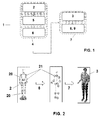
- a preferred embodiment of the invention will be described in connection with a system 1 by means of which, when the positioning of a physical dummy 2 is modified, the physical dummy 2 acting as a peripheral element of the system 1, and by means of an interface, transfers the positioning of its segments 20 to a virtual dummy 3, by the use of inverse kinematics, as a function of the anthropometrics and biomechanical characteristics of a human being represented by the virtual dummy 3. Therefore, by means of the system 1, the new positioning of the segments 20 of the physical dummy 2 is adopted in real-time by the virtual dummy 3.
- the system 1 of the invention comprises:
- the simulation software used together with the system 1 of the invention can be any commercial software application existing in the market, such as Delmia (Digital Enterprise Lean Manufacturing Interactive Application), Human Builder, Activity Analysis, Posture Analysis, Measurement Editor, Task Simulation, for example.
- Delmia Digital Enterprise Lean Manufacturing Interactive Application
- Human Builder Human Builder
- Activity Analysis Posture Analysis
- Measurement Editor Task Simulation
- the data entry and processing module 4 allows the capture of the coordinates corresponding to the degrees of freedom of the physical dummy 2, these values being converted in movements of segments 20 (parts of the body of the human being represented by the physical dummy 2), these movements of segments 20 being exported to the simulation software, such that these data (movements of segments 20) can be used in accessibility and ergonomics simulations.
- the physical dummy 2 used in the system 1 of the invention is for example an anatomically model of the type Art. S. Buck, commercially available. These models are around 20 cm size, having around 30 degrees of freedom, given by the points of articulation in said physical dummy 2, allowing the dummy 2 to display the full range of human movement.
- the markers 21 are located in specific positions defining the segments 20 of the mentioned physical dummy 2, these markers 21 proving the coordinates of the degrees of freedom of such segments 20 in the physical dummy 2.
- the physical dummy 2 is manipulated by the user of the system 1, such that the virtual dummy 3 adopts the positioning of the physical dummy 2, given by the user.
- the physical dummy 2 comprises several markers 21 by means of which the coordinates of the degrees of freedom of the physical dummy 2 can be obtained at any moment.
- the data entry sub-module 5 is able to capture the coordinates of the degrees of freedom in the physical dummy 2.
- the processing sub-module 6 comprises algorithms that convert the coordinates of the degrees of freedom of the physical dummy 2 captured into positioning of the virtual dummy 3, as a function of the anthropometrics and biomechanical characteristics of a human being, and as a function of the population and percentile of said human being, the human being represented by the virtual dummy 3.
- the simulation module 7 provides a communication interface between the data entry and processing module 4 and the simulation software.
- the simulation module 7 also provides the functionalities necessary for the use of the system 1 together with the simulation software.
- the simulation module 7 uses as input the result of the processed data coming from the processing sub-module 6, in a specific format, this format depending on the particular simulation software used by the system 1.
- the method is directed to the assembly of aircraft components in aircraft assembly lines. The method comprises the following steps:
Landscapes
- Engineering & Computer Science (AREA)
- General Engineering & Computer Science (AREA)
- Theoretical Computer Science (AREA)
- Human Computer Interaction (AREA)
- Physics & Mathematics (AREA)
- General Physics & Mathematics (AREA)
- Management, Administration, Business Operations System, And Electronic Commerce (AREA)
- Processing Or Creating Images (AREA)
Priority Applications (2)
| Application Number | Priority Date | Filing Date | Title |
|---|---|---|---|
| EP10382258A EP2444876A1 (fr) | 2010-09-29 | 2010-09-29 | Procédé et système pour la simulation d'un facteur humain dans des procédés d'assemblage |
| US12/965,148 US20120078584A1 (en) | 2010-09-29 | 2010-12-10 | Method and system for the simulation of the human factor in assembly processes |
Applications Claiming Priority (1)
| Application Number | Priority Date | Filing Date | Title |
|---|---|---|---|
| EP10382258A EP2444876A1 (fr) | 2010-09-29 | 2010-09-29 | Procédé et système pour la simulation d'un facteur humain dans des procédés d'assemblage |
Publications (1)
| Publication Number | Publication Date |
|---|---|
| EP2444876A1 true EP2444876A1 (fr) | 2012-04-25 |
Family
ID=43587432
Family Applications (1)
| Application Number | Title | Priority Date | Filing Date |
|---|---|---|---|
| EP10382258A Withdrawn EP2444876A1 (fr) | 2010-09-29 | 2010-09-29 | Procédé et système pour la simulation d'un facteur humain dans des procédés d'assemblage |
Country Status (2)
| Country | Link |
|---|---|
| US (1) | US20120078584A1 (fr) |
| EP (1) | EP2444876A1 (fr) |
Families Citing this family (1)
| Publication number | Priority date | Publication date | Assignee | Title |
|---|---|---|---|---|
| CN104596784B (zh) * | 2014-12-25 | 2017-09-29 | 中国人民解放军空军航空医学研究所 | 一种空投假人 |
Citations (6)
| Publication number | Priority date | Publication date | Assignee | Title |
|---|---|---|---|---|
| US20040236542A1 (en) * | 2003-05-21 | 2004-11-25 | Fea Soft Co., Ltd | Computer-aided structure analysis and design graphic display device that displays joint status using numerical data |
| US20040263531A1 (en) * | 2003-04-28 | 2004-12-30 | Snecma Moteurs | Optimizing ergonomic movement of a virtual dummy |
| US20080289438A1 (en) * | 2007-05-22 | 2008-11-27 | University Of Louisville Research Foundation | Soft tissue impact assessment device and system |
| WO2009027673A1 (fr) * | 2007-08-28 | 2009-03-05 | The University Of Surrey | Cinematique inverse |
| US20090089016A1 (en) * | 2007-09-27 | 2009-04-02 | Vinayakumar Kasimsetty | Occupant positioning module |
| US20090138250A1 (en) * | 2007-09-28 | 2009-05-28 | Dylan Thomas | Method to accurately position finite element dummies in finite element simulations |
-
2010
- 2010-09-29 EP EP10382258A patent/EP2444876A1/fr not_active Withdrawn
- 2010-12-10 US US12/965,148 patent/US20120078584A1/en not_active Abandoned
Patent Citations (6)
| Publication number | Priority date | Publication date | Assignee | Title |
|---|---|---|---|---|
| US20040263531A1 (en) * | 2003-04-28 | 2004-12-30 | Snecma Moteurs | Optimizing ergonomic movement of a virtual dummy |
| US20040236542A1 (en) * | 2003-05-21 | 2004-11-25 | Fea Soft Co., Ltd | Computer-aided structure analysis and design graphic display device that displays joint status using numerical data |
| US20080289438A1 (en) * | 2007-05-22 | 2008-11-27 | University Of Louisville Research Foundation | Soft tissue impact assessment device and system |
| WO2009027673A1 (fr) * | 2007-08-28 | 2009-03-05 | The University Of Surrey | Cinematique inverse |
| US20090089016A1 (en) * | 2007-09-27 | 2009-04-02 | Vinayakumar Kasimsetty | Occupant positioning module |
| US20090138250A1 (en) * | 2007-09-28 | 2009-05-28 | Dylan Thomas | Method to accurately position finite element dummies in finite element simulations |
Non-Patent Citations (4)
| Title |
|---|
| ANONYMOUS: "Visual 3D Getting Started Guide", 30 June 2003 (2003-06-30), pages 1 - 41, XP055330029, Retrieved from the Internet <URL:http://www1.udel.edu/PT/Research/MAL/visual 3d.pdf> [retrieved on 20161219] * |
| E. PENNESTRÌ AND P. P. VALENTINI AND L. VITA: "Comfort analysis of car occupants: comparison between multibody and finite element models", INT. J. VEHICLE SYSTEMS MODELLING AND TESTING, vol. 11, no. 1/2/3, 2005, pages 68 - 78, XP002625020, Retrieved from the Internet <URL:http://citeseerx.ist.psu.edu/viewdoc/download?doi=10.1.1.77.3529&rep=rep1&type=pdf> [retrieved on 20110225] * |
| KATSU YAMANE ET AL: "Dynamics Filter-Concept and Implementation of Online Motion Generator for Human Figures", IEEE TRANSACTIONS ON ROBOTICS AND AUTOMATION, IEEE INC, NEW YORK, US, vol. 19, no. 3, 1 June 2003 (2003-06-01), pages 421 - 431, XP011079636, ISSN: 1042-296X * |
| ROBERT ET AL: "Validation of net joint loads calculated by inverse dynamics in case of complex movements: Application to balance recovery movements", JOURNAL OF BIOMECHANICS, PERGAMON PRESS, NEW YORK, NY, US, vol. 40, no. 11, 1 January 2007 (2007-01-01), pages 2450 - 2456, XP022165543, ISSN: 0021-9290, DOI: 10.1016/J.JBIOMECH.2006.11.014 * |
Also Published As
| Publication number | Publication date |
|---|---|
| US20120078584A1 (en) | 2012-03-29 |
Similar Documents
| Publication | Publication Date | Title |
|---|---|---|
| EP3753685B1 (fr) | Système et procédé de commande | |
| US10751877B2 (en) | Industrial robot training using mixed reality | |
| Garg et al. | Digital twin for fanuc robots: Industrial robot programming and simulation using virtual reality | |
| Ueda et al. | A hand-pose estimation for vision-based human interfaces | |
| CN103302668B (zh) | 基于Kinect的空间遥操作机器人的控制系统及其方法 | |
| Larsson et al. | Motion control and data capturing for laser scanning with an industrial robot | |
| US9245063B2 (en) | Creating ergonomic manikin postures and controlling computer-aided design environments using natural user interfaces | |
| Guo et al. | An evaluation method using virtual reality to optimize ergonomic design in manual assembly and maintenance scenarios | |
| US12564952B2 (en) | Robot teaching device and work teaching method | |
| CN106514667A (zh) | 基于Kinect骨骼追踪和无标定视觉伺服的人机协作系统 | |
| Zhang et al. | Research on teleoperated virtual reality human–robot five-dimensional collaboration system | |
| Ma et al. | A framework for interactive work design based on motion tracking, simulation, and analysis | |
| Yoo et al. | Interactive path editing and simulation system for motion planning and control of a collaborative robot | |
| Daraviña et al. | Visual servoing and kalman filter applied to parallel manipulator 3-RRR | |
| EP2444876A1 (fr) | Procédé et système pour la simulation d'un facteur humain dans des procédés d'assemblage | |
| Horejsi et al. | USING KINECT TECHNOLOGY EQUIPMENT FOR ERGONOMICS. | |
| CN105653460A (zh) | 触屏式产品人机接口测试动作录制与回放的方法及系统 | |
| CN112233208B (zh) | 机器人状态处理方法、装置、计算设备和存储介质 | |
| KR101683763B1 (ko) | 360도 카메라를 이용한 증강현실 로봇 시뮬레이션 시스템 및 방법 | |
| Schlueter | Remote maintenance assistance using real-time augmented reality authoring | |
| JP2010117886A (ja) | 仮想試作システム及び仮想試作における動作情報の処理方法並びに該処理方法を記録した記録媒体 | |
| Tang et al. | A convenient method for tracking color-based object in living video based on ROS and MATLAB/Simulink | |
| Piciarelli et al. | An augmented reality system for technical staff training | |
| CN120862643B (zh) | 一种基于视觉的人形机器人的示教方法及系统 | |
| Gabdullin et al. | Creation of a synthetic dataset for training precise movements of robots for in various industries |
Legal Events
| Date | Code | Title | Description |
|---|---|---|---|
| AK | Designated contracting states |
Kind code of ref document: A1 Designated state(s): AL AT BE BG CH CY CZ DE DK EE ES FI FR GB GR HR HU IE IS IT LI LT LU LV MC MK MT NL NO PL PT RO SE SI SK SM TR |
|
| AX | Request for extension of the european patent |
Extension state: BA ME RS |
|
| PUAI | Public reference made under article 153(3) epc to a published international application that has entered the european phase |
Free format text: ORIGINAL CODE: 0009012 |
|
| 17P | Request for examination filed |
Effective date: 20121025 |
|
| RAP1 | Party data changed (applicant data changed or rights of an application transferred) |
Owner name: AIRBUS DEFENCE AND SPACE SA |
|
| 17Q | First examination report despatched |
Effective date: 20161223 |
|
| STAA | Information on the status of an ep patent application or granted ep patent |
Free format text: STATUS: THE APPLICATION IS DEEMED TO BE WITHDRAWN |
|
| 18D | Application deemed to be withdrawn |
Effective date: 20170503 |