EP2444914A2 - System und Verfahren zur Verwaltung genetischer Informationen - Google Patents
System und Verfahren zur Verwaltung genetischer Informationen Download PDFInfo
- Publication number
- EP2444914A2 EP2444914A2 EP20110185942 EP11185942A EP2444914A2 EP 2444914 A2 EP2444914 A2 EP 2444914A2 EP 20110185942 EP20110185942 EP 20110185942 EP 11185942 A EP11185942 A EP 11185942A EP 2444914 A2 EP2444914 A2 EP 2444914A2
- Authority
- EP
- European Patent Office
- Prior art keywords
- data
- genetic information
- command
- primary key
- read data
- Prior art date
- Legal status (The legal status is an assumption and is not a legal conclusion. Google has not performed a legal analysis and makes no representation as to the accuracy of the status listed.)
- Withdrawn
Links
Images


Classifications
-
- G—PHYSICS
- G16—INFORMATION AND COMMUNICATION TECHNOLOGY [ICT] SPECIALLY ADAPTED FOR SPECIFIC APPLICATION FIELDS
- G16B—BIOINFORMATICS, i.e. INFORMATION AND COMMUNICATION TECHNOLOGY [ICT] SPECIALLY ADAPTED FOR GENETIC OR PROTEIN-RELATED DATA PROCESSING IN COMPUTATIONAL MOLECULAR BIOLOGY
- G16B50/00—ICT programming tools or database systems specially adapted for bioinformatics
-
- G—PHYSICS
- G06—COMPUTING OR CALCULATING; COUNTING
- G06F—ELECTRIC DIGITAL DATA PROCESSING
- G06F16/00—Information retrieval; Database structures therefor; File system structures therefor
- G06F16/20—Information retrieval; Database structures therefor; File system structures therefor of structured data, e.g. relational data
- G06F16/21—Design, administration or maintenance of databases
-
- G—PHYSICS
- G06—COMPUTING OR CALCULATING; COUNTING
- G06F—ELECTRIC DIGITAL DATA PROCESSING
- G06F16/00—Information retrieval; Database structures therefor; File system structures therefor
- G06F16/20—Information retrieval; Database structures therefor; File system structures therefor of structured data, e.g. relational data
- G06F16/22—Indexing; Data structures therefor; Storage structures
- G06F16/2228—Indexing structures
- G06F16/2237—Vectors, bitmaps or matrices
-
- G—PHYSICS
- G06—COMPUTING OR CALCULATING; COUNTING
- G06F—ELECTRIC DIGITAL DATA PROCESSING
- G06F16/00—Information retrieval; Database structures therefor; File system structures therefor
- G06F16/20—Information retrieval; Database structures therefor; File system structures therefor of structured data, e.g. relational data
- G06F16/24—Querying
- G06F16/242—Query formulation
- G06F16/2423—Interactive query statement specification based on a database schema
-
- G—PHYSICS
- G16—INFORMATION AND COMMUNICATION TECHNOLOGY [ICT] SPECIALLY ADAPTED FOR SPECIFIC APPLICATION FIELDS
- G16B—BIOINFORMATICS, i.e. INFORMATION AND COMMUNICATION TECHNOLOGY [ICT] SPECIALLY ADAPTED FOR GENETIC OR PROTEIN-RELATED DATA PROCESSING IN COMPUTATIONAL MOLECULAR BIOLOGY
- G16B50/00—ICT programming tools or database systems specially adapted for bioinformatics
- G16B50/30—Data warehousing; Computing architectures
Definitions
- the present invention relates to bioinformatics technology, and more particularly, to a system and method for efficiently managing a vast amount of read data and genetic information obtained from the read data.
- NGS DNA sequencing technology
- a company called “Tera-gen” has recently launched the similar service.
- the NGS technologies have many potential uses in various fields including a genome field for displaying data extracted through NGS, a bio-industry field for providing genome analysis service, a genome research field for providing data, and a medical field that utilizes genome data in diagnosis and treatment.
- next-generation DNA sequencing technology The amount of data obtained using next-generation DNA sequencing technology is vast. For example, approximately 3.5 billion pieces of data are obtained from one human sample. For efficient analysis, retrieval and display of the obtained data, it is very important to develop database establishment and data processing technology (that is, genetic information management technology).
- SAM sequence alignment/map
- Growse generic genome browser
- IOV integrative genomics viewer
- SAM tools were published in an academic journal "Bioinformatics” in 2009 and suggest a method of effectively storing read data obtained through NGS.
- SAM and binary alignment/map (BAM) file formats are suggested. These file formats offer a way to reduce total data size and extract data within a short period of time.
- a header section is indicated by character '@,' and real data is tab-delimited and includes a total of eleven essential columns as shown in Table 1.
- the SAM format can be converted into the BAM format which is a binary format. This enables rapid extraction of information from data and reduction of data space. To actually access data, a specially designed program called “samtools" should be used.
- GBrowse is a genetic information browser utilized by many research institutes worldwide. Although GBrowse is based on a database called MySQL, it can also manage file-based data. However, it cannot store/manage read data in the database. In addition, since the volume of NGS data is far larger than that of general genetic information, GBrowse cannot be applied as it is to the NGS data. Therefore, attempts were made in 2009 to display the NGS data, and as a result, GBrowse has been modified to be able to display the read data.
- IGV is a browser developed to display genetic information on a local computer.
- IGV is designed to include not only the NGS data but also experimental data such as a microarray.
- data in the SAM or BAM file format may be received as inputs.
- a user may install this tool in his or her computer, obtain a necessary file, and import the file to the tool.
- the conventional technologies are not intended for multiple users. Therefore, when multiple users access the same data, the data accesses cannot be controlled, nor can necessary rules be applied. Hence, a specific program should be devised to handle the same data accesses by the multiple users.
- Data integrity processing is difficult with the conventional technologies. Data integrity is about preventing an unauthorized user from modifying or deleting data in an unauthorized way. For data integrity, each piece of data must be associated with a system account, or a special tool for managing the data must be developed. The security of genetic information of living things is very important. In particular, human genetic information must be protected with a higher level of security than that for resident registration numbers of individuals. Therefore, the difficulty of integrity processing can be pointed out as a clear problem.
- the present invention has been made to solve the foregoing problems of the prior art and therefore an aspect of the present invention is to design a database which can process large-volume genetic information, such as next-generation sequencing (NGS) read data, in a rapid and stable manner.
- NGS next-generation sequencing
- an aspect of the present invention is to make the database be effectively applied when a genome browser displays data.
- a genetic information management system for building a database of genetic information by processing read data obtained from a genome analyzer and outputting database search results in response to a user's command, and the system comprises a parsing unit reading the read data and converting the read data into a table-embedded index; a table management unit classifying the table-embedded index into a master table which contains basic items of the record and a slave table which contains additional items fo the record, and managing the master table and the slave table; and a search unit retrieving data from the master table and/or the slave table and outputting the retrieved data.
- a genetic information management system building a database of genetic information by processing read data obtained from a genome analyzer and outputting database search results in response to a user's command, and the system comprises a parsing unit reading the read data and converting the read data into a table-embedded index; and a search unit searching the table-embedded index using a primary key related to the user's command, wherein the primary key includes at least a part of ASCII codes.
- a genetic information management system building a database of genetic information by processing read data obtained from a genome analyzer and outputting database search results in response to a user's command, and the system comprises a parsing unit reading the read data and converting the read data into a data format in the form of a table-embedded index; a table management unit storing and managing the data format; and a search unit retrieving data from the data format on the basis of a primary key and outputting the retrieved data.
- a genetic information management method of building a database of genetic information by processing read data obtained from a genome analyzer and outputting database search results in response to a user's command comprises reading the read data; generating from the read data a master table which contains basic items about the genetic information; generating from the read data a slave table which contains additional items about the genetic information; and retrieving data from the master table and/or the slave table and outputting the retrieved data, wherein the master table and the slave table constitute a table-embedded index.
- next-generation sequencing NGS
- DNA sequencing performed on one human sample (human genome) using the NGS technology may produce more than approximately 800 GB of read data.
- NGS next-generation sequencing
- the present invention suggests a method of storing/retrieving read data and genetic information, which is obtained from the read data, in/from a database.
- FIG. 1 is a block diagram of a genetic information management system 100 according to an embodiment of the present invention.
- the genetic information management system 100 may include a parsing unit 110, a table management unit 120, a search unit 140, and a user interface 150.
- a genome analyzer 50 is installed outside the genetic information management system 100.
- the genome analyzer 50 can also be installed inside the genetic information management system 100 without departing from the spirit of the present invention.
- the genetic information management system 100 builds a database of genetic information by processing read data obtained from the genome analyzer 50 and outputs database search results in response to a user's command.
- the genome analyzer 50 generates read data, which is to be provided to the genetic information management system 100, from a DNA sample.
- the genome analyzer 50 may include a gene sequencer 51, a mapping unit 52, a pairing unit 53, and a merging unit 54.
- the gene sequencer 51 generates a text output from a DNA sample.
- the text output may include read (sequencing data) and read quality data.
- the gene sequencer 51 may, for example, attach a gene, which is to be analyzed, to a bead existing in a flow cell, treat the flow cell with a chemical substance (e.g., a fluorescent substance) to change the color of the bead according to bases A, T, G and C, and photograph the color of the bead using an optical microscope.
- a chemical substance e.g., a fluorescent substance
- the mapping unit 52 maps the text output to a reference genome.
- the reference genome is a genome sequence that has already been revealed.
- information available in the National Center for Biology Information (NCBI) can be referred to.
- the pairing unit 53 connects read data that forms a pair.
- the merging unit 54 merges obtained pairing data into one file for each sample. Each sample undergoes a number of tests for the sake of accuracy, and the merging unit 54 merges data resulting from these tests.
- the merging process is optional. Through the above processes, output data (that is, read data to be provided to the genetic information management system 100) of the genome analyzer 50 is obtained.
- the parsing unit 110 reads the read data provided by the genome analyzer 50 and converts the read data into a database-based, table-embedded index.
- the table-embedded index may be expressed as an index-organized table (IOT) in Oracle database, as a clustered index in MS-SQL and SYBASE, and as InnoDB in MySQL.
- the present invention uses a database-based system instead of a conventional file-based system.
- the database-based system has various advantages over the conventional file-based system, such as modification of a data structure, avoidance of data redundancy, ease of concurrency control, ease of integrity processing, and ease of recovery processing.
- a genome browser is a browser that displays a large amount of genome information. Thus, data redundancy must be avoided, and concurrency control and modification of a data structure frequently occur in the genome browser.
- the database-based system that can perform integrity processing with ease is more suitable for the genetic information.
- the genome browser will additionally generate a large amount of data in response to a user's command, leading to modification of a data structure. From this perspective, the database-based system that can modify a data structure is more effective.
- the present invention uses a table-embedded index (instead of a conventional table) in building a database.
- Read data presented in a table typically has a small number of columns and a very large number of rows (3.5 billion rows in the case of a human sample).
- Table 2 below is a typical table of read data used in a conventional genome browser. Here, the numbers in brackets refer to the number of bytes.
- [Table 2] Primary key (5) ID(10) Chromosome number (2) Start point (10) Size (2) Type (10) Mod (2) Quality file (100) Sequence (100) Distance (100) ... ... 3 5 billion rows
- the present invention suggests a table-embedded index.
- the table-embedded index overcomes a disadvantage of a conventional table, that is, complements a process of reading the table twice when accessing records using an index.
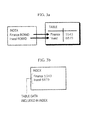
- FIG. 3A is a diagram illustrating an example of a conventional table structure in which an index is separated from a table.
- FIG. 3B is a diagram illustrating an example of a table-embedded index in contrast with FIG. 3A .
- ROWID is obtained by searching an index using a primary key, and then the table is read using the ROWID. Therefore, primary keys of a key column are redundantly stored both in the index and the table, thereby wasting disk space and increasing search time.
- the table-embedded index of FIG. 3B there is no need to store primary keys redundantly.
- the table-embedded index is more effective as the number of rows recorded increases.
- read data of a human genome includes more than maximum 6 billion pieces of data (based on 30X). Therefore, the number of rows is very large, and accordingly the number of primary keys to be recorded is large.
- the conventional table structure that requires two search processes performed using a primary key and has redundant storage spaces severely degrades the performance of a genome browser.
- the table-embedded index include an IOT of Oracle database, a clustered index of MS-SQL and SYBASE, and InnoDB of MySQL.
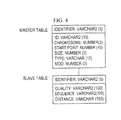
- the table management unit 120 divides the table-embedded index obtained from the parsing unit 110 into a master table which contains basic items about genetic information and a slave table which contains additional items about the genetic information and manages the table-embedded index accordingly.
- the table-embedded index can reduce storage space and is an efficient index that can improve the performance of the genome browser, it still has disadvantages. If one column of the table-embedded index is too large or if the number of columns in the table-embedded index is too large, efficiency may significantly degrade. Thus, for example, quality data containing a large number of bytes needs to be separated from other data in the genetic information.
- the quality data is information that can be omitted from a main browser page, that is, data that can be shown only in a detailed browser page.
- the additional items are data items that have relatively large data sizes and that can be omitted from the main browser.
- the master table and the slave table include the same primary keys and are searched and combined using the same primary keys.
- the user interface 150 receives a user's command, transmits the user's command to the search unit 140, and displays search results of the search unit 140 for the user.
- the user interface 150 may be implemented as, but not limited to, a genome browser.
- the search unit 140 retrieves data from the master table and/or the slave table and outputs the retrieved data in response to a user's command.
- the search unit 140 retrieves data corresponding to a primary key related to the user's command from the master table and outputs the retrieved data.
- the search unit 140 retrieves data corresponding to the primary key from the master table and data corresponding to the primary key from the slave table and outputs a combination of the retrieved data.
- the genome browser (included in the user interface 150) has a different amount of data to be arranged for each section of a data search range. Therefore, setting a different table for each section may be effective.
- the genome browser typically has a Zoom In function and a Zoom Out function.
- the Zoom In function of the genome browser limits a portion of genetic information which is displayed to about 100 kilobases (KB) in order to show the genetic information in detail.
- KB kilobases
- the Zoom In function allows not much of the genetic information of the read data to be displayed, it may lead to the display of more detailed information about a piece of read data, that is, a combination of data of the master table and data of the slave table.
- a portion of the genetic information displayed by the Zoom Out function is about 10 megabases (MB).
- MB megabases
- the master table may be referred to in order to display the basic items. If the genetic information does not have the master table/slave table structure, even when a user frequently uses the Zoom In function and the Zoom Out function, one integrated table may be referred to. However, since one integrated table includes many items of large bytes as described above, the efficiency of the table-embedded index may decrease.
- a common key (primary key) is needed to search and combine the two tables.
- primary key since each sample produces approximately 3.5 billion pieces of read data, addition of only 1 byte to the primary key may result in addition of approximately 3.5 gigabytes. For this reason, a method of putting more than 3.5 billion pieces of data in a short key is required.
- ASCII American Standard Code for Information Interchange
- ASCII characters corresponding to ASCII codes 33 to 126 may be combined to represent a primary key.
- Table 3 below shows ASCII codes and decimal numbers corresponding to the ASCII codes.
- ASCII codes 33 to 126 are general characters, and the other 34 ASCII codes are control characters. Therefore, ASCII characters corresponding to the ASCII codes 33 to 126 may be combined to represent a primary key.
- a primary key is represented in 5 bytes using the ASCII codes in the range 33 to 126, 7.3 billion identifiers can be generated using only 5 bytes. Generating as many identifiers as possible using a small number of bytes is required not just in the double-table structure that includes the master table and the slave table. It may also be used to reduce the size of a master key contained in a table in an embodiment in which a single table (in the form of a table-embedded index only) obtained from the parsing unit 110 of FIG. 1 is searched by the search unit 140.
- large-volume genetic information such as NGS read data can be processed with improved performance.
- the application of a table-embedded index to large-volume genetic information increases storage space and data processing speed, and separation of tables reduces the search time.
- ASCII code-based identifiers are used, the time required to search data and combine tables can be reduced.
- the present invention can be widely used to process large-volume data not only for purposes of providing genome analysis service (sequencing a genome and displaying the sequencing results on a gene browser), for research purposes (extracting DNA from various samples and analyzing the extracted data) and for medical purposes (diagnosis and treatment), but also for other purposes.
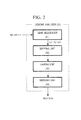
- Each component described above with reference to FIGs. 1 and 2 may be implemented as a software component, such as a task, a class, a subroutine, a process, an object, an execution thread or a program performed in a predetermined region of a memory, or a hardware component, such as a Field Programmable Gate Array (FPGA) or Application Specific Integrated Circuit (ASIC).
- the components may be composed of a combination of the software and hardware components.
- the components may be reside on a computer-readable storage medium or may be distributed over a plurality of computers. Functions provided in the respective components may be separated into further detailed components or combined into one component performing a plurality of functions.
Landscapes
- Engineering & Computer Science (AREA)
- Theoretical Computer Science (AREA)
- Physics & Mathematics (AREA)
- Databases & Information Systems (AREA)
- Life Sciences & Earth Sciences (AREA)
- Health & Medical Sciences (AREA)
- Evolutionary Biology (AREA)
- Spectroscopy & Molecular Physics (AREA)
- Bioethics (AREA)
- Biophysics (AREA)
- Bioinformatics & Cheminformatics (AREA)
- Bioinformatics & Computational Biology (AREA)
- Biotechnology (AREA)
- General Health & Medical Sciences (AREA)
- Medical Informatics (AREA)
- General Engineering & Computer Science (AREA)
- Data Mining & Analysis (AREA)
- General Physics & Mathematics (AREA)
- Software Systems (AREA)
- Mathematical Physics (AREA)
- Computational Linguistics (AREA)
- Information Retrieval, Db Structures And Fs Structures Therefor (AREA)
- Management, Administration, Business Operations System, And Electronic Commerce (AREA)
Applications Claiming Priority (1)
| Application Number | Priority Date | Filing Date | Title |
|---|---|---|---|
| KR20100103538A KR101188886B1 (ko) | 2010-10-22 | 2010-10-22 | 유전 정보 관리 시스템 및 방법 |
Publications (2)
| Publication Number | Publication Date |
|---|---|
| EP2444914A2 true EP2444914A2 (de) | 2012-04-25 |
| EP2444914A3 EP2444914A3 (de) | 2016-01-27 |
Family
ID=44993487
Family Applications (1)
| Application Number | Title | Priority Date | Filing Date |
|---|---|---|---|
| EP11185942.7A Withdrawn EP2444914A3 (de) | 2010-10-22 | 2011-10-20 | System und Verfahren zur Verwaltung genetischer Informationen |
Country Status (5)
| Country | Link |
|---|---|
| US (1) | US9098490B2 (de) |
| EP (1) | EP2444914A3 (de) |
| JP (1) | JP5175381B2 (de) |
| KR (1) | KR101188886B1 (de) |
| CN (1) | CN102456101B (de) |
Cited By (3)
| Publication number | Priority date | Publication date | Assignee | Title |
|---|---|---|---|---|
| EP2850514A4 (de) * | 2012-05-18 | 2016-03-02 | Univ Georgetown | Verfahren und systeme zum bestücken und durchsuchen einer datenbank mit informationen über arzneimittel |
| US10140683B2 (en) | 2011-12-08 | 2018-11-27 | Five3 Genomics, Llc | Distributed system providing dynamic indexing and visualization of genomic data |
| US10832799B2 (en) | 2015-08-17 | 2020-11-10 | Koninklijke Philips N.V. | Multi-level architecture of pattern recognition in biological data |
Families Citing this family (37)
| Publication number | Priority date | Publication date | Assignee | Title |
|---|---|---|---|---|
| US9773091B2 (en) | 2011-10-31 | 2017-09-26 | The Scripps Research Institute | Systems and methods for genomic annotation and distributed variant interpretation |
| US9600625B2 (en) | 2012-04-23 | 2017-03-21 | Bina Technologies, Inc. | Systems and methods for processing nucleic acid sequence data |
| US9678948B2 (en) | 2012-06-26 | 2017-06-13 | International Business Machines Corporation | Real-time message sentiment awareness |
| US9104656B2 (en) * | 2012-07-03 | 2015-08-11 | International Business Machines Corporation | Using lexical analysis and parsing in genome research |
| KR101525584B1 (ko) | 2012-12-03 | 2015-06-03 | 주식회사 케이티 | 바이오 데이터 검증 방법 및 이를 위한 장치 |
| US9690775B2 (en) | 2012-12-27 | 2017-06-27 | International Business Machines Corporation | Real-time sentiment analysis for synchronous communication |
| US9460083B2 (en) | 2012-12-27 | 2016-10-04 | International Business Machines Corporation | Interactive dashboard based on real-time sentiment analysis for synchronous communication |
| US8937564B2 (en) | 2013-01-10 | 2015-01-20 | Infinidat Ltd. | System, method and non-transitory computer readable medium for compressing genetic information |
| US20140236897A1 (en) * | 2013-01-10 | 2014-08-21 | Jacob Brodio | System, method and non-transitory computer readable medium for compressing genetic information |
| US9792405B2 (en) | 2013-01-17 | 2017-10-17 | Edico Genome, Corp. | Bioinformatics systems, apparatuses, and methods executed on an integrated circuit processing platform |
| US10691775B2 (en) | 2013-01-17 | 2020-06-23 | Edico Genome, Corp. | Bioinformatics systems, apparatuses, and methods executed on an integrated circuit processing platform |
| US10068054B2 (en) | 2013-01-17 | 2018-09-04 | Edico Genome, Corp. | Bioinformatics systems, apparatuses, and methods executed on an integrated circuit processing platform |
| US9679104B2 (en) | 2013-01-17 | 2017-06-13 | Edico Genome, Corp. | Bioinformatics systems, apparatuses, and methods executed on an integrated circuit processing platform |
| US10847251B2 (en) | 2013-01-17 | 2020-11-24 | Illumina, Inc. | Genomic infrastructure for on-site or cloud-based DNA and RNA processing and analysis |
| US10235496B2 (en) | 2013-03-15 | 2019-03-19 | The Scripps Research Institute | Systems and methods for genomic annotation and distributed variant interpretation |
| US11342048B2 (en) | 2013-03-15 | 2022-05-24 | The Scripps Research Institute | Systems and methods for genomic annotation and distributed variant interpretation |
| US9418203B2 (en) | 2013-03-15 | 2016-08-16 | Cypher Genomics, Inc. | Systems and methods for genomic variant annotation |
| US9594777B1 (en) * | 2013-08-15 | 2017-03-14 | Pivotal Software, Inc. | In-database single-nucleotide genetic variant analysis |
| US9857328B2 (en) | 2014-12-18 | 2018-01-02 | Agilome, Inc. | Chemically-sensitive field effect transistors, systems and methods for manufacturing and using the same |
| US10020300B2 (en) | 2014-12-18 | 2018-07-10 | Agilome, Inc. | Graphene FET devices, systems, and methods of using the same for sequencing nucleic acids |
| US9618474B2 (en) | 2014-12-18 | 2017-04-11 | Edico Genome, Inc. | Graphene FET devices, systems, and methods of using the same for sequencing nucleic acids |
| US9859394B2 (en) | 2014-12-18 | 2018-01-02 | Agilome, Inc. | Graphene FET devices, systems, and methods of using the same for sequencing nucleic acids |
| US10006910B2 (en) | 2014-12-18 | 2018-06-26 | Agilome, Inc. | Chemically-sensitive field effect transistors, systems, and methods for manufacturing and using the same |
| CA2971589C (en) | 2014-12-18 | 2021-09-28 | Edico Genome Corporation | Chemically-sensitive field effect transistor |
| WO2016154154A2 (en) | 2015-03-23 | 2016-09-29 | Edico Genome Corporation | Method and system for genomic visualization |
| US10419020B2 (en) | 2015-06-18 | 2019-09-17 | International Business Machines Corporation | Increasing storage capacity and data transfer speed in genome data backup |
| EP3608913A1 (de) * | 2015-07-02 | 2020-02-12 | Edico Genome, Corp. | Bioinformatiksysteme, vorrichtungen und auf einer verarbeitungsplattform einer integrierten schaltung ausgeführte verfahren |
| US20170270245A1 (en) | 2016-01-11 | 2017-09-21 | Edico Genome, Corp. | Bioinformatics systems, apparatuses, and methods for performing secondary and/or tertiary processing |
| US10068183B1 (en) | 2017-02-23 | 2018-09-04 | Edico Genome, Corp. | Bioinformatics systems, apparatuses, and methods executed on a quantum processing platform |
| WO2017201081A1 (en) | 2016-05-16 | 2017-11-23 | Agilome, Inc. | Graphene fet devices, systems, and methods of using the same for sequencing nucleic acids |
| US10522241B2 (en) | 2016-09-08 | 2019-12-31 | International Business Machines Corporation | Accelerating genomic data parsing on field programmable gate arrays |
| EA201990933A1 (ru) * | 2016-10-11 | 2019-11-29 | Эффективные структуры данных для представления информации биоинформатики | |
| JP6776937B2 (ja) * | 2017-02-20 | 2020-10-28 | 富士通株式会社 | 情報処理装置、方法及びプログラム |
| US20180314842A1 (en) * | 2017-04-27 | 2018-11-01 | Awakens, Inc. | Computing system with genomic information access mechanism and method of operation thereof |
| RU2659025C1 (ru) * | 2017-06-14 | 2018-06-26 | Общество с ограниченной ответственностью "ЛЭНДИГРАД" | Способы кодирования и декодирования информации |
| JP7747528B2 (ja) | 2020-04-07 | 2025-10-01 | イルミナ インコーポレイテッド | ハードウェア加速K-merグラフ生成 |
| EP4490735A1 (de) | 2022-03-08 | 2025-01-15 | Illumina Inc | Softwarebeschleunigte genomische lese-mapping-engine mit mehreren durchgängen |
Citations (1)
| Publication number | Priority date | Publication date | Assignee | Title |
|---|---|---|---|---|
| KR20100103538A (ko) | 2009-01-16 | 2010-09-27 | 광저우 콘썬 메디신 알앤디 컴퍼니 리미티드 | 당뇨병성 신장질환용 약제학적 조성물 및 이의 제제 및 적용 |
Family Cites Families (23)
| Publication number | Priority date | Publication date | Assignee | Title |
|---|---|---|---|---|
| JPS6266378A (ja) * | 1985-09-19 | 1987-03-25 | Mitsubishi Electric Corp | 文書デ−タ処理装置 |
| US5204663A (en) * | 1990-05-21 | 1993-04-20 | Applied Systems Institute, Inc. | Smart card access control system |
| US6519583B1 (en) * | 1997-05-15 | 2003-02-11 | Incyte Pharmaceuticals, Inc. | Graphical viewer for biomolecular sequence data |
| US6317750B1 (en) * | 1998-10-26 | 2001-11-13 | Hyperion Solutions Corporation | Method and apparatus for accessing multidimensional data |
| US6941317B1 (en) | 1999-09-14 | 2005-09-06 | Eragen Biosciences, Inc. | Graphical user interface for display and analysis of biological sequence data |
| US6484179B1 (en) * | 1999-10-25 | 2002-11-19 | Oracle Corporation | Storing multidimensional data in a relational database management system |
| US6795821B2 (en) * | 2001-07-17 | 2004-09-21 | Trendium, Inc. | Database systems, methods and computer program products including primary key and super key indexes for use with partitioned tables |
| US7529685B2 (en) * | 2001-08-28 | 2009-05-05 | Md Datacor, Inc. | System, method, and apparatus for storing, retrieving, and integrating clinical, diagnostic, genomic, and therapeutic data |
| KR100453517B1 (ko) | 2002-05-31 | 2004-10-20 | 주식회사 이노티브 | 인터넷을 통한 대용량 고품질 디지털 이미지의 실시간서비스 방법 |
| US7634498B2 (en) * | 2003-10-24 | 2009-12-15 | Microsoft Corporation | Indexing XML datatype content system and method |
| US7925555B2 (en) * | 2003-11-05 | 2011-04-12 | Wells Fargo Bank N.A. | Master system of record |
| KR100601941B1 (ko) | 2004-02-17 | 2006-07-14 | 삼성전자주식회사 | 서열 색인 방법 및 그 시스템 |
| JP4433289B2 (ja) * | 2004-04-27 | 2010-03-17 | 日鉄日立システムエンジニアリング株式会社 | ゲノム情報表示システム |
| WO2006002234A2 (en) * | 2004-06-22 | 2006-01-05 | Coras, Inc. | Systems and methods for software based on business concepts |
| US20060074735A1 (en) * | 2004-10-01 | 2006-04-06 | Microsoft Corporation | Ink-enabled workflow authoring |
| US20080077570A1 (en) * | 2004-10-25 | 2008-03-27 | Infovell, Inc. | Full Text Query and Search Systems and Method of Use |
| JP2006244189A (ja) * | 2005-03-04 | 2006-09-14 | Hitachi Software Eng Co Ltd | 遺伝情報検索プログラム |
| US7734619B2 (en) * | 2005-05-27 | 2010-06-08 | International Business Machines Corporation | Method of presenting lineage diagrams representing query plans |
| CN101449204A (zh) * | 2005-09-07 | 2009-06-03 | 实况活动媒体公司 | 用于图像捕获的空中支撑结构和方法 |
| CN100343852C (zh) * | 2005-09-27 | 2007-10-17 | 南方医科大学 | 一种与特定功能相关的基因信息检索系统及用于该系统的检索词数据库的构建方法 |
| US7472140B2 (en) * | 2005-12-20 | 2008-12-30 | Oracle International Corporation | Label-aware index for efficient queries in a versioning system |
| KR100737359B1 (ko) * | 2006-10-04 | 2007-07-10 | (주)이글로벌시스템 | 암호화된 컬럼의 인덱스 구축방법 |
| US9704129B2 (en) * | 2009-08-31 | 2017-07-11 | Thomson Reuters Global Resources | Method and system for integrated professional continuing education related services |
-
2010
- 2010-10-22 KR KR20100103538A patent/KR101188886B1/ko not_active Expired - Fee Related
-
2011
- 2011-10-20 EP EP11185942.7A patent/EP2444914A3/de not_active Withdrawn
- 2011-10-21 JP JP2011231857A patent/JP5175381B2/ja not_active Expired - Fee Related
- 2011-10-21 US US13/278,791 patent/US9098490B2/en not_active Expired - Fee Related
- 2011-10-24 CN CN201110329432.3A patent/CN102456101B/zh not_active Expired - Fee Related
Patent Citations (1)
| Publication number | Priority date | Publication date | Assignee | Title |
|---|---|---|---|---|
| KR20100103538A (ko) | 2009-01-16 | 2010-09-27 | 광저우 콘썬 메디신 알앤디 컴퍼니 리미티드 | 당뇨병성 신장질환용 약제학적 조성물 및 이의 제제 및 적용 |
Cited By (6)
| Publication number | Priority date | Publication date | Assignee | Title |
|---|---|---|---|---|
| US10140683B2 (en) | 2011-12-08 | 2018-11-27 | Five3 Genomics, Llc | Distributed system providing dynamic indexing and visualization of genomic data |
| US10733701B2 (en) | 2011-12-08 | 2020-08-04 | Five3 Genomics, Llc | Distributed system providing dynamic indexing and visualization of genomic data |
| EP2850514A4 (de) * | 2012-05-18 | 2016-03-02 | Univ Georgetown | Verfahren und systeme zum bestücken und durchsuchen einer datenbank mit informationen über arzneimittel |
| US11373734B2 (en) | 2012-05-18 | 2022-06-28 | Georgetown University | Methods and systems for populating and searching a drug informatics database |
| US10832799B2 (en) | 2015-08-17 | 2020-11-10 | Koninklijke Philips N.V. | Multi-level architecture of pattern recognition in biological data |
| US11710540B2 (en) | 2015-08-17 | 2023-07-25 | Koninklijke Philips N.V. | Multi-level architecture of pattern recognition in biological data |
Also Published As
| Publication number | Publication date |
|---|---|
| KR20120042058A (ko) | 2012-05-03 |
| CN102456101B (zh) | 2015-07-08 |
| KR101188886B1 (ko) | 2012-10-09 |
| US20120102041A1 (en) | 2012-04-26 |
| JP2012094141A (ja) | 2012-05-17 |
| US9098490B2 (en) | 2015-08-04 |
| JP5175381B2 (ja) | 2013-04-03 |
| EP2444914A3 (de) | 2016-01-27 |
| CN102456101A (zh) | 2012-05-16 |
Similar Documents
| Publication | Publication Date | Title |
|---|---|---|
| EP2444914A2 (de) | System und Verfahren zur Verwaltung genetischer Informationen | |
| Pierce et al. | Large-scale sequence comparisons with sourmash | |
| Cox et al. | Large-scale compression of genomic sequence databases with the Burrows–Wheeler transform | |
| Li | Minimap and miniasm: fast mapping and de novo assembly for noisy long sequences | |
| EP3252650B1 (de) | Anonymisierungsverarbeitungsvorrichtung, anonymisierungsverarbeitungsverfahren und programm | |
| KR101922129B1 (ko) | 차세대 시퀀싱을 이용하여 획득된 유전 정보를 압축 및 압축해제하는 방법 및 장치 | |
| KR20110129628A (ko) | Dna 서열 검색 방법 및 장치 | |
| KR20190062541A (ko) | 참조 서열을 사용한 생물정보학 데이터의 표현 및 처리를 위한 방법 및 시스템 | |
| US11916576B2 (en) | System and method for effective compression, representation and decompression of diverse tabulated data | |
| KR20050057320A (ko) | 게놈 유도 방법, 시스템 및 기록 매체 | |
| EP3526709B1 (de) | Effiziente datenstrukturen zur darstellung von bioinformatikinformationen | |
| US20150248430A1 (en) | Efficient encoding and storage and retrieval of genomic data | |
| KR102421458B1 (ko) | 액세스 유닛으로 구조화된 생물정보학 데이터에 액세스하기 위한 방법 및 장치 | |
| Karasikov et al. | Efficient and accurate search in petabase-scale sequence repositories | |
| Meng et al. | Reference-free lossless compression of nanopore sequencing reads using an approximate assembly approach | |
| JP2004318321A (ja) | 生物情報検索システム及び検索方法 | |
| EP3526706B1 (de) | Verfahren und vorrichtung zum zugriff auf in zugangseinheiten strukturierte bioinformatikdaten | |
| McKinnon et al. | A comprehensive analysis of the phylogenetic signal in ramp sequences in 211 vertebrates | |
| EP4652607A1 (de) | System und verfahren zur analyse, speicherung und gemeinsamen nutzung von genomdaten unter verwendung einer blockchain | |
| US12445148B2 (en) | System and method for effective compression representation and decompression of diverse tabulated data | |
| WO2024073847A1 (en) | System and method for storing and sharing genomic data using blockchain | |
| Numanagic | Efficient high throughput sequencing data compression and genotyping methods for clinical environments | |
| Záhonová et al. | Nuclear Genome Assembly and Annotation of Kinetoplastids | |
| EP3637422B1 (de) | Computerdateien und verfahren zur unterstützung der forensischen analyse von nukleotidsequenzdaten |
Legal Events
| Date | Code | Title | Description |
|---|---|---|---|
| 17P | Request for examination filed |
Effective date: 20111020 |
|
| AK | Designated contracting states |
Kind code of ref document: A2 Designated state(s): AL AT BE BG CH CY CZ DE DK EE ES FI FR GB GR HR HU IE IS IT LI LT LU LV MC MK MT NL NO PL PT RO RS SE SI SK SM TR |
|
| AX | Request for extension of the european patent |
Extension state: BA ME |
|
| PUAI | Public reference made under article 153(3) epc to a published international application that has entered the european phase |
Free format text: ORIGINAL CODE: 0009012 |
|
| PUAL | Search report despatched |
Free format text: ORIGINAL CODE: 0009013 |
|
| AK | Designated contracting states |
Kind code of ref document: A3 Designated state(s): AL AT BE BG CH CY CZ DE DK EE ES FI FR GB GR HR HU IE IS IT LI LT LU LV MC MK MT NL NO PL PT RO RS SE SI SK SM TR |
|
| AX | Request for extension of the european patent |
Extension state: BA ME |
|
| RIC1 | Information provided on ipc code assigned before grant |
Ipc: G06F 17/30 20060101ALN20151223BHEP Ipc: G06F 19/28 20110101AFI20151223BHEP |
|
| STAA | Information on the status of an ep patent application or granted ep patent |
Free format text: STATUS: THE APPLICATION HAS BEEN WITHDRAWN |
|
| 18W | Application withdrawn |
Effective date: 20161018 |