EP2444944A2 - Procédés de vérification et appareil - Google Patents
Procédés de vérification et appareil Download PDFInfo
- Publication number
- EP2444944A2 EP2444944A2 EP11178355A EP11178355A EP2444944A2 EP 2444944 A2 EP2444944 A2 EP 2444944A2 EP 11178355 A EP11178355 A EP 11178355A EP 11178355 A EP11178355 A EP 11178355A EP 2444944 A2 EP2444944 A2 EP 2444944A2
- Authority
- EP
- European Patent Office
- Prior art keywords
- bar code
- scanner
- customer
- items
- code scanner
- Prior art date
- Legal status (The legal status is an assumption and is not a legal conclusion. Google has not performed a legal analysis and makes no representation as to the accuracy of the status listed.)
- Withdrawn
Links
- 238000000034 method Methods 0.000 title claims description 27
- 230000009977 dual effect Effects 0.000 claims description 21
- 230000000694 effects Effects 0.000 abstract description 2
- 230000008569 process Effects 0.000 description 10
- 238000013459 approach Methods 0.000 description 7
- 235000012206 bottled water Nutrition 0.000 description 2
- 239000000047 product Substances 0.000 description 2
- 230000008859 change Effects 0.000 description 1
- 238000010586 diagram Methods 0.000 description 1
- 230000006870 function Effects 0.000 description 1
- 239000000463 material Substances 0.000 description 1
- 238000012011 method of payment Methods 0.000 description 1
- 230000001737 promoting effect Effects 0.000 description 1
- 230000000284 resting effect Effects 0.000 description 1
- 239000013589 supplement Substances 0.000 description 1
- 230000032258 transport Effects 0.000 description 1
Images

Classifications
-
- G—PHYSICS
- G07—CHECKING-DEVICES
- G07G—REGISTERING THE RECEIPT OF CASH, VALUABLES, OR TOKENS
- G07G1/00—Cash registers
- G07G1/0036—Checkout procedures
- G07G1/0045—Checkout procedures with a code reader for reading of an identifying code of the article to be registered, e.g. barcode reader or radio-frequency identity [RFID] reader
- G07G1/0081—Checkout procedures with a code reader for reading of an identifying code of the article to be registered, e.g. barcode reader or radio-frequency identity [RFID] reader the reader being a portable scanner or data reader
-
- G—PHYSICS
- G07—CHECKING-DEVICES
- G07G—REGISTERING THE RECEIPT OF CASH, VALUABLES, OR TOKENS
- G07G1/00—Cash registers
- G07G1/0036—Checkout procedures
- G07G1/0045—Checkout procedures with a code reader for reading of an identifying code of the article to be registered, e.g. barcode reader or radio-frequency identity [RFID] reader
- G07G1/0054—Checkout procedures with a code reader for reading of an identifying code of the article to be registered, e.g. barcode reader or radio-frequency identity [RFID] reader with control of supplementary check-parameters, e.g. weight or number of articles
-
- G—PHYSICS
- G07—CHECKING-DEVICES
- G07G—REGISTERING THE RECEIPT OF CASH, VALUABLES, OR TOKENS
- G07G1/00—Cash registers
- G07G1/12—Cash registers electronically operated
Definitions
- the present invention relates generally to improved methods and apparatus for checkout, and more particularly to advantageous techniques for utilizing a cost effective secondary handheld scanner to supplement the use of a primary scanner, such as a counter mounted bi-optic or dual aperture scanner, to speed checkout line processing during times of peak activity.
- a primary scanner such as a counter mounted bi-optic or dual aperture scanner
- POS checkout system It is common for a point of sale (POS) checkout system to include two types of barcode scanner: a primary scanner, such as an in-counter bi-optic or dual aperture scanner, and a secondary handheld scanner.
- the primary scanner is typically utilized for high throughput items and supports the rapid scanning of a large number of items in rapid succession.
- the secondary handheld scanner is typically employed to scan heavy, bulky items that are more efficiently scanned in a customer's cart, such as a large bag of dog food, a 24 pack of bottled water, a large potted plant, and the like.
- pre-scanning customer merchandise can be advantageously employed in a variety of contexts, such as, handling the lines presented during peak store sales periods, such as the peak Christmas selling days or during major sales, for example.
- U.S. Patent No. 7,575,161 describes a cart and scanner arrangement for prescanning and bagging a customer's items to speed the checkout process.
- Casio Electronics Co. Ltd. describes a queue busting approach utilizing a rugged Pocket PC terminal, the IT-700 series. Such approaches utilize a relatively expensive bar code scanner or other equipment to build up a transaction receipt.
- the present invention recognizes that such prior art approaches may require too great an investment in additional equipment that may only be needed at certain times of day or during particular times of year.
- the present invention focuses on approaches to leverage existing store equipment with either a simple software upgrade, or in which a substantially reduced investment in further equipment is required as compared with approaches like the Casio Electronics Co. Ltd. approach described above.
- a checkout system comprising: a primary bar code scanner for rapidly scanning a majority of items of a first customer; a secondary handheld bar code scanner for scanning other items of the first customer during periods of normal operation; means for detecting that the secondary handheld bar code scanner is being utilized to scan items of a second customer during periods of peak operation; and control means for integrating data from the primary bar code scanner and the secondary handheld bar code scanner during periods of normal operation, and segregating the data from the primary barcode scanner and the secondary handheld scanner upon detecting the secondary handheld scanner is being utilized to scan items of the second customer.
- a checkout method comprising: rapidly scanning a majority of items of a first customer utilizing a primary bar code scanner; scanning other items of the first customer during periods of normal operation utilizing a secondary handheld bar code scanner; detecting that the secondary handheld bar code scanner is being utilized to scan items of a second customer during periods of peak operation; integrating data from the primary bar code scanner and the secondary handheld bar code scanner during periods of normal operation; and upon detecting the secondary handheld scanner is being utilized to scan items of the second customer, segregating the data from the primary barcode scanner and the secondary handheld scanner.
- the primary bar code scanner may be a dual aperture scanner having a substantially horizontal surface flush mounted with a checkout stand.
- the method may comprise the further step of utilizing the secondary handheld bar code scanner to read a start bar code before starting to scan items of the second customer, and to read a stop bar code after finishing scanning items of the second customer.
- a bar code on a customer loyalty card may be utilized as the start bar code and the stop barcode.
- the method may comprise the further step of providing raw bar code scan data directly from the handheld bar code scanner to a port of a point-of-sale terminal.
- the method may comprise the further step of providing raw bar code scan data directly from the secondary handheld bar code scanner to a port of the primary bar code scanner.
- the method may comprise the further step of utilizing a processor in the primary bar code scanner to control integrating and segregating the data.
- the method may comprise the further step of utilizing the processor to recognize a unique customer identifier received by the primary bar code scanner from the secondary bar code scanner as a start code and storing data received from the secondary bar code scanner in a memory until a stop code is recognized.
- the method may comprise the further step of communicating raw scanned data wirelessly by the secondary handheld scanner.
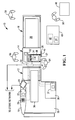
- system 10 is configured as a full-service checkout island and includes bagging portion 12, scanning portion 14, and receiving portion 16.
- Bagging portion 12 includes customer service table 18, conveyor 26, cash drawer 28, bagging shelf 30, and receipt printer 31.
- Customer service table 18 provides a convenient writing surface and includes card reader with pin keypad 20, customer receipt printer 22, and customer display 24.
- Card reader 20 is operational in both full and self-service configurations.
- Printer 22 though present in the full-service configuration, is intended primarily for operation as a receipt printer during the self-service mode of operation.
- Printer 31 is used for full-service operation.
- Customer display 24 operates as a customer information terminal during full-service operation and a customer-operated transaction terminal during self-service operation. Customer display 24 is preferably connected to a store network. An NCR 7401 computer terminal is suitable for use as customer display 24.
- Conveyor 26 supports and transports merchandise items to bagging shelf 30.
- Conveyor 26 preferably telescopes to allow a portion of bagging portion 12 to be lowered to become a bagging shelf in the self-service mode of operation.
- Cash drawer 28 is operated by a full-service checkout employee and allows the employee to process cash and check payments and dispense change.
- Scanning portion 14 includes terminal interface 32, a primary dual aperture bar code scanner 34, a secondary handheld bar code scanner 35, and terminal 33.
- Terminal interface 32 provides an operator with control during a full-service checkout operation.
- Terminal interface 32 includes either a display and keypad or a touch screen and is mounted above the vertical aperture portion of dual aperture bar code scanner 34.
- An NCR Dynakey® terminal is suitable for use as terminal interface 32 although it will be recognized other terminals may also suitably be employed.
- Dual aperture bar code scanner 34 includes a vertical aperture and a horizontal aperture.
- the horizontal aperture is substantially flush with the top surface of scanning portion 14 and may be part of a scale weigh plate if dual aperture bar code scanner 34 is equipped with a scale.
- An NCR 7875 scanner is suitable for use as scanner 34.
- full-service checkout employee 54 can easily scan merchandise items using scanning light beams from both vertical and horizontal apertures.
- Terminal 33 is located within scanning portion 14. Terminal 33 is preferably connected to a store network. During full-service operation, terminal 33 controls card reader 20, cash drawer 28, receipt printer 31, terminal interface 32, primary dual-aperture scanner 34 and second handheld bar code scanner 35.
- Receiving portion 16 includes conveyor belt 38.
- Fig. 1 During full-service operation, customer 53 approaches receiving portion 16 on one side as shown, and places most merchandise items on conveyor belt 38. Large and bulky items are left in a shopping cart 40 which goes to the other side of the checkout stand used by employee 54 as represented schematically in Fig. 1 .
- Employee 54 scans bar coded merchandise items taken from the conveyor belt 38 using dual aperture bar code scanner 34.
- Employee 54 may alternatively process bar coded merchandise items by entering price look-up numbers into terminal interface 32.
- Employee 54 also processes non-bar coded items, such as produce items using the scale of dual aperture bar code scanner 34 and terminal interface 32.
- Employee 54 moves all the processed merchandise items from conveyor 38 to bagging portion 12.
- the employee 50 now turns to any large or bulky items left in the cart 40, such as a fifty pound sack of dog food 42 and a 24 pack of bottled water 44 left on the cart 40.
- store employee 54 removes handheld bar code scanner 35 from its cradle 45 and scans the bar codes for the items 42 and 44 while they are still on the cart 40.
- the handheld bar code scanner 35 is connected by a flexible and lengthy extendible cord 37 to an input, such as a USB port, of the dual aperture scanner 34.
- cord 37 may connect scanner 35 to a USB port or other connector of the terminal 33.
- a processor in dual aperture scanner 34 combines the scan data from the handheld scanner 35 with the data from dual aperture scanner 34 and the combined data is output to and processed by the terminal 33 to produce a customer transaction receipt.
- Customer 53 moves to customer service table 18 to wait for all items to be processed by employee 54 and to complete payment. While waiting, customer 53 may view promotional material displayed by display 24 or use customer display to find information about products, answer surveys, or select coupons. Payment may be recorded by card reader 20.
- employee 54 hands a transaction receipt from receipt printer 31 to customer 53.
- Customer 53, service person 54, or another store employee charged with bagging items then removes the items from bagging portion 12 and bags them.
- Fig. 1 the operation of Fig. 1 up to this point is conventional and typical of how a store might handle a normal period of business.
- the system 10 has been modified to advantageously be readily adaptable to periods of peak business and long customer lines without the addition of any hardware as follows.
- a second store employee 56 utilizes the handheld scanner 35 to pre-scan items from cart 48 for a next customer 58 in line behind customer 53.
- extensible cord 37 is long enough to readily extend to the cart 48 for the next customer.
- the store employee 56 may scan a customer identifier, such as a bar code from a customer loyalty card before that customer's first item is scanned and again after the last item is scanned.
- store employee 56 may scan a bar coded card at start and end of scanning the second customer's items and then give the bar coded card to the second customer to present to store employee 54 to identify the customer.
- start and stop bar code scans can be recognized by the processor of dual aperture scanner 34 because its software has been updated appropriately in accordance with the present invention, as addressed further below in connection with Figs. 2 and 3 .
- a suitably programmed processor comprises an example of control means for integrating data from the primary bar code scanner and the secondary handheld scanner during periods of normal operation, and segregating the data from the primary bar code scanner and the secondary handheld scanner upon detecting the secondary scanner is being utilized to scan items of the second customer.
- the processor segregates the data for the first customer 53 from that of the second customer 58 rather than combining the data from the handheld scanner 35 with the data for the dual aperture scanner 34 as is normally the case for a single customer.
- the terminal 33 receives the data from handheld scanner 35 directly, it has its software updated to recognize the customer identifier as the start and stop codes for data for a second customer so that data is segregated from data for the first customer by a processor in terminal 33.
- the customer loyalty card is returned to second customer 58 who simply presents that card to store employee 54 once customer 53 is done.
- the loyalty card is scanned using dual aperture scanner 34 and the data for customer 58 is communicated to the terminal 33 and processed to generate a transaction receipt. While customer 58 is being helped by employee 54, the next customer in line can start loading items on conveyor belt 38 and employee 56 can start pre scanning the items for the next customer after that.
- Fig. 2 illustrates an example of a checkout process 200 at a checkout stand, such as the stand described in system 10, in accordance with the present invention.
- step 202 of process 200 bar coded items are scanned utilizing a primary scanner by a first store employee, such as dual aperture scanner 34, for example.
- step 204 other barcoded items, such as large or bulky items are scanned utilizing a secondary handheld scanner, such as scanner 35, for example.
- raw bar code data may be provided directly from the secondary handheld scanner to the primary dual aperture scanner.
- step 206 bar code data from steps 202 and 204 is combined and processed to produce a customer receipt.
- step 207 the process repeats for the next customer.
- a second store employee Upon recognition of there being excessively long lines of customers during a period of peak operation, a second store employee is dispatched to the checkout stand and the process 200 continues, in step 208, with bar coded items for a first customer scanned utilizing the primary scanner by the first store employee.
- bar coded items for a next customer in line are pre scanned by the second store employee utilizing a handheld scanner.
- the second store employee scans a customer identifier utilizing the handheld scanner. This identifier functions as a start code.
- the second customer's items are pre scanned.
- the customer identifier is scanned again and recognized as a stop code.
- a store utilizes a customer loyalty card having a bar code
- that bar code may be suitably employed as the customer identifier and serve as both the start and stop codes.
- the second store employee may have a stack of bar coded cards which he or she scans at the start and stop of pre scanning a next customer's items. It will be recognized that separate start and stop codes may be employed if desired. Further, a temporary interruption code may be employed to allow the second store employee to stop pre scanning to allow the first store employee to scan large or bulky items.
- the pre scanned customer Upon completion of pre scanning, the pre scanned customer receives his or her loyalty card back or the bar coded card which is then scanned in step 216 by the first store employee to check out the pre scanned customer.
- the data from step 212 is processed in step 218 to produce a customer receipt. Payment is made and a receipt is provided.
- the pre scanning process continues for the next customer to be prescanned.
- the present invention adds new intelligence to the application software of the primary dual aperture scanner 34.
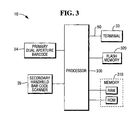
- processor 300 receives inputs from primary dual aperture bar code scanner 34, and secondary handheld bar code scanner 35. It provides outputs on line 50 which is connected to an input of terminal 33.
- Processor 300 has software memory 310 storing software which when executed controls the processor 300 to perform the methods and processes described further herein. It additionally has flash memory 320. When processor 300 has not received a start or stop code from handheld bar code scanner 35, it outputs its own scan data, as well as, any received from scanner 35 on output line 50.
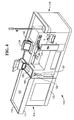
- Fig. 4 illustrates a further checkout system 110 in accordance with a second embodiment of the present invention.
- Checkout station 110 may suitably include a feeder unit 114 and a checkstand 118.
- Feeder unit 114 includes a feeder belt 120 and housing 122 for the motor and control circuitry that operates feeder belt 120.
- Checkstand 118 includes a primary scanner/scale unit 126 and a secondary, handheld scanner 135.
- the secondary scanner 135 is a connected to a port of POS terminal 138, such as a USB connector, by a flexible extensible cord 137 and held in a cradle 45 when not in use.
- the primary scanner scale unit 126 is also connected to terminal 138.
- Scanner/scale unit 126 uses a laser to scan and obtain input data from bar codes applied to products or packages. Unit 126 may also include a scale for measuring the weight of articles that are sold on a price/unit of weight basis. Consumer terminal 134 displays article data as it is entered through scanner/scale unit 126. Terminal 138 may be any known POS terminal that incorporates a card reader 132 to support credit card, debit card, and other payment methods. A receipt printer 144 provides a consumer with a receipt itemizing the articles purchased and the method of payment. Further details of check stand 110 are found in U.S. Patent No. 7,673,796 assigned to the assignee of the present invention. In this embodiment, a processor in the terminal 138 aggregates of segregates the data. While a wired handheld scanner is presently preferred as a lowest cost alternative, it will be recognized a wireless scanner may also be employed if its cost is acceptable.
Landscapes
- Physics & Mathematics (AREA)
- General Physics & Mathematics (AREA)
- Cash Registers Or Receiving Machines (AREA)
Applications Claiming Priority (1)
| Application Number | Priority Date | Filing Date | Title |
|---|---|---|---|
| US12/890,795 US20120074218A1 (en) | 2010-09-27 | 2010-09-27 | Checkout Methods and Apparatus |
Publications (2)
| Publication Number | Publication Date |
|---|---|
| EP2444944A2 true EP2444944A2 (fr) | 2012-04-25 |
| EP2444944A3 EP2444944A3 (fr) | 2012-05-30 |
Family
ID=44508969
Family Applications (1)
| Application Number | Title | Priority Date | Filing Date |
|---|---|---|---|
| EP11178355A Withdrawn EP2444944A3 (fr) | 2010-09-27 | 2011-08-22 | Procédés de vérification et appareil |
Country Status (2)
| Country | Link |
|---|---|
| US (1) | US20120074218A1 (fr) |
| EP (1) | EP2444944A3 (fr) |
Cited By (1)
| Publication number | Priority date | Publication date | Assignee | Title |
|---|---|---|---|---|
| WO2014035595A1 (fr) * | 2012-08-30 | 2014-03-06 | Symbol Technologies, Inc. | Système de caisse de point de transaction et son procédé associé pour traiter des cibles lisibles électro-optiquement par un poste de travail employé par un vendeur et un lecteur accessoire employé par un client |
Families Citing this family (9)
| Publication number | Priority date | Publication date | Assignee | Title |
|---|---|---|---|---|
| US8240570B2 (en) * | 2010-12-08 | 2012-08-14 | Ncr Corporation | Hybrid imaging optical code reader |
| US9082114B2 (en) * | 2011-07-29 | 2015-07-14 | Ncr Corporation | Self-service terminal |
| US20130153655A1 (en) * | 2011-12-15 | 2013-06-20 | Barbara W. Dawkins | Self service retail check out using smart phone |
| US20150356535A1 (en) * | 2013-01-12 | 2015-12-10 | Royston Llc | Modular multi-component checkout stand |
| JP6572630B2 (ja) * | 2015-06-04 | 2019-09-11 | 株式会社寺岡精工 | 商品販売データ処理装置、商品販売データ処理方法、及びプログラム |
| JP6598321B1 (ja) * | 2018-05-21 | 2019-10-30 | Necプラットフォームズ株式会社 | 情報処理装置、制御方法、及びプログラム |
| JP6542443B2 (ja) * | 2018-07-19 | 2019-07-10 | 東芝テック株式会社 | チェックアウトシステム |
| US11037124B1 (en) * | 2020-02-26 | 2021-06-15 | Viscovery Inc. | Checkout apparatus for barcodeless merchandise |
| US12288450B1 (en) * | 2021-09-03 | 2025-04-29 | Ncr Voyix Corporation | Modular self-service checkout system |
Citations (5)
| Publication number | Priority date | Publication date | Assignee | Title |
|---|---|---|---|---|
| US5393965A (en) * | 1990-11-13 | 1995-02-28 | Symbol Technologies, Inc. | Flexible merchandise checkout and inventory management system |
| US6286758B1 (en) | 1999-02-17 | 2001-09-11 | Ncr Corporation | Reconfigurable checkout system |
| US7546953B1 (en) | 2005-11-29 | 2009-06-16 | Ncr Corporation | System for mounting a handheld barcode scanner |
| US7575161B2 (en) | 2002-03-14 | 2009-08-18 | Wal-Mart Stores, Inc. | Systems and methods for pre-scanning merchandise in customer's shopping cart while customer is waiting in checkout line |
| US7673796B2 (en) | 2006-10-11 | 2010-03-09 | Ncr Corporation | System and method for providing remote site intervention support for self-checkout stations |
Family Cites Families (5)
| Publication number | Priority date | Publication date | Assignee | Title |
|---|---|---|---|---|
| DE29604996U1 (de) * | 1996-03-18 | 1996-09-12 | Stork, Malik, 52066 Aachen | Kassenplatz für Verkaufsgeschäfte |
| US5804807A (en) * | 1996-09-12 | 1998-09-08 | Symbol Technologies, Inc. | Scan-ahead system for processing merchandise at a checkout register |
| US5978772A (en) * | 1996-10-11 | 1999-11-02 | Mold; Jeffrey W. | Merchandise checkout system |
| US6325290B1 (en) * | 1998-12-04 | 2001-12-04 | Ncr Corporation | Method and apparatus for checking out large items with a self-service checkout terminal |
| US6179206B1 (en) * | 1998-12-07 | 2001-01-30 | Fujitsu Limited | Electronic shopping system having self-scanning price check and purchasing terminal |
-
2010
- 2010-09-27 US US12/890,795 patent/US20120074218A1/en not_active Abandoned
-
2011
- 2011-08-22 EP EP11178355A patent/EP2444944A3/fr not_active Withdrawn
Patent Citations (5)
| Publication number | Priority date | Publication date | Assignee | Title |
|---|---|---|---|---|
| US5393965A (en) * | 1990-11-13 | 1995-02-28 | Symbol Technologies, Inc. | Flexible merchandise checkout and inventory management system |
| US6286758B1 (en) | 1999-02-17 | 2001-09-11 | Ncr Corporation | Reconfigurable checkout system |
| US7575161B2 (en) | 2002-03-14 | 2009-08-18 | Wal-Mart Stores, Inc. | Systems and methods for pre-scanning merchandise in customer's shopping cart while customer is waiting in checkout line |
| US7546953B1 (en) | 2005-11-29 | 2009-06-16 | Ncr Corporation | System for mounting a handheld barcode scanner |
| US7673796B2 (en) | 2006-10-11 | 2010-03-09 | Ncr Corporation | System and method for providing remote site intervention support for self-checkout stations |
Cited By (1)
| Publication number | Priority date | Publication date | Assignee | Title |
|---|---|---|---|---|
| WO2014035595A1 (fr) * | 2012-08-30 | 2014-03-06 | Symbol Technologies, Inc. | Système de caisse de point de transaction et son procédé associé pour traiter des cibles lisibles électro-optiquement par un poste de travail employé par un vendeur et un lecteur accessoire employé par un client |
Also Published As
| Publication number | Publication date |
|---|---|
| US20120074218A1 (en) | 2012-03-29 |
| EP2444944A3 (fr) | 2012-05-30 |
Similar Documents
| Publication | Publication Date | Title |
|---|---|---|
| US20120074218A1 (en) | Checkout Methods and Apparatus | |
| JP3844563B2 (ja) | 商品アイテムのチェックアウト方法 | |
| US6354496B1 (en) | Method for self service checkout | |
| US6550583B1 (en) | Apparatus for self-serve checkout of large order purchases | |
| US10552814B2 (en) | Shopping cart monitoring system and method for store checkout | |
| EP1120071B1 (fr) | Système de verification et de paiement de marchandise pour un supermarché en self-service | |
| US10339515B1 (en) | Shopping cart with integrated scale and point of sale device | |
| US20130254044A1 (en) | Self-checkout guidance systems and methods | |
| US20040069848A1 (en) | Multiple self-checkout system having integrated payment device | |
| US7516820B1 (en) | Collapsible multiple arm bag holder for a retail checkout station | |
| US6325290B1 (en) | Method and apparatus for checking out large items with a self-service checkout terminal | |
| US6550582B2 (en) | Method and apparatus for processing a large number of items with a self-service checkout terminal | |
| US11657683B2 (en) | Transaction terminal with vertical weigh scale and methods of operation | |
| WO2005001610A2 (fr) | Systeme et procede de realisation de ventes de biens et magasin de detail mettant en oeuvre un tel systeme | |
| CN107452164A (zh) | 一种用于超市购物的方法和系统 | |
| US8413899B2 (en) | Purchased article registration apparatus and method | |
| GB2354360A (en) | Bar code readers | |
| KR101742067B1 (ko) | 물품의 자동인식이 가능한 카트 및 상기 카트를 활용한 결제시스템 | |
| WO2019019617A1 (fr) | Procédé et système d'inspection de marchandises en libre-service | |
| CN112396776A (zh) | 自助结账终端、方法以及非暂时性计算机可读介质 | |
| US9700159B2 (en) | Non-linear checkout stand | |
| WO2005057444A1 (fr) | Ameliorations apportees a des appareils de sortie en libre-service | |
| GB2457315A (en) | Self-service checkout terminal | |
| JPH04287163A (ja) | フレキシブル購入品勘定・在庫管理システム | |
| JPH0540883A (ja) | 商品販売装置 |
Legal Events
| Date | Code | Title | Description |
|---|---|---|---|
| AK | Designated contracting states |
Kind code of ref document: A2 Designated state(s): AL AT BE BG CH CY CZ DE DK EE ES FI FR GB GR HR HU IE IS IT LI LT LU LV MC MK MT NL NO PL PT RO RS SE SI SK SM TR |
|
| AX | Request for extension of the european patent |
Extension state: BA ME |
|
| PUAI | Public reference made under article 153(3) epc to a published international application that has entered the european phase |
Free format text: ORIGINAL CODE: 0009012 |
|
| PUAL | Search report despatched |
Free format text: ORIGINAL CODE: 0009013 |
|
| AK | Designated contracting states |
Kind code of ref document: A3 Designated state(s): AL AT BE BG CH CY CZ DE DK EE ES FI FR GB GR HR HU IE IS IT LI LT LU LV MC MK MT NL NO PL PT RO RS SE SI SK SM TR |
|
| AX | Request for extension of the european patent |
Extension state: BA ME |
|
| RIC1 | Information provided on ipc code assigned before grant |
Ipc: G07G 1/00 20060101AFI20120423BHEP |
|
| 17P | Request for examination filed |
Effective date: 20121130 |
|
| 17Q | First examination report despatched |
Effective date: 20130409 |
|
| STAA | Information on the status of an ep patent application or granted ep patent |
Free format text: STATUS: THE APPLICATION HAS BEEN WITHDRAWN |
|
| 18W | Application withdrawn |
Effective date: 20171123 |