EP2445207A2 - Verfahren und vorrichtung zur übertragung von multimedia-rundfunkdaten in einem drahtlosen kommunikationssystem - Google Patents
Verfahren und vorrichtung zur übertragung von multimedia-rundfunkdaten in einem drahtlosen kommunikationssystem Download PDFInfo
- Publication number
- EP2445207A2 EP2445207A2 EP10789728A EP10789728A EP2445207A2 EP 2445207 A2 EP2445207 A2 EP 2445207A2 EP 10789728 A EP10789728 A EP 10789728A EP 10789728 A EP10789728 A EP 10789728A EP 2445207 A2 EP2445207 A2 EP 2445207A2
- Authority
- EP
- European Patent Office
- Prior art keywords
- rlc
- missed
- rlc sdus
- mac pdu
- rlc sdu
- Prior art date
- Legal status (The legal status is an assumption and is not a legal conclusion. Google has not performed a legal analysis and makes no representation as to the accuracy of the status listed.)
- Granted
Links
Images




Classifications
-
- H—ELECTRICITY
- H04—ELECTRIC COMMUNICATION TECHNIQUE
- H04N—PICTORIAL COMMUNICATION, e.g. TELEVISION
- H04N7/00—Television systems
- H04N7/12—Systems in which the television signal is transmitted via one channel or a plurality of parallel channels, the bandwidth of each channel being less than the bandwidth of the television signal
-
- H—ELECTRICITY
- H04—ELECTRIC COMMUNICATION TECHNIQUE
- H04L—TRANSMISSION OF DIGITAL INFORMATION, e.g. TELEGRAPHIC COMMUNICATION
- H04L12/00—Data switching networks
- H04L12/02—Details
- H04L12/16—Arrangements for providing special services to substations
- H04L12/18—Arrangements for providing special services to substations for broadcast or conference, e.g. multicast
- H04L12/189—Arrangements for providing special services to substations for broadcast or conference, e.g. multicast in combination with wireless systems
-
- H—ELECTRICITY
- H04—ELECTRIC COMMUNICATION TECHNIQUE
- H04L—TRANSMISSION OF DIGITAL INFORMATION, e.g. TELEGRAPHIC COMMUNICATION
- H04L1/00—Arrangements for detecting or preventing errors in the information received
-
- H—ELECTRICITY
- H04—ELECTRIC COMMUNICATION TECHNIQUE
- H04L—TRANSMISSION OF DIGITAL INFORMATION, e.g. TELEGRAPHIC COMMUNICATION
- H04L1/00—Arrangements for detecting or preventing errors in the information received
- H04L1/0001—Systems modifying transmission characteristics according to link quality, e.g. power backoff
- H04L1/0006—Systems modifying transmission characteristics according to link quality, e.g. power backoff by adapting the transmission format
-
- H—ELECTRICITY
- H04—ELECTRIC COMMUNICATION TECHNIQUE
- H04L—TRANSMISSION OF DIGITAL INFORMATION, e.g. TELEGRAPHIC COMMUNICATION
- H04L1/00—Arrangements for detecting or preventing errors in the information received
- H04L1/0001—Systems modifying transmission characteristics according to link quality, e.g. power backoff
- H04L1/0023—Systems modifying transmission characteristics according to link quality, e.g. power backoff characterised by the signalling
- H04L1/0028—Formatting
- H04L1/0029—Reduction of the amount of signalling, e.g. retention of useful signalling or differential signalling
-
- H—ELECTRICITY
- H04—ELECTRIC COMMUNICATION TECHNIQUE
- H04L—TRANSMISSION OF DIGITAL INFORMATION, e.g. TELEGRAPHIC COMMUNICATION
- H04L12/00—Data switching networks
- H04L12/02—Details
- H04L12/16—Arrangements for providing special services to substations
- H04L12/18—Arrangements for providing special services to substations for broadcast or conference, e.g. multicast
- H04L12/1863—Arrangements for providing special services to substations for broadcast or conference, e.g. multicast comprising mechanisms for improved reliability, e.g. status reports
-
- H—ELECTRICITY
- H04—ELECTRIC COMMUNICATION TECHNIQUE
- H04L—TRANSMISSION OF DIGITAL INFORMATION, e.g. TELEGRAPHIC COMMUNICATION
- H04L12/00—Data switching networks
- H04L12/02—Details
- H04L12/16—Arrangements for providing special services to substations
- H04L12/18—Arrangements for providing special services to substations for broadcast or conference, e.g. multicast
- H04L12/1881—Arrangements for providing special services to substations for broadcast or conference, e.g. multicast with schedule organisation, e.g. priority, sequence management
-
- H—ELECTRICITY
- H04—ELECTRIC COMMUNICATION TECHNIQUE
- H04N—PICTORIAL COMMUNICATION, e.g. TELEVISION
- H04N21/00—Selective content distribution, e.g. interactive television or video on demand [VOD]
- H04N21/40—Client devices specifically adapted for the reception of or interaction with content, e.g. set-top-box [STB]; Operations thereof
- H04N21/43—Processing of content or additional data, e.g. demultiplexing additional data from a digital video stream; Elementary client operations, e.g. monitoring of home network or synchronising decoder's clock; Client middleware
- H04N21/436—Interfacing a local distribution network, e.g. communicating with another STB or one or more peripheral devices inside the home
- H04N21/4363—Adapting the video stream to a specific local network, e.g. a Bluetooth® network
- H04N21/43637—Adapting the video stream to a specific local network, e.g. a Bluetooth® network involving a wireless protocol, e.g. Bluetooth®, RF or wireless LAN [IEEE 802.11]
-
- H—ELECTRICITY
- H04—ELECTRIC COMMUNICATION TECHNIQUE
- H04N—PICTORIAL COMMUNICATION, e.g. TELEVISION
- H04N7/00—Television systems
- H04N7/015—High-definition television systems
-
- H—ELECTRICITY
- H04—ELECTRIC COMMUNICATION TECHNIQUE
- H04N—PICTORIAL COMMUNICATION, e.g. TELEVISION
- H04N7/00—Television systems
- H04N7/24—Systems for the transmission of television signals using pulse code modulation
-
- H—ELECTRICITY
- H04—ELECTRIC COMMUNICATION TECHNIQUE
- H04W—WIRELESS COMMUNICATION NETWORKS
- H04W4/00—Services specially adapted for wireless communication networks; Facilities therefor
- H04W4/06—Selective distribution of broadcast services, e.g. multimedia broadcast multicast service [MBMS]; Services to user groups; One-way selective calling services
-
- H—ELECTRICITY
- H04—ELECTRIC COMMUNICATION TECHNIQUE
- H04W—WIRELESS COMMUNICATION NETWORKS
- H04W56/00—Synchronisation arrangements
-
- H—ELECTRICITY
- H04—ELECTRIC COMMUNICATION TECHNIQUE
- H04W—WIRELESS COMMUNICATION NETWORKS
- H04W56/00—Synchronisation arrangements
- H04W56/001—Synchronization between nodes
-
- H—ELECTRICITY
- H04—ELECTRIC COMMUNICATION TECHNIQUE
- H04L—TRANSMISSION OF DIGITAL INFORMATION, e.g. TELEGRAPHIC COMMUNICATION
- H04L1/00—Arrangements for detecting or preventing errors in the information received
- H04L2001/0092—Error control systems characterised by the topology of the transmission link
- H04L2001/0093—Point-to-multipoint
-
- H—ELECTRICITY
- H04—ELECTRIC COMMUNICATION TECHNIQUE
- H04L—TRANSMISSION OF DIGITAL INFORMATION, e.g. TELEGRAPHIC COMMUNICATION
- H04L43/00—Arrangements for monitoring or testing data switching networks
- H04L43/08—Monitoring or testing based on specific metrics, e.g. QoS, energy consumption or environmental parameters
- H04L43/0823—Errors, e.g. transmission errors
- H04L43/0829—Packet loss
-
- H—ELECTRICITY
- H04—ELECTRIC COMMUNICATION TECHNIQUE
- H04L—TRANSMISSION OF DIGITAL INFORMATION, e.g. TELEGRAPHIC COMMUNICATION
- H04L65/00—Network arrangements, protocols or services for supporting real-time applications in data packet communication
- H04L65/1066—Session management
-
- H—ELECTRICITY
- H04—ELECTRIC COMMUNICATION TECHNIQUE
- H04W—WIRELESS COMMUNICATION NETWORKS
- H04W72/00—Local resource management
- H04W72/30—Resource management for broadcast services
Definitions
- the present invention relates to a wireless communication system and, in particular, to a method and apparatus for generating and transmitting multimedia broadcast data in a wireless communication system.
- Mobile communication systems have been developed to provide the subscribers with voice communication services on the move. With the rapid advance of technologies, the mobile communication systems have evolved to support high speed data communication services as well as the standard voice communication services.
- LTE Long Term Evolution
- 3GPP 3rd Generation Partnership Project
- LTE Long Term Evolution
- the LTE system is a technology for realizing highspeed packet-based communication at about 100 Mbps, aiming at commercialization in around 2010.
- a discussion is being held on several schemes: one scheme for reducing the number of nodes located in a communication path by simplifying a configuration of the network, and another scheme for maximally approximating wireless protocols to wireless channels.
- data service is characterized in that the resource is allocated according to the data amount to be transmitted and channel condition.
- a scheduler manages resource allocation in consideration of the resource amount, channel condition, and data amount.
- the scheduler located in the base station manages and allocates the radio resource.
- the second layer protocols such as MAC and RLC are supported in the base station.
- the wireless communication system such as LTE system supporting high speed high quality service meets the requirements for providing multimedia broadcast service, and thus there are many researches being conducted to provide the multimedia broadcast service in the wireless communication system.
- the multimedia broadcast service supported in LTE is called Multimedia Broadcast Multicast Service (MBMS) which is provided in such a manner that a plurality of base stations transmit the same broadcast data generated by an MBMS server. In case that multiple base stations transmit the same data, the transmission efficiency on the radio channel increases significantly.
- MAC Media Access Control
- RLC Radio Link Control
- a method for a base station to transmit multimedia broadcast data in a wireless communication system includes receiving Radio Link Control Service Data Units (RLC SDUs), receiving a control message including information on size of RLC SDU to be transmitted in a synchronization period for current transmission; and processing the RLC SDUs using the size information of RLC SDU.
- RLC SDUs Radio Link Control Service Data Units
- a method for a higher layer node to transmit multimedia broadcast data to a base station in a wireless communication system includes transmitting Radio Link Control Service Data Units (RLC SDUs) to the base station; and transmitting a control message including information on size of RLC SDU in each synchronization (SYNC) period to the base station.
- RLC SDUs Radio Link Control Service Data Units
- SYNC synchronization
- a base station for transmitting multimedia broadcast data in a wireless communication system includes a reception device which receives Radio Link Control Service Data Units (RLC SDUs) and a control message including information on size of RLC SDU to be transmitted in a synchronization period for current transmission; and a controller which processes the RLC SDUs using the size information of RLC SDU.
- RLC SDUs Radio Link Control Service Data Units
- a method for a base station to transmit multimedia broadcast data in a wireless communication system includes receiving Radio Link Control Service Data Units (RLC SDUs); determining, when any missed RLC SDU exists in a synchronization period for current transmission, whether a control message including information on size of RLC SDU to be transmitted in the synchronization period is received; processing, when the control message including the size information of RLC SDU is received, the RLC SDUs using the size information of RLC SDU; and stopping, when the control message including the size information of RLC SDU is not received and the RLC SDUs are missed in series, MBMS transmission in SYNC subframes received afterward and restarting configuration and transmission of MAC PDU with start of next SYNC period.
- RLC SDUs Radio Link Control Service Data Units
- a base station for transmitting multimedia broadcast data in a wireless communication system includes a reception device which receives Radio Link Control Service Data Units (RLC SDUs); and a controller which determines, when any missed RLC SDU exists in a synchronization period for current transmission, whether a control message including information on size of RLC SDU to be transmitted in the synchronization period is received, processes, when the control message including the size information of RLC SDU is received, the RLC SDUs using the size information of RLC SDU, stops, when the control message including the size information of RLC SDU is not received and the RLC SDUs are missed in series, MBMS transmission in SYNC subframes received afterward, and restarts configuration and transmission of MAC PDU with start of next SYNC period.
- RLC SDUs Radio Link Control Service Data Units
- a method for a base station to transmit multimedia broadcast data in a wireless communication system includes receiving Radio Link Control Service Data Units (RLC SDUs); determining whether there are RLC SDUs missed in series in a synchronization period for current transmission; and stopping, when there are RLC SDUs missed in series in a synchronization period, MBMS transmission from SYNC frames received afterward.
- RLC SDUs Radio Link Control Service Data Units
- a base station for transmitting multimedia broadcast data in a wireless communication system includes a reception device which receives Radio Link Control Service Data Units (RLC SDUs); and a controller which determines whether there are RLC SDUs missed in series in a synchronization period for current transmission and stops, when there are RLC SDUs missed in series in a synchronization period, MBMS transmission from SYNC frames received afterward.
- RLC SDUs Radio Link Control Service Data Units
- the method and apparatus for transmitting multimedia broadcast data in a wireless communication system according to the present invention is capable of transmit data stably while maintaining data integrity of the multimedia broadcast data.
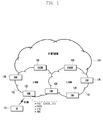
- FIG. 1 is a diagram illustrating a configuration of an LTE mobile communication system.
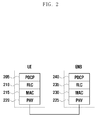
- FIG. 2 is a diagram illustrating a protocol stack of an LTE mobile communication system.
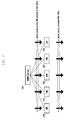
- FIG. 3 is a diagram illustrating a method for providing a normal MBMS service.
- FIG. 4 is a diagram illustrating an operation of a legacy eNB in reception of a part of MBMS data.
- FIG. 5 is a diagram illustrating a configuration of a normal SYNC frame.
- FIG. 6 is a diagram illustrating a normal principle of configuring PN and OC in the SYNC frame.
- FIG. 7 is a diagram illustrating a normal principle of determining the data amount and number of missed data based on PN and OC.
- FIG. 8 is a diagram illustrating the first embodiment of the present invention.
- FIG. 9 is a diagram illustrating the first embodiment of the present invention.
- FIG. 10 is a flowchart illustrating an eNB procedure according to the first embodiment of the present invention.
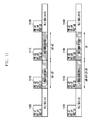
- FIG. 11 is a diagram illustrating the second embodiment of the present invention.
- FIG. 12 is a diagram illustrating a configuration of SYNC frame according to the second embodiment of the present invention.
- FIG. 13 is flowchart illustrating an eNB procedure according to the second embodiment of the present invention.
- FIG. 14 is a drawing illustrating the third embodiment of the present invention.
- FIG. 15 is a flowchart illustrating an eNB device operation according to the third embodiment of the present invention.
- FIG. 16 is a block diagram illustrating the eNB device according to an embodiment of the present invention.
- FIG. 1 is a diagram illustrating a configuration of an LTE mobile communication system.
- the LTE mobile communication system includes Evolved Radio Access Network (hereinafter, referred to as E-RAN) 110 and 112) is simplified in two-node structure of evolved Node B (hereinafter, referred to as eNB or Node B) 120, 122, 124, 126, and 128 and higher node (Access Gateway or enhance Gateway GPRS Support Node, hereinafter referred to as EGGSN) 130 and 132.
- EGGSN evolved Node B
- the User Equipment (hereinafter, referred to as UE) 101 accesses Internet Protocol (IP) network 114 via E-RANs 110 and 112.
- IP Internet Protocol
- the eNBs 120 to 128 corresponds to legacy node B of UMTS system.
- the eNBs 120 to 128 are connected with the UE 101 via radio channel and responsible for more complex functions as compared to the legacy node B. Since all the user traffics including real time services such as Voice over IP (VoIP) are transmitted through shared channel, there is a need of a device for scheduling the based on the state information of the UEs 101, and the eNB is responsible for this function in LTE.
- Each of the eNBs 120 to 128 manages a plurality cells.
- LTE adopts Orthogonal Frequency Division Multiplexing (OFDM) as radio access technology in maximum 20 MHz bandwidth.
- LTE also adopts Adaptive Modulation & Coding (AMC) for determining modulation scheme and channel coding rate depending on the channel condition of the UE 101.
- OFDM Orthogonal Frequency Division Multiplexing
- AMC Adaptive Modulation & Coding
- the LTE system includes an MBMS server which generates MBMS (Multimedia Broadcast Multicast Server) data to the eNBs 120 to 128.
- MBMS Multimedia Broadcast Multicast Server
- the MBMS server and eNBs 120 to 128 are connected to each other through an IP network.
- FIG. 2 is a diagram illustrating a protocol stack of an LTE mobile communication system.
- the protocol stack of the LTE system includes Packet Data Convergence Protocol (PDCP) 205 and 240, Radio Link Control (RLC) 210 and 235, and Medium Access Control (MAC) 215 and 230.
- PDCP Packet Data Convergence Protocol
- RLC Radio Link Control
- MAC Medium Access Control
- the PDCP 205 and 240 is responsible for IP header compression/decompression, and the RLC 210 and 235 is responsible for segmenting the PDCP Protocol Data Unit (PDU) into segments in appropriate size for Automatic Repeat Request (ARQ) operation.
- An RLC header is added at the RLC layer 210 and 235 for the ARQ operation.
- the MAC 215 and 230 is responsible for establishing connection to a plurality of RLC entities so as to multiplex the RLC PDUs into MAC PDUs and demultiplex the MAC PDUs into RLC PDUs.
- a MAC header is added at the MAC layer 215 and 230 for multiplexing and demultiplexing operations.
- the PHY 220 and 225 performs channel coding on the MAC PDU and modulates the MAC PDU into OFDM symbols to transmit over radio channel or performs demodulating and channel-decoding on the received OFDM symbols and delivers the decoded data to the higher layer.
- SDU Service Data unit
- PDU Protocol Data Unit
- MBMS Multimedia Broadcast Multicast Service
- FIG. 3 is a diagram illustrating a method for providing a normal MBMS service.
- the MBMS server 305 generates MBMS service data to the eNBs 310, 315, 320, 325, and 330 participated in the MBMS transmission.
- the eNBs 310, 315, 320, 325, and 330 store the data received from MBMS server 305 and transmit the stored data at a predetermined timing simultaneously.
- the signal is amplified in strength and thus the UEs located in the coverage of the eNBs 310, 315, 32, 325, and 330 receive the signal from the multiple eNBs 310, 315, 320, 325, and 330 so as to experience high reception quality as compared to the case when receiving the signal from only one eNB.
- the multiple eNBs 310, 315, 320, 325, and 330 it is required to fulfill the following conditions.
- the eNBs 310, 315, 320, 325, and 330 must receive the same data; secondly, the eNBs 310, 315, 320, 325, and 330 must process the received data into the same data; and finally, the eNBs 310, 315, 320, 325, and 330 must transmit the same data simultaneously.
- FIG. 4 is a diagram illustrating an operation of a legacy eNB in reception of a part of MBMS data.
- the MBMS server transmits RLC SDU generated through a PDCP process on IP packet to eNBs, in general. Since header compression and decompression which is usual in normal data is not applied to MBMS data, RLC SDU is maintained in the form of the IP packet. Although the description is directed to the case whether the eNB receives RLC SDU, this is identical to the case that the eNB receives the IP packet.
- the eNB segments or concatenates the RLC SDUs received from the MBMS server into RLC PDUs of appropriated size with the addition of RLC header and then multiplexes the RLC PDUs and adds MAC head to generate MAC PDUs.
- the MAC PDUs are transmitted on the radio channel in more detail, since only one RLC PDU is encapsulated in a MAC PDU, the MAC PDU is generated by segmenting an RLC SDU or combining multiple RLC SDUs and then adding RLC header 415 and MAC header 410 to each RLC SDU.
- the eNBs Since all of the eNBs have the RLC and MAC protocols, if the RLC SDUs are received by the eNBs without loss, the MAC PDUs which the respective eNBs have generated with the RLC SDUs are identical among each other. However, there is any RLC SDU missed by an eNB, the eNB fails to generate the MAC PDU due to the missed RLC SDU.
- the best approach to solve this problem is to transmit the next MAC PDU following the MAC PDU including the missed RLC SDU. For example, if an eNB has received the RLC SDUs with the exception of RLC SDU [m+1] 425, the eNB suspends the MAC PDUs including the RLC SDU [m+1] a bit, i.e. MAC PDU [n] 420 and MAC PDU [n+1] 425, and transmits the MAC PDU [n+2] 430.
- the eNB in order for the eNB to transmit MAC PDU [n+2] first, the eNB has to check which RLC SDUs start at which bytes.
- the eNB can calculate the bytes occupied by the missed RLC SDUs in MAC PDUs from a number of missed RLC SDUs and sum of the sizes of missed RLC SDUs. Using this information, the eNB also can determine the RLC SDUs included in the suspended MAC PDUs and the bytes occupied by the RLC SDUs in the MAC PDU to be transmitted.
- the information necessary for the eNB to perform the aforementioned operation is the sum of the sizes of missed RLC SDUs and the number of missed RLC SDUs. Accordingly, the MBMS server transmits the RLC SDUs in SYNC frame to notify the eNB of the sum of the sizes of missed RLC SDUs and the number of missed RLC SDUs.
- FIG. 5 is a diagram illustrating a configuration of a normal SYNC frame.
- the SYNC frame 505 includes a header 510 and a payload 520, and the payload 520 includes one RLC SDU.
- RLC SDU is used interchangeably with the data included in the payload 520 of the SYNC frame 505.
- the header 510 includes packet number, octet counter, and SYNC period-related information.
- the SYNC period is the period defined on a radio channel.
- One or more subframes are designated as MBMS subframes for one SYNC period, and each MBMS subframe carries the MAC PDUs containing only MBMS data.
- the MBMS data amount to be transmitted curing the corresponding SYNC period is determined depending on the number of MBMS subframes allocated for the SYNC period. Also, the network determines the number of MBMS subframes for the SYNC period in consideration of the data rate of the MBMS service.
- the MBMS server manages PN and OC by referencing the SYNC period. For example, the MBMS server transmits the SYNC frames carrying the data amount corresponding to the SYNC period and then initializes the PN and OC of the SYNC protocol to 0. The MBMS server repeats increment of the PN and OC for the transmission of SYNC frames as much as the data amount corresponding to the next SYNC period and initialization of the PN and OC to 0 during the next SYNC period.
- FIG. 6 is a diagram illustrating a normal principle of configuring PN and OC in the SYNC frame.
- the MBMS server transmits 7 SYNC frames from the SYNC frame 610 to the SYNC frame 635 containing 700 bytes for a certain SYNC period.
- Both the PN and OC of the first SYNC frame 610 are set to 0, and the PN and OC of the fifth SYNC frame 630 are set to 4 and 500 respectively. Since the next SYNC frame 640 is transmitted in a new SYNC period, the PN and OC are initialized to 0.
- the data amount transmitted for one SYNC period is constant in general. For simplicity purpose, the RLC and MAC headers are not taken into account.
- the eNB can calculate the number of missed SYNC frames and the sum of the sizes of the RLC SDUs constituting the SYNC frames based on PN and OC.
- FIG. 7 is a diagram illustrating a normal principle of determining the data amount and number of missed data based on PN and OC.
- the eNB determines the three missed SYNC frames and the total 400 bytes of missed data using PN and OC of the SYNC frames 705 and 710.
- the eNB can check that the total 412 bytes corresponding to the missed RLC SDUs should be contained in the MAC PDU. For example, if 50 bytes of MAC PDU [n] are occupied by the RLC SDU 705 already and if the 412 bytes inserted in the rest 450 bytes, 38 bytes are remained empty. In this case, the first 38 bytes of the RLC SDU 710 occupy the remained space such that the MAC PDU [n+1] is filled with from the 39 th byte of the RLC SDU 710. Accordingly, the eNB suspends the MAC PDU [n] carrying the missed RLC SDU and transmits the MAC PDU [n+1] which is configured normally.
- the RLC/MAC overhead can vary in size according to how the RLC SDU are encapsulated in RLC PDU and whether the RLC PDU is greater than a predetermined value. For example, in case that the last byte of the RLC SDU to be encapsulated in an RLC PDU matches with the last byte of the RLC PDU, an RLC field, so called LI (Length Indicator), is omitted.
- LI Length Indicator
- the overhead caused by LI also can vary according to the number of LIs included in the RLC PDU.
- the overhead caused by one LI is 2 bytes, but the overhead increases to 3 bytes for two LIs.
- the present invention proposes a method and apparatus for the eNBs to configure and transmit MAC PDUs for MBMS without modification of the RLC and MAC protocols.
- the eNB calculates the size of RLC SDU filled in the SYNC frame using the PN and OC values of the SYNC frame and determines the MAC PDUs to be transmitted or not and the start byte of the RLC SDU that is to be carried in the MAC PDU.
- the eNB stops building MAC PDU from the SYNC frames including and following the missed SYNC frames. That is, the MBMS transmission is suspended for the duration reserved for the MAC PDUs that are not built.
- the eNB can determine the RLC PDU carrying the corresponding RLC SDU and the number of bytes of the overhead of the RLC PDU.
- the eNB stops transmitting MAC PDU, initializing PN and OC to 0, and restarts transmitting MAC PDU from the start time point of the next SYNC period for which the MAC PDU is built with from the first RLC SDU.
- FIG. 8 is a diagram illustrating the first embodiment of the present invention. Particularly, FIG. 1 shows the eNB operation in case where a series of SYNC frames are not received.
- the RLC SDUs are received successfully with the exception of the RLC PDU 820 in a certain SYNC period among 5 RLC SDUs 810 to 850.
- the eNBs processes the successfully received RLC SDUs according to the conventional RLC and MAC protocols to build RLC PDU and MAC PDU and transmits the MAC PDU 865 in an MBMS subframe.
- the size of the missed RLC SDU 820 is calculated using PN and OC of the synch frame, and it continues to build RLC PDU and MAC PDU as if the corresponding size of RLC SDU is received. This can be implemented in various manner, e.g. by generating a virtual RLC SDU equal to the missed RLC SDU in size and building RLC PDU and MAC PDU continuously with the generated RLC SDU. In spite of the missed RLC SDU, the MAC PDU 870 including the virtually generated RLC SDU is discarded rather than transmitted in the corresponding MBMS subframe.
- the eNB restarts transmission from the MAC PDU which is not influenced by the missed RLC SDU, i.e. the MAC PDU 875 containing the RLC SDU, in the MBMS subframe.
- the eNB can continue building RLC PDU and MAC PDU in consideration of the size of the missed RLC SDU, and transmitting MAC PDUs having no missed RLC SDU in the MBMS subframe while skipping transmission of the MAC PDU in the MBMS subframe reserved for transmitting the MAC PDUs containing the missed RLC SDUs.
- FIG. 9 is a diagram illustrating the first embodiment of the present invention. Particularly, FIG. 9 shows the eNB operation in case that one or more RLC SDUs are not received in series.
- RLC SDUs 920 and 925 are not received among the five RLC SDUs 910 to 930 in a SYNC period.
- the eNB processes the successfully received RLC SDUs 910 and 915 using the conventional RLC and MAC protocols to build RLC PDUs 945 and 965 and transmits the MAC PDU 965 in a subframe.
- the eNB analyzes the PNs and OCs of RLC SDUs 915 and 930 to check that the two RLC SDUs are missed in series and calculate the sum of the sizes of the missed RLC SDUs.
- the eNB cannot check the sizes of individual missed RLC SDUs and thus fails calculating the space occupied by the missed RLC SDUs in MAC PDU and, as a sequence, it is impossible to configure the MAC PDU precisely in spite of the successful receipt of the next RLC SDUs. Accordingly, when it is detected that multiple RLC SDUs are not received, the eNB suspends building MAC PDU until the next SYNC period starts. Also, the transmission of the MAC PDUs scheduled to be transmitted in the MBMS subframe but not configured is canceled. If the next SYNC period starts, the eNB restarts MBMS data transmission.
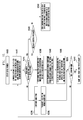
- FIG. 10 is a flowchart illustrating an eNB procedure according to the first embodiment of the present invention.
- the eNB starts operation for generating the MAC PDU to be transmitted in the first MBMS subframe for which no MAC PDU is configured among the MBMS subframes assigned for the SYNC period at step 1010.
- the eNB segments or concatenates RLC SDUs that have not been encapsulated in MAC PDU or some of the RLC SDUs in match with the size of the RLC PDU.
- the eNB determines whether there is any missed RLC SDU until the payload of the RLC PDU is filled entirely at step 1015. If the RLC PDU is filled entirely without missed RLC SDU, the procedure goes to step 1020 and, otherwise if any missed RLC SDU is detected until the payload of the RLC PDU is filled entirely, step 1030. If there is any missed RLC SDU at step 1015, this means that the PNs of the two consecutive RLC SDUs are not in series.
- the eNB configures an RLC PDU by adding a header to the RLC payload generated by segmenting/combining the RLC SDUs and multiplexes RLC PDUs into a MAC PDU at step 1020.
- the eNB transmits the MAC PDU in the corresponding MBMS subframe at step 1025, and then the procedure goes to step 1055.
- the eNB determines whether a number of missed RLC SDUs is greater than one and, if so, missed in series at step 1030. This can be determined by checking the PNs of the RLC SDUs adjacent to the missed RLC SDUs. If the number of missed RLC SDUs is one at step 1030, the procedure goes to step 1035.
- the eNB calculates the size of the missed RLC SDU using OCs of the RLC SDUs adjacent to the missed RLC SDU and determines the MAC PDU corresponding to the MBMS in which the missed RLC SDU is scheduled in consideration of the size of the missed RLC SDU at step 1035. This also can be determined by performing a MAC PDU creation process with the generation of a virtual RLC SDU having the same size as the missed RLC SDU and checking the MAC PDU in which the RLC SDU equal in size to the missed RLC SDU is encapsulated.
- the eNB stops transmitting the MAC PDU reserved to carry the missed RLC SDU in the MBMS subframe at step 1040 and transmits the first MAC PDU configured with the encapsulation of the valid RLC SDUs in the corresponding MBMS subframe at step 1045.
- the normal MAC PDU generation process with the creasing of virtual RLC SDU equal to the missed RLC SDU in size until the first MAC PDU encapsulating the RLC SDU equal in size to the missed RLC SDU is generated.
- the eNB transmits the MAC PDUs generated until then in the corresponding MBMS subframe and stops generations of more MAC PDU at step 1050. In the MBMS subframe corresponding to the MAC PDU that is not generated, transmission is stopped until the next SYNC period starts at step 1060.
- the eNB determines whether the SYNC period expires at step 1055. If all of the MAC PDUs scheduled in the MBMS subframe designated in the corresponding SYNC period are generated with the exception of the MAC PDU which is not generated due to the missed RLC SDU, the procedure goes to step 1060. If there is any MAC PDU to be generated, the eNB returns the procedure to step 1010.
- the second embodiment of the present invention proposes a method and apparatus that is capable of generating MAC PDUs normally with the exception of the MAC PDU corresponding to missed RLC SDUs although more than one RLC SDUs are missed in series.
- the reason why the eNB cannot generate a MAC PDU with more than one RLC SDUs missed in series is because the eNB does not know the sizes of individual missed RLC SDUs. If the information capable of calculating the size of each missed RLC SDU is transmitted along with the RLC SDU, the eNB can generate the MAC PDUs normally with the received RLC SDUs even when a series of multiple RLC SDUs are not received.
- the information capable of calculating the size of each missed RLC SDU can be the previous Octet Count (POC) or the information indicating the size of the data contained in the payload of the previous SYNC frame.
- POC Octet Count
- the eNB can calculates the sizes of the missed RLC SDUs even when the SYNC subframe carrying the [n+1] th RLC SDU and the SYNC frame carry the [n+2] th RLC SDU are not received in series.
- a description is made of a method for calculating the sizes of the missed RLC SDUs in when multiple SYNC frames are missed in series.
- FIG. 11 is a diagram illustrating the second embodiment of the present invention.
- the current SYNC frame includes the OC of the previous SYNC frame, and reference numbers 1105 and 1120 denotes the informations contained in each SYNC frame. Particularly, it is assumed that the informations 1105 to 1120 of the current frame include OCs of the previous SYNC frame.
- the size of the RLC SDU [n+2] is obtained by subtracting OC(y3) of RLC SDU [n+2] from OC(y4) of RLC SDU [n+3] such that it is possible to calculates the size (y4-y3) of RLC SDU [n+2] only with the information contained in RLC SDU [n+3].
- the size of RLC SDU [n+1] is the value obtained by subtracting OC(y2) of RLC SDU [n+1] from OC(y3) of RLC SDU [n+2].
- the size of RLC SDU [n+2] is PPS(z4) of RLC SDU [n+3].
- OC of RLC SDU [n+1] is the value obtained by adding the size of RLC SDU [n] to OC of RLC SDU [n] such that it is possible to calculate the size of RLC SDU [n+1] only with the information contained n RLC SDU [n] and RLC SDU [n+3]. That is, the size of RLC SDU [n+1] is obtained by subtracting the size of RLC SDU [n+2] from the sum of the RLC SDU [n+1] and RLC SDU [n+2], i.e. the value obtained by adding the OC of RLC SDU [n+1] and the size of RLC SDU [n+1] to the OC of RLC SDU [n+3].
- the SYNC frame includes POC or PPS of n SYNC frames, it is possible to calculate the sizes of the missed RLC SDUs even when up to [n+1] SYNC frames are not missed in series.
- OC_[x] denotes the OC of X th RLC SDU
- rlc sdu size_[x] denotes the size of X th RLC SDU.
- OC_[n+m+1] - OC_[n+2] is the sum of the sizes of all RLC SDUs from RLC SDU [n+2] to RLC SDU [n+m].
- FIG. 12 is a diagram illustrating a configuration of SYNC frame according to the second embodiment of the present invention.
- the SYNC frame 1205 contains the information of PN and OC 1210 and RLC SDU 1220 like the conventional SYNC frame. Also, the SYNC frame includes the information necessary for the calculation of the sizes of previous RLC SDUs, and this information includes the OCs carried in the previous n SYNC frames or the sizes of the payloads of the previous n SYNC frames in sequence.
- the eNB can calculate the sizes of [n+1] RLC SDUs carried in the [n+1] SYNC frames even though [n+1] SYNC frames are missed in series right before a certain RLC SDU.
- the number of POCs or PPSs that can be carried in the information for calculating the sizes of previous RLC SDUs influences the link stability between MBMS server and eNB. For example, if the link is good enough and thus the packet reception error rate is very low, there is little possibility to fail receiving two or more RLC SDUs in series. In this case, it is possible to prepare for the two missed SYNC frames by including one previous POC or PSS in the information for calculating the sizes of the previous RLC SDUs. If the link state is unstable, it is possible to prepare for a plurality of SYNC frames missed in series by including POCs or PSSs as many as possible.
- the number of POCs or PSSs to be contained in the SYNC frame can be agreed as a predetermined value between MBMS server and eNBs and adjusted, if necessary, by the MBMS server.
- the MBMS server can transmit one POC or PSS in normal state but multiple POCs or PSSs if link condition is degraded.
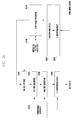
- FIG. 13 is flowchart illustrating an eNB procedure according to the second embodiment of the present invention.
- the eNB starts operation for configuring MAC PDU to be transmitted in the first MBMS subframe for which no MAC PDU is configured among the MBMS subframes designated in the SYNC period at step 1310. That is, the eNB segments or concatenates the RLC SDUs that are not included in any MAC PDU yet or some of the RLC SDUs in match with the RLC PDU size to be encapsulated in the MAC PDU.
- the eNB monitors to determine whether a missed RLC SDU is detected until the payload of RLC PDU is filled entirely at step 1315 and, if the payload of the RLC PDU is filled without missed RLC SDU, the procedure goes to step 1320 and, otherwise if any missed RLC SDU is detected until the payload of RLC PDU is filled entirely, step 1330.
- the eNB adds a header to the RLC payload generated by segmenting/concatenating RLC SDUs to generate RLC PDUs and multiplexes the RLC PDUs into MAC PDU.
- the eNB transmits the MAC PDU in the corresponding MBMS subframe at step 1325, and the procedure goes to step 1355.
- the procedure goes to step 1330.
- the eNB determines whether it is possible to calculate the sizes of all missed RLC SDUs. Under the assumption that the number of RLC SDUs missed in series is n and the number of POCs or PSSs contained in the SYNC frame following the last missed RLC SDU is m, if n is greater than m+1, the eNB cannot calculate the sizes of some of the missed RLC SDUs; and otherwise if n is equal to or less than m+1, the eNB can calculate the sizes of all missed RLC SDUs. If it is possible to calculate the sizes of all missed RLC SDUs, the procedure goes to step 1335 and, otherwise if it is possible to calculate the sizes of some of the missed RLC SDUs, step 1350.
- the eNB determines the MAC PDU corresponding to the MBMS subframe in which the missed RLC SDU is scheduled in consideration of the size of the missed RLC SDU. This can be done through a normal MAC PDU generation process by generating a virtual RLC SDU having the same size as the missed RLC SDU and determining the MAC PDU in which the RLC SDU having the same size as the missed RLC SDU is to be contained. Then eNB suspends transmission in the MBMS subframe corresponding to the MAC PDU in which the missed RLC SDU is to be transmitted at step 1340, and the procedure goes to step 1345.
- the eNB transmits the first MAC PDU generated with the valid RLC SDUs in the corresponding MBMS subframe at step 1345. This can be done by generating a virtual RLC SDU having the same size as the missed RLC SDU and continuing the normal MAC PDU generation process until the first MAC PDU in which the RLC SDU having the same size as the missed RLC is not contained.
- step 1350 the eNB transmits the MAC PDUs generated until then in the corresponding MBMS subframe and stops generating MAC PDU anymore. The transmission stops in the MBMS subframe corresponding to the non-generated MAC PDUs, and the procedure goes to step 1360.
- the eNB determines whether the SYNC period has expired at step 1355. If all of the MAC PDUs to be transmitted in the MBMS subframe during the corresponding SYNC period are generated with the exception of the MAC PDUs excluded by the missed RLC SDUs, the procedure goes to step 1360. If there is MAC PDUs that are not generated yet, the eNB returns the procedure to step 1310.
- the MBMS server transmits a control message including the information on the size of the payload of each synch frame in a SYNC period to the eNB. If the control message is received, the eNB can checks the sizes of all RLC SDUs in the corresponding SYNC period so as to generate the MAC PDUs corresponding to the received RLC SDUs successfully regardless of the number of missed SYNC frames.
- FIG. 14 is a drawing illustrating the third embodiment of the present invention.
- the MBMS server 1410 transmits n SYNC frames from the SYNC frame 1415 having PN of 0 to the SYNC frame 1425 having PN of n which contain RLC SDUs to the eNB 1405 in the SYNC period x.
- the MBMS server also transmits a control message 1430 informing of the sizes of payloads of the SYNC frames or the sizes of contained RLC SDUs to the eNB 1405 for the SYNC period x.
- the control message 1430 contains the sizes of the RLC SDUs carried in the SYNC frame for the SYNC period x.
- the sizes of all RLC SDUs contained in the SYNC frames for the SYNC period x e.g. the size of RLC SDU [0] contained in the SYNC frame [0] and the size of RLC SDU [1] contained in the SYNC frame [1] can be included.
- control message 1430 informing of the sizes of RLC SDUs is transmitted separately, there is no need to transmit the OC information in the SYNC frames such that the OC information is not included in the headers of the SYNC frames carrying the RLC SDUs in the their embodiment of the present invention. Accordingly, the eNB which has not received the control message indicating the sizes of RLC SDUs cannot generate the MAC PDUs precisely after failing receipt of any RLC SDU even when only one RLC SDU is not received and, as a consequence, stop transmission in the MBMS subframe until the next SYNC period starts.
- the eNB can generate MAC PDUs with the successfully received RLC SDUs even through some RLC SDUs are not received and transmit the generated MAC PDUs in the MBMS subframe with the exception of the MAC PDUs corresponding to the missed RLC PDUs.
- FIG. 15 is a flowchart illustrating an eNB device operation according to the third embodiment of the present invention.
- the eNB configures the MAC to be transmitted in the first MBMS subframe for which not MAC PDU is configured yet among the MBMS subframes in the SYNC period at step 1510.
- the eNB segments or concatenates, in series, the RLC SDUs not included in any MAC PDU yet or some of RLC SDUs, in match with the size of RLC SDU to be encapsulated in the MAC PDU.
- the eNB monitors to determine whether any missed RLC SDU is detected until the payload of RLC PDU is filled entirely at step 1515 and, if the payload of the RLC PDU is filled without missed RLC SDU, the procedure goes to step 1520 and, otherwise if any missed RLC SDU is detected until the payload of RLC PDU is filled entirely, step 1530.
- the eNB adds a header to the RLC payload generated by segmenting/concatenating RLC SDUs to generate RLC PDUs and multiplexes the RLC PDUs into MAC PDU.
- the eNB transmits the MAC PDU in the corresponding MBMS subframe at step 1525, and the procedure goes to step 1555. If any missed RLC SDU is detected before the payload of the RLC PDU is filled entirely at step 1515, the procedure goes to step 1530.
- the eNB determines whether a control message including the information on the sizes of the RLC SDUs for the SYNC period is available. If the control message is available, the procedure goes to step 1535 and, otherwise, step 1550.
- the eNB checks the sizes of the missed RLC SDUs using the information contained in the control message and determines the MAC PDU corresponding to a MBMS subframe in which the missed RLC SDU is encapsulated in consideration of the sizes of the missed RLC SDUs. This can be done by generating a virtual RLC SDU having the same size as the missed RLC SDU and continuing the normal MAC PDU generation process so as to check the MAC PDU in which the RLC SDU is encapsulated therein.
- the eNB stops transmission in the MBMS subframe corresponding to the MAC PDU reserved to carry the missed RLC SDU, and the procedure goes to step 1545.
- the eNB configures the first MAC PDU with the valid RLC SDUs and transmits the first MAC PDU in the corresponding MBMS subframe. This can be done by generating a virtual RLC SDU having the same size as the missed RLC SDU and continuing the normal MAC PDU generation process until the first MAC PDU in which the RLC SDU having the same size as the missed RLC is not contained.
- step 1550 the eNB transmits the MAC PDUs generated until then in the corresponding MBMS subframe and stops generating MAC PDU anymore. The transmission stops in the MBMS subframe corresponding to the non-generated MAC PDUs, and the procedure goes to step 1560.
- the eNB determines whether the SYNC period has expired at step 1555. If all of the MAC PDUs to be transmitted in the MBMS subframe during the corresponding SYNC period are generated with the exception of the MAC PDUs excluded by the missed RLC SDUs, the procedure goes to step 1560. If there is any MAC PDU that is not generated yet, the eNB returns the procedure to step 1510.
- FIG. 16 is a block diagram illustrating the eNB device according to an embodiment of the present invention.
- an L1 reception device 1605 is the device for receiving the data transmitted by the MBMS server.
- the L1 reception device 1605 can be an Ethernet reception device or an optical reception device.
- the data received by the L1 reception device 1605 are input to the demultiplexing device 1607.
- the demultiplexing device 1607 transfers the SYNC frame corresponding to a certain MBMS service to the SYNC frame processor of the corresponding MBMS service.
- the SYNC frame processor 1615 receives the SYNC frame and transfers the RLC SDU contained in the payload and related information, e.g. PN and OC, to the RLC SDU storage 1620.
- the SYNC frame processor 1615 transfers POC or PPS carried in the SYNC frame to a missed RLC SDU size calculator 1610. If the control message including the RLC SDU size information is received, the SYNC frame processor 1615 also transfers the control information to the missed RLC SDU size calculator 1610.
- the RLC SDU storage 1620 stores all or some of RLC SDUs that are not transmitted in sequence of PNs. If the PNs of two adjacent RLC SDUs are not consecutive, the RLC SDU storage 1620 transfers the nonconsecutive PNs and OCs corresponding to the PNs to the RLC SDU size calculator 1610. Afterward, the RLC PDU payload generation process is performed in consideration of the sizes of the missed RLC SDUs that are notified by the missed RLC SDU size calculator 1610.
- the RLC SDU storage 1620 segments/concatenates all or some of the RLC SDUs in match with the size required in the RLC PDU generator 1625 to generate the RLC PDU payload and transfers the RLC PDU payload to the RLC PDU generator 1625.
- the RLC SDU storage 1620 notifies the RLC PDU generator 1625 that there is no data to provide. If the missed RLC SDU size calculator 1610 notifies the RLC SDU storage 1620 that the missed SDU size calculation is impossible after a specific RLC SDU, the RLC SDU storage 1620 stops generating RLC payload with the RLC SDU from the specific RLC SDU anymore and notifies the RLC PDU generator 1625 that there is not data to be provided.
- the missed RLC SDU size calculator 1610 notifies the RLC SDU storage 1620 of the sizes of the missed RLC SDUs
- the RLC SDU storage 1620 generates the RLC PDU payload from the time point when the RLC PDU payload generation is possible in consideration of the sizes of the missed RLC SDUs and transfers the RLC PDU payload to the RLC PDU generator 1625.
- the missed RLC SDU size calculator 1610 calculates the sizes of the missed RLC SDUs based on the information provided by the SYNC frame processor 1615 and RLC SDU storage 1620 and transfers this information to the RLC SDU storage 1620.
- the missed RLC SDU size calculator 1610 also notifies the RLC SDU storage 1620 that the sizes of the missed RLC SDUs cannot be calculated.
- the RLC PDU generator 1625 generates RLC PDU in size indicated by the transmission controller 1653.
- the RLC PDU generator 1625 determines the amount of data to be contained in the RLC PDU payload in match with the size indicated by the transmission controller 1653 and instructs the RLC SDU storage 1625 to generate the payload in corresponding size.
- the RLC PDU generator 1625 generates RLC PDU by adding an RLC header to the payload provided by the RLC SDU storage 1620 and transfers the RLC PDU to the MAC PDU generator 1630. If there is no RLC PDU payload provided from the RLC SDU storage 1620, the RLC PDU generator 1625 also does not provide RLC PDU to the MAC PDU generator 1630.
- the MAC PDU generator 1630 encapsulates the RLC PDU provided by the RLC PDU generator 1625 as payload and adds a MAC header to generate a MAC PDU.
- the MAC PDU generator 1630 transfers the MAC PDU to the L1 transmission device 1640 at the time point indicated by transmission controller 1635. If nor RLC PDU is provided by the RLC PDU generator 1625, the MAC PDU generator 1630 cannot generate MAC PDU.
- the L1 transmission device 1640 transmits the MAC PDU provided by the MAC PDU generator 1630 at the transmission time point indicated by the transmission controller 1635 on the predetermined transmission resource according a predetermined modulation/channel coding scheme. If there is no MAC PDU provided by the MAC PDU generator 1630 at the time point indicated by the transmission controller 1635, the L1 transmission device 1640 does not start transmission at the transmission time point.
- the transmission controller 1635 checks the MBMS subframe and controls the RLC PDU generator 1625, MAC PDU generator 1630, and L1 transmission device 1640 to transmit MAC PDUs in the MBMS subframe at an appropriate time point before the start of the MBMS subframe.
Landscapes
- Engineering & Computer Science (AREA)
- Signal Processing (AREA)
- Computer Networks & Wireless Communication (AREA)
- Multimedia (AREA)
- Quality & Reliability (AREA)
- Mobile Radio Communication Systems (AREA)
Priority Applications (1)
| Application Number | Priority Date | Filing Date | Title |
|---|---|---|---|
| EP20171881.4A EP3706446B1 (de) | 2009-06-17 | 2010-06-17 | Verfahren und vorrichtung zur übertragung von multimedia-rundfunkdaten in einem drahtlosen kommunikationssystem |
Applications Claiming Priority (2)
| Application Number | Priority Date | Filing Date | Title |
|---|---|---|---|
| KR1020090053850A KR20100135468A (ko) | 2009-06-17 | 2009-06-17 | 무선 통신 시스템에서 멀티미디어 방송 데이터를 전송하는 방법 및 장치 |
| PCT/KR2010/003907 WO2010147401A2 (ko) | 2009-06-17 | 2010-06-17 | 무선 통신 시스템에서 멀티미디어 방송 데이터를 전송하는 방법 및 장치 |
Related Child Applications (1)
| Application Number | Title | Priority Date | Filing Date |
|---|---|---|---|
| EP20171881.4A Division EP3706446B1 (de) | 2009-06-17 | 2010-06-17 | Verfahren und vorrichtung zur übertragung von multimedia-rundfunkdaten in einem drahtlosen kommunikationssystem |
Publications (3)
| Publication Number | Publication Date |
|---|---|
| EP2445207A2 true EP2445207A2 (de) | 2012-04-25 |
| EP2445207A4 EP2445207A4 (de) | 2016-07-06 |
| EP2445207B1 EP2445207B1 (de) | 2020-04-29 |
Family
ID=43356923
Family Applications (2)
| Application Number | Title | Priority Date | Filing Date |
|---|---|---|---|
| EP20171881.4A Active EP3706446B1 (de) | 2009-06-17 | 2010-06-17 | Verfahren und vorrichtung zur übertragung von multimedia-rundfunkdaten in einem drahtlosen kommunikationssystem |
| EP10789728.2A Active EP2445207B1 (de) | 2009-06-17 | 2010-06-17 | Verfahren und vorrichtung zur übertragung von multimedia-rundfunkdaten in einem drahtlosen kommunikationssystem |
Family Applications Before (1)
| Application Number | Title | Priority Date | Filing Date |
|---|---|---|---|
| EP20171881.4A Active EP3706446B1 (de) | 2009-06-17 | 2010-06-17 | Verfahren und vorrichtung zur übertragung von multimedia-rundfunkdaten in einem drahtlosen kommunikationssystem |
Country Status (5)
| Country | Link |
|---|---|
| US (6) | US8923345B2 (de) |
| EP (2) | EP3706446B1 (de) |
| KR (1) | KR20100135468A (de) |
| ES (1) | ES2795329T3 (de) |
| WO (1) | WO2010147401A2 (de) |
Cited By (3)
| Publication number | Priority date | Publication date | Assignee | Title |
|---|---|---|---|---|
| EP2496009A4 (de) * | 2009-10-27 | 2016-03-30 | China Academy Of Telecomm Tech | Mbms-synchronisationsverfahren, -vorrichtung und -system |
| WO2016106755A1 (zh) * | 2014-12-31 | 2016-07-07 | 华为技术有限公司 | 支持多媒体广播多播业务传输的方法,设备及系统 |
| WO2018082511A1 (zh) * | 2016-11-04 | 2018-05-11 | 华为技术有限公司 | 一种数据包的预处理方法、装置及设备 |
Families Citing this family (5)
| Publication number | Priority date | Publication date | Assignee | Title |
|---|---|---|---|---|
| KR20100135468A (ko) * | 2009-06-17 | 2010-12-27 | 삼성전자주식회사 | 무선 통신 시스템에서 멀티미디어 방송 데이터를 전송하는 방법 및 장치 |
| US20120275399A1 (en) * | 2011-04-27 | 2012-11-01 | Qualcomm Incorporated | System and method for synchronized radio link control and media access control in a wireless communication network |
| EP2685658B1 (de) * | 2012-07-10 | 2014-09-10 | Telefonaktiebolaget L M Ericsson (PUBL) | Technik zur Handhabung eines Datenpaketstroms |
| KR102262269B1 (ko) * | 2017-04-26 | 2021-06-08 | 삼성전자 주식회사 | 차세대 이동 통신 시스템에서 rlc 상태 보고 방법 및 장치 |
| CN112752227B (zh) * | 2019-10-30 | 2023-06-27 | 华为技术有限公司 | 一种通信方法及装置 |
Family Cites Families (14)
| Publication number | Priority date | Publication date | Assignee | Title |
|---|---|---|---|---|
| KR100378987B1 (ko) | 2000-08-19 | 2003-04-07 | 엘지전자 주식회사 | 래디오 링크 콘트롤 (rlc)에서 서비스 데이터유닛(sdu)의 디스카드 처리 방법 |
| CN100340125C (zh) | 2002-09-23 | 2007-09-26 | Lg电子株式会社 | 提供多媒体广播和组播服务(mbms)的无线电通信方法 |
| KR20040026153A (ko) | 2002-09-23 | 2004-03-30 | 엘지전자 주식회사 | 무선통신의 공유채널을 통한 멀티캐스트 서비스 제공 방법및 장치 |
| KR20050095419A (ko) | 2004-03-26 | 2005-09-29 | 삼성전자주식회사 | 패킷 망을 이용하여 음성 서비스를 제공하는이동통신시스템에서 무선 자원을 효율적으로 사용하는 방법 |
| EP1641189B1 (de) | 2004-09-27 | 2010-05-19 | Panasonic Corporation | Fehlerratenmessung in der Funkverbindungssteuerungsschicht zur Steuerung der Dienstqualität eines drahtlosen Kommunikationssystems |
| DE102004047349A1 (de) * | 2004-09-29 | 2006-04-06 | Infineon Technologies Ag | Datensicherungsschicht-Protokolleinheit, Mobilfunkeinrichtungen, Mobilfunknetzwerk-Kontrolleinheit und Verfahren zum Auslesen von Daten aus einer Mehrzahl von Datensicherungsschicht-Protokoll-Pufferspeichern |
| KR20060090138A (ko) | 2005-02-07 | 2006-08-10 | 삼성전자주식회사 | 이동통신 시스템에서 주기적인 상태 보고 전송 방법 및장치 |
| WO2007078156A2 (en) * | 2006-01-05 | 2007-07-12 | Lg Electronics Inc. | Transmitting data in a mobile communication system |
| PL2958393T3 (pl) * | 2006-11-01 | 2018-07-31 | Telefonaktiebolaget Lm Ericsson (Publ) | Dystrybucja danych nadawanych/rozsyłanych grupowo w systemach telekomunikacyjnych |
| WO2008115448A1 (en) * | 2007-03-15 | 2008-09-25 | Interdigital Technology Corporation | Flexible pdu sizes for unacknowledged mode radio link control |
| GB0705547D0 (en) * | 2007-03-23 | 2007-05-02 | Nokia Corp | Distributed operation |
| GB0711833D0 (en) * | 2007-06-18 | 2007-07-25 | Nokia Siemens Networks Oy | A method for providing a plurality of services |
| US8638699B2 (en) * | 2008-11-10 | 2014-01-28 | Qualcomm Incorporated | Method and apparatus for supporting the large service data unit (SDU) |
| KR20100135468A (ko) * | 2009-06-17 | 2010-12-27 | 삼성전자주식회사 | 무선 통신 시스템에서 멀티미디어 방송 데이터를 전송하는 방법 및 장치 |
-
2009
- 2009-06-17 KR KR1020090053850A patent/KR20100135468A/ko not_active Withdrawn
-
2010
- 2010-06-17 WO PCT/KR2010/003907 patent/WO2010147401A2/ko not_active Ceased
- 2010-06-17 EP EP20171881.4A patent/EP3706446B1/de active Active
- 2010-06-17 EP EP10789728.2A patent/EP2445207B1/de active Active
- 2010-06-17 ES ES10789728T patent/ES2795329T3/es active Active
- 2010-06-17 US US13/379,252 patent/US8923345B2/en active Active
-
2014
- 2014-12-22 US US14/579,026 patent/US9288070B2/en active Active
-
2015
- 2015-01-26 US US14/605,026 patent/US9444637B2/en active Active
- 2015-01-26 US US14/605,058 patent/US9444638B2/en active Active
- 2015-01-26 US US14/605,035 patent/US9209986B2/en active Active
- 2015-01-26 US US14/605,047 patent/US9294295B2/en active Active
Non-Patent Citations (1)
| Title |
|---|
| See references of WO2010147401A2 * |
Cited By (3)
| Publication number | Priority date | Publication date | Assignee | Title |
|---|---|---|---|---|
| EP2496009A4 (de) * | 2009-10-27 | 2016-03-30 | China Academy Of Telecomm Tech | Mbms-synchronisationsverfahren, -vorrichtung und -system |
| WO2016106755A1 (zh) * | 2014-12-31 | 2016-07-07 | 华为技术有限公司 | 支持多媒体广播多播业务传输的方法,设备及系统 |
| WO2018082511A1 (zh) * | 2016-11-04 | 2018-05-11 | 华为技术有限公司 | 一种数据包的预处理方法、装置及设备 |
Also Published As
| Publication number | Publication date |
|---|---|
| US20150139065A1 (en) | 2015-05-21 |
| EP2445207B1 (de) | 2020-04-29 |
| EP3706446A1 (de) | 2020-09-09 |
| WO2010147401A3 (ko) | 2011-03-31 |
| US9444637B2 (en) | 2016-09-13 |
| US9444638B2 (en) | 2016-09-13 |
| US9288070B2 (en) | 2016-03-15 |
| US20150139067A1 (en) | 2015-05-21 |
| ES2795329T3 (es) | 2020-11-23 |
| EP2445207A4 (de) | 2016-07-06 |
| KR20100135468A (ko) | 2010-12-27 |
| US20150139064A1 (en) | 2015-05-21 |
| US9294295B2 (en) | 2016-03-22 |
| US20120099510A1 (en) | 2012-04-26 |
| EP3706446B1 (de) | 2021-04-21 |
| US9209986B2 (en) | 2015-12-08 |
| WO2010147401A2 (ko) | 2010-12-23 |
| US20150103728A1 (en) | 2015-04-16 |
| US20150139066A1 (en) | 2015-05-21 |
| US8923345B2 (en) | 2014-12-30 |
Similar Documents
| Publication | Publication Date | Title |
|---|---|---|
| US9288070B2 (en) | Method and apparatus for transmitting multimedia broadcast data in wireless communication system | |
| US11387952B2 (en) | Method and apparatus for processing reverse transmission resources in a mobile communication system | |
| KR101030678B1 (ko) | 단일 주파수 모바일 통신 네트워크에서 브로드캐스트 데이터의 전달을 동기화하기 위한 방법 | |
| US8194578B2 (en) | System and method for transmitting/receiving multicast/broadcast signal in a communication system | |
| US8774221B2 (en) | Apparatus and method for reporting buffer status of UE in mobile communication system | |
| CN101529759B (zh) | 在无线网络广播数据时内容同步的方法 | |
| JP5580418B2 (ja) | 単一のrlcエンティティについての拡張された多重化 | |
| KR101477061B1 (ko) | 휴대 단말기의 비연속 수신 수행 방법 및 장치 | |
| GB2484342A (en) | Allocating resources for a predetermined message exchange e.g. machine-to-machine messages, using a single conversation allocation message. | |
| CN102118872A (zh) | 上行同步命令传递的方法和系统 | |
| KR101714511B1 (ko) | 무선 통신 시스템에서 멀티미디어 방송 데이터를 전송하는 장치 및 방법 | |
| KR101631104B1 (ko) | 무선 통신 시스템에서 멀티미디어 방송 데이터를 전송하는 장치 및 방법 | |
| CN113890898B (zh) | 一种低轨卫星移动通信系统帧结构及组帧与调度方法 | |
| CN101998242A (zh) | 多媒体广播组播业务中多调度周期联合调度的方法及装置 | |
| WO2009102166A2 (ko) | 이동 통신 시스템에서 우선 순위화 비트 레이트를 이용하여 데이터를 전송하는 방법 및 장치 |
Legal Events
| Date | Code | Title | Description |
|---|---|---|---|
| PUAI | Public reference made under article 153(3) epc to a published international application that has entered the european phase |
Free format text: ORIGINAL CODE: 0009012 |
|
| 17P | Request for examination filed |
Effective date: 20111216 |
|
| AK | Designated contracting states |
Kind code of ref document: A2 Designated state(s): AL AT BE BG CH CY CZ DE DK EE ES FI FR GB GR HR HU IE IS IT LI LT LU LV MC MK MT NL NO PL PT RO SE SI SK SM TR |
|
| DAX | Request for extension of the european patent (deleted) | ||
| RAP1 | Party data changed (applicant data changed or rights of an application transferred) |
Owner name: SAMSUNG ELECTRONICS CO., LTD. |
|
| A4 | Supplementary search report drawn up and despatched |
Effective date: 20160608 |
|
| RIC1 | Information provided on ipc code assigned before grant |
Ipc: H04L 12/18 20060101ALI20160602BHEP Ipc: H04W 56/00 20090101ALI20160602BHEP Ipc: H04N 21/4363 20110101ALI20160602BHEP Ipc: H04W 4/06 20090101AFI20160602BHEP Ipc: H04W 72/00 20090101ALI20160602BHEP |
|
| STAA | Information on the status of an ep patent application or granted ep patent |
Free format text: STATUS: EXAMINATION IS IN PROGRESS |
|
| 17Q | First examination report despatched |
Effective date: 20180511 |
|
| GRAP | Despatch of communication of intention to grant a patent |
Free format text: ORIGINAL CODE: EPIDOSNIGR1 |
|
| STAA | Information on the status of an ep patent application or granted ep patent |
Free format text: STATUS: GRANT OF PATENT IS INTENDED |
|
| RIC1 | Information provided on ipc code assigned before grant |
Ipc: H04W 4/06 20090101ALI20191115BHEP Ipc: H04L 1/00 20060101ALI20191115BHEP Ipc: H04W 72/00 20090101ALN20191115BHEP Ipc: H04N 21/4363 20110101ALI20191115BHEP Ipc: H04L 12/18 20060101ALI20191115BHEP Ipc: H04W 56/00 20090101AFI20191115BHEP |
|
| RIC1 | Information provided on ipc code assigned before grant |
Ipc: H04L 1/00 20060101ALI20191128BHEP Ipc: H04N 21/4363 20110101ALI20191128BHEP Ipc: H04W 4/06 20090101ALI20191128BHEP Ipc: H04W 72/00 20090101ALN20191128BHEP Ipc: H04W 56/00 20090101AFI20191128BHEP Ipc: H04L 12/18 20060101ALI20191128BHEP |
|
| INTG | Intention to grant announced |
Effective date: 20191212 |
|
| GRAJ | Information related to disapproval of communication of intention to grant by the applicant or resumption of examination proceedings by the epo deleted |
Free format text: ORIGINAL CODE: EPIDOSDIGR1 |
|
| STAA | Information on the status of an ep patent application or granted ep patent |
Free format text: STATUS: EXAMINATION IS IN PROGRESS |
|
| REG | Reference to a national code |
Ref country code: DE Ref legal event code: R079 Ref document number: 602010064129 Country of ref document: DE Free format text: PREVIOUS MAIN CLASS: H04N0007120000 Ipc: H04W0056000000 |
|
| GRAR | Information related to intention to grant a patent recorded |
Free format text: ORIGINAL CODE: EPIDOSNIGR71 |
|
| GRAS | Grant fee paid |
Free format text: ORIGINAL CODE: EPIDOSNIGR3 |
|
| STAA | Information on the status of an ep patent application or granted ep patent |
Free format text: STATUS: GRANT OF PATENT IS INTENDED |
|
| GRAA | (expected) grant |
Free format text: ORIGINAL CODE: 0009210 |
|
| STAA | Information on the status of an ep patent application or granted ep patent |
Free format text: STATUS: THE PATENT HAS BEEN GRANTED |
|
| INTC | Intention to grant announced (deleted) | ||
| RIC1 | Information provided on ipc code assigned before grant |
Ipc: H04N 21/4363 20110101ALI20200312BHEP Ipc: H04L 1/00 20060101ALI20200312BHEP Ipc: H04W 72/00 20090101ALN20200312BHEP Ipc: H04L 12/18 20060101ALI20200312BHEP Ipc: H04W 4/06 20090101ALI20200312BHEP Ipc: H04W 56/00 20090101AFI20200312BHEP |
|
| AK | Designated contracting states |
Kind code of ref document: B1 Designated state(s): AL AT BE BG CH CY CZ DE DK EE ES FI FR GB GR HR HU IE IS IT LI LT LU LV MC MK MT NL NO PL PT RO SE SI SK SM TR |
|
| INTG | Intention to grant announced |
Effective date: 20200320 |
|
| REG | Reference to a national code |
Ref country code: GB Ref legal event code: FG4D |
|
| REG | Reference to a national code |
Ref country code: CH Ref legal event code: EP |
|
| REG | Reference to a national code |
Ref country code: DE Ref legal event code: R096 Ref document number: 602010064129 Country of ref document: DE |
|
| REG | Reference to a national code |
Ref country code: AT Ref legal event code: REF Ref document number: 1265217 Country of ref document: AT Kind code of ref document: T Effective date: 20200515 |
|
| REG | Reference to a national code |
Ref country code: IE Ref legal event code: FG4D |
|
| REG | Reference to a national code |
Ref country code: NL Ref legal event code: FP |
|
| REG | Reference to a national code |
Ref country code: SE Ref legal event code: TRGR |
|
| REG | Reference to a national code |
Ref country code: LT Ref legal event code: MG4D |
|
| PG25 | Lapsed in a contracting state [announced via postgrant information from national office to epo] |
Ref country code: GR Free format text: LAPSE BECAUSE OF FAILURE TO SUBMIT A TRANSLATION OF THE DESCRIPTION OR TO PAY THE FEE WITHIN THE PRESCRIBED TIME-LIMIT Effective date: 20200730 Ref country code: FI Free format text: LAPSE BECAUSE OF FAILURE TO SUBMIT A TRANSLATION OF THE DESCRIPTION OR TO PAY THE FEE WITHIN THE PRESCRIBED TIME-LIMIT Effective date: 20200429 Ref country code: IS Free format text: LAPSE BECAUSE OF FAILURE TO SUBMIT A TRANSLATION OF THE DESCRIPTION OR TO PAY THE FEE WITHIN THE PRESCRIBED TIME-LIMIT Effective date: 20200829 Ref country code: NO Free format text: LAPSE BECAUSE OF FAILURE TO SUBMIT A TRANSLATION OF THE DESCRIPTION OR TO PAY THE FEE WITHIN THE PRESCRIBED TIME-LIMIT Effective date: 20200729 Ref country code: PT Free format text: LAPSE BECAUSE OF FAILURE TO SUBMIT A TRANSLATION OF THE DESCRIPTION OR TO PAY THE FEE WITHIN THE PRESCRIBED TIME-LIMIT Effective date: 20200831 Ref country code: LT Free format text: LAPSE BECAUSE OF FAILURE TO SUBMIT A TRANSLATION OF THE DESCRIPTION OR TO PAY THE FEE WITHIN THE PRESCRIBED TIME-LIMIT Effective date: 20200429 |
|
| REG | Reference to a national code |
Ref country code: AT Ref legal event code: MK05 Ref document number: 1265217 Country of ref document: AT Kind code of ref document: T Effective date: 20200429 |
|
| REG | Reference to a national code |
Ref country code: ES Ref legal event code: FG2A Ref document number: 2795329 Country of ref document: ES Kind code of ref document: T3 Effective date: 20201123 |
|
| PG25 | Lapsed in a contracting state [announced via postgrant information from national office to epo] |
Ref country code: LV Free format text: LAPSE BECAUSE OF FAILURE TO SUBMIT A TRANSLATION OF THE DESCRIPTION OR TO PAY THE FEE WITHIN THE PRESCRIBED TIME-LIMIT Effective date: 20200429 Ref country code: BG Free format text: LAPSE BECAUSE OF FAILURE TO SUBMIT A TRANSLATION OF THE DESCRIPTION OR TO PAY THE FEE WITHIN THE PRESCRIBED TIME-LIMIT Effective date: 20200729 Ref country code: HR Free format text: LAPSE BECAUSE OF FAILURE TO SUBMIT A TRANSLATION OF THE DESCRIPTION OR TO PAY THE FEE WITHIN THE PRESCRIBED TIME-LIMIT Effective date: 20200429 |
|
| PG25 | Lapsed in a contracting state [announced via postgrant information from national office to epo] |
Ref country code: AL Free format text: LAPSE BECAUSE OF FAILURE TO SUBMIT A TRANSLATION OF THE DESCRIPTION OR TO PAY THE FEE WITHIN THE PRESCRIBED TIME-LIMIT Effective date: 20200429 |
|
| PG25 | Lapsed in a contracting state [announced via postgrant information from national office to epo] |
Ref country code: RO Free format text: LAPSE BECAUSE OF FAILURE TO SUBMIT A TRANSLATION OF THE DESCRIPTION OR TO PAY THE FEE WITHIN THE PRESCRIBED TIME-LIMIT Effective date: 20200429 Ref country code: CZ Free format text: LAPSE BECAUSE OF FAILURE TO SUBMIT A TRANSLATION OF THE DESCRIPTION OR TO PAY THE FEE WITHIN THE PRESCRIBED TIME-LIMIT Effective date: 20200429 Ref country code: SM Free format text: LAPSE BECAUSE OF FAILURE TO SUBMIT A TRANSLATION OF THE DESCRIPTION OR TO PAY THE FEE WITHIN THE PRESCRIBED TIME-LIMIT Effective date: 20200429 Ref country code: EE Free format text: LAPSE BECAUSE OF FAILURE TO SUBMIT A TRANSLATION OF THE DESCRIPTION OR TO PAY THE FEE WITHIN THE PRESCRIBED TIME-LIMIT Effective date: 20200429 Ref country code: DK Free format text: LAPSE BECAUSE OF FAILURE TO SUBMIT A TRANSLATION OF THE DESCRIPTION OR TO PAY THE FEE WITHIN THE PRESCRIBED TIME-LIMIT Effective date: 20200429 Ref country code: AT Free format text: LAPSE BECAUSE OF FAILURE TO SUBMIT A TRANSLATION OF THE DESCRIPTION OR TO PAY THE FEE WITHIN THE PRESCRIBED TIME-LIMIT Effective date: 20200429 Ref country code: MC Free format text: LAPSE BECAUSE OF FAILURE TO SUBMIT A TRANSLATION OF THE DESCRIPTION OR TO PAY THE FEE WITHIN THE PRESCRIBED TIME-LIMIT Effective date: 20200429 |
|
| REG | Reference to a national code |
Ref country code: CH Ref legal event code: PL |
|
| REG | Reference to a national code |
Ref country code: DE Ref legal event code: R097 Ref document number: 602010064129 Country of ref document: DE |
|
| PG25 | Lapsed in a contracting state [announced via postgrant information from national office to epo] |
Ref country code: SK Free format text: LAPSE BECAUSE OF FAILURE TO SUBMIT A TRANSLATION OF THE DESCRIPTION OR TO PAY THE FEE WITHIN THE PRESCRIBED TIME-LIMIT Effective date: 20200429 Ref country code: PL Free format text: LAPSE BECAUSE OF FAILURE TO SUBMIT A TRANSLATION OF THE DESCRIPTION OR TO PAY THE FEE WITHIN THE PRESCRIBED TIME-LIMIT Effective date: 20200429 |
|
| PLBE | No opposition filed within time limit |
Free format text: ORIGINAL CODE: 0009261 |
|
| STAA | Information on the status of an ep patent application or granted ep patent |
Free format text: STATUS: NO OPPOSITION FILED WITHIN TIME LIMIT |
|
| PG25 | Lapsed in a contracting state [announced via postgrant information from national office to epo] |
Ref country code: LU Free format text: LAPSE BECAUSE OF NON-PAYMENT OF DUE FEES Effective date: 20200617 |
|
| 26N | No opposition filed |
Effective date: 20210201 |
|
| REG | Reference to a national code |
Ref country code: BE Ref legal event code: MM Effective date: 20200630 |
|
| PG25 | Lapsed in a contracting state [announced via postgrant information from national office to epo] |
Ref country code: FR Free format text: LAPSE BECAUSE OF NON-PAYMENT OF DUE FEES Effective date: 20200629 Ref country code: CH Free format text: LAPSE BECAUSE OF NON-PAYMENT OF DUE FEES Effective date: 20200630 Ref country code: IE Free format text: LAPSE BECAUSE OF NON-PAYMENT OF DUE FEES Effective date: 20200617 Ref country code: LI Free format text: LAPSE BECAUSE OF NON-PAYMENT OF DUE FEES Effective date: 20200630 |
|
| PG25 | Lapsed in a contracting state [announced via postgrant information from national office to epo] |
Ref country code: BE Free format text: LAPSE BECAUSE OF NON-PAYMENT OF DUE FEES Effective date: 20200630 Ref country code: SI Free format text: LAPSE BECAUSE OF FAILURE TO SUBMIT A TRANSLATION OF THE DESCRIPTION OR TO PAY THE FEE WITHIN THE PRESCRIBED TIME-LIMIT Effective date: 20200429 |
|
| PG25 | Lapsed in a contracting state [announced via postgrant information from national office to epo] |
Ref country code: TR Free format text: LAPSE BECAUSE OF FAILURE TO SUBMIT A TRANSLATION OF THE DESCRIPTION OR TO PAY THE FEE WITHIN THE PRESCRIBED TIME-LIMIT Effective date: 20200429 Ref country code: MT Free format text: LAPSE BECAUSE OF FAILURE TO SUBMIT A TRANSLATION OF THE DESCRIPTION OR TO PAY THE FEE WITHIN THE PRESCRIBED TIME-LIMIT Effective date: 20200429 Ref country code: CY Free format text: LAPSE BECAUSE OF FAILURE TO SUBMIT A TRANSLATION OF THE DESCRIPTION OR TO PAY THE FEE WITHIN THE PRESCRIBED TIME-LIMIT Effective date: 20200429 |
|
| PG25 | Lapsed in a contracting state [announced via postgrant information from national office to epo] |
Ref country code: MK Free format text: LAPSE BECAUSE OF FAILURE TO SUBMIT A TRANSLATION OF THE DESCRIPTION OR TO PAY THE FEE WITHIN THE PRESCRIBED TIME-LIMIT Effective date: 20200429 |
|
| PGFP | Annual fee paid to national office [announced via postgrant information from national office to epo] |
Ref country code: SE Payment date: 20250310 Year of fee payment: 16 |
|
| PGFP | Annual fee paid to national office [announced via postgrant information from national office to epo] |
Ref country code: NL Payment date: 20250520 Year of fee payment: 16 |
|
| PGFP | Annual fee paid to national office [announced via postgrant information from national office to epo] |
Ref country code: DE Payment date: 20250520 Year of fee payment: 16 |
|
| PGFP | Annual fee paid to national office [announced via postgrant information from national office to epo] |
Ref country code: GB Payment date: 20250520 Year of fee payment: 16 |
|
| PGFP | Annual fee paid to national office [announced via postgrant information from national office to epo] |
Ref country code: IT Payment date: 20250523 Year of fee payment: 16 |
|
| PGFP | Annual fee paid to national office [announced via postgrant information from national office to epo] |
Ref country code: ES Payment date: 20250714 Year of fee payment: 16 |