EP2446033B1 - Methode zur herstellung eines adduktes - Google Patents
Methode zur herstellung eines adduktes Download PDFInfo
- Publication number
- EP2446033B1 EP2446033B1 EP10752168.4A EP10752168A EP2446033B1 EP 2446033 B1 EP2446033 B1 EP 2446033B1 EP 10752168 A EP10752168 A EP 10752168A EP 2446033 B1 EP2446033 B1 EP 2446033B1
- Authority
- EP
- European Patent Office
- Prior art keywords
- pna
- library
- encoded
- aggc
- nucleotide chain
- Prior art date
- Legal status (The legal status is an assumption and is not a legal conclusion. Google has not performed a legal analysis and makes no representation as to the accuracy of the status listed.)
- Not-in-force
Links
- 0 CCOC(C(C(C(C(*)=O)=C(C)*(C)*)=C)=C=*1)=CC1=C Chemical compound CCOC(C(C(C(C(*)=O)=C(C)*(C)*)=C)=C=*1)=CC1=C 0.000 description 4
- TXCGAZHTZHNUAI-UHFFFAOYSA-N CC(C)(C(O)=O)Oc(cc1)ccc1Cl Chemical compound CC(C)(C(O)=O)Oc(cc1)ccc1Cl TXCGAZHTZHNUAI-UHFFFAOYSA-N 0.000 description 1
- RZVAJINKPMORJF-UHFFFAOYSA-N CC(Nc(cc1)ccc1O)=O Chemical compound CC(Nc(cc1)ccc1O)=O RZVAJINKPMORJF-UHFFFAOYSA-N 0.000 description 1
- ROBVIMPUHSLWNV-UHFFFAOYSA-N CCC(CCC(N1)=O)(c(cc2)ccc2N)C1=O Chemical compound CCC(CCC(N1)=O)(c(cc2)ccc2N)C1=O ROBVIMPUHSLWNV-UHFFFAOYSA-N 0.000 description 1
- QFOHBWFCKVYLES-UHFFFAOYSA-N CCCCOC(c(cc1)ccc1O)=O Chemical compound CCCCOC(c(cc1)ccc1O)=O QFOHBWFCKVYLES-UHFFFAOYSA-N 0.000 description 1
- WMHSQCDPPJRWIL-UHFFFAOYSA-N N#Cc(cc1)ncc1C(O)=O Chemical compound N#Cc(cc1)ncc1C(O)=O WMHSQCDPPJRWIL-UHFFFAOYSA-N 0.000 description 1
- MJWVCJUSRGLHFO-UHFFFAOYSA-N O=S(C1CCCCC1)(Cl)=O Chemical compound O=S(C1CCCCC1)(Cl)=O MJWVCJUSRGLHFO-UHFFFAOYSA-N 0.000 description 1
Images





Classifications
-
- C—CHEMISTRY; METALLURGY
- C12—BIOCHEMISTRY; BEER; SPIRITS; WINE; VINEGAR; MICROBIOLOGY; ENZYMOLOGY; MUTATION OR GENETIC ENGINEERING
- C12Q—MEASURING OR TESTING PROCESSES INVOLVING ENZYMES, NUCLEIC ACIDS OR MICROORGANISMS; COMPOSITIONS OR TEST PAPERS THEREFOR; PROCESSES OF PREPARING SUCH COMPOSITIONS; CONDITION-RESPONSIVE CONTROL IN MICROBIOLOGICAL OR ENZYMOLOGICAL PROCESSES
- C12Q1/00—Measuring or testing processes involving enzymes, nucleic acids or microorganisms; Compositions therefor; Processes of preparing such compositions
- C12Q1/68—Measuring or testing processes involving enzymes, nucleic acids or microorganisms; Compositions therefor; Processes of preparing such compositions involving nucleic acids
- C12Q1/6813—Hybridisation assays
- C12Q1/6834—Enzymatic or biochemical coupling of nucleic acids to a solid phase
- C12Q1/6837—Enzymatic or biochemical coupling of nucleic acids to a solid phase using probe arrays or probe chips
-
- C—CHEMISTRY; METALLURGY
- C12—BIOCHEMISTRY; BEER; SPIRITS; WINE; VINEGAR; MICROBIOLOGY; ENZYMOLOGY; MUTATION OR GENETIC ENGINEERING
- C12N—MICROORGANISMS OR ENZYMES; COMPOSITIONS THEREOF; PROPAGATING, PRESERVING, OR MAINTAINING MICROORGANISMS; MUTATION OR GENETIC ENGINEERING; CULTURE MEDIA
- C12N15/00—Mutation or genetic engineering; DNA or RNA concerning genetic engineering, vectors, e.g. plasmids, or their isolation, preparation or purification; Use of hosts therefor
- C12N15/09—Recombinant DNA-technology
- C12N15/10—Processes for the isolation, preparation or purification of DNA or RNA
- C12N15/1034—Isolating an individual clone by screening libraries
- C12N15/1068—Template (nucleic acid) mediated chemical library synthesis, e.g. chemical and enzymatical DNA-templated organic molecule synthesis, libraries prepared by non ribosomal polypeptide synthesis [NRPS], DNA/RNA-polymerase mediated polypeptide synthesis
-
- C—CHEMISTRY; METALLURGY
- C40—COMBINATORIAL TECHNOLOGY
- C40B—COMBINATORIAL CHEMISTRY; LIBRARIES, e.g. CHEMICAL LIBRARIES
- C40B40/00—Libraries per se, e.g. arrays, mixtures
- C40B40/04—Libraries containing only organic compounds
- C40B40/06—Libraries containing nucleotides or polynucleotides, or derivatives thereof
-
- C—CHEMISTRY; METALLURGY
- C40—COMBINATORIAL TECHNOLOGY
- C40B—COMBINATORIAL CHEMISTRY; LIBRARIES, e.g. CHEMICAL LIBRARIES
- C40B50/00—Methods of creating libraries, e.g. combinatorial synthesis
- C40B50/04—Methods of creating libraries, e.g. combinatorial synthesis using dynamic combinatorial chemistry techniques
Definitions
- the present invention relates to methods for identifying one or several consensus structure(s) having a high-affinity for a chemical target of interest, and to a method of preparing an adduct starting from said potential consensus structure(s).
- PNA peptide nucleic acid
- Bifunctional molecules were also studied by Rasmussen (WO2006/053571 ) who combines the non-templated technique of lemer with the templated technique of Walder for the generation of oligonucleotide-encoded libraries, and by Morgan (WO 2005/058479 ) who provides methods for synthesizing oligonucleotide-encoded combinatorial libraries, and notably bifunctional molecules comprising building blocks and an oligonucleotide tag. In WO 2007/053358 Morgan also proposes methods for identifying compounds of interest using encoded libraries.
- DNA microarrays custom arrays are available from Agilent with over 200 000 discrete sequence of 60 nucleotides
- high throughput sequencing technologies such as SOLiD (ABI) or Solexa (Illumina) sequencers which have a sequence coverage of over 10 000 000 sequences of 40 or more nucleotide in a single sequencing run.
- Viprogen utilizes a similar approach but using a more complex hybridization architecture to confine the reagent within a cavity formed by the nucleic acids ( Hansen, M. H., Blakskjaer, P., Petersen, L. K., Hansen, T. H., Hoejfeldt, J. W., Gothelf, K. V. & Hansen, N. J. V. (2009) A Yoctoliter-Scale DNA Reactor for Small-Molecule Evolution J.
- Praecis Clark, M. A., Acharya, R. A., Arico-Muendel, C. C., Belyanskaya, S. L., Benjamin, D. R., Carlson, N. R., Centrella, P. A., Chiu, C. H., Creaser, S. P., Cuozzo, J. W., Davie, C. P., Ding, Y., Franklin, G. J., Franzen, K. D., Gefter, M. L., Hale, S. P., Hansen, N. J., Israel, D. I., Jiang, J., Kavarana, M.
- Harbury describes methods for synthesizing a DNA-templated combinatorial library of compounds.
- the diversification and encoding reactions must be performed in water under conditions which do not degrade the DNA which in itself is a severe limitation on the repertoire of reactions that can be utilized to construct the libraries.
- Further limitations for technologies which rely on an enzymatic transformation to extend the nucleic acid tag is the possibility of enzyme poisoning with small molecules present in the library or reagents left from the previous transformations.
- the inventors have discovered a way to capitalize on the programmable assembly of these PNA-tagged small molecules onto libraries of DNA templates to be able to amplify the nucleic acid tag by PCR. This technique allows a very sensitive detection of the selected entity by virtue of the exponential amplification of the PCR reaction.
- An additional advantage of displaying PNA-encoded small molecules onto DNA templates is that it allows to combinatorially display small molecules as fragments of a ligand.
- One purpose of the invention is thus to provide a method for identifying one or several molecular structure(s) having a high-affinity for a target of interest, each molecular structure(s) comprising one nucleotide chain onto which is hybridized at least one PNA-encoded molecule and said method comprising the following steps:
- Still another purpose of the invention is to provide a method for identifying one or several molecular structure(s) having a high-affinity for a target of interest, each molecular structure(s) comprising one nucleotide chain onto which is hybridized at least one PNA-encoded molecule, wherein step f) is missing, said method comprising the following steps:
- the resulting library of PNA-encoded molecule(s)/nucleotide chain hybrid(s) is combinatorial.
- molecular structure a display of one or more identifiable molecule(s) to a target of interest, wherein said one or more identifiable molecule(s) binds or concomitantly bind (respectively) in a specific manner to a target of interest and wherein said one or more identifiable molecule(s) is or are individually appended to a PNA chain hybridized onto a nucleotide chain.
- PNA-encoded molecule is thus meant a small molecule which is PNA-tagged.
- preferred synthetic or natural molecules to be PNA-tagged are chosen among, but not limited to, amino acids, peptides, peptoids, antibodies, heterocycles selected from the groups comprising compounds having therapeutical efficacy and which are very well known from the person skilled in the art, such as benzodiazepines, secondary metabolites such as salicylic acid or erythromycin, carbohydrates and glycan mimetics.
- PNA-encoded molecules libraries may be obtained by chemical synthesis, in particular combinatorial chemistry, co-synthesis or chemical coupling reactions or are commercially available.
- the PNA chain of the PNA-encoded molecule is constituted of 6 to 30-mer PNA, preferably 10 to 20-mer PNA.
- high-affinity for a target is meant that the affinity is sufficient to be useful in a diagnostic or therapeutic application and typically is micromolar or below.
- target of interest any compound including, but not limited to, proteins such as protein complexes, receptors, enzymes, such as kinases and proteases, antibodies and antigens.
- nucleotide chains DNA, RNA or a mixture thereof.
- PNA(s)-nucleotide chain hybrid a compound which consists of a nucleotide chain onto which at least one, but preferably two PNA-encoded molecule(s) or multiple PNA-encoded molecules are hybridized.
- the resulting library of PNA(s)-nucleotide chain hybrids self assembles into predictable hybrids based on the rules of hybridization and nucleotide recognition. The identity of the molecules(s) can be inferred by the sequence of the nucleotide chain.
- Hybridization of multiple PNA-encoded molecules onto a nucleotide chain enables a combinatorial display of the PNA-encoded molecules which can interact cooperatively with a target of interest.
- the library of PNA-encoded molecules may be obtained by any techniques known from the one skilled in the art, for examples by those disclosed by Winssinger et al. 2006, 2007 and 2008 cited above or described herein in examples.
- the person having ordinary skill in the art is able to choose libraries for which there is a fighting chance of obtaining molecular structure(s) having a high-affinity for said chosen target of interest.
- the skilled person may also choose, on a trial basis, libraries containing up to millions of PNA-encoded molecules which he pre-selected without certainty of obtaining molecular structure(s) having a high affinity for said target of interest.
- the target of interest may be free in the reaction medium or may be fixed on any support known in the art, for example magnetic beads or surface-plasam resonance sensors chip.
- any support known in the art for example magnetic beads or surface-plasam resonance sensors chip.
- the skilled person may use any known technique, for example a wash of the immobilized target to remove non specific interactions and ultimately recover said fittest combination(s) with more stringent conditions.
- the skilled person may use any known technique, for example a PCR. Amplification in fungi or bacteria may also be suitable.
- the libraries of PNA-molecules may contain some changes at each round of selection in analogy to natural evolution where amplification is associated with some diversification.
- each corresponding to at least one PNA-encoded molecule is meant that the identification of each known nucleotide chain may allow to find which PNA-encoded molecule(s) where hybridized onto said nucleotide chain and then to deduce which particular display(s) of said PNA-tagged molecule(s) were binding to said target of interest.
- the method previously described is a method wherein the step f) is repeated until a convergence towards one or several consensus sequence(s) is obtained, preferably less than 20 times, still more preferably less than 5 times. In some cases, a consensus sequence may be obtained with only 1 to 3 repetitions.
- the PNA chain can have any length, but advantageously comprises between 6 and 30-mer, preferably between 10 to 20-mer.
- the method according to any previous definition is a method wherein said nucleotide chains only consist of DNA.
- the present invention also has for object a method for identifying one or several consensus structure(s) having a high affinity for a target of interest comprising a method according to any previous definition, further comprising the following step:
- Consensus structure(s) is meant a set of one or several PNA-encoded molecule(s)/nucleotide chain hybrid(s) which have been repeatedly obtained in screening assays which allow selection of fittest PNA-encoded molecule(s)/nucleotide chain hybrid(s) for the target of interest.
- the consensus structure(s) may include said experimentally obtained PNA-encoded molecule(s)/nucleotide chain hybrid(s) differing from each other by the displayed molecule(s) (including wholly different molecules and molecules differing only by a few groups), the distance between said displayed molecule(s) and/or the order in which said molecule(s) is or are displayed (respectively), provided that this or these variation(s) does or do not involve a substantial change in the affinity of the displayed molecule or in the affinity of the concomitantly displayed molecules to said target of interest.
- these consensus structure(s) include(s) all possible experimentally obtained variations in said molecule(s) or in the manner it or they are displayed to said target of interest (respectively).
- This preferred embodiment allows having PNA-encoded molecules hybridized contiguously to a nucleotide chain, wherein the PNA-encoded molecules are very closely displayed in space.
- libraries of PNA-encoded molecules appended at the N-terminus of PNA can be accessed by standard PNA synthesis followed by coupling of the molecule to the N-terminus. While this approach does provide N-terminus appended libraries, it does not allow these libraries to be prepared in a split and mix fashion. This requires a different approach as PNAs are typically synthesized from the C-terminus (thus precluding the co-synthesis of PNA and small molecules). To be able to synthesize the library in a split and mix fashion, the PNA must be synthesized in conjunction with the small molecules. To this end, the inventors developed a new technique which is also part of the invention.
- Standard PNA synthesis can be carried out following the deprotection of the first amino group with the codon for the first element of diversity.
- the resin is then mixed and split and the second element of diversity is introduced.
- the second protecting group is then removed and the amino group is reacted with a PNA oliogomer encoding the second element of diversity carrying a chloroacetamide at the N-terminus.
- PNA oliogomers are prepared on a resin which allows the cleavage of the oligomers with all the nucleobases protected (for example Boc-protected nucleobases are compatible with 1% TFA treatment required for Sieber resin cleavage).
- the product of the coupling is acylated with the appropriate nucleobase to complete the PNA. While the central PNA monomer is effectively a substituted PNA fragment, it is known that substitution at that position with the L stereochemistry (i.e. the stereochemistry of a natural amino acid) is beneficial for the hybridization as it confers the appropriate helicity ( Englund, E. A. & Appella, D. H. (2007) Gamma-substituted peptide nucleic acids constructed from L-lysine are a versatile scaffold for multifunctional display Angew Chem Int Ed Engl 46: 1414-8 ; Corradini, R., Sforza, S., Tedeschi, T., Totsingan, F. & Marchelli, R. (2007) Peptide nucleic acids with a structurally biased backbone: effects of conformational constraints and stereochemistry Curr. Top. Med. Chem. 7: 681-94 ).
- This embodiment allows having PNA-encoded molecules hybridized contiguously or not to a nucleotide chain, wherein said PNA-encoded molecules are more distantly displayed in space.
- the invention also has for object a method according to any previous definition, wherein the PNA-encoded molecules appended at the N-terminus are obtained by a split and mix fashion, in particular by orthogonal solid-phase synthesis.
- the method according to any previous definition is a method wherein the amplification step is carried out by PCR using a 5' primer containing a tag, a functionalized solid support having affinity for said tag and a 3' primer optionally containing a fluorophore.
- the 5' primer may for example contain a biotin tag in case where said solid support is a resin functionalized with streptavidin.
- Other tags and functionalized solid support may be chosen by a person skilled in the art.
- the fluorophore may be used for microarray readout.
- the invention also has for object a method of preparing an adduct as potential drug candidate or catalyst, said method comprising the method according to any previous definition, further comprising the following steps:
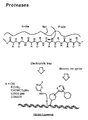
- Figure 1 illustrates the general concept of the invention.
- Libraries of PNA-encoded small molecules (represented by the triangle and parallelogram shapes) are assembled combinatorially onto a library of DNA template.
- the mixture is screened by panning over an immobilized target and the DNA corresponding to the fittest ligand combination is amplified.
- the selection/amplification can be repeated for several cycles and then the DNA is sequence and the covalent version of the small molecule fragments is prepared.
- FIG 2 is a schematic representation of a DNA-Templated Self-Assembled Library (DTSAL).
- DTSAL DNA-Templated Self-Assembled Library
- Libraries are prepared by well established PNA-encoded split and mix combinatorial synthesis (a library of benzodiazepines is used arbitrarily to denote a general library). Libraries containing different pharmacophore fragments are then self-assembled according to the rules of hybridization onto a DNA template library containing all combinations of complementary sequences (for clarity and simplicity, the primers of the DNA template are not shown).
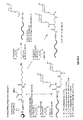
- Figure 3 shows the synthesis of a PNA-encoded library of resorcyclic acid lactones according to example 11.
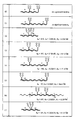
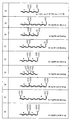
- Figure 4 represents the PNA-encoded split and mix synthesis of heterocyclic libraries by split and mix as described in examples 3 and 4.
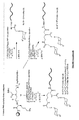
- Figure 5 shows the synthesis of a PNA-encoded library where the molecule is appended at the N-terminus according to example 6.
- Figure 6 illustrates the screening of a DTSAL against carbonic anhydrase and the identification of an inhibitor of carbonic anhydrase according to example 8.
- Figure 7 represents the evolution of ligands for kinases and proteases using biased libraries. Libraries containing biasing element could further enhance ligand discovery for specific target classed.
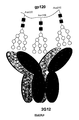
- Figure 8 represents the proposed binding mode of 2G12 dimer with gp120 according to D. A. Calarese, C. N. Scanlan, M. B. Zwick, S. Deechongkit, Y., Mimura, R. Kunert, P. Zhu, M. R. Wormald, R. L. Stanfield, K. H. Roux, J. W. Kelly, P. M. Rudd, R. A. Dwek, H. Katinger, D. R. Burton, I. A. Wilson, Science 2003, 300, 2065 - 2071 .
- Figure 9 represents the synthesis of N- and C-linked PNA carbohydrate conjugates according to example 8.
- Figure 10 shows the affinity of supramolecular complexes to 2G12 measured by SPR (ka is (1/Ms) and kd is (1/s)) according to example 10. Solutions were prepared by mixing 1 equivalent of each PNA with their respective template (*concentration of the template).
- Two libraries of PNA-encoded molecules represented by the triangle and parallelogram shapes on the Figure 1 and chosen among, for example peptides, peptoids, heterocycles or natural product derivatives, are self assembled onto a library of DNA templates (obtained by split and mix combinatorial synthesis).
- the library is then incubated with a molecule of interest and the fittest ligand is retained by affinity (the protein may for example be immobilized on magnetic beads or on a surface such as an surface-plasmon resonance sensor chip).
- affinity the protein may for example be immobilized on magnetic beads or on a surface such as an surface-plasmon resonance sensor chip.
- the identity of the fittest ligand can be decoded by PCR amplification of the DNA template.
- the PCR product can be immobilized by using a PCR-primer with a tag (such as biotin) and converted to a single strand such that the PNA-encoded library can be rehybridized. Since the DNA-template will only have complimentary sequences for the molecules that were selected, the rest of the library will flow through. Releasing the DNA template into solution thus affords a library containing only the molecules which were selected and this library can be used for a second round of sequencing. Reiteration of this process should refine the best ligand. It is important to note that the rehybridization step allows for "mutation" to be incorporated by introducing different PNA-encoded libraries bearing different substitutions.
- a tag such as biotin
- LC-MS were recorded using an HP 1100 series or Thermo Electron Corporation HPLC with a Thermo Finnigan Surveyor® MSQ Mass Spectrometer System. A Thermo Scientific column (50 x 2.1 mm) was used.
- MALDI spectra were measured using a Brucker Daltonics AutoflexTM II TOF/TOF spectrometer. Polymer-bound intermediates were characterized by LC-MS and/or MALDI (2,5-Dihydroxybenzoic acid or ⁇ -Cyano-4-hydroxycinnamic acid matrix and desorbed with laser between 35-55%) following a cleavage from the resin.
- the resin was treated with TFA (95% in H 2 O) for 4 hours.
- the TFA solution was precipitated in Et 2 O (10 times TFA volume) and centrifuged to recover the product as a pellet.
- the precipitate was re-dissolved in H 2 O (500 mL for crude cleaved from 10 mg of resin) then lyophilized.
- Procedure 12 General procedure for Click cycloaddition reaction on NovaPEG resin in Intavis AG Multipep RS Synthesizer
- the resin was swelled in CH 2 Cl 2 for 20 min and treated with a premixed (30 min) solution of the corresponding flavon (5.0 equiv), HOBt (5.0 equiv), DIC (15 equiv) in NMP (1 mL) during 5 hours. Then the resin was filtered and washed with 6 x 10 mL of DMF and 6 x 10 mL of CH 2 Cl 2 .
- the resin (1.0 equiv) was treated with a premixed solution of the corresponding hydrazine or amidinium salt (3.0 equiv) and a aqueous solution of NaHCO 3 (3M, 4.0 equiv) in nBuOH (0.5 mL), and then was shaked at 50 °C for 18 hours. The mixture was filtered and washed sequentially with DMF and CH 2 Cl 2 .
- the resin (10 mg, 2 ⁇ mol, 1.0 equiv) was treated with a 1M solution of PMe 3 (3.0 equiv, THF) in THF (200 mL) for 5 min. After, H 2 O (200 mL) was added and the reaction was shaken for 8 hours. The resin was washed with THF, H 2 O and finally with DMF and CH 2 Cl 2 .
- the resin (10 mg, 2 ⁇ mol, 1.0 equiv) was swollen in CH 2 Cl 2 for 20 min and deprotected with 20% piperidine in DMF (200 ⁇ L) for 10 min; then it was washed with DMF and CH 2 Cl 2 and treated with a premixed solution of chloroacetic anhydride (6.8 mg, 20 equiv) and 2,6-lutidine (5,2 ⁇ L, 22.5 equiv) in CH 2 Cl 2 (150 ⁇ L) for 15 minutes. This process was repeated twice. The resin was then washed with DMF and CH 2 Cl 2 .
- R 1 represents a residue of one amino acid of table 1.
- Table 1 Amino-acids used as elements of diversity Entry Aminoacid m/z calcul m/z found 1 (2S,3S)-2-amino-3-methoxybutanoic acid 2686.54 2687.04 2 (S)-2-amino-3-methoxypropionic acid 2617.53 2617.26 3 Ala 2611.48 2611.96 4 allo-Thr 2641.50 2642.52 5 Arg 2712.59 2713.13 6 Asn 2733.55 2734.95 7 D-Phe 2711.59 2712.13 8 Gln 2716.55 2716.69 9 Glu 2717.55 2718.02 10 Gly 2661.47 2661.99 11 His 2708.54 2709.62 12 Homoser 2617.49 2618.06 13 L-4-Pyridylalanine 2688.54 2689.13 14 L-beta-t-butylalanine 2667.58 2668.16 15 L-cyclo
- R 1 represents a residue of one amino acid of table I and R 2 an alkynyle residue according to table 2.
- Alkyne used as elements of diversity Entry Alkyne m/z (M+Na + ) range 1 4-Ethynylanisole 4717.31-4857.42 2 1-Ethynyl-2-methoxybenzene 4757.32-4897.43 3 2-Ethynylaniline 4718.30-4858.41 4 1-Ethynyl-4-phenoxybenzene 4795.38-4935.49 5 N-Methyl-N-propargylbenzylamine 4713.39-4853.50 6 3-Ethynylanisole 4726.33-4866.44 7 3-Cyclohexyl-1-propyne 4692.36-4832.47 8 3-Dimethylamino-1-propyne 4653.28-4793.39 9 2-Methyl-3-butyn-2-ol 4638.28-4778.39 10 4-Ethynylaniline 4711.32-4851.43 11 3-Butyn-1
- R 1 Phe,Val, Leu, Ala, Ile.
- the 5 -resins prepared in the previous step were suspended in 0.5 mL CH 2 Cl 2 and mixed together in a SPE tube. The resin was shaken for 30 minutes, washed with 2 x CH 2 Cl 2 and then the resin was distributed in 5 different columns in the Multipep Synthesizer. Then the azide group was reduced following procedure 15 and each of the resins was coupled to a different flavon ( procedure 13 ) and capped ( procedure 2 ). PNA encoding according to procedure 11 was then carried out.
- R 1 represents Phe,Val, Leu, Ala
- Ile R 2 represents the different flavones used and are defined in table 4.
- Table 3 Flvon used as element of diversity Entry Flavon CODON m/z (M+Na + ) calcul m/z (M+Na + ) found 1 T*GG Phe: 2661.53 Phe: 2661.92 Val: 2691.43 Val: 2692.99 Leu: 2693.42 Leu: 2694.42 Ala: 2691.44 Ala: 2692.99 Ile: 2691.43 Ile: 2692.99 C*CG Phe: 2661.51 Phe: 2661.92 Val: 2661.43 Val: 2662.09 Leu: 2774.41 Leu: 2776.42 Ala: 2680.43 Ala: 2681.43 Ile: 2762.43 Ile: 2763.41 3 G*CA Phe: 2930.42 Phe: 2931.93 Val: 2811.34 Val: 2813.35 Leu::2877.32 Le
- R 1 and R 2 were defined in table 2 and 3 respectively, R 3 represents the different hydrazines and amidinium salts used and are defined in table 4.
- PNA prepared according to the procedure 10 were derivatized with commercially available pharmacophore by coupling of an acid, alcohol or amine.
- Diglycolic anhydride (2.3 mg, 0.02 mmol, 10.0 equiv) and 2,6 lutidine (4.7 ⁇ L, 0.04 mmol, 20.0 equiv) were dissolved in 200 ⁇ L NMP. The solution was added to resin and the reaction was shaken for 16 h at room temperature. Finally, the resin was washed with DMF and CH 2 Cl 2 .
- BOP 7.1 mg, 0.016 mmol, 8.0 equiv
- HOBt 2.5 mg, 0.016 mmol, 8.0 equiv
- DIPEA 4.2 ⁇ L, 0.024 mmol, 12.0 equiv
- the resin were treated with a solution of the corresponding sulfonyl chlorine (0.02 mmol, 10.0 equiv) and diisopropylamine (0.04 mmol, 20.0 equiv) in 200 ⁇ L of NMP. The reaction was shaken for 8 hours at room temperature. Finally, the resin was washed with DMF and CH 2 Cl 2 .
- Such oligomers is prepared on a Sieber resin which allows the cleavage of the oligomers with all the nucleobases protected (Boc-protected nucleobases are compatible with 1% TFA treatment required for Sieber resin cleavage).
- the product of the coupling is acylated with the appropriate nucleobase to complete the PNA.
- R represents the side chain of any natural of non-natural amino acid.
- Rink resin (NovaPEG) was loaded with the Fmoc (Mtt) protected amino analogue of serine (commercially available) using the same procedure as described for Lys ( procedure 5 ) distributed in 25 columns and the first PNA codon was introduced using ( procedure 10 ) followed by a PEG spacer ( procedure 6 ) and chloroacetylation ( procedure 16 ) .
- the chloroacetamide was displaced with aminoacids methyl esters (5 equiv) in the presence of base (Et i Pr 2 N, 10 equiv) in DMF at 50 °C for 12 h.
- R represents the same or different side chain of any natural of non-natural amino acid.
- the resin was split and mixed and redistributed in 20 columns to be coupled to an Fmoc protected amino acid (5 equiv, HATU 5equiv, Et i Pr 2 N 5equiv) in DMF at rt for 12 h.
- the resin was than treated with DBU (2 equiv) in DMF at rt for 3 hours to promote the Fmoc deprotection and cyclization.
- the MTT was removed ( procedure 9 ) .
- the resin was washed with DMF and the amine acylated with the corresponding nucleobase ( 5 equiv, HATU 5equiv, EtiPr2N 5equiv - for preparation of the nucleobase, see: S. Pothukanuri, Z. Pianowski, N. Winssinger, Eur. J. Org. Chem., 2008, 18, 3141-48 ).
- the library was cleaved from the resin and the completion of every step was confirmed by MALDI analysis.
- Example 7 Procedure for the selection of the fittest combination in a PNA-DNA hybrid library
- a library of DNA containing all permutation of codons complementary to the PNA libraries flanked by 20-mer primer was obtained by split and pool synthesis from commercial supplier (Microsynth AG, Switzerland).
- a 68mer DNA library of 62 500 (125x500) combination was used for screening hybrid library composed of two PNA-encoded libraries of 125 compounds (library A, 14mer PNA) and 500 compounds (library B, 14mer PNA) for screening hybrid library composed of two PNA-encoded libraries of 125 compounds (library A, 14mer PNA) and 500 compounds (library B, 14mer PNA) a 68mer DNA library of 62 500 (125x500) combination was used.
- the self assembled library was prepared by mixing the PNA library A (N-terminus PNA) and B (C-terminus PNA) with the DNA library as well as sequences complementary to the primers on the DNA library (P5' block 5'-ACGAGAGGCTCACAACAGGC-3' (SEQ ID NO: 1) and P3' block, 5'-GGATAGACAATAACGACGAC-3' (SEQ ID NO: 2)). All the component were mixed at equal molar ratio to obtain a final concentration 600 nM in 50 mM, Tris -SO 4 buffer, pH 8.7 or alternatively PBS buffer, NaCl, 0.2 M, in a final volume of 100 ⁇ L. The mixture was heat denatured (10 min at 95 °C) and the hybridization mix was cool down to room temperature for one hour.
- CA Carbonic anhydrase
- the DNA/PNA hybrids solution (10 ⁇ L) was incubated with the target immobilized protein slurry (10 ⁇ L) for 30 min at RT with gentle agitation. After incubation the tubes were the selection took place were placed on a magnetic stand for 2 minutes and the supernatant containing the non bound molecules was pipetted off and discarded. The retained candidates were washed 10 times with PBS-Tween 20, 0.1% (PBS-T) 100 ⁇ L, to eliminate PNA/DNA hybrids non specifically interacting with the target. After 10 washes, The CA functionalized magnetic beads were resuspended on 50 ⁇ L of distilled water and heated at 94°C for 10 min.
- the tubes were placed on a magnetic stand and the supernatant containing the selected candidates was recovered in a new tube, diluted 100 times and 1 ⁇ L of this dilution was used as template for PCR amplification.
- the same procedure was carried out in parallel with BSA functionalized magnetic beads to identify specific selection corresponding to CA by comparison of the selected compounds.
- DNA/PNA hybrids recovered after selection by heat elution were used as templates on PCR amplification under the following conditions.
- PCR reactions containing 2 ⁇ M primer P3' Cy3-5'-GGATAGACAATAACGACGAC-3' (SEQ ID NO: 4), 2 ⁇ M primer P5' Biot-5'- GCCTGTTGTGAGCCTCTCGT-3' (SEQ ID NO: 3), 0.2 units of AmpliTaq Gold® (Applied BiosystemsTM), 1.5 mM MgCl 2 , AmpliTaq Gold® Buffer II, were amplified as follows: one first incubation at 95°C for 10 min, 95°C during 1 min, 52°C for 30s, 68°C for 30 s (25 cycles) and a final elongation 10 min at 72°C.
- PCR reactions were analyzed on 3.5% agarose electrophoresis to confirm the amplification of a specific 68 nucleotides product, stained with ethidium bromide and visualized by UV transilumination.
- PCR reaction 100 ⁇ l of PCR reaction from each round of selection were purified using Quiaquick PCR purification kit (Qiagen®). The purified PCR product was immobilized on Dynal® Streptavidine magnetic beads, and single strand DNA was prepared following a known protocol ( Martin Beaulieu, Garry P. Larson, Louis Geller, Steven D. Flanagan and Theodore G. Krontiris, Nucleic Acids Research, 2001, Vol. 29, No. 5 1114-1124 ).
- the Cy3 labeled DNA strand was conserved at -20°C until hybridization on microarray slides while the immobilized biotinylated strand (template strand) was rehybridized with the PNA libraries A and B (600 nM) during 30 min at 50°C.
- the non hybridized PNA molecules were washes out of the magnetic beads by five successive washes with 100 ⁇ l PBS-T at room temperature.
- the new recruited PNA/DNA hybrids were eluted from the magnetic beads by heating the beads at 95°C (10 ⁇ l) for ten minutes on PBS buffer, 5 mM biotin.
- the eluted DNA/PNA hybrids were engaged in further rounds of selection by using the recover solution to incubate with the immobilized target.
- the covalent adducts from selected fragments were resynthesized on each arm of a bifunctional linker (such as FmocLys(Mtt)OH) by the same protocol as used in the original library synthesis. Different distances between the ligands were achieved using different bifunctional linker. The products obtain following cleavage from the resin were tested for their activity and affinity by enzymatic assay or microcalorimetry.
- a bifunctional linker such as FmocLys(Mtt)OH
- CA II 50 nM For carbonic anhydrase (CA)-, bovine CA II 50 nM was incubated with variable concentrations of the selected compounds for 10 min prior to addition of 4-nitrophenyl acetate. The assay was done on Tris-SO4 50 mM, pH 8.5, and 4-nitrophenyl acetate concentration of 1 mM on 96 well plates, 200 ⁇ l reaction volume.
- Example 8 Screening of a DTSAL and obtaining of an adduct having high-affinity to carbonic anhydrase
- the protocol for the screening of DTSAL involves a reiteration of three steps: hybridization of the PNA-encoded libraries onto a DNA template library,passing the library over the immobilized target to retain the best binders, and amplification and capture of the selected templates.
- the immobilization of the target protein can be carried out on magnetic beads (such as Dynabeads) or SPR sensor chip using standard protocols.
- the 10 micrograms of target was immobilized and incubated with 50 microliters of the library at a total concentration of 100 micromolar.
- the target was washed five times with buffer then heated to 95 degree Celsius to recover the DNA template corresponding to the best ligand combination.
- the DNA template was amplified (20 cycles of PCR) with PCR primers containing a biotin (5' primer) and a fluorophore (3' primer) and the PCR product was captured on a streptavidin resin. Dissociation of the two strands afforded the fluorophore labeled strand in solution which was analyzed by hybridization to a microarray. The templating DNA strand which remained associated to the streptavidin resin was incubated with the library of PNA-encoded molecules and subsequently release by heating to 50 degree Celsius in the presence of an excess of biotin.
- the selected population of DNA-templated library was used for a second round of selection following the same procedure. This was reiterated two more times. Interestingly, hybridization of each round of selection showed a clear evolution towards a consensus sequence.
- the fittest combination was resynthesized as a covalent adduct and measured to have a 10 nM affinity to carbonic anhydrase thus validating the ability to self assemble libraries onto DNA template, screen such library in a miniaturized format and translate the results into a high affinity ligand ( Figure 6 ).
- Example 9 Appllication to the discovery of ligands bridging two different binding pockets
- Receptor homo- or hetero-oligomerization is a fundamental feature of cellular recognition and signal transduction ( Pin, J. P., Neubig, R., Bouvier, M., Devi, L., Filizola, M., Javitch, J. A., Lohse, M. J., Milligan, G., Palczewski, K., Parmentier, M. & Spedding, M. (2007) International Union of Basic and Clinical Pharmacology. LXVII.
- Protein-carbohydrate interaction often achieve high avidity by the cooperative interaction of multiple units ( Lundquist, J. & Toone, E. (2002) The cluster glycoside effect Chem. Rev. 102: 555-578 ).
- An example of therapeutic significance is the interaction of the cholera toxin with cell surface carbohydrates.
- the toxin is a pentamer which recognizes at least five cell-surface carbohydrates. While the affinity of the toxin for the monomeric cell surface trisaccharide is in the mM range, a synthetic oligomer with an architecture matching the toxin's receptor geometry has been reported to have picomolar affinity (106 fold enhancement over the monomer) and to effectively inhibit the toxin in cellular assays ( Kitov, P.
- Shiga-like toxins are neutralized by tailored multivalent carbohydrate ligands Nature 403: 669-72 ). While this example illustrates the importance of accessing oligomeric carbohydrate structures with controlled topology, the synthetic challenges of accessing complex architectures have hampered progress.
- the present invention allowing to access oligomeric carbohydrates in a combinatorial fashion with controlled topology from self assembled PNA-tagged oligosaccharides onto DNA templates is thus enabling.
- the distance between the two primary binding sites in 2G12 is 30 ⁇ (measured from pdb 1OP5 ( Calarese Daniel, A., Scanlan Christopher, N., Zwick Michael, B., Deechongkit, S., Mimura, Y., Kunert, R., Zhu, P., Wormald Mark, R., Stanfield Robyn, L., Roux Kenneth, H., Kelly Jeffery, W., Rudd Pauline, M., Dwek Raymond, A., Katinger, H., Burton Dennis, R. & Wilson Ian, A.
- DNA-saccharide conjugates have been reported, only monosaccharide-DNA conjugates have been reported thus far for microarraying ( Chevolot, Y., Bouillon, C., Vidal, S., Morvan, F., Meyer, A., Cloarec, J. P., Jochum, A., Praly, J. P., Vasseur, J. J. & Souteyrand, E. (2007) DNA-based carbohydrate biochips: a platform for surface glyco-engineering Angew. Chem. Int. Ed. Engl. 46: 2398-402 ) and to study lectin interactions ( Matsuura, K., Hibino, M., Yamada, Y. & Kobayashi, K.
- carbohydrates can be efficiently coupled to polymer-bound PNAs at the C-terminus or the N-terminus using a thiol coupling (thiolactol or carbohydrates bearing a thioalkyl group at the anomeric position) to a chloroacetamide with a mild base such as Hunigs' base or DBU.
- a 10mer PNA was deemed appropriate as it would provide Tm > 50 °C and would present adjacent ligand on the same face of the helix.
- the Fmoc group can be selectively removed and a 10 ⁇ PEG spacer added prior to the chloroacetylations to obtain 10 after glycoside conjugation and release from the resin.
- a first chloroacetylation/ carbohydrate coupling is performed after the Fmoc deprotection but prior to Mtt removal.
- a second chloroacetylation/ carbohydrate coupling can then be performed upon Mtt deprotection to obtain heterodimeric conjugates such as 11.
Landscapes
- Chemical & Material Sciences (AREA)
- Organic Chemistry (AREA)
- Life Sciences & Earth Sciences (AREA)
- Health & Medical Sciences (AREA)
- Engineering & Computer Science (AREA)
- Biochemistry (AREA)
- Genetics & Genomics (AREA)
- Molecular Biology (AREA)
- Zoology (AREA)
- Wood Science & Technology (AREA)
- Bioinformatics & Cheminformatics (AREA)
- Biotechnology (AREA)
- General Engineering & Computer Science (AREA)
- Biomedical Technology (AREA)
- Chemical Kinetics & Catalysis (AREA)
- Medicinal Chemistry (AREA)
- General Chemical & Material Sciences (AREA)
- Physics & Mathematics (AREA)
- General Health & Medical Sciences (AREA)
- Biophysics (AREA)
- Microbiology (AREA)
- Proteomics, Peptides & Aminoacids (AREA)
- Crystallography & Structural Chemistry (AREA)
- Bioinformatics & Computational Biology (AREA)
- Plant Pathology (AREA)
- Analytical Chemistry (AREA)
- Immunology (AREA)
- Measuring Or Testing Involving Enzymes Or Micro-Organisms (AREA)
Claims (10)
- Verfahren zum Identifizieren einer oder mehrerer molekularen Struktur(en), die hohe Affinität für ein Ziel von Interesse aufweist bzw. aufweisen, wobei die molekulare(n) Struktur(en) jeweils eine Nukleotidkette umfassen, an die mindestens ein PNA-kodiertes Molekül hybridisiert ist, und wobei das Verfahren die folgenden Schritte umfasst:a) Bereitstellen mindestens einer Bibliothek von PNA-kodierten Molekülen und einer Bibliothek von Nukleotidketten,b) Hybridisieren der mindestens einen Bibliothek von PNA-kodierten Molekülen an die Bibliothek von Nukleotidketten,c) In-Berührung-bringen der resultierenden Bibliothek von einem zuletzt erhaltenen Hybrid bzw. mehreren zuletzt erhaltenen Hybriden aus einem oder mehreren PNA-kodierten Molekül(en)/Nukleotidkette mit dem Ziel von Interesse,d) Auswählen des am besten passenden Hybrids bzw. mehrerer passender zuletzt erhaltener Hybride aus einem oder mehreren PNA-kodierten Molekül(en)/Nukleotidkette für das Ziel von Interesse,e) Amplifizieren einer oder mehrerer Nukleotidkette(n), die aus dem vorstehend genannten am besten passenden Hybrid bzw. mehreren passenden zuletzt erhaltenen Hybriden aus einem oder mehreren PNA-kodierten Molekül(en)/Nukleotidkette erhalten wird,f) In-Berührung-bringen der vorstehend amplifizierten Nukleotidkette(n) mit einer oder mehreren Bibliotheken von PNA-kodierten Molekülen, wobei letztere jeweils einen identischen Inhalt wie die Bibliothek bzw. die Bibliotheken von PNA-kodierten Molekülen, die in Schritt a) ausgewählt werden, aufweist oder eine gewisse Modifikation enthält, anschließend deren Hybridisierung und Wiederholung von Schritt c) bis e),g) Identifizieren der in Schritt f) erhaltenen Nukleotidkette(n), die jeweils mindestens einem PNA-kodierten Molekül aus der mindestens einen in Schritt a) genannten Bibliothek von PNA-kodierten Molekülen entspricht/entsprechen.
- Verfahren nach Anspruch 1, wobei Schritt f) fehlt, wobei das Verfahren die folgenden Schritte umfasst:a) Bereitstellen mindestens einer Bibliothek von PNA-kodierten Molekülen und einer Bibliothek von Nukleotidketten,b) Hybridisieren der mindestens einen Bibliothek von PNA-kodierten Molekülen an die Bibliothek von Nukleotidketten,c) In-Berührung-bringen der resultierenden Bibliothek von einem zuletzt erhaltenen Hybrid bzw. mehreren zuletzt erhaltenen Hybriden aus einem oder mehreren PNA-kodierten Molekül(en)/Nukleotidkette mit dem Ziel von Interesse,d) Auswählen des am besten passenden Hybrids bzw.
mehrerer passender zuletzt erhaltener Hybride aus einem oder mehreren PNA-kodierten Molekül(en)/Nukleotidkette für das Ziel von Interesse,e) Amplifizieren einer oder mehrerer Nukleotidkette(n), die aus dem vorstehend genannten am besten passenden Hybrid bzw. mehreren passenden zuletzt erhaltenen Hybriden aus einem oder mehreren PNA-kodierten Molekül(en)/Nukleotidkette erhalten wird,g) Identifizieren der in Schritt e) erhaltenen Nukleotidkette(n), die jeweils mindestens einem PNA-kodierten Molekül aus der mindestens einen in Schritt a) genannten Bibliothek von PNA-kodierten Molekülen entspricht/entsprechen. - Verfahren nach Anspruch 1, wobei der Schritt f) wiederholt wird, bis eine Konvergenz in Richtung einer oder mehrerer Konsenssequenz(en) erhalten wird, vorzugsweise weniger als 20 Mal.
- Verfahren nach einem der Ansprüche 1 bis 3, wobei Nukleotidketten nur aus DNA bestehen.
- Verfahren zum Identifizieren einer oder mehrerer Konsenssequenz(en), die hohe Affinität für ein Ziel von Interesse aufweisen, umfassend ein Verfahren nach einem der Ansprüche 1 bis 4, ferner umfassend die folgenden Schritte:h) Bestimmen mindestens einer Konsensstruktur ausgehend von der in Schritt g) identifizierten Nukleotidkette(n), wobei die mindestens eine Konsensstruktur hohe Affinität zu dem Ziel von Interesse aufweist.
- Verfahren nach einem der Ansprüche 1 bis 5, wobei in Schritt a) mindestens zwei Bibliotheken von PNAkodierten Molekülen bereitgestellt sind, wobei die erste PNA-kodierte Moleküle aufweist, die am N-Terminus angehängt sind, und die zweite PNA-kodierte Moleküle aufweist, die am C-Terminus angehängt sind, und kontig an die Nukleotidkette(n) hybridisiert sind.
- Verfahren nach einem der Ansprüche 1 bis 5, wobei alle in Schritt a) PNA-kodierten Moleküle am N-Terminus oder am C-Terminus angehängt sind.
- Verfahren nach einem der Ansprüche 1 bis 7, wobei die PNA-kodierten Moleküle, die am N-Terminus angehängt sind, nach dem "Split-Mix"-Verfahren erhalten werden.
- Verfahren nach einem der Ansprüche 1 bis 8, wobei der Amplifizierungsschritt mittels PCR unter Verwendung eines 5'-Primers, der einen Marker enthält, eines funktionalisierten festen Trägers, der Affinität zu dem Marker aufweist, und eines 3'-Primers, der gegebenenfalls ein Fluorophor enthält, durchgeführt wird.
- Verfahren des Zubereitens eines Adduktes als potenzieller Wirkstoffkandidat oder Katalysator, wobei das Verfahren das Verfahren nach einem der Ansprüche 1 bis 9 umfasst, ferner umfassend die folgenden Schritte:i) Synthetisieren eines kovalenten Adduktes, welches die Konsensstruktur nachahmt;j) Validieren der biologischen oder katalytischen Aktivität des kovalenten Adduktes.
Applications Claiming Priority (2)
| Application Number | Priority Date | Filing Date | Title |
|---|---|---|---|
| US21918609P | 2009-06-22 | 2009-06-22 | |
| PCT/IB2010/001932 WO2010150103A2 (en) | 2009-06-22 | 2010-06-22 | Method of preparing an adduct |
Publications (2)
| Publication Number | Publication Date |
|---|---|
| EP2446033A2 EP2446033A2 (de) | 2012-05-02 |
| EP2446033B1 true EP2446033B1 (de) | 2013-10-23 |
Family
ID=43386962
Family Applications (1)
| Application Number | Title | Priority Date | Filing Date |
|---|---|---|---|
| EP10752168.4A Not-in-force EP2446033B1 (de) | 2009-06-22 | 2010-06-22 | Methode zur herstellung eines adduktes |
Country Status (4)
| Country | Link |
|---|---|
| US (2) | US8716191B2 (de) |
| EP (1) | EP2446033B1 (de) |
| DK (1) | DK2446033T3 (de) |
| WO (1) | WO2010150103A2 (de) |
Families Citing this family (8)
| Publication number | Priority date | Publication date | Assignee | Title |
|---|---|---|---|---|
| WO2013033436A1 (en) * | 2011-09-01 | 2013-03-07 | University Of Iowa Research Foundation | Oligonucleotide-based probes for detection of bacterial nucleases |
| US10619219B2 (en) | 2014-02-07 | 2020-04-14 | University Of Iowa Research Foundation | Oligonucleotide-based probes and methods for detection of microbes |
| DE102014213783B3 (de) * | 2014-07-16 | 2015-06-18 | Technische Universität Dresden | Verfahren zur Identifizierung hochaffiner Komplexe aus zwei Liganden und einem Rezeptor, Vorrichtung zur Durchführung des Verfahrens und selbst-assemblierende chemische Bibliothek zur Verwendung in dem Verfahren |
| WO2016041010A1 (en) * | 2014-09-15 | 2016-03-24 | Garvan Institute Of Medical Research | Methods for diagnosis, prognosis and monitoring of breast cancer and reagents therefor |
| NL2013857B1 (en) * | 2014-11-21 | 2016-10-11 | Piculet Biosciences Tech B V | Self-assembled bivalent ligand complex (SABLC) libraries and methods for screening such libraries. |
| JP7148769B2 (ja) * | 2017-09-12 | 2022-10-06 | 学校法人 工学院大学 | 複素環化合物又はその塩、gpr35作動薬及び医薬組成物 |
| WO2019067711A1 (en) | 2017-09-29 | 2019-04-04 | University Of Iowa Research Foundation | DIGITAL NUCLEASE DETECTION COMPOSITIONS AND METHODS |
| US12258680B2 (en) | 2018-05-18 | 2025-03-25 | Novartis Ag | Solid support |
Family Cites Families (10)
| Publication number | Priority date | Publication date | Assignee | Title |
|---|---|---|---|---|
| EP1123305A1 (de) | 1998-10-19 | 2001-08-16 | The Board Of Trustees Of The Leland Stanford Junior University | Chemie einer dna-templatisierten kombinatorischen bibliothek |
| EP1423400B2 (de) | 2001-03-19 | 2013-05-22 | President and Fellows of Harvard College | Entwicklung neuer molekularer funktionen |
| WO2002099078A2 (en) * | 2001-06-05 | 2002-12-12 | Irm Llc | Functional proteomic profiling |
| CA2478203C (en) | 2002-03-08 | 2011-06-14 | Eidgenossische Technische Hochschule Zurich | Encoded self-assembling chemical libraries (esachel) |
| CN1898257B (zh) | 2003-12-17 | 2010-06-23 | 普雷西斯药品公司 | 合成编码文库的方法 |
| EP1828381B1 (de) | 2004-11-22 | 2009-01-07 | Peter Birk Rasmussen | Matrizengerichtete split-and-mix-synthese von bibliotheken kleiner moleküle |
| US20090035824A1 (en) | 2005-06-17 | 2009-02-05 | Liu David R | Nucleic acid-templated chemistry in organic solvents |
| WO2007011722A2 (en) | 2005-07-15 | 2007-01-25 | President And Fellows Of Harvard College | Reaction discovery system |
| EP2368868A1 (de) | 2005-10-28 | 2011-09-28 | Praecis Pharmaceuticals Inc. | Verfahren zur Identifikation von Verbindungen von Interesse mithilfe kodierter Bibliotheken |
| WO2010091144A1 (en) * | 2009-02-04 | 2010-08-12 | Wake Forest University Health Sciences | Compositions, methods, and kits for identifying candidate molecules from encoded chemical libraries |
-
2010
- 2010-06-22 DK DK10752168.4T patent/DK2446033T3/da active
- 2010-06-22 US US13/378,675 patent/US8716191B2/en not_active Expired - Fee Related
- 2010-06-22 EP EP10752168.4A patent/EP2446033B1/de not_active Not-in-force
- 2010-06-22 WO PCT/IB2010/001932 patent/WO2010150103A2/en not_active Ceased
-
2014
- 2014-03-25 US US14/224,093 patent/US20140200161A1/en not_active Abandoned
Also Published As
| Publication number | Publication date |
|---|---|
| WO2010150103A2 (en) | 2010-12-29 |
| US20140200161A1 (en) | 2014-07-17 |
| WO2010150103A3 (en) | 2011-04-14 |
| US8716191B2 (en) | 2014-05-06 |
| US20120115751A1 (en) | 2012-05-10 |
| EP2446033A2 (de) | 2012-05-02 |
| DK2446033T3 (da) | 2014-01-27 |
Similar Documents
| Publication | Publication Date | Title |
|---|---|---|
| EP2446033B1 (de) | Methode zur herstellung eines adduktes | |
| JP7010875B2 (ja) | Dnaコード化ライブラリを作製およびスクリーニングする方法 | |
| EP3515880B1 (de) | Verfahren und zusammensetzungen zur synthese von codierten bibliotheken | |
| Tse et al. | Translation of DNA into a library of 13 000 synthetic small-molecule macrocycles suitable for in vitro selection | |
| KR101411361B1 (ko) | 구조적 핵산에 의해 가이드되는 화학적 합성 | |
| Daguer et al. | DNA-templated combinatorial assembly of small molecule fragments amenable to selection/amplification cycles | |
| CN1898257B (zh) | 合成编码文库的方法 | |
| DK2348125T3 (en) | Process for the synthesis of a bifunctional complex | |
| JP2020176121A (ja) | Dnaコードライブラリーをタグ付けするための方法 | |
| EP2474613B2 (de) | Verfahren und Zusammensetzungen | |
| US10240147B2 (en) | Production of encoded chemical libraries | |
| US10730906B2 (en) | Multi-step synthesis of templated molecules | |
| DK177345B1 (da) | Fremgangsmåder til syntese af kodede biblioteker | |
| EP1756277B1 (de) | Durch quasizufallsstrukturen und funktionen geführte synthesemethode | |
| US7704925B2 (en) | Ligational encoding using building block oligonucleotides | |
| CN115506036B (zh) | Dna编码化合物文库起始片段及其制备和应用 | |
| Dockerill et al. | Translation of Deoxyribonucleic Acid into Synthetic Alpha Helical Peptides for Darwinian Evolution | |
| WO2005012902A1 (ja) | 有用タンパク質のスクリーニング方法 | |
| Guo | DNA ligase-catalyzed scaffolding of peptide fragments on nucleic acid polymer | |
| Brian et al. | Translation of DNA into a Library of 13,000 Synthetic Small-Molecule Macrocycles Suitable for In Vitro Selection | |
| Tilmans et al. | In-Vitro Evolution of Small Molecules | |
| HK1164264A (en) | Methods of creating and screening dna-encoded libraries | |
| HK1164264B (en) | Methods of creating and screening dna-encoded libraries |
Legal Events
| Date | Code | Title | Description |
|---|---|---|---|
| PUAI | Public reference made under article 153(3) epc to a published international application that has entered the european phase |
Free format text: ORIGINAL CODE: 0009012 |
|
| 17P | Request for examination filed |
Effective date: 20120119 |
|
| AK | Designated contracting states |
Kind code of ref document: A2 Designated state(s): AL AT BE BG CH CY CZ DE DK EE ES FI FR GB GR HR HU IE IS IT LI LT LU LV MC MK MT NL NO PL PT RO SE SI SK SM TR |
|
| DAX | Request for extension of the european patent (deleted) | ||
| 17Q | First examination report despatched |
Effective date: 20121016 |
|
| GRAP | Despatch of communication of intention to grant a patent |
Free format text: ORIGINAL CODE: EPIDOSNIGR1 |
|
| RIC1 | Information provided on ipc code assigned before grant |
Ipc: C40B 40/04 20060101ALI20130430BHEP Ipc: C40B 50/04 20060101ALI20130430BHEP Ipc: C12N 15/10 20060101AFI20130430BHEP Ipc: C40B 40/06 20060101ALI20130430BHEP Ipc: C40B 30/04 20060101ALI20130430BHEP |
|
| INTG | Intention to grant announced |
Effective date: 20130528 |
|
| GRAS | Grant fee paid |
Free format text: ORIGINAL CODE: EPIDOSNIGR3 |
|
| GRAA | (expected) grant |
Free format text: ORIGINAL CODE: 0009210 |
|
| AK | Designated contracting states |
Kind code of ref document: B1 Designated state(s): AL AT BE BG CH CY CZ DE DK EE ES FI FR GB GR HR HU IE IS IT LI LT LU LV MC MK MT NL NO PL PT RO SE SI SK SM TR |
|
| REG | Reference to a national code |
Ref country code: GB Ref legal event code: FG4D |
|
| REG | Reference to a national code |
Ref country code: CH Ref legal event code: EP |
|
| REG | Reference to a national code |
Ref country code: AT Ref legal event code: REF Ref document number: 637637 Country of ref document: AT Kind code of ref document: T Effective date: 20131115 |
|
| REG | Reference to a national code |
Ref country code: IE Ref legal event code: FG4D |
|
| REG | Reference to a national code |
Ref country code: DE Ref legal event code: R096 Ref document number: 602010011205 Country of ref document: DE Effective date: 20131224 |
|
| REG | Reference to a national code |
Ref country code: DK Ref legal event code: T3 Effective date: 20140126 |
|
| REG | Reference to a national code |
Ref country code: NL Ref legal event code: T3 |
|
| REG | Reference to a national code |
Ref country code: NL Ref legal event code: T3 |
|
| REG | Reference to a national code |
Ref country code: CH Ref legal event code: NV Representative=s name: ABREMA AGENCE BREVET ET MARQUES, GANGUILLET, CH |
|
| REG | Reference to a national code |
Ref country code: AT Ref legal event code: MK05 Ref document number: 637637 Country of ref document: AT Kind code of ref document: T Effective date: 20131023 |
|
| REG | Reference to a national code |
Ref country code: LT Ref legal event code: MG4D |
|
| PG25 | Lapsed in a contracting state [announced via postgrant information from national office to epo] |
Ref country code: SE Free format text: LAPSE BECAUSE OF FAILURE TO SUBMIT A TRANSLATION OF THE DESCRIPTION OR TO PAY THE FEE WITHIN THE PRESCRIBED TIME-LIMIT Effective date: 20131023 Ref country code: NO Free format text: LAPSE BECAUSE OF FAILURE TO SUBMIT A TRANSLATION OF THE DESCRIPTION OR TO PAY THE FEE WITHIN THE PRESCRIBED TIME-LIMIT Effective date: 20140123 Ref country code: HR Free format text: LAPSE BECAUSE OF FAILURE TO SUBMIT A TRANSLATION OF THE DESCRIPTION OR TO PAY THE FEE WITHIN THE PRESCRIBED TIME-LIMIT Effective date: 20131023 Ref country code: IS Free format text: LAPSE BECAUSE OF FAILURE TO SUBMIT A TRANSLATION OF THE DESCRIPTION OR TO PAY THE FEE WITHIN THE PRESCRIBED TIME-LIMIT Effective date: 20140223 Ref country code: LT Free format text: LAPSE BECAUSE OF FAILURE TO SUBMIT A TRANSLATION OF THE DESCRIPTION OR TO PAY THE FEE WITHIN THE PRESCRIBED TIME-LIMIT Effective date: 20131023 |
|
| PG25 | Lapsed in a contracting state [announced via postgrant information from national office to epo] |
Ref country code: LV Free format text: LAPSE BECAUSE OF FAILURE TO SUBMIT A TRANSLATION OF THE DESCRIPTION OR TO PAY THE FEE WITHIN THE PRESCRIBED TIME-LIMIT Effective date: 20131023 Ref country code: AT Free format text: LAPSE BECAUSE OF FAILURE TO SUBMIT A TRANSLATION OF THE DESCRIPTION OR TO PAY THE FEE WITHIN THE PRESCRIBED TIME-LIMIT Effective date: 20131023 Ref country code: CY Free format text: LAPSE BECAUSE OF FAILURE TO SUBMIT A TRANSLATION OF THE DESCRIPTION OR TO PAY THE FEE WITHIN THE PRESCRIBED TIME-LIMIT Effective date: 20131023 Ref country code: ES Free format text: LAPSE BECAUSE OF FAILURE TO SUBMIT A TRANSLATION OF THE DESCRIPTION OR TO PAY THE FEE WITHIN THE PRESCRIBED TIME-LIMIT Effective date: 20131023 |
|
| PG25 | Lapsed in a contracting state [announced via postgrant information from national office to epo] |
Ref country code: PT Free format text: LAPSE BECAUSE OF FAILURE TO SUBMIT A TRANSLATION OF THE DESCRIPTION OR TO PAY THE FEE WITHIN THE PRESCRIBED TIME-LIMIT Effective date: 20140224 |
|
| REG | Reference to a national code |
Ref country code: DE Ref legal event code: R097 Ref document number: 602010011205 Country of ref document: DE |
|
| PG25 | Lapsed in a contracting state [announced via postgrant information from national office to epo] |
Ref country code: EE Free format text: LAPSE BECAUSE OF FAILURE TO SUBMIT A TRANSLATION OF THE DESCRIPTION OR TO PAY THE FEE WITHIN THE PRESCRIBED TIME-LIMIT Effective date: 20131023 |
|
| PG25 | Lapsed in a contracting state [announced via postgrant information from national office to epo] |
Ref country code: SK Free format text: LAPSE BECAUSE OF FAILURE TO SUBMIT A TRANSLATION OF THE DESCRIPTION OR TO PAY THE FEE WITHIN THE PRESCRIBED TIME-LIMIT Effective date: 20131023 Ref country code: RO Free format text: LAPSE BECAUSE OF FAILURE TO SUBMIT A TRANSLATION OF THE DESCRIPTION OR TO PAY THE FEE WITHIN THE PRESCRIBED TIME-LIMIT Effective date: 20131023 Ref country code: CZ Free format text: LAPSE BECAUSE OF FAILURE TO SUBMIT A TRANSLATION OF THE DESCRIPTION OR TO PAY THE FEE WITHIN THE PRESCRIBED TIME-LIMIT Effective date: 20131023 Ref country code: PL Free format text: LAPSE BECAUSE OF FAILURE TO SUBMIT A TRANSLATION OF THE DESCRIPTION OR TO PAY THE FEE WITHIN THE PRESCRIBED TIME-LIMIT Effective date: 20131023 |
|
| PLBE | No opposition filed within time limit |
Free format text: ORIGINAL CODE: 0009261 |
|
| STAA | Information on the status of an ep patent application or granted ep patent |
Free format text: STATUS: NO OPPOSITION FILED WITHIN TIME LIMIT |
|
| 26N | No opposition filed |
Effective date: 20140724 |
|
| REG | Reference to a national code |
Ref country code: DE Ref legal event code: R097 Ref document number: 602010011205 Country of ref document: DE Effective date: 20140724 |
|
| PG25 | Lapsed in a contracting state [announced via postgrant information from national office to epo] |
Ref country code: MC Free format text: LAPSE BECAUSE OF FAILURE TO SUBMIT A TRANSLATION OF THE DESCRIPTION OR TO PAY THE FEE WITHIN THE PRESCRIBED TIME-LIMIT Effective date: 20131023 Ref country code: LU Free format text: LAPSE BECAUSE OF FAILURE TO SUBMIT A TRANSLATION OF THE DESCRIPTION OR TO PAY THE FEE WITHIN THE PRESCRIBED TIME-LIMIT Effective date: 20140622 |
|
| PG25 | Lapsed in a contracting state [announced via postgrant information from national office to epo] |
Ref country code: SI Free format text: LAPSE BECAUSE OF FAILURE TO SUBMIT A TRANSLATION OF THE DESCRIPTION OR TO PAY THE FEE WITHIN THE PRESCRIBED TIME-LIMIT Effective date: 20131023 |
|
| REG | Reference to a national code |
Ref country code: IE Ref legal event code: MM4A |
|
| PG25 | Lapsed in a contracting state [announced via postgrant information from national office to epo] |
Ref country code: IE Free format text: LAPSE BECAUSE OF NON-PAYMENT OF DUE FEES Effective date: 20140622 |
|
| REG | Reference to a national code |
Ref country code: FR Ref legal event code: PLFP Year of fee payment: 6 |
|
| PGFP | Annual fee paid to national office [announced via postgrant information from national office to epo] |
Ref country code: FI Payment date: 20150602 Year of fee payment: 6 Ref country code: DK Payment date: 20150610 Year of fee payment: 6 Ref country code: GB Payment date: 20150602 Year of fee payment: 6 Ref country code: DE Payment date: 20150615 Year of fee payment: 6 |
|
| PGFP | Annual fee paid to national office [announced via postgrant information from national office to epo] |
Ref country code: NL Payment date: 20150530 Year of fee payment: 6 |
|
| PGFP | Annual fee paid to national office [announced via postgrant information from national office to epo] |
Ref country code: CH Payment date: 20150702 Year of fee payment: 6 |
|
| PGFP | Annual fee paid to national office [announced via postgrant information from national office to epo] |
Ref country code: BE Payment date: 20150626 Year of fee payment: 6 Ref country code: FR Payment date: 20150626 Year of fee payment: 6 |
|
| PGFP | Annual fee paid to national office [announced via postgrant information from national office to epo] |
Ref country code: IT Payment date: 20150626 Year of fee payment: 6 |
|
| PG25 | Lapsed in a contracting state [announced via postgrant information from national office to epo] |
Ref country code: MT Free format text: LAPSE BECAUSE OF FAILURE TO SUBMIT A TRANSLATION OF THE DESCRIPTION OR TO PAY THE FEE WITHIN THE PRESCRIBED TIME-LIMIT Effective date: 20131023 |
|
| PG25 | Lapsed in a contracting state [announced via postgrant information from national office to epo] |
Ref country code: SM Free format text: LAPSE BECAUSE OF FAILURE TO SUBMIT A TRANSLATION OF THE DESCRIPTION OR TO PAY THE FEE WITHIN THE PRESCRIBED TIME-LIMIT Effective date: 20131023 |
|
| PG25 | Lapsed in a contracting state [announced via postgrant information from national office to epo] |
Ref country code: GR Free format text: LAPSE BECAUSE OF FAILURE TO SUBMIT A TRANSLATION OF THE DESCRIPTION OR TO PAY THE FEE WITHIN THE PRESCRIBED TIME-LIMIT Effective date: 20140124 Ref country code: BG Free format text: LAPSE BECAUSE OF FAILURE TO SUBMIT A TRANSLATION OF THE DESCRIPTION OR TO PAY THE FEE WITHIN THE PRESCRIBED TIME-LIMIT Effective date: 20131023 |
|
| PG25 | Lapsed in a contracting state [announced via postgrant information from national office to epo] |
Ref country code: TR Free format text: LAPSE BECAUSE OF FAILURE TO SUBMIT A TRANSLATION OF THE DESCRIPTION OR TO PAY THE FEE WITHIN THE PRESCRIBED TIME-LIMIT Effective date: 20131023 Ref country code: HU Free format text: LAPSE BECAUSE OF FAILURE TO SUBMIT A TRANSLATION OF THE DESCRIPTION OR TO PAY THE FEE WITHIN THE PRESCRIBED TIME-LIMIT; INVALID AB INITIO Effective date: 20100622 |
|
| PG25 | Lapsed in a contracting state [announced via postgrant information from national office to epo] |
Ref country code: BE Free format text: LAPSE BECAUSE OF NON-PAYMENT OF DUE FEES Effective date: 20160630 |
|
| REG | Reference to a national code |
Ref country code: DE Ref legal event code: R119 Ref document number: 602010011205 Country of ref document: DE |
|
| REG | Reference to a national code |
Ref country code: DK Ref legal event code: EBP Effective date: 20160630 |
|
| PG25 | Lapsed in a contracting state [announced via postgrant information from national office to epo] |
Ref country code: FI Free format text: LAPSE BECAUSE OF NON-PAYMENT OF DUE FEES Effective date: 20160622 |
|
| REG | Reference to a national code |
Ref country code: CH Ref legal event code: PL |
|
| REG | Reference to a national code |
Ref country code: NL Ref legal event code: MM Effective date: 20160701 |
|
| GBPC | Gb: european patent ceased through non-payment of renewal fee |
Effective date: 20160622 |
|
| REG | Reference to a national code |
Ref country code: FR Ref legal event code: ST Effective date: 20170228 |
|
| PG25 | Lapsed in a contracting state [announced via postgrant information from national office to epo] |
Ref country code: CH Free format text: LAPSE BECAUSE OF NON-PAYMENT OF DUE FEES Effective date: 20160630 Ref country code: LI Free format text: LAPSE BECAUSE OF NON-PAYMENT OF DUE FEES Effective date: 20160630 Ref country code: DE Free format text: LAPSE BECAUSE OF NON-PAYMENT OF DUE FEES Effective date: 20170103 Ref country code: FR Free format text: LAPSE BECAUSE OF NON-PAYMENT OF DUE FEES Effective date: 20160630 |
|
| PG25 | Lapsed in a contracting state [announced via postgrant information from national office to epo] |
Ref country code: NL Free format text: LAPSE BECAUSE OF NON-PAYMENT OF DUE FEES Effective date: 20160701 Ref country code: GB Free format text: LAPSE BECAUSE OF NON-PAYMENT OF DUE FEES Effective date: 20160622 |
|
| PG25 | Lapsed in a contracting state [announced via postgrant information from national office to epo] |
Ref country code: IT Free format text: LAPSE BECAUSE OF NON-PAYMENT OF DUE FEES Effective date: 20160622 |
|
| PG25 | Lapsed in a contracting state [announced via postgrant information from national office to epo] |
Ref country code: DK Free format text: LAPSE BECAUSE OF NON-PAYMENT OF DUE FEES Effective date: 20160630 |
|
| PG25 | Lapsed in a contracting state [announced via postgrant information from national office to epo] |
Ref country code: MK Free format text: LAPSE BECAUSE OF FAILURE TO SUBMIT A TRANSLATION OF THE DESCRIPTION OR TO PAY THE FEE WITHIN THE PRESCRIBED TIME-LIMIT Effective date: 20131023 |
|
| PG25 | Lapsed in a contracting state [announced via postgrant information from national office to epo] |
Ref country code: AL Free format text: LAPSE BECAUSE OF FAILURE TO SUBMIT A TRANSLATION OF THE DESCRIPTION OR TO PAY THE FEE WITHIN THE PRESCRIBED TIME-LIMIT Effective date: 20131023 |