EP2447902A1 - Dispositif fournissant des informations, procédé correspondant, programme et support de stockage - Google Patents
Dispositif fournissant des informations, procédé correspondant, programme et support de stockage Download PDFInfo
- Publication number
- EP2447902A1 EP2447902A1 EP10792029A EP10792029A EP2447902A1 EP 2447902 A1 EP2447902 A1 EP 2447902A1 EP 10792029 A EP10792029 A EP 10792029A EP 10792029 A EP10792029 A EP 10792029A EP 2447902 A1 EP2447902 A1 EP 2447902A1
- Authority
- EP
- European Patent Office
- Prior art keywords
- identification number
- action
- individual identification
- terminal device
- user group
- Prior art date
- Legal status (The legal status is an assumption and is not a legal conclusion. Google has not performed a legal analysis and makes no representation as to the accuracy of the status listed.)
- Ceased
Links
Images









Classifications
-
- G—PHYSICS
- G06—COMPUTING OR CALCULATING; COUNTING
- G06Q—INFORMATION AND COMMUNICATION TECHNOLOGY [ICT] SPECIALLY ADAPTED FOR ADMINISTRATIVE, COMMERCIAL, FINANCIAL, MANAGERIAL OR SUPERVISORY PURPOSES; SYSTEMS OR METHODS SPECIALLY ADAPTED FOR ADMINISTRATIVE, COMMERCIAL, FINANCIAL, MANAGERIAL OR SUPERVISORY PURPOSES, NOT OTHERWISE PROVIDED FOR
- G06Q30/00—Commerce
- G06Q30/02—Marketing; Price estimation or determination; Fundraising
Definitions
- the present invention relates to an information providing device, an information providing method, a program therefor, and a storage medium, and more particularly, to an information providing device, an information providing method, a program therefor, and a storage medium which enable provision of services in a shop or the like.
- ID tags of non-contact type have been widely used.
- a unique individual identification number is stored in the ID tag, and the individual identification number is read from the ID tag by a reader, to thereby provide information associated with the individual identification number.
- a user In a case of providing a service with the use of an ID tag, a user carries an ID tag of card type, and, when the user uses the card-type ID tag, a service associated with the ID tag is provided to the user.
- a radio frequency identification (RFID) reader of a communication device acquires information regarding a mobile phone stored in an RFID tag by using RFID wireless communication, and, based on the information thus acquired, a Bluetooth module of the communication device performs Bluetooth wireless communication with a Bluetooth module of the mobile phone to request the mobile phone to establish a dial-up connection.
- the Bluetooth module of the communication device provides an advertisement ID and an e-mail address of the mobile phone to an information providing server through the mobile phone and the network.
- the information providing server transmits, as e-mail, advertisement data associated with the advertisement ID to the e-mail address, to thereby provide the advertisement data to the mobile phone (for example, see Patent Literature 1).
- a service utilizing an ID tag can be provided only to a device from which the ID tag has been read. Further, a service utilizing an ID tag is determined in advance, and thus it is impossible to change the service from a shop.
- the present invention has been made so that, by utilizing an ID tag, a service provider can provide a desired service to customers in a shop, a service providing place, or the like.
- An information providing device includes: first storage control means for controlling storing a terminal device identification number for specifying a terminal device of a user; second storage control means for controlling storing an individual identification number for identifying an ID tag of non-contact type which is set up by a service provider and an action associated with the individual identification number; reception control means for controlling reception of the terminal device identification number and the individual identification number, which are transmitted from the terminal device which has read the ID tag; and execution means for executing, when the terminal device identification number and the individual identification number are received, an action of providing a service of the service provider to the terminal device of the user belonging to the user group, which is identified by the terminal device identification number, the action being stored in association with the individual identification number.
- the terminal device of the user may belong to a user group
- the first storage control means may control storing an end timing of a valid period of the user group
- the reception control means may control reception of a request for registration of the user group, the request being transmitted along with the terminal device identification number from the terminal device
- the action executed by the execution means may be, if a current time point is not past the end timing of the user group when the terminal device identification number and the individual identification number are received, provided to the terminal device of the user, the action being stored in association with the individual identification number.
- the first storage control means may control storing the end timing, the end timing being obtained by adding a predetermined period of time to a time point at which the request for the registration of the user group is received.
- the information providing device may further include third storage control means for controlling storing a count for each user group, which indicates a number of times the individual identification number has been received, and the execution means may cause the count for the each user group, which indicates the number of times the individual identification number has been received, to be stored, and may execute the action associated with the count for the each user group, which indicates the number of times the individual identification number has been received.
- third storage control means for controlling storing a count for each user group, which indicates a number of times the individual identification number has been received
- the execution means may cause the count for the each user group, which indicates the number of times the individual identification number has been received, to be stored, and may execute the action associated with the count for the each user group, which indicates the number of times the individual identification number has been received.
- the second storage control means may control storing the individual identification number in association with a tag group to which the ID tag belongs; and the execution means may execute an action of providing a service to the terminal device of the user belonging to the user group, the action being stored in association with the individual identification number via the tag group.
- the reception control means may control reception of a request for setting of the action, which is transmitted from an information processing device of the service provider; and the second storage control means may control storing the individual identification number and the action when the request for the setting of the action is made.
- the reception control means may control reception of a request for change of the action, which is transmitted from an information processing device of the service provider; and the first storage control means may control storing the individual identification number and the action which has been subjected to the change.
- An information providing method includes: controlling storing a terminal device identification number for specifying a terminal device of a user; controlling storing an individual identification number for identifying an ID tag of non-contact type which is set up by a service provider and an action associated with the individual identification number; controlling reception of the terminal device identification number and the individual identification number, which are transmitted from the terminal device which has read the ID tag; and executing, when the terminal device identification number and the individual identification number are received, an action of providing a service of the service provider to the terminal device of the user, which is identified by the terminal device identification number, the action being stored in association with the individual identification number.
- a program controls a computer to perform information providing processing including: controlling storing a terminal device identification number for specifying a terminal device of a user; controlling storing an individual identification number for identifying an ID tag of non-contact type which is set up by a service provider and an action associated with the individual identification number; controlling reception of the terminal device identification number and the individual identification number, which are transmitted from the terminal device which has read the ID tag; and executing, when the terminal device identification number and the individual identification number are received, an action of providing a service of the service provider to the terminal device of the user, which is identified by the terminal device identification number, the action being stored in association with the individual identification number.
- a storage medium has a program stored therein, the program controlling a computer to perform information providing processing including: controlling storing a terminal device identification number for specifying a terminal device of a user; controlling storing an individual identification number for identifying an ID tag of non-contact type which is set up by a service provider and an action associated with the individual identification number; controlling reception of the terminal device identification number and the individual identification number, which are transmitted from the terminal device which has read the ID tag; and executing, when the terminal device identification number and the individual identification number are received, an action of providing a service of the service provider to the terminal device of the user, which is identified by the terminal device identification number, the action being stored in association with the individual identification number.
- storing a terminal device identification number for specifying a terminal device of a user storing an individual identification number for identifying an ID tag of non-contact type which is set up by a service provider and an action associated with the individual identification number; controlling reception of the terminal device identification number and the individual identification number, which are transmitted from the terminal device which has read the ID tag; and executing, when the terminal device identification number and the individual identification number are received, an action of providing a service of the service provider to the terminal device of the user belonging to the user group, which is identified by the terminal device identification number, the action being stored in association with the individual identification number.
- the service provider can provide a desired service to customers in a shop, a service providing place, or the like.
- an information providing device includes: first storage control means for controlling storing a terminal device identification number for specifying a terminal device of a user belonging to a user group and an end timing of a valid period of the user group (for example, user group DB 70 of FIG. 3 ); second storage control means for controlling storing an individual identification number for identifying an ID tag of non-contact type which is set up by a service provider and an action associated with the individual identification number (forexample, action DB 69 of FIG.
- reception control means for controlling reception of a request for registration of the user group, which is transmitted along with the terminal device identification number from the terminal device, and controlling reception of the terminal device identification number and the individual identification number, which are transmitted from the terminal device which has read the ID tag (for example, web server function 61 of FIG. 3 ); and execution means for executing, if a current time point is not past the end timing of the user group when the terminal device identification number and the individual identification number are received, an action of providing a service of the service provider to the terminal device of the user belonging to the user group, which is identified by the terminal device identification number, the action being stored in association with the individual identification number(for example, service providing section 67 of FIG. 3 ).
- the information providing device further includes third storage control means for controlling storing a count for each user group, which indicates a number of times the individual identification number has been received (for example, history DB 71 of FIG. 3 ).
- the execution means may cause the count for the each user group, which indicates the number of times the individual identification number has been received, to be stored, and may execute the action associated with the count for the each user group, which indicates the number of times the individual identification number has been received.
- An information providing method or information providing processing that a computer is controlled to perform by a program includes: controlling storing a terminal device identification number for specifying a terminal device of a user belonging to a user group and an end timing of a valid period of the user group (for example, processing of Step S134 of FIG. 8 ); controlling storage relation between an individual identification number for identifying an ID tag of non-contact type which is set up by a service provider and an action associated with the individual identification number (for example, processing of Step S108 of FIG.
- FIG. 1 is a diagram illustrating a service providing system.
- a server 11 is managed by a service provider, and provides various kinds of services via Internet 12.
- the server 11 is connected via the Internet 12 to a personal computer 21 installed in a shop 13.
- the personal computer 21 accesses the server 11 via the Internet 12, to thereby set and change services to be provided from the server 11.
- the following embodiment takes as an example a case in which ID tags of non-contact type are attached to equipment in a shop.
- the ID tag of non-contact type may be set up so as to be placed under a tablecloth, or may be attached to objects outside the shop, such as a road sign and a signboard.
- the shop represents one aspect of the service provider, whereas "to attach an ID tag" represents one aspect of "to set up an ID tag”.
- An RFID tag 22-1 and an RFID tag 22-2 which are ID tags of non-contact type, are attached to equipment in the shop 13, such as a coffee cup or a saucer, a chair, a table, and a tablecloth.
- FeliCa registered trademark
- the RFID tag 22-1 and the RFID tag 22-2 may be the passive type or the active type, may be the long range type, the proximity type, the vicinity type, or the close coupled type, and may be the electromagnetic coupling type, the electromagnetic induction type, or the microwave type. Owing to the use of the RFID tag 22-1 and the RFID tag 22-2, which are ID tags of non-contact type, there is no need to provide a new power line unlike other electronic equipment.
- a mobile phone 14-1 and a mobile phone 14-2 are operated by respective users, who are customers of the shop 13.
- the mobile phone 14-1 and the mobile phone 14-2 each have a reader function of reading the RFID tag 22-1 and the RFID tag 22-2. It should be noted that the mobile phone 14-1 and the mobile phone 14-2 may be provided with a writer function of writing data into the RFID tag 22-1 and the RFID tag 22-2.
- a user who operates the mobile phone 14-1 or the mobile phone 14-2 constitutes a user group, which is a group of a plurality of users, such as friends, a married couple, a family, and colleagues.
- the mobile phone 14-1 and the mobile phone 14-2 are one example of terminal devices of users belonging to a user group.
- the personal computer 21 accesses the server 11 via the Internet 12, to thereby set an action as a service of the shop, which is to be provided in a case where the RFID tag 22-1 or the RFID tag 22-2 has been read. As described later, the personal computer 21 is also used to change an action after the action has been set.
- the mobile phone 14-1 or the mobile phone 14-2 requests registration of a user group to the server 11 (to predetermined address) via the Internet 12.
- the mobile phone 14-1 or the mobile phone 14-2 When the mobile phone 14-1 or the mobile phone 14-2 has read, from the RFID tag 22-1 or the RFID tag 22-2, an individual identification number for identifying each of the RFID tag 22-1 and the RFID tag 22-2, the mobile phone 14-1 or the mobile phone 14-2 transmits the individual identification number to the server 11 (to predetermined address) via the Internet 12.
- the individual identification number may use IDm.
- the individual identification number only needs to allow identifying each of the RFID tag 22-1 and the RFID tag 22-2, and thus may be any ID or the like, which is set arbitrarily and uniquely.
- the server 11 executes an action as a service of the shop, which has been set by the personal computer 21, with respect to the user group.
- each of the mobile phone 14-1 and the mobile phone 14-2 downloads an application program in advance from the server 11 via the Internet 12 before reading the RFID tag 22-1 or the RFID tag 22-2.
- the mobile phone 14-1 and the mobile phone 14-2 are simply referred to as mobile phone 14.
- the RFID tag 22-1 and the RFID tag 22-2 are simply referred to as RFID tag 22.
- FIG. 2 is a block diagram illustrating a configuration example of hardware of the server 11.
- a central processing unit (CPU) 31, a read onlymemory (ROM) 32, and a random access memory (RAM) 33 are connected to one another via a bus 34.
- the bus 34 is further connected to an input/output interface 35.
- the input/output interface 35 is connected to an input unit 36, an output unit 37, a storage unit 38, a communication unit 39, and a drive 40.
- the input unit 36 includes a keyboard, a mouse, a microphone, and the like.
- the output unit 37 includes a display, a speaker, and the like.
- the storage unit 38 includes a hard disc, a nonvolatile memory, and the like.
- the communication unit 39 includes a network interface and the like.
- the drive 40 drives a removable medium 41 such as a magnetic disc, an optical disc, a magneto-optical disc, or a semiconductor memory.
- the CPU 31 loads programs stored in the storage unit 38 into the RAM 33 via the input/output interface 35 and the bus 34, and then executes the programs, to thereby perform a series of processing steps described later.
- the programs executed by the server 11 are provided in a recorded form on the removable medium 41, which is a packaged medium formed of a magnetic disc (including a flexible disc), an optical disc (such as a compact disc-read only memory (CD-ROM), a digital versatile disc (DVD), etc.), a magneto-optical disc, a semiconductor disc, or the like.
- the programs are provided via a wired or wireless transmission medium, such as a local area network, the Internet 12, or digital satellite broadcasting.
- the programs may be installed onto the computer by inserting the removable medium 41 into the drive 40 and storing the programs in the storage unit 38 via the input/output interface 35.
- the programs may be installed onto the computer by receiving the programs with the communication unit 39 via the wired or wireless transmission medium, and storing the programs in the storage unit 38.
- the programs may be preinstalled onto the computer by storing the programs in the ROM 32 or the storage unit 38 in advance.
- FIG. 3 is a block diagram illustrating a configuration example of functions implemented in the server 11 executing the programs.
- the server 11 executes the programs, there are implemented a web server function 61, a page data generation section 62, an individual identification number registration processing section 63, an action setting section 64, a user group registration processing section 65, an e-mail transmission processing section 66, a service providing section 67, an application database (DB) 68 (hereinbelow, referred to as application DB 68), an action database (DB) 69 (hereinbelow, referred to as action DB 69), a user group database (DB) 70 (hereinbelow, referred to as user group DB 70), and a history database (DB) 71 (hereinbelow, referred to as history DB 71).
- DB application database
- DB action database
- DB user group database
- DB 71 hereinbelow, referred to as history DB 71
- each of the application DB 68, the action DB 69, the user group DB 70, and the history DB 71 may be a database that is directly built on a file system provided by an operating system, or may be a database that is built with the use of a database management system. Further, some databases may be combined among the application DB 68, the action DB 69, the user group DB 70, and the history DB 71, to thereby configure one database.
- the web server function 61 is implemented by, for example, executing a so-called web server program, such as Apache HTTP Server. According to the procedures defined in the hypertext transfer protocol (HTTP), the web server function 61 provides webpage data employing the hypertext markup language (HTML) method, the extensible markup language (XML) method, or the like, which contains various kinds of objects, such as text and images.
- the page data generation section 62 generates webpage data that is to be provided by the web server function 61.
- the individual identification number registration processing section 63 accepts a request for registration of the individual identification number of the RFID tag 22, and causes the action DB 69 to store the individual identification number.
- the action setting section 64 accepts setting of an action associated with the individual identification number, and causes the action DB 69 to store the action in association with the individual identification number.
- the user group registration processing section 65 accepts a request for registration of the user group, and causes the user group DB 70 to store a serial number for specifying the mobile phone 14 of the user belonging to the user group, and a start timing and an end timing of a valid period of the user group.
- the serial number is one example of a terminal device identification number for specifying a terminal device of a user.
- the e-mail transmission processing section 66 performs processing of transmitting e-mail to the mobile phone 14 of the user belonging to the user group.
- the service providing section 67 executes an action associated with the individual identification number.
- the service providing section 67 includes an action condition acquisition section 81, a registration judgment section 82, an action determination section 83, and an action execution section 84.
- the action condition acquisition section 81 acquires conditions for executing an action from the action DB 69, the user group DB 70, and the history DB 71.
- the registration judgment section 82 judges whether or not the received individual identification number is stored in the action DB 69. Based on the individual identification number, an access count of the user group, and the like, the action determination section 83 determines an action that is to be executed.
- the action execution section 84 executes the determined action.
- the application DB 68 stores an application program to be downloaded onto the mobile phone 14, and a program necessary for executing an action.
- the action DB 69 stores the individual identification number for identifying the RFID tag 22 and the action associated with the individual identification number in association with each other.
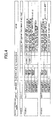
- FIG. 4 is a table showing an example of data stored in the action DB 69.
- the action DB 69 stores the individual identification number for specifying the RFID tag 22, a shop ID for specifying the shop 13, permissions, flags, and an action to serve as an service of the shop 13.
- the permission indicates a condition item for permitting the execution of an action.
- the flag indicates a condition corresponding to the permission.
- the action there is stored an ID for specifying processing, a program ID for specifying a program for executing the processing, or the like.
- the action DB 69 stores: as a first permission, a condition regarding whether or not the access count of the user group is 0; as a first flag associated with the first permission, a flag indicating whether or not the access count of the user group is 0; as a secondpermission, a condition regarding whether or not it is during a campaign period; as a second flag associated with the second permission, a flag indicating whether or not it is during a campaign period; as a third permission, a statement for generating a random number and setting a value obtained by multiplying the random number by 1.2 in a variable A; and as a third flag associated with the third permission, a flag indicating whether or not the variable A is equal to or larger than 1.
- the action DB 69 stores an action of distributing an advertisement about the shop campaign to the user group, in association with an individual identification number "AAA100001" and a shop ID "S555777".
- the action DB 69 stores an action of distributing a coupon to the user group as well as setting the access count of the user group in the history DB 71, in association with: an individual identification number "AAA100002"; the shop ID "S555777"; the first flag, which is associated with the first permission regarding whether or not the access count of the user group is 0, indicating "1", which means that the access count of the user group is 0; the second flag, which is associated with the second permission regarding whether or not it is during a campaign period, indicating "1", which means that it is during a campaign period; and the third flag, which is associated with the third permission requesting generating a random number and setting a value obtained by multiplying the random number by 1.2 in a variable A, indicating that the variable A is equal to or larger than 1.
- the action DB 69 stores an action of distributing a lost-lottery page to the user group as well as setting the access count of the user group in the history DB 71, in association with: the individual identification number "AAA100002"; the shop ID "S555777"; the first flag, which is associated with the first permission regarding whether or not the access count of the user group is 0, indicating "1", which means that the access count of the user group is 0; the second flag, which is associated with the second permission regarding whether or not it is during a campaign period, indicating "1", which means that it is during a campaign period; and the third flag, which is associated with the third permission requesting generating a random number and setting a value obtained by multiplying the random number by 1.2 in a variable A, indicating that the variable A is less than 1.
- the action DB 69 stores an action of distributing a page indicating that a coupon distribution period has expired to the user group, in association with: the individual identification number "AAA100002"; the shop ID "S555777"; the first flag, which is associated with the first permission regarding whether or not the access count of the user group is 0, indicating "1", which means that the access count of the user group is 0; and the second flag, which is associated with the second permission regarding whether or not it is during a campaign period, indicating "0", which means that it is not during a campaign period.
- the action DB 69 stores an action of distributing a page indicating confirmation of user's participation to the user group, in association with: the individual identification number "AAA100002"; the shop ID "S555777"; the first flag, which is associated with the first permission regarding whether or not the access count of the user group is 0, indicating "0", which means that the access count is not 0.
- the action DB 69 stores an action of distributing a point-get URL to the user group as well as setting the access count of the user group in the history DB 71, in association with: an individual identification number "AAA100003"; the shop ID "S555777"; the first flag, which is associated with the first permission regarding whether or not the access count of the user group is 0, indicating "1", which means that the access count of the user group is 0; and the second flag, which is associated with the second permission regarding whether or not it is during a campaign period, indicating "1", which means that it is during a campaign period.
- the action DB 69 stores an action of distributing a page indicating the campaign is finished to the user group as well as setting the access count of the user group in the history DB 71, in association with: the individual identification number "AAA100003"; the shop ID "S555777"; the first flag, which is associated with the first permission regarding whether or not the access count of the user group is 0, indicating "1", which means that the access count of the user group is 0; and the second flag, which is associated with the second permission regarding whether or not it is during a campaign period, indicating "0", which means that it is not during a campaign period.
- the action DB 69 stores an action of distributing an advertisement to the user group, in association with: the individual identification number "AAA100003"; the shop ID "S555777"; and the first flag, which is associated with the first permission regarding whether or not the access count of the user group is 0, indicating "0", which means that the access count of the user group is not 0.
- the permissions are not limited to the conditions regarding the access count of the user group and the periods such as the campaign period. Other conditions may also be used, such as a condition regarding whether or not the user is a member of the service provider, a condition regarding whether or not the user is located in the shop 13, a serial number for specifying the mobile phone 14, a date, and a time point.
- the user group DB 70 stores a serial number and an end timing of a valid period of the user group.
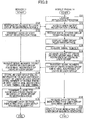
- FIG. 5 is a table showing an example of data stored in the user group DB 70.
- the user group DB 70 stores: a user group identification number for identifying (specifying) the user group; a user count indicating the count of the users belonging to the group; a serial number for specifying the mobile phone 14 of the user belonging to the user group; an e-mail address of the user belonging to the user group; and a start timing and an end timing of the user group.
- the start timing of the user group indicates a date and time when the valid period of the user group starts, and the end timing of the user group indicates a date and time when the valid period of the user group ends.
- the user group DB 70 stores: a user group identification number "UGAA100001"; a user count “2"; serial numbers “BBB100001” and “BBB100002”; e-mail addresses "CCC1001@ddd” and "CCC1002@ddd”; a start timing "200901011045" indicating “10:45, January 1, 2009”; and an end timing "200901011245" indicating "12:45, January 1, 2009”.
- the user group DB 70 stores: a user group identification number "UGAA100002"; a user count “4"; serial numbers “BBB100003”, “BBB100005”, “BBB100006”, and “BBB100007”; e-mail addresses "CCC1003@ddd”, “CCC1005@ddd”, “CCC1006@ddd”, and "CCC1007@ddd”; a start timing "200901021230” indicating "12:30, January 2, 2009”; and an end timing "200901021430” indicating "14 : 30, January 2, 2009” .
- the user group DB 70 stores: a user group identification number "UGAA100003"; a user count “2"; serial numbers “BBB100004" and “BBB100008”; e-mail addresses "CCC1004@ddd” and "CCC1008@ddd”; a start timing "200902032315” indicating "23:15, February 3, 2009”; and an end timing "200902040115” indicating "1: 15, February 4, 2009”.
- the history DB 71 stores a history of, for example, an access count of the user group.
- Step S201 the personal computer 21 accesses a registration service of the server 11 via the Internet 12.
- Step S101 the web server function 61 responds to the access to the registration service, which is made by the personal computer 21.
- Step S202 the personal computer 21 reads an individual identification number from the RFID tag 22 with the use of a reader connected thereto or incorporated therein.
- Step S203 the personal computer 21 transmits the individual identification number to the server 11 via the Internet 12, and requests registration of the individual identification number.
- Step S102 the individual identification number registration processing section 63 uses the communication unit 39 to receive the individual identification number, and accepts the registration of the individual identification number transmitted from the personal computer 21.
- Step S103 the individual identification number registration processing section 63 supplies, to the action DB 69, the individual identification number accepted for the registration, and the action DB 69 saves (stores) the individual identification number.
- Step S204 the personal computer 21 transmits, via the Internet 12, a shop ID, the individual identification number, a permission, a flag, and an action, and requests setting of the permission and the action associated with the individual identification number.
- the action setting section 64 uses the communication unit 39 to receive the shop ID, the individual identification number, the permission, the flag, and the action, which are transmitted from the personal computer 21, and accepts the setting of the permission and the action associated with the individual identification number.
- the action setting section 64 saves the permission and the action associated with the individual identification number, which are accepted for the setting.
- the action setting section 64 supplies, to the action DB 69, the shop ID, the individual identification number, the permission, the flag, and the action.
- the action DB 69 saves (stores) the shop ID, the individual identification number, the permission, the flag, and the action in association with one another.
- Step S205 a person in charge of the shop 13 places the RFID tag 22 inside the shop 13.
- the person in charge attaches the RFID tag 22 to the equipment of the shop 13 so that the RFID tag 22 is not easily recognized from outside (so that the RFID tag 22 is hidden).
- Step S206 the personal computer 21 accesses the registration service of the server 11 via the Internet 12.
- the web server function 61 responds to the access to the registration service, which is made by the personal computer 21.
- Step S207 the personal computer 21 transmits, via the Internet 12, a changed permission, a changed flag, or a changed action along with the shop ID and the individual identification number, and requests the change of the permission and the action associated with the individual identification number.
- the action setting section 64 uses the communication unit 39 to receive the shop ID and the individual identification number, which are transmitted from the personal computer 21, and to further receive the changed permission, the changed flag, or the changed action, and accepts the change of the permission and the action associated with the individual identification number.
- the action setting section 64 saves the changed permission and action associated with the individual identification number.
- the action setting section 64 supplies, to the action DB 69, the shop ID, the individual identification number, the changed permission, the changed flag, and the changed action.
- the action DB 69 saves the shop ID, the individual identification number, the changed permission, the changed flag, and the changed action in association with one another. Then, the registration processing is ended.
- the individual identification number and the action are associated with each other. Associating the individual identification number with the action may be performed with ease on the personal computer 21.
- the server 11 may first read the individual identification number from the RFID tag 22, and then set the permission and the action.
- FIG. 7 is a flow chart illustrating another example of the registration processing.
- the individual identification number registration processing section 63 reads an individual identification number from the RFID tag 22 with the use of the reader connected thereto or incorporated therein.
- the individual identification number registration processing section 63 supplies, to the action DB 69, the individual identification number accepted for the registration, and the action DB 69 saves the individual identification number.
- Aperson in charge of the service provider provides the RFID tag 22 to the shop 13.
- Step S221 the person in charge of the shop 13 places the RFID tag 22 inside the shop 13. In other words, the person in charge attaches the RFID tag 22 to the equipment of the shop 13 in the same manner as in Step S205.
- Step S124 the action setting section 64 acquires a shop ID, the individual identification number, a permission, a flag, and an action, which are input in response to operation performed to the input unit 36 by the person in charge, and sets the permission and the action associated with the individual identification number.
- Step S125 the action setting section 64 saves the permission and the action associated with the individual identification number.
- the action setting section 64 supplies, to the action DB 69, the shop ID, the individual identification number, the permission, the flag, and the action.
- the action DB 69 saves (stores) the shop ID, the individual identification number, the permission, the flag, and the action in association with one another.
- Step S222, Step S223, Step S126, Step S127, and Step S128 are the same as Step S206, Step S207, Step S106, Step S107, and Step S108, respectively, and description thereof is therefore omitted herein.
- the number of tasks required in the shop 13 may be reduced.
- the action DB 69 stores the shop ID, the individual identification number, the permission, the flag, and the action in association with one another.
- Step S331 the mobile phone 14 executes an application program downloaded in advance from the server 11.
- Step S332 the mobile phone 14 accesses a user group registration service of the server 11 via the Internet 12.
- the user group registration processing section 65 responds to the access to the user group registration service, which is made by the mobile phone 14.
- Step S132 the user group registration processing section 65 uses the page data generation section 62 to generate data of a user group registration page, and further uses the web server function 61 that controls the communication unit 39 to transmit, via the Internet 12 to the mobile phone 14, the generated data of the user group registration page.
- Step S333 the mobile phone 14 receives the data of the user group registration page transmitted from the server 11.
- Step S334 the mobile phone 14 displays the user group registration page.
- Step S335 the mobile phone 14 acquires a serial number stored inside the mobile phone 14 itself.
- Step S336 the mobile phone 14 acquires, in response to user's operation to an input unit (not shown) constituted by a button, a dial, a touch panel, and other such component, a count of users in a user group, which is to be newly generated, and e-mail addresses of the users in the user group.
- the count of users in the user group is acquired based on data that is input in response to the user's operation to the input unit.
- the e-mail addresses of the users in the user group are acquired by reading data of an address book stored in an internal memory.
- Step S337 the mobile phone 14 transmits, via the Internet 12 to the server 11, the serial number of its own, the count of users in the user group, and the e-mail addresses of the users in the user group.
- the user group registrationprocessing section 65 uses the web server function 61 that controls the communication unit 39 to receive the serial number of the mobile phone 14, the count of users in the user group, and the e-mail addresses of the users in the user group, which are transmitted from the mobile phone 14 via the Internet 12.
- Step S134 the user group registration processing section 65 acquires a current time point based on a real-time clock (not shown), and sets the acquired current time point as the start timing of the valid period of the user group. Further, the user group registration processing section 65 adds, to the current time point, a predetermined period of time, for example, two hours, and sets the time point thus obtained as the end timing of the valid period of the user group. The user group registration processing section 65 then stores, in the user group DB 70, as information on the new user group, the count of users in the user group, the serial number of the mobile phone 14 of the first user, the e-mail addresses of the users in the user group, the start timing, and the end timing.
- the user group registration processing section 65 uses the e-mail transmission processing section 66 that controls the communication unit 39 to transmit e-mail for notifying other users in the user group (users excluding the first user from the users in the user group) of an address of the user group registration page. It should be noted that the e-mail for the notification of the address of the user group registration page has a user group identification number for identifying the new user group written therein.
- Step S136 the user group registration processing section 65 uses the page data generation section 62 to generate data of a page indicating that the user group has been generated, and further uses the web server function 61 that controls the communication unit 39 to transmit, via the Internet 12 to the mobile phone 14 of the first user, the data of the page indicating that the user group has been generated.
- Step S3308 the mobile phone 14 receives the data of the page indicating that the user group has been generated, which is transmitted from the server 11.
- Step S339 the mobile phone 14 displays the page indicating that the user group has been generated. Then, the processing of generating a user group is ended.
- the user group is newly generated after the mobile phone 14 of the first user among the users who are to belong to the user group accesses the user group registration service.
- Step S341 the mobile phone 14 receives the e-mail for the notification of the address of the user group registration page, which is transmitted from the server 11.
- Step S342 the mobile phone 14 executes an application program downloaded in advance from the server 11.
- Step S343 the mobile phone 14 refers to the address written in the e-mail received in the processing of Step S341, and accesses the user group registration service of the server 11 via the Internet 12.
- the user group registration processing section 65 responds to the access to the user group registration service, which is made by the mobile phone 14.
- Step S142 the user group registration processing section 65 uses the page data generation section 62 to generate data of a user group registration page, and further uses the web server function 61 that controls the communication unit 39 to transmit, via the Internet 12 to the mobile phone 14, the generated data of the user group registration page.
- Step S344 the mobile phone 14 receives the data of the user group registration page transmitted from the server 11.
- Step S345 the mobile phone 14 displays the user group registration page.
- Step S346 the mobile phone 14 acquires an e-mail address of the user of the mobile phone 14 and a serial number of the mobile phone 14, which are stored inside the mobile phone 14 itself.
- Step S347 the mobile phone 14 transmits, via the Internet 12 to the server 11, the user group identification number written in the e-mail received in the processing of Step S341, the e-mail address of the user of the mobile phone 14, and the serial number of the mobile phone 14.
- the user group registration processing section 65 uses the web server function 61 that controls the communication unit 39 to receive the user group identification number, the e-mail address, and the serial number, which are transmitted from the mobile phone 14 via the Internet 12.
- Step S144 the user group registration processing section 65 stores, in the user group DB 70, the serial number of the mobile phone 14 that is accessing the user group registration page in association with the user group identification number and the e-mail address.
- Step S145 the user group registration processing section 65 uses the page data generation section 62 to generate data of a page indicating that the serial number has been registered in the user group, and further uses the web server function 61 that controls the communication unit 39 to transmit, via the Internet 12 to the mobile phone 14 that is accessing the user group registration page, the data of the page indicating that the serial number has been registered in the user group.
- Step S348 the mobile phone 14 receives the data of the page indicating that the serial number has been registered in the user group, which is transmitted from the server 11.
- Step S349 the mobile phone 14 displays the page indicating that the serial number has been registered in the user group.
- Step S146 the user group registration processing section 65 judges whether or not all the serial numbers of the mobile phones 14 of the users in the user group have been stored in the user group DB 70. If it is judged that all the serial numbers of the mobile phones 14 of the users in the user group have been stored in the user group DB 70, the procedure advances to Step S147, and the user group registration processing section 65 uses the e-mail transmission processing section 66 that controls the communication unit 39 to transmit e-mail for notifying all the users in the user group of the fact that the users have all been registered in the user group. Then, the processing of registering a serial number in the user group is ended.
- Step S146 if it is judged that not all the serial numbers of the mobile phones 14 of the users in the user group have been stored in the user group DB 70, the processing of Step S147 is skipped and the processing of registering a serial number in the user group is ended without the transmission of the e-mail.
- each of the mobile phones 14 of all the users belonging to the user group accesses the user group registration service, and all the serial numbers of the mobile phones 14 of the users in the user group are stored in the user group DB 70. After all the serial numbers in the user group have been registered, the users in the user group searches for the RFID tag 22 using their own mobile phones 14.
- Step S351 the mobile phone 14 executes an application program downloaded in advance from the server 11.
- the mobile phone 14 approaches the RFID tag 22 attached to the equipment of the shop 13, in Step S352, the mobile phone 14 starts communication with the RFID tag 22.
- Step S353 the mobile phone 14 reads an individual identification number from the RFID tag 22.
- Step S354 the mobile phone 14 accesses a service which is provided by the server 11 via the Internet 12.
- the service providing section 67 responds to the access to the service which is provided by the server 11, which is made by the mobile phone 14.
- Step S355 the mobile phone 14 transmits the individual identification number and a serial number for specifying the mobile phone 14 to the server 11 via the Internet 12.
- Step S152 the service providing section 67 uses the communication unit 39 to receive the individual identification number and the serial number, which are transmitted from the mobile phone 14.
- Step S153 processing of providing a service is executed.
- the processing of providing a service is described later in detail with reference to a flow chart of FIG. 11 .
- Step S154 the service providing section 67 uses the web server function 61 that controls the communication unit 39 to transmit page data to the mobile phone 14 via the Internet 12.
- Step S356 the mobile phone 14 receives the page data transmitted from the server 11.
- Step S357 the mobile phone 14 executes processing based on the page data.
- Step S358 the mobile phone 14 displays a page. Then, the processing of searching for the RFID tag 22 is ended.
- Step S11 the action condition acquisition section 81 acquires the individual identification number received in the processing of Step S152.
- Step S12 the action condition acquisition section 81 acquires the serial number received in the processing of Step S152.
- Step S13 the action condition acquisition section 81 refers to the action DB 69 to read, from the action DB 69, a permission, a flag, and an action associated with the acquired individual identification number.
- the action condition acquisition section 81 refers to the user group DB 70 to acquire, from the user group DB 70, a user group identification number associated with the acquired serial number, a serial number for specifying the mobile phone 14 of a user belonging to the user group, and an end timing of the valid period of the user group.
- Step S15 the registration judgment section 82 judges whether or not the serial number received in the processing of Step S152 is stored in the user group DB 70, and if it is judged that the serial number is stored in the user group DB 70, the procedure advances to Step S16.
- Step S16 the registration judgment section 82 compares the current time point indicated by the real-time clock (not shown) with the end timing of the valid period of the user group, to thereby judge whether or not the current time point is past the end timing of the user group. If it is judged that the current time point is not past the end timing of the user group, the procedure advances to Step S17.
- Step S17 the action condition acquisition section 81 acquires e-mail addresses of the other users in the user group (users in the user group excluding the user of the mobile phone 14 that is accessing the server 11 in the processing of searching for the RFID tag 22 illustrated in FIG. 10 ) from the user group DB 70.
- the action condition acquisition section 81 refers to the history DB 71 to read an access count of the user group from the history DB 71.
- Step S19 the registration judgment section 82 judges whether or not the acquired individual identification number is stored in the action DB 69. If it is judged in Step S19 that the individual identification number is stored in the action DB 69, the procedure advances to Step S20, and the action determination section 83 determines an action based on the permission associated with the individual identification number and the access count of the user group.
- the action execution section 84 executes the determined action. For example, the action execution section 84 reads a program corresponding to the determined action from the application DB 68 and executes the program, to thereby execute the action. It should be noted that a coupon or a URL is distributed to the mobile phone 14 that is accessing the server 11 in the processing of searching for the RFID tag 22 illustrated in FIG. 10 by providing a page, while a coupon or a URL is distributed to the mobile phones 14 of the other users in the user group by using e-mail.
- Step S22 the page data generation section 62 generates page data corresponding to the executed action. Then, the processing of providing a service is ended. If it is judged in Step S19 that the individual identification number is not stored in the action DB 69, the procedure advances to Step S23, and the service providing section 67 executes error processing. Then, the processing of providing a service is ended.
- Step S16 If it is judged in Step S16 that the current time point is past the end timing of the user group, the procedure advances to Step S23, and the service providing section 67 executes the error processing. Then, the processing of providing a service is ended. Further, if it is judged in Step S15 that the serial number is not stored in the user group DB 70, the procedure advances to Step S23, and the service providing section 67 executes the error processing. Then, the processing of providing a service is ended.
- the shop 13 can provide a service to the group of customers (users) who use the mobile phones 14.
- the permission and the action associated with the individual identification number may be changed with ease on the side of the shop 13, and accordingly, in a shop which an indefinite number of customers (users) visit, the shop can provide a desired service to the group of customers according to situations.
- tag group An example of providing an action as a service of the shop 13 by using the mobile phone 14 to read the RFID tags 22 attached to a plurality of equipments of the shop 13 and belonging to a group.
- the group including ID tags such as the RFID tags 22 is hereinbelow referred to as tag group.
- FIG. 12 is a block diagram illustrating another configuration example of functions implemented in the server 11 executing the programs. Specifically, when the server 11 executes the programs, there are implemented the web server function 61, the page data generation section 62, a tag group registration processing section 101, an action setting section 102, the user group registration processing section 65, the e-mail transmission processing section 66, a service providing section 103, the application DB 68, an action database (DB) 104 (hereinbelow, referred to as action DB 104), the user group DB 70, the history DB 71, and a tag group database (DB) 105 (hereinbelow, referred to as tag group DB 105).
- DB action database
- tag group DB 105 tag group database
- the web server function 61, the page data generation section 62, the user group registration processing section 65, the e-mail transmission processing section 66, the application DB 68, the user group DB 70, and the history DB 71 are the same as those illustrated in FIG. 3 , and description thereof is therefore omitted herein.
- the tag group registration processing section 101 accepts a request for registration of a tag group, and stores a tag group identification number for identifying the tag group in the action DB 104.
- the action setting section 102 accepts setting of an action associated with the tag group identification number, and stores the action in the action DB 104 in association with the tag group identification number.
- the service providing section 103 executes, when receiving an individual identification number of the RFID tag 22 belonging to the tag group, the action associated with the tag group identification number identifying the tag group.
- the action DB 104 stores the tag group identification number for identifying the tag group and the action associated with the tag group identification number in association with each other.
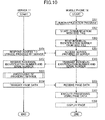
- FIG. 13 is a table showing an example of data stored in the action DB 104.
- the action DB 104 stores a tag group identification number for identifying the tag group, a shop ID for specifying the shop 13, permissions, flags, and an action as a service of the shop 13.
- the action DB 104 stores: as a first permission, a condition regarding whether or not the access count of the user group is 0; as a first flag associated with the first permission, a flag indicating whether or not the access count of the user group is 0; as a second permission, a condition regarding whether or not it is during a campaign period; as a second flag associated with the second permission, a flag indicating whether or not it is during a campaign period; as a third permission, a statement for generating a random number and setting a value obtained by multiplying the random number by 1.2 in a variable A; and as a third flag associated with the third permission, a flag indicating whether or not the variable A is equal to or larger than 1.
- the action DB 104 stores an action of distributing an advertisement about the shop campaign to the user group, in association with a tag group identification number "TGAA100001" and a shop ID "S555777".
- the action DB 104 stores an action of distributing a coupon to the user group as well as setting the access count of the user group in the history DB 71, in association with: a tag group identification number "TGAA100002"; the shop ID "S555777"; the first flag, which is associated with the first permission regarding whether or not the access count of the user group is 0, indicating "1", which means that the access count of the user group is 0; the second flag, which is associated with the second permission regarding whether or not it is during a campaign period, indicating "1", which means that it is during a campaign period; and the third flag, which is associated with the third permission requesting generating a random number and setting a value obtained by multiplying the random number by 1. 2 in a variable A, indicating that the variable A is equal to or larger than 1.
- the action DB 104 stores an action of distributing a lost-lottery page to the user group as well as setting the access count of the user group in the history DB 71, in association with: the tag group identification number "TGAA100002"; the shop ID "S555777"; the first flag, which is associated with the first permission regarding whether or not the access count of the user group is 0, indicating "1", which means that the access count of the user group is 0; the second flag, which is associated with the second permission regarding whether or not it is during a campaign period, indicating "1", which means that it is during a campaign period; and the third flag, which is associated with the third permission requesting generating a random number and setting a value obtained by multiplying the random number by 1.2 in a variable A, indicating that the variable A is less than 1.
- the action DB 104 stores an action of distributing a page indicating that a coupon distribution period has expired to the user group, in association with: the tag group identification number "TGAA100002"; the shop ID "S555777"; the first flag, which is associated with the first permission regarding whether or not the access count of the user group is 0, indicating "1", which means that the access count of the user group is 0; and the second flag, which is associated with the second permission regarding whether or not it is during a campaign period, indicating "0", which means that it is not during a campaign period.
- the action DB 104 stores an action of distributing a page indicating confirmation of user's participation to the user group, in association with: the tag group identification number "TGAA100002"; the shop ID "S555777"; the first flag, which is associated with the first permission regarding whether or not the access count of the user group is 0, indicating "0", which means that the access count is not 0.
- the action DB 104 stores an action of distributing a point-get URL to the user group as well as setting the access count of the user group in the history DB 71, in association with: a tag group identification number "TGAA100003°'; the shop ID "S555777"; the first flag, which is associated with the first permission regarding whether or not the access count of the user group is 0, indicating "1", which means that the access count of the user group is 0; and the second flag, which is associated with the second permission regarding whether or not it is during a campaign period, indicating "1", which means that it is during a campaign period.
- the action DB 104 stores an action of distributing a page indicating the campaign is finished to the user group as well as setting the access count of the user group in the history DB 71, in association with: the tag group identification number "TGAA100003"; the shop ID "S555777"; the first flag, which is associated with the first permission regarding whether or not the access count of the user group is 0, indicating "1", which means that the access count of the user group is 0; and the second flag, which is associated with the second permission regarding whether or not it is during a campaign period, indicating "0", which means that it is not during a campaign period.
- the action DB 104 stores an action of distributing an advertisement to the user group, in association with: the tag group identification number "TGAA100003"; the shop ID "S555777"; and the first flag, which is associated with the first permission regarding whether or not the access count of the user group is 0, indicating "0", which means that the access count of the user group is not 0.
- the tag group DB 105 stores a tag group identification number and an individual identification number of the RFID tag 22 belonging to the tag group.
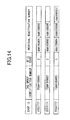
- FIG. 14 is a table showing an example of data stored in the tag group DB 105.
- the tag group DB 105 stores a shop ID, a tag group identification number, an RFID count, which is a count of the RFID tags 22 belonging to the tag group, and an individual identification number of the RFID tag 22 belonging to the tag group.
- the tag group DB 105 stores, in association with the shop ID "S555777" and the tag group identification number "TGAA100001", an RFID count “2" and individual identification numbers "AAA100001” and "AAA100002". Further, the tag group DB 105 stores, in association with the shop ID "S555777” and the tag group identification number "TGAA100002", an RFID count “2" and individual identification numbers "AAA100003” and "AAA100005”. Still further, the tag group DB 105 stores, in association with the shop ID "S555777” and the tag group identification number "TGAA100003", an RFID count "3" and individual identification numbers "AAA100004", “AAA100006", and "AAA100007”.
- action DB 104 and the tag group DB 105 may be realized by a single database.
- Step S281 the personal computer 21 accesses a registration service of the server 11 via the Internet 12.
- Step S181 the web server function 61 responds to the access to the registration service, which is made by the personal computer 21.
- Step S282 the personal computer 21 reads an individual identification number from each of the RFID tags 22 in the tag group with the use of the reader connected thereto or incorporated therein.
- Step S283 the personal computer 21 requests registration of the tag group via the Internet 12.
- the tag group registration processing section 101 uses the communication unit 39 to receive the request for registration of the tag group, which is transmitted from the personal computer 21, and accepts the registration of the tag group.
- Step S183 the tag group registration processing section 101 generates a tag group identification number.
- Step S284 the personal computer 21 transmits, via the Internet 12 to the server 11, the individual identification number of each of the RFID tags 22 in the tag group.
- the tag group registration processing section 101 uses the communication unit 39 to receive the individual identification number of each of the RFID tags 22 in the tag group.
- the tag group registration processing section 101 supplies, to the tag group DB 105, the generated tag group identification number, the count of the RFID tags 22 in the tag group, and the individual identification number of each of the RFID tags 22 in the tag group.
- the tag group DB 105 saves (stores) the newly generated tag group identification number, the count of the RFID tags 22 in the tag group, and the individual identification number of each of the RFID tags 22 in the tag group.
- Step S285 the personal computer 21 transmits, via the Internet 12, a shop ID, the tag group identification number, a permission, a flag, and an action, and requests setting of the permission and the action associated with the tag group identification number.
- the action setting section 102 uses the communication unit 39 to receive the shop ID, the tag group identification number, the permission, the flag, and the action, which are transmitted from the personal computer 21, and accepts the setting of the permission and the action associated with the tag group identification number.
- Step S187 the action setting section 102 saves the permission and the action associated with the tag group identification number, which are accepted for the setting.
- the action setting section 102 supplies, to the action DB 104, the shop ID, the tag group identification number, the permission, the flag, and the action.
- the action DB 104 saves (stores) the shop ID, the tag group identification number, the permission, the flag, and the action in association with one another.
- Step S286 the person in charge of the shop 13 places each of the RFID tags 22 in the tag group inside the shop 13.
- Step S287 the personal computer 21 accesses the registration service of the server 11 via the Internet 12.
- the web server function 61 responds to the access to the registration service, which is made by the personal computer 21.
- Step S288 the personal computer 21 transmits, via the Internet 12, a changed permission, a changed flag, or a changed action along with the shop ID and the tag group identification number, and requests the change of the permission and the action associated with the tag group identification number.
- Step S189 the action setting section 102 uses the communication unit 39 to receive the shop ID and the tag group identification number, which are transmitted from the personal computer 21, and to further receive the changed permission, the changed flag, or the changed action, and accepts the change of the permission and the action associated with the tag group identification number.
- Step S190 the action setting section 102 saves the changed permission and action associated with the tag group identification number.
- the action setting section 102 supplies, to the action DB 104, the shop ID, the tag group identification number, the changed permission, the changed flag, and the changed action.
- the action DB 104 saves the shop ID, the tag group identification number, the changed permission, the changed flag, and the changed action in association with one another. Then, the registration processing is ended.
- the tag group identification number and the action are associated with each other. Associating the tag group identification number with the action may be performed with ease on the personal computer 21. It should be noted that the personal computer 21 may transmit, via the Internet 12, the shop ID, the tag group identification number, the individual identification number, the permission, the flag, and the action to request the setting of the permission and the action associated with the tag group identification number and theindividualidentification number, and the action setting section 102 may save, in the action DB 104, the permission and the action associated with the tag group identification number and the individual identification number.
- the server 11 may first read the individual identification number from the RFID tag 22, and then set the permission and the action.
- Processing of generating a user group is the same as the processing described with reference to the flow chart of FIG. 8 , and description thereof is therefore omitted herein. Processing of registering a serial number in the user group is the same as the processing described with reference to the flow chart of FIG. 9 , and description thereof is therefore omitted herein.
- processing of searching for the RFID tag 22 is the same as the processing described with reference to the flow chart of FIG. 10 , and description thereof is therefore omitted herein.
- Step S41 to Step S47 Processing of from Step S41 to Step S47 is the same as the processing of from Step S11 to Step S17 of FIG. 11 , respectively, and description thereof is therefore omitted herein.
- an action condition acquisition section 121 refers to the tag group DB 105 to read, from the tag group DB 105, a record of a tag group including the individual identification number acquired in the processing of Step S41.
- the record of a tag group includes a shop ID, a tag group identification number, an RFID count, and an individual identification number, which relate to the corresponding tag group.
- the action condition acquisition section 121 acquires, from the read record, a tag group identification number of the tag group to which the individual identification number belongs (to which the RFID tag 22 having the individual identification number belongs).
- Step S50 the action condition acquisition section 121 refers to the history DB 71 to read an access count of the user group from the history DB 71.
- Step S51 a registration judgment section 122 judges whether or not the acquired tag group identification number is stored in the action DB 104. If it is judged in Step S51 that the tag group identification number is stored in the action DB 104, the procedure advances to Step S52, and an action determination section 123 determines an action based on the permission associated with the tag group identification number and the access count of the user group. In Step S53, an action execution section 124 executes the determined action in the same manner as in the processing of Step S21.
- Step S54 the page data generation section 62 generates page data corresponding to the executed action. Then, the processing of providing a service is ended. If it is judged in Step S51 that the tag group identification number is not stored in the action DB 104, the procedure advances to Step S55, and the service providing section 103 executes error processing. Then, the processing of providing a service is ended.
- Step S46 If it is judged in Step S46 that the current time point is past the end timing of the user group, the procedure advances to Step S55, and the service providing section 103 executes the error processing. Then, the processing of providing a service is ended. Further, if it is judged in Step S45 that the serial number is not stored in the user group DB 70, the procedure advances to Step S55, and the service providing section 103 executes the error processing. Then, the processing of providing a service is ended.
- the shop 13 can provide a service to all the customers (users) belonging to the user group.
- reading of the individual identification numbers of all the RFID tags 22 belonging to the tag group may allow the shop 13 to provide a service to all the customers (users) belonging to the user group.
- FIG. 17 is a table showing another example of the data stored in the action DB 104.
- the action DB 104 stores: a tag group identification number; a shop ID; an individual identification number; tag group individual identification numbers; flags associated with the tag group individual identification numbers; a permission regarding whether or not the access count of the user group is 0; a flag associated with the permission; and an action.
- the tag group individual identification number is an individual identification number of the RFID tag 22 belonging to the tag group, and is different from the individual identification number transmitted from the mobile phone 14.
- the flag associated with the tag group individual identification number indicates whether or not the RFID tag 22 having the corresponding tag group individual identification number has already been accessed by a customer (user) belonging to the user group.
- the flag associated with the permission indicates whether or not the access count of the user group is 0.
- the action DB 104 stores an action of distributing a coupon to the user group as well as setting an access count of the individual identification number and the access count of the user group in the history DB 71, in association with: the flag, which is associated with a tag group individual identification number "AAA100002", indicating "1", which means that the tag group individual identification number "AAA100002” has been read by the mobile phone 14 of any one of the users in the user group; and the flag, which is associated with the permission regarding whether or not the access count of the user group is 0, indicating "1", which means that the access count of the user group is 0.
- the action DB 104 stores an action of distributing a page indicating confirmation of user's participation to the user group, in association with: the flag, which is associated with the tag group individual identification number "AAA100002", indicating "1", which means that the tag group individual identification number "AAA100002” has been read by the mobile phone 14 of any one of the users in the user group; and the flag, which is associated with the permission regarding whether or not the access count of the user group is 0, indicating "0", which means that the access count of the user group is not 0.
- the action DB 104 stores an action of distributing a page displaying "one more left” to the user group as well as setting the access count of the individual identification number in the history DB 71, in association with the flag, which is associated with the tag group individual identification number "AAA100002", indicating "0", which means that the tag group individual identification number "AAA100002” has not been read by the mobile phone 14 of any users in the user group.
- the action DB 104 stores an action of distributing a coupon to the user group as well as setting the access count of the individual identification number and the access count of the user group in the history DB 71, in association with: the flag, which is associated with a tag group individual identification number "AAA100001", indicating "1", which means that the tag group individual identification number "AAA100001” has been read by the mobile phone 14 of any one of the users in the user group; and the flag, which is associated with the permission regarding whether or not the access count of the user group is 0, indicating "1", which means that the access count of the user group is 0.
- the action DB 104 stores an action of distributing a page indicating confirmation of user's participation to the user group, in association with: the flag, which is associated with the tag group individual identification number "AAA100001", indicating "1", which means that the tag group individual identification number "AAA100001” has been read by the mobile phone 14 of any one of the users in the user group; and the flag, which is associated with the permission regarding whether or not the access count of the user group is 0, indicating "0", which means that the access count of the user group is not 0.
- the action DB 104 stores an action of distributing a page displaying "one more left” to the user group as well as setting the access count of the individual identification number in the history DB 71, in association with the flag, which is associated with the tag group individual identification number "AAA100001", indicating "0", which means that the tag group individual identification number "AAA100001” has not been read by the mobile phone 14 of any users in the user group.
- the action DB 104 stores: a tag group individual identification number "AAA100005” or "AAA100003” and a flag associated therewith; the permission regarding whether or not the access count of the user group is 0 and a flag associated therewith; and an action.
- the action DB 104 stores: two tag group individual identification numbers out of tag group individual identification numbers "AAA100004", “AAA100006”, and"AAA100007” (which are different from the individual identification number transmitted from the mobile phone 14) and two flags associated therewith; the permission regarding whether or not the access count of the user group is 0 and a flag associated therewith; and an action.
- Step S71 to Step S81 are the same as the processing steps from Step S41 to Step S51 of FIG. 16 , respectively, and description thereof is therefore omitted herein.
- Step S81 If it is judged in Step S81 that the tag group identification number is stored in the action DB 104, the procedure advances to Step S82, and the action condition acquisition section 121 refers to the history DB 71 to read, from the history DB 71, an access count of the tag group individual identification number associated with the tag group identification number.
- Step S83 the action determination section 123 determines an action based on the permission associated with the tag group identification number, the access count of the individual identification number, the access count of the tag group individual identification number, and the access count of the user group.
- Processing steps from Step S84 to Step S86 are the same as processing steps from Step S53 to Step S55 of FIG. 16 , respectively, and description thereof is therefore omitted herein.
- the shop 13 can provide a service to all the customers (users) belonging to the user group.
- the shop can provide a desired service to the group of customers according to situations.
- the RFID tags 22 Once the RFID tags 22 are placed, access from the personal computer 21 to the server 11 for the change of the permission and the action is only necessary to change the service which is to be provided when the RFID tag 22 is read.
- the plurality of RFID tags 22 may be placed across a plurality of the shops 13.
- one or a plurality of RFID tags 22 may be placed in shops 13 that serve respectively as a nail salon, a hair salon, and an aesthetic salon, and reading of the whole or a predetermined combination of the RFID tags 22 may trigger the execution of an action.
- the plurality of RFID tags 22 may be placed on the floors of the shop 13 such as a department store.
- storage relation between a terminal device identification number for specifying a terminal device of a user belonging to a user group and an end timing of a valid period of the user group is controlled, storage relation between an individual identification number for identifying an ID tag of non-contact type which is set up by a service provider and an action associated with the individual identification number is controlled, reception of a request for registration of the user group, which is transmitted along with the terminal device identification number from the terminal device, is controlled, reception of the terminal device identification number and the individual identification number, which are transmitted from the terminal device which has read the ID tag, is controlled, and, if a current time point is not past the end timing of the user group when the terminal device identification number and the individual identification number are received, an action of providing a service of the service provider to the terminal device of the user belonging to the user group, which is identified by the terminal device identification number, is executed, the action being stored in association with the individual identification number.
- serial number of the mobile phone 14 is used, but such information only needs to specify the mobile phone 14 and is not limited to the serial number.
- terminal device specifying information for specifying the mobile phone 14 serving as the terminal device a subscriber number (subscriber ID), a user ID, an IP address, or an arbitrarily and uniquely set ID may be used instead of the serial number.
- an action of providing a point, an image, music, or a password may be employed because the action is executed for providing a benefit to the customer (user).
- the program executed by the computer may be a program with which the processing steps are executed in time series in the order described herein, or a program with which the processing steps are executed in parallel or at such a necessary timing as when call processing is executed.
Landscapes
- Business, Economics & Management (AREA)
- Strategic Management (AREA)
- Engineering & Computer Science (AREA)
- Accounting & Taxation (AREA)
- Development Economics (AREA)
- Finance (AREA)
- Economics (AREA)
- Game Theory and Decision Science (AREA)
- Entrepreneurship & Innovation (AREA)
- Marketing (AREA)
- Physics & Mathematics (AREA)
- General Business, Economics & Management (AREA)
- General Physics & Mathematics (AREA)
- Theoretical Computer Science (AREA)
- Information Transfer Between Computers (AREA)
- Management, Administration, Business Operations System, And Electronic Commerce (AREA)
- Telephonic Communication Services (AREA)
- Mobile Radio Communication Systems (AREA)
Applications Claiming Priority (2)
| Application Number | Priority Date | Filing Date | Title |
|---|---|---|---|
| JP2009148287 | 2009-06-23 | ||
| PCT/JP2010/060386 WO2010150711A1 (fr) | 2009-06-23 | 2010-06-18 | Dispositif fournissant des informations, procédé correspondant, programme et support de stockage |
Publications (2)
| Publication Number | Publication Date |
|---|---|
| EP2447902A1 true EP2447902A1 (fr) | 2012-05-02 |
| EP2447902A4 EP2447902A4 (fr) | 2013-04-10 |
Family
ID=43386480
Family Applications (1)
| Application Number | Title | Priority Date | Filing Date |
|---|---|---|---|
| EP20100792029 Ceased EP2447902A4 (fr) | 2009-06-23 | 2010-06-18 | Dispositif fournissant des informations, procédé correspondant, programme et support de stockage |
Country Status (6)
| Country | Link |
|---|---|
| US (1) | US8498665B2 (fr) |
| EP (1) | EP2447902A4 (fr) |
| JP (1) | JP5209118B2 (fr) |
| AR (1) | AR077194A1 (fr) |
| TW (1) | TWI416415B (fr) |
| WO (1) | WO2010150711A1 (fr) |
Families Citing this family (8)
| Publication number | Priority date | Publication date | Assignee | Title |
|---|---|---|---|---|
| CN102611637A (zh) * | 2011-01-20 | 2012-07-25 | 腾讯科技(深圳)有限公司 | 一种群组的实现方法及系统 |
| US20120278134A1 (en) * | 2011-03-03 | 2012-11-01 | The Cleveland Clinic Foundation | System and method for operational and behavioral business intelligence |
| US9727879B2 (en) * | 2011-03-30 | 2017-08-08 | Nokia Technologies Oy | Method and apparatus for providing tag-based content installation |
| JP6007075B2 (ja) * | 2012-11-16 | 2016-10-12 | 任天堂株式会社 | サービス提供システム、サービス提供方法、サーバシステムおよびサービス提供プログラム |
| JP2017049622A (ja) * | 2014-01-24 | 2017-03-09 | 日産自動車株式会社 | 特典付与システム |
| CN107533520B (zh) * | 2015-04-22 | 2021-03-23 | 稻毛浩 | 信息处理系统 |
| JP2024113916A (ja) * | 2023-02-10 | 2024-08-23 | 株式会社キーエンス | 情報読取システム、スキャナシステムの設定方法および情報読取システムを設定する方法 |
| JP7801513B1 (ja) * | 2025-03-03 | 2026-01-16 | 東芝テック株式会社 | 情報提供システム、情報提供装置及び情報処理プログラム |
Family Cites Families (11)
| Publication number | Priority date | Publication date | Assignee | Title |
|---|---|---|---|---|
| JP2002215990A (ja) * | 2001-01-16 | 2002-08-02 | Patent One Kk | 報酬決定システム及び方法、報酬決定サーバ装置、プログラム並びに記録媒体 |
| JP2002251567A (ja) * | 2001-02-23 | 2002-09-06 | Yasuhiro Nakagami | 広告方法および広告システム |
| JP3719659B2 (ja) * | 2001-12-26 | 2005-11-24 | 株式会社日立製作所 | 情報受信システム及び情報受信端末 |
| JP2003224677A (ja) | 2002-01-31 | 2003-08-08 | Sony Corp | 情報提供システム、並びに、情報処理装置および方法 |
| CN100524330C (zh) * | 2003-02-06 | 2009-08-05 | 诺基亚有限公司 | 本地共享多媒体内容订阅的系统和方法 |
| JP2005332257A (ja) * | 2004-05-20 | 2005-12-02 | Nec Corp | 顧客サービス提供/商品動向把握システム、方法およびプログラム |
| NO324406B1 (no) * | 2005-06-20 | 2007-10-08 | Telenor Asa | SIM RFID-leser med WLAN-tilgang |
| JP2005339578A (ja) * | 2005-07-14 | 2005-12-08 | Hitachi Ltd | 情報受信システム及び情報受信端末 |
| JP5138970B2 (ja) * | 2006-12-20 | 2013-02-06 | リプレックス株式会社 | システム、サーバ、情報端末、オペレーティングシステム、ミドルウェア、情報通信機器、認証方法、システム及びアプリケーションソフトウェア |
| US7870076B2 (en) * | 2007-02-27 | 2011-01-11 | Red Hat, Inc. | Method and an apparatus to provide interoperability between different protection schemes |
| JP2008312048A (ja) * | 2007-06-15 | 2008-12-25 | Ripplex Inc | 情報端末の認証方法 |
-
2010
- 2010-06-18 EP EP20100792029 patent/EP2447902A4/fr not_active Ceased
- 2010-06-18 JP JP2011519861A patent/JP5209118B2/ja active Active
- 2010-06-18 WO PCT/JP2010/060386 patent/WO2010150711A1/fr not_active Ceased
- 2010-06-18 US US13/380,674 patent/US8498665B2/en active Active
- 2010-06-22 TW TW099120335A patent/TWI416415B/zh active
- 2010-06-23 AR ARP100102204A patent/AR077194A1/es active IP Right Grant
Also Published As
| Publication number | Publication date |
|---|---|
| US20120115458A1 (en) | 2012-05-10 |
| TW201120758A (en) | 2011-06-16 |
| TWI416415B (zh) | 2013-11-21 |
| EP2447902A4 (fr) | 2013-04-10 |
| US8498665B2 (en) | 2013-07-30 |
| JPWO2010150711A1 (ja) | 2012-12-10 |
| JP5209118B2 (ja) | 2013-06-12 |
| AR077194A1 (es) | 2011-08-10 |
| WO2010150711A1 (fr) | 2010-12-29 |
Similar Documents
| Publication | Publication Date | Title |
|---|---|---|
| EP2447902A1 (fr) | Dispositif fournissant des informations, procédé correspondant, programme et support de stockage | |
| US20030005056A1 (en) | Interactive networked schedule | |
| JP5132121B2 (ja) | 無線id管理装置、無線id管理方法および無線idレコーダ | |
| US20030069806A1 (en) | System and method for sharing needs and information using physical entities | |
| WO2008053578A1 (fr) | Dispositif de regroupement d'utilisateurs et procédé de regroupement d'utilisateurs | |
| EP2242013A1 (fr) | Systèmes et procédés de mise à jour de contenu résolu d'un code mobile | |
| JP2010009315A (ja) | 推薦店舗提示システム | |
| WO2008149101A2 (fr) | Applications de téléphones mobiles | |
| JP2019133632A (ja) | 情報処理システム、端末装置、プログラム、及び情報処理方法 | |
| JP5817320B2 (ja) | ユーザ登録システム及びユーザ登録方法 | |
| CN101546314A (zh) | 一种主动提供场所信息的方法与系统 | |
| KR100747306B1 (ko) | 재생용 데이터 갱신 시스템 및 재생용 데이터 갱신 방법 | |
| KR20160145074A (ko) | 개점개업일, 주년기념일, 폐점폐업일의 이벤트정보의 전송시스템 | |
| JP5702454B2 (ja) | 情報提供装置、情報提供方法、およびプログラム | |
| JP2007535051A (ja) | 商品を保護する保護されるべき権利に関する参照の表示方法 | |
| KR101019582B1 (ko) | 사용자 맞춤형 일정 정보를 중개하는 능동 중개 서비스시스템 및 방법 | |
| JP2012133440A (ja) | コメント管理システム | |
| JP2001167197A (ja) | 自動情報収集端末システム | |
| JP2006039930A (ja) | 情報提供システム、情報提供方法および事業者サーバ | |
| JP2006285354A (ja) | 購買情報処理システム | |
| JP2005258955A (ja) | データベース作成方法、アンケート結果送信方法、情報送信方法、データベース作成装置、及びコンピュータプログラム | |
| JP3823691B2 (ja) | 情報検索方法およびシステム並びに情報検索プログラムを記録した記録媒体 | |
| JP5763135B2 (ja) | 携帯端末、設定システムおよび設定方法 | |
| WO2002003162A2 (fr) | Systeme de planification d'internet et technique de commande de ce systeme | |
| JP2006126969A (ja) | 託児所付き予約サービスシステム |
Legal Events
| Date | Code | Title | Description |
|---|---|---|---|
| PUAI | Public reference made under article 153(3) epc to a published international application that has entered the european phase |
Free format text: ORIGINAL CODE: 0009012 |
|
| 17P | Request for examination filed |
Effective date: 20120111 |
|
| AK | Designated contracting states |
Kind code of ref document: A1 Designated state(s): AL AT BE BG CH CY CZ DE DK EE ES FI FR GB GR HR HU IE IS IT LI LT LU LV MC MK MT NL NO PL PT RO SE SI SK SM TR |
|
| DAX | Request for extension of the european patent (deleted) | ||
| A4 | Supplementary search report drawn up and despatched |
Effective date: 20130313 |
|
| RIC1 | Information provided on ipc code assigned before grant |
Ipc: G06Q 10/00 20120101ALI20130307BHEP Ipc: G06Q 30/00 20120101AFI20130307BHEP Ipc: G06F 15/00 20060101ALI20130307BHEP |
|
| 17Q | First examination report despatched |
Effective date: 20131219 |
|
| APBK | Appeal reference recorded |
Free format text: ORIGINAL CODE: EPIDOSNREFNE |
|
| APBN | Date of receipt of notice of appeal recorded |
Free format text: ORIGINAL CODE: EPIDOSNNOA2E |
|
| APBR | Date of receipt of statement of grounds of appeal recorded |
Free format text: ORIGINAL CODE: EPIDOSNNOA3E |
|
| RAP1 | Party data changed (applicant data changed or rights of an application transferred) |
Owner name: RAKUTEN, INC. |
|
| APAF | Appeal reference modified |
Free format text: ORIGINAL CODE: EPIDOSCREFNE |
|
| APAF | Appeal reference modified |
Free format text: ORIGINAL CODE: EPIDOSCREFNE |
|
| APBT | Appeal procedure closed |
Free format text: ORIGINAL CODE: EPIDOSNNOA9E |
|
| REG | Reference to a national code |
Ref country code: DE Ref legal event code: R003 |
|
| STAA | Information on the status of an ep patent application or granted ep patent |
Free format text: STATUS: THE APPLICATION HAS BEEN REFUSED |
|
| 18R | Application refused |
Effective date: 20200527 |