EP2448201B1 - Weiterleitung von E-Mail-Nachrichtenanhängen von einer drahtlosen Vorrichtung - Google Patents
Weiterleitung von E-Mail-Nachrichtenanhängen von einer drahtlosen Vorrichtung Download PDFInfo
- Publication number
- EP2448201B1 EP2448201B1 EP11180780.6A EP11180780A EP2448201B1 EP 2448201 B1 EP2448201 B1 EP 2448201B1 EP 11180780 A EP11180780 A EP 11180780A EP 2448201 B1 EP2448201 B1 EP 2448201B1
- Authority
- EP
- European Patent Office
- Prior art keywords
- attachments
- mail message
- message
- wireless device
- Prior art date
- Legal status (The legal status is an assumption and is not a legal conclusion. Google has not performed a legal analysis and makes no representation as to the accuracy of the status listed.)
- Active
Links
Images




Classifications
-
- H—ELECTRICITY
- H04—ELECTRIC COMMUNICATION TECHNIQUE
- H04L—TRANSMISSION OF DIGITAL INFORMATION, e.g. TELEGRAPHIC COMMUNICATION
- H04L51/00—User-to-user messaging in packet-switching networks, transmitted according to store-and-forward or real-time protocols, e.g. e-mail
- H04L51/07—User-to-user messaging in packet-switching networks, transmitted according to store-and-forward or real-time protocols, e.g. e-mail characterised by the inclusion of specific contents
- H04L51/08—Annexed information, e.g. attachments
-
- H—ELECTRICITY
- H04—ELECTRIC COMMUNICATION TECHNIQUE
- H04L—TRANSMISSION OF DIGITAL INFORMATION, e.g. TELEGRAPHIC COMMUNICATION
- H04L51/00—User-to-user messaging in packet-switching networks, transmitted according to store-and-forward or real-time protocols, e.g. e-mail
- H04L51/21—Monitoring or handling of messages
- H04L51/214—Monitoring or handling of messages using selective forwarding
-
- H—ELECTRICITY
- H04—ELECTRIC COMMUNICATION TECHNIQUE
- H04L—TRANSMISSION OF DIGITAL INFORMATION, e.g. TELEGRAPHIC COMMUNICATION
- H04L12/00—Data switching networks
- H04L12/02—Details
- H04L12/16—Arrangements for providing special services to substations
- H04L12/18—Arrangements for providing special services to substations for broadcast or conference, e.g. multicast
- H04L12/1859—Arrangements for providing special services to substations for broadcast or conference, e.g. multicast adapted to provide push services, e.g. data channels
-
- H—ELECTRICITY
- H04—ELECTRIC COMMUNICATION TECHNIQUE
- H04L—TRANSMISSION OF DIGITAL INFORMATION, e.g. TELEGRAPHIC COMMUNICATION
- H04L51/00—User-to-user messaging in packet-switching networks, transmitted according to store-and-forward or real-time protocols, e.g. e-mail
- H04L51/06—Message adaptation to terminal or network requirements
- H04L51/063—Content adaptation, e.g. replacement of unsuitable content
-
- H—ELECTRICITY
- H04—ELECTRIC COMMUNICATION TECHNIQUE
- H04L—TRANSMISSION OF DIGITAL INFORMATION, e.g. TELEGRAPHIC COMMUNICATION
- H04L51/00—User-to-user messaging in packet-switching networks, transmitted according to store-and-forward or real-time protocols, e.g. e-mail
- H04L51/58—Message adaptation for wireless communication
Definitions
- the present disclosure relates to the forwarding of electronic mail (e-mail) and in particular to forwarding of electronic e-mail containing attachments from a wireless device.
- a wireless device When a wireless device receives a regular, or unencrypted e-mail message from a mail server, typically the mail server scans the message and extracts all attachment headers and sends them to the device along with the first small chunk of the body of the message. This means that when the device receives the initial data for an e-mail message, even though the device may only have data for a small portion of the e-mail message, it immediately knows what attachments are available in the message, since the attachment headers (typically consisting of the attachment filenames and content types) are enough for the user to know what attachments are associated with the message.
- the mail server In the case of encrypted messages, the mail server is unable to decrypt the contents of the message to scan for the attachment headers is it does not have appropriate decryption keys as only the sender and receiver are able to decrypt any messages.
- a typical e-mail message format looks like: Body ----- Attachment header 1 Attachment 1 data ----- Attachment header 2 Attachment 2 data
- a device that has only received a portion may only see the body of the e-mail message, or just the first attachment (but not necessarily the 2nd), or just the first two attachments, (but not the third), etc, depending on how much data the device has received for the message.
- This may be a particular problem for mail protocols designed to conserve resources of the wireless device, such as bandwidth and memory, by not downloading all of the message if not requested to do so by the user.
- IETF Internet Engineering Task Force
- attachment #1 is very large, for example 5 Megabytes (MB)
- the device would have to download all 5 MB of attachment #1 before it could see the attachment #2, which may be unreasonable to do for the device in many cases.
- the attachments may not be downloaded or viewed by the user unless the entire message is received by the wireless device. Unknowingly forwarding attachments can be a serious security issue when the user is not aware of the existence of all attachments and content.
- US Patent Publication Number US 2002/0010748 discloses a mail gateway that generates an identifier for each of attached files included in the e-mail addressed to a user and held in the mail server, and notifies the mail terminal belonging to the user of a list of generated IDs.
- the mail gateway constructs e-mail including the selected attached files and the mail server transmits the constructed e-mail to receivers' addresses thereof.
- US Patent Number US 7054905 discloses a system that replaces an attachment to an email message with a reference to a location where the attachment is stored. Upon receiving the email message, the system examines the email message to determine if the email message includes an attachment. If the email message includes the attachment, the system stores the attachment at a location on a communication network from which the attachment can be retrieved. The system also modifies the email message by replacing the attachment with a reference specifying the location of the attachment, and sends the modified email message to a recipient of the email message. In one embodiment of the present invention, the recipient receives the modified email message and uses the reference specifying the location of the attachment to retrieve the attachment across the communication network.
- a system for forwarding an e-mail message from a wireless device comprising a server for receiving the e-mail message and forwarding the e-mail to one or more recipients; and a wireless device comprising a processor and a memory containing instructions for: receiving e-mail message portions of the e-mail message, the e-mail message comprising one or more attachments; determining an attachment indicator to identify attachments from the one or more attachments that have been received at, or displayed on, the wireless device to be forwarded with a body of the e-mail message to one or more recipients; sending a forwarding request from the wireless device to the server, the forwarding request comprising a message identifier, the attachment indicator and an identification of the one or more recipients; wherein the forwarding request causes the server to retrieve an e-mail message body using the message identifier and extract any attachments identified by the attachment indicator to forward to the one or more recipients.
- a computer readable memory containing instructions which when executed by a processor perform: receiving at the wireless device e-mail message portions of the e-mail message, the e-mail message comprising one or more attachments; determining an attachment indicator to identify attachments from the one or more attachments that have been received at, or displayed on, the wireless device to be forwarded with a body of the e-mail message to one or more recipients; sending a forwarding request from the wireless device to a server, the forwarding request comprising a message identifier, the attachment indicator and an identification of the one or more recipients; wherein the forwarding request causes the server to retrieve an e-mail message body using the message identifier and extract any attachments identified by the attachment indicator to forward to the one or more recipients.
- the device When forwarding regular, or unencrypted e-mail messages with attachments from a wireless device, typically the device doesn't send the attachments from the original message being forwarded to the mail server or wireless server; instead, the server simply looks in the mailbox at the original message, and adds on all the attachments from the original message. If the user is forwarding an encrypted message for which they are not aware of the existence of all attachments, the user may inadvertently forward attachments, since the user's device did not receive all of the attachments. The user is therefore not aware that the original message being forwarded contained additional attachments and may inadvertently forward sensitive data unknowingly.
- the wireless device when forwarding or replying to a message, as an optimization, typically the contents of the original message are not sent from the wireless device to the wireless server or mail server; instead, the wireless device sends only the newly typed message body and a pointer (or reference ID) to the original message. In typical situations the server may forward the original message and inadvertently send all of the attachments even if the forwarding party was not aware of them.
- the system and method enable only attachments to be forwarded with a message for which the user is aware of their existence or has identified on their device for forwarding.
- the wireless device may not have the entire message and all of the attachments prior to forwarding the e-mail message. If it happens that the original encrypted message has three attachments, but the user never downloaded enough of the original message to see all three attachments, no attachments are included in the forwarded message so that the user does not unknowingly forward attachments to other parties that may contain sensitive information.
- MIME Multipurpose Internet Mail Extensions
- S/MIME Secure/Multipurpose Internet Mail Extensions
- Attachments are embedded within S/MIME body and are not visible until the portion of the e-mail message containing the respective attachment is downloaded to the wireless device. Attachments are received in a serial manner based upon their position within the body text of the e-mail message.
- the attachments may be any file type such as media files, documents, executable files, or compressed files that are supported for embedding in the MIME format.
- Figure 1 shows a representation of e-mail message attachment forwarding from a wireless device.
- An e-mail message 100 having three associated attachments is delivered to a mail server 120 (1) and is identified to a wireless server 130, comprising at least a processor 132 and a memory 134.
- the wireless server 130 determines the destination user and the associated wireless device 110 and forwards one or more portions (2) of the original e-mail message 100, as required or requested, to the wireless device 110 coupled to network 140, such as the Internet, and a wireless network 150.
- the received e-mail message 102 may therefore only contain portions of the original text (indicated as full/partial hatching of envelopes in Figure 1 ) and only provide a subset of the original attachments (indicated as enumerated paperclips in Figure 1 ). For example the portions of the original e-mail received by user 110 only contain the first attachment.
- the user then forwards the e-mail message (3) by sending a request to the wireless server 130.
- the request includes a message identifier and an attachment indicator to indentify the amount of the original e-mail delivered or view on the wireless device and the number of attachments to be forwarded.
- the wireless server 130 can then retrieve the e-mail message from the user's mailbox on the mail server 120 (4).
- the wireless server 130 and mail server 120 are depicted as being separate entities however, they may be a single server and reside on the same device and/or be incorporated or integrated into the same application as required, however for simplicity the term wireless sever is used throughout the disclosure.
- the mail server 120 may also use or receive keys from a public key infrastructure (PKI) server 122 (5).
- PKI public key infrastructure
- the requested message is then provided to the wireless server 130 (6).
- the wireless server 130 extracts the attachments based on the attachment indicator and generates an e-mail message with any additional text added by the user and portions of the original e-mail message text.
- the e-mail message is then forwarded to devices 112 and 114, the forwarded message 104 having only the attachments that were provided to wireless device 110.
- recipients of the e-mail message 104 may not necessarily be coupled to the wireless network 150 but can be any device capable of receiving an e-mail message.
- FIG 2 shows a representation of e-mail message attachment forwarding from a wireless device where a subset of delivered attachments are forwarded.
- portions of the original e-mail message are delivered to the wireless device 110 containing two out of three e-mail attachments (shown as enumerated paperclips in Figure 2 ).
- a subset of received attachments are selected for forwarding.
- the attachments are identified by the attachment indicator, which in this example may uniquely identify the attachment by name, position within the e-mail or associated portion.
- the e-mail message 104 forwarded to devices 112 and 114 would therefore only have the selected attachment provided. In this example, only attachment #2 is forwarded to the devices who are therefore not aware of attachments #1 and #3.
- Figure 3 shows a method of e-mail message attachment forwarding from a wireless device and a wireless server.
- One or more portions of the e-mail message are sent from the wireless server to the wireless device (310).
- the original e-mail message has M attachments associated with it, while the portions sent to the wireless device only contain N attachments, as all of the portions associated with the message are not received by the device prior to a forwarding request.
- a request to forward the e-mail message is sent from the wireless device to the wireless server (320) and/or wireless server.
- the request identifies the attachments present in the portion(s) of the e-mail message that were received at the device by an attachment count N.
- the request provides the forwarding information such as identification of the recipients and text to be provided in the forwarding e-mail message in a standard messaging format such as provided by the MIME protocol.
- An e-mail message identifier may also be provided that identifies the original message in the user e-mail box than can be retrieved by the wireless sever. For example, in the portions of the e-mail message received at the wireless device only two out of three attachments were present. N attachments, of a total of M attachments present in the original e-mail message are extracted from the e-mail message by the wireless server (330). The process of extracting the e-mail message attachments may require retrieving or receiving an encryption key from the wireless device or public key infrastructure (PKI) server to extract the attachments.
- PKI public key infrastructure
- the e-mail message and the N attachments are then forwarded to the recipients from the wireless server (340) along with the forwarded e-mail message.
- the user of the wireless device may also be presented with an option, if they are examining an encrypted message, to request that the wireless server decrypt the original message and send the attachment headers to the device.
- the user can then be aware of all the attachments and decide which attachments are to be forwarded. In this case, the device is required to send a decryption key to the wireless server, or mail server, to enable decryption of the original message. Only attachments that are identified by the forwarding device are forwarded to recipient ensuring that attachments that a user is unaware of are not inappropriately distributed.
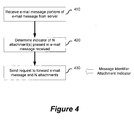
- Figure 4 shows a method of e-mail message attachment forwarding performed at a wireless device.
- One or more portions of the e-mail message are received at the wireless device from a wireless server (410) and/or mail server.
- the portions are provided incrementally as the message is viewed by the user on the wireless device.
- a request initiated by the user to forward the e-mail containing the N attachments is received.
- the user may, or may not have viewed the N attachments that are present in the e-mail message portions are received at the wireless device where the message has M original attachments.
- the message is provided in an encrypted protocol format such as S/MIME, or marked as secure or confidential either through metadata associated with the email, or by some other identifier such as subject line, body text, etc.
- the forwarding request is then sent to the wireless server (430) providing the forwarding text provided by the user, a message identifier to allow retrieval of the original message from an associated user mailbox and an attachment indicator so that the server may extract the first N attachments present in the e-mail message.
- the method may also comprise appending to the body of the email text identifying that the e-mail message was truncated or that additional attachments were not forwarded from the original message.
- Figure 5 shows a method of selective e-mail message attachment forwarding from a wireless device.
- the wireless devices receives one or more portions of the e-mail message (510) containing N attachments.
- the original e-mail message containing M attachments are only provided to the wireless device as portions of the email are delivered based upon request from the device, mail application or as network conditions or configuration allow. If the message is provided in an encrypted protocol format such as S/MIME, or marked as confidential either through metadata associated with the email, or by some other identifier such as subject line, body text, etc.
- identification the N attachments identified in the portions received e-mail message are provided to the device and can be accessed by the user (520). Of the displayed attachments, P attachments are indicated as being viewed by the user (530).
- the user can then select particular attachments to be forwarded.
- a request to forward the e-mail message and P attachments is then sent to the wireless server (540).
- metrics may be determined for each attachment (550). For example, these metrics can include whether the attachment was viewed, how long the attachment was viewed for (in time such as seconds) or whether each page of the attachment was examined (X of Y pages)
- the device can also provide an option to the user to declare how high in each of these metrics an attachment must be measured in order to be considered viewed. This option may be presented on a per e-mail basis or defined as an option in the e-mail application itself and applied to all forwarding situations to enable automatic attachment selection.
- the device can also prompt the user with a warning indicating which attachments haven't been viewed, presenting the user with relevant metrics (e.g. 'You spent 53 seconds examining this attachment', or 'You read the first 5 of 10 pages of this attachment').
- the device can present a user with dialog indicating relevant statuses of each attachment, along with a selection box such as a checkbox indicating which attachments will be included based on whether the user has actually seen the attachment.
- the user can then toggle which P of N attachments to forward with the message body and forwarding text.
- the user can then make an individual assessment as to the P attachments that are to be forwarded, based upon the N attachments received at the wireless device.
- the forwarded message will therefore only contain P attachments present on the wireless device and will not forwarded any of N attachments not specifically identified by the user or the M attachments associated with the original e-mail message but not actually delivered to the device.
- Figure 6 shows a method at a wireless server for implementing e-mail forwarding from a wireless device.
- a request from the wireless device to forward an e-mail message containing M e-mail message attachments is received at the wireless server (610), and/or mail server.
- the attachment indicator P or N depending on device software configuration, is determined from the forwarding request (620) received from the device.
- the message associated with a received message identifier is retrieved (630) from a mailbox location associated with the user. If the message is an encrypted message, the wireless device will also provide decryption keys of the message (660) so that the wireless server can decrypt the message and extract the appropriate attachments.
- the indicated attachments are then extracted from the original e-mail message (640) by the server.
- the attachment indicator may be a value identifying that the first N attachments were received and are to be forwarded, or in the case of selective forwarding the indicator P may be a unique identifier associated with each attachment (attachments abc.doc and fgh.doc), or define the relative position of the attachment within the portions of the e-mail (attachments 1, 3, and 5), or the portions that were received at the device where the associated attachment starts (portion 6, portion 9). Only the identified attachments P are selectively forwarded where the device received N attachments. The forwarded e-mail is then sent to the identified recipients in the forwarding request (650), where the forwarded e-mail only contains P (or N) of M attachments viewed or selected by the user of the device.
- the message identifier and attachment indicator can be incorporated in the MIME encoding of the e-mail message.
- FIG. 7 is a block diagram of a wireless device for replying/forwarding of e-mail, in particular a wireless device 700 is shown incorporating a communication subsystem having both a receiver 712 and a transmitter 714 as well as associated components such as one or more embedded or internal antenna elements 716 and 718.
- the particular design of the communication subsystem will be dependent upon the communication network in which the device is intended to operate.
- wireless device 700 may send and receive communication signals over a wireless network 780.
- Signals received by antenna 716 are input to receiver 712, which may perform such common receiver functions as signal amplification, frequency down conversion, channel selection and the like.
- Radio processor 711 interacts with receiver 712 and transmitter 714, and further with flash memory 762, random access memory (RAM) 760, the subscriber identity module 764, a headset 768, a speaker 770, and a microphone 772.
- Microprocessor 738 interacts with further device subsystems such as the display 722, flash memory 740, random access memory (RAM) 736, auxiliary input/output (I/O) subsystems 728, serial port 730, keyboard 732, input devices such as a touch screen or touch input device 734, other communications 742 and other device subsystems generally designated as 744.
- display 722 flash memory 740
- RAM random access memory
- I/O auxiliary input/output subsystems
- serial port 730 serial port 730
- keyboard 732 keyboard 732
- input devices such as a touch screen or touch input device 734
- Some of the subsystems shown in Figure 7 perform communication-related functions, whereas other subsystems may provide "resident" or on-device functions.
- some subsystems such as keyboard 732 and display 722, for example, may be used for both communication-related functions, such as entering a text message for transmission over a communication network, and device-resident functions such as a calculator or task list.
- certain components may be combined, for example, the keyboard 732 and the display 722 may be combined as a single component such as a touch screen.
- Radio processor 711 and microprocessor 738 is stored in a persistent store such as flash memory 740 and 762, which may instead be a read-only memory (ROM) or similar storage element (not shown).
- ROM read-only memory
- Those skilled in the art will appreciate that the operating system, specific device applications, or parts thereof, may be temporarily loaded into a volatile memory such as RAM 736 and RAM 760. Received communication signals may also be stored in RAM 736.
- flash memory 740 can be segregated into different areas for computer programs 746, device state 748, address book 750, other applications 752 and e-mail programs 754. These different storage types indicate that each program can allocate a portion of flash memory 740 for their own data storage requirements.
- Microprocessor 738 in addition to its operating system functions, preferably enables execution of software applications on the wireless device
- wireless device 700 For voice communications, overall operation of wireless device 700 is similar, except that received signals would preferably be output to the speaker 770 or headset 768 and signals for transmission would be generated by the microphone 772.
- Alternative voice or audio I/O subsystems such as a voice message recording subsystem, may also be implemented on wireless device 700.
- Other device subsystems 744 such as a short-range communications subsystem, is a further optional component which may provide for communication between wireless device 700 and different systems or devices, which need not necessarily be similar devices.
- the subsystem 744 may include an infrared device and associated circuits and components or a BluetoothTM communication module to provide for communication with similarly enabled systems and devices.
- the system and methods according to the present disclosure may be implemented by any hardware, software or a combination of hardware and software having the above described functions.
- the software code either in its entirety or a part thereof, may be stored in a computer-readable memory.
- a computer data program representing the software code may be embodied on a computer-readable memory.
Landscapes
- Engineering & Computer Science (AREA)
- Computer Networks & Wireless Communication (AREA)
- Signal Processing (AREA)
- Information Transfer Between Computers (AREA)
Claims (13)
- Ein Verfahren zum Weiterleiten einer Email-Nachricht (100) von einer drahtlosen Vorrichtung (110), wobei das Verfahren aufweist:Empfangen (410), an der drahtlosen Vorrichtung, von Email-Nachricht-Teilen (102) der Email-Nachricht, wobei die Email-Nachricht einen Anhang oder mehrere Anhänge aufweist;Bestimmen (420) eines Anhang-Indikators, der Anhänge aus dem einen Anhang oder den mehreren Anhängen identifiziert, der/die an der der drahtlosen Vorrichtung empfangen oder auf dieser angezeigt wurde(n), zur Weiterleitung mit einem Hauptteil der Email-Nachricht an einen oder mehrere Empfänger (112, 114);Senden (430) einer Weiterleitungsanforderung von der drahtlosen Vorrichtung (100) an einen Server (120), wobei die Weiterleitungsanforderung einen Nachrichtenidentifizierer, den Anhang-Indikator und eine Identifikation des einen oder der mehreren Empfänger(s) (112, 114) aufweist,wobei die Weiterleitungsanforderung den Server (120) veranlasst, einen Email-Nachricht-Hauptteil unter Verwendung des Nachrichtenidentifizierers abzurufen und Anhänge zu extrahieren, die von dem Anhang-Indikator identifiziert werden, zur Weiterleitung an den einen oder die mehreren Empfänger (112, 114).
- Das Verfahren gemäß Anspruch 1, wobei die Email-Nachricht-Teile, die an der drahtlosen Vorrichtung empfangen werden, N Anhänge von M Anhängen enthalten, die mit der Email-Nachricht assoziiert sind.
- Das Verfahren gemäß Anspruch 2, wobei der Anhang-Indikator die N Anhänge identifiziert, die an der Vorrichtung in den Email-Nachricht-Teilen empfangen werden.
- Das Verfahren gemäß Anspruch 2, wobei der Anhang-Indikator einen Teilsatz von P Anhängen der N Anhänge identifiziert, die durch die drahtlose Vorrichtung angezeigt wurden, zur Weiterleitung mit der Email-Nachricht.
- Das Verfahren gemäß Anspruch 4, wobei der Teilsatz von P Anhängen einen eindeutigen Identifizierer für jeden Anhang hat, der aus der ursprünglichen Email zu extrahieren ist.
- Das Verfahren gemäß Anspruch 5, wobei der Anhang-Indikator die P Anhänge eindeutig identifiziert, die basierend auf Betrachtungsmetriken bestimmt werden, die angeben, ob ein Anhang betrachtet wurde, der mit den N Anhängen assoziiert ist.
- Das Verfahren gemäß Anspruch 5, wobei der Anhang-Indikator die P Anhänge eindeutig identifiziert, die durch eine Benutzerauswahl aus den N Anhängen identifiziert werden, die an der drahtlosen Vorrichtung empfangen werden und mit der Email-Nachricht weiterzuleiten sind.
- Das Verfahren gemäß Anspruch 7, das weiter ein Präsentieren von Betrachtungsmetriken aufweist, die angeben, ob ein Anhang betrachtet wurde für jeden der N Anhänge vor einer Auswahl von P Anhängen zum Weiterleiten.
- Das Verfahren gemäß einem der Ansprüche 1 bis 8, wobei die Email-Nachricht eine verschlüsselte Email-Nachricht ist.
- Das Verfahren gemäß Anspruch 9, wobei die verschlüsselte Email-Nachricht eine S/MIME(Secure/Multipurpose Internet Mail Extensions)-Format-Nachricht ist.
- Das Verfahren gemäß Ansprüche 9 oder 10, wobei das Senden der Weiterleitungsanforderung weiter ein Senden eines Entschlüsselungsschlüssels an den Server umfasst zum Entschlüsseln der Email-Nachricht und Extrahieren der Anhänge, die mit dem Anhang-Indikator assoziiert sind.
- Ein System zum Weiterleiten einer Email-Nachricht von einer drahtlosen Vorrichtung, wobei das System aufweist:einen Server (120, 130) zum Empfangen der Email-Nachricht (102) und Weiterleiten der Email an einen oder mehrere Empfänger (112, 114); undeine drahtlose Vorrichtung (110), die einen Prozessor und einen Speicher aufweist, der Anweisungen enthält zur Ausführung des Verfahrens gemäß den Ansprüchen 1 bis 11.
- Computerlesbarer Speicher, der Anweisungen enthält, die bei Ausführung durch einen Prozessor das Verfahren gemäß den Ansprüchen 1 bis 11 durchführen.
Applications Claiming Priority (1)
| Application Number | Priority Date | Filing Date | Title |
|---|---|---|---|
| US40823210P | 2010-10-29 | 2010-10-29 |
Publications (2)
| Publication Number | Publication Date |
|---|---|
| EP2448201A1 EP2448201A1 (de) | 2012-05-02 |
| EP2448201B1 true EP2448201B1 (de) | 2013-11-13 |
Family
ID=44719353
Family Applications (1)
| Application Number | Title | Priority Date | Filing Date |
|---|---|---|---|
| EP11180780.6A Active EP2448201B1 (de) | 2010-10-29 | 2011-09-09 | Weiterleitung von E-Mail-Nachrichtenanhängen von einer drahtlosen Vorrichtung |
Country Status (3)
| Country | Link |
|---|---|
| US (1) | US8838710B2 (de) |
| EP (1) | EP2448201B1 (de) |
| CA (1) | CA2751935C (de) |
Families Citing this family (9)
| Publication number | Priority date | Publication date | Assignee | Title |
|---|---|---|---|---|
| CA2756552C (en) * | 2010-10-29 | 2015-10-06 | Research In Motion Limited | Forwarding e-mail from a wireless device |
| US8566577B2 (en) * | 2010-11-30 | 2013-10-22 | Blackberry Limited | Method and device for storing secured sent message data |
| KR20120070896A (ko) * | 2010-12-22 | 2012-07-02 | 한국전자통신연구원 | 이메일 재전송이 가능한 이메일 제공 장치 및 방법 |
| US9584451B2 (en) * | 2012-04-24 | 2017-02-28 | Blackberry Limited | System, method and apparatus for optimizing wireless communications of secure e-mail messages with attachments |
| US20150189482A1 (en) * | 2012-06-12 | 2015-07-02 | And Works Co., Ltd. | Device for providing related information for monile communication terminal and system for sharing related information |
| KR102058635B1 (ko) * | 2012-12-24 | 2019-12-24 | 삼성전자주식회사 | 파일 이름 제어 방법 및 그 전자 장치 |
| US9887943B2 (en) * | 2014-06-01 | 2018-02-06 | Apple Inc. | Dual server system for sending a large email attachment |
| US20160294749A1 (en) | 2015-03-30 | 2016-10-06 | International Business Machines Corporation | Selective forwarding of components of an attached archive in email system |
| US20170005971A1 (en) * | 2015-06-30 | 2017-01-05 | Samsung Electronics Co., Ltd. | Method and system for data communication |
Family Cites Families (5)
| Publication number | Priority date | Publication date | Assignee | Title |
|---|---|---|---|---|
| US7054905B1 (en) | 2000-03-30 | 2006-05-30 | Sun Microsystems, Inc. | Replacing an email attachment with an address specifying where the attachment is stored |
| US7664824B2 (en) | 2000-07-24 | 2010-02-16 | Panasonic Corporation | System for transmission/reception of e-mail with attached files |
| US7773106B2 (en) | 2002-11-12 | 2010-08-10 | Microsoft Corporation | System and apparatus for sending complete responses to truncated electronic mail messages on a mobile device |
| US20050021938A1 (en) | 2003-06-10 | 2005-01-27 | Kabushiki Kaisha Toshiba | Document access control system and method |
| US20090220084A1 (en) * | 2008-02-29 | 2009-09-03 | Research In Motion Limited | System and method for dynamically updating message list indicators |
-
2011
- 2011-09-09 CA CA2751935A patent/CA2751935C/en active Active
- 2011-09-09 EP EP11180780.6A patent/EP2448201B1/de active Active
- 2011-09-09 US US13/228,604 patent/US8838710B2/en active Active
Also Published As
| Publication number | Publication date |
|---|---|
| US8838710B2 (en) | 2014-09-16 |
| US20120110097A1 (en) | 2012-05-03 |
| EP2448201A1 (de) | 2012-05-02 |
| CA2751935C (en) | 2015-11-17 |
| CA2751935A1 (en) | 2012-04-29 |
Similar Documents
| Publication | Publication Date | Title |
|---|---|---|
| EP2448201B1 (de) | Weiterleitung von E-Mail-Nachrichtenanhängen von einer drahtlosen Vorrichtung | |
| EP2448202B1 (de) | Weiterleitung von E-Mails von einer drahtlosen Vorrichtung | |
| US10038735B2 (en) | Delivery control for HTTP communications among multiple end user communication devices | |
| US8452854B2 (en) | Method and apparatus for remote manipulation of attachments | |
| US20080281924A1 (en) | End user transparent email attachment handling to overcome size and attachment policy barriers | |
| US7984100B1 (en) | Email system automatically notifying sender status and routing information during delivery | |
| US20130340094A1 (en) | Delivery control for http communications among multiple end user communication devices | |
| CN103731334B (zh) | 消息状态展示方法及装置 | |
| US7603425B2 (en) | Email provider prevention/deterrence of unsolicited messages | |
| US10749835B2 (en) | Method and system for tracking an email message | |
| US9769101B2 (en) | Centralized communications controller | |
| JP2009301559A (ja) | プログラム | |
| CA2669244C (en) | Method and apparatus for remote manipulation of attachments | |
| CN100461776C (zh) | 实现电子邮件通知的系统、方法和装置 | |
| US9584451B2 (en) | System, method and apparatus for optimizing wireless communications of secure e-mail messages with attachments | |
| CN104703155A (zh) | 一种手机短信的删除方法及装置 | |
| JP4363596B1 (ja) | プログラム | |
| US8635292B2 (en) | Method for reduction of disk space usage of electronic messages in a network | |
| JP6780410B2 (ja) | メール転送方法、メール転送装置およびメール転送プログラム | |
| JP2019068180A (ja) | メール監視装置およびメール監視プログラム | |
| JP2006148882A (ja) | メールサーバ | |
| JP2015084462A (ja) | 電子メール送信方法、装置及びプログラム | |
| JP2010086012A (ja) | 迷惑メール対策装置及び方法 | |
| JP2024032653A (ja) | 電子メッセージを提供するための技法 | |
| JP2009064334A (ja) | 電子メール配信システム、方法及びプログラム |
Legal Events
| Date | Code | Title | Description |
|---|---|---|---|
| PUAI | Public reference made under article 153(3) epc to a published international application that has entered the european phase |
Free format text: ORIGINAL CODE: 0009012 |
|
| 17P | Request for examination filed |
Effective date: 20110909 |
|
| AK | Designated contracting states |
Kind code of ref document: A1 Designated state(s): AL AT BE BG CH CY CZ DE DK EE ES FI FR GB GR HR HU IE IS IT LI LT LU LV MC MK MT NL NO PL PT RO RS SE SI SK SM TR |
|
| AX | Request for extension of the european patent |
Extension state: BA ME |
|
| GRAP | Despatch of communication of intention to grant a patent |
Free format text: ORIGINAL CODE: EPIDOSNIGR1 |
|
| INTG | Intention to grant announced |
Effective date: 20130624 |
|
| RAP1 | Party data changed (applicant data changed or rights of an application transferred) |
Owner name: BLACKBERRY LIMITED |
|
| GRAS | Grant fee paid |
Free format text: ORIGINAL CODE: EPIDOSNIGR3 |
|
| GRAA | (expected) grant |
Free format text: ORIGINAL CODE: 0009210 |
|
| AK | Designated contracting states |
Kind code of ref document: B1 Designated state(s): AL AT BE BG CH CY CZ DE DK EE ES FI FR GB GR HR HU IE IS IT LI LT LU LV MC MK MT NL NO PL PT RO RS SE SI SK SM TR |
|
| REG | Reference to a national code |
Ref country code: GB Ref legal event code: FG4D |
|
| REG | Reference to a national code |
Ref country code: CH Ref legal event code: EP |
|
| RAP2 | Party data changed (patent owner data changed or rights of a patent transferred) |
Owner name: BLACKBERRY LIMITED |
|
| REG | Reference to a national code |
Ref country code: AT Ref legal event code: REF Ref document number: 640981 Country of ref document: AT Kind code of ref document: T Effective date: 20131215 |
|
| REG | Reference to a national code |
Ref country code: IE Ref legal event code: FG4D |
|
| REG | Reference to a national code |
Ref country code: DE Ref legal event code: R096 Ref document number: 602011003662 Country of ref document: DE Effective date: 20140109 |
|
| REG | Reference to a national code |
Ref country code: NL Ref legal event code: T3 |
|
| REG | Reference to a national code |
Ref country code: AT Ref legal event code: MK05 Ref document number: 640981 Country of ref document: AT Kind code of ref document: T Effective date: 20131113 |
|
| REG | Reference to a national code |
Ref country code: LT Ref legal event code: MG4D |
|
| PG25 | Lapsed in a contracting state [announced via postgrant information from national office to epo] |
Ref country code: IS Free format text: LAPSE BECAUSE OF FAILURE TO SUBMIT A TRANSLATION OF THE DESCRIPTION OR TO PAY THE FEE WITHIN THE PRESCRIBED TIME-LIMIT Effective date: 20140313 Ref country code: NO Free format text: LAPSE BECAUSE OF FAILURE TO SUBMIT A TRANSLATION OF THE DESCRIPTION OR TO PAY THE FEE WITHIN THE PRESCRIBED TIME-LIMIT Effective date: 20140213 Ref country code: SE Free format text: LAPSE BECAUSE OF FAILURE TO SUBMIT A TRANSLATION OF THE DESCRIPTION OR TO PAY THE FEE WITHIN THE PRESCRIBED TIME-LIMIT Effective date: 20131113 Ref country code: HR Free format text: LAPSE BECAUSE OF FAILURE TO SUBMIT A TRANSLATION OF THE DESCRIPTION OR TO PAY THE FEE WITHIN THE PRESCRIBED TIME-LIMIT Effective date: 20131113 Ref country code: FI Free format text: LAPSE BECAUSE OF FAILURE TO SUBMIT A TRANSLATION OF THE DESCRIPTION OR TO PAY THE FEE WITHIN THE PRESCRIBED TIME-LIMIT Effective date: 20131113 Ref country code: LT Free format text: LAPSE BECAUSE OF FAILURE TO SUBMIT A TRANSLATION OF THE DESCRIPTION OR TO PAY THE FEE WITHIN THE PRESCRIBED TIME-LIMIT Effective date: 20131113 |
|
| PG25 | Lapsed in a contracting state [announced via postgrant information from national office to epo] |
Ref country code: RS Free format text: LAPSE BECAUSE OF FAILURE TO SUBMIT A TRANSLATION OF THE DESCRIPTION OR TO PAY THE FEE WITHIN THE PRESCRIBED TIME-LIMIT Effective date: 20131113 Ref country code: BE Free format text: LAPSE BECAUSE OF FAILURE TO SUBMIT A TRANSLATION OF THE DESCRIPTION OR TO PAY THE FEE WITHIN THE PRESCRIBED TIME-LIMIT Effective date: 20131113 Ref country code: CY Free format text: LAPSE BECAUSE OF FAILURE TO SUBMIT A TRANSLATION OF THE DESCRIPTION OR TO PAY THE FEE WITHIN THE PRESCRIBED TIME-LIMIT Effective date: 20131113 Ref country code: AT Free format text: LAPSE BECAUSE OF FAILURE TO SUBMIT A TRANSLATION OF THE DESCRIPTION OR TO PAY THE FEE WITHIN THE PRESCRIBED TIME-LIMIT Effective date: 20131113 Ref country code: LV Free format text: LAPSE BECAUSE OF FAILURE TO SUBMIT A TRANSLATION OF THE DESCRIPTION OR TO PAY THE FEE WITHIN THE PRESCRIBED TIME-LIMIT Effective date: 20131113 Ref country code: ES Free format text: LAPSE BECAUSE OF FAILURE TO SUBMIT A TRANSLATION OF THE DESCRIPTION OR TO PAY THE FEE WITHIN THE PRESCRIBED TIME-LIMIT Effective date: 20131113 |
|
| PG25 | Lapsed in a contracting state [announced via postgrant information from national office to epo] |
Ref country code: PT Free format text: LAPSE BECAUSE OF FAILURE TO SUBMIT A TRANSLATION OF THE DESCRIPTION OR TO PAY THE FEE WITHIN THE PRESCRIBED TIME-LIMIT Effective date: 20140313 |
|
| PG25 | Lapsed in a contracting state [announced via postgrant information from national office to epo] |
Ref country code: EE Free format text: LAPSE BECAUSE OF FAILURE TO SUBMIT A TRANSLATION OF THE DESCRIPTION OR TO PAY THE FEE WITHIN THE PRESCRIBED TIME-LIMIT Effective date: 20131113 |
|
| REG | Reference to a national code |
Ref country code: DE Ref legal event code: R097 Ref document number: 602011003662 Country of ref document: DE |
|
| PG25 | Lapsed in a contracting state [announced via postgrant information from national office to epo] |
Ref country code: RO Free format text: LAPSE BECAUSE OF FAILURE TO SUBMIT A TRANSLATION OF THE DESCRIPTION OR TO PAY THE FEE WITHIN THE PRESCRIBED TIME-LIMIT Effective date: 20131113 Ref country code: PL Free format text: LAPSE BECAUSE OF FAILURE TO SUBMIT A TRANSLATION OF THE DESCRIPTION OR TO PAY THE FEE WITHIN THE PRESCRIBED TIME-LIMIT Effective date: 20131113 Ref country code: CZ Free format text: LAPSE BECAUSE OF FAILURE TO SUBMIT A TRANSLATION OF THE DESCRIPTION OR TO PAY THE FEE WITHIN THE PRESCRIBED TIME-LIMIT Effective date: 20131113 Ref country code: SK Free format text: LAPSE BECAUSE OF FAILURE TO SUBMIT A TRANSLATION OF THE DESCRIPTION OR TO PAY THE FEE WITHIN THE PRESCRIBED TIME-LIMIT Effective date: 20131113 |
|
| PLBE | No opposition filed within time limit |
Free format text: ORIGINAL CODE: 0009261 |
|
| STAA | Information on the status of an ep patent application or granted ep patent |
Free format text: STATUS: NO OPPOSITION FILED WITHIN TIME LIMIT |
|
| PG25 | Lapsed in a contracting state [announced via postgrant information from national office to epo] |
Ref country code: DK Free format text: LAPSE BECAUSE OF FAILURE TO SUBMIT A TRANSLATION OF THE DESCRIPTION OR TO PAY THE FEE WITHIN THE PRESCRIBED TIME-LIMIT Effective date: 20131113 |
|
| 26N | No opposition filed |
Effective date: 20140814 |
|
| REG | Reference to a national code |
Ref country code: DE Ref legal event code: R097 Ref document number: 602011003662 Country of ref document: DE Effective date: 20140814 |
|
| PG25 | Lapsed in a contracting state [announced via postgrant information from national office to epo] |
Ref country code: SI Free format text: LAPSE BECAUSE OF FAILURE TO SUBMIT A TRANSLATION OF THE DESCRIPTION OR TO PAY THE FEE WITHIN THE PRESCRIBED TIME-LIMIT Effective date: 20131113 |
|
| PG25 | Lapsed in a contracting state [announced via postgrant information from national office to epo] |
Ref country code: MC Free format text: LAPSE BECAUSE OF FAILURE TO SUBMIT A TRANSLATION OF THE DESCRIPTION OR TO PAY THE FEE WITHIN THE PRESCRIBED TIME-LIMIT Effective date: 20131113 Ref country code: LU Free format text: LAPSE BECAUSE OF FAILURE TO SUBMIT A TRANSLATION OF THE DESCRIPTION OR TO PAY THE FEE WITHIN THE PRESCRIBED TIME-LIMIT Effective date: 20140909 |
|
| REG | Reference to a national code |
Ref country code: CH Ref legal event code: PL |
|
| REG | Reference to a national code |
Ref country code: IE Ref legal event code: MM4A |
|
| PG25 | Lapsed in a contracting state [announced via postgrant information from national office to epo] |
Ref country code: LI Free format text: LAPSE BECAUSE OF NON-PAYMENT OF DUE FEES Effective date: 20140930 Ref country code: CH Free format text: LAPSE BECAUSE OF NON-PAYMENT OF DUE FEES Effective date: 20140930 |
|
| PG25 | Lapsed in a contracting state [announced via postgrant information from national office to epo] |
Ref country code: IT Free format text: LAPSE BECAUSE OF FAILURE TO SUBMIT A TRANSLATION OF THE DESCRIPTION OR TO PAY THE FEE WITHIN THE PRESCRIBED TIME-LIMIT Effective date: 20131113 Ref country code: IE Free format text: LAPSE BECAUSE OF NON-PAYMENT OF DUE FEES Effective date: 20140909 |
|
| PG25 | Lapsed in a contracting state [announced via postgrant information from national office to epo] |
Ref country code: SM Free format text: LAPSE BECAUSE OF FAILURE TO SUBMIT A TRANSLATION OF THE DESCRIPTION OR TO PAY THE FEE WITHIN THE PRESCRIBED TIME-LIMIT Effective date: 20131113 |
|
| PG25 | Lapsed in a contracting state [announced via postgrant information from national office to epo] |
Ref country code: GR Free format text: LAPSE BECAUSE OF FAILURE TO SUBMIT A TRANSLATION OF THE DESCRIPTION OR TO PAY THE FEE WITHIN THE PRESCRIBED TIME-LIMIT Effective date: 20140214 Ref country code: MT Free format text: LAPSE BECAUSE OF FAILURE TO SUBMIT A TRANSLATION OF THE DESCRIPTION OR TO PAY THE FEE WITHIN THE PRESCRIBED TIME-LIMIT Effective date: 20131113 Ref country code: BG Free format text: LAPSE BECAUSE OF FAILURE TO SUBMIT A TRANSLATION OF THE DESCRIPTION OR TO PAY THE FEE WITHIN THE PRESCRIBED TIME-LIMIT Effective date: 20131113 |
|
| PG25 | Lapsed in a contracting state [announced via postgrant information from national office to epo] |
Ref country code: TR Free format text: LAPSE BECAUSE OF FAILURE TO SUBMIT A TRANSLATION OF THE DESCRIPTION OR TO PAY THE FEE WITHIN THE PRESCRIBED TIME-LIMIT Effective date: 20131113 Ref country code: HU Free format text: LAPSE BECAUSE OF FAILURE TO SUBMIT A TRANSLATION OF THE DESCRIPTION OR TO PAY THE FEE WITHIN THE PRESCRIBED TIME-LIMIT; INVALID AB INITIO Effective date: 20110909 |
|
| REG | Reference to a national code |
Ref country code: FR Ref legal event code: PLFP Year of fee payment: 6 |
|
| REG | Reference to a national code |
Ref country code: FR Ref legal event code: PLFP Year of fee payment: 7 |
|
| PG25 | Lapsed in a contracting state [announced via postgrant information from national office to epo] |
Ref country code: MK Free format text: LAPSE BECAUSE OF FAILURE TO SUBMIT A TRANSLATION OF THE DESCRIPTION OR TO PAY THE FEE WITHIN THE PRESCRIBED TIME-LIMIT Effective date: 20131113 |
|
| REG | Reference to a national code |
Ref country code: FR Ref legal event code: PLFP Year of fee payment: 8 |
|
| PG25 | Lapsed in a contracting state [announced via postgrant information from national office to epo] |
Ref country code: AL Free format text: LAPSE BECAUSE OF FAILURE TO SUBMIT A TRANSLATION OF THE DESCRIPTION OR TO PAY THE FEE WITHIN THE PRESCRIBED TIME-LIMIT Effective date: 20131113 |
|
| REG | Reference to a national code |
Ref country code: DE Ref legal event code: R079 Ref document number: 602011003662 Country of ref document: DE Free format text: PREVIOUS MAIN CLASS: H04L0012580000 Ipc: H04L0051000000 |
|
| REG | Reference to a national code |
Ref country code: DE Ref legal event code: R082 Ref document number: 602011003662 Country of ref document: DE Ref country code: DE Ref legal event code: R081 Ref document number: 602011003662 Country of ref document: DE Owner name: MALIKIE INNOVATIONS LTD., IE Free format text: FORMER OWNER: BLACKBERRY LTD., WATERLOO, ONTARIO, CA |
|
| PGFP | Annual fee paid to national office [announced via postgrant information from national office to epo] |
Ref country code: DE Payment date: 20250926 Year of fee payment: 15 |
|
| PGFP | Annual fee paid to national office [announced via postgrant information from national office to epo] |
Ref country code: NL Payment date: 20250925 Year of fee payment: 15 |
|
| PGFP | Annual fee paid to national office [announced via postgrant information from national office to epo] |
Ref country code: GB Payment date: 20250923 Year of fee payment: 15 |
|
| PGFP | Annual fee paid to national office [announced via postgrant information from national office to epo] |
Ref country code: FR Payment date: 20250925 Year of fee payment: 15 |