EP2449121B1 - Verfahren zur alkoholherstellung - Google Patents
Verfahren zur alkoholherstellung Download PDFInfo
- Publication number
- EP2449121B1 EP2449121B1 EP10794423.3A EP10794423A EP2449121B1 EP 2449121 B1 EP2449121 B1 EP 2449121B1 EP 10794423 A EP10794423 A EP 10794423A EP 2449121 B1 EP2449121 B1 EP 2449121B1
- Authority
- EP
- European Patent Office
- Prior art keywords
- substrate
- fermentation
- culture
- acid
- microbial
- Prior art date
- Legal status (The legal status is an assumption and is not a legal conclusion. Google has not performed a legal analysis and makes no representation as to the accuracy of the status listed.)
- Active
Links
Images




Classifications
-
- C—CHEMISTRY; METALLURGY
- C12—BIOCHEMISTRY; BEER; SPIRITS; WINE; VINEGAR; MICROBIOLOGY; ENZYMOLOGY; MUTATION OR GENETIC ENGINEERING
- C12Q—MEASURING OR TESTING PROCESSES INVOLVING ENZYMES, NUCLEIC ACIDS OR MICROORGANISMS; COMPOSITIONS OR TEST PAPERS THEREFOR; PROCESSES OF PREPARING SUCH COMPOSITIONS; CONDITION-RESPONSIVE CONTROL IN MICROBIOLOGICAL OR ENZYMOLOGICAL PROCESSES
- C12Q3/00—Condition responsive control processes
-
- C—CHEMISTRY; METALLURGY
- C12—BIOCHEMISTRY; BEER; SPIRITS; WINE; VINEGAR; MICROBIOLOGY; ENZYMOLOGY; MUTATION OR GENETIC ENGINEERING
- C12P—FERMENTATION OR ENZYME-USING PROCESSES TO SYNTHESISE A DESIRED CHEMICAL COMPOUND OR COMPOSITION OR TO SEPARATE OPTICAL ISOMERS FROM A RACEMIC MIXTURE
- C12P7/00—Preparation of oxygen-containing organic compounds
- C12P7/02—Preparation of oxygen-containing organic compounds containing a hydroxy group
- C12P7/04—Preparation of oxygen-containing organic compounds containing a hydroxy group acyclic
- C12P7/06—Ethanol, i.e. non-beverage
- C12P7/065—Ethanol, i.e. non-beverage with microorganisms other than yeasts
-
- C—CHEMISTRY; METALLURGY
- C12—BIOCHEMISTRY; BEER; SPIRITS; WINE; VINEGAR; MICROBIOLOGY; ENZYMOLOGY; MUTATION OR GENETIC ENGINEERING
- C12M—APPARATUS FOR ENZYMOLOGY OR MICROBIOLOGY; APPARATUS FOR CULTURING MICROORGANISMS FOR PRODUCING BIOMASS, FOR GROWING CELLS OR FOR OBTAINING FERMENTATION OR METABOLIC PRODUCTS, i.e. BIOREACTORS OR FERMENTERS
- C12M41/00—Means for regulation, monitoring, measurement or control, e.g. flow regulation
- C12M41/26—Means for regulation, monitoring, measurement or control, e.g. flow regulation of pH
-
- C—CHEMISTRY; METALLURGY
- C12—BIOCHEMISTRY; BEER; SPIRITS; WINE; VINEGAR; MICROBIOLOGY; ENZYMOLOGY; MUTATION OR GENETIC ENGINEERING
- C12M—APPARATUS FOR ENZYMOLOGY OR MICROBIOLOGY; APPARATUS FOR CULTURING MICROORGANISMS FOR PRODUCING BIOMASS, FOR GROWING CELLS OR FOR OBTAINING FERMENTATION OR METABOLIC PRODUCTS, i.e. BIOREACTORS OR FERMENTERS
- C12M41/00—Means for regulation, monitoring, measurement or control, e.g. flow regulation
- C12M41/30—Means for regulation, monitoring, measurement or control, e.g. flow regulation of concentration
- C12M41/34—Means for regulation, monitoring, measurement or control, e.g. flow regulation of concentration of gas
-
- C—CHEMISTRY; METALLURGY
- C12—BIOCHEMISTRY; BEER; SPIRITS; WINE; VINEGAR; MICROBIOLOGY; ENZYMOLOGY; MUTATION OR GENETIC ENGINEERING
- C12M—APPARATUS FOR ENZYMOLOGY OR MICROBIOLOGY; APPARATUS FOR CULTURING MICROORGANISMS FOR PRODUCING BIOMASS, FOR GROWING CELLS OR FOR OBTAINING FERMENTATION OR METABOLIC PRODUCTS, i.e. BIOREACTORS OR FERMENTERS
- C12M41/00—Means for regulation, monitoring, measurement or control, e.g. flow regulation
- C12M41/48—Automatic or computerized control
-
- C—CHEMISTRY; METALLURGY
- C12—BIOCHEMISTRY; BEER; SPIRITS; WINE; VINEGAR; MICROBIOLOGY; ENZYMOLOGY; MUTATION OR GENETIC ENGINEERING
- C12P—FERMENTATION OR ENZYME-USING PROCESSES TO SYNTHESISE A DESIRED CHEMICAL COMPOUND OR COMPOSITION OR TO SEPARATE OPTICAL ISOMERS FROM A RACEMIC MIXTURE
- C12P7/00—Preparation of oxygen-containing organic compounds
- C12P7/40—Preparation of oxygen-containing organic compounds containing a carboxyl group including Peroxycarboxylic acids
- C12P7/54—Acetic acid
-
- Y—GENERAL TAGGING OF NEW TECHNOLOGICAL DEVELOPMENTS; GENERAL TAGGING OF CROSS-SECTIONAL TECHNOLOGIES SPANNING OVER SEVERAL SECTIONS OF THE IPC; TECHNICAL SUBJECTS COVERED BY FORMER USPC CROSS-REFERENCE ART COLLECTIONS [XRACs] AND DIGESTS
- Y02—TECHNOLOGIES OR APPLICATIONS FOR MITIGATION OR ADAPTATION AGAINST CLIMATE CHANGE
- Y02E—REDUCTION OF GREENHOUSE GAS [GHG] EMISSIONS, RELATED TO ENERGY GENERATION, TRANSMISSION OR DISTRIBUTION
- Y02E50/00—Technologies for the production of fuel of non-fossil origin
- Y02E50/10—Biofuels, e.g. bio-diesel
Definitions
- This invention relates generally to methods for increasing the efficiency of microbial growth and production of products by microbial fermentation of substrates. More particularly the invention relates to processes for producing alcohols, particularly ethanol, by microbial fermentation of gaseous substrates containing carbon monoxide. In particular embodiments, the invention relates to methods of optimising substrate supply such that overall efficiency of microbial fermentation increases.
- Ethanol is rapidly becoming a major hydrogen-rich liquid transport fuel around the world.
- Worldwide consumption of ethanol in 2005 was an estimated 12.2 billion gallons.
- the global market for the fuel ethanol industry has also been predicted to continue to grow sharply in future, due to an increased interest in ethanol in Europe, Japan, the USA and several developing nations.
- ethanol is used to produce E10, a 10% mixture of ethanol in gasoline.
- the ethanol component acts as an oxygenating agent, improving the efficiency of combustion and reducing the production of air pollutants.
- ethanol satisfies approximately 30% of the transport fuel demand, as both an oxygenating agent blended in gasoline, and as a pure fuel in its own right.
- GOG Green House Gas
- EU European Union
- CO is a major, energy-rich by-product of the incomplete combustion of organic materials such as coal or oil and oil derived products.
- Other industrial processes also result in the production of carbon monoxide.
- the steel industry in Australia is reported to produce and release into the atmosphere over 500,000 tonnes of CO annually.
- Catalytic processes may be used to convert gases consisting primarily of CO and/or CO and hydrogen (H 2 ) into a variety of fuels and chemicals. Micro-organisms may also be used to convert these gases into fuels and chemicals. These biological processes, although generally slower than chemical reactions, have several advantages over catalytic processes, including higher specificity, higher yields, lower energy costs and greater resistance to poisoning.
- micro-organisms to grow on CO as a sole carbon source was first discovered in 1903. This was later determined to be a property of organisms that use the acetyl coenzyme A (acetyl CoA) biochemical pathway of autotrophic growth (also known as the Woods-Ljungdahl pathway and the carbon monoxide dehydrogenase / acetyl CoA synthase (CODH/ACS) pathway).
- CODH/ACS carbon monoxide dehydrogenase / acetyl CoA synthase
- a large number of anaerobic organisms including carboxydotrophic, photosynthetic, methanogenic and acetogenic organisms have been shown to metabolize CO to various end products, namely CO 2 , H 2 , methane, n-butanol, acetate and ethanol. While using CO as the sole carbon source, all such organisms produce at least two of these end products.
- Anaerobic bacteria such as those from the genus Clostridium, have been demonstrated to produce ethanol from CO, CO 2 and H 2 via the acetyl CoA biochemical pathway.
- various strains of Clostridium Ijungdahlii that produce ethanol from gases are described in WO 00/68407 , EP 117309 , US patent nos. 5,173,429 , 5,593,886 , and 6,368,819 , WO 98/00558 and WO 02/08438 .
- the bacterium Clostridium autoethanogenum sp is also known to produce ethanol from gases ( Abrini et al., Archives of Microbiology 161, pp 345-351 (1994 )).
- ethanol production by micro-organisms by fermentation of gases is typically associated with co-production of acetate and/or acetic acid.
- the efficiency of production of ethanol using such fermentation processes may be less than desirable.
- the acetate/acetic acid by-product can be used for some other purpose, it may pose a waste disposal problem.
- Acetate/acetic acid is converted to methane by micro-organisms and therefore has the potential to contribute to GHG emissions.
- WO2007/117157 , WO2008/115080 and WO2009/022925 describe processes that produce alcohols, particularly ethanol, by anaerobic fermentation of gases containing carbon monoxide.
- WO2007/117157 describes a process that produces alcohols, particularly ethanol, by anaerobic fermentation of gases containing carbon monoxide. Acetate produced as a by-product of the fermentation process is converted into hydrogen gas and carbon dioxide gas, either or both of which may be used in the anaerobic fermentation process.
- WO2008/115080 describes a process for the production of alcohol(s) in multiple fermentation stages.
- By-products produced as a result of anaerobic fermentation of gas(es) in a first bioreactor can be used to produce products in a second bioreactor. Furthermore, by-products of the second fermentation stage can be recycled to the first bioreactor to produce products.
- WO2009/022925 discloses the effect of pH and ORP in the conversion of substrates comprising CO to products such as acids and alcohols by fermentation.
- WO2009/058028 describes methods of capturing carbon by microbial fermentation of a gaseous substrate comprising CO.
- Microbes capable of growing on CO-containing gases are known to do so at a slower rate than is traditionally associated with microbes grown on sugars.
- the time required for a microbial population to grow to a sufficiently high cell density to allow an economically viable level of product to be synthesised is a key operating cost affecting the profitability of the process. Technologies that act to enhance culture growth rates and/or productivities and therefore reduce the time required to reach desired cell densities and/or desired product levels and may serve to improve the commercial viability of the overall process.
- ensuring that the appropriate conditions for microbial growth and/or alcohol production can be critical to maintaining optimal microbial growth and/or alcohol productivities.
- providing a substrate to a microbial culture at or toward an optimum level or range can result in optimal microbial growth and/or desired metabolite production as described in WO/2010/093262 .
- microbial growth slows and the fermentation product(s) are predominantly acid(s) such as acetate, whereas too much substrate can lead to poor microbial growth and/or cell death.
- the present invention provides a method of optimising supply of a substrate comprising CO to a bioreactor, wherein the substrate is fermented to produce products including one or more alcohol(s) and/or acid(s) by a culture of one or more carboxydotrophic microorganisms, the method including determining acid levels in the bioreactor at a first time point and a second time point, wherein an increase in acid level between the first and second time points results in an increase in substrate supply, wherein a decrease in acid level between the first and second timepoints results in a decrease in substrate supply and wherein the substrate is provided such that acid levels are maintained between predetermined threshold concentrations of 1 to 10 g/L fermentation broth.
- acid levels are determined by measuring the pH of the culture.
- the substrate supply is adjusted in response to a detected change to the pH of the fermentation broth.
- the pH is maintained in a range from 5 to 6.
- the substrate supply is controlled by maintaining the pH of the fermentation broth at a constant rate of change.
- the microorganism is Clostridium autoethanogenum, Clostridium Ijungdahlii, Clostridium ragsdalei or Clostridium carboxydivorans.
- the acid levels are maintained between 2 to 8g/L fermentation broth.
- the products are produced in a ratio of at least 2:1 alcohol(s) to acid(s).
- the substrate supply may be automatically controlled in response to changes in acid levels.
- Acid levels may be maintained between predetermined threshold concentrations of 1-10g/L fermentation broth. Acid levels may be maintained between predetermined threshold concentrations of 2-8g/L fermentation broth. Typically, acid levels are determined by measuring pH of the culture.
- the fermentation is continuous.
- Also described is a method of determining an optimum substrate supply level and/or range including providing a substrate to a culture of one or more carboxydotrophic microorganisms in a bioreactor, at or substantially toward a level such that a desired ratio of alcohol: acid products is produced by fermentation of a substrate comprising CO.
- the acid is acetate.
- the alcohol is ethanol.
- the substrate comprises CO.
- the products may be acid(s) and/or alcohol(s).
- alcohol particularly ethanol
- acid particularly acetate
- the method may include providing the substrate such that pH of a fermentation media remains substantially constant or within a predetermined range.
- the substrate is provided such that there is substantially no net change in acid(s) concentration during fermentation.
- the substrate may be provided such that pH is maintained within a desirable range.
- the desirable range may be ⁇ 0.5 units of the optimum operating pH.
- the substrate is provided such that pH is maintained between 5-6; or between 5.1-5.9; or within 5.2-5.8; or between 5.3-5.7; or between 5.4-5.6; or substantially at 5.5.
- the substrate may comprise CO.
- provision of the substrate is controlled such that pH remains substantially constant or within a predetermined range or changes with a predetermined rate of change.
- the method includes increasing substrate supply in response to a decrease in pH. Additionally or alternatively, the method includes decreasing the substrate supply in response to an increase in pH.
- the method may include monitoring metabolite concentration in a fermentation broth by known analytical methods.
- the substrate may comprise CO.
- the products are acid(s) and/or alcohol(s).
- products are produced such that a desirable product ratio of at least 1:1; or at least 1:2; or at least 1:3; or at least 1:4; or at least 1:5; or at least 1:10; or at least 1:20; acid: alcohol is produced by the culture.
- alcohol particularly ethanol
- acid is produced without concomitant production of acid (particularly acetate).
- the method may include providing the substrate such that hydrogen is produced by the microbial culture.
- the substrate may be provided such that hydrogen is produced at a level of at least 0.5mol%; or at least 1.0mol%; or at least 1.5mol%; or at least 2.0mol% of the substrate consumed by the microbial culture.
- the substrate is provided such that specific CO uptake by the microbial culture is maintained between 0.6-1.5mmol CO consumed per gram of biomass per minute (mmol/g/min).
- the substrate comprises CO
- excess CO inhibits hydrogenase enzyme(s)
- the microbe cannot relieve itself of excess reducing power, thus leading to culture problems such as growth inhibition and/or microbial death.
- provision of the substrate is controlled such that hydrogen produced by the microbial culture at a level of at least 0.5mol%; or at least 1.0mol%; or at least 1.5mol%; or at least 2.0mol% of the substrate consumed by the culture.
- the substrate supply is increased such that hydrogen production is maintained at a level of at least 0.5mol%; or at least 1.0mol%; or at least 1.5mol%; or at least 2.0mol% of the substrate consumed by the microbial culture.
- substrate supply can be decreased or maintained substantially constant, such that hydrogen production is maintained at a level at least 0.5mol%; or at least 1.0mol%; or at least 1.5mol%; or at least 2.0mol% of the substrate consumed by the microbial culture.
- Also described is a method of improving overall efficiency of microbial fermentation of a substrate to produce products comprising providing the substrate comprising CO, to a microbial culture such that the specific uptake of the microbial culture is substantially maintained between 0.6-1.5mmol CO consumed per gram of biomass per minute (mmol/g/min).
- the substrate comprising CO may be provided such that specific uptake is substantially maintained between 0.8-1.2mmol/g/min.
- the substrate comprising CO is gaseous.
- the gaseous substrate comprises a gas obtained as a by-product of an industrial process.
- the industrial process is selected from the group consisting of ferrous metal products manufacturing, non-ferrous products manufacturing, petroleum refining processes, gasification of biomass, gasification of coal, electric power production, carbon black production, ammonia production, methanol production and coke manufacturing.
- Substrates having lower concentrations of CO, such as 6%, may also be appropriate, particularly when H 2 and CO 2 are also present.
- the CO-containing substrate will typically contain a major proportion of CO, such as at least about 20% to about 100% CO by volume, from 40% to 95% CO by volume, from 40% to 60% CO by volume, and from 45% to 55% CO by volume.
- the substrate comprises about 25%, or about 30%, or about 35%, or about 40%, or about 45%, or about 50% CO, or about 55% CO, or about 60% CO by volume.
- the alcohol produced by the fermentation process is ethanol.
- the fermentation reaction may also produce acetate.
- the fermentation reaction is carried out by one of more strains of acetogenic bacteria.
- the acetogenic bacterium is selected from Clostridium, Moorella and Carboxydothermus, such as Clostridium autoethanogenum, Clostridium Ijungdahlii and Morella thermoacetica.
- the acetogenic bacterium is Clostridium autoethanogenum.
- a system for microbial fermentation of a substrate to produce products including a bioreactor configured to conduct a desired fermentation, determining means configured to determine pH of a fermentation broth during the desired fermentation and controlling means adapted to control substrate supply.
- the system may be configured to provide a substrate comprising CO.
- the controlling means may be configured to make one or more adjustments to substrate supply if the pH has deviated from a predetermined value or range.
- the system may include processing means.
- the processing means may be linked to the controlling means, such that substrate supply can be automatically regulated in response to changes in pH.
- the substrate supply may be controlled such that increasing amounts of substrate are supplied when pH decreases and/or lesser amounts of substrate are provided when pH increases.
- a system for microbial fermentation of a substrate to produce products including a bioreactor configured to conduct a desired fermentation, determining means configured to determine an amount of hydrogen produced during the desired fermentation and controlling means adapted to control substrate supply.
- the system may be configured to provide a substrate comprising CO.
- the determining means may also determine the amount of substrate consumed during fermentation.
- the determining means can optionally be linked to a processing means such that a H2- produced/ CO consumed ratio can be determined.
- the controlling means may be configured to make one or more adjustments to substrate supply if the H2 produced /CO consumed ratio has deviated from a predetermined value or range.
- the processing means may be linked to the controlling means, such that substrate supply can be automatically regulated in response to changes in H2 production and/or the H2 produced /CO consumed ratio.
- Also described is a system for microbial fermentation to produce products including:
- the determining means may be configured to determine the amount of one or more acid(s) produced in a fermentation
- the determining means may be configured to determine the pH of fermentation.
- the determining means may be configured to determine the amount of H2 produced in fermentation.
- the invention provides a method of optimising supply of a substrate comprising CO to a bioreactor, wherein the substrate is fermented to produce products including one or more alcohol(s) and/or acid(s) by a culture of one or more carboxydotrophic microorganisms, the method including determining acid levels in the bioreactor at a first time point and a second time point, wherein an increase in acid level between the first and second time points results in an increase in substrate supply, wherein a decrease in acid level between the first and second time points results in a decrease in substrate supply and wherein the substrate is provided such that acid levels are maintained between predetermined threshold concentrations of 1 to 10 g/L fermentation broth.
- the substrate is provided to one or more carboxydotrophic bacteria, such as acetogenic bacteria.
- carboxydotrophic bacteria such as acetogenic bacteria.
- acetogenic bacteria such as Clostridium autoethanogenum, Clostridium Ijungdahlii, Clostridium ragsdalei and Clostridium carboxydivorans convert a substrate comprising CO into products including acids and alcohols.
- supplying a substrate, such as a substrate comprising CO, to a microbial culture at or toward an optimum level or range can result in optimal microbial growth and/or desired metabolite production, as described in WO2010/093262 .
- supplying a substrate comprising CO at or towards an optimum level, to a microbial culture comprising one or more carboxydotrophic microorganisms results in good microbial growth and production of desired products, such as one or more alcohols.
- the substrate In order to maintain optimal microbial growth and production of desired products, the substrate must be provided to the microbial culture at or toward an optimal level substantially continuously over the course of fermentation. Deviation from the optimum supply can lead to a slowdown in growth, production of less desirable products or in extreme cases, can result in inhibition of microbial growth or microbial death.
- a substrate is oxidised by a microbial culture to produce energy (reducing equivalents) that may be used in the production of metabolites and/or in cellular growth.
- energy reducing equivalents
- Increasing the substrate supply leads to an increase in reducing equivalents available for production of metabolites and/or growth.
- reducing equivalents are used in order for the microbial culture to grow and produce products such as acid(s).
- a microbe can use the additional substrate to produce additional reducing equivalents, which can be used to reduce product(s) such as acid(s) to desirable products such as alcohol(s).
- the amount of alcohol(s) increases relative to the acid(s), as the microbe uses the increasing amounts of reducing equivalents.
- the microbial culture will grow and produce alcohol(s), such as ethanol.
- the substrate supply or level at which a substrate is provided to one or more microorganisms is substantially related to the mass transfer rate of the substrate into an aqueous fermentation broth.
- Mass transfer of a gas into a liquid is a function of three main variables:
- the substrate supply or level can be increased by one or more of: increasing the rate at which a substrate is provided to a bioreactor, increasing partial pressure of the substrate, or by mechanical means such as increasing the agitation of a stirred tank bioreactor, or increasing the mass transfer characteristics of a particular bioreactor.
- increasing the rate at which a substrate is provided to a bioreactor increasing partial pressure of the substrate, or by mechanical means such as increasing the agitation of a stirred tank bioreactor, or increasing the mass transfer characteristics of a particular bioreactor.
- Many devices and equipment for promotion of mass transfer to microorganisms in fermentation of gaseous substrates are known.
- products are produced such that a desirable product ratio of at least 1:1; or at least 1:2; or at least 1:3; or at least 1:4; or at least 1:5; or at least 1:10; or at least 1:20; acid: alcohol is produced by the culture.
- steady state continuous fermentation of a substrate comprising CO will produce products including acetate and/or alcohols.
- acetate is maintained at a concentration of less than 10g/L, or less than 9g/L, or less than 8g/L, or less than 7g/L, or less than 6g/l, or less than 5g/L in the fermentation broth.
- alcohol particularly ethanol
- acid particularly acetate
- over-availability (through oversupply) of substrate can lead to culture problems, such as growth inhibition and/or microbial death.
- a substrate is provided at or toward an optimum level, when the culture produces acid(s), such as acetate, at a specific rate of less than 2g/g biomass/day, or less than 1.5g/g/day, or less than 1.2g/g/day, or less than 1g/g/day.
- a microbial culture will grow exponentially during the growth phase.
- the substrate should be supplied in increasing amounts, such that a substantially optimal amount of substrate is continuously provided.
- the substrate in a continuous culture, the substrate must be provided at or toward an optimum level or range over an extended period to maintain sustainable microbial growth and desired metabolite production. It is recognised small changes in operating conditions such as fresh media supply rate, temperature, pH, ORP, culture viability can result in changes in biomass levels and thus substrate requirements.
- substrate can be supplied at or toward an optimum level, irrespective of changes in biomass.
- a substrate may be provided to a microbial culture in fermentation media such that pH of the media changes substantially at or toward a predetermined rate of change or within a predetermined rate of change range.
- the rate of change approaches zero, such that in some embodiments pH of the media is substantially maintained constant or within a pre-determined range.
- acetogenic bacteria produce products including acetic acid.
- pH of a fermentation media containing a substrate limited acetogenic culture will decrease unless it can be controlled by addition of a base.
- acetate will be converted to alcohol and the pH will increase unless it can be controlled by addition of an acid.
- acidic metabolites may be produced or consumed by a microbial culture.
- optimal alcohol productivity is associated with the co-production of acid(s) such as acetate.
- acidic metabolites such as acetate will result in a decrease in pH of the fermentation broth over time.
- products are produced such that a desirable product ratio of at least 1:1; or at least 1:2; or at least 1:3; or at least 1:4; or at least 1:5; or at least 1:10; or at least 1:20; acid: alcohol is produced by the culture and pH will change as a result of acid production by the microbial culture.
- pH of a fermentation broth may change due to various influences such as consumption or production of one or more acids or bases, or a combination thereof.
- nitrogen fixation by a microbial culture during microbial growth can result in a decrease in pH.
- Carboxydotrophic microorganisms such as Clostridium autoethanogenum can uptake nitrogen in the form of NH3 which can result in a decrease in pH of a fermentation broth over time.
- Other metabolites, such as phosphate and/or lactate may also be produced and/or consumed by the microbial culture, thus affecting the pH of a fermentation broth.
- acetate is typically a significant product in fermentation by acetogenic bacteria, and typically has the largest influence on the pH.
- Described herein is a method of providing a substrate at or toward an optimal level or range, the method including maintaining pH change substantially at or toward a predetermined rate of change.
- a desired rate of change of pH for a given microbial culture can be determined experimentally.
- a microbial culture can be supplied an optimal amount of substrate for optimal growth and/or desired metabolite production and pH changes monitored.
- acidic and/or basic components may be produced and/or consumed by the microbial culture, resulting in a change in pH over time.
- This (pre)determined rate of change of pH can then be used to control substrate supply to a microbial culture in subsequent fermentations.
- an optimally supplied culture of microorganisms grows and produces metabolites including alcohols (such as ethanol) and acids (such as acetate).
- the production of acid(s) will remain substantially constant such that there is a substantially constant rate of change of pH. If pH decreases quicker than the predetermined rate of change, it can be determined that more acid(s) are being produced by the culture and the substrate supply can be increased toward the optimum rate. If the pH decreases slower than the predetermined rate of change, it can be inferred that acid(s) are produced at a slower rate by the culture and the substrate supply can be decreased toward the optimum rate. If the pH increases, it can be inferred that acid(s) are consumed by the culture and the substrate supply can be decreased toward the optimum rate.
- pH change can be counteracted by addition of an acid or a base to maintain a substantially constant pH.
- the rate of acid/base added to the fermentation can be used to determine the optimum substrate supply.
- microbial growth and alcohol production can be optimised by maintaining pH at a predetermined level, or within a predetermined range, by supplying a substrate comprising CO, at a desirable level.
- pH can be maintained at a predetermined level, or within a predetermined range by ensuring there is no net production or consumption of acidic metabolites, such as acetate.
- the rate of change of pH is approximately zero. If, during fermentation, the pH starts to decrease it can be inferred that acid(s), such as acetate, is produced by the culture and that the culture is substrate limited.
- the substrate supply is increased.
- the pH starts to rise, it can be inferred that there is a net conversion of acid(s), such as acetate, into alcohol(s), such as ethanol, and that the culture is oversupplied with substrate.
- acid(s) such as acetate
- alcohol(s) such as ethanol
- an optimal level of substrate at one time point may be a limiting amount of substrate at a later time point, if the culture has grown in batch operation. It is considered during exponential growth, the optimum amount of substrate required will also increase substantially exponentially.
- the dynamic state of the culture means a substrate supply can be continuously supplied at or towards an optimum level or range in response to small changes in the microbial culture.
- the optimum supply of a substrate may also be dependant on the fermentation operational requirements. For example, in batch fermentation (or a batch phase start-up of a continuous culture) it may be desirable to provide substrate such that there is no net production or consumption of acetate and there is no change in pH. In continuous operation, it may be desirable to continuously produce small amounts of acetate, such that a stable culture can be maintained.
- accumulation and/or consumption of metabolites can be monitored by any means known in the art and substrate supply controlled in response to metabolite levels.
- acetate and/or lactate concentration in a fermenter can be periodically or substantially continuously monitored by a variety of analytical techniques, such as GC, HPLC, GCIR, GCMS, LCMS, NIR via one or more selective probe(s), such as amperomic probes or other suitable assays, familiar to those skilled in the art.
- Metabolite concentrations can be monitored in the fermentation media in the bioreactor and/or in media exiting the bioreactor (such as the product stream from a continuous fermentation) and substrate levels optimised based on the metabolites measured in the media. For example, if acetate starts to accumulate in the media above a predetermined threshold, substrate supply can increase in accordance with the method of the invention. Similarly, if acetate concentration decreases below a predetermined or preset threshold, substrate supply can be decreased. In particular embodiments, at steady state, when the substrate is provided at or toward an optimum level, acetate is maintained within a predetermined concentration range of approximately 1-10g/L, or approximately 2-8g/L, or approximately 3-7g/L, or approximately 4-6g/L.
- acetate is maintained at a concentration of approximately 10g/L, or approximately 9g/L, or approximately 8g/L, or approximately 7g/L, or approximately 6g/l, or approximately 5g/L in the fermentation broth.
- a substrate is provided at or toward an optimum level, when the culture produces acid(s), such as acetate, at a specific rate of less than 2g/g biomass/day, or less than 1.5g/g/day, or less than 1.2g/g/day, or less than 1g/g/day.
- media pH can be used as an indication that the culture is supplied with a substantially optimal amount of substrate, or at least within an optimal range. Furthermore, by maintaining the media at a desired pH or within a predetermined pH range, substrate supply, particularly supply of a substrate comprising CO, can be optimised.
- H2 may be produced by one or more carboxydotrophic microorganisms when a substrate comprising CO and minimal or no H2 is provided at or toward an optimum level or range.
- carboxydotrophic bacteria such as Clostridium autoethanogenum, may convert a portion of the substrate into products such as acid(s) and small amounts of alcohol(s) and a further portion is directed to anabolic production of cellular material (growth).
- H2 is substantially not produced.
- carboxydotrophic bacteria such as C . autoethanogenum
- carboxydotrophic bacteria convert a portion of the substrate into products such as acid(s) and alcohol(s), a portion into cellular material and a further portion into H2.
- carboxydotrophic bacteria such as C . autoethanogenum
- convert a portion of the substrate into products such as acid(s) and alcohol(s) a portion into cellular material and a further portion into H2.
- a substrate particularly a substrate comprising CO
- H2 is produced in addition to desired metabolites such as ethanol.
- oversupply of a substrate comprising CO can lead to inhibition of hydrogenase enzyme(s), thus reducing the amount of H2 produced by the culture.
- the substrate can be provided at or about an optimal level, or within an optimal range by monitoring H2 produced by the culture.
- the substrate comprises CO
- excess CO inhibits hydrogenase enzyme(s), thus substantially preventing H2 production.
- hydrogenase enzyme(s) are inhibited, the microbe cannot relieve itself of excess reducing power, thus leading to culture problems such as growth inhibition and/or microbial death.
- hydrogen produced by a microbial culture can be used as an indication that the culture is supplied with a substantially optimal amount of substrate, or at least within an optimal range.
- hydrogen production by a microbial culture can be used to control substrate supply to the microbial culture. For example, substrate supply to a substrate limited culture can be increased until hydrogen production is observed. Following initiation of hydrogen production, substrate supply can be adjusted to maintain hydrogen production over time. As a microbial culture grows, the substrate supply can be increased to maintain hydrogen production.
- This control method is of particular importance in a growing microbial culture, as the substrate requirement of the culture will change over time.
- an optimal level of substrate at one time point may be a limiting amount of substrate at a later time point, if the culture has grown. It is considered during exponential growth, the optimum amount of substrate required will also increase substantially exponentially.
- the hydrogenase enzymes are reversible, so a microbial culture can use a hydrogen component of a substrate stream comprising hydrogen as an energy source.
- the methods of optimisation employ a substrate comprising CO that contains minimal amounts of hydrogen or is substantially hydrogen free.
- the terms “increasing the efficiency”, “increased efficiency” and the like, when used in relation to a fermentation process, include, but are not limited to, increasing one or more of: the rate of growth of micro-organisms catalysing the fermentation, the volume of desired product (such as alcohols) produced per volume of substrate (such as carbon monoxide) consumed, the rate of production or level of production of the desired product, and the relative proportion of the desired product produced compared with other by-products of the fermentation.
- “optimisation” or the like includes increasing the efficiency towards a maximum efficiency given a particular set of fermentation conditions.
- substrate comprising carbon monoxide and like terms should be understood to include any substrate in which carbon monoxide is available to one or more strains of bacteria for growth and/or fermentation, for example.
- Gaseous substrate comprising carbon monoxide include any gas which contains carbon monoxide.
- the gaseous substrate will typically contain a significant proportion of CO, preferably at least about 5% to about 100% CO by volume.
- the term "acid” as used herein includes both carboxylic acids and the associated carboxylate anion, such as the mixture of free acetic acid and acetate present in a fermentation broth as described herein.
- the ratio of molecular acid to carboxylate in the fermentation broth is dependent upon the pH of the system.
- acetate includes both acetate salt alone and a mixture of molecular or free acetic acid and acetate salt, such as the mixture of acetate salt and free acetic acid present in a fermentation broth as may be described herein.
- the ratio of molecular acetic acid to acetate in the fermentation broth is dependent upon the pH of the system.
- biomass includes a fermentation device consisting of one or more vessels and/or towers or piping arrangements, which includes the Continuous Stirred Tank Reactor (CSTR), Immobilized Cell Reactor (ICR), Trickle Bed Reactor (TBR), Moving Bed Biofilm Reactor (MBBR), Bubble Column, Gas Lift Fermenter, Membrane Reactor such as Hollow Fibre Membrane Bioreactor (HFMBR), Static Mixer, or other vessel or other device suitable for gas-liquid contact.
- CSTR Continuous Stirred Tank Reactor
- ICR Immobilized Cell Reactor
- TBR Trickle Bed Reactor
- MBBR Moving Bed Biofilm Reactor
- Bubble Column Gas Lift Fermenter
- Membrane Reactor such as Hollow Fibre Membrane Bioreactor (HFMBR), Static Mixer, or other vessel or other device suitable for gas-liquid contact.
- HFMBR Hollow Fibre Membrane Bioreactor
- Static Mixer or other vessel or other device suitable for gas-liquid contact.
- mass transfer as used herein relates to the transfer of atoms or molecules, particularly substrate atoms or molecules from a gaseous phase into an aqueous solution.
- the phrases "fermenting”, “fermentation process” or “fermentation reaction” and the like, as used herein, are intended to encompass both the growth phase and product biosynthesis phase of the process.
- the bioreactor may comprise a first growth reactor and a second fermentation reactor.
- the addition of metals or compositions to a fermentation reaction should be understood to include addition to either or both of these reactors.
- the invention may be applicable to production of alternative alcohols and/or acids as will be known by persons of ordinary skill in the art to which the invention relates. Further, the invention may be applicable to fermentation to produce butyrate, propionate, caproate, ethanol, propanol, and butanol. The methods may also be of use in producing hydrogen.
- these products may be produced by fermentation using microbes from the genus Moorella, Clostridia, Ruminococcus, Acetobacterium, Eubacterium, Butyribacterium, Oxobacter, Methanosarcina, Methanosarcina, and Desulfotomaculum.
- Certain embodiments of the invention are adapted to use gas streams produced by one or more industrial processes.
- Such processes include steel making processes, particularly processes which produce a gas stream having a high CO content or a CO content above a predetermined level (i.e., 5%).
- acetogenic bacteria are preferably used to produce acids and/or alcohols, particularly ethanol or butanol, within one or more bioreactors.
- the invention may be applied to various industries or waste gas streams, including those of vehicles with an internal combustion engine.
- the invention may be applied to other fermentation reactions including those using the same or different micro-organisms.
- the scope of the invention is not limited to the particular embodiments and/or applications described but is instead to be understood in a broader sense; for example, the source of the gas stream is not limiting, other than that at least a component thereof is usable to feed a fermentation reaction.
- the invention has particular applicability to improving the overall carbon capture and/or production of ethanol and other alcohols from gaseous substrates such as automobile exhaust gases and high volume CO-containing industrial flue gases.
- Processes for the production of ethanol and other alcohols from gaseous substrates are known. Exemplary processes include those described for example in WO2007/117157 , WO2008/115080 , US 6,340,581 , US 6,136,577 , US 5,593,886 , US 5,807,722 and US 5,821,111 .
- a number of carboxydotrophic anaerobic bacteria are known to be capable of carrying out the fermentation of CO to alcohols, including n-butanol and ethanol, and acetic acid, and are suitable for use in the process of the present invention.
- Examples of such bacteria that are suitable for use in the invention include those of the genus Clostridium, such as strains of Clostridium Ijungdahlii, including those described in WO 00/68407 , EP 117309 , US patent No's 5,173,429 , 5,593,886 , and 6,368,819 , WO 98/00558 and WO 02/08438 , Clostridium carboxydivorans ( Liou et al., International Journal of Systematic and Evolutionary Microbiology 33: pp 2085-2091 ), Clostridium ragsdalei ( WO/2008/028055 ) and Clostridium autoethanogenum ( Abrini et al, Archives of Microbiology
- Suitable bacteria include those of the genus Moorella, including Moorella sp HUC22-1, ( Sakai et al, Biotechnology Letters 29: pp 1607-1612 ), and those of the genus Carboxydothermus ( Svetlichny, V.A., Sokolova, T.G. et al (1991), Systematic and Applied Microbiology 14: 254-260 ).
- Clostridium autoethanogenum is a Clostridium autoethanogenum having the identifying characteristics of the strain deposited at the German Resource Centre for Biological Material (DSMZ) under the identifying deposit number 19630.
- the Clostridium autoethanogenum is a Clostridium autoethanogenum having the identifying characteristics of DSMZ deposit number DSMZ 10061.
- Culturing of the bacteria used in the methods of the invention may be conducted using any number of processes known in the art for culturing and fermenting substrates using anaerobic bacteria. Exemplary techniques are provided in the "Examples" section below. By way of further example, those processes generally described in the following articles using gaseous substrates for fermentation may be utilised: (i) K. T. Klasson, et al. (1991). Bioreactors for synthesis gas fermentations resources. Conservation and Recycling, 5; 145-165 ; (ii) K. T. Klasson, et al. (1991). Bioreactor design for synthesis gas fermentations. Fuel. 70. 605-614 ; (iii) K. T. Klasson, et al.
- the fermentation may be carried out in any suitable bioreactor, such as a continuous stirred tank reactor (CSTR), an immobilised cell reactor, a gas-lift reactor, a bubble column reactor (BCR), a membrane reactor, such as a Hollow Fibre Membrane Bioreactor (HFMBR) or a trickle bed reactor (TBR).
- the bioreactor may comprise a first, growth reactor in which the micro-organisms are cultured, and a second, fermentation reactor, to which fermentation broth from the growth reactor is fed and in which most of the fermentation product (e.g. ethanol and acetate) is produced.
- CSTR continuous stirred tank reactor
- BCR bubble column reactor
- HFMBR Hollow Fibre Membrane Bioreactor
- TBR trickle bed reactor
- the bioreactor may comprise a first, growth reactor in which the micro-organisms are cultured, and a second, fermentation reactor, to which fermentation broth from the growth reactor is fed and in which most of the fermentation product (e.g. ethanol and acetate
- the carbon source for the fermentation reaction is a gaseous substrate containing CO.
- the substrate may be a CO-containing waste gas obtained as a by-product of an industrial process, or from some other source such as from automobile exhaust fumes.
- the industrial process is selected from the group consisting of ferrous metal products manufacturing, such as a steel mill, non-ferrous products manufacturing, petroleum refining processes, gasification of coal, electric power production, carbon black production, ammonia production, methanol production and coke manufacturing.
- the CO-containing substrate may be captured from the industrial process before it is emitted into the atmosphere, using any convenient method.
- it may also be desirable to treat it to remove any undesired impurities, such as dust particles before introducing it to the fermentation.
- the gaseous substrate may be filtered or scrubbed using known methods.
- the CO-containing substrate may be sourced from the gasification of biomass.
- the process of gasification involves partial combustion of biomass in a restricted supply of air or oxygen.
- the resultant gas typically comprises mainly CO and H 2 , with minimal volumes of CO 2 , methane, ethylene and ethane.
- biomass by-products obtained during the extraction and processing of foodstuffs such as sugar from sugarcane, or starch from maize or grains, or non-food biomass waste generated by the forestry industry may be gasified to produce a CO-containing gas suitable for use in the present invention.
- the CO-containing substrate will typically contain a major proportion of CO, such as at least about 20% to about 100% CO by volume, from 40% to 95% CO by volume, from 40% to 70% CO by volume, and from 40% to 65% CO by volume.
- the substrate comprises 25%, or 30%, or 35%, or 40%, or 45%, or 50% CO by volume.
- Substrates having lower concentrations of CO, such as 6%, may also be appropriate, particularly when H 2 and CO 2 are also present.
- the substrate stream comprises low concentrations of H2, for example, less than 5%, or less than 4%, or less than 3%, or less than 2%, or less than 1%, or is substantially hydrogen free.
- the substrate may also contain some CO 2 for example, such as about 1% to about 80% CO 2 by volume, or 1% to about 30% CO 2 by volume.
- the substrate may comprise substantial amounts of H2.
- the presence of hydrogen results in an improved overall efficiency of alcohol production.
- the substrate may comprise an approx 2:1, or 1:1, or 1:2 ratio of H2:CO.
- the carbon monoxide will be added to the fermentation reaction in a gaseous state.
- the methods of the invention are not limited to addition of the substrate in this state.
- the carbon monoxide can be provided in a liquid.
- a liquid may be saturated with a carbon monoxide containing gas and that liquid added to the bioreactor. This may be achieved using standard methodology.
- a microbubble dispersion generator Hensirisak et. al. Scale-up of microbubble dispersion generator for aerobic fermentation; Applied Biochemistry and Biotechnology Volume 101, Number 3 / October, 2002 ) could be used for this purpose.
- a gaseous substrate will be supplied to an aqueous fermentation broth comprising one or more microorganisms such that effective mass transfer across the gas/liquid interface occurs.
- Many methods are known to increase efficiency of mass transfer of a substrate comprising CO into an aqueous fermentation broth, all of which are incorporated herein as if individually specified.
- the rate of mass transfer of the substrate comprising CO is controlled such that the substrate is provided at or toward an optimum rate in accordance of the methods of the invention.
- a suitable liquid nutrient medium will need to be fed to the bioreactor.
- a nutrient medium will contain vitamins and minerals sufficient to permit growth of the micro-organism used.
- Anaerobic media suitable for the fermentation of ethanol using CO as the sole carbon source are known in the art. For example, suitable media are described in US patent No's 5,173,429 and 5,593,886 and WO 02/08438 , WO2007/115157 , WO2008/115080 and WO2009/022925 referred to above.
- the fermentation should desirably be carried out under appropriate conditions for the desired fermentation to occur (e.g. CO-to-ethanol).
- Reaction conditions that should be considered include pressure, temperature, gas flow rate, liquid flow rate, media pH, media redox potential, agitation rate (if using a continuous stirred tank reactor), inoculum level, maximum gas substrate concentrations to ensure that CO in the liquid phase does not become limiting, and maximum product concentrations to avoid product inhibition. Suitable conditions are described in WO02/08438 , WO07/117157 , WO2008/115080 and WO2009/022925 .
- the fermentation is conducted at pressure higher than ambient pressure.
- Operating at increased pressures allows a significant increase in the rate of CO transfer from the gas phase to the liquid phase where it can be taken up by the micro-organism as a carbon source for the production of ethanol.
- This in turn means that the retention time (defined as the liquid volume in the bioreactor divided by the input gas flow rate) can be reduced when bioreactors are maintained at elevated pressure rather than atmospheric pressure.
- mass transfer rate of CO into an aqueous media is proportional to the partial pressure of a gaseous substrate comprising CO.
- the mass transfer rate can be increased by increasing the proportion of CO in a gas stream by enrichment or removal of unwanted components, such as inert components.
- partial pressure of CO can be increasing the pressure of a gaseous substrate stream.
- WO 02/08438 describes gas-to-ethanol fermentations performed under pressures of 30 psig and 75 psig, giving ethanol productivities of 150 g/l/day and 369 g/l/day respectively.
- example fermentations performed using similar media and input gas compositions at atmospheric pressure were found to produce between 10 and 20 times less ethanol per litre per day.
- the rate of introduction of the CO-containing gaseous substrate is such as to ensure that the concentration of CO in the liquid phase does not become limiting. This is because a consequence of CO-limited conditions may be that the ethanol product is consumed by the culture.
- the products of the fermentation reaction can be recovered using known methods. Exemplary methods include those described in WO07/117157 , WO08/115080 , US 6,340,581 , US 6,136,577 , US 5,593,886 , US 5,807,722 and US 5,821,111 . However, briefly and by way of example only ethanol may be recovered from the fermentation broth by methods such as fractional distillation or evaporation, and extractive fermentation.
- Distillation of ethanol from a fermentation broth yields an azeotropic mixture of ethanol and water (i.e., 95% ethanol and 5% water).
- Anhydrous ethanol can subsequently be obtained through the use of molecular sieve ethanol dehydration technology, which is also well known in the art.
- Extractive fermentation procedures involve the use of a water-miscible solvent that presents a low toxicity risk to the fermentation organism, to recover the ethanol from the dilute fermentation broth.
- oleyl alcohol is a solvent that may be used in this type of extraction process. Oleyl alcohol is continuously introduced into a fermenter, whereupon this solvent rises forming a layer at the top of the fermenter which is continuously extracted and fed through a centrifuge. Water and cells are then readily separated from the oleyl alcohol and returned to the fermenter while the ethanol-laden solvent is fed into a flash vaporization unit. Most of the ethanol is vaporized and condensed while the oleyl alcohol is non volatile and is recovered for reuse in the fermentation.
- Acetate which is produced as a by-product in the fermentation reaction, may also be recovered from the fermentation broth using methods known in the art.
- an adsorption system involving an activated charcoal filter may be used.
- microbial cells are first removed from the fermentation broth using a suitable separation unit.
- Numerous filtration-based methods of generating a cell free fermentation broth for product recovery are known in the art.
- the cell free ethanol - and acetate - containing permeate is then passed through a column containing activated charcoal to adsorb the acetate.
- Acetate in the acid form (acetic acid) rather than the salt (acetate) form is more readily adsorbed by activated charcoal. It is therefore preferred that the pH of the fermentation broth is reduced to less than about 3 before it is passed through the activated charcoal column, to convert the majority of the acetate to the acetic acid form.
- Acetic acid adsorbed to the activated charcoal may be recovered by elution using methods known in the art.
- ethanol may be used to elute the bound acetate.
- ethanol produced by the fermentation process itself may be used to elute the acetate. Because the boiling point of ethanol is 78.8 oC and that of acetic acid is 107 oC, ethanol and acetate can readily be separated from each other using a volatility-based method such as distillation.
- US patent No's 6,368,819 and 6,753,170 describe a solvent and cosolvent system that can be used for extraction of acetic acid from fermentation broths.
- the systems described in US patent No's 6,368,819 and 6,753,170 describe a water immiscible solvent/co-solvent that can be mixed with the fermentation broth in either the presence or absence of the fermented micro-organisms in order to extract the acetic acid product.
- the solvent/co-solvent containing the acetic acid product is then separated from the broth by distillation. A second distillation step may then be used to purify the acetic acid from the solvent/co-solvent system.
- the products of the fermentation reaction may be recovered from the fermentation broth by continuously removing a portion of the broth from the fermentation bioreactor, separating microbial cells from the broth (conveniently by filtration), and recovering one or more product from the broth simultaneously or sequentially.
- ethanol it may be conveniently recovered by distillation, and acetate may be recovered by adsorption on activated charcoal, using the methods described above.
- the separated microbial cells can be returned to the fermentation bioreactor.
- the cell free permeate remaining after the ethanol and acetate have been removed is also preferably returned to the fermentation bioreactor. Additional nutrients (such as B vitamins) may be added to the cell free permeate to replenish the nutrient medium before it is returned to the bioreactor.
- the pH of the broth was adjusted as described above to enhance adsorption of acetic acid to the activated charcoal, the pH should be re-adjusted to a similar pH to that of the broth in the fermentation bioreactor, before being returned to the bioreactor.
- the substrate may comprises CO and is provided to one or more carboxydotrophic bacteria, such as acetogenic bacteria.
- carboxydotrophic bacteria such as acetogenic bacteria.
- acetogenic bacteria such as Clostridium autoethanogenum, Clostridium Ijungdahlii, Clostridium ragsdalei and Clostridium carboxydivorans convert a substrate comprising CO into products including acids and alcohols.
- Methods of optimising microbial fermentation of a substrate, particularly a substrate comprising CO, by controlling the supply of the substrate, such that it is provided at an optimum level, towards an optimum level or within an optimum range, to promote culture viability and production of desirable metabolites such as ethanol are described.
- IProducts may be produced such that a desirable product ratio of at least 1:1; or at least 1:2; or at least 1:3; or at least 1:4; or at least 1:5; or at least 1:10; or at least 1:20; acid: alcohol is produced by the culture.
- alcohol particularly ethanol
- acid is produced without concomitant production of acid (particularly acetate).
- the microbial culture is not able to regulate substrate uptake.
- an oversupply of substrate leads to culture problems, such as growth inhibition and/or microbial death.
- a substrate comprising CO is typically provided in gaseous form and availability of CO to a microbial culture will be dependent upon the mass transfer properties of the fermentation system.
- availability of CO to a microbial culture suspended in a fermentation broth is dependent on factors known to those skilled in the art including temperature, broth composition, gas supply rate, gas composition, CO vapour pressure, mixing.
- increasing availability of CO to a microbial fermentation requires improving mass transfer properties of the system, such as increasing substrate supply rate and/or increasing agitation of a mechanically stirred bioreactor.
- the substrate In order to maintain culture viability, microbial growth and/or production of desirable products, such as alcohols, the substrate should be made available to the culture at an optimum level, towards an optimum level or within an optimum range.
- a microbial culture with an inadequate (sub-optimal) supply of CO may grow poorly, be less viable and/or produce predominantly less desirable products, such as acid(s), in particular acetate.
- the growth rate and metabolite production rate can also be substantially lower than a microbial culture supplied with an adequate or optimised amount of substrate.
- the microbial culture is not able to regulate substrate uptake. Thus, an oversupply of substrate leads to culture problems, such as growth inhibition and/or microbial death.
- the substrate may be provided at an optimum level, or within an optimum range, by maintaining pH of the fermentation media at a constant level or within a constant range or within a predetermined rate of change.
- a microbial culture may produce or consume one or more acidic and/or basic components such that pH changes during optimum operation.
- substrate can be supplied such that pH changes substantially at or toward a predetermined rate of change.
- sustainable microbial growth and desired metabolite production will be associated with production and/or consumption of one or more acids and/or bases, such that there is a net change in pH over time.
- carboxydotrophic microorganisms such as Clostridium autoethanogenum, produce alcohol (such as ethanol) and acids (such as acetate) concurrently.
- products are produced such that a desirable product ratio of at least 1:1; or at least 1:2; or at least 1:3; or at least 1:4; or at least 1:5; or at least 1:10; or at least 1:20; acid: alcohol is produced by the culture.
- a pH change associated with consumption of basic components such as NH3.
- the pH is controlled through the addition of a base or continuous addition of fresh media with a pH suitable to maintain a constant pH.
- the pH of a fermentation system is typically affected by the production of acid compounds such as acetate and/or lactate and to a lesser extent by the consumption of basic or acid compounds such as NH3, phosphate etc.
- the rate of pH change will be dependent on the rate at which the such production and/or consumption of acidic/basic compounds takes place.
- acetogenic microbes produce acetate as a metabolite and this accounts for the largest change in pH over time.
- a rate of pH change can be determined experimentally when a substrate is supplied at an optimum rate. For example, when a culture of one or more carboxydotrophic microorganisms is provided substrate at or toward an optimum level, ethanol and acetate may be produced at particular rates.
- the pH of the fermentation broth will change in accordance with the amount of acetate present and to a lesser extent, the amount of other acid or basic components such as NH3 present. It is recognised the rate of change of pH will be dependent on the buffering capacity of the fermentation broth and the pH start point. For example, acetate accumulation in a well buffered fermentation broth will lead to small and/or slow changes in pH. Conversely, acetate accumulation in a substantially in buffered fermentation broth will lead to large and/or rapid changes in pH. Thus, rate of change of pH at optimum substrate supply should be predetermined for any given fermentation system.
- pH change through acid production can be counteracted by the addition of base, such as NH4OH.
- pH of a continuously operated fermentation system can be maintained within optimum pH operating parameters.
- the optimum operating pH of Clostridium autoethanogenum has been experimentally determined to be approximately 5- 5.5.
- the desirable range is ⁇ 0.5 units of the optimum operating pH.
- Optimum operating pH for various carboxydotrophic bacteria is described in Henstra et al. Current Opinion in Biotechnology, 2007, 18:200-206 .
- control over substrate provision can be maintained using several alternative mechanisms. For example, by determining the rate of change of pH, by determining the amount of acid/base required to counteract the pH change or by determining the amount of acetate produced by the culture.
- the invention provides a method of optimising supply of a substrate comprising CO to a bioreactor, wherein the substrate is fermented to produce products including one or more alcohol(s) and/or acid(s) by a culture of one or more carboxydotrophic microorganisms, the method including determining acid levels in the bioreactor at a first time point and a second time point, wherein an increase in acid level between the first and second time points results in an increase in substrate supply, and wherein a decrease in acid level between the first and second time points results in a decrease in substrate supply and wherein the substrate is provided such that acid levels are maintained between predetermined threshold concentrations of 1 to 10 g/L fermentation broth.
- acetate is maintained at a substantially constant concentration of approximately 10g/L, or approximately 9g/L, or approximately 8g/L, or approximately 7g/L, approximately 6g/L, or approximately 5g/L fermentation broth.
- the acetate is maintained within a predetermined concentration range, such as approximately 2-8g/L, or approximately 3-7g/L, or approximately 4-6g/L fermentation broth.
- the rate of production of one or more acid(s) such as acetate is dependent on the microbial density in a fermentation broth.
- the specific productivity of acetate is maintained at less than 2g/g biomass/day, or less than 1.5g/g/day, or less than 1.2g/g/day, or less than 1g/g/day.
- alcohol particularly ethanol
- acid particularly acetate
- the product ratio may also be related in part to media composition as described in Gaddy US 7,285,402 .
- the desired product ratio may change from one fermentation system to another. Accordingly the rate of change of pH associated with supply of the optimum substrate level will also change.
- the culture becomes substrate limited at any stage of the fermentation, the culture produces acid(s), such as acetate, causing the pH of fermentation broth to decrease.
- the substrate supply can be increased such that net acetate accumulation ceases and pH stabilises.
- substrate is oversupplied, there is a net consumption of acid(s), as acetate is converted to ethanol and the pH increases.
- the substrate supply should be decreased such that net acid consumption ceases and the pH stabilises. It is noted that substrate oversupply for an extended period can lead to culture problems such as growth inhibition and/or microbial death.
- the substrate is provided such that pH is maintained within a desirable range.
- a suitable pH or pH range for conducting a particular fermentation for example embodiments wherein Clostridium autoethanogenum is used to produce products, the substrate is provided such that pH is maintained between 5-6; or between 5.1-5.9; or within 5.2-5.8; or between 5.3-5.7; or between 5.4-5.6; or substantially at 5.5.
- pH can be determined by any known means. However, by way of example, electrode probes are typically used to measure pH during fermentation and examples of such probes will be known to those skilled in the art.
- the microbial culture in scenario 1 should be provided with increasing amounts of substrate until pH stabilises, or returned to a predetermined level.
- Such a culture is considered to be provided with an optimum amount of substrate as in scenario 2.
- the growing culture should be provided increasing amounts of substrate over time, such that pH is substantially maintained constant or within a predetermined range. If, at any time, substrate is oversupplied (scenario 3), pH increases and the substrate supply must be decreased back towards the optimum for efficient growth and metabolite production to resume.
- the method includes monitoring metabolite concentrations in a fermentation media, in addition to monitoring pH.
- metabolite concentrations in a fermentation media in addition to monitoring pH.
- analytical methods such as GC, GCIR, GCMS, LCMS, HPLC, NIR can be used.
- the method comprising providing the substrate substantially at an optimum level, towards an optimum level or within an optimum range.
- the substrate comprises CO and is provided to one or more carboxydotrophic bacteria, such as acetogenic bacteria.
- carboxydotrophic bacteria such as acetogenic bacteria.
- acetogenic bacteria such as Clostridium autoethanogenum, Clostridium Ijungdahlii, Clostridium ragsdalei and Clostridium carboxydivorans convert a substrate comprising CO into products including acids and alcohols.
- the CO content of the gas comprises little or no H2, such as less than 5%, or less than 4%, or less than 3%, or less than 2%, or less than 1% or 0% H2.
- a substrate comprising CO is typically provided in gaseous form and availability of CO to a microbial culture will be dependent upon the mass transfer properties of the fermentation system.
- availability of CO to a microbial culture suspended in a fermentation broth is dependent on factors known to those skilled in the art including temperature, broth composition, gas supply rate, gas composition, CO vapour pressure, mixing.
- increasing availability of CO to a microbial fermentation requires improving mass transfer properties of the system, such as increasing substrate supply rate and/or increasing agitation of a mechanically stirred bioreactor.
- the substrate In order to maintain culture viability, microbial growth and/or production of desirable products, such as alcohols, the substrate should be made available to the culture at an optimum level, towards an optimum level or within an optimum range.
- a microbial culture with an inadequate (sub-optimal) supply of CO may grow poorly, be less viable and/or produce predominantly less desirable products, such as acid(s), in particular acetate.
- the growth rate and metabolite production rate can also be substantially lower than a microbial culture supplied with an adequate or optimised amount of substrate.
- the method of improving microbial fermentation includes monitoring hydrogen production by a microbial culture and controlling supply of the substrate based on hydrogen production.
- a microbial culture supplied with an optimal amount of substrate will grow and produce desirable products, such as alcohols, at an optimal rate.
- the microbial culture will also produce hydrogen.
- small amounts of hydrogen will be produced, such as about 0.5-5mol% of the substrate consumed by a microbial culture.
- a microbial culture may be provided with an optimal amount of substrate when the amount of hydrogen produced is maintained at approximately 1-3% of the substrate consumed by the culture.
- Hydrogen produced by a microbial culture can be used as an indication that the culture is supplied with a substantially optimal amount of substrate, or at least within an optimal range. Furthermore, hydrogen production by a microbial culture can be used to control substrate supply to the microbial culture. For example, substrate supply to a substrate limited culture can be increased until hydrogen production is observed. Following initiation of hydrogen production, substrate supply can be adjusted to maintain hydrogen production over time.
- the microbial culture in scenario 1 should be provided with increasing amounts of substrate until hydrogen is produced by the culture.
- Such a culture is considered to be provided with an optimum amount of substrate as in scenario 2.
- the growing culture should be provided increasing amounts of substrate over time, such that H2 production is maintained. If, at any time, substrate is oversupplied (scenario 3), H2 production stops and the substrate supply must be decreased back towards the optimum for efficient growth and metabolite production to resume.
- the specific CO uptake during substrate limitation is typically 0.3-0.6mmol CO consumed per gram of biomass per minute (mmol/g/min).
- a microbial culture comprising C . autoethanogenum produces no or minimal amounts of H2 (less than 0.5mol% of the substrate consumed).
- the H2 produced by the culture increases to at least 0.5mol%; or at least 1.0mol%; or at least 1.5mol%; or at least 2.0mol% of the CO consumed by the culture.
- the specific uptake of the culture increases above about 0.6mmol/g/min.
- a microbial culture comprising C is typically 0.3-0.6mmol CO consumed per gram of biomass per minute (mmol/g/min).
- autoethanogenum has an optimal substrate supply when the specific uptake can be maintained at least 0.6mmol/g/min but less than 1.2mmol/g/min.
- the specific uptake increases above 1.2mmol/g/min, the substrate is oversupplied and H2 production decreases and the substrate supply should be reduced. If the substrate supply is not reduced, growth inhibition and cell death occur.
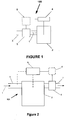
- FIG. 1 is a schematic representation of a system 100.
- Substrate stream 1 enters the bioreactor 2 via a suitable conduit 3.
- Substrate stream 1 comprises CO and in certain embodiments, the substrate stream is a waste gas stream from an industrial process, such as the decarburisation of steel.
- Substrate stream 1 may be a constant stream in the sense that it is constantly supplied, but the content of the stream may vary over time.
- Bioreactor 2 is configured to perform the desired fermentation reaction to produce products.
- Bioreactor 2 may be configured to convert CO into products including one or more acids and/or alcohols.
- Bioreactor 2 may comprise more than one tank, each tank configured to perform the same reaction and/or different stages within a particular fermentation process and/or different reactions, including different reactions for different fermentations that may include one or more common stages.
- bioreactor 2 The products produced in bioreactor 2, such as acids and/or alcohols, may be recovered by any recovery process known in the art.
- pH of the fermentation media can be monitored by pH measurement means 4.
- an operator can optionally make adjustments to microbial culture in bioreactor 2 and/or the substrate stream 1 using adjustment means 5 to maintain the microbial culture at, or transition the culture such that the substrate is supplied at an optimum level, towards an optimum level, or within an optimum range, in response to pH changes.
- Adjustments to the level of CO provided to the culture includes one or more of: changing CO concentration of the fermentation broth; changing composition of the substrate stream; changing pressure of the substrate stream; fermentation broth agitation rate.
- system 100 includes optional processing means 6 adapted to determine pH of the fermentation broth and control adjustment means 5, such that the substrate is supplied to the microbial culture at an optimum level, or within an optimum range.
- adjustments means 5 can be configured to make continuous adjustments or adjustments at discrete time points if necessary.
- 4 is a determining means configured to determine the concentration of acid, such as acetate, in the bioreactor 2. If the concentration of acid is determined to be above a predetermined threshold, the adjustment means 5 can increase the substrate supplied to the bioreactor 2. Any known determining means may be used to measure the concentration of acid in the bioreactor 2. However, by way of example, HPLC, GCMS, LCMS and/or NIR may be used.
- FIG. 2 is a schematic representation of a system 101.
- Substrate stream 1 enters the bioreactor 2 via a suitable conduit 3.
- Substrate stream 1 comprises CO and in certain embodiments, the substrate stream is a waste gas stream from an industrial process, such as the decarburisation of steel.
- Substrate stream 1 may be a constant stream in the sense that it is constantly supplied, but the content of the stream may vary over time.
- the substrate stream may comprise little or no H2 such as less than 5%, or less than 4%, or less than 3%, or less than 2%, or less than 1% or 0% H2.
- Bioreactor 2 is configured to perform the desired fermentation reaction to produce products.
- Bioreactor 2 may be configured to convert CO into products including one or more acids and/or alcohols.
- Bioreactor 2 may comprise more than one tank, each tank configured to perform the same reaction and/or different stages within a particular fermentation process and/or different reactions, including different reactions for different fermentations that may include one or more common stages.
- bioreactor 2 The products produced in bioreactor 2, such as acids and/or alcohols, may be recovered by any recovery process known in the art.
- Measuring means 8 may be adapted to determine the H2 and optionally CO and CO2 concentration in the exhausted stream exiting bioreactor 2 via exhaust outlet 4.
- the amount of hydrogen produced by the microbial culture may be determined. Accordingly, an operator can optionally make adjustments to microbial culture in bioreactor 2 and/or the substrate stream 1 using adjustment means 9 to maintain the microbial culture at, or transition the culture such that the substrate is supplied at an optimum level, towards an optimum level, or within an optimum range.
- Adjustments to maintain or transition the culture includes one or more of: changing CO concentration of the fermentation broth; changing composition of the substrate stream; changing pressure of the substrate stream; fermentation broth agitation rate. Additionally or alternatively, system 101 includes optional processing means 6 adapted to determine hydrogen concentration of the exhaust stream and control adjustment means 9, such that the substrate is supplied to the microbial culture at an optimum level, or within an optimum range.
- the hydrogen exiting bioreactor 2 can be monitored continuously or at discrete time point. Furthermore, adjustments means 9 can be configured to make continuous adjustments or adjustments at discrete time points if necessary.
- Any means for determining the hydrogen produced by the culture can be used, however typically; one or more gas chromatographs are used to determine H2 concentrations of the stream exiting the bioreactor 2 and optionally substrate stream 1.
- the means for determining the H2 concentrations in the stream exiting bioreactor 2 may be a Varian CP-4900 micro GC.
- Solution A NH 4 Ac 3.083g KCl 0.15g MgCl 2 .6H 2 O 0.4g NaCl (optional) 0.12g CaCl 2 .2H 2 O 0.294g Distilled Water I Up to 1L Solution B Biotin 20.0 mg Calcium D-(*)-pantothenate 50.0 mg Folic acid 20.0 mg Vitamin B12 50.0 mg Pyridoxine. HCI 10.0 mg p-Aminobenzoic acid 50.0 mg Thiamine.
- a 1 L three necked flask was fitted with a gas tight inlet and outlet to allow working under inert gas and subsequent transfer of the desired product into a suitable storage flask.
- the flask was charged with CrCl 3 .6H 2 0 (40g, 0.15 mol), zinc granules [20 mesh] (18.3g, 0.28 mol), mercury (13.55g, 1mL, 0.0676 mol) and 500 ml of distilled water. Following flushing with N 2 for one hour, the mixture was warmed to about 80°C to initiate the reaction. Following two hours of stirring under a constant N 2 flow, the mixture was cooled to room temperature and continuously stirred for another 48 hours by which time the reaction mixture had turned to a deep blue solution. The solution was transferred into N 2 purged serum bottles and stored in the fridge for future use.
- Clostridium autoethanogenum used is that deposited at the German Resource Centre for Biological Material (DSMZ) and allocated the accession number 19630.
- Channel 1 was a 10m Mol-sieve column running at 70°C, 200kPa argon and a backflush time of 4.2s
- channel 2 was a 10m PPQ column running at 90°C, 150kPa helium and no backflush.
- the injector temperature for both channels was 70°C. Runtimes were set to 120s, but all peaks of interest would usually elute before 100s.
- Cell density was determined by counting bacterial cells in a defined aliquot of fermentation broth. Alternatively, the absorbance of the samples was measured at 600nm (spectrophotometer) and the dry mass determined via calculation according to published procedures.
- Solution F (15mL) was added, the pH was adjusted to 5.5 and the solution sparged with N2 before switching to CO containing gas (50% CO; 50% N2) at 40mL/min.
- the reactor was then inoculated with 150 ml of a Clostridium autoethanogenum culture. The bioreactor was maintained at 37°C and stirred at 300 rpm. During the growth phase, the agitation was increased to stepwise to 800rpm.
- Metabolite and microbial growth can be seen in Figure 3 .
- substrate supply was increased by increasing agitation and/or gas flow rate.
- FIG 3 it can be seen that exponential growth occurs between day 0.5 and 1.2.
- the substrate supply was increased in accordance with microbial growth to maintain hydrogen production by the culture at a level between approx 1-2.5mol%.
- the CO supply was increased, however H2 production dropped substantially, indicating a slight oversupply of substrate.
- H2 production and CO consumption can be seen in Figure 4 . While the culture continues to grow and produce metabolites after day 1.2, the growth rate substantially slows and is no longer exponential.
- substrate supply such that H2 is produced, ethanol is produced without concomitant acid production.
- Table 1 shows that by maintaining substrate supply such that hydrogen is produced by the culture, specific CO uptake can be maintained at a high level of at least 0.6mmol/g/min and up to approx 1.2mmol/g/min.
- Table 1 H2 production, as a function of CO consumed and specific CO uptake during the exponential growth period of Example 1.
- Day H2 produced /CO consumed (mol%) Specific CO uptake mmol/ g biomass/min 0.53 1.9 0.3 0.58 1.2 0.6 0.68 1.8 0.8 0.74 1.7 0.8 0.78 1.6 1.0 0.92 1.8 1.2 0.97 0.93 1.2 1.02 1 1.2 1.3 1.07 1.9 1.3 1.11 2.3 1.1 1.15 2.4 1.0 1.19 2.4 0.9
- a 1L bioreactor was charged with 400ml Solution E media, prepared as described above under a constant flow of N2.
- the gas was switched to CO containing gas (50% CO; 50%N2) at atmospheric pressure prior to inoculation with 400 ml of a Clostridium autoethanogenum culture.
- the bioreactor was maintained at 37°C stirred at 400 rpm at the start of the culture. During the growth phase, the agitation was increased to 400 rpm.
- the pH was maintained at 5.5 before allowing it to drop to pH 5.3.
- the culture was switched to continuous operation by adding fresh media at a dilution rate of approximately 1 reactor volume per day.
- the fresh media was prepared in accordance with the above, but contained additional nickel (approx 0.5mL/L of a 0.1M solution).
- biomass was maintained at a constant level by supplying substrate such that H2 was continuously produced (see Figures 5 and 6 ).
- substrate supply was increased such that specific uptake increased to approx 0.8-0.9mmol/g/min (see Table 2).
- Ethanol productivity increased to approx 9-10g/L/day, while acetate productivity remained at 6-8g/L/day.
- Table 2 H2 production, as a function of CO consumed and specific CO uptake during the exponential growth period of Example 2.
- a 1L bioreactor was charged with 200ml Solution E media prepared as described above, under a constant flow of N2.
- the gas was switched to CO containing gas (50% CO; 20% CO2; 3% H2; 27% N2) at atmospheric pressure prior to inoculation with 800 ml of a Clostridium autoethanogenum culture.
- the bioreactor was maintained at 37°C stirred at 200 rpm at the start of the culture. During the growth phase, the agitation was increased to 400 rpm.
- the pH was adjusted to 5.5 and maintained by automatic addition of 5 M NaOH. Following an initial growth period, the culture was switched to continuous operation by adding fresh media at a dilution rate of approximately 1 reactor volume per day.
- Microbial growth, metabolite production and gas consumption/production data can be seen in Figures 7 and 8 .
- Substrate supply was increased over time by increasing agitation and gas flow. At day 1.9, agitation was increased 100rpm every two hours for 8 hours. During that time, CO consumption increased and H2 production increased slightly, indicating CO being supplied at or approaching an optimum level. During this time, specific CO uptake increases from 0.6mmol/g/min up to 0.9mmol/g/min.
- Solution F (15mL) was added, the pH was adjusted to 5.5 and the solution sparged with N2 before switching to CO containing gas (50% CO; 50% N2) at 40mL/min.
- the reactor was then inoculated with 150 ml of a Clostridium autoethanogenum culture. The bioreactor was maintained at 37°C and stirred at 300 rpm. During the growth phase, the agitation was increased to stepwise to 800rpm.
- Metabolite and microbial growth can be seen in Figure 9 .
- substrate supply was increased by increasing agitation and/or gas flow rate.
- FIG 9 it can be seen that exponential growth occurs between day 0.5 and 1.2.
- the substrate supply was increased in accordance with microbial growth to maintain pH of the media between approximately pH 5 and 5.6 as shown in Figure 10 .
- the substrate availability was increased slowly by increasing agitation and/or gas flow.
- the substrate was provided such that there was a net conversion of acetate to ethanol in addition to microbial growth and alcohol biosynthesis.
- the pH increased slowly to approximately 5.6.
- Table 1 shows that by maintaining substrate supply such that pH is maintained within a desirable range, specific CO uptake can be maintained at a high level of at least 0.6mmol/g/min and up to approx 1.2mmol/g/min.
- Table 1 pH and specific CO uptake during the exponential growth period of Example 1.
- Day pH Specific CO uptake mmol/ g biomass/min 0.53 5.1 0.3 0.58 5.2 0.6 0.68 5.2 0.8 0.74 5.3 0.8 0.78 5.3 1.0 0.92 5.3 1.2 0.97 5.5 1.2 1.02 5.6 1.3 1.07 5.3 1.3 1.11 5.1 1.1 1.15 5.0 1.0 1.19 4.9 0.9
- Example 5A Continuous fermentation in CSTR
- Media was prepared as follows: 100 ml of Solution A was added to 1.7L of water. 85% H 3 PO 4 (30mM) was added and the media solution was sterilised by autoclaving for 30 minutes at 121°C, or by filter sterilisation prior to use. The media solution was aseptically and anaerobically transferred into a 3 L CSTR vessel, and continuously sparged with N 2 .
- the microbial culture was allowed to grow in batch mode for approximately 1 day. At day 1, the fermentation was switched to continuous operation wherein fresh media was provided at a dilution rate of approximately 1.5 to 1.8 reactor volumes per day. Substrate supply was increased automatically in response to the requirements of the microbial culture in accordance with the invention (described below).
- Results of the fermentation are shown in Figures 11-12 .
- the substrate supply rate and agitation rate were increased or decreased automatically over the time course of the fermentation in response to changes in pH.
- the pH was automatically maintained at approximately pH 5.5 by increasing the substrate supply.
- the substrate was provided such that a substantially constant rate of pH change was achieved. If the rate of change increased, the substrate supply was automatically increased to bring the pH rate of change back to a predetermined value. Conversely, if the rate of change decreased (or the pH started to increase), the substrate supply was decreased.
- the rate of pH change was approximately three pH units per day.
- All liquid fermentation broth from example 5A was directed into a 3L CSTR fitted with a hydrophilic Xampler cell recycle membrane from GE Healthcare, pore size: 0.1 NMWC, fibre internal diameter: 1mm, membrane area: 0.011 m2.
- the fermenter was operated such that a constant volume was maintained and continuously provided with a substrate stream comprising 2%H2, 33% N2, 45%CO and 22% CO2.
- the cell recycle loop was operated such that approximately 70% of the microbial biomass was retained in the fermenter at each pass.
- Substrate gas was automatically provided such that pH was substantially maintained at approximately 5.3.
- the substrate supply was decreased.
- the pH started to decrease the substrate supply was increased. Results of the fermentation are shown in Figures 13-14 .
- the substrate supply automatically increases to maintain a substantially constant pH. Maintaining a constant pH slightly below the pH of the incoming fermentation broth results in a net conversion of acetate into ethanol. During fermentation, no acetate was produced, so the net level in the fermenter decreased to less than 5g/L, while the ethanol accumulated to at least 40g/L. Operating the fermenter in this manner resulted in a constant production of H2. Between day 6 and 7, the amount of H2 produced by the culture was approximately 1mol%.
- a 2L CSTR was set up under the following conditions: Media was prepared as follows: 85% H 3 PO 4 (30mM) was added to 1.5L of solution A. The pH of the media was adjusted to 5.3 by the addition of NH4OH. The media solution was sterilised by autoclaving for 30 minutes at 121°C, or by filter sterilisation prior to use. Resazurin was added as a redox indicator. The media solution was aseptically and anaerobically transferred into a 1.5 L CSTR vessel, and continuously sparged with N 2 . Once transferred to the fermentation vessel, the reduction state and pH of the transferred media could be measured directly via probes.
- the media was heated to 37°C and stirred at 300rpm, then trace metal solution J (1.5mL) and nitriloactetic acid (0.15M solution, 0.3ml), then Na2WO3 (1.5mL of a 0.01M solution) then Solution K (15mL) were added. Prior to inoculation, the gas was switched to 50% N2 and 50% CO. An actively growing Clostridium autoethanogenum culture was inoculated into the CSTR at a level of approximately 12% (v/v). During this experiment, Na2S (0.2M) solution was added at a rate of approx 0.3ml/hour.
- the microbial culture was allowed to grow in batch mode for approximately 1 day. At day 1, the fermentation was switched to continuous operation wherein fresh media was provided. Substrate supply was increased in response to the requirements of the microbial culture. Results of the fermentation are shown in Figures 15-16 . Following an initial period of stabilisation, the fermentation was operated such that the biomass stabilised at approximately 3g/L, while acetate was maintained at a concentration of approximately 5g/L and ethanol was maintained at a concentration of 15-20g/L. At a dilution rate of approximately 1.5, the specific acetate productivity is approximately 1.2g/g biomass/day, while the ethanol productivity ranges from approximately 4-6g/g biomass/day.
- H2 was also produced throughout the fermentation at levels exceeding 1mol%.
Landscapes
- Chemical & Material Sciences (AREA)
- Organic Chemistry (AREA)
- Engineering & Computer Science (AREA)
- Wood Science & Technology (AREA)
- Zoology (AREA)
- Life Sciences & Earth Sciences (AREA)
- Health & Medical Sciences (AREA)
- Bioinformatics & Cheminformatics (AREA)
- Microbiology (AREA)
- Biochemistry (AREA)
- Biotechnology (AREA)
- General Engineering & Computer Science (AREA)
- General Health & Medical Sciences (AREA)
- Genetics & Genomics (AREA)
- General Chemical & Material Sciences (AREA)
- Chemical Kinetics & Catalysis (AREA)
- Analytical Chemistry (AREA)
- Biomedical Technology (AREA)
- Sustainable Development (AREA)
- Immunology (AREA)
- Molecular Biology (AREA)
- Proteomics, Peptides & Aminoacids (AREA)
- Computer Hardware Design (AREA)
- Preparation Of Compounds By Using Micro-Organisms (AREA)
- Apparatus Associated With Microorganisms And Enzymes (AREA)
Claims (8)
- Verfahren zur Optimierung der Zufuhr eines Substrats, das CO umfasst, in einen Bioreaktor, wobei das Substrat fermentiert wird, um Produkte einschließlich eines oder mehrerer Alkohole und/oder einer oder mehrerer Säuren mittels einer Kultur von einem oder mehreren carboxydotrophen Mikroorganismen herzustellen, wobei das Verfahren das Bestimmen des Säuregehalts in dem Bioreaktor zu einem ersten Zeitpunkt und zu einem zweiten Zeitpunkt umfasst, wobei ein Anstieg im Säuregehalt zwischen dem ersten und dem zweiten Zeitpunkt zu einer Erhöhung der Substratzufuhr führt, wobei eine Abnahme im Säuregehalt zwischen dem ersten und dem zweiten Zeitpunkt zu einer Abnahme der Substratzufuhr führt, und wobei das Substrat derart zugeführt wird, dass die Säuregehalte zwischen vorbestimmten Schwellenwertkonzentrationen von 1 bis 10 g/L an Fermentationsbrühe gehalten werden.
- Verfahren nach Anspruch 1, wobei die Säuregehalte durch Messen des pH-Werts der Kultur bestimmt werden.
- Verfahren nach Anspruch 2, wobei die Substratzufuhr als Reaktion auf eine detektierte Änderung im pH-Wert der Fermentationsbrühe angepasst wird.
- Verfahren nach Anspruch 2 oder 3, wobei der pH-Wert in einem Bereich von 5 bis 6 aufrechterhalten wird.
- Verfahren nach Anspruch 3, wobei die Substratzufuhr durch Aufrechterhalten des pH-Werts der Fermentationsbrühe auf einer konstanten Änderungsrate gesteuert wird.
- Verfahren nach einem der vorstehenden Ansprüche, wobei der Mikroorganismus Clostridium autoethanogenum, Clostridium ljungdahlii, Clostridium ragsdalei oder Clostridium carboxydivorans ist.
- Verfahren nach einem der vorstehenden Ansprüche, wobei der Säuregehalt zwischen 2 und 8 g/l an Fermentationsbrühe aufrechterhalten wird.
- Verfahren nach einem der vorstehenden Ansprüche, wobei Produkte in einem Verhältnis von mindestens 2:1 Alkohol(en) zu Säure(n) hergestellt werden.
Priority Applications (2)
| Application Number | Priority Date | Filing Date | Title |
|---|---|---|---|
| EP20183020.5A EP3739056A1 (de) | 2009-07-02 | 2010-07-02 | Verfahren zur alkoholherstellung |
| PL10794423T PL2449121T3 (pl) | 2009-07-02 | 2010-07-02 | Sposób wytwarzania alkoholu |
Applications Claiming Priority (3)
| Application Number | Priority Date | Filing Date | Title |
|---|---|---|---|
| US22292009P | 2009-07-02 | 2009-07-02 | |
| US22634109P | 2009-07-17 | 2009-07-17 | |
| PCT/NZ2010/000136 WO2011002318A1 (en) | 2009-07-02 | 2010-07-02 | Alcohol production process |
Related Child Applications (2)
| Application Number | Title | Priority Date | Filing Date |
|---|---|---|---|
| EP20183020.5A Division-Into EP3739056A1 (de) | 2009-07-02 | 2010-07-02 | Verfahren zur alkoholherstellung |
| EP20183020.5A Division EP3739056A1 (de) | 2009-07-02 | 2010-07-02 | Verfahren zur alkoholherstellung |
Publications (3)
| Publication Number | Publication Date |
|---|---|
| EP2449121A1 EP2449121A1 (de) | 2012-05-09 |
| EP2449121A4 EP2449121A4 (de) | 2014-01-01 |
| EP2449121B1 true EP2449121B1 (de) | 2020-09-02 |
Family
ID=43411221
Family Applications (2)
| Application Number | Title | Priority Date | Filing Date |
|---|---|---|---|
| EP10794423.3A Active EP2449121B1 (de) | 2009-07-02 | 2010-07-02 | Verfahren zur alkoholherstellung |
| EP20183020.5A Withdrawn EP3739056A1 (de) | 2009-07-02 | 2010-07-02 | Verfahren zur alkoholherstellung |
Family Applications After (1)
| Application Number | Title | Priority Date | Filing Date |
|---|---|---|---|
| EP20183020.5A Withdrawn EP3739056A1 (de) | 2009-07-02 | 2010-07-02 | Verfahren zur alkoholherstellung |
Country Status (8)
| Country | Link |
|---|---|
| US (2) | US20110212433A1 (de) |
| EP (2) | EP2449121B1 (de) |
| KR (1) | KR101742835B1 (de) |
| CN (2) | CN107858381A (de) |
| ES (1) | ES2827845T3 (de) |
| PL (1) | PL2449121T3 (de) |
| PT (1) | PT2449121T (de) |
| WO (1) | WO2011002318A1 (de) |
Families Citing this family (30)
| Publication number | Priority date | Publication date | Assignee | Title |
|---|---|---|---|---|
| WO2010064932A1 (en) | 2008-12-01 | 2010-06-10 | Lanzatech New Zealand Limited | Optimised fermentation media |
| CN102361989B (zh) | 2009-01-29 | 2014-03-12 | 兰扎泰克新西兰有限公司 | 醇的生产方法 |
| DK3399019T3 (da) | 2009-02-26 | 2021-06-28 | Lanzatech New Zealand Ltd | Fremgangsmåder til bevaring af kulturs levedygtighed |
| ES2690151T3 (es) | 2010-01-14 | 2018-11-19 | Lanzatech New Zealand Limited | Fermentación de CO2 usando un potencial eléctrico |
| WO2011112103A1 (en) | 2010-03-10 | 2011-09-15 | Lanzatech New Zealand Limited | Acid production by fermentation |
| KR101950042B1 (ko) * | 2010-12-03 | 2019-02-19 | 이네오스 바이오 에스에이 | 비 co-흡수 조절을 포함하는 발효 방법 |
| US9663802B2 (en) * | 2014-07-09 | 2017-05-30 | Synata Bio, Inc. | Processes for removing co-produced oxygenated organics from anaerobic fermentation broths for the bioconversion of syngas to product oxygenated organic compound |
| CN103184242B (zh) * | 2011-12-31 | 2016-08-03 | 新奥气化采煤有限公司 | 煤炭地下气化产品气体的生物利用方法 |
| EA024718B1 (ru) * | 2012-02-09 | 2016-10-31 | Ланцатек Нью Зилэнд Лимитед | Усовершенствованное улавливание углерода при брожении |
| US8735115B2 (en) * | 2012-03-30 | 2014-05-27 | Lanzatech New Zealand Limited | Method for controlling the sulphur concentration in a fermentation method |
| US9758800B2 (en) | 2012-07-11 | 2017-09-12 | Synata Bio, Inc. | Method for producing C4 oxygentates by fermentation using high oxidation state sulfur |
| EP2885415B1 (de) * | 2012-08-17 | 2022-08-03 | Easel Biotechnologies LLC | Zweistufenproduktion von höheren alkoholen |
| US10233478B2 (en) * | 2012-09-19 | 2019-03-19 | Ineos Bio Sa | Process for reducing CO2 emissions and increasing alcohol productivity in syngas fermentation |
| SG11201601044XA (en) | 2013-08-12 | 2016-03-30 | Genentech Inc | Compositions and method for treating complement-associated conditions |
| DK3047028T5 (da) * | 2013-09-22 | 2024-10-14 | Lanzatech Nz Inc | Fermenteringsfremgangsmåde |
| EP2902477A1 (de) * | 2014-01-29 | 2015-08-05 | Siemens VAI Metals Technologies GmbH | Erzeugung von C2-C5 Kohlenwasserstoffen mittels Bakterienfermentation |
| AU2015253042A1 (en) | 2014-05-01 | 2016-10-20 | Genentech, Inc. | Anti-factor D antibody variants and uses thereof |
| US9617566B2 (en) | 2014-07-11 | 2017-04-11 | Lanzatech New Zealand Limited | Control of bioreactor processes |
| EP3176248A4 (de) * | 2014-07-30 | 2018-06-13 | Sekisui Chemical Co., Ltd. | Vorrichtung zur herstellung von organischer substanz aus abfall und verfahren zur herstellung von organischer substanz aus abfall |
| US10113194B2 (en) | 2014-10-22 | 2018-10-30 | Lanzatech New Zealand Limited | Gas testing unit and method |
| FI3209786T3 (fi) | 2014-10-22 | 2023-06-13 | Lanzatech Nz Inc | Monivaiheisia bioreaktoriprosesseja |
| US10407510B2 (en) | 2015-10-30 | 2019-09-10 | Genentech, Inc. | Anti-factor D antibodies and conjugates |
| EP3368090A1 (de) | 2015-10-30 | 2018-09-05 | H. Hoffnabb-La Roche Ag | Anti-faktor-d-antikörpervarianten-konjugate und verwendungen davon |
| EP3411490B1 (de) | 2016-02-04 | 2020-11-04 | Lanzatech New Zealand Limited | Niederdrucksortierer mit internem teiler und verwendungen dafür |
| MY189593A (en) | 2017-06-13 | 2022-02-18 | Lanzatech Inc | Improvements in biological conversion and product recovery processes |
| SG11202007617UA (en) | 2018-02-12 | 2020-09-29 | Lanzatech Inc | Integrated process for filtering constituents from a gas stream |
| JP2021532805A (ja) * | 2018-08-08 | 2021-12-02 | ジュペン バイオ (エイチケイ) リミテッド | 二酸化炭素の生物変換方法 |
| JP7825557B2 (ja) * | 2020-01-16 | 2026-03-06 | ジュペン バイオ (エイチケイ) リミテッド | 生物変換のためのプロセス制御 |
| KR102494796B1 (ko) * | 2020-04-20 | 2023-02-01 | 현대제철 주식회사 | 바이오 연료 제조방법 |
| CN115141714B (zh) * | 2022-06-14 | 2025-06-24 | 贵州金泽新能源科技有限公司 | 一种厌氧菌发酵系统及发酵方法 |
Family Cites Families (24)
| Publication number | Priority date | Publication date | Assignee | Title |
|---|---|---|---|---|
| US4533211A (en) | 1983-01-31 | 1985-08-06 | International Business Machines Corporation | Frequency multiplexed optical spatial filter based upon photochemical hole burning |
| US5173429A (en) | 1990-11-09 | 1992-12-22 | The Board Of Trustees Of The University Of Arkansas | Clostridiumm ljungdahlii, an anaerobic ethanol and acetate producing microorganism |
| US5807722A (en) | 1992-10-30 | 1998-09-15 | Bioengineering Resources, Inc. | Biological production of acetic acid from waste gases with Clostridium ljungdahlii |
| US5821111A (en) * | 1994-03-31 | 1998-10-13 | Bioengineering Resources, Inc. | Bioconversion of waste biomass to useful products |
| US6136577A (en) * | 1992-10-30 | 2000-10-24 | Bioengineering Resources, Inc. | Biological production of ethanol from waste gases with Clostridium ljungdahlii |
| US5593886A (en) | 1992-10-30 | 1997-01-14 | Gaddy; James L. | Clostridium stain which produces acetic acid from waste gases |
| KR100387301B1 (ko) | 1996-07-01 | 2003-06-12 | 바이오 엔지니어링 리소스 인코포레이티드 | 폐가스로부터의 생성물의 생물학적 제조방법 |
| UA72220C2 (uk) * | 1998-09-08 | 2005-02-15 | Байоенджініерінг Рісорсиз, Інк. | Незмішувана з водою суміш розчинник/співрозчинник для екстрагування оцтової кислоти, спосіб одержання оцтової кислоти (варіанти), спосіб анаеробного мікробного бродіння для одержання оцтової кислоти (варіанти), модифікований розчинник та спосіб його одержання |
| WO2000068407A1 (en) | 1999-05-07 | 2000-11-16 | Bioengineering Resources, Inc. | Clostridium strains which produce ethanol from substrate-containing gases |
| WO2002008438A2 (en) * | 2000-07-25 | 2002-01-31 | Bioengineering Resources, Inc. | Methods for increasing the production of ethanol from microbial fermentation |
| US7588399B2 (en) | 2005-09-16 | 2009-09-15 | Black & Decker Inc. | PTO selector mechanism for parallel axis transmission |
| NZ546496A (en) * | 2006-04-07 | 2008-09-26 | Lanzatech New Zealand Ltd | Gas treatment process |
| US20070275447A1 (en) * | 2006-05-25 | 2007-11-29 | Lewis Randy S | Indirect or direct fermentation of biomass to fuel alcohol |
| US7704723B2 (en) | 2006-08-31 | 2010-04-27 | The Board Of Regents For Oklahoma State University | Isolation and characterization of novel clostridial species |
| NZ553984A (en) | 2007-03-19 | 2009-07-31 | Lanzatech New Zealand Ltd | Alcohol production process |
| US20080305540A1 (en) | 2007-06-08 | 2008-12-11 | Robert Hickey | Membrane supported bioreactor for conversion of syngas components to liquid products |
| US20090035848A1 (en) | 2007-08-03 | 2009-02-05 | Robert Hickey | Moving bed biofilm reactor (mbbr) system for conversion of syngas components to liquid products |
| CN102016052B (zh) | 2007-08-15 | 2015-04-29 | 朗泽科技新西兰有限公司 | 生产醇的工艺 |
| NZ560757A (en) | 2007-10-28 | 2010-07-30 | Lanzatech New Zealand Ltd | Improved carbon capture in microbial fermentation of industrial gases to ethanol |
| EA019266B1 (ru) | 2008-03-12 | 2014-02-28 | Ланзатек Нью Зиленд Лимитед | Микробиологический способ производства спирта |
| WO2010064933A1 (en) | 2008-12-01 | 2010-06-10 | Lanzatech New Zealand Limited | Optimised fermentation media |
| WO2010064932A1 (en) | 2008-12-01 | 2010-06-10 | Lanzatech New Zealand Limited | Optimised fermentation media |
| CN102361989B (zh) * | 2009-01-29 | 2014-03-12 | 兰扎泰克新西兰有限公司 | 醇的生产方法 |
| DK3399019T3 (da) | 2009-02-26 | 2021-06-28 | Lanzatech New Zealand Ltd | Fremgangsmåder til bevaring af kulturs levedygtighed |
-
2010
- 2010-07-02 EP EP10794423.3A patent/EP2449121B1/de active Active
- 2010-07-02 PT PT107944233T patent/PT2449121T/pt unknown
- 2010-07-02 CN CN201711092494.0A patent/CN107858381A/zh active Pending
- 2010-07-02 ES ES10794423T patent/ES2827845T3/es active Active
- 2010-07-02 EP EP20183020.5A patent/EP3739056A1/de not_active Withdrawn
- 2010-07-02 CN CN2010800301136A patent/CN102471783A/zh active Pending
- 2010-07-02 US US13/060,862 patent/US20110212433A1/en not_active Abandoned
- 2010-07-02 KR KR1020127003000A patent/KR101742835B1/ko active Active
- 2010-07-02 WO PCT/NZ2010/000136 patent/WO2011002318A1/en not_active Ceased
- 2010-07-02 PL PL10794423T patent/PL2449121T3/pl unknown
-
2013
- 2013-04-29 US US13/872,646 patent/US8906655B2/en active Active
Non-Patent Citations (1)
| Title |
|---|
| None * |
Also Published As
| Publication number | Publication date |
|---|---|
| PL2449121T3 (pl) | 2021-01-25 |
| US20110212433A1 (en) | 2011-09-01 |
| PT2449121T (pt) | 2020-09-21 |
| US20130252230A1 (en) | 2013-09-26 |
| KR20120055549A (ko) | 2012-05-31 |
| ES2827845T3 (es) | 2021-05-24 |
| EP2449121A1 (de) | 2012-05-09 |
| EP3739056A1 (de) | 2020-11-18 |
| WO2011002318A1 (en) | 2011-01-06 |
| KR101742835B1 (ko) | 2017-06-01 |
| CN107858381A (zh) | 2018-03-30 |
| CN102471783A (zh) | 2012-05-23 |
| EP2449121A4 (de) | 2014-01-01 |
| US8906655B2 (en) | 2014-12-09 |
Similar Documents
| Publication | Publication Date | Title |
|---|---|---|
| EP2449121B1 (de) | Verfahren zur alkoholherstellung | |
| EP2391724B1 (de) | Methode zur verbesserung der effizienz mikrobieller fermentation | |
| US8354269B2 (en) | Optimised media containing nickel for fermentation of carbonmonoxide | |
| EP3070170B1 (de) | Fermentation von co2 unter verwendung eines elektrischen potenzials | |
| EP2970868B1 (de) | Verfahren zur steuerung der metabolitenproduktion in einer mikrobiellen fermentierung | |
| WO2009022925A1 (en) | Processes of producing alcohols | |
| US20110300593A1 (en) | Optimised fermentation media | |
| US20110250629A1 (en) | Alcohol production process | |
| HK40040779A (en) | Alcohol production process | |
| HK1159184A (en) | Method of improving efficiency of microbial fermentation | |
| HK1159184B (en) | Method of improving efficiency of microbial fermentation | |
| NZ583586A (en) | Processes of producing alcohols by microbial fermentation of carbon monoxide |
Legal Events
| Date | Code | Title | Description |
|---|---|---|---|
| PUAI | Public reference made under article 153(3) epc to a published international application that has entered the european phase |
Free format text: ORIGINAL CODE: 0009012 |
|
| 17P | Request for examination filed |
Effective date: 20120201 |
|
| AK | Designated contracting states |
Kind code of ref document: A1 Designated state(s): AL AT BE BG CH CY CZ DE DK EE ES FI FR GB GR HR HU IE IS IT LI LT LU LV MC MK MT NL NO PL PT RO SE SI SK SM TR |
|
| DAX | Request for extension of the european patent (deleted) | ||
| A4 | Supplementary search report drawn up and despatched |
Effective date: 20131129 |
|
| RIC1 | Information provided on ipc code assigned before grant |
Ipc: C12P 7/42 20060101ALI20131125BHEP Ipc: C12P 7/06 20060101AFI20131125BHEP Ipc: C12M 1/00 20060101ALI20131125BHEP Ipc: C12P 7/54 20060101ALI20131125BHEP Ipc: C12P 1/04 20060101ALI20131125BHEP |
|
| 17Q | First examination report despatched |
Effective date: 20151001 |
|
| STAA | Information on the status of an ep patent application or granted ep patent |
Free format text: STATUS: EXAMINATION IS IN PROGRESS |
|
| REG | Reference to a national code |
Ref country code: DE Ref legal event code: R079 Ref document number: 602010065332 Country of ref document: DE Free format text: PREVIOUS MAIN CLASS: C12P0007060000 Ipc: C12M0001340000 |
|
| GRAP | Despatch of communication of intention to grant a patent |
Free format text: ORIGINAL CODE: EPIDOSNIGR1 |
|
| STAA | Information on the status of an ep patent application or granted ep patent |
Free format text: STATUS: GRANT OF PATENT IS INTENDED |
|
| RIC1 | Information provided on ipc code assigned before grant |
Ipc: C12M 1/36 20060101ALI20191217BHEP Ipc: C12M 1/34 20060101AFI20191217BHEP Ipc: C12P 7/54 20060101ALI20191217BHEP Ipc: C12P 7/06 20060101ALI20191217BHEP |
|
| INTG | Intention to grant announced |
Effective date: 20200117 |
|
| GRAS | Grant fee paid |
Free format text: ORIGINAL CODE: EPIDOSNIGR3 |
|
| GRAA | (expected) grant |
Free format text: ORIGINAL CODE: 0009210 |
|
| STAA | Information on the status of an ep patent application or granted ep patent |
Free format text: STATUS: THE PATENT HAS BEEN GRANTED |
|
| AK | Designated contracting states |
Kind code of ref document: B1 Designated state(s): AL AT BE BG CH CY CZ DE DK EE ES FI FR GB GR HR HU IE IS IT LI LT LU LV MC MK MT NL NO PL PT RO SE SI SK SM TR |
|
| REG | Reference to a national code |
Ref country code: GB Ref legal event code: FG4D |
|
| REG | Reference to a national code |
Ref country code: AT Ref legal event code: REF Ref document number: 1308823 Country of ref document: AT Kind code of ref document: T Effective date: 20200915 Ref country code: CH Ref legal event code: EP |
|
| REG | Reference to a national code |
Ref country code: DE Ref legal event code: R096 Ref document number: 602010065332 Country of ref document: DE |
|
| REG | Reference to a national code |
Ref country code: PT Ref legal event code: SC4A Ref document number: 2449121 Country of ref document: PT Date of ref document: 20200921 Kind code of ref document: T Free format text: AVAILABILITY OF NATIONAL TRANSLATION Effective date: 20200914 |
|
| REG | Reference to a national code |
Ref country code: FI Ref legal event code: FGE |
|
| REG | Reference to a national code |
Ref country code: IE Ref legal event code: FG4D |
|
| REG | Reference to a national code |
Ref country code: SE Ref legal event code: TRGR |
|
| REG | Reference to a national code |
Ref country code: NL Ref legal event code: FP |
|
| REG | Reference to a national code |
Ref country code: NO Ref legal event code: T2 Effective date: 20200902 |
|
| REG | Reference to a national code |
Ref country code: LT Ref legal event code: MG4D |
|
| PG25 | Lapsed in a contracting state [announced via postgrant information from national office to epo] |
Ref country code: BG Free format text: LAPSE BECAUSE OF FAILURE TO SUBMIT A TRANSLATION OF THE DESCRIPTION OR TO PAY THE FEE WITHIN THE PRESCRIBED TIME-LIMIT Effective date: 20201202 Ref country code: HR Free format text: LAPSE BECAUSE OF FAILURE TO SUBMIT A TRANSLATION OF THE DESCRIPTION OR TO PAY THE FEE WITHIN THE PRESCRIBED TIME-LIMIT Effective date: 20200902 Ref country code: LT Free format text: LAPSE BECAUSE OF FAILURE TO SUBMIT A TRANSLATION OF THE DESCRIPTION OR TO PAY THE FEE WITHIN THE PRESCRIBED TIME-LIMIT Effective date: 20200902 Ref country code: GR Free format text: LAPSE BECAUSE OF FAILURE TO SUBMIT A TRANSLATION OF THE DESCRIPTION OR TO PAY THE FEE WITHIN THE PRESCRIBED TIME-LIMIT Effective date: 20201203 |
|
| PG25 | Lapsed in a contracting state [announced via postgrant information from national office to epo] |
Ref country code: LV Free format text: LAPSE BECAUSE OF FAILURE TO SUBMIT A TRANSLATION OF THE DESCRIPTION OR TO PAY THE FEE WITHIN THE PRESCRIBED TIME-LIMIT Effective date: 20200902 |
|
| PG25 | Lapsed in a contracting state [announced via postgrant information from national office to epo] |
Ref country code: RO Free format text: LAPSE BECAUSE OF FAILURE TO SUBMIT A TRANSLATION OF THE DESCRIPTION OR TO PAY THE FEE WITHIN THE PRESCRIBED TIME-LIMIT Effective date: 20200902 Ref country code: SM Free format text: LAPSE BECAUSE OF FAILURE TO SUBMIT A TRANSLATION OF THE DESCRIPTION OR TO PAY THE FEE WITHIN THE PRESCRIBED TIME-LIMIT Effective date: 20200902 Ref country code: CZ Free format text: LAPSE BECAUSE OF FAILURE TO SUBMIT A TRANSLATION OF THE DESCRIPTION OR TO PAY THE FEE WITHIN THE PRESCRIBED TIME-LIMIT Effective date: 20200902 Ref country code: EE Free format text: LAPSE BECAUSE OF FAILURE TO SUBMIT A TRANSLATION OF THE DESCRIPTION OR TO PAY THE FEE WITHIN THE PRESCRIBED TIME-LIMIT Effective date: 20200902 |
|
| REG | Reference to a national code |
Ref country code: AT Ref legal event code: UEP Ref document number: 1308823 Country of ref document: AT Kind code of ref document: T Effective date: 20200902 |
|
| REG | Reference to a national code |
Ref country code: ES Ref legal event code: FG2A Ref document number: 2827845 Country of ref document: ES Kind code of ref document: T3 Effective date: 20210524 |
|
| PG25 | Lapsed in a contracting state [announced via postgrant information from national office to epo] |
Ref country code: IS Free format text: LAPSE BECAUSE OF FAILURE TO SUBMIT A TRANSLATION OF THE DESCRIPTION OR TO PAY THE FEE WITHIN THE PRESCRIBED TIME-LIMIT Effective date: 20210102 Ref country code: AL Free format text: LAPSE BECAUSE OF FAILURE TO SUBMIT A TRANSLATION OF THE DESCRIPTION OR TO PAY THE FEE WITHIN THE PRESCRIBED TIME-LIMIT Effective date: 20200902 |
|
| REG | Reference to a national code |
Ref country code: DE Ref legal event code: R097 Ref document number: 602010065332 Country of ref document: DE |
|
| PG25 | Lapsed in a contracting state [announced via postgrant information from national office to epo] |
Ref country code: SK Free format text: LAPSE BECAUSE OF FAILURE TO SUBMIT A TRANSLATION OF THE DESCRIPTION OR TO PAY THE FEE WITHIN THE PRESCRIBED TIME-LIMIT Effective date: 20200902 |
|
| PLBE | No opposition filed within time limit |
Free format text: ORIGINAL CODE: 0009261 |
|
| STAA | Information on the status of an ep patent application or granted ep patent |
Free format text: STATUS: NO OPPOSITION FILED WITHIN TIME LIMIT |
|
| 26N | No opposition filed |
Effective date: 20210603 |
|
| PG25 | Lapsed in a contracting state [announced via postgrant information from national office to epo] |
Ref country code: SI Free format text: LAPSE BECAUSE OF FAILURE TO SUBMIT A TRANSLATION OF THE DESCRIPTION OR TO PAY THE FEE WITHIN THE PRESCRIBED TIME-LIMIT Effective date: 20200902 Ref country code: DK Free format text: LAPSE BECAUSE OF FAILURE TO SUBMIT A TRANSLATION OF THE DESCRIPTION OR TO PAY THE FEE WITHIN THE PRESCRIBED TIME-LIMIT Effective date: 20200902 |
|
| REG | Reference to a national code |
Ref country code: CH Ref legal event code: PL |
|
| PG25 | Lapsed in a contracting state [announced via postgrant information from national office to epo] |
Ref country code: MC Free format text: LAPSE BECAUSE OF FAILURE TO SUBMIT A TRANSLATION OF THE DESCRIPTION OR TO PAY THE FEE WITHIN THE PRESCRIBED TIME-LIMIT Effective date: 20200902 |
|
| PG25 | Lapsed in a contracting state [announced via postgrant information from national office to epo] |
Ref country code: LI Free format text: LAPSE BECAUSE OF NON-PAYMENT OF DUE FEES Effective date: 20210731 Ref country code: CH Free format text: LAPSE BECAUSE OF NON-PAYMENT OF DUE FEES Effective date: 20210731 |
|
| PG25 | Lapsed in a contracting state [announced via postgrant information from national office to epo] |
Ref country code: LU Free format text: LAPSE BECAUSE OF NON-PAYMENT OF DUE FEES Effective date: 20210702 |
|
| PG25 | Lapsed in a contracting state [announced via postgrant information from national office to epo] |
Ref country code: IE Free format text: LAPSE BECAUSE OF NON-PAYMENT OF DUE FEES Effective date: 20210702 |
|
| PG25 | Lapsed in a contracting state [announced via postgrant information from national office to epo] |
Ref country code: HU Free format text: LAPSE BECAUSE OF FAILURE TO SUBMIT A TRANSLATION OF THE DESCRIPTION OR TO PAY THE FEE WITHIN THE PRESCRIBED TIME-LIMIT; INVALID AB INITIO Effective date: 20100702 Ref country code: CY Free format text: LAPSE BECAUSE OF FAILURE TO SUBMIT A TRANSLATION OF THE DESCRIPTION OR TO PAY THE FEE WITHIN THE PRESCRIBED TIME-LIMIT Effective date: 20200902 |
|
| P01 | Opt-out of the competence of the unified patent court (upc) registered |
Effective date: 20230516 |
|
| REG | Reference to a national code |
Ref country code: BE Ref legal event code: PD Owner name: LANZATECH NZ, INC.; US Free format text: DETAILS ASSIGNMENT: CHANGE OF OWNER(S), OTHER; FORMER OWNER NAME: NICHOLLS JEREMY Effective date: 20231201 Ref country code: BE Ref legal event code: HC Owner name: LANZATECH NZ, INC.; NZ Free format text: DETAILS ASSIGNMENT: CHANGE OF OWNER(S), CHANGE OF OWNER(S) NAME; FORMER OWNER NAME: LANZATECH NEW ZEALAND LIMITED Effective date: 20231201 |
|
| PG25 | Lapsed in a contracting state [announced via postgrant information from national office to epo] |
Ref country code: MK Free format text: LAPSE BECAUSE OF FAILURE TO SUBMIT A TRANSLATION OF THE DESCRIPTION OR TO PAY THE FEE WITHIN THE PRESCRIBED TIME-LIMIT Effective date: 20200902 |
|
| PG25 | Lapsed in a contracting state [announced via postgrant information from national office to epo] |
Ref country code: TR Free format text: LAPSE BECAUSE OF FAILURE TO SUBMIT A TRANSLATION OF THE DESCRIPTION OR TO PAY THE FEE WITHIN THE PRESCRIBED TIME-LIMIT Effective date: 20200902 |
|
| PGFP | Annual fee paid to national office [announced via postgrant information from national office to epo] |
Ref country code: PT Payment date: 20240619 Year of fee payment: 15 |
|
| PGFP | Annual fee paid to national office [announced via postgrant information from national office to epo] |
Ref country code: NL Payment date: 20240725 Year of fee payment: 15 |
|
| PG25 | Lapsed in a contracting state [announced via postgrant information from national office to epo] |
Ref country code: MT Free format text: LAPSE BECAUSE OF FAILURE TO SUBMIT A TRANSLATION OF THE DESCRIPTION OR TO PAY THE FEE WITHIN THE PRESCRIBED TIME-LIMIT Effective date: 20200902 |
|
| PGFP | Annual fee paid to national office [announced via postgrant information from national office to epo] |
Ref country code: FI Payment date: 20240725 Year of fee payment: 15 |
|
| PGFP | Annual fee paid to national office [announced via postgrant information from national office to epo] |
Ref country code: GB Payment date: 20240724 Year of fee payment: 15 |
|
| PGFP | Annual fee paid to national office [announced via postgrant information from national office to epo] |
Ref country code: BE Payment date: 20240725 Year of fee payment: 15 |
|
| PGFP | Annual fee paid to national office [announced via postgrant information from national office to epo] |
Ref country code: FR Payment date: 20240725 Year of fee payment: 15 |
|
| PGFP | Annual fee paid to national office [announced via postgrant information from national office to epo] |
Ref country code: ES Payment date: 20240806 Year of fee payment: 15 |
|
| PGFP | Annual fee paid to national office [announced via postgrant information from national office to epo] |
Ref country code: AT Payment date: 20240718 Year of fee payment: 15 |
|
| PGFP | Annual fee paid to national office [announced via postgrant information from national office to epo] |
Ref country code: NO Payment date: 20240718 Year of fee payment: 15 Ref country code: SE Payment date: 20240725 Year of fee payment: 15 Ref country code: IT Payment date: 20240722 Year of fee payment: 15 |
|
| PGFP | Annual fee paid to national office [announced via postgrant information from national office to epo] |
Ref country code: PL Payment date: 20250618 Year of fee payment: 16 |
|
| PGFP | Annual fee paid to national office [announced via postgrant information from national office to epo] |
Ref country code: DE Payment date: 20250728 Year of fee payment: 16 |
|
| REG | Reference to a national code |
Ref country code: NL Ref legal event code: MM Effective date: 20250801 |
|
| REG | Reference to a national code |
Ref country code: AT Ref legal event code: MM01 Ref document number: 1308823 Country of ref document: AT Kind code of ref document: T Effective date: 20250702 |
|
| GBPC | Gb: european patent ceased through non-payment of renewal fee |
Effective date: 20250702 |
|
| REG | Reference to a national code |
Ref country code: BE Ref legal event code: MM Effective date: 20250731 |
|
| PG25 | Lapsed in a contracting state [announced via postgrant information from national office to epo] |
Ref country code: GB Free format text: LAPSE BECAUSE OF NON-PAYMENT OF DUE FEES Effective date: 20250702 |
|
| PG25 | Lapsed in a contracting state [announced via postgrant information from national office to epo] |
Ref country code: NO Free format text: LAPSE BECAUSE OF NON-PAYMENT OF DUE FEES Effective date: 20250731 |
|
| PG25 | Lapsed in a contracting state [announced via postgrant information from national office to epo] |
Ref country code: FI Free format text: LAPSE BECAUSE OF NON-PAYMENT OF DUE FEES Effective date: 20250702 Ref country code: AT Free format text: LAPSE BECAUSE OF NON-PAYMENT OF DUE FEES Effective date: 20250702 |
|
| PG25 | Lapsed in a contracting state [announced via postgrant information from national office to epo] |
Ref country code: BE Free format text: LAPSE BECAUSE OF NON-PAYMENT OF DUE FEES Effective date: 20250731 |
|
| PG25 | Lapsed in a contracting state [announced via postgrant information from national office to epo] |
Ref country code: NL Free format text: LAPSE BECAUSE OF NON-PAYMENT OF DUE FEES Effective date: 20250801 |
|
| PG25 | Lapsed in a contracting state [announced via postgrant information from national office to epo] |
Ref country code: FR Free format text: LAPSE BECAUSE OF NON-PAYMENT OF DUE FEES Effective date: 20250731 |
|
| PG25 | Lapsed in a contracting state [announced via postgrant information from national office to epo] |
Ref country code: PT Free format text: LAPSE BECAUSE OF NON-PAYMENT OF DUE FEES Effective date: 20260102 |