EP2449743B1 - Procédé et appareil destinés à être utilisés dans un sous-système multimédia ip - Google Patents
Procédé et appareil destinés à être utilisés dans un sous-système multimédia ip Download PDFInfo
- Publication number
- EP2449743B1 EP2449743B1 EP09780154.2A EP09780154A EP2449743B1 EP 2449743 B1 EP2449743 B1 EP 2449743B1 EP 09780154 A EP09780154 A EP 09780154A EP 2449743 B1 EP2449743 B1 EP 2449743B1
- Authority
- EP
- European Patent Office
- Prior art keywords
- hss
- user
- cscf
- locking
- request
- Prior art date
- Legal status (The legal status is an assumption and is not a legal conclusion. Google has not performed a legal analysis and makes no representation as to the accuracy of the status listed.)
- Active
Links
Images





Classifications
-
- H—ELECTRICITY
- H04—ELECTRIC COMMUNICATION TECHNIQUE
- H04L—TRANSMISSION OF DIGITAL INFORMATION, e.g. TELEGRAPHIC COMMUNICATION
- H04L65/00—Network arrangements, protocols or services for supporting real-time applications in data packet communication
- H04L65/10—Architectures or entities
- H04L65/1016—IP multimedia subsystem [IMS]
-
- H—ELECTRICITY
- H04—ELECTRIC COMMUNICATION TECHNIQUE
- H04L—TRANSMISSION OF DIGITAL INFORMATION, e.g. TELEGRAPHIC COMMUNICATION
- H04L63/00—Network architectures or network communication protocols for network security
- H04L63/10—Network architectures or network communication protocols for network security for controlling access to devices or network resources
-
- H—ELECTRICITY
- H04—ELECTRIC COMMUNICATION TECHNIQUE
- H04L—TRANSMISSION OF DIGITAL INFORMATION, e.g. TELEGRAPHIC COMMUNICATION
- H04L65/00—Network arrangements, protocols or services for supporting real-time applications in data packet communication
- H04L65/1066—Session management
- H04L65/1073—Registration or de-registration
-
- H—ELECTRICITY
- H04—ELECTRIC COMMUNICATION TECHNIQUE
- H04L—TRANSMISSION OF DIGITAL INFORMATION, e.g. TELEGRAPHIC COMMUNICATION
- H04L65/00—Network arrangements, protocols or services for supporting real-time applications in data packet communication
- H04L65/1066—Session management
- H04L65/1076—Screening of IP real time communications, e.g. spam over Internet telephony [SPIT]
Definitions
- the present invention relates to a method and apparatus for use in an IP Multimedia Subsystem.
- IP Multimedia services provide a dynamic combination of voice, video, messaging, data, etc. within the same session.
- the number of services offered to the end users will grow, and the inter-personal communication experience will be enriched. This will lead to a new generation of personalised, rich multimedia communication services, including so-called "combinational IP Multimedia" services.
- the UMTS Universal Mobile Telecommunications System
- GSM Global System for Mobile Communications
- GPRS General Packet Radio Service
- PDNs packet data networks
- UMTS is standardised by the 3 rd Generation Partnership Project (3GPP) which is a conglomeration of regional standards bodies such as the European Telecommunication Standards Institute (ETSI), the Association of Radio Industry Businesses (ARIB) and others. See 3GPP TS 23.002 for more details.
- 3GPP 3 rd Generation Partnership Project
- the UMTS architecture includes a subsystem known as the IP Multimedia Subsystem (IMS) for supporting traditional telephony as well as new IP multimedia services (3GPP TS 22.228, TS 23.228, TS 24.229, TS 29.228, TS 29.229, TS 29.328 and TS 29.329 Releases 5 to 7).
- IMS IP Multimedia Subsystem
- the IMS is able to connect to both PSTN/ISDN (Public Switched Telephone Network/Integrated Services Digital Network) as well as the Internet.
- PSTN/ISDN Public Switched Telephone Network/Integrated Services Digital Network
- the IMS makes use of the Session Initiation Protocol (SIP) to set up and control calls or sessions between user terminals (or user terminals and application servers).
- SIP Session Initiation Protocol
- SDP Session Description Protocol
- SIP was created as a user-to-user protocol
- IMS allows operators and service providers to control user access to services and to charge users accordingly.
- the 3GPP has chosen SIP for signalling between a User Equipment (UE) and the IMS as well as between the components within the IMS.
- UE User Equipment
- FIG. 1 of the accompanying drawings illustrates schematically how the IMS fits into the mobile network architecture in the case of a GPRS/PS access network (IMS can of course operate over other access networks).
- IMS GPRS/PS access network
- CSCFs Call/Session Control Functions
- the 3GPP architecture defines three types of CSCFs: the Proxy CSCF (P-CSCF) which is the first point of contact within the IMS for a SIP terminal; the Serving CSCF (S-CSCF) which provides services to the user that the user is subscribed to; and the Interrogating CSCF (I-CSCF) whose role is to identify the correct S-CSCF and to forward to that S-CSCF a request received from a SIP terminal via a P-CSCF.
- P-CSCF Proxy CSCF
- S-CSCF Serving CSCF
- I-CSCF Interrogating CSCF
- a user registers with the IMS using the specified SIP REGISTER method. During the registration process, it is the responsibility of the I-CSCF to select a S-CSCF if a S-CSCF is not already selected.
- the I-CSCF receives the required S-CSCF capabilities from the home network's Home Subscriber Server (HSS), and selects an appropriate S-CSCF based on the received capabilities. It is noted that the allocation of an S-CSCF is key to controlling (and charging for) user access to IMS-based services.
- the P-CSCF When a registered user subsequently sends a session request to the IMS, the P-CSCF is able to forward the request to the selected S-CSCF based on information received from the S-CSCF during the registration process.
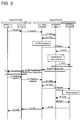
- FIG. 2 provides an illustration of a SIP registration procedure involving a challenge-response type of authentication; this illustration is taken from TS 29.228, and discussed in detail in that document, so a detailed further explanation is not required here.
- the I-CSCF of the Home Network receives the Register message 2 from the P-CSCF of the Visited Network (the P-CSCF having received a Register message 1 from the UA itself), it sends a User Authorization Request (UAR) message 3 to the HSS, to which the HSS responds with a User Authorization Answer (UAA) message 4.
- UAR User Authorization Request
- UAA User Authorization Answer
- MAR Multimedia Authentication Request
- MAA Multimedia Authentication Answer
- the authentication information feeds back to the UA via messages 8 to 10, and in reply the UA again sends a Register message 11, but this time including a response to the challenge.
- Messages 12 to 14 then correspond to messages 2 to 4 respectively.
- the Register message 15, including challenge response, is sent from the I-CSCF to the S-CSCF, and (in this case) the S-CSCF is able to authenticate the UA, sending a Server Assignment Request (SAR) message 18 to the HSS, to which the HSS answers with a Server Assignment Answer (SAA) message 19.
- SAR Server Assignment Request
- SAA Server Assignment Answer
- WO 2008/061570 relates to a method of authenticating a user, with the authentication method involving an exchange between a S-CSCF and a HSS. If the authentication process fails, then the user is blacklisted or blocked.
- US2005/159157 discloses a method and communication system for authentication of requests.
- 3GPP TS x2.140 V0.5.0 (2002-2) discloses an "administrative state” and an “operational state” which is maintained at the HSS for the purpose of locking and unlocking a user at the HSS.
- a method for use by a Serving Call Session Control Function, S-CSCF, of an IP Multimedia Subsystem, IMS comprising receiving a challengeable request from a user, performing a number of failed authentication attempts of the user following receipt of the request, determining that the number of failed authentication attempts has reached a predetermined number, and characterised by, following such a determination: sending a locking signal from the S-CSCF to a Home Subscriber Service, HSS, of the IMS to indicate to the HSS that the user should be locked at the HSS, such that any request received from the user at another node of the IMS requiring an authentication challenge can be rejected with reference to the HSS, and subsequently unlocking the user in response to receipt of an unlock signal from the HSS.
- S-CSCF Serving Call Session Control Function
- IMS IP Multimedia Subsystem
- the method may alternatively or in addition comprise, following the determination, locking the user at the S-CSCF, such that any request received from the user at the S-CSCF requiring an authentication challenge can be rejected by the S-CSCF.
- the locking signal may be carried by a Server Assignment Request, SAR, message.
- the at least one such unlock signal may be carried by a Registration Termination Request, RTR, message.
- the method may comprise maintaining a locking timer at the S-CSCF and at least one such unlock signal may be generated by the locking timer upon expiry of the locking timer.
- Such a locking timer may also be maintained at the HSS.
- the method may comprise coordinating the locking timer maintained at the S-CSCF with that maintained at the HSS by use of signalling between the HSS and the S-CSCF.
- an apparatus for use as or in a Serving Call Session Control Function, S-CSCF, of an IP Multimedia Subsystem, IMS comprising means for receiving a challengeable request from a user, performing a number of failed authentication attempts of the user following receipt of the request, determining that the number of failed authentication attempts has reached a predetermined number, and characterised by, following such a determination: (a) sending a locking signal from the S-CSCF to a Home Subscriber Service, HSS, of the IMS to indicate to the HSS that the user should be locked at the HSS, such that any request received from the user at another node of the IMS requiring an authentication challenge can be rejected with reference to the HSS, and subsequently unlocking the user in response to receipt of an unlock signal from the HSS.
- S-CSCF Serving Call Session Control Function
- IMS IP Multimedia Subsystem
- the means may alternatively or in addition be for, following the determination, locking the user at the S-CSCF, such that any request received from the user at the S-CSCF requiring an authentication challenge can be rejected by the S-CSCF.
- a program for controlling an apparatus to perform a method according to the first aspect of the present invention or which, when loaded into an apparatus, causes the apparatus to become an apparatus according to the second aspect of the present invention may be carried on a carrier medium.
- the carrier medium may be a storage medium.
- the carrier medium may be a transmission medium.
- an apparatus programmed by a program according to the third aspect of the present invention.
- a storage medium containing a program according to the third aspect of the present invention.
- An embodiment of the present invention offers a technical advantage of addressing the issue mentioned above relating to the prior art.
- Technical advantages are set out in more detail below.
- An embodiment of the present invention aims to address a problem mentioned above, which arises where a malicious user sends multiple requests to the system, each requiring authentication, for example in an attempt to determine the password of another user.
- the S-CSCF would have a counter that counts the number of failed registration attempts for a specific user. When the number of failed attempts is equal to a certain value in the S-CSCF, the user would be locked out for a certain amount of time. During that time, all registrations for that user would be rejected by the S-CSCF. The locking would be cleared after a certain time.
- the locking could also be cleared if the S-CSCF receives an administrative Registration Termination Request (RTR) for the user from the HSS, for example if the user has called operator customer support for help.
- RTR Registration Termination Request
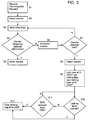
- Figure 3 is from the point of view of the S-CSCF.
- step S1 of Figure 3 a challengeable request is received from a user (such as a Register request, or any other type of request where the S-CSCF has a local policy or configuration to challenge the request).
- a counter is reset in step S2.
- step S3 a challenge is sent to the user.
- step S4 it is determined whether a correct response to the challenge has been received within a predetermined time. If yes, then the request received in step S1 is allowed and processing proceeds as normal (represented by step S5). If not, then processing proceeds to step S6, in which the counter is incremented. If it is determined in step S7 that the counter has not yet reached a predetermined limit, then processing returns to step S3, where a fresh challenge is sent. If it is determined in step S7 that the counter has reached the predetermined limit, then the request received in step S1 is rejected in step S8 and processing proceeds to step S9.
- a locking flag is set to indicate that the user is locked out, and a locking timer is started. While the locking flag is set, no further challengeable requests from the user will be answered. For example, new attempts at registering would be rejected at the S-CSCF. If the user already has a valid registration, traffic to this user could be forwarded as in normal registered case, and traffic from this user that does not require a challenge could also forwarded; however, since the user is locked, no more challenges would be allowed and therefore traffic from this user that requires a challenge would be rejected. In the case where the user is not registered, since no user profile has yet been downloaded, a "fake" or minimum user profile could be associated with the locking flag; this is an implementation detail that is not important to the underlying concept.
- step S10 it is determined whether the locking timer has expired; if so then processing proceeds to step S12 where the locking flag is cleared, so that challengeable requests from the user can again be answered.
- the determination in step S10 can be made by waiting for an unlock signal to be received by the locking timer, with the locking timer sending such an unlock signal when it expires; step S10 could therefore be considered as a step of determining if such an unlock signal has been received.
- step S10 determines whether a Registration Termination Request (RTR) message has been received from the HSS; this RTR message can be considered to be or to carry an unlock signal.
- RTR Registration Termination Request
- the locking flag in the S-CSCF could also be cleared when the registration timer expires (in much the same way as when an RTR message is received as described above). It could be that the locking timer has precedence over the registration timer, so that even if the registration timer expires, locking would remain in place until the locking timer expires.
- the scheme presented in Figure 3 has a major advantage from an operator perspective over previously-considered methods, since it allows the operator to control the unlocking of the user conveniently from the HSS, where the user is provisioned, rather than doing it in the S-CSCF. It is also not essential that an RTR message is used to indicate to the S-CSCF to unlock the user; and other type of suitable message could be used; for example, a Push Profile Request (PPR) message could be used by the HSS to inform the S-CSCF to change state to "unlocked”.
- PPR Push Profile Request
- locking is provided only at the S-CSCF (although it can be controlled from the HSS).
- locking is provided at least partly at the HSS, as will now be described with reference to Figures 4 to 6 .
- Figure 4 is a flowchart illustrating steps performed at the S-CSCF
- Figure 5 is a flowchart illustrating steps performed at the HSS
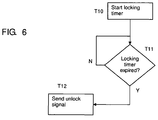
- Figure 6 is a flowchart illustrating steps that can be performed either at the S-CSCF, or at the HSS, or a combination of both.
- Steps S1 to S8 of Figure 4 are equivalent to those shown in Figure 3 , and a further description of these steps is not required.
- the S-CSCF initiates locking of the user at the HSS by sending a SAR message in step R9 to the HSS with a status of "locked"; the SAR message can be considered to carry a locking signal.
- the SAR message might have a status of "de-registered and locked”, whereas where the user is already registered, the SAR message might have a status of "registered and locked”.
- the SAR message is received at the HSS in step Q10, and in view of the status of "locked", the HSS sets a locking flag in step Q11 to indicate that the user is locked.
- a SAA message is sent by the HSS in step Q12, and received by the S-CSCF in step R10 (see Figure 4 ).
- a locking timer is used in this embodiment to keep track of when the user should be unlocked.
- the locking timer in this embodiment can be employed either at the HSS or at the S-CSCF, or a combination of the two, with signalling between the HSS and S-CSCF if necessary.
- a locking timer could be provided only at the HSS, with signalling from the HSS to the S-CSCF to indicate the status of the locking timer (for example, to indicate that the locking timer has expired).
- a locking timer could be provided in both the HSS and S-CSCF, coordinated by signalling between the HSS and S-CSCF (for example, the SAA message sent from the HSS in step Q12 could include locking information, used by the S-CSCF to synchronise its own locking timer to that in the HSS).
- FIG. 6 is an illustrative flowchart showing a locking timer being started in step T10, and a check being made in step T11 as to whether the locking timer has expired. If it has not expired, processing remains at step T11. If it has expired, an unlock signal (clear locking flag signal) is sent.
- an unlock signal (clear locking flag signal) is sent.
- step Q13 The HSS loops around step Q13, checking for this unlock signal; when it is received, processing continues to step Q14, where the locking flag at the HSS is cleared to indicate that the user is unlocked.
- Step S1 relates to an Initial Register request
- a locking flag may also be set at the S-CSCF following step S8, with the user then being locked both at the S-CSCF and the HSS.
- Steps R11 to R13 show the extra steps performed at the S-CSCF, and these correspond closely to steps Q11, Q13 and Q14 respectively.
- step S1 where the request received in step S1 is an Initial Register request, traffic to the user in the locked state would be handled in the normal "not registered/unregistered" manner.
- step S1 is a register request
- the HSS would not actually be required to inform the S-CSCF that the locking has expired.
- the next Register request that is received at the I-CSCF from the user will be successful, owing to the fact that the HSS will allow it because the locking flag for that user, as maintained at the HSS, would be clear.
- the S-CSCF does not have to store locking information for any unregistered users, because this locking information can be stored centrally at the HSS.
- the first aspect of the present invention described above can be seen as a method in which a Serving Call Session Control Function cooperates with a Home Subscriber Server to unlock a user after that user has been locked following a predetermined number of failed authentications of the user at the S-CSCF.
- the second aspect of the present invention described above can be seen as a method in which a Serving Call Session Control Function cooperates with a Home Subscriber Server to lock a user following a predetermined number of failed authentications of the user at the S-CSCF.
- any request received from the user at a node of the IMS where the lock is in effect and requiring an authentication challenge is caused by the node to be rejected.
- what unites the first and second aspects of the present invention is a method for use in an IMS in which a S-CSCF of the IMS cooperates with a HSS of the IMS to lock a user following a predetermined number of failed authentications of the user at the S-CSCF and/or unlock that user thereafter, with any request received from the user at a node of the IMS where the lock is in effect and requiring an authentication challenge being caused by the node to be rejected.
- step A represents a predetermined number of failed authentications of the User Agent (UA) at the S-CSCF
- step B represents cooperation between then S-CSCF and HSS to lock and/or unlock the UA.
- FIGS 8 and 9 are illustrative block diagrams showing some of these components more explicitly.
- Figure 8 illustrates components of the S-CSCF
- Figure 9 illustrates components of the HSS. It will be appreciated that not all of the illustrated components are essential in all embodiments.
- the S-CSCF comprises: a locking signal sending portion C1 for performing step R9; a locking flag storage portion C2 for use in any of steps S9, S12, R11 and R13; a locking timer C3 for use in any of steps S9, S10, T10 and T11; a locking timer coordinator C4 for use in sending/receiving signalling for coordinating the locking timer C3 with another locking timer located in the HSS (see H3 of Figure 9 , described below), for example for performing step R10; an unlock signal receiving portion C5 for use in any of steps R12, S11 and S10; a locking flag updating portion C6 for use in any of steps S9, S12, R11 and R13; and an unlock signal sending portion C7 for
- the HSS comprises: a locking signal receiving portion H1 for performing step Q10; a locking flag storage portion H2 for use in any of steps Q11 and Q14; a locking timer H3 for use in any of steps T10 and T11; a locking timer coordinator H4 for use in sending/receiving signalling for coordinating the locking timer H3 with another locking timer located in the S-CSCF (see C3 of Figure 8 , described above), for example for performing step Q12; a locking flag updating portion H5 for use in any of steps Q11 and Q14; and an unlock signal sending portion H6 for forming step T12, and/or in a step performed by the HSS to send the unlock signal received by the S-CSCF in step S11.
- operation of one or more of the above-described components can be controlled by a program operating on the device or apparatus.
- Such an operating program can be stored on a computer-readable medium, or could, for example, be embodied in a signal such as a downloadable data signal provided from an Internet website.
- the appended claims are to be interpreted as covering an operating program by itself, or as a record on a carrier, or as a signal, or in any other form.
Landscapes
- Engineering & Computer Science (AREA)
- Multimedia (AREA)
- Computer Networks & Wireless Communication (AREA)
- Signal Processing (AREA)
- Business, Economics & Management (AREA)
- General Business, Economics & Management (AREA)
- Computer Hardware Design (AREA)
- Computer Security & Cryptography (AREA)
- Computing Systems (AREA)
- General Engineering & Computer Science (AREA)
- Mobile Radio Communication Systems (AREA)
Claims (8)
- Procédé destiné à être utilisé par une fonction de commande de session d'appel de desserte, S-CSCF, d'un sous-système multimédia IP, IMS, le procédé comprenant la réception (S1) d'une demande pouvant faire l'objet d'un défi en provenance d'un utilisateur, l'exécution (S3, S4, S6) d'un nombre de tentatives d'authentification ayant échoué de l'utilisateur à la suite de la réception de la demande, la détermination (S7) que le nombre de tentatives d'authentification ayant échoué a atteint un nombre prédéterminé, et caractérisé par, à la suite d'une telle détermination : l'envoi d'un signal de verrouillage de la S-CSCF à un service d'abonné de rattachement, HSS, de l'IMS pour indiquer au HSS que l'utilisateur doit être verrouillé au HSS, de sorte que toute demande reçue en provenance de l'utilisateur à un autre noeud de l'IMS nécessitant un défi d'authentification puisse être rejetée en référence au HSS, puis le déverrouillage de l'utilisateur en réponse à la réception d'un signal de déverrouillage en provenance du HSS.
- Procédé selon la revendication 1, dans lequel le signal de verrouillage est porté par un message de demande d'assignation de serveur, SAR.
- Procédé selon la revendication 1 ou 2, dans lequel le signal de déverrouillage est porté par un message de demande de terminaison d'enregistrement, RTR.
- Procédé selon la revendication 1, 2 ou 3, comprenant le maintien d'une minuterie de verrouillage à la S-CSCF et dans lequel au moins un tel signal de déverrouillage est généré par la minuterie de verrouillage à l'expiration de la minuterie de verrouillage.
- Procédé selon la revendication 4, dans lequel une telle minuterie de verrouillage est également maintenue au HSS, et comprenant la coordination de la minuterie de verrouillage maintenue à la S-CSCF avec celle maintenue au HSS par l'utilisation d'une signalisation entre le HSS et la S-CSCF.
- Appareil destiné à être utilisé par une fonction de commande de session d'appel de desserte, S-CSCF, d'un sous-système multimédia IP, IMS, comprenant des moyens pour effectuer la réception (S1) d'une demande pouvant faire l'objet d'un défi en provenance d'un utilisateur, l'exécution (S3, S4, S6) d'un nombre de tentatives d'authentification ayant échoué de l'utilisateur à la suite de la réception de la demande, la détermination (S7) que le nombre de tentatives d'authentification ayant échoué a atteint un nombre prédéterminé, et caractérisé par, à la suite d'une telle détermination : l'envoi d'un signal de verrouillage de la S-CSCF à un service d'abonné de rattachement, HSS, de l'IMS pour indiquer au HSS que l'utilisateur doit être verrouillé au HSS, de sorte que toute demande reçue en provenance de l'utilisateur à un autre noeud de l'IMS nécessitant un défi d'authentification puisse être rejetée en référence au HSS, puis le déverrouillage de l'utilisateur en réponse à la réception d'un signal de déverrouillage en provenance du HSS.
- Programme comprenant des instructions exécutables par ordinateur qui, lorsqu'elles sont exécutées par un ordinateur, amènent l'ordinateur à effectuer les étapes du procédé selon l'une quelconque des revendications 1 à 5.
- Support de mémorisation contenant un programme selon la revendication 7.
Applications Claiming Priority (1)
| Application Number | Priority Date | Filing Date | Title |
|---|---|---|---|
| PCT/EP2009/058455 WO2011000439A1 (fr) | 2009-07-03 | 2009-07-03 | Procédé et appareil destinés à être utilisés dans un sous-système multimédia ip |
Publications (2)
| Publication Number | Publication Date |
|---|---|
| EP2449743A1 EP2449743A1 (fr) | 2012-05-09 |
| EP2449743B1 true EP2449743B1 (fr) | 2016-09-07 |
Family
ID=42035783
Family Applications (1)
| Application Number | Title | Priority Date | Filing Date |
|---|---|---|---|
| EP09780154.2A Active EP2449743B1 (fr) | 2009-07-03 | 2009-07-03 | Procédé et appareil destinés à être utilisés dans un sous-système multimédia ip |
Country Status (3)
| Country | Link |
|---|---|
| US (1) | US20120117624A1 (fr) |
| EP (1) | EP2449743B1 (fr) |
| WO (1) | WO2011000439A1 (fr) |
Families Citing this family (4)
| Publication number | Priority date | Publication date | Assignee | Title |
|---|---|---|---|---|
| US10063380B2 (en) | 2013-01-22 | 2018-08-28 | Amazon Technologies, Inc. | Secure interface for invoking privileged operations |
| US9026110B1 (en) * | 2013-08-29 | 2015-05-05 | Sprint Spectrum L.P. | Methods and systems for using macro coverage to manage femtocell registrations, so as to avoid signaling overload |
| US9986525B1 (en) * | 2016-11-30 | 2018-05-29 | T-Mobile Usa, Inc. | Error handling during IMS subscription for registration status |
| US11206535B1 (en) * | 2020-07-13 | 2021-12-21 | T-Mobile Usa, Inc. | Device authentication in a wireless telecommunications network |
Citations (1)
| Publication number | Priority date | Publication date | Assignee | Title |
|---|---|---|---|---|
| US20050159157A1 (en) * | 2004-01-20 | 2005-07-21 | Nokia Corporation | Authentications in a communication system |
Family Cites Families (4)
| Publication number | Priority date | Publication date | Assignee | Title |
|---|---|---|---|---|
| GB0110900D0 (en) * | 2001-05-03 | 2001-06-27 | Nokia Corp | Registrations in a communication system |
| EP2084882B1 (fr) | 2006-11-24 | 2015-02-25 | Telefonaktiebolaget LM Ericsson (publ) | Authentification dans un réseau de communication |
| US8064882B2 (en) * | 2007-03-09 | 2011-11-22 | Cisco Technology, Inc. | Blacklisting of unlicensed mobile access (UMA) users via AAA policy database |
| EP2066098B1 (fr) * | 2007-11-30 | 2016-05-25 | Nokia Solutions and Networks Oy | Affectation d'une entité de service dans un réseau de communication |
-
2009
- 2009-07-03 EP EP09780154.2A patent/EP2449743B1/fr active Active
- 2009-07-03 WO PCT/EP2009/058455 patent/WO2011000439A1/fr not_active Ceased
- 2009-07-03 US US13/381,994 patent/US20120117624A1/en not_active Abandoned
Patent Citations (1)
| Publication number | Priority date | Publication date | Assignee | Title |
|---|---|---|---|---|
| US20050159157A1 (en) * | 2004-01-20 | 2005-07-21 | Nokia Corporation | Authentications in a communication system |
Non-Patent Citations (1)
| Title |
|---|
| BT: "Subscription Management - Draft Stage 2", 3GPP DRAFT; S5A020125, 3RD GENERATION PARTNERSHIP PROJECT (3GPP), MOBILE COMPETENCE CENTRE ; 650, ROUTE DES LUCIOLES ; F-06921 SOPHIA-ANTIPOLIS CEDEX ; FRANCE, vol. SA WG5, no. Miami; 20020303, 3 March 2002 (2002-03-03), XP050293863 * |
Also Published As
| Publication number | Publication date |
|---|---|
| EP2449743A1 (fr) | 2012-05-09 |
| US20120117624A1 (en) | 2012-05-10 |
| WO2011000439A1 (fr) | 2011-01-06 |
Similar Documents
| Publication | Publication Date | Title |
|---|---|---|
| EP1879324B1 (fr) | Procede d'authentification d'un terminal utilisateur dans un sous-systeme multimedia ip | |
| US8265090B2 (en) | Storing access network information for an IMS user in a subscriber profile | |
| EP2070287B1 (fr) | Fourniture d'information d'accès dans un réseau de communication | |
| US9479600B2 (en) | Methods and apparatuses for initiating provisioning of subscriber data in a HSS of an IP multimedia subsystem network | |
| EP1973289B1 (fr) | Procédé pour la fourniture d'abonnement à des réseaux à commutation par paquets | |
| EP2347562B1 (fr) | Gestion d'identités d'utilisateurs dans un sous-système multimédia ip | |
| EP1982545A1 (fr) | Procédé et appareil pour une utilisation dans un reseau de communication | |
| EP1524816B1 (fr) | Authentification de messages sur un système de communication | |
| EP2084882B1 (fr) | Authentification dans un réseau de communication | |
| EP2250791B1 (fr) | Sécurisation d'informations de contact | |
| EP1994707B1 (fr) | Commande d'accès dans un réseau de communication | |
| US20120117624A1 (en) | Method and Apparatus for use in an IP Multimedia Subsystem | |
| EP2119178B1 (fr) | Procédé et appareils pour la fourniture de services réseau proposés via un ensemble de serveurs dans un réseau ims |
Legal Events
| Date | Code | Title | Description |
|---|---|---|---|
| PUAI | Public reference made under article 153(3) epc to a published international application that has entered the european phase |
Free format text: ORIGINAL CODE: 0009012 |
|
| 17P | Request for examination filed |
Effective date: 20111122 |
|
| AK | Designated contracting states |
Kind code of ref document: A1 Designated state(s): AT BE BG CH CY CZ DE DK EE ES FI FR GB GR HR HU IE IS IT LI LT LU LV MC MK MT NL NO PL PT RO SE SI SK SM TR |
|
| DAX | Request for extension of the european patent (deleted) | ||
| RIN1 | Information on inventor provided before grant (corrected) |
Inventor name: FORSMAN, TIMO Inventor name: KHAN, DAVID Inventor name: JONSSON, ANNIKA GERD HELENA |
|
| RIN1 | Information on inventor provided before grant (corrected) |
Inventor name: FORSMAN, TIMO Inventor name: JONSSON, ANNIKA GERD HELENA Inventor name: KHAN, DAVID |
|
| RAP1 | Party data changed (applicant data changed or rights of an application transferred) |
Owner name: TELEFONAKTIEBOLAGET L M ERICSSON (PUBL) |
|
| 17Q | First examination report despatched |
Effective date: 20151016 |
|
| GRAP | Despatch of communication of intention to grant a patent |
Free format text: ORIGINAL CODE: EPIDOSNIGR1 |
|
| RIC1 | Information provided on ipc code assigned before grant |
Ipc: H04L 29/06 20060101AFI20160225BHEP |
|
| INTG | Intention to grant announced |
Effective date: 20160314 |
|
| GRAS | Grant fee paid |
Free format text: ORIGINAL CODE: EPIDOSNIGR3 |
|
| GRAA | (expected) grant |
Free format text: ORIGINAL CODE: 0009210 |
|
| AK | Designated contracting states |
Kind code of ref document: B1 Designated state(s): AT BE BG CH CY CZ DE DK EE ES FI FR GB GR HR HU IE IS IT LI LT LU LV MC MK MT NL NO PL PT RO SE SI SK SM TR |
|
| REG | Reference to a national code |
Ref country code: GB Ref legal event code: FG4D |
|
| REG | Reference to a national code |
Ref country code: CH Ref legal event code: EP |
|
| REG | Reference to a national code |
Ref country code: IE Ref legal event code: FG4D |
|
| REG | Reference to a national code |
Ref country code: AT Ref legal event code: REF Ref document number: 827728 Country of ref document: AT Kind code of ref document: T Effective date: 20161015 |
|
| REG | Reference to a national code |
Ref country code: DE Ref legal event code: R096 Ref document number: 602009040998 Country of ref document: DE |
|
| REG | Reference to a national code |
Ref country code: NL Ref legal event code: FP |
|
| REG | Reference to a national code |
Ref country code: LT Ref legal event code: MG4D |
|
| PG25 | Lapsed in a contracting state [announced via postgrant information from national office to epo] |
Ref country code: FI Free format text: LAPSE BECAUSE OF FAILURE TO SUBMIT A TRANSLATION OF THE DESCRIPTION OR TO PAY THE FEE WITHIN THE PRESCRIBED TIME-LIMIT Effective date: 20160907 Ref country code: NO Free format text: LAPSE BECAUSE OF FAILURE TO SUBMIT A TRANSLATION OF THE DESCRIPTION OR TO PAY THE FEE WITHIN THE PRESCRIBED TIME-LIMIT Effective date: 20161207 Ref country code: LT Free format text: LAPSE BECAUSE OF FAILURE TO SUBMIT A TRANSLATION OF THE DESCRIPTION OR TO PAY THE FEE WITHIN THE PRESCRIBED TIME-LIMIT Effective date: 20160907 Ref country code: HR Free format text: LAPSE BECAUSE OF FAILURE TO SUBMIT A TRANSLATION OF THE DESCRIPTION OR TO PAY THE FEE WITHIN THE PRESCRIBED TIME-LIMIT Effective date: 20160907 |
|
| REG | Reference to a national code |
Ref country code: AT Ref legal event code: MK05 Ref document number: 827728 Country of ref document: AT Kind code of ref document: T Effective date: 20160907 |
|
| PG25 | Lapsed in a contracting state [announced via postgrant information from national office to epo] |
Ref country code: SE Free format text: LAPSE BECAUSE OF FAILURE TO SUBMIT A TRANSLATION OF THE DESCRIPTION OR TO PAY THE FEE WITHIN THE PRESCRIBED TIME-LIMIT Effective date: 20160907 Ref country code: LV Free format text: LAPSE BECAUSE OF FAILURE TO SUBMIT A TRANSLATION OF THE DESCRIPTION OR TO PAY THE FEE WITHIN THE PRESCRIBED TIME-LIMIT Effective date: 20160907 Ref country code: ES Free format text: LAPSE BECAUSE OF FAILURE TO SUBMIT A TRANSLATION OF THE DESCRIPTION OR TO PAY THE FEE WITHIN THE PRESCRIBED TIME-LIMIT Effective date: 20160907 Ref country code: GR Free format text: LAPSE BECAUSE OF FAILURE TO SUBMIT A TRANSLATION OF THE DESCRIPTION OR TO PAY THE FEE WITHIN THE PRESCRIBED TIME-LIMIT Effective date: 20161208 |
|
| PG25 | Lapsed in a contracting state [announced via postgrant information from national office to epo] |
Ref country code: EE Free format text: LAPSE BECAUSE OF FAILURE TO SUBMIT A TRANSLATION OF THE DESCRIPTION OR TO PAY THE FEE WITHIN THE PRESCRIBED TIME-LIMIT Effective date: 20160907 Ref country code: RO Free format text: LAPSE BECAUSE OF FAILURE TO SUBMIT A TRANSLATION OF THE DESCRIPTION OR TO PAY THE FEE WITHIN THE PRESCRIBED TIME-LIMIT Effective date: 20160907 |
|
| PG25 | Lapsed in a contracting state [announced via postgrant information from national office to epo] |
Ref country code: CZ Free format text: LAPSE BECAUSE OF FAILURE TO SUBMIT A TRANSLATION OF THE DESCRIPTION OR TO PAY THE FEE WITHIN THE PRESCRIBED TIME-LIMIT Effective date: 20160907 Ref country code: AT Free format text: LAPSE BECAUSE OF FAILURE TO SUBMIT A TRANSLATION OF THE DESCRIPTION OR TO PAY THE FEE WITHIN THE PRESCRIBED TIME-LIMIT Effective date: 20160907 Ref country code: PT Free format text: LAPSE BECAUSE OF FAILURE TO SUBMIT A TRANSLATION OF THE DESCRIPTION OR TO PAY THE FEE WITHIN THE PRESCRIBED TIME-LIMIT Effective date: 20170109 Ref country code: PL Free format text: LAPSE BECAUSE OF FAILURE TO SUBMIT A TRANSLATION OF THE DESCRIPTION OR TO PAY THE FEE WITHIN THE PRESCRIBED TIME-LIMIT Effective date: 20160907 Ref country code: SM Free format text: LAPSE BECAUSE OF FAILURE TO SUBMIT A TRANSLATION OF THE DESCRIPTION OR TO PAY THE FEE WITHIN THE PRESCRIBED TIME-LIMIT Effective date: 20160907 Ref country code: IS Free format text: LAPSE BECAUSE OF FAILURE TO SUBMIT A TRANSLATION OF THE DESCRIPTION OR TO PAY THE FEE WITHIN THE PRESCRIBED TIME-LIMIT Effective date: 20170107 Ref country code: SK Free format text: LAPSE BECAUSE OF FAILURE TO SUBMIT A TRANSLATION OF THE DESCRIPTION OR TO PAY THE FEE WITHIN THE PRESCRIBED TIME-LIMIT Effective date: 20160907 Ref country code: BE Free format text: LAPSE BECAUSE OF FAILURE TO SUBMIT A TRANSLATION OF THE DESCRIPTION OR TO PAY THE FEE WITHIN THE PRESCRIBED TIME-LIMIT Effective date: 20160907 Ref country code: BG Free format text: LAPSE BECAUSE OF FAILURE TO SUBMIT A TRANSLATION OF THE DESCRIPTION OR TO PAY THE FEE WITHIN THE PRESCRIBED TIME-LIMIT Effective date: 20161207 |
|
| REG | Reference to a national code |
Ref country code: DE Ref legal event code: R097 Ref document number: 602009040998 Country of ref document: DE |
|
| PG25 | Lapsed in a contracting state [announced via postgrant information from national office to epo] |
Ref country code: IT Free format text: LAPSE BECAUSE OF FAILURE TO SUBMIT A TRANSLATION OF THE DESCRIPTION OR TO PAY THE FEE WITHIN THE PRESCRIBED TIME-LIMIT Effective date: 20160907 |
|
| PLBE | No opposition filed within time limit |
Free format text: ORIGINAL CODE: 0009261 |
|
| STAA | Information on the status of an ep patent application or granted ep patent |
Free format text: STATUS: NO OPPOSITION FILED WITHIN TIME LIMIT |
|
| PG25 | Lapsed in a contracting state [announced via postgrant information from national office to epo] |
Ref country code: DK Free format text: LAPSE BECAUSE OF FAILURE TO SUBMIT A TRANSLATION OF THE DESCRIPTION OR TO PAY THE FEE WITHIN THE PRESCRIBED TIME-LIMIT Effective date: 20160907 |
|
| 26N | No opposition filed |
Effective date: 20170608 |
|
| PG25 | Lapsed in a contracting state [announced via postgrant information from national office to epo] |
Ref country code: SI Free format text: LAPSE BECAUSE OF FAILURE TO SUBMIT A TRANSLATION OF THE DESCRIPTION OR TO PAY THE FEE WITHIN THE PRESCRIBED TIME-LIMIT Effective date: 20160907 |
|
| REG | Reference to a national code |
Ref country code: CH Ref legal event code: PL |
|
| REG | Reference to a national code |
Ref country code: IE Ref legal event code: MM4A |
|
| REG | Reference to a national code |
Ref country code: FR Ref legal event code: ST Effective date: 20180330 |
|
| PG25 | Lapsed in a contracting state [announced via postgrant information from national office to epo] |
Ref country code: LI Free format text: LAPSE BECAUSE OF NON-PAYMENT OF DUE FEES Effective date: 20170731 Ref country code: CH Free format text: LAPSE BECAUSE OF NON-PAYMENT OF DUE FEES Effective date: 20170731 Ref country code: IE Free format text: LAPSE BECAUSE OF NON-PAYMENT OF DUE FEES Effective date: 20170703 |
|
| PG25 | Lapsed in a contracting state [announced via postgrant information from national office to epo] |
Ref country code: FR Free format text: LAPSE BECAUSE OF NON-PAYMENT OF DUE FEES Effective date: 20170731 |
|
| PG25 | Lapsed in a contracting state [announced via postgrant information from national office to epo] |
Ref country code: LU Free format text: LAPSE BECAUSE OF NON-PAYMENT OF DUE FEES Effective date: 20170703 |
|
| PG25 | Lapsed in a contracting state [announced via postgrant information from national office to epo] |
Ref country code: MT Free format text: LAPSE BECAUSE OF NON-PAYMENT OF DUE FEES Effective date: 20170703 |
|
| PG25 | Lapsed in a contracting state [announced via postgrant information from national office to epo] |
Ref country code: MC Free format text: LAPSE BECAUSE OF FAILURE TO SUBMIT A TRANSLATION OF THE DESCRIPTION OR TO PAY THE FEE WITHIN THE PRESCRIBED TIME-LIMIT Effective date: 20160907 Ref country code: HU Free format text: LAPSE BECAUSE OF FAILURE TO SUBMIT A TRANSLATION OF THE DESCRIPTION OR TO PAY THE FEE WITHIN THE PRESCRIBED TIME-LIMIT; INVALID AB INITIO Effective date: 20090703 |
|
| PG25 | Lapsed in a contracting state [announced via postgrant information from national office to epo] |
Ref country code: CY Free format text: LAPSE BECAUSE OF NON-PAYMENT OF DUE FEES Effective date: 20160907 |
|
| PG25 | Lapsed in a contracting state [announced via postgrant information from national office to epo] |
Ref country code: MK Free format text: LAPSE BECAUSE OF FAILURE TO SUBMIT A TRANSLATION OF THE DESCRIPTION OR TO PAY THE FEE WITHIN THE PRESCRIBED TIME-LIMIT Effective date: 20160907 |
|
| PG25 | Lapsed in a contracting state [announced via postgrant information from national office to epo] |
Ref country code: TR Free format text: LAPSE BECAUSE OF FAILURE TO SUBMIT A TRANSLATION OF THE DESCRIPTION OR TO PAY THE FEE WITHIN THE PRESCRIBED TIME-LIMIT Effective date: 20160907 |
|
| REG | Reference to a national code |
Ref country code: DE Ref legal event code: R079 Ref document number: 602009040998 Country of ref document: DE Free format text: PREVIOUS MAIN CLASS: H04L0029060000 Ipc: H04L0065000000 |
|
| PGFP | Annual fee paid to national office [announced via postgrant information from national office to epo] |
Ref country code: GB Payment date: 20240729 Year of fee payment: 16 |
|
| PGFP | Annual fee paid to national office [announced via postgrant information from national office to epo] |
Ref country code: NL Payment date: 20250726 Year of fee payment: 17 |
|
| PGFP | Annual fee paid to national office [announced via postgrant information from national office to epo] |
Ref country code: DE Payment date: 20250729 Year of fee payment: 17 |
|
| GBPC | Gb: european patent ceased through non-payment of renewal fee |
Effective date: 20250703 |
|
| PG25 | Lapsed in a contracting state [announced via postgrant information from national office to epo] |
Ref country code: GB Free format text: LAPSE BECAUSE OF NON-PAYMENT OF DUE FEES Effective date: 20250703 |