EP2450907B1 - Alkali Einzelionenleiter mit hoher Leitfähigkeit und Überführungszahl sowie Herstellungsverfahren dafür - Google Patents
Alkali Einzelionenleiter mit hoher Leitfähigkeit und Überführungszahl sowie Herstellungsverfahren dafür Download PDFInfo
- Publication number
- EP2450907B1 EP2450907B1 EP10014342.9A EP10014342A EP2450907B1 EP 2450907 B1 EP2450907 B1 EP 2450907B1 EP 10014342 A EP10014342 A EP 10014342A EP 2450907 B1 EP2450907 B1 EP 2450907B1
- Authority
- EP
- European Patent Office
- Prior art keywords
- group
- alkaline
- single ion
- acid group
- ion conductor
- Prior art date
- Legal status (The legal status is an assumption and is not a legal conclusion. Google has not performed a legal analysis and makes no representation as to the accuracy of the status listed.)
- Not-in-force
Links
Images


Classifications
-
- H—ELECTRICITY
- H01—ELECTRIC ELEMENTS
- H01G—CAPACITORS; CAPACITORS, RECTIFIERS, DETECTORS, SWITCHING DEVICES, LIGHT-SENSITIVE OR TEMPERATURE-SENSITIVE DEVICES OF THE ELECTROLYTIC TYPE
- H01G9/00—Electrolytic capacitors, rectifiers, detectors, switching devices, light-sensitive or temperature-sensitive devices; Processes of their manufacture
- H01G9/004—Details
- H01G9/022—Electrolytes; Absorbents
- H01G9/035—Liquid electrolytes, e.g. impregnating materials
-
- H—ELECTRICITY
- H01—ELECTRIC ELEMENTS
- H01B—CABLES; CONDUCTORS; INSULATORS; SELECTION OF MATERIALS FOR THEIR CONDUCTIVE, INSULATING OR DIELECTRIC PROPERTIES
- H01B1/00—Conductors or conductive bodies characterised by the conductive materials; Selection of materials as conductors
- H01B1/06—Conductors or conductive bodies characterised by the conductive materials; Selection of materials as conductors mainly consisting of other non-metallic substances
- H01B1/12—Conductors or conductive bodies characterised by the conductive materials; Selection of materials as conductors mainly consisting of other non-metallic substances organic substances
- H01B1/122—Ionic conductors
-
- H—ELECTRICITY
- H01—ELECTRIC ELEMENTS
- H01M—PROCESSES OR MEANS, e.g. BATTERIES, FOR THE DIRECT CONVERSION OF CHEMICAL ENERGY INTO ELECTRICAL ENERGY
- H01M10/00—Secondary cells; Manufacture thereof
- H01M10/05—Accumulators with non-aqueous electrolyte
- H01M10/056—Accumulators with non-aqueous electrolyte characterised by the materials used as electrolytes, e.g. mixed inorganic/organic electrolytes
- H01M10/0564—Accumulators with non-aqueous electrolyte characterised by the materials used as electrolytes, e.g. mixed inorganic/organic electrolytes the electrolyte being constituted of organic materials only
- H01M10/0565—Polymeric materials, e.g. gel-type or solid-type
-
- H—ELECTRICITY
- H01—ELECTRIC ELEMENTS
- H01M—PROCESSES OR MEANS, e.g. BATTERIES, FOR THE DIRECT CONVERSION OF CHEMICAL ENERGY INTO ELECTRICAL ENERGY
- H01M10/00—Secondary cells; Manufacture thereof
- H01M10/05—Accumulators with non-aqueous electrolyte
- H01M10/056—Accumulators with non-aqueous electrolyte characterised by the materials used as electrolytes, e.g. mixed inorganic/organic electrolytes
- H01M10/0564—Accumulators with non-aqueous electrolyte characterised by the materials used as electrolytes, e.g. mixed inorganic/organic electrolytes the electrolyte being constituted of organic materials only
- H01M10/0566—Liquid materials
- H01M10/0568—Liquid materials characterised by the solutes
-
- H—ELECTRICITY
- H01—ELECTRIC ELEMENTS
- H01M—PROCESSES OR MEANS, e.g. BATTERIES, FOR THE DIRECT CONVERSION OF CHEMICAL ENERGY INTO ELECTRICAL ENERGY
- H01M10/00—Secondary cells; Manufacture thereof
- H01M10/05—Accumulators with non-aqueous electrolyte
- H01M10/056—Accumulators with non-aqueous electrolyte characterised by the materials used as electrolytes, e.g. mixed inorganic/organic electrolytes
- H01M10/0564—Accumulators with non-aqueous electrolyte characterised by the materials used as electrolytes, e.g. mixed inorganic/organic electrolytes the electrolyte being constituted of organic materials only
- H01M10/0566—Liquid materials
- H01M10/0569—Liquid materials characterised by the solvents
-
- H—ELECTRICITY
- H01—ELECTRIC ELEMENTS
- H01M—PROCESSES OR MEANS, e.g. BATTERIES, FOR THE DIRECT CONVERSION OF CHEMICAL ENERGY INTO ELECTRICAL ENERGY
- H01M8/00—Fuel cells; Manufacture thereof
- H01M8/10—Fuel cells with solid electrolytes
- H01M8/1016—Fuel cells with solid electrolytes characterised by the electrolyte material
- H01M8/1018—Polymeric electrolyte materials
-
- H—ELECTRICITY
- H01—ELECTRIC ELEMENTS
- H01M—PROCESSES OR MEANS, e.g. BATTERIES, FOR THE DIRECT CONVERSION OF CHEMICAL ENERGY INTO ELECTRICAL ENERGY
- H01M2300/00—Electrolytes
- H01M2300/0017—Non-aqueous electrolytes
- H01M2300/0065—Solid electrolytes
- H01M2300/0082—Organic polymers
-
- Y—GENERAL TAGGING OF NEW TECHNOLOGICAL DEVELOPMENTS; GENERAL TAGGING OF CROSS-SECTIONAL TECHNOLOGIES SPANNING OVER SEVERAL SECTIONS OF THE IPC; TECHNICAL SUBJECTS COVERED BY FORMER USPC CROSS-REFERENCE ART COLLECTIONS [XRACs] AND DIGESTS
- Y02—TECHNOLOGIES OR APPLICATIONS FOR MITIGATION OR ADAPTATION AGAINST CLIMATE CHANGE
- Y02E—REDUCTION OF GREENHOUSE GAS [GHG] EMISSIONS, RELATED TO ENERGY GENERATION, TRANSMISSION OR DISTRIBUTION
- Y02E60/00—Enabling technologies; Technologies with a potential or indirect contribution to GHG emissions mitigation
- Y02E60/10—Energy storage using batteries
-
- Y—GENERAL TAGGING OF NEW TECHNOLOGICAL DEVELOPMENTS; GENERAL TAGGING OF CROSS-SECTIONAL TECHNOLOGIES SPANNING OVER SEVERAL SECTIONS OF THE IPC; TECHNICAL SUBJECTS COVERED BY FORMER USPC CROSS-REFERENCE ART COLLECTIONS [XRACs] AND DIGESTS
- Y02—TECHNOLOGIES OR APPLICATIONS FOR MITIGATION OR ADAPTATION AGAINST CLIMATE CHANGE
- Y02E—REDUCTION OF GREENHOUSE GAS [GHG] EMISSIONS, RELATED TO ENERGY GENERATION, TRANSMISSION OR DISTRIBUTION
- Y02E60/00—Enabling technologies; Technologies with a potential or indirect contribution to GHG emissions mitigation
- Y02E60/30—Hydrogen technology
- Y02E60/50—Fuel cells
Definitions
- alkaline ion conductors used in electrochemical cells are solutions of salts (such as LiCF 3 SO s or LiPF 6 ) in either aprotic polar solvents (such as ethylene carbonate) or polar polymers (such as polyethylene oxides).
- aprotic polar solvents such as ethylene carbonate
- polar polymers such as polyethylene oxides
- dissociation is not complete, i.e. a number of different charged species are present.
- the effective transference number of Li + is usually around 30%, and the presence of different kind of mobile species (e.g. anions, triple ions) leads to significant concentration polarization effects (formation of a salt concentration gradient) at high Li + currents.
- a true single ion (in particular Li + ) conductor is very desirably since it would allow for higher currents.
- PFSA ionomers have been chosen because they were known to show the highest conductivities among all ionomers in their hydrated proton forms. This was thought to be the result of their special microstructure which is distinctly different from this of hydrocarbon based ionomers. This microstructure is thought to be beneficial for obtaining high ionic conductivity, but it is also the reason for the very high hydrodynamic solvent transport (solvent permeation and electroosmotic solvent drag) in such systems. Therefore, non-perfluorinated hydrocarbon ionomers and polyelectrolytes in aprotic media had never been considered as base material for obtaining high alkaline ion conductivity.
- US 2007/205388 A1 discloses a hydrocarbon polymer with ionic conductivity having an acid substituent group which is a sulfamide group.
- US 2007/082247 A1 discloses the conversion of a sodium salt of a copolymer into the acid (proton) form by treatment in hydrochloric acid.
- DMSO is used to dissolve the material prior to ion exchange with HCl and is completely removed for obtaining the final product.
- an object of the present invention is to provide improved hydrocarbon polymer-based alkaline single ion conductors with very high conductivity and transference number and low hydrodynamic solvent transport in aprotic media and methods for preparing the same.
- the present invention describes pure alkaline ion conductors (transference number equal or close to unity) with alkaline conductivities similar to those of solutions of alkaline ion salts.
- ionomers or polyelectrolytes preferably of high ion exchange capacity, especially highly sulfonated polyarylene sulfones, are transferred into their alkaline ion form and then solvated with aprotic polar solvents.
- solvated PFSA perfluorosulfonic acid
- ionomers e.g. Nafion
- the method of the invention for producing an alkaline single ion conductor with high conductivity according to claim 1 comprises:
- the hydrocarbon oligomer or polymer may be any hydrocarbon-based, non-perfluorinated oligomer or polymer which can be substituted with the desired amount of immobilized acidic substituent groups as indicated above.
- the oligomer or polymer may comprise aliphatic or aromatic recurring units or combinations thereof.
- the oligomer or polymer may be, e.g., selected from the group comprising polyethers, polyesters, polyimides and polyamides, polybenzimidazoles, polysulfones, polyether sulfones, polyether ketones, polyphenylene oxides, polyphenylene sulfide, polycarbonates, vinyl-based polymers, acryl-based polymers, e.g. polymethyl methacrylates, and polyphosphazenes.
- the hydrocarbon oligomer or polymer is a polyvinylphosphonic acid in its alkali ion form or a polyarylene compound comprising one or more structural elements of the general formula I -[-X-Ar(WA) n -Y-] m -, wherein m is an integer from 1 to 1.000.000, more specifically from 1 to 100.000, preferably from 1 to 10.000, e.g.
- X and Y which are identical or different from each other, each represent a bridging group which may be an electron-acceptor or electron-donor group or neither
- Ar represents an aromatic or heteroaromatic ring system with 5-18 ring atoms and with W representing an anion of an acidic substituent group selected from a sulfonic acid group or a phosphonic acid group, A representing an alkali cation, and n being between 0.1 and 4; wherein the aromatic or heteroaromatic ring system, in addition to the acidic group W and the substituents X and Y, may feature additional substituents, preferably substitents which are not electron-donor groups; and wherein X, Y, Ar, W, n and m can be identical or different in different structural elements, independently of each other.
- the polyarylene compound consists of recurring elements of the formula I.
- the alkali counterion of said hydrocarbon oligomer or polymer is selected from the group consisting of a Na + cation and a Li + cation.
- hydrocarbon oligomer or polymer in particular the polyarylene compound or polyvinylphosphonic acid, may be unsubstituted, except for the acidic substituents, or further substituted/grafted by aliphatic and/or aromatic substituents.
- Ar in the sulfonated polyarylene of formula I above is selected from the group consisting of phenylene, naphthylene, anthracene, phenanthrene, biphenylene, furan, thiophene, pyrrole, thiazole, triazole, pyridine, imidazole and benzimidazole.
- Ar is phenylene.
- X and Y in formula I are selected independently of each other from the group consisting of -SO 2 -, -SO-, -SO 2 O-, -CO-, -COO-, -CONH-, -CONR- or -POR-, with R being an organic residue, in particular alkyl, preferably lower alkyl with C 1 -C 10 , -S-, -O-, and -SO 2 -NH-SO 2 -, unsubstituted or substituted alkylene, e.g. fluorinated alkylene, unsubstituted or substituted arylene.
- the unsubstituted or substituted arylene group may comprise a phenylene, naphthylene, anthracene, phenanthrene, biphenylene, furan, thiophene, pyrrole, thiazole, triazole, pyridine, imidazole and benzimidazole group.
- X and Y are both electron acceptor groups, in particular -SO 2 -, resulting in a sulfonated polyarylene sulfone, in particular a sulfonated poly-phenylensulfone.
- X and y are -O- and -CO-, resulting in a sulfonated polyarylene ether ketone, in particular a sulfonated polyphenylene ether ketone (S-PEEK).
- proton conducting acid functionalized (especially -SO 3 H, -PO 3 H 2 ) hydrocarbon ionomers and polyelectrolytes as indicated above can be converted into their corresponding alkaline ion form by using an ion exchange column or by direct exchange in solution and subsequent dialysis.
- the functionalized hydrocarbon oligomers or polymers can be synthesized directly in their alkaline ion form compounds and used in the present methods.
- the proton conducting acid functionalized hydrocarbons may also be grafted to inorganic particles which may help to further improve the mechanical properties.
- Block-copolymers comprising such functionalized hydrocarbons may allow for combining very high conductivity with increased morphological stability and flexibility.
- the block-copolymers may comprise different blocks of proton conducting acid functionalized hydrocarbons as outlined above and also one or more blocks derived from other kinds of polymers/oligomers such as PBI (polybenzimidazole), PTFE (polytetra-fluoroethylene), PVDF (polyvinylidene fluoride), PSU (polysulfones), PES (polyether sulfones), PEK (polyether ketones), PPO (polyphenylene oxide), PPS (polyphenylene sulfide), PI (polyimides), PC (polycarbonates), PMMA (polymethyl methacrylates) and polyphosphazenes.
- PBI polybenzimidazole
- Such block-copolymers can be prepared by methods well known in the art of polymer chemistry.
- Hal in the dihalogen compound represents a halogen residue, e.g. F, Cl, Br and I.
- the solvated ionomers or polyelectrolytes may also be used to impregnate various porous matrices or woven fabrics.
- the solvated ionomers or polyelectrolytes, including copolymers comprising the same are integrated into an inert porous matrix, such as an organic matrix (porous PE, PP, PVDF, PTFE, e.g. stretched PTFE etc.) or anorganic matrix (porous boronitride, silicon dioxide, etc.).
- an organic matrix such as an organic matrix (porous PE, PP, PVDF, PTFE, e.g. stretched PTFE etc.) or anorganic matrix (porous boronitride, silicon dioxide, etc.).
- the solvated ionomers or polyelectrolytes can be combined with fiber materials, such as glass fibers, ceramic fibers, textile fibers, carbon fibers, microporous polypropylene or polytetrafluoroethylene, etc.
- the aprotic polar solvent may be any solvent which is able to solvate the respective hydrocarbon oligomer or polymer, i.e. ionomer or polyelectrolyte, and to allow a high uptake of the solvent by said hydrocarbon oligomer or polymer.
- the molar ratio of solvent/alkaline cation may be in the range from 1:1 to 10.000:1, such as 1:1 to 1000:1 or 1:1 to 200:1, More specifically, a molar ratio of solvent/alkaline cation in the range of from 3:1 to 200:1, preferably from 5:1 to 200:1, in particular 3:1 to 30:1 or 20:1, or 5:1 to 30:1 or 20:1 is used.
- the aprotic polar solvent is selected from the group consisting of EC, PC, BC, yBL, yVL, NMO, DMC, DEC, EMC, EA, MB, EB, DMM, DME, DEE, THF, 2-Me-THF, 1,3-DL, 4-Me-1,3-DL, 2-Me-1,3-DL, DMSO, NMP, NEP and mixtures thereof.
- solvents and their chemical structure are well known in the art and, e.g., disclosed in Doyle et al. above.
- suitable may be not only be low molecular weight solvents as above but also higher molecular weight solvents such as glyme or even polyethylene oxides (PEO).
- the alkaline single ion conductors obtainable by the above methods comprise a hydrocarbon oligomer or polymer having immobilized acidic substituent groups selected from the group consisting of a sulfonic acid group or a phosphonic acid group, in its alkaline ion form, wherein the hydrocarbon oligomer or polymer is solvated in an aprotic polar solvent and has a molar ratio of solvent/alkali cation in the range from 1:1 to 10.000:1, such as 1:1 to 1000:1 or 1:1 to 200:1, more specifically in the range from 3:1 to 200:1, preferably from 5:1 to 200:1, in particular 3:1 to 30:1 or 20:1, or 5:1 to 30:1 or 20:1, and a conductivity of at least 10 -5 S/cm, in particular at least 10- 4 S/cm, preferably at least 10 -3 S/cm, more preferred at least 5 x 10 -3 S/cm, at room temperature (24°C) in said aprotic solvent.
- the alkali single ion conductors comprise a compound as disclosed above, e.g. an unsubstituted or substituted polyvinyl phosphonic acid, a sulfonic acid-substituted or phosphonic acid-substituted aliphatic or aromatic polymer, in particular a sulfonated or phosphonated polyarylene sulfone, polyarylene sulfide, polyarylene ether or polyarylene ether ketone.
- a compound as disclosed above e.g. an unsubstituted or substituted polyvinyl phosphonic acid, a sulfonic acid-substituted or phosphonic acid-substituted aliphatic or aromatic polymer, in particular a sulfonated or phosphonated polyarylene sulfone, polyarylene sulfide, polyarylene ether or polyarylene ether ketone.
- the alkaline single ion conductors comprise a polyarylene compound consisting of recurring structural elements of the general formula II -[-X-Ar(WA) n -Y-]m-, which may be the same or different, wherein m is an integer from 1 to 1.000.000, more specifically from 1 to 100.000, preferably from 1 to 10.000, e.g.
- X and Y which are identical or different from each other, each represent a bridging group which may be an electron-acceptor or electron-donor group or neither, W represents the anion of a sulfonic acid group or phosphonic acid group, A represents a sodium or lithium cation, n is a number between 0.1 and 4, X and Y are selected independently of each other from the group consisting of -SO 2 -, -SO-, -SO 2 O-, -CO-, -COO-, -CONH-, -CONR- or -POR-, with R being an organic residue, in particular alkyl, -S-, -O-, and -SO 2 -NH-SO 2 -, unsubstituted or substituted alkylene, e.g. fluorinated alkylene, unsubstituted or substituted arylene, and Ar is phenyl.
- W in said formula II represents the anion of a sulfonic acid group
- n is a number between 0.1 and 4, preferably between 1 and 4
- X and Y are each SO 2 and Ar is phenyl.
- the present invention also encompasses the use of a polyarylene compound comprising one or more structural elements of the general formulae I or II above as an alkaline single ion conductor, in particular a sodium or lithium single ion conductor.
- the alkaline single ion conductors of the invention will have a broad range of industrial applications, in particular in the fields of electrochemistry and electric energy storage technology.
- a further aspect of the present invention relates to an electric or electrochemical storage device comprising the alkaline single ion conductor according to any one of claims 8 to 12.
- Said storage device may for example be a lithium or sodium battery, a fuel cell or a supercapacitor.
- the alkaline single ion conductors of the invention may be selected from the above materials as appropriate to provide specific characteristics such as a specific conductivity etc. and, in particular, may be combined with other materials as appropriate.
- the single ion conductors of the invention may be embedded in a porous matrix or combined with fiber materials, fillers or other additives.
- Such materials are known as such in the art of ion conductor technology.
- the present invention uses hydrocarbon oligomers and polymers, which, when functionalized with ion exchanging groups, can take up more solvent, either because of their higher ion exchange capacity or because of their weaker backbone interaction.
- the higher solvent uptake is thought to lead to a higher degree of dissociation and a better connectivity within the solvated part of the material.
- the conductivity is significantly higher (> 10 -3 S/cm at room temperature), and this conductivity is a true single ion conductivity, because the anions (e.g. -SO 3 H, -PO 3 H 2 ) are immobilized on the polymer backbone.
- hydrocarbon backbones are generally less hydrophobic than the PTFE backbone of PFSA membranes
- hydrodynamic solvent transport e.g. electroosmotic solvent drag
- High single ion conductivity and low electroosmotic drag are actually preventing the system from any significant current polarization effect, and its viscous character allows for the immediate substitution of conventional liquid electrolytes in existing electrochemical cells such as Li-ion batteries in which the electrolyte is a constituent of both the separator and the electrode structures.
- Sulfonated poly(phenylene-sulfones) with a high ion exchange capacity provide especially high conductivities (e.g. S-220 and S-360) as shown in Figs. 1 und 3 .
- the sulfonic acid anion immobilized on any hydrocarbon polymer can serve as a conjugated base for the alkali cation, in particular Li + ion.
- the sulfimide anion SO 2 -N-SO 2 ) -
- the aprotic solvent may comprise any of the solvents disclosed above or by Kang Xu in Chemical Reviews 2004, 104, 4303-4417 .
- some conductivities of S-220 in the Li-form solvated with NEP instead of DMSO have been assessed and are shown in Fig. 3 .
- the conductivities are actually slightly lower which is probably reflecting a lower degree of dissociation as a consequence of the lower dielectric constant of NEP compared to DMSO. Nevertheless, the observed conductivities are still very high.
- DMSO/-SO 3 Li 20 for S-220
- DMSO/-SO 3 Li 30 for S-360
- a sulfonated poly(phenylene-ether-ketone) (S-PEEK) (A-O-A-O-A-CO-, A partially sulfonated) prepared as described or purchased from Fumatech and a sulfonated poly(phenylene-sulfone) with low ion exchange capacity, i.e. high equivalent molecular weight, S-640) were transferred into their Li + forms (as described above) and solvated with DMSO.
- Fig. 2 shows the resulting conductivities in comparison with S-220 and demonstrates that with appropriate solvent ratios high conductivities of > 10 -3 S/cm are obtainable with these materials as well.
- the sulfonated poly(phenylene-sulfone) S-220 of Example 1 was also solvated with NEP in a Li/solvent ratio of 1:10 (as described above) and the resulting conductivity compared to the conductivity with DMSO as a solvent under the same conditions (measurements as described in Example 1).
- Fig. 3 shows that for a given mole fraction of solvent, the conductivities are actually slightly lower than in DMSO which is probably reflecting a lower degree of dissociation as a consequence of the lower dielectric constant of NEP compared to DMSO. Nevertheless, the observed conductivities are still very high.
- the sulfonated poly(phenylene-sulfone) S-220 was also prepared in its Na + form and solvated with various amounts of DMSO as described in Example 1.
- Fig. 4 demonstrates that in this case also high conductivities in the range of > 10 -3 S/cm were obtained.
- PVPA polyvinylphosphonic acid
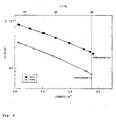
- B. Bingöl, W.H. Meyer, M. Wagner, G. Wegner Macromolecules Rapid Commun. 27, 1719 (2006 ) was transferred into its Li + form using a ion exchange column and solvated with DMSO.
- Fig. 5 shows the resulting conductivity in comparison with the corresponding conductivity of S-220.
- ionomers and polyelectrolytes with high solvent content are shown to exhibit very high ionic conductivity in their Li + and Na + forms when solvated with aprotic polar solvents such as DMSO, EC or PC.
- the electrolytes show low hydrodynamic solvent transport and they are single ion conductors, i.e. the transference number of the cations is close to unity.
Landscapes
- Chemical & Material Sciences (AREA)
- Electrochemistry (AREA)
- Chemical Kinetics & Catalysis (AREA)
- Engineering & Computer Science (AREA)
- Physics & Mathematics (AREA)
- Manufacturing & Machinery (AREA)
- General Chemical & Material Sciences (AREA)
- Condensed Matter Physics & Semiconductors (AREA)
- Inorganic Chemistry (AREA)
- General Physics & Mathematics (AREA)
- Power Engineering (AREA)
- Dispersion Chemistry (AREA)
- Spectroscopy & Molecular Physics (AREA)
- Sustainable Energy (AREA)
- Life Sciences & Earth Sciences (AREA)
- Sustainable Development (AREA)
- Microelectronics & Electronic Packaging (AREA)
- Conductive Materials (AREA)
- Fuel Cell (AREA)
Claims (15)
- Verfahren zur Herstellung eines Alkali-Einzelionenleiters mit hoher Leitfähigkeit, umfassend:a) Bereitstellen eines Kohlenwasserstoff-Oligomers oder -Polymers mit immobilisierten sauren Substituentengruppen, welche aus der Gruppe, die aus einer Sulfonsäuregruppe und einer Phosphonsäuregruppe besteht, ausgewählt sind, in seiner Alkali-Ionenform, wobei mindestens ein Teil der sauren Protonen der Substituentengruppen gegen Alkali-Kationen ausgetauscht worden sind, undb) Solvatisieren des Kohlenwasserstoff-Oligomers oder -Polymers von Schritt a) in einem aprotischen polaren Lösungsmittel für eine ausreichende Zeit, um eine Lösungsmittelaufnahme von mindestens 5 Gew.-% zu bewirken und um ein solvatisiertes Produkt zu erhalten, wobei das Molverhältnis von Lösungsmittel/Alkali-Kation im Bereich von 1:1 bis 10.000:1, spezieller von 1:1 bis 1000:1, vorzugsweise von 3:1 bis 200:1, liegt und wobei das solvatisierte Produkt eine Leitfähigkeit von mindestens 10-5 S/cm bei Raumtemperatur (24°C) aufweist.
- Verfahren nach Anspruch 1, wobei das Kohlenwasserstoff-Oligomer oder -Polymer eine Polyvinylphosphonsäure ist oder eine Polyarylen-Verbindung, die ein oder mehrere Strukturelemente der allgemeinen Formel I
-[-X-Ar(WA)n-Y-]m-,
umfasst, wobei m eine ganze Zahl von 1 bis 1.000.000 ist,
X und Y, welche gleich oder verschieden voneinander sind, jeweils eine Brückengruppe, die eine Elektronenakzeptorgruppe oder eine Elektronendonorgruppe oder keines davon sein kann, darstellen und Ar ein aromatisches oder heteroaromatisches Ringsystem mit 5-18 Ringatomen darstellt, und wobei W ein Anion einer sauren Substituentengruppe, ausgewählt aus einer Sulfonsäuregruppe und einer Phosphonsäuregruppe, darstellt,
A ein Alkali-Kation darstellt und n zwischen 0,1 und 4 liegt;
wobei das aromatische oder heteroaromatische Ringsystem neben der sauren Gruppe W und den Substituenten X und Y weitere Substituenten aufweisen kann, und wobei X, Y, Ar, W, n und m in verschiedenen Strukturelementen unabhängig voneinander gleich oder verschieden sein können. - Verfahren nach Anspruch 1 oder 2, wobei das Alkali-Kation aus der Gruppe, die aus einem Na+-Kation und einem Li+-Kation besteht, ausgewählt ist.
- Verfahren nach irgendeinem der Ansprüche 2 bis 3, wobei X und Y in der Formel I unabhängig voneinander aus der Gruppe, die aus -SO2- -SO-, -SO2O-, -CO-, -COO-, Alkylen, fluoriertem Alkylen, Arylen, -CONH-, -CONR- oder -POR-, wobei R ein organischer Rest, insbesondere Alkyl, ist, -S-, -O- und -SO2-NH-SO2- besteht, ausgewählt sind.
- Verfahren nach irgendeinem der Ansprüche 2 bis 4, wobei Ar aus der Gruppe, die aus Phenylen, Naphthylen, Anthracen, Phenanthren, Biphenylen, Furan, Thiophen, Pyrrol, Thiazol, Triazol, Pyridin, Imidazol und Benzimidazol besteht, ausgewählt ist.
- Verfahren nach irgendeinem der Ansprüche 2 bis 5, wobei die Polyarylen-Verbindung aus sich wiederholenden Elementen der Formel I besteht.
- Verfahren nach irgendeinem der Ansprüche 1 bis 6, wobei das aprotische polare Lösungsmittel aus der Gruppe, die aus EC, PC, BC, γBL, γVL, NMO, DMC, DEC, EMC, EA, MB, EB, DMM, DME, DEE, THF, 2-Me-THF, 1,3-DL, 4-Me-1,3-DL, 2-Me-1,3-DL, DMSO, NMP, NEP und Mischungen davon besteht, ausgewählt ist.
- Alkali-Einzelionenleiter, erhältlich mit dem Verfahren nach irgendeinem der Ansprüche 1 bis 7 und umfassend ein Kohlenwasserstoff-Oligomer oder -Polymer mit immobilisierten sauren Substituentengruppen, welche aus der Gruppe, die aus einer Sulfonsäuregruppe und einer Phosphonsäuregruppe besteht, ausgewählt sind, in seiner Alkali-Ionenform, wobei das Kohlenwasserstoff-Oligomer oder -Polymer in einem aprotischen polaren Lösungsmittel solvatisiert ist und ein Molverhältnis von Lösungsmittel/Alkali-Kation im Bereich von 1:1 bis 10.000:1, spezieller von 1:1 bis 1000:1, insbesondere 3:1 bis 20:1, und eine Leitfähigkeit von mindestens 10-5 S/cm bei Raumtemperatur (24°C) in dem aprotischen Lösungsmittel aufweist.
- Alkali-Einzelionenleiter nach Anspruch 8 oder 9, welcher ein Natrium- oder Lithium-Einzelionenleiter ist.
- Alkali-Einzelionenleiter nach Anspruch 9, umfassend eine Polyarylen-Verbindung, welche besteht aus sich wiederholenden Strukturelementen der allgemeinen Formel II
-[-X-Ar(WA)n-Y-]m-,
welche gleich oder verschieden sein können,
wobei m eine ganze Zahl von 1 bis 1.000.000 ist, W das Anion einer Sulfonsäuregruppe oder Phosphonsäuregruppe darstellt, A ein Natrium- oder Lithium-Kation darstellt, n zwischen 0,1 und 4 liegt, X und Y unabhängig voneinander aus der Gruppe, die aus -SO2-, -SO-, -SO2O-, -CO-, -COO-, -CONH-, -CONR- oder -POR-, wobei R ein organischer Rest, insbesondere Alkyl, ist, -S-, -O-, -SO2-NH-SO2-, Alkylen, fluoriertem Alkylen, Arylen besteht, ausgewählt sind und Ar Phenyl ist. - Alkali-Einzelionenleiter nach Anspruch 10, wobei W das Anion einer Sulfonsäuregruppe darstellt, n zwischen 0,1 und 4 liegt, X und Y jeweils SO2 sind und Ar Phenyl ist.
- Alkali-Einzelionenleiter nach irgendeinem der Ansprüche 8 bis 11, welcher in einer porösen Matrix eingebettet ist oder mit Fasermaterialien, Füllstoffen oder anderen Additiven kombiniert ist.
- Elektrische oder elektrochemische Speichervorrichtung, umfassend den Alkali-Einzelionenleiter nach irgendeinem der Ansprüche 8 bis 12.
- Speichervorrichtung nach Anspruch 13, welche eine Lithium- oder Natriumbatterie, eine Brennstoffzelle oder ein Superkondensator ist.
- Verwendung einer Polyarylen-Verbindung, umfassend ein oder mehrere Strukturelemente der allgemeinen Formel I
-[-X-Ar(WA)n-Y-]m-,
wobei m eine ganze Zahl von 1 bis 1.000.000 ist, X und Y, welche identisch oder verschieden voneinander sind, jeweils eine Brückengruppe, die eine Elektronakzeptorgruppe oder Elektronendonorgruppe oder keines davon sein kann, darstellen und Ar ein aromatisches oder heteroaromatisches Ringsystem mit 5-18 Ringatomen darstellt, und W ein Anion einer sauren Substituentengruppe, ausgewählt aus einer Sulfonsäuregruppe und einer Phosphonsäuregruppe, darstellt, A ein Alkali-Kation, insbesondere ein Lithium-Ion, darstellt und n zwischen 0,1 und 4 liegt; wobei das aromatische oder heteroaromatische Ringsystem neben der sauren Gruppe W und den Substituenten X und Y weitere Substituenten aufweisen kann; und wobei X, Y, Ar, W, n und m in verschiedenen Strukturelementen unabhängig voneinander gleich oder verschieden sein können, als Alkali-Einzelionenleiter, insbesondere als ein Lithium-Einzelionenleiter.
Priority Applications (3)
| Application Number | Priority Date | Filing Date | Title |
|---|---|---|---|
| EP10014342.9A EP2450907B1 (de) | 2010-11-05 | 2010-11-05 | Alkali Einzelionenleiter mit hoher Leitfähigkeit und Überführungszahl sowie Herstellungsverfahren dafür |
| PCT/EP2011/005526 WO2012059222A1 (en) | 2010-11-05 | 2011-11-02 | Alkaline single ion conductors with high conductivity and transference number and methods for preparing the same |
| US13/882,535 US9299501B2 (en) | 2010-11-05 | 2011-11-02 | Alkaline single ion conductors with high conductivity and transference number and methods for preparing the same |
Applications Claiming Priority (1)
| Application Number | Priority Date | Filing Date | Title |
|---|---|---|---|
| EP10014342.9A EP2450907B1 (de) | 2010-11-05 | 2010-11-05 | Alkali Einzelionenleiter mit hoher Leitfähigkeit und Überführungszahl sowie Herstellungsverfahren dafür |
Publications (2)
| Publication Number | Publication Date |
|---|---|
| EP2450907A1 EP2450907A1 (de) | 2012-05-09 |
| EP2450907B1 true EP2450907B1 (de) | 2014-02-12 |
Family
ID=43797652
Family Applications (1)
| Application Number | Title | Priority Date | Filing Date |
|---|---|---|---|
| EP10014342.9A Not-in-force EP2450907B1 (de) | 2010-11-05 | 2010-11-05 | Alkali Einzelionenleiter mit hoher Leitfähigkeit und Überführungszahl sowie Herstellungsverfahren dafür |
Country Status (3)
| Country | Link |
|---|---|
| US (1) | US9299501B2 (de) |
| EP (1) | EP2450907B1 (de) |
| WO (1) | WO2012059222A1 (de) |
Families Citing this family (17)
| Publication number | Priority date | Publication date | Assignee | Title |
|---|---|---|---|---|
| US9819053B1 (en) | 2012-04-11 | 2017-11-14 | Ionic Materials, Inc. | Solid electrolyte high energy battery |
| US9742008B2 (en) | 2013-12-03 | 2017-08-22 | Ionic Materials, Inc. | Solid, ionically conducting polymer material, and methods and applications for same |
| US12074274B2 (en) | 2012-04-11 | 2024-08-27 | Ionic Materials, Inc. | Solid state bipolar battery |
| US10559827B2 (en) | 2013-12-03 | 2020-02-11 | Ionic Materials, Inc. | Electrochemical cell having solid ionically conducting polymer material |
| US11152657B2 (en) | 2012-04-11 | 2021-10-19 | Ionic Materials, Inc. | Alkaline metal-air battery cathode |
| US11251455B2 (en) | 2012-04-11 | 2022-02-15 | Ionic Materials, Inc. | Solid ionically conducting polymer material |
| US10199657B2 (en) | 2012-04-11 | 2019-02-05 | Ionic Materials, Inc. | Alkaline metal-air battery cathode |
| WO2014022224A1 (en) * | 2012-08-02 | 2014-02-06 | The Penn State Research Foundation | Polymer conductor for lithium-ion batteries |
| HUE053572T2 (hu) | 2014-04-01 | 2021-07-28 | Ionic Mat Inc | Nagykapacitású polimer katód és a katódot tartalmazó nagy energiasûrûségû újratölthetõ cella |
| KR102654722B1 (ko) * | 2015-06-02 | 2024-04-03 | 아이오닉 머터리얼스, 인코퍼레이션 | 알칼리 금속-공기 배터리의 캐소드 |
| KR102640010B1 (ko) | 2015-06-04 | 2024-02-22 | 아이오닉 머터리얼스, 인코퍼레이션 | 고체 중합체 전해질을 갖는 리튬 금속 배터리 |
| EP3304620A4 (de) | 2015-06-04 | 2018-11-07 | Ionic Materials, Inc. | Bipolare feststoffbatterie |
| US11342559B2 (en) | 2015-06-08 | 2022-05-24 | Ionic Materials, Inc. | Battery with polyvalent metal anode |
| KR102607433B1 (ko) | 2015-06-08 | 2023-11-27 | 아이오닉 머터리얼스, 인코퍼레이션 | 알루미늄 애노드와 고체 중합체를 갖는 배터리 |
| CN110337746A (zh) | 2017-01-26 | 2019-10-15 | 离子材料公司 | 具有固体聚合物电解质的碱性电池阴极 |
| KR102338573B1 (ko) * | 2017-07-10 | 2021-12-14 | 현대자동차주식회사 | 연료전지 및 그 제조 방법. |
| CN118841629B (zh) * | 2024-08-27 | 2025-02-28 | 哈尔滨工业大学 | 一种钠离子电池低浓度低温电解液及其制备方法和应用 |
Family Cites Families (8)
| Publication number | Priority date | Publication date | Assignee | Title |
|---|---|---|---|---|
| GB420435A (en) | 1933-05-24 | 1934-11-26 | Albert Stubbs | Improvements in electric motor control systems |
| IT1273067B (it) | 1994-03-22 | 1997-07-04 | Fiat Auto Spa | Dispositivo automatico per ridurre il consumo di energia elettrica da parte di un lunotto termico |
| EP0834201A4 (de) | 1995-06-07 | 1999-11-10 | Moltech Corp | Elektroaktive hochladungskapazitive polyazetylen-co-polysulfur materialien und elektrolytische zellen, die diese enthalten |
| US6033804A (en) | 1996-11-01 | 2000-03-07 | E. I. Du Pont De Nemours And Company | Highly conductive ion exchange polymer and process |
| WO1999005100A1 (fr) * | 1997-07-25 | 1999-02-04 | Acep Inc | Composes ioniques ayant une charge anionique delocalisee, leur utilisation comme composants de conducteurs ioniques ou de catalyseur |
| US20050118478A1 (en) * | 2002-03-06 | 2005-06-02 | Joachim Kiefer | Mixture comprising sulphonic acid containing vinyl, polymer electrolyte membrane comprising polyvinylsulphonic acid and the use thereof in fuel cells |
| DE102005010411A1 (de) | 2005-03-07 | 2006-09-14 | MAX-PLANCK-Gesellschaft zur Förderung der Wissenschaften e.V. | Sulfonierte Poly(arylene) als hydrolytisch und thermo-oxidativ stabile Polymere |
| KR100634551B1 (ko) * | 2005-10-12 | 2006-10-16 | 삼성에스디아이 주식회사 | 이온전도성 가교 공중합체 및 이를 포함하는 연료전지 |
-
2010
- 2010-11-05 EP EP10014342.9A patent/EP2450907B1/de not_active Not-in-force
-
2011
- 2011-11-02 WO PCT/EP2011/005526 patent/WO2012059222A1/en not_active Ceased
- 2011-11-02 US US13/882,535 patent/US9299501B2/en active Active
Also Published As
| Publication number | Publication date |
|---|---|
| EP2450907A1 (de) | 2012-05-09 |
| US20130216936A1 (en) | 2013-08-22 |
| US9299501B2 (en) | 2016-03-29 |
| WO2012059222A1 (en) | 2012-05-10 |
Similar Documents
| Publication | Publication Date | Title |
|---|---|---|
| EP2450907B1 (de) | Alkali Einzelionenleiter mit hoher Leitfähigkeit und Überführungszahl sowie Herstellungsverfahren dafür | |
| Ge et al. | Current challenges and perspectives of polymer electrolyte membranes | |
| Asensio et al. | Proton-conducting membranes based on benzimidazole polymers for high-temperature PEM fuel cells. A chemical quest | |
| Iojoiu et al. | From polymer chemistry to membrane elaboration: A global approach of fuel cell polymeric electrolytes | |
| CA2880997C (en) | Redox flow cell comprising high molecular weight compounds as redox pair and semipermeable membrane for storage of electrical energy | |
| Lee et al. | Preparation and evaluation of sulfonated-fluorinated poly (arylene ether) s membranes for a proton exchange membrane fuel cell (PEMFC) | |
| Chromik et al. | Stability of acid-excess acid–base blend membranes in all-vanadium redox-flow batteries | |
| Khataee et al. | Poly (arylene alkylene) s functionalized with perfluorosulfonic acid groups as proton exchange membranes for vanadium redox flow batteries | |
| Jutemar et al. | Locating sulfonic acid groups on various side chains to poly (arylene ether sulfone) s: Effects on the ionic clustering and properties of proton-exchange membranes | |
| JP3594027B2 (ja) | 高分子電解質組成物 | |
| EP1449886A1 (de) | Polyelektrolytzusammensetzungen | |
| Wang et al. | Highly compatible acid–base blend membranes based on sulfonated poly (ether ether ketone) and poly (ether ether ketone-alt-benzimidazole) for fuel cells application | |
| Wang et al. | Side chain sulfonic acid polymers with intrinsic pores in the main chain as proton exchange membranes for fuel cells and redox flow battery | |
| JPWO2004001771A1 (ja) | 高分子電解質膜およびその製造法 | |
| JP5905857B2 (ja) | 高分子電解質、高分子電解質膜、燃料電池用触媒層バインダー、およびその利用 | |
| KR101977853B1 (ko) | 고분자 전해질막 | |
| Kwon et al. | Novel sulfonated poly (arylene ether sulfone) containing hydroxyl groups for enhanced proton exchange membrane properties | |
| Zhang et al. | Fabrication of a polymer electrolyte membrane with uneven side chains for enhancing proton conductivity | |
| KR20230086523A (ko) | 폴리카바졸계 양이온교환형 이온전도체 및 이의 제조방법 | |
| CA2656691A1 (en) | Process for producing polymer electrolyte emulsion | |
| US11682793B2 (en) | Single-ion polymer electrolyte molecular design | |
| US20120115065A1 (en) | Ion-conductive composite electrolyte, membrane-electrode assembly using the same, electrochemical device using membrane-electrode assembly, and method for producing ion-conductive composite electrolyte membrane | |
| Crivellaro et al. | Membranes for flow batteries | |
| Ma | The fundamental studies of polybenzimidazole/phosphoric acid polymer electrolyte for fuel cells | |
| Liu et al. | Proton conductivity of aromatic polymers |
Legal Events
| Date | Code | Title | Description |
|---|---|---|---|
| PUAI | Public reference made under article 153(3) epc to a published international application that has entered the european phase |
Free format text: ORIGINAL CODE: 0009012 |
|
| AK | Designated contracting states |
Kind code of ref document: A1 Designated state(s): AL AT BE BG CH CY CZ DE DK EE ES FI FR GB GR HR HU IE IS IT LI LT LU LV MC MK MT NL NO PL PT RO RS SE SI SK SM TR |
|
| AX | Request for extension of the european patent |
Extension state: BA ME |
|
| 17P | Request for examination filed |
Effective date: 20121017 |
|
| 17Q | First examination report despatched |
Effective date: 20130204 |
|
| GRAP | Despatch of communication of intention to grant a patent |
Free format text: ORIGINAL CODE: EPIDOSNIGR1 |
|
| GRAJ | Information related to disapproval of communication of intention to grant by the applicant or resumption of examination proceedings by the epo deleted |
Free format text: ORIGINAL CODE: EPIDOSDIGR1 |
|
| GRAP | Despatch of communication of intention to grant a patent |
Free format text: ORIGINAL CODE: EPIDOSNIGR1 |
|
| INTG | Intention to grant announced |
Effective date: 20130913 |
|
| GRAS | Grant fee paid |
Free format text: ORIGINAL CODE: EPIDOSNIGR3 |
|
| GRAA | (expected) grant |
Free format text: ORIGINAL CODE: 0009210 |
|
| AK | Designated contracting states |
Kind code of ref document: B1 Designated state(s): AL AT BE BG CH CY CZ DE DK EE ES FI FR GB GR HR HU IE IS IT LI LT LU LV MC MK MT NL NO PL PT RO RS SE SI SK SM TR |
|
| REG | Reference to a national code |
Ref country code: GB Ref legal event code: FG4D |
|
| REG | Reference to a national code |
Ref country code: CH Ref legal event code: EP |
|
| REG | Reference to a national code |
Ref country code: AT Ref legal event code: REF Ref document number: 652448 Country of ref document: AT Kind code of ref document: T Effective date: 20140215 |
|
| REG | Reference to a national code |
Ref country code: IE Ref legal event code: FG4D |
|
| REG | Reference to a national code |
Ref country code: DE Ref legal event code: R096 Ref document number: 602010013460 Country of ref document: DE Effective date: 20140327 |
|
| REG | Reference to a national code |
Ref country code: NL Ref legal event code: VDEP Effective date: 20140212 |
|
| REG | Reference to a national code |
Ref country code: AT Ref legal event code: MK05 Ref document number: 652448 Country of ref document: AT Kind code of ref document: T Effective date: 20140212 |
|
| REG | Reference to a national code |
Ref country code: LT Ref legal event code: MG4D |
|
| PG25 | Lapsed in a contracting state [announced via postgrant information from national office to epo] |
Ref country code: NO Free format text: LAPSE BECAUSE OF FAILURE TO SUBMIT A TRANSLATION OF THE DESCRIPTION OR TO PAY THE FEE WITHIN THE PRESCRIBED TIME-LIMIT Effective date: 20140512 Ref country code: LT Free format text: LAPSE BECAUSE OF FAILURE TO SUBMIT A TRANSLATION OF THE DESCRIPTION OR TO PAY THE FEE WITHIN THE PRESCRIBED TIME-LIMIT Effective date: 20140212 Ref country code: IS Free format text: LAPSE BECAUSE OF FAILURE TO SUBMIT A TRANSLATION OF THE DESCRIPTION OR TO PAY THE FEE WITHIN THE PRESCRIBED TIME-LIMIT Effective date: 20140612 |
|
| PG25 | Lapsed in a contracting state [announced via postgrant information from national office to epo] |
Ref country code: PT Free format text: LAPSE BECAUSE OF FAILURE TO SUBMIT A TRANSLATION OF THE DESCRIPTION OR TO PAY THE FEE WITHIN THE PRESCRIBED TIME-LIMIT Effective date: 20140612 Ref country code: CY Free format text: LAPSE BECAUSE OF FAILURE TO SUBMIT A TRANSLATION OF THE DESCRIPTION OR TO PAY THE FEE WITHIN THE PRESCRIBED TIME-LIMIT Effective date: 20140212 Ref country code: NL Free format text: LAPSE BECAUSE OF FAILURE TO SUBMIT A TRANSLATION OF THE DESCRIPTION OR TO PAY THE FEE WITHIN THE PRESCRIBED TIME-LIMIT Effective date: 20140212 Ref country code: AT Free format text: LAPSE BECAUSE OF FAILURE TO SUBMIT A TRANSLATION OF THE DESCRIPTION OR TO PAY THE FEE WITHIN THE PRESCRIBED TIME-LIMIT Effective date: 20140212 Ref country code: FI Free format text: LAPSE BECAUSE OF FAILURE TO SUBMIT A TRANSLATION OF THE DESCRIPTION OR TO PAY THE FEE WITHIN THE PRESCRIBED TIME-LIMIT Effective date: 20140212 Ref country code: ES Free format text: LAPSE BECAUSE OF FAILURE TO SUBMIT A TRANSLATION OF THE DESCRIPTION OR TO PAY THE FEE WITHIN THE PRESCRIBED TIME-LIMIT Effective date: 20140212 Ref country code: SE Free format text: LAPSE BECAUSE OF FAILURE TO SUBMIT A TRANSLATION OF THE DESCRIPTION OR TO PAY THE FEE WITHIN THE PRESCRIBED TIME-LIMIT Effective date: 20140212 |
|
| PG25 | Lapsed in a contracting state [announced via postgrant information from national office to epo] |
Ref country code: LV Free format text: LAPSE BECAUSE OF FAILURE TO SUBMIT A TRANSLATION OF THE DESCRIPTION OR TO PAY THE FEE WITHIN THE PRESCRIBED TIME-LIMIT Effective date: 20140212 Ref country code: BE Free format text: LAPSE BECAUSE OF FAILURE TO SUBMIT A TRANSLATION OF THE DESCRIPTION OR TO PAY THE FEE WITHIN THE PRESCRIBED TIME-LIMIT Effective date: 20140212 Ref country code: RS Free format text: LAPSE BECAUSE OF FAILURE TO SUBMIT A TRANSLATION OF THE DESCRIPTION OR TO PAY THE FEE WITHIN THE PRESCRIBED TIME-LIMIT Effective date: 20140212 Ref country code: HR Free format text: LAPSE BECAUSE OF FAILURE TO SUBMIT A TRANSLATION OF THE DESCRIPTION OR TO PAY THE FEE WITHIN THE PRESCRIBED TIME-LIMIT Effective date: 20140212 |
|
| PG25 | Lapsed in a contracting state [announced via postgrant information from national office to epo] |
Ref country code: DK Free format text: LAPSE BECAUSE OF FAILURE TO SUBMIT A TRANSLATION OF THE DESCRIPTION OR TO PAY THE FEE WITHIN THE PRESCRIBED TIME-LIMIT Effective date: 20140212 Ref country code: CZ Free format text: LAPSE BECAUSE OF FAILURE TO SUBMIT A TRANSLATION OF THE DESCRIPTION OR TO PAY THE FEE WITHIN THE PRESCRIBED TIME-LIMIT Effective date: 20140212 Ref country code: RO Free format text: LAPSE BECAUSE OF FAILURE TO SUBMIT A TRANSLATION OF THE DESCRIPTION OR TO PAY THE FEE WITHIN THE PRESCRIBED TIME-LIMIT Effective date: 20140212 Ref country code: EE Free format text: LAPSE BECAUSE OF FAILURE TO SUBMIT A TRANSLATION OF THE DESCRIPTION OR TO PAY THE FEE WITHIN THE PRESCRIBED TIME-LIMIT Effective date: 20140212 |
|
| REG | Reference to a national code |
Ref country code: DE Ref legal event code: R097 Ref document number: 602010013460 Country of ref document: DE |
|
| PG25 | Lapsed in a contracting state [announced via postgrant information from national office to epo] |
Ref country code: PL Free format text: LAPSE BECAUSE OF FAILURE TO SUBMIT A TRANSLATION OF THE DESCRIPTION OR TO PAY THE FEE WITHIN THE PRESCRIBED TIME-LIMIT Effective date: 20140212 Ref country code: SK Free format text: LAPSE BECAUSE OF FAILURE TO SUBMIT A TRANSLATION OF THE DESCRIPTION OR TO PAY THE FEE WITHIN THE PRESCRIBED TIME-LIMIT Effective date: 20140212 |
|
| PLBE | No opposition filed within time limit |
Free format text: ORIGINAL CODE: 0009261 |
|
| STAA | Information on the status of an ep patent application or granted ep patent |
Free format text: STATUS: NO OPPOSITION FILED WITHIN TIME LIMIT |
|
| 26N | No opposition filed |
Effective date: 20141113 |
|
| REG | Reference to a national code |
Ref country code: DE Ref legal event code: R097 Ref document number: 602010013460 Country of ref document: DE Effective date: 20141113 |
|
| PG25 | Lapsed in a contracting state [announced via postgrant information from national office to epo] |
Ref country code: IT Free format text: LAPSE BECAUSE OF FAILURE TO SUBMIT A TRANSLATION OF THE DESCRIPTION OR TO PAY THE FEE WITHIN THE PRESCRIBED TIME-LIMIT Effective date: 20140212 |
|
| PG25 | Lapsed in a contracting state [announced via postgrant information from national office to epo] |
Ref country code: SI Free format text: LAPSE BECAUSE OF FAILURE TO SUBMIT A TRANSLATION OF THE DESCRIPTION OR TO PAY THE FEE WITHIN THE PRESCRIBED TIME-LIMIT Effective date: 20140212 |
|
| PG25 | Lapsed in a contracting state [announced via postgrant information from national office to epo] |
Ref country code: MC Free format text: LAPSE BECAUSE OF FAILURE TO SUBMIT A TRANSLATION OF THE DESCRIPTION OR TO PAY THE FEE WITHIN THE PRESCRIBED TIME-LIMIT Effective date: 20140212 Ref country code: LU Free format text: LAPSE BECAUSE OF FAILURE TO SUBMIT A TRANSLATION OF THE DESCRIPTION OR TO PAY THE FEE WITHIN THE PRESCRIBED TIME-LIMIT Effective date: 20141105 |
|
| REG | Reference to a national code |
Ref country code: CH Ref legal event code: PL |
|
| PG25 | Lapsed in a contracting state [announced via postgrant information from national office to epo] |
Ref country code: CH Free format text: LAPSE BECAUSE OF NON-PAYMENT OF DUE FEES Effective date: 20141130 Ref country code: LI Free format text: LAPSE BECAUSE OF NON-PAYMENT OF DUE FEES Effective date: 20141130 |
|
| REG | Reference to a national code |
Ref country code: IE Ref legal event code: MM4A |
|
| PG25 | Lapsed in a contracting state [announced via postgrant information from national office to epo] |
Ref country code: IE Free format text: LAPSE BECAUSE OF NON-PAYMENT OF DUE FEES Effective date: 20141105 |
|
| REG | Reference to a national code |
Ref country code: FR Ref legal event code: PLFP Year of fee payment: 6 |
|
| PG25 | Lapsed in a contracting state [announced via postgrant information from national office to epo] |
Ref country code: SM Free format text: LAPSE BECAUSE OF FAILURE TO SUBMIT A TRANSLATION OF THE DESCRIPTION OR TO PAY THE FEE WITHIN THE PRESCRIBED TIME-LIMIT Effective date: 20140212 |
|
| PG25 | Lapsed in a contracting state [announced via postgrant information from national office to epo] |
Ref country code: GR Free format text: LAPSE BECAUSE OF FAILURE TO SUBMIT A TRANSLATION OF THE DESCRIPTION OR TO PAY THE FEE WITHIN THE PRESCRIBED TIME-LIMIT Effective date: 20140513 Ref country code: BG Free format text: LAPSE BECAUSE OF FAILURE TO SUBMIT A TRANSLATION OF THE DESCRIPTION OR TO PAY THE FEE WITHIN THE PRESCRIBED TIME-LIMIT Effective date: 20140212 |
|
| PG25 | Lapsed in a contracting state [announced via postgrant information from national office to epo] |
Ref country code: TR Free format text: LAPSE BECAUSE OF FAILURE TO SUBMIT A TRANSLATION OF THE DESCRIPTION OR TO PAY THE FEE WITHIN THE PRESCRIBED TIME-LIMIT Effective date: 20140212 Ref country code: HU Free format text: LAPSE BECAUSE OF FAILURE TO SUBMIT A TRANSLATION OF THE DESCRIPTION OR TO PAY THE FEE WITHIN THE PRESCRIBED TIME-LIMIT; INVALID AB INITIO Effective date: 20101105 Ref country code: MT Free format text: LAPSE BECAUSE OF FAILURE TO SUBMIT A TRANSLATION OF THE DESCRIPTION OR TO PAY THE FEE WITHIN THE PRESCRIBED TIME-LIMIT Effective date: 20140212 |
|
| REG | Reference to a national code |
Ref country code: FR Ref legal event code: PLFP Year of fee payment: 7 |
|
| REG | Reference to a national code |
Ref country code: FR Ref legal event code: PLFP Year of fee payment: 8 |
|
| PG25 | Lapsed in a contracting state [announced via postgrant information from national office to epo] |
Ref country code: MK Free format text: LAPSE BECAUSE OF FAILURE TO SUBMIT A TRANSLATION OF THE DESCRIPTION OR TO PAY THE FEE WITHIN THE PRESCRIBED TIME-LIMIT Effective date: 20140212 |
|
| PG25 | Lapsed in a contracting state [announced via postgrant information from national office to epo] |
Ref country code: AL Free format text: LAPSE BECAUSE OF FAILURE TO SUBMIT A TRANSLATION OF THE DESCRIPTION OR TO PAY THE FEE WITHIN THE PRESCRIBED TIME-LIMIT Effective date: 20140212 |
|
| PGFP | Annual fee paid to national office [announced via postgrant information from national office to epo] |
Ref country code: GB Payment date: 20231123 Year of fee payment: 14 |
|
| PGFP | Annual fee paid to national office [announced via postgrant information from national office to epo] |
Ref country code: FR Payment date: 20231124 Year of fee payment: 14 Ref country code: DE Payment date: 20231120 Year of fee payment: 14 |
|
| REG | Reference to a national code |
Ref country code: DE Ref legal event code: R119 Ref document number: 602010013460 Country of ref document: DE |
|
| GBPC | Gb: european patent ceased through non-payment of renewal fee |
Effective date: 20241105 |
|
| PG25 | Lapsed in a contracting state [announced via postgrant information from national office to epo] |
Ref country code: DE Free format text: LAPSE BECAUSE OF NON-PAYMENT OF DUE FEES Effective date: 20250603 |
|
| PG25 | Lapsed in a contracting state [announced via postgrant information from national office to epo] |
Ref country code: GB Free format text: LAPSE BECAUSE OF NON-PAYMENT OF DUE FEES Effective date: 20241105 |
|
| PG25 | Lapsed in a contracting state [announced via postgrant information from national office to epo] |
Ref country code: FR Free format text: LAPSE BECAUSE OF NON-PAYMENT OF DUE FEES Effective date: 20241130 |