EP2450988A1 - Anodenaktivmasse für lithium-sekundärbatterie, herstellungsverfahren dafür und lithium-sekundärbatterie damit - Google Patents
Anodenaktivmasse für lithium-sekundärbatterie, herstellungsverfahren dafür und lithium-sekundärbatterie damit Download PDFInfo
- Publication number
- EP2450988A1 EP2450988A1 EP09716197A EP09716197A EP2450988A1 EP 2450988 A1 EP2450988 A1 EP 2450988A1 EP 09716197 A EP09716197 A EP 09716197A EP 09716197 A EP09716197 A EP 09716197A EP 2450988 A1 EP2450988 A1 EP 2450988A1
- Authority
- EP
- European Patent Office
- Prior art keywords
- active material
- secondary battery
- anode active
- lithium secondary
- titanium oxide
- Prior art date
- Legal status (The legal status is an assumption and is not a legal conclusion. Google has not performed a legal analysis and makes no representation as to the accuracy of the status listed.)
- Withdrawn
Links
Images



Classifications
-
- H—ELECTRICITY
- H01—ELECTRIC ELEMENTS
- H01M—PROCESSES OR MEANS, e.g. BATTERIES, FOR THE DIRECT CONVERSION OF CHEMICAL ENERGY INTO ELECTRICAL ENERGY
- H01M4/00—Electrodes
- H01M4/02—Electrodes composed of, or comprising, active material
- H01M4/36—Selection of substances as active materials, active masses, active liquids
- H01M4/362—Composites
- H01M4/366—Composites as layered products
-
- H—ELECTRICITY
- H01—ELECTRIC ELEMENTS
- H01M—PROCESSES OR MEANS, e.g. BATTERIES, FOR THE DIRECT CONVERSION OF CHEMICAL ENERGY INTO ELECTRICAL ENERGY
- H01M10/00—Secondary cells; Manufacture thereof
- H01M10/05—Accumulators with non-aqueous electrolyte
- H01M10/052—Li-accumulators
- H01M10/0525—Rocking-chair batteries, i.e. batteries with lithium insertion or intercalation in both electrodes; Lithium-ion batteries
-
- H—ELECTRICITY
- H01—ELECTRIC ELEMENTS
- H01M—PROCESSES OR MEANS, e.g. BATTERIES, FOR THE DIRECT CONVERSION OF CHEMICAL ENERGY INTO ELECTRICAL ENERGY
- H01M4/00—Electrodes
- H01M4/02—Electrodes composed of, or comprising, active material
- H01M4/13—Electrodes for accumulators with non-aqueous electrolyte, e.g. for lithium-accumulators; Processes of manufacture thereof
- H01M4/131—Electrodes based on mixed oxides or hydroxides, or on mixtures of oxides or hydroxides, e.g. LiCoOx
-
- H—ELECTRICITY
- H01—ELECTRIC ELEMENTS
- H01M—PROCESSES OR MEANS, e.g. BATTERIES, FOR THE DIRECT CONVERSION OF CHEMICAL ENERGY INTO ELECTRICAL ENERGY
- H01M4/00—Electrodes
- H01M4/02—Electrodes composed of, or comprising, active material
- H01M4/36—Selection of substances as active materials, active masses, active liquids
- H01M4/48—Selection of substances as active materials, active masses, active liquids of inorganic oxides or hydroxides
- H01M4/485—Selection of substances as active materials, active masses, active liquids of inorganic oxides or hydroxides of mixed oxides or hydroxides for inserting or intercalating light metals, e.g. LiTi2O4 or LiTi2OxFy
-
- H—ELECTRICITY
- H01—ELECTRIC ELEMENTS
- H01M—PROCESSES OR MEANS, e.g. BATTERIES, FOR THE DIRECT CONVERSION OF CHEMICAL ENERGY INTO ELECTRICAL ENERGY
- H01M4/00—Electrodes
- H01M4/02—Electrodes composed of, or comprising, active material
- H01M4/36—Selection of substances as active materials, active masses, active liquids
- H01M4/58—Selection of substances as active materials, active masses, active liquids of inorganic compounds other than oxides or hydroxides, e.g. sulfides, selenides, tellurides, halogenides or LiCoFy; of polyanionic structures, e.g. phosphates, silicates or borates
- H01M4/583—Carbonaceous material, e.g. graphite-intercalation compounds or CFx
- H01M4/587—Carbonaceous material, e.g. graphite-intercalation compounds or CFx for inserting or intercalating light metals
-
- H—ELECTRICITY
- H01—ELECTRIC ELEMENTS
- H01M—PROCESSES OR MEANS, e.g. BATTERIES, FOR THE DIRECT CONVERSION OF CHEMICAL ENERGY INTO ELECTRICAL ENERGY
- H01M4/00—Electrodes
- H01M4/02—Electrodes composed of, or comprising, active material
- H01M4/62—Selection of inactive substances as ingredients for active masses, e.g. binders, fillers
- H01M4/621—Binders
- H01M4/622—Binders being polymers
-
- H—ELECTRICITY
- H01—ELECTRIC ELEMENTS
- H01M—PROCESSES OR MEANS, e.g. BATTERIES, FOR THE DIRECT CONVERSION OF CHEMICAL ENERGY INTO ELECTRICAL ENERGY
- H01M4/00—Electrodes
- H01M4/02—Electrodes composed of, or comprising, active material
- H01M4/62—Selection of inactive substances as ingredients for active masses, e.g. binders, fillers
- H01M4/624—Electric conductive fillers
- H01M4/625—Carbon or graphite
-
- H—ELECTRICITY
- H01—ELECTRIC ELEMENTS
- H01M—PROCESSES OR MEANS, e.g. BATTERIES, FOR THE DIRECT CONVERSION OF CHEMICAL ENERGY INTO ELECTRICAL ENERGY
- H01M4/00—Electrodes
- H01M4/02—Electrodes composed of, or comprising, active material
- H01M2004/026—Electrodes composed of, or comprising, active material characterised by the polarity
- H01M2004/027—Negative electrodes
-
- Y—GENERAL TAGGING OF NEW TECHNOLOGICAL DEVELOPMENTS; GENERAL TAGGING OF CROSS-SECTIONAL TECHNOLOGIES SPANNING OVER SEVERAL SECTIONS OF THE IPC; TECHNICAL SUBJECTS COVERED BY FORMER USPC CROSS-REFERENCE ART COLLECTIONS [XRACs] AND DIGESTS
- Y02—TECHNOLOGIES OR APPLICATIONS FOR MITIGATION OR ADAPTATION AGAINST CLIMATE CHANGE
- Y02E—REDUCTION OF GREENHOUSE GAS [GHG] EMISSIONS, RELATED TO ENERGY GENERATION, TRANSMISSION OR DISTRIBUTION
- Y02E60/00—Enabling technologies; Technologies with a potential or indirect contribution to GHG emissions mitigation
- Y02E60/10—Energy storage using batteries
Definitions
- the present invention relates to an anode active material for a lithium secondary battery, a method for preparing the same, and a lithium secondary battery comprising the same. More particularly, the present invention relates to an anode active material that can improve electrical characteristics and safety of a lithium ion secondary battery or lithium ion polymer battery, and a method for preparing the same.
- an anode active material for a lithium secondary battery includes crystalline carbon such as natural graphite or artificial graphite, and amorphous carbon such as non-graphitizable carbon or graphitizable carbon.
- the natural graphite has advantages of low price, a flat discharge curve at a negative potential and excellent initial discharge capacity. However, charge/discharge efficiency and charge/discharge capacity reduce remarkably while charge and discharge cycles are repeated.
- Mesophase graphite has a spherical particle shape and allows high density filling, and thus is capable of improving an energy density per volume of a battery and exhibits excellence in forming an electrode plate.
- the mesophase graphite has a disadvantage of a low reversible capacity.
- the non-graphitizable carbon has advantages of excellent safety and high capacity.
- the non-graphitizable carbon has smaller size than graphitizable carbon, and has a micropore, consequently low density, thus causing irregular particle shape and particle size after a pulverizing process.
- the non-graphitizable carbon is difficult to be widely applied to a battery.
- the lithium titanium oxide has a spinel-type stable structure, and thus is evaluated as one of materials capable of improving safety.
- the use of the lithium titanium oxide as an anode active material allows flatness of a potential curve, excellent charge and discharge cycle life, improved high rate characteristics and power characteristics, and excellent durability.
- battery characteristics are reduced due to a low average voltage.
- Korean Patent Registration No. 10-0666822 discloses a method for surface-coating carbon with a metal or metalloid for high capacity and high efficiency of a battery.
- Korean Patent Registration No. 10-0433822 discloses a method for surface-coating a carbon active material with a metal or metal oxide to improve conductivity, high rate charge and discharge characteristics and cycle life.
- Korean Laid-open Patent Publication No. 10-2007-0078536 discloses a method for coating natural graphite with a low crystallinity carbon material.
- Korean Laid-open Patent Publication No. 10-2006-0106761 discloses a method for adding graphite or carbon black to lithium titanium oxide so as to prevent overcharge.
- anode active material capable of maintaining excellent battery characteristics and exhibiting excellent safety and a method for preparing the anode active material with excellent reproducibility and productivity.
- An object of the present invention is to provide an anode active material for a lithium secondary battery that can improve basic electrochemical characteristics and safety of the lithium secondary battery, and a method for preparing the anode active material with excellent reproducibility and productivity.
- an anode active material for a lithium secondary battery according to the present invention includes a carbonaceous material core; and a shell formed outside of the carbonaceous material core.
- the shell includes a plurality of spinel-type lithium titanium oxide particles attached on an outer surface of the carbonaceous material core, and a plurality of metal oxide particles, wherein the metal belongs to group 4 or 13 of the periodic table, the metal oxide particles filling voids formed by the carbonaceous material and the plurality of spinel-type lithium titanium oxide particles.
- the anode active material for a lithium secondary battery according to the present invention has the shell including the lithium titanium oxide and the metal oxide that have different average particle sizes. Thus, conductivity and high output density are improved, resulting in excellent electrical characteristics. And, a lithium secondary battery using the anode active material according to the present invention can ensure sufficient safety.
- a method for preparing an anode active material for a lithium secondary battery according to the present invention includes (S1) preparing a core forming carbonaceous material; and (S2) forming a shell outside of the core by dry-coating the core with a mixture of a plurality of spinel-type lithium titanium oxide particles and a plurality of metal oxide particles, wherein the metal belongs to group 4 or 13 of the periodic table, the metal oxide particles having such an average particle size to be located in voids formed by the carbonaceous material and the lithium titanium oxide particles.
- the method for preparing an anode active material according to the present invention may further include adding thermoplastic polymer powder and/or a conductive material as a shell forming material, in the step (S2).
- the method may further include thermally treating the resulting product after the step (S2).
- the above-mentioned anode active material can be used to manufacture an anode of a lithium secondary battery and a lithium secondary battery including the anode.
- the carbonaceous material useful in the present invention is not limited to a specific material if it is a carbonaceous material used as an anode active material for a lithium secondary battery in the prior art.
- the carbonaceous material includes low crystallinity carbon and high crystallinity carbon.
- the low crystallinity carbon includes soft carbon and hard carbon
- the high crystallinity carbon includes high temperature plasticity carbon such as natural graphite, Kish graphite, pyrolytic carbon, mesophase pitch based carbon fiber, meso-carbon microbeads, mesophase pitches, or petroleum or coal tar pitch derived cokes.
- the core carbonaceous material may have an average particle size of a conventional anode active material.
- the average particle size may be 3 to 60 ⁇ m, however the present invention is not limited in this regard.
- the core is dry-coated with a mixture of a plurality of spinel-type lithium titanium oxide particles and a plurality of metal oxide particles, wherein the metal belongs to group 4 or 13 of the periodic table, the metal oxide particles having such an average particle size to be located in voids created by the carbonaceous material and the lithium titanium oxide particles, to form a shell outside of the core (S2).
- the anode active material of the present invention can improve the battery performance by forming a shell consisted of specific compound particles outside of a carbonaceous material core.
- charge/discharge efficiency and charge/discharge capacity reduce remarkably while charge and discharge cycles are repeated, which is resulted from a decomposition reaction of a liquid electrolyte occurring at an edge of the natural graphite of high crystallinity.
- the natural graphite is coated with a shell according to the present invention, the reaction between the edge and the liquid electrolyte is prevented, and consequently the above-mentioned problems can be solved.
- effects of suppressing reactivity with an electrolyte and sensitivity to moisture increase by surface-coating according to the present invention, thereby improving the battery performance.
- the shell of the present invention is described in detail as follows.
- the anode active material of the present invention charging proceeds earlier, at around 1.0 to 1.5V based on a lithium metal, to the spinel-type lithium titanium oxide (Li 4 Ti 5 O 12 ) of the shell than the carbonaceous material of the core, so that a passivating layer or solid electrolyte interface (SEI) layer having good ion conductivity in the above-mentioned range is formed on the surface of an anode.
- SEI solid electrolyte interface
- the activated lithium titanium oxide reduces resistance of the surface of the anode.
- the anode active material of the present invention can have excellent electrical characteristics.
- the above-mentioned layer suppresses a reaction between the carbonaceous material corresponding to the core and a non-aqueous liquid electrolyte, and thus it can prevent phenomenon that the non-aqueous liquid electrolyte is decomposed or a structure of the anode is destroyed.
- the lithium titanium oxide of the shell and the layer surrounding the carbonaceous material core restrict a contact between the core and the liquid electrolyte. Accordingly, eduction of lithium on the surface of the anode active material is suppressed to reduce an amount of heat involved in the reaction with the liquid electrolyte. Therefore, the anode active material of the present invention can provide excellent battery performance and safety.
- a content of the spinel-type lithium titanium oxide for the shell may be properly selected depending on purpose of use, kind or a manufacturing environment of a lithium secondary battery.
- the above-mentioned range can provide an intentional effect of the present invention because a redundant lithium titanium oxide does not leave behind and the entire surface of the carbonaceous material is sufficiently coated.
- An average particle size of the spinel-type lithium titanium oxide for the shell may vary depending on purpose of use or a manufacturing environment, for example 30 to 800 nm. The above-mentioned range is preferable because agglomeration of particles is minimized and a coating process is performed effectively.
- the shell of the anode active material according to the present invention includes metal oxide particles, wherein the metal belongs to group 4 or 13 of the periodic table.
- the metal oxide particles wherein the metal belongs to group 4 or 13 of the periodic table, have higher hardness than the core carbonaceous material.
- the carbonaceous material can obtain sphericity and disintegration effects during a dry coating process, due to friction with the metal oxide particles.
- the resulting fine cracks or scratches on the surface of the carbonaceous material by the metal oxide particles during the dry coating process allows easy attachment of the lithium titanium oxide particles and conductive material particles (to be described later) that may be optionally included in the shell, to the surface of the carbonaceous material, thereby maximizing a coating performance.
- the metal oxide particles have such a small average particle size that the metal oxide particles can be located in voids created by the core carbonaceous material and the lithium titanium oxide particles (optionally including conductive material particles); and thus the metal oxide particles fill the voids created by the core carbonaceous material and the spinel-type lithium titanium oxide particles, so that bond between the above-mentioned particles comprising the shell can be improved.
- the average particle size of the metal oxide particles wherein the metal belongs to group 4 or 13 of the periodic table, is several nanometers to tens nanometers.
- the average particle size of the metal oxide may be 5 to 30% of the average particle size of the spinel-type lithium titanium oxide, however the present invention is not limited in this regard. In the case that the average particle size of the metal oxide is in the above-mentioned range, the coating performance of the spinel-type lithium titanium oxide, and sphericity and disintegration effects of the carbonaceous material and the lithium titanium oxide can exhibit effectively.
- the extent to which the metal oxide particles fill the voids varies in the same shell. And, some of the metal oxide particles may be located in the voids and the others may be located between the lithium titanium oxide particles and the core carbonaceous material or between the lithium titanium oxide particles, which is obvious to an ordinary person skilled in the art without departing from the scope of the invention.
- the present invention may preferably use titanium dioxide, aluminum oxide, zirconium oxide, hafnium oxide or tallium oxide, and more preferably titanium dioxide.
- a content of the metal oxide particles, wherein the metal belongs to group 4 or 13 of the periodic table may be 2 to 10 parts by weight based on 100 parts by weight of the lithium titanium oxide, however the present invention is not limited in this regard.
- the content is less than 2 parts by weight, coating of the spinel-type lithium titanium oxide on the surface of the core carbonaceous material is ineffectectual.
- titanium dioxide left over after coating may increase resistance between active materials to deteriorate electrochemical characteristics.
- the shell may optionally further include a conductive material.
- the conductive material used in the present invention increases conductivity of the anode active material of the present invention.
- the conductive material useful in the present invention includes at least one of the group consisting of super-P, Ketjen black, graphite, acetylene black, carbon nano tube and activated carbon.
- the conductive material has similar average particle size to the spinel-type lithium titanium oxide, for example 800 nm or less.
- the average particle size is smaller than 800 nm, the specific surface area of the conductive material increases, resulting in reduction in an amount of addition and increase in coating effect.
- a minimum limit of the average particle size of the conductive material is not limited to a specific value.
- the average particle size is larger than 800 nm, it is not preferable because the conductive material has difficulty in forming a shell with the other materials used to form the shell.
- a content of the conductive material used in the shell may be properly selected according to purpose of use, kind or a manufacturing environment of a lithium secondary battery.
- the content of the conductive material may be 0.1 parts by weight or more, based on 100 parts by weight of the carbonaceous material, however the present invention is not limited in this regard.
- the content of the conductive material is less than 0.1 parts by weight, a usage effect of the conductive material is insufficient.
- the conductive material is used in a relatively excessive amount, a conductive material left over after coating exits on the surface of the anode active material or is mixed with the anode active material.
- a maximum limit of the content of the conductive material for the shell is not limited to a specific value.
- the conductive material may be included in an amount of 0.5 parts by weight or less, however the present invention is not limited in this regard.
- the spinel-type lithium titanium oxide is coated on the carbonaceous material core by a dry coating process.
- the dry coating process coats the surface of the core with coating materials for the shell in a mechanical manner.
- a shear force, a collision force or a compression force is applied according to necessity, thereby varying from simple mixing to coating.
- sphericity and disintegration occur to the carbonaceous material corresponding to the core by the nano metal oxide corresponding to the shell at the same time, thereby improving powder characteristics of the anode active material.
- the shell may optionally further include thermoplastic polymer powder.
- the thermoplastic polymer powder has an increased flowability when its temperature exceeds the glass transition temperature, the softening point or the melting point temperature due to friction heat generated during the dry coating process. At this time, the thermoplastic polymer powder acts as a binder, and accordingly, coating performance can be improved.
- thermal treatment may be performed.
- the thermal treatment may increase adhesion between the carbonaceous material and the lithium titanium oxide, and remove impurities.
- the thermal treatment conditions may be properly selected depending on the kind or a preparation environment of the core carbonaceous material.
- the thermal treatment may be performed at 100 to 450°C for 2 to 12 hours, however the present invention is not limited in this regard.
- the thermal treatment conditions may be adjusted according to necessity. For example, to simply remove moisture, the thermal treatment may be performed at a relatively lower temperature for a longer time within the above-mentioned range. To remove impurities, the thermal treatment may be performed at a relatively higher temperature for a shorter time.
- the thermal treatment can increase the density of the shell, sufficiently solve defects in a crystal structure of the core, and stably maintain a structure of the core.
- effects of the thermal treatment are sufficiently obtained. In the case that the thermal treatment is performed more than 12 hours, an additional effect of the increased time is not expected.
- an anode active material of the present invention can be obtained, and an anode of a lithium secondary battery and a lithium secondary battery can be manufactured using the same.
- methods used in the prior art can be applied without limitation.
- an electrode active material composition including an electrode active material, a binder, a solvent and optionally a conductive material is coated on a current collector to form an electrode active material layer.
- the electrode active material layer is formed by directly coating the electrode active material composition on a current collector, or by coating the electrode active material composition on a separate support, drying the composition, separating the resulting film from the support and laminating the film onto a current collector.
- the support is not limited to a specific one if it is capable of supporting the electrode active material layer, for example a Mylar film or a polyethyleneterephthalate (PET) film.
- the electrode active material, the binder, the conductive material and the solvent may be all typical ones used to manufacture a lithium secondary battery in the prior art.
- a cathod active material may be a lithium-containing metal oxide such as LiCoO 2 LiNiO 2 and LiMn 2 O 4 or a lithium-containing metal oxide obtained by adding Co, Ni or Mn to the above-mentioned lithium-containing metal oxide, such as LiNi 1-x Co x O 2 and may be sulfide, selenide or halide other than the above-mentioned oxides.
- the binder may be polyvinylidenefluoride-hexafluoropropylene copolymer (PVDF-co-HFP), polyvinylidenefluoride, polyacrylonitrile, polymethylmethacrylate, or mixtures thereof.
- the conductive material may be carbon black or acetylene black, and the solvent may be acetone or N-methylpyrrolidone.
- a separator is interposed between a cathode electrode plate and an anode electrode plate.
- An electrode assembly is manufactured in this way. Subsequently, the manufactured electrode assembly is put into a case and a liquid electrolyte for a lithium secondary battery is added, so that a lithium secondary battery of the present invention is completed.
- MGP Mesophase Graphite Powder
- a spinel-type lithium titanium oxide having a particle size distribution of 30 to 500nm, Super-P having an average particle size of 500nm and TiO 2 having an average particle size of 40nm were used as shell forming materials.
- 1,000g of the prepared MGP was mixed with 20g of the lithium titanium oxide, 5g of the Super-P and 1g of the TiO 2 .
- the mixture was treated for 3 minutes in a dry coating system (Hosokawa Micron Corp., Japan, NOB-130) with a speed of rotation of 2500 rpm to prepare a core-shell type anode active material.
- the prepared anode active material, a conductive carbon for providing conductivity, and PVdF (polyvinylidenefluoride) as a binder were mixed with a mixing ratio of 85/8/7, and a proper amount of NMP (N-methylpyrrolidone) was added to obtain a slurry having a proper viscosity.
- NMP N-methylpyrrolidone
- a lithium metal oxide composite, LiNi (1-x-y) Mn x Co y O 2 was used as a cathode, a separator was interposed between the above-mentioned anode and cathode, and an aluminum outer member was applied to manufacture a lithium secondary battery.
- the battery had a size of 4.5mm thickness ⁇ 64mm width ⁇ 95mm length, and a design capacity of 2000mAh.
- An anode active material, an electrode and a lithium secondary battery were manufactured by the same method as those of the Example 1, except that 15g of lithium titanium oxide, 3g of Super-P and 1g of TiO 2 were used.
- An anode active material, an electrode and a lithium secondary battery were manufactured by the same method as those of the Example 1, except that 25g of lithium titanium oxide and 1g of TiO 2 were used.
- An anode active material, an electrode and a lithium secondary battery were manufactured by the same method as those of the Example 1, except that only MGP was used instead of the core-shell type anode active material.
- An anode active material, an electrode and a lithium secondary battery were manufactured by the same method as those of the Example 1, except that a mixture of MGP and lithium titanium oxide with a weight ratio of 90: 10 was used instead of the core-shell type anode active material.
- An anode active material, an electrode and a lithium secondary battery were manufactured by the same method as those of the Example 1, except that only 20g of lithium titanium oxide was used as a material for a shell, and after coating, thermal treatment was performed at 450°C for 4 hours with a temperature increase rate of 2°C /min under an oxygen atmosphere.
- the average particle size, D 10 , D 50 and D 90 before and after coating in anode active materials prepared according to the examples was measured by a laser diffraction technology while the anode active materials were dispersed using ultrasonic waves.
- a particle size analysis system (Malvern Instruments, Mastersizer 2000E) was used to measure the average particle size.
- the measurement results show that the average particle size and tap density hardly changed according to coating content, and the tap density was increased by 2 to 4% after coating.
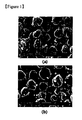
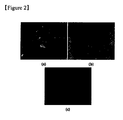
- Example 1 To check the surface characteristics of Example 1 and Comparative example 3, measurement results obtained using SEM (Scanning Electron Microscope) are shown in FIG. 1 . And, mapping of the core-shell type carbon active material prepared in Example 1 is shown in FIG. 2 . As shown in FIGs. 1 and 2 , the carbonaceous material of the present invention is coated uniformly with lithium titanium oxide, TiO 2 and Super-P.
- the batteries manufactured according to the examples and the comparative examples were initially charged using a charge/discharge cycle system on conditions of CC-CV (constant current-constant voltage) of a charge voltage of 4.2V and a current density of 400mAh at 25°C, and after a resting stage of 10 minutes, were discharged with a discharge capacity of 1000mAh until the voltage was 2.7V, and electrical characteristics and safety were evaluated.
- CC-CV constant current-constant voltage
- metal oxide was coated on the surface of the core, so that initial charge/discharge efficiency and specific capacity was relatively reduced.
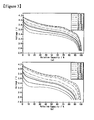
- Example 1 As shown in Table 2, the discharge characteristics with current density were evaluated from a ratio of a discharge capacity at a current density of 20C to a discharge capacity at a current density of 0.5C(1000mA) as a nominal capacity.
- the discharge characteristics with current density for Example 1 FIG. 3a
- discharge characteristics with current density for Comparative example 1 FIG. 3b
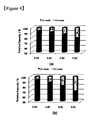
- charge characteristics were measured by charging on conditions of CC-CV of a charge current of 0.5C to 5.0C and a charge voltage of 4.2V.
- a charge capacity in a CC mode was compared with the total charge capacity according to current density, and comparison results are shown in Table 2 and FIG. 4 .
- the anode active material of Example 1 had better cycle life than the anode active materials of Comparative examples 1 and 3.
- the addition of TiO 2 to the lithium titanium oxide of the shell improved a coating performance, thereby suppressing a reaction between an anode active material and a liquid electrolyte and activating the surface of the anode active material due to coating of Super-P.
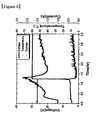
- the battery behavior during high temperature storage was measured, and measurement results of the examples and comparative examples are shown in Table 3.
- the battery behavior of the anode active material of Example 1 is shown in FIG. 7 .
- the battery surface temperature after a nail penetration test was measured, and measurement results of the examples and comparative examples are shown in Table 3.
- the battery behavior and change in surface temperature of the anode active material of Example 1 are shown in FIG. 8 .
- Examples 1 to 3 have a little lower initial charge/discharge efficiency and specific capacity than Comparative example 1. This is because the surface of MGP is coated with nano-sized lithium titanium oxide, consequently an irreversible capacity occurs at the other potential area, and as a result, Examples 1 to 3 exhibit a little lower specific capacity. However, this does not act as an important factor to battery characteristics. On the contrary, Comparative example 1 shows relatively higher initial charge/discharge efficiency and specific capacity, but shows very weak characteristics in the evaluation on electrical conductivity and safety.
- Example 1 it is found through Example 1 that addition of TiO 2 increases adhesion between a carbonaceous material and lithium titanium oxide and is effective to improve high rate characteristics.
- the anode active material of Comparative example 2 obtained by simply mixing a carbonaceous material and lithium titanium oxide, because the carbonaceous material and the lithium titanium oxide are operated at different voltage ranges, battery performance reduces and safety does not take effect.
- the anode active material of Comparative example 3 in which only lithium titanium oxide was used as a shell forming material, some of the lithium titanium oxide may not be involved in coating.
- the anode active material should contain a larger amount of liquid electrolyte to increase the surface resistance. As cycles are repeated with high rate charge/discharge, cycle life is reduced.
- An anode active material for a lithium secondary battery according to the present invention comprises a carbonaceous material core, and a shell including spinel-type lithium titanium oxide particles and metal oxide that fills voids formed by the spinel-type lithium titanium oxide particles.
- a lithium secondary battery manufactured using the anode active material exhibits excellent electrical characteristics and safety.
- a method for preparing the anode active material for a lithium secondary battery according to the present invention provides excellent reproducibility and productivity in preparing the core-shell type anode active material of the present invention.
Landscapes
- Chemical & Material Sciences (AREA)
- Chemical Kinetics & Catalysis (AREA)
- Electrochemistry (AREA)
- General Chemical & Material Sciences (AREA)
- Engineering & Computer Science (AREA)
- Inorganic Chemistry (AREA)
- Materials Engineering (AREA)
- Composite Materials (AREA)
- Manufacturing & Machinery (AREA)
- Battery Electrode And Active Subsutance (AREA)
Applications Claiming Priority (1)
| Application Number | Priority Date | Filing Date | Title |
|---|---|---|---|
| PCT/KR2009/002776 WO2010137753A1 (ko) | 2009-05-26 | 2009-05-26 | 리튬 이차전지용 음극 활물질 및 그 제조방법과 이를 포함하는 리튬 이차전지 |
Publications (2)
| Publication Number | Publication Date |
|---|---|
| EP2450988A1 true EP2450988A1 (de) | 2012-05-09 |
| EP2450988A4 EP2450988A4 (de) | 2014-06-04 |
Family
ID=43222850
Family Applications (1)
| Application Number | Title | Priority Date | Filing Date |
|---|---|---|---|
| EP09716197.0A Withdrawn EP2450988A4 (de) | 2009-05-26 | 2009-05-26 | Anodenaktivmasse für lithium-sekundärbatterie, herstellungsverfahren dafür und lithium-sekundärbatterie damit |
Country Status (5)
| Country | Link |
|---|---|
| US (1) | US10283762B2 (de) |
| EP (1) | EP2450988A4 (de) |
| JP (1) | JP5524202B2 (de) |
| CN (1) | CN101986797B (de) |
| WO (1) | WO2010137753A1 (de) |
Cited By (7)
| Publication number | Priority date | Publication date | Assignee | Title |
|---|---|---|---|---|
| US20140087233A1 (en) * | 2011-05-31 | 2014-03-27 | Ji-Jun Hong | Lithium secondary battery |
| WO2014195324A2 (en) | 2013-06-04 | 2014-12-11 | Solvay Specialty Polymers Italy S.P.A. | Core-shell type anode active material for lithium secondary batteries, method for preparing the same and lithium secondary batteries containing the same |
| EP2658015A4 (de) * | 2010-12-21 | 2015-01-07 | Lg Chemical Ltd | Kathodenaktivmaterial und sekundärbatterie damit |
| US10297816B2 (en) | 2011-11-30 | 2019-05-21 | Kokam Co., Ltd. | Lithium secondary battery having improved safety and stability |
| US10593930B2 (en) | 2013-06-20 | 2020-03-17 | Lg Chem, Ltd. | High capacity electrode active material for lithium secondary battery and lithium secondary battery using the same |
| US10797309B2 (en) | 2015-11-11 | 2020-10-06 | Lg Chem, Ltd. | Negative electrode active material and lithium secondary battery comprising the same |
| EP3660957A4 (de) * | 2017-10-20 | 2020-11-25 | LG Chem, Ltd. | Aktives material für negative elektrode und negative elektrode einer festkörperbatterie damit |
Families Citing this family (14)
| Publication number | Priority date | Publication date | Assignee | Title |
|---|---|---|---|---|
| WO2014034933A1 (ja) * | 2012-09-03 | 2014-03-06 | 日本ケミコン株式会社 | リチウムイオン二次電池用電極材料、この電極材料の製造方法、及びリチウムイオン二次電池 |
| CN103050705A (zh) * | 2013-01-06 | 2013-04-17 | 天津市捷威动力工业有限公司 | 一种钛酸锂表涂负极及使用该种负极的锂离子电池 |
| KR101785268B1 (ko) * | 2013-12-10 | 2017-10-16 | 삼성에스디아이 주식회사 | 음극 활물질, 이를 포함하는 리튬 전지 및 상기 음극 활물질의 제조방법 |
| JP6476944B2 (ja) * | 2015-02-06 | 2019-03-06 | 株式会社リコー | 非水電解液蓄電素子 |
| CN105047929A (zh) * | 2015-06-08 | 2015-11-11 | 内蒙古瑞盛石墨新材料有限公司 | 一种多孔结构的锂离子电池负极材料及其制备方法 |
| KR102473531B1 (ko) | 2015-09-24 | 2022-12-05 | 삼성전자주식회사 | 복합 전극활물질, 이를 채용한 전극과 리튬전지, 및 복합 전극활물질 제조방법 |
| KR102537225B1 (ko) | 2015-10-23 | 2023-05-30 | 삼성전자주식회사 | 복합 음극 활물질, 상기 복합 음극 활물질을 포함하는 음극 및 상기 음극을 포함하는 리튬 이차전지 |
| WO2017082680A1 (ko) * | 2015-11-11 | 2017-05-18 | 주식회사 엘지화학 | 음극 활물질 및 이를 포함하는 리튬 이차전지 |
| JP7053192B2 (ja) * | 2017-08-30 | 2022-04-12 | 旭化成株式会社 | 非水電解質電池用吸着層並びにこれを用いた非水電解質電池用セパレータ及び非水電解質電池 |
| KR102671430B1 (ko) | 2019-02-22 | 2024-05-30 | 주식회사 엘지에너지솔루션 | 음극 활물질 및 이를 포함하는 리튬이차전지 |
| KR102715682B1 (ko) * | 2019-05-13 | 2024-10-11 | 한국전기연구원 | 탄소재 표면에 금속 인화물 코팅을 포함하는 음극 활물질, 그의 제조 방법 및 이러한 음극 활물질을 구비한 비수계 리튬이차전지 및 그의 제조 방법 |
| EP4047683A4 (de) | 2019-10-15 | 2024-03-13 | Industry-University Cooperation Foundation Hanyang University ERICA Campus | Elektrodenzwischenprodukt, elektrodenpulver, elektrode damit, elektrodenpellet damit und verfahren zur jeweiligen herstellung |
| US12489138B2 (en) | 2019-10-15 | 2025-12-02 | Industry-University Cooperation Foundation Hanyang University Erica Campus | Intermediate product of solid electrolyte, solid electrolyte using same, secondary battery including same, and method for manufacturing same |
| EP4641659A4 (de) * | 2023-09-06 | 2026-04-29 | Lg Energy Solution Ltd | Negativelektrode und lithium-ionen-sekundärbatterie mit negativelektrode |
Family Cites Families (12)
| Publication number | Priority date | Publication date | Assignee | Title |
|---|---|---|---|---|
| JP4729774B2 (ja) * | 2000-02-28 | 2011-07-20 | 株式会社豊田中央研究所 | リチウム二次電池用負極材料の製造方法 |
| KR100433822B1 (ko) | 2002-01-17 | 2004-06-04 | 한국과학기술연구원 | 금속이 피복된 탄소 활물질, 이의 제조방법, 및 이를포함하는 금속-탄소 하이브리드 전극 및 리튬이차전지 |
| US7629082B2 (en) | 2004-04-23 | 2009-12-08 | Lg Chem, Ltd. | Anode active material with improved electrochemical properties and electrochemical device comprising the same |
| JP4284232B2 (ja) * | 2004-05-20 | 2009-06-24 | 株式会社東芝 | 非水電解質二次電池 |
| JP2006066298A (ja) | 2004-08-27 | 2006-03-09 | Toyota Motor Corp | リチウム二次電池 |
| JP2006278282A (ja) | 2005-03-30 | 2006-10-12 | Sanyo Electric Co Ltd | 非水電解液二次電池 |
| KR100816586B1 (ko) | 2006-01-27 | 2008-03-24 | 엘에스전선 주식회사 | 2차 전지용 음극재, 이를 이용한 2차 전지, 2차 전지용음극재 제조방법 및 이를 이용한 2차 전지 |
| WO2009002053A2 (en) * | 2007-06-22 | 2008-12-31 | Lg Chem, Ltd. | Anode material of excellent conductivity and high power secondary battery employed with the same |
| CN101425580A (zh) * | 2007-10-29 | 2009-05-06 | 比亚迪股份有限公司 | 锂离子电池负极活性物质及其制备方法以及负极和电池 |
| KR100888685B1 (ko) * | 2007-11-05 | 2009-03-13 | 주식회사 코캄 | 코어-쉘형 리튬 이차전지용 음극 활물질 및 그 제조방법과이를 포함하는 리튬 이차전지 |
| JP2009252421A (ja) * | 2008-04-03 | 2009-10-29 | Toyota Motor Corp | 負極活物質およびその製造方法ならびに該負極活物質を備えた電池 |
| KR101105878B1 (ko) | 2008-12-02 | 2012-01-16 | 주식회사 코캄 | 리튬 이차전지용 코어-쉘형 음극 활물질 및 그 제조방법과 이를 포함하는 리튬 이차전지 |
-
2009
- 2009-05-26 CN CN2009800004654A patent/CN101986797B/zh active Active
- 2009-05-26 WO PCT/KR2009/002776 patent/WO2010137753A1/ko not_active Ceased
- 2009-05-26 JP JP2011516113A patent/JP5524202B2/ja active Active
- 2009-05-26 US US12/528,064 patent/US10283762B2/en active Active
- 2009-05-26 EP EP09716197.0A patent/EP2450988A4/de not_active Withdrawn
Cited By (10)
| Publication number | Priority date | Publication date | Assignee | Title |
|---|---|---|---|---|
| EP2658015A4 (de) * | 2010-12-21 | 2015-01-07 | Lg Chemical Ltd | Kathodenaktivmaterial und sekundärbatterie damit |
| US9012081B2 (en) | 2010-12-21 | 2015-04-21 | Lg Chem, Ltd. | Anode active material and secondary battery comprising the same |
| US20140087233A1 (en) * | 2011-05-31 | 2014-03-27 | Ji-Jun Hong | Lithium secondary battery |
| US9252413B2 (en) | 2011-05-31 | 2016-02-02 | Kokam Co., Ltd. | Lithium secondary battery |
| US10297816B2 (en) | 2011-11-30 | 2019-05-21 | Kokam Co., Ltd. | Lithium secondary battery having improved safety and stability |
| WO2014195324A2 (en) | 2013-06-04 | 2014-12-11 | Solvay Specialty Polymers Italy S.P.A. | Core-shell type anode active material for lithium secondary batteries, method for preparing the same and lithium secondary batteries containing the same |
| US10593930B2 (en) | 2013-06-20 | 2020-03-17 | Lg Chem, Ltd. | High capacity electrode active material for lithium secondary battery and lithium secondary battery using the same |
| US10797309B2 (en) | 2015-11-11 | 2020-10-06 | Lg Chem, Ltd. | Negative electrode active material and lithium secondary battery comprising the same |
| EP3660957A4 (de) * | 2017-10-20 | 2020-11-25 | LG Chem, Ltd. | Aktives material für negative elektrode und negative elektrode einer festkörperbatterie damit |
| US11387441B2 (en) | 2017-10-20 | 2022-07-12 | Lg Energy Solution, Ltd. | Negative electrode active material and negative electrode for solid state battery including the same |
Also Published As
| Publication number | Publication date |
|---|---|
| JP2011521436A (ja) | 2011-07-21 |
| EP2450988A4 (de) | 2014-06-04 |
| US10283762B2 (en) | 2019-05-07 |
| CN101986797A (zh) | 2011-03-16 |
| JP5524202B2 (ja) | 2014-06-18 |
| WO2010137753A1 (ko) | 2010-12-02 |
| CN101986797B (zh) | 2013-08-14 |
| US20190088936A1 (en) | 2019-03-21 |
Similar Documents
| Publication | Publication Date | Title |
|---|---|---|
| US10283762B2 (en) | Anode active material for lithium secondary battery, method for preparing the same and lithium secondary battery comprising the same | |
| EP2208247B1 (de) | Anoden-aktivmaterial des kern-schalentyps für eine lithium-sekundärbatterie, herstellungsverfahren dafür und lithium-sekundärbatterie damit | |
| EP2374176B1 (de) | Anodenaktivmaterial des kern-schalen-typs für lithium-sekundärbatterien, herstellungsverfahren dafür und lithium-sekundärbatterien damit | |
| RU2403654C1 (ru) | Катодный активный материал для литиевых вторичных батарей с высокой безопасностью, способ приготовления этого материала и литиевые вторичные батареи, содержащие этот материал | |
| CN1324736C (zh) | 正极活性物质和含有该正极活性物质的非水电解质二次电池 | |
| CN106935793B (zh) | 负极、制备负极的方法及包含该负极的锂二次电池 | |
| CN1706054A (zh) | 负极、电池及其制造方法 | |
| JP2011253688A (ja) | 負極活物質粒子、負電極板、リチウムイオン二次電池、車両、電池搭載機器、及び、負極活物質粒子の製造方法 | |
| JP2007173134A (ja) | リチウムイオン電池の電極用材料、リチウムイオン電池の電極形成用スラリーおよびリチウムイオン電池 | |
| KR101142533B1 (ko) | 금속계 아연 음극 활물질 및 이를 이용한 리튬이차전지 | |
| KR101105875B1 (ko) | 리튬 이차전지용 음극 활물질 및 그 제조방법과 이를 포함하는 리튬 이차전지 | |
| KR20150142735A (ko) | 리튬 이온 이차 전지용 음극활물질로서 카본이 코팅된 NbO₂의 제조 방법 |
Legal Events
| Date | Code | Title | Description |
|---|---|---|---|
| PUAI | Public reference made under article 153(3) epc to a published international application that has entered the european phase |
Free format text: ORIGINAL CODE: 0009012 |
|
| 17P | Request for examination filed |
Effective date: 20090722 |
|
| AK | Designated contracting states |
Kind code of ref document: A1 Designated state(s): AT BE BG CH CY CZ DE DK EE ES FI FR GB GR HR HU IE IS IT LI LT LU LV MC MK MT NL NO PL PT RO SE SI SK TR |
|
| DAX | Request for extension of the european patent (deleted) | ||
| A4 | Supplementary search report drawn up and despatched |
Effective date: 20140506 |
|
| RIC1 | Information provided on ipc code assigned before grant |
Ipc: H01M 4/131 20100101ALI20140428BHEP Ipc: H01M 4/62 20060101ALI20140428BHEP Ipc: H01M 10/0525 20100101ALI20140428BHEP Ipc: H01M 4/36 20060101ALI20140428BHEP Ipc: H01M 4/485 20100101AFI20140428BHEP |
|
| STAA | Information on the status of an ep patent application or granted ep patent |
Free format text: STATUS: THE APPLICATION IS DEEMED TO BE WITHDRAWN |
|
| 18D | Application deemed to be withdrawn |
Effective date: 20141203 |