EP2451809B1 - Procédé pour la préparation et la purification de sels de solifénacine - Google Patents
Procédé pour la préparation et la purification de sels de solifénacine Download PDFInfo
- Publication number
- EP2451809B1 EP2451809B1 EP10732304.0A EP10732304A EP2451809B1 EP 2451809 B1 EP2451809 B1 EP 2451809B1 EP 10732304 A EP10732304 A EP 10732304A EP 2451809 B1 EP2451809 B1 EP 2451809B1
- Authority
- EP
- European Patent Office
- Prior art keywords
- temperature
- solifenacin
- hexanol
- seeding
- mixture
- Prior art date
- Legal status (The legal status is an assumption and is not a legal conclusion. Google has not performed a legal analysis and makes no representation as to the accuracy of the status listed.)
- Active
Links
Images






Classifications
-
- C—CHEMISTRY; METALLURGY
- C07—ORGANIC CHEMISTRY
- C07D—HETEROCYCLIC COMPOUNDS
- C07D453/00—Heterocyclic compounds containing quinuclidine or iso-quinuclidine ring systems, e.g. quinine alkaloids
- C07D453/02—Heterocyclic compounds containing quinuclidine or iso-quinuclidine ring systems, e.g. quinine alkaloids containing not further condensed quinuclidine ring systems
Definitions
- the invention relates to a preparation and purification processes of solifenacin succinate, particularly to a crystallization process of solifenacin succinate, leading to high purity of the obtained product as well as to the desired average particle size and desired modality of the particle size distribution.
- Solifenacin with its chemical name (1S)-(3R)-1-azabicyclo[2.2.2]oct-3-yl 3,4-dihydro-1-phenyl-2(1 H )-isoquinoline carboxylate (I) is used for symptomatic treatment of urgent incontinence and/or increased frequency of urinating and urgency of urinating in patients with a hyperactive urinary bladder.
- the commercial tablet is marketed under the name Vesicare ® and has been approved by the FDA for once daily treatment of OAB in 5 mg and 10 mg tablets. Each Vesicare tablet contains 5 or 10 mg of solifenacin succinate and is formulated for oral administration.
- the technical problem to be solved was to develop the method to decrease the impurity content of solifenacin succinate, as well as the provision of a process yielding the selected average particle size and a mono-modal average particle size distribution, characterized in that the average particle size can easily be achieved by controlling the seeding temperature and the aging of the crystallization at the seeding temperature, T seeding .
- T seeding the seeding temperature
- a product which possesses a bi- or even multi-modal average particle size distributions, can be prepared.
- controlled modality and non-agglomerated particles with defined average size are particularly desired.
- EP 1 714 965 A1 describes the purification of solifenacin succinate, solifenacin hydrochloride and solifenacin oxalate.
- solifenacin hydrochloride is crystallized from a mixture of acetonitrile and ethyl ether
- solifenacin oxalate is deposited from a mixture of isopropanol and isopropyl ether.
- WO 2008/011462 A2 enumerates a number of solvents suitable for the crystallization of solifenacin salts but specifically only uses acetone, ethanol and ethyl acetate for the preparation of solifenacin succinate (Example 9, Example 8).
- the mixture was either heated to 75°C and maintained for about 2.5 hours and then gradually cooled to 4°C and aged for about 4 hours, or heated to about 60°C and aged for about 1 hour, cooled to 12°C and maintained for about 1 hour.
- acetone a second crystallization was needed.
- Example 10 describes the crystallization of solifenacin hydrochloride from acetonitrile and diethyl ether. No seeding nor any other means of controlling the average particle size and the modality of its distribution is described.
- WO 2008/013851 teaches the preparation of crystalline solifenacin succinate from various solvents i.a. from C 1 -C 4 alcohols, or mixtures comprising a C 1 -C 4 alcohol. With the exception of 95% ethanol no reaction mixture comprising water is disclosed by WO 2008/013851 . Also here, no seeding by any means of controlling the average particle size and the modality of its distribution is described.
- the present invention provides a crystallization process as defined in claim 1 annexed.
- solifenacin succinate applying C 5 -C 10 alcohols comprising water.
- solifenacin succinate is crystallized from a mixture comprising pentanol and water or from a solvent mixture comprising hexanol and water.
- the average particle size of formed product can be controlled in a crystallization process with seeding and the degree of super-saturation applied through the crystallization process which consequently influences the rate and type of nucleation and the rate of crystal growth through the crystallization process.
- solifenacin succinate in the case of solifenacin succinate, the cooling gradient parameter (cooling ramp), solvent concentration and temperature of spontaneous or secondary nucleation can be used for control of average particle size and modality of its distribution and also the purity of prepared material. Surprisingly it was found out, that aging the media after seeds are added can have crucial role in effective preparation of solifenacin succinate with one-modal particle size distribution on a large-scale production, especially if optimized seeding temperature is used.
- the seeding temperature from the range of 40°C to 80°C, preferably 50°C to 70°C, most preferably 50°C to 60°C, the time of aging the seeded mixture from 0 to 250 minutes, preferably from 10 to 120 minutes, and the cooling ramp between 0.1 K/min to 1.5 K/min, preferably between 0.2 K/min and 0.5 K/min.
- particle size distribution means a particle size frequency distribution that shows the percentage of particles (normalized in means of mass, volume or count) found in each size range and usually displayed in a histogram form.
- »unimodal distribution « or »one-modal distribution « refers to one whose histogram has a single peak, so that the frequencies at first increase and then decrease.
- «bi-modal distribution « is one whose histogram has two peaks. Similarly, there can be trimodal distributions and so on.
- dried product means a solifenacine salt with solvent/anti-solvent content below 0.50 w/w %. This refers to mass percentage content of C 5 to C 10 alcohol and water present in dried product.
- applying C 5 -C 10 alcohols encompasses applying or using at least one C 5 -C 10 alcohol.
- applying a mixture of C 5 -C 10 alcohols and water encompasses applying or using a mixture of at least one C 5 -C 10 alcohol and water.
- the C 5 to C 10 alcohol(s) applied in a crystallization process for the preparation and/or purification of solifenacin salts can be at least one alcohol selected from the group of C 5 alcohols, C 6 alcohols, C 7 alcohols, C 8 alcohols, C 9 alcohols, and C 10 alcohols, preferably at least one alcohol selected from the group of n-pentanol, isopentanol, sec-pentanol, n-hexanol, iso hexanol, sec-hexanol, n-heptanol, n-octanol, n-nonanol and n-decanol, preferably n-pentanol, n-hexanol, or n-heptanol, most preferably n-hexanol.
- solifenacin succinate can comprise the step of dissolving a solifenacin salt, which is solifenacin succinate, in particular the step of dissolving a solifenacin salt, which is solifenacin succinate, in a mixture comprising at least one C 5 -C 10 alcohol and water.
- a mixture of at least one C 5 -C 10 alcohol and at least one further alcohol having less than 5 or more than 10 carbon atoms can be applied or used, with water.
- the volume ratio between water (preferably purified and/or degassed water) to an organic solvent is in particular between 0.1% and 10%, preferably between 0.4% and 5%, most preferably between 0.5 and 3 %(V/V %).
- the mass to volume ratio between solifenacin succinate and the solvent mixture applied is in particular between 1/50 to 1/1 kg/L, preferably between 1/10 to 1/1.5 kg/L and most preferably between 1/5 to 1/2 kg/L.
- the mass to volume ratio between solifenacin succinate, and the solvent mixture applied is in particular between 1 kg solifenacin succinate to 2 L of n-hexanol and water and I kg solifenacin succinate to 5 L of n-hexanol and water, preferably between 1 kg solifenacin succinate to 3 L of n-hexanol and water and 1 kg solifenacin succinate to 4 L of n-hexanol and water.
- the volume to volume ratio between water and n-hexanol in case of solifenacin succinate is preferably between 1 to 50 and I to 200, preferably between 1 to 70 and 1 to 150, most preferably between 1 to 90 and 1 to 120.
- the crude solifenacin succinate according to the present invention when wet may still comprise a water/C 5 -C 10 alcohol content of 80 % w/w to below 1 % w/w directly from the filtration/centrifugation step.
- the average particle size of the obtained solifenacin succinate may be optimized to the average diameter of 20 to 600 micrometers ( ⁇ m), preferably to the average particle size from 30 - 400 micrometers, most preferably to the average particle size between 40 and 250 micrometers by the process of the present invention.
- average particle size refers to the volume mean diameter of particles.
- d 90 value means that at least 90% of the particles have volume diameter of less than the specified value. The same approach goes for the d 50 and d 10 .
- the particles of solifenacin succinate may be optimized in size with the use of a dispergator.
- a dispergator any commercially available product may be used, such as Ultra-TurraX ® .
- Another option is the use of mills after the isolation of solifenacin succinate. During milling the mechanical force exerted on the particle surface leads to particle size reduction.
- Milling can be performed by any milling process known in the art, for example using a ball mill (planetary ball mill or mixer mill), hammer mill, bead mill, disc mill, ultrasonic mill, torus mill, impact mill, vibration mill, pin mill or air jet mill.
- the basic principle of treatment in an air jet mill is collision and attrition between particles suspended within the high velocity air stream which introduces the power to the milling chamber.
- particles are fractured by impact of grinding media (e.g. balls, cubes, cylinders, jars etc.) that can occupy up to half of the mill chamber volume. Due to rotation of the chamber the grinding media falls from an elevated position.
- grinding media e.g. balls, cubes, cylinders, jars etc.
- Friction is also present among all elements, contributing significantly to the attrition and consequently to the amorphous nature of the material being milled.
- One of the most widely used mills in the pharmaceutical industry is the hammer mill. In such equipment, particles are exposed to the impact of rapidly rotating hammers. During milling, material may additionally hit the perforated screen that is placed over the chamber outlet.
- the obtained crystalline form of solifenacin succinate is preferably Form I, characterized by powder X-ray diffraction (PXRD) pattern having peaks at about: 3.7, 5.4, 7.4, 8.2, 9.4, 11.1, 11.8, 12.5, 13.5, 14.1, 14.4, 15.5, 16.4, 17.1.17.6, 18.1, 18.6, 19.1, 19.6, 20.0, 20.8, 21.2, 21.8, 22.8, 23.2, 23.8, 24.7, 25.2, 25.6, 26.2, 26.5, 26.8, 27.5, 28.2, 28.5, 29.0, 29.5, 30.2 ⁇ 0,2 2-theta degrees or 3.7, 7.4, 11.1, 11.9, 13.5, 14.1, 14.8, 15.5, 15.8, 17.6, 18.1,18.5, 19.3, 20.2, 21.0, 21.8, 22.3, 22.7, 23.0, 23.2, 23.9, 25.1, 25.8, 26.1, 26.6, 27.2, 27.6, 28.6, 29.5 ⁇ 0,2 2-theta degrees, as measured on Panalytical x'pert pro diffrak
- the present invention is illustrated by the following Examples without being limited thereto.
- the Reactor Temperature (RT) versus time during the cooling process is presented as a linear function, but is not limited thereto. It is used as an average cooling rate for describing the time needed for cooling the mixture in the reactor from starting temperature to the desired (final) temperature.
- the real function of the reactor temperature versus time of crystallization process can be represented by any other continuous function.
- T seeding The "temperature of seeding" is the temperature, at which the seeds of pure chemical substance are added.
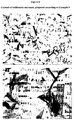
- a mixture comprising 80 ml of 1-hexanol and 0.8 ml of purified water was prepared. 20.0 g of solifenacin succinate was added and the formed suspension was heated to 85 °C (Reactor Temperature, RT) and maintained at this temperature for the next 30 minutes for all solid to dissolve. Continuous homogenization with mechanical mixer was applied during the crystallization process. Formed clear solution was cooled to 50 °C (T seeding ) in 30 minutes. 200 mg of seeds of pure solifenacin were added at the temperature of 50°C and maintained at this temperature for next 60 minutes. Then the formed suspension was cooled with average cooling ramp 0.22 K/min to 10 °C (in 180 minutes) and maintained at this temperature for the next 30 minutes for the crystallization to complete. Finally, the formed product was isolated with filtration and washed with 15 ml of 1-hexanol, cooled to 10 °C.
- a mixture comprising 80 ml of 1-hexanol and 0.8 ml of purified water was prepared. 20.0 g of solifenacin succinate was added and the formed suspension was heated to 85 °C (RT) and maintained at this temperature for the next 30 minutes for all solid to dissolve. Continuous homogenization with mechanical mixer was applied during the crystallization process. Formed clear solution was cooled to 55 °C (T seeding ) in the next 30 minutes. 200 mg of seeds of pure solifenacin were added at the temperature of 55°C and maintained at this temperature for next 60 minutes. Then the formed suspension was cooled with average cooling ramp 0.25 K/min to 10 °C (in 180 minutes) and maintained at this temperature for the next 30 minutes for the crystallization to complete. Finally, the formed product was isolated with filtration and washed with 15 ml of 1-hexanol, cooled to 10 °C.
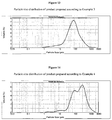
- Particle size distribution of product prepared according to Example 2 is shown in Fig. 12 .
- a mixture comprising 80 ml of 1-hexanol and 0.8 ml of purified water was prepared in glass reactor. 20.0 g of solifenacin succinate was added and the formed suspension was heated to 85 °C (RT) and maintained at this temperature for the next 30 minutes for all solid to dissolve. Continuous homogenization with mechanical mixer was applied during the crystallization process. Formed clear solution was cooled to 60 °C (T seeding ) in 30 minutes. 200 mg of seeds of pure solifenacin were added at the temperature of 60°C and maintained at this temperature for next 60 minutes. Then the formed suspension was cooled with average cooling ramp 0.28 K/min to 10 °C (in 180 minutes) and maintained at this temperature for the next 30 minutes for the crystallization to complete. Finally, the formed product was isolated with filtration and washed with 15 ml of 1-hexanol, cooled to 10 °C.
- a mixture comprising 80 ml of 1-hexanol and 0.8 ml of purified water was prepared in glass reactor. 20.0 g of solifenacin succinate was added and the formed suspension was heated to 85 °C (RT) and maintained at this temperature for the next 30 minutes for all solid to dissolve. Continuous homogenization with mechanical mixer was applied during the crystallization process. Formed clear solution was cooled to 65 °C (T seeding ) in 30 minutes. 200 mg of seeds of pure solifenacin were added at the temperature of 65°C and maintained at this temperature for next 60 minutes. Then the formed suspension was cooled with average cooling ramp 0.31 K/min to 10 °C (in 180 minutes) and maintained at this temperature for the next 30 minutes for the crystallization to complete. Finally, the formed product was isolated with filtration and washed with 15 ml of 1-hexanol, cooled to 10 °C.
- a mixture comprising 80 ml of 1-hexanol and 0.8 ml of purified water was prepared. 20.0 g of solifenacin succinate was added and the formed suspension was heated to 85 °C (RT) and maintained at this temperature for the next 30 minutes for all solid to dissolve. Continuous homogenization with mechanical mixer was applied during the crystallization process. Formed clear solution was cooled to 50 °C (T seeding ) in 30 minutes. 200 mg of seeds of pure solifenacin were added at the temperature of 50°. After that the suspension was immediately cooled with average cooling ramp 0.22 K/min to 10 °C (in 180 minutes) and maintained at this temperature for the next 30 minutes for the crystallization to complete. Finally, the formed product was isolated with filtration and washed with 15 ml of 1-hexanol, cooled to 10 °C.
- a mixture comprising 80 ml of 1-hexanol and 0.8 ml of purified water was prepared.
- 20.0 g of solifenacin succinate was added and the formed suspension was heated to 85 °C (RT) and maintained at this temperature for the next 30 minutes for all solid to dissolve.
- Continuous homogenization with mechanical mixer was applied during the crystallization process.
- Formed clear solution was cooled to 55 °C (T seeding ) in the next 30 minutes.
- 200 mg of seeds of pure solifenacin were added at the temperature of 55°.
- the suspension was immediately cooled with average cooling ramp 0.25 K/min to 10 °C (in 180 minutes) and maintained at this temperature for the next 30 minutes for the crystallization to complete.
- the formed product was isolated with filtration and washed with 15 ml of 1-hexanol, cooled to 10 °C.
- a mixture comprising 80 ml of 1-hexanol and 0.8 ml of purified water was prepared.
- 20.0 g of solifenacin succinate was added and the formed suspension was heated to 85 °C (RT) and maintained at this temperature for the next 30 minutes for all solid to dissolve.
- Continuous homogenization with mechanical mixer was applied during the crystallization process.
- Formed clear solution was cooled to 60 °C (T seeding ) in the next 30 minutes.
- 200 mg of seeds of pure solifenacin were added at the temperature of 60°.
- the suspension was immediately cooled with average cooling ramp 0.28 K/min to 10 °C (in 180 minutes) and maintained at this temperature for the next 30 minutes for the crystallization to complete.
- the formed product was isolated with filtration and washed with 15 ml of 1-hexanol, cooled to 10 °C.
- Average particle size 71 ⁇ m
- Particle size distribution D 50 9.4 ⁇ m
- a mixture comprising 80 ml of 1-hexanol and 0.8 ml of purified water was prepared.
- 20.0 g of solifenacin succinate was added and the formed suspension was heated to 85 °C (RT) and maintained at this temperature for the next 30 minutes for all solid to dissolve.
- Continuous homogenization with mechanical mixer was applied during the crystallization process.
- Formed clear solution was cooled to 65 °C (T seeding ) in the next 30 minutes.
- 200 mg of seeds of pure solifenacin were added at the temperature of 65°.
- the suspension was immediately cooled with average cooling ramp 0.31 K/min to 10 °C (in 180 minutes) and maintained at this temperature for the next 30 minutes for the crystallization to complete.
- the formed product was isolated with filtration and washed with 15 ml of 1-hexanol, cooled to 10 °C.
- Particle size distribution of product prepared according to Example 8 is shown in Fig. 18 .
- a mixture comprising 20 ml of 1-hexanol and 0.2 ml of purified water was prepared.
- Continuous homogenization with mechanical mixer was applied during the crystallization process.
- Formed clear solution was cooled to 10 °C (RT) in the next 250 minutes with average cooling ramp 0.30 K/min and maintained at this temperature for the next 10 minutes for the crystallization to complete.
- the formed product was isolated with filtration and washed with 3 ml of 1-hexanol, cooled to 10 °C.
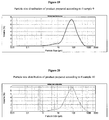
- Particle size distribution of product prepared according to Example 9 is shown in Fig. 19 .
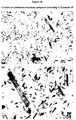
- a mixture comprising 20L of 1-hexanol and 200 ml of purified water was prepared in a reactor. 5.00 kg of solifenacin succinate was added and the formed suspension was heated to 85 °C (RT) and maintained at this temperature for the next 30 minutes for all solid to dissolve. Continuous homogenization with mechanical mixer was applied during the crystallization process. Formed clear solution was cooled to 58 °C (RT) in 30 minutes. 50 g of seeds of pure solifenacin were added at the temperature of 58 °C and maintained at this temperature for next 60 minutes. Then the formed suspension was cooled with average cooling ramp 0.28 K/min to 10 °C (in 180 minutes) and maintained at this temperature for the next 30 minutes for the crystallization to complete. Finally, the formed product was isolated with filtration and washed with 2L of 1-hexanol, cooled to 10 °C.
- Particle size distribution of product prepared according to Example 10 is shown in Fig. 20 .
Landscapes
- Chemical & Material Sciences (AREA)
- Organic Chemistry (AREA)
- Nitrogen Condensed Heterocyclic Rings (AREA)
- Pharmaceuticals Containing Other Organic And Inorganic Compounds (AREA)
Claims (13)
- Un procédé de cristallisation pour la préparation et/ou la purification de succinate de solifénacine, en mettant en oeuvre un mélange d'alcools en C5-C10 et d'eau.
- Un procédé selon la revendication 1, dans lequel le mélange de solvants utilisé pour le procédé de cristallisation comprend de l'eau et un alcool en C5 à C10 choisi parmi le groupe constitué du n-pentanol, de l'isopentanol, du sec-pentanol, du n-hexanol, l'iso hexanol, du sec-hexanol, du n-heptanol, du n-octanol, du n-nonanol et du n-décanol.
- Un procédé selon l'une quelconque des revendications 1 et 2, caractérisé en ce que l'alcool est choisi parmi le groupe du n-pentanol et du n-hexanol.
- Un procédé selon l'une quelconque des revendications 1 et 2, caractérisé en ce que :i) un sel de solifénacine, qui est du succinate de solifénacine, est dissous dans un mélange de solvants comprenant de l'eau et un alcool en C5 à C10, de préférence le n-pentanol, le n-hexanol ou le n-heptanol, avec la plus grande préférence le n-hexanol, à une température comprise entre 40 °C et 150 °C, de préférence entre 75 °C et 100 °C, jusqu'à ce que tout le sel de solifénacine soit dissous,(ii) refroidissement du mélange dissous à la température d'ensemencement Tensemencement, qui est comprise entre 40 °C et 80 °C, de préférence entre 50 °C et 70 °C, avec la plus grande préférence entre 50 °C et 60 °C,(iii) facultativement, ensemencement du mélange dissous avec des cristaux de sel de solifénacine,iv) facultativement, vieillissement du milieu ensemencé afin de réguler davantage le processus de nucléation pendant 10 à 120 minutes,v) refroidissement du mélange à une température finale comprise entre -40 °C et 40 °C, de préférence à une température comprise entre 5 °C et 10 °C pendant un laps de temps compris entre 0,5 et 10 heures, de préférence entre 2 et 3 heures, et maintien de celui-ci à la température finale pendant 15 minutes à 20 heures si nécessaire,vi) filtration et lavage des cristaux obtenus.
- Un procédé selon l'une quelconque des revendications 1 et 2, caractérisé en ce que :i) la solifénacine base est dissoute dans un mélange de solvants comprenant un alcool en C5 à C10, de préférence le n-pentanol, le n-hexanol ou le n-heptanol, avec la plus grande préférence le n-hexanol, et comprenant de l'eau, à n'importe quelle température donnée,ii) addition de l'anti-acide, qui peut être sous forme concentrée (solide, gazeuse ou liquide) ou dissous ou mis en suspension séparément dans n'importe quel (anti-)solvant,iii) facultativement, ensemencement du mélange dissous avec des cristaux de solifénacine à la température d'ensemencement Tensemencement, comprise entre 40 °C et 80 °C, de préférence entre 50 °C et 70 °C, avec la plus grande préférence entre 50 °C et 60 °C,iv) facultativement, vieillissement du milieu ensemencé,v) refroidissement du mélange à une température finale comprise entre -40 °C et 40 °C, pendant un laps de temps compris entre 0,5 et 10 heures, de préférence entre 2 et 3 heures, et maintien de celui-ci à la température finale pendant 15 minutes à 20 heures si nécessaire,vi) filtration et lavage des cristaux obtenus.
- Un procédé selon l'une quelconque des revendications 1 à 5, caractérisé en ce que la rampe de refroidissement jusqu'à la température finale est comprise entre 0,1 K/min et 1,5 K/min, de préférence entre 0,2 K/min et 0,5 K/min.
- Un procédé selon l'une quelconque des revendications 1 à 6, caractérisé en ce que le rapport masse/volume entre le succinate de solifénacine et le mélange de solvants appliqué est compris entre 1/50 et 1/1 kg/l, de préférence entre 1/10 et 1/1,5 kg/l et avec la plus grande préférence, entre 1/5 et 1/2 kg/l.
- Un procédé selon l'une quelconque des revendications 1 à 7, caractérisé en ce qu'après l'ensemencement du milieu supersaturé, le vieillissement à la température d'ensemencement est appliqué.
- Un procédé selon l'une quelconque des revendications 1 à 8, caractérisé en ce que la température d'ensemencement est inférieure à 65 °C.
- Un procédé de cristallisation pour le succinate de solifénacine selon l'une quelconque des revendications précédentes, en utilisant des mélanges d'alcool et d'eau, caractérisé par un ensemencement et/ou un vieillissement en-deçà de 65 °C.
- Un procédé selon l'une quelconque des revendications 1 à 9, caractérisé en ce que l'on obtient une matière présentant une distribution granulométrique monomodale.
- Un procédé selon l'une quelconque des revendications 1 à 10, caractérisé en ce que l'on obtient une matière présentant une distribution granulométrique monomodale et une taille de particule moyenne comprise entre 40 et 250 µm.
- Un procédé selon l'une quelconque des revendications 1 à 12, caractérisé en ce que le procédé de cristallisation pour la préparation et/ou la purification du succinate de solifénacine met en oeuvre un mélange d'au moins un alcool en C5-C10 et d'au moins un autre alcool comportant moins de 5 ou plus de 10 atomes de carbone, et d'eau.
Priority Applications (1)
| Application Number | Priority Date | Filing Date | Title |
|---|---|---|---|
| SI201031320A SI2451809T1 (sl) | 2009-07-09 | 2010-07-09 | Postopek za pripravo in čiščenje soli solifenacina |
Applications Claiming Priority (3)
| Application Number | Priority Date | Filing Date | Title |
|---|---|---|---|
| SI200900188 | 2009-07-09 | ||
| SI200900193 | 2009-07-15 | ||
| PCT/EP2010/004204 WO2011003624A1 (fr) | 2009-07-09 | 2010-07-09 | Procédé pour la préparation et la purification de sels de solifénacine |
Publications (2)
| Publication Number | Publication Date |
|---|---|
| EP2451809A1 EP2451809A1 (fr) | 2012-05-16 |
| EP2451809B1 true EP2451809B1 (fr) | 2016-10-12 |
Family
ID=42797198
Family Applications (1)
| Application Number | Title | Priority Date | Filing Date |
|---|---|---|---|
| EP10732304.0A Active EP2451809B1 (fr) | 2009-07-09 | 2010-07-09 | Procédé pour la préparation et la purification de sels de solifénacine |
Country Status (4)
| Country | Link |
|---|---|
| EP (1) | EP2451809B1 (fr) |
| EA (1) | EA020966B1 (fr) |
| SI (1) | SI2451809T1 (fr) |
| WO (1) | WO2011003624A1 (fr) |
Families Citing this family (2)
| Publication number | Priority date | Publication date | Assignee | Title |
|---|---|---|---|---|
| CN102887894A (zh) * | 2011-07-18 | 2013-01-23 | 天津市医药集团技术发展有限公司 | 一种琥珀酸索利那新晶型及其制备方法 |
| BR112015004902A2 (pt) | 2012-09-05 | 2017-07-04 | Chase Pharmaceuticals Corp | métodos e composição neutroprotetores anticolinérgicos |
Family Cites Families (4)
| Publication number | Priority date | Publication date | Assignee | Title |
|---|---|---|---|---|
| US20080287680A1 (en) | 2004-02-09 | 2008-11-20 | Astellas Pharma Inc. | Solifenacin Succinate-Containing Composition |
| WO2008011462A2 (fr) | 2006-07-19 | 2008-01-24 | Dr. Reddy's Laboratories Ltd. | Procédé de fabrication de solifénacine et de ses sels |
| US20080114028A1 (en) * | 2006-07-24 | 2008-05-15 | Tamas Koltai | Process for preparing polymorphic forms of solifenacin succinate |
| JP2009538362A (ja) * | 2007-07-13 | 2009-11-05 | テバ ファーマシューティカル インダストリーズ リミティド | ソリフェナシンの調製方法 |
-
2010
- 2010-07-09 SI SI201031320A patent/SI2451809T1/sl unknown
- 2010-07-09 EA EA201290045A patent/EA020966B1/ru not_active IP Right Cessation
- 2010-07-09 EP EP10732304.0A patent/EP2451809B1/fr active Active
- 2010-07-09 WO PCT/EP2010/004204 patent/WO2011003624A1/fr not_active Ceased
Also Published As
| Publication number | Publication date |
|---|---|
| EP2451809A1 (fr) | 2012-05-16 |
| EA201290045A1 (ru) | 2012-06-29 |
| WO2011003624A1 (fr) | 2011-01-13 |
| EA020966B1 (ru) | 2015-03-31 |
| SI2451809T1 (sl) | 2017-01-31 |
Similar Documents
| Publication | Publication Date | Title |
|---|---|---|
| AU2011288497B2 (en) | Crystalline form of pyrimido[6,1-a]isoquinolin-4-one compound | |
| JP4614870B2 (ja) | アリピプラゾール無水物結晶、それらの製造方法及びそれらを含む製剤 | |
| EP3932918A1 (fr) | Cristal eutectique formé par l'apixaban et un acide carboxylique et son procédé de préparation | |
| EP2451809B1 (fr) | Procédé pour la préparation et la purification de sels de solifénacine | |
| CN103570621B (zh) | 一种(-)-石杉碱甲的制备 | |
| CA2861891C (fr) | Forme cristalline de sel (6s)-5-methyltetrahydrofolate et procede pour sa preparation | |
| EP3530271A1 (fr) | Forme cristalline ii de dextral-oxiracétam, procédé pour sa préparation et utilisation correspondante | |
| US11739051B2 (en) | Crystalline particles of bis-choline tetrathiomolybdate | |
| CN100413881C (zh) | 依匹乐酮晶形 | |
| EP3135666B1 (fr) | Forme cristalline iii du (s)-oxiracétam, son procédé de préparation, et application | |
| CN101163704A (zh) | 大粒径他达那非及其制备方法 | |
| US7417044B2 (en) | Tadalafil having a large particle size and a process for preparation thereof | |
| CN108774217A (zh) | 一种阿齐沙坦微粉原料药的制备工艺 | |
| EP2300415A2 (fr) | Procédé de contrôle de la dimension particulaire d'un dérivé de 3-ý(trifluorométhyl)phényl¨-1-aminopropane | |
| CN113105439A (zh) | 一种小粒度奥美沙坦酯的结晶制备方法 | |
| CN102219748B (zh) | 无定型安贝生坦及其制备方法 | |
| CN104324008A (zh) | 一种工业化制备微粉化伊潘立酮的方法 | |
| CN104098575B (zh) | 一种盐酸依匹斯汀晶型及其制备方法和用途 | |
| JP2004137272A (ja) | 溶出性の良好なイソキサゾール誘導体経口製剤 | |
| EP1693374B1 (fr) | Preparation microcristalline et preparation medicinale contenant cette derniere | |
| WO2005058872A1 (fr) | Formes cristallines d'hydrochlorure d'erythro-mefloquine (+) et (-) | |
| EP2043607A2 (fr) | Procédé de préparation de valsartan micronisé | |
| HK1094703A (en) | Microcrystal and medicinal preparation containing the same |
Legal Events
| Date | Code | Title | Description |
|---|---|---|---|
| PUAI | Public reference made under article 153(3) epc to a published international application that has entered the european phase |
Free format text: ORIGINAL CODE: 0009012 |
|
| 17P | Request for examination filed |
Effective date: 20120208 |
|
| AK | Designated contracting states |
Kind code of ref document: A1 Designated state(s): AL AT BE BG CH CY CZ DE DK EE ES FI FR GB GR HR HU IE IS IT LI LT LU LV MC MK MT NL NO PL PT RO SE SI SK SM TR |
|
| AX | Request for extension of the european patent |
Extension state: BA ME RS |
|
| RIN1 | Information on inventor provided before grant (corrected) |
Inventor name: PECAVAR, ANICA Inventor name: KLJAJIC, ALEN Inventor name: BUKOVEC, POLONA Inventor name: PRUDIC, DARJA Inventor name: RUZIC, MILOS Inventor name: ZUPET, ROK |
|
| 17Q | First examination report despatched |
Effective date: 20140220 |
|
| GRAP | Despatch of communication of intention to grant a patent |
Free format text: ORIGINAL CODE: EPIDOSNIGR1 |
|
| INTG | Intention to grant announced |
Effective date: 20160421 |
|
| GRAS | Grant fee paid |
Free format text: ORIGINAL CODE: EPIDOSNIGR3 |
|
| GRAA | (expected) grant |
Free format text: ORIGINAL CODE: 0009210 |
|
| AK | Designated contracting states |
Kind code of ref document: B1 Designated state(s): AL AT BE BG CH CY CZ DE DK EE ES FI FR GB GR HR HU IE IS IT LI LT LU LV MC MK MT NL NO PL PT RO SE SI SK SM TR |
|
| AX | Request for extension of the european patent |
Extension state: BA ME RS |
|
| REG | Reference to a national code |
Ref country code: GB Ref legal event code: FG4D |
|
| REG | Reference to a national code |
Ref country code: CH Ref legal event code: EP |
|
| REG | Reference to a national code |
Ref country code: AT Ref legal event code: REF Ref document number: 836394 Country of ref document: AT Kind code of ref document: T Effective date: 20161015 |
|
| REG | Reference to a national code |
Ref country code: IE Ref legal event code: FG4D |
|
| REG | Reference to a national code |
Ref country code: DE Ref legal event code: R096 Ref document number: 602010037136 Country of ref document: DE |
|
| REG | Reference to a national code |
Ref country code: LT Ref legal event code: MG4D |
|
| REG | Reference to a national code |
Ref country code: NL Ref legal event code: MP Effective date: 20161012 |
|
| PG25 | Lapsed in a contracting state [announced via postgrant information from national office to epo] |
Ref country code: LV Free format text: LAPSE BECAUSE OF FAILURE TO SUBMIT A TRANSLATION OF THE DESCRIPTION OR TO PAY THE FEE WITHIN THE PRESCRIBED TIME-LIMIT Effective date: 20161012 |
|
| REG | Reference to a national code |
Ref country code: AT Ref legal event code: MK05 Ref document number: 836394 Country of ref document: AT Kind code of ref document: T Effective date: 20161012 |
|
| PG25 | Lapsed in a contracting state [announced via postgrant information from national office to epo] |
Ref country code: GR Free format text: LAPSE BECAUSE OF FAILURE TO SUBMIT A TRANSLATION OF THE DESCRIPTION OR TO PAY THE FEE WITHIN THE PRESCRIBED TIME-LIMIT Effective date: 20170113 Ref country code: NO Free format text: LAPSE BECAUSE OF FAILURE TO SUBMIT A TRANSLATION OF THE DESCRIPTION OR TO PAY THE FEE WITHIN THE PRESCRIBED TIME-LIMIT Effective date: 20170112 Ref country code: LT Free format text: LAPSE BECAUSE OF FAILURE TO SUBMIT A TRANSLATION OF THE DESCRIPTION OR TO PAY THE FEE WITHIN THE PRESCRIBED TIME-LIMIT Effective date: 20161012 Ref country code: SE Free format text: LAPSE BECAUSE OF FAILURE TO SUBMIT A TRANSLATION OF THE DESCRIPTION OR TO PAY THE FEE WITHIN THE PRESCRIBED TIME-LIMIT Effective date: 20161012 |
|
| PG25 | Lapsed in a contracting state [announced via postgrant information from national office to epo] |
Ref country code: FI Free format text: LAPSE BECAUSE OF FAILURE TO SUBMIT A TRANSLATION OF THE DESCRIPTION OR TO PAY THE FEE WITHIN THE PRESCRIBED TIME-LIMIT Effective date: 20161012 Ref country code: BE Free format text: LAPSE BECAUSE OF FAILURE TO SUBMIT A TRANSLATION OF THE DESCRIPTION OR TO PAY THE FEE WITHIN THE PRESCRIBED TIME-LIMIT Effective date: 20161012 Ref country code: IS Free format text: LAPSE BECAUSE OF FAILURE TO SUBMIT A TRANSLATION OF THE DESCRIPTION OR TO PAY THE FEE WITHIN THE PRESCRIBED TIME-LIMIT Effective date: 20170212 Ref country code: AT Free format text: LAPSE BECAUSE OF FAILURE TO SUBMIT A TRANSLATION OF THE DESCRIPTION OR TO PAY THE FEE WITHIN THE PRESCRIBED TIME-LIMIT Effective date: 20161012 Ref country code: PL Free format text: LAPSE BECAUSE OF FAILURE TO SUBMIT A TRANSLATION OF THE DESCRIPTION OR TO PAY THE FEE WITHIN THE PRESCRIBED TIME-LIMIT Effective date: 20161012 Ref country code: HR Free format text: LAPSE BECAUSE OF FAILURE TO SUBMIT A TRANSLATION OF THE DESCRIPTION OR TO PAY THE FEE WITHIN THE PRESCRIBED TIME-LIMIT Effective date: 20161012 Ref country code: NL Free format text: LAPSE BECAUSE OF FAILURE TO SUBMIT A TRANSLATION OF THE DESCRIPTION OR TO PAY THE FEE WITHIN THE PRESCRIBED TIME-LIMIT Effective date: 20161012 Ref country code: ES Free format text: LAPSE BECAUSE OF FAILURE TO SUBMIT A TRANSLATION OF THE DESCRIPTION OR TO PAY THE FEE WITHIN THE PRESCRIBED TIME-LIMIT Effective date: 20161012 Ref country code: PT Free format text: LAPSE BECAUSE OF FAILURE TO SUBMIT A TRANSLATION OF THE DESCRIPTION OR TO PAY THE FEE WITHIN THE PRESCRIBED TIME-LIMIT Effective date: 20170213 |
|
| REG | Reference to a national code |
Ref country code: DE Ref legal event code: R097 Ref document number: 602010037136 Country of ref document: DE |
|
| PG25 | Lapsed in a contracting state [announced via postgrant information from national office to epo] |
Ref country code: SK Free format text: LAPSE BECAUSE OF FAILURE TO SUBMIT A TRANSLATION OF THE DESCRIPTION OR TO PAY THE FEE WITHIN THE PRESCRIBED TIME-LIMIT Effective date: 20161012 Ref country code: CZ Free format text: LAPSE BECAUSE OF FAILURE TO SUBMIT A TRANSLATION OF THE DESCRIPTION OR TO PAY THE FEE WITHIN THE PRESCRIBED TIME-LIMIT Effective date: 20161012 Ref country code: EE Free format text: LAPSE BECAUSE OF FAILURE TO SUBMIT A TRANSLATION OF THE DESCRIPTION OR TO PAY THE FEE WITHIN THE PRESCRIBED TIME-LIMIT Effective date: 20161012 Ref country code: DK Free format text: LAPSE BECAUSE OF FAILURE TO SUBMIT A TRANSLATION OF THE DESCRIPTION OR TO PAY THE FEE WITHIN THE PRESCRIBED TIME-LIMIT Effective date: 20161012 Ref country code: RO Free format text: LAPSE BECAUSE OF FAILURE TO SUBMIT A TRANSLATION OF THE DESCRIPTION OR TO PAY THE FEE WITHIN THE PRESCRIBED TIME-LIMIT Effective date: 20161012 |
|
| PLBE | No opposition filed within time limit |
Free format text: ORIGINAL CODE: 0009261 |
|
| STAA | Information on the status of an ep patent application or granted ep patent |
Free format text: STATUS: NO OPPOSITION FILED WITHIN TIME LIMIT |
|
| PG25 | Lapsed in a contracting state [announced via postgrant information from national office to epo] |
Ref country code: IT Free format text: LAPSE BECAUSE OF FAILURE TO SUBMIT A TRANSLATION OF THE DESCRIPTION OR TO PAY THE FEE WITHIN THE PRESCRIBED TIME-LIMIT Effective date: 20161012 Ref country code: SM Free format text: LAPSE BECAUSE OF FAILURE TO SUBMIT A TRANSLATION OF THE DESCRIPTION OR TO PAY THE FEE WITHIN THE PRESCRIBED TIME-LIMIT Effective date: 20161012 Ref country code: BG Free format text: LAPSE BECAUSE OF FAILURE TO SUBMIT A TRANSLATION OF THE DESCRIPTION OR TO PAY THE FEE WITHIN THE PRESCRIBED TIME-LIMIT Effective date: 20170112 |
|
| 26N | No opposition filed |
Effective date: 20170713 |
|
| REG | Reference to a national code |
Ref country code: CH Ref legal event code: PL |
|
| GBPC | Gb: european patent ceased through non-payment of renewal fee |
Effective date: 20170709 |
|
| REG | Reference to a national code |
Ref country code: IE Ref legal event code: MM4A |
|
| REG | Reference to a national code |
Ref country code: FR Ref legal event code: ST Effective date: 20180330 |
|
| PG25 | Lapsed in a contracting state [announced via postgrant information from national office to epo] |
Ref country code: CH Free format text: LAPSE BECAUSE OF NON-PAYMENT OF DUE FEES Effective date: 20170731 Ref country code: IE Free format text: LAPSE BECAUSE OF NON-PAYMENT OF DUE FEES Effective date: 20170709 Ref country code: GB Free format text: LAPSE BECAUSE OF NON-PAYMENT OF DUE FEES Effective date: 20170709 Ref country code: LI Free format text: LAPSE BECAUSE OF NON-PAYMENT OF DUE FEES Effective date: 20170731 |
|
| PG25 | Lapsed in a contracting state [announced via postgrant information from national office to epo] |
Ref country code: FR Free format text: LAPSE BECAUSE OF NON-PAYMENT OF DUE FEES Effective date: 20170731 |
|
| PG25 | Lapsed in a contracting state [announced via postgrant information from national office to epo] |
Ref country code: LU Free format text: LAPSE BECAUSE OF NON-PAYMENT OF DUE FEES Effective date: 20170709 |
|
| REG | Reference to a national code |
Ref country code: DE Ref legal event code: R082 Ref document number: 602010037136 Country of ref document: DE Representative=s name: HOEFER & PARTNER PATENTANWAELTE MBB, DE |
|
| PG25 | Lapsed in a contracting state [announced via postgrant information from national office to epo] |
Ref country code: MT Free format text: LAPSE BECAUSE OF NON-PAYMENT OF DUE FEES Effective date: 20170709 |
|
| PG25 | Lapsed in a contracting state [announced via postgrant information from national office to epo] |
Ref country code: MC Free format text: LAPSE BECAUSE OF FAILURE TO SUBMIT A TRANSLATION OF THE DESCRIPTION OR TO PAY THE FEE WITHIN THE PRESCRIBED TIME-LIMIT Effective date: 20161012 Ref country code: HU Free format text: LAPSE BECAUSE OF FAILURE TO SUBMIT A TRANSLATION OF THE DESCRIPTION OR TO PAY THE FEE WITHIN THE PRESCRIBED TIME-LIMIT; INVALID AB INITIO Effective date: 20100709 |
|
| PG25 | Lapsed in a contracting state [announced via postgrant information from national office to epo] |
Ref country code: CY Free format text: LAPSE BECAUSE OF NON-PAYMENT OF DUE FEES Effective date: 20161012 |
|
| PG25 | Lapsed in a contracting state [announced via postgrant information from national office to epo] |
Ref country code: MK Free format text: LAPSE BECAUSE OF FAILURE TO SUBMIT A TRANSLATION OF THE DESCRIPTION OR TO PAY THE FEE WITHIN THE PRESCRIBED TIME-LIMIT Effective date: 20161012 |
|
| PG25 | Lapsed in a contracting state [announced via postgrant information from national office to epo] |
Ref country code: TR Free format text: LAPSE BECAUSE OF FAILURE TO SUBMIT A TRANSLATION OF THE DESCRIPTION OR TO PAY THE FEE WITHIN THE PRESCRIBED TIME-LIMIT Effective date: 20161012 |
|
| PG25 | Lapsed in a contracting state [announced via postgrant information from national office to epo] |
Ref country code: AL Free format text: LAPSE BECAUSE OF FAILURE TO SUBMIT A TRANSLATION OF THE DESCRIPTION OR TO PAY THE FEE WITHIN THE PRESCRIBED TIME-LIMIT Effective date: 20161012 |
|
| PGFP | Annual fee paid to national office [announced via postgrant information from national office to epo] |
Ref country code: DE Payment date: 20230725 Year of fee payment: 14 |
|
| PGFP | Annual fee paid to national office [announced via postgrant information from national office to epo] |
Ref country code: SI Payment date: 20240708 Year of fee payment: 15 |
|
| REG | Reference to a national code |
Ref country code: DE Ref legal event code: R119 Ref document number: 602010037136 Country of ref document: DE |
|
| PG25 | Lapsed in a contracting state [announced via postgrant information from national office to epo] |
Ref country code: DE Free format text: LAPSE BECAUSE OF NON-PAYMENT OF DUE FEES Effective date: 20250201 |