EP2452703B1 - Funktionalisierte RGD-Peptidmimetika und deren Herstellung sowie Implantat mit einer Beschichtung, die solche funktionalisierte RGD-Peptidmimetika enthält - Google Patents
Funktionalisierte RGD-Peptidmimetika und deren Herstellung sowie Implantat mit einer Beschichtung, die solche funktionalisierte RGD-Peptidmimetika enthält Download PDFInfo
- Publication number
- EP2452703B1 EP2452703B1 EP11188034.0A EP11188034A EP2452703B1 EP 2452703 B1 EP2452703 B1 EP 2452703B1 EP 11188034 A EP11188034 A EP 11188034A EP 2452703 B1 EP2452703 B1 EP 2452703B1
- Authority
- EP
- European Patent Office
- Prior art keywords
- rgd
- stands
- implant
- formula
- coating
- Prior art date
- Legal status (The legal status is an assumption and is not a legal conclusion. Google has not performed a legal analysis and makes no representation as to the accuracy of the status listed.)
- Not-in-force
Links
- 239000007943 implant Substances 0.000 title claims description 69
- 238000000576 coating method Methods 0.000 title claims description 34
- 239000011248 coating agent Substances 0.000 title claims description 33
- 239000000816 peptidomimetic Substances 0.000 title claims description 11
- 238000004519 manufacturing process Methods 0.000 title claims description 5
- 229920000656 polylysine Polymers 0.000 claims description 22
- 108010039918 Polylysine Proteins 0.000 claims description 20
- 229920001661 Chitosan Polymers 0.000 claims description 19
- QFJCIRLUMZQUOT-HPLJOQBZSA-N sirolimus Chemical compound C1C[C@@H](O)[C@H](OC)C[C@@H]1C[C@@H](C)[C@H]1OC(=O)[C@@H]2CCCCN2C(=O)C(=O)[C@](O)(O2)[C@H](C)CC[C@H]2C[C@H](OC)/C(C)=C/C=C/C=C/[C@@H](C)C[C@@H](C)C(=O)[C@H](OC)[C@H](O)/C(C)=C/[C@@H](C)C(=O)C1 QFJCIRLUMZQUOT-HPLJOQBZSA-N 0.000 claims description 11
- ZAHRKKWIAAJSAO-UHFFFAOYSA-N rapamycin Natural products COCC(O)C(=C/C(C)C(=O)CC(OC(=O)C1CCCCN1C(=O)C(=O)C2(O)OC(CC(OC)C(=CC=CC=CC(C)CC(C)C(=O)C)C)CCC2C)C(C)CC3CCC(O)C(C3)OC)C ZAHRKKWIAAJSAO-UHFFFAOYSA-N 0.000 claims description 10
- 229960002930 sirolimus Drugs 0.000 claims description 10
- 239000004480 active ingredient Substances 0.000 claims description 9
- 150000001875 compounds Chemical class 0.000 claims description 9
- 230000008878 coupling Effects 0.000 claims description 7
- 238000010168 coupling process Methods 0.000 claims description 7
- 238000005859 coupling reaction Methods 0.000 claims description 7
- 229920000642 polymer Polymers 0.000 claims description 7
- 239000002243 precursor Substances 0.000 claims description 7
- 125000001931 aliphatic group Chemical group 0.000 claims description 6
- 125000002947 alkylene group Chemical group 0.000 claims description 6
- 125000003118 aryl group Chemical group 0.000 claims description 6
- 238000000034 method Methods 0.000 claims description 6
- 229920000729 poly(L-lysine) polymer Polymers 0.000 claims description 6
- KDXKERNSBIXSRK-RXMQYKEDSA-N D-lysine Chemical compound NCCCC[C@@H](N)C(O)=O KDXKERNSBIXSRK-RXMQYKEDSA-N 0.000 claims description 4
- 229930012538 Paclitaxel Natural products 0.000 claims description 2
- 229910052751 metal Inorganic materials 0.000 claims description 2
- 239000007769 metal material Substances 0.000 claims description 2
- 229960001592 paclitaxel Drugs 0.000 claims description 2
- 150000003141 primary amines Chemical class 0.000 claims description 2
- RCINICONZNJXQF-MZXODVADSA-N taxol Chemical compound O([C@@H]1[C@@]2(C[C@@H](C(C)=C(C2(C)C)[C@H](C([C@]2(C)[C@@H](O)C[C@H]3OC[C@]3([C@H]21)OC(C)=O)=O)OC(=O)C)OC(=O)[C@H](O)[C@@H](NC(=O)C=1C=CC=CC=1)C=1C=CC=CC=1)O)C(=O)C1=CC=CC=C1 RCINICONZNJXQF-MZXODVADSA-N 0.000 claims description 2
- 239000002861 polymer material Substances 0.000 claims 1
- IYMAXBFPHPZYIK-BQBZGAKWSA-N Arg-Gly-Asp Chemical compound NC(N)=NCCC[C@H](N)C(=O)NCC(=O)N[C@@H](CC(O)=O)C(O)=O IYMAXBFPHPZYIK-BQBZGAKWSA-N 0.000 description 35
- 108010072041 arginyl-glycyl-aspartic acid Proteins 0.000 description 28
- 239000000463 material Substances 0.000 description 21
- XEEYBQQBJWHFJM-UHFFFAOYSA-N Iron Chemical compound [Fe] XEEYBQQBJWHFJM-UHFFFAOYSA-N 0.000 description 18
- 239000002585 base Substances 0.000 description 17
- 102000006495 integrins Human genes 0.000 description 17
- 108010044426 integrins Proteins 0.000 description 17
- 229910045601 alloy Inorganic materials 0.000 description 16
- 239000000956 alloy Substances 0.000 description 16
- 239000003814 drug Substances 0.000 description 14
- 229940079593 drug Drugs 0.000 description 13
- 229910052742 iron Inorganic materials 0.000 description 9
- FYYHWMGAXLPEAU-UHFFFAOYSA-N Magnesium Chemical compound [Mg] FYYHWMGAXLPEAU-UHFFFAOYSA-N 0.000 description 8
- 229910052749 magnesium Inorganic materials 0.000 description 8
- 239000011777 magnesium Substances 0.000 description 8
- HCHKCACWOHOZIP-UHFFFAOYSA-N Zinc Chemical compound [Zn] HCHKCACWOHOZIP-UHFFFAOYSA-N 0.000 description 7
- 229910052725 zinc Inorganic materials 0.000 description 7
- 239000011701 zinc Substances 0.000 description 7
- 239000013543 active substance Substances 0.000 description 6
- 238000006243 chemical reaction Methods 0.000 description 5
- 238000010828 elution Methods 0.000 description 5
- 102000004169 proteins and genes Human genes 0.000 description 5
- 108090000623 proteins and genes Proteins 0.000 description 5
- 210000001519 tissue Anatomy 0.000 description 5
- PXHVJJICTQNCMI-UHFFFAOYSA-N Nickel Chemical compound [Ni] PXHVJJICTQNCMI-UHFFFAOYSA-N 0.000 description 4
- 125000003277 amino group Chemical group 0.000 description 4
- 230000006870 function Effects 0.000 description 4
- 238000002513 implantation Methods 0.000 description 4
- 239000002609 medium Substances 0.000 description 4
- WFKWXMTUELFFGS-UHFFFAOYSA-N tungsten Chemical compound [W] WFKWXMTUELFFGS-UHFFFAOYSA-N 0.000 description 4
- 229910052721 tungsten Inorganic materials 0.000 description 4
- 239000010937 tungsten Substances 0.000 description 4
- 0 *C(N*NC(N*)=*)=N Chemical compound *C(N*NC(N*)=*)=N 0.000 description 3
- QTBSBXVTEAMEQO-UHFFFAOYSA-N Acetic acid Chemical compound CC(O)=O QTBSBXVTEAMEQO-UHFFFAOYSA-N 0.000 description 3
- 230000021164 cell adhesion Effects 0.000 description 3
- 239000003795 chemical substances by application Substances 0.000 description 3
- 229910017052 cobalt Inorganic materials 0.000 description 3
- 239000010941 cobalt Substances 0.000 description 3
- GUTLYIVDDKVIGB-UHFFFAOYSA-N cobalt atom Chemical compound [Co] GUTLYIVDDKVIGB-UHFFFAOYSA-N 0.000 description 3
- 230000007797 corrosion Effects 0.000 description 3
- 238000005260 corrosion Methods 0.000 description 3
- 230000004054 inflammatory process Effects 0.000 description 3
- 229920000747 poly(lactic acid) Polymers 0.000 description 3
- 108090000765 processed proteins & peptides Proteins 0.000 description 3
- 238000012360 testing method Methods 0.000 description 3
- VYZAMTAEIAYCRO-UHFFFAOYSA-N Chromium Chemical compound [Cr] VYZAMTAEIAYCRO-UHFFFAOYSA-N 0.000 description 2
- 206010061218 Inflammation Diseases 0.000 description 2
- 229910000861 Mg alloy Inorganic materials 0.000 description 2
- ZOKXTWBITQBERF-UHFFFAOYSA-N Molybdenum Chemical compound [Mo] ZOKXTWBITQBERF-UHFFFAOYSA-N 0.000 description 2
- KDLHZDBZIXYQEI-UHFFFAOYSA-N Palladium Chemical compound [Pd] KDLHZDBZIXYQEI-UHFFFAOYSA-N 0.000 description 2
- FAPWRFPIFSIZLT-UHFFFAOYSA-M Sodium chloride Chemical compound [Na+].[Cl-] FAPWRFPIFSIZLT-UHFFFAOYSA-M 0.000 description 2
- RTAQQCXQSZGOHL-UHFFFAOYSA-N Titanium Chemical compound [Ti] RTAQQCXQSZGOHL-UHFFFAOYSA-N 0.000 description 2
- 239000002253 acid Substances 0.000 description 2
- 230000004913 activation Effects 0.000 description 2
- 229910052782 aluminium Inorganic materials 0.000 description 2
- XAGFODPZIPBFFR-UHFFFAOYSA-N aluminium Chemical compound [Al] XAGFODPZIPBFFR-UHFFFAOYSA-N 0.000 description 2
- 239000007864 aqueous solution Substances 0.000 description 2
- 230000006399 behavior Effects 0.000 description 2
- 230000004071 biological effect Effects 0.000 description 2
- 230000015556 catabolic process Effects 0.000 description 2
- 210000004027 cell Anatomy 0.000 description 2
- 230000008859 change Effects 0.000 description 2
- 229910052804 chromium Inorganic materials 0.000 description 2
- 239000011651 chromium Substances 0.000 description 2
- 108010045325 cyclic arginine-glycine-aspartic acid peptide Proteins 0.000 description 2
- 238000006731 degradation reaction Methods 0.000 description 2
- 238000011161 development Methods 0.000 description 2
- 230000018109 developmental process Effects 0.000 description 2
- 230000003511 endothelial effect Effects 0.000 description 2
- 230000005012 migration Effects 0.000 description 2
- 238000013508 migration Methods 0.000 description 2
- 239000000203 mixture Substances 0.000 description 2
- 229910052750 molybdenum Inorganic materials 0.000 description 2
- 239000011733 molybdenum Substances 0.000 description 2
- 229910052759 nickel Inorganic materials 0.000 description 2
- 210000000056 organ Anatomy 0.000 description 2
- 230000000399 orthopedic effect Effects 0.000 description 2
- 230000002093 peripheral effect Effects 0.000 description 2
- BASFCYQUMIYNBI-UHFFFAOYSA-N platinum Chemical compound [Pt] BASFCYQUMIYNBI-UHFFFAOYSA-N 0.000 description 2
- 230000035755 proliferation Effects 0.000 description 2
- 208000037803 restenosis Diseases 0.000 description 2
- 125000006850 spacer group Chemical group 0.000 description 2
- 239000000126 substance Substances 0.000 description 2
- 239000000758 substrate Substances 0.000 description 2
- 230000003319 supportive effect Effects 0.000 description 2
- 239000010936 titanium Substances 0.000 description 2
- 229910052719 titanium Inorganic materials 0.000 description 2
- 230000002792 vascular Effects 0.000 description 2
- ZSLUVFAKFWKJRC-IGMARMGPSA-N 232Th Chemical compound [232Th] ZSLUVFAKFWKJRC-IGMARMGPSA-N 0.000 description 1
- 229910000967 As alloy Inorganic materials 0.000 description 1
- 229910001020 Au alloy Inorganic materials 0.000 description 1
- OYPRJOBELJOOCE-UHFFFAOYSA-N Calcium Chemical compound [Ca] OYPRJOBELJOOCE-UHFFFAOYSA-N 0.000 description 1
- RYGMFSIKBFXOCR-UHFFFAOYSA-N Copper Chemical compound [Cu] RYGMFSIKBFXOCR-UHFFFAOYSA-N 0.000 description 1
- 102000010834 Extracellular Matrix Proteins Human genes 0.000 description 1
- 108010037362 Extracellular Matrix Proteins Proteins 0.000 description 1
- 206010020751 Hypersensitivity Diseases 0.000 description 1
- WHXSMMKQMYFTQS-UHFFFAOYSA-N Lithium Chemical compound [Li] WHXSMMKQMYFTQS-UHFFFAOYSA-N 0.000 description 1
- 208000031481 Pathologic Constriction Diseases 0.000 description 1
- 229940078123 Ras inhibitor Drugs 0.000 description 1
- 206010070834 Sensitisation Diseases 0.000 description 1
- XUIMIQQOPSSXEZ-UHFFFAOYSA-N Silicon Chemical compound [Si] XUIMIQQOPSSXEZ-UHFFFAOYSA-N 0.000 description 1
- BQCADISMDOOEFD-UHFFFAOYSA-N Silver Chemical compound [Ag] BQCADISMDOOEFD-UHFFFAOYSA-N 0.000 description 1
- 102000013530 TOR Serine-Threonine Kinases Human genes 0.000 description 1
- 108010065917 TOR Serine-Threonine Kinases Proteins 0.000 description 1
- 229910052776 Thorium Inorganic materials 0.000 description 1
- 229910001069 Ti alloy Inorganic materials 0.000 description 1
- ATJFFYVFTNAWJD-UHFFFAOYSA-N Tin Chemical compound [Sn] ATJFFYVFTNAWJD-UHFFFAOYSA-N 0.000 description 1
- QCWXUUIWCKQGHC-UHFFFAOYSA-N Zirconium Chemical compound [Zr] QCWXUUIWCKQGHC-UHFFFAOYSA-N 0.000 description 1
- 230000009471 action Effects 0.000 description 1
- 230000006978 adaptation Effects 0.000 description 1
- 229910052783 alkali metal Inorganic materials 0.000 description 1
- 150000001340 alkali metals Chemical class 0.000 description 1
- 229910052784 alkaline earth metal Inorganic materials 0.000 description 1
- 150000001342 alkaline earth metals Chemical class 0.000 description 1
- 239000013566 allergen Substances 0.000 description 1
- 208000026935 allergic disease Diseases 0.000 description 1
- 230000007815 allergy Effects 0.000 description 1
- 150000001413 amino acids Chemical class 0.000 description 1
- 239000005557 antagonist Substances 0.000 description 1
- 238000013459 approach Methods 0.000 description 1
- 239000012736 aqueous medium Substances 0.000 description 1
- 230000008901 benefit Effects 0.000 description 1
- 230000000975 bioactive effect Effects 0.000 description 1
- 230000015572 biosynthetic process Effects 0.000 description 1
- 230000017531 blood circulation Effects 0.000 description 1
- 230000023555 blood coagulation Effects 0.000 description 1
- 210000004204 blood vessel Anatomy 0.000 description 1
- 229910052793 cadmium Inorganic materials 0.000 description 1
- BDOSMKKIYDKNTQ-UHFFFAOYSA-N cadmium atom Chemical compound [Cd] BDOSMKKIYDKNTQ-UHFFFAOYSA-N 0.000 description 1
- 229910052791 calcium Inorganic materials 0.000 description 1
- 239000011575 calcium Substances 0.000 description 1
- 230000010261 cell growth Effects 0.000 description 1
- 210000000170 cell membrane Anatomy 0.000 description 1
- 239000000919 ceramic Substances 0.000 description 1
- 229910010293 ceramic material Inorganic materials 0.000 description 1
- 230000012085 chronic inflammatory response Effects 0.000 description 1
- 230000000295 complement effect Effects 0.000 description 1
- 230000004154 complement system Effects 0.000 description 1
- 239000000470 constituent Substances 0.000 description 1
- 229910052802 copper Inorganic materials 0.000 description 1
- 239000010949 copper Substances 0.000 description 1
- 210000004351 coronary vessel Anatomy 0.000 description 1
- 239000000824 cytostatic agent Substances 0.000 description 1
- 230000001085 cytostatic effect Effects 0.000 description 1
- 238000000354 decomposition reaction Methods 0.000 description 1
- 230000007423 decrease Effects 0.000 description 1
- 230000001419 dependent effect Effects 0.000 description 1
- 238000013461 design Methods 0.000 description 1
- 238000007598 dipping method Methods 0.000 description 1
- 201000010099 disease Diseases 0.000 description 1
- 208000037265 diseases, disorders, signs and symptoms Diseases 0.000 description 1
- 238000001035 drying Methods 0.000 description 1
- 230000002526 effect on cardiovascular system Effects 0.000 description 1
- 239000012636 effector Substances 0.000 description 1
- 230000000694 effects Effects 0.000 description 1
- 238000005516 engineering process Methods 0.000 description 1
- 230000005021 gait Effects 0.000 description 1
- PCHJSUWPFVWCPO-UHFFFAOYSA-N gold Chemical compound [Au] PCHJSUWPFVWCPO-UHFFFAOYSA-N 0.000 description 1
- 229910052737 gold Inorganic materials 0.000 description 1
- 239000010931 gold Substances 0.000 description 1
- 239000003353 gold alloy Substances 0.000 description 1
- 210000003714 granulocyte Anatomy 0.000 description 1
- 230000012010 growth Effects 0.000 description 1
- 230000035876 healing Effects 0.000 description 1
- 206010020718 hyperplasia Diseases 0.000 description 1
- 230000008105 immune reaction Effects 0.000 description 1
- 238000010348 incorporation Methods 0.000 description 1
- 230000002757 inflammatory effect Effects 0.000 description 1
- 230000028709 inflammatory response Effects 0.000 description 1
- 230000003993 interaction Effects 0.000 description 1
- 230000007794 irritation Effects 0.000 description 1
- 239000012948 isocyanate Substances 0.000 description 1
- 150000002513 isocyanates Chemical class 0.000 description 1
- NONOKGVFTBWRLD-UHFFFAOYSA-N isocyanatosulfanylimino(oxo)methane Chemical compound O=C=NSN=C=O NONOKGVFTBWRLD-UHFFFAOYSA-N 0.000 description 1
- 239000003446 ligand Substances 0.000 description 1
- 229910052744 lithium Inorganic materials 0.000 description 1
- 238000011068 loading method Methods 0.000 description 1
- 230000007774 longterm Effects 0.000 description 1
- 210000004698 lymphocyte Anatomy 0.000 description 1
- WPBNNNQJVZRUHP-UHFFFAOYSA-L manganese(2+);methyl n-[[2-(methoxycarbonylcarbamothioylamino)phenyl]carbamothioyl]carbamate;n-[2-(sulfidocarbothioylamino)ethyl]carbamodithioate Chemical compound [Mn+2].[S-]C(=S)NCCNC([S-])=S.COC(=O)NC(=S)NC1=CC=CC=C1NC(=S)NC(=O)OC WPBNNNQJVZRUHP-UHFFFAOYSA-L 0.000 description 1
- 239000011159 matrix material Substances 0.000 description 1
- 230000002503 metabolic effect Effects 0.000 description 1
- 239000002184 metal Substances 0.000 description 1
- 229910001092 metal group alloy Inorganic materials 0.000 description 1
- 150000002739 metals Chemical class 0.000 description 1
- 230000003278 mimic effect Effects 0.000 description 1
- 238000012544 monitoring process Methods 0.000 description 1
- 210000001616 monocyte Anatomy 0.000 description 1
- 230000000877 morphologic effect Effects 0.000 description 1
- 230000003448 neutrophilic effect Effects 0.000 description 1
- 238000005457 optimization Methods 0.000 description 1
- 229910052763 palladium Inorganic materials 0.000 description 1
- 239000008363 phosphate buffer Substances 0.000 description 1
- 229910052697 platinum Inorganic materials 0.000 description 1
- 238000002360 preparation method Methods 0.000 description 1
- 230000008569 process Effects 0.000 description 1
- 102000004196 processed proteins & peptides Human genes 0.000 description 1
- 238000012545 processing Methods 0.000 description 1
- 229910052761 rare earth metal Inorganic materials 0.000 description 1
- 150000002910 rare earth metals Chemical class 0.000 description 1
- 230000009467 reduction Effects 0.000 description 1
- 238000011160 research Methods 0.000 description 1
- 230000008313 sensitization Effects 0.000 description 1
- 229910052710 silicon Inorganic materials 0.000 description 1
- 239000010703 silicon Substances 0.000 description 1
- 229910052709 silver Inorganic materials 0.000 description 1
- 239000004332 silver Substances 0.000 description 1
- 210000000329 smooth muscle myocyte Anatomy 0.000 description 1
- 239000011780 sodium chloride Substances 0.000 description 1
- 239000000243 solution Substances 0.000 description 1
- 238000005507 spraying Methods 0.000 description 1
- 229910001220 stainless steel Inorganic materials 0.000 description 1
- 238000010561 standard procedure Methods 0.000 description 1
- 210000000130 stem cell Anatomy 0.000 description 1
- 230000001225 therapeutic effect Effects 0.000 description 1
- 229910052718 tin Inorganic materials 0.000 description 1
- 208000019553 vascular disease Diseases 0.000 description 1
- 229910052727 yttrium Inorganic materials 0.000 description 1
- VWQVUPCCIRVNHF-UHFFFAOYSA-N yttrium atom Chemical compound [Y] VWQVUPCCIRVNHF-UHFFFAOYSA-N 0.000 description 1
- 229910052726 zirconium Inorganic materials 0.000 description 1
Classifications
-
- A—HUMAN NECESSITIES
- A61—MEDICAL OR VETERINARY SCIENCE; HYGIENE
- A61L—METHODS OR APPARATUS FOR STERILISING MATERIALS OR OBJECTS IN GENERAL; DISINFECTION, STERILISATION OR DEODORISATION OF AIR; CHEMICAL ASPECTS OF BANDAGES, DRESSINGS, ABSORBENT PADS OR SURGICAL ARTICLES; MATERIALS FOR BANDAGES, DRESSINGS, ABSORBENT PADS OR SURGICAL ARTICLES
- A61L31/00—Materials for other surgical articles, e.g. stents, stent-grafts, shunts, surgical drapes, guide wires, materials for adhesion prevention, occluding devices, surgical gloves, tissue fixation devices
- A61L31/08—Materials for coatings
- A61L31/10—Macromolecular materials
-
- A—HUMAN NECESSITIES
- A61—MEDICAL OR VETERINARY SCIENCE; HYGIENE
- A61K—PREPARATIONS FOR MEDICAL, DENTAL OR TOILETRY PURPOSES
- A61K47/00—Medicinal preparations characterised by the non-active ingredients used, e.g. carriers or inert additives; Targeting or modifying agents chemically bound to the active ingredient
- A61K47/50—Medicinal preparations characterised by the non-active ingredients used, e.g. carriers or inert additives; Targeting or modifying agents chemically bound to the active ingredient the non-active ingredient being chemically bound to the active ingredient, e.g. polymer-drug conjugates
- A61K47/69—Medicinal preparations characterised by the non-active ingredients used, e.g. carriers or inert additives; Targeting or modifying agents chemically bound to the active ingredient the non-active ingredient being chemically bound to the active ingredient, e.g. polymer-drug conjugates the conjugate being characterised by physical or galenical forms, e.g. emulsion, particle, inclusion complex, stent or kit
- A61K47/6957—Medicinal preparations characterised by the non-active ingredients used, e.g. carriers or inert additives; Targeting or modifying agents chemically bound to the active ingredient the non-active ingredient being chemically bound to the active ingredient, e.g. polymer-drug conjugates the conjugate being characterised by physical or galenical forms, e.g. emulsion, particle, inclusion complex, stent or kit the form being a device or a kit, e.g. stents or microdevices
-
- A—HUMAN NECESSITIES
- A61—MEDICAL OR VETERINARY SCIENCE; HYGIENE
- A61L—METHODS OR APPARATUS FOR STERILISING MATERIALS OR OBJECTS IN GENERAL; DISINFECTION, STERILISATION OR DEODORISATION OF AIR; CHEMICAL ASPECTS OF BANDAGES, DRESSINGS, ABSORBENT PADS OR SURGICAL ARTICLES; MATERIALS FOR BANDAGES, DRESSINGS, ABSORBENT PADS OR SURGICAL ARTICLES
- A61L31/00—Materials for other surgical articles, e.g. stents, stent-grafts, shunts, surgical drapes, guide wires, materials for adhesion prevention, occluding devices, surgical gloves, tissue fixation devices
- A61L31/04—Macromolecular materials
- A61L31/043—Proteins; Polypeptides; Degradation products thereof
- A61L31/047—Other specific proteins or polypeptides not covered by A61L31/044 - A61L31/046
-
- A—HUMAN NECESSITIES
- A61—MEDICAL OR VETERINARY SCIENCE; HYGIENE
- A61L—METHODS OR APPARATUS FOR STERILISING MATERIALS OR OBJECTS IN GENERAL; DISINFECTION, STERILISATION OR DEODORISATION OF AIR; CHEMICAL ASPECTS OF BANDAGES, DRESSINGS, ABSORBENT PADS OR SURGICAL ARTICLES; MATERIALS FOR BANDAGES, DRESSINGS, ABSORBENT PADS OR SURGICAL ARTICLES
- A61L31/00—Materials for other surgical articles, e.g. stents, stent-grafts, shunts, surgical drapes, guide wires, materials for adhesion prevention, occluding devices, surgical gloves, tissue fixation devices
- A61L31/14—Materials characterised by their function or physical properties, e.g. injectable or lubricating compositions, shape-memory materials, surface modified materials
- A61L31/16—Biologically active materials, e.g. therapeutic substances
-
- A—HUMAN NECESSITIES
- A61—MEDICAL OR VETERINARY SCIENCE; HYGIENE
- A61L—METHODS OR APPARATUS FOR STERILISING MATERIALS OR OBJECTS IN GENERAL; DISINFECTION, STERILISATION OR DEODORISATION OF AIR; CHEMICAL ASPECTS OF BANDAGES, DRESSINGS, ABSORBENT PADS OR SURGICAL ARTICLES; MATERIALS FOR BANDAGES, DRESSINGS, ABSORBENT PADS OR SURGICAL ARTICLES
- A61L2300/00—Biologically active materials used in bandages, wound dressings, absorbent pads or medical devices
- A61L2300/40—Biologically active materials used in bandages, wound dressings, absorbent pads or medical devices characterised by a specific therapeutic activity or mode of action
- A61L2300/416—Anti-neoplastic or anti-proliferative or anti-restenosis or anti-angiogenic agents, e.g. paclitaxel, sirolimus
Definitions
- the invention relates to functionalized RGD peptide mimetics and a related manufacturing method, and to an implant having a coating containing such RGD peptide mimetics.
- Implants have found many uses in modern medical technology and include, for example, implants with supportive function, e.g. Stents, implants with control function, e.g. Electrodes and implants with measuring or monitoring function, e.g. Sensors. Implants can be used, for example, for supporting vessels, hollow organs and gait systems (endovascular implants, eg stents), for the attachment and temporary fixation of tissue implants and tissue grafts, but also for orthopedic purposes, for example as nail, plate or screw. A particularly commonly used form of implant is the stent.
- stents have the purpose to take on a supportive function in hollow organs of a patient.
- stents of conventional design have a filigree support structure made of metallic struts, which is initially present in a compressed form for introduction into the body and is widened at the site of the application.
- vascular constrictions in particular constrictions (stenoses) of the coronary arteries.
- A-neurysmenstents are known which serve to support damaged vessel walls.
- Stents have a peripheral wall of sufficient bearing capacity to keep the stenosed vessel open to the desired extent, and a tubular body through which blood flow continues unimpeded.
- the peripheral wall is usually formed by a grid-like support structure, which allows to introduce the stent in a compressed state with a small outer diameter to be treated bottleneck of the respective vessel and there, for example, with the help of a balloon catheter expand so far that the vessel the desired having enlarged inner diameter.
- the implant in particular the stent, has a base body made of an implant material.
- An implant material is a non-living material that is used in medical applications and interacts with biological systems.
- Biocompatibility is the ability of a material to produce an appropriate tissue reaction in a specific application. This involves an adaptation of the chemical, physical, biological and morphological surface properties of an implant to the recipient tissue with the aim of a clinically desired interaction.
- the biocompatibility of the implant material is also dependent on the timing of the reaction of the biosystem is implanted in the. Thus, irritations and inflammations occur relatively quickly, which can lead to tissue changes. Biological systems therefore react in different ways depending on the properties of the implant material.
- the implant materials can be divided into bioactive, bioinert and degradable / resorbable materials.
- Implant materials include polymers, metallic materials, and ceramic materials (for example, as a coating).
- Biocompatible metals and metal alloys for permanent implants include, for example, stainless steels (eg, 316L), cobalt base alloys (eg, CoCrMo cast alloys, CoCrMo forged alloys, CoCrWNi forged alloys and CoCrNiMo forged alloys), pure titanium, and titanium alloys (eg, cp titanium, TiA16V4 or Ti-A16Nb7) and gold alloys.
- stainless steels eg, 316L
- cobalt base alloys eg, CoCrMo cast alloys, CoCrMo forged alloys, CoCrWNi forged alloys and CoCrNiMo forged alloys
- pure titanium eg, cp titanium, TiA16V4 or Ti-A16Nb7
- gold alloys e.g, gold alloys.
- a biological reaction to polymeric, ceramic or metallic implant materials depends on the concentration, duration and type of delivery. Frequently, the presence of an implant material leads to inflammatory reactions, the trigger of which can be mechanical stimuli, chemical substances as well as metabolic products.
- the inflammatory process is usually accompanied by the migration of neutrophilic granulocytes and monocytes through the vessel walls, the migration of lymphocyte effector cells to form specific antibodies against the inflammatory stimulus, activation of the complement system to release complement factors acting as mediators, and finally activation of blood clotting.
- An immunological reaction is usually closely associated with the inflammatory response and can lead to sensitization and allergy formation.
- Known metallic allergens include, for example, nickel, chromium and cobalt, which are also used in many surgical implants as alloy components.
- implant materials are provided with coatings of particularly tissue-compatible materials. These materials are mostly of organic or synthetic-polymeric nature and partly of natural origin. Other strategies to prevent restenosis focus on preventing proliferation by medication, e.g. B. Treatment with cytostatics to inhibit.
- the active ingredients may be provided, for example, on the implant surface in the form of an active agent-releasing coating.
- RGD peptides are selective antagonists of integrins, they are being researched for their medical relevance or derived peptidomimetics.
- WO 00/49135 describe substrates for cell growth, eg vascular grafts or orthopedic implants.
- the substrates comprise on their surface a base layer of eg chitosan or polylysine, and a cell adhesion protein.
- the cell adhesion protein preferably comprises an RGD binding site.
- the cell adhesion protein may be covalently coupled to the base layer.
- cyclic RGD peptides or RGD peptide mimetics have already been proposed as part of an implant coating. It is known to load polymer stents with integrin-binding cRGD peptides for the reduction of neointimal hyperplasia by attraction of endothelial progenitor cells (press release of the German Society of Cardiology - Cardiovascular Research (DGK), September 2005).
- DES drug-coated stents
- RGD peptide mimetics are needed primarily to improve the healing process, but for long-term developments it is generally still necessary to use other agents, e.g. As rapamycin, release from the coating.
- the subsequent incorporation of RGD peptide mimetics in an existing coating system has the problem that on the one hand it must be ensured that the RGD peptide mimetics are provided at the earliest possible time on the surface of the implant, but on the other hand, the elution characteristic of a underneath base of the coating provided drug should not change. Otherwise, a renewed optimization of the elution characteristics of the drug would be required, which is very expensive in individual cases and makes it difficult to vary the system.
- the present invention provides an implant with a coating, the coating comprising a functionalized RGD peptide mimetic RGD-P1 having the formula (1): and or a functionalized RGD peptide mimetic RGD-P2 having the formula (2): contains or consists of.
- Q, T and U, V independently represent O or NH, where Q ⁇ T and U ⁇ V.
- A is O or (CH 2 ) 1-3 and X is CH 2 , O, N or S, where when A is O then X must be CH 2 .
- Y is CH 2 , O, N or S and Z and M are each independently O or S.
- n and r stand for 1 to 6 and m stands for 2 to 8.
- P is a group selected from substituted or unsubstituted alkylene, preferably (CH 2 ) 1-6 , or substituted or unsubstituted, aromatic or aliphatic N- or O-cycloalkylene.
- R independently represents a polymeric group selected from chitosan and polylysine, polylysine comprising poly-D-lysine and poly-L-lysine, polylysine being poly-L-lysine.
- This aspect of the invention is therefore based inter alia on the finding that, with the aid of the coupling according to the invention to the polymers, chitosan or polylysine Apply the functionalized RGD Peptidmimetika obtained in a particularly advantageous manner as a thin layer on an implant and thereby essentially retain both their integrin specificity and their Integrinitatiseigenschaften.
- an implant has an active substance-releasing basecoat layer comprising or consisting of the functionalized RGD peptide mimetics RGD-P1 according to formula (1) and / or RGD-P2 according to formula (2), for example in the form of a topcoat the elution characteristic of the underlying basis for the active ingredient not or at most only changed to a very small extent.
- the implant according to the invention is distinguished by the fact that the ingrowth of the implant is promoted by the integrin binding of the functionalized RGD peptide mimetics, while there are no or only negligible effects on the properties of underlying layers.
- RGD peptide mimetic is understood to be a chemical compound that substantially behaves as the underlying protein in terms of binding properties to selected integrins, but structurally differs from the underlying protein.
- peptide mimetics do not have a continuous peptide backbone of peptide bonds and are usually not exclusively composed of proteinogenic amino acids.
- RGD-P1 having the formula (1) is a compound having an integrin, which binds ß preferably at a 5 1 integrin.
- the integrin binding domain of the RGD-P1 comprises, inter alia, the following structure:
- RGD-P2 In the case of the functionalized RGD peptide mimetic RGD-P2 of formula (2), it is a compound having an integrin binding domain which preferentially binds to a v ⁇ 3 integrin.
- the integrin binding domain of RGD-P2 includes, inter alia, the following structure:
- the integrin binding domains of the RGD peptide mimetics RGD-P1 and RGD-P2 are each followed by an aminoalkanoic acid, which is used as a spacer (so-called "spacer").
- RGD peptide mimetics RGD-P1 and RGD-P2 are functionalized at the free amino group of the aminoalkanoic acid such that they are in turn covalently linked via one of the free amino groups of the polymers chitosan or polylysine.
- the resulting functionalized RGD peptide mimetic thus represents a polymer based on chitosan or polylysine, wherein at one, several or all free amino groups of chitosan or polylysine via the coupling group isocyanate or thioisocyanate and an aminoalkanoic a specific RGD-based integrin binding is coupled.
- the implant according to the invention has the coating containing the functionalized RGD peptide mimetic RGD-P1 according to formula (1) and / or RGD-P2 according to formula (2) as a topcoat.
- a cover layer is understood to mean a layer which delimits the implant at least in sections as the topmost coating against the environment. In a preferred embodiment, the cover layer terminates the coating of the implant on the side facing away from the main body of the implant.
- the implant may have a base layer, which may possibly consist of several different layers.
- the cover layer covers the base layer at least partially or completely.
- the base layer may comprise an active agent-releasing layer.
- a coating in the sense of the invention is an at least partial application of the components of the coating to the basic body of the implant.
- the entire surface of the main body of the implant is covered by the coating.
- a layer thickness is preferably in the range of 1 nm to 100 ⁇ m, more preferably 300 nm to 15 ⁇ m.
- the coating can be applied directly to the implant surface.
- the processing can be carried out according to standard methods for the coating.
- As a base layer single-layered, but also multi-layered systems (for example so-called base coat, drug coat or topcoat layers) can be produced.
- the base layer may be applied directly to the main body of the implant or further layers are provided therebetween. Methods for coating implants both for the preparation of the base layer and for the production of the cover layer are known in the art.
- Active substance in the sense of the invention is understood to mean a pharmaceutical substance having a pharmaceutical action which serves to heal, alleviate, prevent or detect diseases in the human or animal body.
- Active ingredients include, in particular, paclitaxel, sirolimus, rapamycin and rapamycin derivatives.
- agents that act via the mTOR recognition sequence include, for example, paclitaxel, sirolimus, rapamycin and rapamycin derivatives.
- agents that act via the mTOR recognition sequence include, in particular, agents that act via the mTOR recognition sequence.
- RAS inhibitors especially those that prevent RAS adhesion to the cell membrane.
- the implant according to the invention is preferably a stent, particularly preferably a biocorrodible stent.
- the stent may have a basic body which contains or consists of a biodegradable implant material.
- the main body of the stent according to the invention may comprise or consist of a biocorrodible magnesium alloy.
- alloy is understood as meaning a metallic structure whose main component is magnesium, iron, zinc or tungsten.
- the main component is the alloy component whose weight fraction of the alloy is highest.
- a proportion of the main component is preferably more than 50% by weight, in particular more than 70% by weight.
- alloys of the elements magnesium, iron, zinc or tungsten may be chosen in their composition so that they are biocorrodible.
- biocorrodible in the context of the invention alloys are referred to, in which a degradation takes place in physiological environment, which ultimately leads to the fact that the entire implant or the part of the implant formed from the material loses its mechanical integrity.
- test medium for testing the corrosion behavior of a candidate alloy is used artificial plasma, as prescribed in EN ISO 10993-15: 2000 for biocorrosion studies (composition NaCl 6.8 g / l, CaCl 2 0.2 g / l, KCl 0 , 4 g / l, MgSO 4 0.1 g / l, NaHCO 3 2.2 g / l, Na 2 HPO 4 0.166 g / l, NaH 2 PO 4 0.026 g / l).
- a sample of the alloy to be examined is stored in a sealed sample container with a defined amount of the test medium at 37 ° C.
- the artificial plasma according to EN ISO 10993-15: 2000 corresponds to a blood-like medium and thus represents a possibility to reproducibly reproduce a physiological environment within the meaning of the invention.
- suitable biocorrodible metallic implant materials whose main component is an element from the group of alkali metals, alkaline earth metals, iron, zinc and aluminum.
- Particularly suitable alloys based on magnesium, iron and zinc are described. Secondary constituents of the alloys may be manganese, cobalt, nickel, chromium, copper, cadmium, lead, tin, thorium, zirconium, silver, gold, palladium, platinum, silicon, calcium, lithium, aluminum, zinc and iron.
- Q, T and U, V independently represent O or NH, where Q ⁇ T and U ⁇ V.
- A is O or (CH 2 ) 1-3 and X is CH 2 , O, N or S, where when A is O then X must be CH 2 .
- Y is CH 2 , O, N or S and Z and M are each independently O or S.
- n and r stand for 1 to 6 and m stands for 2 to 8.
- P is a group selected from substituted or unsubstituted alkylene, preferably (CH 2 ) 1-6 , or substituted or unsubstituted, aromatic or aliphatic N- or O-cycloalkylene.
- a particular advantage here is that the active ingredients, which are already coated on the surface of the drug-releasing implant, while retaining their biological activity, are provided with the coating containing the compounds according to the invention can be.
- the coating of the implant according to the invention with a functionalized RGD peptide mimetic can be prepared as follows. Chitosan or polylysine can be applied in dilute aqueous solution, for example, to a stent, which may also be pre-coated with a base material loaded with active substance, by means of a spraying or dipping process. The subsequent coupling of precursors of the RGD peptide mimetics RGD-P1 and / or RGD-P2 is then carried out in an aqueous medium in which there is no risk in lipophilic drugs that elute in this medium, the incorporated in the base drugs and thus decreases the drug loading ,
- Q, T and U, V independently represent O or NH, where Q ⁇ T and U ⁇ V.
- A is O or (CH 2 ) 1-3 and X is CH 2 , O, N or S, where when A is O then X must be CH 2 .
- Y is CH 2 , O, N or S and Z and M are each independently O or S.
- n and r stand for 1 to 6 and m stands for 2 to 8.
- P is a group selected from substituted or unsubstituted alkylene, preferably (CH 2 ) 1-6 , or substituted or unsubstituted, aromatic or aliphatic N- or O-cycloalkylene.
- R independently represents a polymeric group selected from chitosan and polylysine, polylysine comprising poly-D-lysine and poly-L-lysine, polylysine being poly-L-lysine.
- the abovementioned compounds according to the invention can be used in particular in a coating of an implant, in particular in the cover layer of an active substance-releasing agent Stents are used, wherein the stent comprises a resorbable or permanent body of a metallic or polymeric material.
- a stent coated with polylactide (PLLA) and sirolimus is sprayed with a solution of chitosan in dilute acetic acid (0.3%). After drying, the stent is immersed in a buffered (phosphate buffer 50 mM) aqueous solution of a precursor of the functionalized RGD peptide mimetic RGD-P1 having the formula (3) or a precursor of the functionalized RGD peptide mimetic RGD-P2 having the formula (4) ( Concentration: 5 mg / ml; pH 7; room temperature). After 1 h all amine groups of chitosan are reacted with the reactive groups of the coupling groups.
- a buffered phosphate buffer 50 mM
- the stent shows no different elution kinetics for sirolimus.
- a first endothelial covering is visible as early as 3 days after implantation in the animal.
Landscapes
- Health & Medical Sciences (AREA)
- Life Sciences & Earth Sciences (AREA)
- Heart & Thoracic Surgery (AREA)
- Epidemiology (AREA)
- Animal Behavior & Ethology (AREA)
- General Health & Medical Sciences (AREA)
- Public Health (AREA)
- Veterinary Medicine (AREA)
- Surgery (AREA)
- Vascular Medicine (AREA)
- Engineering & Computer Science (AREA)
- Chemical & Material Sciences (AREA)
- Medicinal Chemistry (AREA)
- Bioinformatics & Cheminformatics (AREA)
- Pharmacology & Pharmacy (AREA)
- Biomedical Technology (AREA)
- Molecular Biology (AREA)
- Materials For Medical Uses (AREA)
- Peptides Or Proteins (AREA)
- Prostheses (AREA)
Description
- Die Erfindung betrifft funktionalisierte RGD-Peptidmimetika und ein dazugehöriges Herstellungsverfahren sowie ein Implantat mit einer Beschichtung, die solche RGD-Peptidmimetika enthält.
- Implantate haben in vielfältiger Ausführungsform Anwendung in der modernen Medizintechnik gefunden und umfassen beispielsweise Implantate mit Stützfunktion, z.B. Stents, Implantate mit Steuerungsfunktion, z.B. Elektroden und Implantate mit Mess- oder Überwachungsfunktion, z.B. Sensoren. Implantate können beispielsweise der Unterstützung von Gefäßen, Hohlorganen und Gangsystemen (Endovaskuläre Implantate, z. B. Stents), zur Befestigung und temporären Fixierung von Gewebeimplantaten und Gewebstransplantationen dienen, aber auch zu orthopädischen Zwecken, zum Beispiel als Nagel, Platte oder Schraube. Eine besonders häufig verwendete Form eines Implantats ist der Stent.
- Die Implantation von Stents hat sich als eine der wirkungsvollsten therapeutischen Maßnahmen bei der Behandlung von Gefäßerkrankungen etabliert. Stents haben den Zweck, in Hohlorganen eines Patienten eine Stützfunktion zu übernehmen. Stents herkömmlicher Bauart weisen dazu eine filigrane Tragstruktur aus metallischen Streben auf, die zur Einbringung in den Körper zunächst in einer komprimierten Form vorliegt und am Ort der Applikation aufgeweitet wird. Einer der Hauptanwendungsbereiche solcher Stents ist das dauerhafte oder temporäre Weiten und Offenhalten von Gefäßverengungen, insbesondere von Verengungen (Stenosen) der Herzkranzgefäße. Daneben sind beispielsweise auch A-neurysmenstents bekannt, die zur Stützung beschädigter Gefäßwände dienen.
- Stents besitzen eine Umfangswandung von ausreichender Tragkraft, um das verengte Gefäß im gewünschten Maße offen zu halten, und einen rohrförmigen Grundkörper durch den der Blutfluss ungehindert weiterläuft. Die Umfangswandung wird in der Regel von einer gitterartigen Tragstruktur gebildet, die es erlaubt, den Stent in einem komprimierten Zustand mit kleinem Außendurchmesser bis zur zu behandelnden Engstelle des jeweiligen Gefäßes einzuführen und dort beispielsweise mit Hilfe eines Ballonkatheters soweit aufzuweiten, dass das Gefäß den gewünschten, vergrößerten Innendurchmesser aufweist.
- Das Implantat, insbesondere der Stent, besitzt einen Grundkörper aus einem Implantatwerkstoff. Ein Implantatwerkstoff ist ein nicht lebendes Material, das für eine Anwendung in der Medizin eingesetzt wird und mit biologischen Systemen in Wechselwirkung tritt. Grundvoraussetzungen für den Einsatz eines Werkstoffes als Implantatwerkstoff, der bei bestimmungsgemäßen Zweck mit der Körperumgebung in Kontakt steht, ist dessen Körperverträglichkeit (Biokompatibilität). Unter Biokompatibilität wird die Fähigkeit eines Werkstoffes verstanden, in einer spezifischen Anwendung eine angemessene Gewebereaktion hervorzurufen. Dies beinhaltet eine Anpassung der chemischen, physikalischen, biologischen und morphologischen Oberflächeneigenschaften eines Implantates an das Empfängergewebe mit dem Ziel einer klinisch erwünschten Wechselwirkung. Die Biokompatibilität des Implantatswerkstoffs ist weiterhin abhängig vom zeitlichen Ablauf der Reaktion des Biosystems in das implantiert wird. So treten relativ kurzfristig Reizungen und Entzündungen auf, die zu Gewebeveränderungen führen können. Biologische Systeme reagieren demnach in Abhängigkeit von den Eigenschaften des Implantatswerkstoffs in verschiedener Weise. Entsprechend der Reaktion des Biosystems können die Implantatswerkstoffe in bioaktive, bioinerte und degradierbare/resorbierbare Werkstoffe unterteilt werden.
- Implantatwerkstoffe umfassen Polymere, metallische Werkstoffe und keramische Materialien (zum Beispiel als Beschichtung). Biokompatible Metalle und Metalllegierungen für Permanentimplantate beinhalten beispielsweise rostfreie Stähle (zum Beispiel 316L), Kobaltbasislegierungen (zum Beispiel CoCrMo-Gußlegierungen, CoCrMo-Schmiedelegierungen, CoCrWNi-Schmiedelegierungen und CoCrNiMo-Schmiedelegierungen), Reintitan und Titanlegierungen (z. B. cp Titan, TiA16V4 oder Ti-A16Nb7) und Goldlegierungen. Im Bereich biokorrodierbarer Stents wird der Einsatz von Magnesium oder Reineisen sowie biokorrodierbaren Basislegierungen der Elemente Magnesium, Eisen, Zink, Molybdän und Wolfram vorgeschlagen.
- Eine biologische Reaktion auf polymere, keramische oder metallische Implantatwerkstoffe hängt von der Konzentration, Einwirkdauer und Art der Zuführung ab. Häufig führt die Gegenwart eines Implantatwerkstoffs zu Entzündungsreaktionen, deren Auslöser mechanische Reize, chemische Stoffe aber auch Stoffwechselprodukte sein können. Der Entzündungsvorgang ist in der Regel begleitet von der Einwanderung neutrophiler Granulozyten und Monozyten durch die Gefäßwände, der Einwanderung von Lymphozyten-Effektorzellen unter Bildung spezifischer Antikörper gegen den Entzündungsreiz, der Aktivierung des Komplementsystems unter Freisetzung von Komplementfaktoren, die als Mediatoren wirken, und letztendlich der Aktivierung der Blutgerinnung. Eine immunologische Reaktion ist meist eng mit der Entzündungsreaktion verbunden und kann zur Sensibilisierung und Allergiebildung führen. Bekannte metallische Allergene umfassen beispielsweise Nickel, Chrom und Kobalt, die auch in vielen chirurgischen Implantaten als Legierungskomponenten Verwendung finden. Ein wesentliches Problem beispielsweise der Stentimplantation in Blutgefäße ist die In-Stent Restenose aufgrund eines überschießenden neointimalen Wachstums, das durch eine starke Proliferation der arteriellen glatten Muskelzellen und eine chronische Entzündungsreaktion hervorgerufen wird.
- Bekannt ist, dass sich ein höheres Maß an Biokompatibilität erreichen lässt, wenn Implantatwerkstoffe mit Beschichtungen aus besonders gewebsverträglichen Materialien versehen werden. Diese Materialien sind zumeist organischer oder synthetisch-polymerer Natur und teils natürlichen Ursprungs. Weitere Strategien zur Vermeidung der Restenose konzentrieren sich darauf, die Proliferation durch Medikation, z. B. Behandlung mit Cytostatika, zu hemmen. Die Wirkstoffe können zum Beispiel auf der Implantatoberfläche in Form einer Wirkstoff-freisetzenden Beschichtung bereitgestellt werden.
- Es ist ferner bekannt, dass die Triade RGD (Arg-Gly-Asp) vielen Integrinen als eine primäre Erkennungssequenz für Proteine der extrazellulären Matrix dient. Peptide, welche diese Sequenz enthalten, können somit die Liganden dieser Integrine nachahmen und daher an diese binden.
- Aufgrund der Tatsache, dass RGD-Peptide selektive Antagonisten für Integrine sind, werden sie bzw. von ihnen abgeleitete Peptidmimetika hinsichtlich ihrer medizinischen Relevanz erforscht.
-
WO 00/49135 - So sind zyklische RGD-Peptide (cRGD) oder RGD-Peptidmimetika bereits als Bestandteil einer Implantatbeschichtung vorgeschlagen worden. Es ist bekannt, Polymer-Stents mit Integrin-bindenden cRGD-Peptiden zur Reduktion der neointimalen Hyperplasie durch Attraktion von endothelialen Progenitorzellen zu beladen (Pressemitteilung der Deutschen Gesellschaft für Kardiologie - Herz- und Kreislaufforschung e. V. (DGK), September 2005).
- Für die Entwicklung von Implantaten mit Wirkstoff-freisetzender Beschichtung, insbesondere wirkstoffbeschichteter Stents (sogenannter DES- oder "drug eluting"-Stents), stellt der Einsatz von cRGDs oder RGD-Peptidmimetika somit einen vielversprechenden Ansatz zur Verbesserung der Verträglichkeit der Implantate dar. Der Einsatz von RGD-Peptidmimetika ist jedoch vornehmlich zur Verbesserung des Einheilungprozesses notwendig, für langfristige Entwicklungen ist es in der Regel dennoch notwendig, andere Wirkstoffe, z. B. Rapamycin, aus der Beschichtung freizusetzen. Damit besteht bei nachträglicher Aufnahme von RGD-Peptidmimetika in ein bestehendes Beschichtungssystem das Problem, dass zum einen sichergestellt werden muss, dass die RGD-Peptidmimetika zu einem möglichst frühen Zeitpunkt an der Oberfläche des Implantats bereitgestellt werden, sich jedoch andererseits die Elutionscharakteristik eines sich in einer darunter befindlichen Basis der Beschichtung bereitgestellten Wirkstoffs nicht verändern soll. Ansonsten wäre eine erneute Optimierung der Elutionscharakteristik des Wirkstoffs erforderlich, was im Einzelfall sehr aufwendig ist und eine Variation des Systems erschwert.
- Es wäre daher von Vorteil, die Bereitstellung von RGD-Peptidmimetika an der Implantatsoberfläche so zu gestalten, dass sich die Elutionscharakteristik aus der darunter liegenden Basisschicht für einen dort eingebetteten Wirkstoff nicht oder nur unwesentlich ändert. Ferner wäre von Vorteil, wenn die Erkennungssequenzen der RGD-Peptidmimetika sofort nach Implantation zugänglich sind, also zum Beispiel nicht erst durch allmähliche Degradation der Beschichtungsmatrix freigelegt werden.
- Die vorliegende Erfindung stellt ein Implantat mit einer Beschichtung bereit, wobei die Beschichtung ein funktionalisiertes RGD-Peptidmimetikum RGD-P1 mit der Formel (1):

ein funktionalisiertes RGD-Peptidmimetikum RGD-P2 mit der Formel (2):
- Dabei steht Q, T sowie U, V unabhängig voneinander für O oder NH, wobei Q≠T und U≠V.
- Dabei steht A für O oder (CH2)1-3 und X für CH2, O, N oder S, wobei wenn A gleich O ist, X CH2 sein muss.
- Dabei steht Y für CH2, O, N oder S sowie Z und M unabhängig voneinander für O oder S.
- n und r stehen für 1 bis 6 und m steht für 2 bis 8.
- Weiterhin steht P für eine Gruppe ausgewählt aus substituiertem oder unsubstituiertem Alkylen, bevorzugt (CH2)1-6, oder substituiertem oder unsubstituiertem, aromatischem oder aliphatischem N- oder O-Cycloalkylen.
- R steht unabhängig voneinander für eine polymere Gruppe, ausgewählt aus Chitosan und Polylysin, wobei Polylysin Poly-D-Lysin und Poly-L-Lysin umfasst, bevorzugtes Polylysin ist dabei Poly-L-Lysin.
- Diesem Aspekt der Erfindung liegt demnach unter anderem die Erkenntnis zugrunde, dass sich mit Hilfe der erfindungsgemäßen Kopplung an die Polymere Chitosan oder Polylysin die erhaltenen funktionalisierten RGD-Peptidmimetika in besonders vorteilhafter Weise als dünne Schicht auf ein Implantat auftragen lassen und dabei sowohl ihre Integrinspezifität als auch ihre Integrinbindungseigenschaften im Wesentlichen erhalten bleiben. Weist ein Implantat auf einer Wirkstoff-freisetzenden Basisbeschichtung eine Schicht enthaltend oder bestehend aus den funktionalisierten RGD-Peptidmimetika RGD-P1 gemäß Formel (1) und/oder RGD-P2 gemäß der Formel (2) auf, beispielsweise in Form einer Deckschicht, so wird die Elutionscharakteristik der darunter liegenden Basis für den Wirkstoff nicht oder allenfalls nur in sehr geringem Umfang verändert. Das erfindungsgemäße Implantat zeichnet sich also dadurch aus, dass das Einwachsen des Implantats durch die Integrinbindung der funktionalisierten RGD-Peptidmimetika gefördert wird, während sich keine oder nur vernachlässigbare Effekte auf die Eigenschaften von darunter liegenden Schichten ergeben.
- Unter einem RGD-Peptidmimetikum wird eine chemische Verbindung verstanden, die sich bezüglich der Bindungseigenschaften an ausgewählte Integrine im Wesentlichen verhält wie das zugrunde liegende Protein, sich aber strukturell von dem zugrunde liegenden Protein unterscheidet. In der Regel weisen Peptidmimetika kein durchgängiges Peptidrückgrat aus Peptidbindungen auf und sind meist nicht ausschließlich aus proteinogenen Aminosäuren aufgebaut.
- Im vorliegenden Fall handelt es sich bei dem funktionalisierten RGD-Peptidmimetikum RGD-P1 mit der Formel (1) um eine Verbindung, die eine Integrinbindungsdomäne aufweist, die bevorzugt an a5ß1 Integrin bindet. Die Integrinbindungsdomäne des RGD-P1 umfasst unter Anderem folgende Struktur:

- Im Fall des funktionalisierten RGD-Peptidmimetikums RGD-P2 mit der Formel (2) handelt es sich um eine Verbindung, die eine Integrinbindungsdomäne aufweist, die bevorzugt an avß3 Integrin bindet. Die Integrinbindungsdomäne des RGD-P2 umfasst unter Anderem folgende Struktur:

- An die Integrinbindungsdomänen der RGD-Peptidmimetika RGD-P1 und RGD-P2 schließt sich jeweils eine Aminoalkansäure an, die als Abstandshalter (sog. "spacer") eingesetzt wird.
- Die RGD-Peptidmimetika RGD-P1 und RGD-P2 sind an der freien Aminogruppe der Aminoalkansäure derart funktionalisiert, dass sie wiederum über eine der freien Aminogruppen der Polymere Chitosan oder Polylysin kovalent verbunden sind.
- Das erhaltene funktionalisierte RGD-Peptidmimetikum stellt also ein Polymer dar auf Basis des Chitosan oder Polylysins, wobei an einer, mehrerer oder allen freien Aminogruppen des Chitosans oder des Polylysins über die Kopplungsgruppe Isocyanat oder Thioisocyanat und eine Aminoalkansäure eine spezifische RGD-basierte Integrinbindungsdomäne gekoppelt ist.
- Um nach erfolgter Implantation einen möglichst direkten Kontakt der Integrinbindungsdomänen der RGD-Peptidmimetika des Implantats mit Integrinen von umgebenden Zellen zu erlauben, weist das erfindungsgemäße Implantat die Beschichtung enthaltend das funktionalisierte RGD-Peptidmimetikum RGD-P1 gemäß Formel (1) und/oder RGD-P2 gemäß Formel (2) als Deckschicht auf. Unter einer Deckschicht wird dabei eine Schicht verstanden, die das Implantat mindestens abschnittweise als oberste Beschichtung gegen die Umwelt abgrenzt. In einer bevorzugten Ausführungsform schließt die Deckschicht die Beschichtung des Implantats auf der dem Grundkörper des Implantats abgewandten Seite ab.
- Unter der Deckschicht kann das Implantat eine Basisschicht aufweisen, die ggf. aus mehreren unterschiedlichen Schichten bestehen kann. Die Deckschicht bedeckt die Basisschicht dabei mindestens teilweise oder ganz. Die Basisschicht kann eine Wirkstoff-freisetzende Schicht umfassen.
- Eine Beschichtung im Sinne der Erfindung ist eine zumindest abschnittsweise Auftragung der Komponenten der Beschichtung auf den Grundkörper des Implantats. Vorzugsweise wird die gesamte Oberfläche des Grundkörpers des Implantats von der Beschichtung bedeckt. Eine Schichtdicke liegt vorzugsweise im Bereich von 1 nm bis 100 µm, besonders bevorzugt 300 nm bis 15 µm. Die Beschichtung kann direkt auf die Implantatoberfläche aufgetragen werden. Die Verarbeitung kann nach Standardverfahren für die Beschichtung erfolgen. Als Basisschicht können einschichtige, aber auch mehrschichtige Systeme (zum Beispiel so genannte base coat -, drug coat - oder top coat - Schichten) erstellt werden. Die Basisschicht kann unmittelbar auf dem Grundkörper des Implantats aufgebracht sein oder es sind weitere Schichten dazwischen vorgesehen. Verfahren zur Beschichtung von Implantaten sowohl zur Erstellung der Basisschicht als auch zur Erstellung der Deckschicht sind dem Fachmann bekannt.
- Unter Wirkstoff im erfindungsgemäßen Sinne wird ein Arzneistoff mit pharmazeutischer Wirkung verstanden, der im menschlichen oder tierischen Körper zur Heilung, Linderung, Verhütung oder Erkennung von Krankheiten dient. Wirkstoffe umfassen insbesondere Paclitaxel, Sirolimus, Rapamycin und Rapamycinderivate. Insbesondere Wirkstoffe, die über die mTOR-Erkennungssequenz wirken. Ferner RAS-Inhibitoren, insbesondere solche, die die RAS-Adhäsion an die Zellmembran verhindern.
- Bevorzugt handelt es sich bei dem erfindungsgemäßen Implantat um einen Stent, besonders bevorzugt um einen biokorrodierbaren Stent. Dazu kann der Stent einen Grundkörper aufweisen, der einen biodegradierbaren Implantatwerkstoff enthält oder daraus besteht. Im Bereich biokorrodierbarer Stents wird der Einsatz von Magnesium oder Reineisen sowie biokorrodierbaren Basislegierungen der Elemente Magnesium, Eisen, Zink, Molybdän und Wolfram vorgeschlagen. Insbesondere kann der Grundkörper des erfindungsgemäßen Stents eine biokorrodierbare Magnesiumlegierung aufweisen oder daraus bestehen.
- Unter Legierung wird vorliegend ein metallisches Gefüge verstanden, deren Hauptkomponente Magnesium, Eisen, Zink oder Wolfram ist. Hauptkomponente ist die Legierungskomponente, deren Gewichtsanteil an der Legierung am höchsten ist. Ein Anteil der Hauptkomponente beträgt vorzugsweise mehr 50 Gew.%, insbesondere mehr als 70 Gew.%.
- Die Legierungen der Elemente Magnesium, Eisen, Zink oder Wolfram können so in ihrer Zusammensetzung gewählt sein, dass sie biokorrodierbar sind. Als biokorrodierbar im Sinne der Erfindung werden Legierungen bezeichnet, bei denen in physiologischer Umgebung ein Abbau stattfindet, der letztendlich dazu führt, dass das gesamte Implantat oder der aus dem Werkstoff gebildete Teil des Implantates seine mechanische Integrität verliert. Als Prüfmedium zur Testung des Korrosionsverhaltens einer in Frage kommenden Legierung dient künstliches Plasma, wie es nach EN ISO 10993-15:2000 für Biokorrosionsuntersuchungen vorgeschrieben ist (Zusammensetzung NaCl 6,8 g/l, CaCl2 0,2 g/l, KCl 0,4 g/l, MgSO4 0,1 g/l, NaHCO3 2,2 g/l, Na2HPO4 0,126 g/l, NaH2PO4 0,026 g/l). Eine Probe der zu untersuchenden Legierung wird dazu in einem verschlossenen Probenbehälter mit einer definierten Menge des Prüfmediums bei 37°C gelagert. In zeitlichen Abständen - abgestimmt auf das zu erwartende Korrosionsverhalten - von wenigen Stunden bis zu mehreren Monaten werden die Proben entnommen und in bekannter Weise auf Korrosionsspuren untersucht. Das künstliche Plasma nach EN ISO 10993-15:2000 entspricht einem blutähnlichen Medium und stellt damit eine Möglichkeit dar, eine physiologische Umgebung im Sinne der Erfindung reproduzierbar nachzustellen.
- In
DE 197 31 021 A1 werden geeignete biokorrodierbare metallische Implantatwerkstoffe vorgestellt, deren Hauptbestandteil ein Element aus der Gruppe Alkalimetalle, Erdalkalimetalle, Eisen, Zink und Aluminium ist. Als besonders geeignet werden Legierungen auf Basis von Magnesium, Eisen und Zink beschrieben. Nebenbestandteile der Legierungen können Mangan, Cobalt, Nickel, Chrom, Kupfer, Cadmium, Blei, Zinn, Thorium, Zirkonium, Silber, Gold, Palladium, Platin, Silizium, Calcium, Lithium, Aluminium, Zink und Eisen sein. Weiterhin ist aus derDE 102 53 634 A1 der Einsatz einer biokorrodierbaren Magnesiumlegierung mit einem Anteil von Magnesium >90%, Yttrium 3,7 - 5,5%, Seltenerdmetallen 1,5 - 4,4% und Rest < 1% bekannt, die sich insbesondere zur Herstellung eines Stents, z. B. in Form eines selbstexpandierenden oder ballonexpandierbaren Stent, eignet. - Ein weiterer Aspekt der Erfindung liegt in der Bereitstellung eines Verfahrens zur Herstellung eines obig genannten Implantates. Das Verfahren umfasst die Schritte:
- Beschichtung eines Stents mit einer Schicht, die Chitosan und/oder Polylysin enthält oder daraus besteht;
- kovalente Kopplung eines in Chitosan und/oder Polylysin enthaltenen primären Amins mit einem Vorläufer des RGD-Peptidmimetikums RGD-P1 mit der Formel (3):

eines Vorläufers des RGD-Peptidmimetikums RGD-P2 mit der Formel (4):
- Dabei steht Q, T sowie U, V unabhängig voneinander für O oder NH, wobei Q≠T und U≠V.
- Dabei steht A für O oder (CH2)1-3 und X für CH2, O, N oder S, wobei wenn A gleich O ist, X CH2 sein muss.
- Dabei steht Y für CH2, O, N oder S sowie Z und M unabhängig voneinander für O oder S.
- n und r stehen für 1 bis 6 und m steht für 2 bis 8.
- Weiterhin steht P für eine Gruppe ausgewählt aus substituiertem oder unsubstituiertem Alkylen, bevorzugt (CH2)1-6, oder substituiertem oder unsubstituiertem, aromatischem oder aliphatischem N- oder O-Cycloalkylen.
- Mit dem vorgeschlagenen Verfahren können beispielsweise auch bereits bestehende Wirkstoff-freisetzende Implantate, Stents oder Systeme im Anschluss an die eigentliche Wirkstoffbeschichtung mit einer Deckschicht enthaltend die funktionalisierten RGD-Peptidmimetika RGD-P1 und/oder RGD-P2 beschichtet werden.
- Ein besonderer Vorteil hierbei ist, dass die Wirkstoffe, die bereits auf der Oberfläche des Wirkstoff-freisetzende Implantats beschichtet vorliegen, unter Erhalt ihrer biologischen Aktivität mit der Beschichtung enthaltend die erfindungsgemäßen Verbindungen versehen werden können. Die meisten dem Fachmann bekannte Methoden zum beschichten eines vorab mit bspw. Sirolimus-beschichteten Stents führen zu einer teilweisen Zersetzung des Wirkstoffs, was zu einer verminderten biologischen Aktivität des Implantats führt.
- Die Beschichtung des erfindungsgemäßen Implantats mit einem funktionalisierten RGD-Peptidmimetikum kann folgendermaßen hergestellt werden. Chitosan oder Polylysin kann in verdünnter wässriger Lösung zum Beispiel auf einen ggf. auch mit einem wirkstoffbeladenen Basismaterial vorbeschichteten Stent durch einen Sprüh- oder Tauchprozess aufgebracht werden. Die nachträgliche Ankopplung von Vorläufern der RGD-Peptidmimetika RGD-P1 und/oder RGD-P2 geschieht dann im wässrigen Medium, in dem bei lipophilen Wirkstoffen nicht die Gefahr besteht, dass in diesem Medium die in der Basis eingebundenen Wirkstoffe eluieren und damit die Wirkstoffbeladung sinkt.
- In einem weiteren Aspekt stellt die vorliegende Erfindung Verbindungen bereit gemäß der:
- Formel (1)

- Formel (2)

- Formel (3)

- oder Formel (4)

- Dabei steht Q, T sowie U, V unabhängig voneinander für O oder NH, wobei Q≠T und U≠V.
- Dabei steht A für O oder (CH2)1-3 und X für CH2, O, N oder S, wobei wenn A gleich O ist, X CH2 sein muss.
- Dabei steht Y für CH2, O, N oder S sowie Z und M unabhängig voneinander für O oder S.
- n und r stehen für 1 bis 6 und m steht für 2 bis 8.
- Weiterhin steht P für eine Gruppe ausgewählt aus substituiertem oder unsubstituiertem Alkylen, bevorzugt (CH2)1-6, oder substituiertem oder unsubstituiertem, aromatischem oder aliphatischem N- oder O-Cycloalkylen.
- R steht unabhängig voneinander für eine polymere Gruppe, ausgewählt aus Chitosan und Polylysin, wobei Polylysin Poly-D-Lysin und Poly-L-Lysin umfasst, bevorzugtes Polylysin ist dabei Poly-L-Lysin.
- Die genannten erfindungsgemäßen Verbindungen können insbesondere in einer Beschichtung eines Implantates, insbesondere in der Deckschicht eines Wirkstoff-freisetzenden Stents verwendet werden, wobei der Stent einen resorbierbaren oder permanenten Grundkörper aus einem metallischen oder polymeren Material aufweist.
- Die Erfindung wird nachfolgend anhand von Ausführungsbeispielen näher erläutert.
- Ein Stent mit einer Beschichtung aus Polylactid (PLLA) und Sirolimus wird mit einer Lösung von Chitosan in verdünnter Essigsäure (0,3 %) besprüht. Nach dem Trocknen wird der Stent in eine gepufferte (Phosphatpuffer 50mM) wässrige Lösung eines Vorläufers des funktionalisierten RGD-Peptidmimetikums RGD-P1 mit der Formel (3) oder eines Vorläufers des funktionalisierten RGD-Peptidmimetikums RGD-P2 mit der Formel (4) getaucht (Konzentration: 5 mg/ml; pH 7; Raumtemperatur). Nach 1h sind alle Amingruppen des Chitosan mit den reaktiven Gruppen der Kopplungsgruppen abreagiert.
- Der Stent zeigt keine abweichende Elutionskinetik für Sirolimus. Im Gegensatz zu rein mit PLLA und Sirolimus beschichteten Stents ist schon 3 Tage nach Implantation im Tier eine erste Endothelbedeckung sichtbar.
Claims (10)
- Implantat mit einer Beschichtung, wobei die Beschichtung ein funktionalisiertes RGD-Peptidmimetikum RGD-P1 mit der Formel (1):

ein funktionalisiertes RGD-Peptidmimetikum RGD-P2 mit der Formel (2):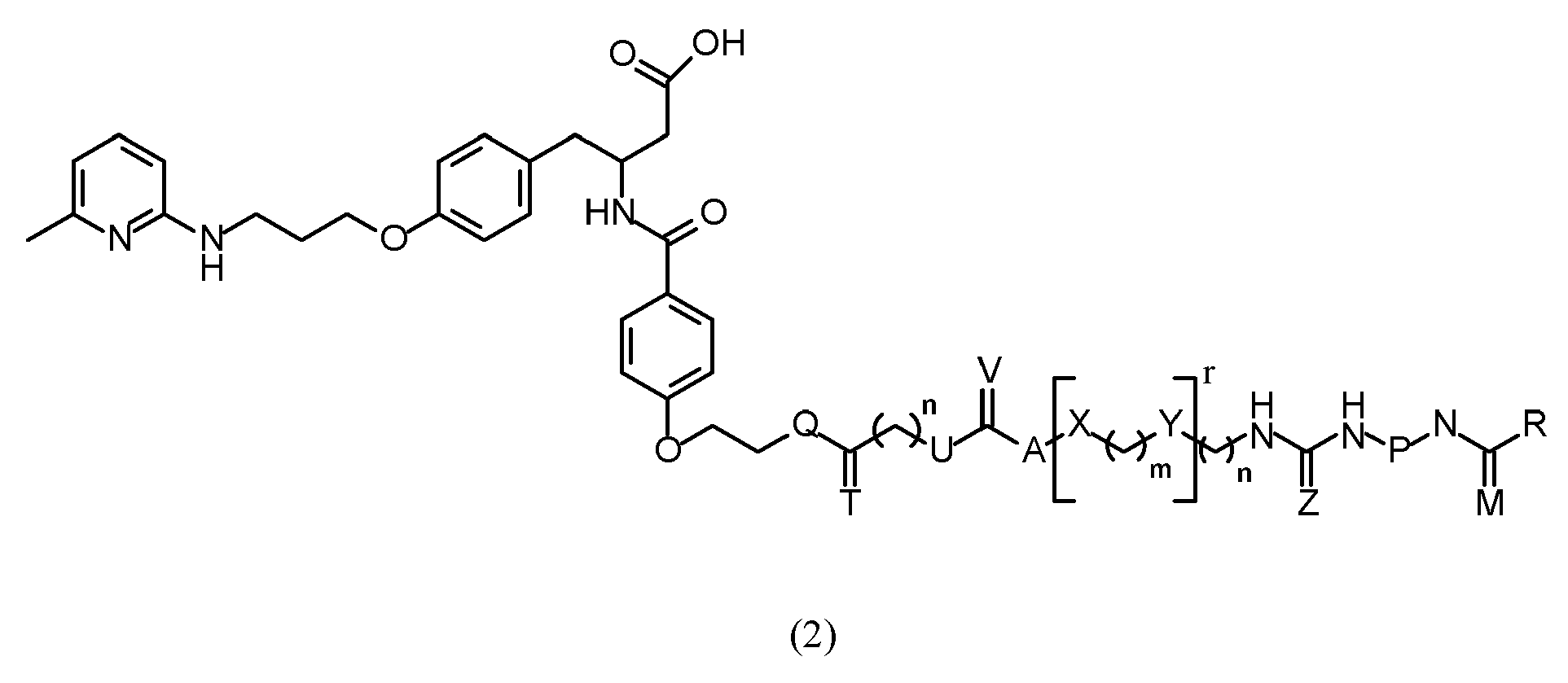 Q, T sowie U, V unabhängig voneinander für O oder NH steht und Q≠T und U≠V;A für O oder (CH2)1-3 und X für CH2, O, N oder S steht und wenn A gleich O ist, X CH2 ist;Y für CH2, O, N oder S sowie Z und M unabhängig voneinander für O oder S steht; n und r für 1 bis 6 stehen und m für 2 bis 8 steht;P für eine Gruppe ausgewählt aus substituiertem oder unsubstituiertem Alkylen, bevorzugt (CH2)1-6, oder substituiertem oder unsubstituiertem, aromatischem oder aliphatischem N- oder O-Cycloalkylen steht; undR unabhängig voneinander für eine polymere Gruppe ausgewählt aus Chitosan und Polylysin steht, wobei Polylysin Poly-D-Lysin und Poly-L-Lysin umfasst.
 - Implantat nach Anspruch 1, wobei die Beschichtung enthaltend das funktionalisierte RGD-Peptidmimetikum RGD-P1 der Formel (1) und/oder RGD-P2 der Formel (2) als Deckschicht ausgebildet ist.
- Implantat nach Anspruch 1 oder 2, wobei die Beschichtung des Implantats eine Basisschicht umfasst und eine auf der Basisschicht aufgetragene Deckschicht enthaltend das funktionalisierte RGD-Peptidmimetikum RGD-P1 der Formel (1) und/oder RGD-P2 der Formel (2).
- Implantat nach Anspruch 3, wobei die Basisschicht eine Wirkstoff-freisetzende Schicht aufweist.
- Implantat nach Anspruch 4, wobei der Wirkstoff Paclitaxel, Sirolimus und/oder Rapamycin ist, bevorzugt ist der Wirkstoff Sirolimus.
- Implantat nach einem der Ansprüche 1 bis 5, wobei das Implantat ein Stent, ein Sensor oder eine Elektrode ist.
- Implantat nach Anspruch 6, wobei der Stent einen resorbierbaren oder permanenten Grundkörper aus einem metallischen oder polymeren Material aufweist.
- Verfahren zur Herstellung eines Implantats nach einem der Ansprüche 1 bis 7, wobei das Verfahren die Schritte umfasst:- Beschichtung eines Stents mit einer Schicht, die Chitosan und/oder Polylysin enthält oder daraus besteht;- kovalente Kopplung eines in Chitosan und/oder Polylysin enthaltenen primären Amins mit der Kopplungsgruppe eines Vorläufers des funktionalisierten RGD-Peptidmimetikums RGD-P1 mit der Formel (3):

eines Vorläufers des funktionalisierten RGD-Peptidmimetikums RGD-P2 mit der Formel (4): Q, T sowie U, V unabhängig voneinander für O oder NH steht und Q≠T und U≠V; A für O oder (CH2)1-3 und X für CH2, O, N oder S steht und wenn A gleich O ist, X CH2 ist;Y für CH2, O, N oder S sowie Z und M unabhängig voneinander für O oder S steht; n und r für 1 bis 6 stehen und m für 2 bis 8 steht;P für eine Gruppe ausgewählt aus substituiertem oder unsubstituiertem Alkylen, bevorzugt (CH2)1-6, oder substituiertem oder unsubstituiertem, aromatischem oder aliphatischem N- oder O-Cycloalkylen steht.
 - Verbindung gemäß:Formel (1)
 Formel (2)
 Formel (3)
 Formel (4)
 Q, T sowie U, V unabhängig voneinander für O oder NH steht und Q≠T und U≠V;A für O oder (CH2)1-3 und X für CH2, O, N oder S steht und wenn A gleich O ist, X CH2 ist;Y für CH2, O, N oder S sowie Z und M unabhängig voneinander für O oder S steht; n und r für 1 bis 6 stehen und m für 2 bis 8 steht;P für eine Gruppe ausgewählt aus substituiertem oder unsubstituiertem Alkylen, bevorzugt (CH2)1-6, oder substituiertem oder unsubstituiertem, aromatischem oder aliphatischem N- oder O-Cycloalkylen steht; undR unabhängig voneinander für eine polymere Gruppe ausgewählt aus Chitosan und Polylysin steht, wobei Polylysin Poly-D-Lysin und Poly-L-Lysin umfasst.
 - Verwendung einer Verbindung nach Anspruch 9 in einer Beschichtung eines Implantates, insbesondere in der Deckschicht eines Wirkstoff-freisetzenden Stents.
Applications Claiming Priority (1)
| Application Number | Priority Date | Filing Date | Title |
|---|---|---|---|
| US41280410P | 2010-11-12 | 2010-11-12 |
Publications (3)
| Publication Number | Publication Date |
|---|---|
| EP2452703A2 EP2452703A2 (de) | 2012-05-16 |
| EP2452703A3 EP2452703A3 (de) | 2014-10-01 |
| EP2452703B1 true EP2452703B1 (de) | 2015-03-04 |
Family
ID=45033707
Family Applications (2)
| Application Number | Title | Priority Date | Filing Date |
|---|---|---|---|
| EP11185761.1A Not-in-force EP2452702B1 (de) | 2010-11-12 | 2011-10-19 | Funktionalisierte RGD-Peptidmimetika und deren Herstellung sowie Implantat mit einer Beschichtung, die solche funktionalisierte RGD-Peptidmimetika enthält |
| EP11188034.0A Not-in-force EP2452703B1 (de) | 2010-11-12 | 2011-11-07 | Funktionalisierte RGD-Peptidmimetika und deren Herstellung sowie Implantat mit einer Beschichtung, die solche funktionalisierte RGD-Peptidmimetika enthält |
Family Applications Before (1)
| Application Number | Title | Priority Date | Filing Date |
|---|---|---|---|
| EP11185761.1A Not-in-force EP2452702B1 (de) | 2010-11-12 | 2011-10-19 | Funktionalisierte RGD-Peptidmimetika und deren Herstellung sowie Implantat mit einer Beschichtung, die solche funktionalisierte RGD-Peptidmimetika enthält |
Country Status (2)
| Country | Link |
|---|---|
| US (2) | US8728496B2 (de) |
| EP (2) | EP2452702B1 (de) |
Families Citing this family (2)
| Publication number | Priority date | Publication date | Assignee | Title |
|---|---|---|---|---|
| US8961592B2 (en) | 2010-11-12 | 2015-02-24 | Biotronik Ag | Functionalized RGD peptidomimetics and their manufacture, and implant having a coating containing such functional-ized RGD peptidomimetics |
| WO2021119199A1 (en) * | 2019-12-10 | 2021-06-17 | The Regents Of The University Of California | Alpha-5 beta-1 inhibitors |
Family Cites Families (6)
| Publication number | Priority date | Publication date | Assignee | Title |
|---|---|---|---|---|
| DE19731021A1 (de) | 1997-07-18 | 1999-01-21 | Meyer Joerg | In vivo abbaubares metallisches Implantat |
| DE60040648D1 (de) * | 1999-01-21 | 2008-12-11 | Adv Med Solutions Ltd | Träger zum zellwachstum |
| DE10253634A1 (de) | 2002-11-13 | 2004-05-27 | Biotronik Meß- und Therapiegeräte GmbH & Co. Ingenieurbüro Berlin | Endoprothese |
| US8703167B2 (en) * | 2006-06-05 | 2014-04-22 | Advanced Cardiovascular Systems, Inc. | Coatings for implantable medical devices for controlled release of a hydrophilic drug and a hydrophobic drug |
| WO2008143933A1 (en) * | 2007-05-15 | 2008-11-27 | Cvpath Institute, Inc. | Coating stents with integrin selective peptides or mimetics |
| DE102007050668A1 (de) * | 2007-10-24 | 2009-04-30 | Biotronik Vi Patent Ag | Stent mit einem Grundkörper aus einem bioinerten metallischen Implantatwerkstoff |
-
2011
- 2011-10-19 EP EP11185761.1A patent/EP2452702B1/de not_active Not-in-force
- 2011-11-07 EP EP11188034.0A patent/EP2452703B1/de not_active Not-in-force
- 2011-11-09 US US13/292,498 patent/US8728496B2/en active Active
- 2011-11-09 US US13/292,522 patent/US20120121659A1/en not_active Abandoned
Also Published As
| Publication number | Publication date |
|---|---|
| EP2452702A2 (de) | 2012-05-16 |
| EP2452703A3 (de) | 2014-10-01 |
| US8728496B2 (en) | 2014-05-20 |
| EP2452702B1 (de) | 2015-03-04 |
| EP2452702A3 (de) | 2014-10-01 |
| US20120121658A1 (en) | 2012-05-17 |
| EP2452703A2 (de) | 2012-05-16 |
| US20120121659A1 (en) | 2012-05-17 |
Similar Documents
| Publication | Publication Date | Title |
|---|---|---|
| EP2151255B1 (de) | Biokorrodierbares Implantat mit einer Beschichtung enthaltend ein Hydrogel | |
| EP2151254B1 (de) | Biokorrodierbares Implantat mit einer Beschichtung enthaltend eine wirkstoff-tragende Polymermatrix | |
| EP2036583A2 (de) | Stent mit einer Beschichtung | |
| EP2016958A2 (de) | Stent mit einer Beschichtung oder Füllung einer Kavität | |
| EP2161045A2 (de) | Verwendung von organischen Gold-Komplexen als bioaktive und radioopaque Stentbeschichtung für permanente und degradierbare vaskuläre Implantate | |
| EP1930032A2 (de) | Biokorrodierbares metallisches Implantat mit einer Beschichtung oder Kavitätenfüllung aus Gelatine | |
| EP2016959A1 (de) | Stent mit einer Beschichtung | |
| EP2181723A2 (de) | Implantat aus einer biokorrodierbaren Eisen- oder Magnesiumlegierung | |
| DE102008021894A1 (de) | Implantat umfassend eine Oberfläche mit verringerter Thrombogenität | |
| DE102008002471A1 (de) | Stent mit einer Beschichtung oder einem Grundkörper, der ein Lithiumsalz enthält, und Verwendung von Lithiumsalzen zur Restenoseprophylaxe | |
| EP2033668A2 (de) | Implantat aus einer biokorrodierbaren Magnesiumlegierung und mit einer Beschichtung aus einem biokorrodierbaren Polyphosphazen | |
| DE102007059755A1 (de) | Implantate mit membrandiffusionskontrollierter Wirkstofffreisetzung | |
| EP2407184A2 (de) | Abluminal beschichtete Wirkstoff-freisetzende Stents mit einer formschlüssigen Schutzschicht | |
| EP2415489B1 (de) | Polylactid-beschichtetes Implantat aus einer biokorrodierbaren Magnesiumlegierung | |
| EP2055328B1 (de) | Stent mit einem Grundkörper aus einem bioinerten metallischen Implantatwerkstoff | |
| DE102008040572A1 (de) | Implantat mit Beschichtung | |
| EP2452703B1 (de) | Funktionalisierte RGD-Peptidmimetika und deren Herstellung sowie Implantat mit einer Beschichtung, die solche funktionalisierte RGD-Peptidmimetika enthält | |
| EP2462962B1 (de) | Implantat mit einer das implantat zumindest bereichsweise bedeckenden, wirkstoffhaltigen beschichtung | |
| EP2452653B1 (de) | cRGD-Peptid-Derivat und seine Herstellung sowie Implantat mit einer Beschichtung, die ein cRGD-Peptid-Derivat enthält | |
| EP2433660B1 (de) | Beschichtetes Implantat aus einer biokorrodierbaren Magnesiumlegierung | |
| DE102010043814A1 (de) | Funktionalisierte RGD-Peptidmimetika und deren Herstellung sowie Implantat mit einer Beschichtung, die solche funktionalisierte RGD-Peptidmimetika enthält | |
| US8961592B2 (en) | Functionalized RGD peptidomimetics and their manufacture, and implant having a coating containing such functional-ized RGD peptidomimetics | |
| DE102008043736A1 (de) | Biokorrodierbares Implantat mit einer Wirkstoff-enthaltenden Beschichtung | |
| DE102009059070A1 (de) | Medizinische Einrichtung und Verfahren zu ihrer Herstellung |
Legal Events
| Date | Code | Title | Description |
|---|---|---|---|
| PUAI | Public reference made under article 153(3) epc to a published international application that has entered the european phase |
Free format text: ORIGINAL CODE: 0009012 |
|
| AK | Designated contracting states |
Kind code of ref document: A2 Designated state(s): AL AT BE BG CH CY CZ DE DK EE ES FI FR GB GR HR HU IE IS IT LI LT LU LV MC MK MT NL NO PL PT RO RS SE SI SK SM TR |
|
| AX | Request for extension of the european patent |
Extension state: BA ME |
|
| PUAL | Search report despatched |
Free format text: ORIGINAL CODE: 0009013 |
|
| AK | Designated contracting states |
Kind code of ref document: A3 Designated state(s): AL AT BE BG CH CY CZ DE DK EE ES FI FR GB GR HR HU IE IS IT LI LT LU LV MC MK MT NL NO PL PT RO RS SE SI SK SM TR |
|
| AX | Request for extension of the european patent |
Extension state: BA ME |
|
| RIC1 | Information provided on ipc code assigned before grant |
Ipc: A61L 31/16 20060101ALI20140828BHEP Ipc: A61L 31/10 20060101AFI20140828BHEP |
|
| REG | Reference to a national code |
Ref country code: DE Ref legal event code: R079 Ref document number: 502011006096 Country of ref document: DE Free format text: PREVIOUS MAIN CLASS: A61L0031040000 Ipc: A61K0047480000 |
|
| 17P | Request for examination filed |
Effective date: 20140922 |
|
| RBV | Designated contracting states (corrected) |
Designated state(s): AL AT BE BG CH CY CZ DE DK EE ES FI FR GB GR HR HU IE IS IT LI LT LU LV MC MK MT NL NO PL PT RO RS SE SI SK SM TR |
|
| GRAP | Despatch of communication of intention to grant a patent |
Free format text: ORIGINAL CODE: EPIDOSNIGR1 |
|
| RIC1 | Information provided on ipc code assigned before grant |
Ipc: C08B 37/08 20060101ALI20141016BHEP Ipc: A61L 31/16 20060101ALI20141016BHEP Ipc: A61K 47/48 20060101AFI20141016BHEP Ipc: C07C 33/00 20060101ALI20141016BHEP Ipc: A61L 31/10 20060101ALI20141016BHEP |
|
| INTG | Intention to grant announced |
Effective date: 20141110 |
|
| GRAS | Grant fee paid |
Free format text: ORIGINAL CODE: EPIDOSNIGR3 |
|
| GRAA | (expected) grant |
Free format text: ORIGINAL CODE: 0009210 |
|
| AK | Designated contracting states |
Kind code of ref document: B1 Designated state(s): AL AT BE BG CH CY CZ DE DK EE ES FI FR GB GR HR HU IE IS IT LI LT LU LV MC MK MT NL NO PL PT RO RS SE SI SK SM TR |
|
| REG | Reference to a national code |
Ref country code: GB Ref legal event code: FG4D Free format text: NOT ENGLISH |
|
| REG | Reference to a national code |
Ref country code: CH Ref legal event code: EP |
|
| REG | Reference to a national code |
Ref country code: IE Ref legal event code: FG4D Free format text: LANGUAGE OF EP DOCUMENT: GERMAN |
|
| REG | Reference to a national code |
Ref country code: AT Ref legal event code: REF Ref document number: 713267 Country of ref document: AT Kind code of ref document: T Effective date: 20150415 |
|
| REG | Reference to a national code |
Ref country code: DE Ref legal event code: R096 Ref document number: 502011006096 Country of ref document: DE Effective date: 20150416 |
|
| REG | Reference to a national code |
Ref country code: NL Ref legal event code: T3 |
|
| PG25 | Lapsed in a contracting state [announced via postgrant information from national office to epo] |
Ref country code: NO Free format text: LAPSE BECAUSE OF FAILURE TO SUBMIT A TRANSLATION OF THE DESCRIPTION OR TO PAY THE FEE WITHIN THE PRESCRIBED TIME-LIMIT Effective date: 20150604 Ref country code: ES Free format text: LAPSE BECAUSE OF FAILURE TO SUBMIT A TRANSLATION OF THE DESCRIPTION OR TO PAY THE FEE WITHIN THE PRESCRIBED TIME-LIMIT Effective date: 20150304 Ref country code: LT Free format text: LAPSE BECAUSE OF FAILURE TO SUBMIT A TRANSLATION OF THE DESCRIPTION OR TO PAY THE FEE WITHIN THE PRESCRIBED TIME-LIMIT Effective date: 20150304 Ref country code: HR Free format text: LAPSE BECAUSE OF FAILURE TO SUBMIT A TRANSLATION OF THE DESCRIPTION OR TO PAY THE FEE WITHIN THE PRESCRIBED TIME-LIMIT Effective date: 20150304 Ref country code: SE Free format text: LAPSE BECAUSE OF FAILURE TO SUBMIT A TRANSLATION OF THE DESCRIPTION OR TO PAY THE FEE WITHIN THE PRESCRIBED TIME-LIMIT Effective date: 20150304 Ref country code: FI Free format text: LAPSE BECAUSE OF FAILURE TO SUBMIT A TRANSLATION OF THE DESCRIPTION OR TO PAY THE FEE WITHIN THE PRESCRIBED TIME-LIMIT Effective date: 20150304 |
|
| REG | Reference to a national code |
Ref country code: LT Ref legal event code: MG4D |
|
| PG25 | Lapsed in a contracting state [announced via postgrant information from national office to epo] |
Ref country code: LV Free format text: LAPSE BECAUSE OF FAILURE TO SUBMIT A TRANSLATION OF THE DESCRIPTION OR TO PAY THE FEE WITHIN THE PRESCRIBED TIME-LIMIT Effective date: 20150304 Ref country code: GR Free format text: LAPSE BECAUSE OF FAILURE TO SUBMIT A TRANSLATION OF THE DESCRIPTION OR TO PAY THE FEE WITHIN THE PRESCRIBED TIME-LIMIT Effective date: 20150605 Ref country code: RS Free format text: LAPSE BECAUSE OF FAILURE TO SUBMIT A TRANSLATION OF THE DESCRIPTION OR TO PAY THE FEE WITHIN THE PRESCRIBED TIME-LIMIT Effective date: 20150304 |
|
| PG25 | Lapsed in a contracting state [announced via postgrant information from national office to epo] |
Ref country code: SK Free format text: LAPSE BECAUSE OF FAILURE TO SUBMIT A TRANSLATION OF THE DESCRIPTION OR TO PAY THE FEE WITHIN THE PRESCRIBED TIME-LIMIT Effective date: 20150304 Ref country code: PT Free format text: LAPSE BECAUSE OF FAILURE TO SUBMIT A TRANSLATION OF THE DESCRIPTION OR TO PAY THE FEE WITHIN THE PRESCRIBED TIME-LIMIT Effective date: 20150706 Ref country code: EE Free format text: LAPSE BECAUSE OF FAILURE TO SUBMIT A TRANSLATION OF THE DESCRIPTION OR TO PAY THE FEE WITHIN THE PRESCRIBED TIME-LIMIT Effective date: 20150304 Ref country code: RO Free format text: LAPSE BECAUSE OF FAILURE TO SUBMIT A TRANSLATION OF THE DESCRIPTION OR TO PAY THE FEE WITHIN THE PRESCRIBED TIME-LIMIT Effective date: 20150304 Ref country code: CZ Free format text: LAPSE BECAUSE OF FAILURE TO SUBMIT A TRANSLATION OF THE DESCRIPTION OR TO PAY THE FEE WITHIN THE PRESCRIBED TIME-LIMIT Effective date: 20150304 |
|
| PG25 | Lapsed in a contracting state [announced via postgrant information from national office to epo] |
Ref country code: PL Free format text: LAPSE BECAUSE OF FAILURE TO SUBMIT A TRANSLATION OF THE DESCRIPTION OR TO PAY THE FEE WITHIN THE PRESCRIBED TIME-LIMIT Effective date: 20150304 Ref country code: IS Free format text: LAPSE BECAUSE OF FAILURE TO SUBMIT A TRANSLATION OF THE DESCRIPTION OR TO PAY THE FEE WITHIN THE PRESCRIBED TIME-LIMIT Effective date: 20150704 |
|
| REG | Reference to a national code |
Ref country code: DE Ref legal event code: R097 Ref document number: 502011006096 Country of ref document: DE |
|
| PG25 | Lapsed in a contracting state [announced via postgrant information from national office to epo] |
Ref country code: IT Free format text: LAPSE BECAUSE OF FAILURE TO SUBMIT A TRANSLATION OF THE DESCRIPTION OR TO PAY THE FEE WITHIN THE PRESCRIBED TIME-LIMIT Effective date: 20150304 |
|
| PLBE | No opposition filed within time limit |
Free format text: ORIGINAL CODE: 0009261 |
|
| STAA | Information on the status of an ep patent application or granted ep patent |
Free format text: STATUS: NO OPPOSITION FILED WITHIN TIME LIMIT |
|
| PG25 | Lapsed in a contracting state [announced via postgrant information from national office to epo] |
Ref country code: DK Free format text: LAPSE BECAUSE OF FAILURE TO SUBMIT A TRANSLATION OF THE DESCRIPTION OR TO PAY THE FEE WITHIN THE PRESCRIBED TIME-LIMIT Effective date: 20150304 |
|
| 26N | No opposition filed |
Effective date: 20151207 |
|
| PG25 | Lapsed in a contracting state [announced via postgrant information from national office to epo] |
Ref country code: SI Free format text: LAPSE BECAUSE OF FAILURE TO SUBMIT A TRANSLATION OF THE DESCRIPTION OR TO PAY THE FEE WITHIN THE PRESCRIBED TIME-LIMIT Effective date: 20150304 |
|
| PG25 | Lapsed in a contracting state [announced via postgrant information from national office to epo] |
Ref country code: MC Free format text: LAPSE BECAUSE OF FAILURE TO SUBMIT A TRANSLATION OF THE DESCRIPTION OR TO PAY THE FEE WITHIN THE PRESCRIBED TIME-LIMIT Effective date: 20150304 Ref country code: LU Free format text: LAPSE BECAUSE OF FAILURE TO SUBMIT A TRANSLATION OF THE DESCRIPTION OR TO PAY THE FEE WITHIN THE PRESCRIBED TIME-LIMIT Effective date: 20151107 |
|
| REG | Reference to a national code |
Ref country code: FR Ref legal event code: ST Effective date: 20160729 |
|
| REG | Reference to a national code |
Ref country code: DE Ref legal event code: R079 Ref document number: 502011006096 Country of ref document: DE Free format text: PREVIOUS MAIN CLASS: A61K0047480000 Ipc: A61K0047500000 |
|
| PG25 | Lapsed in a contracting state [announced via postgrant information from national office to epo] |
Ref country code: FR Free format text: LAPSE BECAUSE OF NON-PAYMENT OF DUE FEES Effective date: 20151130 |
|
| PG25 | Lapsed in a contracting state [announced via postgrant information from national office to epo] |
Ref country code: HU Free format text: LAPSE BECAUSE OF FAILURE TO SUBMIT A TRANSLATION OF THE DESCRIPTION OR TO PAY THE FEE WITHIN THE PRESCRIBED TIME-LIMIT; INVALID AB INITIO Effective date: 20111107 Ref country code: BG Free format text: LAPSE BECAUSE OF FAILURE TO SUBMIT A TRANSLATION OF THE DESCRIPTION OR TO PAY THE FEE WITHIN THE PRESCRIBED TIME-LIMIT Effective date: 20150304 Ref country code: SM Free format text: LAPSE BECAUSE OF FAILURE TO SUBMIT A TRANSLATION OF THE DESCRIPTION OR TO PAY THE FEE WITHIN THE PRESCRIBED TIME-LIMIT Effective date: 20150304 |
|
| PG25 | Lapsed in a contracting state [announced via postgrant information from national office to epo] |
Ref country code: CY Free format text: LAPSE BECAUSE OF FAILURE TO SUBMIT A TRANSLATION OF THE DESCRIPTION OR TO PAY THE FEE WITHIN THE PRESCRIBED TIME-LIMIT Effective date: 20150304 |
|
| PG25 | Lapsed in a contracting state [announced via postgrant information from national office to epo] |
Ref country code: BE Free format text: LAPSE BECAUSE OF NON-PAYMENT OF DUE FEES Effective date: 20151130 |
|
| PG25 | Lapsed in a contracting state [announced via postgrant information from national office to epo] |
Ref country code: TR Free format text: LAPSE BECAUSE OF FAILURE TO SUBMIT A TRANSLATION OF THE DESCRIPTION OR TO PAY THE FEE WITHIN THE PRESCRIBED TIME-LIMIT Effective date: 20150304 Ref country code: MT Free format text: LAPSE BECAUSE OF FAILURE TO SUBMIT A TRANSLATION OF THE DESCRIPTION OR TO PAY THE FEE WITHIN THE PRESCRIBED TIME-LIMIT Effective date: 20150304 |
|
| REG | Reference to a national code |
Ref country code: AT Ref legal event code: MM01 Ref document number: 713267 Country of ref document: AT Kind code of ref document: T Effective date: 20161107 |
|
| PG25 | Lapsed in a contracting state [announced via postgrant information from national office to epo] |
Ref country code: AT Free format text: LAPSE BECAUSE OF NON-PAYMENT OF DUE FEES Effective date: 20161107 |
|
| PG25 | Lapsed in a contracting state [announced via postgrant information from national office to epo] |
Ref country code: MK Free format text: LAPSE BECAUSE OF FAILURE TO SUBMIT A TRANSLATION OF THE DESCRIPTION OR TO PAY THE FEE WITHIN THE PRESCRIBED TIME-LIMIT Effective date: 20150304 |
|
| PG25 | Lapsed in a contracting state [announced via postgrant information from national office to epo] |
Ref country code: AL Free format text: LAPSE BECAUSE OF FAILURE TO SUBMIT A TRANSLATION OF THE DESCRIPTION OR TO PAY THE FEE WITHIN THE PRESCRIBED TIME-LIMIT Effective date: 20150304 |
|
| PGFP | Annual fee paid to national office [announced via postgrant information from national office to epo] |
Ref country code: DE Payment date: 20211126 Year of fee payment: 11 Ref country code: IE Payment date: 20211118 Year of fee payment: 11 Ref country code: NL Payment date: 20211119 Year of fee payment: 11 Ref country code: GB Payment date: 20211123 Year of fee payment: 11 |
|
| PGFP | Annual fee paid to national office [announced via postgrant information from national office to epo] |
Ref country code: CH Payment date: 20211123 Year of fee payment: 11 |
|
| REG | Reference to a national code |
Ref country code: DE Ref legal event code: R119 Ref document number: 502011006096 Country of ref document: DE |
|
| REG | Reference to a national code |
Ref country code: CH Ref legal event code: PL |
|
| REG | Reference to a national code |
Ref country code: NL Ref legal event code: MM Effective date: 20221201 |
|
| GBPC | Gb: european patent ceased through non-payment of renewal fee |
Effective date: 20221107 |
|
| PG25 | Lapsed in a contracting state [announced via postgrant information from national office to epo] |
Ref country code: LI Free format text: LAPSE BECAUSE OF NON-PAYMENT OF DUE FEES Effective date: 20221130 Ref country code: CH Free format text: LAPSE BECAUSE OF NON-PAYMENT OF DUE FEES Effective date: 20221130 |
|
| PG25 | Lapsed in a contracting state [announced via postgrant information from national office to epo] |
Ref country code: NL Free format text: LAPSE BECAUSE OF NON-PAYMENT OF DUE FEES Effective date: 20221201 |
|
| PG25 | Lapsed in a contracting state [announced via postgrant information from national office to epo] |
Ref country code: IE Free format text: LAPSE BECAUSE OF NON-PAYMENT OF DUE FEES Effective date: 20221107 Ref country code: GB Free format text: LAPSE BECAUSE OF NON-PAYMENT OF DUE FEES Effective date: 20221107 Ref country code: DE Free format text: LAPSE BECAUSE OF NON-PAYMENT OF DUE FEES Effective date: 20230601 |