EP2453002A1 - Ohrkerze - Google Patents
Ohrkerze Download PDFInfo
- Publication number
- EP2453002A1 EP2453002A1 EP10190810A EP10190810A EP2453002A1 EP 2453002 A1 EP2453002 A1 EP 2453002A1 EP 10190810 A EP10190810 A EP 10190810A EP 10190810 A EP10190810 A EP 10190810A EP 2453002 A1 EP2453002 A1 EP 2453002A1
- Authority
- EP
- European Patent Office
- Prior art keywords
- retaining element
- ear candle
- ear
- candle according
- lamellae
- Prior art date
- Legal status (The legal status is an assumption and is not a legal conclusion. Google has not performed a legal analysis and makes no representation as to the accuracy of the status listed.)
- Granted
Links
Images



Classifications
-
- A—HUMAN NECESSITIES
- A61—MEDICAL OR VETERINARY SCIENCE; HYGIENE
- A61F—FILTERS IMPLANTABLE INTO BLOOD VESSELS; PROSTHESES; DEVICES PROVIDING PATENCY TO, OR PREVENTING COLLAPSING OF, TUBULAR STRUCTURES OF THE BODY, e.g. STENTS; ORTHOPAEDIC, NURSING OR CONTRACEPTIVE DEVICES; FOMENTATION; TREATMENT OR PROTECTION OF EYES OR EARS; BANDAGES, DRESSINGS OR ABSORBENT PADS; FIRST-AID KITS
- A61F11/00—Methods or devices for treatment of the ears or hearing sense; Non-electric hearing aids; Methods or devices for enabling ear patients to achieve auditory perception through physiological senses other than hearing sense; Protective devices for the ears, carried on the body or in the hand
-
- A—HUMAN NECESSITIES
- A61—MEDICAL OR VETERINARY SCIENCE; HYGIENE
- A61F—FILTERS IMPLANTABLE INTO BLOOD VESSELS; PROSTHESES; DEVICES PROVIDING PATENCY TO, OR PREVENTING COLLAPSING OF, TUBULAR STRUCTURES OF THE BODY, e.g. STENTS; ORTHOPAEDIC, NURSING OR CONTRACEPTIVE DEVICES; FOMENTATION; TREATMENT OR PROTECTION OF EYES OR EARS; BANDAGES, DRESSINGS OR ABSORBENT PADS; FIRST-AID KITS
- A61F11/00—Methods or devices for treatment of the ears or hearing sense; Non-electric hearing aids; Methods or devices for enabling ear patients to achieve auditory perception through physiological senses other than hearing sense; Protective devices for the ears, carried on the body or in the hand
- A61F11/006—Ear cleaners, e.g. curettes
-
- C—CHEMISTRY; METALLURGY
- C11—ANIMAL OR VEGETABLE OILS, FATS, FATTY SUBSTANCES OR WAXES; FATTY ACIDS THEREFROM; DETERGENTS; CANDLES
- C11C—FATTY ACIDS FROM FATS, OILS OR WAXES; CANDLES; FATS, OILS OR FATTY ACIDS BY CHEMICAL MODIFICATION OF FATS, OILS, OR FATTY ACIDS OBTAINED THEREFROM
- C11C5/00—Candles
-
- C—CHEMISTRY; METALLURGY
- C11—ANIMAL OR VEGETABLE OILS, FATS, FATTY SUBSTANCES OR WAXES; FATTY ACIDS THEREFROM; DETERGENTS; CANDLES
- C11C—FATTY ACIDS FROM FATS, OILS OR WAXES; CANDLES; FATS, OILS OR FATTY ACIDS BY CHEMICAL MODIFICATION OF FATS, OILS, OR FATTY ACIDS OBTAINED THEREFROM
- C11C5/00—Candles
- C11C5/008—Candles characterised by their form; Composite candles, e.g. candles containing zones of different composition, inclusions, or the like
Definitions
- the invention relates to an ear candle with an air-permeable retaining element, which is arranged within the ear candle.
- the prior art ( DE 10 2006 004 138 Al ) includes an ear candle with integrated retaining element, wherein at a rear end, that is, an ear-side end of the ear candle, the retaining element is disposed within the ear candle.
- This retaining element is an air-permeable retaining element which has a cross-sectional area which is tapered or frustoconical or dome-shaped or sloping roof-shaped or pyramidal or hollow cylindrical, wherein the tip or the stump or the curvature of this retaining element is aligned in the direction of a frontward end of the ear candle.
- the ear candle consists of a waxy cotton fabric.
- wax a natural wax such as beeswax can be used. It is also possible to use synthetic waxes such as stearin or paraffin. However, natural waxes are preferred.
- the cotton fabric is rolled into a tube such that when rolling, at least one layer of the fabric overlaps one another or several layers of the fabric are superimposed.
- This tube is placed with one end on the external auditory canal, and the other end is lit, so that an open flame is formed.
- the ear candles are purely physical. A slight negative pressure (chimney effect) and the vibration waves of the air in the candle caused by the movement of the flame act like a gentle eardrum massage. This leads to an intense feeling of pleasant warmth and a liberating perceived pressure equalization in the ear, frontal and sinus area.
- the amount of wax in the cotton fabric is tuned to the combustion process. This means that in the optimal case, the ear candle should burn as free as possible.
- the gas mixture cools in the ear candle, falls down, condenses and would pass unhindered into the external auditory canal without a retaining element.
- the in the prior art ( DE 10 2006 004 138 Al described ear candle with retaining element has the disadvantage that the retaining element described there either insufficiently retains the resulting condensate and possibly effluent wax, depending on the material from which the retaining element consists, for example, if it consists of a fly screen or a fine-meshed wire. If the retaining element consists of a filter paper or a filter cloth, it settles too easily, so that the air permeability is no longer guaranteed.
- the technical problem underlying the invention is to provide an ear plug with a retaining element, which reliably prevents condensate and possibly effluent beeswax from continuing to flow and also ensures air permeability of the retaining element even with larger amounts of condensate and wax.
- the inventive embodiment of the retaining element in the ear candle ensures that condensate and possibly effluent wax is very reliably prevented from continuing to flow in the retaining element.
- the retention element according to the invention is not even with larger amounts of condensate and wax, so that the air permeability is guaranteed.
- the slats are advantageously designed with their wall-facing side flush with the wall. They rest at least semicircular on the wall of the retaining element. In addition, they protrude beyond a centerline of the retaining element. The slats cover more than half of the opening of the retaining element.
- the at least two lamellae are formed overlapping in the axial direction. Characterized in that the at least two lamellae are arranged opposite one another in the interior, the retaining element is visually dense seen in the axial direction, so that even dripping condensate or dripping wax is collected by the lamellae.
- At least three lamellae are arranged in the retaining element, wherein at least one lamella arranged opposite the other lamellae and this is formed overlapping in the axial direction. Even with three blades, the retaining element is seen in the axial direction visually dense, so even dripping wax or condensate can not get into the outer ear canal, but is caught by the slats.
- the retaining element has at least one opening in a lateral surface.
- the at least one opening is arranged in the region of the at least one lamella.
- the at least two lamellae are advantageously arranged at an angle of 30 ° to 60 ° in the retaining element.
- the at least two fins are arranged at an angle of 45 ° in the retaining element. This ensures that, on the one hand, the lamellae overlap in such a way that the retaining element is visually tight in the axial direction, so that no condensate or wax can enter the external auditory canal, and, on the other hand, there is sufficient air passage in the retaining element.
- the retaining element has a neck for attachment to the outer auditory canal (attachment neck), which has a diameter which widens toward the ear candle. This ensures that the retaining element can be easily and without injury placed on the external auditory canal with the neck nozzle. Through a training with rounded outer surfaces of the neck it is ensured that no sharp edges are present and thus the skin is not injured. In addition, the feel of the ear candle is significantly improved.
- the attachment piece advantageously has a projection which corresponds to the thickness of the material of the ear candle.
- the attachment piece which is partially disposed in the ear candle and partly projects beyond the ear candle, is flush with a sleeve of the ear candle.
- the ear candle consists of a beeswax-soaked cotton fabric. This cotton fabric is rolled to the ear candle so that the ear candle has a cavity inside.
- the sleeve of the ear candle thus consists of the single or multi-layered cotton fabric, which is impregnated with beeswax.
- the attachment piece advantageously projects over the ear candle in the axial direction. This ensures that the ear plug can be placed with the neck piece of the retaining element on the external auditory canal, without any risk of injury to the skin.
- the retaining element is advantageously cylindrical or conical section-shaped. This makes it possible to insert the retaining element in the prefabricated ear candle in a simple manner.
- the retaining element is advantageously clamped in the ear candle without additional adhesive.
- the retaining element is advantageously made of plastic, glass, ceramic, wood and metal.
- a particularly preferred embodiment provides to form the retaining element made of plastic.
- plastic polypropylene (PP) is used.
- PP polypropylene
- PC polypropylene carbonate
- PE polyethylene
- Fig. 1 shows a retaining element 1, which has a wall 2 and an interior 3.
- three blades 4, 5, 6 are arranged, which are arranged at an angle ⁇ of 45 °.
- the slats 4, 5, 6 project beyond the center line 9, that is, the slats 4, 5, 6 overlap seen in the axial direction, so that the retaining element seen in the axial direction optically dense is trained. This ensures that condensate and possibly effluent wax 100% is collected by the retaining element.
- the effluent wax collects in particular in the recesses 10, 11, 12. This in turn means that the air passage in the retaining element is not affected by the collecting condensate and wax.
- the retaining element has an attachment piece 13, which has a rounded outer surface 14.
- the attachment piece 13 has a projection 15, such that the retaining element 1 is flush with a sleeve 21 of an ear candle 16.
- the retaining element 1 is partially disposed in the sleeve 21 of the ear plug 16 and communicates with the attachment piece 13 via.
- Fig. 2 shows the retaining element 1 with the attachment piece 13 and the opening 7 and the blades 4 and 5.
- Fig. 2 shows the retaining element 1 with the attachment piece 13 and the opening 7 and the blades 4 and 5.
- the sleeve 21 in Fig. 2 not shown.
- Fig. 3 shows a retaining element 17, which has two blades 18, 19.
- the retaining element 17 is arranged in the ear plug 16.
- the lamellae 18, 19 overlap, so that draining condensate and even dripping condensate and wax can not pass through the retaining element in the direction of the ear (not shown).
- the retaining element 17 has an opening 20, which is arranged in the region of the lamellae 18, 19.
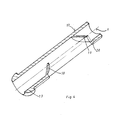
- Fig. 4 shows the retaining element 17 with the blades 18, 19 and the opening 20th
- the neck nozzle 13 which has the same design and function as in the embodiment according to the Fig. 1 and 2 having.
- Fig. 5 shows the ear plug 16 with the sleeve 21, which consists of a beeswax soaked cotton fabric.
- the retaining element 1 is arranged in the ear-side part 22 of the ear plug 16.
- the retaining element 1 has the slats 4, 5, 6 and the openings 7, 8, which are closed by the sleeve 21.
- the retaining element 1 also has the attachment piece 13, so that the ear candle can be placed injury-free with significantly improved feel.
Landscapes
- Chemical & Material Sciences (AREA)
- Health & Medical Sciences (AREA)
- Life Sciences & Earth Sciences (AREA)
- Engineering & Computer Science (AREA)
- General Health & Medical Sciences (AREA)
- Acoustics & Sound (AREA)
- Psychology (AREA)
- Biophysics (AREA)
- Biomedical Technology (AREA)
- Heart & Thoracic Surgery (AREA)
- Vascular Medicine (AREA)
- Animal Behavior & Ethology (AREA)
- Physics & Mathematics (AREA)
- Public Health (AREA)
- Veterinary Medicine (AREA)
- Otolaryngology (AREA)
- General Chemical & Material Sciences (AREA)
- Chemical Kinetics & Catalysis (AREA)
- Oil, Petroleum & Natural Gas (AREA)
- Wood Science & Technology (AREA)
- Organic Chemistry (AREA)
- Composite Materials (AREA)
- Fats And Perfumes (AREA)
- Arrangement Of Elements, Cooling, Sealing, Or The Like Of Lighting Devices (AREA)
- Non-Portable Lighting Devices Or Systems Thereof (AREA)
- Body Washing Hand Wipes And Brushes (AREA)
- Crushing And Grinding (AREA)
Abstract
Description
- Die Erfindung betrifft eine Ohrkerze mit einem luftdurchlässigen Rückhalteelement, welches innerhalb der Ohrkerze angeordnet ist.
- Zum Stand der Technik (
DE 10 2006 004 138 Al ) gehört eine Ohrkerze mit integriertem Rückhalteelement, bei dem an einem rückwärtigen Ende, das heißt einem ohrseitigen Ende der Ohrkerze, das Rückhalteelement innerhalb der Ohrkerze angeordnet ist. - Es handelt sich bei diesem Rückhalteelement um ein luftdurchlässiges Rückhalteelement, welches eine Querschnittsfläche aufweist, welche spitzkegelig oder stumpfkegelig oder kuppelförmig oder schrägdachförmig oder pyramidenförmig oder hohlzylindrisch ist, wobei die Spitze oder der Stumpf oder die Krümmung dieses Rückhalteelementes in Richtung eines frontwärtigen Endes der Ohrkerze ausgerichtet ist.
- Die Ohrkerze besteht im Wesentlichen aus einem mit Wachs getränkten Baumwollstoff. Als Wachs kann ein natürliches Wachs wie zum Beispiel Bienenwachs verwendet werden. Es ist auch möglich, synthetische Wachse wie Stearin oder Paraffin zu verwenden. Bevorzugt werden jedoch natürliche Wachse. Der Baumwollstoff ist zu einer Röhre gerollt, derart, dass beim Rollen wenigstens eine Lage des Stoffes überlappend oder mehrere Lagen des Stoffes übereinanderliegen.
- Diese Röhre wird mit einem Ende auf den äußeren Gehörgang aufgesetzt, und das andere Ende wird angezündet, so dass eine offene Flamme entsteht.
- Die Ohrkerzen wirken rein physikalisch. Ein leichter Unterdruck (Kamineffekt) und die durch die Bewegung der Flamme hervorgerufenen Vibrationswellen der Luft in der Kerze wirken wie eine sanfte Trommelfellmassage. Dies führt zu einem intensiven Gefühl angenehmer Wärme und einem als befreiend empfundenen Druckausgleich im Ohr-, Stirn- und Nebenhöhlenbereich.
- Die Wachsmenge in dem Baumwollstoff ist auf den Verbrennungsvorgang abgestimmt. Das heißt, dass im optimalen Fall die Ohrkerze möglichst rückstandsfrei verbrennen soll.
- Beim Abbrennen bleibt eine Aschefahne erhalten, die zum Schluss in der Regel abknickt.
- Im Inneren der Ohrkerze entsteht ein Gasgemisch. Das Gasgemisch kühlt in der Ohrkerze ab, fällt nach unten, kondensiert und würde ohne Rückhalteelement ungehindert in den äußeren Gehörgang gelangen.
- Beim Abbrennen der Ohrkerze schmilzt darüber hinaus das Wachs. In seltenen Fällen kann es vorkommen, dass, wenn das Wachs in zu großer Menge vorhanden ist, auch das Wachs in der Ohrkerze nach unten fließt und ohne Rückhalteelement in den äußeren Gehörgang gelangen würde.
- Die im Stand der Technik (
DE 10 2006 004 138 Al ) beschriebene Ohrkerze mit Rückhalteelement weist den Nachteil auf, dass das dort beschriebene Rückhalteelement das entstehende Kondensat und eventuell abfließendes Wachs entweder nicht ausreichend zurückhält, je nach dem, aus welchem Material das Rückhalteelement besteht, beispielsweise wenn es aus einem Fliegengitter oder einem feinmaschigen Draht besteht. Besteht das Rückhalteelement aus einem Filterpapier oder einem Filterstoff, setzt es sich zu leicht zu, so dass die Luftdurchlässigkeit nicht mehr gewährleistet ist. - Das der Erfindung zugrunde liegende technische Problem besteht darin, eine Ohrkerze mit einem Rückhalteelement anzugeben, welches Kondensat und eventuell abfließendes Bienenwachs zuverlässig am Weiterfließen hindert und darüber hinaus auch bei größeren Kondensat- und Wachsmengen eine Luftdurchlässigkeit des Rückhalteelementes gewährleistet.
- Dieses technische Problem wird durch eine Ohrkerze mit einem luftdurchlässigen Rückhalteelement mit den Merkmalen gemäß Anspruch 1 gelöst.
- Die erfindungsgemäße Ohrkerze mit einem luftdurchlässigen Rückhalteelement, welches wenigstens teilweise innerhalb der Ohrkerze angeordnet ist, wobei das Rückhalteelement eine Wand und einen Innenraum aufweist, zeichnet sich dadurch aus, dass an der Wand wenigstens zwei in den Innenraum gerichtete Lamellen angeordnet sind, und dass die wenigstens zwei Lamellen in axialer Richtung sich überlappend ausgebildet sind.
- Durch die erfindungsgemäße Ausführungsform des Rückhalteelementes in der Ohrkerze ist gewährleistet, dass Kondensat und eventuell abfließendes Wachs sehr zuverlässig in dem Rückhalteelement an dem Weiterfließen gehindert wird. Das erfindungsgemäße Rückhalteelement setzt sich auch bei größeren Kondensat- und Wachsmengen nicht zu, so dass die Luftdurchlässigkeit gewährleistet ist.
- Die Lamellen sind vorteilhaft mit ihrer der Wand zugewandten Seite bündig an der Wand anliegend ausgebildet. Sie liegen mindestens halbkreisförmig an der Wand des Rückhalteelementes an. Außerdem ragen sie über eine Mittellinie des Rückhalteelementes. Die Lamellen decken mehr als die Hälfte der Öffnung des Rückhalteelementes ab.
- Die wenigstens zwei Lamellen sind in axialer Richtung sich überlappend ausgebildet. Dadurch, dass die wenigstens zwei Lamellen sich gegenüberliegend in dem Innenraum angeordnet sind, ist das Rückhalteelement in axialer Richtung gesehen optisch dicht, so dass sogar herabtropfendes Kondensat oder herabtropfendes Wachs von den Lamellen aufgefangen wird.
- Gemäß einer besonders bevorzugten Ausführungsform der Erfindung sind wenigstens drei Lamellen in dem Rückhalteelement angeordnet, wobei wenigstens eine Lamelle den anderen Lamellen gegenüberliegend angeordnet und diese in axialer Richtung überlappend ausgebildet ist. Auch mit drei Lamellen ist das Rückhalteelement in axialer Richtung gesehen optisch dicht ausgebildet, damit selbst herabtropfendes Wachs oder Kondensat nicht in den äußeren Gehörgang gelangen kann, sondern von den Lamellen aufgefangen wird.
- Gemäß einer weiteren vorteilhaften Ausführungsform der Erfindung weist das Rückhalteelement in einer Mantelfläche wenigstens eine Öffnung auf. Hierdurch ist das erfindungsgemäße Rückhalteelement, wenn es als Spritzgusselement ausgebildet ist, einfacher herzustellen.
- Gemäß einer weiteren vorteilhaften Ausführungsform der Erfindung ist die wenigstens eine Öffnung im Bereich der wenigstens einen Lamelle angeordnet. Hierdurch wird aus dem Material, welches sonst im Bereich der Öffnung die Wand des Rückhalteelementes bilden würde, für die Ausbildung der Lamelle verwendet wird.
- Die wenigstens zwei Lamellen sind vorteilhaft in einem Winkel von 30° bis 60° in dem Rückhalteelement angeordnet. Gemäß einer besonders bevorzugten Ausführungsform der Erfindung sind die wenigstens zwei Lamellen in einem Winkel von 45° in dem Rückhalteelement angeordnet. Hierdurch ist gewährleistet, dass zum einen die Lamellen sich derart überlappen, dass das Rückhalteelement in axialer Richtung gesehen optisch dicht ist, so dass kein Kondensat oder Wachs in den äußeren Gehörgang gelangen kann, und dass andererseits ein ausreichender Luftdurchlass in dem Rückhalteelement gegeben ist.
- Eine Weiterbildung der Erfindung sieht vor, dass das Rückhalteelement einen Stutzen zum Ansatz auf den äußeren Gehörgang (Ansatzstutzen) aufweist, der einen zur Ohrkerze hin sich erweiternden Durchmesser aufweist. Hierdurch ist gewährleistet, dass das Rückhalteelement mit dem Ansatzstutzen leicht und verletzungsfrei auf den äußeren Gehörgang aufgesetzt werden kann. Durch eine Weiterbildung mit abgerundeten Außenflächen des Ansatzstutzens ist gewährleistet, dass keine scharfen Kanten vorhanden sind und damit die Haut nicht verletzt wird. Darüber hinaus ist die Haptik der Ohrkerze deutlich verbessert.
- In Richtung der Ohrkerze weist der Ansatzstutzen vorteilhaft einen Überstand auf, der der Dicke des Materials der Ohrkerze entspricht. Hierdurch schließt der Ansatzstutzen, der teilweise in der Ohrkerze angeordnet ist und zum Teil über die Ohrkerze übersteht, bündig mit einer Hülse der Ohrkerze ab. Wie schon ausgeführt, besteht die Ohrkerze beispielsweise aus einem mit Bienenwachs getränkten Baumwollstoff. Dieser Baumwollstoff wird zu der Ohrkerze gerollt, so dass die Ohrkerze innen einen Hohlraum aufweist. Die Hülse der Ohrkerze besteht damit aus dem ein- oder mehrlagigen Baumwollstoff, der mit Bienenwachs getränkt ist.
- Wie schon ausgeführt, steht der Ansatzstutzen vorteilhaft in axialer Richtung über die Ohrkerze über. Hierdurch ist gewährleistet, dass die Ohrkerze mit dem Ansatzstutzen des Rückhalteelementes auf den äußeren Gehörgang aufgesetzt werden kann, ohne dass eine Verletzungsgefahr der Haut besteht.
- Das Rückhalteelement ist vorteilhaft zylinderförmig oder kegelabschnittsförmig ausgebildet. Hierdurch ist es möglich, das Rückhalteelement in die vorgefertigte Ohrkerze in einfacher Art und Weise einzuschieben.
- Das Rückhalteelement ist vorteilhaft in der Ohrkerze ohne zusätzliche Klebemittel klemmend gehalten.
- Das Rückhalteelement besteht vorteilhaft aus Kunststoff, Glas, Keramik, Holz und Metall. Eine besonders bevorzugte Ausführungsform sieht vor, das Rückhalteelement aus Kunststoff auszubilden. Besonders bevorzugt wird als Kunststoff Polypropylen (PP) verwendet. Es ist jedoch auch möglich, Polypropylencarbonat (PPC) oder Polyethylen (PE) zu verwenden. Es ist ebenfalls möglich, ein Gemisch vorzusehen.
- Weitere Merkmale und Vorteile der Erfindung ergeben sich anhand der zugehörigen zeichnung, in der mehrere Ausführungsbeispiele eines erfindungsgemäßen Rückhalteelementes einer Ohrkerze nur beispielhaft dargestellt sind. In der Zeichnung zeigen:
- Fig. 1
- einen Längsschnitt durch ein Rückhalteelement mit drei Lamellen;
- Fig. 2
- eine Ansicht in Richtung des Pfeiles II der
Fig. 1 (ohne das Teil 21); - Fig. 3
- einen Längsschnitt durch ein Rückhalteelement mit zwei Lamellen;
- Fig. 4
- ein Rückhalteelement mit zwei Elementen in perspektiver Ansicht, längs aufgeschnitten;
- Fig. 5
- einen Längsschnitt durch eine Ohrkerze mit einem Rückhalteelement.
-
Fig. 1 zeigt ein Rückhalteelement 1, welches eine Wand 2 und einen Innenraum 3 aufweist. In dem Innenraum sind drei Lamellen 4, 5, 6 angeordnet, die mit einem Winkel α von 45° angeordnet sind. - Im Bereich der Lamellen 4, 5 sind Öffnungen 7, 8 in dem Rückhalteelement angeordnet.
- Wie man an der eingezeichneten Mittellinie 9 erkennt, ragen die Lamellen 4, 5, 6 jeweils über die Mittellinie 9 hinaus, das heißt die Lamellen 4, 5, 6 überlappen sich in axialer Richtung gesehen, so dass das Rückhalteelement in axialer Richtung gesehen optisch dicht ausgebildet ist. Hierdurch ist gewährleistet, dass Kondensat und eventuell abfließendes Wachs 100%ig von dem Rückhalteelement aufgefangen wird.
- Das abfließende Wachs sammelt sich insbesondere in den Vertiefungen 10, 11, 12. Das bedeutet wiederum, dass der Luftdurchlass in dem Rückhalteelement von dem sich sammelnden Kondensat und Wachs nicht beeinträchtigt wird.
- Das Rückhalteelement weist einen Ansatzstutzen 13 auf, der eine abgerundete Außenfläche 14 aufweist. Darüber hinaus weist der Ansatzstutzen 13 einen Überstand 15 auf, derart, dass das Rückhalteelement 1 mit einer Hülse 21 einer Ohrkerze 16 bündig abschließt. Das Rückhalteelement 1 ist teilweise in der Hülse 21 der Ohrkerze 16 angeordnet und steht mit dem Ansatzstutzen 13 über.
-
Fig. 2 zeigt das Rückhalteelement 1 mit dem Ansatzstutzen 13 und der Öffnung 7 sowie den Lamellen 4 und 5. Der besseren Übersicht wegen ist die Hülse 21 inFig. 2 nicht dargestellt. -
Fig. 3 zeigt ein Rückhalteelement 17, welches zwei Lamellen 18, 19 aufweist. Das Rückhalteelement 17 ist in der Ohrkerze 16 angeordnet. Auch die Lamellen 18, 19 überlappen sich, so dass abfließendes Kondensat und sogar herabtropfendes Kondensat und Wachs nicht durch das Rückhalteelement hindurch in Richtung Ohr (nicht dargestellt) gelangen kann. - Das Rückhalteelement 17 weist eine Öffnung 20 auf, welche im Bereich der Lamellen 18, 19 angeordnet ist.
-
Fig. 4 zeigt das Rückhalteelement 17 mit den Lamellen 18, 19 sowie der Öffnung 20. - In den
Fig. 3 und4 ist ebenfalls der Ansatzstutzen 13 dargestellt, der die gleiche Ausbildung und Funktion wie bei der Ausführungsform gemäß denFig. 1 und2 aufweist. -
Fig. 5 zeigt die Ohrkerze 16 mit der Hülse 21, die aus einem mit Bienenwachs getränkten Baumwollstoff besteht. Im ohrseitigen Teil 22 der Ohrkerze 16 ist das Rückhalteelement 1 angeordnet. Das Rückhalteelement 1 weist die Lamellen 4, 5, 6 auf sowie die Öffnungen 7, 8, die durch die Hülse 21 verschlossen sind. - Das Rückhalteelement 1 weist darüber hinaus den Ansatzstutzen 13 auf, damit die Ohrkerze verletzungsfrei mit deutlich verbesserter Haptik platziert werden kann.
-
- 1
- Rückhalteelement
- 2
- Wand
- 3
- Innenraum
- 4
- Lamelle
- 5
- Lamelle
- 6
- Lamelle
- 7
- Öffnung
- 8
- Öffnung
- 9
- Mittellinie
- 10
- Vertiefung
- 11
- Vertiefung
- 12
- Vertiefung
- 13
- Ansatzstutzen
- 14
- abgerundete Außenfläche
- 15
- Überstand
- 16
- Ohrkerze
- 17
- Rückhalteelement
- 18
- Lamelle
- 19
- Lamelle
- 20
- Öffnung
- 21
- Hülse einer Ohrkerze
- 22
- ohrseitiger Teil der Ohrkerze 16
Claims (14)
- Ohrkerze mit einem luftdurchlässigen Rückhalteelement, welches wenigstens teilweise innerhalb der Ohrkerze angeordnet ist, wobei das Rückhalteelement eine Wand und einen Innenraum aufweist,
dadurch gekennzeichnet , dass an der Wand (2) wenigstens zwei in den Innenraum (3) gerichtete Lamellen (4, 5, 6; 18, 19) angeordnet sind, dass die wenigstens zwei Lamellen sich gegenüberliegend in dem Innenraum (3) angeordnet sind, und dass die wenigstens zwei Lamellen (4, 5, 6; 18, 19) in axialer Richtung sich überlappend ausgebildet sind. - Ohrkerze nach Anspruch 1, dadurch gekennzeichnet, dass wenigstens drei Lamellen (4, 5, 6) in dem Rückhalteelement (1) angeordnet sind, und dass wenigstens eine Lamelle (5) den anderen Lamellen (4, 6) gegenüberliegend angeordnet ist und diese Lamellen (4, 6) in axialer Richtung überlappend ausgebildet sind.
- Ohrkerze nach Anspruch 1 oder 2, dadurch gekennzeichnet, dass das Rückhalteelement (1) in der Wand (2) wenigstens eine Öffnung (7, 8, 20) aufweist.
- Ohrkerze nach Anspruch 3, dadurch gekennzeichnet, dass die wenigstens eine Öffnung (7, 8, 20) im Bereich wenigstens einer Lamelle (4, 5, 18) angeordnet ist.
- Ohrkerze nach einem der vorhergehenden Ansprüche,
dadurch gekennzeichnet, dass die wenigstens zwei Lamellen (4, 5, 6; 18, 19) in einem Winkel von 30° bis 60° in dem Rückhalteelement (1) angeordnet sind. - Ohrkerze nach Anspruch 5, dadurch gekennzeichnet, dass die wenigstens zwei Lamellen (4, 5, 6; 18, 19) in einem Winkel von 45° in dem Rückhalteelement (1) angeordnet sind.
- Ohrkerze nach einem der vorhergehenden Ansprüche,
dadurch gekennzeichnet, dass die wenigstens zwei Lamellen (4, 5, 6; 18, 19) bündig und wenigstens halbkreisförmig an dem Rückhalteelement angeordnet sind. - Ohrkerze nach einem der vorhergehenden Ansprüche,
dadurch gekennzeichnet, dass das Rückhalteelement (1) einen Ansatzstutzen (13) aufweist, der einen zur Ohrkerze (16) hin sich erweiterten Durchmesser aufweist. - Ohrkerze nach Anspruch 8 dadurch gekennzeichnet, dass der Ansatzstutzen (13) eine abgerundete Außenfläche (14) aufweist.
- Ohrkerze nach einem der Ansprüche 8 oder 9, dadurch gekennzeichnet, dass der Ansatzstutzen (13) in Richtung Ohrkerze (16) einen Überstand (15) aufweist, der der Dicke einer Hülse (21) der Ohrkerze (16) entspricht.
- Ohrkerze nach einem der Ansprüche 8 bis 10, dadurch gekennzeichnet, dass der Ansatzstutzen (13) in axialer Richtung über die Ohrkerze (16) überstehend ausgebildet ist.
- Ohrkerze nach einem der vorhergehenden Ansprüche, dadurch gekennzeichnet, dass das Rückhalteelement (1) zylinderförmig oder kegelabschnittsförmig ausgebildet ist.
- Ohrkerze nach einem der vorhergehenden Ansprüche, dadurch gekennzeichnet, dass das Rückhalteelement (1) aus Kunststoff, Glas, Keramik, Holz oder Metall gebildet ist.
- Ohrkerze nach einem der vorhergehenden Ansprüche, dadurch gekennzeichnet, dass das Rückhalteelement (1) aus Polypropylen (PP), Polypropylencarbonat (PPC) und/oder Polyethylen (PE) gebildet ist.
Priority Applications (12)
| Application Number | Priority Date | Filing Date | Title |
|---|---|---|---|
| EP10190810A EP2453002B1 (de) | 2010-11-11 | 2010-11-11 | Ohrkerze |
| PL10190810T PL2453002T3 (pl) | 2010-11-11 | 2010-11-11 | Świeca do uszu |
| MYPI2012005358A MY161629A (en) | 2010-11-11 | 2011-11-08 | Ear candle |
| TW100140634A TW201221637A (en) | 2010-11-11 | 2011-11-08 | Ear candle |
| US13/814,301 US8574250B2 (en) | 2010-11-11 | 2011-11-08 | Ear candle |
| RU2013104088/04A RU2515613C1 (ru) | 2010-11-11 | 2011-11-08 | Ушная свеча |
| AU2011328218A AU2011328218B2 (en) | 2010-11-11 | 2011-11-08 | Ear candle |
| CA2802150A CA2802150C (en) | 2010-11-11 | 2011-11-08 | Ear candle |
| PCT/EP2011/069683 WO2012062774A1 (en) | 2010-11-11 | 2011-11-08 | Ear candle |
| CN201180036721.2A CN103154219B (zh) | 2010-11-11 | 2011-11-08 | 耳烛 |
| KR1020137000883A KR101477432B1 (ko) | 2010-11-11 | 2011-11-08 | 이어 캔들 |
| JP2013517415A JP5556963B2 (ja) | 2010-11-11 | 2011-11-08 | イヤーキャンドル |
Applications Claiming Priority (1)
| Application Number | Priority Date | Filing Date | Title |
|---|---|---|---|
| EP10190810A EP2453002B1 (de) | 2010-11-11 | 2010-11-11 | Ohrkerze |
Publications (2)
| Publication Number | Publication Date |
|---|---|
| EP2453002A1 true EP2453002A1 (de) | 2012-05-16 |
| EP2453002B1 EP2453002B1 (de) | 2012-10-10 |
Family
ID=43769719
Family Applications (1)
| Application Number | Title | Priority Date | Filing Date |
|---|---|---|---|
| EP10190810A Active EP2453002B1 (de) | 2010-11-11 | 2010-11-11 | Ohrkerze |
Country Status (12)
| Country | Link |
|---|---|
| US (1) | US8574250B2 (de) |
| EP (1) | EP2453002B1 (de) |
| JP (1) | JP5556963B2 (de) |
| KR (1) | KR101477432B1 (de) |
| CN (1) | CN103154219B (de) |
| AU (1) | AU2011328218B2 (de) |
| CA (1) | CA2802150C (de) |
| MY (1) | MY161629A (de) |
| PL (1) | PL2453002T3 (de) |
| RU (1) | RU2515613C1 (de) |
| TW (1) | TW201221637A (de) |
| WO (1) | WO2012062774A1 (de) |
Cited By (1)
| Publication number | Priority date | Publication date | Assignee | Title |
|---|---|---|---|---|
| ITMI20130941A1 (it) * | 2013-06-07 | 2014-12-08 | Hovan Cosmetics S R L | Inserto per tubi utilizzati in trattamenti auricolari |
Families Citing this family (2)
| Publication number | Priority date | Publication date | Assignee | Title |
|---|---|---|---|---|
| TWI660716B (zh) * | 2017-01-25 | 2019-06-01 | 叡得美學有限公司 | Ear candle device |
| USD1010128S1 (en) * | 2022-07-01 | 2024-01-02 | Zitao Cen | Ear candle |
Citations (3)
| Publication number | Priority date | Publication date | Assignee | Title |
|---|---|---|---|---|
| FR2768924A1 (fr) * | 1997-09-29 | 1999-04-02 | Marcel Jover | Bougie auriculaire comportant un filtre |
| EP0908161A1 (de) * | 1997-09-16 | 1999-04-14 | Otosan di Gianardi Massimiliano | Sicherheitszubehör für Stoff- und Wachskonen zum Putzen der Ohrhöhle |
| DE102006004138A1 (de) | 2006-01-27 | 2007-08-09 | Krüger, Raphael | Ohrkerze mit integriertem Rückhalteelement |
Family Cites Families (7)
| Publication number | Priority date | Publication date | Assignee | Title |
|---|---|---|---|---|
| JPS57197A (en) * | 1980-06-03 | 1982-01-05 | Keiaato Kk | Candle and candle stand |
| JPS5759841U (de) * | 1980-09-24 | 1982-04-08 | ||
| JPS6339236Y2 (de) * | 1985-08-05 | 1988-10-14 | ||
| JP3037312U (ja) * | 1996-08-06 | 1997-05-16 | 祥夫 清水 | 溶解した蝋の外だれ防止キャンドル |
| CN2894665Y (zh) * | 2006-04-06 | 2007-05-02 | 谢淑贞 | 耳烛的结构 |
| RU76221U1 (ru) * | 2007-12-14 | 2008-09-20 | Общество с ограниченной ответственностью "Реамед" | Устройство для лечения заболеваний уха |
| CN101669870B (zh) * | 2009-09-18 | 2011-04-27 | 邢海明 | 一种中耳炎治疗仪 |
-
2010
- 2010-11-11 EP EP10190810A patent/EP2453002B1/de active Active
- 2010-11-11 PL PL10190810T patent/PL2453002T3/pl unknown
-
2011
- 2011-11-08 CN CN201180036721.2A patent/CN103154219B/zh active Active
- 2011-11-08 JP JP2013517415A patent/JP5556963B2/ja not_active Expired - Fee Related
- 2011-11-08 CA CA2802150A patent/CA2802150C/en active Active
- 2011-11-08 WO PCT/EP2011/069683 patent/WO2012062774A1/en not_active Ceased
- 2011-11-08 MY MYPI2012005358A patent/MY161629A/en unknown
- 2011-11-08 AU AU2011328218A patent/AU2011328218B2/en active Active
- 2011-11-08 US US13/814,301 patent/US8574250B2/en not_active Expired - Fee Related
- 2011-11-08 KR KR1020137000883A patent/KR101477432B1/ko active Active
- 2011-11-08 TW TW100140634A patent/TW201221637A/zh unknown
- 2011-11-08 RU RU2013104088/04A patent/RU2515613C1/ru active
Patent Citations (3)
| Publication number | Priority date | Publication date | Assignee | Title |
|---|---|---|---|---|
| EP0908161A1 (de) * | 1997-09-16 | 1999-04-14 | Otosan di Gianardi Massimiliano | Sicherheitszubehör für Stoff- und Wachskonen zum Putzen der Ohrhöhle |
| FR2768924A1 (fr) * | 1997-09-29 | 1999-04-02 | Marcel Jover | Bougie auriculaire comportant un filtre |
| DE102006004138A1 (de) | 2006-01-27 | 2007-08-09 | Krüger, Raphael | Ohrkerze mit integriertem Rückhalteelement |
Cited By (1)
| Publication number | Priority date | Publication date | Assignee | Title |
|---|---|---|---|---|
| ITMI20130941A1 (it) * | 2013-06-07 | 2014-12-08 | Hovan Cosmetics S R L | Inserto per tubi utilizzati in trattamenti auricolari |
Also Published As
| Publication number | Publication date |
|---|---|
| CA2802150A1 (en) | 2012-05-18 |
| KR20130045891A (ko) | 2013-05-06 |
| TW201221637A (en) | 2012-06-01 |
| WO2012062774A1 (en) | 2012-05-18 |
| AU2011328218A1 (en) | 2013-01-10 |
| CN103154219A (zh) | 2013-06-12 |
| CA2802150C (en) | 2015-03-17 |
| AU2011328218B2 (en) | 2013-06-27 |
| EP2453002B1 (de) | 2012-10-10 |
| RU2515613C1 (ru) | 2014-05-20 |
| JP2013540829A (ja) | 2013-11-07 |
| US20130218182A1 (en) | 2013-08-22 |
| PL2453002T3 (pl) | 2013-03-29 |
| CN103154219B (zh) | 2014-07-02 |
| US8574250B2 (en) | 2013-11-05 |
| MY161629A (en) | 2017-04-28 |
| JP5556963B2 (ja) | 2014-07-23 |
| KR101477432B1 (ko) | 2014-12-29 |
Similar Documents
| Publication | Publication Date | Title |
|---|---|---|
| DE10319769B4 (de) | Feuerzeug | |
| DE1136257B (de) | Zigarette | |
| EP2453002B1 (de) | Ohrkerze | |
| EP3302815A1 (de) | Drallkörper sowie kegeldüse mit einem solchen drallkörper | |
| DE202023103784U1 (de) | Wickel für die Herstellung einer gestopften Rauchware | |
| DE202004000760U1 (de) | Zigarettenspitze | |
| DE2846593A1 (de) | Absorptionskoerper fuer fluessigkeiten, insbesondere koerperfluessigkeiten | |
| AT519138B1 (de) | Zigarre | |
| DE3015399C2 (de) | Absaugkatheter | |
| DE102009026035B3 (de) | Ohrkerze | |
| DE3301273A1 (de) | Hohles firstabdeckelement mit lueftungsoeffnungen | |
| DE102006004138A1 (de) | Ohrkerze mit integriertem Rückhalteelement | |
| DE19634760C2 (de) | Rauchfilter | |
| DE3516841C2 (de) | ||
| EP3736490A1 (de) | Vorrichtung umfassend einen nach oben offenen hohlkörper und einen abnehmbaren deckel | |
| DE3303301C2 (de) | Tabakrauchfilter | |
| CH662479A5 (de) | Ventilationselement fuer einen rauchbaren artikel. | |
| CH687431A5 (de) | Rauchfilter fuer Tabakpfeifen. | |
| DE102023124885A1 (de) | Filter für Rauchgeräte | |
| AT520525B1 (de) | Anordnung mit einer Kerze und einer Kerzenschale | |
| EP2982267A2 (de) | Kosmetikbehälter | |
| DE29605497U1 (de) | Rauchfilter | |
| DE202015000210U1 (de) | Pfeifenkopf und Wasserpfeife, sowie Tonkopf zur Benutzung als Tabakbehälter einer Wasserpfeife | |
| WO2014114631A1 (de) | Faltbarer einsatz für blumenvasen | |
| DE10241760A1 (de) | Fackel |
Legal Events
| Date | Code | Title | Description |
|---|---|---|---|
| PUAI | Public reference made under article 153(3) epc to a published international application that has entered the european phase |
Free format text: ORIGINAL CODE: 0009012 |
|
| 17P | Request for examination filed |
Effective date: 20110516 |
|
| AK | Designated contracting states |
Kind code of ref document: A1 Designated state(s): AL AT BE BG CH CY CZ DE DK EE ES FI FR GB GR HR HU IE IS IT LI LT LU LV MC MK MT NL NO PL PT RO RS SE SI SK SM TR |
|
| AX | Request for extension of the european patent |
Extension state: BA ME |
|
| GRAP | Despatch of communication of intention to grant a patent |
Free format text: ORIGINAL CODE: EPIDOSNIGR1 |
|
| GRAS | Grant fee paid |
Free format text: ORIGINAL CODE: EPIDOSNIGR3 |
|
| GRAA | (expected) grant |
Free format text: ORIGINAL CODE: 0009210 |
|
| AK | Designated contracting states |
Kind code of ref document: B1 Designated state(s): AL AT BE BG CH CY CZ DE DK EE ES FI FR GB GR HR HU IE IS IT LI LT LU LV MC MK MT NL NO PL PT RO RS SE SI SK SM TR |
|
| AX | Request for extension of the european patent |
Extension state: BA ME |
|
| REG | Reference to a national code |
Ref country code: GB Ref legal event code: FG4D Free format text: NOT ENGLISH |
|
| REG | Reference to a national code |
Ref country code: AT Ref legal event code: REF Ref document number: 578977 Country of ref document: AT Kind code of ref document: T Effective date: 20121015 Ref country code: CH Ref legal event code: EP |
|
| REG | Reference to a national code |
Ref country code: IE Ref legal event code: FG4D Free format text: LANGUAGE OF EP DOCUMENT: GERMAN |
|
| REG | Reference to a national code |
Ref country code: DE Ref legal event code: R096 Ref document number: 502010001423 Country of ref document: DE Effective date: 20121206 |
|
| PG25 | Lapsed in a contracting state [announced via postgrant information from national office to epo] |
Ref country code: SI Free format text: LAPSE BECAUSE OF FAILURE TO SUBMIT A TRANSLATION OF THE DESCRIPTION OR TO PAY THE FEE WITHIN THE PRESCRIBED TIME-LIMIT Effective date: 20121010 |
|
| REG | Reference to a national code |
Ref country code: NL Ref legal event code: VDEP Effective date: 20121010 |
|
| REG | Reference to a national code |
Ref country code: LT Ref legal event code: MG4D |
|
| REG | Reference to a national code |
Ref country code: PL Ref legal event code: T3 |
|
| PG25 | Lapsed in a contracting state [announced via postgrant information from national office to epo] |
Ref country code: HR Free format text: LAPSE BECAUSE OF FAILURE TO SUBMIT A TRANSLATION OF THE DESCRIPTION OR TO PAY THE FEE WITHIN THE PRESCRIBED TIME-LIMIT Effective date: 20121010 Ref country code: FI Free format text: LAPSE BECAUSE OF FAILURE TO SUBMIT A TRANSLATION OF THE DESCRIPTION OR TO PAY THE FEE WITHIN THE PRESCRIBED TIME-LIMIT Effective date: 20121010 Ref country code: NL Free format text: LAPSE BECAUSE OF FAILURE TO SUBMIT A TRANSLATION OF THE DESCRIPTION OR TO PAY THE FEE WITHIN THE PRESCRIBED TIME-LIMIT Effective date: 20121010 Ref country code: SE Free format text: LAPSE BECAUSE OF FAILURE TO SUBMIT A TRANSLATION OF THE DESCRIPTION OR TO PAY THE FEE WITHIN THE PRESCRIBED TIME-LIMIT Effective date: 20121010 Ref country code: LT Free format text: LAPSE BECAUSE OF FAILURE TO SUBMIT A TRANSLATION OF THE DESCRIPTION OR TO PAY THE FEE WITHIN THE PRESCRIBED TIME-LIMIT Effective date: 20121010 Ref country code: NO Free format text: LAPSE BECAUSE OF FAILURE TO SUBMIT A TRANSLATION OF THE DESCRIPTION OR TO PAY THE FEE WITHIN THE PRESCRIBED TIME-LIMIT Effective date: 20130110 Ref country code: ES Free format text: LAPSE BECAUSE OF FAILURE TO SUBMIT A TRANSLATION OF THE DESCRIPTION OR TO PAY THE FEE WITHIN THE PRESCRIBED TIME-LIMIT Effective date: 20130121 Ref country code: IS Free format text: LAPSE BECAUSE OF FAILURE TO SUBMIT A TRANSLATION OF THE DESCRIPTION OR TO PAY THE FEE WITHIN THE PRESCRIBED TIME-LIMIT Effective date: 20130210 |
|
| BERE | Be: lapsed |
Owner name: LESCHIK, UDO Effective date: 20121130 |
|
| PG25 | Lapsed in a contracting state [announced via postgrant information from national office to epo] |
Ref country code: PT Free format text: LAPSE BECAUSE OF FAILURE TO SUBMIT A TRANSLATION OF THE DESCRIPTION OR TO PAY THE FEE WITHIN THE PRESCRIBED TIME-LIMIT Effective date: 20130211 Ref country code: LV Free format text: LAPSE BECAUSE OF FAILURE TO SUBMIT A TRANSLATION OF THE DESCRIPTION OR TO PAY THE FEE WITHIN THE PRESCRIBED TIME-LIMIT Effective date: 20121010 Ref country code: GR Free format text: LAPSE BECAUSE OF FAILURE TO SUBMIT A TRANSLATION OF THE DESCRIPTION OR TO PAY THE FEE WITHIN THE PRESCRIBED TIME-LIMIT Effective date: 20130111 |
|
| REG | Reference to a national code |
Ref country code: HU Ref legal event code: AG4A Ref document number: E015973 Country of ref document: HU |
|
| PG25 | Lapsed in a contracting state [announced via postgrant information from national office to epo] |
Ref country code: CZ Free format text: LAPSE BECAUSE OF FAILURE TO SUBMIT A TRANSLATION OF THE DESCRIPTION OR TO PAY THE FEE WITHIN THE PRESCRIBED TIME-LIMIT Effective date: 20121010 Ref country code: SK Free format text: LAPSE BECAUSE OF FAILURE TO SUBMIT A TRANSLATION OF THE DESCRIPTION OR TO PAY THE FEE WITHIN THE PRESCRIBED TIME-LIMIT Effective date: 20121010 Ref country code: RS Free format text: LAPSE BECAUSE OF FAILURE TO SUBMIT A TRANSLATION OF THE DESCRIPTION OR TO PAY THE FEE WITHIN THE PRESCRIBED TIME-LIMIT Effective date: 20121010 Ref country code: BG Free format text: LAPSE BECAUSE OF FAILURE TO SUBMIT A TRANSLATION OF THE DESCRIPTION OR TO PAY THE FEE WITHIN THE PRESCRIBED TIME-LIMIT Effective date: 20130110 Ref country code: DK Free format text: LAPSE BECAUSE OF FAILURE TO SUBMIT A TRANSLATION OF THE DESCRIPTION OR TO PAY THE FEE WITHIN THE PRESCRIBED TIME-LIMIT Effective date: 20121010 Ref country code: EE Free format text: LAPSE BECAUSE OF FAILURE TO SUBMIT A TRANSLATION OF THE DESCRIPTION OR TO PAY THE FEE WITHIN THE PRESCRIBED TIME-LIMIT Effective date: 20121010 |
|
| REG | Reference to a national code |
Ref country code: IE Ref legal event code: MM4A |
|
| PLBE | No opposition filed within time limit |
Free format text: ORIGINAL CODE: 0009261 |
|
| STAA | Information on the status of an ep patent application or granted ep patent |
Free format text: STATUS: NO OPPOSITION FILED WITHIN TIME LIMIT |
|
| PG25 | Lapsed in a contracting state [announced via postgrant information from national office to epo] |
Ref country code: BE Free format text: LAPSE BECAUSE OF NON-PAYMENT OF DUE FEES Effective date: 20121130 Ref country code: RO Free format text: LAPSE BECAUSE OF FAILURE TO SUBMIT A TRANSLATION OF THE DESCRIPTION OR TO PAY THE FEE WITHIN THE PRESCRIBED TIME-LIMIT Effective date: 20121010 |
|
| 26N | No opposition filed |
Effective date: 20130711 |
|
| PG25 | Lapsed in a contracting state [announced via postgrant information from national office to epo] |
Ref country code: IE Free format text: LAPSE BECAUSE OF NON-PAYMENT OF DUE FEES Effective date: 20121111 |
|
| REG | Reference to a national code |
Ref country code: DE Ref legal event code: R097 Ref document number: 502010001423 Country of ref document: DE Effective date: 20130711 |
|
| PG25 | Lapsed in a contracting state [announced via postgrant information from national office to epo] |
Ref country code: CY Free format text: LAPSE BECAUSE OF FAILURE TO SUBMIT A TRANSLATION OF THE DESCRIPTION OR TO PAY THE FEE WITHIN THE PRESCRIBED TIME-LIMIT Effective date: 20121010 Ref country code: MT Free format text: LAPSE BECAUSE OF FAILURE TO SUBMIT A TRANSLATION OF THE DESCRIPTION OR TO PAY THE FEE WITHIN THE PRESCRIBED TIME-LIMIT Effective date: 20121010 Ref country code: AL Free format text: LAPSE BECAUSE OF FAILURE TO SUBMIT A TRANSLATION OF THE DESCRIPTION OR TO PAY THE FEE WITHIN THE PRESCRIBED TIME-LIMIT Effective date: 20121010 |
|
| PG25 | Lapsed in a contracting state [announced via postgrant information from national office to epo] |
Ref country code: TR Free format text: LAPSE BECAUSE OF FAILURE TO SUBMIT A TRANSLATION OF THE DESCRIPTION OR TO PAY THE FEE WITHIN THE PRESCRIBED TIME-LIMIT Effective date: 20121010 Ref country code: MC Free format text: LAPSE BECAUSE OF NON-PAYMENT OF DUE FEES Effective date: 20121130 |
|
| PG25 | Lapsed in a contracting state [announced via postgrant information from national office to epo] |
Ref country code: SM Free format text: LAPSE BECAUSE OF FAILURE TO SUBMIT A TRANSLATION OF THE DESCRIPTION OR TO PAY THE FEE WITHIN THE PRESCRIBED TIME-LIMIT Effective date: 20121010 Ref country code: LU Free format text: LAPSE BECAUSE OF NON-PAYMENT OF DUE FEES Effective date: 20121111 |
|
| PGFP | Annual fee paid to national office [announced via postgrant information from national office to epo] |
Ref country code: HU Payment date: 20141112 Year of fee payment: 5 |
|
| PG25 | Lapsed in a contracting state [announced via postgrant information from national office to epo] |
Ref country code: MK Free format text: LAPSE BECAUSE OF FAILURE TO SUBMIT A TRANSLATION OF THE DESCRIPTION OR TO PAY THE FEE WITHIN THE PRESCRIBED TIME-LIMIT Effective date: 20121010 |
|
| REG | Reference to a national code |
Ref country code: FR Ref legal event code: PLFP Year of fee payment: 6 |
|
| PG25 | Lapsed in a contracting state [announced via postgrant information from national office to epo] |
Ref country code: HU Free format text: LAPSE BECAUSE OF NON-PAYMENT OF DUE FEES Effective date: 20151112 |
|
| REG | Reference to a national code |
Ref country code: FR Ref legal event code: PLFP Year of fee payment: 7 |
|
| REG | Reference to a national code |
Ref country code: FR Ref legal event code: PLFP Year of fee payment: 8 |
|
| REG | Reference to a national code |
Ref country code: DE Ref legal event code: R082 Ref document number: 502010001423 Country of ref document: DE Representative=s name: PATENTANWAELTE BAUER VORBERG KAYSER PARTNERSCH, DE Ref country code: DE Ref legal event code: R081 Ref document number: 502010001423 Country of ref document: DE Owner name: BIOSUN - GMBH, DE Free format text: FORMER OWNER: LESCHIK, UDO, 35630 EHRINGSHAUSEN, DE |
|
| REG | Reference to a national code |
Ref country code: CH Ref legal event code: PUE Owner name: BIOSUN GMBH, DE Free format text: FORMER OWNER: LESCHIK, UDO, DE |
|
| REG | Reference to a national code |
Ref country code: GB Ref legal event code: 732E Free format text: REGISTERED BETWEEN 20191107 AND 20191113 |
|
| REG | Reference to a national code |
Ref country code: AT Ref legal event code: PC Ref document number: 578977 Country of ref document: AT Kind code of ref document: T Owner name: BIOSUN GMBH, DE Effective date: 20191126 |
|
| REG | Reference to a national code |
Ref country code: CH Ref legal event code: U11 Free format text: ST27 STATUS EVENT CODE: U-0-0-U10-U11 (AS PROVIDED BY THE NATIONAL OFFICE) Effective date: 20251201 |
|
| PGFP | Annual fee paid to national office [announced via postgrant information from national office to epo] |
Ref country code: DE Payment date: 20251118 Year of fee payment: 16 |
|
| PGFP | Annual fee paid to national office [announced via postgrant information from national office to epo] |
Ref country code: GB Payment date: 20251120 Year of fee payment: 16 |
|
| PGFP | Annual fee paid to national office [announced via postgrant information from national office to epo] |
Ref country code: AT Payment date: 20251117 Year of fee payment: 16 |
|
| PGFP | Annual fee paid to national office [announced via postgrant information from national office to epo] |
Ref country code: IT Payment date: 20251128 Year of fee payment: 16 |
|
| PGFP | Annual fee paid to national office [announced via postgrant information from national office to epo] |
Ref country code: FR Payment date: 20251120 Year of fee payment: 16 |
|
| PGFP | Annual fee paid to national office [announced via postgrant information from national office to epo] |
Ref country code: CH Payment date: 20251201 Year of fee payment: 16 |
|
| PGFP | Annual fee paid to national office [announced via postgrant information from national office to epo] |
Ref country code: PL Payment date: 20251030 Year of fee payment: 16 |