EP2453383A1 - Détection de caractéristiques faciales - Google Patents
Détection de caractéristiques faciales Download PDFInfo
- Publication number
- EP2453383A1 EP2453383A1 EP20100306248 EP10306248A EP2453383A1 EP 2453383 A1 EP2453383 A1 EP 2453383A1 EP 20100306248 EP20100306248 EP 20100306248 EP 10306248 A EP10306248 A EP 10306248A EP 2453383 A1 EP2453383 A1 EP 2453383A1
- Authority
- EP
- European Patent Office
- Prior art keywords
- map
- edges
- skin tone
- edge
- tone area
- Prior art date
- Legal status (The legal status is an assumption and is not a legal conclusion. Google has not performed a legal analysis and makes no representation as to the accuracy of the status listed.)
- Ceased
Links
Images

Classifications
-
- G—PHYSICS
- G06—COMPUTING OR CALCULATING; COUNTING
- G06V—IMAGE OR VIDEO RECOGNITION OR UNDERSTANDING
- G06V40/00—Recognition of biometric, human-related or animal-related patterns in image or video data
- G06V40/10—Human or animal bodies, e.g. vehicle occupants or pedestrians; Body parts, e.g. hands
- G06V40/16—Human faces, e.g. facial parts, sketches or expressions
- G06V40/168—Feature extraction; Face representation
- G06V40/171—Local features and components; Facial parts ; Occluding parts, e.g. glasses; Geometrical relationships
-
- G—PHYSICS
- G06—COMPUTING OR CALCULATING; COUNTING
- G06V—IMAGE OR VIDEO RECOGNITION OR UNDERSTANDING
- G06V40/00—Recognition of biometric, human-related or animal-related patterns in image or video data
- G06V40/10—Human or animal bodies, e.g. vehicle occupants or pedestrians; Body parts, e.g. hands
- G06V40/16—Human faces, e.g. facial parts, sketches or expressions
- G06V40/161—Detection; Localisation; Normalisation
- G06V40/165—Detection; Localisation; Normalisation using facial parts and geometric relationships
Definitions
- the present invention generally relates to devices and methods for facial features detection in pictures. It finds application, in particular, in mobile devices such as mobile phones.
- Face detection has been the subject of many researches and developments for many years. Many approaches have been developed in order to obtain real-time robust face detection. In the case of mobile phones, these solutions typically require the use of either (or both of) dedicated hardware or strong Central Processing Unit (CPU) capabilities, which is typically available only on high-end feature phones or smart phones.
- CPU Central Processing Unit
- Such algorithms may target a low CPU use on a low-cost mobile platform, without dedicated hardware for example.
- a first aspect of the present invention relates to a method for facial features detection in a picture frame containing a skin tone area, comprising:
- the predetermined number of parts is equal to four, each part representing a respective quarter of the skin tone area.
- four respective edge magnitude thresholds are used to build the binary map quarter by quarter. This approach allows overcoming an issue due to the fact that edges of the mouth are generally weaker than those of the eyes as will be described in the following description.
- the edge magnitude threshold is calculated so as to keep a given percentage, e.g. the top ten percent of edges based on their ranked edge magnitude values when building the binary map. Stated otherwise, the edge magnitude threshold may be applied to the edge map to convert it into binary by retaining the edges beyond that threshold.
- the method for facial features detection further comprises calculating an average luminance within the skin tone area and defining an absolute rejection threshold dependent on the calculated average luminance, wherein in each part of the skin tone area, only the edges further having a magnitude beyond than the absolute rejection threshold are kept for building the binary map. Stated otherwise, the absolute rejection threshold may be used to reject edges that are too small.
- the expression “beyond” can mean that the magnitude is greater than the absolute rejection threshold value in some embodiments, and smaller than this threshold value in other embodiments.
- the absolute rejection threshold allows rejecting even the top ten percent of edges if these edges are not strong enough. This feature permits to avoid using edges that are more related to noise in untextured areas and thus to reduce false detections.
- the features detection is adapted to any kind of background and lighting, allowing good edge detection for a face in backlight lighting where edges corresponding to the facial feature are difficult to detect and have a low absolute value (because the face is darker), without increasing the false detections in other well-lighted low-textured areas, for example.
- the step of extracting edges comprises the application of two differential filters to extract horizontal and vertical edges from the luminance map.
- the kept edges for building the binary map are only horizontal edges.
- the method of facial features detection further comprises a step of down-sampling the luminance map in each part of the skin tone area prior to the step of extracting edges.
- This down-sampling allows reducing the amount of data to be processed.
- the method for facial features detection advantageously comprises a step of delimiting the skin tone area by an ellipse having a height h and a width w .
- Restricting the extraction to the inscribed ellipse comprising skin pixels of the potential face avoids the consideration of outline edges in the binary map, as for example, edges belonging to a textured background.
- the step of extracting facial features comprises extracting eyes from two kept horizontal edges defining an eye line and each having a width less than X located on the top half part of the ellipse, both horizontal edges being distant from each other with a distance d1 verifying a 1 ⁇ w ⁇ d 1 ⁇ b 1 ⁇ w and extracting a mouth from one kept horizontal edge located on the bottom half part of the ellipse, said horizontal edge being distant from the eye line with a distance d2 verifying a 2 ⁇ h ⁇ d 2 ⁇ b 2 ⁇ w, where a1, b1, a2 , b2 and X are suitable parameters, either constant or adaptive.
- This feature allows detecting the mouth and the eyes with a good precision.
- a second aspect of the present invention relates to a computer program product comprising one or more stored sequences of instructions that are accessible to a processor and which, when executed by the processor, cause the processor to perform the steps of the method for facial features detection of the first aspect of the invention.
- a third aspect of the present invention relates to a device, called a facial features detector, configured to perform the steps of the method for facial features detection of the first aspect of the invention.
- a fourth aspect of the present invention relates to a mobile phone comprising a device according to the third aspect of the invention.
- Faces are in general characterized by their chromatic homogeneity and the strong edges around the facial features such as the eyes and the mouth. Therefore, face detection algorithms may be based on a first step of skin tone detection, using the chromatic composition of images to perform a real-time face detection.
- FFD Facial Feature Detection
- edges may be used. Usually, the most significant edges are associated with the eyes and the mouth, and perhaps with nostrils and eyebrows.
- the presence of significant edges representing the eyes and the mouth is checked. If these edges are well placed and present symmetrical characteristics (e.g., eyes of similar shape, sizes of elements such as eyes and mouth, positions of eyes with respect to the mouth and/or inside the skin blob, etc.) the considered skin tone area is validated as a face.
- symmetrical characteristics e.g., eyes of similar shape, sizes of elements such as eyes and mouth, positions of eyes with respect to the mouth and/or inside the skin blob, etc.
- Some typical algorithms for facial features detection construct a binary map from the luminance image of the picture by extracting representative pixels for feature detection.
- binary map or “bit map” is commonly meant to refer to a series of bits used to identify the presence (denoted by, e.g., 1) or absence (denoted by, e.g., 0) of an edge pixel.
- This binary map may be obtained through a thresholding of the edge image associated to the luminance image. Connected components extraction may then be performed on this binary map, and the obtained components (typically horizontal stripes) may be referred to as candidate features.
- the obtained components typically horizontal stripes
- one of the detected components may be identified as the eye line, i.e., a (typically horizontal) stripe containing the eyes.
- the FFD process may try to detect the mouth as one of the remaining candidate features below the eye line.
- One difficulty related to this process is to find a suitable threshold that will allow making visible the mouth and both the eyes in the binary map.
- the strongest edges may only be retained under criteria leading to many candidate features within the binary map. If there are too many candidate features inside the binary map, it becomes more difficult to extract the eyes and mouth.
- taking only the strongest edges can still lead to false detections, particularly in low textured regions such as walls, skies, etc., where the strongest edges, however small in absolute values, could present an aspect similar to those of eyes and mouth.
- Another difficultuy is to find a suitable algorithm that will allow making visible mainly both the eyes and the mouth in the binary map. If there are too many candidate features inside the binary map, it becomes more difficult to extract the eyes and mouth. Low textured regions such as walls, skies, etc. should also be taken care of. This is because in such regions, an edge detection process could easily extract features, that, once binarized, may be confused with eyes and mouth by the face detection algorithm, leading to false detections.
- edge maps may also contain edges not belonging to the face but to a textured background behind it that is somehow included in the skin tone area. Such edges could disturb the threshold determination, and thus the Facial Feature Detection algorithm.
- edges of the mouth are generally weaker than those of the eyes, making it difficult to extract both features properly through a single threshold.
- FIG. 1 there is shown therein a schematic view of a device 2 for facial features detection according to embodiments of the present invention.
- the device 2 may comprise a light sensor 4 which outputs light pixels in a first colour space.
- at least one other image source e.g. other image capturing device or a memory where an image is stored, or an image input port where an image signal is fed from another device, etc
- the device 2 also comprises an Image Signal Processor, ISP, 6 which processes the sensed light pixels to provide image data to an encoder 7 which encodes these data for a further display, for example.
- ISP Image Signal Processor
- the Image Signal Processor 6 may comprise a converter 8 which converts the sensed light pixels from the first colour space, for example the (R,G,B) colour space to a second colour space, for example the (Y,U,V) colour space.
- a converter 8 which converts the sensed light pixels from the first colour space, for example the (R,G,B) colour space to a second colour space, for example the (Y,U,V) colour space.
- a converter 8 may not be needed in some embodiments, e.g. if an image has already been captured or stored in an appropriate color space.
- the Image Signal Processor 6 may also comprise a face detection unit (FDU) 9 that comprises a skin tone detector (SK-DET) 91 and a facial features detector (FFD) 92.
- the facial features detector 92 comprises at least one edge filter (EDG-FILT) 921, a threshold definition unit (THLD_DEF) 922 and a feature detector (FT_DET) 923.
- EDG-FILT edge filter
- THLD_DEF threshold definition unit
- F_DET feature detector
- the face detection unit 9 may also allow dynamic settings and corrections during the recording or acquisition of a video or a picture such as an auto-white balance (AWB), an auto-focus (AF) and an auto-exposure (AE). These three settings and corrections are commonly named "the 3A”.
- AVB auto-white balance
- AF auto-focus
- AE auto-exposure
- the face detection means 9 may be able to detect facial features even if the lighting on the face is inhomogeneous.
- the flow chart of Figure 2 illustrates steps of facial features detection in a picture frame according to some embodiments.
- the first step carried out on the frame is at step 16, wherein the constructed luminance map is down-sampled. This step allows reducing the amount of data to be processed. It is not mandatory, and provides an advantageous effect only where processing capacity is limited.
- a skin tone detection step 10 is carried out that extracts skin tone areas, i.e., different connected skin areas contained in the frame.
- each detected skin tone area is delimited by an ellipse having a height h and a width w.
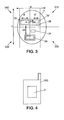
- Such an ellipse 11 inscribed in the skin tone area is represented in Figure 3 .
- This skin detection step 10 may be carried out by the skin tone detector 91 of Figure 1 .
- Each detected skin tone area is then divided at step 12 in a number of parts, for instance four parts, each corresponding to, for example, a respective quarter in the skin tone area.
- a skin tone area 11 may thus be divided in a first part 310 corresponding to the top-right quarter of the area 11, a second part 320 corresponding to its bottom-right quarter, a third part 330 corresponding to its bottom-left quarter and a fourth part 340 corresponding to its top-left quarter.
- any other number of parts may be considered, e.g., two parts which may respectively correspond to the left and right halves, or to the top and bottom halves, of the skin tone area 11.
- the number of parts may be predetermined, for instance four or two as in the examples mentioned above. In a variant, however, the number of parts in which the skin tone area is divided may be adaptive. This may prove advantageous to take into account some intrinsic characteristics of the image data to be processed, and/or to take advantage of some algorithms of data processing be they either readily available or to become available in future.
- a luminance map is constructed.
- the luminance map gives the luminance value of each pixel within the skin tone area.
- step 18 horizontal and/or vertical edges are extracted from the luminance map by applying at least one (e.g., two) differential filter(s) having, for example, the coefficients -1, 0, 1.
- This step may be carried out by the edge filter 921 of Figure 1 , in which said differential filter(s) is (are) comprised.
- an edge magnitude threshold is computed in order to keep only the most significant horizontal edges for further processing whereas the other edges are eliminated.
- vertical edges may be considered in replacement of, or in addition to the horizontal edges.
- the edge magnitude threshold for each part of the skin tone area is so defined that a given percentage, e.g. the top ten percent of the edges having luminance values beyond (let us say above as a matter of non limiting example) said threshold, are kept. Any percentage other than 10% may be considered, preferably within a range between 5% and 20%, depending on the performances to be achieved in terms of accuracy of the edge detection.
- an average luminance of each detected skin tone area is also calculated at step 20.
- An absolute rejection threshold is then defined dependent on the calculated average luminance. Indeed, a low average luminance value means a dark face. In such situations it may be beneficial to lower the absolute rejection threshold as compared to a high luminance average value. More generally speaking, the dependency of the threshold on the average luminance value is typically such that the lower the average luminance value, the lower the absolute rejection threshold.
- the absolute rejection_threshold value may equal 5; if the average luminance is above 128 then the absolute_threshold value may equal 8; for values of the average luminance in between 64 and 128, there might be a linear interpolation of the absolute rejection_threshold value between 5 and 8.
- each part of the skin tone area only the edges having a luminance greater than the absolute rejection threshold are kept for further processing according to some embodiments. Thus, even the top ten percent strongest edges of one part may be eliminated if their luminance value is less than the absolute rejection threshold.
- the edge magnitude threshold and/or the absolute rejection threshold may be defined by the threshold definition unit 922 of Figure 1 .
- the kept horizontal edges whose luminance is simultaneously greater than the absolute rejection threshold and than the edge magnitude threshold of the corresponding part of the skin tone area are used for building a binary map at step 22.
- the binary map contains only binary values, i.e., a value of one if the luminance value of the pixel satisfies both above conditions or a value of zero if one of the above conditions is not satisfied.
- step 24 facial features are extracted from the binary map, by the feature detector 923 of Figure 1 .
- This step may be carried out by using any suitable method for facial features extraction either known in the current state of art or developed in the future. Such methods are typically based on facial feature extraction algorithms the description of which would go beyond the scope of the present description.
- Figure 3 shows the extraction of eyes and mouth from a detected skin tone area delimited by the ellipse 11.
- the areas 30 and 32 both containing e.g. horizontal edges, are located at the same horizontal level on the top half part of the ellipse 11. They define a linearly extending area 38, also called an "eye line" in the jargon of the one with ordinary skills in the art.
- the edge in area 30 has a width d' and the edge in area 32 has a width d" .
- edges of 30 and 32 are distant from each other by a distance d1 .
- the edge contained in area 36, located in the bottom half part of the ellipse 11, is distant from the eye line 38 with a distance d2.
- the map is processed to recognize eyes and mouth based on various criterion involving their sizes and respective distances.
- a1, b1 and X are suitable parameters (either constant or adaptive)
- the distances d', d"and d1 verify all the following conditions d ⁇ ⁇ X ; d ⁇ ⁇ X ; a ⁇ 1 ⁇ w ⁇ d ⁇ 1 ⁇ b ⁇ 1 ⁇ w , then the edges 30 and 32 may be concluded to correspond to the eyes.
- edge 36 may be concluded to corresponds to a mouth, where a2 and b2 are other suitable parameters (either constant or adaptive).
- edge 34 does not satisfy the above conditions because the distance between this edge 34 and the eye line 35 is lower than a 2 ⁇ h, then it may be concluded that the edge 34 does not correspond to a mouth.
- the detection of the eyes 30, 32 and of the mouth 36 by the above method permits to validate that the considered skin tone area comprises a face.
- Figure 4 illustrates a mobile phone 100 comprising a device 2 as described with reference to Figure 1 .
- Embodiments of the present invention can also be embedded in a computer program product, which comprises all the features enabling the implementation of the method described herein, and which - when loaded in an information processing system - is able to carry out this method.
- Computer program means or computer program in the present context mean any expression, in any language, code or notation, of a set of instructions intended to cause a system having an information processing capability to perform a particular function either directly or after a conversion to another language.
- Such a computer program can be stored on a computer or machine readable medium allowing data, instructions, messages or message packets, and other machine readable information to be read from the medium.
- the computer or machine readable medium may include non-volatile memory, such as ROM, Flash memory, Disk drive memory, CD-ROM, and other permanent storage. Additionally, a computer or machine readable medium may include, for example, volatile storage such as RAM, buffers, cache memory, and network circuits. Furthermore, the computer or machine readable medium may comprise computer or machine readable information in a transitory state medium such as a network link and/or a network interface, including a wired network or a wireless network, that allow a device to read such computer or machine readable information.
- a transitory state medium such as a network link and/or a network interface, including a wired network or a wireless network, that allow a device to read such computer or machine readable information.
Landscapes
- Engineering & Computer Science (AREA)
- Health & Medical Sciences (AREA)
- Oral & Maxillofacial Surgery (AREA)
- Physics & Mathematics (AREA)
- General Health & Medical Sciences (AREA)
- Human Computer Interaction (AREA)
- General Physics & Mathematics (AREA)
- Multimedia (AREA)
- Theoretical Computer Science (AREA)
- Geometry (AREA)
- Computer Vision & Pattern Recognition (AREA)
- Image Processing (AREA)
- Image Analysis (AREA)
Priority Applications (3)
| Application Number | Priority Date | Filing Date | Title |
|---|---|---|---|
| EP20100306248 EP2453383A1 (fr) | 2010-11-12 | 2010-11-12 | Détection de caractéristiques faciales |
| US13/884,084 US9092661B2 (en) | 2010-11-12 | 2011-11-14 | Facial features detection |
| PCT/EP2011/070079 WO2012062933A1 (fr) | 2010-11-12 | 2011-11-14 | Détection de caractéristiques faciales |
Applications Claiming Priority (1)
| Application Number | Priority Date | Filing Date | Title |
|---|---|---|---|
| EP20100306248 EP2453383A1 (fr) | 2010-11-12 | 2010-11-12 | Détection de caractéristiques faciales |
Publications (1)
| Publication Number | Publication Date |
|---|---|
| EP2453383A1 true EP2453383A1 (fr) | 2012-05-16 |
Family
ID=43415226
Family Applications (1)
| Application Number | Title | Priority Date | Filing Date |
|---|---|---|---|
| EP20100306248 Ceased EP2453383A1 (fr) | 2010-11-12 | 2010-11-12 | Détection de caractéristiques faciales |
Country Status (3)
| Country | Link |
|---|---|
| US (1) | US9092661B2 (fr) |
| EP (1) | EP2453383A1 (fr) |
| WO (1) | WO2012062933A1 (fr) |
Cited By (1)
| Publication number | Priority date | Publication date | Assignee | Title |
|---|---|---|---|---|
| WO2016076898A1 (fr) * | 2014-11-13 | 2016-05-19 | Intel Corporation | Détection, sur la base de la biométrie, de l'usurpation d'un visage dans une image |
Families Citing this family (6)
| Publication number | Priority date | Publication date | Assignee | Title |
|---|---|---|---|---|
| US10558848B2 (en) | 2017-10-05 | 2020-02-11 | Duelight Llc | System, method, and computer program for capturing an image with correct skin tone exposure |
| US12401911B2 (en) | 2014-11-07 | 2025-08-26 | Duelight Llc | Systems and methods for generating a high-dynamic range (HDR) pixel stream |
| US12401912B2 (en) | 2014-11-17 | 2025-08-26 | Duelight Llc | System and method for generating a digital image |
| US12445736B2 (en) | 2015-05-01 | 2025-10-14 | Duelight Llc | Systems and methods for generating a digital image |
| CN106611429B (zh) * | 2015-10-26 | 2019-02-05 | 腾讯科技(深圳)有限公司 | 检测皮肤区域的方法和检测皮肤区域的装置 |
| JP6872742B2 (ja) * | 2016-06-30 | 2021-05-19 | 学校法人明治大学 | 顔画像処理システム、顔画像処理方法及び顔画像処理プログラム |
Family Cites Families (8)
| Publication number | Priority date | Publication date | Assignee | Title |
|---|---|---|---|---|
| AUPR541801A0 (en) * | 2001-06-01 | 2001-06-28 | Canon Kabushiki Kaisha | Face detection in colour images with complex background |
| AU2002951473A0 (en) * | 2002-09-18 | 2002-10-03 | Canon Kabushiki Kaisha | Method for tracking facial features in video sequence |
| JP4130820B2 (ja) | 2004-08-27 | 2008-08-06 | 株式会社豊田中央研究所 | 顔中心位置検出装置及び方法並びにプログラム |
| US8913830B2 (en) * | 2005-01-18 | 2014-12-16 | Siemens Aktiengesellschaft | Multilevel image segmentation |
| US7840037B2 (en) | 2007-03-09 | 2010-11-23 | Seiko Epson Corporation | Adaptive scanning for performance enhancement in image detection systems |
| CN102016882B (zh) * | 2007-12-31 | 2015-05-27 | 应用识别公司 | 利用脸部签名来标识和共享数字图像的方法、系统和计算机程序 |
| TW201039251A (en) * | 2009-04-30 | 2010-11-01 | Novatek Microelectronics Corp | Facial expression recognition apparatus and facial expression recognition method thereof |
| TWI453680B (zh) * | 2010-10-08 | 2014-09-21 | Micro Star Int Co Ltd | 可抑制雜訊及環境影響之臉部辨識方法 |
-
2010
- 2010-11-12 EP EP20100306248 patent/EP2453383A1/fr not_active Ceased
-
2011
- 2011-11-14 WO PCT/EP2011/070079 patent/WO2012062933A1/fr not_active Ceased
- 2011-11-14 US US13/884,084 patent/US9092661B2/en active Active
Non-Patent Citations (6)
| Title |
|---|
| JOHNSON R P: "CONTRAST BASED EDGE DETECTION", PATTERN RECOGNITION, ELSEVIER, GB, vol. 23, no. 3/04, 1 January 1990 (1990-01-01), pages 311 - 318, XP000115581, ISSN: 0031-3203, DOI: 10.1016/0031-3203(90)90018-G * |
| MCLLROY, C. ET AL: "Hardware for real-time image processing", IEE PROC COMPUTERS AND DIGITAL TECHNIQUES, 1984, pages 223 - 229, XP002633332 * |
| PARKER, J.R.: "Algorithms for image processing and computer vision", 1 January 1997, JOHN WILEY & SONS, INC. NEW YORK, NY, USA, ISBN: 0471140562, pages: 116 - 149, XP002633331 * |
| PRATT W K ED - PRATT W K: "Digital Image Processing, PASSAGE", 1 January 2001, DIGITAL IMAGE PROCESSING : PIKS INSIDE, NEW YORK : JOHN WILEY & SONS, US, PAGE(S) 29-33,443, ISBN: 978-0-471-37407-7, XP002374598 * |
| YANG M H ET AL: "Face Detection and Gesture Recognition for Human-Computer Interaction", 1 January 2001, FACE DETECTION AND GESTURE RECOGNITION FOR HUMAN-COMPUTER INTERACTION; [KLUWER INTERNATIONAL SERIES IN VIDEO VIDEO COUMPUTING], NORWELL, MA : KLUWER ACADEMIC PUBL, US, PAGE(S) 21 - 26, ISBN: 978-0-7923-7409-1, XP002485296 * |
| YANG MING-HSUAN ET AL: "Face Detection and Gesture Recognition for Human-Computer Interaction", 1 January 2001, FACE DETECTION AND GESTURE RECOGNITION FOR HUMAN-COMPUTER INTERACTION; [KLUWER INTERNATIONAL SERIES IN VIDEO VIDEO COUMPUTING], NORWELL, MA : KLUWER ACADEMIC PUBL, US, PAGE(S) 12 - 15, ISBN: 978-0-7923-7409-1, XP002515577 * |
Cited By (2)
| Publication number | Priority date | Publication date | Assignee | Title |
|---|---|---|---|---|
| WO2016076898A1 (fr) * | 2014-11-13 | 2016-05-19 | Intel Corporation | Détection, sur la base de la biométrie, de l'usurpation d'un visage dans une image |
| US9690998B2 (en) | 2014-11-13 | 2017-06-27 | Intel Corporation | Facial spoofing detection in image based biometrics |
Also Published As
| Publication number | Publication date |
|---|---|
| US9092661B2 (en) | 2015-07-28 |
| US20130251202A1 (en) | 2013-09-26 |
| WO2012062933A1 (fr) | 2012-05-18 |
Similar Documents
| Publication | Publication Date | Title |
|---|---|---|
| US9092661B2 (en) | Facial features detection | |
| EP2849431B1 (fr) | Méthode et appareil de détection de contre-jour | |
| EP2866170B1 (fr) | Procédé et dispositif de traitement d'images | |
| US9666161B2 (en) | Method and system for replacing theme of a mobile terminal on the basis of a user's clothes color | |
| CN101599175B (zh) | 确定拍摄背景发生改变的检测方法及图像处理设备 | |
| US8290277B2 (en) | Method and apparatus for setting a lip region for lip reading | |
| US10713793B2 (en) | Image processing apparatus, image processing method, and recording medium | |
| US20140079321A1 (en) | Device and method for detecting the presence of a logo in a picture | |
| CN111368587B (zh) | 场景检测方法、装置、终端设备及计算机可读存储介质 | |
| CN116249015B (zh) | 摄像头遮挡检测方法、装置、摄像头设备及存储介质 | |
| CN105243371A (zh) | 一种人脸美颜程度的检测方法、系统及拍摄终端 | |
| CN113674217A (zh) | 眩光检测方法、装置、设备及存储介质 | |
| JP2021052238A (ja) | 付着物検出装置および付着物検出方法 | |
| WO2010116478A1 (fr) | Dispositif de traitement d'image, procédé de traitement d'image et programme de traitement d'image | |
| JP6274876B2 (ja) | 画像処理装置、画像処理方法及びプログラム | |
| US9239947B2 (en) | Face detection method | |
| CN108810407B (zh) | 一种图像处理方法、移动终端及计算机可读存储介质 | |
| CN111881846A (zh) | 图像处理方法和相关装置、设备、存储介质 | |
| CN113382233A (zh) | 检测终端视频录制异常的方法、系统、介质及终端 | |
| US20140247987A1 (en) | Object detection apparatus, storage medium, and integrated circuit | |
| CN111885371A (zh) | 图像遮挡检测方法、装置、电子设备和计算机可读介质 | |
| JP2014099087A (ja) | 特徴点検出装置およびプログラム | |
| CN106650583A (zh) | 人脸检测方法、装置及终端设备 | |
| CN111161211B (zh) | 一种图像检测方法及装置 | |
| CN115601606B (zh) | 一种门店状态检测方法、装置、设备及存储介质 |
Legal Events
| Date | Code | Title | Description |
|---|---|---|---|
| PUAI | Public reference made under article 153(3) epc to a published international application that has entered the european phase |
Free format text: ORIGINAL CODE: 0009012 |
|
| AK | Designated contracting states |
Kind code of ref document: A1 Designated state(s): AL AT BE BG CH CY CZ DE DK EE ES FI FR GB GR HR HU IE IS IT LI LT LU LV MC MK MT NL NO PL PT RO RS SE SI SK SM TR |
|
| AX | Request for extension of the european patent |
Extension state: BA ME |
|
| 17P | Request for examination filed |
Effective date: 20121116 |
|
| 17Q | First examination report despatched |
Effective date: 20130102 |
|
| STAA | Information on the status of an ep patent application or granted ep patent |
Free format text: STATUS: THE APPLICATION HAS BEEN REFUSED |
|
| 18R | Application refused |
Effective date: 20140211 |