EP2455346A1 - Herstellungsverfahren und vorrichtung zur herstellung von glasplatten - Google Patents
Herstellungsverfahren und vorrichtung zur herstellung von glasplatten Download PDFInfo
- Publication number
- EP2455346A1 EP2455346A1 EP10799679A EP10799679A EP2455346A1 EP 2455346 A1 EP2455346 A1 EP 2455346A1 EP 10799679 A EP10799679 A EP 10799679A EP 10799679 A EP10799679 A EP 10799679A EP 2455346 A1 EP2455346 A1 EP 2455346A1
- Authority
- EP
- European Patent Office
- Prior art keywords
- opening
- molding chamber
- chamber
- glass ribbon
- width direction
- Prior art date
- Legal status (The legal status is an assumption and is not a legal conclusion. Google has not performed a legal analysis and makes no representation as to the accuracy of the status listed.)
- Granted
Links
Images


Classifications
-
- C—CHEMISTRY; METALLURGY
- C03—GLASS; MINERAL OR SLAG WOOL
- C03B—MANUFACTURE, SHAPING, OR SUPPLEMENTARY PROCESSES
- C03B17/00—Forming molten glass by flowing-out, pushing-out, extruding or drawing downwardly or laterally from forming slits or by overflowing over lips
- C03B17/06—Forming glass sheets
- C03B17/064—Forming glass sheets by the overflow downdraw fusion process; Isopipes therefor
-
- C—CHEMISTRY; METALLURGY
- C03—GLASS; MINERAL OR SLAG WOOL
- C03B—MANUFACTURE, SHAPING, OR SUPPLEMENTARY PROCESSES
- C03B17/00—Forming molten glass by flowing-out, pushing-out, extruding or drawing downwardly or laterally from forming slits or by overflowing over lips
- C03B17/06—Forming glass sheets
- C03B17/067—Forming glass sheets combined with thermal conditioning of the sheets
-
- C—CHEMISTRY; METALLURGY
- C03—GLASS; MINERAL OR SLAG WOOL
- C03B—MANUFACTURE, SHAPING, OR SUPPLEMENTARY PROCESSES
- C03B17/00—Forming molten glass by flowing-out, pushing-out, extruding or drawing downwardly or laterally from forming slits or by overflowing over lips
- C03B17/06—Forming glass sheets
- C03B17/068—Means for providing the drawing force, e.g. traction or draw rollers
-
- C—CHEMISTRY; METALLURGY
- C03—GLASS; MINERAL OR SLAG WOOL
- C03B—MANUFACTURE, SHAPING, OR SUPPLEMENTARY PROCESSES
- C03B18/00—Shaping glass in contact with the surface of a liquid
- C03B18/02—Forming sheets
- C03B18/04—Changing or regulating the dimensions of the molten glass ribbon
- C03B18/06—Changing or regulating the dimensions of the molten glass ribbon using mechanical means, e.g. restrictor bars, edge rollers
-
- C—CHEMISTRY; METALLURGY
- C03—GLASS; MINERAL OR SLAG WOOL
- C03B—MANUFACTURE, SHAPING, OR SUPPLEMENTARY PROCESSES
- C03B33/00—Severing cooled glass
- C03B33/02—Cutting or splitting sheet glass or ribbons; Apparatus or machines therefor
- C03B33/0215—Cutting or splitting sheet glass or ribbons; Apparatus or machines therefor the ribbon being in a substantially vertical plane
Definitions
- the present invention relates to a method and a device for manufacturing a glass sheet.
- a method called a fusion process is conventionally known as a manufacturing method of a high-quality glass sheet.
- the fusion process is a method in which molten glass is run down along both side surfaces of a molded body with a cross section of a wedge shape converging downward and also the molten glass is joined and integrated just under a lower edge part of the molded body and while cooling an integrated sheet-shaped glass ribbon, the glass ribbon is drawn downward, thereby molding in a target thickness.
- the invention has been implemented in view of the problem described above, and an object of the invention is to provide a method and a device for manufacturing a glass sheet capable of easily manufacturing a high-quality glass sheet.
- the present invention relates to a method for manufacturing a glass sheet, the method comprising:
- the present invention relates to a device for manufacturing a glass sheet, comprising:
- a method and device for manufacturing a glass sheet capable of easily manufacturing the high-quality glass sheet can be provided.
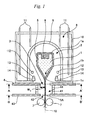
- Fig. 1 is a partially sectional view showing a manufacturing device of a glass sheet according to one embodiment of the invention.
- Fig. 2 is a functional block diagram showing a control system of the manufacturing device of the glass sheet of Fig.
- the molded body 1 is constructed of, for example, an alumina or zirconia refractory.
- the molded body 1 has a cross section of a wedge shape converging downward.
- a recess 6 is formed in the upper portion of the molded body 1.
- a molten glass supply pipe (not shown) is connected to the recess 6 of the molded body 1.
- Molten glass 5 supplied from this molten glass supply pipe to the inside of the recess 6 spills from an upper edge (that is, the upper edge of the molded body 1) 1 a of the recess 6 and runs down along both side surfaces of the molded body 1 and joins just under a lower edge part 1b of the molded body 1.
- the joining molten glass 5 forms a sheet-shaped glass ribbon 5A.
- the glass ribbon 5A is molded by being downward elongated by a pair of rollers 7 rotated and driven by a rotary driving device 71.
- a pair of rollers 7 is provided by one set, but may be provided by plural sets.
- both ends in a width direction of the glass ribbon 5A are cut off and the remaining center in the width direction is used as a glass sheet which is a product.
- the molding chamber 2 is installed inside a furnace chamber 8.
- the molding chamber 2 and the furnace chamber 8 are partitioned by a partition wall 9.
- the partition wall 9 is placed and fixed on a floor surface of a furnace wall 10 forming the furnace chamber 8.
- the partition wall 9 and the furnace wall 10 are constructed of a refractory.
- Plural first heating elements 11 are installed inside the furnace chamber 8 in order to prevent the molten glass 5 or the glass ribbon 5A from being cooled.
- Each of the first heating elements 11 is connected to a power source 72.
- the amount of electric power of supply from the power source 72 to each of the first heating elements 11 is individually controlled by a controller 73. Consequently, temperature of the molten glass 5 or the glass ribbon 5A can be adjusted.
- Second heating elements 12, third heating elements 13 and cooling elements 14 are installed in the molding chamber 2 in order to control temperature distribution in a vertical direction and a width direction of the molten glass 5 or the glass ribbon 5A.
- the second heating elements 12 are arranged in both sides of the molded body 1, and the plural heating elements 12 are disposed in a direction parallel to the width direction of the molten glass 5 in each side.
- Each of the second heating elements 12 is connected to the power source 72.
- the amount of electric power of supply from the power source 72 to each of the second heating elements 12 is individually controlled by the controller 73. Consequently, temperature distribution in the vertical direction and the width direction of the molten glass 5 or the glass ribbon 5A can be adjusted.
- the third heating elements 13 are arranged in both sides in the vicinity of the lower edge part 1b of the molded body 1, and the plural heating elements 13 are disposed in the direction parallel to the width direction of the molten glass 5 in each side.
- Each of the third heating elements 13 is connected to the power source 72.
- the amount of electric power of supply from the power source 72 to each of the third heating elements 13 is individually controlled by the controller 73. Consequently, temperature distribution in the vertical direction and the width direction of the molten glass 5 or the glass ribbon 5A can be adjusted.
- the cooling elements 14 are arranged in both sides in the vicinity of the lower edge part 1b of the molded body 1, and the plural cooling elements 14 are disposed in the direction parallel to the width direction of the molten glass 5 in each side.
- Each of the cooling elements 14 is connected to a refrigerant supply pipe 75 capable of adjusting an aperture by a throttle valve 74.
- the amount of refrigerant supply from the refrigerant supply pipe 75 to each of the cooling elements 14 is individually controlled by the controller 73. Consequently, temperature distribution in the vertical direction and the width direction of the molten glass 5 or the glass ribbon 5A can be adjusted.
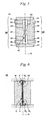
- Fig. 3 is a sectional view seen from the side of the molded body 1 along line A-A' of Fig. 1 , and is the sectional view showing the opening 3 of the molding chamber.
- Fig. 4 is a sectional view showing a modified example of Fig. 3 .
- the opening 3 of the molding chamber is provided just under the molded body 1.
- the opening 3 of the molding chamber extends in the width direction of the glass ribbon 5A.
- a shape dimension of the opening 3 of the molding chamber is set larger than a shape dimension of a cross section of the glass ribbon 5A so that the first opening member 4 does not make contact with the glass ribbon 5A.
- a thickness of the center in the width direction of the glass ribbon 5A passing through the opening 3 of the molding chamber is 1.0 mm or less.
- the gap W 1 is set in the range of 8 mm to 70 mm, more preferably, the range of 10 mm to 60 mm.
- the gap W 1 may be constant or vary in the width direction of the glass ribbon 5A as long as the gap W 1 is set within the range described above.
- the gap W 1 may be constant or vary in a longitudinal direction (vertical direction in Fig. 1 ) of the glass ribbon 5A as long as the gap W 1 is set within the range described above.
- the gap W 1 When the gap W 1 is set smaller than 8 mm, heat transfer between the molding chamber 2 and the lower portion of the molding chamber 2 is inhibited, and a temperature of the molding chamber 2 tends to become a desired temperature or higher, and a big temperature difference occurs between the molding chamber 2 and the lower portion of the molding chamber 2 (that is, the upper portion and the lower portion of the first opening member 4 regarded as a boundary). Therefore, a sudden change in temperature occurs at the boundary (that is, the vicinity of the opening 3 of the molding chamber) between the molding chamber 2 and the lower portion of the molding chamber 2.
- the gap W 1 is set larger than 70 mm, the heat transfer between the molding chamber 2 and the lower portion of the molding chamber 2 is promoted, and the temperature of the molding chamber 2 tends to become a desired temperature or lower. As a result, a viscosity of the glass ribbon 5A becomes high and the glass ribbon 5A is not elongated thinly and may be cut.
- the gap W 1 is set smaller than 8 mm or is set larger than 70 mm thus, a problem arises.
- the problem is seen in the case of manufacturing a thin glass sheet with a thickness of 1.0 mm or less, and is particularly remarkably seen in the case of manufacturing the thin glass sheet with a thickness of 0.3 mm or less.
- a viscosity ratio V 2 /V 1 of a viscosity V 1 of the center in the width direction of the molten glass 5 in the upper edge 1a of the molded body 1 to a viscosity V 2 of the center in the width direction of the glass ribbon 5A passing through the opening 3 of the molding chamber is set in the range of 20 to 50000.
- the viscosity ratio V 2 /V 1 When the viscosity ratio V 2 /V 1 is set smaller than 20, a width of the glass ribbon 5A becomes narrow under its own weight or by a downward tensile force and the glass ribbon 5A may be cut, or a thickness of the glass ribbon 5A may become nonuniform even when the glass ribbon is not cut.
- the viscosity ratio V 2 /V 1 is set larger than 50000, the glass ribbon 5A is not elongated well thinly and may be cut.
- gaps W 2 (see Figs. 3 and 4 ) between side surface portions P (see Figs. 3 and 4 ) in the width direction side of the glass ribbon 5A of the opening 3 of the molding chamber and respective ends in the width direction of the glass ribbon 5A passing through the opening 3 of the molding chamber will be described.
- the gap W 2 is set in the range of 10 mm to 500 mm.
- the gap W 2 When the gap W 2 is set smaller than 10 mm, heat transfer between the molding chamber 2 and the lower portion of the molding chamber 2 is inhibited, and a temperature in the vicinity of the end of the glass ribbon 5A of the molding chamber 2 tends to become a desired temperature or higher. Also, when the gap W 2 is set larger than 500 mm, the heat transfer between the molding chamber 2 and the lower portion of the molding chamber 2 is promoted, and the temperature in the vicinity of the end of the glass ribbon 5A of the molding chamber 2 tends to become a desired temperature or lower. Therefore, in both cases, a temperature difference between the center and the end in the width direction of the glass ribbon 5A becomes big.
- a thickness of the glass ribbon 5A becomes too thin or the glass ribbon 5A warps too much and thereby, the glass ribbon 5A is cut and it becomes difficult to produce the glass sheets continuously stably. Or, even when the glass ribbon 5A is not cut, warpage or non-uniformity of thickness of the manufactured glass sheet may occur.
- the first opening member 4 is desirably formed of a material in which heat transfer resistance in operating temperature is 0.001 m 2 K/W or more.
- a plate made of, for example, ceramic fiber is used in the first opening member 4. Consequently, heat transfer through the first opening member 4 can be inhibited and temperature distribution of the inside of the molding chamber 2 can be controlled easily.
- the first opening member 4 may have, for example, a plate shape as shown in Fig. 1 or a block shape, and the shape of the first opening member 4 is not limited.
- the first opening member 4 is substantially horizontally provided just under the furnace wall 10, and is broadly constructed of two partition wall members 20, 30.
- the two partition wall members 20, 30 are arranged so as to sandwich the vertical plane 18.
- a gap formed by the two partition wall members 20, 30 forms the opening 3 of the molding chamber for passing the glass ribbon 5A under the molding chamber 2.
- the partition wall member 20 is preferably divided into plural blocks 21 to 27 for molding chamber in the width direction of the glass ribbon 5A.
- the partition wall member 20 is preferably constructed of the plural blocks 21 to 27 for molding chamber aligned in a direction parallel to the width direction of the glass ribbon 5A.
- the partition wall member 30 is preferably divided into plural blocks 31 to 37 for molding chamber in the width direction of the glass ribbon 5A.
- the partition wall member 30 is preferably constructed of the plural blocks 31 to 37 for molding chamber aligned in the direction parallel to the width direction of the glass ribbon 5A.
- the number of divisions of one partition wall member 20 may be equal to or different from the number of divisions of the other partition wall member 30.
- a division surface of each of the blocks 21 to 27, 31 to 37 for molding chamber is set perpendicularly to the width direction of the glass ribbon 5A.
- the division surface of each of the blocks 21 to 27, 31 to 37 for molding chamber is set perpendicularly to the width direction of the glass ribbon 5A, but may be set obliquely to the width direction of the glass ribbon 5A.
- a shape of a surface opposed to the vertical plane 18 of each of the blocks 21 to 27, 31 to 37 for molding chamber may be parallel or nonparallel to the vertical plane 18.
- Each of the blocks 21 to 27, 31 to 37 for molding chamber has a configuration movable in a direction of moving near to or away from the vertical plane 18 manually or by a first actuator 76.
- each of the blocks 21 to 27, 31 to 37 for molding chamber has a configuration replaceable manually or by the first actuator 76 without stopping of supply of the molten glass 5 to the molded body 1. If supply of the molten glass 5 to the molded body 1 is stopped in the case of replacement, manufacture of the glass sheet is stopped for a long time.
- the shape dimension of the opening 3 of the molding chamber can be adjusted by moving one or plural blocks 22 to 26 for molding chamber in the middle of the partition wall member 20 in a direction of moving near to or away from the vertical plane 18.
- the shape dimension of the opening 3 of the molding chamber can be adjusted by moving one or plural blocks 32 to 36 for molding chamber in the middle of the partition wall member 30 in the direction of moving near to or away from the vertical plane 18.
- the shape dimension of the opening 3 of the molding chamber can be changed by replacing one or plural blocks 22 to 26, 32 to 36 for molding chamber.
- one block 22 to 26, 32 to 36 for molding chamber may be respectively replaced with one block 22A to 26A, 32A to 36A for molding chamber as shown in Figs. 3 and 4 , or plural adjacent blocks for molding chamber may be replaced with one block for molding chamber.
- the gap W 1 between the opening 3 of the molding chamber and the vertical plane 18 can be adjusted or changed, and heat transfer between the molding chamber 2 and the lower portion of the molding chamber 2 can be adjusted. Consequently, temperature distribution (and thus a shape dimension) of the glass ribbon 5A can be adjusted, and changes in thickness, composition, etc. of the glass sheet which is a product can be handled.
- each of the blocks 22 to 26 for molding chamber in the middle of the partition wall member 20 may be further divided in a vertical direction in Fig. 1 .
- Each of the blocks 32 to 36 for molding chamber in the middle of the partition wall member 30 may be further divided in the vertical direction in Fig. 1 . Consequently, the heat transfer between the molding chamber 2 and the lower portion of the molding chamber 2 can be adjusted more finely.
- shape and material of the molded body 1, shape and material of the partition wall 9 or the furnace wall 10, and shape and arrangement of each of the heating elements, etc. are optimized so as to optimize viscosity distribution (and thus a shape dimension) of the molten glass 5 or the glass ribbon 5A.
- viscosity distribution and thus a shape dimension
- wettability between the molded body 1 and the molten glass 5 changes partially, so that a thickness of the molten glass 5 running down along both side surfaces of the molded body 1 changes partially.
- the shape dimension of the molten glass 5 or the glass ribbon 5A may change due to secular deterioration in components constructing the manufacturing device of the glass sheet. This tendency is seen in the case of manufacturing a thin glass sheet with a thickness of 1.0 mm or less, and is particularly remarkably seen in the case of manufacturing the thin glass sheet with a thickness of 0.3 mm or less.
- the viscosity distribution of the molten glass 5 or the glass ribbon 5A can be controlled, so that the shape dimension of the molten glass 5 or the glass ribbon 5A can be modified. Consequently, the secular deterioration in the components constructing the manufacturing device of the glass sheet can be handled.
- the shape dimension of the opening 3 of the molding chamber is adjusted or changed based on, for example, a shape dimension of the glass sheet manufactured already so that the glass sheet manufactured from now is formed in a desired shape dimension.
- the glass sheet manufactured already is measured by a measuring device 77 (see Fig. 2 ).
- the measuring device 77 may be connected to the controller 73 as shown in Fig. 2 .
- the controller 73 controls the first actuator 76 so that the glass sheet to be manufactured is formed in the desired shape dimension, and moves or replaces one or plural blocks 22 to 26, 32 to 36 for molding chamber. Consequently, the shape dimension of the opening 3 of the molding chamber is adjusted or changed.
- a pair of blocks 24, 34 for molding chamber in the center of the partition wall members 20, 30 is respectively moved in a direction of moving away from the vertical plane 18. Consequently, the gap W 1 between a side surface of the opening 3 of the molding chamber and the center in the width direction of the glass ribbon 5A becomes large, so that the amount of heat transfer between the molding chamber 2 and the lower portion of the molding chamber 2 becomes large. Therefore, in the center in the width direction of the glass ribbon 5A passing through the opening 3 of the molding chamber, the temperature becomes low and the viscosity becomes high, so that the thickness becomes thick. Hence, the thickness of the center in the width direction of the manufactured glass sheet can be set at the target value.
- the blocks 24, 34 for molding chamber may be replaced with a pair of blocks 24A, 34A (see Fig. 4 ) for molding chamber with different shapes. Consequently, since the gap W 1 between the side surface of the opening 3 of the molding chamber and the center in the width direction of the glass ribbon 5A becomes large, the thickness of the center in the width direction of the manufactured glass sheet can also be set at the target value in this case.
- heat transfer between the molding chamber 2 and the lower portion of the molding chamber 2 is adjusted in a desired state, for example, by changing the first opening member 4 shown in Fig. 3 to a first opening member 4A shown in Fig. 4 . Consequently, warpage of the manufactured glass sheet may be inhibited.
- the shape dimension of the opening 3 of the molding chamber is adjusted or changed based on the shape dimension of the manufactured glass sheet, but the invention is not limited to this.
- temperature distribution of the inside of the molding chamber 2 or temperature distribution of the inside of the opening 3 of the molding chamber may be used instead of the shape dimension of the manufactured glass sheet.
- the temperature distribution of the inside of the molding chamber 2 or the temperature distribution of the inside of the opening 3 of the molding chamber is measured by a temperature sensor (not shown) such as a thermocouple provided inside the molding chamber 2 or the opening 3 of the molding chamber.
- the shape dimension of the opening 3 of the molding chamber is preferably adjusted or changed so that at least a part of the gap W 1 changes in the width direction of the glass ribbon 5A as shown in, for example, Fig. 3 .
- heat transfer between the molding chamber 2 and the lower portion of the molding chamber 2 changes in the width direction of the glass ribbon 5A, so that viscosity distribution in the width direction of the glass ribbon 5A changes. Therefore, a shape dimension in the width direction of the glass ribbon 5A can be optimized. Consequently, secular deterioration in components constructing the manufacturing device of the glass sheet can be handled.
- the opening 3 of the molding chamber may have a configuration substantially closable by plural blocks for molding chamber when the manufacturing device of the glass sheet is started up (that is, when the molten glass 5 is not run down along both side surfaces of the molded body 1 and the molded body 1 is heated).
- the opening 3 of the molding chamber is substantially closed, heat transfer between the molding chamber 2 and the lower portion of the molding chamber 2 is prevented, so that when the molded body 1 is heated, temperature distribution in the vertical direction of the molded body 1 tends to become uniform, and damage to the molded body 1 from thermal stress can be inhibited.
- the blocks 22 to 26, 32 to 36 for molding chamber in the middle of the respective partition wall members 20, 30 are moved to open the opening 3 of the molding chamber.
- the manufacturing device of the glass sheet further comprises a communication chamber 41 for communicating with the molding chamber 2 through the opening 3 of the molding chamber, and a communication chamber opening 42 for drawing downward the glass ribbon 5A out of the communication chamber 41.
- the communication chamber opening 42 is formed by a second opening member 43.
- the communication chamber 41 is provided under the molding chamber 2 and is surrounded by a tube wall 44.
- the tube wall 44 is constructed of a refractory or a heat insulating material.
- a heating element or a cooling element may be installed in the tube wall 44.
- the heating element is connected to the power source 72, and the amount of electric power of supply from the power source 72 to the heating element is controlled by the controller 73.
- the cooling element 14 is connected to the refrigerant supply pipe 75 capable of adjusting an aperture by a throttle valve, and the amount of refrigerant supply from the refrigerant supply pipe 75 to the cooling element 14 is controlled by the controller 73. Consequently, a temperature of the glass ribbon 5A passing through the communication chamber 41 can be adjusted. Thus, a temperature of the glass ribbon 5A passing through the molding chamber 2 can be adjusted by heat transfer between the molding chamber 2 and the communication chamber 41.
- Fig. 5 is a sectional view seen from the side of the communication chamber along line B-B' of Fig. 1 , and is the sectional view showing the communication chamber opening 42.
- a shape dimension of the communication chamber opening 42 is set larger than a cross-sectional shape of the glass ribbon 5A so that the second opening member 43 does not make contact with the glass ribbon 5A.
- a gap, in a direction orthogonal to the vertical plane 18, between the vertical plane 18 including the lower edge 1c of the molded body 1 and the communication chamber opening 42 may be constant or vary in the width direction of the glass ribbon 5A. Also, the gap may be constant or vary in the longitudinal direction (vertical direction in Fig. 1 ) of the glass ribbon 5A.
- the communication chamber opening 42 is formed in the second opening member 43.
- the second opening member 43 is desirably formed of a material in which heat transfer resistance in operating temperature is 0.001 m 2 K/W or more.
- a plate made of, for example, ceramic fiber is used in the second opening member 43. Consequently, heat transfer through the second opening member 43 can be inhibited and temperature distribution of the inside of the communication chamber 41 can be controlled easily.
- the second opening member 43 may have, for example, a plate shape as shown in Fig. 1 or a block shape, and the shape of the second opening member 43 is not limited.
- the second opening member 43 is substantially horizontally provided just under the tube wall 44, and is broadly constructed of two partition wall members 50, 60.
- the two partition wall members 50, 60 are arranged so as to sandwich the vertical plane 18.
- a gap formed by the two partition wall members 50, 60 forms the communication chamber opening 42 for passing the glass ribbon 5A under the communication chamber 41.
- a configuration of the second opening member 43 may be equal to or different from a configuration of the first opening member 4 in which the opening 3 of the molding chamber is formed.
- the partition wall member 50 is preferably divided into plural blocks 51 to 57 for communication chamber in the width direction of the glass ribbon 5A.
- the partition wall member 50 is preferably constructed of the plural blocks 51 to 57 for communication chamber aligned in a direction parallel to the width direction of the glass ribbon 5A.
- the partition wall member 60 is preferably respectively divided into plural blocks 61 to 67 for communication chamber in the width direction of the glass ribbon 5A.
- the partition wall member 60 is preferably respectively constructed of the plural blocks 61 to 67 for communication chamber aligned in the direction parallel to the width direction of the glass ribbon 5A.
- the number of divisions of one partition wall member 50 may be equal to or different from the number of divisions of the other partition wall member 60.
- a division surface of each of the blocks 51 to 57, 61 to 67 for communication chamber is set perpendicularly to the width direction of the glass ribbon 5A.
- the division surface of each of the blocks 51 to 57, 61 to 67 for communication chamber is set perpendicularly to the width direction of the glass ribbon 5A, but may be set obliquely to the width direction of the glass ribbon 5A.
- a shape of a surface opposed to the vertical plane 18 of each of the blocks 51 to 57, 61 to 67 for communication chamber may be parallel or nonparallel to the vertical plane 18.
- Each of the blocks 51 to 57, 61 to 67 for communication chamber has a configuration movable in a direction of moving near to or away from the vertical plane 18 manually or by a second actuator 78.
- each of the blocks 51 to 57, 61 to 67 for communication chamber has a configuration replaceable manually or by the second actuator 78 without stopping of supply of the molten glass 5 to the molded body 1. If supply of the molten glass 5 to the molded body 1 is stopped in the case of replacement, manufacture of the glass sheet is stopped for a long time.
- a shape dimension of the communication chamber opening 42 can be adjusted by moving one or plural blocks 52 to 56 for communication chamber in the middle of the partition wall member 50 in a direction of moving near to or away from the vertical plane 18.
- the shape dimension of the communication chamber opening 42 can be adjusted by moving one or plural blocks 62 to 66 for communication chamber in the middle of the partition wall member 60 in the direction of moving near to or away from the vertical plane 18.
- the shape dimension of the communication chamber opening 42 can be changed by replacing one or plural blocks 52 to 56, 62 to 66 for communication chamber.
- the gap, in the direction orthogonal to the vertical plane 18, between the communication chamber opening 42 and the vertical plane 18 can be adjusted or changed, and heat transfer between the molding chamber 2 and the communication chamber 41 and heat transfer between the communication chamber 41 and the lower portion of the communication chamber 41 can be adjusted. Consequently, temperature distribution (and thus a shape dimension) of the glass ribbon 5A can be adjusted, and even when thickness, composition, etc. of the glass sheet which is a product are changed or even when a component constructing the manufacturing device of the glass sheet deteriorates, a high-quality thin glass sheet can easily be manufactured without stopping manufacture of the glass sheet for a long time.
- a chamber having the same action and function as those of the communication chamber 41 may be further provided under the communication chamber 41.
- the gap W 1 is set in the range of 8 mm to 70 mm, so that a sudden change in temperature can be prevented from occurring at the boundary between the molding chamber 2 and the lower portion of the molding chamber 2 and also, heat transfer between the molding chamber 2 and the lower portion of the molding chamber 2 can be controlled within a proper range. Consequently, a high-quality thin glass sheet can easily be manufactured.
- the gap W 2 is set in the range of 10 mm to 500 mm, so that the heat transfer between the molding chamber 2 and the lower portion of the molding chamber 2 can be controlled within a proper range. Consequently, a difference in temperature in the width direction of the glass ribbon 5A can be controlled within a proper range.
- the shape dimension of the opening 3 of the molding chamber is preferably adjusted or changed by moving or replacing one or plural blocks 22 to 26, 32 to 36 for molding chamber, and the heat transfer between the molding chamber 2 and the lower portion of the molding chamber 2 can be adjusted. Consequently, changes in thickness, composition, etc. of the glass sheet which is a product can be handled. Also, secular deterioration in components constructing the manufacturing device of the glass sheet can be handled.
- the shape dimension of the opening 3 of the molding chamber is preferably adjusted or changed so that at least a part of the gap W 1 changes in the width direction of the glass ribbon 5A, and the heat transfer between the molding chamber 2 and the lower portion of the molding chamber 2 can be changed in the width direction of the glass ribbon 5A. Consequently, viscosity distribution in the width direction of the glass ribbon 5A can be changed, and the shape dimension in the width direction of the glass ribbon 5A can be optimized.
- the shape dimension of the opening 3 of the molding chamber is preferably adjusted or changed based on the shape dimension etc. of the manufactured glass sheet, and a glass sheet with a desired shape dimension can be manufactured.
- the opening 3 of the molding chamber it is preferable to substantially close the opening 3 of the molding chamber by the plural blocks for molding chamber when the manufacturing device of the glass sheet is started up (when the molten glass 5 is not run down along both side surfaces of the molded body 1 and the molded body 1 is heated), and the heat transfer between the molding chamber 2 and the lower portion of the molding chamber 2 is prevented. Therefore, even when the molded body 1 is heated, temperature distribution in the vertical direction of the molded body 1 tends to become uniform, and damage to the molded body 1 from thermal stress can be inhibited.
- Example 1 a non-alkali glass sheet with a thickness of 0.3 mm was manufactured using the manufacturing device of the glass sheet shown in Figs. 1 and 3 .
- a heat insulating plate (manufactured by Nichias Corporation, T/#5461 RF board 16MD) made of ceramic fiber with a thickness of 25 mm was used as the first opening member 4.
- thermal conductivity in operating temperature was 0.2 W/m ⁇ K and heat transfer resistance in operating temperature was 0.13 m 2 K/W.
- the minimum value was set at 25 mm and the maximum value was set at 55 mm.
- the minimum value was set at 45 mm and the maximum value was set at 125 mm.
- a temperature of the center in the width direction of the molten glass 5 in the upper edge 1a of the molded body 1 made of zirconia was measured and was converted into a viscosity V 1 .
- a temperature of the center in the width direction of the glass ribbon 5A in the opening 3 of the molding chamber was measured and was converted into a viscosity V 2 .
- a viscosity ratio V 2 /V 1 was 10000.
- a thickness of the center in the width direction of the glass ribbon 5A after molding was measured.
- Table 1 shows the results.
- the average of thicknesses was 0.3 mm of a target, and a high-quality thin non-alkali glass sheet in which the maximum deviation of thickness was ⁇ 0.01 mm was obtained.
- Example 2 a non-alkali glass sheet with a thickness of 0.2 mm was manufactured using the manufacturing device of the glass sheet shown in Figs. 1 and 3 .
- a heat insulating plate (manufactured by Nichias Corporation, T/#5461 RF board 16MD) made of ceramic fiber with a thickness of 25 mm was used as the first opening member 4.
- thermal conductivity in operating temperature was 0.2 W/m ⁇ K and heat transfer resistance in operating temperature was 0.13 m 2 K/W.
- the minimum value was set at 20 mm and the maximum value was set at 52 mm.
- the minimum value was set at 44 mm and the maximum value was set at 125 mm.
- a temperature of the center in the width direction of the molten glass 5 in the upper edge 1a of the molded body 1 made of zirconia was measured and was converted into a viscosity V 1 .
- a temperature of the center in the width direction of the glass ribbon 5A in the opening 3 of the molding chamber was measured and was converted into a viscosity V 2 .
- a viscosity ratio V 2 /V 1 was 900.
- a thickness of the center in the width direction of the glass ribbon 5A after molding was measured.
- Table 1 shows the results.
- the average of thicknesses was 0.2 mm of a target, and a high-quality thin non-alkali glass sheet in which the maximum deviation of thickness was ⁇ 0.01 mm was obtained.
- Example 3 a non-alkali glass sheet with a thickness of 0.1 mm was manufactured using the manufacturing device of the glass sheet shown in Figs. 1 and 3 .
- a heat insulating plate (manufactured by Nichias Corporation, T/#5461 RF board 16MD) made of ceramic fiber with a thickness of 25 mm was used as the first opening member 4.
- thermal conductivity in operating temperature was 0.2 W/m ⁇ K and heat transfer resistance in operating temperature was 0.13 m 2 K/W.
- the minimum value was set at 11 mm and the maximum value was set at 50 mm.
- the minimum value was set at 43 mm and the maximum value was set at 125 mm.
- a temperature of the center in the width direction of the molten glass 5 in the upper edge 1a of the molded body 1 made of zirconia was measured and was converted into a viscosity V 1 .
- a temperature of the center in the width direction of the glass ribbon 5A in the opening 3 of the molding chamber was measured and was converted into a viscosity V 2 .
- a viscosity ratio V 2 N 1 was 30.
- a thickness of the center in the width direction of the glass ribbon 5A after molding was measured.
- Table 1 shows the results.
- the average of thicknesses was 0.1 mm of a target, and a high-quality thin non-alkali glass sheet in which the maximum deviation of thickness was ⁇ 0.01 mm was obtained.
- Table 1 shows the results.
- Comparative Example 1 the gap W 1 was too small, so that heat transfer between the molding chamber 2 and the lower portion of the molding chamber 2 was inhibited.
- a viscosity of the glass ribbon 5A became low and a width of the glass ribbon 5A became narrow and the glass ribbon 5A was cut halfway and stable continuous molding could not be implemented.
- Example 2 experiment was performed in a manner similar to Example 1 except that setting of the gap W 1 was changed using the first opening member 4B shown in Fig. 6 instead of the first opening member 4 shown in Fig. 3 (see Table 1).
- a viscosity ratio V 2 /V 1 was 80000.
- Table 1 shows the results.
- Comparative Example 2 the gap W 1 was too large, so that heat transfer between the molding chamber 2 and the lower portion of the molding chamber 2 was promoted.
- a viscosity of the glass ribbon 5A became high and the glass ribbon 5A could not be elongated thinly well and was cut halfway and stable continuous molding could not be implemented.
- Table 1 shows the results.
- Comparative Example 3 the minimum value of the gap W 2 was too small, so that heat transfer between the molding chamber 2 and the lower portion of the molding chamber 2 was inhibited.
- a temperature of the end in the width direction of the glass ribbon 5A became high and a temperature difference between the center and the end in the width direction of the glass ribbon 5A became big and the glass ribbon 5A could not be elongated equally in the width direction and stable continuous molding could not be implemented.
- Table 1 shows the results.
- Comparative Example 4 the maximum value of the gap W 2 was too large, so that heat transfer between the molding chamber 2 and the lower portion of the molding chamber 2 was promoted.
- a temperature of the end in the width direction of the glass ribbon 5A became low and a temperature difference between the center and the end in the width direction of the glass ribbon 5A became big and the glass ribbon 5A could not be elongated equally in the width direction and stable continuous molding could not be implemented.
- a method and a device for manufacturing a glass sheet capable of easily manufacturing a high-quality glass sheet can be provided.
Landscapes
- Chemical & Material Sciences (AREA)
- Engineering & Computer Science (AREA)
- Materials Engineering (AREA)
- Organic Chemistry (AREA)
- Mechanical Engineering (AREA)
- Re-Forming, After-Treatment, Cutting And Transporting Of Glass Products (AREA)
- Joining Of Glass To Other Materials (AREA)
- Glass Compositions (AREA)
Applications Claiming Priority (2)
| Application Number | Priority Date | Filing Date | Title |
|---|---|---|---|
| JP2009164345 | 2009-07-13 | ||
| PCT/JP2010/058670 WO2011007617A1 (ja) | 2009-07-13 | 2010-05-21 | ガラス板の製造方法及び製造装置 |
Publications (3)
| Publication Number | Publication Date |
|---|---|
| EP2455346A1 true EP2455346A1 (de) | 2012-05-23 |
| EP2455346A4 EP2455346A4 (de) | 2013-11-06 |
| EP2455346B1 EP2455346B1 (de) | 2016-01-13 |
Family
ID=43449227
Family Applications (1)
| Application Number | Title | Priority Date | Filing Date |
|---|---|---|---|
| EP10799679.5A Not-in-force EP2455346B1 (de) | 2009-07-13 | 2010-05-21 | Herstellungsverfahren zur herstellung von glasplatten |
Country Status (7)
| Country | Link |
|---|---|
| US (1) | US8453478B2 (de) |
| EP (1) | EP2455346B1 (de) |
| JP (1) | JP5648635B2 (de) |
| KR (1) | KR101751082B1 (de) |
| CN (1) | CN102471121B (de) |
| TW (1) | TWI481571B (de) |
| WO (1) | WO2011007617A1 (de) |
Cited By (3)
| Publication number | Priority date | Publication date | Assignee | Title |
|---|---|---|---|---|
| WO2012166446A1 (en) | 2011-05-27 | 2012-12-06 | Corning Incorporated | Non-polished glass wafer, thinning system and method for using the non-polished glass wafer to thin a semiconductor wafer |
| WO2018098119A1 (en) * | 2016-11-23 | 2018-05-31 | Corning Incorporated | Methods and apparatuses for compensating for forming body dimensional variations |
| WO2022051077A1 (en) * | 2020-09-02 | 2022-03-10 | Corning Incorporated | Apparatus and method to improve attributes of drawn glass |
Families Citing this family (23)
| Publication number | Priority date | Publication date | Assignee | Title |
|---|---|---|---|---|
| JP5023242B2 (ja) * | 2010-09-30 | 2012-09-12 | AvanStrate株式会社 | ガラス板の製造方法 |
| WO2012043772A1 (ja) * | 2010-09-30 | 2012-04-05 | AvanStrate株式会社 | ガラス板の製造方法 |
| TWI402224B (zh) * | 2011-03-31 | 2013-07-21 | Avanstrate Inc | Method for manufacturing glass substrates |
| US20130133370A1 (en) * | 2011-11-28 | 2013-05-30 | Olus Naili Boratav | Apparatus for reducing radiative heat loss from a forming body in a glass forming process |
| US8869562B2 (en) * | 2012-11-29 | 2014-10-28 | Corning Incorporated | Glass forming apparatus |
| US9290403B2 (en) * | 2013-02-25 | 2016-03-22 | Corning Incorporated | Repositionable heater assemblies for glass production lines and methods of managing temperature of glass in production lines |
| KR101755136B1 (ko) * | 2014-02-21 | 2017-07-06 | 아반스트레이트 가부시키가이샤 | 유리판의 제조 방법 및 유리판의 제조 장치 |
| US9682882B2 (en) | 2014-07-17 | 2017-06-20 | Corning Incorporated | Methods for producing a glass ribbon |
| JP6144740B2 (ja) * | 2014-09-30 | 2017-06-07 | AvanStrate株式会社 | ディスプレイ用ガラス基板の製造方法 |
| CN204779315U (zh) * | 2014-11-24 | 2015-11-18 | 康宁股份有限公司 | 用于制造玻璃带的设备 |
| WO2016100417A1 (en) * | 2014-12-19 | 2016-06-23 | Corning Incorporated | Apparatus for manufacturing a glass ribbon |
| KR102006563B1 (ko) * | 2015-06-30 | 2019-08-01 | 아반스트레이트 가부시키가이샤 | 디스플레이용 유리 기판의 제조 방법 |
| CN107735369B (zh) * | 2015-06-30 | 2021-06-18 | 安瀚视特控股株式会社 | 玻璃基板的制造方法及玻璃基板制造装置 |
| JP6675849B2 (ja) * | 2015-09-30 | 2020-04-08 | AvanStrate株式会社 | ガラス板の製造方法およびガラス板の製造装置 |
| KR20190003810A (ko) * | 2016-05-24 | 2019-01-09 | 코닝 인코포레이티드 | 유리 제조 장치 및 방법들 |
| US11512015B2 (en) | 2016-11-23 | 2022-11-29 | Corning Incorporated | Method and apparatus for glass ribbon thermal control |
| CN108996890A (zh) * | 2017-06-07 | 2018-12-14 | 秦皇岛玻璃工业研究设计院有限公司 | 利用玻璃纤维熔窑排放料制备超薄玻璃的设备和方法 |
| WO2019018670A1 (en) * | 2017-07-21 | 2019-01-24 | Corning Incorporated | METHOD AND APPARATUS FOR HEAT TRANSFER OF ADJUSTABLE GLASS TAPE |
| JP6951661B2 (ja) * | 2017-07-26 | 2021-10-20 | 日本電気硝子株式会社 | ガラス物品の製造方法及び製造装置 |
| WO2019079318A1 (en) * | 2017-10-20 | 2019-04-25 | Corning Incorporated | THERMAL SHIELD APPARATUS PROVIDED WITH A SOLID MONOLITHIC NOSE |
| WO2020085297A1 (ja) * | 2018-10-26 | 2020-04-30 | 日本電気硝子株式会社 | ガラス物品の製造方法 |
| JP7495662B2 (ja) * | 2020-07-16 | 2024-06-05 | 日本電気硝子株式会社 | ガラス物品の製造方法 |
| NL2027190B1 (en) | 2020-11-13 | 2022-06-30 | Corning Inc | Apparatus for, and method of, roll forming sheets of high refractive index glass |
Family Cites Families (9)
| Publication number | Priority date | Publication date | Assignee | Title |
|---|---|---|---|---|
| US2691247A (en) * | 1948-12-17 | 1954-10-12 | Union Des Verreries Mecaniques | Process of and apparatus for drawing glass into sheet form |
| JP2556567B2 (ja) | 1988-11-30 | 1996-11-20 | ホーヤ株式会社 | ガラス板の製造装置 |
| JP2530060Y2 (ja) | 1991-11-27 | 1997-03-26 | ホーヤ株式会社 | ガラス板の製造装置 |
| US8042361B2 (en) * | 2004-07-20 | 2011-10-25 | Corning Incorporated | Overflow downdraw glass forming method and apparatus |
| JP4753067B2 (ja) * | 2005-08-18 | 2011-08-17 | 日本電気硝子株式会社 | 板ガラスの成形方法 |
| CN101374778B (zh) * | 2005-12-15 | 2012-12-12 | 康宁股份有限公司 | 溢流下拉玻璃形成方法和装置 |
| JP4918183B2 (ja) * | 2006-09-29 | 2012-04-18 | Hoya株式会社 | 板ガラスの製造装置及び製造方法、並びにガラス製品及び液晶ディスプレイの製造方法 |
| JP5241223B2 (ja) * | 2007-12-20 | 2013-07-17 | 日本電気硝子株式会社 | ガラス板の製造方法及び製造設備 |
| WO2009081740A1 (ja) * | 2007-12-25 | 2009-07-02 | Nippon Electric Glass Co., Ltd. | ガラス板の製造方法及び製造設備 |
-
2010
- 2010-05-21 EP EP10799679.5A patent/EP2455346B1/de not_active Not-in-force
- 2010-05-21 KR KR1020127000981A patent/KR101751082B1/ko not_active Expired - Fee Related
- 2010-05-21 CN CN201080031639.6A patent/CN102471121B/zh not_active Expired - Fee Related
- 2010-05-21 JP JP2011522757A patent/JP5648635B2/ja not_active Expired - Fee Related
- 2010-05-21 WO PCT/JP2010/058670 patent/WO2011007617A1/ja not_active Ceased
- 2010-07-07 TW TW099122364A patent/TWI481571B/zh not_active IP Right Cessation
-
2012
- 2012-01-13 US US13/349,798 patent/US8453478B2/en not_active Expired - Fee Related
Cited By (6)
| Publication number | Priority date | Publication date | Assignee | Title |
|---|---|---|---|---|
| WO2012166446A1 (en) | 2011-05-27 | 2012-12-06 | Corning Incorporated | Non-polished glass wafer, thinning system and method for using the non-polished glass wafer to thin a semiconductor wafer |
| EP2715780A4 (de) * | 2011-05-27 | 2014-11-19 | Corning Inc | Wafer aus nicht-poliertem glas, verdünnungssystem und verfahren zur verwendung des wafers aus nicht-poliertem glas zur verdünnung eines halbleiterwafers |
| US9227295B2 (en) | 2011-05-27 | 2016-01-05 | Corning Incorporated | Non-polished glass wafer, thinning system and method for using the non-polished glass wafer to thin a semiconductor wafer |
| US9573835B2 (en) | 2011-05-27 | 2017-02-21 | Corning Incorporated | Non-polished glass wafer, thinning system and method for using the non-polished glass wafer to thin a semiconductor wafer |
| WO2018098119A1 (en) * | 2016-11-23 | 2018-05-31 | Corning Incorporated | Methods and apparatuses for compensating for forming body dimensional variations |
| WO2022051077A1 (en) * | 2020-09-02 | 2022-03-10 | Corning Incorporated | Apparatus and method to improve attributes of drawn glass |
Also Published As
| Publication number | Publication date |
|---|---|
| WO2011007617A1 (ja) | 2011-01-20 |
| CN102471121B (zh) | 2015-03-04 |
| TW201107254A (en) | 2011-03-01 |
| US8453478B2 (en) | 2013-06-04 |
| KR20120038966A (ko) | 2012-04-24 |
| JP5648635B2 (ja) | 2015-01-07 |
| EP2455346B1 (de) | 2016-01-13 |
| EP2455346A4 (de) | 2013-11-06 |
| TWI481571B (zh) | 2015-04-21 |
| KR101751082B1 (ko) | 2017-06-26 |
| JPWO2011007617A1 (ja) | 2012-12-27 |
| US20120159990A1 (en) | 2012-06-28 |
| CN102471121A (zh) | 2012-05-23 |
Similar Documents
| Publication | Publication Date | Title |
|---|---|---|
| EP2455346A1 (de) | Herstellungsverfahren und vorrichtung zur herstellung von glasplatten | |
| KR101644671B1 (ko) | 유리판의 제조 방법 | |
| US20120111060A1 (en) | Glass plate production method and production device | |
| KR101755136B1 (ko) | 유리판의 제조 방법 및 유리판의 제조 장치 | |
| KR101452609B1 (ko) | 유리판 제조 장치 및 유리판 냉각 방법 | |
| JP5761187B2 (ja) | ガラス板の研磨方法、ガラス板の製造方法、およびガラス板の製造装置 | |
| KR20190055133A (ko) | 유리 기재 프로세싱 장치 및 방법 | |
| KR101644670B1 (ko) | 유리판의 제조 방법 | |
| KR102459796B1 (ko) | 유리판의 제조 방법, 및 유리판의 제조 장치 | |
| CN105621863A (zh) | 浮法玻璃制造装置及浮法玻璃制造方法 | |
| KR102179884B1 (ko) | 유리 기판의 제조 방법, 및 유리 기판 제조 장치 | |
| CN117776500B (zh) | 一种降低玻璃板厚薄差的装置 | |
| CN121651641A (zh) | 玻璃物品的制造方法以及玻璃物品的制造装置 |
Legal Events
| Date | Code | Title | Description |
|---|---|---|---|
| PUAI | Public reference made under article 153(3) epc to a published international application that has entered the european phase |
Free format text: ORIGINAL CODE: 0009012 |
|
| 17P | Request for examination filed |
Effective date: 20120119 |
|
| AK | Designated contracting states |
Kind code of ref document: A1 Designated state(s): AL AT BE BG CH CY CZ DE DK EE ES FI FR GB GR HR HU IE IS IT LI LT LU LV MC MK MT NL NO PL PT RO SE SI SK SM TR |
|
| DAX | Request for extension of the european patent (deleted) | ||
| A4 | Supplementary search report drawn up and despatched |
Effective date: 20131007 |
|
| RIC1 | Information provided on ipc code assigned before grant |
Ipc: C03B 17/06 20060101AFI20130930BHEP |
|
| 17Q | First examination report despatched |
Effective date: 20140221 |
|
| GRAP | Despatch of communication of intention to grant a patent |
Free format text: ORIGINAL CODE: EPIDOSNIGR1 |
|
| INTG | Intention to grant announced |
Effective date: 20150722 |
|
| GRAS | Grant fee paid |
Free format text: ORIGINAL CODE: EPIDOSNIGR3 |
|
| GRAA | (expected) grant |
Free format text: ORIGINAL CODE: 0009210 |
|
| RIN1 | Information on inventor provided before grant (corrected) |
Inventor name: MUKAI TAKASHI Inventor name: TSUDA MASAHIRO Inventor name: NARAKI TAKESHI |
|
| AK | Designated contracting states |
Kind code of ref document: B1 Designated state(s): AL AT BE BG CH CY CZ DE DK EE ES FI FR GB GR HR HU IE IS IT LI LT LU LV MC MK MT NL NO PL PT RO SE SI SK SM TR |
|
| REG | Reference to a national code |
Ref country code: GB Ref legal event code: FG4D |
|
| REG | Reference to a national code |
Ref country code: CH Ref legal event code: EP |
|
| REG | Reference to a national code |
Ref country code: IE Ref legal event code: FG4D |
|
| REG | Reference to a national code |
Ref country code: AT Ref legal event code: REF Ref document number: 770382 Country of ref document: AT Kind code of ref document: T Effective date: 20160215 |
|
| REG | Reference to a national code |
Ref country code: DE Ref legal event code: R096 Ref document number: 602010030220 Country of ref document: DE |
|
| REG | Reference to a national code |
Ref country code: LT Ref legal event code: MG4D |
|
| REG | Reference to a national code |
Ref country code: NL Ref legal event code: MP Effective date: 20160113 |
|
| REG | Reference to a national code |
Ref country code: AT Ref legal event code: MK05 Ref document number: 770382 Country of ref document: AT Kind code of ref document: T Effective date: 20160113 |
|
| PG25 | Lapsed in a contracting state [announced via postgrant information from national office to epo] |
Ref country code: NL Free format text: LAPSE BECAUSE OF FAILURE TO SUBMIT A TRANSLATION OF THE DESCRIPTION OR TO PAY THE FEE WITHIN THE PRESCRIBED TIME-LIMIT Effective date: 20160113 |
|
| PG25 | Lapsed in a contracting state [announced via postgrant information from national office to epo] |
Ref country code: GR Free format text: LAPSE BECAUSE OF FAILURE TO SUBMIT A TRANSLATION OF THE DESCRIPTION OR TO PAY THE FEE WITHIN THE PRESCRIBED TIME-LIMIT Effective date: 20160414 Ref country code: HR Free format text: LAPSE BECAUSE OF FAILURE TO SUBMIT A TRANSLATION OF THE DESCRIPTION OR TO PAY THE FEE WITHIN THE PRESCRIBED TIME-LIMIT Effective date: 20160113 Ref country code: NO Free format text: LAPSE BECAUSE OF FAILURE TO SUBMIT A TRANSLATION OF THE DESCRIPTION OR TO PAY THE FEE WITHIN THE PRESCRIBED TIME-LIMIT Effective date: 20160413 Ref country code: ES Free format text: LAPSE BECAUSE OF FAILURE TO SUBMIT A TRANSLATION OF THE DESCRIPTION OR TO PAY THE FEE WITHIN THE PRESCRIBED TIME-LIMIT Effective date: 20160113 Ref country code: IT Free format text: LAPSE BECAUSE OF FAILURE TO SUBMIT A TRANSLATION OF THE DESCRIPTION OR TO PAY THE FEE WITHIN THE PRESCRIBED TIME-LIMIT Effective date: 20160113 Ref country code: FI Free format text: LAPSE BECAUSE OF FAILURE TO SUBMIT A TRANSLATION OF THE DESCRIPTION OR TO PAY THE FEE WITHIN THE PRESCRIBED TIME-LIMIT Effective date: 20160113 |
|
| PG25 | Lapsed in a contracting state [announced via postgrant information from national office to epo] |
Ref country code: SE Free format text: LAPSE BECAUSE OF FAILURE TO SUBMIT A TRANSLATION OF THE DESCRIPTION OR TO PAY THE FEE WITHIN THE PRESCRIBED TIME-LIMIT Effective date: 20160113 Ref country code: LV Free format text: LAPSE BECAUSE OF FAILURE TO SUBMIT A TRANSLATION OF THE DESCRIPTION OR TO PAY THE FEE WITHIN THE PRESCRIBED TIME-LIMIT Effective date: 20160113 Ref country code: PT Free format text: LAPSE BECAUSE OF FAILURE TO SUBMIT A TRANSLATION OF THE DESCRIPTION OR TO PAY THE FEE WITHIN THE PRESCRIBED TIME-LIMIT Effective date: 20160513 Ref country code: BE Free format text: LAPSE BECAUSE OF NON-PAYMENT OF DUE FEES Effective date: 20160531 Ref country code: IS Free format text: LAPSE BECAUSE OF FAILURE TO SUBMIT A TRANSLATION OF THE DESCRIPTION OR TO PAY THE FEE WITHIN THE PRESCRIBED TIME-LIMIT Effective date: 20160513 Ref country code: PL Free format text: LAPSE BECAUSE OF FAILURE TO SUBMIT A TRANSLATION OF THE DESCRIPTION OR TO PAY THE FEE WITHIN THE PRESCRIBED TIME-LIMIT Effective date: 20160113 Ref country code: AT Free format text: LAPSE BECAUSE OF FAILURE TO SUBMIT A TRANSLATION OF THE DESCRIPTION OR TO PAY THE FEE WITHIN THE PRESCRIBED TIME-LIMIT Effective date: 20160113 Ref country code: LT Free format text: LAPSE BECAUSE OF FAILURE TO SUBMIT A TRANSLATION OF THE DESCRIPTION OR TO PAY THE FEE WITHIN THE PRESCRIBED TIME-LIMIT Effective date: 20160113 |
|
| REG | Reference to a national code |
Ref country code: DE Ref legal event code: R097 Ref document number: 602010030220 Country of ref document: DE |
|
| PG25 | Lapsed in a contracting state [announced via postgrant information from national office to epo] |
Ref country code: EE Free format text: LAPSE BECAUSE OF FAILURE TO SUBMIT A TRANSLATION OF THE DESCRIPTION OR TO PAY THE FEE WITHIN THE PRESCRIBED TIME-LIMIT Effective date: 20160113 Ref country code: DK Free format text: LAPSE BECAUSE OF FAILURE TO SUBMIT A TRANSLATION OF THE DESCRIPTION OR TO PAY THE FEE WITHIN THE PRESCRIBED TIME-LIMIT Effective date: 20160113 |
|
| PLBE | No opposition filed within time limit |
Free format text: ORIGINAL CODE: 0009261 |
|
| STAA | Information on the status of an ep patent application or granted ep patent |
Free format text: STATUS: NO OPPOSITION FILED WITHIN TIME LIMIT |
|
| PG25 | Lapsed in a contracting state [announced via postgrant information from national office to epo] |
Ref country code: RO Free format text: LAPSE BECAUSE OF FAILURE TO SUBMIT A TRANSLATION OF THE DESCRIPTION OR TO PAY THE FEE WITHIN THE PRESCRIBED TIME-LIMIT Effective date: 20160113 Ref country code: SM Free format text: LAPSE BECAUSE OF FAILURE TO SUBMIT A TRANSLATION OF THE DESCRIPTION OR TO PAY THE FEE WITHIN THE PRESCRIBED TIME-LIMIT Effective date: 20160113 Ref country code: CZ Free format text: LAPSE BECAUSE OF FAILURE TO SUBMIT A TRANSLATION OF THE DESCRIPTION OR TO PAY THE FEE WITHIN THE PRESCRIBED TIME-LIMIT Effective date: 20160113 Ref country code: SK Free format text: LAPSE BECAUSE OF FAILURE TO SUBMIT A TRANSLATION OF THE DESCRIPTION OR TO PAY THE FEE WITHIN THE PRESCRIBED TIME-LIMIT Effective date: 20160113 |
|
| 26N | No opposition filed |
Effective date: 20161014 |
|
| PG25 | Lapsed in a contracting state [announced via postgrant information from national office to epo] |
Ref country code: LU Free format text: LAPSE BECAUSE OF FAILURE TO SUBMIT A TRANSLATION OF THE DESCRIPTION OR TO PAY THE FEE WITHIN THE PRESCRIBED TIME-LIMIT Effective date: 20160521 Ref country code: BE Free format text: LAPSE BECAUSE OF FAILURE TO SUBMIT A TRANSLATION OF THE DESCRIPTION OR TO PAY THE FEE WITHIN THE PRESCRIBED TIME-LIMIT Effective date: 20160113 |
|
| REG | Reference to a national code |
Ref country code: CH Ref legal event code: PL |
|
| GBPC | Gb: european patent ceased through non-payment of renewal fee |
Effective date: 20160521 |
|
| PG25 | Lapsed in a contracting state [announced via postgrant information from national office to epo] |
Ref country code: LI Free format text: LAPSE BECAUSE OF NON-PAYMENT OF DUE FEES Effective date: 20160531 Ref country code: CH Free format text: LAPSE BECAUSE OF NON-PAYMENT OF DUE FEES Effective date: 20160531 |
|
| REG | Reference to a national code |
Ref country code: IE Ref legal event code: MM4A |
|
| PG25 | Lapsed in a contracting state [announced via postgrant information from national office to epo] |
Ref country code: BG Free format text: LAPSE BECAUSE OF FAILURE TO SUBMIT A TRANSLATION OF THE DESCRIPTION OR TO PAY THE FEE WITHIN THE PRESCRIBED TIME-LIMIT Effective date: 20160413 Ref country code: SI Free format text: LAPSE BECAUSE OF FAILURE TO SUBMIT A TRANSLATION OF THE DESCRIPTION OR TO PAY THE FEE WITHIN THE PRESCRIBED TIME-LIMIT Effective date: 20160113 |
|
| REG | Reference to a national code |
Ref country code: FR Ref legal event code: ST Effective date: 20170131 |
|
| PG25 | Lapsed in a contracting state [announced via postgrant information from national office to epo] |
Ref country code: FR Free format text: LAPSE BECAUSE OF NON-PAYMENT OF DUE FEES Effective date: 20160531 |
|
| PG25 | Lapsed in a contracting state [announced via postgrant information from national office to epo] |
Ref country code: IE Free format text: LAPSE BECAUSE OF NON-PAYMENT OF DUE FEES Effective date: 20160521 Ref country code: GB Free format text: LAPSE BECAUSE OF NON-PAYMENT OF DUE FEES Effective date: 20160521 |
|
| PG25 | Lapsed in a contracting state [announced via postgrant information from national office to epo] |
Ref country code: HU Free format text: LAPSE BECAUSE OF FAILURE TO SUBMIT A TRANSLATION OF THE DESCRIPTION OR TO PAY THE FEE WITHIN THE PRESCRIBED TIME-LIMIT; INVALID AB INITIO Effective date: 20100521 Ref country code: CY Free format text: LAPSE BECAUSE OF FAILURE TO SUBMIT A TRANSLATION OF THE DESCRIPTION OR TO PAY THE FEE WITHIN THE PRESCRIBED TIME-LIMIT Effective date: 20160113 |
|
| PG25 | Lapsed in a contracting state [announced via postgrant information from national office to epo] |
Ref country code: TR Free format text: LAPSE BECAUSE OF FAILURE TO SUBMIT A TRANSLATION OF THE DESCRIPTION OR TO PAY THE FEE WITHIN THE PRESCRIBED TIME-LIMIT Effective date: 20160113 Ref country code: MT Free format text: LAPSE BECAUSE OF NON-PAYMENT OF DUE FEES Effective date: 20160531 Ref country code: MK Free format text: LAPSE BECAUSE OF FAILURE TO SUBMIT A TRANSLATION OF THE DESCRIPTION OR TO PAY THE FEE WITHIN THE PRESCRIBED TIME-LIMIT Effective date: 20160113 Ref country code: MC Free format text: LAPSE BECAUSE OF FAILURE TO SUBMIT A TRANSLATION OF THE DESCRIPTION OR TO PAY THE FEE WITHIN THE PRESCRIBED TIME-LIMIT Effective date: 20160113 |
|
| REG | Reference to a national code |
Ref country code: DE Ref legal event code: R082 Ref document number: 602010030220 Country of ref document: DE Representative=s name: MUELLER-BORE & PARTNER PATENTANWAELTE PARTG MB, DE Ref country code: DE Ref legal event code: R081 Ref document number: 602010030220 Country of ref document: DE Owner name: AGC INC., JP Free format text: FORMER OWNER: ASAHI GLASS CO., LTD., TOKIO/TOKYO, JP |
|
| PG25 | Lapsed in a contracting state [announced via postgrant information from national office to epo] |
Ref country code: AL Free format text: LAPSE BECAUSE OF FAILURE TO SUBMIT A TRANSLATION OF THE DESCRIPTION OR TO PAY THE FEE WITHIN THE PRESCRIBED TIME-LIMIT Effective date: 20160113 |
|
| PGFP | Annual fee paid to national office [announced via postgrant information from national office to epo] |
Ref country code: DE Payment date: 20230519 Year of fee payment: 14 |
|
| REG | Reference to a national code |
Ref country code: DE Ref legal event code: R119 Ref document number: 602010030220 Country of ref document: DE |
|
| PG25 | Lapsed in a contracting state [announced via postgrant information from national office to epo] |
Ref country code: DE Free format text: LAPSE BECAUSE OF NON-PAYMENT OF DUE FEES Effective date: 20241203 |