EP2455955A2 - Électrolyte à gel pour cellule solaire sensibilisée aux colorants et cellule solaire sensibilisée aux colorants incluant l'électrolyte à gel - Google Patents
Électrolyte à gel pour cellule solaire sensibilisée aux colorants et cellule solaire sensibilisée aux colorants incluant l'électrolyte à gel Download PDFInfo
- Publication number
- EP2455955A2 EP2455955A2 EP11182215A EP11182215A EP2455955A2 EP 2455955 A2 EP2455955 A2 EP 2455955A2 EP 11182215 A EP11182215 A EP 11182215A EP 11182215 A EP11182215 A EP 11182215A EP 2455955 A2 EP2455955 A2 EP 2455955A2
- Authority
- EP
- European Patent Office
- Prior art keywords
- iodide
- gel electrolyte
- polymer
- electrode
- electrolyte
- Prior art date
- Legal status (The legal status is an assumption and is not a legal conclusion. Google has not performed a legal analysis and makes no representation as to the accuracy of the status listed.)
- Withdrawn
Links
Images



Classifications
-
- H—ELECTRICITY
- H01—ELECTRIC ELEMENTS
- H01G—CAPACITORS; CAPACITORS, RECTIFIERS, DETECTORS, SWITCHING DEVICES, LIGHT-SENSITIVE OR TEMPERATURE-SENSITIVE DEVICES OF THE ELECTROLYTIC TYPE
- H01G9/00—Electrolytic capacitors, rectifiers, detectors, switching devices, light-sensitive or temperature-sensitive devices; Processes of their manufacture
- H01G9/20—Light-sensitive devices
- H01G9/2004—Light-sensitive devices characterised by the electrolyte, e.g. comprising an organic electrolyte
- H01G9/2009—Solid electrolytes
-
- H—ELECTRICITY
- H01—ELECTRIC ELEMENTS
- H01G—CAPACITORS; CAPACITORS, RECTIFIERS, DETECTORS, SWITCHING DEVICES, LIGHT-SENSITIVE OR TEMPERATURE-SENSITIVE DEVICES OF THE ELECTROLYTIC TYPE
- H01G9/00—Electrolytic capacitors, rectifiers, detectors, switching devices, light-sensitive or temperature-sensitive devices; Processes of their manufacture
- H01G9/20—Light-sensitive devices
- H01G9/2004—Light-sensitive devices characterised by the electrolyte, e.g. comprising an organic electrolyte
- H01G9/2018—Light-sensitive devices characterised by the electrolyte, e.g. comprising an organic electrolyte characterised by the ionic charge transport species, e.g. redox shuttles
-
- H—ELECTRICITY
- H01—ELECTRIC ELEMENTS
- H01G—CAPACITORS; CAPACITORS, RECTIFIERS, DETECTORS, SWITCHING DEVICES, LIGHT-SENSITIVE OR TEMPERATURE-SENSITIVE DEVICES OF THE ELECTROLYTIC TYPE
- H01G9/00—Electrolytic capacitors, rectifiers, detectors, switching devices, light-sensitive or temperature-sensitive devices; Processes of their manufacture
- H01G9/20—Light-sensitive devices
- H01G9/2027—Light-sensitive devices comprising an oxide semiconductor electrode
- H01G9/2031—Light-sensitive devices comprising an oxide semiconductor electrode comprising titanium oxide, e.g. TiO2
-
- H—ELECTRICITY
- H01—ELECTRIC ELEMENTS
- H01G—CAPACITORS; CAPACITORS, RECTIFIERS, DETECTORS, SWITCHING DEVICES, LIGHT-SENSITIVE OR TEMPERATURE-SENSITIVE DEVICES OF THE ELECTROLYTIC TYPE
- H01G9/00—Electrolytic capacitors, rectifiers, detectors, switching devices, light-sensitive or temperature-sensitive devices; Processes of their manufacture
- H01G9/20—Light-sensitive devices
- H01G9/2059—Light-sensitive devices comprising an organic dye as the active light absorbing material, e.g. adsorbed on an electrode or dissolved in solution
-
- H—ELECTRICITY
- H10—SEMICONDUCTOR DEVICES; ELECTRIC SOLID-STATE DEVICES NOT OTHERWISE PROVIDED FOR
- H10K—ORGANIC ELECTRIC SOLID-STATE DEVICES
- H10K85/00—Organic materials used in the body or electrodes of devices covered by this subclass
- H10K85/30—Coordination compounds
- H10K85/341—Transition metal complexes, e.g. Ru(II)polypyridine complexes
- H10K85/344—Transition metal complexes, e.g. Ru(II)polypyridine complexes comprising ruthenium
-
- Y—GENERAL TAGGING OF NEW TECHNOLOGICAL DEVELOPMENTS; GENERAL TAGGING OF CROSS-SECTIONAL TECHNOLOGIES SPANNING OVER SEVERAL SECTIONS OF THE IPC; TECHNICAL SUBJECTS COVERED BY FORMER USPC CROSS-REFERENCE ART COLLECTIONS [XRACs] AND DIGESTS
- Y02—TECHNOLOGIES OR APPLICATIONS FOR MITIGATION OR ADAPTATION AGAINST CLIMATE CHANGE
- Y02E—REDUCTION OF GREENHOUSE GAS [GHG] EMISSIONS, RELATED TO ENERGY GENERATION, TRANSMISSION OR DISTRIBUTION
- Y02E10/00—Energy generation through renewable energy sources
- Y02E10/50—Photovoltaic [PV] energy
- Y02E10/542—Dye sensitized solar cells
Definitions
- the present invention relates to a gel electrolyte for a dye sensitized solar cell and a dye sensitized solar cell including the gel electrolyte.
- Dye sensitized solar cells are photoelectro-chemical solar cells using photosensitive dye molecules that absorb visible light to generate electron-hole pairs and an oxide semiconductor electrode formed of titanium oxide for delivering generated electrons.
- a photoelectro-chemical solar cell includes a photo-cathode including a semiconductor oxide nanoparticle layer to which dye molecules are adsorbed, an opposite electrode including a platinum catalyst, and an electrolyte including a redox ion couple.
- the electrolyte is a key element in determining the photoelectric efficiency and durability of the solar cell.
- Liquid electrolytes have high ionic conductivity and thus, high photoelectric conversion efficiency.
- the liquid electrolytes may leak or evaporate, and thus, a solar cell including the liquid electrolyte may have low durability. Accordingly, to prevent leakage and evaporation, a solvent that has high viscosity and a high boiling point is needed.
- a gel electrolyte for a dye sensitized solar cell including a redox couple generated from a polymer-iodine complex and an iodide salt; inorganic nanoparticles; and a high-viscosity organic solvent.
- a dye sensitized solar cell including a first electrode; a light absorption layer formed on a surface of the first electrode; a second electrode facing the first electrode on which the light absorption layer is formed; and a gel electrolyte according to the invention in its first aspect interposed between the light absorption layer and the second electrode.
- the polymer-iodine complex is represented by Formula1 below: wherein n is a number from 5 to 1,000, and m is a number from 5 to 10,000.
- a gel electrolyte for a dye sensitized solar cell according to the invention may have high ionic conductivity and high stability.
- a gel electrolyte for a dye sensitized solar cell includes a redox couple generated from a polymer-iodine complex and an iodide salt (e.g., the polymer-iodine ⁇ the iodide salt constituting the redox couple); inorganic nanoparticles; and a high-viscosity organic solvent.
- an iodide salt e.g., the polymer-iodine ⁇ the iodide salt constituting the redox couple
- inorganic nanoparticles e.g., the polymer-iodine ⁇ the iodide salt constituting the redox couple
- inorganic nanoparticles e.g., the polymer-iodine ⁇ the iodide salt constituting the redox couple
- a high-viscosity organic solvent e.g., the polymer-iodine ⁇ the iodide salt constituting the redox couple
- the polymer included in the polymer-iodine complex may be any one of various suitable polymers that enable formation of a complex with iodine.
- suitable polymers are polyvinylalcohol, polyvinylpyrrolidone, polyvinylpyridine, nylon, polysaccharide, or mixtures thereof.
- polymer-iodine complex may be a polyvinylpyrrolidone-iodine complex represented by Formula 1 below: in which n is a number (e.g., an integer) from 5 to 1,000, and m is a number from 5 to 10,000.
- iodine is captured by the polymer and thus the iodine may not freely diffuse.
- metal electrode corrosion caused by iodine flowing through micropores formed in a protection layer may be substantially suppressed. Accordingly, compared to a comparable electrolyte including iodine, when the gel electrolyte is used, the corrosion of metal electrode may be substantially suppressed.
- the polymer-iodine complex may be in an amount of between 40 and 400 parts by weight based on 100 parts by weight of the inorganic nanoparticles. If the amount of the polymer-iodine complex is within the range described above, redox performance of the gel electrolyte is high.
- a mixed mole ratio of a repeating unit of the polymer to iodine may be in a range of 20:1 to 1:1, for example 10:1 to 5:1. If the mixed mole ratio of the repeating unit of the polymer to iodine is within the range described above, redox is smoothly performed.
- the iodine contained in the polymer-iodine complex may be in of between 0.01 and 0.10 mol/L, for example, between 0.03 and 0.06 mol/L. If the amount of iodine is within the range described above, recombination of electrons is smoothly performed.
- the iodide salt may include at least one selected from the group consisting of lithium iodide (LiI), bromine iodide (LiBr), sodium iodide, potassium iodine, magnesium iodide, copper iodide, silicon iodide, manganese iodide, barium iodide, molybdenum iodide, calcium iodide, iron iodide, caesium iodide, zinc iodide, mercury iodide, ammonium iodide, methyl iodide, methylene iodide, ethyl iodide, ethylene iodide, isopropyl iodide, isobutyl iodide, benzyl iodide, benzoyl iodide, allyl iodide, imidazolium iodide, pyri
- the redox couple generated from a polymer-iodine complex may include a cation of the polymer-iodine complex and an iodine ion (I - /I 3 - ).
- the redox couple may be in an amount of between 40 and 400 parts by weight based on 100 parts by weight of the inorganic nanoparticles. If the redox couple is within the range described above, the gel electrolyte has high ionic conductivity.
- inorganic nanoparticles Due to the inorganic nanoparticles, ions are aligned at surfaces of the inorganic nanoparticles and move fast due to an exchange mechanism even in a high-viscosity state, and thus, the ionic conductivity of the gel electrolyte is improved and an optimal iodine concentration can be lowered. Accordingly, since inorganic nanoparticles are used together with the polymer-iodine complex in the gel electrolyte, high ionic conductivity of the gel electrolyte may be obtained even at a low iodine concentration.
- the inorganic nanoparticles may be, for example, selected from the group consisting of titania, silica, and indium tin oxide.
- the inorganic nanoparticles may have an average particle diameter of between 5 and 200 nm, for example, between 10 and 50 nm. If the average particle of the inorganic nanoparticles is within the range described above, the gel electrolyte has high ionic conductivity.
- the inorganic nanoparticles are comprised in an amount of between 1 and 20 parts by weight, for example, between 5 and 10 parts by weight, based on 100 parts by weight of the total weight of the gel electrolyte. If the amount of the inorganic nanoparticles is within the range described above, the gel electrolyte has high ionic conductivity.
- the gel electrolyte includes a high-viscosity organic solvent.
- the high-viscosity organic solvent may be an organic solvent having a boiling point of 120°C or higher. In an embodiment, the high-viscosity organic solvent has a boiling point of 150°C or higher.
- the high-viscosity organic solvent may include at least one selected from the group consisting of 3-methoxypropionnitrile, N-methylpyrrolidone (NMP), 1-alkyl (R)-3-methylimidazolium tetracyanoborate, 1-alkyl(R)-3-methylimidazolium dicyanamide, and 1-alkyl(R)-3-methylimidazolium-bis(trifluoromethylsulfonyl)imide.
- the alkyl(R) may be a C1-C20 alkyl or a C2-C20 alkenyl, and examples of the alkyl are methyl, ethyl, butyl, pentyl, hexyl, propyl, dimethyl, allyl, etc.
- Examples of a high-viscosity organic solvent are 3-methoxypropionitrile, 1-ethyl-3-methylimidazolium tetracyanoborate, 1-ethyl-3-methylimidazolium bis(trifluoromethylsulfonyl)imide, 1-ethyl-3-methylimidazolium dicyanoamide, 1-ethyl-3-methylimidazolium trifluoromethanesulfonate, 1-ethyl-3-methylimidazolium methylsulfate, 1-ethyl-3-methylimidazolium tetrafluoroborate, and a mixture thereof.
- the high-viscosity organic solvent may be comprised in an amount of between 1000 and 1600 parts by weight based on 100 parts by weight of the inorganic nanoparticles. If the amount of the high-viscosity organic solvent is within the range described above, the gel electrolyte has high ionic conductivity.
- the gel electrolyte may further include a polymer for controlling viscosity of the gel electrolyte.
- the viscosity-controlling polymer may control viscosity of the gel electrolyte and may act as a solvent for dissolving the iodide salt.
- the viscosity-controlling polymer may include at least one selected from the group consisting of an ethylene oxide-based polymer and a vinylidenefluoride-hexafluoropropylene copolymer.
- the viscosity-controlling polymer may have a weight average molecular weight of between 5,000 and 1,000,000 g/mol, for example, between 100,000 and 500,000 g/mol, for example, at 300,000 g/mol. If the weight average molecular weight of the viscosity-controlling polymer is within the range described above, the gel electrolyte has an appropriate viscosity, and thus, has high ionic conductivity.
- the viscosity-controlling polymer may be comprised in an amount of between 20 and 200 parts by weight based on 100 parts by weight of the inorganic nanoparticles. If the amount of the viscosity-controlling polymer is within the range described above, the gel electrolyte has an appropriate viscosity, and thus, has high ionic conductivity.
- the gel electrolyte may further include a nitrogen-containing additive for improving current and voltage characteristics of a solar cell.
- the nitrogen-containing additive may be included in an amount of between 100 and 300 parts by weight based on 100 parts by weight of the inorganic nanoparticles.
- Examples of a nitrogen-containing additive are 4-tert-butylpyridine, pyrazole, imidazole, 1,2,3-triazole, 1,2,4-triazole, tetrazole, pyridines, pyridazine, pyrimidine, pyrazine, 1,3,5-triazine, 2-aminoquinoline, 3-aminoquinoline, 5-aininoquinoline, or 6-aminoquinoline.
- the gel electrolyte Since the amount of iodine included in the gel electrolyte is reduced or minimized, the gel electrolyte is efficient and stable and also has high ionic conductivity.
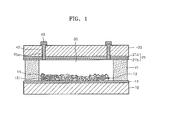
- Figure 1 is a cross-sectional view of a dye sensitized solar cell according to an embodiment of the present invention.
- the dye sensitized solar cell includes a first substrate 10, a first electrode 11, a light absorption layer 13, a dye 15, a second electrode 21, a second substrate 20 facing the first substrate 10, and an electrolyte 30 interposed between the first electrode 11 and the second electrode 21, wherein the first electrode 11, the light absorption layer 13, and the dye 15 are formed on the first substrate 10 and the second electrode 21 is formed on the second substrate 20.
- a separate case may be further disposed outside the first substrate 10 and the second substrate 20.
- the first substrate 10 acts as a support for the first electrode 11 in the present embodiment and may be transparent, thereby allowing passage of external light.
- the first substrate 10 may be formed of glass or plastic. Examples of plastic for forming the first substrate 10 are polyethylene terephthalate (PET), polyethylene naphthalate (PEN), polycarbonate (PC), polypropylene (PP), polyimide poly imide (PI), or triacetyl cellulose (TAC).
- PET polyethylene terephthalate
- PEN polyethylene naphthalate
- PC polycarbonate
- PP polypropylene
- PI polyimide poly imide
- TAC triacetyl cellulose
- the first electrode 11 formed on the first substrate 10 may be formed of a transparent material including at least one selected from the group consisting of indium tin oxide, indium oxide, tin oxide, zinc oxide, sulfur oxide, fluorine oxide, ZnO-Ga 2 O 3 , and ZnO-Al 2 O 3 .
- the first electrode 11 may be a mono layer or a stacked layer of the transparent materials described above.
- the light absorption layer 13 is formed on the first electrode 11.
- the light absorption layer 13 includes titanium dioxide particles 131 and pores with an appropriate average pore size. Due to the pores, the electrolyte 30 may smoothly flow and necking characteristics of the titanium dioxide particles 131 may be improved.
- the light absorption layer 13 may have a thickness of between 10 nm and 3000 nm, for example, between 10 nm and 1000 nm.
- the thickness of the light absorption layer 13 is not limited thereto and may be changed according to the future technology development.
- the dye 15 may be adsorbed to a surface of the light absorption layer 13 and may absorb external light to generate excited electrons.
- the second substrate 20 facing the first substrate 10 may act as a support for the second electrode 21, and may be transparent.
- the second substrate 20 may be formed of glass or plastic.
- the second electrode 21 formed on the second substrate 20 is disposed to face the first electrode 11 and may include a transparent electrode 21a and a catalyst electrode 21b.
- the transparent electrode 21a may be formed of a transparent material such as indium tin oxide, fluorine tin oxide, antimony tin oxide, zinc oxide, tin oxide, ZnO-Ga 2 O 3 , or ZnO-Al 2 O 3 .
- the transparent electrode 21a may be a mono layer or a stacked layer of the transparent materials described above.
- the catalyst electrode 21b may activate the redox couple and may be a platinum electrode.
- the first substrate 10 is combined with the second substrate 20 using an adhesive 41, and the electrolyte 30 is injected through holes 25a passing through the second substrate 20 and the second electrode 21 to fill a space between the first electrode 11 and the second electrode 21.
- the electrolyte 30 may uniformly diffuse into the light absorption layer 13.
- the electrolyte 30 receives electrons (generated by oxidation and reduction) from the second electrode 21 and delivers the electrons to the dye 15.
- the holes 25a passing through the second substrate 20 and the second electrode 21 are sealed by the adhesive 42 and the cover glass 43.
- a typical porous metal oxide layer may be further formed between the first electrode 11 and the light absorption layer 13.
- the light absorption layer 13 acts as a light scattering electrode and allows a large amount of dye to be adsorbed thereto. Due to such characteristics of the light absorption layer 13, disadvantages of conventional light scattering electrodes may be overcome. Thus, the dye sensitized solar cell including the light absorption layer 13 has relatively high efficiency.
- the typical porous metal oxide layer may be formed of metal oxide particles, such as titanium dioxide, zinc oxide, tin oxide, strontium oxide, indium oxide, iridium oxide, lanthanum oxide, vanadium oxide, molybdenum oxide, tungsten oxide, niobium oxide, magnesium oxide, aluminium oxide, yttrium oxide, scandium oxide, samarium oxide, gallium oxide, or strontium titanium oxide.
- metal oxide particles may be TiO 2 as titanium dioxide, SnO 2 as tin oxide, WO 3 as tungsten oxide, ZnO as zinc oxide, or a combination thereof.
- a light absorption layer including a porous film to which dye is adsorbed is formed on a first electrode.
- a second electrode configured to include a photo-cathode and to have holes (e.g., holes 25a), is prepared; and the second electrode is combined with the first electrode on which the light absorption layer is formed.
- An electrolyte forming composition is injected through the holes of the second electrode, thereby completing the manufacturing of the dye sensitized solar cell.
- the electrolyte forming composition includes a polymer-iodine complex, an iodide salt, a high-boiling point solvent, and inorganic nanoparticles.
- the electrolyte forming composition may further include at least one selected from the group consisting of a viscosity-controlling polymer and a nitrogen-containing additive.
- a light absorption layer including a porous film to which dye is adsorbed is formed on a first electrode.
- a polymer-iodine complex, iodide salt, a high-boiling point solvent, and inorganic nanoparticles are mixed to prepare an electrolyte forming composition, which is coated on the light absorption layer to form a gel electrolyte.
- the electrolyte forming composition may further include at least one selected from the group consisting of a viscosity-controlling polymer and a nitrogen-containing additive.
- a second electrode is positioned on the gel electrolyte, and then, the first electrode is combined with the second electrode, thereby completing manufacturing of the dye sensitized solar cell.
- Example 1 Preparation of electrolyte(PVP-I 2 + TiO 2 )
- NMP N-methyl-2-pyrrolidone
- TiO 2 was added to the resultant product and mixed by a centrifugal conditioning mixer (Thinky mixer) at a ratio of 2,000 rpm for 30 minutes to prepare an electrolyte.
- the amount of TiO 2 was about 5 weight % of the total weight of the electrolyte.
- An average particle diameter of TiO 2 was about 20 nm, and TiO 2 was sintered at a temperature of 500°C for 30 minutes before it was used in this experiment.
- An amount of the PEO was about 9 weight% based on the total weight of the electrolyte.
- the amount of the PEO corresponds to 180 parts by weight based on 100 parts by weight of inorganic nanoparticles (TiO 2 ).
- NMP was directly used as a solvent to prepare an electrolyte without being subjected to a separate purification process.
- the amount of I 2 was fixed at 0.12 M.
- 1-butyl-3-methyl imidazolium iodide (BMImI) 1.2 M, I 2 and 4-tertbutylpyridine (TBP) 0.5 M were dissolved in NMP to prepare an electrolyte.
- An average particle diameter of TiO 2 was about 20 nm, and TiO 2 was sintered at a temperature of 500 °C for 30 minutes before it was used in this experiment.
- An electrolyte was prepared in the same manner as in Comparative Example 1, except that PVP-I 2 was used instead of I 2 .
- TiO 2 paste (PST-18NR, JGC C&C, Japan) was coated to a thickness of 12 ⁇ m on a fluorine-containing tin oxide (FTO) substrate (thickness: 2.3 mm) by screen printing and calcinated at a temperature of 500 °C for 30 min. Then, scattering particles paste (400c, JGC C&C, Japan) was coated and calcinated in the same manner as described above to prepare a photo-cathode. A thickness of a coating layer of the scattering particles paste after the calcinating was about 4 ⁇ m.
- FTO fluorine-containing tin oxide
- the photo-cathode was immersed in a dye solution (0.2 mM N719/EtOH) and left for 24 hours. Separately, platinum (Pt) was scattered on FTO for 20 minutes to form an opposite electrode having holes.
- a hot melt film (Suryln®, DuPont, 60 ⁇ m) was inserted between the photo-cathode and the opposite electrode having holes and then the photo-cathode and the opposite electrode were thermally attached to each other by hot pressing at a temperature of 130 °C for 15 seconds.
- the electrolytes prepared according to Examples 1 and 2 and Comparative Examples 1-3 were injected through the holes of the opposite electrode, thereby completing manufacturing of test cells.
- the current-voltage test was performed on the test cells under reference evaluation conditions including AM1.5G and 100 mW cm -2 . Also, ionic conductivity and cell impedance of the test cells were measured using an impedance analyzer, and silver (Ag) corrosion evaluation was also performed using the test cells.
- J is a Y value of an energy conversion efficiency graph and V is an X value of the energy conversion efficiency graph, and J sc and V oc are intercept values of the respective axes.
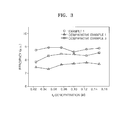
- Solar cells were manufactured using the electrolyte prepared according to Example 1 in which PVP-I 2 were used at various concentrations, and current-voltage characteristics of the solar cells were measured using a solar simulator under reference measurement conditions, and the results are shown in Table 1 below.
- the photoelectric conversion characteristics shown in Table 1 were evaluated under conditions including AM1.5G and 100 mW cm -2 .
- the greater atnount of PVP-I 2 used leads to the higher dark current and the lower Voc.
- the electrolyte has highest efficiency at the iodine concentration of about 2.33 x 10 -4 mol (0.0465 mol/L).
- FIGS 2A and 2B show cell impedance test results of the electrolyte prepared according to Example 1.
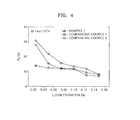
- the electrolyte of Example 1 requires a relatively low iodine concentration compared with the electrolytes of Comparative Examples 1 and 3. This is because the TiO 2 nanoparticles contribute to an increase in transport characteristics of the redox couple.
- the electrolyte of Example 1 has smaller electrolyte diffusion resistance than those of Comparative Example 1 and Comparative Example 3.
- OCV open circuit voltage
- the solar cell manufactured using the electrolyte of Example 1 has higher efficiency than the solar cells of Comparative Example 1 and 3.
- Example 1 Impedance and conductivity characteristics of the electrolytes of Example 1 and Comparative Example 3 were evaluated and the results are shown in Table 4.
- Table 4 Composition Impedance (Ohm ( ⁇ )) Conductivity (mS/cm)
- Example 1 NMP/PVP-I 2 + TiO 2 1809.9 3.07 x 10 -3
- Example 3 NMP/PVP-I 2 3962.3 1.40 x 10 -3
- Example 1 In order to measure an Ag grid corrosion rate with respect to the electrolytes of Example 1 and Comparative Example 2, the electrolytes were injected to an Ag grid cell and a resistance change was evaluated at a temperature of 85 °C for 200 hours, and the results are shown in Figure 5 .
- the electrolyte of Example 1 has smaller resistance than the electrolyte of Comparative Example 2.
- an electrolyte for a dye sensitized solar cell has high ionic conductivity and a low metal electrode corrosion rate at a low iodine concentration.
- a dye sensitized solar cell including the electrolyte has high photoelectron conversion efficiency.
Landscapes
- Engineering & Computer Science (AREA)
- Power Engineering (AREA)
- Chemical & Material Sciences (AREA)
- Chemical Kinetics & Catalysis (AREA)
- Electrochemistry (AREA)
- Microelectronics & Electronic Packaging (AREA)
- Hybrid Cells (AREA)
- Photovoltaic Devices (AREA)
Applications Claiming Priority (1)
| Application Number | Priority Date | Filing Date | Title |
|---|---|---|---|
| KR1020100117096A KR101137379B1 (ko) | 2010-11-23 | 2010-11-23 | 염료감응 태양전지용 겔형 전해질 및 이를 포함하는 염료감응 태양전지 |
Publications (2)
| Publication Number | Publication Date |
|---|---|
| EP2455955A2 true EP2455955A2 (fr) | 2012-05-23 |
| EP2455955A3 EP2455955A3 (fr) | 2012-09-12 |
Family
ID=44651488
Family Applications (1)
| Application Number | Title | Priority Date | Filing Date |
|---|---|---|---|
| EP11182215A Withdrawn EP2455955A3 (fr) | 2010-11-23 | 2011-09-21 | Électrolyte à gel pour cellule solaire sensibilisée aux colorants et cellule solaire sensibilisée aux colorants incluant l'électrolyte à gel |
Country Status (5)
| Country | Link |
|---|---|
| US (1) | US20120125422A1 (fr) |
| EP (1) | EP2455955A3 (fr) |
| JP (1) | JP2012114086A (fr) |
| KR (1) | KR101137379B1 (fr) |
| CN (1) | CN102479617A (fr) |
Cited By (2)
| Publication number | Priority date | Publication date | Assignee | Title |
|---|---|---|---|---|
| CN103219157A (zh) * | 2012-12-24 | 2013-07-24 | 长兴化学工业股份有限公司 | 用于染料敏化太阳能电池的电解质组成物 |
| EP4528762A1 (fr) * | 2023-09-25 | 2025-03-26 | Ecopolix AS | Gel à base de polymère-iode et films minces solides pour composants optoélectroniques antiseptiques et non toxiques |
Families Citing this family (9)
| Publication number | Priority date | Publication date | Assignee | Title |
|---|---|---|---|---|
| WO2013026563A1 (fr) * | 2011-08-25 | 2013-02-28 | Merck Patent Gmbh | Additifs pour cellules solaires à pigment photosensible |
| JP2014010997A (ja) * | 2012-06-29 | 2014-01-20 | Fujikura Ltd | 電気化学素子用電解質及びこれを用いた色素増感太陽電池 |
| US20160217936A1 (en) * | 2012-12-14 | 2016-07-28 | Sharp Kabushiki Kaisha | Photoelectric conversion element |
| KR20170033325A (ko) * | 2014-07-30 | 2017-03-24 | 세키스이가가쿠 고교가부시키가이샤 | 태양 전지의 제조 방법 |
| CA3019132A1 (fr) | 2016-04-01 | 2017-10-05 | NOHMs Technologies, Inc. | Liquides ioniques modifies contenant du phosphore |
| JP2018107177A (ja) * | 2016-12-22 | 2018-07-05 | 太陽誘電株式会社 | 光電変換素子及びそれを有する電子部品 |
| WO2019018432A1 (fr) | 2017-07-17 | 2019-01-24 | NOHMs Technologies, Inc. | Électrolytes contenant du phosphore |
| CN108335912A (zh) * | 2018-01-30 | 2018-07-27 | 浙江夏远信息技术有限公司 | 一种染料敏化太阳能电池准固态电解质 |
| JP7402311B2 (ja) | 2020-02-14 | 2023-12-20 | カウンシル・オブ・サイエンティフィック・アンド・インダストリアル・リサーチ・アン・インディアン・レジスタード・ボディ・インコーポレイテッド・アンダー・ザ・レジストレーション・オブ・ソサエティーズ・アクト・(アクト・21・オブ・1860) | 機能性透明ゲル電解質システム及びその高速スイッチングエレクトロクロミック/電気化学装置 |
Family Cites Families (6)
| Publication number | Priority date | Publication date | Assignee | Title |
|---|---|---|---|---|
| JP4754862B2 (ja) * | 2005-04-15 | 2011-08-24 | シャープ株式会社 | 色素増感太陽電池およびその製造方法 |
| JP5096700B2 (ja) * | 2006-06-27 | 2012-12-12 | パナソニック株式会社 | 光電変換素子 |
| KR100869802B1 (ko) * | 2006-11-17 | 2008-11-21 | 삼성에스디아이 주식회사 | 염료감응 태양전지용 전해질, 이를 포함하는 염료감응태양전지, 및 이의 제조방법 |
| KR20090076410A (ko) * | 2008-01-08 | 2009-07-13 | 삼성에스디아이 주식회사 | 염료감응 태양전지용 겔형 전해질, 그 제조방법, 및 상기겔형 전해질을 포함하는 태양전지 |
| KR101461522B1 (ko) * | 2008-04-10 | 2014-11-14 | 한양대학교 산학협력단 | 겔형 전해질 및 이를 이용한 염료감응 태양전지 |
| JP2010009831A (ja) * | 2008-06-25 | 2010-01-14 | Tdk Corp | 光電変換素子 |
-
2010
- 2010-11-23 KR KR1020100117096A patent/KR101137379B1/ko not_active Expired - Fee Related
-
2011
- 2011-04-12 US US13/085,380 patent/US20120125422A1/en not_active Abandoned
- 2011-09-13 CN CN201110276419.6A patent/CN102479617A/zh active Pending
- 2011-09-21 EP EP11182215A patent/EP2455955A3/fr not_active Withdrawn
- 2011-11-11 JP JP2011247097A patent/JP2012114086A/ja active Pending
Non-Patent Citations (1)
| Title |
|---|
| None |
Cited By (5)
| Publication number | Priority date | Publication date | Assignee | Title |
|---|---|---|---|---|
| CN103219157A (zh) * | 2012-12-24 | 2013-07-24 | 长兴化学工业股份有限公司 | 用于染料敏化太阳能电池的电解质组成物 |
| US20140175325A1 (en) * | 2012-12-24 | 2014-06-26 | Eternal Chemical Co., Ltd. | Electrolyte composition for dye-sensitized solar cell |
| US9111687B2 (en) * | 2012-12-24 | 2015-08-18 | Eternal Materials Co., Ltd. | Electrolyte composition for dye-sensitized solar cell |
| CN103219157B (zh) * | 2012-12-24 | 2015-12-09 | 长兴材料工业股份有限公司 | 用于染料敏化太阳能电池的电解质组成物 |
| EP4528762A1 (fr) * | 2023-09-25 | 2025-03-26 | Ecopolix AS | Gel à base de polymère-iode et films minces solides pour composants optoélectroniques antiseptiques et non toxiques |
Also Published As
| Publication number | Publication date |
|---|---|
| EP2455955A3 (fr) | 2012-09-12 |
| JP2012114086A (ja) | 2012-06-14 |
| KR101137379B1 (ko) | 2012-04-20 |
| CN102479617A (zh) | 2012-05-30 |
| US20120125422A1 (en) | 2012-05-24 |
Similar Documents
| Publication | Publication Date | Title |
|---|---|---|
| EP2455955A2 (fr) | Électrolyte à gel pour cellule solaire sensibilisée aux colorants et cellule solaire sensibilisée aux colorants incluant l'électrolyte à gel | |
| CN1322592C (zh) | 光电转换元件 | |
| US6900382B2 (en) | Gel electrolytes for dye sensitized solar cells | |
| US7414188B2 (en) | Co-sensitizers for dye sensitized solar cells | |
| US8377504B2 (en) | Method for producing electroconductive polymer electrode, and dye-sensitized solar cell equipped with the same | |
| US20090203164A1 (en) | Electrolyte composition for dye-sensitized solar cell, dye-sensitized solar cell including same, and method of preparing same | |
| US20050011550A1 (en) | Low temperature interconnection of nanoparticles | |
| US20050019414A1 (en) | Low temperature interconnection of nanoparticles | |
| KR101223736B1 (ko) | 염료감응 태양전지용 전해질 및 이를 이용한 염료감응 태양전지 | |
| US20230104362A1 (en) | Dye sensitized photovoltaic cells | |
| KR20120110235A (ko) | 고분자 전해질 조성물 및 이를 포함하는 염료감응 태양전지 | |
| US20110272007A1 (en) | Electrode for dye sensitized solar cell, method of manufacturing the same, and dye sensitized solar cell using the electrode | |
| EP2509085A2 (fr) | Électrolyte pour cellule solaire sensibilisée aux colorants et cellule solaire sensibilisée aux colorants l'incluant | |
| KR101054470B1 (ko) | 염료감응 태양전지용 전해질 및 이를 이용한 염료감응 태양전지 | |
| JP4050535B2 (ja) | 色素増感型太陽電池の製造方法 | |
| Kushwaha et al. | Ionic liquid integrated polyethylene glycol (PEG)-based quasi-solid electrolyte for efficiency enhancement of dye-sensitized solar cell | |
| US20140299190A1 (en) | Electrolyte for dye sensitized solar cell and dye sensitized solar cell using the same | |
| KR100656361B1 (ko) | 타이타니아 나노입자가 충진된 고분자 전해질 용액과 이를포함하는 염료감응 태양전지 | |
| Shahbaz et al. | A poly (styrene-co-acrylonitrile) gel electrolyte for dye-sensitized solar cells with improved photoelectrochemical performance | |
| KR101819883B1 (ko) | 인시츄 경화형 고분자 젤 전해질 및 이를 이용한 전기화학장치 | |
| Seo et al. | Pore-filled electrolyte membranes for facile fabrication of long-term stable dye-sensitized solar cells | |
| KR20110135465A (ko) | 겔형 고분자 전해질 조성물 및 이를 포함하는 염료감응 태양전지 | |
| Kang | Conjugated Polymer-coated Counter Electrodes for Dye-sensitized Solar Cells Employing Solid Polymer Electrolytes |
Legal Events
| Date | Code | Title | Description |
|---|---|---|---|
| PUAI | Public reference made under article 153(3) epc to a published international application that has entered the european phase |
Free format text: ORIGINAL CODE: 0009012 |
|
| AK | Designated contracting states |
Kind code of ref document: A2 Designated state(s): AL AT BE BG CH CY CZ DE DK EE ES FI FR GB GR HR HU IE IS IT LI LT LU LV MC MK MT NL NO PL PT RO RS SE SI SK SM TR |
|
| AX | Request for extension of the european patent |
Extension state: BA ME |
|
| PUAL | Search report despatched |
Free format text: ORIGINAL CODE: 0009013 |
|
| AK | Designated contracting states |
Kind code of ref document: A3 Designated state(s): AL AT BE BG CH CY CZ DE DK EE ES FI FR GB GR HR HU IE IS IT LI LT LU LV MC MK MT NL NO PL PT RO RS SE SI SK SM TR |
|
| AX | Request for extension of the european patent |
Extension state: BA ME |
|
| RIC1 | Information provided on ipc code assigned before grant |
Ipc: H01G 9/20 20060101AFI20120809BHEP |
|
| 17P | Request for examination filed |
Effective date: 20130311 |
|
| STAA | Information on the status of an ep patent application or granted ep patent |
Free format text: STATUS: THE APPLICATION HAS BEEN WITHDRAWN |
|
| 18W | Application withdrawn |
Effective date: 20130430 |