EP2458043A1 - Product of crosslinked material and method for producing the same - Google Patents
Product of crosslinked material and method for producing the same Download PDFInfo
- Publication number
- EP2458043A1 EP2458043A1 EP10192395A EP10192395A EP2458043A1 EP 2458043 A1 EP2458043 A1 EP 2458043A1 EP 10192395 A EP10192395 A EP 10192395A EP 10192395 A EP10192395 A EP 10192395A EP 2458043 A1 EP2458043 A1 EP 2458043A1
- Authority
- EP
- European Patent Office
- Prior art keywords
- carrier material
- crosslinker
- group
- collector
- hydroxy group
- Prior art date
- Legal status (The legal status is an assumption and is not a legal conclusion. Google has not performed a legal analysis and makes no representation as to the accuracy of the status listed.)
- Withdrawn
Links
- 238000004519 manufacturing process Methods 0.000 title claims abstract description 5
- 239000011243 crosslinked material Substances 0.000 title 1
- 239000012876 carrier material Substances 0.000 claims abstract description 81
- 239000004971 Cross linker Substances 0.000 claims abstract description 45
- 125000002887 hydroxy group Chemical group [H]O* 0.000 claims abstract description 37
- 229920000642 polymer Polymers 0.000 claims abstract description 35
- 125000003396 thiol group Chemical group [H]S* 0.000 claims abstract description 31
- 125000000837 carbohydrate group Chemical group 0.000 claims abstract description 24
- 150000001875 compounds Chemical class 0.000 claims abstract description 24
- 125000004432 carbon atom Chemical group C* 0.000 claims abstract description 19
- 239000002121 nanofiber Substances 0.000 claims abstract description 19
- 238000001523 electrospinning Methods 0.000 claims abstract description 12
- 229920006395 saturated elastomer Polymers 0.000 claims abstract description 12
- 238000009987 spinning Methods 0.000 claims abstract description 11
- UFHFLCQGNIYNRP-UHFFFAOYSA-N Hydrogen Chemical compound [H][H] UFHFLCQGNIYNRP-UHFFFAOYSA-N 0.000 claims abstract description 7
- 229910052739 hydrogen Inorganic materials 0.000 claims abstract description 7
- 239000001257 hydrogen Substances 0.000 claims abstract description 7
- AZKVWQKMDGGDSV-BCMRRPTOSA-N Genipin Chemical compound COC(=O)C1=CO[C@@H](O)[C@@H]2C(CO)=CC[C@H]12 AZKVWQKMDGGDSV-BCMRRPTOSA-N 0.000 claims abstract description 6
- 150000004891 diazines Chemical class 0.000 claims abstract description 6
- AZKVWQKMDGGDSV-UHFFFAOYSA-N genipin Natural products COC(=O)C1=COC(O)C2C(CO)=CCC12 AZKVWQKMDGGDSV-UHFFFAOYSA-N 0.000 claims abstract description 6
- SXRSQZLOMIGNAQ-UHFFFAOYSA-N Glutaraldehyde Chemical compound O=CCCCC=O SXRSQZLOMIGNAQ-UHFFFAOYSA-N 0.000 claims abstract description 5
- 150000001718 carbodiimides Chemical class 0.000 claims abstract description 5
- 239000000126 substance Substances 0.000 claims description 29
- 239000000463 material Substances 0.000 claims description 22
- 239000000243 solution Substances 0.000 claims description 22
- 238000000034 method Methods 0.000 claims description 18
- 102000008186 Collagen Human genes 0.000 claims description 16
- 108010035532 Collagen Proteins 0.000 claims description 16
- 229920001436 collagen Polymers 0.000 claims description 16
- HCZKYJDFEPMADG-TXEJJXNPSA-N masoprocol Chemical group C([C@H](C)[C@H](C)CC=1C=C(O)C(O)=CC=1)C1=CC=C(O)C(O)=C1 HCZKYJDFEPMADG-TXEJJXNPSA-N 0.000 claims description 14
- 125000001997 phenyl group Chemical group [H]C1=C([H])C([H])=C(*)C([H])=C1[H] 0.000 claims description 8
- LFQSCWFLJHTTHZ-UHFFFAOYSA-N Ethanol Chemical compound CCO LFQSCWFLJHTTHZ-UHFFFAOYSA-N 0.000 claims description 7
- QTBSBXVTEAMEQO-UHFFFAOYSA-N Acetic acid Chemical compound CC(O)=O QTBSBXVTEAMEQO-UHFFFAOYSA-N 0.000 claims description 6
- OKKJLVBELUTLKV-UHFFFAOYSA-N Methanol Chemical compound OC OKKJLVBELUTLKV-UHFFFAOYSA-N 0.000 claims description 6
- HEMHJVSKTPXQMS-UHFFFAOYSA-M Sodium hydroxide Chemical compound [OH-].[Na+] HEMHJVSKTPXQMS-UHFFFAOYSA-M 0.000 claims description 6
- HCZKYJDFEPMADG-UHFFFAOYSA-N erythro-nordihydroguaiaretic acid Natural products C=1C=C(O)C(O)=CC=1CC(C)C(C)CC1=CC=C(O)C(O)=C1 HCZKYJDFEPMADG-UHFFFAOYSA-N 0.000 claims description 6
- 229960003951 masoprocol Drugs 0.000 claims description 6
- 229920001184 polypeptide Polymers 0.000 claims description 6
- 102000004196 processed proteins & peptides Human genes 0.000 claims description 6
- 108090000765 processed proteins & peptides Proteins 0.000 claims description 6
- 239000003356 suture material Substances 0.000 claims description 6
- 102000015636 Oligopeptides Human genes 0.000 claims description 5
- 108010038807 Oligopeptides Proteins 0.000 claims description 5
- 229910052588 hydroxylapatite Inorganic materials 0.000 claims description 5
- XYJRXVWERLGGKC-UHFFFAOYSA-D pentacalcium;hydroxide;triphosphate Chemical compound [OH-].[Ca+2].[Ca+2].[Ca+2].[Ca+2].[Ca+2].[O-]P([O-])([O-])=O.[O-]P([O-])([O-])=O.[O-]P([O-])([O-])=O XYJRXVWERLGGKC-UHFFFAOYSA-D 0.000 claims description 5
- CSCPPACGZOOCGX-UHFFFAOYSA-N Acetone Chemical compound CC(C)=O CSCPPACGZOOCGX-UHFFFAOYSA-N 0.000 claims description 4
- 229920001577 copolymer Polymers 0.000 claims description 4
- 239000007788 liquid Substances 0.000 claims description 4
- 229920002635 polyurethane Polymers 0.000 claims description 4
- 239000004814 polyurethane Substances 0.000 claims description 4
- -1 silk Polymers 0.000 claims description 4
- 239000007864 aqueous solution Substances 0.000 claims description 3
- 229910002113 barium titanate Inorganic materials 0.000 claims description 3
- 239000000919 ceramic Substances 0.000 claims description 3
- 229910000154 gallium phosphate Inorganic materials 0.000 claims description 3
- 238000000338 in vitro Methods 0.000 claims description 3
- 239000000203 mixture Substances 0.000 claims description 3
- 239000010936 titanium Substances 0.000 claims description 3
- XLYOFNOQVPJJNP-UHFFFAOYSA-N water Substances O XLYOFNOQVPJJNP-UHFFFAOYSA-N 0.000 claims description 3
- WSMQKESQZFQMFW-UHFFFAOYSA-N 5-methyl-pyrazole-3-carboxylic acid Chemical compound CC1=CC(C(O)=O)=NN1 WSMQKESQZFQMFW-UHFFFAOYSA-N 0.000 claims description 2
- WKBOTKDWSSQWDR-UHFFFAOYSA-N Bromine atom Chemical compound [Br] WKBOTKDWSSQWDR-UHFFFAOYSA-N 0.000 claims description 2
- 229920001661 Chitosan Polymers 0.000 claims description 2
- RYGMFSIKBFXOCR-UHFFFAOYSA-N Copper Chemical compound [Cu] RYGMFSIKBFXOCR-UHFFFAOYSA-N 0.000 claims description 2
- 108010010803 Gelatin Proteins 0.000 claims description 2
- WHXSMMKQMYFTQS-UHFFFAOYSA-N Lithium Chemical compound [Li] WHXSMMKQMYFTQS-UHFFFAOYSA-N 0.000 claims description 2
- XUIMIQQOPSSXEZ-UHFFFAOYSA-N Silicon Chemical compound [Si] XUIMIQQOPSSXEZ-UHFFFAOYSA-N 0.000 claims description 2
- BQCADISMDOOEFD-UHFFFAOYSA-N Silver Chemical compound [Ag] BQCADISMDOOEFD-UHFFFAOYSA-N 0.000 claims description 2
- RTAQQCXQSZGOHL-UHFFFAOYSA-N Titanium Chemical compound [Ti] RTAQQCXQSZGOHL-UHFFFAOYSA-N 0.000 claims description 2
- HCHKCACWOHOZIP-UHFFFAOYSA-N Zinc Chemical compound [Zn] HCHKCACWOHOZIP-UHFFFAOYSA-N 0.000 claims description 2
- QCWXUUIWCKQGHC-UHFFFAOYSA-N Zirconium Chemical compound [Zr] QCWXUUIWCKQGHC-UHFFFAOYSA-N 0.000 claims description 2
- 239000002253 acid Substances 0.000 claims description 2
- 150000007513 acids Chemical class 0.000 claims description 2
- 150000001298 alcohols Chemical class 0.000 claims description 2
- 229920000615 alginic acid Polymers 0.000 claims description 2
- 235000010443 alginic acid Nutrition 0.000 claims description 2
- HSFWRNGVRCDJHI-UHFFFAOYSA-N alpha-acetylene Natural products C#C HSFWRNGVRCDJHI-UHFFFAOYSA-N 0.000 claims description 2
- 125000003277 amino group Chemical group 0.000 claims description 2
- 230000000844 anti-bacterial effect Effects 0.000 claims description 2
- 230000000843 anti-fungal effect Effects 0.000 claims description 2
- 230000000840 anti-viral effect Effects 0.000 claims description 2
- 229940121375 antifungal agent Drugs 0.000 claims description 2
- 229910052788 barium Inorganic materials 0.000 claims description 2
- DSAJWYNOEDNPEQ-UHFFFAOYSA-N barium atom Chemical compound [Ba] DSAJWYNOEDNPEQ-UHFFFAOYSA-N 0.000 claims description 2
- JRPBQTZRNDNNOP-UHFFFAOYSA-N barium titanate Chemical compound [Ba+2].[Ba+2].[O-][Ti]([O-])([O-])[O-] JRPBQTZRNDNNOP-UHFFFAOYSA-N 0.000 claims description 2
- GDTBXPJZTBHREO-UHFFFAOYSA-N bromine Substances BrBr GDTBXPJZTBHREO-UHFFFAOYSA-N 0.000 claims description 2
- 229910052794 bromium Inorganic materials 0.000 claims description 2
- 229910052799 carbon Inorganic materials 0.000 claims description 2
- 125000002843 carboxylic acid group Chemical group 0.000 claims description 2
- 229920002678 cellulose Polymers 0.000 claims description 2
- 239000001913 cellulose Substances 0.000 claims description 2
- 229910052802 copper Inorganic materials 0.000 claims description 2
- 239000010949 copper Substances 0.000 claims description 2
- NKZSPGSOXYXWQA-UHFFFAOYSA-N dioxido(oxo)titanium;lead(2+) Chemical compound [Pb+2].[O-][Ti]([O-])=O NKZSPGSOXYXWQA-UHFFFAOYSA-N 0.000 claims description 2
- 229920000159 gelatin Polymers 0.000 claims description 2
- 239000008273 gelatin Substances 0.000 claims description 2
- 235000019322 gelatine Nutrition 0.000 claims description 2
- 235000011852 gelatine desserts Nutrition 0.000 claims description 2
- 229910052732 germanium Inorganic materials 0.000 claims description 2
- GNPVGFCGXDBREM-UHFFFAOYSA-N germanium atom Chemical compound [Ge] GNPVGFCGXDBREM-UHFFFAOYSA-N 0.000 claims description 2
- HFGPZNIAWCZYJU-UHFFFAOYSA-N lead zirconate titanate Chemical compound [O-2].[O-2].[O-2].[O-2].[O-2].[Ti+4].[Zr+4].[Pb+2] HFGPZNIAWCZYJU-UHFFFAOYSA-N 0.000 claims description 2
- 229910052451 lead zirconate titanate Inorganic materials 0.000 claims description 2
- 229910052744 lithium Inorganic materials 0.000 claims description 2
- GQYHUHYESMUTHG-UHFFFAOYSA-N lithium niobate Chemical compound [Li+].[O-][Nb](=O)=O GQYHUHYESMUTHG-UHFFFAOYSA-N 0.000 claims description 2
- 125000002496 methyl group Chemical group [H]C([H])([H])* 0.000 claims description 2
- 229910052758 niobium Inorganic materials 0.000 claims description 2
- 239000010955 niobium Substances 0.000 claims description 2
- GUCVJGMIXFAOAE-UHFFFAOYSA-N niobium atom Chemical compound [Nb] GUCVJGMIXFAOAE-UHFFFAOYSA-N 0.000 claims description 2
- 239000003960 organic solvent Substances 0.000 claims description 2
- 230000002138 osteoinductive effect Effects 0.000 claims description 2
- 229920000747 poly(lactic acid) Polymers 0.000 claims description 2
- 229920001197 polyacetylene Polymers 0.000 claims description 2
- 229920000767 polyaniline Polymers 0.000 claims description 2
- 229920001610 polycaprolactone Polymers 0.000 claims description 2
- 239000004632 polycaprolactone Substances 0.000 claims description 2
- 229920000728 polyester Polymers 0.000 claims description 2
- 229920000128 polypyrrole Polymers 0.000 claims description 2
- 229920000123 polythiophene Polymers 0.000 claims description 2
- UKDIAJWKFXFVFG-UHFFFAOYSA-N potassium;oxido(dioxo)niobium Chemical compound [K+].[O-][Nb](=O)=O UKDIAJWKFXFVFG-UHFFFAOYSA-N 0.000 claims description 2
- 229910052710 silicon Inorganic materials 0.000 claims description 2
- 239000010703 silicon Substances 0.000 claims description 2
- 229910052709 silver Inorganic materials 0.000 claims description 2
- 239000004332 silver Substances 0.000 claims description 2
- QTKDGWAHANSHNE-UHFFFAOYSA-M silver;hydrogen sulfate Chemical compound [Ag+].OS([O-])(=O)=O QTKDGWAHANSHNE-UHFFFAOYSA-M 0.000 claims description 2
- XMVONEAAOPAGAO-UHFFFAOYSA-N sodium tungstate Chemical compound [Na+].[Na+].[O-][W]([O-])(=O)=O XMVONEAAOPAGAO-UHFFFAOYSA-N 0.000 claims description 2
- 229910052719 titanium Inorganic materials 0.000 claims description 2
- 229910052725 zinc Inorganic materials 0.000 claims description 2
- 239000011701 zinc Substances 0.000 claims description 2
- 229910052726 zirconium Inorganic materials 0.000 claims description 2
- BYEAHWXPCBROCE-UHFFFAOYSA-N 1,1,1,3,3,3-hexafluoropropan-2-ol Chemical compound FC(F)(F)C(O)C(F)(F)F BYEAHWXPCBROCE-UHFFFAOYSA-N 0.000 claims 1
- 239000000047 product Substances 0.000 description 19
- 238000004132 cross linking Methods 0.000 description 12
- 150000001413 amino acids Chemical class 0.000 description 8
- 238000005406 washing Methods 0.000 description 6
- 210000004027 cell Anatomy 0.000 description 5
- 125000004356 hydroxy functional group Chemical group O* 0.000 description 5
- 230000015572 biosynthetic process Effects 0.000 description 4
- 238000006243 chemical reaction Methods 0.000 description 4
- 238000001556 precipitation Methods 0.000 description 4
- 241000282414 Homo sapiens Species 0.000 description 3
- 125000003275 alpha amino acid group Chemical group 0.000 description 3
- 210000000988 bone and bone Anatomy 0.000 description 3
- 239000000316 bone substitute Substances 0.000 description 3
- 239000000872 buffer Substances 0.000 description 3
- 239000000835 fiber Substances 0.000 description 3
- 230000035876 healing Effects 0.000 description 3
- 238000001727 in vivo Methods 0.000 description 3
- 150000003839 salts Chemical class 0.000 description 3
- 210000001519 tissue Anatomy 0.000 description 3
- 241000251468 Actinopterygii Species 0.000 description 2
- 241000283690 Bos taurus Species 0.000 description 2
- 102000012422 Collagen Type I Human genes 0.000 description 2
- 108010022452 Collagen Type I Proteins 0.000 description 2
- 241000283073 Equus caballus Species 0.000 description 2
- KDXKERNSBIXSRK-UHFFFAOYSA-N Lysine Natural products NCCCCC(N)C(O)=O KDXKERNSBIXSRK-UHFFFAOYSA-N 0.000 description 2
- 239000004472 Lysine Substances 0.000 description 2
- 206010052428 Wound Diseases 0.000 description 2
- 208000027418 Wounds and injury Diseases 0.000 description 2
- 230000001476 alcoholic effect Effects 0.000 description 2
- 238000006664 bond formation reaction Methods 0.000 description 2
- 230000008468 bone growth Effects 0.000 description 2
- 239000002131 composite material Substances 0.000 description 2
- 229920006037 cross link polymer Polymers 0.000 description 2
- 230000004069 differentiation Effects 0.000 description 2
- LOKCTEFSRHRXRJ-UHFFFAOYSA-I dipotassium trisodium dihydrogen phosphate hydrogen phosphate dichloride Chemical compound P(=O)(O)(O)[O-].[K+].P(=O)(O)([O-])[O-].[Na+].[Na+].[Cl-].[K+].[Cl-].[Na+] LOKCTEFSRHRXRJ-UHFFFAOYSA-I 0.000 description 2
- 239000006185 dispersion Substances 0.000 description 2
- 239000011159 matrix material Substances 0.000 description 2
- 239000002953 phosphate buffered saline Substances 0.000 description 2
- 210000000130 stem cell Anatomy 0.000 description 2
- 0 *c1ccc(*c2ccc(*)c(*)c2)cc1* Chemical compound *c1ccc(*c2ccc(*)c(*)c2)cc1* 0.000 description 1
- KFZMGEQAYNKOFK-UHFFFAOYSA-N 2-propanol Substances CC(C)O KFZMGEQAYNKOFK-UHFFFAOYSA-N 0.000 description 1
- 108010005094 Advanced Glycation End Products Proteins 0.000 description 1
- 239000004475 Arginine Substances 0.000 description 1
- 102000000503 Collagen Type II Human genes 0.000 description 1
- 108010041390 Collagen Type II Proteins 0.000 description 1
- 102000001187 Collagen Type III Human genes 0.000 description 1
- 108010069502 Collagen Type III Proteins 0.000 description 1
- 102000012432 Collagen Type V Human genes 0.000 description 1
- 108010022514 Collagen Type V Proteins 0.000 description 1
- 102000009736 Collagen Type XI Human genes 0.000 description 1
- 108010034789 Collagen Type XI Proteins 0.000 description 1
- 229910003334 KNbO3 Inorganic materials 0.000 description 1
- ROHFNLRQFUQHCH-YFKPBYRVSA-N L-leucine Chemical compound CC(C)C[C@H](N)C(O)=O ROHFNLRQFUQHCH-YFKPBYRVSA-N 0.000 description 1
- FFEARJCKVFRZRR-BYPYZUCNSA-N L-methionine Chemical compound CSCC[C@H](N)C(O)=O FFEARJCKVFRZRR-BYPYZUCNSA-N 0.000 description 1
- ROHFNLRQFUQHCH-UHFFFAOYSA-N Leucine Natural products CC(C)CC(N)C(O)=O ROHFNLRQFUQHCH-UHFFFAOYSA-N 0.000 description 1
- 229910003327 LiNbO3 Inorganic materials 0.000 description 1
- 241001465754 Metazoa Species 0.000 description 1
- 229910020347 Na2WO3 Inorganic materials 0.000 description 1
- 229910003781 PbTiO3 Inorganic materials 0.000 description 1
- 125000000539 amino acid group Chemical group 0.000 description 1
- 238000013459 approach Methods 0.000 description 1
- ODKSFYDXXFIFQN-UHFFFAOYSA-N arginine Natural products OC(=O)C(N)CCCNC(N)=N ODKSFYDXXFIFQN-UHFFFAOYSA-N 0.000 description 1
- 125000000637 arginyl group Chemical group N[C@@H](CCCNC(N)=N)C(=O)* 0.000 description 1
- 230000008901 benefit Effects 0.000 description 1
- 230000004071 biological effect Effects 0.000 description 1
- 125000000484 butyl group Chemical group [H]C([*])([H])C([H])([H])C([H])([H])C([H])([H])[H] 0.000 description 1
- 210000000845 cartilage Anatomy 0.000 description 1
- 230000015556 catabolic process Effects 0.000 description 1
- YCIMNLLNPGFGHC-UHFFFAOYSA-N catechol Chemical group OC1=CC=CC=C1O YCIMNLLNPGFGHC-UHFFFAOYSA-N 0.000 description 1
- 230000024245 cell differentiation Effects 0.000 description 1
- 230000010261 cell growth Effects 0.000 description 1
- 230000002925 chemical effect Effects 0.000 description 1
- 210000003040 circulating cell Anatomy 0.000 description 1
- 229940096422 collagen type i Drugs 0.000 description 1
- 238000006731 degradation reaction Methods 0.000 description 1
- 238000004090 dissolution Methods 0.000 description 1
- 230000000694 effects Effects 0.000 description 1
- 230000005684 electric field Effects 0.000 description 1
- RTZKZFJDLAIYFH-UHFFFAOYSA-N ether Substances CCOCC RTZKZFJDLAIYFH-UHFFFAOYSA-N 0.000 description 1
- 239000004744 fabric Substances 0.000 description 1
- 239000007789 gas Substances 0.000 description 1
- 238000010348 incorporation Methods 0.000 description 1
- 238000009830 intercalation Methods 0.000 description 1
- 230000002687 intercalation Effects 0.000 description 1
- 230000005923 long-lasting effect Effects 0.000 description 1
- 239000012528 membrane Substances 0.000 description 1
- 210000002901 mesenchymal stem cell Anatomy 0.000 description 1
- 229930182817 methionine Natural products 0.000 description 1
- 230000003647 oxidation Effects 0.000 description 1
- 238000007254 oxidation reaction Methods 0.000 description 1
- 238000005691 oxidative coupling reaction Methods 0.000 description 1
- 230000002093 peripheral effect Effects 0.000 description 1
- 238000006116 polymerization reaction Methods 0.000 description 1
- 230000008569 process Effects 0.000 description 1
- 230000001737 promoting effect Effects 0.000 description 1
- 102000004169 proteins and genes Human genes 0.000 description 1
- 108090000623 proteins and genes Proteins 0.000 description 1
- 239000002994 raw material Substances 0.000 description 1
- 230000009257 reactivity Effects 0.000 description 1
- 230000009467 reduction Effects 0.000 description 1
- 230000001172 regenerating effect Effects 0.000 description 1
- 230000008929 regeneration Effects 0.000 description 1
- 238000011069 regeneration method Methods 0.000 description 1
- 238000010405 reoxidation reaction Methods 0.000 description 1
- 239000002904 solvent Substances 0.000 description 1
- 230000000392 somatic effect Effects 0.000 description 1
- 230000003068 static effect Effects 0.000 description 1
- 230000008467 tissue growth Effects 0.000 description 1
Classifications
-
- B—PERFORMING OPERATIONS; TRANSPORTING
- B29—WORKING OF PLASTICS; WORKING OF SUBSTANCES IN A PLASTIC STATE IN GENERAL
- B29D—PRODUCING PARTICULAR ARTICLES FROM PLASTICS OR FROM SUBSTANCES IN A PLASTIC STATE
- B29D99/00—Subject matter not provided for in other groups of this subclass
- B29D99/0078—Producing filamentary materials
-
- A—HUMAN NECESSITIES
- A61—MEDICAL OR VETERINARY SCIENCE; HYGIENE
- A61L—METHODS OR APPARATUS FOR STERILISING MATERIALS OR OBJECTS IN GENERAL; DISINFECTION, STERILISATION OR DEODORISATION OF AIR; CHEMICAL ASPECTS OF BANDAGES, DRESSINGS, ABSORBENT PADS OR SURGICAL ARTICLES; MATERIALS FOR BANDAGES, DRESSINGS, ABSORBENT PADS OR SURGICAL ARTICLES
- A61L17/00—Materials for surgical sutures or for ligaturing blood vessels ; Materials for prostheses or catheters
-
- A—HUMAN NECESSITIES
- A61—MEDICAL OR VETERINARY SCIENCE; HYGIENE
- A61L—METHODS OR APPARATUS FOR STERILISING MATERIALS OR OBJECTS IN GENERAL; DISINFECTION, STERILISATION OR DEODORISATION OF AIR; CHEMICAL ASPECTS OF BANDAGES, DRESSINGS, ABSORBENT PADS OR SURGICAL ARTICLES; MATERIALS FOR BANDAGES, DRESSINGS, ABSORBENT PADS OR SURGICAL ARTICLES
- A61L27/00—Materials for grafts or prostheses or for coating grafts or prostheses
- A61L27/14—Macromolecular materials
-
- A—HUMAN NECESSITIES
- A61—MEDICAL OR VETERINARY SCIENCE; HYGIENE
- A61L—METHODS OR APPARATUS FOR STERILISING MATERIALS OR OBJECTS IN GENERAL; DISINFECTION, STERILISATION OR DEODORISATION OF AIR; CHEMICAL ASPECTS OF BANDAGES, DRESSINGS, ABSORBENT PADS OR SURGICAL ARTICLES; MATERIALS FOR BANDAGES, DRESSINGS, ABSORBENT PADS OR SURGICAL ARTICLES
- A61L27/00—Materials for grafts or prostheses or for coating grafts or prostheses
- A61L27/36—Materials for grafts or prostheses or for coating grafts or prostheses containing ingredients of undetermined constitution or reaction products thereof, e.g. transplant tissue, natural bone, extracellular matrix
- A61L27/38—Materials for grafts or prostheses or for coating grafts or prostheses containing ingredients of undetermined constitution or reaction products thereof, e.g. transplant tissue, natural bone, extracellular matrix containing added animal cells
-
- C—CHEMISTRY; METALLURGY
- C08—ORGANIC MACROMOLECULAR COMPOUNDS; THEIR PREPARATION OR CHEMICAL WORKING-UP; COMPOSITIONS BASED THEREON
- C08L—COMPOSITIONS OF MACROMOLECULAR COMPOUNDS
- C08L89/00—Compositions of proteins; Compositions of derivatives thereof
-
- D—TEXTILES; PAPER
- D01—NATURAL OR MAN-MADE THREADS OR FIBRES; SPINNING
- D01D—MECHANICAL METHODS OR APPARATUS IN THE MANUFACTURE OF ARTIFICIAL FILAMENTS, THREADS, FIBRES, BRISTLES OR RIBBONS
- D01D5/00—Formation of filaments, threads, or the like
- D01D5/0007—Electro-spinning
- D01D5/0015—Electro-spinning characterised by the initial state of the material
- D01D5/003—Electro-spinning characterised by the initial state of the material the material being a polymer solution or dispersion
- D01D5/0038—Electro-spinning characterised by the initial state of the material the material being a polymer solution or dispersion the fibre formed by solvent evaporation, i.e. dry electro-spinning
-
- D—TEXTILES; PAPER
- D01—NATURAL OR MAN-MADE THREADS OR FIBRES; SPINNING
- D01D—MECHANICAL METHODS OR APPARATUS IN THE MANUFACTURE OF ARTIFICIAL FILAMENTS, THREADS, FIBRES, BRISTLES OR RIBBONS
- D01D5/00—Formation of filaments, threads, or the like
- D01D5/38—Formation of filaments, threads, or the like during polymerisation
-
- D—TEXTILES; PAPER
- D01—NATURAL OR MAN-MADE THREADS OR FIBRES; SPINNING
- D01F—CHEMICAL FEATURES IN THE MANUFACTURE OF ARTIFICIAL FILAMENTS, THREADS, FIBRES, BRISTLES OR RIBBONS; APPARATUS SPECIALLY ADAPTED FOR THE MANUFACTURE OF CARBON FILAMENTS
- D01F1/00—General methods for the manufacture of artificial filaments or the like
- D01F1/02—Addition of substances to the spinning solution or to the melt
- D01F1/10—Other agents for modifying properties
-
- A—HUMAN NECESSITIES
- A61—MEDICAL OR VETERINARY SCIENCE; HYGIENE
- A61L—METHODS OR APPARATUS FOR STERILISING MATERIALS OR OBJECTS IN GENERAL; DISINFECTION, STERILISATION OR DEODORISATION OF AIR; CHEMICAL ASPECTS OF BANDAGES, DRESSINGS, ABSORBENT PADS OR SURGICAL ARTICLES; MATERIALS FOR BANDAGES, DRESSINGS, ABSORBENT PADS OR SURGICAL ARTICLES
- A61L2400/00—Materials characterised by their function or physical properties
- A61L2400/12—Nanosized materials, e.g. nanofibres, nanoparticles, nanowires, nanotubes; Nanostructured surfaces
-
- Y—GENERAL TAGGING OF NEW TECHNOLOGICAL DEVELOPMENTS; GENERAL TAGGING OF CROSS-SECTIONAL TECHNOLOGIES SPANNING OVER SEVERAL SECTIONS OF THE IPC; TECHNICAL SUBJECTS COVERED BY FORMER USPC CROSS-REFERENCE ART COLLECTIONS [XRACs] AND DIGESTS
- Y10—TECHNICAL SUBJECTS COVERED BY FORMER USPC
- Y10T—TECHNICAL SUBJECTS COVERED BY FORMER US CLASSIFICATION
- Y10T428/00—Stock material or miscellaneous articles
- Y10T428/29—Coated or structually defined flake, particle, cell, strand, strand portion, rod, filament, macroscopic fiber or mass thereof
- Y10T428/2913—Rod, strand, filament or fiber
- Y10T428/2933—Coated or with bond, impregnation or core
- Y10T428/2971—Impregnation
Definitions
- the invention relates to a method for producing a nanofiber-based product according to the preamble of claim 1, a product which can be obtained by such a method according to the preamble of claim 12 and the use of such a product according to claim 15.
- This object is achieved by a method having the characteristics of claim 1.
- This method for producing a nanofiber-based product comprises the steps of providing a carrier material solution which itself comprises a carrier material, and bringing the carrier material in contact with the collector by electrospinning the carrier material solution out of the spinning device.
- the collector has a first electrical polarity and the spinning device has a second electrical polarity which is opposite to the first polarity.
- the carrier material essentially consists of a polymer which is - at least after it has contacted the collector - chemically crosslinked with the residue of a crosslinker and/or embedded in a polymer formed by the crosslinker.
- the carrier material is preferably finally crosslinked and/or finally embedded already immediately after having contacted the collector, i.e. upon contact with the collector.
- the carrier material is solved or dispersed together with the crosslinker in the carrier material solution and is then precipitated from the carrier material solution under electric field strength onto the collector. Due to this precipitation, the crosslinking and/or embedding reaction ends.
- the crosslinker is added to the carrier material solution during electrospinning. Also in this case, crosslinking is terminated upon carrier material precipitation on the collector.
- crosslinker which is chosen from the group consisting of glutaraldehyde, carbodiimide, genipin, photoreactive diazines and a compound according to the general formula (1) wherein R 1 is
- crosslinker is used in the entire text to encompass chemical substances which crosslink the carrier material by forming chemical bonds to the carrier material and/or by forming a polymer in which the carrier material is embedded. It is possible that chemical bond formation between crosslinker and carrier material also takes place in case of a polymer of crosslinker in which the carrier material is embedded.
- the carrier material can intercalate a polymer of a crosslinker and additionally can form chemical bonds to the crosslinker. Alternatively, only chemical bond formation (without polymeric embedding or intercalation) can take place.
- a substance comprising a polymer of a crosslinker and an embedded (or embedded and at least partially chemical linked) carrier material can also be denoted as composite or as nanofiber reinforced composite.
- the crosslinker genipin has the following molecular structure:
- photoreactive diazines are photoreactive analogues to leucine and methionine.
- R 1 is a residue having the following formula (II) wherein each of the two indicated terminal methyl residues is linked to a carbon atom of each benzene ring and wherein R 6 and R 7 are independently from each other
- At least two hydroxy groups or at least two sulfhydryl groups or at least one hydroxy group and one sulfhydryl group of the compound according to the general formula (I) are bound to a single or to both benzene rings of this compound.
- the reactive groups (hydroxy and/or sulfhydryl) can be positioned in the benzene rings in ortho, meta or para position to each other, wherein an ortho position is preferred.
- the crosslinker bears at least one, preferably at least two, preferably exactly two catechol groups.
- the crosslinker might be a di-catechol or an according derivative.
- all hydroxy and/or sulfhydryl groups of the compound are bound to the benzene rings and no further such groups exist in the molecule.
- the compound according to the general formula (I) mediates crosslinking of polymers particularly by its hydroxy or sulfhydryl groups.
- an ether bridge can be formed by reaction of a hydroxy group of the compound according to the general formula (I) and the polymer.
- a disulfide bridge may be formed between the sulfhydryl group of the compound according to the general formula (I) and a sulfhydryl group of a polymer to be crosslinked. Since the compound according to the general formula (I) bears at least two reactive groups (hydroxy and/or sulfhydryl), it has at least two reactive centers so that long cross-linked networks can be produced. The more hydroxy and/or sulfhydryl groups the compound according to the general formula (I) bears, the higher branched can be the resulting crosslinked polymer.
- the crosslinker might also react with only specific amino acids of the carrier material to be crosslinked if this carrier material bears amino acids.
- the crosslinker might only react with lysine or arginine residues of the carrier material but not with other amino acid residues of the carrier material.
- the stiffer material properties following crosslinking with a crosslinker, in particular with NDGA, suggest that similar chemistries that are shown in cartilage may take place as well. It was previously described that advanced glycation end products of arginine and lysine contribute to stiffness, color, and an apparent reduction in both amino acids noted above.
- the crosslinker reacts with specific amino acids of the carrier material and additionally forms a polymer in which the carrier material can be embedded.
- the compound according to the general formula (I) bears more than three, in particular more than four, in particular more than five, in particular more than six, in particular exactly four reactive groups of the type hydroxy and/or sulfhydryl.
- the crosslinker is nordihydroguaiaretic acid (NDGA).
- NDGA nordihydroguaiaretic acid
- Nanofibers of the carrier material being crosslinked by NDGA show a very high stability and are very long-lasting in solutions in which non-crosslinked polymers already dissolve. NDGA forms a polymer
- the crosslinker is used in an amount of 2 to 20 wt % with respect to the dry mass of the polymer of the carrier material. Further suited amounts are 5 to 15 wt %, in particular 7 to 13 wt %, in particular 9 to 11 wt %, in particular around 10 wt %.
- the carrier material is crosslinked before it reaches the collector.
- cross-linking can take place particularly well not only on the surface of the nanofibers already being electrospun, but also internally. This enhances the stability of the nanofibers themselves and between each other.
- the carrier material comprises of collagen, a mixture of collagen and hydroxy apatite, gelatin, alginates, chitosan, silk, cellulose, polyurethane, a polyester, polycaprolactone, polylactide, polypyrrole, polyaniline, polyacetylene, polythiophene, a copolymer of the preceding polymers and/or a copolymer bearing carboxylic acid groups and/or amine groups.
- amino acid structures like oligopeptides or polypeptides. Oligopeptides are considered to consist of a sequence of up to 10 amino acids, whereas polypeptides are considered to be amino acid structures having more than 10 amino acids. Proteins are to be considered to be encompassed by the term "polypeptide”. This means the amino acids structure can exhibit a primary, secondary and tertiary structure by itself so that the structure of the material to be deposited on the collector can exhibit an individually adjusted sub-structure.
- an amino acid structure By using an amino acid structure, one can take advantage not only of the secondary or tertiary structure of the oligopeptides or polypeptides, but also of the amphiphilic charge of the single amino acids being present in the oligopeptides or polypeptides.
- collagen type I, II, III, V, or XI wherein type I collagen is particularly well suited.
- the collagen might for example have a human, bovine, equine, ovine or fish origin or can be an artificial collagen resembling human, bovine, equine, ovine or fish collagen, or might consist of collagen, or collagen fibrils that have been expressed in culture by vector incorporation without limitation to mammalian source.
- a particularly well-suited material is collagen.
- collagen as carrier material and NDGA as crosslinker leads to very well crosslinked and stable collagen nanofibers. They can be used in a particularly advantageous manner for producing a product according to the instant method.
- the spinning device may be a nozzle through which the carrier material solution can be sprayed, or a turning (or rotating) pin located in a bath of the carrier material solution. By turning or rotating the pin in the bath, the carrier material solution is transported out of the bath and accelerated in the direction of the collector.
- the electrospinning may be performed at a voltage of 8 to 20 kV, in particular of 10 to 17 kV, in particular of 12 to 15 kV between the collector and the spinning device.
- a voltage of approximately 12.5 kV is particularly suited.
- Those voltages are well suited for accelerating the carrier material solution sufficiently fast out of the spinning device towards the collector.
- Further electrospinning parameters like the speed of a rotating pin for ejecting some of the carrier material solution out of a reservoir of the carrier material solution or the flow rate of the carrier material solution towards a nozzle, and the distance between the spinning device and the collector can be adjusted to the respective needs according to standard protocols of electrospinning.
- the polymer is solved or dispersed in at least one liquid chosen from the group of water, alcohols like methanol or ethanol, aqueous solutions of acids or bases like acetic acid or sodium hydroxide and organic solvents like acetone or 1,1,1,3,3,3-hexaflouoro-2-propanol to produce a carrier material solution.
- a liquid chosen from the group of water, alcohols like methanol or ethanol, aqueous solutions of acids or bases like acetic acid or sodium hydroxide and organic solvents like acetone or 1,1,1,3,3,3-hexaflouoro-2-propanol to produce a carrier material solution.
- carrier material solution also encompasses “carrier material dispersions”. This means, it is not necessary that the carrier material is ideally solved in an according liquid. If an essentially stable dispersion of the carrier material in an according liquid is established, electrospinning can also take place.
- the carrier material is deposited onto the collector to form a sheet material.
- a sheet material can be used as bone substitute material or as wound-covering fleece.
- the carrier material is removed from the collector after having contacted it and is then spun to a yarn.
- a yarn may be used as suture material in orthopaedic or surgical applications.
- the linear material, or yarn, or bioyarn may also be embodied as a raw material characterized by its strength, stiffness, elasticity, modulus, charge and composition as to make it a linear material that can be braided, woven, knitted, plied, or in other ways converted to mesh, fabric, matted material, or laminated with specific endowment as to afford areas between the threads to dynamic as well as static properties that align to the degradation of the material and regeneration of the biologic tissue.
- the electrospun carrier material is washed after having been removed from the collector.
- washing By washing, remainders of non-reacted crosslinker or reaction co-products can be removed, thus improving the biocompatibility of the obtained product.
- Washing can be performed by an aqueous solution of an alcohol like for example ethanol in a concentration of for example 80 %, 70 %, 60 % or 50 % (v/v).
- Further suited washing solutions are low salt buffers like phosphate buffered saline (PBS). Washing can be performed in a two-step manner by first using an alcoholic solution and afterwards a low salt buffer (or first a low salt buffer and afterwards an alcoholic solution) as washing solutions.
- PBS phosphate buffered saline
- no washing step is necessary due to the specific crosslinker chosen and the concentration in which it is used.
- Such product comprises a carrier material being built up from nanofibers having a diameter of less than 1 200 nm, in particular less than 1 100 nm, in particular less than 1 000 nm, in particular less than 900 nm, in particular less than 800 nm, in particular less than 700 nm, in particular less than 600 nm, in particular less than 500 nm, in particular less than 400 nm, in particular less than 300 nm.
- the carrier material essentially consists of a polymer which is chemically crosslinked with the residue of a crosslinker.
- This crosslinker is chosen from the group consisting of glutaraldehyde, carbodiimide, genipin and photoreactive diazines as well as a compound according to the general formula (1) wherein R 1 is
- the molecular ratio between the carrier material and the residue of the crosslinker is in the range of 20:1 to 5:1, in particular of 15:1 to 7:1, in particular of 12:1 to 8:1, in particular of 11:1 to 9:1 in the product.
- the product further comprises at least one auxiliary substance of the group consisting of osteoinductive substances, electrically conductive substances, electrically semiconductive substances, electrically insulating substances, antibacterial substances, antiviral substances, antifungal substances, ceramics (like, e.g., hydroxyapatite ceramics), barium, copper, bromine, niobium, lithium, germanium, titanium, lead, zirconium, silicon, silver, zinc, polyurethane and silver hydrogen sulfate, gallium orthophosphate (GaPO 4 ), langasite (La 3 Ga s SiO 14 ), barium titanate (BaTiO 3 ), lead titanate (PbTiO 3 ), lead zirconate titanate (Pb[Zr x Ti 1- x ]O 3 0 ⁇ x ⁇ 1), potassium niobate (KNbO 3 ), lithium niobate (LiNbO 3 ), lithium tantalate (LiTaO 3 ), sodium tungstate (N
- auxiliary substance By such an auxiliary substance, additional biological and/or chemical effects can be introduced into the product.
- the auxiliary substance can be entrapped within the polymer network of the carrier material or the carrier material and the crosslinker, respectively.
- the entrapment offers the effect that a certain placement/precipitation of the auxiliary substance can be achieved, e.g. a placement/precipitation in the banding structure of the carrier material perpendicular to scaffold orientation.
- hydroxyapatite is used as auxiliary substance and collagen is used as carrier material, the natural orientation of hydroxyapatite with respect to collagen in normal bone (i.e. in the banding structure of bone perpendicular to scaffold orientation) can be mimicked.
- the product exhibits an maximum tensile strength of ca. 50 to 200 MPa, in particular of ca. 75 to 175 MPa, in particular of ca. 90 to 150 MPa, in particular of ca. 100 to 125 MPa.
- the product exhibits an elastic modulus of ca. 300 to 700 MPa, in particular of ca. 350 to 650 MPa, in particular of ca. 400 to 600 MPa, in particular of ca. 450 to 580 MPa, in particular of ca. 500 to 550 MPa.
- a product having the characteristics as explained above can be very well used as scaffold for growing cells in vitro or in vivo or as suture material.
- the cells to be grown can be mesenchymal stem cells, fully competent stem cells, expanded somatic lineages, separated and suspended cells, peripheral circulating cells and cells of either included or induced potential.
- In vivo cell growth can be for example achieved with respect to bone growth or with respect to healing processes of wounds.
- Suture material made of a product as explained above can also ameliorate healing processes at the suture sites since cells attach more easily to such a suture material than to conventional suture materials.
- the sheet material can be implanted into a body of a patient (either human or animal) and act as (temporary) bone substitute material. If it is made from a biodegradable or bioresorbable material like for example collagen, the sheet material will be resorbed or degraded over time and newly grown bone will replace the sheet material step by step. By promoting bone growth due to the specific structure of the sheet material, healing processes after operations are accelerated.
- the use of a sheet material as described above for enabling tissue growth either in vivo or in vitro is also part of the invention. Specifically, the use of a sheet material as described above as bone substitute material is encompassed by the invention.
- the sheet material may embody itself with charge that potentiates tissue differentiation.
- Electrospinning, charge potentiation, and multi-laminar sheet formation all carry the option to defined physical conditions of the matrix, and define voltage differences in regenerative tissues. Processed materials from electrospun biologic components, both linear and in piled matte, will be used to define matrix charge and enliven the differentiation process.
Landscapes
- Health & Medical Sciences (AREA)
- Engineering & Computer Science (AREA)
- Chemical & Material Sciences (AREA)
- Life Sciences & Earth Sciences (AREA)
- Public Health (AREA)
- Textile Engineering (AREA)
- Veterinary Medicine (AREA)
- Epidemiology (AREA)
- Animal Behavior & Ethology (AREA)
- General Health & Medical Sciences (AREA)
- Mechanical Engineering (AREA)
- Chemical Kinetics & Catalysis (AREA)
- Medicinal Chemistry (AREA)
- Biomedical Technology (AREA)
- Transplantation (AREA)
- Oral & Maxillofacial Surgery (AREA)
- Dermatology (AREA)
- Zoology (AREA)
- General Chemical & Material Sciences (AREA)
- Materials Engineering (AREA)
- Cell Biology (AREA)
- Vascular Medicine (AREA)
- Botany (AREA)
- Surgery (AREA)
- Dispersion Chemistry (AREA)
- Manufacturing & Machinery (AREA)
- Polymers & Plastics (AREA)
- Organic Chemistry (AREA)
- Artificial Filaments (AREA)
- Spinning Methods And Devices For Manufacturing Artificial Fibers (AREA)
- Nonwoven Fabrics (AREA)
- Materials For Medical Uses (AREA)
Abstract
The invention relates to a method for producing a nanofiber-based product, comprising the steps of providing a carrier material solution comprising a carrier material, and of bringing the carrier material in contact with a collector by electrospinning the carrier material solution out of a spinning device. Thereby, the collector has a first electrical polarity and the spinning device has a second electrical polarity being opposite to the first polarity. According to the invention, the carrier material essentially consists of a polymer being - at least after having contacted the collector - chemically crosslinked with the residue of a crosslinker and/or embedded in a polymer, which polymer is formed by the crosslinker. The crosslinker is chosen from the group consisting of glutaraldehyde, carbodiimide, genipin, photoreactive diazines and a compound according to the general formula (1)

wherein wherein R1 is a single bond between the adjacent carbon atoms, or a carbohydrate chain having 1 to 10 carbon atoms and optionally bearing a hydroxy group, the carbohydrate chain being saturated, unsaturated or polyunsaturated, and wherein R2, R3, R4 and R5 are independently from each other a hydrogen; a carbohydrate chain having 1 to 10 carbon atoms and optionally bearing a hydroxy group, the carbohydrate chain being saturated, unsaturated or polyunsaturated; a hydroxy group; or a sulfhydryl group; with the provision that the compound bears at least two hydroxy groups, or two sulfhydryl groups, or one hydroxy group and one sulfhydryl group. The invention further relates to an according product and its use.
Description
- The invention relates to a method for producing a nanofiber-based product according to the preamble of claim 1, a product which can be obtained by such a method according to the preamble of claim 12 and the use of such a product according to claim 15.
- It is known from prior art to electrospin different polymers into nanofibers. However, the stability of these nanofibers is often not satisfactory high. When the electrospun fibers are brought into contact with water or another solvent, dissolution of the fibers often occurs. Many approaches to stabilize the polymers by crosslinking have failed.
- It is an object of the invention to provide a method by which highly stable nanofiber-based products can be obtained as well as to provide such nanofiber-based products.
- This object is achieved by a method having the characteristics of claim 1. This method for producing a nanofiber-based product comprises the steps of providing a carrier material solution which itself comprises a carrier material, and bringing the carrier material in contact with the collector by electrospinning the carrier material solution out of the spinning device. Thereby, the collector has a first electrical polarity and the spinning device has a second electrical polarity which is opposite to the first polarity. According to the invention, the carrier material essentially consists of a polymer which is - at least after it has contacted the collector - chemically crosslinked with the residue of a crosslinker and/or embedded in a polymer formed by the crosslinker. The carrier material is preferably finally crosslinked and/or finally embedded already immediately after having contacted the collector, i.e. upon contact with the collector. In other words, the carrier material is solved or dispersed together with the crosslinker in the carrier material solution and is then precipitated from the carrier material solution under electric field strength onto the collector. Due to this precipitation, the crosslinking and/or embedding reaction ends. Alternatively, the crosslinker is added to the carrier material solution during electrospinning. Also in this case, crosslinking is terminated upon carrier material precipitation on the collector.
- It turned out that electrospun fibers which had been crosslinked after electrospinning did not show an enhanced stability with respect to non-crosslinked nanofibers. Therefore, it is crucial that the crosslinking is finished upon formation of the nanofibers. This is presently the case when the carrier material contacts the collector, because carrier material and crosslinker are electrospun together.
- It has been also turned out that not any generally known crosslinker can be used to successfully crosslink the polymer, but only a crosslinker which is chosen from the group consisting of glutaraldehyde, carbodiimide, genipin, photoreactive diazines and a compound according to the general formula (1)

- a single bond between the adjacent carbon atoms, or
- a carbohydrate chain having 1 to 10 carbon atoms and optionally bearing a hydroxy group, the carbohydrate chain being saturated, unsaturated or polyunsaturated,
- a hydrogen,
- a carbohydrate chain having 1 to 10 carbon atoms and optionally bearing a hydroxy group, the carbohydrate chain being saturated, unsaturated or polyunsaturated,
- a hydroxy group, or
- a sulfhydryl group,
- two hydroxy groups, or
- two sulfhydryl groups, or
- one hydroxy group and one sulfhydryl group.
- The term "crosslinker" is used in the entire text to encompass chemical substances which crosslink the carrier material by forming chemical bonds to the carrier material and/or by forming a polymer in which the carrier material is embedded. It is possible that chemical bond formation between crosslinker and carrier material also takes place in case of a polymer of crosslinker in which the carrier material is embedded. Thus, the carrier material can intercalate a polymer of a crosslinker and additionally can form chemical bonds to the crosslinker. Alternatively, only chemical bond formation (without polymeric embedding or intercalation) can take place. A substance comprising a polymer of a crosslinker and an embedded (or embedded and at least partially chemical linked) carrier material can also be denoted as composite or as nanofiber reinforced composite.
- The crosslinker genipin has the following molecular structure:

- During electrospinning, a voltage difference between the electrified carrier material to be spun and the grounded collector exists. This voltage difference ameliorates crosslinking processes of the single polymer molecules of the carrier material when a crosslinker belonging to the above-explained group is used.
- Well-suited examples for photoreactive diazines are photoreactive analogues to leucine and methionine.
- In an embodiment R1 is a residue having the following formula (II)

- a hydrogen,
- a carbohydrate chain having 1 to 10 carbon atoms and optionally bearing a hydroxy group, the carbohydrate chain being saturated, unsaturated or polyunsaturated,
- a hydroxy group, or
- a sulfhydryl group.
- This means that in this embodiment the two benzene rings of the compound according to formula (I) are linked together by an optionally derivatized butyl chain, leading to a compound of the general formula (III):

- In an embodiment, at least two hydroxy groups or at least two sulfhydryl groups or at least one hydroxy group and one sulfhydryl group of the compound according to the general formula (I) are bound to a single or to both benzene rings of this compound. By binding the hydroxy and/or sulfhydryl groups to the benzene rings, a higher reactivity of the hydroxy and/or sulfhydryl group is achieved which leads to a better crosslinking performance of the according compound. The reactive groups (hydroxy and/or sulfhydryl) can be positioned in the benzene rings in ortho, meta or para position to each other, wherein an ortho position is preferred.
- In a further embodiment, the crosslinker bears at least one, preferably at least two, preferably exactly two catechol groups. Thus, the crosslinker might be a di-catechol or an according derivative.
- In a further embodiment, all hydroxy and/or sulfhydryl groups of the compound are bound to the benzene rings and no further such groups exist in the molecule.
- The compound according to the general formula (I) mediates crosslinking of polymers particularly by its hydroxy or sulfhydryl groups. For example, an ether bridge can be formed by reaction of a hydroxy group of the compound according to the general formula (I) and the polymer. Alternatively, a disulfide bridge may be formed between the sulfhydryl group of the compound according to the general formula (I) and a sulfhydryl group of a polymer to be crosslinked. Since the compound according to the general formula (I) bears at least two reactive groups (hydroxy and/or sulfhydryl), it has at least two reactive centers so that long cross-linked networks can be produced. The more hydroxy and/or sulfhydryl groups the compound according to the general formula (I) bears, the higher branched can be the resulting crosslinked polymer.
- The crosslinker might also react with only specific amino acids of the carrier material to be crosslinked if this carrier material bears amino acids. For example, the crosslinker might only react with lysine or arginine residues of the carrier material but not with other amino acid residues of the carrier material. The stiffer material properties following crosslinking with a crosslinker, in particular with NDGA, suggest that similar chemistries that are shown in cartilage may take place as well. It was previously described that advanced glycation end products of arginine and lysine contribute to stiffness, color, and an apparent reduction in both amino acids noted above. In a preferred embodiment, the crosslinker reacts with specific amino acids of the carrier material and additionally forms a polymer in which the carrier material can be embedded.
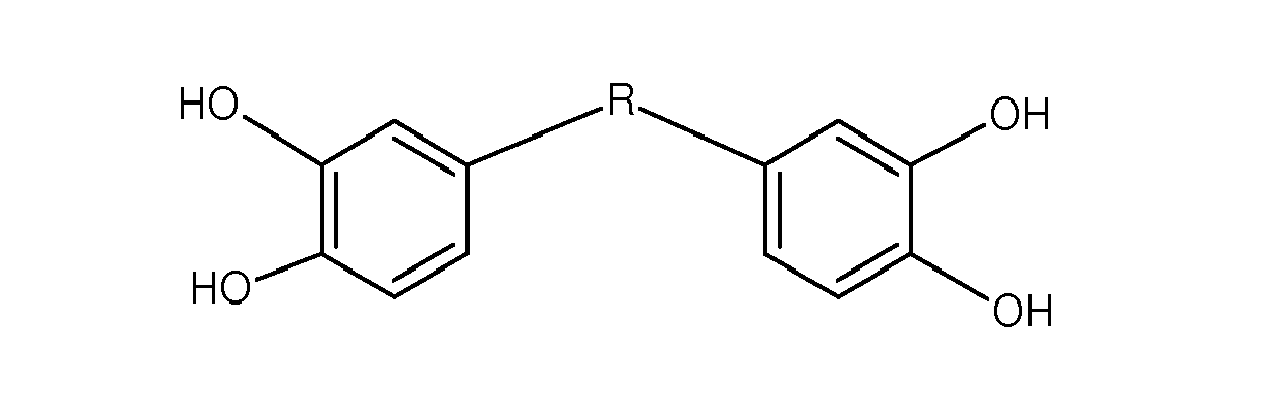
- A possible polymerization scheme for polymer formation of the crosslinker is explained in the following. Assuming the crosslinker being a di-catechol derivative,

- Two di-quinones react then via aryloxy free radical generation and subsequent oxidative coupling as well as reoxidation to a bisquinone:
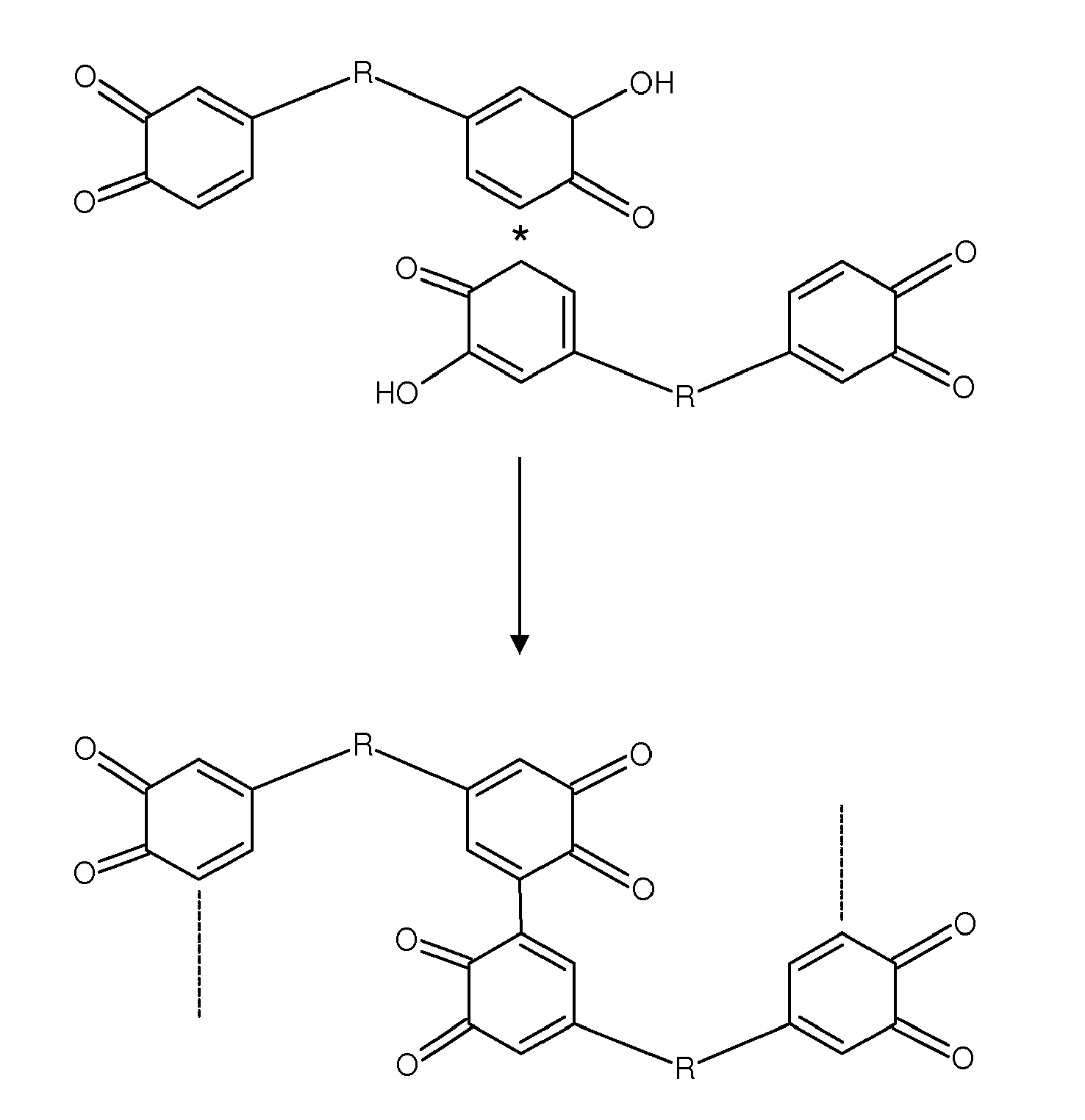
- Further equivalent reactions lead to an extended polymer of bisquinone units so that a bisquinone polymer is formed. The carrier material can well intercalate this bisquinone polymer and can thus be embedded in it.
- In an embodiment, the compound according to the general formula (I) bears more than three, in particular more than four, in particular more than five, in particular more than six, in particular exactly four reactive groups of the type hydroxy and/or sulfhydryl.
- In a further embodiment, the crosslinker is nordihydroguaiaretic acid (NDGA). The structure of NDGA is the following:

- It turned out that NDGA is a very well suited crosslinker for crosslinking the polymer of the carrier material. Nanofibers of the carrier material being crosslinked by NDGA show a very high stability and are very long-lasting in solutions in which non-crosslinked polymers already dissolve. NDGA forms a polymer
- In a further embodiment, the crosslinker is used in an amount of 2 to 20 wt % with respect to the dry mass of the polymer of the carrier material. Further suited amounts are 5 to 15 wt %, in particular 7 to 13 wt %, in particular 9 to 11 wt %, in particular around 10 wt %.
- In a further embodiment, the carrier material is crosslinked before it reaches the collector. In doing so, cross-linking can take place particularly well not only on the surface of the nanofibers already being electrospun, but also internally. This enhances the stability of the nanofibers themselves and between each other. As explained above, it is crucial that the crosslinking is finished upon formation of the nanofibers. This is the case when the carrier material contacts the collector. If crosslinking is already finished a certain while before the carrier material contacts the collector, the integrity of the nanofibers is even more enhanced when the impact of the contact with the collector acts upon them.
- In a further embodiment, the carrier material comprises of collagen, a mixture of collagen and hydroxy apatite, gelatin, alginates, chitosan, silk, cellulose, polyurethane, a polyester, polycaprolactone, polylactide, polypyrrole, polyaniline, polyacetylene, polythiophene, a copolymer of the preceding polymers and/or a copolymer bearing carboxylic acid groups and/or amine groups.
- Further suited carrier materials are amino acid structures like oligopeptides or polypeptides. Oligopeptides are considered to consist of a sequence of up to 10 amino acids, whereas polypeptides are considered to be amino acid structures having more than 10 amino acids. Proteins are to be considered to be encompassed by the term "polypeptide". This means the amino acids structure can exhibit a primary, secondary and tertiary structure by itself so that the structure of the material to be deposited on the collector can exhibit an individually adjusted sub-structure. By using an amino acid structure, one can take advantage not only of the secondary or tertiary structure of the oligopeptides or polypeptides, but also of the amphiphilic charge of the single amino acids being present in the oligopeptides or polypeptides.
- Well-suited collagens are collagen type I, II, III, V, or XI, wherein type I collagen is particularly well suited. The collagen might for example have a human, bovine, equine, ovine or fish origin or can be an artificial collagen resembling human, bovine, equine, ovine or fish collagen, or might consist of collagen, or collagen fibrils that have been expressed in culture by vector incorporation without limitation to mammalian source.
- A particularly well-suited material is collagen. Using collagen as carrier material and NDGA as crosslinker leads to very well crosslinked and stable collagen nanofibers. They can be used in a particularly advantageous manner for producing a product according to the instant method.
- The spinning device may be a nozzle through which the carrier material solution can be sprayed, or a turning (or rotating) pin located in a bath of the carrier material solution. By turning or rotating the pin in the bath, the carrier material solution is transported out of the bath and accelerated in the direction of the collector.
- In an embodiment, the electrospinning may be performed at a voltage of 8 to 20 kV, in particular of 10 to 17 kV, in particular of 12 to 15 kV between the collector and the spinning device. A voltage of approximately 12.5 kV is particularly suited. Those voltages are well suited for accelerating the carrier material solution sufficiently fast out of the spinning device towards the collector. Further electrospinning parameters like the speed of a rotating pin for ejecting some of the carrier material solution out of a reservoir of the carrier material solution or the flow rate of the carrier material solution towards a nozzle, and the distance between the spinning device and the collector can be adjusted to the respective needs according to standard protocols of electrospinning.
- In a further embodiment, the polymer is solved or dispersed in at least one liquid chosen from the group of water, alcohols like methanol or ethanol, aqueous solutions of acids or bases like acetic acid or sodium hydroxide and organic solvents like acetone or 1,1,1,3,3,3-hexaflouoro-2-propanol to produce a carrier material solution.
- The term "carrier material solution" also encompasses "carrier material dispersions". This means, it is not necessary that the carrier material is ideally solved in an according liquid. If an essentially stable dispersion of the carrier material in an according liquid is established, electrospinning can also take place.
- In a further embodiment, the carrier material is deposited onto the collector to form a sheet material. Such a sheet material can be used as bone substitute material or as wound-covering fleece.
- In an alternative embodiment, the carrier material is removed from the collector after having contacted it and is then spun to a yarn. Such a yarn may be used as suture material in orthopaedic or surgical applications. The linear material, or yarn, or bioyarn, may also be embodied as a raw material characterized by its strength, stiffness, elasticity, modulus, charge and composition as to make it a linear material that can be braided, woven, knitted, plied, or in other ways converted to mesh, fabric, matted material, or laminated with specific endowment as to afford areas between the threads to dynamic as well as static properties that align to the degradation of the material and regeneration of the biologic tissue.
- In a further embodiment, the electrospun carrier material is washed after having been removed from the collector. By washing, remainders of non-reacted crosslinker or reaction co-products can be removed, thus improving the biocompatibility of the obtained product. Washing can be performed by an aqueous solution of an alcohol like for example ethanol in a concentration of for example 80 %, 70 %, 60 % or 50 % (v/v). Further suited washing solutions are low salt buffers like phosphate buffered saline (PBS). Washing can be performed in a two-step manner by first using an alcoholic solution and afterwards a low salt buffer (or first a low salt buffer and afterwards an alcoholic solution) as washing solutions.
- In an alternative embodiment, no washing step is necessary due to the specific crosslinker chosen and the concentration in which it is used.
- The object is also achieved by a product which can in particular be obtained by a method according to the preceding explanations. Such product comprises a carrier material being built up from nanofibers having a diameter of less than 1 200 nm, in particular less than 1 100 nm, in particular less than 1 000 nm, in particular less than 900 nm, in particular less than 800 nm, in particular less than 700 nm, in particular less than 600 nm, in particular less than 500 nm, in particular less than 400 nm, in particular less than 300 nm.
- According to the invention, the carrier material essentially consists of a polymer which is chemically crosslinked with the residue of a crosslinker. This crosslinker is chosen from the group consisting of glutaraldehyde, carbodiimide, genipin and photoreactive diazines as well as a compound according to the general formula (1)

- a single bond between the adjacent carbon atoms, or
- a carbohydrate chain having 1 to 10 carbon atoms and optionally bearing a hydroxy group, the carbohydrate chain being saturated, unsaturated or polyunsaturated,
- a hydrogen,
- a carbohydrate chain having 1 to 10 carbon atoms and optionally bearing a hydroxy group, the carbohydrate chain being saturated, unsaturated or polyunsaturated,
- a hydroxy group, or
- a sulfhydryl group,
- two hydroxy groups, or
- two sulfhydryl groups, or
- one hydroxy group and one sulfhydryl group.
- In an embodiment, the molecular ratio between the carrier material and the residue of the crosslinker is in the range of 20:1 to 5:1, in particular of 15:1 to 7:1, in particular of 12:1 to 8:1, in particular of 11:1 to 9:1 in the product.
- In an embodiment, the product further comprises at least one auxiliary substance of the group consisting of osteoinductive substances, electrically conductive substances, electrically semiconductive substances, electrically insulating substances, antibacterial substances, antiviral substances, antifungal substances, ceramics (like, e.g., hydroxyapatite ceramics), barium, copper, bromine, niobium, lithium, germanium, titanium, lead, zirconium, silicon, silver, zinc, polyurethane and silver hydrogen sulfate, gallium orthophosphate (GaPO4), langasite (La3GasSiO14), barium titanate (BaTiO3), lead titanate (PbTiO3), lead zirconate titanate (Pb[Zr x Ti1-x ]O3 0<x<1), potassium niobate (KNbO3), lithium niobate (LiNbO3), lithium tantalate (LiTaO3), sodium tungstate (Na2WO3), Ba2NaNb5O5 and Pb2KNb5O15, wherein the auxiliary substance is chemically and/or physically bound to the carrier material.
- By such an auxiliary substance, additional biological and/or chemical effects can be introduced into the product. The auxiliary substance can be entrapped within the polymer network of the carrier material or the carrier material and the crosslinker, respectively. The entrapment offers the effect that a certain placement/precipitation of the auxiliary substance can be achieved, e.g. a placement/precipitation in the banding structure of the carrier material perpendicular to scaffold orientation. Thus, if hydroxyapatite is used as auxiliary substance and collagen is used as carrier material, the natural orientation of hydroxyapatite with respect to collagen in normal bone (i.e. in the banding structure of bone perpendicular to scaffold orientation) can be mimicked.
- In an embodiment, the product exhibits an maximum tensile strength of ca. 50 to 200 MPa, in particular of ca. 75 to 175 MPa, in particular of ca. 90 to 150 MPa, in particular of ca. 100 to 125 MPa.
- In a further embodiment, the product exhibits an elastic modulus of ca. 300 to 700 MPa, in particular of ca. 350 to 650 MPa, in particular of ca. 400 to 600 MPa, in particular of ca. 450 to 580 MPa, in particular of ca. 500 to 550 MPa.
- Further embodiments explained with respect to the claimed method can also be applied in an analogous way to the claimed product and are not repeated here for the sake of brevity only.
- A product having the characteristics as explained above can be very well used as scaffold for growing cells in vitro or in vivo or as suture material. The cells to be grown can be mesenchymal stem cells, fully competent stem cells, expanded somatic lineages, separated and suspended cells, peripheral circulating cells and cells of either included or induced potential. In vivo cell growth can be for example achieved with respect to bone growth or with respect to healing processes of wounds. Suture material made of a product as explained above can also ameliorate healing processes at the suture sites since cells attach more easily to such a suture material than to conventional suture materials.
- For example, the sheet material can be implanted into a body of a patient (either human or animal) and act as (temporary) bone substitute material. If it is made from a biodegradable or bioresorbable material like for example collagen, the sheet material will be resorbed or degraded over time and newly grown bone will replace the sheet material step by step. By promoting bone growth due to the specific structure of the sheet material, healing processes after operations are accelerated. The use of a sheet material as described above for enabling tissue growth either in vivo or in vitro is also part of the invention. Specifically, the use of a sheet material as described above as bone substitute material is encompassed by the invention. The sheet material may embody itself with charge that potentiates tissue differentiation. Stem cell differentiation has been closely tied to electrovolt membrane potential during phenotypic emergence. Electrospinning, charge potentiation, and multi-laminar sheet formation all carry the option to defined physical conditions of the matrix, and define voltage differences in regenerative tissues. Processed materials from electrospun biologic components, both linear and in piled matte, will be used to define matrix charge and enliven the differentiation process.
Claims (15)
- Method for producing a nanofiber-based product, comprising the following steps:- providing a carrier material solution comprising a carrier material,- bringing the carrier material in contact with a collector by electrospinning the carrier material solution out of a spinning device, the collector having a first electrical polarity and the spinning device having a second electrical polarity being opposite to the first polarity,characterized
in that the carrier material essentially consists of a polymer being, at least after having contacted the collector, chemically crosslinked with the residue of a crosslinker and/or embedded in a polymer formed by the crosslinker, the crosslinker being chosen from the group consisting of a compound according to the general formula (1)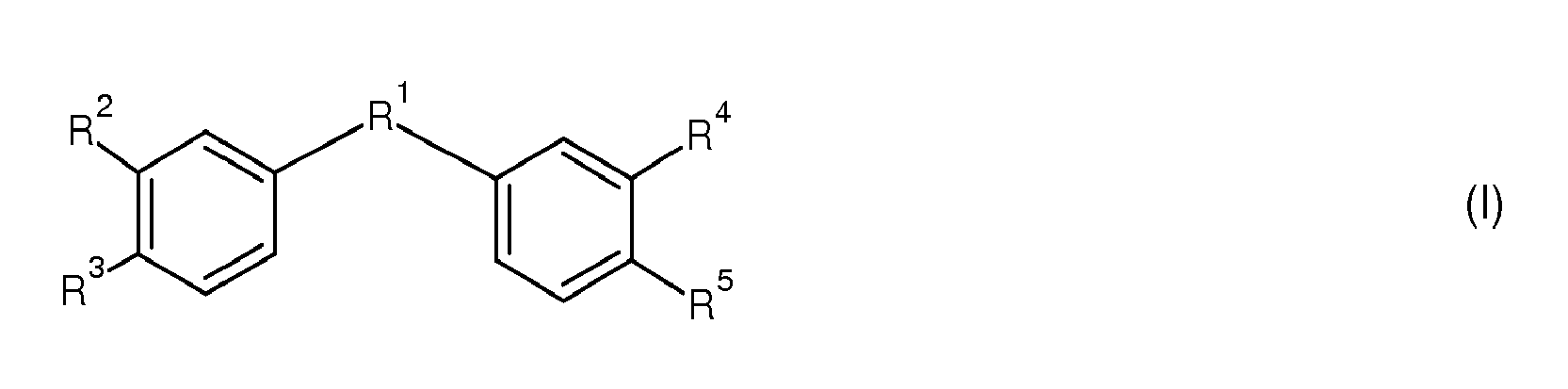 - a single bond between the adjacent carbon atoms, or- a carbohydrate chain having 1 to 10 carbon atoms and optionally bearing a hydroxy group, the carbohydrate chain being saturated, unsaturated or polyunsaturated,and wherein R2, R3, R4 and R5 are independently from each other- a hydrogen,- a carbohydrate chain having 1 to 10 carbon atoms and optionally bearing a hydroxy group, the carbohydrate chain being saturated, unsaturated or polyunsaturated,- a hydroxy group, or- a sulfhydryl group,with the provision that the compound bears at least- two hydroxy groups, or- two sulfhydryl groups, or- one hydroxy group and one sulfhydryl group,as well as of glutaraldehyde, carbodiimide, genipin and photoreactive diazines.
 - Method according to claim 1, characterized in that R1 is a residue having the following formula (II)
 - a hydrogen,- a carbohydrate chain having 1 to 10 carbon atoms and optionally bearing a hydroxy group, the carbohydrate chain being saturated, unsaturated or polyunsaturated,- a hydroxy group, or- a sulfhydryl group.
 - Method according to claim 1 or 2, characterized in that at least two hydroxy groups or at least two sulfhydryl groups or at least one hydroxy group and one sulfhydryl group of the compound according to general formula (I) are bound to the benzene rings of this compound.
- Method according to any of the preceding claims, characterized in that the crosslinker is nordihydroguaiaretic acid.
- Method according to any of the preceding claims, characterized in that the crosslinker is used in an amount of 2 to 20 percent by mass with respect to the dry mass of the polymer of the carrier material.
- Method according to any of the preceding claims, characterized in that the carrier material is crosslinked before it reaches the collector.
- Method according to any of the preceding claims, characterized in that the carrier material comprises collagen, a mixture of collagen and hydroxy apatite, gelatin, alginates, chitosan, silk, cellulose, polyurethane, a polyester, polycaprolactone, polylactide, polypyrrole, polyaniline, polyacetylene, polythiophene, a copolymer of the preceding polymers and/or a copolymer bearing carboxylic acid groups and/or amine groups, as well as oligopeptides or polypeptides.
- Method according to any of the preceding claims, characterized in that the electrospinning is done at a voltage of 8 to 20 kV between the collector and the spinning device.
- Method according to any of the preceding claims, characterized in that the polymer is solved or dispersed in at least one liquid chosen from the group of water, alcohols like methanol or ethanol, aqueous solutions of acids or bases like acetic acid or sodium hydroxide and organic solvents like acetone or 1,1,1,3,3,3-hexafluoro-2-propanol to produce a carrier material solution.
- Method according to any of the preceding claims, characterized in that the carrier material is deposited onto the collector to form a sheet material.
- Method according to any of claims 1 to 9, characterized in that the carrier material is removed from the collector after having contacted it and is then spun to a yarn.
- Product, in particular obtainable by a method according to any of the preceding claims, comprising a carrier material being built up from nanofibers having a diameter of less than 1200 nm and being
characterized
in that the carrier material essentially consists of a polymer being chemically crosslinked with the residue of a crosslinker and/or being embedded in a polymer formed by the crosslinker, the crosslinker being chosen from the group consisting of a compound according to the general formula (1) - a single bond between the adjacent carbon atoms, or- a carbohydrate chain having 1 to 10 carbon atoms and optionally bearing a hydroxy group, the carbohydrate chain being saturated, unsaturated or polyunsaturated,and wherein R2, R3, R4 and R5 are independently from each other- a hydrogen,- a carbohydrate chain having 1 to 10 carbon atoms and optionally bearing a hydroxy group, the carbohydrate chain being saturated, unsaturated or polyunsaturated,- a hydroxy group, or- a sulfhydryl group,with the provision that the compound bears at least- two hydroxy groups, or- two sulfhydryl groups, or- one hydroxy group and one sulfhydryl group,as well as glutaraldehyde, carbodiimide, genipin and photoreactive diazines.
 - Product according to claim 12, characterized in that the molecular ratio between the carrier material and the residue of the crosslinker is in the range of 20:1 to 5:1 in the product.
- Product according to any of the preceding claims, characterized in that it further comprises at least one auxiliary substance of the group consisting of osteoinductive substances, electrically conductive substances, electrically semiconductive substances, electrically insulating substances, antibacterial substances, antiviral substances, antifungal substances, ceramics, barium, copper, bromine, niobium, lithium, germanium, titanium, lead, zirconium, silicon, silver, zinc, polyurethane and silver hydrogen sulfate, gallium orthophosphate, langasite, barium titanate, lead titanate, lead zirconate titanate, potassium niobate, lithium niobate, lithium tantalate, sodium tungstate, Ba2NaNb5O5 and Pb2KNb5O15, wherein the auxiliary substance is chemically and/or physically bound to the carrier material.
- Use of a product according to any of claims 12 to 14 as scaffold for growing cells in vitro or as suture material.
Priority Applications (4)
| Application Number | Priority Date | Filing Date | Title |
|---|---|---|---|
| EP10192395A EP2458043A1 (en) | 2010-11-24 | 2010-11-24 | Product of crosslinked material and method for producing the same |
| EP11802296.1A EP2643503B1 (en) | 2010-11-24 | 2011-11-23 | Product of crosslinked material and method for producing the same |
| US13/989,381 US20140051169A1 (en) | 2010-11-24 | 2011-11-23 | Product of crosslinked material and method for producing the same |
| PCT/EP2011/070871 WO2012069559A1 (en) | 2010-11-24 | 2011-11-23 | Product of crosslinked material and method for producing the same |
Applications Claiming Priority (1)
| Application Number | Priority Date | Filing Date | Title |
|---|---|---|---|
| EP10192395A EP2458043A1 (en) | 2010-11-24 | 2010-11-24 | Product of crosslinked material and method for producing the same |
Publications (1)
| Publication Number | Publication Date |
|---|---|
| EP2458043A1 true EP2458043A1 (en) | 2012-05-30 |
Family
ID=43788037
Family Applications (2)
| Application Number | Title | Priority Date | Filing Date |
|---|---|---|---|
| EP10192395A Withdrawn EP2458043A1 (en) | 2010-11-24 | 2010-11-24 | Product of crosslinked material and method for producing the same |
| EP11802296.1A Not-in-force EP2643503B1 (en) | 2010-11-24 | 2011-11-23 | Product of crosslinked material and method for producing the same |
Family Applications After (1)
| Application Number | Title | Priority Date | Filing Date |
|---|---|---|---|
| EP11802296.1A Not-in-force EP2643503B1 (en) | 2010-11-24 | 2011-11-23 | Product of crosslinked material and method for producing the same |
Country Status (3)
| Country | Link |
|---|---|
| US (1) | US20140051169A1 (en) |
| EP (2) | EP2458043A1 (en) |
| WO (1) | WO2012069559A1 (en) |
Cited By (3)
| Publication number | Priority date | Publication date | Assignee | Title |
|---|---|---|---|---|
| CN104189958A (en) * | 2014-08-25 | 2014-12-10 | 中国人民解放军总医院 | Method for preparing chitosan-silk fibroin composite nano-fiber multifunctional patch for promoting myocardial tissue regeneration and monitoring stem cells |
| CN108042844A (en) * | 2017-12-11 | 2018-05-18 | 青岛大学 | A kind of preparation method of suture |
| CN110201211A (en) * | 2019-05-17 | 2019-09-06 | 安徽柯林医疗用品科技股份有限公司 | A kind of medical bandage and preparation method thereof |
Families Citing this family (31)
| Publication number | Priority date | Publication date | Assignee | Title |
|---|---|---|---|---|
| KR102118457B1 (en) | 2011-02-14 | 2020-06-03 | 미메딕스 그룹 인크. | Tissue grafts modified with a cross-linking agent and methods of making and using the same |
| CA2857636C (en) | 2011-12-22 | 2020-06-23 | Mimedx Group Inc. | Cross-linked dehydrated placental tissue grafts and methods for making and using the same |
| US9943551B2 (en) | 2012-08-15 | 2018-04-17 | Mimedx Group, Inc. | Tissue grafts composed of micronized placental tissue and methods of making and using the same |
| CA2880157C (en) | 2012-08-15 | 2020-07-21 | Mimedx Group, Inc. | Reinforced placental tissue grafts and methods of making and using the same |
| US9155799B2 (en) | 2012-11-19 | 2015-10-13 | Mimedx Group, Inc. | Cross-linked collagen with at least one bound antimicrobial agent for in vivo release of the agent |
| US8940684B2 (en) * | 2012-11-19 | 2015-01-27 | Mimedx Group, Inc. | Cross-linked collagen comprising an antifungal agent |
| US8946163B2 (en) | 2012-11-19 | 2015-02-03 | Mimedx Group, Inc. | Cross-linked collagen comprising metallic anticancer agents |
| WO2014110590A1 (en) | 2013-01-14 | 2014-07-17 | Scripps Health | Tissue array printing |
| US10206977B1 (en) | 2013-01-18 | 2019-02-19 | Mimedx Group, Inc. | Isolated placental stem cell recruiting factors |
| US9662355B2 (en) | 2013-01-18 | 2017-05-30 | Mimedx Group, Inc. | Methods for treating cardiac conditions |
| WO2014160019A1 (en) | 2013-03-14 | 2014-10-02 | Lifenet Health | Aligned fiber and method of use thereof |
| US10029030B2 (en) | 2013-03-15 | 2018-07-24 | Mimedx Group, Inc. | Molded placental tissue compositions and methods of making and using the same |
| US10335433B2 (en) | 2013-04-10 | 2019-07-02 | Mimedx Group, Inc. | NDGA polymers and metal complexes thereof |
| US9446142B2 (en) | 2013-05-28 | 2016-09-20 | Mimedx Group, Inc. | Polymer chelator conjugates |
| JP6756612B2 (en) | 2013-08-30 | 2020-09-16 | ミメディクス グループ インコーポレイテッド | Finely divided placental composition containing a chelator |
| WO2015109329A1 (en) | 2014-01-17 | 2015-07-23 | Mimedx Group, Inc. | Method for inducing angiogenesis |
| CN103861145B (en) * | 2014-03-10 | 2017-02-22 | 武汉大学 | Immediately crosslinking technology for preparing macroporous three-dimensional nanofiber bracket |
| EP3116557B1 (en) | 2014-03-14 | 2020-03-11 | Scripps Health | Electrospinning of cartilage and meniscus matrix polymers |
| JP7099822B2 (en) | 2014-08-28 | 2022-07-12 | ミメディクス グループ インコーポレイテッド | Collagen-enhanced tissue graft |
| US11033659B2 (en) * | 2014-09-29 | 2021-06-15 | Board Of Regents Of The University Of Nebraska | Nanofiber structures and methods of synthesis and use thereof |
| WO2017007842A1 (en) * | 2015-07-07 | 2017-01-12 | Singapore Health Services Pte Ltd. | A polymer product and preparation thereof |
| CA3038304A1 (en) | 2016-09-28 | 2018-04-05 | Board Of Regents Of The University Of Nebraska | Nanofiber structures and methods of use thereof |
| AU2018268713B2 (en) | 2017-05-16 | 2024-04-18 | Embody Inc. | Biopolymer compositions, scaffolds and devices |
| WO2018227078A1 (en) | 2017-06-09 | 2018-12-13 | Board Of Regents Of The University Of Nebraska | Nanofiber structures and methods of use thereof |
| EP3684726A4 (en) | 2017-09-19 | 2021-06-30 | Board of Regents of the University of Nebraska | NANO FIBER STRUCTURES AND METHOD OF USING THEM |
| EP3700462A4 (en) | 2017-10-24 | 2021-11-17 | Embody Inc. | BIOPOLYMER SCAFFOLDING IMPLANTS AND THEIR PRODUCTION METHODS |
| US12383652B2 (en) | 2018-12-14 | 2025-08-12 | Board Of Regents Of The University Of Nebraska | Nanofiber structures and methods of manufacture and use thereof |
| CN113874192B (en) | 2019-02-01 | 2024-01-02 | 恩博迪股份有限公司 | microfluidic extrusion |
| CN110354298B (en) * | 2019-07-26 | 2021-08-17 | 南京聚屹新材料有限公司 | Preparation method of in-situ crosslinked silver nanowire/polycaprolactone surgical suture |
| CN111067662B (en) * | 2019-11-05 | 2021-10-26 | 南京艾澜德生物科技有限公司 | Recombinant collagen and double-layer artificial blood vessel stent thereof |
| CN114957737B (en) * | 2022-06-02 | 2025-04-25 | 齐鲁工业大学(山东省科学院) | A method for preparing super cross-linked polyaniline by N-alkylation reaction |
Citations (5)
| Publication number | Priority date | Publication date | Assignee | Title |
|---|---|---|---|---|
| US6565960B2 (en) * | 2000-06-01 | 2003-05-20 | Shriners Hospital Of Children | Polymer composite compositions |
| WO2008082588A2 (en) * | 2006-12-27 | 2008-07-10 | Shriners Hospitals For Children | Woven and/or braided fiber implants and methods of making same |
| WO2009011944A2 (en) * | 2007-04-11 | 2009-01-22 | Drexel University | Fibrous mats containing chitosan nanofibers |
| WO2009064767A2 (en) * | 2007-11-12 | 2009-05-22 | Massachusetts Institute Of Technology | Bactericidal nanofibers, and methods of use thereof |
| US20100183699A1 (en) * | 2009-01-21 | 2010-07-22 | Wankei Wan | Compositions and methods to cross link polymer fibers |
-
2010
- 2010-11-24 EP EP10192395A patent/EP2458043A1/en not_active Withdrawn
-
2011
- 2011-11-23 US US13/989,381 patent/US20140051169A1/en not_active Abandoned
- 2011-11-23 EP EP11802296.1A patent/EP2643503B1/en not_active Not-in-force
- 2011-11-23 WO PCT/EP2011/070871 patent/WO2012069559A1/en not_active Ceased
Patent Citations (5)
| Publication number | Priority date | Publication date | Assignee | Title |
|---|---|---|---|---|
| US6565960B2 (en) * | 2000-06-01 | 2003-05-20 | Shriners Hospital Of Children | Polymer composite compositions |
| WO2008082588A2 (en) * | 2006-12-27 | 2008-07-10 | Shriners Hospitals For Children | Woven and/or braided fiber implants and methods of making same |
| WO2009011944A2 (en) * | 2007-04-11 | 2009-01-22 | Drexel University | Fibrous mats containing chitosan nanofibers |
| WO2009064767A2 (en) * | 2007-11-12 | 2009-05-22 | Massachusetts Institute Of Technology | Bactericidal nanofibers, and methods of use thereof |
| US20100183699A1 (en) * | 2009-01-21 | 2010-07-22 | Wankei Wan | Compositions and methods to cross link polymer fibers |
Cited By (4)
| Publication number | Priority date | Publication date | Assignee | Title |
|---|---|---|---|---|
| CN104189958A (en) * | 2014-08-25 | 2014-12-10 | 中国人民解放军总医院 | Method for preparing chitosan-silk fibroin composite nano-fiber multifunctional patch for promoting myocardial tissue regeneration and monitoring stem cells |
| CN104189958B (en) * | 2014-08-25 | 2015-12-02 | 中国人民解放军总医院 | For promoting the preparation method of the multi-functional sticking patch of Properties of Chitosan Fibroin Blend albumen composite nano fiber of regenerating heart tissue and stem cell monitoring |
| CN108042844A (en) * | 2017-12-11 | 2018-05-18 | 青岛大学 | A kind of preparation method of suture |
| CN110201211A (en) * | 2019-05-17 | 2019-09-06 | 安徽柯林医疗用品科技股份有限公司 | A kind of medical bandage and preparation method thereof |
Also Published As
| Publication number | Publication date |
|---|---|
| WO2012069559A1 (en) | 2012-05-31 |
| EP2643503A1 (en) | 2013-10-02 |
| US20140051169A1 (en) | 2014-02-20 |
| EP2643503B1 (en) | 2014-11-05 |
Similar Documents
| Publication | Publication Date | Title |
|---|---|---|
| EP2643503B1 (en) | Product of crosslinked material and method for producing the same | |
| EP2458044A1 (en) | Product containing nanocrystals and method for producing the same | |
| Hernández‐Rangel et al. | Collagen based electrospun materials for skin wounds treatment | |
| Zheng et al. | Mimicking the electrophysiological microenvironment of bone tissue using electroactive materials to promote its regeneration | |
| Bhattarai et al. | Alginate‐based nanofibrous scaffolds: Structural, mechanical, and biological properties | |
| Datta et al. | Oleoyl-chitosan-based nanofiber mats impregnated with amniotic membrane derived stem cells for accelerated full-thickness excisional wound healing | |
| CN106729980B (en) | A kind of bionic nerve graft for peripheral nerve repair and its preparation method | |
| Liu et al. | Recent progress of spider-silk-inspired adhesive materials | |
| CZ2007716A3 (en) | Process for producing nanifibers | |
| Lin et al. | Characterization of electrospun nanofiber matrices made of collagen blends as potential skin substitutes | |
| CN111962210B (en) | Polycaprolactone/methacryloylated elastin nanofiber composite membrane and preparation method and application thereof | |
| CN102861355A (en) | Functional wound dressing capable of accelerating wound healing and preparation method thereof | |
| CN117626527A (en) | Micro-nano fiber composite biofilm based on electrospinning technology and its preparation method and application | |
| EP2458042A1 (en) | Sheet material, method for producing the same and device for carrying out the method | |
| Hoque et al. | Electrospun matrices from natural polymers for skin regeneration | |
| CN108691028B (en) | A kind of preparation method of polylactic acid/soybean protein isolate composite nano fiber and obtained nanofiber and application | |
| CN111632193A (en) | Chitosan-based nerve fiber membrane and preparation method, nerve conduit and application | |
| Abdu et al. | Selected natural fibers and their electrospinning | |
| CN100358588C (en) | Elastin shaped body and its preparation method | |
| Araujo et al. | Processing and characterization of α-elastin electrospun membranes | |
| CN113082282B (en) | High-orientation high-strength bacterial cellulose composite membrane and preparation and application thereof | |
| CN107754016A (en) | A kind of preparation method of polylactic acid/chitosan composite nano fiber scaffold for heart tissue engineering | |
| CN110384820A (en) | It is a kind of that de- cell tendon line and its construction method is lyophilized | |
| Valizadeh et al. | Recent advances in electrospinning of some selected biopolymers | |
| CN106880874A (en) | An artificial composite hernia patch and its preparation method |
Legal Events
| Date | Code | Title | Description |
|---|---|---|---|
| PUAI | Public reference made under article 153(3) epc to a published international application that has entered the european phase |
Free format text: ORIGINAL CODE: 0009012 |
|
| AK | Designated contracting states |
Kind code of ref document: A1 Designated state(s): AL AT BE BG CH CY CZ DE DK EE ES FI FR GB GR HR HU IE IS IT LI LT LU LV MC MK MT NL NO PL PT RO RS SE SI SK SM TR |
|
| AX | Request for extension of the european patent |
Extension state: BA ME |
|
| STAA | Information on the status of an ep patent application or granted ep patent |
Free format text: STATUS: THE APPLICATION IS DEEMED TO BE WITHDRAWN |
|
| 18D | Application deemed to be withdrawn |
Effective date: 20121127 |