EP2458855A1 - Procédé, système et dispositif de commande en temps réel d'un service de ppv (paiement à la séance) - Google Patents
Procédé, système et dispositif de commande en temps réel d'un service de ppv (paiement à la séance) Download PDFInfo
- Publication number
- EP2458855A1 EP2458855A1 EP09849390A EP09849390A EP2458855A1 EP 2458855 A1 EP2458855 A1 EP 2458855A1 EP 09849390 A EP09849390 A EP 09849390A EP 09849390 A EP09849390 A EP 09849390A EP 2458855 A1 EP2458855 A1 EP 2458855A1
- Authority
- EP
- European Patent Office
- Prior art keywords
- user
- program
- ppv program
- subscribed
- ppv
- Prior art date
- Legal status (The legal status is an assumption and is not a legal conclusion. Google has not performed a legal analysis and makes no representation as to the accuracy of the status listed.)
- Withdrawn
Links
Images



Classifications
-
- H—ELECTRICITY
- H04—ELECTRIC COMMUNICATION TECHNIQUE
- H04N—PICTORIAL COMMUNICATION, e.g. TELEVISION
- H04N7/00—Television systems
- H04N7/16—Analogue secrecy systems; Analogue subscription systems
- H04N7/162—Authorising the user terminal, e.g. by paying; Registering the use of a subscription channel, e.g. billing
- H04N7/163—Authorising the user terminal, e.g. by paying; Registering the use of a subscription channel, e.g. billing by receiver means only
-
- H—ELECTRICITY
- H04—ELECTRIC COMMUNICATION TECHNIQUE
- H04N—PICTORIAL COMMUNICATION, e.g. TELEVISION
- H04N21/00—Selective content distribution, e.g. interactive television or video on demand [VOD]
- H04N21/20—Servers specifically adapted for the distribution of content, e.g. VOD servers; Operations thereof
- H04N21/21—Server components or server architectures
- H04N21/218—Source of audio or video content, e.g. local disk arrays
- H04N21/2187—Live feed
-
- H—ELECTRICITY
- H04—ELECTRIC COMMUNICATION TECHNIQUE
- H04N—PICTORIAL COMMUNICATION, e.g. TELEVISION
- H04N21/00—Selective content distribution, e.g. interactive television or video on demand [VOD]
- H04N21/20—Servers specifically adapted for the distribution of content, e.g. VOD servers; Operations thereof
- H04N21/25—Management operations performed by the server for facilitating the content distribution or administrating data related to end-users or client devices, e.g. end-user or client device authentication, learning user preferences for recommending movies
- H04N21/262—Content or additional data distribution scheduling, e.g. sending additional data at off-peak times, updating software modules, calculating the carousel transmission frequency, delaying a video stream transmission, generating play-lists
- H04N21/26258—Content or additional data distribution scheduling, e.g. sending additional data at off-peak times, updating software modules, calculating the carousel transmission frequency, delaying a video stream transmission, generating play-lists for generating a list of items to be played back in a given order, e.g. playlist, or scheduling item distribution according to such list
-
- H—ELECTRICITY
- H04—ELECTRIC COMMUNICATION TECHNIQUE
- H04N—PICTORIAL COMMUNICATION, e.g. TELEVISION
- H04N21/00—Selective content distribution, e.g. interactive television or video on demand [VOD]
- H04N21/40—Client devices specifically adapted for the reception of or interaction with content, e.g. set-top-box [STB]; Operations thereof
- H04N21/47—End-user applications
- H04N21/472—End-user interface for requesting content, additional data or services; End-user interface for interacting with content, e.g. for content reservation or setting reminders, for requesting event notification, for manipulating displayed content
- H04N21/47211—End-user interface for requesting content, additional data or services; End-user interface for interacting with content, e.g. for content reservation or setting reminders, for requesting event notification, for manipulating displayed content for requesting pay-per-view content
-
- H—ELECTRICITY
- H04—ELECTRIC COMMUNICATION TECHNIQUE
- H04N—PICTORIAL COMMUNICATION, e.g. TELEVISION
- H04N21/00—Selective content distribution, e.g. interactive television or video on demand [VOD]
- H04N21/60—Network structure or processes for video distribution between server and client or between remote clients; Control signalling between clients, server and network components; Transmission of management data between server and client, e.g. sending from server to client commands for recording incoming content stream; Communication details between server and client
- H04N21/63—Control signaling related to video distribution between client, server and network components; Network processes for video distribution between server and clients or between remote clients, e.g. transmitting basic layer and enhancement layers over different transmission paths, setting up a peer-to-peer communication via Internet between remote STB's; Communication protocols; Addressing
- H04N21/633—Control signals issued by server directed to the network components or client
- H04N21/6332—Control signals issued by server directed to the network components or client directed to client
- H04N21/6334—Control signals issued by server directed to the network components or client directed to client for authorisation, e.g. by transmitting a key
-
- H—ELECTRICITY
- H04—ELECTRIC COMMUNICATION TECHNIQUE
- H04N—PICTORIAL COMMUNICATION, e.g. TELEVISION
- H04N21/00—Selective content distribution, e.g. interactive television or video on demand [VOD]
- H04N21/60—Network structure or processes for video distribution between server and client or between remote clients; Control signalling between clients, server and network components; Transmission of management data between server and client, e.g. sending from server to client commands for recording incoming content stream; Communication details between server and client
- H04N21/63—Control signaling related to video distribution between client, server and network components; Network processes for video distribution between server and clients or between remote clients, e.g. transmitting basic layer and enhancement layers over different transmission paths, setting up a peer-to-peer communication via Internet between remote STB's; Communication protocols; Addressing
- H04N21/64—Addressing
- H04N21/6405—Multicasting
-
- H—ELECTRICITY
- H04—ELECTRIC COMMUNICATION TECHNIQUE
- H04N—PICTORIAL COMMUNICATION, e.g. TELEVISION
- H04N21/00—Selective content distribution, e.g. interactive television or video on demand [VOD]
- H04N21/60—Network structure or processes for video distribution between server and client or between remote clients; Control signalling between clients, server and network components; Transmission of management data between server and client, e.g. sending from server to client commands for recording incoming content stream; Communication details between server and client
- H04N21/63—Control signaling related to video distribution between client, server and network components; Network processes for video distribution between server and clients or between remote clients, e.g. transmitting basic layer and enhancement layers over different transmission paths, setting up a peer-to-peer communication via Internet between remote STB's; Communication protocols; Addressing
- H04N21/643—Communication protocols
- H04N21/64322—IP
Definitions
- the present invention relates to the field of the Internet Protocol Television (IPTV), and more particularly, to a method, a system and a device for real-time control of a Pay per View (PPV) service.
- IPTV Internet Protocol Television
- PSV Pay per View
- IPTV technology which is based on the IP Multimedia Subsystem (IMS) network, provides abundant video and audio services for users, such as live channels, and programs on-demand, and so on.
- IMS IP Multimedia Subsystem
- the PPV television service is provided on live channels, and generally, the service in the digital TV is paid per view on the basis of the entire channels.
- the main object of the present invention is to provide a method, a system and a device for real-time control of a PPV service, which enable users to subscribe and view the PPV program in real time, thereby improving the user's experience.
- the present invention provides a method for real-time control of a pay per view (PPV) service, and the method comprises:
- the live session establishment request at least includes a user profile and a live channel identifier; the method further comprises: the user terminal sending the live session establishment request to the IPTV SCF entity via a Core IP Multimedia Subsystem (Core IMS).
- Core IMS Core IP Multimedia Subsystem
- the IPTV SCF entity confirming that there is the PPV program that is not subscribed by the user on the current live channel comprises:
- the IPTV SCF entity notifying the user terminal to subscribe the PPV program that is not subscribed comprises:
- the IPTV SCF entity acquiring the subscription URL of the PPV program that is not subscribed comprises: the IPTV SCF entity acquiring the subscription URL of the PPV program that is not subscribed by the user from an IPTV application server; the IPTV SCF entity notifying the user terminal to subscribe the PPV program that is not subscribed comprises: the IPTV SCF entity sending a message including the subscription URL to the user terminal via a Core IMS, and the user terminal subscribing the PPV program that is not subscribed according to the subscription URL.
- the method further comprises:
- the method further comprises:
- the IPTV SCF entity acquiring the border point of the PPV program comprises:
- the CC confirming the time shift border point comprises:
- the CC confirming the program time to which the user plays back comprises: comparing the border point of the PPV program with the time shift border point, and taking a closer one to the current time as the program time to which the user can play back.
- the present invention further provides a system for real-time control of a PPV service, and the system comprises: a user terminal and an IPTV SCF entity, wherein the user terminal is configured to: send a live session establishment request to the IPTV SCF entity; the IPTV SCF entity is configured to: confirm that there is a PPV program that is not subscribed by a user on a current live channel according to the live session establishment request; and is also configured to: notify the user terminal to subscribe the PPV program that is not subscribed.
- the IPTV SCF entity is further configured to: acquire a subscription URL of the PPV program that is not subscribed, and notify the user terminal to subscribe the PPV program that is not subscribed according to the subscription URL; correspondingly, the system further comprises: an IPTV application server, which is configured to: provide the subscription URL of the PPV program that is not subscribed to the IPTV SCF entity; and is also configured to: provide a program playlist of the live channel to the IPTV SCF; and a user profile server function entity, which is configured to: provide information of a PPV program that is subscribed by the user to the IPTV SCF entity; correspondingly, the IPTV SCF entity is further configured to: confirm that there is the PPV program not subscribed by the user on the live channel according to the program playlist and the information of the PPV program that is subscribed by the user.
- the system further comprises:
- the method further comprises: a CC, wherein correspondingly, the IPTV SCF entity is further configured to: acquire a border point of the PPV program on the live channel from the IPTV application server, and send the border point of the PPV program to the CC; the CC is configured to: determine a time shift border point, and confirm a program time to which the user plays back according to the border point of the PPV program.
- the present invention further provides a device for real-time control of a PPV service, and the device comprises:
- the scheme for real-time control of the PPV service in accordance with the present invention confirms that there is a PPV program on a live channel via an IPTV service control function entity when a user requests the live channel, and then notifies the user to subscribe the PPV program at a specific time; and controls the time shift border via the IPTV service control function entity in the case that the user is switched from the live state to the time shift state,.
- a user When viewing a video program on a live channel, a user needs to join in a multicast group, and all the users in the multicast can use the live channel to view the program in common, that is, the relationship between the video source corresponding to the live channel at the network side and the users in the multicast group is an one-to-multiple relationship, and the program viewed by the user via the live channel is real-time, and thus this state is named as the live state; when being switched from the live state to the time shift state, the user needs to leave the multicast group, and to establish a one-to-one relationship with the video source corresponding to the current live channel, and at this time the program viewed by the user is not real time.
- the IPTV system which is adaptable to the scheme for real-time control of the PPV service in accordance with the present invention is shown in FIG. 1 , comprising: a user terminal, an IPTV service control function entity, a user profile server function entity, a Content Delivery Network (CDN) subsystem, a service selection function entity, a service discovery function entity, a service control function entity, a transport processing function entity, and a resource allocation control function entity.
- CDN Content Delivery Network
- the service control function entity is the Core IP Multimedia Subsystem (IMS) when the IPTV system in the present invention is based on the next generation network, namely the IMS network.
- IMS Core IP Multimedia Subsystem
- IPTV SCF IPTV Service Control Function
- the IPTV SCF entity mainly provides the service authentication at the session initial stage, determines whether a user is allowed to use the corresponding services or not according to the user's IPTV service list, performs the credit control, and selects the corresponding IPTV media function.
- the IPTV SCF entity can be considered as the Session Initiation Protocol (SIP) application server in architecture of the next generation network.
- SIP Session Initiation Protocol
- the IPTV SCF entity interacts with the Core IMS via an ISC interface; and the user terminal and the IPTV SCF entity exchange session related information via the Core IMS.
- the user terminal might also configure the IPTV service list via the Ut interface.
- the CDN subsystem is responsible for signaling control of the on-demand services and the media stream transmission, and it comprises: a CDN Controller (CDNC), a Cluster Controller (CC), and a Content Delivery Function (CDF) entity.
- CDNC CDN Controller
- CC Cluster Controller
- CDF Content Delivery Function
- the IPTV SCF entity routes the SIP message to the CDNC through the Core IMS (an Y2 interface), and the CDNC selects one of the CCs administered by the CDNC according to the SIP message;
- the main function of the CC is: selecting one of the CDF entities administered by the CC to provide the specific media stream data (e.g., transmitted in a way of the RTP), and is also used to deal with the control signaling (e.g., the RTSP command) during the play-back process.
- the IPTV application server provides a basic IPTV server display interface, and provides a Web interface for the user subscribing in the present invention.
- the transport processing function entity mainly provides the media stream data of the live channel for a user terminal.
- the resource allocation control function entity mainly implements to provide functions such as the basic policy control, resource reservation, and acceptance control and so on.
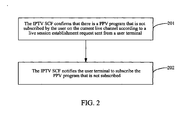
- FIG. 2 Based on the structural diagram of the IPTV system shown in FIG. 1 , the procedure of the method for real-time control of the PPV service in accordance with the present invention is shown in FIG. 2 , and the method comprises following steps.
- Step 201 the IPTV SCF entity confirms that there is a PPV program that is not subscribed by a user on the current live channel according to a live session establishment request sent by a user terminal.
- Step 202 the IPTV SCF entity notifies the user terminal to subscribe the PPV program that is not subscribed.
- FIG. 3 shows a procedure of the method for real-time control of the PPV service according to the embodiment 1, and the procedure is adaptable to the case that the user terminal requests the live channel. As shown in FIG.3 , this procedure comprises following steps.
- Step 301 the user terminal sends a live session establishment request to the Core IMS.
- the user When the user needs to view a live program, the user sends a live session establishment request including a live channel identifier to the Core IMS via the user terminal, and the live channel is the one where the program that the user wants to view is situated.
- Step 302 the Core IMS cooperates with the resource allocation control function entity to perform the resource reservation operation according to the live session establishment request.
- the aforementioned live session establishment request also includes the information of the resource, namely the network bandwidth requested by the user, needed by the user when viewing the program on the live channel.
- the Core IMS cooperates with the resource allocation control function entity according to the network bandwidth requested by the user to perform the resource reservation on the current live channel, i.e., reserving the network bandwidth whose size is the same as that requested by the user, so as to be used for subsequently playing the media stream.
- Step 303 the Core IMS forwards the live session establishment request to the IPTV SCF entity.
- Step 304 the IPTV SCF entity judges whether there is a PPV program that is not subscribed by the user or not on the current live channel.
- the Core IMS forwards the live session establishment request to the IPTV SCF entity, and the IPTV SCF entity checks whether there is the PPV program or not on this live channel according to this live session establishment request and confirms the subscription condition of PPV programs of this user.
- the IPTV application server might provide a program playlist, and the IPTV SCF entity is able to acquire the program playlist of the current live channel according to the live channel identifier, so as to judge whether there is the PPV program, including the PPV program that is played and the PPV program to be played on this live channel, or not on this live channel; preferably, a field for denoting the program attribute can be set in the playlist, and it can be learned whether a video program is a PPV program or not with this field; the specific value of the field can be set as needed.
- the user profile server function entity stores the user profile, including the user identity information, and the subscription condition of PPV programs of this user, and so on, and therefore, the IPTV SCF entity is able to acquire the subscription condition of PPV programs of this user, including whether the user subscribes the PPV program or not and the subscribed PPV program information (the program name, etc.) by inquiring the user profile server function entity according to the user profile (the user's identity, etc.) included in the live session establishment request.
- the IPTV SCF entity can determine whether there is the PPV program on this live channel or not and whether there is PPV program subscribed or not subscribed by the user or not in combination with the playlist provided by the IPTV application server and the user profile provided by the user profile server function entity.
- Step 305 the IPTV SCF entity returns a 200 OK response to the Core IMS to notify the Core IMS that the live session has been established.
- the IPTV SCF entity after receiving the live session establishment request, not only should check whether there is the PPV program on the current live channel or not and confirms the subscription condition of PPV programs of the user, but also needs to establish a live session based on this live channel, and returns a 200 OK response to the Core IMS after establishing the live session successfully.
- Step 306 the Core IMS and the resource allocation control function entity cooperate to submit the resource.
- the Core IMS and the resource allocation control function entity submit the resource, that is, allocate the requested network bandwidth for this user on the current live channel, and step 307 is performed, in which a 200 OK response is returned to the user terminal to inform the user terminal that the resource is ready.
- Step 308 the user terminal sends an Internet Group Management Protocol (IGMP) join message to the transport processing function entity.
- IGMP Internet Group Management Protocol
- the user terminal learns that the resource is ready, it immediately sends the IGMP join message to the transport processing function entity to join in the current multicast group, that is, the multicast group corresponding to this live channel, so as to become a user of this multicast group, and therefore, the transport processing function entity can send the media stream (that is, the video program data stream on this live channel) corresponding to this live channel to this user terminal which belongs to this multicast group.
- the user terminal Since the programs on the live channel can only be played to the user terminals that belong to the multicast group corresponding to the live channel, the user terminal cannot view the programs on the live channel until joining in this multicast group.
- the media stream sent by the transport processing function entity to the user terminal in this step includes: the media stream of a PPV program that can be played with the live channel and the media stream of a non-PPV program.
- Steps 309 ⁇ 315 are a procedure related to subscribing the PPV program, and therefore, if it is confirmed that there is no PPV program on the current live channel or there is a subscribed PPV program in step 304, the user does not need to subscribe a PPV program on the current live channel, or the subscription procedure does not require executing; if there is PPV program that is a program that the user has not subscribed on the current live channel, the subscription procedure of steps 309 ⁇ 315 is performed.
- the IPTV SCF entity confirms in step 304 that there is a PPV program on the current live channel and confirms that the PPV program has not been subscribed by this user, then the IPTV SCF entity sets a timer according to the start time of this PPV program, and when the timer is time-out (this time is the specific time), the IPTV SCF entity interacts with the IPTV application server to acquire the subscription URL of this PPV program. Specifically, the duration of the timer might be set according to the IPTV strategy or as needed.
- the current time is 9:00
- the IPTV SCF entity confirms that there is a PPV program that is not subscribed by the user on the current live channel, and the start time of the PPV program is 10:00
- the timer can be set at once as needed, and the time-out time of the timer is 10:05 (this case is that the user is firstly allowed to view the PPV program for 5 minutes and then is notified to subscribe)
- the IPTV SCF entity interacts with the IPTV application server at 10:05 to acquire the subscription Uniform Resource Locator (URL) of this PPV program
- the timer can be set when playing the PPV program, and the duration of the timer is 5 minutes as needed, that is, the IPTV SCF entity interacts with the IPTV application server at the time when the PPV program is played for 5 minutes to acquire the subscription URL of this PPV program.
- URL Uniform Resource Locator
- the procedure is performed as described in steps 310 ⁇ 311: the IPTV server returns the subscription URL of the current PPV program to the IPTV SCF entity; the IPTV SCF entity sends a message (including the subscription URL) to the user terminal via the Core IMS to notify the user to subscribe the PPV program.
- Step 312 the user subscribes the PPV program based on the IPTV application server according to the subscription URL.
- the message for notifying the user to subscribe is displayed on the user terminal in the form of the Web interface, and the user might click the subscription URL on this interface to enter the subscription interface provided by the IPTV application server to subscribe the PPV program.
- Step 313 the IPTV application server updates the subscription information of the user in the user profile server function entity.
- Step 314 the user profile server function entity returns the update success message to the IPTV application server after the update succeeding.
- Step 315 the IPTV application server returns a 200 OK to the user terminal to inform the user of subscription success of this PPV program, and then the user can continue to view this PPV program.
- FIG. 4 shows a flow chart of the method for real-time control of the PPV service according to embodiment 2, the difference between this procedure and the one shown as FIG. 3 is in that: the user successfully subscribes the PPV program in the procedure shown in FIG. 3 ; while the procedure shown in FIG. 4 illustrates that the user subscribing the PPV program is failure.
- steps 401 ⁇ 412 is the same as that in steps 301 ⁇ 312, and is not repeated herein.
- FIG. 5 shows a flow chart of the method for real-time control of the PPV service according to embodiment 3, and this procedure can apply to the case that the user terminal requests to be switched from the live state to the time shift state.
- the procedure comprises following steps.
- Step 501 a live session is established, and this step corresponds to steps 301 ⁇ 308 in FIG. 3 .
- Step 502 the user terminal sends a live session adjustment request to the Core IMS.
- the live session adjustment request can be used to denote that the user requests to be switched to the time shift state, and the live session adjustment message includes the resource, namely the network bandwidth, required by the user for being switching to the time shift state.
- Step 503 the Core IMS cooperates with the resource allocation function entity to adjust the resource.
- the network bandwidth is adjusted based on the current live channel according to the network bandwidth required in the time shift state requested by the user to prepare for the user being switching from the live state to the time shift state.
- Step 504 the Core IMS forwards the live session adjustment request to the IPTV SCF entity.
- Step 505 the IPTV SCF entity confirms the border point of the PPV program on the current live channel according to this live session adjustment request.
- the end time of the last PPV program in the programs that have already been played can be confirmed based on the program playlist of the current live channel, and the end time is the border point of the PPV program.
- Step 506 the IPTV SCF entity selects a CDNC, and the implementation is known in the art herein and is not repeated.
- Steps 507-509 the IPTV SCF entity sends the live session adjustment request including information of the border point of the PPV program to the Core IMS; then the Core IMS sends the live session adjustment request to the CC via the selected CDNC.
- Step 510 the CC stores the information of the border point of the PPV program on the current live channel in the live session adjustment request.
- Step 511 the CC sends the Real Time Streaming Protocol (RTSP) Setup signaling to the CDF entity to notify the CDF entity to establish the signaling channel in the time shift state so as to control the data channel (transmitting the stream media data) in the time shift state.
- RTSP Real Time Streaming Protocol
- Step 512 the CDF entity returns the 200 OK response to the CC after completing to establish the signaling channel; and the CC returns the 200 OK response to the Core IMS via the CDNC and IPTV SCF entity.
- Step 513 the Core IMS cooperates with the resource allocation function entity to confirm the resource adjustment, that is, regarding to the resource request in step 503, it confirms here that the resource, namely the network bandwidth, requested by the user has been allocated, and the step 514 is performed, in which the Core IMS returns the 200 OK response to the user terminal.
- Step 515 the user terminal sends an IGMP Leave message to the transport processing function entity to leave the multicast group corresponding to the current live channel. Since the user needs to be switched to the time shift state in which the relationship between the user terminal and the video resource (the video resource corresponding to the current live channel) at the network side is an one-to-one relationship, therefore when being switched to the time shift state, the user must leave the current multicast group first and then enters the time shift state.
- Step 516 the user terminal sends a RTSP PLAY message to the CC through the signaling channel to inform the CC that the user terminal needs to view the program which has already been played on the current live channel, that is, the user needs to paly back to view the program that has already been played.
- Step 517 the CC compares the stored border point of the PPV program with the time shift border point to confirm the program time to which the user might play back.
- the real-time program played on the live channel would be recorded and stored for a certain time period so that the user can view the program on demand whenever necessary; at this moment, the user can play back to a certain time to view the program that has been played already on this live channel.
- the time shift border point might be determined according to the current live channel allowable maximum duration for storing the program that has been played, for example, the current time is 10:00, and the maximum duration is 3 hours, and then the time shift border point is 7:00, that is, the current live channel is only able to store the program content in the last 3 hours.
- the border point of the PPV program is compared with the time shift border point, and the time shift border point closest to the current time is taken as the program time to which the user might play back.
- the current time is 10:00, it is assumed that the current live channel allowable maximum duration for storing the program that has been played is 3 hours, and then the time shift border point is 7:00; if the last border point of the PPV program on the current live channel is 6:00, then the program time to which the user might play back is 7:00; and if the border point of the PPV program on the current live channel is 8:00, then the program time to which the user might play back is 8:00.
- Step 518 the CC returns the program time to which the user might play back to the user terminal, and then the user is able to view the program after this time.
- the present invention further provides a control system.
- the system comprises: a user terminal 10 and an IPTV SCF entity 20, wherein, the user terminal 10 is configured to: send a live session establishment request to the IPTV SCF entity 20; the IPTV SCF entity 20 is configured to: confirm that there is a PPV program that is not subscribed by the user on the current live channel according to the live session establishment request, and is also configured to: notify the user terminal 10 to subscribe the PPV program that is not subscribed.
- the IPTV SCF entity 20 is further configured to: acquire the subscription URL of the PPV program that is not subscribed, and notify the user terminal 10 to subscribe the PPV program that is not subscribed according to the subscription URL; correspondingly, the system further comprises:
- This system further comprises:
- this system further comprises: a CC 60, correspondingly, the IPTV SCF entity 20 is further configured to: acquire the border point of the PPV program on the live channel from the IPTV application server 30, and send the border point of the PPV program to the CC 60; the CC 60 is configured to: determine the time shift border point and determine the program time to which the user plays back according to the border point of the PPV program.
- the present invention further provides a device for real-time control of the PPV service, and this device adapts to the IPTV SCF entity, its internal structure is shown in FIG. 7 , and comprises:
Landscapes
- Engineering & Computer Science (AREA)
- Multimedia (AREA)
- Signal Processing (AREA)
- Databases & Information Systems (AREA)
- Computer Security & Cryptography (AREA)
- Computer Networks & Wireless Communication (AREA)
- Human Computer Interaction (AREA)
- Two-Way Televisions, Distribution Of Moving Picture Or The Like (AREA)
Applications Claiming Priority (2)
| Application Number | Priority Date | Filing Date | Title |
|---|---|---|---|
| CN2009100933370A CN102026024B (zh) | 2009-09-18 | 2009-09-18 | 一种ppv业务的实时控制方法、系统和设备 |
| PCT/CN2009/075997 WO2011032339A1 (fr) | 2009-09-18 | 2009-12-24 | Procédé, système et dispositif de commande en temps réel d'un service de ppv (paiement à la séance) |
Publications (2)
| Publication Number | Publication Date |
|---|---|
| EP2458855A1 true EP2458855A1 (fr) | 2012-05-30 |
| EP2458855A4 EP2458855A4 (fr) | 2013-06-12 |
Family
ID=43758033
Family Applications (1)
| Application Number | Title | Priority Date | Filing Date |
|---|---|---|---|
| EP09849390.1A Withdrawn EP2458855A4 (fr) | 2009-09-18 | 2009-12-24 | Procédé, système et dispositif de commande en temps réel d'un service de ppv (paiement à la séance) |
Country Status (5)
| Country | Link |
|---|---|
| US (1) | US20120174172A1 (fr) |
| EP (1) | EP2458855A4 (fr) |
| CN (1) | CN102026024B (fr) |
| SG (1) | SG178055A1 (fr) |
| WO (1) | WO2011032339A1 (fr) |
Families Citing this family (1)
| Publication number | Priority date | Publication date | Assignee | Title |
|---|---|---|---|---|
| CN111083503B (zh) * | 2018-10-22 | 2022-02-22 | 武汉斗鱼网络科技有限公司 | 对直播间计算相似度的方法、装置、设备和存储介质 |
Family Cites Families (18)
| Publication number | Priority date | Publication date | Assignee | Title |
|---|---|---|---|---|
| US4754426A (en) * | 1984-05-31 | 1988-06-28 | American Television & Communications Corporation | System for controlling communications on a cable television network |
| US7991697B2 (en) * | 2002-12-16 | 2011-08-02 | Irdeto Usa, Inc. | Method and system to digitally sign and deliver content in a geographically controlled manner via a network |
| US7054949B2 (en) * | 2001-01-19 | 2006-05-30 | World Streaming Network, Inc. | System and method for streaming media |
| US20030030751A1 (en) * | 2001-08-13 | 2003-02-13 | Lupulescu Ruben D. | System and method for wireless access to pay fer view program guide |
| EP1826981B1 (fr) * | 2006-02-22 | 2016-07-06 | Alcatel Lucent | Système de diffusion multimédias interactif avec un canal specialisé de publicité. |
| CN1852119A (zh) * | 2006-02-28 | 2006-10-25 | 华为技术有限公司 | 对组播节目进行按次计费的方法 |
| US20070261085A1 (en) * | 2006-05-05 | 2007-11-08 | Alcatel | Method and system for accessing programs from multiple triple play service listings |
| CN1946173A (zh) * | 2006-10-10 | 2007-04-11 | 华为技术有限公司 | 一种iptv直播业务控制方法、系统和设备 |
| CN100542276C (zh) * | 2007-06-01 | 2009-09-16 | 华为技术有限公司 | 一种视频点播类业务的实现方法、服务器及客户端 |
| US20090005015A1 (en) * | 2007-06-28 | 2009-01-01 | Shamilian John H | Method and Apparatus for Providing IMS Services |
| CN101374102B (zh) * | 2007-08-21 | 2012-07-04 | 华为技术有限公司 | 一种传递iptv业务参数的方法、设备及功能实体 |
| CN101374225B (zh) * | 2007-08-25 | 2015-06-03 | 中兴通讯股份有限公司 | 一种交互式网络电视系统的时移方法 |
| US8656424B2 (en) * | 2007-12-31 | 2014-02-18 | Digital Keystone, Inc. | Distributed TV access system |
| US8689247B2 (en) * | 2008-04-04 | 2014-04-01 | Qualcomm Incorporated | Systems and methods for distributing and redeeming credits on a broadcast system |
| CN101404753A (zh) * | 2008-10-25 | 2009-04-08 | 华为技术有限公司 | 一种点播业务的控制方法、装置及系统 |
| US8387081B2 (en) * | 2009-02-11 | 2013-02-26 | Verzion Patent And Licensing Inc. | Dynamic pricing for pay-per-view events |
| RU2496277C2 (ru) * | 2009-05-26 | 2013-10-20 | Нокиа Корпорейшн | Способ и устройство для переноса мультимедийного сеанса |
| US20110055883A1 (en) * | 2009-08-28 | 2011-03-03 | Telefonaktiebolaget Lm Ericsson (Publ) | Method for active switching of content in an iptv-based playlist |
-
2009
- 2009-09-18 CN CN2009100933370A patent/CN102026024B/zh not_active Expired - Fee Related
- 2009-12-24 WO PCT/CN2009/075997 patent/WO2011032339A1/fr not_active Ceased
- 2009-12-24 US US13/383,873 patent/US20120174172A1/en not_active Abandoned
- 2009-12-24 EP EP09849390.1A patent/EP2458855A4/fr not_active Withdrawn
- 2009-12-24 SG SG2012003695A patent/SG178055A1/en unknown
Also Published As
| Publication number | Publication date |
|---|---|
| WO2011032339A1 (fr) | 2011-03-24 |
| EP2458855A4 (fr) | 2013-06-12 |
| CN102026024A (zh) | 2011-04-20 |
| CN102026024B (zh) | 2013-03-20 |
| SG178055A1 (en) | 2012-03-29 |
| US20120174172A1 (en) | 2012-07-05 |
Similar Documents
| Publication | Publication Date | Title |
|---|---|---|
| CN102037703B (zh) | Iptv通信网络中ip电视频道之间切换的方法和设备 | |
| RU2530016C2 (ru) | Способ локализации контента и узел сети доставки контента | |
| US8332527B2 (en) | Streaming media network system, streaming media service realization method and streaming media service enabler | |
| US8973057B2 (en) | Method and equipment for providing unicast preparation for IPTV | |
| CN100579209C (zh) | 基于ngn网络实现时移电视业务的方法及系统、媒体资源设备 | |
| EP1926319A2 (fr) | Commande de sous-système multimédia pour services de télévision transmis par un réseau de protocole internet | |
| CN101467419B (zh) | 网际协议多媒体子系统架构网络中接入基于网际协议的电视服务的系统 | |
| JP5436577B2 (ja) | ネットワークにおける関連付けられたセッションの管理 | |
| WO2010022570A1 (fr) | Procédé pour pousser des informations, dispositif et système basés sur l’iptv | |
| CN101378492B (zh) | 一种实现网络录制的方法、系统及装置 | |
| CN101378491A (zh) | 一种实现画中画视频的方法、系统及实体 | |
| US8452878B2 (en) | Content sharing for social engagement | |
| EP2512132B1 (fr) | Procédé et dispositif de commande de la bande passante de décodeurs dans un système de télévision sur protocole internet (iptv) | |
| CN101741816A (zh) | 基于网际协议电视的信息推送方法、装置及系统 | |
| CN101426124B (zh) | 下一代通信网络中交互式网络电视系统的时移方法 | |
| EP2458855A1 (fr) | Procédé, système et dispositif de commande en temps réel d'un service de ppv (paiement à la séance) | |
| CN101378546A (zh) | 实现媒体交付控制的方法、实体及系统 | |
| CN101616133A (zh) | 实现共享群业务的方法、系统和装置 | |
| JP2009245270A (ja) | 映像配信システム及び映像配信方法 | |
| CN102143391B (zh) | 基于ims的iptv业务实现方法和装置 | |
| CN101667877A (zh) | 用于下一代网络的用户直播实现方法和系统 | |
| HK1113045A (en) | Multimedia subsystem control for internet protocol based television services |
Legal Events
| Date | Code | Title | Description |
|---|---|---|---|
| PUAI | Public reference made under article 153(3) epc to a published international application that has entered the european phase |
Free format text: ORIGINAL CODE: 0009012 |
|
| 17P | Request for examination filed |
Effective date: 20120126 |
|
| AK | Designated contracting states |
Kind code of ref document: A1 Designated state(s): AT BE BG CH CY CZ DE DK EE ES FI FR GB GR HR HU IE IS IT LI LT LU LV MC MK MT NL NO PL PT RO SE SI SK SM TR |
|
| DAX | Request for extension of the european patent (deleted) | ||
| A4 | Supplementary search report drawn up and despatched |
Effective date: 20130514 |
|
| RIC1 | Information provided on ipc code assigned before grant |
Ipc: H04N 21/643 20110101ALI20130507BHEP Ipc: H04N 21/6405 20110101ALI20130507BHEP Ipc: H04N 21/262 20110101ALI20130507BHEP Ipc: H04N 21/2187 20110101ALI20130507BHEP Ipc: H04N 21/472 20110101ALI20130507BHEP Ipc: H04N 21/6334 20110101ALI20130507BHEP Ipc: H04N 7/173 20110101AFI20130507BHEP |
|
| STAA | Information on the status of an ep patent application or granted ep patent |
Free format text: STATUS: THE APPLICATION IS DEEMED TO BE WITHDRAWN |
|
| 18D | Application deemed to be withdrawn |
Effective date: 20131214 |