EP2460488A2 - Chirurgische Handschuhanwendungsvorrichtung - Google Patents
Chirurgische Handschuhanwendungsvorrichtung Download PDFInfo
- Publication number
- EP2460488A2 EP2460488A2 EP11191957A EP11191957A EP2460488A2 EP 2460488 A2 EP2460488 A2 EP 2460488A2 EP 11191957 A EP11191957 A EP 11191957A EP 11191957 A EP11191957 A EP 11191957A EP 2460488 A2 EP2460488 A2 EP 2460488A2
- Authority
- EP
- European Patent Office
- Prior art keywords
- cylinder
- barrier
- bracelet
- finger
- glove
- Prior art date
- Legal status (The legal status is an assumption and is not a legal conclusion. Google has not performed a legal analysis and makes no representation as to the accuracy of the status listed.)
- Withdrawn
Links
- 230000004888 barrier function Effects 0.000 claims abstract description 107
- 230000001681 protective effect Effects 0.000 claims abstract description 6
- 238000005096 rolling process Methods 0.000 claims abstract description 5
- 239000000463 material Substances 0.000 claims description 35
- 238000004891 communication Methods 0.000 claims description 34
- 230000003287 optical effect Effects 0.000 claims description 11
- 210000000707 wrist Anatomy 0.000 claims description 10
- 238000000034 method Methods 0.000 claims description 7
- 238000012544 monitoring process Methods 0.000 claims description 3
- 238000002604 ultrasonography Methods 0.000 claims 1
- 210000003811 finger Anatomy 0.000 description 48
- 210000002683 foot Anatomy 0.000 description 15
- 238000003780 insertion Methods 0.000 description 7
- 230000037431 insertion Effects 0.000 description 7
- 230000000977 initiatory effect Effects 0.000 description 5
- 230000003247 decreasing effect Effects 0.000 description 4
- 150000002825 nitriles Chemical class 0.000 description 4
- 230000005540 biological transmission Effects 0.000 description 3
- 210000000454 fifth toe Anatomy 0.000 description 3
- 239000012678 infectious agent Substances 0.000 description 3
- 229920000126 latex Polymers 0.000 description 3
- 230000007246 mechanism Effects 0.000 description 3
- 210000003813 thumb Anatomy 0.000 description 3
- 125000000391 vinyl group Chemical group [H]C([*])=C([H])[H] 0.000 description 3
- 229920002554 vinyl polymer Polymers 0.000 description 3
- POIUWJQBRNEFGX-XAMSXPGMSA-N cathelicidin Chemical compound C([C@@H](C(=O)N[C@@H](CCCNC(N)=N)C(=O)N[C@@H](CCCCN)C(=O)N[C@@H](CO)C(=O)N[C@@H](CCCCN)C(=O)N[C@@H](CCC(O)=O)C(=O)N[C@@H](CCCCN)C(=O)N[C@@H]([C@@H](C)CC)C(=O)NCC(=O)N[C@@H](CCCCN)C(=O)N[C@@H](CCC(O)=O)C(=O)N[C@@H](CC=1C=CC=CC=1)C(=O)N[C@@H](CCCCN)C(=O)N[C@@H](CCCNC(N)=N)C(=O)N[C@@H]([C@@H](C)CC)C(=O)N[C@@H](C(C)C)C(=O)N[C@@H](CCC(N)=O)C(=O)N[C@@H](CCCNC(N)=N)C(=O)N[C@@H]([C@@H](C)CC)C(=O)N[C@@H](CCCCN)C(=O)N[C@@H](CC(O)=O)C(=O)N[C@@H](CC=1C=CC=CC=1)C(=O)N[C@@H](CC(C)C)C(=O)N[C@@H](CCCNC(N)=N)C(=O)N[C@@H](CC(N)=O)C(=O)N[C@@H](CC(C)C)C(=O)N[C@@H](C(C)C)C(=O)N1[C@@H](CCC1)C(=O)N[C@@H](CCCNC(N)=N)C(=O)N[C@@H]([C@@H](C)O)C(=O)N[C@@H](CCC(O)=O)C(=O)N[C@@H](CO)C(O)=O)NC(=O)[C@H](CC=1C=CC=CC=1)NC(=O)[C@H](CC(O)=O)NC(=O)CNC(=O)[C@H](CC(C)C)NC(=O)[C@@H](N)CC(C)C)C1=CC=CC=C1 POIUWJQBRNEFGX-XAMSXPGMSA-N 0.000 description 2
- 230000006835 compression Effects 0.000 description 2
- 238000007906 compression Methods 0.000 description 2
- 230000002596 correlated effect Effects 0.000 description 2
- 208000015181 infectious disease Diseases 0.000 description 2
- 239000004816 latex Substances 0.000 description 2
- 238000004519 manufacturing process Methods 0.000 description 2
- 230000002829 reductive effect Effects 0.000 description 2
- 230000008719 thickening Effects 0.000 description 2
- 241000905957 Channa melasoma Species 0.000 description 1
- 206010061598 Immunodeficiency Diseases 0.000 description 1
- RRHGJUQNOFWUDK-UHFFFAOYSA-N Isoprene Chemical compound CC(=C)C=C RRHGJUQNOFWUDK-UHFFFAOYSA-N 0.000 description 1
- 210000003484 anatomy Anatomy 0.000 description 1
- 238000000149 argon plasma sintering Methods 0.000 description 1
- 238000013474 audit trail Methods 0.000 description 1
- 230000008901 benefit Effects 0.000 description 1
- 238000000576 coating method Methods 0.000 description 1
- 230000001010 compromised effect Effects 0.000 description 1
- 238000011109 contamination Methods 0.000 description 1
- 230000000875 corresponding effect Effects 0.000 description 1
- 230000008021 deposition Effects 0.000 description 1
- 239000013013 elastic material Substances 0.000 description 1
- 238000005516 engineering process Methods 0.000 description 1
- 230000007613 environmental effect Effects 0.000 description 1
- 239000011521 glass Substances 0.000 description 1
- 210000004247 hand Anatomy 0.000 description 1
- 230000036512 infertility Effects 0.000 description 1
- 238000002372 labelling Methods 0.000 description 1
- 230000000670 limiting effect Effects 0.000 description 1
- 238000005259 measurement Methods 0.000 description 1
- 229910052751 metal Inorganic materials 0.000 description 1
- 239000002184 metal Substances 0.000 description 1
- 150000002739 metals Chemical class 0.000 description 1
- 229920003052 natural elastomer Polymers 0.000 description 1
- 229920001194 natural rubber Polymers 0.000 description 1
- 239000004033 plastic Substances 0.000 description 1
- 229920003023 plastic Polymers 0.000 description 1
- 238000005067 remediation Methods 0.000 description 1
- 229910001220 stainless steel Inorganic materials 0.000 description 1
- 239000010935 stainless steel Substances 0.000 description 1
- 238000003860 storage Methods 0.000 description 1
- 229920003051 synthetic elastomer Polymers 0.000 description 1
- 239000005061 synthetic rubber Substances 0.000 description 1
- 229920001169 thermoplastic Polymers 0.000 description 1
- 239000004634 thermosetting polymer Substances 0.000 description 1
- 239000004416 thermosoftening plastic Substances 0.000 description 1
- 238000012546 transfer Methods 0.000 description 1
- 238000009423 ventilation Methods 0.000 description 1
Images

Classifications
-
- A—HUMAN NECESSITIES
- A61—MEDICAL OR VETERINARY SCIENCE; HYGIENE
- A61B—DIAGNOSIS; SURGERY; IDENTIFICATION
- A61B42/00—Surgical gloves; Finger-stalls specially adapted for surgery; Devices for handling or treatment thereof
- A61B42/10—Surgical gloves
-
- A—HUMAN NECESSITIES
- A61—MEDICAL OR VETERINARY SCIENCE; HYGIENE
- A61B—DIAGNOSIS; SURGERY; IDENTIFICATION
- A61B42/00—Surgical gloves; Finger-stalls specially adapted for surgery; Devices for handling or treatment thereof
Definitions
- the invention relates to easy to use and comfortable sanitary barriers used for medical examination or applying protective material to areas of the body such as the fingers, hands, or feet.
- Tight fitting examination gloves also lead to perspiration under the glove due to lack of ventilation. This perspiration can produce a slippery connection to the hand that may cause the glove to fold over on itself further decreasing the user's comfort.
- a barrier for protecting a user includes a bracelet connected to a cylinder at a first end where the cylinder is compressed into a plane of the bracelet prior to deployment.
- the first cylinder is compressed by rolling such as by a midpoint roll, folding such as by an accordion fold, or other, but is not rolled about the bracelet.
- a cylinder is made of a biofluid-impermeable material.
- a barrier optionally includes a plurality of cylinders including a first cylinder attached to one or more finger cylinders to form the conformation of a glove. When each of the cylinders is compressed into the plane of the bracelet, the barrier is readily deployable.
- a first cylinder optionally includes one or more ribs that may be more rigid than the cylinder wall itself.
- One or more bands that contract the cross-sectional area of a cylinder are optionally included. Such bands optionally serve to assist retaining the barrier on a user.
- a barrier optionally includes one or more end caps attached to a distal end of a cylinder or continuous therewith. An end cap is optionally made from material of increased pliability relative to the wall of a cylinder and may form a conformational fit over an object inserted therein.
- a marking is optionally included on an end cap or other portion of a cylinder.
- a bracelet optionally includes one or more communications devices that may be active or passive.
- a communications device is optical, radiofrequency, or other.
- a medical examination glove includes a bracelet defining a plane, a first cylinder attached to the bracelet at a first end, and one or more fenestrated caps defining the regions where a plurality of finger cylinders are attached to the first cylinder.
- the finger cylinders each include an end cap.
- Each finger cylinder and the first cylinder are compressed into a plane defined by the bracelet.
- the glove is optionally compressed by a midpoint roll and an accordion fold in a first cylinder and a midpoint roll in each of the finger cylinders.
- a rib is optionally included within a wall of the first cylinder where the rib is more rigid than the wall of the cylinder.
- At least one band is optionally provided that contracts the cross-sectional area of the cylinder in the area of the band.
- a bracelet optionally includes one or more communications devices such as an RFID tag.
- a system of monitoring use of a barrier in a site is also provided wherein use of a barrier or medical glove is recorded following a scanning device receiving a signal from the communications device.
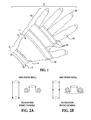
- FIG. 1 illustrates one embodiment of a barrier
- FIG. 2 illustrates alternate methods of compressing a barrier or portion thereof including an endpoint roll (A) or a midpoint roll (B);
- FIG. 3 illustrates alternate methods of compressing a barrier or portion thereof including an accordion fold (A) or a bellows fold (B);
- FIG. 4 illustrates one embodiment of a compressed barrier of FIG. 1 (A) and its subsequent deployment by insertion of a user's hand (B).
- FIG. 1 is a perspective view of a barrier in the conformation of a medical examination glove that is formed of a plurality of cylinders affixed to a bracelet.
- a barrier 1 includes a bracelet 2 defining a plane that is attached to a first cylinder 4 at a first end of the first cylinder 4.
- a bracelet 2 has a width, cross-sectional length, and cross-sectional area.
- a plane defined by a bracelet 2 is appreciated to be of width optionally substantially equal to or smaller than the width of the bracelet 2 and is at most no wider than a cross-sectional area of the bracelet. As such, when a cylinder is compressed into a compressed conformation the entire cylinder can be within the plane.
- a bracelet 2 is optionally continuous or discontinuous in outer circumference. In some embodiments a bracelet 2 is discontinuous in outer circumference such that it is collapsible for storage or transport yet may be opened to accept an object in the interior of the bracelet 2.
- a bracelet 2 optionally includes a fastener 23 openable to sufficient dimension that a human hand or foot, optionally that of an adult, can fit through the center portion of the bracelet 2 and allow the hand or foot to contact a portion of a cylinder.
- a bracelet 2 can be made of any material with suitable rigidity to either hold a shape on its own or with additional support.
- a bracelet is made of any polymeric material such as thermoplastics or thermoset resins.
- Other illustrative materials include metals such as stainless steel, glass, natural or synthetic rubbers such as latex rubber, nitrile, vinyl, or other materials known in the art.
- a length reducing first cylinder 4 is attached to a bracelet 2 at a first end.
- a cylinder 4 is optionally made of the same or a different material than that of the bracelet 2.
- a first cylinder is made of a biofluid-impermeable material that is either of synthetic or natural origin.
- Illustrative examples include latex, vinyls, or nitriles.
- the material of a first cylinder is not biofluid impermeable yet will be sufficient to offer sanitary protection to a user.
- Illustrative examples include flexible vinyl or plastic sheeting or other materials known in the art.
- a first cylinder 4 optionally includes three regions.
- a wrist region 6 is appreciated as being proximal to a bracelet 2 and interconnected therewith. This wrist region 6 is continuous with a palm region 8 that may be of greater or similar cross-sectional area as that of the wrist region.
- the palm region 8 is optionally interconnected to a finger region 10.
- a wrist region, palm region, or both optionally have greater cross-sectional area than a bracelet.
- a finger region 10 optionally includes one or more finger cylinders 16 attached to a region of a first cylinder 4 at a point distant from the first end such as in the area of a palm region 8. In some embodiments, the finger cylinders 16 are of smaller cross-sectional area than a first cylinder and can be independently tailored to a user's finger size.
- a terminal end of one or more finger cylinders is optionally dimensioned so as to form conformational contact with a phalanx of a subject.
- the human fingers typically have a diameter of 12 to 23 millimeters and a circumference of 40 to 70 millimeters. As such a dimension of at least a portion of a finger cylinder, such as any cross-sectional length, is smaller or within the range of typical human finger diameter.
- the cross-sectional area of a finger cylinder 16, or a first cylinder 4 is optionally uniform or variable.
- a terminal end 20 of a finger cylinder 16 is optionally of smaller cross-sectional area than an insertion end so that a subject's finger upon insertion into a finger cylinder 16 allows conformational contact to occur at the fingertip while a looser fit is achieved at the base of the finger.
- a first cylinder 4 optionally includes one or more fenestrated caps 18 that represent a division between a first cylinder 4 and one or more finger cylinders 16. As illustrated in FIG. 1 , five finger cylinders 16 are connected to a single first cylinder 4 via a plurality of fenestrated caps 18. A first fenestrated cap is positioned at a location in a first cylinder 4 to define the base of a first finger cylinder that is optionally intended to accept the thumb of a subject. An optional second fenestrated cap 18 defines the intersection between a first cylinder 4 and a finger cylinder 16 that is optionally intended to accept a digitus minimus of a subject's hand.
- a third fenestrated cap 18 is optionally located further terminal on a first cylinder 4 to define an intersecting region between the first cylinder 4 and as many as three additional finger cylinders 16 that are optionally designed to accept a digitus secundus manus, a digitus medias, or a digitus annularis.
- a fenestrated cap is merely a region demarking the beginning of any other cylinder attached to a first cylinder.
- the one or more fenestrated caps 20 are optionally made from the same or different material as a first cylinder or a finger cylinder.
- a fenestrated cap 20 is optionally of greater or reduced elasticity from the first cylinder wall material or the material of a finger cylinder. Decreased elasticity is optionally achieved by a thickening in the material that defines the location of the fenestrated cap. This thickening in the material at these locations optionally serves to increase the resilience of the material and decrease the likelihood of tears at these locations.
- a first cylinder 4 and/or one or more finger cylinders 16 optionally includes an end cap 20 that closes an end of the cylinder.
- An end cap 20 provides a closed terminal end to the cylinder, thus, creating barrier protection around the entire cylinder 4 excepting the bracelet 2.
- An end cap 20 is optionally attached to or continuous with the wall of a cylinder.
- An end cap 20 is optionally continuous with the wall of an adjacent cylinder.
- An end cap 20 is optionally made of similar material or different material than the cylinder 16 to which it is attached.
- the area of the end cap 20 is made of a material with decreased thickness or increased elasticity relative to the cylinder to provide improved conformational fit around the distal portion of a user's finger.
- a first cylinder 4 or a finger cylinder 16 optionally includes one or more ribs 12 that may be made of stiffer material or a thicker material than that which comprises the cylinder.
- a rib 12 is optionally included within the wall structure of a cylinder and prevents the lumen of the cylinder from collapsing after deployment. It is appreciated that several ribs may be included at different locations within the same or different cylinders 16 on a barrier.
- a first rib 12 is optionally located in the palm region which helps maintain a loose fit over the palm of a user thereby increasing comfort and decreasing the likelihood of excessive perspiration.
- Additional ribs are optionally located at the base of each finger cylinder 16 near the fenestrated cap 20 or near the joints between the proximal and intermediate phalanges of a user. Inclusion of one or more ribs also increases user comfort and flexibility while still allowing conformational contact around the distal phalanx of a subject.
- One or more bands 14 is optionally included at one or more regions within a barrier.
- Bands are localized segments of elastic material that are also optionally included within the wall structure of a cylinder 4 which encourages the lumen of the cylinder to reduce in cross-sectional area after deployment to help the cylinder 4 conform closely to the shape that is contained therein at the point of the band 14.
- a band 14 is located in the wrist region 6 that, after deployment, helps secure the barrier to the hand of a user while still allowing a loose fit in the palm region.
- a band 14 is optionally made out of the same material or different material as that of the cylinder into which it is incorporated.
- a band 14 is optionally an area of increased thickness or simply reduced cross-sectional area.
- a cylinder 4 is optionally sufficiently dimensioned to fit relatively loosely around a user's palm and/or wrist. Relatively loosely is meant to refer to a loose fit relative to that of a traditional prior art latex or nitrile glove that is commonly used for medical examination.
- the conformational contact at the fingertips combined with the relatively loose fit around the palm and/or wrist of a subject leads to increased comfort and corresponding increased user compliance.
- a cylinder 4 Prior to being deployed, a cylinder 4 is optionally rolled or folded into a planar shape within the cross-sectional area of a bracelet 2. It is appreciated that different cylinders or different regions of the same cylinder are compressed, folded, or rolled so as to create an overall planar shape of the entire barrier structure optionally within the internal dimension of the bracelet.
- An inventive cylinder optionally includes a marking 24.
- a marking 24 optionally illustrates the location to place a finger or a portion of the foot into a region within the cross-sectional area of a bracelet to allow for maximal ease of deployment of the barrier. In some embodiments five markings are included at each of the end caps 20 on finger cylinders 16. Markings 24 are optionally a different color, texture, material, or other discernable difference, than the remainder of the barrier so a user can readily see where to stick the distal portion of each phalanx to direct him to the conformational contact portion of each of the finger cylinders thereby maximizing ease of deploying the barrier and without the need for sliding the barrier material over any portion of the hand.
- a barrier as provided by the subject invention optionally eliminates sliding an object into a cylinder by using a folding and/or rolling mechanism that allows the terminal region or end cap to be immediately contacted by a subject's finger as a first point of insertion. This creates maximal conformational contact between the fingertip and the end cap and easy and rapid deployment of the remainder of the barrier over the subject's hand.
- a bracelet 2 includes a communications device 22.
- a communications device is optionally referred herein as a tag.
- tags such as identification tags operable as a communications device are found in U.S. Publication No. 2005/0258939 , the contents of which are incorporated herein by reference.
- a communications device 22 is optionally configured to receive, store, transmit, or combinations thereof, data such as data indicating usage of a barrier, time of use, moving a bracelet into a site, or other information.
- a communications device 22 is optionally coupled to a scanning device such that transmitting energy or signals between a communications device and a scanning device or vice versa allows the transfer of information to or from a communications device.
- An illustrative example of a communications device 22 is a radiofrequency identification (RFID) tag.
- RFID radiofrequency identification
- a tag With the emergence of an RFID standards authority, a tag is readily tracked to a specific source such as a particular barrier. Owing to the data-carrying capacity of a tag, a large number of tags are capable of rapid interrogation.
- the size of a tag is optionally on the scale of 1 to 500 microns allowing ready labeling of a bracelet or other region of a barrier.
- a communications device 22 is optionally located on a bracelet surface or is embedded in the structural material of the bracelet.
- Use of an RFID tag optionally creates an active bracelet capable of communicating information to a scanning device and thereby facilitating information exchange with a computer database.
- An RFID tag is optionally active or passive. Active and passive RFID tags, their manufacture, and use are known in the art. In some embodiments a passive RFID tag is used where a scanning device emits a radiofrequency signal that energizes a coiled antenna from which the tag draws power, thus, emitting a signal that is receivable by the scanner or other receiving device. Such devices are illustratively described in U.S. Patent No. 5,053,774 , the contents of which are incorporated herein by reference.
- a communications device uses "smart card” technology, the resulting barrier operating in a manner as is apparent to one skilled in the art.
- a communications device 22 optionally communicates identifying information alone or is additionally or alternatively capable of reporting more complex information such as environmental measurements and other information such as is described in U.S. Patent Nos. 5,287,113 ; 5,532,686 ; 5,257,011 ; 6,078,251 ; and 6,617,963 , the contents of each of which are incorporated herein by reference.
- a communications device 22 functions to passively communicate information such as use or identification information to a scanning device.
- a monochromatic optical signal emitted by a scanning device is directed to a passive tag.
- the optical signal optionally has a wavelength ranging from ultraviolet through visible to infrared.
- Optical signals are optionally monochromatic and emitted by a scanning device that includes a laser or photodiode, or the signal is polychromatic optionally such as that obtained from an incandescent light source.
- a passive communications device optionally includes a reflective or retro-reflective transponder that interacts with the incoming optical signal to return a reflected output signal communicating an identification code.
- the identification tag may communicate information specific to the barrier, the barrier type, lot, origin of manufacture, or may simply identify that a barrier is used within a site.
- Methods of encoding a tag with a unique code illustratively include the deposition of bandpass filter coatings onto a reflective surface of the passive optical identification tag; the placement of one or more dye molecules onto the surface, the dye molecules being stimulated by the incoming optical signal so as to emit a characteristic reflection wavelength, fluorescence, or phosphorescence; and scoring a reflective surface to create light scattering of an incoming optical signal of a predetermined magnitude.
- an inventive barrier is a foot cover.
- a foot cover is optionally a sterile cover such as that used in surgical areas, or a sterile or non-sterile cover the like of which is useful at security sites.
- a bracelet is attached to a first cylinder that is made of protective, but not necessarily biofluid-impermeable material, and may but need not be sterile.
- the first cylinder includes an end cap that is attached to or continuous with the wall of the cylinder.
- a barrier is optionally provided in pairs.
- a barrier is optionally tailored to fit the right hand or left hand of a user.
- barriers are optionally provided in right and left pairs.
- a barrier may be provided in pairs, but each barrier is indistinguishable from the other.
- a barrier is intended to accept a foot of a user. Due to the generally loose fit of the barrier, there may be no need to provide a right or left hand specific barrier in a pair.
- a barrier is provided with a communications device located on the barrier wall, on the bracelet, or both.
- a "site” is defined by some geographical characteristics, coordinates like longitude and latitude obtained from a GPS-type reading, or a geographic or physical location associated with a scan event by a particular scanning device.
- a site is a patient's room or treatment area.
- a scanning device is used at a site to interrogate the site for the presence of a deployed barrier and communicate the use of a barrier to a database which records such use.
- the database includes application-specific information that illustratively includes compliance information, administration information, inventory information, treatment information, or combinations thereof. Based on the recording of information and comparison with treatment delivery, user compliance is readily measured.
- a database also records usage information so as to provide a measure of inventory levels and alert an operator that more barriers are needed in a particular site.
- a scanning device optionally is used to monitor a site for the presence of a deployed barrier.
- a scanning device optionally emits a signal such as an infrared signal, radiofrequency signal, ultrasonic signal, or other signal that is receivable, reflectable, or other, by a tag on a barrier.
- a scanning device is in a receive mode so that a signal emitted by a communications device is read by the scanning device when a barrier is used in a site area.
- Upon receiving a signal from a communications device that the device is deployed within the site, such use is communicated to a database that is housed within the communications device or is remote therefrom such as hosted by a remote computer system in communication with the scanning device.
- the barrier type, source, specific identifier, or other barrier information is recorded in the database.
- a database optionally stores the identification of a user.
- a user optionally scans illustratively an identification badge prior to entering a site. When the user deploys a barrier the use of the barrier is correlated with the user within the site. This allows monitoring and metrics of user compliance and identification of users that require remediation.
- a passive tag is located on a bracelet or the wall of a barrier.
- a site is a treatment area monitored by one or a plurality of scanning devices defining the dimensions of the site.
- the passive tag is then operable to communicate a signal to a scanning device that the barrier has been removed from the dispenser and is therefore deployed by the user.
- the scanner communicates the received signal to a database that records the barrier use.
- An illustrative example of a passive tag is described in U.S. Publication No. 2005/0258939 , the contents of which are incorporated herein by reference.
- a communications device is printed or otherwise located directly on the surface of a cylinder.
- an optical tag is located on a cylinder that when the cylinder is deployed such as by unrolling, unfolding, or combinations thereof, the optical tag is then positioned to communicate a signal to a scanning device. This prevents recording use of a barrier absent its actual deployment.
- the communications device is used to create an audit trail of patient contact.
- Each time a user deploys a barrier its use is recorded as an event of patient contact.
- the event can be correlated with a treatment type, time, location of the site, patient identification, or identification of the user to create a recorded trail of patient contact. This information can be used to confirm that a particular user interacted with a patient, that a barrier was used in a site area, or that a particular treatment was properly delivered.
- Communications devices on a foot barrier, a hand barrier, or any other barrier type optionally emit, reflect, or redirect distinguishable signals so that use of illustratively a glove barrier, a foot barrier, or both are simultaneously or sequentially detected by a scanning device and their deployment recorded in a database.
- FIG. 2 illustrates two optional methods of rolling a cylinder.
- FIG. 2A illustrates an endpoint roll where one terminal end of a cylinder serves as the initiation point of the roll. The cylinder lumen is rolled around this initiation point until the terminal end or the end that includes a simple cap is in a relative planar orientation to the initiation point of the roll.
- FIG. 2B illustrates a midpoint roll where a roll is initiated at some point between a proximal end and distal end of a cylinder. A proximal end is defined herein as the end nearest a bracelet.
- a midpoint roll offers the advantage of allowing several cylinders that are attached to each other, such as a first cylinder which is attached to a finger cylinder, to be independently rolled to form an overall planar shape and increase ease of deployment by allowing simultaneous or sequential unrolling of each of the cylinders in independent fashion. It is appreciated that any point between the proximal and distal ends of a cylinder can serve as the initiation point of a midpoint roll. In some embodiments, the initiation point of the midpoint roll is near the midpoint of the cylinder length.
- FIG. 3A illustrates an accordion fold which in the case of a cylinder is a circular fold that results in a fan-like compression of the cylinder lumen.
- FIG. 2B Another illustrative fold is depicted in FIG. 2B as a bellows fold.
- a bellows fold serves to longitudinally collapse a cylinder that may have nonparallel ends or other non-uniform shape.
- Patent No. 6,054,194 illustrates many different mechanisms for bellows folding and is incorporated herein by reference.
- FIG. 4A illustrates one embodiment of a barrier in the form of a glove that is folded and rolled at various locations on a plurality of cylinders so as to form an essentially planar shape within the plane of the bracelet.
- FIG. 4A illustrates a compressed form of the barrier of FIG. 1 .
- a first cylinder is compressed by a midpoint roll up to the point of a first fenestrated cap. This first fenestrated cap illustrates the division between a first cylinder and a finger cylinder that is operable to accept a thumb.
- the finger cylinder operable to accept a thumb is rolled via a midpoint roll into essentially the same plane as that of the lower portion of the first cylinder.
- the first cylinder is optionally folded by an accordion fold up to a second fenestrated cap that serves as a division between a first cylinder and a finger cylinder operable to accept a digitus minimus.
- This digitus minimus finger cylinder is optionally rolled via a midpoint roll also into the same plane as the first cylinder.
- a second accordion fold is optionally included between the second fenestrated cap and the third fenestrated cap.
- each finger cylinder is rolled by a midpoint roll.
- This overall configuration collapses a barrier in the form of a glove into an essentially single plane. Collapsing a barrier in this or other manner exposes the end caps as sides of the established plane and able to accept initial contact of a hand upon insertion into the bracelet. Collapsing the cylinders into the plane also allows rapid and easy insertion of a subject's finger or entire hand into a barrier for rapid deployment without the risk of contaminating the external surface of the barrier, increased likelihood of tearing the barrier, or other compromise.
- Patents and publications mentioned in the specification are indicative of the levels of those skilled in the art to which the invention pertains. These patents and publications are incorporated herein by reference to the same extent as if each individual application or publication was specifically and individually incorporated herein by reference.
Landscapes
- Health & Medical Sciences (AREA)
- Surgery (AREA)
- Life Sciences & Earth Sciences (AREA)
- Engineering & Computer Science (AREA)
- Biomedical Technology (AREA)
- Heart & Thoracic Surgery (AREA)
- Medical Informatics (AREA)
- Molecular Biology (AREA)
- Animal Behavior & Ethology (AREA)
- General Health & Medical Sciences (AREA)
- Public Health (AREA)
- Veterinary Medicine (AREA)
- Accommodation For Nursing Or Treatment Tables (AREA)
Applications Claiming Priority (1)
| Application Number | Priority Date | Filing Date | Title |
|---|---|---|---|
| US12/959,782 US8578519B2 (en) | 2010-12-03 | 2010-12-03 | Surgical glove appliance device |
Publications (1)
| Publication Number | Publication Date |
|---|---|
| EP2460488A2 true EP2460488A2 (de) | 2012-06-06 |
Family
ID=45218381
Family Applications (1)
| Application Number | Title | Priority Date | Filing Date |
|---|---|---|---|
| EP11191957A Withdrawn EP2460488A2 (de) | 2010-12-03 | 2011-12-05 | Chirurgische Handschuhanwendungsvorrichtung |
Country Status (2)
| Country | Link |
|---|---|
| US (1) | US8578519B2 (de) |
| EP (1) | EP2460488A2 (de) |
Families Citing this family (9)
| Publication number | Priority date | Publication date | Assignee | Title |
|---|---|---|---|---|
| US10321725B2 (en) | 2011-10-26 | 2019-06-18 | Allen B. Kantrowitz | Infection control glove with sensory contamination indicator |
| US20160143379A1 (en) * | 2013-07-22 | 2016-05-26 | Summit Glove Inc. | Glove having a widened cuff and with finger regions that include a flexible hinge region |
| US9380794B2 (en) * | 2013-07-22 | 2016-07-05 | Summit Glove Inc. | Method and system for tracking glove failure |
| US12446639B2 (en) | 2015-04-24 | 2025-10-21 | Summit Glove Inc. | Drug resistant glove |
| USD895228S1 (en) | 2016-05-25 | 2020-09-08 | Summit Glove Inc. | Patterned glove with a straight cuff |
| USD893129S1 (en) | 2016-05-25 | 2020-08-18 | Summit Glove Inc. | Patterned glove with a flared cuff |
| US20190045860A1 (en) * | 2017-08-11 | 2019-02-14 | Pm Gloves | Glove's color beading ring |
| US10413004B1 (en) | 2018-05-01 | 2019-09-17 | Ross Rudolph | Protective gloves with improved fingertip fitment and methods and mold-forms for manufacturing such gloves |
| CN113040450B (zh) * | 2021-02-25 | 2023-10-13 | 国网安徽省电力有限公司枞阳县供电公司 | 一种具有调节松弛程度的电力用冬季防护手套 |
Citations (8)
| Publication number | Priority date | Publication date | Assignee | Title |
|---|---|---|---|---|
| US5053774A (en) | 1987-07-31 | 1991-10-01 | Texas Instruments Deutschland Gmbh | Transponder arrangement |
| US5257011A (en) | 1991-12-03 | 1993-10-26 | Avid Corporation | Data altering means for multi-memory electronic identification tag |
| US5287113A (en) | 1990-02-12 | 1994-02-15 | Texas Instruments Deutschland Gmbh | Voltage limiting batteryless transponder circuit |
| US5532686A (en) | 1991-07-29 | 1996-07-02 | Bio Medic Data Systems, Inc. | Programmable transponder |
| US6054194A (en) | 1997-02-11 | 2000-04-25 | Kane; Nathan R. | Mathematically optimized family of ultra low distortion bellow fold patterns |
| US6078251A (en) | 1996-03-27 | 2000-06-20 | Intermec Ip Corporation | Integrated multi-meter and wireless communication link |
| US6617963B1 (en) | 1999-02-26 | 2003-09-09 | Sri International | Event-recording devices with identification codes |
| US20050258939A1 (en) | 2004-02-13 | 2005-11-24 | Kantrowitz Allen B | Optical transponder containing identification tag |
Family Cites Families (34)
| Publication number | Priority date | Publication date | Assignee | Title |
|---|---|---|---|---|
| US312518A (en) * | 1885-02-17 | schoenhof | ||
| US2169939A (en) * | 1937-02-16 | 1939-08-15 | Forest L Anderson | Swimming glove |
| US2266716A (en) * | 1939-03-01 | 1941-12-16 | Isaac W Robertson | Rubber glove |
| US2299855A (en) * | 1939-04-10 | 1942-10-27 | Smith Emerson Sterling | Static ring for linemen's gloves |
| US2641767A (en) * | 1951-02-27 | 1953-06-16 | Rosa Elizabeth La | Rubber glove |
| US2707283A (en) * | 1953-01-14 | 1955-05-03 | Silver Wilfred | Glove |
| US3099015A (en) * | 1960-06-14 | 1963-07-30 | William J Renehan | Joint for interconnecting tubular members |
| US3235881A (en) * | 1963-10-04 | 1966-02-22 | Dow Chemical Co | Plastic glove |
| US3231910A (en) * | 1964-01-16 | 1966-02-01 | Archie L Tegland | Swimming glove |
| US3283338A (en) * | 1965-09-09 | 1966-11-08 | Landau Lucian | Glove construction for providing comfort to the wearer |
| FR1508320A (fr) * | 1966-11-23 | 1968-01-05 | Mapa | Gant de caoutchouc utilisable indifféremment sur les deux mains |
| US3386104A (en) * | 1967-04-18 | 1968-06-04 | John A. Casey | Safety glove and internal finger protector |
| US3476109A (en) * | 1967-07-17 | 1969-11-04 | William P Hurney | Fingertip bandages |
| FR2195510B1 (de) * | 1972-08-10 | 1974-12-27 | Piercan Sa | |
| US4069913A (en) * | 1975-08-11 | 1978-01-24 | Harrigan Roy Major | Surgical glove package and fixture |
| US4275812A (en) * | 1975-10-01 | 1981-06-30 | Poncy Mark P | Surgical glove package and donning method |
| US4141609A (en) * | 1977-11-25 | 1979-02-27 | Central Research Laboratories, Inc. | System for effecting access into sealed enclosures |
| US5093933A (en) * | 1991-06-14 | 1992-03-10 | Berry Carolyn M | Gluing glove construction |
| US5380078A (en) * | 1993-06-22 | 1995-01-10 | W. L. Gore & Associates, Inc. | Retractable gloves for handling objects in isolation |
| AUPO310796A0 (en) * | 1996-10-17 | 1996-11-14 | Kk Poschelk Pty Ltd | Apparatus and method for fitting and removal of gloves |
| US5816440A (en) | 1997-03-01 | 1998-10-06 | Shields; Jack W. | Overfolded sterile glove dispensers |
| US5921434A (en) | 1998-03-26 | 1999-07-13 | Hollander; Kenneth A. | Disposable glove dispenser |
| US5975083A (en) | 1998-04-29 | 1999-11-02 | Henderson, Jr.; Ralph E. | Sanitary hand barrier |
| US6375034B1 (en) | 2000-03-21 | 2002-04-23 | Adrian Corbett | Glove dispenser |
| US20020040912A1 (en) | 2000-06-29 | 2002-04-11 | Mchugh Edward J. | Dispenser for medical products used in infection control |
| US6839912B2 (en) * | 2002-06-03 | 2005-01-11 | Morning Pride Manufacturing, L.L.C. | Protective glove having inner ribs between inner liner and outer shell |
| US7063233B2 (en) | 2002-06-13 | 2006-06-20 | Oneglove, Llc | Method of folding gloves and dispenser therefor |
| AU2003303948A1 (en) | 2002-08-08 | 2004-11-23 | La Jolla Biosciences | Compositions and methods for preventing infection |
| US20060107437A1 (en) * | 2004-09-30 | 2006-05-25 | Kimberly-Clark Worldwide, Inc. | Apparel with telescoping sleeves |
| US7242293B2 (en) * | 2004-12-21 | 2007-07-10 | Intel Corporation | Radio-frequency identification apparatus, systems, and methods |
| US20070118964A1 (en) | 2005-11-08 | 2007-05-31 | Sacco-Siebenman Llc | Glove having an attached item of jewelry |
| US7874455B2 (en) | 2005-12-13 | 2011-01-25 | Oneglove, Llc | Dispenser and gloves |
| US20070284387A1 (en) | 2006-06-09 | 2007-12-13 | Ellswood Mark R | Dispenser system |
| US7527181B1 (en) * | 2007-05-08 | 2009-05-05 | Sullivan Steven R | Glove donning system |
-
2010
- 2010-12-03 US US12/959,782 patent/US8578519B2/en not_active Expired - Fee Related
-
2011
- 2011-12-05 EP EP11191957A patent/EP2460488A2/de not_active Withdrawn
Patent Citations (8)
| Publication number | Priority date | Publication date | Assignee | Title |
|---|---|---|---|---|
| US5053774A (en) | 1987-07-31 | 1991-10-01 | Texas Instruments Deutschland Gmbh | Transponder arrangement |
| US5287113A (en) | 1990-02-12 | 1994-02-15 | Texas Instruments Deutschland Gmbh | Voltage limiting batteryless transponder circuit |
| US5532686A (en) | 1991-07-29 | 1996-07-02 | Bio Medic Data Systems, Inc. | Programmable transponder |
| US5257011A (en) | 1991-12-03 | 1993-10-26 | Avid Corporation | Data altering means for multi-memory electronic identification tag |
| US6078251A (en) | 1996-03-27 | 2000-06-20 | Intermec Ip Corporation | Integrated multi-meter and wireless communication link |
| US6054194A (en) | 1997-02-11 | 2000-04-25 | Kane; Nathan R. | Mathematically optimized family of ultra low distortion bellow fold patterns |
| US6617963B1 (en) | 1999-02-26 | 2003-09-09 | Sri International | Event-recording devices with identification codes |
| US20050258939A1 (en) | 2004-02-13 | 2005-11-24 | Kantrowitz Allen B | Optical transponder containing identification tag |
Also Published As
| Publication number | Publication date |
|---|---|
| US20120137402A1 (en) | 2012-06-07 |
| US8578519B2 (en) | 2013-11-12 |
Similar Documents
| Publication | Publication Date | Title |
|---|---|---|
| US8578519B2 (en) | Surgical glove appliance device | |
| US11633181B2 (en) | System and method for increased operating room efficiency | |
| US10603033B2 (en) | Systems and methods for increased operating room efficiency | |
| JP5893922B2 (ja) | ディスポーザブル・オキシメータ・デバイス | |
| US20130268293A1 (en) | Hygiene compliance systems and methods including optical tags | |
| US20080051746A1 (en) | Surgical sponge incorporating rfid technology and method of use | |
| US20110185611A1 (en) | Apparatus and method for rapid identification and tracking of individuals in an emergency situation | |
| JP2017515630A5 (de) | ||
| US7370369B2 (en) | Sanitary arm sleeve structure | |
| US20080277405A1 (en) | Dispensing Apparatus Containing a Glove Stack and Method of Folding Gloves Therein | |
| GB2492455A (en) | Identity bracelet with pocket for encapsulated device | |
| JP3778272B2 (ja) | 医事管理用タグ | |
| US10555789B2 (en) | Padded medical procedure glove | |
| US20160324429A1 (en) | Blood Pressure Cuff Pathogen Barrier | |
| KR102334134B1 (ko) | 다기능 신체 착용 밴드 | |
| US20120095450A1 (en) | Elongated and retractable sterile marker apparatus | |
| ES2624696B1 (es) | Placa para la toma de muestras de flora bacteriana en la mano | |
| KR20210050607A (ko) | 큐알 코드를 이용한 병원용 웨어러블 디바이스의 사용자 등록 시스템 및 그 방법 | |
| Lindqvist | Rfid monitoring of health care routines and processes in hospital environment | |
| WO2010102333A2 (en) | Multi-functional covering sleeve for finger or toe | |
| JP2008113720A (ja) | 認知症患者観察システム | |
| CN117133417A (zh) | 一种无菌包自助配发系统 | |
| UKKONEN et al. | health-care sensing |
Legal Events
| Date | Code | Title | Description |
|---|---|---|---|
| PUAI | Public reference made under article 153(3) epc to a published international application that has entered the european phase |
Free format text: ORIGINAL CODE: 0009012 |
|
| AK | Designated contracting states |
Kind code of ref document: A2 Designated state(s): AL AT BE BG CH CY CZ DE DK EE ES FI FR GB GR HR HU IE IS IT LI LT LU LV MC MK MT NL NO PL PT RO RS SE SI SK SM TR |
|
| AX | Request for extension of the european patent |
Extension state: BA ME |
|
| STAA | Information on the status of an ep patent application or granted ep patent |
Free format text: STATUS: THE APPLICATION IS DEEMED TO BE WITHDRAWN |
|
| 18D | Application deemed to be withdrawn |
Effective date: 20140701 |