EP2462749B2 - Verfahren für dvb-t2-rundfunk mit einfügung regionaler inhalte und in diesem verfahren verwendete vorrichtung - Google Patents
Verfahren für dvb-t2-rundfunk mit einfügung regionaler inhalte und in diesem verfahren verwendete vorrichtung Download PDFInfo
- Publication number
- EP2462749B2 EP2462749B2 EP11741425.0A EP11741425A EP2462749B2 EP 2462749 B2 EP2462749 B2 EP 2462749B2 EP 11741425 A EP11741425 A EP 11741425A EP 2462749 B2 EP2462749 B2 EP 2462749B2
- Authority
- EP
- European Patent Office
- Prior art keywords
- stream
- regional
- national
- broadcasting
- programmes
- Prior art date
- Legal status (The legal status is an assumption and is not a legal conclusion. Google has not performed a legal analysis and makes no representation as to the accuracy of the status listed.)
- Active
Links
Images



Classifications
-
- H—ELECTRICITY
- H04—ELECTRIC COMMUNICATION TECHNIQUE
- H04N—PICTORIAL COMMUNICATION, e.g. TELEVISION
- H04N5/00—Details of television systems
- H04N5/38—Transmitter circuitry for the transmission of television signals according to analogue transmission standards
-
- H—ELECTRICITY
- H04—ELECTRIC COMMUNICATION TECHNIQUE
- H04H—BROADCAST COMMUNICATION
- H04H20/00—Arrangements for broadcast or for distribution combined with broadcast
- H04H20/18—Arrangements for synchronising broadcast or distribution via plural systems
-
- H—ELECTRICITY
- H04—ELECTRIC COMMUNICATION TECHNIQUE
- H04H—BROADCAST COMMUNICATION
- H04H20/00—Arrangements for broadcast or for distribution combined with broadcast
- H04H20/65—Arrangements characterised by transmission systems for broadcast
- H04H20/67—Common-wave systems, i.e. using separate transmitters operating on substantially the same frequency
-
- H—ELECTRICITY
- H04—ELECTRIC COMMUNICATION TECHNIQUE
- H04N—PICTORIAL COMMUNICATION, e.g. TELEVISION
- H04N21/00—Selective content distribution, e.g. interactive television or video on demand [VOD]
- H04N21/20—Servers specifically adapted for the distribution of content, e.g. VOD servers; Operations thereof
- H04N21/23—Processing of content or additional data; Elementary server operations; Server middleware
- H04N21/234—Processing of video elementary streams, e.g. splicing of video streams or manipulating encoded video stream scene graphs
- H04N21/23424—Processing of video elementary streams, e.g. splicing of video streams or manipulating encoded video stream scene graphs involving splicing one content stream with another content stream, e.g. for inserting or substituting an advertisement
-
- H—ELECTRICITY
- H04—ELECTRIC COMMUNICATION TECHNIQUE
- H04N—PICTORIAL COMMUNICATION, e.g. TELEVISION
- H04N21/00—Selective content distribution, e.g. interactive television or video on demand [VOD]
- H04N21/20—Servers specifically adapted for the distribution of content, e.g. VOD servers; Operations thereof
- H04N21/23—Processing of content or additional data; Elementary server operations; Server middleware
- H04N21/236—Assembling of a multiplex stream, e.g. transport stream, by combining a video stream with other content or additional data, e.g. inserting a URL [Uniform Resource Locator] into a video stream, multiplexing software data into a video stream; Remultiplexing of multiplex streams; Insertion of stuffing bits into the multiplex stream, e.g. to obtain a constant bit-rate; Assembling of a packetised elementary stream
- H04N21/23608—Remultiplexing multiplex streams, e.g. involving modifying time stamps or remapping the packet identifiers
-
- H—ELECTRICITY
- H04—ELECTRIC COMMUNICATION TECHNIQUE
- H04N—PICTORIAL COMMUNICATION, e.g. TELEVISION
- H04N21/00—Selective content distribution, e.g. interactive television or video on demand [VOD]
- H04N21/40—Client devices specifically adapted for the reception of or interaction with content, e.g. set-top-box [STB]; Operations thereof
- H04N21/43—Processing of content or additional data, e.g. demultiplexing additional data from a digital video stream; Elementary client operations, e.g. monitoring of home network or synchronising decoder's clock; Client middleware
- H04N21/44—Processing of video elementary streams, e.g. splicing a video clip retrieved from local storage with an incoming video stream or rendering scenes according to encoded video stream scene graphs
- H04N21/44016—Processing of video elementary streams, e.g. splicing a video clip retrieved from local storage with an incoming video stream or rendering scenes according to encoded video stream scene graphs involving splicing one content stream with another content stream, e.g. for substituting a video clip
-
- H—ELECTRICITY
- H04—ELECTRIC COMMUNICATION TECHNIQUE
- H04N—PICTORIAL COMMUNICATION, e.g. TELEVISION
- H04N21/00—Selective content distribution, e.g. interactive television or video on demand [VOD]
- H04N21/60—Network structure or processes for video distribution between server and client or between remote clients; Control signalling between clients, server and network components; Transmission of management data between server and client, e.g. sending from server to client commands for recording incoming content stream; Communication details between server and client
- H04N21/61—Network physical structure; Signal processing
- H04N21/6106—Network physical structure; Signal processing specially adapted to the downstream path of the transmission network
- H04N21/6112—Network physical structure; Signal processing specially adapted to the downstream path of the transmission network involving terrestrial transmission, e.g. DVB-T
-
- H—ELECTRICITY
- H04—ELECTRIC COMMUNICATION TECHNIQUE
- H04H—BROADCAST COMMUNICATION
- H04H20/00—Arrangements for broadcast or for distribution combined with broadcast
- H04H20/10—Arrangements for replacing or switching information during the broadcast or the distribution
- H04H20/106—Receiver-side switching
-
- H—ELECTRICITY
- H04—ELECTRIC COMMUNICATION TECHNIQUE
- H04H—BROADCAST COMMUNICATION
- H04H20/00—Arrangements for broadcast or for distribution combined with broadcast
- H04H20/28—Arrangements for simultaneous broadcast of plural pieces of information
- H04H20/30—Arrangements for simultaneous broadcast of plural pieces of information by a single channel
Definitions
- the present invention relates to the field of broadcast television program methods and devices used in such methods.
- the invention proposes a broadcasting method allowing the personalization of program streams for broadcast areas covered by a transmission network on a single modulation frequency in accordance with the DVB-T2 standard (Digital Video Broadcast - Terrestrial version 2 in English) the second version of the terrestrial video broadcast standard.
- DVB-T2 standard Digital Video Broadcast - Terrestrial version 2 in English
- Digital broadcast networks on a single modulation frequency or SFN (Single Frequency Network) networks are becoming widespread in a number of broadcast systems.
- DVB-T Digital Video Broadcasting - Terrestrial
- DVB-H Digital Video Broadcasting - Handheld
- ETSI EN 302 304 DVB-H - Transmission System for Handheld Terminals
- Chinese standard DTMB Digital Terrestrial Multimedia Broadcast in English
- DMB-T / H Digital Multimedia Broadcast-Terrestrial / Handheld
- the DVB organization has now standardized a second version for broadcasting terrestrial television programs, under the name of DVB-T2 ETSI EN302 755 V1.2.1, the invention falls within the scope of this standard.
- the SFN networks are characterized in that the broadcasting of the services is carried out by the transmission of the same data stream by different transmitters on one and the same modulation frequency. Therefore, it is necessary that these different transmitters receive exactly the same content and are finely synchronized with each other to avoid generating interference in the places at the junction of the coverage areas of different transmitters.
- This synchronization between the different SFN transmitters can, for example, be achieved by inserting into the stream distributed to these transmitters synchronization packets such as T2-MI packets (T2-Modulator Interface MIP in English, and MIP for Megapixel).
- synchronization packets such as T2-MI packets (T2-Modulator Interface MIP in English, and MIP for Megapixel).
- frame Initialization Packet) of the DVB-T2 timestamp type which correspond in the DVB-T2 standard to the timestamps used in the DVB-H and DVB-T standards.
- SFN diffusion is characterized by the definition of SFN plates.
- An SFN plate is a geographical area covered by a set of transmitters whose number is greater than or equal to one. These transmitters are finely synchronized and emit exactly the same data stream on the same frequency.
- Broadcasting a set of programs within a data flow over a geographic area is typically organized from a central point.
- the geographical area covered is typically composed of a plurality of SFN plates.
- the plurality of programs broadcast includes programs for the entire area covered and region-specific programs.
- the region is defined here as a unit, possibly unitary, of SFN plates within the area covered by the broadcast and in which the programs broadcast are the same.
- national programs for programs broadcast throughout the area and regional programs for programs broadcast only in one or more regions are widespread use of national programs for programs broadcast throughout the area and regional programs for programs broadcast only in one or more regions.
- the simplest way to broadcast these programs is to create a feed by region. This flow is composed for each region of all the national programs and regional programs specific to this region. These different streams are then transmitted from the central point of transmission and broadcast to the regions concerned.
- This solution poses a first problem which is the duplication of the diffusion of national programs. Indeed, the typical means of diffusion is the satellite, the described solution multiplies by the number of regions the diffusion of the national programs whereas ideally, a single diffusion of these programs could suffice. Satellite bandwidth is expensive.
- a second problem is that regional programs are typically available at the regional level. The creation of the different flows therefore requires to go back these regional flows to the central point of emission to constitute the different necessary flows.
- the invention aims to solve the above problems by a method of broadcasting a set of national and regional programs that do not require the duplication of the broadcasting of the national programs or to put the regional programs back to a central point.
- This method is based on the creation of different T2-MI streams using the physical layer tunneling technology defined in the DVB-T2 standard and called PLP (Physical Layer Pipe), a mechanism described in the document "Digital Video Broadcasting (DVB); Frame structure channel coding and modulation for a second generation digital terrestrial television broadcasting system (DVB-T2); AND IF EN 302 755 V1.1.1 (2009-09) ) ".
- a T2-MI stream is dedicated to national programs. T2-MI streams are created for regional programs.
- Each transmitter receives on the one hand the national T2-MI stream and at least one regional T2-MI stream. It has the means to replace at least one tunnel of the national T2-MI stream with a tunnel of the regional T2-MI stream to generate the T2-MI stream to be transmitted.
- the first architecture is illustrated by the Fig. 1 . It's a centralized architecture. All content or programs are aggregated at a central point. This central point is called the headend. Each region must therefore transmit its regional programs to the head of the network so that the different regional flows are created at the head of the network.
- the headend includes a device 1.1, or rather a set of devices, responsible for creating flows.
- This device receives in input on the one hand a set 1.2 of so-called national programs, because they are intended to be broadcast over an entire area typically representing a country. It must be understood here that we are talking about national programs and countries, but that this is only a technical area, a dissemination area. This zone may be more limited than a national territory or, on the contrary, cover several countries sharing the same broadcasting system.
- Device 1.1 also receives as input one or more regional programs 1.3.
- regional programs 1.3 we are talking about a region to be understood in the sense of the patent as a unified area of diffusion. That is, an area where the same set of programs must be broadcast.
- the device creates a set of streams 1.4.
- the DVB standard in its first version defines a stream transport stream format TS (Transport Stream in English), this stream is directly constituted by a multiplex of the various programs.
- the DVB standard in version 2 defines a new stream format called T2-MI stream.
- a T2-MI stream consists of a set of isolated physical layer tunnels. Each tunnel contains a multiplex of programs corresponding to a stream TS within the meaning of version 1 of the standard.
- this solution creates a T2-MI flow per region.
- the T2-MI stream is therefore composed of the different programs to be broadcast on a given region. There is shown in the figure two regions 1.7 and 1.8 each composed of a SFN plate. It should be understood that a region can be composed of one or more SFN plates.
- Satellite broadcasting typically takes place via satellite 1.5, which retransmits the different T2-MI 1.6 streams to the regions.
- Satellite broadcasting is just one example, any other means of dissemination that can be used.
- the advantage of satellite is that it allows wide coverage of a set of potentially numerous transmitters that are far apart. Depending on the territory to be covered, it may be envisaged a diffusion by optical fiber for example.
- Each T2-MI stream because it must include all the programs intended for a given region, includes on the one hand all the national programs that must be distributed everywhere and, on the other hand, all the regional programs. intended for the region concerned. It is easy to see that the dissemination of national programs is duplicated within each of the T2-MI streams created. This duplication is particularly detrimental in the case of a satellite broadcast because of the cost of the bandwidth.
- the regional programs 1.3 of the different regions must be available at the head of the network 1.1. It is therefore necessary to transfer this program, typically created at the regional level, to the central network head of the zone. This transfer is also expensive.
- the Fig. 2 illustrates another known architecture for regionalized DVB-T broadcast.
- a national network head 2.1 which takes as input all the national programs 2.2.
- This national headend generates a single T2-MI 2.3 stream of national programs which is then broadcast to the regions.
- This regional network head receives, on the one hand, the T2-MI stream of national programs 2.3, but also one or more regional programs 2.5.
- the DVB-T2 standard allows the addition of one or more additional programs to an existing T2-MI stream (Digital Video Broadcasting (DVB); Implementation guidelines for a second generation digital terrestrial television broadcasting system (DVB-T2); DVB Document A133 June 2010 20102010Ds 6.2.6 "The concept of a T2-system", in particular Figure 26: "Transmissions in a T2-system” and section 7.6tio "Regional / local content insertion”).
- the regional programs are then typically received in the form of TS transport stream and not in the form of T2-MI stream.
- the regional headend then generates a regional T2-MI stream 2.7, 2.8 and 2.9, which includes the national programs and the region-specific regional program (s).
- this architecture solves the problem of the reassembly of regional programs at the level of the national head of the network.
- the national programs are broadcast once between the national network head and the regional network heads. They are broadcast a second time within regional T2-MI flows between the regional network heads and the different transmitters within the region. Especially since this second broadcast often requires the use of satellite to ensure access to many transmitters and rebroadcasters in a region, some may be difficult to connect to a cable network.
- the regional head end typically receives as input a T2-MI stream which contains the national programs and, possibly in different tunnels, the programs to be replaced by regional content.
- This regional content is typically received in the form of transport stream (TS stream).
- TS stream transport stream
- the data contained in the TS streams must then be combined to form T2-MI packets to be inserted instead of baseband blocks of the T2-MI multiplex. This is to remultiplex the T2-MI stream.
- This operation is done at a single point, the regional headend, for a given SFN plate. Indeed, it is typically non-deterministic and could not be done simply at the level of, for example, transmitters.
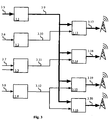
- the architecture according to the invention is illustrated Fig. 3 .
- a national headend 3.1 which, as in the previous architecture, receives as input a set of national programs 3.5 and generates a T2-MI flow of national programs 3.9.
- regional headers 3.2, 3.3 and 3.4 that receive regional programs 3.6, 3.7 and 3.8 that generate regional T2-MI flows 3.10, 3.11 and 3.12.
- These regional network heads are advantageously located within each region, but they can be located anywhere in the territory.
- These different T2-MI streams are broadcast to the transmitters of the different regions.
- Each transmitter is equipped with a T2-MI flux recomposition device according to the invention 3.13, 3.14, 3.15 and 3.16 which receives as input on the one hand the national T2-MI stream and on the other hand the T2-MI stream. region corresponding to the region of origin of said transmitter.
- This redialing device is responsible for replacing within the national T2-MI stream received some tunnels containing programs by one or more tunnels containing regional programs received within the regional T2-MI stream. It generates a T2-MI 3.17, 3.18, 3.19 and 3.20 flow that includes both national programs and regional programs.
- These T2-MI streams are directly transmitted by the transmitter connected to the T2-MI stream recomposition device.
- this architecture requires a single broadcast of each program between the head of the network concerned, national or regional, and the final transmitter for the broadcast of the regional multiplex. It also makes it possible, through advantageous placement of the regional network heads within the regions, to avoid a rise in regional programs at the level of the national head-end.
- the Fig. 4 illustrates the method of broadcasting programs according to an exemplary embodiment of the invention.
- the national T2-MI stream is generated.
- This T2-MI stream integrates programs to be broadcast throughout the territory.
- This T2-MI stream complies with the DVB-T2 standard.
- These tunnels have been integrated into the standard to allow different contents to be separated in the same multiplex. Typically they can differentiate from high definition video, conventional video or radio.
- the different tunnels are completely independent and can be broadcast according to broadcast parameters such as modulation parameters.
- the T2-MI stream may include several of these tunnels designed to isolate the broadcast of each type of content according to broadcast parameters adapted to it.
- the invention uses the tunnels mechanism for anything else. It is planned to isolate in a tunnel from the national T2-MI stream all the programs actually intended for national distribution. Individual national programs are isolated in specific tunnels that can be replaced in at least one region by a regional program. Schematically, we thus find in the national T2-MI stream a "big” tunnel which contains the programs actually broadcast in all regions and a plurality of "small” tunnels isolating each program that can be replaced in at least one region.
- the regional headends constitute the T2-MI flows comprising the program or programs specific to a given region.
- Each program is isolated in a particular tunnel. It is important here to set the T2-MI flow in a way that is compatible with the national T2-MI flow.
- a stream according to the DVB-T2 standard defines frames (T2Frame according to the vocabulary of the standard) endowed with a frame period, this frame period must be identical to that which is chosen for the T2-MI national stream .
- the tunnels are transported within the frames in the form of data blocks (Base Band Frame according to the vocabulary of the standard) whose size is configurable. It is necessary that the block size of regional T2-MI flows be identical to that set for the national T2-MI flow. We will come back in detail on this point when describing the T2-MI flux recomposition device.
- step 4.3 the national T2-MI stream and the various regional T2-MI streams are broadcast to the transmitters of the different regions.
- This broadcasting can be done by any broadcast channel such as the satellite that can easily cover a large area or a fiber optic network.
- the goal here is to bring the national T2-MI stream and the relevant regional T2-MI stream to each transmitter within a region.
- step 4.4 the two T2-MI streams, the national and the regional concerned, are received at each transmitter by a T2-MI flow recomposition device.
- the T2-MI stream recomposition device generates the final T2-MI stream by replacing within the national T2-MI stream one or more national programs with one or more regional programs received within the T2 stream.
- the replacement unit here is the physical layer tunnel or PLP.
- the replacement is based on the replacement of the blocks composing a tunnel of the national T2-MI stream by the blocks of another tunnel of the regional T2-MI stream. This operation being done at the level of each transmitter of the same SFN zone, it is essential that the generated T2-MI flows are perfectly synchronized and that the data which compose them are perfectly the same by the byte.
- This final T2-MI stream is then broadcast by the transmitters.
- each program is broadcast only once between the head of the network that manages it, national or regional, and the final transmitters.
- the T2-MI 5.1 flow recomposition device is illustrated by the Fig. 5 . It receives as input a national T2-MI stream 5.2 and a regional T2-MI stream 5.3. A first stage 5.4 aims to perfectly synchronize the two streams T2-MI. These T2-MI streams are in DVB-T2 format called T2-MI. Stage 5.4 begins by reading the configuration information contained in the T2-MI packets. It recovers the two T2-MI streams and analyzes the frames and blocks. It then uses the temporal information of the T2-MI stream, in particular the time stamps (timestamp in English), to determine the frame numbers to be synchronized. This information 5.6 is passed to the synchronization stage 5.5.
- the latter then performs the synchronization of the frames and the identification of the frame numbers.
- the stage 5.7 performs the actual replacement of the blocks to generate the final T2-MI stream 5.8.
- This final T2-MI stream is synchronized to the received national T2-MI stream.
- the synchronization can be done, for example, according to the embodiment described in the French patent application published under the number FR2932037 .
- the effective replacement of the blocks is in the embodiment of the invention as illustrated by the Fig. 6 .
- the T2-MI 6.1 stream represents the national T2-MI stream
- the T2-MI 6.2 stream represents the regional T2-MI stream.
- the two T2-MI streams have the same frame duration 6.5, 6.6 and are perfectly synchronized at these frames.
- Each frame carries baseband blocks, each block belonging to one of the tunnels. All blocks are the same size, taking into account the size of the different tunnels transported being made by the number of blocks within the frame for each tunnel.
- Block 6.4 of the tunnel containing the replacement program within the regional T2-MI stream replaces blocks 6.3 of the program to be replaced within the national T2-MI stream.
- the configuration of the T2-MI flow recomposition devices is done by extending the T2-MI protocol. This makes it possible to keep the transmitted stream fully compatible with the DVB-T2 standard but to use an extension of this protocol to convey information specific to the regionalization. This information includes the designation of the services to be replaced, for example.
- the regionalization configuration is typically performed at the regional headend. But it is also possible to make this configuration at the head of the national network because in any case the T2-MI protocol is used.
- both the broadcasting method and the operation of the T2-MI stream recomposition device do not require any proprietary mechanism. They are implemented by cleverly using the mechanisms offered by the standard. Some of these mechanisms, such as physical layer tunnels, are diverted from their primary function.
- This block replacement method with synchronization from time information and frame numbers is then deterministic. This is not the case when the regional contents are received in the form of TS streams that must be remultiplexed in an existing T2-MI flow. Thanks to this determinism, all the T2-MI flux recomposition devices of the same region generate exactly the same signal which makes it possible to guarantee the non-disturbance of the SFN signal.
Landscapes
- Engineering & Computer Science (AREA)
- Signal Processing (AREA)
- Multimedia (AREA)
- Business, Economics & Management (AREA)
- Marketing (AREA)
- Two-Way Televisions, Distribution Of Moving Picture Or The Like (AREA)
- Data Exchanges In Wide-Area Networks (AREA)
Claims (5)
- Verfahren zur Ausstrahlung von Fernsehprogrammen gemäß dem DVB-T2-Standard, wobei die Ausstrahlung ein Ausstrahlungsgebiet abdecken soll, wobei das Ausstrahlungsgebiet eine Einheit von Ausstrahlungsflachen enthält, die von einer Einheit von Sendern abgedeckt werden, die fein synchronisiert sind und auf der gleichen Frequenz senden, wobei bestimmte Programme, die dazu bestimmt sind, im gesamten Gebiet ausgestrahlt zu werden, nationale Programme genannt werden, wobei das Ausstrahlungsgebiet eine Einheit von Regionen enthalt, innerhalb derer die ausgestrahlten Programme die gleichen sind, wobei eine Region aus mindestens einer Ausstrahlungsflache besteht, wobei bestimmte Programme, die dazu bestimmt sind, nur in einer oder mehreren Regionen ausgestrahlt zu werden, regionale Programme genannt werden, dadurch gekennzeichnet, dass es die folgenden Schritte aufweist:- einen Schritt (E4.1) der Erzeugung eines nationalen T2-MI-Stroms, der die nationalen Programme enthalt, wobei die nationalen Programme, die ersetzt werden sollen, innerhalb eines oder mehrerer Physical Layer Pipes isoliert sind, wobei der nationale T2-MI-Strom aus Rahmen besteht, die aus Basisbandblöcken bestehen;- einen Schritt (E4.2) der Erzeugung eines oder mehrerer regionaler T2-MIStröme, die die regionalen Programme enthalten, wobei jeder regionale T2-MIStrom die spezifischen regionalen Programme einer Region enthalt, wobei die regionalen Programme innerhalb einer Physical Layer Pipe isoliert sind, wobei der oder die regionalen T2-MI-Ströme aus Rahmen gleicher Dauer wie die Rahmen des nationalen T2-MI-Stroms bestehen, wobei die Basisbandblöcke der Rahmen, die den oder die regionalen T2-MI-Ströme bilden, die gleiche Größe wie die Größe der Basisbandblöcke der Rahmen haben, die den nationalen T2-MI-Strom bilden;- einen Schritt (E4.3) der Ausstrahlung des nationalen T2-MI-Stroms und mindestens eines regionalen T2-MI-Stroms an jeden Sender (3.13, 3.14, 3.15, 3.16) des Ausstrahlungsgebiets;- einen Schritt (4.5) der Wiederzusammensetzung von T2-MI-Strömen im Bereich jedes Senders, um die Basisbandblöcke mindestens einer Physical Layer Pipe des nationalen T2-MI-Stroms durch die Basisbandblöcke einer Physical Layer Pipe des regionalen T2-MI-Stroms zu ersetzen, um den vom Sender zu sendenden endgültigen T2-MI-Strom zu erzeugen.
- Ausstrahlungsverfahren nach Anspruch 1, dadurch gekennzeichnet, dass der nationale T2-MI-Strom von einer nationalen Kopfstation erzeugt wird und die regionalen T2-MI-Ströme von regionalen Kopfstationen erzeugt werden, die innerhalb der Regionen angeordnet sind.
- Ausstrahlungsverfahren nach einem der Ansprüche 1 bis 2, dadurch gekennzeichnet, dass der Schritt der Wiederzusammensetzung eines T2-MI-Stroms mit Hilfe von Konfigurationsinformationen konfiguriert wird, die innerhalb mindestens eines T2-MI-Stroms übertragen werden, der mit Hilfe der Erweiterung des T2-MI-Protokolls empfangen wird.
- System zur Ausstrahlung und Wiederzusammensetzung von Fernsehprogrammen gemäß dem DVB-T2-Standard, wobei die Ausstrahlung ein Ausstrahlungsgebiet abdecken soll, wobei das Ausstrahlungsgebiet eine Einheit von Ausstrahlungsflachen enthalt, die von einer Einheit von fein synchronisierten und auf der gleichen Frequenz sendenden Sendern abgedeckt werden, wobei bestimmte Programme, die dazu bestimmt sind, im gesamten Gebiet ausgestrahlt zu werden, nationale Programme genannt werden, wobei das Ausstrahlungsgebiet eine Einheit von Regionen enthalt, innerhalb derer die ausgestrahlten Programme die gleichen sind, wobei eine Region aus mindestens einer Ausstrahlungsflache besteht, wobei bestimmte Programme, die dazu bestimmt sind, nur in einer oder mehreren Regionen ausgestrahlt zu werden, regionale Programme genannt werden, dadurch gekennzeichnet, dass es aufweist:- Einrichtungen (3.1) zur Erzeugung eines nationalen T2-MI-Stroms, der die nationalen Programme enthalt, wobei die zu ersetzenden nationalen Programme innerhalb eines oder mehrerer Physical Layer Pipes isoliert sind, wobei der nationale T2-MI-Strom aus Rahmen besteht, die aus Basisbandblöcken bestehen;- Einrichtungen (3.2, 3.3, 3.4) zur Erzeugung eines oder mehrerer regionaler T2-MI-Ströme, die die regionalen Programme enthalten, wobei jeder regionale T2-MI-Strom die spezifischen regionalen Programme einer Region enthalt, wobei die regionalen Programme innerhalb einer Physical Layer Pipe isoliert sind, wobei der oder die regionalen T2-MI-Ströme aus Rahmen gleicher Dauer wie die Rahmen des nationalen T2-MI-Stroms bestehen, wobei die Basisbandblöcke der Rahmen, die den oder die regionalen T2-MI-Ströme bilden, die gleiche Größe wie die Basisbandblöcke der Rahmen haben, die den nationalen T2-MI-Strom bilden;- Einrichtungen (3.1, 3.2, 3.3, 3.4) zur Ausstrahlung des nationalen T2-MIStroms und mindestens eines regionalen T2-MI-Stroms an jeden Sender des Ausstrahlungsgebiets;- Einrichtungen (3.13, 3.14, 3.15, 3.16) zur Wiederzusammensetzung eines T2-MI-Stroms im Bereich jedes Senders, um die Basisbandblöcke mindestens einer Physical Layer Pipe des nationalen T2-MI-Stroms durch die Basisbandblöcke einer Physical Layer Pipe des regionalen T2-MI-Stroms zu ersetzen, um den endgültigen T2-MI-Strom zu erzeugen, der vom Sender zu senden ist.
- System zur Ausstrahlung und Wiederzusammensetzung von T2-MI-Strömen nach Anspruch 4, dadurch gekennzeichnet, dass es Einrichtungen enthält, um Konfigurationsinformationen zu empfangen, die in mindestens einem der mit Hilfe der Erweiterung des T2-MI-Protokolls empfangenen T2-MI-Ströme enthalten sind.
Priority Applications (3)
| Application Number | Priority Date | Filing Date | Title |
|---|---|---|---|
| DK13191980.5T DK2709369T3 (en) | 2010-08-13 | 2011-07-20 | Method for DVB-T2 broadcast with the insertion of regional content and device used in the method |
| PL11741425T PL2462749T5 (pl) | 2010-08-13 | 2011-07-20 | Sposób rozgłaszania dvb-t2 z wstawianiem zawartości regionalnej oraz urządzenie wykorzystywane w sposobie |
| EP13191980.5A EP2709369B1 (de) | 2010-08-13 | 2011-07-20 | Vorrichtung für DVB-T2-Diffusion mit Einfügung eines regionalen Inhalts in T2-MI Format |
Applications Claiming Priority (2)
| Application Number | Priority Date | Filing Date | Title |
|---|---|---|---|
| FR1056594A FR2963864B1 (fr) | 2010-08-13 | 2010-08-13 | Procede de diffusion dvb-t2 avec insertion de contenu regional et dispositif utilise dans le procede |
| PCT/EP2011/062484 WO2012019889A1 (fr) | 2010-08-13 | 2011-07-20 | Procede de diffusion dvb-t2 avec insertion de contenu regional et dispositif utilise dans le procede |
Related Child Applications (2)
| Application Number | Title | Priority Date | Filing Date |
|---|---|---|---|
| EP13191980.5A Division EP2709369B1 (de) | 2010-08-13 | 2011-07-20 | Vorrichtung für DVB-T2-Diffusion mit Einfügung eines regionalen Inhalts in T2-MI Format |
| EP13191980.5A Division-Into EP2709369B1 (de) | 2010-08-13 | 2011-07-20 | Vorrichtung für DVB-T2-Diffusion mit Einfügung eines regionalen Inhalts in T2-MI Format |
Publications (3)
| Publication Number | Publication Date |
|---|---|
| EP2462749A1 EP2462749A1 (de) | 2012-06-13 |
| EP2462749B1 EP2462749B1 (de) | 2014-03-12 |
| EP2462749B2 true EP2462749B2 (de) | 2017-08-30 |
Family
ID=44023004
Family Applications (2)
| Application Number | Title | Priority Date | Filing Date |
|---|---|---|---|
| EP13191980.5A Active EP2709369B1 (de) | 2010-08-13 | 2011-07-20 | Vorrichtung für DVB-T2-Diffusion mit Einfügung eines regionalen Inhalts in T2-MI Format |
| EP11741425.0A Active EP2462749B2 (de) | 2010-08-13 | 2011-07-20 | Verfahren für dvb-t2-rundfunk mit einfügung regionaler inhalte und in diesem verfahren verwendete vorrichtung |
Family Applications Before (1)
| Application Number | Title | Priority Date | Filing Date |
|---|---|---|---|
| EP13191980.5A Active EP2709369B1 (de) | 2010-08-13 | 2011-07-20 | Vorrichtung für DVB-T2-Diffusion mit Einfügung eines regionalen Inhalts in T2-MI Format |
Country Status (9)
| Country | Link |
|---|---|
| US (1) | US9148607B2 (de) |
| EP (2) | EP2709369B1 (de) |
| CN (1) | CN103098486B (de) |
| DK (2) | DK2709369T3 (de) |
| ES (2) | ES2472463T5 (de) |
| FR (1) | FR2963864B1 (de) |
| PL (2) | PL2709369T3 (de) |
| RU (1) | RU2564537C2 (de) |
| WO (1) | WO2012019889A1 (de) |
Families Citing this family (10)
| Publication number | Priority date | Publication date | Assignee | Title |
|---|---|---|---|---|
| FR2999853B1 (fr) * | 2012-12-13 | 2018-05-25 | Enensys Technologies | Procede de generation et de transfert d'au moins un flux de donnees |
| WO2015046886A1 (en) * | 2013-09-27 | 2015-04-02 | Lg Electronics Inc. | Apparatus for transmitting broadcast signals, apparatus for receiving broadcast signals, method for transmitting broadcast signals and method for receiving broadcast signals |
| FR3024626B1 (fr) * | 2014-07-31 | 2016-08-19 | Enensys Tech | Procede de diffusion d'un service d'alerte |
| US9503761B2 (en) * | 2015-02-03 | 2016-11-22 | Tribune Broadcasting Company, Llc | Method and system for localized replacement of base content in video feed, with replacement-media delivered in broadcast-TV transport stream |
| FR3036904B1 (fr) * | 2015-06-01 | 2017-06-09 | Enensys Tech | Procede de traitement d'un flux global d'origine comprenant au moins un tunnel couche physique encapsulant un flux de transport, dispositif et programme d'ordinateur correspondants |
| FR3042360A1 (fr) | 2015-10-13 | 2017-04-14 | Envivio France | Optimisation de la bande passante des contenus regionaux dans un contexte de multiplexage statistique |
| EP3157261A1 (de) * | 2015-10-13 | 2017-04-19 | Ericsson IT Solutions & Services SAS | Codierungs- und multiplexierungsverfahren und -system für programme von mehreren fernsehsendern |
| RU2621063C1 (ru) * | 2016-06-14 | 2017-05-31 | ТимКаст Текнолоджи | Сообщение для передачи данных, способ передачи множества указанных сообщений, способ регионализации контента (варианты) и способ регионализации сигнализации регионального букета |
| RU2649415C1 (ru) * | 2017-04-10 | 2018-04-03 | Владимир Леонидович Карякин | Региональная сеть цифрового тв вещания стандарта dvb-t2 |
| US10750220B2 (en) | 2018-04-06 | 2020-08-18 | Enensys Technologies | Method for generating a STL stream, local adapter and corresponding computer program |
Citations (1)
| Publication number | Priority date | Publication date | Assignee | Title |
|---|---|---|---|---|
| WO2011104142A1 (en) † | 2010-02-25 | 2011-09-01 | Sony Corporation | Mapping apparatus and method for transmission of data in a multi-carrier broadcast system |
Family Cites Families (9)
| Publication number | Priority date | Publication date | Assignee | Title |
|---|---|---|---|---|
| KR100516663B1 (ko) * | 2003-01-02 | 2005-09-22 | 삼성전자주식회사 | 방송형-서비스와 데이터-서비스를 동시에 제공하는 수동형광 가입자 망 시스템 |
| RU2341910C2 (ru) * | 2003-03-03 | 2008-12-20 | Нокиа Корпорейшн | Способ, система и сетевой объект для указания иерархического режима для транспортных потоков, переносимых при широкополосной передаче |
| ITTO20030346A1 (it) * | 2003-05-13 | 2004-11-14 | Rai Radiotelevisione Italiana Spa | Procedimento di trasmissione di segnali televisivi digitali per reti numeriche terrestri(dvb-t) a frequenza singola, e di trattamento dei segnali trasmessi dopo ricezione |
| KR101356466B1 (ko) * | 2007-02-16 | 2014-01-28 | 삼성전자주식회사 | 디지털 방송 처리장치 및 디지털 방송 처리방법 |
| WO2008111921A1 (en) * | 2007-03-15 | 2008-09-18 | Maindata, Spol. S R.O. | The way of bandwidth efficient distribution of multiple transport streams with partially same content |
| WO2009000982A2 (fr) * | 2007-06-25 | 2008-12-31 | Thomson Licensing | Procédés de génération de flux finaux et de flux secondaires de contenus primaires et secondaires à transmettre, pour des réseaux sfn, et dispositifs de génération et stations associés |
| GB2454262B (en) * | 2007-11-05 | 2011-02-09 | British Broadcasting Corp | Signal discovery |
| US8261308B2 (en) * | 2008-01-21 | 2012-09-04 | Nokia Corporation | Mapping of network information between data link and physical layer |
| FR2932037B1 (fr) | 2008-05-27 | 2010-08-20 | Enensys Technologies | Dispositif et procede de synchronisation de flux de donnees numeriques. |
-
2010
- 2010-08-13 FR FR1056594A patent/FR2963864B1/fr active Active
-
2011
- 2011-07-20 PL PL13191980T patent/PL2709369T3/pl unknown
- 2011-07-20 WO PCT/EP2011/062484 patent/WO2012019889A1/fr not_active Ceased
- 2011-07-20 US US13/814,781 patent/US9148607B2/en active Active
- 2011-07-20 DK DK13191980.5T patent/DK2709369T3/en active
- 2011-07-20 EP EP13191980.5A patent/EP2709369B1/de active Active
- 2011-07-20 ES ES11741425.0T patent/ES2472463T5/es active Active
- 2011-07-20 DK DK11741425.0T patent/DK2462749T4/da active
- 2011-07-20 EP EP11741425.0A patent/EP2462749B2/de active Active
- 2011-07-20 PL PL11741425T patent/PL2462749T5/pl unknown
- 2011-07-20 ES ES13191980.5T patent/ES2588502T3/es active Active
- 2011-07-20 CN CN201180039743.4A patent/CN103098486B/zh active Active
- 2011-07-20 RU RU2012108964/07A patent/RU2564537C2/ru active
Patent Citations (1)
| Publication number | Priority date | Publication date | Assignee | Title |
|---|---|---|---|---|
| WO2011104142A1 (en) † | 2010-02-25 | 2011-09-01 | Sony Corporation | Mapping apparatus and method for transmission of data in a multi-carrier broadcast system |
Non-Patent Citations (1)
| Title |
|---|
| ETSI TS 102 773 v1.1.1 (2009-09) † |
Also Published As
| Publication number | Publication date |
|---|---|
| ES2588502T3 (es) | 2016-11-03 |
| WO2012019889A1 (fr) | 2012-02-16 |
| FR2963864B1 (fr) | 2013-06-14 |
| US20130215328A1 (en) | 2013-08-22 |
| US9148607B2 (en) | 2015-09-29 |
| EP2709369B1 (de) | 2016-05-25 |
| CN103098486B (zh) | 2016-05-04 |
| DK2709369T3 (en) | 2016-08-29 |
| CN103098486A (zh) | 2013-05-08 |
| PL2462749T3 (pl) | 2014-08-29 |
| PL2462749T5 (pl) | 2018-04-30 |
| EP2462749B1 (de) | 2014-03-12 |
| EP2709369A3 (de) | 2014-04-02 |
| DK2462749T3 (da) | 2014-06-23 |
| EP2462749A1 (de) | 2012-06-13 |
| PL2709369T3 (pl) | 2017-01-31 |
| ES2472463T3 (es) | 2014-07-01 |
| RU2564537C2 (ru) | 2015-10-10 |
| FR2963864A1 (fr) | 2012-02-17 |
| DK2462749T4 (da) | 2017-11-27 |
| ES2472463T5 (es) | 2018-01-18 |
| EP2709369A2 (de) | 2014-03-19 |
| RU2012108964A (ru) | 2014-09-27 |
Similar Documents
| Publication | Publication Date | Title |
|---|---|---|
| EP2462749B2 (de) | Verfahren für dvb-t2-rundfunk mit einfügung regionaler inhalte und in diesem verfahren verwendete vorrichtung | |
| EP1463309A1 (de) | Datenstromformatverarbeitung für mobilen Audio/Video-Empfang | |
| EP2735167B1 (de) | System zum ausstrahlen von videoprogrammen | |
| FR3006541A1 (fr) | Appareil de reception video pour l'elaboration d'un contenu video recevable a partir d'une pluralite de plateformes de distribution et methode d'elaboration d'un tel contenu video | |
| EP2932724A1 (de) | Verfahren zur generierung und übertragung von mindestens einem datenstrom | |
| WO2009000982A2 (fr) | Procédés de génération de flux finaux et de flux secondaires de contenus primaires et secondaires à transmettre, pour des réseaux sfn, et dispositifs de génération et stations associés | |
| EP3411968B1 (de) | Verfahren und ausrüstungsteil zur erzeugung eines ursprünglichen gesamten datenstroms und eines modifizierten gesamten datenstroms, der von einer rundfunkstelle beziehungsweise einer rebroadcasting-stelle ausgestrahlt werden soll | |
| KR100874018B1 (ko) | 방송 송신 방법 | |
| EP2865189B1 (de) | Verfahren und vorrichtung zur zeitstempelung eines datenstroms, einfügungsverfahren und -vorrichtung sowie entsprechende computerprogrammprodukte und speichermedium | |
| EP3304775B1 (de) | Verfahren zur verarbeitung eines globalen originaldatenstroms mit mindestens einem einen transportdatenstrom verkapselnden tunnel auf physikalischer ebene | |
| EP3643072A1 (de) | Verfahren und vorrichtung zur erzeugung eines transportstroms, rundfunkverfahren und -stelle und computerprogramm dafür | |
| EP2201771A2 (de) | Verfahren, einrichtung und system zur erzeugung eines verteilungsdatenstroms | |
| FR2937489A1 (fr) | Procede et dispositif de modification du debit d'un flux de donnees, procede et dispositif de diffusion d'un flux de donnees, programmes d'ordinateur correspondants | |
| EP4091331A1 (de) | Abmeldeverfahren für einen strom in multiplex mit variabler bitrate, wobei der strom aus mehreren segmenten, einem zugehörigen sendeort und vorrichtungen besteht | |
| FR2970616A1 (fr) | Procede d'acces a des programmes a partir de postes de television et systeme associe. | |
| FR2962873A1 (fr) | Procede et appareil pour fournir et exploiter un signal de diffusion 3d a l'aide d'un systeme de diffusion multimedia numerique | |
| EP3175623A1 (de) | Verfahren zur rundsendung eines alarmdienstes |
Legal Events
| Date | Code | Title | Description |
|---|---|---|---|
| PUAI | Public reference made under article 153(3) epc to a published international application that has entered the european phase |
Free format text: ORIGINAL CODE: 0009012 |
|
| 17P | Request for examination filed |
Effective date: 20120307 |
|
| AK | Designated contracting states |
Kind code of ref document: A1 Designated state(s): AL AT BE BG CH CY CZ DE DK EE ES FI FR GB GR HR HU IE IS IT LI LT LU LV MC MK MT NL NO PL PT RO RS SE SI SK SM TR |
|
| 17Q | First examination report despatched |
Effective date: 20120626 |
|
| RIN1 | Information on inventor provided before grant (corrected) |
Inventor name: DENIAU, ERIC Inventor name: CHAUVIERE, BENOIT Inventor name: LHERMITTE, RICHARD |
|
| REG | Reference to a national code |
Ref country code: DE Ref legal event code: R079 Ref document number: 602011005378 Country of ref document: DE Free format text: PREVIOUS MAIN CLASS: H04N0021236000 Ipc: H04N0021610000 |
|
| GRAP | Despatch of communication of intention to grant a patent |
Free format text: ORIGINAL CODE: EPIDOSNIGR1 |
|
| RIC1 | Information provided on ipc code assigned before grant |
Ipc: H04N 21/61 20110101AFI20130916BHEP Ipc: H04H 20/18 20080101ALI20130916BHEP |
|
| DAX | Request for extension of the european patent (deleted) | ||
| INTG | Intention to grant announced |
Effective date: 20131007 |
|
| GRAS | Grant fee paid |
Free format text: ORIGINAL CODE: EPIDOSNIGR3 |
|
| TPAC | Observations filed by third parties |
Free format text: ORIGINAL CODE: EPIDOSNTIPA |
|
| GRAA | (expected) grant |
Free format text: ORIGINAL CODE: 0009210 |
|
| AK | Designated contracting states |
Kind code of ref document: B1 Designated state(s): AL AT BE BG CH CY CZ DE DK EE ES FI FR GB GR HR HU IE IS IT LI LT LU LV MC MK MT NL NO PL PT RO RS SE SI SK SM TR |
|
| REG | Reference to a national code |
Ref country code: GB Ref legal event code: FG4D Free format text: NOT ENGLISH |
|
| REG | Reference to a national code |
Ref country code: CH Ref legal event code: EP |
|
| REG | Reference to a national code |
Ref country code: AT Ref legal event code: REF Ref document number: 656957 Country of ref document: AT Kind code of ref document: T Effective date: 20140315 |
|
| REG | Reference to a national code |
Ref country code: IE Ref legal event code: FG4D Free format text: LANGUAGE OF EP DOCUMENT: FRENCH |
|
| REG | Reference to a national code |
Ref country code: DE Ref legal event code: R096 Ref document number: 602011005378 Country of ref document: DE Effective date: 20140424 |
|
| REG | Reference to a national code |
Ref country code: CH Ref legal event code: NV Representative=s name: RIEDERER HASLER AND PARTNER PATENTANWAELTE AG, LI |
|
| REG | Reference to a national code |
Ref country code: DK Ref legal event code: T3 Effective date: 20140616 |
|
| REG | Reference to a national code |
Ref country code: SE Ref legal event code: TRGR Ref country code: ES Ref legal event code: FG2A Ref document number: 2472463 Country of ref document: ES Kind code of ref document: T3 Effective date: 20140701 |
|
| REG | Reference to a national code |
Ref country code: NL Ref legal event code: VDEP Effective date: 20140312 |
|
| PG25 | Lapsed in a contracting state [announced via postgrant information from national office to epo] |
Ref country code: LT Free format text: LAPSE BECAUSE OF FAILURE TO SUBMIT A TRANSLATION OF THE DESCRIPTION OR TO PAY THE FEE WITHIN THE PRESCRIBED TIME-LIMIT Effective date: 20140312 |
|
| REG | Reference to a national code |
Ref country code: AT Ref legal event code: MK05 Ref document number: 656957 Country of ref document: AT Kind code of ref document: T Effective date: 20140312 |
|
| REG | Reference to a national code |
Ref country code: NO Ref legal event code: T2 Effective date: 20140312 |
|
| REG | Reference to a national code |
Ref country code: LT Ref legal event code: MG4D |
|
| PG25 | Lapsed in a contracting state [announced via postgrant information from national office to epo] |
Ref country code: CY Free format text: LAPSE BECAUSE OF FAILURE TO SUBMIT A TRANSLATION OF THE DESCRIPTION OR TO PAY THE FEE WITHIN THE PRESCRIBED TIME-LIMIT Effective date: 20140312 Ref country code: FI Free format text: LAPSE BECAUSE OF FAILURE TO SUBMIT A TRANSLATION OF THE DESCRIPTION OR TO PAY THE FEE WITHIN THE PRESCRIBED TIME-LIMIT Effective date: 20140312 |
|
| REG | Reference to a national code |
Ref country code: PL Ref legal event code: T3 |
|
| PG25 | Lapsed in a contracting state [announced via postgrant information from national office to epo] |
Ref country code: HR Free format text: LAPSE BECAUSE OF FAILURE TO SUBMIT A TRANSLATION OF THE DESCRIPTION OR TO PAY THE FEE WITHIN THE PRESCRIBED TIME-LIMIT Effective date: 20140312 Ref country code: RS Free format text: LAPSE BECAUSE OF FAILURE TO SUBMIT A TRANSLATION OF THE DESCRIPTION OR TO PAY THE FEE WITHIN THE PRESCRIBED TIME-LIMIT Effective date: 20140312 Ref country code: LV Free format text: LAPSE BECAUSE OF FAILURE TO SUBMIT A TRANSLATION OF THE DESCRIPTION OR TO PAY THE FEE WITHIN THE PRESCRIBED TIME-LIMIT Effective date: 20140312 |
|
| PG25 | Lapsed in a contracting state [announced via postgrant information from national office to epo] |
Ref country code: IS Free format text: LAPSE BECAUSE OF FAILURE TO SUBMIT A TRANSLATION OF THE DESCRIPTION OR TO PAY THE FEE WITHIN THE PRESCRIBED TIME-LIMIT Effective date: 20140712 Ref country code: RO Free format text: LAPSE BECAUSE OF FAILURE TO SUBMIT A TRANSLATION OF THE DESCRIPTION OR TO PAY THE FEE WITHIN THE PRESCRIBED TIME-LIMIT Effective date: 20140312 Ref country code: EE Free format text: LAPSE BECAUSE OF FAILURE TO SUBMIT A TRANSLATION OF THE DESCRIPTION OR TO PAY THE FEE WITHIN THE PRESCRIBED TIME-LIMIT Effective date: 20140312 Ref country code: CZ Free format text: LAPSE BECAUSE OF FAILURE TO SUBMIT A TRANSLATION OF THE DESCRIPTION OR TO PAY THE FEE WITHIN THE PRESCRIBED TIME-LIMIT Effective date: 20140312 Ref country code: BG Free format text: LAPSE BECAUSE OF FAILURE TO SUBMIT A TRANSLATION OF THE DESCRIPTION OR TO PAY THE FEE WITHIN THE PRESCRIBED TIME-LIMIT Effective date: 20140612 Ref country code: NL Free format text: LAPSE BECAUSE OF FAILURE TO SUBMIT A TRANSLATION OF THE DESCRIPTION OR TO PAY THE FEE WITHIN THE PRESCRIBED TIME-LIMIT Effective date: 20140312 |
|
| PG25 | Lapsed in a contracting state [announced via postgrant information from national office to epo] |
Ref country code: AT Free format text: LAPSE BECAUSE OF FAILURE TO SUBMIT A TRANSLATION OF THE DESCRIPTION OR TO PAY THE FEE WITHIN THE PRESCRIBED TIME-LIMIT Effective date: 20140312 |
|
| REG | Reference to a national code |
Ref country code: SK Ref legal event code: T3 Ref document number: E 17046 Country of ref document: SK |
|
| REG | Reference to a national code |
Ref country code: DE Ref legal event code: R026 Ref document number: 602011005378 Country of ref document: DE |
|
| PLBI | Opposition filed |
Free format text: ORIGINAL CODE: 0009260 |
|
| PG25 | Lapsed in a contracting state [announced via postgrant information from national office to epo] |
Ref country code: PT Free format text: LAPSE BECAUSE OF FAILURE TO SUBMIT A TRANSLATION OF THE DESCRIPTION OR TO PAY THE FEE WITHIN THE PRESCRIBED TIME-LIMIT Effective date: 20140714 |
|
| PLAX | Notice of opposition and request to file observation + time limit sent |
Free format text: ORIGINAL CODE: EPIDOSNOBS2 |
|
| 26 | Opposition filed |
Opponent name: APPEAR TV AS Effective date: 20141212 Opponent name: KOERFER, THOMAS Effective date: 20141212 |
|
| REG | Reference to a national code |
Ref country code: DE Ref legal event code: R026 Ref document number: 602011005378 Country of ref document: DE Effective date: 20141212 |
|
| PG25 | Lapsed in a contracting state [announced via postgrant information from national office to epo] |
Ref country code: RS Free format text: LAPSE BECAUSE OF FAILURE TO SUBMIT A TRANSLATION OF THE DESCRIPTION OR TO PAY THE FEE WITHIN THE PRESCRIBED TIME-LIMIT Effective date: 20140903 Ref country code: LU Free format text: LAPSE BECAUSE OF FAILURE TO SUBMIT A TRANSLATION OF THE DESCRIPTION OR TO PAY THE FEE WITHIN THE PRESCRIBED TIME-LIMIT Effective date: 20140720 |
|
| REG | Reference to a national code |
Ref country code: IE Ref legal event code: MM4A |
|
| PLAF | Information modified related to communication of a notice of opposition and request to file observations + time limit |
Free format text: ORIGINAL CODE: EPIDOSCOBS2 |
|
| PLBB | Reply of patent proprietor to notice(s) of opposition received |
Free format text: ORIGINAL CODE: EPIDOSNOBS3 |
|
| PG25 | Lapsed in a contracting state [announced via postgrant information from national office to epo] |
Ref country code: SI Free format text: LAPSE BECAUSE OF FAILURE TO SUBMIT A TRANSLATION OF THE DESCRIPTION OR TO PAY THE FEE WITHIN THE PRESCRIBED TIME-LIMIT Effective date: 20140312 |
|
| PG25 | Lapsed in a contracting state [announced via postgrant information from national office to epo] |
Ref country code: IE Free format text: LAPSE BECAUSE OF NON-PAYMENT OF DUE FEES Effective date: 20140720 |
|
| REG | Reference to a national code |
Ref country code: DE Ref legal event code: R082 Ref document number: 602011005378 Country of ref document: DE Representative=s name: WEICKMANN & WEICKMANN PATENTANWAELTE - RECHTSA, DE Ref country code: DE Ref legal event code: R082 Ref document number: 602011005378 Country of ref document: DE Representative=s name: WEICKMANN & WEICKMANN PATENT- UND RECHTSANWAEL, DE |
|
| PG25 | Lapsed in a contracting state [announced via postgrant information from national office to epo] |
Ref country code: SM Free format text: LAPSE BECAUSE OF FAILURE TO SUBMIT A TRANSLATION OF THE DESCRIPTION OR TO PAY THE FEE WITHIN THE PRESCRIBED TIME-LIMIT Effective date: 20140312 Ref country code: MC Free format text: LAPSE BECAUSE OF FAILURE TO SUBMIT A TRANSLATION OF THE DESCRIPTION OR TO PAY THE FEE WITHIN THE PRESCRIBED TIME-LIMIT Effective date: 20140312 |
|
| REG | Reference to a national code |
Ref country code: FR Ref legal event code: PLFP Year of fee payment: 6 |
|
| PG25 | Lapsed in a contracting state [announced via postgrant information from national office to epo] |
Ref country code: MT Free format text: LAPSE BECAUSE OF FAILURE TO SUBMIT A TRANSLATION OF THE DESCRIPTION OR TO PAY THE FEE WITHIN THE PRESCRIBED TIME-LIMIT Effective date: 20140312 Ref country code: GR Free format text: LAPSE BECAUSE OF FAILURE TO SUBMIT A TRANSLATION OF THE DESCRIPTION OR TO PAY THE FEE WITHIN THE PRESCRIBED TIME-LIMIT Effective date: 20140613 |
|
| PG25 | Lapsed in a contracting state [announced via postgrant information from national office to epo] |
Ref country code: HU Free format text: LAPSE BECAUSE OF FAILURE TO SUBMIT A TRANSLATION OF THE DESCRIPTION OR TO PAY THE FEE WITHIN THE PRESCRIBED TIME-LIMIT; INVALID AB INITIO Effective date: 20110720 |
|
| APBM | Appeal reference recorded |
Free format text: ORIGINAL CODE: EPIDOSNREFNO |
|
| APBP | Date of receipt of notice of appeal recorded |
Free format text: ORIGINAL CODE: EPIDOSNNOA2O |
|
| APAH | Appeal reference modified |
Free format text: ORIGINAL CODE: EPIDOSCREFNO |
|
| APBM | Appeal reference recorded |
Free format text: ORIGINAL CODE: EPIDOSNREFNO |
|
| APBP | Date of receipt of notice of appeal recorded |
Free format text: ORIGINAL CODE: EPIDOSNNOA2O |
|
| APBQ | Date of receipt of statement of grounds of appeal recorded |
Free format text: ORIGINAL CODE: EPIDOSNNOA3O |
|
| APBU | Appeal procedure closed |
Free format text: ORIGINAL CODE: EPIDOSNNOA9O |
|
| REG | Reference to a national code |
Ref country code: FR Ref legal event code: PLFP Year of fee payment: 7 |
|
| PUAH | Patent maintained in amended form |
Free format text: ORIGINAL CODE: 0009272 |
|
| STAA | Information on the status of an ep patent application or granted ep patent |
Free format text: STATUS: PATENT MAINTAINED AS AMENDED |
|
| 27A | Patent maintained in amended form |
Effective date: 20170830 |
|
| AK | Designated contracting states |
Kind code of ref document: B2 Designated state(s): AL AT BE BG CH CY CZ DE DK EE ES FI FR GB GR HR HU IE IS IT LI LT LU LV MC MK MT NL NO PL PT RO RS SE SI SK SM TR |
|
| REG | Reference to a national code |
Ref country code: DE Ref legal event code: R102 Ref document number: 602011005378 Country of ref document: DE |
|
| REG | Reference to a national code |
Ref country code: CH Ref legal event code: AELC |
|
| REG | Reference to a national code |
Ref country code: DK Ref legal event code: T4 Effective date: 20171124 |
|
| REG | Reference to a national code |
Ref country code: NO Ref legal event code: TB2 |
|
| REG | Reference to a national code |
Ref country code: SE Ref legal event code: RPEO |
|
| REG | Reference to a national code |
Ref country code: ES Ref legal event code: DC2A Ref document number: 2472463 Country of ref document: ES Kind code of ref document: T5 Effective date: 20180118 |
|
| REG | Reference to a national code |
Ref country code: SK Ref legal event code: T5 Ref document number: E 17046 Country of ref document: SK |
|
| PG25 | Lapsed in a contracting state [announced via postgrant information from national office to epo] |
Ref country code: MK Free format text: LAPSE BECAUSE OF FAILURE TO SUBMIT A TRANSLATION OF THE DESCRIPTION OR TO PAY THE FEE WITHIN THE PRESCRIBED TIME-LIMIT Effective date: 20140312 |
|
| REG | Reference to a national code |
Ref country code: FR Ref legal event code: PLFP Year of fee payment: 8 |
|
| PG25 | Lapsed in a contracting state [announced via postgrant information from national office to epo] |
Ref country code: AL Free format text: LAPSE BECAUSE OF FAILURE TO SUBMIT A TRANSLATION OF THE DESCRIPTION OR TO PAY THE FEE WITHIN THE PRESCRIBED TIME-LIMIT Effective date: 20140312 |
|
| PGFP | Annual fee paid to national office [announced via postgrant information from national office to epo] |
Ref country code: IE Payment date: 20180710 Year of fee payment: 19 Ref country code: SK Payment date: 20180717 Year of fee payment: 8 Ref country code: CH Payment date: 20180823 Year of fee payment: 8 Ref country code: BE Payment date: 20180731 Year of fee payment: 8 |
|
| REG | Reference to a national code |
Ref country code: DK Ref legal event code: EBP Effective date: 20190731 |
|
| REG | Reference to a national code |
Ref country code: CH Ref legal event code: PL |
|
| REG | Reference to a national code |
Ref country code: SE Ref legal event code: EUG |
|
| REG | Reference to a national code |
Ref country code: SK Ref legal event code: MM4A Ref document number: E 17046 Country of ref document: SK Effective date: 20190720 |
|
| REG | Reference to a national code |
Ref country code: BE Ref legal event code: MM Effective date: 20190731 |
|
| PG25 | Lapsed in a contracting state [announced via postgrant information from national office to epo] |
Ref country code: SE Free format text: LAPSE BECAUSE OF NON-PAYMENT OF DUE FEES Effective date: 20190721 |
|
| PG25 | Lapsed in a contracting state [announced via postgrant information from national office to epo] |
Ref country code: SK Free format text: LAPSE BECAUSE OF NON-PAYMENT OF DUE FEES Effective date: 20190720 Ref country code: BE Free format text: LAPSE BECAUSE OF NON-PAYMENT OF DUE FEES Effective date: 20190731 Ref country code: CH Free format text: LAPSE BECAUSE OF NON-PAYMENT OF DUE FEES Effective date: 20190731 Ref country code: LI Free format text: LAPSE BECAUSE OF NON-PAYMENT OF DUE FEES Effective date: 20190731 |
|
| PG25 | Lapsed in a contracting state [announced via postgrant information from national office to epo] |
Ref country code: DK Free format text: LAPSE BECAUSE OF NON-PAYMENT OF DUE FEES Effective date: 20190731 |
|
| PGFP | Annual fee paid to national office [announced via postgrant information from national office to epo] |
Ref country code: PL Payment date: 20250624 Year of fee payment: 15 |
|
| PGFP | Annual fee paid to national office [announced via postgrant information from national office to epo] |
Ref country code: GB Payment date: 20250619 Year of fee payment: 15 |
|
| PGFP | Annual fee paid to national office [announced via postgrant information from national office to epo] |
Ref country code: NO Payment date: 20250623 Year of fee payment: 15 |
|
| PGFP | Annual fee paid to national office [announced via postgrant information from national office to epo] |
Ref country code: FR Payment date: 20250620 Year of fee payment: 15 |
|
| PGFP | Annual fee paid to national office [announced via postgrant information from national office to epo] |
Ref country code: TR Payment date: 20250626 Year of fee payment: 15 |
|
| PGFP | Annual fee paid to national office [announced via postgrant information from national office to epo] |
Ref country code: ES Payment date: 20250801 Year of fee payment: 15 |
|
| PGFP | Annual fee paid to national office [announced via postgrant information from national office to epo] |
Ref country code: DE Payment date: 20250620 Year of fee payment: 15 |
|
| PGFP | Annual fee paid to national office [announced via postgrant information from national office to epo] |
Ref country code: IT Payment date: 20250619 Year of fee payment: 15 |