EP2462961A2 - Implant constitué d'une matière première biocorrodable et doté d'un revêtement comprenant un adhésif tissulaire - Google Patents
Implant constitué d'une matière première biocorrodable et doté d'un revêtement comprenant un adhésif tissulaire Download PDFInfo
- Publication number
- EP2462961A2 EP2462961A2 EP11189694A EP11189694A EP2462961A2 EP 2462961 A2 EP2462961 A2 EP 2462961A2 EP 11189694 A EP11189694 A EP 11189694A EP 11189694 A EP11189694 A EP 11189694A EP 2462961 A2 EP2462961 A2 EP 2462961A2
- Authority
- EP
- European Patent Office
- Prior art keywords
- implant
- coating
- implant according
- tissue adhesive
- biocorrodible
- Prior art date
- Legal status (The legal status is an assumption and is not a legal conclusion. Google has not performed a legal analysis and makes no representation as to the accuracy of the status listed.)
- Withdrawn
Links
- 239000007943 implant Substances 0.000 title claims abstract description 78
- 238000000576 coating method Methods 0.000 title claims abstract description 34
- 239000011248 coating agent Substances 0.000 title claims abstract description 32
- 239000000463 material Substances 0.000 title claims abstract description 25
- 239000003106 tissue adhesive Substances 0.000 title claims description 22
- 229910000861 Mg alloy Inorganic materials 0.000 claims abstract description 7
- 239000013543 active substance Substances 0.000 claims abstract description 7
- 108010080379 Fibrin Tissue Adhesive Proteins 0.000 claims abstract description 6
- QFJCIRLUMZQUOT-HPLJOQBZSA-N sirolimus Chemical compound C1C[C@@H](O)[C@H](OC)C[C@@H]1C[C@@H](C)[C@H]1OC(=O)[C@@H]2CCCCN2C(=O)C(=O)[C@](O)(O2)[C@H](C)CC[C@H]2C[C@H](OC)/C(C)=C/C=C/C=C/[C@@H](C)C[C@@H](C)C(=O)[C@H](OC)[C@H](O)/C(C)=C/[C@@H](C)C(=O)C1 QFJCIRLUMZQUOT-HPLJOQBZSA-N 0.000 claims abstract description 5
- 229930012538 Paclitaxel Natural products 0.000 claims abstract description 3
- 229960001592 paclitaxel Drugs 0.000 claims abstract description 3
- ZAHRKKWIAAJSAO-UHFFFAOYSA-N rapamycin Natural products COCC(O)C(=C/C(C)C(=O)CC(OC(=O)C1CCCCN1C(=O)C(=O)C2(O)OC(CC(OC)C(=CC=CC=CC(C)CC(C)C(=O)C)C)CCC2C)C(C)CC3CCC(O)C(C3)OC)C ZAHRKKWIAAJSAO-UHFFFAOYSA-N 0.000 claims abstract description 3
- 229960002930 sirolimus Drugs 0.000 claims abstract description 3
- RCINICONZNJXQF-MZXODVADSA-N taxol Chemical compound O([C@@H]1[C@@]2(C[C@@H](C(C)=C(C2(C)C)[C@H](C([C@]2(C)[C@@H](O)C[C@H]3OC[C@]3([C@H]21)OC(C)=O)=O)OC(=O)C)OC(=O)[C@H](O)[C@@H](NC(=O)C=1C=CC=CC=1)C=1C=CC=CC=1)O)C(=O)C1=CC=CC=C1 RCINICONZNJXQF-MZXODVADSA-N 0.000 claims abstract description 3
- 239000000853 adhesive Substances 0.000 claims description 13
- 230000001070 adhesive effect Effects 0.000 claims description 13
- 229920001651 Cyanoacrylate Polymers 0.000 claims description 12
- -1 cyanoacrylate ester Chemical class 0.000 claims description 10
- 239000003550 marker Substances 0.000 claims description 8
- 239000003814 drug Substances 0.000 claims description 7
- 229940079593 drug Drugs 0.000 claims description 6
- 239000004480 active ingredient Substances 0.000 claims description 4
- 238000007373 indentation Methods 0.000 claims description 4
- 230000001681 protective effect Effects 0.000 claims description 3
- 239000007767 bonding agent Substances 0.000 claims 1
- 239000004830 Super Glue Substances 0.000 abstract 1
- FGBJXOREULPLGL-UHFFFAOYSA-N ethyl cyanoacrylate Chemical compound CCOC(=O)C(=C)C#N FGBJXOREULPLGL-UHFFFAOYSA-N 0.000 abstract 1
- 229910045601 alloy Inorganic materials 0.000 description 11
- 239000000956 alloy Substances 0.000 description 11
- 238000002513 implantation Methods 0.000 description 10
- 239000000178 monomer Substances 0.000 description 8
- MWCLLHOVUTZFKS-UHFFFAOYSA-N Methyl cyanoacrylate Chemical compound COC(=O)C(=C)C#N MWCLLHOVUTZFKS-UHFFFAOYSA-N 0.000 description 6
- 210000001519 tissue Anatomy 0.000 description 6
- XEEYBQQBJWHFJM-UHFFFAOYSA-N Iron Chemical compound [Fe] XEEYBQQBJWHFJM-UHFFFAOYSA-N 0.000 description 4
- FYYHWMGAXLPEAU-UHFFFAOYSA-N Magnesium Chemical compound [Mg] FYYHWMGAXLPEAU-UHFFFAOYSA-N 0.000 description 4
- 230000015556 catabolic process Effects 0.000 description 4
- 238000006731 degradation reaction Methods 0.000 description 4
- 229910052749 magnesium Inorganic materials 0.000 description 4
- 239000011777 magnesium Substances 0.000 description 4
- 229920000642 polymer Polymers 0.000 description 4
- IJVRPNIWWODHHA-UHFFFAOYSA-N 2-cyanoprop-2-enoic acid Chemical compound OC(=O)C(=C)C#N IJVRPNIWWODHHA-UHFFFAOYSA-N 0.000 description 3
- 108010073385 Fibrin Proteins 0.000 description 3
- 102000009123 Fibrin Human genes 0.000 description 3
- BWGVNKXGVNDBDI-UHFFFAOYSA-N Fibrin monomer Chemical compound CNC(=O)CNC(=O)CN BWGVNKXGVNDBDI-UHFFFAOYSA-N 0.000 description 3
- 238000006243 chemical reaction Methods 0.000 description 3
- 238000005260 corrosion Methods 0.000 description 3
- 230000007797 corrosion Effects 0.000 description 3
- 229950003499 fibrin Drugs 0.000 description 3
- 239000012634 fragment Substances 0.000 description 3
- 239000002609 medium Substances 0.000 description 3
- 238000012360 testing method Methods 0.000 description 3
- 208000005189 Embolism Diseases 0.000 description 2
- 108010049003 Fibrinogen Proteins 0.000 description 2
- 102000008946 Fibrinogen Human genes 0.000 description 2
- FAPWRFPIFSIZLT-UHFFFAOYSA-M Sodium chloride Chemical compound [Na+].[Cl-] FAPWRFPIFSIZLT-UHFFFAOYSA-M 0.000 description 2
- RTAQQCXQSZGOHL-UHFFFAOYSA-N Titanium Chemical compound [Ti] RTAQQCXQSZGOHL-UHFFFAOYSA-N 0.000 description 2
- 238000005299 abrasion Methods 0.000 description 2
- 230000004913 activation Effects 0.000 description 2
- 230000001028 anti-proliverative effect Effects 0.000 description 2
- 230000015572 biosynthetic process Effects 0.000 description 2
- 239000000470 constituent Substances 0.000 description 2
- 229920001577 copolymer Polymers 0.000 description 2
- 230000000694 effects Effects 0.000 description 2
- 229940012952 fibrinogen Drugs 0.000 description 2
- 230000006870 function Effects 0.000 description 2
- 229910052742 iron Inorganic materials 0.000 description 2
- 229910001092 metal group alloy Inorganic materials 0.000 description 2
- 210000000056 organ Anatomy 0.000 description 2
- 230000002093 peripheral effect Effects 0.000 description 2
- 239000000126 substance Substances 0.000 description 2
- 229910052715 tantalum Inorganic materials 0.000 description 2
- GUVRBAGPIYLISA-UHFFFAOYSA-N tantalum atom Chemical compound [Ta] GUVRBAGPIYLISA-UHFFFAOYSA-N 0.000 description 2
- 229940075469 tissue adhesives Drugs 0.000 description 2
- 229910052719 titanium Inorganic materials 0.000 description 2
- 239000010936 titanium Substances 0.000 description 2
- 230000002792 vascular Effects 0.000 description 2
- ZCYVEMRRCGMTRW-UHFFFAOYSA-N 7553-56-2 Chemical compound [I] ZCYVEMRRCGMTRW-UHFFFAOYSA-N 0.000 description 1
- 206010002329 Aneurysm Diseases 0.000 description 1
- 108010039627 Aprotinin Proteins 0.000 description 1
- 229910001020 Au alloy Inorganic materials 0.000 description 1
- OYPRJOBELJOOCE-UHFFFAOYSA-N Calcium Chemical compound [Ca] OYPRJOBELJOOCE-UHFFFAOYSA-N 0.000 description 1
- UXVMQQNJUSDDNG-UHFFFAOYSA-L Calcium chloride Chemical compound [Cl-].[Cl-].[Ca+2] UXVMQQNJUSDDNG-UHFFFAOYSA-L 0.000 description 1
- 108010071289 Factor XIII Proteins 0.000 description 1
- 229910000640 Fe alloy Inorganic materials 0.000 description 1
- 229910052688 Gadolinium Inorganic materials 0.000 description 1
- 206010061218 Inflammation Diseases 0.000 description 1
- JVTAAEKCZFNVCJ-REOHCLBHSA-N L-lactic acid Chemical compound C[C@H](O)C(O)=O JVTAAEKCZFNVCJ-REOHCLBHSA-N 0.000 description 1
- ZOKXTWBITQBERF-UHFFFAOYSA-N Molybdenum Chemical compound [Mo] ZOKXTWBITQBERF-UHFFFAOYSA-N 0.000 description 1
- 208000031481 Pathologic Constriction Diseases 0.000 description 1
- 229940078123 Ras inhibitor Drugs 0.000 description 1
- 102000013530 TOR Serine-Threonine Kinases Human genes 0.000 description 1
- 108010065917 TOR Serine-Threonine Kinases Proteins 0.000 description 1
- 108090000190 Thrombin Proteins 0.000 description 1
- 229910001069 Ti alloy Inorganic materials 0.000 description 1
- HCHKCACWOHOZIP-UHFFFAOYSA-N Zinc Chemical compound [Zn] HCHKCACWOHOZIP-UHFFFAOYSA-N 0.000 description 1
- 230000009471 action Effects 0.000 description 1
- 230000006978 adaptation Effects 0.000 description 1
- 229910052782 aluminium Inorganic materials 0.000 description 1
- XAGFODPZIPBFFR-UHFFFAOYSA-N aluminium Chemical compound [Al] XAGFODPZIPBFFR-UHFFFAOYSA-N 0.000 description 1
- 238000004873 anchoring Methods 0.000 description 1
- 229960004405 aprotinin Drugs 0.000 description 1
- 239000012736 aqueous medium Substances 0.000 description 1
- 210000001367 artery Anatomy 0.000 description 1
- 230000008901 benefit Effects 0.000 description 1
- 230000000975 bioactive effect Effects 0.000 description 1
- 229920002988 biodegradable polymer Polymers 0.000 description 1
- 239000004621 biodegradable polymer Substances 0.000 description 1
- 239000008280 blood Substances 0.000 description 1
- 210000004369 blood Anatomy 0.000 description 1
- 230000017531 blood circulation Effects 0.000 description 1
- 210000004204 blood vessel Anatomy 0.000 description 1
- 210000000988 bone and bone Anatomy 0.000 description 1
- 229910052791 calcium Inorganic materials 0.000 description 1
- 239000011575 calcium Substances 0.000 description 1
- 239000001110 calcium chloride Substances 0.000 description 1
- 229910001628 calcium chloride Inorganic materials 0.000 description 1
- 229910010293 ceramic material Inorganic materials 0.000 description 1
- 229910052729 chemical element Inorganic materials 0.000 description 1
- 239000003795 chemical substances by application Substances 0.000 description 1
- 210000004351 coronary vessel Anatomy 0.000 description 1
- 239000007822 coupling agent Substances 0.000 description 1
- 230000003111 delayed effect Effects 0.000 description 1
- 230000001419 dependent effect Effects 0.000 description 1
- 238000013461 design Methods 0.000 description 1
- 201000010099 disease Diseases 0.000 description 1
- 208000037265 diseases, disorders, signs and symptoms Diseases 0.000 description 1
- 238000005516 engineering process Methods 0.000 description 1
- 229940012444 factor xiii Drugs 0.000 description 1
- 238000013467 fragmentation Methods 0.000 description 1
- 238000006062 fragmentation reaction Methods 0.000 description 1
- UIWYJDYFSGRHKR-UHFFFAOYSA-N gadolinium atom Chemical compound [Gd] UIWYJDYFSGRHKR-UHFFFAOYSA-N 0.000 description 1
- 239000007789 gas Substances 0.000 description 1
- PCHJSUWPFVWCPO-UHFFFAOYSA-N gold Chemical compound [Au] PCHJSUWPFVWCPO-UHFFFAOYSA-N 0.000 description 1
- 229910052737 gold Inorganic materials 0.000 description 1
- 239000010931 gold Substances 0.000 description 1
- 239000003353 gold alloy Substances 0.000 description 1
- 230000035876 healing Effects 0.000 description 1
- 230000004054 inflammatory process Effects 0.000 description 1
- 239000004615 ingredient Substances 0.000 description 1
- ZPNFWUPYTFPOJU-LPYSRVMUSA-N iniprol Chemical compound C([C@H]1C(=O)NCC(=O)NCC(=O)N[C@H]2CSSC[C@H]3C(=O)N[C@@H](CCCCN)C(=O)N[C@@H](C)C(=O)N[C@@H](CCCNC(N)=N)C(=O)N[C@H](C(N[C@H](C(=O)N[C@@H](CCCNC(N)=N)C(=O)N[C@@H](CC=4C=CC(O)=CC=4)C(=O)N[C@@H](CC=4C=CC=CC=4)C(=O)N[C@@H](CC=4C=CC(O)=CC=4)C(=O)N[C@@H](CC(N)=O)C(=O)N[C@@H](C)C(=O)N[C@@H](CCCCN)C(=O)N[C@@H](C)C(=O)NCC(=O)N[C@@H](CC(C)C)C(=O)N[C@@H](CSSC[C@H](NC(=O)[C@H](CC(O)=O)NC(=O)[C@H](CCC(O)=O)NC(=O)[C@H](C)NC(=O)[C@H](CO)NC(=O)[C@H](CCCCN)NC(=O)[C@H](CC=4C=CC=CC=4)NC(=O)[C@H](CC(N)=O)NC(=O)[C@H](CC(N)=O)NC(=O)[C@H](CCCNC(N)=N)NC(=O)[C@H](CCCCN)NC(=O)[C@H](C)NC(=O)[C@H](CCCNC(N)=N)NC2=O)C(=O)N[C@@H](CCSC)C(=O)N[C@@H](CCCNC(N)=N)C(=O)N[C@@H]([C@@H](C)O)C(=O)N[C@@H](CSSC[C@H](NC(=O)[C@H](CC=2C=CC=CC=2)NC(=O)[C@H](CC(O)=O)NC(=O)[C@H]2N(CCC2)C(=O)[C@@H](N)CCCNC(N)=N)C(=O)N[C@@H](CC(C)C)C(=O)N[C@@H](CCC(O)=O)C(=O)N2[C@@H](CCC2)C(=O)N2[C@@H](CCC2)C(=O)N[C@@H](CC=2C=CC(O)=CC=2)C(=O)N[C@@H]([C@@H](C)O)C(=O)NCC(=O)N2[C@@H](CCC2)C(=O)N3)C(=O)NCC(=O)NCC(=O)N[C@@H](C)C(O)=O)C(=O)N[C@@H](CCC(N)=O)C(=O)N[C@H](C(=O)N[C@@H](CC=2C=CC=CC=2)C(=O)N[C@H](C(=O)N1)C(C)C)[C@@H](C)O)[C@@H](C)CC)=O)[C@@H](C)CC)C1=CC=C(O)C=C1 ZPNFWUPYTFPOJU-LPYSRVMUSA-N 0.000 description 1
- 150000007529 inorganic bases Chemical class 0.000 description 1
- 238000003780 insertion Methods 0.000 description 1
- 230000037431 insertion Effects 0.000 description 1
- 230000003993 interaction Effects 0.000 description 1
- 230000000968 intestinal effect Effects 0.000 description 1
- 229910052740 iodine Inorganic materials 0.000 description 1
- 239000011630 iodine Substances 0.000 description 1
- 230000007794 irritation Effects 0.000 description 1
- 210000004185 liver Anatomy 0.000 description 1
- 229940124302 mTOR inhibitor Drugs 0.000 description 1
- 229910052751 metal Inorganic materials 0.000 description 1
- 239000002184 metal Substances 0.000 description 1
- 239000007769 metal material Substances 0.000 description 1
- 150000002739 metals Chemical class 0.000 description 1
- 238000000034 method Methods 0.000 description 1
- 239000000203 mixture Substances 0.000 description 1
- 229910052750 molybdenum Inorganic materials 0.000 description 1
- 239000011733 molybdenum Substances 0.000 description 1
- 230000000877 morphologic effect Effects 0.000 description 1
- 229910001000 nickel titanium Inorganic materials 0.000 description 1
- HLXZNVUGXRDIFK-UHFFFAOYSA-N nickel titanium Chemical compound [Ti].[Ti].[Ti].[Ti].[Ti].[Ti].[Ti].[Ti].[Ti].[Ti].[Ti].[Ni].[Ni].[Ni].[Ni].[Ni].[Ni].[Ni].[Ni].[Ni].[Ni].[Ni].[Ni].[Ni].[Ni] HLXZNVUGXRDIFK-UHFFFAOYSA-N 0.000 description 1
- RPQUGMLCZLGZTG-UHFFFAOYSA-N octyl cyanoacrylate Chemical class CCCCCCCCOC(=O)C(=C)C#N RPQUGMLCZLGZTG-UHFFFAOYSA-N 0.000 description 1
- 230000000399 orthopedic effect Effects 0.000 description 1
- 238000004806 packaging method and process Methods 0.000 description 1
- 239000004033 plastic Substances 0.000 description 1
- 229920003023 plastic Polymers 0.000 description 1
- 229920001432 poly(L-lactide) Polymers 0.000 description 1
- 229920000747 poly(lactic acid) Polymers 0.000 description 1
- 229920000052 poly(p-xylylene) Polymers 0.000 description 1
- 238000006116 polymerization reaction Methods 0.000 description 1
- 238000002360 preparation method Methods 0.000 description 1
- 230000001737 promoting effect Effects 0.000 description 1
- 230000001105 regulatory effect Effects 0.000 description 1
- 238000007634 remodeling Methods 0.000 description 1
- 238000005096 rolling process Methods 0.000 description 1
- 239000000565 sealant Substances 0.000 description 1
- 239000012781 shape memory material Substances 0.000 description 1
- 150000004756 silanes Chemical class 0.000 description 1
- 239000011780 sodium chloride Substances 0.000 description 1
- 210000004872 soft tissue Anatomy 0.000 description 1
- 229910001220 stainless steel Inorganic materials 0.000 description 1
- 230000003319 supportive effect Effects 0.000 description 1
- 238000001356 surgical procedure Methods 0.000 description 1
- 230000001225 therapeutic effect Effects 0.000 description 1
- 229960004072 thrombin Drugs 0.000 description 1
- WFKWXMTUELFFGS-UHFFFAOYSA-N tungsten Chemical compound [W] WFKWXMTUELFFGS-UHFFFAOYSA-N 0.000 description 1
- 229910052721 tungsten Inorganic materials 0.000 description 1
- 239000010937 tungsten Substances 0.000 description 1
- 238000010518 undesired secondary reaction Methods 0.000 description 1
- 208000019553 vascular disease Diseases 0.000 description 1
- 229910052725 zinc Inorganic materials 0.000 description 1
- 239000011701 zinc Substances 0.000 description 1
Images
Classifications
-
- A—HUMAN NECESSITIES
- A61—MEDICAL OR VETERINARY SCIENCE; HYGIENE
- A61L—METHODS OR APPARATUS FOR STERILISING MATERIALS OR OBJECTS IN GENERAL; DISINFECTION, STERILISATION OR DEODORISATION OF AIR; CHEMICAL ASPECTS OF BANDAGES, DRESSINGS, ABSORBENT PADS OR SURGICAL ARTICLES; MATERIALS FOR BANDAGES, DRESSINGS, ABSORBENT PADS OR SURGICAL ARTICLES
- A61L31/00—Materials for other surgical articles, e.g. stents, stent-grafts, shunts, surgical drapes, guide wires, materials for adhesion prevention, occluding devices, surgical gloves, tissue fixation devices
- A61L31/14—Materials characterised by their function or physical properties, e.g. injectable or lubricating compositions, shape-memory materials, surface modified materials
- A61L31/148—Materials at least partially resorbable by the body
-
- A—HUMAN NECESSITIES
- A61—MEDICAL OR VETERINARY SCIENCE; HYGIENE
- A61L—METHODS OR APPARATUS FOR STERILISING MATERIALS OR OBJECTS IN GENERAL; DISINFECTION, STERILISATION OR DEODORISATION OF AIR; CHEMICAL ASPECTS OF BANDAGES, DRESSINGS, ABSORBENT PADS OR SURGICAL ARTICLES; MATERIALS FOR BANDAGES, DRESSINGS, ABSORBENT PADS OR SURGICAL ARTICLES
- A61L31/00—Materials for other surgical articles, e.g. stents, stent-grafts, shunts, surgical drapes, guide wires, materials for adhesion prevention, occluding devices, surgical gloves, tissue fixation devices
- A61L31/02—Inorganic materials
- A61L31/022—Metals or alloys
-
- A—HUMAN NECESSITIES
- A61—MEDICAL OR VETERINARY SCIENCE; HYGIENE
- A61L—METHODS OR APPARATUS FOR STERILISING MATERIALS OR OBJECTS IN GENERAL; DISINFECTION, STERILISATION OR DEODORISATION OF AIR; CHEMICAL ASPECTS OF BANDAGES, DRESSINGS, ABSORBENT PADS OR SURGICAL ARTICLES; MATERIALS FOR BANDAGES, DRESSINGS, ABSORBENT PADS OR SURGICAL ARTICLES
- A61L31/00—Materials for other surgical articles, e.g. stents, stent-grafts, shunts, surgical drapes, guide wires, materials for adhesion prevention, occluding devices, surgical gloves, tissue fixation devices
- A61L31/08—Materials for coatings
- A61L31/10—Macromolecular materials
-
- A—HUMAN NECESSITIES
- A61—MEDICAL OR VETERINARY SCIENCE; HYGIENE
- A61L—METHODS OR APPARATUS FOR STERILISING MATERIALS OR OBJECTS IN GENERAL; DISINFECTION, STERILISATION OR DEODORISATION OF AIR; CHEMICAL ASPECTS OF BANDAGES, DRESSINGS, ABSORBENT PADS OR SURGICAL ARTICLES; MATERIALS FOR BANDAGES, DRESSINGS, ABSORBENT PADS OR SURGICAL ARTICLES
- A61L31/00—Materials for other surgical articles, e.g. stents, stent-grafts, shunts, surgical drapes, guide wires, materials for adhesion prevention, occluding devices, surgical gloves, tissue fixation devices
- A61L31/14—Materials characterised by their function or physical properties, e.g. injectable or lubricating compositions, shape-memory materials, surface modified materials
- A61L31/16—Biologically active materials, e.g. therapeutic substances
-
- A—HUMAN NECESSITIES
- A61—MEDICAL OR VETERINARY SCIENCE; HYGIENE
- A61L—METHODS OR APPARATUS FOR STERILISING MATERIALS OR OBJECTS IN GENERAL; DISINFECTION, STERILISATION OR DEODORISATION OF AIR; CHEMICAL ASPECTS OF BANDAGES, DRESSINGS, ABSORBENT PADS OR SURGICAL ARTICLES; MATERIALS FOR BANDAGES, DRESSINGS, ABSORBENT PADS OR SURGICAL ARTICLES
- A61L2300/00—Biologically active materials used in bandages, wound dressings, absorbent pads or medical devices
- A61L2300/40—Biologically active materials used in bandages, wound dressings, absorbent pads or medical devices characterised by a specific therapeutic activity or mode of action
- A61L2300/416—Anti-neoplastic or anti-proliferative or anti-restenosis or anti-angiogenic agents, e.g. paclitaxel, sirolimus
Definitions
- the invention relates to a coated implant having a base body made of a biocorrodible material.
- Implants have found application in modern medical technology in a variety of embodiments. They serve for example for the support of vessels, hollow organs and duct systems (endovascular implants, for example stents), for the attachment and temporary fixation of tissue implants and tissue transplants, but also for orthopedic purposes, for example as a nail, plate or screw.
- endovascular implants for example stents
- tissue implants and tissue transplants but also for orthopedic purposes, for example as a nail, plate or screw.
- a particularly commonly used form of implant is the stent.
- stents have the purpose to take on a supportive function in hollow organs of a patient.
- stents of conventional design have a filigree support structure made of metallic struts, which is initially present in a compressed form for introduction into the body and is widened at the site of the application.
- vascular constrictions in particular constrictions (stenoses) of the coronary arteries.
- A-neurysmenstents are known, which serve primarily to seal the aneurysm. The support function is given in addition.
- Stents have a peripheral wall of sufficient bearing capacity to keep the stenosed vessel open to the desired extent, and a tubular body through which blood flow continues unimpeded.
- the peripheral wall is usually from a formed lattice-like support structure, which allows to introduce the stent in a compressed state with a small outer diameter to be treated bottleneck of the respective vessel and there, for example, with the help of a balloon catheter expand so far that the vessel has the desired, enlarged inner diameter.
- shape memory materials such as nitinol have the ability to self-expand when a restoring force that keeps the implant to a small diameter is eliminated. The restoring force is usually exerted by a protective tube on the material.
- the implant in particular the stent, has a base body made of an implant material.
- An implant material is a non-living material that is used in medical applications and interacts with biological systems.
- Biocompatibility is the ability of a material to produce an appropriate tissue reaction in a specific application. This involves an adaptation of the chemical, physical, biological and morphological surface properties of an implant to the recipient tissue with the aim of a clinically desired interaction.
- the biocompatibility of the implant material is also dependent on the timing of the reaction of the biosystem is implanted in the. Thus, irritations and inflammations occur relatively quickly, which can lead to tissue changes.
- the implant materials can be subdivided into bioactive, bioinert and degradable / resorbable materials (here referred to as biocorrodible).
- Implant materials include polymers, metallic materials, and ceramic materials (for example, as a coating).
- Biocompatible metals and metal alloys for permanent implants include, for example, stainless steels (for example, 316L), cobalt-base alloys (for example, CoCrMo cast alloys, CoCrMo forged alloys, CoCrWNi forged alloys, and CoCrNiMo forged alloys), Pure titanium and titanium alloys (eg cp titanium, TiA16V4 or Ti-A16Nb7) and gold alloys.
- the use of magnesium or pure iron as well as biocorrodible base alloys of the elements magnesium, iron, zinc, molybdenum and tungsten is proposed.
- the present invention is concerned with biocorrodible implant materials, in particular base alloys of magnesium.
- Degradable stents made of magnesium alloys, but also of polymeric agents are typically not radiopaque. Therefore, x-ray markers should be attached to the stent.
- the simplest are permanent markers made of gold or tantalum, which are - if necessary, electrically isolated - attached to the stent.
- these markers are no longer mechanically pressed from the stent to the vessel wall. There is a risk that the marker in the bloodstream (lumen) separates and also leads to distal in the artery in question to embolisms.
- One or more of the above-mentioned disadvantages of the prior art are achieved with the aid of the implant according to the invention with a base body made of a biocorrodible material or at least reduced.
- a surface of the implant has, at least in regions, a coating which consists of or contains a tissue adhesive.
- the invention is based on the finding that, by using a medical tissue adhesive, the base body and / or other additional elements with degradation properties deviating from the basic body can be securely bound to the tissue at the implantation site.
- the tissue adhesive can be applied to the entire surface of the implant or only in partial areas of the surface of the implant
- Tissue adhesives are all known medical tissue adhesives.
- the tissue adhesive may be a cyanoacrylate ester adhesive or a fibrin sealant.
- Suitable Cyanoacryl Acidester adhesives are for example in DE 10 2007 003 768 A1 and US 6,224,622 B1 described.
- the effect of cyanoacrylic acid-based adhesives is based on the polymerization of cyanoacrylic acid monomers to polymeric and / or copolymeric structures.
- cyanoacrylic acid ester adhesives preferred for the solution according to the invention are themselves biodegradable over the course of days, weeks or months.
- cyanoacrylate monomers alkyl cyanoacrylates, alkenyl cyanoacrylates, alkoxyalkyl cyanoacrylates
- non-cyanoacrylate monomers glycolyde, lactides and caprolactones.
- the cyanoacrylate ester adhesive is present as a polymer of cyanoacrylate monomers.
- non-degradable or only very slowly biodegradable cyanoacrylic acid ester adhesive in the context of this invention is also suitable, e.g. Cyanoacrylate polymers of monomers with long organic chains, such as e.g. in octyl cyanoacrylates.
- the adhesive material in this application, as well as the non-degradable implant components, will remain at the site of implantation.
- Suitable fibrin sealants in the context of the present invention are two-component systems which have a strong adhesion during the mixing of the components in a timely manner.
- the ingredients known to those skilled in the art must not be present in already mixed form.
- the coating according to the invention provides one of the two components of the tissue adhesive.
- fibrin adhesives in implant coatings is based here on the fact that the fibrinogen normally contained in one of the components of the fibrin glue is not part of a coating according to the invention, contrary to what is known to the person skilled in the art, since it is already present at the implantation site through the use of the implant in blood vessels ,
- aprotinin is coexistent with the other common constituents of fibrin livers, including factor XIII, thrombin and a calcium source, such as e.g. Calcium chloride, before. Only by recruiting circulating fibrinogen after implantation, the bonding is guaranteed.
- a coating according to the invention is an at least partial application of the components of the coating to the base body, x-ray markers and / or further structural elements of the implant.
- the coating is applied abluminally to the implant only.
- a layer thickness is preferably in the range of 1 nm to 100 ⁇ m, more preferably 300 nm to 15 ⁇ m.
- the coating according to the invention can be applied directly to the implant surface or further intermediate layers are provided; Thus, if appropriate, the main body of the implant may have an inorganic base layer which improves the adhesion of the coating according to the invention.
- further layers can be applied to facilitate, for example, the introduction of the implant into the body. Methods for coating implants are known to the person skilled in the art (eg pipetting on, rolling up).
- materials are referred to, in which a degradation / remodeling takes place in a physiological environment, so that the existing part of the implant of the whole or at least predominantly no longer exists.
- the biocorrodible implant material is a biocorrodible metal alloy or a biodegradable polymer.
- the biocorrodible implant material is preferably a biocorrodible magnesium alloy, an iron alloy or a biocorrodible polylactide, in particular PLLA.
- Magnesium alloy is understood here to mean a metallic structure whose main component is magnesium.
- the main component is the alloy component whose weight fraction of the alloy is highest.
- a proportion of the main component is preferably more than 50% by weight, in particular more than 70% by weight.
- the alloy should be chosen so that it is biocorrodible.
- test medium for testing the corrosion behavior of a candidate alloy is used artificial plasma, as prescribed in EN ISO 10993-15: 2000 for biocorrosion studies (composition NaCl 6.8 g / 1, CaCl 2 0.2 g / l, KCl 0 , 4 g / l, MgSO 4 0.1 g / l, NaHCO 3 2.2 g / l, Na 2 HPO 4 0.166 g / l, NaH 2 PO 4 0.026 g / l).
- a sample of the alloy to be examined is stored in a sealed sample container with a defined amount of the test medium at 37 ° C and pH 7.38.
- the artificial plasma according to EN ISO 10993-15: 2000 corresponds to a blood-like medium and thus represents a possibility to reproducibly reproduce a physiological environment within the meaning of the invention.
- the implant may have additional elements such as a permanent or biodegradable X-ray marker.
- a permanent or biodegradable X-ray marker are known in the art and can be based, inter alia, on high-order chemical elements, such as tantalum, or ionic or non-ionic complexes, as well as polymers based on e.g. Iodine or gadolinium.
- a permanent X-ray marker can be fixed on the base body of a biocorrodible implant.
- the coating according to the invention can then be applied to this implant.
- the coating containing the tissue adhesive is applied only on the X-ray marker.
- the permanent X-ray marker is preferably coated with a non-biodegradable cyanoacrylic acid adhesive.
- the coating may contain one or more active agents which are released after implantation.
- Active substance in the sense of the invention is understood to mean a pharmaceutical substance having a pharmaceutical action which serves to heal, alleviate, prevent or detect diseases in the human or animal body.
- Active ingredients include, in particular, paclitaxel, sirolimus and its derivatives.
- active ingredients which act on mTOR and RAS inhibitors, in particular those which prevent RAS adhesion, are advantageous.
- the active ingredient-containing part of the coating need not be identical to the layer containing the tissue adhesive.
- the drug-containing layer can be applied in addition to the tissue adhesive. This layer can be applied below and / or above the tissue adhesive.
- At least one, preferably abluminal, layer for example for promoting endothelialization, is conceivable.
- the drug-containing layer is below the tissue adhesive, directly on the implant surface.
- This active substance layer thus represents a primer for the tissue adhesive on the implant surface.
- the active substance-containing coating may additionally be roughened or provided with symmetrical or random structural elements such as cuts, indentations (grooves, pits), elevations.
- the surface of the implant can be additionally subjected to a mechanical and / or chemical preparation.
- a primer e.g. Silanes
- a polymeric coupling agent e.g. Parylene
- the surface of the implant can be roughened or provided with symmetrical or random structural elements such as cuts, indentations (grooves, pits), elevations.
- a high-layer-adhesion coating material or a temporary topcoat may be applied.
- abrasion or activation may also be avoided by a sheath or protective tube withdrawn just prior to placement of the implant.
- the drug-containing layer can serve as a temporary cover layer for the layer containing the tissue adhesive.
- the surface of the cover layer can additionally be roughened or provided with symmetrical or random structural elements such as cuts, indentations (grooves, pits), elevations.
- the implant In order to increase the storage stability of such a coating according to the invention, the implant from the coating and until use before a contact protected with aqueous media and high humidities.
- dry shielding gases as well as moisture-proof packaging, eg on aluminum or plastic basis use.
- Implants according to the invention are introduced into the body by a surgical procedure and include fasteners for bone, such as screws, plates or nails, surgical suture, intestinal staples, vascular clips, prostheses in the hard and soft tissue and anchoring elements for electrodes, in particular of Pacemakers or defibrillators.
- the implant consists entirely or partially of the biocorrodible material.
- the implant is a stent.
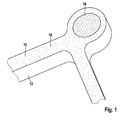
- FIGURE shows a schematic representation of a stent with the coating according to the invention.
- the single FIGURE shows a stent 10 with a base body 12 made of a biocorrodible magnesium alloy and an x-ray marker 14 fixed on the base body 12.
- a coating 16 is applied, which contains a tissue adhesive, for example a cyanoacrylic acid ester adhesive.
Landscapes
- Health & Medical Sciences (AREA)
- Life Sciences & Earth Sciences (AREA)
- Public Health (AREA)
- Veterinary Medicine (AREA)
- Epidemiology (AREA)
- Surgery (AREA)
- Animal Behavior & Ethology (AREA)
- General Health & Medical Sciences (AREA)
- Heart & Thoracic Surgery (AREA)
- Vascular Medicine (AREA)
- Chemical & Material Sciences (AREA)
- Engineering & Computer Science (AREA)
- Biomedical Technology (AREA)
- Medicinal Chemistry (AREA)
- Molecular Biology (AREA)
- Inorganic Chemistry (AREA)
- Materials For Medical Uses (AREA)
Applications Claiming Priority (1)
| Application Number | Priority Date | Filing Date | Title |
|---|---|---|---|
| US42080810P | 2010-12-08 | 2010-12-08 |
Publications (2)
| Publication Number | Publication Date |
|---|---|
| EP2462961A2 true EP2462961A2 (fr) | 2012-06-13 |
| EP2462961A3 EP2462961A3 (fr) | 2014-08-27 |
Family
ID=45217236
Family Applications (1)
| Application Number | Title | Priority Date | Filing Date |
|---|---|---|---|
| EP11189694.0A Withdrawn EP2462961A3 (fr) | 2010-12-08 | 2011-11-18 | Implant constitué d'une matière première biocorrodable et doté d'un revêtement comprenant un adhésif tissulaire |
Country Status (2)
| Country | Link |
|---|---|
| US (1) | US20120150281A1 (fr) |
| EP (1) | EP2462961A3 (fr) |
Families Citing this family (2)
| Publication number | Priority date | Publication date | Assignee | Title |
|---|---|---|---|---|
| US12521203B2 (en) * | 2020-10-23 | 2026-01-13 | Cortronik GmbH | Automated method for the effective fixation of X-ray markers in vascular implants |
| US12539115B2 (en) | 2021-05-10 | 2026-02-03 | Cilag Gmbh International | System of surgical staple cartridges comprising absorbable staples |
Citations (2)
| Publication number | Priority date | Publication date | Assignee | Title |
|---|---|---|---|---|
| US6224622B1 (en) | 1999-09-29 | 2001-05-01 | Chemence, Inc. | Bioabsorable cyanoacrylate tissue adhesives |
| DE102007003768A1 (de) | 2007-01-19 | 2008-07-24 | Henkel Ag & Co. Kgaa | Polyester und Weichmacher enthaltende Cyanacrylsäureester-Klebstoffe |
Family Cites Families (12)
| Publication number | Priority date | Publication date | Assignee | Title |
|---|---|---|---|---|
| US5660873A (en) * | 1994-09-09 | 1997-08-26 | Bioseal, Limited Liability Corporaton | Coating intraluminal stents |
| US5550172A (en) * | 1995-02-07 | 1996-08-27 | Ethicon, Inc. | Utilization of biocompatible adhesive/sealant materials for securing surgical devices |
| US6174330B1 (en) * | 1997-08-01 | 2001-01-16 | Schneider (Usa) Inc | Bioabsorbable marker having radiopaque constituents |
| US6790228B2 (en) * | 1999-12-23 | 2004-09-14 | Advanced Cardiovascular Systems, Inc. | Coating for implantable devices and a method of forming the same |
| US20060286063A1 (en) * | 2000-11-06 | 2006-12-21 | Afmedica, Inc. | Combination drug therapy for reducing scar tissue formation |
| US7083822B2 (en) * | 2002-04-26 | 2006-08-01 | Medtronic Vascular, Inc. | Overlapping coated stents |
| US20070225631A1 (en) * | 2002-10-04 | 2007-09-27 | Bowlin Gary L | Sealants for Skin and Other Tissues |
| US8021418B2 (en) * | 2003-06-19 | 2011-09-20 | Boston Scientific Scimed, Inc. | Sandwiched radiopaque marker on covered stent |
| US20070254012A1 (en) * | 2006-04-28 | 2007-11-01 | Ludwig Florian N | Controlled degradation and drug release in stents |
| DE102007034041A1 (de) * | 2007-07-20 | 2009-01-22 | Biotronik Vi Patent Ag | Medikamentendepots für medizinische Implantate |
| US8317857B2 (en) * | 2008-01-10 | 2012-11-27 | Telesis Research, Llc | Biodegradable self-expanding prosthesis |
| DE102008043642A1 (de) * | 2008-11-11 | 2010-05-12 | Biotronik Vi Patent Ag | Endoprothese |
-
2011
- 2011-11-18 EP EP11189694.0A patent/EP2462961A3/fr not_active Withdrawn
- 2011-12-06 US US13/312,017 patent/US20120150281A1/en not_active Abandoned
Patent Citations (2)
| Publication number | Priority date | Publication date | Assignee | Title |
|---|---|---|---|---|
| US6224622B1 (en) | 1999-09-29 | 2001-05-01 | Chemence, Inc. | Bioabsorable cyanoacrylate tissue adhesives |
| DE102007003768A1 (de) | 2007-01-19 | 2008-07-24 | Henkel Ag & Co. Kgaa | Polyester und Weichmacher enthaltende Cyanacrylsäureester-Klebstoffe |
Also Published As
| Publication number | Publication date |
|---|---|
| US20120150281A1 (en) | 2012-06-14 |
| EP2462961A3 (fr) | 2014-08-27 |
Similar Documents
| Publication | Publication Date | Title |
|---|---|---|
| EP1891993B1 (fr) | Implant métallique biocorrodable doté d'un revêtement ou d'un remplissage de cavité en copolymère Peg/Plga | |
| EP2457601B1 (fr) | Composite de marqueur et implant médical doté d'un marqueur de radiographie | |
| EP2151254B1 (fr) | Implant biocorrodable doté d'un revêtement contenant une matrice polymère portant une matière active | |
| EP2151255B1 (fr) | Implant biocorrodable recouvert d'un revêtement hydrogel | |
| EP1930032A2 (fr) | Implant biocorrodable métallique doté d'un revêtement ou d'un remplissage de cavité en gélatine | |
| EP3562526B1 (fr) | Endoprothèse en alliage de magnésium biodégradable ayant un revêtement de fluorure de magnésium et un revêtement organique | |
| DE102008043724A1 (de) | Erhöhung der Effizienz pharmazeutische Wirkstoffe-freisetzender Medizinprodukte durch Kombination mit einem Inhibitor des Transportproteins P-Glycoprotein | |
| DE102007034019A1 (de) | Stent mit einer Beschichtung oder Füllung einer Kavität | |
| EP2442836B1 (fr) | Implant constitué d'un matériau métallique pouvant être résorbé par l'organisme | |
| EP1897567A1 (fr) | Marqueur radiographique pour implants médicaux en matière première métallique biocorrodable | |
| DE102007059755A1 (de) | Implantate mit membrandiffusionskontrollierter Wirkstofffreisetzung | |
| EP2407184A2 (fr) | Stent revêtu de manière abluminale libérant une matière active et doté d'une couche de protection par complémentarité de forme | |
| EP2415489B1 (fr) | Implant revêtu d'agents polylactiques issu d'un alliage de magnésium biocorrodable | |
| US20120150282A1 (en) | Implant having a paclitaxel-releasing coating | |
| EP2289575B1 (fr) | Implant médical contenant une substance anti-oxydante | |
| EP2462962B1 (fr) | Implant doté d'un revêtement comprenant un principe actif et recouvrant l'implant au moins partiellement | |
| EP2147689A2 (fr) | Implant doté d'un revêtement | |
| EP2055328A1 (fr) | Stent doté d'un corps de base constitué d'une matière bioinerte métallique | |
| EP2500043A1 (fr) | Produit médical doté d'un revêtement actif | |
| EP2433660B1 (fr) | Implant revêtu en alliage de magnésium biocorrodable | |
| DE202018001853U1 (de) | Bioresorbierbares Implantat | |
| US20120150281A1 (en) | Implant made of biocorrodible material and with a coating containing a tissue adhesive | |
| DE102007030438A1 (de) | Implantat aus einer biokorrodierbaren Magnesiumlegierung und mit einer Beschichtung aus einem Poly(orthoester) | |
| EP2281590A2 (fr) | Implant bio-corrodable doté d'un revêtement actif | |
| DE102009059070A1 (de) | Medizinische Einrichtung und Verfahren zu ihrer Herstellung |
Legal Events
| Date | Code | Title | Description |
|---|---|---|---|
| PUAI | Public reference made under article 153(3) epc to a published international application that has entered the european phase |
Free format text: ORIGINAL CODE: 0009012 |
|
| AK | Designated contracting states |
Kind code of ref document: A2 Designated state(s): AL AT BE BG CH CY CZ DE DK EE ES FI FR GB GR HR HU IE IS IT LI LT LU LV MC MK MT NL NO PL PT RO RS SE SI SK SM TR |
|
| PUAL | Search report despatched |
Free format text: ORIGINAL CODE: 0009013 |
|
| AK | Designated contracting states |
Kind code of ref document: A3 Designated state(s): AL AT BE BG CH CY CZ DE DK EE ES FI FR GB GR HR HU IE IS IT LI LT LU LV MC MK MT NL NO PL PT RO RS SE SI SK SM TR |
|
| RIC1 | Information provided on ipc code assigned before grant |
Ipc: A61L 31/02 20060101AFI20140718BHEP Ipc: A61L 31/10 20060101ALI20140718BHEP Ipc: A61L 31/14 20060101ALI20140718BHEP Ipc: A61L 31/16 20060101ALI20140718BHEP |
|
| STAA | Information on the status of an ep patent application or granted ep patent |
Free format text: STATUS: THE APPLICATION IS DEEMED TO BE WITHDRAWN |
|
| 18D | Application deemed to be withdrawn |
Effective date: 20150228 |