EP2463420A2 - Procédé de remaillage d'étoffe tricotée et étoffe tricotée - Google Patents
Procédé de remaillage d'étoffe tricotée et étoffe tricotée Download PDFInfo
- Publication number
- EP2463420A2 EP2463420A2 EP11009658A EP11009658A EP2463420A2 EP 2463420 A2 EP2463420 A2 EP 2463420A2 EP 11009658 A EP11009658 A EP 11009658A EP 11009658 A EP11009658 A EP 11009658A EP 2463420 A2 EP2463420 A2 EP 2463420A2
- Authority
- EP
- European Patent Office
- Prior art keywords
- stitch
- bind
- needle bed
- knitted fabric
- knitting
- Prior art date
- Legal status (The legal status is an assumption and is not a legal conclusion. Google has not performed a legal analysis and makes no representation as to the accuracy of the status listed.)
- Withdrawn
Links
- 238000000034 method Methods 0.000 title claims abstract description 76
- 239000004744 fabric Substances 0.000 title claims abstract description 72
- 238000009940 knitting Methods 0.000 claims abstract description 94
- 238000010586 diagram Methods 0.000 description 13
- 239000011295 pitch Substances 0.000 description 12
Images

Classifications
-
- D—TEXTILES; PAPER
- D04—BRAIDING; LACE-MAKING; KNITTING; TRIMMINGS; NON-WOVEN FABRICS
- D04B—KNITTING
- D04B1/00—Weft knitting processes for the production of fabrics or articles not dependent on the use of particular machines; Fabrics or articles defined by such processes
- D04B1/22—Weft knitting processes for the production of fabrics or articles not dependent on the use of particular machines; Fabrics or articles defined by such processes specially adapted for knitting goods of particular configuration
Definitions
- the present invention relates to a bind-off method of a knitted fabric for performing a bind-off process on stitches at an end in a wale direction of a knitted fabric held on a needle bed when knitting a knitted fabric using a flat knitting machine, and a knitted fabric obtained by applying the bind-off method of a knitted fabric.
- the bind-off process can be mentioned as a method of processing such that a stitch row (stitch row at the end in a wale direction) of the final course of the knitted fabric does not ravel.
- the bind-off process is a process of repeating overlapping of adjacent stitches of the stitch row held on a needle bed, and forming of a new stitch following the overlapped stitches (double stitches) from one end side toward the other end side in a knitting width direction of the knitted fabric (see e.g., Patent Document 1).
- Patent Document 1 Japanese Unexamined Patent Publication No. 2-091254
- Stretching property is often demanded on a bind-off processing portion formed in the final course of a knitted fabric.
- a typical example is a neck of a sweater.
- the neck of the sweater needs to enable the head to pass through when wearing the sweater and to fit a human body when the sweater is worn.
- the bind-off processing portion obtained with the conventional bind-off method has sufficient stretching property. It is assumed that the stretching property of the bind-off processing portion is not satisfactory because a stretch allowance of a knitting yarn in the bind-off processing portion is small. The size (density) of a stitch may be increased to deal with the problem that the stretch allowance of the knitting yarn is small, but in this case, the bind-off processing portion may be flared thus affecting the appearance of the knitted fabric.
- a bind-off method of a knitted fabric according to the present invention is a bind-off method of a knitted fabric for performing a bind-off process on a stitch row at an end in a wale direction of a knitted fabric held on a needle bed using a flat knitting machine having at least a pair of front and back needle beds, at least either of which being capable of being racked in a transverse direction and a stitch held on a knitting needle of the needle bed being transferrable to a different knitting needle.
- the bind-off process method of the present invention alternately repeats the following steps [1] and [2] using the same knitting yarn with the stitch row allocated to one needle bed and other needle bed.
- the allocation of the stitch row to the front and back needle beds is preferably carried out based on a certain rule.
- stitches are preferably allocated alternately one by one to the front and back needle beds from the starting end direction toward the bind-off direction (see first embodiment to be described later).
- front stitches and back stitches are allocated to the front and back needle beds when the stitch row is knitted, and thus the allocated state can be used as is (see fourth embodiment to be described later).
- the stitches of the stitch row of the rib structure may be allocated alternately one by one to the front and back needle beds.
- the front stitches are arranged on the one needle bed, the back stitches are arranged on the other needle bed, and the front stitches and the back stitches are alternately lined from the starting end direction toward the bind-off direction (see second and third embodiments to be described later).
- a pickup stitch is preferably formed on an empty needle of either the front or back needle bed before forming the new stitch in at least either the front or back needle bed; and the pickup stitch is preferably removed from the needle bed after forming the new stitch.
- the timing of forming the pickup stitch on the empty needle it may be before forming the new stitch of step [1] or it may be before forming the new stitch of step [2].
- the pickup stitch may be formed, of course, at both before forming the new stitch of step [1] and before forming the new stitch of step [2].
- the timing of removing the pickup stitch from the needle bed is not particularly limited as long as it is after the new stitch is formed. For instance, if the pickup stitch is formed before forming the new stitch of step [1], the pickup stitch may be removed from the needle bed immediately after forming the new stitch of step [1] or the pickup stitch may be removed from the needle bed after all the bind-off processes are finished.
- an elastic yarn is preferably used for the knitting yarn.
- the elastic yarn may be used, or the elastic yarn aligned with the non-elastic yarn may be used.
- a knitted fabric of the present invention is a knitted fabric including a bind-off processing portion formed by repeating a bind-off process from one end side to the other end side in a knitting width direction using a flat knitting machine having at least a pair of front and back needle beds, at least either of which being capable of being racked in a transverse direction and a stitch held on a knitting needle of the needle bed being transferrable to a different knitting needle.
- the bind-off processing portion arranged in the knitted fabric of the present invention has a bind-off stitch comprising a front stitch and a bind-off stitch comprising a back stitch alternately formed from one side to the other side in the knitting width direction of the knitted fabric with the same knitting yarn.
- the knitted fabric of the present invention including a bind-off processing portion with a bind-off stitch (front bind-off stitch) comprising a front stitch and a bind-off stitch (back bind-off stitch) comprising a back stitch alternately formed from one side to the other side in the knitting width direction of the knitted fabric with the same knitting yarn can be knitted.
- the knitting yarn is reeled to the front bind-off stitch and the back bind-off stitch from the cross-over yarn so that the bind-off processing portion is stretched when the knitted fabric of the present invention is pulled in the knitting width direction of the knitted fabric. Therefore, the bind-off processing portion in the knitted fabric of the present invention exhibits stretching property better than the conventional bind-off processing portion.
- the bind-off processing portion is formed by alternately lining the front bind-off stitch and the back bind-off stitch like the rib structure, and thus is in a compactly folded state. The line of the end of the bind-off processing portion is thus beautifully finished without unevenness, and the bind-off processing portion does not flare in the knitting width direction.
- the yarn length can be increased between the front bind-off stitch and the back bind-off stitch, which are alternately formed, by forming the pickup stitch and removing the pickup stitch in the bind-off method of the knitted fabric of the present invention.
- the bind-off stitches can be formed to a size that the knitting yarn of a sufficient length can be reeled toward the cross-over yarn when the bind-off stitches are deformed, and the stretching property of the bind-off processing portion can be further enhanced.
- a hole can be prevented from forming in the bind-off processing portion by the stretching property of the elastic yarn even if the yarn length is increased between the front bind-off stitch and the back bind-off stitch by using the elastic yarn in the bind-off method of the knitted fabric of the present invention.
- the stretching property of the bind-off processing portion can be enhanced by the stretching property of the elastic yarn itself.
- the knitting described in the embodiments all describe a knitting example using a two-bed flat knitting machine having a pair of front and back needle beds extending in a transverse direction and disposed opposite to each other in a cross direction, wherein the back needle bed is capable of being racked in the transverse direction and a stitch can be transferred between the front and back needle beds.
- the flat knitting machine to be used may, of course, be a four-bed flat knitting machine.
- Fig.1 "S + number" on the left column indicates the step number, and the right column shows the knitting state in each step.
- the vertical or diagonal arrow in the right column indicates transfer, and the reference numerals 1 to 12 indicate the positions of the knitting needles (black dots) of the front needle bed FB and the back needle bed BB.
- ⁇ in Fig. 1 indicates the stitch held on the needle bed, ⁇ indicates double stitches, ⁇ indicates the stitch knitted in each knitting step, and reversed V-letter indicates a pickup stitch.
- the transfer involving racking the operation of such racking is not described.
- the stitches ⁇ , ⁇ , ⁇ held on the knitting needles 2, 4, 6 of the FB are transferred to the knitting needles 2, 4, 6 of the opposing BB.
- the stitch ⁇ of the knitting needle 6 of the BB is overlapped on the stitch ⁇ of the knitting needle 8 of the FB.
- a pickup stitch ⁇ is formed on the knitting needle 10 of the BB while moving a yarn feeder in the bind-off direction LS, the yarn feeder is further moved to a position beyond the double stitches ⁇ / ⁇ , and a new stitch P0 following the double stitches ⁇ / ⁇ formed on the knitting needle 8 of the FB in S3 is formed while moving the yarn feeder in the starting end direction RS in S5.
- the stitch P0 formed in S5 is the bind-off stitch formed first in the bind-off process, and is a front stitch.
- the pickup stitch ⁇ formed in S4 may be formed on an empty needle of the FB.
- the pickup stitch ⁇ may be formed while moving the yarn feeder in the starting end direction RS.
- the stitch P0 is transferred to the knitting needle 6 of the BB in the next S6, and thus is assumed as the stitch (stitch at the end on the other side) at the end in the starting end direction RS of the BB in the present embodiment.
- the stitch ⁇ held on the knitting needle 7 of the FB then becomes the stitch (stitch at the end on one side) at the end in the starting end direction RS of the FB.
- the stitches of the stitch row of the plain knitting are alternately allocated one by one to the FB and the BB.
- the yarn length of the knitting yarn to the stitch P0 from the start of the bind-off process can be increased by removing the pickup stitch ⁇ formed in S4 from the knitting needle 10 of the BB in S7.
- the yarn length is determined more or less by to what extent the position of forming the pickup stitch ⁇ is spaced apart from the position of forming the stitch P0.
- the position of the pickup stitch ⁇ may be appropriately selected according to the necessary yarn length.
- the timing to remove the pickup stitch ⁇ is not particularly limited as long as it is after the stitch P0 is formed in S5. For instance, the pickup stitch ⁇ may be removed from the BB after all the bind-off process is finished.
- the yarn feeder is moved in the bind-off direction LS to the position beyond the double stitches ⁇ / ⁇ of S7, and then the yarn feeder is inverted in the starting end direction RS and a new stitch P1 following the double stitches ⁇ / ⁇ is formed.
- the stitch P1 formed in S8 is a back stitch.
- the stitch P1 is held on the BB at the time point when S8 is completed, but is transferred to the FB in the next S9 to become the stitch at the end on one side at the end in the starting end direction RS of the FB.
- the stitches P1, P0 held on the knitting needles 5, 6 of the BB are transferred to the knitting needles 5, 6 of the opposing FB, and the stitch ⁇ held on the knitting needle 4 of the BB is transferred to the knitting needle 6 of the FB in S10.
- the stitch P0 switch at the end on the other side
- the stitch ⁇ which was at the position closest to the stitch P0 on the BB are overlapped on the knitting needle 6 of the FB.
- the stitch P1 in S8 is defined as the stitch at the end on one side of the FB, and thus is not the stitch closest to the stitch P0 that is the stitch at the end on the other side.
- the stitches are less by one stitch in the FB and the BB from the state of S5. Therefore, in the subsequent knitting including S12, the bind-off process can be performed on the final course of the knitted fabric by repeating the knitting similar to S5 to S11.
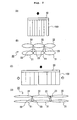
- a bind-off processing portion 20 formed in the final course of a knitted fabric 100 shown in Fig. 2(A) from the direction of the black arrow in the figure a front stitch 21 and a back stitch 22, which are alternately formed, are lined in the thickness direction of the knitted fabric, as shown in the image diagram of Fig. 2(B) .
- the front stitch 21 and the back stitch 22 are connected through a cross-over yarn 23, and the bind-off processing portion 20 is tightened like the rib structure.
- the bind-off processing portion 20 exhibits stretching property better than the conventional art. Furthermore, the knitting yarn configuring the bind-off processing portion 20 is less likely to break even if the bind-off processing portion 20 is stretched.
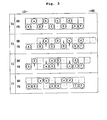
- a second embodiment an example of performing a bind-off process on a stitch row at an end in a wale direction of a knitted fabric having a 2 x 2 rib structure through a bind-off method of a knitted fabric of the present invention will be described based on the knitting process diagram of Fig. 3 .
- the second embodiment shows an example of performing the bind-off process on the stitch row after stitches of the stitch row having the 2 x 2 rib structure are alternately allocated one by one to the FB and the BB.
- the knitting process diagram of Fig. 3 is, unlike the knitting process diagram of Fig. 1 , a knitting process diagram expressed so that the state of racking of the BB can be seen.
- the stitch denoted with a reference symbol of a capital alphabet held on the FB is the front stitch
- the stitch denoted with a reference symbol of a small letter alphabet held on the BB is the back stitch.
- the BB is racked by one pitch in the starting end direction RS, and thereafter, back stitches a, c are transferred from the BB to the FB and front stitches B, D are transferred from the FB to the BB in T2. Then, in T3, the BB is further racked by one pitch in the starting end direction RS, and thereafter, the back stitches a, c are returned from the FB to the BB and the front stitches B, D are returned from the BB to the FB. In T4, the BB is racked by two pitches in the bind-off direction LS to return the BB to a standard position facing the FB.
- the front stitches and the back stitches are alternately lined on the FB and the BB except the front stitch F, that is, the back stitch (front stitch) is arranged between two front stitches (back stitches) adjacent in the longitudinal direction of the needle bed.
- the arrangement state of all the stitches of T4 the arrangement state same as S2 of Fig. 1 is obtained. Therefore, the 2 x 2 rib structure of the second embodiment is to be subsequently subjected to the bind-off process through the knitting similar to the first embodiment with reference to Fig. 1 .
- the bind-off method of the second embodiment described above only the front stitches are arranged on the FB and only the back stitches are arranged on the BB, and furthermore, the alignment in the knitting width direction of the front stitches on the FB and the alignment in the knitting width direction of the back stitches on the BB can be subjected to the bind-off process while being maintained in a state when the rib structure is knitted. Therefore, according to the bind-off method of the present embodiment, the bind-off processing portion that is orderly and that has satisfactory appearance can be formed. Moreover, almost all the double stitches formed in the bind-off process of this embodiment are the double stitches in which the front stitch and the back stitch are overlapped.
- the end stitch of the FB and the adjacent stitch which is next to such an end stitch are overlapped, a new stitch (back stitch as it is formed on the BB) following the double stitches is formed, and such a back stitch is defined as the next end stitch, and thus the end stitch is always the back stitch and the adjacent stitch is always the front stitch.
- the end stitch is always the front stitch, and the adjacent stitch is always the back stitch. Therefore, one factor of realizing the bind-off processing portion of satisfactory appearance is that the combination of the stitches to be overlapped is orderly over the entire bind-off processing portion.
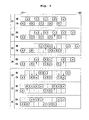
- a bind-off process on a stitch row at an end in a wale direction of a knitted fabric having a 3 x 3 rib structure through a bind-off method of a knitted fabric of the present invention will be described based on the knitting process diagram of Fig. 4 .
- the bind-off process is performed on the stitch row after alternately allocating the stitches of the relevant stitch row one by one to the FB and the BB, similar to the first and second embodiments.
- Fig. 4 is viewed similar to Fig. 3 .
- front stitches B, E are transferred from the FB to the BB (U2), the BB is racked by one pitch in the starting end direction RS, and thereafter, the front stitches B, E are returned from the BB to the FB and back stitches a, d are transferred from the BB to the FB (U3).
- the back stitches a, d are returned from the FB to the BB (U4), and then the BB is further racked by one pitch in the starting end direction RS, a front stitch C is transferred from the FB to the BB and a back stitch c is transferred from the BB to the FB (U5).
- the front stitch C is returned from the BB to the FB
- the back stitch c is returned from the FB to the BB (U6)
- the BB is racked by two pitches in the bind-off direction LS to return the BB to the standard position.
- a state in which the front stitches and the back stitches are alternately lined one by one on the FB and the BB that is, a state in which the back stitch (front stitch) is arranged between two front stitches (back stitches) adjacent in the longitudinal direction of the needle bed is obtained.
- a front stitch E and a back stitch e are first overlapped, a new stitch following the double stitches is formed, the new stitch is defined as the stitch (stitch at the end on one side) at the end in the starting end direction RS of the FB, and the knitting similar to the first embodiment with reference to Fig. 1 is carried out.
- the bind-off method of the third embodiment described above can also form the bind-off processing portion having a satisfactory appearance due to reasons similar to the bind-off method of the second embodiment.
- the case of performing the bind-off process on the stitch row of the rib structure e.g., various rib structures such as 2 x 1 and 2 x 3 different from the second and third embodiments can also form the bind-off processing portion having a satisfactory appearance by alternately arranging the front stitches and the back stitches one by one on the FB and the BB from the starting end direction RS toward the bind-off direction LS.
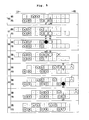
- a fourth embodiment when performing a bind-off process of a knitted fabric of the present invention on a stitch row having a 2 x 2 rib structure, an example of starting the bind-off process of the knitted fabric of the present invention on the stitch row with the same state as when the relevant stitch row is knitted will be described based on Fig. 5.
- Fig. 5 is viewed similar to Fig. 3 .
- V1 a state in which the front stitches and the back stitches are alternately held by the two stitches on the FB and the BB is shown.
- the BB is racked by two pitches in the starting end direction RS from the state of V1, and thereafter, a pickup stitch ⁇ is formed at a position spaced apart by four needles in the starting end direction RS from the back stitch c of the BB and the back stitch d is overlapped on a front stitch F (V2).
- V2 front stitch F
- the position of forming the pickup stitch ⁇ is not limited to such a position.
- the stitch P0 is formed following the double stitches d/F of V2 after racking the BB by one pitch in the bind-off direction LS (V3).
- the stitch P0 is defined as the stitch (stitch at the end on the other side) at the end in the starting end direction RS of the BB.
- a stitch E that is the stitch (stitch at the end on one side) at the end on the starting end direction RS side of the FB is then transferred from the FB to the BB, and the stitch P0 is also transferred from the FB to the BB (V4).
- the BB is racked by three pitches in the bind-off direction LS, and thereafter, the pickup stitch ⁇ is removed from the BB, a front stitch D is overlapped on the front stitch E transferred to the BB in V4 (V5), and the stitch P1 following the double stitches D/E is formed (V6).
- V5 the front stitch D overlapped on the front stitch E is the stitch which was at the position closest in the bind-off direction LS from the front stitch E in V3.
- the stitches P0, P1 are then transferred from the BB to the FB (V7), the BB is racked by two pitches in the starting end direction RS, and then the back stitch c is overlapped on the stitch P0 (V8).
- V8 the back stitch c to be overlapped on the stitch P0 that is the end stitch of the BB is the stitch which was at the position closest in the bind-off direction LS from the stitch P0 in V4.
- the stitch E in V4 is not the stitch of the BB and thus is not the stitch proximate to the stitch P0.
- the knitting substantially similar to V3 to V8 may be repeated after V8. Specifically, a new stitch following the double stitches c/P0 is formed, and such a new stitch is defined as the end stitch in the starting end direction RS of the BB.
- the stitch P1 that is the end stitch of the FB and the front stitch C are overlapped, a new stitch following such double stitches is formed, and such a new stitch is defined as the end stitch in the FB.
- the bind-off processing portion having a satisfactory appearance can be formed since the double stitches is a combination of the front stitch and the back stitch, similar to the bind-off method of the second and third embodiments.
- the embodiments of the present invention are not limited to the embodiments described above, and can be appropriately changed within a scope not deviating from the gist of the invention.
- the bind-off process described in the above embodiments may be carried out on each of the front side knitted fabric and the back side knitted fabric.
Landscapes
- Engineering & Computer Science (AREA)
- Textile Engineering (AREA)
- Knitting Of Fabric (AREA)
Applications Claiming Priority (1)
| Application Number | Priority Date | Filing Date | Title |
|---|---|---|---|
| JP2010276264A JP2012122175A (ja) | 2010-12-10 | 2010-12-10 | 編地の伏目方法、および編地 |
Publications (2)
| Publication Number | Publication Date |
|---|---|
| EP2463420A2 true EP2463420A2 (fr) | 2012-06-13 |
| EP2463420A3 EP2463420A3 (fr) | 2014-01-08 |
Family
ID=45370379
Family Applications (1)
| Application Number | Title | Priority Date | Filing Date |
|---|---|---|---|
| EP11009658.3A Withdrawn EP2463420A3 (fr) | 2010-12-10 | 2011-12-07 | Procédé de remaillage d'étoffe tricotée et étoffe tricotée |
Country Status (3)
| Country | Link |
|---|---|
| EP (1) | EP2463420A3 (fr) |
| JP (1) | JP2012122175A (fr) |
| CN (1) | CN102534981A (fr) |
Families Citing this family (2)
| Publication number | Priority date | Publication date | Assignee | Title |
|---|---|---|---|---|
| TWI585254B (zh) * | 2013-04-23 | 2017-06-01 | 島精機製作所股份有限公司 | 編織物之編織方法 |
| JP6274908B2 (ja) * | 2014-02-27 | 2018-02-07 | 株式会社島精機製作所 | 編地の伏目方法 |
Citations (1)
| Publication number | Priority date | Publication date | Assignee | Title |
|---|---|---|---|---|
| JPH0291254A (ja) | 1988-09-21 | 1990-03-30 | Shima Seiki Seisakusho:Kk | 編地及び編地端部処理方法 |
Family Cites Families (8)
| Publication number | Priority date | Publication date | Assignee | Title |
|---|---|---|---|---|
| JP3164507B2 (ja) * | 1996-05-20 | 2001-05-08 | 株式会社島精機製作所 | 1×1リブ編地の伏せ目処理方法 |
| JP3612164B2 (ja) * | 1997-02-28 | 2005-01-19 | 株式会社島精機製作所 | 伸縮性に優れた伏せ目処理方法 |
| EP1211341B1 (fr) * | 1999-07-13 | 2010-04-14 | Shima Seiki Mfg., Ltd | Procede de couture d'ourlets avec une excellente aptitude a l'etirage |
| TW470795B (en) * | 1999-08-31 | 2002-01-01 | Shima Seiki Mfg | Knitting method for waste yarn disposal |
| TW523561B (en) * | 2000-07-28 | 2003-03-11 | Shima Seiki Mfg | Welt-seaming method and welt-seamed knitted fabric, and cad device for welt-seaming |
| JP3987802B2 (ja) * | 2001-03-26 | 2007-10-10 | 株式会社島精機製作所 | 伏目処理された編地および伏目処理方法 |
| WO2004094711A1 (fr) * | 2003-04-21 | 2004-11-04 | Shima Seiki Mfg., Ltd. | Procede pour assembler un article en tricot |
| JP4336298B2 (ja) * | 2004-12-09 | 2009-09-30 | 株式会社島精機製作所 | 編地の編成方法、編地を編成させるための編成プログラム |
-
2010
- 2010-12-10 JP JP2010276264A patent/JP2012122175A/ja active Pending
-
2011
- 2011-12-06 CN CN2011104017455A patent/CN102534981A/zh active Pending
- 2011-12-07 EP EP11009658.3A patent/EP2463420A3/fr not_active Withdrawn
Patent Citations (1)
| Publication number | Priority date | Publication date | Assignee | Title |
|---|---|---|---|---|
| JPH0291254A (ja) | 1988-09-21 | 1990-03-30 | Shima Seiki Seisakusho:Kk | 編地及び編地端部処理方法 |
Also Published As
| Publication number | Publication date |
|---|---|
| JP2012122175A (ja) | 2012-06-28 |
| CN102534981A (zh) | 2012-07-04 |
| EP2463420A3 (fr) | 2014-01-08 |
Similar Documents
| Publication | Publication Date | Title |
|---|---|---|
| EP2530197A2 (fr) | Procédé pour tricoter une étoffe et étoffe tricotée | |
| EP2634299B1 (fr) | Procédé de tricotage d'une étoffe tricotée avec frange | |
| EP0839940A2 (fr) | Procédé de tricotage d'une étoffe tubulaire à mailles cÔtes 2X1 | |
| EP2226417A1 (fr) | Procédé de tricotage de tissu, et tissu | |
| EP2319969B1 (fr) | Procédé pour tricoter une étoffe et étoffe tricotée | |
| JP5995535B2 (ja) | 編地の編成方法 | |
| EP2460919A2 (fr) | Procédé de jonction pour étoffe tricotée et étoffe tricotée | |
| EP2366820B1 (fr) | Procédé pour tricoter un vêtement de tricot à col en V et tricot à col en V | |
| EP2330240B1 (fr) | Procédé pour tricoter une étoffe et étoffe tricotée | |
| KR101603889B1 (ko) | 편성포의 편성방법 | |
| EP2450479B1 (fr) | Étoffe tricotée avec poche et son procédé de tricotage | |
| EP2540887B1 (fr) | Procédé pour tricoter une étoffe et étoffe tricotée | |
| EP2465983A1 (fr) | Procédé de formation de tissu et tissu | |
| US20160122913A1 (en) | Method for knitting knitted fabric | |
| KR101844740B1 (ko) | 편성포의 편성방법 및 편성포 | |
| EP2327818B1 (fr) | Procédé pour tricoter une étoffe et étoffe tricotée | |
| JP5603779B2 (ja) | 内増やし方法、および編地 | |
| EP2546399B1 (fr) | Procédé de configuration de la rangée initiale d'un tricot et étoffe tricotée | |
| EP2581479B1 (fr) | Procédé de jonction pour étoffe tricotée et étoffe tricotée | |
| EP2463420A2 (fr) | Procédé de remaillage d'étoffe tricotée et étoffe tricotée | |
| CN104746224A (zh) | 针织物的编织方法 | |
| CN107142601B (zh) | 筒状编织物的编织方法 | |
| EP2636778B1 (fr) | Procédé permettant d'empêcher l'effilochage de fil à tricoter | |
| CN102421949B (zh) | 筒状针织物的编织方法及筒状针织物 | |
| JP5695847B2 (ja) | 内増やし方法、および編地 |
Legal Events
| Date | Code | Title | Description |
|---|---|---|---|
| PUAI | Public reference made under article 153(3) epc to a published international application that has entered the european phase |
Free format text: ORIGINAL CODE: 0009012 |
|
| AK | Designated contracting states |
Kind code of ref document: A2 Designated state(s): AL AT BE BG CH CY CZ DE DK EE ES FI FR GB GR HR HU IE IS IT LI LT LU LV MC MK MT NL NO PL PT RO RS SE SI SK SM TR |
|
| AX | Request for extension of the european patent |
Extension state: BA ME |
|
| PUAL | Search report despatched |
Free format text: ORIGINAL CODE: 0009013 |
|
| AK | Designated contracting states |
Kind code of ref document: A3 Designated state(s): AL AT BE BG CH CY CZ DE DK EE ES FI FR GB GR HR HU IE IS IT LI LT LU LV MC MK MT NL NO PL PT RO RS SE SI SK SM TR |
|
| AX | Request for extension of the european patent |
Extension state: BA ME |
|
| RIC1 | Information provided on ipc code assigned before grant |
Ipc: D04B 1/22 20060101AFI20131203BHEP |
|
| 17P | Request for examination filed |
Effective date: 20140704 |
|
| RBV | Designated contracting states (corrected) |
Designated state(s): AL AT BE BG CH CY CZ DE DK EE ES FI FR GB GR HR HU IE IS IT LI LT LU LV MC MK MT NL NO PL PT RO RS SE SI SK SM TR |
|
| STAA | Information on the status of an ep patent application or granted ep patent |
Free format text: STATUS: THE APPLICATION HAS BEEN WITHDRAWN |
|
| 18W | Application withdrawn |
Effective date: 20140811 |