EP2463839A1 - Drahtlose Mehrzweckausrüstung zur Überwachung und zum Schutz einer Person, Verfahren zum Betrieb der Ausrüstung - Google Patents
Drahtlose Mehrzweckausrüstung zur Überwachung und zum Schutz einer Person, Verfahren zum Betrieb der Ausrüstung Download PDFInfo
- Publication number
- EP2463839A1 EP2463839A1 EP11466038A EP11466038A EP2463839A1 EP 2463839 A1 EP2463839 A1 EP 2463839A1 EP 11466038 A EP11466038 A EP 11466038A EP 11466038 A EP11466038 A EP 11466038A EP 2463839 A1 EP2463839 A1 EP 2463839A1
- Authority
- EP
- European Patent Office
- Prior art keywords
- unit
- personal
- personal unit
- signal
- equipment
- Prior art date
- Legal status (The legal status is an assumption and is not a legal conclusion. Google has not performed a legal analysis and makes no representation as to the accuracy of the status listed.)
- Withdrawn
Links
Images

Classifications
-
- G—PHYSICS
- G08—SIGNALLING
- G08B—SIGNALLING SYSTEMS, e.g. PERSONAL CALLING SYSTEMS; ORDER TELEGRAPHS; ALARM SYSTEMS
- G08B21/00—Alarms responsive to a single specified undesired or abnormal condition and not otherwise provided for
- G08B21/18—Status alarms
- G08B21/22—Status alarms responsive to presence or absence of persons
-
- G—PHYSICS
- G07—CHECKING-DEVICES
- G07C—TIME OR ATTENDANCE REGISTERS; REGISTERING OR INDICATING THE WORKING OF MACHINES; GENERATING RANDOM NUMBERS; VOTING OR LOTTERY APPARATUS; ARRANGEMENTS, SYSTEMS OR APPARATUS FOR CHECKING NOT PROVIDED FOR ELSEWHERE
- G07C9/00—Individual registration on entry or exit
- G07C9/20—Individual registration on entry or exit involving the use of a pass
- G07C9/28—Individual registration on entry or exit involving the use of a pass the pass enabling tracking or indicating presence
-
- G—PHYSICS
- G08—SIGNALLING
- G08B—SIGNALLING SYSTEMS, e.g. PERSONAL CALLING SYSTEMS; ORDER TELEGRAPHS; ALARM SYSTEMS
- G08B21/00—Alarms responsive to a single specified undesired or abnormal condition and not otherwise provided for
- G08B21/02—Alarms for ensuring the safety of persons
- G08B21/0202—Child monitoring systems using a transmitter-receiver system carried by the parent and the child
- G08B21/0269—System arrangements wherein the object is to detect the exact location of child or item using a navigation satellite system, e.g. GPS
-
- G—PHYSICS
- G08—SIGNALLING
- G08B—SIGNALLING SYSTEMS, e.g. PERSONAL CALLING SYSTEMS; ORDER TELEGRAPHS; ALARM SYSTEMS
- G08B21/00—Alarms responsive to a single specified undesired or abnormal condition and not otherwise provided for
- G08B21/02—Alarms for ensuring the safety of persons
- G08B21/0202—Child monitoring systems using a transmitter-receiver system carried by the parent and the child
- G08B21/0272—System arrangements wherein the object is to detect exact location of child or item using triangulation other than GPS
-
- G—PHYSICS
- G08—SIGNALLING
- G08B—SIGNALLING SYSTEMS, e.g. PERSONAL CALLING SYSTEMS; ORDER TELEGRAPHS; ALARM SYSTEMS
- G08B21/00—Alarms responsive to a single specified undesired or abnormal condition and not otherwise provided for
- G08B21/02—Alarms for ensuring the safety of persons
- G08B21/0202—Child monitoring systems using a transmitter-receiver system carried by the parent and the child
- G08B21/0286—Tampering or removal detection of the child unit from child or article
-
- G—PHYSICS
- G08—SIGNALLING
- G08B—SIGNALLING SYSTEMS, e.g. PERSONAL CALLING SYSTEMS; ORDER TELEGRAPHS; ALARM SYSTEMS
- G08B21/00—Alarms responsive to a single specified undesired or abnormal condition and not otherwise provided for
- G08B21/02—Alarms for ensuring the safety of persons
- G08B21/04—Alarms for ensuring the safety of persons responsive to non-activity, e.g. of elderly persons
- G08B21/0438—Sensor means for detecting
- G08B21/0453—Sensor means for detecting worn on the body to detect health condition by physiological monitoring, e.g. electrocardiogram, temperature, breathing
-
- G—PHYSICS
- G08—SIGNALLING
- G08B—SIGNALLING SYSTEMS, e.g. PERSONAL CALLING SYSTEMS; ORDER TELEGRAPHS; ALARM SYSTEMS
- G08B29/00—Checking or monitoring of signalling or alarm systems; Prevention or correction of operating errors, e.g. preventing unauthorised operation
- G08B29/16—Security signalling or alarm systems, e.g. redundant systems
Definitions
- the invention involves equipment for temporary monitoring (supervision and protection) of persons.
- the equipment provides for monitoring of movement of a person and signalling (alarm) in pre-defined situations when the monitored person is in danger, even when the main unit, i.e. the component of the equipment attached to the body of the monitored person, is out of operation.
- Locators send information on their position via the GSM network either automatically, or upon request. Some locators also include backup memory recording information on the locator's position even when the mobile network is not available; such information is sent when the mobile network becomes available.
- Locators also include a hardware movement sensor detecting movement of the locator even when no GPS is available and sending information of such movement.
- the above devices provide only for passive monitoring of persons and are not equipped with a function providing for signalling (alarm) in situations when the monitored person becomes exposed to a danger.
- locators with built-in sound monitoring equipment or emergency call function If that function is activated, the locator calls pre-defined telephone numbers or sends an SMS thereto.
- the locator calls pre-defined telephone numbers or sends an SMS thereto.
- such equipment is not a solution in situations where the monitored person does not activate the emergency call or sound monitoring when in danger.
- the patented document US DE 623,965 S describes equipment intended for monitoring of persons, equipped with a GSM module and a GPS unit.
- the equipment includes sensors that can activate emergency signalling in certain situations, particularly shock sensors, temperature sensors, and pressure sensors.
- shock sensors e.g., a sensor that can activate emergency signalling in certain situations
- temperature sensors e.g., a thermometer
- pressure sensors e.g., a thermometer
- not even this equipment solves a situation when a certain part of the equipment attached to the monitored person's body is disabled in danger (e.g. by a signal jammer, wrapping in material eliminating the GSM signal, devastation of the equipment by strong electrical discharge) before the sensors can be activated, which disables emergency signalling.
- Another problem of the existing devices is the possibility of deactivation by a controller located directly on the device or deactivation by destruction of the device, which renders signalling of danger impossible, thus leading to elimination of protection of the monitored person e.g. when assaulted with a gun or electric "baton".
- the locator only provides information of the last position of the devices, but it does not send the information about danger that would enable the notified persons to act without delay.
- Such equipment can have built-in inclination meters signalling emergency in situations when e.g. the monitored person trips over and remains lying on the ground motionless.
- the above devices are intended for monitoring of health status, particularly of ill or elderly persons in healthcare.
- Such devices are not equipped with a function providing for signalling (alarm) in situations when the monitored person is exposed to external danger without imminent impact on their health status. I.e. they are not a solution in situations when a part of the equipment attached to the body of the monitored person is disabled in danger.
- wrist bands for persons in house arrest.
- Such devices consist of a robust wrist band that may not be removed by the monitored person, and a base unit defining a specific zone (usually tens of meters from the base unit) by the reach of its signal. When such a zone is breached, the base unit triggers an alarm.
- Such devices cannot be used for persons who are not to be restricted in their movement, but their safety is to be provided for within such unrestricted movement.
- the equipment comprises at least one Personal Unit in the form of a case (resistant to damage by force) similar to a watch case.
- a strap similar to that of a watch is attached to the case.
- Installed inside the strap are circuits reacting to mechanical disruption and a fastening system - e.g. by a key, a mechanical code, etc.
- the inside of the case includes the control unit, a wireless device for two-way communication including an antenna (e.g. a GSM module), a GPS module, a battery, a shock sensor, a body temperature and heart rate sensor, possibly also a piezoelectric siren, a light source, or a source of electromagnetic signal for localisation of persons.
- the communication device may be equipped with a backup power source and a signal receiver; the backup signal source works on a wavelength or frequency different from the primary one. If the primary signal source is disabled, the backup is activated automatically.
- a "PANIC” button is located on a side of the case. When pressed for a certain time (parameter adjustable e.g. 0.5-3 seconds), the button activates the alarm signal.
- the top side of the case displays indication of battery status, transmission signal strength, activation or deactivation of the device, monitoring mode, indication of alarm, departure from a pre-defined geographic area and exceeding of pre-defined duration of relocation.
- LCD display can provide additional information (e.g. battery capacity in units, etc.).
- the top side may be equipped with an LCD, electrical or mechanical clockwork with the above embedded indications for design and other reasons.
- the Personal Unit is not equipped with an on/off button due to security reasons. If it is equipped with such a button, the button will not be functional when the Personal Unit is activated. If the Personal Unit is equipped with an on/off button, the button is not accessible when the Personal Unit is fastened to the body.
- the Personal Unit is equipped with a charging and communication connector for configuration of parameters.
- the connector is built in on the inner side of the case in order not to be accessible when the Personal Unit is fastened to the body of the monitored person, and to avoid damage of the Personal Unit e.g. by strong electric shock.
- the inside of the case is accessible from the inner side. Access is protected by security screws and made possible only for authorised service companies.
- the case of the Personal Unit is waterproof, or at least water resistant.
- the strap is connected with the case so that the Personal Unit can be attached to the wrist of the monitored person.
- Circuits are built in the strap and the buckle of the strap with a built-in security element works as a connector closing the circuits in one part of the strap with those in the other.
- the security element of the strap is intended to prevent the attacker or the monitored person from un-strapping the Unit.
- the circuits in the strap provide for monitoring of strap disruption (tearing, cutting, or un-strapping).
- Versions of the Personal Unit may include types intended for fastening not only to a wrist, but also to an ankle or another part of the body where it may be better concealed in case of an assault.
- the Personal Unit When switched on (Standby mode), the Personal Unit is first attached to the body (e.g. a wrist) of the monitored person, and then it is activated by the Control Unit for security reasons (Active mode).
- a Control Unit is represented by (an) external device(s) (e.g. a GSM telephone).
- the Personal Unit has a fixed pre-defined unique telephone number and potentially also another unique identifier (e.g. internal mobile equipment identity - IMEI) enabling the activation.
- the Control Unit may be a GSM telephone of the parents in case of monitoring of a child. This means that the highest security level is based on keeping the GSM number (if the product uses e.g. the GSM network) of the Personal Unit secret from third persons. In principle, even the monitored person does not need to know the number.
- the Personal Unit When the monitoring has been completed, the Personal Unit must be deactivated by the Control Unit (Standby mode) and only then the strap may be unstrapped and the Personal Unit removed from the body of the monitored person without causing alarm.
- the Personal Unit may be activated and deactivated (switched from the Standby mode to the Active mode and vice versa) remotely upon consideration of the person handling the Control Unit (e.g. parents, bodyguards, etc.).
- This functionality is particularly relevant in situations when the monitored person finds itself in a secure environment (e.g. at school, where some activity might raise false alarm), or if the Personal Unit must be removed from the monitored person (e.g. during sports activities, etc.).
- the Personal Unit is set so as to send an alarm signal to the Receiving Unit(s) under predefined conditions.
- a receiving unit may be any device capable of communicating with the Personal Unit (central emergency stations, PCs or other computers, various types of communicators or mobile telephones). It is possible to set e.g. the following conditions: longer depression (parameter e.g. 0.5-3 seconds) of the PANIC button on the case of the Personal Unit, reaching of certain values of physiological parameters monitored by sensors of the Personal Unit (sensors of pressure, heart rate, temperature, etc.), interruption of circuits in the strap of the Personal Unit, etc.
- Alarm raised by the Personal Unit may be aborted exclusively by the above external device - the Control Unit.
- the Parallel Unit Connected to the Personal Unit (or to multiple Personal Units) by wireless communication is the Parallel Unit (as described below).
- the Parallel Unit is configured for a certain type of communication (e.g. in regular time intervals) with the Personal Unit. When the communication is lost, the Parallel Unit sends an alarm signal to the Receiving Unit (as described below).
- This functionality addresses the disadvantages of the existing devices as it eliminates the danger resulting from disabling of the Personal Unit by loss of wireless communication with the Receiving Unit, destruction of the Personal Unit, or any other reason.
- the risk of loss of wireless communication signal may be addressed by building in (a) backup signal source(s).
- the backup signal source(s) is/are used for sending signal differently from the main frequency. If the primary signal source is disabled, the backup signal source is automatically activated and it may be used particularly for sending the alarm signal.
- the Parallel Unit also enables pre-defining of a geographic area for movement of the Personal Unit.
- the geographic zones are defined in the GPS system as zones determined by a certain distance (e.g. 100m) from a certain point defined by GPS coordinates. Geographic zones may be alternatively defined as zones within the reach of a certain Wi-Fi transmitter. It is also possible to set a certain time limit for relocation between geographic areas, which will be counted down on the Personal Unit as well as the Parallel Unit.
- the Parallel Unit monitors the movement of the Personal Unit and compares its actual position with the saved data of the predefined geographic areas. When the time limit for relocation has been reached, the Personal Unit gives a notification by a light signal or vibrations.
- the Parallel Unit also monitors exceeding of the time limit for relocation of the Personal Unit between the pre-defined geographic areas and if the limit is exceeded by a pre-set additional limit, it sends an alarm signal.
- This functionality addresses another drawback of the existing devices by actively notifying the Receiving Unit of the increased risk even in case that the Personal Unit is disabled due to any reason.
- the principal difference between this device and the devices intended for guarding persons confined to house arrest lies in unlimited movement of the monitored person to a geographic area around a certain base unit.
- the person is given freedom of movement that is monitored by the Parallel Unit in relation to certain predefined geographic zones of unlimited number. Also the duration of relocation between zones may be set at will. Movement of the Personal Unit is not monitored only in relation to the position of the Parallel Unit .
- the Parallel Unit may be situated at any location; it is crucial to situate it at a safe place with constant availability of wireless communication. This is due to one of the purposes of the Parallel Unit - to inform the Receiving Unit(s) of the status of the Personal Unit even in case that the Personal Unit or any of the Receiving Units is out of the reach of wireless communication.
- the Receiving Unit is a device designed for communication and particularly reception of messages sent by the Parallel Unit and the Personal Unit.
- Receiving Units are mostly various types of communicators or mobile telephones, PCs or other computers, central emergency stations.
- the Receiving Unit receives alarm signals sent by the Parallel Unit or the Personal Unit under pre-defined conditions.
- the communication between the Personal Unit and the Receiving Unit is wireless on various network frequencies, usually via the GSM network.
- the Control Unit is a device designed for activation and deactivation of the Personal Unit. Control Units are mostly various types of communicators or mobile telephones. The communication between the Personal Unit and the Control Unit is wireless on various network frequencies, usually via the GSM network. The Control Unit may simultaneously be used as a Receiving Unit.
- the Personal Unit is equipped with a device for communication with several other Receiving Units, e.g. via a GSM module - for facilitation, we will assume that the Personal Unit uses the GSM network for communication, but it may be equipped with one or more backup signal sources and receivers providing for communication on different frequencies.
- Communication can take place on several optional levels - e.g. connection with the national emergency station being the top level, a private emergency station the second level, a GSM telephone of the parents of the monitored child, bodyguards, etc. being the third level, etc.
- the lowest level may be informational, e.g. for notification that the monitored person has reached or left a pre-defined geographic area.
- the Personal Unit sends messages according to the set priorities. The number of levels may be higher.
- the Control Unit must be programmed prior to utilisation. It is particularly important to assign the selected telephone numbers to the individual connections levels; it is possible to assign multiple numbers to a level.
- the Personal Unit then sends messages from the top level to the bottom level.
- the individual functionalities of the Personal Unit are assigned the alarm communication level upon the user's discretion, e.g. as follows:
- a special communication level is the communication between the Personal Unit and the Control Unit (as described below). It is necessary to set in the Personal Unit the number(s) of the device(s), e.g. GSM telephone, to activate and deactivate the Personal Unit. Multiple telephone numbers may be set.
- the Personal Unit may be programmed using the built-in connector on the inner (inaccessible) side of the Personal Unit case, or a secure Wi-Fi network, or another transmission of parameters from the Control Unit to the device (e.g. a SMS).
- Programming of the Personal Unit must include setting of the situations in which alarm is to be signalled as well as the level assigned to the situations and the method of communication with the Receiving Unit(s):
- the Parallel Unit is a device designed for storage of data of the status and position of the Personal Unit and for setting of the parameters of monitoring; usually a static device located in a building, e.g. at the place of residence of the monitored person and the controlling person, place of work of the controlling person, a central emergency station, etc.
- the Parallel Unit may be connected to a PC for the purpose of visualisation of the store data and for easy setting of the parameters of the Personal Unit.
- the equipment for monitoring and protection of persons using a parallel unit offers two basic modes of monitoring:
- the Personal Unit unilaterally communicates with the Parallel Unit (signalling of alarm and sending of a notification in case of low battery capacity or flat battery).
- the Personal Unit communicates with the Parallel Unit bilaterally in the "request-response” mode, or only sends to the Parallel Unit the information about its position and parameters at the given time (e.g. identification of the Personal Unit, its position, status (alarm, no alarm), status of communication signal, battery status and information from the individual sensors of the Personal Unit).
- the Parallel Unit receives the information, stores it in the memory and can display it on a PC screen. In case of (repeated) loss of communication between the Personal Unit and the Parallel Unit, or another pre-defined situation, the Parallel Unit sends a message to the Receiving Unit.
- the Parallel Unit can send the information about the recent movement of the Personal Unit, including additional information (status of signal, battery, individual sensors, etc.) to higher communication levels (e.g. the police).
- additional information status of signal, battery, individual sensors, etc.
- higher communication levels e.g. the police.
- the Parallel Unit sends a message or an alarm signal to the Receiving Unit.
- the Personal Unit sends the information about departure from a pre-defined geographic area (a secure zone) to the Parallel Unit. This is when the duration of relocation set in the parameter of the Personal Unit and the Parallel Unit starts to count down. If the monitored person does not return to the original pre-defined geographic area or reach another pre-defined geographic area within the set time, the Personal Unit may signal the approaching alarm activation during the additional time remaining before alarm activation on the display of the Personal Unit or by an acoustic signal or vibration in the set intervals. When a pre-defined geographic area (a secure zone) has been reached, the Personal Unit will send the respective information to the Parallel Unit and the countdown of the time set for relocation between pre-defined geographic areas or for return to the original pre-defined area is deactivated.
- a pre-defined geographic area a secure zone
- the Parallel Unit also enables activation of a Personal Unit's acoustic converter, light source or source of electromagnetic signal to facilitate finding of the Personal Unit.
- the existing equipment does not address security of monitored person with regard to the risk of disablement or hampering of the monitoring equipment attached to the body of the monitored person.
- the equipment for monitoring and protection of persons using the main unit and the parallel unit addresses the problem.
- the Personal Unit may not be deactivated or switched off when attached to the monitored person, which eliminates the danger of deactivation by the monitored person or forced deactivation upon exertion of pressure on the monitored person. Protection against this type of deactivation is further improved by the sensors of the Personal Unit, which automatically raise alarm when certain parameters have been reached, particularly physiological parameters like pressure, heart rate, temperature. This brings the possibility to raise alarm even before the device is deactivated e.g. by destruction (physiological reactions of the monitored person in a stress situation raise the alarm).
- the device particularly addresses the situation when a component attached to the body of the monitored person is disabled in danger (e.g. by a signal jammer, wrapping in material eliminating the GSM signal, devastation of the equipment by strong electrical discharge) before the sensors evaluating physiological parameters can be activated, or before the strap of the Personal Unit is broken.
- alarm is raised by the Parallel Unit.
- the Parallel Unit raises alarm e.g. if the Personal Unit does not respond in pre-defined intervals, or if the signal for communication of the Personal Unit is lost.
- Principal benefits of the equipment include the possibility to set pre-defined geographic areas (secure zones) and a more intensive level of monitoring of the person when relocating between pre-defined geographic areas.
- pre-defined geographic areas home, school, places of free time activities, health care facilities, friends', stores, etc.
- pre-defined geographic areas home, school, places of free time activities, health care facilities, friends', stores, etc.
- Fig. 1 presents the diagram of communication between the individual components of the multifunctional wireless equipment for monitoring and protection of persons, i.e. the Personal Unit (1), the Control Unit (2), the Parallel Unit (3), and the Receiving Unit(s) (4) via the transmitting network (5).
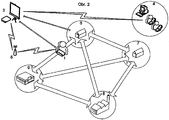
- Fig. 2 presents a diagram of functioning of the multifunctional wireless equipment for monitoring and protection of persons in pre-defined geographic areas (6), (7), (8) and (9), and during relocation between such areas.
- An example of application of the invention is represented by utilisation thereof in monitoring of a child on the way to school by parents.
- the Personal Unit (1) is attached to the wrist or ankle of the monitored child so that the strap is not too tight and uncomfortable, but not too loose in order to render the inner charging and communication connector inaccessible.
- the strap of the Personal Unit (1) is one-time adjusted before first use to fit the monitored person.
- the strap is locked or otherwise secured to avoid undesired removal or attack.
- the Personal Unit (1) must be charged in the charging unit and switched on before attaching to the monitored person (if an on/off button is built in the case of the Personal Unit (1).
- the top side of the Personal Unit (1) features indicators of activation, signal strength, battery status and security mode.
- the Personal Unit (1) is subsequently activated by the Control Unit (2) (e.g. a GSM telephone), e.g. via a SMS.
- the SMS switches the mode of monitoring from standard to high and vice versa.
- the child is then monitored in the respective mode of monitoring on the way to school.
- the Personal Unit (1) is first deactivated via the Control Unit (2) and then the strap of the Personal Unit (1) is unlocked and unfastened. At this moment, the Personal Unit (1) can be switched off and put into the battery charging unit.
- the Personal Unit may be safely switched off remotely, e.g. when a child attends a sports club where device would be obstructive, so the parents can deactivate the device upon verification with the coach by telephone. The child will have a key, or the coach can have a spare key and unlock the strap upon deactivation and remove the Personal Unit.
- the Personal Unit (1) is reattached, activation is requested by telephone and the child may return home upon verification of the status of the Personal Unit (activation indicated).
- defined geographic areas may be used optionally.
- coordinates of one or several pre-defined geographic areas e.g. home, school, grandparents or the sports facility, and their sizes (e.g. the diameter of 100m around the centre point of the defined geographic area), which delimits e.g. he premises of the school.
- pre-defined geographic areas secure areas
- sizes e.g. the diameter of 100m around the centre point of the defined geographic area
- delimits e.g. he premises of the school.
- maximum duration of relocation from one pre-defined geographic area to any other, or of return to the same pre-defined geographic area e.g. 15 minutes
- time of tolerated exceeding of the time limit for relocation e.g. 5 minutes).
- a pre-defined geographic area (6) (50m from the centre of home in this case) is departed from, the status of departure from a pre-defined geographic area (secure zone) is activated automatically and the Personal Unit (1) as well as the Parallel Unit (3) starts counting down the time (15 minutes in this case) that may be displayed on the display for information depending on the type of the Personal Unit (1).
- the countdown is deactivated, but all other monitoring functions (the PANIC button, sensors of physiological functions, etc.) remain active.
- the Personal Unit depending on its settings or configuration can start sending a short acoustic signal, vibrate or indicate on the display that 5 minutes remain to raising of the alarm in this case.
- the relocation is completed within the remaining time, or verification by telephone with the parents takes place.
- the parents either disable (reset or extend) this function using the Control Unit (2), or alarm is raised.
- the signal or a data message is sent to the Receiving Unit(s) (4) and all indicators of the Personal Unit (1) are flashing and the piezoelectric siren gives interrupted acoustic signal, as appropriate.
- the equipment is intended for the general public concerned about safety of their loved ones. This may include a family with small children regularly attending school or another activity. Relocation of children represents the most dangerous situation with regard to the risk of such acts.
- the equipment may also be used by a woman returning from work late in the evening or involved in various free time activities (fitness, aerobics, etc.)
- the equipment may also be used for strictly private purposes, e.g. for parental control of pubescent youth.
- the device may also be used in nursing homes and connected to the emergency station services by medical personnel (activated either by a button or in case of deterioration of health status - falling on the ground, higher or lower temperature, heart rate, etc.)
- a great advantage of the equipment is represented by the variability enabling adaptation of the functionalities to the needs of a specific application.
Landscapes
- Physics & Mathematics (AREA)
- General Physics & Mathematics (AREA)
- Health & Medical Sciences (AREA)
- General Health & Medical Sciences (AREA)
- Business, Economics & Management (AREA)
- Emergency Management (AREA)
- Child & Adolescent Psychology (AREA)
- Engineering & Computer Science (AREA)
- Computer Security & Cryptography (AREA)
- Radar, Positioning & Navigation (AREA)
- Life Sciences & Earth Sciences (AREA)
- Biophysics (AREA)
- Cardiology (AREA)
- Heart & Thoracic Surgery (AREA)
- Physical Education & Sports Medicine (AREA)
- Physiology (AREA)
- Pulmonology (AREA)
- Gerontology & Geriatric Medicine (AREA)
- Alarm Systems (AREA)
Applications Claiming Priority (1)
| Application Number | Priority Date | Filing Date | Title |
|---|---|---|---|
| CZ20100900A CZ2010900A3 (cs) | 2010-12-07 | 2010-12-07 | Multifunkcní bezdrátové zarízení pro dozorování a ochranu osob a zpusob cinnosti tohoto zarízení |
Publications (1)
| Publication Number | Publication Date |
|---|---|
| EP2463839A1 true EP2463839A1 (de) | 2012-06-13 |
Family
ID=45406563
Family Applications (1)
| Application Number | Title | Priority Date | Filing Date |
|---|---|---|---|
| EP11466038A Withdrawn EP2463839A1 (de) | 2010-12-07 | 2011-12-06 | Drahtlose Mehrzweckausrüstung zur Überwachung und zum Schutz einer Person, Verfahren zum Betrieb der Ausrüstung |
Country Status (2)
| Country | Link |
|---|---|
| EP (1) | EP2463839A1 (de) |
| CZ (1) | CZ2010900A3 (de) |
Cited By (6)
| Publication number | Priority date | Publication date | Assignee | Title |
|---|---|---|---|---|
| CN103578224A (zh) * | 2013-11-12 | 2014-02-12 | 国家电网公司 | 人体近距离语音提醒安防系统 |
| CN106465459A (zh) * | 2014-10-15 | 2017-02-22 | 华为技术有限公司 | 一种用于可穿戴设备脱落检测的方法及可穿戴设备 |
| WO2021102622A1 (en) * | 2019-11-25 | 2021-06-03 | Qualcomm Incorporated | Methods and apparatus for wireless device operation |
| CN114067544A (zh) * | 2020-08-06 | 2022-02-18 | 苏州水桥智能科技有限公司 | 一种监护方法及计算机可读存储介质 |
| US11265416B2 (en) * | 2019-06-05 | 2022-03-01 | Kyndryl, Inc. | Management of communication notifications based upon geographic location |
| CN114463939A (zh) * | 2022-02-21 | 2022-05-10 | 徐汇程 | 一种电力一体化通信资源管理系统 |
Citations (6)
| Publication number | Priority date | Publication date | Assignee | Title |
|---|---|---|---|---|
| DE623965C (de) | 1933-02-12 | 1936-01-09 | Wuerker G M B H | Stickautomat |
| US5497149A (en) * | 1993-09-02 | 1996-03-05 | Fast; Ray | Global security system |
| FR2872917A1 (fr) * | 2004-07-06 | 2006-01-13 | Dmatel Ltd | Reseau de surveillance et de suivi |
| US20060015233A1 (en) * | 2004-07-14 | 2006-01-19 | United Parcel Service Of America, Inc. | Wirelessly enabled trailer locking/unlocking |
| US20070023496A1 (en) * | 2005-04-13 | 2007-02-01 | Hall Christopher J | House arrest apparatus |
| US20070229350A1 (en) * | 2005-02-01 | 2007-10-04 | Scalisi Joseph F | Apparatus and Method for Providing Location Information on Individuals and Objects using Tracking Devices |
-
2010
- 2010-12-07 CZ CZ20100900A patent/CZ2010900A3/cs unknown
-
2011
- 2011-12-06 EP EP11466038A patent/EP2463839A1/de not_active Withdrawn
Patent Citations (6)
| Publication number | Priority date | Publication date | Assignee | Title |
|---|---|---|---|---|
| DE623965C (de) | 1933-02-12 | 1936-01-09 | Wuerker G M B H | Stickautomat |
| US5497149A (en) * | 1993-09-02 | 1996-03-05 | Fast; Ray | Global security system |
| FR2872917A1 (fr) * | 2004-07-06 | 2006-01-13 | Dmatel Ltd | Reseau de surveillance et de suivi |
| US20060015233A1 (en) * | 2004-07-14 | 2006-01-19 | United Parcel Service Of America, Inc. | Wirelessly enabled trailer locking/unlocking |
| US20070229350A1 (en) * | 2005-02-01 | 2007-10-04 | Scalisi Joseph F | Apparatus and Method for Providing Location Information on Individuals and Objects using Tracking Devices |
| US20070023496A1 (en) * | 2005-04-13 | 2007-02-01 | Hall Christopher J | House arrest apparatus |
Cited By (10)
| Publication number | Priority date | Publication date | Assignee | Title |
|---|---|---|---|---|
| CN103578224A (zh) * | 2013-11-12 | 2014-02-12 | 国家电网公司 | 人体近距离语音提醒安防系统 |
| CN106465459A (zh) * | 2014-10-15 | 2017-02-22 | 华为技术有限公司 | 一种用于可穿戴设备脱落检测的方法及可穿戴设备 |
| EP3188569A4 (de) * | 2014-10-15 | 2017-12-20 | Huawei Technologies Co., Ltd. | Verfahren zur detektion des abfallens einer wearable-vorrichtung sowie wearable-vorrichtung |
| US10210741B2 (en) | 2014-10-15 | 2019-02-19 | Huawei Technologies Co., Ltd. | Fall-off detection method for wearable device and wearable device |
| CN106465459B (zh) * | 2014-10-15 | 2019-11-29 | 华为技术有限公司 | 一种用于可穿戴设备脱落检测的方法及可穿戴设备 |
| US11265416B2 (en) * | 2019-06-05 | 2022-03-01 | Kyndryl, Inc. | Management of communication notifications based upon geographic location |
| WO2021102622A1 (en) * | 2019-11-25 | 2021-06-03 | Qualcomm Incorporated | Methods and apparatus for wireless device operation |
| US12294947B2 (en) | 2019-11-25 | 2025-05-06 | Qualcomm Incorporated | Methods and apparatus for wireless device operation |
| CN114067544A (zh) * | 2020-08-06 | 2022-02-18 | 苏州水桥智能科技有限公司 | 一种监护方法及计算机可读存储介质 |
| CN114463939A (zh) * | 2022-02-21 | 2022-05-10 | 徐汇程 | 一种电力一体化通信资源管理系统 |
Also Published As
| Publication number | Publication date |
|---|---|
| CZ2010900A3 (cs) | 2012-07-11 |
Similar Documents
| Publication | Publication Date | Title |
|---|---|---|
| EP2260482B1 (de) | System und verfahren zum überwachen von individuen unter verwendung einer bake und intelligenten fernverfolgungseinrichtung | |
| US5497149A (en) | Global security system | |
| KR101354625B1 (ko) | 원격 보호 및 감시 시스템 | |
| EP2463839A1 (de) | Drahtlose Mehrzweckausrüstung zur Überwachung und zum Schutz einer Person, Verfahren zum Betrieb der Ausrüstung | |
| US20100238033A1 (en) | Tracking and Alert Apparatus, System and Method | |
| CA2904864A1 (en) | System, method, and apparatus for detecting wireless devices | |
| US20050285747A1 (en) | Biometrically authenticated telecommunications system for probation release monitoring programs and other security-oriented applications | |
| WO2009114850A1 (en) | Private network emergency alert pager system | |
| JP2004527838A (ja) | 個人財産警報システム | |
| KR20190035866A (ko) | 웨어러블 트랜스폰더(들), 경고 및 모니터링 시스템 | |
| US20200250953A1 (en) | Removal Detection of a Wearable Computer | |
| CA2993966A1 (en) | Wearable emergency alert system | |
| AU2020344682A1 (en) | Wireless patient monitoring compliance system | |
| US20040080421A1 (en) | Monitoring and alert system | |
| KR20080101609A (ko) | 감시 시스템, 장치 및 그 감시 방법 | |
| US20020109595A1 (en) | Personal alert device | |
| US20170053520A1 (en) | Alarm unit | |
| US20120262289A1 (en) | Security systems having portable monitoring devices and methods using same | |
| US20100283608A1 (en) | Intrusion Warning and Reporting Network | |
| US20080316023A1 (en) | Personal warning system | |
| CA2717866C (en) | A system and method for monitoring individuals using a beacon and intelligent remote tracking device | |
| KR20130120328A (ko) | 휴대 경보기 | |
| AU2018100352A4 (en) | Personal distress beacon | |
| AU2017332957A1 (en) | System for monitoring the physical condition of at least one user and method for monitoring the physical condition of a user | |
| JP2005316735A (ja) | 徘徊者通報システム及び携帯端末 |
Legal Events
| Date | Code | Title | Description |
|---|---|---|---|
| PUAI | Public reference made under article 153(3) epc to a published international application that has entered the european phase |
Free format text: ORIGINAL CODE: 0009012 |
|
| 17P | Request for examination filed |
Effective date: 20111221 |
|
| AK | Designated contracting states |
Kind code of ref document: A1 Designated state(s): AL AT BE BG CH CY CZ DE DK EE ES FI FR GB GR HR HU IE IS IT LI LT LU LV MC MK MT NL NO PL PT RO RS SE SI SK SM TR |
|
| AX | Request for extension of the european patent |
Extension state: BA ME |
|
| 17Q | First examination report despatched |
Effective date: 20140414 |
|
| R17C | First examination report despatched (corrected) |
Effective date: 20140414 |
|
| STAA | Information on the status of an ep patent application or granted ep patent |
Free format text: STATUS: THE APPLICATION IS DEEMED TO BE WITHDRAWN |
|
| 18D | Application deemed to be withdrawn |
Effective date: 20190702 |