EP2465370A2 - Système et procédé pour adapter des vêtements et leur fabrication - Google Patents
Système et procédé pour adapter des vêtements et leur fabrication Download PDFInfo
- Publication number
- EP2465370A2 EP2465370A2 EP11275156A EP11275156A EP2465370A2 EP 2465370 A2 EP2465370 A2 EP 2465370A2 EP 11275156 A EP11275156 A EP 11275156A EP 11275156 A EP11275156 A EP 11275156A EP 2465370 A2 EP2465370 A2 EP 2465370A2
- Authority
- EP
- European Patent Office
- Prior art keywords
- wearer
- garment
- section
- bandeau
- fabric
- Prior art date
- Legal status (The legal status is an assumption and is not a legal conclusion. Google has not performed a legal analysis and makes no representation as to the accuracy of the status listed.)
- Granted
Links
Images









Classifications
-
- A—HUMAN NECESSITIES
- A41—WEARING APPAREL
- A41D—OUTERWEAR; PROTECTIVE GARMENTS; ACCESSORIES
- A41D15/00—Convertible garments
-
- A—HUMAN NECESSITIES
- A41—WEARING APPAREL
- A41B—SHIRTS; UNDERWEAR; BABY LINEN; HANDKERCHIEFS
- A41B9/00—Undergarments
-
- A—HUMAN NECESSITIES
- A41—WEARING APPAREL
- A41C—CORSETS; BRASSIERES
- A41C1/00—Corsets or girdles
-
- A—HUMAN NECESSITIES
- A41—WEARING APPAREL
- A41C—CORSETS; BRASSIERES
- A41C1/00—Corsets or girdles
- A41C1/06—Corsets or girdles with brassieres
-
- A—HUMAN NECESSITIES
- A41—WEARING APPAREL
- A41C—CORSETS; BRASSIERES
- A41C1/00—Corsets or girdles
- A41C1/12—Component parts
-
- A—HUMAN NECESSITIES
- A41—WEARING APPAREL
- A41C—CORSETS; BRASSIERES
- A41C5/00—Machines, appliances, or methods for manufacturing corsets or brassieres
-
- A—HUMAN NECESSITIES
- A41—WEARING APPAREL
- A41D—OUTERWEAR; PROTECTIVE GARMENTS; ACCESSORIES
- A41D31/00—Materials specially adapted for outerwear
- A41D31/0005—Materials specially adapted for outerwear made from a plurality of interconnected elements
-
- A—HUMAN NECESSITIES
- A41—WEARING APPAREL
- A41H—APPLIANCES OR METHODS FOR MAKING CLOTHES, e.g. FOR DRESS-MAKING OR FOR TAILORING, NOT OTHERWISE PROVIDED FOR
- A41H21/00—Supports for the body whilst trying-on or fitting
-
- A—HUMAN NECESSITIES
- A41—WEARING APPAREL
- A41H—APPLIANCES OR METHODS FOR MAKING CLOTHES, e.g. FOR DRESS-MAKING OR FOR TAILORING, NOT OTHERWISE PROVIDED FOR
- A41H3/00—Patterns for cutting-out; Methods of drafting or marking-out such patterns, e.g. on the cloth
- A41H3/04—Making patterns by modelling on the human body
-
- A—HUMAN NECESSITIES
- A41—WEARING APPAREL
- A41D—OUTERWEAR; PROTECTIVE GARMENTS; ACCESSORIES
- A41D2400/00—Functions or special features of garments
- A41D2400/38—Shaping the contour of the body or adjusting the figure
Definitions
- the invention relates to a system and method for garment fitting and fabrication.
- Foundation garments and swimwear require close accommodation to the body.
- Foundation garments are undergarments designed to temporarily alter the wearer's body shape by supporting, stabilizing or contouring body parts to enhance the figure or to alleviate medical problems.
- Typical foundation garments include for example, brassieres, girdles, corsets, corselets, bodysuits, body briefers, control underwear, and control panel nylons.
- the female breast is a modified subcutaneous gland located on the anterior chest wall within the superficial fascia, with the deep layer of the fascia marking the breast's posterior boundary and the superficial portion of the fascia marking the anterior boundary.
- the breast is composed of the skin, subcutaneous tissue, and the corpus mammae (i.e., ducts, lobules, areolar structures, connective tissue, lymphatics, fat, blood vessels and nerves).
- Breast support is dependent upon the skin and weak suspensory ligaments (Cooper's ligaments) which are attached to the deep fascia overlying the pectoralis muscles.
- the breast Due to limited intrinsic support, the breast is easily displaced during activity and may cause breast pain, particularly during exercise (Scurr et al., 2009; White et al., 2009; Bridgman et al., 2008; McGhee et al., 2007; Mason et al., 1999). Without proper support, the ligaments and skin may stretch, leading to breast sag or ptosis. Repeated loading leads to ligament creep and permanent stretching of the supporting structures of the breast. As gravity pulls down the breasts, the throat and face tissue are also pulled downwardly.
- Girdles are commonly worn to support or mold the waist, stomach, hips, buttocks and thighs, to improve posture, and to provide pregnant women with back support. Girdles are commonly formed of materials having elasticity or stretch (Ibrahim, 1968). However, proper fitting of a girdle tends to be difficult since a girdle spans rounded areas of the body such as the stomach, hips and buttocks. Overly large girdles may fail to provide the required support, gape or bulge at the seams, or ride up and down the body, creating unflattering wrinkles under clothing. Girdles which are too small may constrict the body, impede breathing or circulation, dig into the flesh, and cause excess skin or fat to roll over the edges of the girdle. As with bras, women tend to select the wrong girdle size or have difficulty finding a properly fitting girdle which permits sitting, moving, and breathing without discomfort.
- ISO 3635 ISO 4416
- ISO/TR 10652 ISO/TR 10652
- ISO 3635 ISO 4416
- ISO/TR 10652 ISO/TR 10652
- These standard sizes describe combinations of body measurements that are commonly seen in the general population. Many women do not fall within these standard sizes if they have irregular proportions or belong to a demographic profile where women are generally smaller (for example, Asia; Zheng et al., 2007). As women age, their anatomical or physiological changes affect clothing fit (Ashdown and Na, 2008). Since there are many variations in women's figures and proportions, providing satisfactory fit with foundation garments such as bras and girdles and swimwear remains challenging for manufacturers and retailers.
- Patterns can be formed by 2-D processes including flat, drafting and reverse engineering methods (Shin, 2007).
- a pattern is generated from an existing foundation pattern known as a block from which garment styles can be created.
- the pattern maker creates a new style by adding design details.
- patterns are drawn directly onto paper using collected measurements taken from a pre-existing garment, an individual or a body form.
- patterns are made from an existing garment which is taken apart to generate pattern pieces.
- Patterns can also be formed by 3-D processes including draping, wherein a garment is produced by applying inexpensive fabric such as muslin directly onto a 3-D form. The muslin is adjusted while on the 3-D form and details of the drape are marked (e.g., any darts, seams, gathers, tucks to remove or control buckling fabric). The drape is transferred to pattern paper to be traced. The 2-D pattern pieces are used to generate the sample garment.
- this method has its disadvantages since the body form may not necessarily represent real body proportions, and muslin may not share the characteristics of the specific fabric that will be used to make the final garment.
- Custom-made foundation garments and swimwear are made according to the specifications of the wearer, but their creation is often expensive and time-consuming, requiring the wearer to make multiple appointments for detailed measuring, fitting and alterations.
- the present invention relates to a system and method for garment fitting and fabrication.
- the invention comprises a system for manufacturing a garment for a wearer comprising a fabric template and a plurality of fabric pieces attachable to the template to form the garment.
- the fabric template comprises a plurality of bands which are interconnected and arranged to form a foundation, a lower lift section, and an upper lift section.
- the foundation comprises a bandeau.
- the bandeau section comprises a breast-covering part, upper and lower edges, ends, and adjustable fastening means.
- the bandeau is formed of an elasticized or resilient form-fitting material.
- the foundation further comprises a suspender section, a girdle section, and a corset section.
- the suspender section comprises bands connecting the bandeau to the girdle section in a criss-cross pattern overlying the wearer's back.
- the girdle section comprises bands traversing in a criss-cross pattern overlying the wearer's front pelvic region, and extending underneath the wearer's buttocks and upwardly from between the wearer's thighs to converge with the suspender section, and bands at the top of the criss-cross pattern converging at the back of the wearer's waist.
- the corset section comprises a lower edge of the bandeau, the suspender section, and bands of the girdle section which criss-cross over the front pelvic region and converge at the back of the wearer's waist.
- the lower lift section comprises bands traversing in a criss-cross pattern overlying the wearer's upper back, and extending downwardly over the wearer's shoulders along the sides of the wearer's breasts to align substantially horizontally below the wearer's breasts.
- the upper lift section comprises bands encircling the wearer's arms and traversing in a criss-cross pattern over the wearer's sternum to isolate each of the wearer's breasts, and to extend over lower portions of the wearer's breasts.
- the garment is a brassiere, a top, a swimsuit, sportswear, a supporting garment, a body-shaping garment, or a medical garment.
- the invention comprises a method for preparing a garment for a wearer comprising the steps of:
- a bandeau conforming substantially to the torso of the wearer is fitted before step (b).
- the fabric pieces are adjusted to fit the wearer.
- the method further comprises pinning the fabric pieces together.
- the garment is a brassiere, a top, a swimsuit, sportswear, a supporting garment, a body-shaping garment, or a medical garment. In one embodiment, the garment is prepared within about four hours.
- the invention comprises a method for treating or preventing disorders associated with insufficient breast support comprising clothing a subject in a garment manufactured using the above system.
- the disorders are selected from ptosis, mastalgia, macromastia, maceration, intertrigo, muscle tension, neck pain, back pain, headaches, fatigue, upper limb neural symptoms, abrasions, poor posture, impaired circulation, shoulder strain, or breathing problems.
- the invention comprises a kit for preparing a garment for a wearer comprising a plurality of pre-fabricated fabric pieces in a variety of sizes, styles, and fabrics, each of the fabric pieces being structured to correspond to respective portions of the above fabric template, and instructions for using the fabric pieces to prepare the garment.
- Figures 1A-C show front, side and rear views respectively, of a fabric template of the present invention.
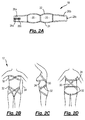
- Figure 2A shows a front view of a bandeau of the present invention.
- Figures 2B-D show front, side and rear views respectively, of a foundation of the present invention.
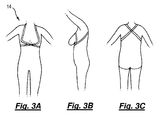
- Figures 3A-C show front, side and rear views respectively, of a lower lift section of the present invention.
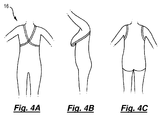
- Figures 4A-C show front, side and rear views respectively, of an upper lift section of the present invention.
- Figures 5A-D show connection points among the bands of the foundation, lower lift section, upper lift section, suspender section, girdle section, and corset section.
- Figure 6 shows a side view of fabric pieces attached to bands of a fabric template of the present invention.
- Figures 7A-D show views of a full support bra formed using a fabric template of the present invention and fabric pieces.
- Figure 7A shows half of the bandeau.
- Figure 7B shows the same bandeau with addition of fabric pieces to the lower lift section.
- Figure 7C shows the bandeau with addition of fabric pieces to the upper lift section.
- Figure 7D shows the bandeau with addition of fabric pieces to the lower lift and upper lift sections spanning the wearer's upper back.
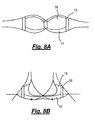
- Figures 8A-D show front views of various embodiments of bras formed using a fabric template of the present invention: bandeau bra ( Figure 8A ), push-up bra ( Figure 8B ), plunging neckline bra ( Figure 8C ), and asymmetrical bra ( Figure 8D ).
- Figures 9A-C show rear views of various embodiments of garments formed using a fabric template of the present invention: sports bra ( Figure 9A ), cross-back bra ( Figure 9B ), and halter top ( Figure 9C ).
- Figures 10A-C show front, side and rear views respectively, of a lower body supporting garment formed using a fabric template of the present invention.
- Figures 11A-C show front, side and rear views respectively, of a high-waisted, thonged back garment formed using a fabric template of the present invention.
- Figures 12A-C show front, side and rear views respectively, of a hipster waist, partial back coverage garment formed using a fabric template of the present invention.
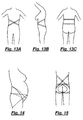
- Figures 13A-C show front, side and rear views respectively, of an upper torso shaper formed using a fabric template of the present invention.
- Figure 14 shows a side view of a maternity shaper or obesity body shaper formed using a fabric template of the present invention.
- Figure 15 shows a rear view of a bottomless buttock shaper formed using a fabric template of the present invention.
- Figures 16A-B show basic blocks for the rear and front of a swimsuit, respectively.
- Figure 16C shows the complete pattern pieces with seam allowance, matching notches, and pattern information.
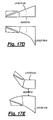
- Figures 17A-B show basic blocks for the rear and back of a swimsuit, respectively.
- Figures 17C-E show complete pattern pieces with seam allowance, matching notches and pattern information to produce styles to fit different figure types including hourglass ( Figure 17C ), athletic ( Figure 17D ), and apple ( Figure 17E ).
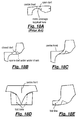
- Figure 18A shows prior art pattern pieces for a crotchline.
- Figures B-E show pattern pieces for a design of a crotch for a garment.
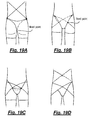
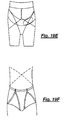
- Figures 19A-F show openings or closures at the front ( Figures 19B-F ) or rear ( Figure 19A ) of lower body garments.
- Figures 20A-B show openings or closures at the rear and front of a lower body garment.
- Figure 20C shows pattern pieces used to form the garment.
- the present invention relates to a system and method for garment fitting and fabrication.
- the present invention relates to a system and method for garment fitting and fabrication.
- the invention comprises a system for manufacturing a garment for a wearer comprising a fabric template and a plurality of fabric pieces attachable to the template to form the garment.
- the term "wearer” means a female or male adult or child.
- FIGS 1A-C generally show one embodiment of a fabric template (10) of the present invention.
- the fabric template (10) comprises a plurality of bands which are interconnected and arranged to form a foundation (12), a lower lift section (14), and an upper lift section (16).
- the foundation (12) comprises a bandeau (18).
- bandeau means a band-shaped covering for the breasts.
- the bandeau (18) is a strapless top having sufficient circumference and width to circumnavigate the wearer's torso and to cover the breasts, respectively.
- the bandeau (18) comprises a breast-covering part (20), upper and lower edges (22, 24), ends (26a, 26b), and adjustable fastening means (28a, 28b, 28c).
- the breast-covering part (20) has a criss-cross shape to enable centering of the bandeau (18) on the sternum of the wearer's body.
- the bandeau (18) is formed of an elasticized or resilient form-fitting material to encircle the wearer's torso snugly, yet comfortably, and to impart sufficient compression to stabilize and shape the breasts.
- Suitable materials include, but are not limited to, nylon, spandex, darlex, LycraTM, jersey, cotton, polyurethane, neoprene, elastomer and the like.
- the material may be a breathable fabric.
- the bandeau (18) may be in the form of a circular knit-type sock made in different circumferences and which can be adjusted to the depth of the breasts when placed on the body. A material which is shaped by heat or pressure, and retains its shape upon removal from the body may also be used.
- the upper edge (22) of the bandeau (18) rests over the top of the breasts against the chest to compress the breasts downward to limit any upward movement of the breasts.
- the upper edge (22) of the bandeau (18) extends under the arm and across the back in a horizontal line to connect with itself at the center back. This configuration applies to garments requiring only upper body support such as, for example, brassieres or tops.
- the upper edge (22) of the bandeau (18) extends to form the suspender section (30) as described below. This configuration applies to garments requiring both upper and lower body support such as, for example, foundation garments.
- the lower edge (24) of the bandeau (18) is positioned at the inframammary fold to support the breasts in a raised position. It will be recognized by those skilled in the art that the underbust band of a bra generally sits at the inframammary fold and holds the breast in a pert position with the breast lifted away from the chest wall; however, after hours of wear, the band crushes or rolls over or under the ptosis. To prevent this problem, the lower edge (24) preferably supports the breast in a pseudo-ptosis state at about 1 to 2 cm above the inframammary fold. The lower edge (24) traverses the wearer's back horizontally.
- the ends (26a, 26b) of the bandeau (18) may meet at either the wearer's front or back, or both.
- Figure 2A shows one embodiment of the bandeau (18) in which the ends (26a, 26b) meet at the wearer's back.
- a back closure requires the wearer to contort both arms and hands to the mid-back section, or to remove the bra straps and rotate the closure to the front. If the wearer is physically incapacitated for example, by a dislocated shoulder, rotator cuff disability, and the like, a front closure may be preferred.
- the ends (26a, 26b) of the bandeau (18) include fastening means (28a, 28b, 28c) for securing one end to the other, preferably in adjustable fashion.
- the fastening means (28a, 28b, 28c) may be any fastening means known in the art such as hooks and eyes, snaps, studs, pop fasteners, snap tape, or VelcroTM.
- the foundation (12) comprises in addition to the bandeau (18), a suspender section (30), a girdle section (32), and a corset section (34).
- the suspender section (30) serves as "a suspension bridge" between the wearer's thorax and pelvis.
- the suspender section (30) comprises bands connecting the bandeau (18) to the girdle section (32) in a criss-cross pattern overlying the wearer's back.
- the upper edge (22) of the bandeau (18) extends on both sides of the wearer's body under the arms to the back in a downward diagonal direction to form a criss-cross under the lower edge (24) of the bandeau (18).
- the upper edge (22) intersects with the lower edge (24) of the bandeau (18). This configuration (or use of the hips) counterbalances the weight of the breasts which would otherwise cause the lower edge (24) of the bandeau (18) to rise.
- the upper back is supported from the weight and strain of the breasts since the load on the upper back is reduced by transferring the weight and strain to the hips.
- the intersection of the upper edge (22) with the lower edge (24) of the bandeau (18) creates an underarm triangle or "wing" which supports and stabilizes the breasts towards the center frontline, restricting the pendulous trajectory.
- the suspender section (30) prevents the girdle section (32) from slipping downwards.
- the girdle section (32) supports and holds in the wearer's lower abdominal wall.
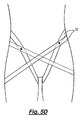
- the girdle section (32) comprises bands which traverse in a criss-cross pattern overlying the wearer's front pelvic region. The bands then extend underneath the wearer's buttocks and upwardly from between the wearer's thighs to converge with the suspender section (30).
- the term "converge" means to merge or to join at a shared point.
- the bands converging at the back of the wearer's waist.
- the bands for the girdle section (32) traverse from opposite iliac crests to form a criss-cross pattern at the lower abdominal wall.
- the bands then wrap over the ilium from front to back to converge with the suspender section (30).
- the bands At the top of the criss-cross pattern, the bands converge at the sylliac on the back of the pelvis.
- the portion of the bands under the buttocks provides the structure and framework for fabric pieces to support, lift and shape the buttocks.
- the corset section (34) supports and holds in the wearer's body from below the chest to the hips. As shown in Figures 2B-D , the corset section (34) comprises the lower edge (24) of the bandeau (18), the suspender section (30), and the bands of the girdle section (32) which criss-cross over the front pelvic region and connect at the back of the wearer's waist.
- Folds of the skin may be prone to intertrigo which can be worsened by any conditions causing increased heat, wetness, and friction, and may be complicated by superficial skin infection with yeast or bacteria.
- the corset section (34) creates a chest wall ptosis barrier which pockets the breasts, minimizes bounce so as to prevent mastalgia, and wicks moisture to treat or prevent maceration and intertrigo.
- the chest wall ptosis barrier forms the inner barrier between the chest wall and the ptosis portion of the breast to which the lower lift and upper lift sections (14, 16) attach, creating a pocket within the cradle of the lift to hold the pendulous portion of the breast at an appropriate location for the breast to move outwardly from the chest wall.
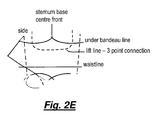
- the location depends on the weight and circumference of the breast mass. In women having macromastia, the location would be at the fourth or fifth rib. This three point connection is designated as "the lift line" ( Figure 2E ). As the breast volume increases, the lower lift line sits further down the ribcage.
- a band wraps horizontally across the circumference of the thorax from the lift line, crossing past the suspender section (30) and connecting with its opposing end at the center of the spine.
- the lower lift section (14) supports the pendulous portion of the breasts. As shown in Figures 3A-C , the lower lift section (14) comprises bands which traverse in a criss-cross pattern overlying the wearer's upper back, and extend downwardly over the wearer's shoulders along the sides of the breasts to align substantially horizontally below the pendulous portion of the breasts.
- the lower lift section (14) pushes the breasts towards the center frontline to restrict pendulous trajectory, and forms a "shelf" for the pendulous portion of the breasts.
- the upper lift section (16) helps to raise the breasts by supporting the lower portions of the breasts.
- the upper lift section (16) comprises bands which encircle the wearer's arms and traverse in a criss-cross pattern over the wearer's sternum to isolate each of the wearer's breasts, and to extend over the lower portions of the wearer's breasts.
- the upper lift section (16) provides lift of the breasts towards the chest and separation of the breasts.
- the lower lift and upper lift sections (14, 16) together provide secure positioning of the breast to the chest wall to minimize movement during high impact activities such as exercise.
- a center frontline supporting triangle may be formed by a fabric piece attached at the intersection of the lower lift and upper lift sections (14, 16).
- a chest supporting triangle may be formed by a fabric piece attached at the intersection of the upper edge (22) of the bandeau (18), and the lower lift and upper lift sections (14, 16).
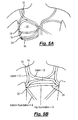
- FIG. 5A shows a front view of the wearer, indicating connection points among the bandeau (18), the lower lift section (14), and the upper lift section (16).
- Figure 5B shows a rear view of the wearer, indicating connection points among the bandeau (18), the lower lift section (14), the upper lift section (16), and the suspender section (30).
- Figure 5C shows a side view of the wearer, indicating connection points among the bandeau (18), the lower lift section (14), the upper lift section (16), and the suspender section (30).
- Figure 5D shows a front view of the wearer's front pelvic region, indicating connection points within the girdle section (32). The connection points also serve as a guide for the attachment of supporting individual fabric pieces onto the fabric template (10).
- the width of the bands for the suspender, girdle and corset sections (30, 32, 34) can be at least two inches or more, although other widths can be used.
- the bands are formed of a material having sufficient elasticity including, but not limited to, nylon, spandex, darlex, LycraTM, jersey, cotton, polyurethane, neoprene, elastomer and the like.
- the fabric template (10) aids garment fitting and fabrication since it indicates the structure and position for individual fabric pieces.
- the fabric template (10) functions as a frame which defines spaces and shapes for which corresponding fabric pieces are structured.
- the fabric pieces are selectively attached to provide additional support, to lift and shape the wearer's body, and to yield the desired garment.
- the term "fabric” means any cloth made from yarn or fibres by weaving, knitting, felting, etc.
- the fabric may be an elastic/stretch fabric including, but not limited to, nylon, spandex, darlex, LycraTM, jersey, cotton, polyurethane, neoprene, elastomer and the like.
- the fabric may include moisture-absorbing or wicking fibres or yarns capable of wicking or drawing moisture away from the skin. Wicking can be solely due to capillary action, as in the case of polyester or it may be a form of absorbency, as with cotton. Wicking may also be due to hydrophilic properties.
- the fabric may include fibres or yarns coated with anti-microbial metals selected from Ag, Au, Pt, Pd, Ir, Sn, Cu, Sb, Bi, Zn, and alloys or compounds of one or more of these metals.
- fabric piece "1” is attached to bands of the foundation (12) and upper lift section (16) to lie against the wearer's rib cage.
- Fabric piece “2” is attached to bands of the upper and lower lift sections (16, 14) to support the breasts in a raised position.
- Fabric piece “3” is attached to bands of the foundation (12) and lower lift section (14) to minimize any upward movement of the breasts.
- the end line for the chest ptosis barrier is represented as a dashed line (36).
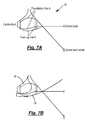
- Figures 7A-D show a method of execution for forming a full support bra. Fabric pieces are shown superimposed on the bandeau (18) in sequence.
- Figure 7A shows half of the bandeau (18).
- Figure 7B shows the same half bandeau (18) with addition of fabric pieces to the lower lift section (14).
- Figure 7C shows the half bandeau (18) with addition of fabric pieces to the upper lift section (16).
- Figure 7D shows the half bandeau (18) with addition of fabric pieces to the lower lift (14) and upper lift (16) sections spanning the wearer's upper back.
- the term "garment” refers to apparel which covers the upper body region including the breasts, or lower body region including the waist, stomach, hips, buttocks and thighs.
- the garment is a brassiere, top, swimsuit, sportswear, or a medical garment.
- the term “brassiere” or “bra” means a structure which conceals, supports and elevates the bust of the wearer.
- the term “top” means garments which cover the upper body or torso, and include a bottom hem at one end, and a neckline at the other end.
- tops examples include camisoles, blouses, halter tops, shirts, tank tops, tube tops, t-shirts, polo shirts, sports jerseys, and golf shirts.
- the term "swimsuit” for women means either a two-piece bra and panty ensemble or a one-piece maillot style.
- the term "sportswear” means active wear garments designed for comfort and casual wear including, for example, swimsuits, wetsuits, leotards, bodysuits, salopettes, cycling suits, and tracksuits.
- the term "medical garment” means a garment designed for postoperative and/or therapeutic use, and includes garments typically used after plastic, aesthetic, reconstructive, orthopaedic, general, surgical, and burn treatment applications.
- medical garments include mastectomy brassieres, surgical vests and corsets, abdominal belts or girdles, lymphoedema garments, body suits, trunk bandages, and other postoperative compression garments.
- a bandeau bra Figure 8A
- Figure 8B push-up bra
- Figure 8C plunging neckline bra
- Figure 8D asymmetrical bra
- Figure 9A sports bra
- Figure 9B Figure 9B
- halter top Figure 9C
- lower body supporting garment Figures 10A-C
- Figures 11A-C high-wa
- Portions of the fabric template (10) used to structure the garments are outlined. As shown in Figures 8A-D and Figures 9A-B , the bra designs incorporate the bandeau (18) and bands of the lower lift and upper sections (14, 16).
- the halter top of Figure 9C incorporates bands of the lower lift section (14) and the suspender section (30).
- the garments of Figures 10A-C, 11A-C, 12A-C , 14, and 15 incorporate bands of the suspender and/or girdle sections (30, 32).
- the garments of Figures 13A-C incorporate bands within the corset section (24).
- the fabric pieces developed from the fabric template (10) can serve as foundation patterns or blocks for garments such as, for example, swimsuits.
- Figures 16A-B show basic blocks for the rear and front of a swimsuit, respectively.
- Figure 16C shows the complete pattern pieces with seam allowance, matching notches, and pattern information.
- block means a custom-fitted basic pattern from which patterns for many different styles can be created.
- the flat method can be used whereby a pattern is generated from an existing foundation pattern or block from which garment styles can be created.
- FIGS 17A-B show basic blocks for the front and rear of a swimsuit, respectively.
- Figures 17C-E show complete pattern pieces with seam allowance, matching notches and pattern information.
- Intermediate blocks developed from the basic blocks may be used to produce styles to fit different figure types including hourglass ( Figure 17C ), athletic ( Figure 17D ), and apple ( Figure 17E ).
- Fabric pieces can also be modified to fit specific areas of the body including, for example, the crotch.
- Prior art designs for classic bifurcated and panty crotchlines typically include an open dart positioned on the center frontline which can cause puckering and does not provide any option for full leg coverage ( Figure 18A).
- Figures 18B-E show an adjustable crotch extension design for length and width, which includes a closed dart on the center frontline and an open dart under the buttock.
- Openings or closures may be positioned at the front or rear of the garment as shown, for example in the following figures: rear closure ( Figure 19A ); diaper release ( Figure 19B ); crotch release ( Figure 19C ); clip in center back ( Figure 19D ); clip in center front ( Figure 19E ); connection for top to bottom ( Figure 19F ); and front and back closures ( Figures 20A-C ).
- the positioning of openings or closures may vary depending on factors including, but not limited to, the fit, function, or style of the garment, and the wearer's preferences or physical disabilities.
- the invention comprises a method for preparing a garment for a wearer comprising the steps of:
- Modular fabric pieces are pre-fabricated in a variety of sizes, styles, and functions.
- the fabric pieces function as blocks to form the structural base of a garment.
- the fitter selects fabric pieces in accordance to the wearer's body contour and preferences. Alternatively, the wearer may select her choices through a printed or online catalogue prior to attending the on-site fitting.
- a bandeau (18) having the circumference of the wearer's bust is selected and fitted to the wearer's body.
- Suitable tools for measuring the circumference of the wearer's bust include, but are not limited to, measuring tape, metal tape, and the like.
- the width of the client's rib cage may provide an estimated circumference of the wearer's bust. Rib cage width can be measured by having the wearer stand with her back to a wall, marking each side of her rib cage using pegs, thumbtacks, or a pencil, and measuring the distance between the markers.
- the estimated circumference may vary slightly from the true circumference due to factors such as, for example, the shape of the bridge at the sternum, the height from the bridge to the top of the breast, the length of ptosis, and the depth or volume of the breasts.
- the fitter drapes the fabric pieces directly onto the wearer's body. Since the fabric pieces are laid directly onto the body, the wearer has the opportunity to decide upon the desired feel of fit (i.e., tighter or looser, neckline, etc.). The fabric pieces are adjusted or altered as needed to fit the wearer.
- drafting fit templates may also be used in combination with the fabric pieces. As will be recognized by those skilled in the art, drafting fit templates provide individualized information as to neckline, sleeve cut, etc. Any changes to the wearer's original choices for the garment can be made during draping. In addition, there is no loss of garment details since the garment is fitted directly onto the wearer's body.
- the fabric pieces are pinned together.
- the fitter relays the details of the fabric pieces to a production operator who prepares and cuts any exterior or additional pieces required to complete assembly of the garment. With the fabric pieces provided by the production operator, the fitter finishes the fitting process on the wearer. Assembly of the garment is completed by making any needed alterations and sewing all the fabric pieces together. Any additional requirements may be included such as, for example, underwire for women having macromastia, and padding to create symmetry for a smaller breast, a lower shoulder, or a lower hip, or to enhance the size of the breasts or buttocks.
- the garment is fitted and prepared within about four hours. In one embodiment, the garment is fitted and prepared in about 3.8 hours, including about 80 minutes for consultation and fitting, about 85 minutes for drafting and alteration, and about 65 minutes for sewing. After consultation and fitting, the garment can thus be prepared within about two and a half hours.
- the pre-fabricated fabric pieces may be provided in a kit for fashion training or home sewing.
- the invention comprises a kit for preparing a garment for a wearer comprising a plurality of pre-fabricated fabric pieces in a variety of sizes, styles, and fabrics, each of the fabric pieces being structured to correspond to respective portions of the fabric template, and instructions for using the fabric pieces to prepare the garment.
- the invention comprises a method for treating or preventing disorders associated with insufficient breast support comprising clothing a subject in a garment manufactured using the above system.
- the disorders may be selected from ptosis, mastalgia, macromastia, maceration, intertrigo, muscle tension, neck pain, back pain, headaches, fatigue, upper limb neural symptoms, abrasions, poor posture, impaired circulation, shoulder strain, or breathing problems.
- the term “mastalgia” means general breast pain including cyclical mastalgia with symptoms at certain timepoints in the menstrual cycle, non-cyclical mastalgia which results in consistent pain to all or part of the breast, and exercise-related mastalgia.
- the term “macromastia” means a state of having disproportionately large breasts.
- the term “maceration” means the softening and breaking down of skin resulting from prolonged exposure to moisture.
- the term “intertrigo” means inflammation of skin folds which occurs with ptosis and macromastia.
- a garment was prepared for a client according to the steps set out in Table 1. The time for each step was determined, with the total time for consultation/fitting being about 80 minutes, the total time for drafting/alteration being about 85 minutes, and the total time for sewing being about 65 minutes. The overall total time for preparation of the garment was 3.8 hours. These results indicate that a garment can be fitted and fabricated accurately and efficiently within less than about four hours. This preparation time is considerably less than the typical production time required for custom-made garments.
Landscapes
- Engineering & Computer Science (AREA)
- Textile Engineering (AREA)
- Manufacturing & Machinery (AREA)
- Corsets Or Brassieres (AREA)
- Details Of Garments (AREA)
Applications Claiming Priority (1)
| Application Number | Priority Date | Filing Date | Title |
|---|---|---|---|
| US12/968,724 US8549763B2 (en) | 2010-12-15 | 2010-12-15 | System and method for garment fitting and fabrication |
Publications (3)
| Publication Number | Publication Date |
|---|---|
| EP2465370A2 true EP2465370A2 (fr) | 2012-06-20 |
| EP2465370A3 EP2465370A3 (fr) | 2013-04-03 |
| EP2465370B1 EP2465370B1 (fr) | 2016-01-27 |
Family
ID=45093639
Family Applications (1)
| Application Number | Title | Priority Date | Filing Date |
|---|---|---|---|
| EP11275156.5A Active EP2465370B1 (fr) | 2010-12-15 | 2011-12-06 | Système et procédé pour adapter des vêtements et leur fabrication |
Country Status (3)
| Country | Link |
|---|---|
| US (1) | US8549763B2 (fr) |
| EP (1) | EP2465370B1 (fr) |
| CA (1) | CA2760304C (fr) |
Families Citing this family (28)
| Publication number | Priority date | Publication date | Assignee | Title |
|---|---|---|---|---|
| CA2838790A1 (fr) * | 2011-06-10 | 2012-12-13 | Vishal PUNI | Chemise pour la stabilisation des epaules |
| GB2500627A (en) * | 2012-03-27 | 2013-10-02 | Wendy Moore | A breast measuring device for determining bra size |
| US20140019087A1 (en) * | 2012-07-11 | 2014-01-16 | Bradley Bengtson | Tools, Systems and Methods for Standardization of Bra Cup Measurements |
| US9107462B1 (en) * | 2012-09-28 | 2015-08-18 | Google Inc. | Textile pattern optimization based on fabric orientation and bias characterization |
| WO2014159726A1 (fr) * | 2013-03-13 | 2014-10-02 | Mecommerce, Inc. | Détermination de la dimension d'un objet cible dans une image au moyen d'un objet de référence |
| US20140259277A1 (en) * | 2013-03-14 | 2014-09-18 | Udderly Hot Mama LLC | Breastfeeding Garment |
| ES2625756T3 (es) * | 2013-04-18 | 2017-07-20 | Van De Velde Nv | Método de prueba para un sujetador |
| US9498691B2 (en) | 2014-01-17 | 2016-11-22 | Justin Douglas Antoine | Training apparatus for athletes and others |
| US10426649B2 (en) | 2014-10-28 | 2019-10-01 | Saemee Lyu | Posture improvement shapewear garment and systems |
| US20160183617A1 (en) * | 2014-12-12 | 2016-06-30 | Carlanda R. McKinney | Method for preparing custom-fitted undergarments |
| FR3032863B1 (fr) | 2015-02-25 | 2017-10-20 | Dbapparel Operations | Soutien-gorge adapte pour la pratique sportive |
| US11213078B2 (en) | 2015-06-10 | 2022-01-04 | Nike, Inc. | Support garment with lock down support |
| CN107846992A (zh) * | 2015-06-12 | 2018-03-27 | 蓝旗亚日本株式会社 | 西装原型以及西装原型用测定器 |
| US11019853B2 (en) | 2015-07-24 | 2021-06-01 | Sexy Back Bra, Llc. | Backless support bra |
| US9750288B2 (en) * | 2015-07-24 | 2017-09-05 | Sexy Back Bra, Llc | Backless support bra |
| US11132811B2 (en) * | 2016-03-08 | 2021-09-28 | The Lycra Company Llc | Method and system for improving size selection of garments |
| USD785905S1 (en) * | 2016-05-04 | 2017-05-09 | Lululemon Athletica Canada Inc. | Bathing suit |
| BR112019002539B1 (pt) * | 2016-08-08 | 2023-02-28 | Sexy Back Bra, Llc | Sutiã de suporte sem costas |
| DK3750515T3 (da) * | 2016-08-22 | 2025-03-31 | Sanko Tekstil Isletmeleri San Ve Tic As | Kompressionsbeklædning med multiple kompressionskræfter ogfremgangsmåde til dannelse heraf |
| US11013274B2 (en) | 2017-07-16 | 2021-05-25 | Honeylove Sculptwear, Inc. | Shaping garments with upper leg slimming bands |
| US10856597B2 (en) * | 2018-03-05 | 2020-12-08 | Shoulder Bare Ltd. | Device for comfortably maintaining off-shoulder fashions |
| US12048338B2 (en) * | 2018-03-28 | 2024-07-30 | Ifgcure Holdings, Llc | Wearable orthopedic device for lower body posture correction and improved ergonomics |
| JP7189440B2 (ja) * | 2019-03-05 | 2022-12-14 | 株式会社ワコール | カップ付き衣類のサイズ判定装置およびサイズ判定方法 |
| US11839243B1 (en) * | 2019-09-12 | 2023-12-12 | Preferred Prescription, Inc. | Therapeutic shirt with high compression support for improved posture for pregnant women and overweight wearers |
| US20220151312A1 (en) * | 2020-11-14 | 2022-05-19 | Christine M. Schramm | Fabric Inserts To Eliminate Restriction of Movement In Clothing |
| US12016402B2 (en) | 2021-05-17 | 2024-06-25 | Nike, Inc. | Bra support structure |
| US12075852B2 (en) | 2021-08-24 | 2024-09-03 | Nike, Inc. | Breast-supporting structure |
| USD1116352S1 (en) * | 2024-06-28 | 2026-03-10 | Popilush, Llc | Garment |
Citations (32)
| Publication number | Priority date | Publication date | Assignee | Title |
|---|---|---|---|---|
| GB139725A (en) | 1919-08-23 | 1920-03-11 | Elena Barbu | Improvements in bust-supporters |
| GB337273A (en) | 1929-12-23 | 1930-10-30 | Harris Norman Grinager | Measurement foundation garment for use in measuring the figure |
| US2180180A (en) | 1938-02-05 | 1939-11-14 | Berger Brothers Co | Controlling bandeau |
| US2283108A (en) | 1940-07-31 | 1942-05-12 | Berger Brothers Co | Controlling or fitting garment |
| US2406699A (en) | 1944-08-26 | 1946-08-27 | Lustig Florence | Bust separator |
| US2775767A (en) | 1954-04-14 | 1957-01-01 | Famous Fit Inc | Garment |
| US2858832A (en) | 1955-09-02 | 1958-11-04 | Berger Brothers Co | Controlling and measuring garment |
| US2863152A (en) | 1957-04-29 | 1958-12-09 | Blatt Paula | Panty |
| US3261359A (en) | 1964-03-17 | 1966-07-19 | Barbara V Gould | Garment |
| US3339554A (en) | 1965-08-09 | 1967-09-05 | Vestal L Nobbs | Girdle |
| GB1468762A (en) | 1975-04-03 | 1977-03-30 | Sutherland M | Means for ascertaining required sizes of brassieres |
| GB2201579A (en) | 1987-03-03 | 1988-09-07 | Mary Sutherland | Improvements in or relating to brassieres |
| US4868990A (en) | 1988-05-11 | 1989-09-26 | Executive Fit, Inc. | Garment measuring system |
| US5215494A (en) | 1992-04-20 | 1993-06-01 | Flanagan Patricia C | Breast foundation and natural support |
| GB2273646A (en) | 1992-12-24 | 1994-06-29 | Wacoal Corp | Garment for at least the lower body. |
| US5548519A (en) | 1994-08-12 | 1996-08-20 | Custom Clothing Technology Corporation | Custom apparel manufacturing apparatus and method |
| US5603653A (en) | 1995-06-07 | 1997-02-18 | Hartman; Kathie F. | Perspiration absorbent pads for female breasts |
| US5768135A (en) | 1994-08-12 | 1998-06-16 | Custom Clothing Technology Corporation | Custom apparel manufacturing apparatus and method |
| US5908346A (en) | 1993-09-08 | 1999-06-01 | Mccall; Rita | Brassiere and garment incorporating a brassiere |
| WO1999053783A1 (fr) | 1998-04-21 | 1999-10-28 | Robert Balit | Systeme de soutien pour maillot de bain et justaucorps |
| US6101424A (en) | 1996-10-24 | 2000-08-08 | New Lady Co., Ltd. | Method for manufacturing foundation garment |
| GB2355385A (en) | 1999-10-18 | 2001-04-25 | Xenon Entpr Ltd | Apparatus and method of measuring breast characteristics |
| US6276069B1 (en) | 1999-03-01 | 2001-08-21 | Jockey International, Inc. | Brassiere sizer |
| US6336839B1 (en) | 2001-02-20 | 2002-01-08 | Laila Valli | Modular brassiere fitment apparatus |
| EP1179301A1 (fr) | 1998-05-11 | 2002-02-13 | Hiroshi Yoshihara | Structure de soutien/correction de forme pour le corps humain et element vestimentaire comportant ladite structure |
| US6751877B2 (en) | 2002-07-15 | 2004-06-22 | Carol S. Grove | Wearable adjustable garment pattern template |
| US6991611B2 (en) | 2002-02-14 | 2006-01-31 | Jhoon Goo Rhee | Posture apparatus |
| US7058471B2 (en) | 2003-01-14 | 2006-06-06 | Watanabe John S | System and method for custom-made clothing |
| US7164962B2 (en) | 2005-05-12 | 2007-01-16 | Kevin Petterson | Method and apparatus for fitting brassieres |
| US20090215359A1 (en) | 2008-02-22 | 2009-08-27 | Jockey International, Inc. | System and method of constructing and sizing brassieres |
| US7607966B1 (en) | 2007-12-03 | 2009-10-27 | Fox Leslie Z | Breast uplift support assembly |
| WO2010001136A1 (fr) | 2008-07-04 | 2010-01-07 | Faveo Limited | Perfectionnements apportés à un vêtement ou s'y rapportant |
Family Cites Families (29)
| Publication number | Priority date | Publication date | Assignee | Title |
|---|---|---|---|---|
| US2222687A (en) | 1936-05-08 | 1940-11-26 | Maiden Form Brassiere Company | Strap construction |
| US2553225A (en) | 1948-04-02 | 1951-05-15 | Weaver Roy Blaine | Brassiere |
| FR1454565A (fr) | 1965-08-24 | 1966-02-11 | Lejaby Ets | Procédé de coupe et de montage des éléments constitutifs d'une gaine, corset ou autre sous-vêtement et produit nouveau en résultant |
| US3939565A (en) * | 1969-06-11 | 1976-02-24 | Bush Roberta F | Pattern fitting tool and method of custom fitting patters |
| US3979831A (en) * | 1974-11-22 | 1976-09-14 | Lutz Helene P | Method and apparatus for altering clothing patterns |
| US4136452A (en) * | 1977-04-13 | 1979-01-30 | Camp 7, Inc. | Method for fabricating a custom fit garment |
| US4205446A (en) * | 1978-06-08 | 1980-06-03 | Gibson Donald A | Dress pattern |
| US4444191A (en) | 1979-06-21 | 1984-04-24 | Harned Marguerite J | Comfort garment |
| US4293959A (en) * | 1979-12-26 | 1981-10-13 | Gioello Debbie A | Stretch knit body suit with padded areas |
| US4475552A (en) * | 1982-03-03 | 1984-10-09 | Hiroshi Yoshihara | Core belt arrangement of a woman's garment |
| FR2558350B3 (fr) | 1984-01-19 | 1986-05-16 | Yoshihara Hiroshi | Dispositif de sangle de soutien pour vetement feminin |
| DE3587075T2 (de) * | 1984-11-22 | 1993-09-02 | Hiroshi Yoshihara | Kleidungsstruktur und verfahren zur herstellung von kleidungsstuecken. |
| EP0277215A1 (fr) * | 1986-08-19 | 1988-08-10 | Horst Forschner | Procede de bricolage de vetements et jeu d'elements formant des vetements a bricoler soi-meme |
| US4885844A (en) * | 1988-11-14 | 1989-12-12 | Chun Joong H | Computer aided custom tailoring with disposable measurement clothing |
| US5378192A (en) | 1993-10-04 | 1995-01-03 | Darmante; Dale T. | Custom-fit front-opening brassiere |
| ATE181645T1 (de) | 1993-10-22 | 1999-07-15 | Lovable Italiana Spa | Bustier |
| US5992027A (en) * | 1996-01-31 | 1999-11-30 | Mack; Helen | Method of determining the correct size in women's sewing patterns |
| JP3088950B2 (ja) | 1996-03-04 | 2000-09-18 | 株式会社ワコール | ヒップアップ機能を有する衣類 |
| US6023785A (en) | 1997-11-10 | 2000-02-15 | Johnson; Christina Erteszek | Size adjustable bra |
| US5873768A (en) * | 1998-04-21 | 1999-02-23 | Edie Fleischman-Ament | Active-wear garment |
| AU3062901A (en) | 2000-02-14 | 2001-08-20 | Joel Peralta Sanchez | Personalized bathing suit, inter alia |
| JP4351422B2 (ja) | 2002-06-06 | 2009-10-28 | 株式会社ワコール | 股付き矯正衣類 |
| FR2851459B1 (fr) | 2003-02-21 | 2005-04-22 | Philippe Nicolas | Disposition de contention elastique permettant d'assurer un mouvement d'adduction des cuisses d'un etre humain |
| AU2003284502A1 (en) | 2003-11-28 | 2005-06-17 | Wacoal Corp. | Corrective clothes with crotch |
| US20060026734A1 (en) * | 2004-08-06 | 2006-02-09 | Fitzgerald Jodie A | Garment having novel attachment device |
| NL2000124C2 (nl) | 2006-07-03 | 2008-01-07 | Hunkemoeller B V | Bustenhouder. |
| US8777692B2 (en) | 2008-02-08 | 2014-07-15 | As Ip Holdings, Inc. | Brassiere |
| US20100035512A1 (en) | 2008-02-08 | 2010-02-11 | Melfi Maria Jimenez | Brassiere |
| AU2009208143A1 (en) | 2008-08-13 | 2010-03-04 | Josephine Rizzacasa | Support garment |
-
2010
- 2010-12-15 US US12/968,724 patent/US8549763B2/en active Active
-
2011
- 2011-12-06 EP EP11275156.5A patent/EP2465370B1/fr active Active
- 2011-12-07 CA CA2760304A patent/CA2760304C/fr active Active
Patent Citations (34)
| Publication number | Priority date | Publication date | Assignee | Title |
|---|---|---|---|---|
| GB139725A (en) | 1919-08-23 | 1920-03-11 | Elena Barbu | Improvements in bust-supporters |
| GB337273A (en) | 1929-12-23 | 1930-10-30 | Harris Norman Grinager | Measurement foundation garment for use in measuring the figure |
| US2180180A (en) | 1938-02-05 | 1939-11-14 | Berger Brothers Co | Controlling bandeau |
| US2283108A (en) | 1940-07-31 | 1942-05-12 | Berger Brothers Co | Controlling or fitting garment |
| US2406699A (en) | 1944-08-26 | 1946-08-27 | Lustig Florence | Bust separator |
| US2775767A (en) | 1954-04-14 | 1957-01-01 | Famous Fit Inc | Garment |
| US2858832A (en) | 1955-09-02 | 1958-11-04 | Berger Brothers Co | Controlling and measuring garment |
| US2863152A (en) | 1957-04-29 | 1958-12-09 | Blatt Paula | Panty |
| US3261359A (en) | 1964-03-17 | 1966-07-19 | Barbara V Gould | Garment |
| US3339554A (en) | 1965-08-09 | 1967-09-05 | Vestal L Nobbs | Girdle |
| GB1468762A (en) | 1975-04-03 | 1977-03-30 | Sutherland M | Means for ascertaining required sizes of brassieres |
| GB2201579A (en) | 1987-03-03 | 1988-09-07 | Mary Sutherland | Improvements in or relating to brassieres |
| US4868990A (en) | 1988-05-11 | 1989-09-26 | Executive Fit, Inc. | Garment measuring system |
| US5215494A (en) | 1992-04-20 | 1993-06-01 | Flanagan Patricia C | Breast foundation and natural support |
| GB2273646A (en) | 1992-12-24 | 1994-06-29 | Wacoal Corp | Garment for at least the lower body. |
| US5908346A (en) | 1993-09-08 | 1999-06-01 | Mccall; Rita | Brassiere and garment incorporating a brassiere |
| US5548519A (en) | 1994-08-12 | 1996-08-20 | Custom Clothing Technology Corporation | Custom apparel manufacturing apparatus and method |
| US5768135A (en) | 1994-08-12 | 1998-06-16 | Custom Clothing Technology Corporation | Custom apparel manufacturing apparatus and method |
| US5603653A (en) | 1995-06-07 | 1997-02-18 | Hartman; Kathie F. | Perspiration absorbent pads for female breasts |
| US6101424A (en) | 1996-10-24 | 2000-08-08 | New Lady Co., Ltd. | Method for manufacturing foundation garment |
| WO1999053783A1 (fr) | 1998-04-21 | 1999-10-28 | Robert Balit | Systeme de soutien pour maillot de bain et justaucorps |
| EP1179301A1 (fr) | 1998-05-11 | 2002-02-13 | Hiroshi Yoshihara | Structure de soutien/correction de forme pour le corps humain et element vestimentaire comportant ladite structure |
| US6276069B1 (en) | 1999-03-01 | 2001-08-21 | Jockey International, Inc. | Brassiere sizer |
| GB2371207A (en) | 1999-10-18 | 2002-07-24 | T Bra Ltd | Bra measuring apparatus and method |
| GB2355385A (en) | 1999-10-18 | 2001-04-25 | Xenon Entpr Ltd | Apparatus and method of measuring breast characteristics |
| US6336839B1 (en) | 2001-02-20 | 2002-01-08 | Laila Valli | Modular brassiere fitment apparatus |
| US6991611B2 (en) | 2002-02-14 | 2006-01-31 | Jhoon Goo Rhee | Posture apparatus |
| US7578798B2 (en) | 2002-02-14 | 2009-08-25 | Jhoon Goo Rhee | Posture apparatus |
| US6751877B2 (en) | 2002-07-15 | 2004-06-22 | Carol S. Grove | Wearable adjustable garment pattern template |
| US7058471B2 (en) | 2003-01-14 | 2006-06-06 | Watanabe John S | System and method for custom-made clothing |
| US7164962B2 (en) | 2005-05-12 | 2007-01-16 | Kevin Petterson | Method and apparatus for fitting brassieres |
| US7607966B1 (en) | 2007-12-03 | 2009-10-27 | Fox Leslie Z | Breast uplift support assembly |
| US20090215359A1 (en) | 2008-02-22 | 2009-08-27 | Jockey International, Inc. | System and method of constructing and sizing brassieres |
| WO2010001136A1 (fr) | 2008-07-04 | 2010-01-07 | Faveo Limited | Perfectionnements apportés à un vêtement ou s'y rapportant |
Non-Patent Citations (17)
| Title |
|---|
| ASHDOWN, S.P.; NA, H.: "Comparison of 3-D body scan data to quantify upper-body postural variation in older and younger women", CLOTHING & TEXTILES RESEARCH JOURNAL, vol. 26, no. 4, 2008, pages 292 - 307 |
| BOWLES, K.; STEELE, J.R.; CHAUNCHAIYAKUL, R.: "Do current sports brassiere designs impede respiratory function?", MEDICINE & SCIENCE IN SPORTS AND EXERCISE, 2005, pages 1633 - 1640 |
| BRIDGMAN, C.; SCURR, J.; WHITE, J.; HEDGER, W.: "Three dimensional kinematics of the breast during a two step star jump. Annual Conference of the British Association of Sport and Exercise Sciences 2008", JOURNAL OF SPORTS SCIENCES, vol. 26, no. 1, 2008, pages S34 |
| BYE, E.; LABAT, K.L.; DELONG, M.R.: "Analysis of body measurement systems for apparel", CLOTHING AND TEXTILES RESEARCH JOURNAL, vol. 24, no. 2, 2006, pages 66 - 79 |
| HEISEY, F.L.; BROWN, P.; JOHNSON, R.F.: "Three-dimensional pattern drafting: a theoretical framework", CLOTHING AND TEXTILES RESEARCH JOURNAL, vol. 6, no. 3, 1988, pages 1 - 9 |
| IBRAHIM, S.M.: "Mechanics of form-persuasive garments based on spandex fibers", TEXTILE RESEARCH JOURNAL, vol. 38, 1968, pages 950 - 963 |
| LABAT, K.; BYE, E.: "Physical characteristics related to bra fit. Ergonomics", CHEN, C., vol. 53, no. 4, 2010, pages 514 - 524 |
| LEE, H.; HONG, K.; KIM, E.A.: "Measurement protocol of women's nude breasts using a 3D scanning technique", APPLIED ERGONOMICS, vol. 35, 2004, pages 353 - 359 |
| LOKER, S.; ASHDOWN, S.: "Dress in the third dimension: online interactivity and its new horizons", CLOTHING & TEXTILES RESEARCH JOURNAL, vol. 26, no. 2, 2008, pages 164 - 176 |
| MASON, B.R.; PAGE, K.; FALLON, K.: "An analysis of movement and discomfort of the female breast during exercise and the effects of breast support in three cases", JOURNAL OF SCIENCE AND MEDICINE IN SPORT, vol. 2, no. 2, 1999, pages 134 - 144, XP005386167, DOI: doi:10.1016/S1440-2440(99)80193-5 |
| MCGHEE, D.E.; POWER, B.M.; STEELE, J.R.: "Does deep water running reduce exercise-induced breast discomfort?", BR. J. SPORTS MED., vol. 41, 2007, pages 879 - 883 |
| MCGHEE, D.E.; STEELE, J.R.: "How do respiratory state and measurement method affect bra size calculation.", BR. J. SPORTS MED., vol. 40, 2006, pages 970 - 974 |
| SCURR, J.; WHITE, J.; HEDGER, W.: "Breast displacement in three dimensions during the walking and running gait cycles", JOURNAL OF APPLIED BIOMECHANICS, vol. 25, 2009, pages 322 - 329 |
| SHIN, K.: "Patternmaking for the underwired bra: new directions", JTI, vol. 98, no. 4, 2007, pages 301 - 317 |
| WHITE, J.L.; SCURR, J.C.; SMITH, N.A.: "The effect of breast support on kinetics during overground running performance", ERGONOMICS, vol. 52, no. 4, 2009, pages 492 - 498 |
| WOOD, K.; CAMERON, M.; FITZGERALD, K.: "Breast size, bra fit and thoracic pain in young women: a correlational study", CHIROPRACTIC & OSTEOPATHY, vol. 16, 2008, pages 1 - 7 |
| ZHENG, R.; YU, W.; FAN, J.: "Development of a new Chinese bra sizing system based on breast anthropometric measurements", INTERNATIONAL JOURNAL OF INDUSTRIAL ERGONOMICS, vol. 37, 2007, pages 697 - 705, XP022165180, DOI: doi:10.1016/j.ergon.2007.05.008 |
Also Published As
| Publication number | Publication date |
|---|---|
| EP2465370A3 (fr) | 2013-04-03 |
| EP2465370B1 (fr) | 2016-01-27 |
| CA2760304A1 (fr) | 2012-06-15 |
| CA2760304C (fr) | 2016-02-09 |
| US8549763B2 (en) | 2013-10-08 |
| US20120156962A1 (en) | 2012-06-21 |
Similar Documents
| Publication | Publication Date | Title |
|---|---|---|
| US8549763B2 (en) | System and method for garment fitting and fabrication | |
| US5873768A (en) | Active-wear garment | |
| US7395557B1 (en) | Seamless upper body garment | |
| EP0238664B1 (fr) | Structure de vetements et procede de production de ce derniers | |
| US12053034B2 (en) | Garment with motion-supporting compression zones and body-shaping compression zones | |
| US9901124B2 (en) | Contoured buttocks enhancing and tummy slimming hosiery and foundation garment | |
| US20100184355A1 (en) | Circularly knit anti-slip seamless torso trim bra-slip | |
| US20140310854A1 (en) | Body Sculpting Garment | |
| US20060240743A1 (en) | Back supporting brassiere and undergarments with reinforced zones and method of making the same | |
| WO2010037116A1 (fr) | Sous-vêtement de maintien | |
| US20240423296A1 (en) | Post-surgical compression garment | |
| AU2014209122A1 (en) | Support bustier garment | |
| US9894939B1 (en) | Garment including shapewear | |
| Kuzmichev et al. | Sizing and fit for pressure garments | |
| KR200483968Y1 (ko) | 기능성 보정속옷 | |
| US9277772B2 (en) | Garment for supporting a wearer's breasts | |
| WO2015139076A1 (fr) | Vêtement de façonnage corporel | |
| CN210169071U (zh) | 一种具有文胸的束身美体衣 | |
| RU204281U1 (ru) | Корсетное изделие | |
| KR102863802B1 (ko) | 체형 보정용 의류 | |
| CN219920325U (zh) | 一种美体塑身衣 | |
| JP7671563B2 (ja) | 下着 | |
| US20110281500A1 (en) | Modified Body Shaper With No Leak Liner(s) | |
| JP3084017U (ja) | ファンデーション下着 | |
| CN207075567U (zh) | 一种塑身连体内衣 |
Legal Events
| Date | Code | Title | Description |
|---|---|---|---|
| PUAI | Public reference made under article 153(3) epc to a published international application that has entered the european phase |
Free format text: ORIGINAL CODE: 0009012 |
|
| AK | Designated contracting states |
Kind code of ref document: A2 Designated state(s): AL AT BE BG CH CY CZ DE DK EE ES FI FR GB GR HR HU IE IS IT LI LT LU LV MC MK MT NL NO PL PT RO RS SE SI SK SM TR |
|
| AX | Request for extension of the european patent |
Extension state: BA ME |
|
| PUAL | Search report despatched |
Free format text: ORIGINAL CODE: 0009013 |
|
| AK | Designated contracting states |
Kind code of ref document: A3 Designated state(s): AL AT BE BG CH CY CZ DE DK EE ES FI FR GB GR HR HU IE IS IT LI LT LU LV MC MK MT NL NO PL PT RO RS SE SI SK SM TR |
|
| AX | Request for extension of the european patent |
Extension state: BA ME |
|
| RIC1 | Information provided on ipc code assigned before grant |
Ipc: A41C 1/00 20060101ALI20130227BHEP Ipc: A41C 1/12 20060101ALI20130227BHEP Ipc: A41C 1/06 20060101ALI20130227BHEP Ipc: A41C 5/00 20060101ALI20130227BHEP Ipc: A41D 31/00 20060101ALI20130227BHEP Ipc: A41D 15/00 20060101AFI20130227BHEP Ipc: A41B 9/00 20060101ALI20130227BHEP Ipc: A41H 21/00 20060101ALI20130227BHEP |
|
| 17P | Request for examination filed |
Effective date: 20130919 |
|
| RBV | Designated contracting states (corrected) |
Designated state(s): AL AT BE BG CH CY CZ DE DK EE ES FI FR GB GR HR HU IE IS IT LI LT LU LV MC MK MT NL NO PL PT RO RS SE SI SK SM TR |
|
| REG | Reference to a national code |
Ref country code: DE Ref legal event code: R079 Ref document number: 602011022986 Country of ref document: DE Free format text: PREVIOUS MAIN CLASS: A41D0015000000 Ipc: A41H0003040000 |
|
| GRAP | Despatch of communication of intention to grant a patent |
Free format text: ORIGINAL CODE: EPIDOSNIGR1 |
|
| INTG | Intention to grant announced |
Effective date: 20150731 |
|
| RIC1 | Information provided on ipc code assigned before grant |
Ipc: A41D 15/00 20060101ALI20150717BHEP Ipc: A41D 31/00 20060101ALI20150717BHEP Ipc: A41C 5/00 20060101ALI20150717BHEP Ipc: A41C 1/06 20060101ALI20150717BHEP Ipc: A41H 21/00 20060101ALI20150717BHEP Ipc: A41B 9/00 20060101ALI20150717BHEP Ipc: A41C 1/00 20060101ALI20150717BHEP Ipc: A41H 3/04 20060101AFI20150717BHEP Ipc: A41C 1/12 20060101ALI20150717BHEP |
|
| GRAS | Grant fee paid |
Free format text: ORIGINAL CODE: EPIDOSNIGR3 |
|
| GRAA | (expected) grant |
Free format text: ORIGINAL CODE: 0009210 |
|
| AK | Designated contracting states |
Kind code of ref document: B1 Designated state(s): AL AT BE BG CH CY CZ DE DK EE ES FI FR GB GR HR HU IE IS IT LI LT LU LV MC MK MT NL NO PL PT RO RS SE SI SK SM TR |
|
| REG | Reference to a national code |
Ref country code: GB Ref legal event code: FG4D |
|
| REG | Reference to a national code |
Ref country code: CH Ref legal event code: EP |
|
| REG | Reference to a national code |
Ref country code: AT Ref legal event code: REF Ref document number: 772257 Country of ref document: AT Kind code of ref document: T Effective date: 20160215 |
|
| REG | Reference to a national code |
Ref country code: IE Ref legal event code: FG4D |
|
| REG | Reference to a national code |
Ref country code: DE Ref legal event code: R096 Ref document number: 602011022986 Country of ref document: DE |
|
| REG | Reference to a national code |
Ref country code: LT Ref legal event code: MG4D |
|
| REG | Reference to a national code |
Ref country code: NL Ref legal event code: MP Effective date: 20160127 |
|
| REG | Reference to a national code |
Ref country code: AT Ref legal event code: MK05 Ref document number: 772257 Country of ref document: AT Kind code of ref document: T Effective date: 20160127 |
|
| PG25 | Lapsed in a contracting state [announced via postgrant information from national office to epo] |
Ref country code: NL Free format text: LAPSE BECAUSE OF FAILURE TO SUBMIT A TRANSLATION OF THE DESCRIPTION OR TO PAY THE FEE WITHIN THE PRESCRIBED TIME-LIMIT Effective date: 20160127 |
|
| PG25 | Lapsed in a contracting state [announced via postgrant information from national office to epo] |
Ref country code: HR Free format text: LAPSE BECAUSE OF FAILURE TO SUBMIT A TRANSLATION OF THE DESCRIPTION OR TO PAY THE FEE WITHIN THE PRESCRIBED TIME-LIMIT Effective date: 20160127 Ref country code: NO Free format text: LAPSE BECAUSE OF FAILURE TO SUBMIT A TRANSLATION OF THE DESCRIPTION OR TO PAY THE FEE WITHIN THE PRESCRIBED TIME-LIMIT Effective date: 20160427 Ref country code: GR Free format text: LAPSE BECAUSE OF FAILURE TO SUBMIT A TRANSLATION OF THE DESCRIPTION OR TO PAY THE FEE WITHIN THE PRESCRIBED TIME-LIMIT Effective date: 20160428 Ref country code: FI Free format text: LAPSE BECAUSE OF FAILURE TO SUBMIT A TRANSLATION OF THE DESCRIPTION OR TO PAY THE FEE WITHIN THE PRESCRIBED TIME-LIMIT Effective date: 20160127 Ref country code: IT Free format text: LAPSE BECAUSE OF FAILURE TO SUBMIT A TRANSLATION OF THE DESCRIPTION OR TO PAY THE FEE WITHIN THE PRESCRIBED TIME-LIMIT Effective date: 20160127 Ref country code: ES Free format text: LAPSE BECAUSE OF FAILURE TO SUBMIT A TRANSLATION OF THE DESCRIPTION OR TO PAY THE FEE WITHIN THE PRESCRIBED TIME-LIMIT Effective date: 20160127 |
|
| PG25 | Lapsed in a contracting state [announced via postgrant information from national office to epo] |
Ref country code: AT Free format text: LAPSE BECAUSE OF FAILURE TO SUBMIT A TRANSLATION OF THE DESCRIPTION OR TO PAY THE FEE WITHIN THE PRESCRIBED TIME-LIMIT Effective date: 20160127 Ref country code: PT Free format text: LAPSE BECAUSE OF FAILURE TO SUBMIT A TRANSLATION OF THE DESCRIPTION OR TO PAY THE FEE WITHIN THE PRESCRIBED TIME-LIMIT Effective date: 20160527 Ref country code: LV Free format text: LAPSE BECAUSE OF FAILURE TO SUBMIT A TRANSLATION OF THE DESCRIPTION OR TO PAY THE FEE WITHIN THE PRESCRIBED TIME-LIMIT Effective date: 20160127 Ref country code: RS Free format text: LAPSE BECAUSE OF FAILURE TO SUBMIT A TRANSLATION OF THE DESCRIPTION OR TO PAY THE FEE WITHIN THE PRESCRIBED TIME-LIMIT Effective date: 20160127 Ref country code: SE Free format text: LAPSE BECAUSE OF FAILURE TO SUBMIT A TRANSLATION OF THE DESCRIPTION OR TO PAY THE FEE WITHIN THE PRESCRIBED TIME-LIMIT Effective date: 20160127 Ref country code: LT Free format text: LAPSE BECAUSE OF FAILURE TO SUBMIT A TRANSLATION OF THE DESCRIPTION OR TO PAY THE FEE WITHIN THE PRESCRIBED TIME-LIMIT Effective date: 20160127 Ref country code: PL Free format text: LAPSE BECAUSE OF FAILURE TO SUBMIT A TRANSLATION OF THE DESCRIPTION OR TO PAY THE FEE WITHIN THE PRESCRIBED TIME-LIMIT Effective date: 20160127 Ref country code: IS Free format text: LAPSE BECAUSE OF FAILURE TO SUBMIT A TRANSLATION OF THE DESCRIPTION OR TO PAY THE FEE WITHIN THE PRESCRIBED TIME-LIMIT Effective date: 20160527 |
|
| REG | Reference to a national code |
Ref country code: DE Ref legal event code: R097 Ref document number: 602011022986 Country of ref document: DE |
|
| PG25 | Lapsed in a contracting state [announced via postgrant information from national office to epo] |
Ref country code: DK Free format text: LAPSE BECAUSE OF FAILURE TO SUBMIT A TRANSLATION OF THE DESCRIPTION OR TO PAY THE FEE WITHIN THE PRESCRIBED TIME-LIMIT Effective date: 20160127 Ref country code: EE Free format text: LAPSE BECAUSE OF FAILURE TO SUBMIT A TRANSLATION OF THE DESCRIPTION OR TO PAY THE FEE WITHIN THE PRESCRIBED TIME-LIMIT Effective date: 20160127 |
|
| PG25 | Lapsed in a contracting state [announced via postgrant information from national office to epo] |
Ref country code: RO Free format text: LAPSE BECAUSE OF FAILURE TO SUBMIT A TRANSLATION OF THE DESCRIPTION OR TO PAY THE FEE WITHIN THE PRESCRIBED TIME-LIMIT Effective date: 20160127 Ref country code: SK Free format text: LAPSE BECAUSE OF FAILURE TO SUBMIT A TRANSLATION OF THE DESCRIPTION OR TO PAY THE FEE WITHIN THE PRESCRIBED TIME-LIMIT Effective date: 20160127 Ref country code: CZ Free format text: LAPSE BECAUSE OF FAILURE TO SUBMIT A TRANSLATION OF THE DESCRIPTION OR TO PAY THE FEE WITHIN THE PRESCRIBED TIME-LIMIT Effective date: 20160127 Ref country code: SM Free format text: LAPSE BECAUSE OF FAILURE TO SUBMIT A TRANSLATION OF THE DESCRIPTION OR TO PAY THE FEE WITHIN THE PRESCRIBED TIME-LIMIT Effective date: 20160127 |
|
| PLBE | No opposition filed within time limit |
Free format text: ORIGINAL CODE: 0009261 |
|
| STAA | Information on the status of an ep patent application or granted ep patent |
Free format text: STATUS: NO OPPOSITION FILED WITHIN TIME LIMIT |
|
| PG25 | Lapsed in a contracting state [announced via postgrant information from national office to epo] |
Ref country code: BE Free format text: LAPSE BECAUSE OF FAILURE TO SUBMIT A TRANSLATION OF THE DESCRIPTION OR TO PAY THE FEE WITHIN THE PRESCRIBED TIME-LIMIT Effective date: 20160127 |
|
| REG | Reference to a national code |
Ref country code: FR Ref legal event code: PLFP Year of fee payment: 6 |
|
| 26N | No opposition filed |
Effective date: 20161028 |
|
| PG25 | Lapsed in a contracting state [announced via postgrant information from national office to epo] |
Ref country code: SI Free format text: LAPSE BECAUSE OF FAILURE TO SUBMIT A TRANSLATION OF THE DESCRIPTION OR TO PAY THE FEE WITHIN THE PRESCRIBED TIME-LIMIT Effective date: 20160127 Ref country code: BG Free format text: LAPSE BECAUSE OF FAILURE TO SUBMIT A TRANSLATION OF THE DESCRIPTION OR TO PAY THE FEE WITHIN THE PRESCRIBED TIME-LIMIT Effective date: 20160427 |
|
| REG | Reference to a national code |
Ref country code: CH Ref legal event code: PL |
|
| PG25 | Lapsed in a contracting state [announced via postgrant information from national office to epo] |
Ref country code: MC Free format text: LAPSE BECAUSE OF FAILURE TO SUBMIT A TRANSLATION OF THE DESCRIPTION OR TO PAY THE FEE WITHIN THE PRESCRIBED TIME-LIMIT Effective date: 20160127 |
|
| REG | Reference to a national code |
Ref country code: IE Ref legal event code: MM4A |
|
| PG25 | Lapsed in a contracting state [announced via postgrant information from national office to epo] |
Ref country code: LU Free format text: LAPSE BECAUSE OF NON-PAYMENT OF DUE FEES Effective date: 20161206 Ref country code: LI Free format text: LAPSE BECAUSE OF NON-PAYMENT OF DUE FEES Effective date: 20161231 Ref country code: CH Free format text: LAPSE BECAUSE OF NON-PAYMENT OF DUE FEES Effective date: 20161231 |
|
| REG | Reference to a national code |
Ref country code: FR Ref legal event code: PLFP Year of fee payment: 7 |
|
| PG25 | Lapsed in a contracting state [announced via postgrant information from national office to epo] |
Ref country code: IE Free format text: LAPSE BECAUSE OF NON-PAYMENT OF DUE FEES Effective date: 20161206 |
|
| PG25 | Lapsed in a contracting state [announced via postgrant information from national office to epo] |
Ref country code: CY Free format text: LAPSE BECAUSE OF FAILURE TO SUBMIT A TRANSLATION OF THE DESCRIPTION OR TO PAY THE FEE WITHIN THE PRESCRIBED TIME-LIMIT Effective date: 20160127 Ref country code: HU Free format text: LAPSE BECAUSE OF FAILURE TO SUBMIT A TRANSLATION OF THE DESCRIPTION OR TO PAY THE FEE WITHIN THE PRESCRIBED TIME-LIMIT; INVALID AB INITIO Effective date: 20111206 |
|
| PG25 | Lapsed in a contracting state [announced via postgrant information from national office to epo] |
Ref country code: TR Free format text: LAPSE BECAUSE OF FAILURE TO SUBMIT A TRANSLATION OF THE DESCRIPTION OR TO PAY THE FEE WITHIN THE PRESCRIBED TIME-LIMIT Effective date: 20160127 Ref country code: MK Free format text: LAPSE BECAUSE OF FAILURE TO SUBMIT A TRANSLATION OF THE DESCRIPTION OR TO PAY THE FEE WITHIN THE PRESCRIBED TIME-LIMIT Effective date: 20160127 |
|
| PG25 | Lapsed in a contracting state [announced via postgrant information from national office to epo] |
Ref country code: MT Free format text: LAPSE BECAUSE OF NON-PAYMENT OF DUE FEES Effective date: 20161206 |
|
| PG25 | Lapsed in a contracting state [announced via postgrant information from national office to epo] |
Ref country code: AL Free format text: LAPSE BECAUSE OF FAILURE TO SUBMIT A TRANSLATION OF THE DESCRIPTION OR TO PAY THE FEE WITHIN THE PRESCRIBED TIME-LIMIT Effective date: 20160127 |
|
| P01 | Opt-out of the competence of the unified patent court (upc) registered |
Effective date: 20230530 |
|
| PGFP | Annual fee paid to national office [announced via postgrant information from national office to epo] |
Ref country code: GB Payment date: 20251201 Year of fee payment: 15 |
|
| PGFP | Annual fee paid to national office [announced via postgrant information from national office to epo] |
Ref country code: FR Payment date: 20251201 Year of fee payment: 15 |
|
| PGFP | Annual fee paid to national office [announced via postgrant information from national office to epo] |
Ref country code: DE Payment date: 20251230 Year of fee payment: 15 |