EP2465769A2 - Optimierung von Heissgasströmungen ausgesetzten Strukturen - Google Patents
Optimierung von Heissgasströmungen ausgesetzten Strukturen Download PDFInfo
- Publication number
- EP2465769A2 EP2465769A2 EP11194128A EP11194128A EP2465769A2 EP 2465769 A2 EP2465769 A2 EP 2465769A2 EP 11194128 A EP11194128 A EP 11194128A EP 11194128 A EP11194128 A EP 11194128A EP 2465769 A2 EP2465769 A2 EP 2465769A2
- Authority
- EP
- European Patent Office
- Prior art keywords
- fairing
- front part
- aircraft
- rear part
- erosion
- Prior art date
- Legal status (The legal status is an assumption and is not a legal conclusion. Google has not performed a legal analysis and makes no representation as to the accuracy of the status listed.)
- Withdrawn
Links
- 238000005457 optimization Methods 0.000 title 1
- 239000003381 stabilizer Substances 0.000 claims abstract description 26
- 239000000463 material Substances 0.000 claims abstract description 9
- 239000004918 carbon fiber reinforced polymer Substances 0.000 claims description 4
- 239000002184 metal Substances 0.000 claims description 4
- 229910001220 stainless steel Inorganic materials 0.000 claims description 4
- 239000010935 stainless steel Substances 0.000 claims description 4
- 239000002131 composite material Substances 0.000 claims description 3
- 229920002430 Fibre-reinforced plastic Polymers 0.000 claims description 2
- 239000011151 fibre-reinforced plastic Substances 0.000 claims description 2
- 239000011521 glass Substances 0.000 claims description 2
- 238000001465 metallisation Methods 0.000 claims description 2
- 239000002071 nanotube Substances 0.000 claims 1
- 230000003628 erosive effect Effects 0.000 description 25
- 238000013461 design Methods 0.000 description 10
- 230000004224 protection Effects 0.000 description 9
- 230000015556 catabolic process Effects 0.000 description 3
- 238000006731 degradation reaction Methods 0.000 description 3
- 230000000694 effects Effects 0.000 description 3
- 238000009924 canning Methods 0.000 description 2
- 238000009499 grossing Methods 0.000 description 2
- 238000007689 inspection Methods 0.000 description 2
- 238000004519 manufacturing process Methods 0.000 description 2
- 239000007769 metal material Substances 0.000 description 2
- 238000000034 method Methods 0.000 description 2
- 238000003466 welding Methods 0.000 description 2
- 229910000831 Steel Inorganic materials 0.000 description 1
- 238000005260 corrosion Methods 0.000 description 1
- 230000007797 corrosion Effects 0.000 description 1
- 230000000593 degrading effect Effects 0.000 description 1
- 239000007789 gas Substances 0.000 description 1
- 238000005304 joining Methods 0.000 description 1
- 238000012423 maintenance Methods 0.000 description 1
- 238000012986 modification Methods 0.000 description 1
- 230000004048 modification Effects 0.000 description 1
- 239000002105 nanoparticle Substances 0.000 description 1
- 238000010422 painting Methods 0.000 description 1
- 238000003908 quality control method Methods 0.000 description 1
- 238000007493 shaping process Methods 0.000 description 1
- 239000010959 steel Substances 0.000 description 1
- 238000011282 treatment Methods 0.000 description 1
Images


Classifications
-
- B—PERFORMING OPERATIONS; TRANSPORTING
- B64—AIRCRAFT; AVIATION; COSMONAUTICS
- B64C—AEROPLANES; HELICOPTERS
- B64C5/00—Stabilising surfaces
- B64C5/02—Tailplanes
-
- B—PERFORMING OPERATIONS; TRANSPORTING
- B64—AIRCRAFT; AVIATION; COSMONAUTICS
- B64C—AEROPLANES; HELICOPTERS
- B64C7/00—Structures or fairings not otherwise provided for
Definitions
- the present invention refers to the optimisation of structures that are subjected to hot streams from gases, in particular, to an aircraft fairing design and, more in particular, to the fairing design of the horizontal stabilizer of an aircraft.
- An aircraft fairing is a structure whose primary function is to produce a smooth outline and reduce drag. These structures are covers for gaps and spaces between parts of an aircraft, thus reducing drag and interference drag in these parts, also improving the aircraft appearance.
- fairings are commonly used on elevator and horizontal stabilizer tips, on engine cowlings, on fin and rudder tips, and on wing root and wing tips. Particularly in the case of fairings on elevator and horizontal stabilizer tips, the fairing has the objective of smoothing out the airflow at the tips.
- Fairings on aircraft horizontal stabilizers suffer from erosion degrading them after time, as the rest of fairings present in the aircraft, as they are elements working in particularly erosive environments.
- these fairings also suffer from erosion coming from the hot air stream from the engines (higher temperature and speed conditions), the erosion issue therefore being a main issue in the design of these horizontal stabilizers fairings, specially in cases of small aircraft, with a short distance between the wing and the tail. This effect coming from the hot air stream from the engines is particularly relevant in the cases of aircraft landing and take-off.
- these fairings are not made as light and cheap as they could because of the erosion requirements limitation, therefore being provided with specific anti-erosion protection.
- fairings for horizontal stabilizers are manufactured from a metallic material, additionally comprising erosion protection areas to avoid the base element being deteriorated.
- fairings Due to the special configuration and twisting shape of fairings in horizontal stabilizers, these fairings are made at present mainly from metallic sheets being shaped and joined afterwards, by welding or by rivets.
- These known fairings have the problem of requiring costly and time consuming inspection requirements, such as x-ray, also having higher manufacturings costs, because of the manual processes employed.
- these elements present quality problems because of their particular shaping, typically known as oil canning.
- oil canning it is meant a moderate deformation or buckling of the flat sheet material made of metal, typically caused by uneven stresses at fastening points.
- the present invention is oriented towards this need.
- An object of the present invention is to provide an optimised aircraft fairing design, in particular, an optimised fairing design for the horizontal stabilizer of an aircraft.
- the fairing comprises a front part and a rear part, the front part being arranged such that it covers a limited extent of the fairing, which is the part of the fairing receiving hot air stream coming from the engines.
- the front part in the fairing is manufactured for resisting erosion degradation, whereas the rear part of the fairing has the requirements of providing the dimensional configuration of the fairing, this rear part being made of a single unitary piece.
- the front and rear parts of the fairing according to the invention are overlapped and further joined by using rivets. For this reason, the rear part over which the front part overlaps is enlarged so that the front part is supported on it. The stronger requirements are then to be taken in the design and structure of the front part, which is the part of the fairing resisting erosion.
- fairings 1 are commonly used on elevator and horizontal stabilizer tips, on engine cowlings, on fin and rudder tips, and on wing root and wing tips. Particularly in the case of fairings on elevator and horizontal stabilizer tips, the fairing has the objective of smoothing out the airflow at the tips.
- fairings 10 on aircraft horizontal stabilizers 3 particularly suffer from erosion as they also also withstand a hot air stream 6 coming from the engines 4, which is particularly relevant for the cases in which there exists a short distance 5 between the wing 1 and the tail 7, as it is shown in Figure 2 (where it has been shaded the area of the horizontal stabilizer 3 wich can suffer from erosion coming from the hot air stream 6 from the aircraft engines 4).
- the distance 5 between the wing and the tail 7 is considered short when it is of 20 metres or less, which happens for short haul aircraft having medium capacity of around 150 passengers.
- This effect of the hot air stream 6 from the engines 4 is particularly relevant in the cases of aircraft landing and take-off (see Figure 1 for the case of take-off).
- an aircraft fairing 10 is proposed, particularly for the horizontal stabilizer 3 of an aircraft, such that this fairing 10 is basically an aerodynamic cover of the tip part of the horizontal stabilizer 3 of the aircraft.
- the fairing 10 of the invention comprises a front part 11 and a rear part 12: the front part 11 is mainly suffering from erosion coming from the hot air stream 6 from the engines 4, whereas the rear part 12 is designed by aerodynamic loads only. Therefore, the front part 11 is arranged such that it covers a limited extent of the fairing 10, which is the part of the fairing 10 receiving hot air stream coming from the aircraft engines 4, which is typically of 10% or less of the total overall length of the fairing 10; the rear part 12 covers the rest of the surface of the fairing 10.
- the front part 11 in the fairing 10 is manufactured for resisting erosion degradation, whereas the rear part 12 of the fairing 10 has the requirements of providing the dimensional configuration of the cited fairing 10, this rear part 12 being made of a single unitary piece.
- This rear part 12 is made of a single piece makes interchangeability possible, which is certainly advantageous for maintenance and repairing needs.
- the front and rear parts of the fairing 10 according to the invention are overlapped and further joined preferably by rivets. For this reason, the rear part 12 over which the front part 11 overlaps is enlarged so that the front part 11 is supported on it. Highest requirements are then to be taken in the design and structure of the front part 11, which is the part of the fairing 10 resisting erosion.
- the front part 11 of the fairing 10 is preferably manufactured using an anti-erosion material, this fort part 11 being assembled or joined to the rear part 12 which is the main structure of the fairing 10, this rear part 12 being enlarged in order to support the front part 11.
- This front part 11 may be heavier than the traditional parts in known fairings, but it has a better behaviour against erosion.
- the rear part 12, which is also the main and bigger part of the fairing 10 is made from a material completely different to that of the front part 11, as this rear part 12 is not affected by erosion, so a slimmer, lighter and cheaper part is designed and manufactured.
- the front part 11 is made of a metallic material, preferably steel.
- the front part 11 comprises a metallization in its external surface.
- the front part 11 can comprise nanoparticles.
- the horizontal surface with respect to the aircraft flight direction of the horizontal stabilizer 3 is affected by the hot air stream 6 coming from the engines 4, causing an increased erosion effect on the tail 7 surfaces.
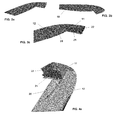
- the front 11 part and the rear part 12 of the fairing 10 can be separated, as shown in Figures 4a and 4b : some structural elements in the primary structure of the horizontal stabilizer 3, such as ribs, could be enlarged in order to support the front part 11 of the fairing 10 specifically suffering from erosion and protected against it.
- these enlarged elements are ribs, marked as 20 and 22.
- the front part 11 of the fairing 10 which is the one designed for resisting erosion, is made of stainless steel having a very low thickness supported by the rear part 12 made of composite material, preferably of CFRP (carbon fiber-reinforced polymer) or GFRP (glass fiber-reinforced polymer).
- CFRP carbon fiber-reinforced polymer
- GFRP glass fiber-reinforced polymer
- the front part 11 of the fairing 10 is made of stainless steel having a thickness of about 0,4 mm, which has proved to be satisfactory, as this front part 11 is designed only for erosion resistance; however, an additional support element or a thickness increase in this front part 11 can be made necessary for aerodynamic loads design or for joining needs, for example.
Landscapes
- Engineering & Computer Science (AREA)
- Aviation & Aerospace Engineering (AREA)
- Laminated Bodies (AREA)
- Pressure Welding/Diffusion-Bonding (AREA)
Applications Claiming Priority (1)
| Application Number | Priority Date | Filing Date | Title |
|---|---|---|---|
| ES201031879A ES2403361B1 (es) | 2010-12-17 | 2010-12-17 | Optimización de estructuras sometidas a corrientes de gases calientes. |
Publications (2)
| Publication Number | Publication Date |
|---|---|
| EP2465769A2 true EP2465769A2 (de) | 2012-06-20 |
| EP2465769A3 EP2465769A3 (de) | 2014-01-08 |
Family
ID=45349414
Family Applications (1)
| Application Number | Title | Priority Date | Filing Date |
|---|---|---|---|
| EP11194128.2A Withdrawn EP2465769A3 (de) | 2010-12-17 | 2011-12-16 | Optimierung von Heissgasströmungen ausgesetzten Strukturen |
Country Status (5)
| Country | Link |
|---|---|
| US (1) | US8550398B2 (de) |
| EP (1) | EP2465769A3 (de) |
| CA (1) | CA2764340C (de) |
| ES (1) | ES2403361B1 (de) |
| RU (1) | RU2598492C2 (de) |
Families Citing this family (2)
| Publication number | Priority date | Publication date | Assignee | Title |
|---|---|---|---|---|
| US9586699B1 (en) | 1999-08-16 | 2017-03-07 | Smart Drilling And Completion, Inc. | Methods and apparatus for monitoring and fixing holes in composite aircraft |
| US9625361B1 (en) | 2001-08-19 | 2017-04-18 | Smart Drilling And Completion, Inc. | Methods and apparatus to prevent failures of fiber-reinforced composite materials under compressive stresses caused by fluids and gases invading microfractures in the materials |
Citations (2)
| Publication number | Priority date | Publication date | Assignee | Title |
|---|---|---|---|---|
| WO1996020108A1 (en) * | 1994-12-23 | 1996-07-04 | United Technologies Corporation | Engineered ceramic components for the leading edge of a helicopter rotor blade |
| GB2461133A (en) * | 2008-06-27 | 2009-12-30 | George Valentino Constantinou | Erosion-protecting devices for aircraft |
Family Cites Families (12)
| Publication number | Priority date | Publication date | Assignee | Title |
|---|---|---|---|---|
| US2567124A (en) * | 1946-05-10 | 1951-09-04 | Curtiss Wright Corp | Airfoil construction |
| US3712566A (en) * | 1971-02-25 | 1973-01-23 | Us Navy | Supersonic vehicle control surface having a thermally protective coating |
| FR2616409B1 (fr) * | 1987-06-09 | 1989-09-15 | Aerospatiale | Pale en materiaux composites et son procede de fabrication |
| US6341747B1 (en) * | 1999-10-28 | 2002-01-29 | United Technologies Corporation | Nanocomposite layered airfoil |
| DE10005348B4 (de) * | 2000-02-08 | 2004-05-06 | Airbus Deutschland Gmbh | Verfahren zur Fertigung von Nasenstrukturen für aerodynamische Flächen |
| ES2197727B1 (es) * | 2000-07-27 | 2005-04-01 | Construcciones Aeronauticas, S.A. | Borde de ataque de superficies sustentadoras de aeronaves. |
| US8276847B2 (en) * | 2004-04-16 | 2012-10-02 | Airbus Operations Gmbh | Cover for an aircraft structure |
| US7334759B2 (en) * | 2004-12-18 | 2008-02-26 | Castillo Francisco J | Airplane surface protection film kits |
| GB0525896D0 (en) * | 2005-12-20 | 2006-02-01 | Airbus Uk Ltd | A joint for use in aircraft construction |
| DE102006052303B4 (de) * | 2006-11-03 | 2012-07-12 | Eads Deutschland Gmbh | Schutz von erosionsbelasteten Luftfahrtstrukturen durch nanopartikelverstärkte anorganisch-organische Hybridbeschichtungen |
| FI20080208L (fi) * | 2008-03-13 | 2008-03-27 | Patria Aerostructures Oy | Ilma-aluksen johtoreunaelementti, menetelmä sen valmistamiseksi sekä siipi ja vakain |
| EP2523851B1 (de) * | 2010-01-14 | 2018-12-26 | Saab AB | Aerodynamische oberfläche mit verbesserten eigenschaften |
-
2010
- 2010-12-17 ES ES201031879A patent/ES2403361B1/es not_active Expired - Fee Related
-
2011
- 2011-04-21 US US13/091,202 patent/US8550398B2/en not_active Expired - Fee Related
- 2011-12-16 EP EP11194128.2A patent/EP2465769A3/de not_active Withdrawn
- 2011-12-16 RU RU2011151537/11A patent/RU2598492C2/ru not_active IP Right Cessation
- 2011-12-19 CA CA2764340A patent/CA2764340C/en not_active Expired - Fee Related
Patent Citations (2)
| Publication number | Priority date | Publication date | Assignee | Title |
|---|---|---|---|---|
| WO1996020108A1 (en) * | 1994-12-23 | 1996-07-04 | United Technologies Corporation | Engineered ceramic components for the leading edge of a helicopter rotor blade |
| GB2461133A (en) * | 2008-06-27 | 2009-12-30 | George Valentino Constantinou | Erosion-protecting devices for aircraft |
Also Published As
| Publication number | Publication date |
|---|---|
| US8550398B2 (en) | 2013-10-08 |
| ES2403361A1 (es) | 2013-05-17 |
| CA2764340A1 (en) | 2012-06-17 |
| RU2598492C2 (ru) | 2016-09-27 |
| ES2403361B1 (es) | 2014-04-29 |
| US20120153083A1 (en) | 2012-06-21 |
| RU2011151537A (ru) | 2013-06-27 |
| EP2465769A3 (de) | 2014-01-08 |
| CA2764340C (en) | 2018-04-17 |
Similar Documents
| Publication | Publication Date | Title |
|---|---|---|
| EP2041399B1 (de) | Flugtriebwerkseinlass mit verformungsbereich | |
| CN104066647B (zh) | 冲击抵抗和损坏容限改善的飞行器机身段 | |
| US8371537B2 (en) | Aircraft structure with hinge rib assembly | |
| EP3031711B1 (de) | Flugzeugrahmen für zur heckanschlagwinkelverbesserung | |
| EP4140877B1 (de) | Vorflügel für einen flugzeugflügel, verfahren zur herstellung solch eines vorflügels | |
| CN112407244B (zh) | 飞机前缘组件 | |
| EP3243744B1 (de) | Flugzeugverbindung | |
| US11591098B2 (en) | Nacelle forward part of a propulsion assembly comprising an inclined stiffening frame | |
| US10246177B2 (en) | Leading-edge structure for aircraft, aircraft wing, and aircraft | |
| EP2886449A1 (de) | Vorderkante für eine Flugzeugsauftriebsfläche | |
| US11427298B2 (en) | Advanced plume suppressing segmented heat shield | |
| US10450081B2 (en) | Aircraft engine pylon to wing mounting assembly | |
| US9868539B2 (en) | Aircraft engine pylon to wing mounting assembly | |
| CA2764340C (en) | Optimization of structures subjected to hot gas streams | |
| US9688412B2 (en) | Aerodynamic fairing | |
| US10370113B2 (en) | Flow drag mitigation device | |
| CN113382926A (zh) | 用于飞行器的前缘部件 | |
| EP4378824A1 (de) | Strömungskörper für ein flugzeug mit geteilten rippen |
Legal Events
| Date | Code | Title | Description |
|---|---|---|---|
| PUAI | Public reference made under article 153(3) epc to a published international application that has entered the european phase |
Free format text: ORIGINAL CODE: 0009012 |
|
| AK | Designated contracting states |
Kind code of ref document: A2 Designated state(s): AL AT BE BG CH CY CZ DE DK EE ES FI FR GB GR HR HU IE IS IT LI LT LU LV MC MK MT NL NO PL PT RO RS SE SI SK SM TR |
|
| AX | Request for extension of the european patent |
Extension state: BA ME |
|
| PUAL | Search report despatched |
Free format text: ORIGINAL CODE: 0009013 |
|
| AK | Designated contracting states |
Kind code of ref document: A3 Designated state(s): AL AT BE BG CH CY CZ DE DK EE ES FI FR GB GR HR HU IE IS IT LI LT LU LV MC MK MT NL NO PL PT RO RS SE SI SK SM TR |
|
| AX | Request for extension of the european patent |
Extension state: BA ME |
|
| RIC1 | Information provided on ipc code assigned before grant |
Ipc: B64C 5/02 20060101AFI20131129BHEP Ipc: B64C 7/00 20060101ALI20131129BHEP |
|
| 17P | Request for examination filed |
Effective date: 20140708 |
|
| RBV | Designated contracting states (corrected) |
Designated state(s): AL AT BE BG CH CY CZ DE DK EE ES FI FR GB GR HR HU IE IS IT LI LT LU LV MC MK MT NL NO PL PT RO RS SE SI SK SM TR |
|
| STAA | Information on the status of an ep patent application or granted ep patent |
Free format text: STATUS: EXAMINATION IS IN PROGRESS |
|
| 17Q | First examination report despatched |
Effective date: 20161201 |
|
| GRAP | Despatch of communication of intention to grant a patent |
Free format text: ORIGINAL CODE: EPIDOSNIGR1 |
|
| STAA | Information on the status of an ep patent application or granted ep patent |
Free format text: STATUS: GRANT OF PATENT IS INTENDED |
|
| INTG | Intention to grant announced |
Effective date: 20190329 |
|
| STAA | Information on the status of an ep patent application or granted ep patent |
Free format text: STATUS: THE APPLICATION IS DEEMED TO BE WITHDRAWN |
|
| 18D | Application deemed to be withdrawn |
Effective date: 20190702 |