EP2466548A1 - Verfahren zur Verarbeitung einer objektbasierten Bilddatei mit inhaltstypabhängigen Bildverarbeitungsalgorithmen - Google Patents
Verfahren zur Verarbeitung einer objektbasierten Bilddatei mit inhaltstypabhängigen Bildverarbeitungsalgorithmen Download PDFInfo
- Publication number
- EP2466548A1 EP2466548A1 EP11192570A EP11192570A EP2466548A1 EP 2466548 A1 EP2466548 A1 EP 2466548A1 EP 11192570 A EP11192570 A EP 11192570A EP 11192570 A EP11192570 A EP 11192570A EP 2466548 A1 EP2466548 A1 EP 2466548A1
- Authority
- EP
- European Patent Office
- Prior art keywords
- image
- text
- processing
- segments
- image file
- Prior art date
- Legal status (The legal status is an assumption and is not a legal conclusion. Google has not performed a legal analysis and makes no representation as to the accuracy of the status listed.)
- Withdrawn
Links
Images

Classifications
-
- G—PHYSICS
- G06—COMPUTING OR CALCULATING; COUNTING
- G06T—IMAGE DATA PROCESSING OR GENERATION, IN GENERAL
- G06T11/00—Two-dimensional [2D] image generation
- G06T11/60—Creating or editing images; Combining images with text
- G06T11/65—Creating or editing images; Combining images with text on geographic maps
-
- G—PHYSICS
- G06—COMPUTING OR CALCULATING; COUNTING
- G06T—IMAGE DATA PROCESSING OR GENERATION, IN GENERAL
- G06T11/00—Two-dimensional [2D] image generation
- G06T11/60—Creating or editing images; Combining images with text
-
- G—PHYSICS
- G06—COMPUTING OR CALCULATING; COUNTING
- G06T—IMAGE DATA PROCESSING OR GENERATION, IN GENERAL
- G06T2207/00—Indexing scheme for image analysis or image enhancement
- G06T2207/30—Subject of image; Context of image processing
- G06T2207/30176—Document
Definitions
- the invention relates to a method of processing an object-based image file with content type dependent image processing algorithms.
- image processing algorithms When an image is displayed on a display device or printed with a printer, various image processing algorithms may be applied for improving the appearance of the image.
- the image processing algorithms include colour management algorithms used for converting the colours from the colour space of the image source to the colour space of the display or printer.
- Other examples of image processing algorithms are halftoning algorithms, scaling algorithms, algorithms for background colour correction, contrast enhancement or edge sharpening, optical character recognition algorithms, and the like.
- the optimal selection of image processing algorithms and processing parameters will depend upon the image contents. For example, business graphics are typically required to have bright colours and sharp and clear contours, whereas, in case of a photographic image, the colour management should be such that the colours in the photo look realistic, and contrast and edge sharpening should be moderate.
- text characters are typically required to be black and have clear contours. If text is to be printed with a colour printer, colour management should be such that the text characters are printed only with black ink or toner in order to avoid colour bleeding.
- a so-called segmentation process may be used for identifying those areas in the image that include contents of certain pre-defined content types such as text, photo, business graphics, maps (text and lines on multi-colour background), CAD drawings, and the like.
- Such segmentation process may for example be based on two-dimensional spatial frequency analysis or the like. An example of a segmentation process is described in US 5 073 953 .
- an object-based image file e. g. an image file given in a page description language (PDL), such as PostScript or PDF, including specifications of a number of objects or primitives such as the drawings, text objects, photos or the like, that compose the image
- PDL page description language
- some information on the content type will explicitly or implicitly be included in the object definitions already.
- the image file includes text in the form of ASCII characters along with attributes for font type, font size and the like, it is clear that the related content type will be text.
- vector graphics i.e. mathematical descriptions of objects or primitives such as lines, curves, circles and the like, along with attributes for line width, contour colour, fill colour and the like, it is clear that the content type will hardly be photo.
- bitmap or pixel map object when the file includes a bitmap or pixel map object, it is not certain that this bitmap or pixel map actually represents a photographic image.
- the contents might as well be text or business graphics or a map which could as well have been defined as text or vector graphics.
- the method according to the invention comprises the steps of:
- the invention has the advantage that, even when the image is defined by an object-based image file, e.g. in a page description language (PDL), powerful known segmentation algorithms may be used for identifying the content type of different parts of the image, which permits to classify the contents far more precisely then would be possible on the basis of the object definitions.
- PDL page description language
- the segmentation process is capable of recognizing other content types such a geographical maps, road maps, an business graphics, and is also capable of recognizing text, for example, even when it had been defined as a bitmap.
- the image processing algorithms that have been selected on the basis of the result of the segmentation are not applied to the areas of the segments but to the related objects, the borders of the areas where the processing algorithms apply are precisely defined by the object definitions.
- the invention encompasses also a printer and a software product implementing the method that have been described above.
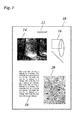
- the headline 12 is defined as text, i.e. a string of ASCII characters with specifications for the text colour, the font type, font size and style and coordinate information defining the position of the text on the page.
- the photo 14 will be included in the image file in the form of a pixel map along with coordinate information indicating the position of the photo on the page.
- the graphical objects 16 will be defined as vector graphics, i.e. a set of instructions for drawing a line, a square and an ellipse with specified dimensions and in specified coordinate positions, along with attributes for fill colour, contour colour, line width and the like.
- the text 18 could be defined as text just as the headline 12. However by way of example, it shall be assumed here that the text 18 has been scanned-in from a hard copy and is therefore defined in the image file as a bitmap.
- the road map 20 comprises a multi-colour background with lines (roads and borders) and text superposed thereon.
- This road map 20 might have been defined in the image file as a pixel map just as the photo 14 but may as well be defined as vector graphics (specifying the coloured areas of the background and the roads), combined with text.
- the content types of the various objects described above are not derived directly from the object definitions in the image file but by means of a segmentation process.
- the image is at first rasterized so as to obtain a pixel map representation of the entire image.
- a preselected standard algorithm may be used for the necessary image processing such as colour management and the like.
- the resolution of the pixel map should on the one hand be high enough to permit a reasonable segmentation and should on the other hand be as small as possible so as to limit the necessary processing time.
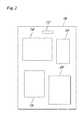
- the rasterized image is then subjected to a segmentation process the result of which is illustrated in Fig. 2 .
- the segmentation process searches for areas in the raster image that consist of contents of a certain pre-defined type.
- pre-defined content types such as colour photo, black and white photo, CAD graphics, text, map, business graphics and the like.
- the segmentation process has to decide to which one of the pre-defined content types this part of the image belongs. This may be done for example by means of spatial frequency analysis.
- the process results in five separate segments 12', 14', 16', 18' and 20'.
- the segment 12' corresponds to the headline 12 and is classified as text.
- the segment 14' corresponds to the photo 14 and is classified as photo.
- the segment 16' covers the graphical objects 16 and is classified as CAD drawing.
- the segment 18' corresponds to the text 18 and is classified as text, because the segmentation process ignores that the text 18 was defined as a bitmap in the original image file.
- the segment 20' corresponds to the road map 20 and is classified as "map".
- the image file is interpreted, and a display list is established which includes the definitions of all the objects 12 - 20. Since these object definitions include coordinate information permitting to determine the location of each object on the page, it is possible to compare the locations of the objects to the locations of the segments 12' - 20'. In the simple example that has been shown here, each object is included in one of the segments, so that the segment to which a given object belongs can easily be determined.
- the object can be tagged with the content type of the associated segment.
- the headline 12 and the text 18 will be tagged as "text”
- the photo 14 will be tagged as “photo”
- the graphical objects 16 will be tagged as "CAD drawing”
- the road map 20 will be tagged as "map”.
- the display list will be processed object by object so as to render each of the object by executing the instructions included in the respective object definitions.
- the processing of each object will include image processing steps such as colour management and the like, and the image processing algorithms will be selected individually for each object based on the content type of the associated segment.
- the text objects 12 and 18 will be processed with algorithms that are optimal for text, so that the text will be rendered with plain black characters.
- the photo 14 will be rendered with algorithms that are optimal for photos so as to give a realistic visual impression.
- the graphical object 16 will be rendered with image processing algorithms resulting in clear colours and smooth contours, and the road map 20 will be rendered with processing algorithms that are optimized for maps, including colour management that makes the text clearly stand out against the coloured background.
- the display list is ordered such that the objects will be rendered in the sequence in which the objects are layered in the image, so that, when two objects overlap, the background will be processed first and will then be superposed by the object that is processed later.
- Fig. 3 The essential steps of the method according to the invention have been summarized in Fig. 3 . It will be understood that the method may be carried out, for example, in an image processor that forms part of a digital printer. As an alternative, the method may be carried out on a multi-purpose computer loaded with suitable software so as to process an image file that will then be sent to a printer for being printed.
- step S1 an input image file is loaded into the image processor.
- the image is rasterized in step S2, and the rasterized image is segmented in step S3.
- step S4 the image file is interpreted so as to derive the display list. It will be understood that step S4 might also precede step S3 or step S2.
- each object of the display list is associated with the nearest segment, and, in step S6, each object is tagged with a content type, normally the content type of the segment with which it has been associated.
- the objects of the display list are processed one by one with image processing algorithms individually selected for each object on the basis of the content type with which it has been tagged.
- step S7 is followed by a step S8 in which the processed objects are rendered so as to obtain a pixel map of the entire image ready to be printed.
Landscapes
- Physics & Mathematics (AREA)
- General Physics & Mathematics (AREA)
- Engineering & Computer Science (AREA)
- Theoretical Computer Science (AREA)
- Processing Or Creating Images (AREA)
- Facsimile Image Signal Circuits (AREA)
Priority Applications (1)
| Application Number | Priority Date | Filing Date | Title |
|---|---|---|---|
| EP11192570A EP2466548A1 (de) | 2010-12-16 | 2011-12-08 | Verfahren zur Verarbeitung einer objektbasierten Bilddatei mit inhaltstypabhängigen Bildverarbeitungsalgorithmen |
Applications Claiming Priority (2)
| Application Number | Priority Date | Filing Date | Title |
|---|---|---|---|
| EP10306431 | 2010-12-16 | ||
| EP11192570A EP2466548A1 (de) | 2010-12-16 | 2011-12-08 | Verfahren zur Verarbeitung einer objektbasierten Bilddatei mit inhaltstypabhängigen Bildverarbeitungsalgorithmen |
Publications (1)
| Publication Number | Publication Date |
|---|---|
| EP2466548A1 true EP2466548A1 (de) | 2012-06-20 |
Family
ID=43827581
Family Applications (1)
| Application Number | Title | Priority Date | Filing Date |
|---|---|---|---|
| EP11192570A Withdrawn EP2466548A1 (de) | 2010-12-16 | 2011-12-08 | Verfahren zur Verarbeitung einer objektbasierten Bilddatei mit inhaltstypabhängigen Bildverarbeitungsalgorithmen |
Country Status (2)
| Country | Link |
|---|---|
| US (1) | US20120159292A1 (de) |
| EP (1) | EP2466548A1 (de) |
Families Citing this family (3)
| Publication number | Priority date | Publication date | Assignee | Title |
|---|---|---|---|---|
| JP6222900B2 (ja) * | 2012-07-09 | 2017-11-01 | キヤノン株式会社 | 画像処理装置、画像処理方法およびプログラム |
| WO2014117815A1 (en) | 2013-01-29 | 2014-08-07 | Hewlett-Packard Development Company, L.P. | Printer and method of processing an image to be printed |
| CN114627197B (zh) * | 2022-03-10 | 2025-01-10 | 土巴兔集团股份有限公司 | 一种图像文件优化方法及其相关设备 |
Citations (3)
| Publication number | Priority date | Publication date | Assignee | Title |
|---|---|---|---|---|
| US5073953A (en) | 1988-09-12 | 1991-12-17 | Oce Nederland B.V. | System and method for automatic document segmentation |
| US5767978A (en) * | 1997-01-21 | 1998-06-16 | Xerox Corporation | Image segmentation system |
| US20100171999A1 (en) * | 2008-07-09 | 2010-07-08 | Canon Kabushiki Kaisha | Image processing apparatus, image processing method, and computer program thereof |
Family Cites Families (14)
| Publication number | Priority date | Publication date | Assignee | Title |
|---|---|---|---|---|
| US5313570A (en) * | 1993-03-31 | 1994-05-17 | Miles, Inc. | Method for determining color boundaries for correcting for plate misregistration in color printing |
| US5596690A (en) * | 1993-07-21 | 1997-01-21 | Xerox Corporation | Method and apparatus for operating on an object-based model data structure to produce a second image in the spatial context of a first image |
| US5479603A (en) * | 1993-07-21 | 1995-12-26 | Xerox Corporation | Method and apparatus for producing a composite second image in the spatial context of a first image |
| AU5688199A (en) * | 1998-08-20 | 2000-03-14 | Raycer, Inc. | System, apparatus and method for spatially sorting image data in a three-dimensional graphics pipeline |
| US6980318B1 (en) * | 1999-05-25 | 2005-12-27 | Silverbrook Research Pty Ltd | Method and system for delivery of a greeting card |
| US6704024B2 (en) * | 2000-08-07 | 2004-03-09 | Zframe, Inc. | Visual content browsing using rasterized representations |
| JP4065503B2 (ja) * | 2001-08-21 | 2008-03-26 | キヤノン株式会社 | 画像処理装置、画像入出力装置、変倍処理方法、及びメモリ制御方法 |
| US7043077B2 (en) * | 2001-11-07 | 2006-05-09 | International Business Machines Corporation | System and method for efficient compression of raster image data |
| US7042587B2 (en) * | 2001-11-28 | 2006-05-09 | Hewlett-Packard Development Company, L.P. | Image data caching |
| US20060055970A1 (en) * | 2004-09-10 | 2006-03-16 | Smith Jeffrey A | Page buffer management in a printing system |
| EP1831823B1 (de) * | 2004-12-21 | 2011-03-09 | Canon Kabushiki Kaisha | Segmentierung eines digitalen bildes und herstellung einer kompakten repräsentation |
| JP4408836B2 (ja) * | 2005-05-30 | 2010-02-03 | キヤノン株式会社 | 画像処理装置及びその制御方法、プログラム |
| JP4757120B2 (ja) * | 2006-07-06 | 2011-08-24 | キヤノン株式会社 | 画像処理装置及びその制御方法 |
| JP5013961B2 (ja) * | 2007-05-21 | 2012-08-29 | キヤノン株式会社 | 位置姿勢計測装置及びその制御方法 |
-
2011
- 2011-12-05 US US13/311,229 patent/US20120159292A1/en not_active Abandoned
- 2011-12-08 EP EP11192570A patent/EP2466548A1/de not_active Withdrawn
Patent Citations (3)
| Publication number | Priority date | Publication date | Assignee | Title |
|---|---|---|---|---|
| US5073953A (en) | 1988-09-12 | 1991-12-17 | Oce Nederland B.V. | System and method for automatic document segmentation |
| US5767978A (en) * | 1997-01-21 | 1998-06-16 | Xerox Corporation | Image segmentation system |
| US20100171999A1 (en) * | 2008-07-09 | 2010-07-08 | Canon Kabushiki Kaisha | Image processing apparatus, image processing method, and computer program thereof |
Also Published As
| Publication number | Publication date |
|---|---|
| US20120159292A1 (en) | 2012-06-21 |
Similar Documents
| Publication | Publication Date | Title |
|---|---|---|
| US9691145B2 (en) | Methods and systems for automated selection of regions of an image for secondary finishing and generation of mask image of same | |
| US20040075699A1 (en) | Method and apparatus for highlighting graphical objects | |
| CN105159869B (zh) | 图片编辑方法及系统 | |
| EP2466548A1 (de) | Verfahren zur Verarbeitung einer objektbasierten Bilddatei mit inhaltstypabhängigen Bildverarbeitungsalgorithmen | |
| JP4807950B2 (ja) | デジタル画像の表示における角先鋭化の方法 | |
| US9384427B2 (en) | Systems and methods for optimizing pixel based raster trapping | |
| RU2534005C2 (ru) | Способ и система преобразования моментального снимка экрана в метафайл | |
| US20240319930A1 (en) | Method for preflighting a graphics artwork file | |
| US8432572B2 (en) | Systems and methods of trapping for print devices | |
| US8537425B2 (en) | Method for optimizing the search for trapping regions | |
| JP5672168B2 (ja) | 画像処理装置、画像処理方法及びプログラム | |
| RU2520407C1 (ru) | Способ и система улучшения текста при цифровом копировании печатных документов | |
| RU2469399C1 (ru) | Система и способ черновой печати посредством преобразования картинок в контурные эскизы | |
| US20120200896A1 (en) | Method for Optimizing the Search for Trapping Regions | |
| JP4736489B2 (ja) | 画像処理装置 | |
| JP5994287B2 (ja) | 画像処理装置、及び無色トナー画像の表示方法 | |
| JP6836861B2 (ja) | 画像形成システム、画像データ処理装置、画像データ処理方法、及びプログラム | |
| JP2024004205A (ja) | 情報処理装置、情報処理方法、およびプログラム | |
| KR101769945B1 (ko) | 프린팅용 이미지 전처리 방법 및 그 장치 | |
| EP2574033B1 (de) | Drucksteuerungsvorrichtung, Bilderzeugungsvorrichtung und Verfahren zur Erzeugung von Bildern | |
| CN121236223A (zh) | 一种基于flux-kontext的文字抹除方法、装置、设备和介质 | |
| JP2006113800A (ja) | 画像処理方法、画像処理装置及び画像処理プログラム |
Legal Events
| Date | Code | Title | Description |
|---|---|---|---|
| PUAI | Public reference made under article 153(3) epc to a published international application that has entered the european phase |
Free format text: ORIGINAL CODE: 0009012 |
|
| AK | Designated contracting states |
Kind code of ref document: A1 Designated state(s): AL AT BE BG CH CY CZ DE DK EE ES FI FR GB GR HR HU IE IS IT LI LT LU LV MC MK MT NL NO PL PT RO RS SE SI SK SM TR |
|
| AX | Request for extension of the european patent |
Extension state: BA ME |
|
| STAA | Information on the status of an ep patent application or granted ep patent |
Free format text: STATUS: THE APPLICATION IS DEEMED TO BE WITHDRAWN |
|
| 18D | Application deemed to be withdrawn |
Effective date: 20121221 |