EP2466941B1 - Kommunikationseffekte in netzwerksimulationen - Google Patents
Kommunikationseffekte in netzwerksimulationen Download PDFInfo
- Publication number
- EP2466941B1 EP2466941B1 EP11193891.6A EP11193891A EP2466941B1 EP 2466941 B1 EP2466941 B1 EP 2466941B1 EP 11193891 A EP11193891 A EP 11193891A EP 2466941 B1 EP2466941 B1 EP 2466941B1
- Authority
- EP
- European Patent Office
- Prior art keywords
- effects
- platform
- communications
- simulation
- transmitter
- Prior art date
- Legal status (The legal status is an assumption and is not a legal conclusion. Google has not performed a legal analysis and makes no representation as to the accuracy of the status listed.)
- Active
Links
Images



Classifications
-
- H—ELECTRICITY
- H04—ELECTRIC COMMUNICATION TECHNIQUE
- H04W—WIRELESS COMMUNICATION NETWORKS
- H04W16/00—Network planning, e.g. coverage or traffic planning tools; Network deployment, e.g. resource partitioning or cells structures
- H04W16/22—Traffic simulation tools or models
Definitions
- Network simulation is used to design various kinds of networks, simulate and then analyze the effect of various parameters on network performance.
- Network simulation tools can test scenarios that might be particularly difficult or expensive to emulate using real hardware.
- a perfect communication may be modeled. In a perfect communication, every message is received without error or delay. Although a perfect communications model significantly simplifies the simulation, it does not reflect the actual conditions that wireless communications encounter in the real world. Thus, it can introduce significant inaccuracies in simulation results.
- Communications effects refer to communications within a simulation environment in a manner that is consistent with effects experienced in the real world. For instance, messages might be dropped, corrupted, delayed, jammed, or blocked by terrain, or they may be affected by weather, network congestion, etc.
- each simulated radio transmission To incorporate realistic communications effects, calculations are performed on each simulated radio transmission to evaluate the effects of certain characteristics (e.g., location of receiver, blockage of line of sight, effects of network protocols) on each transmitter and receiver.
- Each message is either delivered with realistically calculated errors, noise, and delays or it is not delivered at all (that is, dropped).
- the communication effects are simulated by performing calculations inline at the time they occur in the simulation. For each separate radio transmission that occurs in a simulation, a network simulator tool is invoked to perform all communication effects calculations.
- Network scalability is also a problem.
- Each communication effect can require a large amount of computations.
- the number of computations per transmission increases as higher fidelity communications effects are needed.
- high fidelity simulations might be achievable for a hundred nodes, but not for thousands of nodes. Or, if the number of computations per transmission is held the same as the number of simulated nodes increases, the communication effects fidelity is reduced.
- US2007/036088A1 discusses simulation models of media access control and physical layer characteristics facilitate the simulation or emulation of a variety of phenomena that affect transmissions via a wireless media.
- US2006/080077A1 discusses a distributed communications effects module method, apparatus, and computer medium are adapted to provide communications effects to a simulated message in a distributed simulation in order to enhance the ability of the distributed simulation to model real-world behavior.
- a method comprises using a communications effects engine to simulate real-time, high fidelity communications effects for a platform simulation.
- a transmitter in the platform simulation is requested to send a surrogate message to a receiver in the platform simulation.
- Communications effects are computed in response to the message, and the communications effects are saved for later use. Saving the communications effects includes building tables of communications effects for the transmitter-receiver pair, and distributing the tables to platform simulators. When a future communication event involving the transmitter and receiver occurs, the saved effects are used to simulate the communication effects for that event.
- a system comprises a platform simulation engine for performing a platform simulation.
- the platform simulation includes a plurality of transmitter-receiver pairs.
- the system further comprises a communications effects engine for simulating real-time, high fidelity communications effects of transmissions between the transmitter-receiver pairs.
- the platform simulation periodically sends probes from the transmitter to the receiver.
- the communications effects engine computes and saves communications effects for the corresponding transmitter-receiver pair.
- the communications effects engine uses the saved effects of that pair to simulate the communication effects for the event.
- FIG. 1 illustrates a simulator 110 including a platform simulation engine 120 and a communications effects engine (CEE) 130.
- the platform simulation engine 120 simulates an environment including a plurality of platforms.
- the platform simulation engine simulates force effects such as platform movement, operation and interaction.
- the platform simulation engine 120 simulates transmitter-receiver communications of transmitter-receiver pairs during the simulation. In a transmitter-receiver communication, a transmitter transmits a message to a receiver over a communications link.
- the radio network 210 includes a plurality of platforms 220 that function as a radio receiver, or radio transmitter, or both.
- the platforms 220 communicate via communications links 230 and 240, which have statistical connectivity, delay, and error characteristics.
- These characteristics may be affected by a number of factors, including, but not limited to radio transmission frequency, bandwidth, power, modulation, location of each potential transmitter and receiver, blockage of a line-of-sight radio signal by terrain or structures, antenna type, characteristics, gain patterns, orientation, signal fading or loss due to weather or other atmospheric effects, multipath reflections, jamming, individual and overall network traffic loads, and effects of network protocols (which can dynamically drop or delay messages to accommodate higher priority traffic or to ease network congestion). These characteristics can vary over the course of a simulation.
- the platforms 220 may be stationary or mobile.
- the links 230 and 240 may be wired or wireless or any combination thereof.
- a number of mobile platforms 220 could form a wireless ad hoc network, in which the communication links are dynamic and wireless.
- the network 210 is not limited to any particular number of platforms 220.
- the platforms 220 may form a single network, subnets within a network, or multiple networks.
- the network 210 of Figure 2 happens to illustrate nine platforms 220 that form first and second networks.
- the first network is formed by the filled links 240, and the second network is formed by the unfilled links 230.
- a message can affect actions in the simulation. For example, a message might cause a platform to change its position or mode of operation. Thus, the platform simulation engine 120 needs to know how long a message takes to arrive, if that message arrives at all. However, the platform simulation engine 120 does not account for the terrain, atmospheric conditions, network topology, routing protocols, network loading, etc.
- the CEE 130 simulates the communication effects with a high level of fidelity. In addition to accounting for transmitter and receiver characteristics, the CEE 130 accounts for other characteristics (including those listed above) that can affect message delivery.
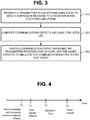
- Figure 3 illustrates a method of simulating real-time, high fidelity communication effects within a radio network simulation.
- a short surrogate message or probe is sent from a transmitting platform in the platform simulation to a receiving platform in the platform simulation. Size and format of the message is dictated by simulation needs. As but one example, the message may consist of a simple header and several bytes of data.
- communication effects are computed in response to the surrogate message.
- the communication effects are computed just as they would be for a message sent by a transmitting platform during a simulation (i.e., by a network simulator).
- Simulated routing protocols provide representative route convergence and route selection delays.
- Simulated message loads are representative of a real radio network, as are simulated end-to-end delays and congestion.
- the communications effects are saved for later use.
- the communications effects may be saved in a lookup table.
- the saved effects are used to simulate the communication effects for that event.
- the saved effects show no connectivity for the receiving platform.
- the network simulation immediately shows a drop decision rather than waiting for a timeout to occur.
- the saved effects show that a message between the pair will be delivered with calculated errors, noise, and delays.
- the saved effects are used to determine errors, noise and delay of the delivered message.
- FIG. 4 illustrates advantages of this method.
- a receiving platform receives a transmission at time T1, and it must deliver a decision by time T2. Had the decision been computed, it would have been delivered at time T3, which is too late. However, by sending a probe from the transmitting platform to the receiving platform, and generating and saving the communication effects at time T0, the saved effects can be used at time T2. Thus, a delivered decision is timely.
- drop decisions can be made immediately. If the communication effects saved at time T0 indicate that the receiving platform is unable to receive a message, the drop decision can be made at time T1 instead of waiting until time T2. This allows simulation resources to be freed up.
- Accuracy of the saved effects will depend in part on how close in time a probe is to the transmission in the platform simulation (that is, the difference between times T0 and T1). Accuracy also depends on how closely the network simulation traffic matches the platform simulation traffic and how closely the probe message characteristics match the characteristics of the messages in the simulation (e.g. size, protocol type, priority).
- Accuracy of the saved effects can be improved by sending additional probes at periodic intervals, whereby the saved effects are updated.
- the probes may be sent at intervals fast enough that the network state does not change appreciably between them but slow enough that network loading is virtually unaffected.
- the method of Figure 3 has been described for a single pair of transmitting-receiving platforms. In practice, a simulation may include many of these transmitter-receiver pairs. The method of Figure 3 can be applied to each transmitter-receiver pair in the simulation.
- FIG. 5 illustrates a simulator 510 including a distributed platform simulation engine and a distributed communications effects engine. Components of the CEE are shaded, and components of the platform simulation engine are not shaded.
- the platform simulation engine includes a plurality of platform force effects simulators 520.
- the force effects simulators 520 provide platform position and transmitter information to the CEE via a simulation data bus 530 using a protocol for data exchange.
- a protocol for data exchange is Distributed Interactive Simulation (DIS), which is a recognized IEEE standard.
- DIS Distributed Interactive Simulation
- HLA Higher-Level Architecture
- the force effects simulators 520 may reside on a plurality of clients 535, which may be implemented in hardware as a plurality of networked computers.
- the CEE includes a plurality of network simulators 540, which use the platform position and transmitter information to simulate a radio network with high fidelity.
- the network simulators 540 may be a proprietary simulation tool or a commercial off-the-shelf simulation tool, such as OPNET, QualNet or CORE.
- the network simulators 540 simulate the protocols (routing, data transfer, etc.) and traffic loading. They may generate end-to-end connectivity (connected/disconnected) and traffic statistics (min delay, mean delay, etc.) on connections of interest (i.e. relevant to force effects simulation).
- the network simulators 540 may also generates link connectivity and loading statistics. On request, the current end-to-end route is reported for a specified source-destination pair.
- the network simulators 540 may reside on a single computer 550 or a plurality of networked computers.
- the CEE further includes a CEE server 560, which communicates with CEE agents 570 over the simulation data bus 530.
- the CEE agents 570 provide an interface between the CEE server 560 and the platform effects simulators 520.
- FIG. 6 illustrates an example of functions performed by the CEE server 560.
- data exchanged between the network simulators 540 and the CEE server 560 will follow the DIS protocol.
- a simulation that uses the DIS protocol generates data elements termed Protocol Data Units (PDUs) to specify data about the name, type, attributes, and behaviors of each entity in the simulation, including transmitting and receiving nodes. Examples of the PDUs are listed in Table 1 below.
- PDUs Protocol Data Units
- the CEE server 560 "listens" to the DIS traffic generated during a platform simulation and processes those PDUs that are concerned with transmitting and receiving messages.
- TABLE 1 Entity State PDU Specifies positions of radios and jammers
- Transmitter PDU Specifies radio transmission parameters (frequency, etc.)
- Electromagnetic Emission PDU Specifies radar/jammer transmission parameters
- IFF PDU Specifies IFF transmission parameters Start/Resume PDU Monitors simulation time, and starts or resumes the simulation Stop/Freeze PDU Monitors simulation time, and stops or pauses the simulation
- the CEE Server 560 based on the DIS traffic, the CEE Server 560 identifies all of transmitting and receiving platforms in the platform simulation.
- the CEE server 560 can also narrow the list of transmitter-receive pairs to only those of interest.
- the CEE Server 560 periodically requests the platform simulation engine to generate probes for all transmitter-receiver pairs of interest. Each request interrupts the platform simulation and causes a transmitting platform of a pair to send a short surrogate message to its paired receiving platform.
- the probes may be requested at periodic intervals, which can be configured frequently enough so that the transmission characteristics between platforms can be reasonably assumed to not vary much between the surrogate message and the message during a simulation, but not so frequently that the probes themselves impose any significant additional traffic load across the network or on the network simulator. For example, short surrogate messages may be sent 1-2 times per second.
- the network simulators 540 processes output data from the force effects simulators 520 to produce communications effects data.
- the CEE server 560 saves the communications effects in Master CEE tables 580.
- the tables 580 contain information on broken as well as degraded links.
- the tables 580 may be organized by transmitter-receiver pairs and the content in each table is a specific characteristic of that pair (i.e., connectivity statistics, delay statistics, and error statics).
- Table 2 provides a simple example of a three by three connectivity Table.
- the columns correspond to the transmitting platforms, and the rows correspond to the receiving platforms.
- a table entry of "1" indicates “connectivity” between the transmitting platform and the receiving platform.
- a table entry of "0” indicates “no connectivity” between the transmitting platform and the receiving platform.
- the diagonal in the connectivity table is set to "0" by convention.
- table data 590 is distributed to the CEE agents 570.
- complete tables can be sent to the CEE agents 570.
- the Master CEE tables 580 can be published to all of the CEE agents 570 in the CEE, or the CEE agents 570 are only supplied with the information that they need. For example, a receiver may have multiple transmitters with which it could communicate, however only one transmitter is communicating. Therefore an initial data distribution may contain all potential transmitters (with no connectivity listed for all but one).
- subsequent publication may include only those table entries that have changed.
- the changes can be published asynchronously, as they occur, to minimize the information exchange between the CEE server 560 and the CEE agents 570.
- extensive calculations do not have to be re-computed for every single transmission event, saving time for both the CEE server 560 and the CEE agents 590, which would have to wait for those results.
- FIG. 7 illustrates an example of operations performed by a client 535.
- the CEE client 535 handles platform effects for one or more of the platforms in the platform simulation.
- the CEE client 535 via its CEE agent 570, receives table data from the CEE server 560. Both are ongoing processes.
- the CEE agent 570 looks up the communications effects for that pair in the CEE table data 590, and provides the table data to the force effects simulator 520.
- the force effects simulator 520 sends a message from the transmitter in that pair to the receiver in that pair. The message is sent according to the connectivity, delay and error specified in the lookup data.
- the table lookup provides a very close approximation without having to wait for additional computations to be performed.
- any additional decisions to be made by the CEE agent 570 may be made. These decisions may include random probability draws, which may be communicated back to the CEE server 560 in the form of a "traffic report".
- the CEE server 560 may use this "traffic report" to appropriately alter the known state of the simulated network, thus improving the modeling used to create the predicted results.
- the modeling could be improved because the client 550 reports back to the network simulator 540 (i.e. a feedback loop), which makes the network simulator's traffic more representative of the actual network traffic.
- Figure 8 is an illustration of a computer, which can be used in either the platform simulation engine or the CEE.
- the computer 810 includes a processing unit 820 and memory 830 encoded with data 840 such as platform simulator tools or network simulator tools or CEE server applications, or client agent applications.
- the memory 830 may also store Master CEE tables 580 or client table data 590.
- the CEE supports scalability to very large networks.
- the communication effects calculations can be sophisticated and complex without affecting the overall simulation performance, which means that the CEE scales well to increasingly higher fidelity simulations.
- Scalability is further enhanced because the CEE can put minimal traffic on the Simulation Data Bus.
- the CEE may promulgate only traffic characteristics of interest to the platform simulation engine, and it may distribute only changes to the characteristics of traffic of interest.
- an article for causing a server to interact with a platform simulation engine including a plurality of distributed platform simulators comprising memory encoded with data for causing the server to:
- the data causes the server to builds tables of the saved communications effects data and distribute table information to the platform simulators.
- the table information is updated only by sending changed table entries.
- each platform simulator is supplied only with needed table information.
- the saved effects indicate statistical connectivity, delay, and error characteristics.
Landscapes
- Engineering & Computer Science (AREA)
- Computer Networks & Wireless Communication (AREA)
- Signal Processing (AREA)
- Data Exchanges In Wide-Area Networks (AREA)
- Computer And Data Communications (AREA)
- Mobile Radio Communication Systems (AREA)
- Management, Administration, Business Operations System, And Electronic Commerce (AREA)
Claims (9)
- Verfahren, welches das Verwenden einer Maschine (130) für Kommunikationseffekte zum Simulieren von Echtzeit-High-Fidelity-Kommunikationseffekten für eine Plattformsimulation aufweist, wobei das Verfahren Folgendes aufweist:Anfordern (310), dass ein Sender in der Plattformsimulation eine Ersatznachricht an einen Empfänger in der Plattformsimulation sendet;Berechnen (320) von Kommunikationseffekten als Reaktion auf die Nachricht und Speichern der Kommunikationseffekte für eine spätere Verwendung, wobei das Speichern der Kommunikationseffekte das Erstellen von Tabellen von Kommunikationseffekten für das Sender-Empfänger-Paar und das Verteilen der Tabellen an Plattformsimulatoren (520) aufweist; und,wenn ein zukünftiges Kommunikationsereignis auftritt, welches den Sender und Empfänger einschließt, Verwenden (330) der gespeicherten Effekte zum Simulieren der Kommunikationseffekte für das Ereignis.
- Verfahren nach Anspruch 1, wobei zusätzliche Ersatznachrichten in regelmäßigen Abständen angefordert werden; wobei die gespeicherten Kommunikationseffekte aktualisiert werden; und wobei die gespeicherten Kommunikationseffekte statistische Konnektivitäts-, Verzögerungs- und Fehlereigenschaften angeben.
- Verfahren nach Anspruch 1, wobei die verteilen Tabellen nur durch das Senden von geänderten Tabelleneinträgen aktualisiert werden; und wobei ein Plattformsimulator einen Tabellenabruf zum Bestimmen der Kommunikationseffekte für ein zukünftiges Kommunikationsereignis durchführt und eine Nachricht gemäß den abgerufenen Effekten liefert.
- Verfahren nach Anspruch 1, wobei ein Netzwerksimulatorwerkzeug zum Berechnen der Kommunikationseffekte als Reaktion auf die Ersatznachricht verwendet wird.
- Verfahren nach Anspruch 1, welches ferner das Anhören des Netzverkehrs in der Plattformsimulation und das Identifizieren des Sender-Empfänger-Paares vor dem Senden der Ersatznachricht aufweist.
- System (110), aufweisend:eine Maschine (120) zur Plattformsimulation zum Durchführen einer Plattformsimulation, wobei die Plattformsimulation mehrere Sender-Empfänger-Paare aufweist; undeine Maschine (130) für Kommunikationseffekte zum Simulieren von Echtzeit-High-Fidelity-Kommunikationseffekten von Übertragungen zwischen den Sender-Empfänger-Paaren,wobei die Plattformsimulation für jedes Paar in regelmäßigen Abständen Proben von dem Sender an den Empfänger sendet;wobei die Maschine (130) für Kommunikationseffekte als Reaktion auf jede Probe Kommunikationseffekte für das entsprechende Sender-Empfänger-Paar berechnet und speichert;wobei die Maschine (130) für Kommunikationseffekte einen Netzwerksimulator (540) zum Berechnen der Kommunikationseffekte als Reaktion auf die Proben und einen Server (560) zum Speichern der Kommunikationseffekte und zum Verteilen der gespeicherten Effekte an die Plattformsimulatoren aufweist, wobei der Server (560) Tabellen der gespeicherten Kommunikationseffekte erstellt und die Tabellen an die Plattformsimulatoren verteilt; undwobei, wenn ein zukünftiges Kommunikationsereignis in der Plattformsimulation ein Sender-Empfänger-Paar einschließt, die Maschine (130) für Kommunikationseffekte die gespeicherten Effekte des Paares zum Simulieren der Kommunikationseffekte für das Ereignis verwendet.
- System nach Anspruch 6, wobei die Maschine (120) zur Plattformsimulation mehrere verteilte Simulatoren der Krafteffekte der Plattform (520) zum Durchführen der Plattformsimulation aufweist; und wobei die gespeicherten Effekte statistische Konnektivitäts-, Verzögerungs- und Fehlereigenschaften angeben.
- System nach Anspruch 7, wobei die Plattformsimulatoren einen Tabellenabruf zum Bestimmen der Kommunikationseffekte für Kommunikationsereignisse durchführen; wobei der Server (560) jeden Plattformsimulator nur mit den benötigten Tabelleninformationen versorgt; und wobei der Server die verteilten Tabellen nur durch das Senden der geänderten Tabelleneinträge aktualisiert.
- System nach Anspruch 7, wobei der Server (560) auch den Netzverkehr in der Plattformsimulation anhört und die Sender-Empfänger-Paare von Interesse identifiziert.
Applications Claiming Priority (1)
| Application Number | Priority Date | Filing Date | Title |
|---|---|---|---|
| US12/969,574 US8902767B2 (en) | 2010-12-15 | 2010-12-15 | Communications effects in network simulations |
Publications (3)
| Publication Number | Publication Date |
|---|---|
| EP2466941A2 EP2466941A2 (de) | 2012-06-20 |
| EP2466941A3 EP2466941A3 (de) | 2015-07-29 |
| EP2466941B1 true EP2466941B1 (de) | 2018-04-25 |
Family
ID=45418427
Family Applications (1)
| Application Number | Title | Priority Date | Filing Date |
|---|---|---|---|
| EP11193891.6A Active EP2466941B1 (de) | 2010-12-15 | 2011-12-15 | Kommunikationseffekte in netzwerksimulationen |
Country Status (5)
| Country | Link |
|---|---|
| US (1) | US8902767B2 (de) |
| EP (1) | EP2466941B1 (de) |
| JP (1) | JP5875846B2 (de) |
| CN (1) | CN102571231B (de) |
| CA (1) | CA2758776C (de) |
Families Citing this family (10)
| Publication number | Priority date | Publication date | Assignee | Title |
|---|---|---|---|---|
| US9825820B2 (en) | 2010-12-15 | 2017-11-21 | The Boeing Company | Communication effects in network simulations |
| EP3029977B1 (de) | 2014-12-01 | 2019-11-06 | The Boeing Company | Kommunikationseffekte in netzwerksimulationen |
| US9467879B2 (en) * | 2015-02-03 | 2016-10-11 | The Boeing Company | Automated close-loop electromagnetic (EM) datalink testing |
| CN105703946B (zh) * | 2016-01-18 | 2019-01-22 | 北京理工大学 | 一种面向QualNet的仿真场景节点信息定时修改方法 |
| US11563644B2 (en) | 2019-01-04 | 2023-01-24 | GoTenna, Inc. | Method and apparatus for modeling mobility and dynamic connectivity on a stationary wireless testbed |
| US11323890B2 (en) * | 2019-07-10 | 2022-05-03 | At&T Intellectual Property I, L.P. | Integrated mobility network planning |
| JP7298646B2 (ja) * | 2021-05-19 | 2023-06-27 | 横河電機株式会社 | ネットワークシミュレータ、ネットワークシミュレーション方法およびネットワークシミュレーションプログラム |
| JP7491268B2 (ja) * | 2021-06-08 | 2024-05-28 | トヨタ自動車株式会社 | マルチエージェントシミュレーションシステム |
| WO2023164056A1 (en) * | 2022-02-23 | 2023-08-31 | DeepSig Inc. | Radio event detection and processing in communications systems |
| US12108260B2 (en) | 2022-04-27 | 2024-10-01 | At&T Intellectual Property I, L.P. | Integrated network deployment tool |
Family Cites Families (16)
| Publication number | Priority date | Publication date | Assignee | Title |
|---|---|---|---|---|
| US7606575B2 (en) * | 1988-08-04 | 2009-10-20 | Broadcom Corporation | Remote radio data communication system with data rate switching |
| US5563874A (en) * | 1995-01-27 | 1996-10-08 | Bell Communications Research, Inc. | Error monitoring algorithm for broadband signaling |
| US5710758A (en) * | 1995-09-29 | 1998-01-20 | Qualcomm Incorporated | Wireless network planning tool |
| DE19611944C2 (de) * | 1996-03-26 | 2003-03-27 | Daimler Chrysler Ag | Integrierter Schaltkreis zur Kopplung eines mikrokontrollierten Steuergerätes an einen Zweidraht-Bus |
| JP4488595B2 (ja) * | 2000-06-08 | 2010-06-23 | 株式会社アドバンテスト | テストパターン生成方法 |
| US6922395B1 (en) * | 2000-07-25 | 2005-07-26 | Bbnt Solutions Llc | System and method for testing protocols for ad hoc networks |
| JP2003179540A (ja) * | 2001-12-10 | 2003-06-27 | Ntt Docomo Inc | シミュレーションシステム、広域ネットワークシミュレータ装置、無線区間シミュレータ装置、シミュレーション方法、シミュレーションプログラム及びシミュレーションプログラムを記録した記録媒体 |
| US7508748B2 (en) * | 2003-10-24 | 2009-03-24 | Qualcomm Incorporated | Rate selection for a multi-carrier MIMO system |
| US7620537B2 (en) * | 2004-06-14 | 2009-11-17 | Raytheon Company | Distributed communications effects module |
| US7379846B1 (en) * | 2004-06-29 | 2008-05-27 | Sun Microsystems, Inc. | System and method for automated problem diagnosis |
| US8249094B2 (en) * | 2005-08-11 | 2012-08-21 | Opnet Technologies, Inc. | Wireless MAC and link-layer simulation modeling |
| US7940685B1 (en) * | 2005-11-16 | 2011-05-10 | At&T Intellectual Property Ii, Lp | Method and apparatus for monitoring a network |
| JPWO2008044783A1 (ja) * | 2006-10-06 | 2010-02-18 | 日本電気株式会社 | 無線lanシステムの通信品質評価方法、通信品質評価装置および通信品質評価プログラム |
| CN101500255B (zh) * | 2008-02-03 | 2010-10-20 | 中国移动通信集团公司 | 一种移动终端测试方法及系统 |
| WO2010075899A1 (en) * | 2008-12-31 | 2010-07-08 | Telecom Italia S.P.A. | Method and system for simulating the physical level of a radio network |
| CN102237934A (zh) * | 2010-04-26 | 2011-11-09 | 中国移动通信集团公司 | 一种终端数据传输性能的测试方法、系统及装置 |
-
2010
- 2010-12-15 US US12/969,574 patent/US8902767B2/en active Active
-
2011
- 2011-11-18 CA CA2758776A patent/CA2758776C/en active Active
- 2011-12-07 JP JP2011267418A patent/JP5875846B2/ja active Active
- 2011-12-15 EP EP11193891.6A patent/EP2466941B1/de active Active
- 2011-12-15 CN CN201110434620.2A patent/CN102571231B/zh active Active
Non-Patent Citations (1)
| Title |
|---|
| None * |
Also Published As
| Publication number | Publication date |
|---|---|
| JP2012129998A (ja) | 2012-07-05 |
| CA2758776A1 (en) | 2012-06-15 |
| JP5875846B2 (ja) | 2016-03-02 |
| CN102571231A (zh) | 2012-07-11 |
| CA2758776C (en) | 2016-08-30 |
| US20120155522A1 (en) | 2012-06-21 |
| US8902767B2 (en) | 2014-12-02 |
| EP2466941A3 (de) | 2015-07-29 |
| CN102571231B (zh) | 2015-12-02 |
| EP2466941A2 (de) | 2012-06-20 |
Similar Documents
| Publication | Publication Date | Title |
|---|---|---|
| EP2466941B1 (de) | Kommunikationseffekte in netzwerksimulationen | |
| US9825820B2 (en) | Communication effects in network simulations | |
| US6965851B2 (en) | Apparatus and method for analyzing performance of a mobile network | |
| CN108337036A (zh) | 一种基于导航卫星星座的星间链路仿真系统 | |
| CN116599853B (zh) | 一种基于Docker的卫星网络仿真方法及平台 | |
| Bhattacherjee et al. | {cISP}: A {Speed-of-Light} Internet Service Provider | |
| EP3874685B1 (de) | Verfahren, system und knoten zur simulation des verhaltens und/oder der leistung eines internet-der-dinge (iot) systems | |
| CN112929907B (zh) | 天线参数的确定方法及装置 | |
| CN114866439A (zh) | 一种无线自组织网络组网性能的测试系统和方法 | |
| US8249094B2 (en) | Wireless MAC and link-layer simulation modeling | |
| EP3029977B1 (de) | Kommunikationseffekte in netzwerksimulationen | |
| US20030169700A1 (en) | Power margin control | |
| CN117560050A (zh) | 一种卫星通信系统抗干扰抗截获能力评估总体架构 | |
| Kharchenko et al. | Study of Multimedia Traffic and Loss in High-Altitude Platform-Assisted VANET | |
| Jia et al. | Design and implementation of LEO constellation simulation system based on distributed simulation platform | |
| CN119743193B (zh) | 非地面通信仿真系统、方法、仿真平台、模拟器、存储介质及产品 | |
| CN106130676B (zh) | 一种卫星通信系统模拟器 | |
| Fan et al. | Simulation and analysis of heterogeneous traffic of space-ground integrated information network based on OPNET | |
| WO2026016118A1 (en) | Method, apparatus and system for model generation | |
| Ergenç et al. | iSDR: SDR-in-the-loop Simulation | |
| CN120769293A (zh) | 一种半实物仿真平台中虚拟节点构建及仿真方法 | |
| Boralessa et al. | OHMS-NetSim: Enabling Obstacle-Aware Network-Physics Co-simulation for Outdoor Multi-robot Applications | |
| CN118102360A (zh) | 一种基于容器的链路级高保真网络仿真方法 | |
| KR20250180160A (ko) | 빔 신호를 시뮬레이션하기 위한 시스템, 방법, 및 디바이스 | |
| Veena | Development of experimental frame and abstract DEVS models to support SCOPE network expansion |
Legal Events
| Date | Code | Title | Description |
|---|---|---|---|
| PUAI | Public reference made under article 153(3) epc to a published international application that has entered the european phase |
Free format text: ORIGINAL CODE: 0009012 |
|
| 17P | Request for examination filed |
Effective date: 20111215 |
|
| AK | Designated contracting states |
Kind code of ref document: A2 Designated state(s): AL AT BE BG CH CY CZ DE DK EE ES FI FR GB GR HR HU IE IS IT LI LT LU LV MC MK MT NL NO PL PT RO RS SE SI SK SM TR |
|
| AX | Request for extension of the european patent |
Extension state: BA ME |
|
| PUAL | Search report despatched |
Free format text: ORIGINAL CODE: 0009013 |
|
| AK | Designated contracting states |
Kind code of ref document: A3 Designated state(s): AL AT BE BG CH CY CZ DE DK EE ES FI FR GB GR HR HU IE IS IT LI LT LU LV MC MK MT NL NO PL PT RO RS SE SI SK SM TR |
|
| AX | Request for extension of the european patent |
Extension state: BA ME |
|
| RIC1 | Information provided on ipc code assigned before grant |
Ipc: H04W 16/22 20090101AFI20150624BHEP |
|
| GRAP | Despatch of communication of intention to grant a patent |
Free format text: ORIGINAL CODE: EPIDOSNIGR1 |
|
| INTG | Intention to grant announced |
Effective date: 20180109 |
|
| GRAS | Grant fee paid |
Free format text: ORIGINAL CODE: EPIDOSNIGR3 |
|
| GRAA | (expected) grant |
Free format text: ORIGINAL CODE: 0009210 |
|
| AK | Designated contracting states |
Kind code of ref document: B1 Designated state(s): AL AT BE BG CH CY CZ DE DK EE ES FI FR GB GR HR HU IE IS IT LI LT LU LV MC MK MT NL NO PL PT RO RS SE SI SK SM TR |
|
| REG | Reference to a national code |
Ref country code: GB Ref legal event code: FG4D |
|
| REG | Reference to a national code |
Ref country code: CH Ref legal event code: EP |
|
| REG | Reference to a national code |
Ref country code: AT Ref legal event code: REF Ref document number: 994137 Country of ref document: AT Kind code of ref document: T Effective date: 20180515 |
|
| REG | Reference to a national code |
Ref country code: IE Ref legal event code: FG4D |
|
| REG | Reference to a national code |
Ref country code: DE Ref legal event code: R096 Ref document number: 602011047753 Country of ref document: DE |
|
| REG | Reference to a national code |
Ref country code: NL Ref legal event code: MP Effective date: 20180425 |
|
| REG | Reference to a national code |
Ref country code: LT Ref legal event code: MG4D |
|
| PG25 | Lapsed in a contracting state [announced via postgrant information from national office to epo] |
Ref country code: NL Free format text: LAPSE BECAUSE OF FAILURE TO SUBMIT A TRANSLATION OF THE DESCRIPTION OR TO PAY THE FEE WITHIN THE PRESCRIBED TIME-LIMIT Effective date: 20180425 |
|
| PG25 | Lapsed in a contracting state [announced via postgrant information from national office to epo] |
Ref country code: BG Free format text: LAPSE BECAUSE OF FAILURE TO SUBMIT A TRANSLATION OF THE DESCRIPTION OR TO PAY THE FEE WITHIN THE PRESCRIBED TIME-LIMIT Effective date: 20180725 Ref country code: FI Free format text: LAPSE BECAUSE OF FAILURE TO SUBMIT A TRANSLATION OF THE DESCRIPTION OR TO PAY THE FEE WITHIN THE PRESCRIBED TIME-LIMIT Effective date: 20180425 Ref country code: NO Free format text: LAPSE BECAUSE OF FAILURE TO SUBMIT A TRANSLATION OF THE DESCRIPTION OR TO PAY THE FEE WITHIN THE PRESCRIBED TIME-LIMIT Effective date: 20180725 Ref country code: SE Free format text: LAPSE BECAUSE OF FAILURE TO SUBMIT A TRANSLATION OF THE DESCRIPTION OR TO PAY THE FEE WITHIN THE PRESCRIBED TIME-LIMIT Effective date: 20180425 Ref country code: ES Free format text: LAPSE BECAUSE OF FAILURE TO SUBMIT A TRANSLATION OF THE DESCRIPTION OR TO PAY THE FEE WITHIN THE PRESCRIBED TIME-LIMIT Effective date: 20180425 Ref country code: PL Free format text: LAPSE BECAUSE OF FAILURE TO SUBMIT A TRANSLATION OF THE DESCRIPTION OR TO PAY THE FEE WITHIN THE PRESCRIBED TIME-LIMIT Effective date: 20180425 Ref country code: LT Free format text: LAPSE BECAUSE OF FAILURE TO SUBMIT A TRANSLATION OF THE DESCRIPTION OR TO PAY THE FEE WITHIN THE PRESCRIBED TIME-LIMIT Effective date: 20180425 |
|
| PG25 | Lapsed in a contracting state [announced via postgrant information from national office to epo] |
Ref country code: LV Free format text: LAPSE BECAUSE OF FAILURE TO SUBMIT A TRANSLATION OF THE DESCRIPTION OR TO PAY THE FEE WITHIN THE PRESCRIBED TIME-LIMIT Effective date: 20180425 Ref country code: HR Free format text: LAPSE BECAUSE OF FAILURE TO SUBMIT A TRANSLATION OF THE DESCRIPTION OR TO PAY THE FEE WITHIN THE PRESCRIBED TIME-LIMIT Effective date: 20180425 Ref country code: GR Free format text: LAPSE BECAUSE OF FAILURE TO SUBMIT A TRANSLATION OF THE DESCRIPTION OR TO PAY THE FEE WITHIN THE PRESCRIBED TIME-LIMIT Effective date: 20180726 Ref country code: RS Free format text: LAPSE BECAUSE OF FAILURE TO SUBMIT A TRANSLATION OF THE DESCRIPTION OR TO PAY THE FEE WITHIN THE PRESCRIBED TIME-LIMIT Effective date: 20180425 |
|
| REG | Reference to a national code |
Ref country code: AT Ref legal event code: MK05 Ref document number: 994137 Country of ref document: AT Kind code of ref document: T Effective date: 20180425 |
|
| PG25 | Lapsed in a contracting state [announced via postgrant information from national office to epo] |
Ref country code: PT Free format text: LAPSE BECAUSE OF FAILURE TO SUBMIT A TRANSLATION OF THE DESCRIPTION OR TO PAY THE FEE WITHIN THE PRESCRIBED TIME-LIMIT Effective date: 20180827 |
|
| REG | Reference to a national code |
Ref country code: DE Ref legal event code: R097 Ref document number: 602011047753 Country of ref document: DE |
|
| PG25 | Lapsed in a contracting state [announced via postgrant information from national office to epo] |
Ref country code: EE Free format text: LAPSE BECAUSE OF FAILURE TO SUBMIT A TRANSLATION OF THE DESCRIPTION OR TO PAY THE FEE WITHIN THE PRESCRIBED TIME-LIMIT Effective date: 20180425 Ref country code: DK Free format text: LAPSE BECAUSE OF FAILURE TO SUBMIT A TRANSLATION OF THE DESCRIPTION OR TO PAY THE FEE WITHIN THE PRESCRIBED TIME-LIMIT Effective date: 20180425 Ref country code: RO Free format text: LAPSE BECAUSE OF FAILURE TO SUBMIT A TRANSLATION OF THE DESCRIPTION OR TO PAY THE FEE WITHIN THE PRESCRIBED TIME-LIMIT Effective date: 20180425 Ref country code: AT Free format text: LAPSE BECAUSE OF FAILURE TO SUBMIT A TRANSLATION OF THE DESCRIPTION OR TO PAY THE FEE WITHIN THE PRESCRIBED TIME-LIMIT Effective date: 20180425 Ref country code: CZ Free format text: LAPSE BECAUSE OF FAILURE TO SUBMIT A TRANSLATION OF THE DESCRIPTION OR TO PAY THE FEE WITHIN THE PRESCRIBED TIME-LIMIT Effective date: 20180425 Ref country code: SK Free format text: LAPSE BECAUSE OF FAILURE TO SUBMIT A TRANSLATION OF THE DESCRIPTION OR TO PAY THE FEE WITHIN THE PRESCRIBED TIME-LIMIT Effective date: 20180425 |
|
| PG25 | Lapsed in a contracting state [announced via postgrant information from national office to epo] |
Ref country code: SM Free format text: LAPSE BECAUSE OF FAILURE TO SUBMIT A TRANSLATION OF THE DESCRIPTION OR TO PAY THE FEE WITHIN THE PRESCRIBED TIME-LIMIT Effective date: 20180425 Ref country code: IT Free format text: LAPSE BECAUSE OF FAILURE TO SUBMIT A TRANSLATION OF THE DESCRIPTION OR TO PAY THE FEE WITHIN THE PRESCRIBED TIME-LIMIT Effective date: 20180425 |
|
| PLBE | No opposition filed within time limit |
Free format text: ORIGINAL CODE: 0009261 |
|
| STAA | Information on the status of an ep patent application or granted ep patent |
Free format text: STATUS: NO OPPOSITION FILED WITHIN TIME LIMIT |
|
| 26N | No opposition filed |
Effective date: 20190128 |
|
| PG25 | Lapsed in a contracting state [announced via postgrant information from national office to epo] |
Ref country code: SI Free format text: LAPSE BECAUSE OF FAILURE TO SUBMIT A TRANSLATION OF THE DESCRIPTION OR TO PAY THE FEE WITHIN THE PRESCRIBED TIME-LIMIT Effective date: 20180425 |
|
| REG | Reference to a national code |
Ref country code: CH Ref legal event code: PL |
|
| PG25 | Lapsed in a contracting state [announced via postgrant information from national office to epo] |
Ref country code: MC Free format text: LAPSE BECAUSE OF FAILURE TO SUBMIT A TRANSLATION OF THE DESCRIPTION OR TO PAY THE FEE WITHIN THE PRESCRIBED TIME-LIMIT Effective date: 20180425 Ref country code: LU Free format text: LAPSE BECAUSE OF NON-PAYMENT OF DUE FEES Effective date: 20181215 |
|
| REG | Reference to a national code |
Ref country code: IE Ref legal event code: MM4A |
|
| REG | Reference to a national code |
Ref country code: BE Ref legal event code: MM Effective date: 20181231 |
|
| PG25 | Lapsed in a contracting state [announced via postgrant information from national office to epo] |
Ref country code: IE Free format text: LAPSE BECAUSE OF NON-PAYMENT OF DUE FEES Effective date: 20181215 |
|
| PG25 | Lapsed in a contracting state [announced via postgrant information from national office to epo] |
Ref country code: BE Free format text: LAPSE BECAUSE OF NON-PAYMENT OF DUE FEES Effective date: 20181231 Ref country code: AL Free format text: LAPSE BECAUSE OF FAILURE TO SUBMIT A TRANSLATION OF THE DESCRIPTION OR TO PAY THE FEE WITHIN THE PRESCRIBED TIME-LIMIT Effective date: 20180425 |
|
| PG25 | Lapsed in a contracting state [announced via postgrant information from national office to epo] |
Ref country code: CH Free format text: LAPSE BECAUSE OF NON-PAYMENT OF DUE FEES Effective date: 20181231 Ref country code: LI Free format text: LAPSE BECAUSE OF NON-PAYMENT OF DUE FEES Effective date: 20181231 |
|
| PG25 | Lapsed in a contracting state [announced via postgrant information from national office to epo] |
Ref country code: MT Free format text: LAPSE BECAUSE OF NON-PAYMENT OF DUE FEES Effective date: 20181215 |
|
| PG25 | Lapsed in a contracting state [announced via postgrant information from national office to epo] |
Ref country code: TR Free format text: LAPSE BECAUSE OF FAILURE TO SUBMIT A TRANSLATION OF THE DESCRIPTION OR TO PAY THE FEE WITHIN THE PRESCRIBED TIME-LIMIT Effective date: 20180425 |
|
| PG25 | Lapsed in a contracting state [announced via postgrant information from national office to epo] |
Ref country code: CY Free format text: LAPSE BECAUSE OF FAILURE TO SUBMIT A TRANSLATION OF THE DESCRIPTION OR TO PAY THE FEE WITHIN THE PRESCRIBED TIME-LIMIT Effective date: 20180425 Ref country code: MK Free format text: LAPSE BECAUSE OF NON-PAYMENT OF DUE FEES Effective date: 20180425 Ref country code: HU Free format text: LAPSE BECAUSE OF FAILURE TO SUBMIT A TRANSLATION OF THE DESCRIPTION OR TO PAY THE FEE WITHIN THE PRESCRIBED TIME-LIMIT; INVALID AB INITIO Effective date: 20111215 |
|
| PG25 | Lapsed in a contracting state [announced via postgrant information from national office to epo] |
Ref country code: IS Free format text: LAPSE BECAUSE OF FAILURE TO SUBMIT A TRANSLATION OF THE DESCRIPTION OR TO PAY THE FEE WITHIN THE PRESCRIBED TIME-LIMIT Effective date: 20180825 |
|
| P01 | Opt-out of the competence of the unified patent court (upc) registered |
Effective date: 20230516 |
|
| PGFP | Annual fee paid to national office [announced via postgrant information from national office to epo] |
Ref country code: GB Payment date: 20251229 Year of fee payment: 15 |
|
| PGFP | Annual fee paid to national office [announced via postgrant information from national office to epo] |
Ref country code: FR Payment date: 20251226 Year of fee payment: 15 |
|
| PGFP | Annual fee paid to national office [announced via postgrant information from national office to epo] |
Ref country code: DE Payment date: 20251229 Year of fee payment: 15 |