EP2466973A2 - Verfahren und Vorrichtung zur Optimierung von E-TFC-Beschränkung für HSUPA-Kanäle - Google Patents
Verfahren und Vorrichtung zur Optimierung von E-TFC-Beschränkung für HSUPA-Kanäle Download PDFInfo
- Publication number
- EP2466973A2 EP2466973A2 EP12159438A EP12159438A EP2466973A2 EP 2466973 A2 EP2466973 A2 EP 2466973A2 EP 12159438 A EP12159438 A EP 12159438A EP 12159438 A EP12159438 A EP 12159438A EP 2466973 A2 EP2466973 A2 EP 2466973A2
- Authority
- EP
- European Patent Office
- Prior art keywords
- tfc
- wtru
- values
- tfcs
- mpr
- Prior art date
- Legal status (The legal status is an assumption and is not a legal conclusion. Google has not performed a legal analysis and makes no representation as to the accuracy of the status listed.)
- Withdrawn
Links
- 238000000034 method Methods 0.000 title claims abstract description 46
- 230000005540 biological transmission Effects 0.000 claims abstract description 12
- 108010003272 Hyaluronate lyase Proteins 0.000 claims abstract description 5
- 238000010845 search algorithm Methods 0.000 description 5
- 230000007423 decrease Effects 0.000 description 3
- 230000006870 function Effects 0.000 description 3
- 238000003491 array Methods 0.000 description 1
- 230000001174 ascending effect Effects 0.000 description 1
- 230000001413 cellular effect Effects 0.000 description 1
- 238000004590 computer program Methods 0.000 description 1
- 230000003247 decreasing effect Effects 0.000 description 1
- 230000001419 dependent effect Effects 0.000 description 1
- 239000004973 liquid crystal related substance Substances 0.000 description 1
- 230000003287 optical effect Effects 0.000 description 1
- 239000004065 semiconductor Substances 0.000 description 1
Images

Classifications
-
- H—ELECTRICITY
- H04—ELECTRIC COMMUNICATION TECHNIQUE
- H04W—WIRELESS COMMUNICATION NETWORKS
- H04W52/00—Power management, e.g. Transmission Power Control [TPC] or power classes
- H04W52/04—Transmission power control [TPC]
- H04W52/18—TPC being performed according to specific parameters
- H04W52/28—TPC being performed according to specific parameters using user profile, e.g. mobile speed, priority or network state, e.g. standby, idle or non-transmission
-
- H—ELECTRICITY
- H04—ELECTRIC COMMUNICATION TECHNIQUE
- H04L—TRANSMISSION OF DIGITAL INFORMATION, e.g. TELEGRAPHIC COMMUNICATION
- H04L1/00—Arrangements for detecting or preventing errors in the information received
- H04L1/0001—Systems modifying transmission characteristics according to link quality, e.g. power backoff
- H04L1/0002—Systems modifying transmission characteristics according to link quality, e.g. power backoff by adapting the transmission rate
- H04L1/0003—Systems modifying transmission characteristics according to link quality, e.g. power backoff by adapting the transmission rate by switching between different modulation schemes
- H04L1/0004—Systems modifying transmission characteristics according to link quality, e.g. power backoff by adapting the transmission rate by switching between different modulation schemes applied to control information
-
- H—ELECTRICITY
- H04—ELECTRIC COMMUNICATION TECHNIQUE
- H04L—TRANSMISSION OF DIGITAL INFORMATION, e.g. TELEGRAPHIC COMMUNICATION
- H04L1/00—Arrangements for detecting or preventing errors in the information received
- H04L1/0001—Systems modifying transmission characteristics according to link quality, e.g. power backoff
-
- H—ELECTRICITY
- H04—ELECTRIC COMMUNICATION TECHNIQUE
- H04L—TRANSMISSION OF DIGITAL INFORMATION, e.g. TELEGRAPHIC COMMUNICATION
- H04L1/00—Arrangements for detecting or preventing errors in the information received
- H04L1/0001—Systems modifying transmission characteristics according to link quality, e.g. power backoff
- H04L1/0006—Systems modifying transmission characteristics according to link quality, e.g. power backoff by adapting the transmission format
-
- H—ELECTRICITY
- H04—ELECTRIC COMMUNICATION TECHNIQUE
- H04W—WIRELESS COMMUNICATION NETWORKS
- H04W52/00—Power management, e.g. Transmission Power Control [TPC] or power classes
- H04W52/04—Transmission power control [TPC]
- H04W52/30—Transmission power control [TPC] using constraints in the total amount of available transmission power
- H04W52/34—TPC management, i.e. sharing limited amount of power among users or channels or data types, e.g. cell loading
- H04W52/346—TPC management, i.e. sharing limited amount of power among users or channels or data types, e.g. cell loading distributing total power among users or channels
-
- Y—GENERAL TAGGING OF NEW TECHNOLOGICAL DEVELOPMENTS; GENERAL TAGGING OF CROSS-SECTIONAL TECHNOLOGIES SPANNING OVER SEVERAL SECTIONS OF THE IPC; TECHNICAL SUBJECTS COVERED BY FORMER USPC CROSS-REFERENCE ART COLLECTIONS [XRACs] AND DIGESTS
- Y02—TECHNOLOGIES OR APPLICATIONS FOR MITIGATION OR ADAPTATION AGAINST CLIMATE CHANGE
- Y02D—CLIMATE CHANGE MITIGATION TECHNOLOGIES IN INFORMATION AND COMMUNICATION TECHNOLOGIES [ICT], I.E. INFORMATION AND COMMUNICATION TECHNOLOGIES AIMING AT THE REDUCTION OF THEIR OWN ENERGY USE
- Y02D30/00—Reducing energy consumption in communication networks
- Y02D30/70—Reducing energy consumption in communication networks in wireless communication networks
Definitions
- the present invention generally relates to a wireless communication system.
- E-DCH enhanced dedicated channel
- E-PDPCH enhanced packet data physical channel
- E-DPCCH enhanced dedicated physical control channel
- the E-DCH provides higher capacity, higher throughput and reduced delay when compared with the traditional dedicated channels (DCHs).
- the E-DCH is only applicable to UMTS terrestrial radio access (UTRA) frequency division duplex (UTRA FDD).
- the enhanced medium access control is a new entity that handles the E-DCH transport channel.
- the E-DCH is configured with specific E-DCH transport format combinations (E-TFCs).
- E-TFCs E-DCH transport format combinations
- RRC radio resource control
- the MAC-e is configured to use a set of transport formats based on pre-defined tables.
- TTI transmission time interval
- RRC radio resource control
- E-DCH transport format set The main difference between the E-DCH transport format set and the traditional transport format set, (other than the sizes being pre-configured), is that these tables are very large, whereby each table contains more than 120 TB sizes.
- the rules for E-TFC selection are described in the UMTS standards, (e.g., TS 25.331). According to these rules, the E-TFC restriction procedure shall always be applied before the E-TFC selection process.
- the E-TFC restriction procedure is used because a wireless transmit/receive unit (WTRU) is not allowed to exceed a maximum allowed UL transmission power when transmitting in the UL channels.
- WTRU wireless transmit/receive unit
- a WTRU calculates the amount of power required to transmit a given E-TFC.
- the WTRU calculates the estimated power leftover from TFC selection when the dedicated physical data channel (DPDCH) is present, and it calculates the leftover power from a high-speed dedication physical control channel (HS-DPCCH) transmission, and a high-speed dedicated physical common control channel (DPCCCH) transmission.
- DPDCH dedicated physical data channel
- HS-DPCCH high-speed dedication physical control channel
- DPCCCH high-speed dedicated physical common control channel
- the UTRAN should ensure that the ordering of the enhanced transport format combination indicator (E-TFCI) table is in increasing transmission power, by correctly setting of reference E-TFCI power offsets (which are then used to calculate ⁇ edj , ⁇ ed,Cj and ⁇ c,C ). This guarantees that the elements of an E-TFC table are ordered in terms of power requirement. Therefore, in order to determine which E-TFC is blocked, the WTRU starts searching from the bottom of the table (largest TB size) and proceeds up the table, until it finds an E-TFC that is not blocked (i.e., unblocked).
- E-TFCI enhanced transport format combination indicator
- the WTRU finds an unblocked E-TFC it can terminate the search because it can assume that, if an E-TFC of a particular TB size is not blocked, then all E-TFCs with smaller TB sizes are not blocked. Similarly, if an E-TFC of a particular TB size is blocked, then the WTRU can assume that all E-TFCs with larger TB sizes are also blocked.
- a WTRU may reduce the maximum allowed transmit power by the E-TFC MPR values specified in the 3GPP, which are shown in Table 2.
- MPR Maximum Power Reduction
- the selection of a supported E-TFC based on the power limitation becomes a more complex and time-consuming procedure. Since the E-TFC MPR values are dependent on the number of codes and the minimum spreading factor allowed to be used, and the MPR values are not directly proportional to the required power of each E-TFC, there will be holes in the E-TFC table. When there are holes, if a given E-TFC is not blocked, that does not necessarily mean that all E-TFCs with smaller TB sizes are also not blocked.
- a method and apparatus for optimizing a search for E-TFCs in a high speed downlink packet access (HSPDA) system by splitting an E-TFC table into sub-tables is provided. If a particular E-TFC in a sub-table is not blocked, then all E-TFCs in the same sub-table with smaller TB sizes are assumed to be unblocked. If an E-TFC in the sub-table is blocked, then all E-TFCs in the same sub-table with larger TB sizes may also assumed to be blocked.
- HSPDA high speed downlink packet access
- a window within the E-TFC table is selected in which to search.
- a determination is then made as to whether a first element in the search window is blocked. If the first element is blocked, then all of the elements in the search window are assumed to be blocked, and the search is terminated. Otherwise, a determination is made as to whether a last element in the search window is blocked. If the last element is not blocked, then all of the elements less than or equal to the last element in the search window are assumed to be unblocked, and all elements greater than the last element in the search window are assumed to be blocked. If the last element is blocked, the size of the search window is reduced until the last element is determined to not be blocked.
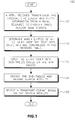
- Figure 1 is a flow chart of a procedure that splits an E-TFC table into sub-tables for E-TFC restriction
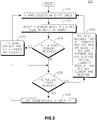
- Figure 2 is a flowchart of an optimized search procedure
- Figure 3 is a wireless communication system including a WTRU and a base station configured to perform the procedures of Figures 1 and 2 .
- wireless transmit/receive unit includes but is not limited to a user equipment (UE), a mobile station, a fixed or mobile subscriber unit, a pager, a cellular telephone, a personal digital assistant (PDA), a computer, or any other type of user device capable of operating in a wireless environment.
- base station includes but is not limited to a Node-B, a site controller, an access point (AP), or any other type of interfacing device capable of operating in a wireless environment.
- the E-TFC MPR Table 2 shows that the MPR values are a function of the following: the channel gain value ⁇ hs , (which indicates if the HSDPA channel is being used in the TTI), the channel gain value ⁇ d (which indicates if a DCH channel is being used in the TTI), SFmin (minimum spreading factor required by the E-TFC), and Ncodes (number of codes required by the E-TFC).
- ⁇ hs and ⁇ d are fixed in a given TTI (i.e., same value for all E-TFCs).
- Ncodes and SFmin are functions of the Transport Block (TB) size and vary per E-TFC.
- the WTRU determines the absence or presence of HSDPA and a DCH, and depending on the scenario, to look up the corresponding value of the MPR in the Table 2. The MPR value is then subtracted from the maximum power to determine the allowed power output by the WTRU.
- the values of MPR will be different based on the values of SFmin and Ncodes.
- E-TFCs are listed in increasing order of TB size. Moreover, according to UMTS standards, the number of codes and SF for each E-TFC is selected based on the following order: ⁇ N256, N128, N64, N32, N16, N8, N4, 2xN4, 2xN2, 2 ⁇ N2+2 ⁇ N4 ⁇ . This implies that E-TFCs are listed in increasing order of SF and number codes.
- the following tables list the MPR values for each of the four cases listed above.
- the tables below also contain the number of holes in the E-TFC table for each case.
- the number of holes for each case depicted varies as a result of changes in the MPR values as the Ncodes increase and the SF decreases.
- the E-TFC table is split into logical sub-tables where each sub-table contains all the E-TFCs which have the same MPR value and are continuous in the table.
- FIG. 1 is a flow chart of a search procedure 100 according to a first embodiment.
- a WTRU receives a TTI length and E-TFC information from a base station and/or RRC regarding which of the pre-defined tables the MAC-e should use when selecting a transport format.
- the WTRU determines which E-TFCs of an E-TFC table have the same MPR values and are continuous in the E-TFC table based on the information.
- step 115 the WTRU the splits the E-TFC table into M sub-tables, where each sub-table contains the E-TFCs of the same MPR value and are continuous.
- the WTRU searches the M sub-tables according to a suitable algorithm.
- the WTRU selects a transport format based on the search results.
- the search is performed faster because it can be performed independently within each sub-table.
- An efficient search algorithm to further optimize the search within a sub-table is disclosed below.
- the number of sub-tables in a given table may be given by (Number of holes + 1).
- the boundary between two sub-tables is known as the sub-table boundary.
- the sub-table boundary is automatically defined.
- the procedure below is an algorithm to optimize the search that is performed within every sub-table to look for the blocked E-TFCs and hence using the algorithm can make the search process faster.
- the sub-table boundaries depict the amount of searching that is required. Therefore, depending on the number of sub-tables, the search algorithm is iteratively applied to each sub-table and the boundaries are used to differentiate between the sub-tables.
- h1, h2 and h3 are defined as follows:
- a procedure for a search within an E-TFC table is disclosed.
- the algorithm should be applied independently in each sub-table as if they were individual E-TFC tables.
- FIG. 2 is a flowchart of an optimized search procedure 200.
- the WTRU selects an E-TFC table.
- the WTRU selects a window within the E-TFC table in which to search. Each table is arranged in ascending order; therefore, the first element is the smallest element.
- the WTRU determines whether the element in the search window is blocked, step 215. Since the first element is the E-TFC which requires the least power in the table, if the first element is determined in step 215 to be blocked, then the WTRU assumes that all the elements in the search window are blocked (step 220), and the WTRU can then either terminate the search, or search another E-TFC table.
- the WTRU checks the last element within the window (step 225). If the last element of the search window is determined in step 225 to be blocked, the WTRU will decrement the size of the search window by setting the current last element to the last element-1 (step 230) and repeat step 225. The WTRU will continue repeating steps 225 and 230 which will decrease the size of the window until it is determined that the last element is not blocked.
- the WTRU finds a current last element that is unblocked, the WTRU assumes that all of the elements in the window that are smaller than or equal to the current last element are not blocked, and all of the elements that are greater than the current last element are blocked (step 235), and the WTRU can then either terminate the search, or search another E-TFC sub-table.
- the above procedure has been described in use with an E-TFC without MPR, however it may be used even in the case where there is MPR, in which case the E-TFC sub-tables described above may be used.
- the window search procedure described above outperforms the sequential search in cases where the top-most E-TFC in the window (i.e., the E-TFC with smallest TB size in the window) is blocked.
- the only case where the proposed algorithm requires more instructions than the sequential search is the case where the top-most E-TFC in the window is not blocked, in which case there will be one extra comparison required by the window search algorithm (when compared with a sequential search).
- the window search algorithm will outperform the sequential search algorithm on average.
- the window size can be fixed or a dynamically adjusted window size. For example, if the known probability of finding the blocked E-TFCs in the N last elements of the table is high, the window size should be fixed to N. Moreover, the value of N is a function of several factors, such as WTRU location (pathloss), presence of DCH and HSDPA, etc. As a result the value of N can vary on a TTI basis according to the above listed factors or other factors.
- the size of the window may be reduced by a given number, because the chance of finding blocked E-TFCs in that sub-table is small.
- the number of searches required to find the blocked E-TFCs and isolate the holes can be performed faster than a step by step comparison of all the 128 E-TFCs present in the table.
- FIG. 3 shows a wireless communication system 300 including a WTRU 305 and a base station 310.
- the E-TFC and MPR table is predefined in the UMTS standards and so the WTRU 305 has the table pre-configured and pre-coded in a memory 355.
- the base station 310 using RRC procedures, signals certain reference values to the WTRU 305. The values are used to calculate quantized amplitude ratio for each ETFC.
- the WTRU 305 may include a processor 315, a receiver 320, a transmitter 325 and an antenna 330.
- the base station 310 may include a processor 335, a receiver 340, a transmitter 345 and an antenna 350.
- the WTRU 305 and the base station 310 are each configured to perform a method of optimizing E-TFC restriction when MPR values are used.
- the processor 335 in the base station 310 generates information that indicates a TTI length and E-TFC information including an E-TFC table.
- the transmitter 345 transmits this information via the antenna 350.
- Reference values are signaled to the WTRU 305 which are used in the power restriction procedure.
- the E-TFC table is predefined and pre-stored in a memory 355 of the WTRU 305.
- the information is received by the receiver 320 via the antenna 330, and is forwarded to the processor 315.
- the processor 315 is configured to determine which E-TFCs have the same MPR values and are continuous in the received E-TFC table.
- the processor 315 is further configured to split the E-TFC table into sub-tables based on the MPR values.
- the processor 315 is also configured to search the sub-tables and select a transport format for the WTRU 305 to use when communicating with the base station 310.
- ROM read only memory
- RAM random access memory
- register cache memory
- semiconductor memory devices magnetic media such as internal hard disks and removable disks, magneto-optical media, and optical media such as CD-ROM disks, and digital versatile disks (DVDs).
- Suitable processors include, by way of example, a general purpose processor, a special purpose processor, a conventional processor, a digital signal processor (DSP), a plurality of microprocessors, one or more microprocessors in association with a DSP core, a controller, a microcontroller, Application Specific Integrated Circuits (ASICs), Field Programmable Gate Arrays (FPGAs) circuits, any other type of integrated circuit (IC), and/or a state machine.
- DSP digital signal processor
- ASICs Application Specific Integrated Circuits
- FPGAs Field Programmable Gate Arrays
- a processor in association with software may be used to implement a radio frequency transceiver for use in a wireless transmit receive unit (WTRU), user equipment (UE), terminal, base station, radio network controller (RNC), or any host computer.
- the WTRU may be used in conjunction with modules, implemented in hardware and/or software, such as a camera, a video camera module, a videophone, a speakerphone, a vibration device, a speaker, a microphone, a television transceiver, a hands free headset, a keyboard, a Bluetooth® module, a frequency modulated (FM) radio unit, a liquid crystal display (LCD) display unit, an organic light-emitting diode (OLED) display unit, a digital music player, a media player, a video game player module, an Internet browser, and/or any wireless local area network (WLAN) module.
- modules implemented in hardware and/or software, such as a camera, a video camera module, a videophone, a speakerphone, a vibration device, a speaker,
Landscapes
- Engineering & Computer Science (AREA)
- Computer Networks & Wireless Communication (AREA)
- Signal Processing (AREA)
- Quality & Reliability (AREA)
- Mobile Radio Communication Systems (AREA)
- Container, Conveyance, Adherence, Positioning, Of Wafer (AREA)
- Management, Administration, Business Operations System, And Electronic Commerce (AREA)
- Hybrid Cells (AREA)
Applications Claiming Priority (3)
| Application Number | Priority Date | Filing Date | Title |
|---|---|---|---|
| US86405106P | 2006-11-02 | 2006-11-02 | |
| EP07861688A EP2089987B9 (de) | 2006-11-02 | 2007-11-02 | Verfahren und vorrichtung zur optimierung von e-tfc-beschränkung für hsupa-kanäle |
| EP11158303A EP2375830A3 (de) | 2006-11-02 | 2007-11-02 | Verfahren und Vorrichtung zur Optimierung von E-TFC-Beschränkung für HSUPA-Kanäle |
Related Parent Applications (2)
| Application Number | Title | Priority Date | Filing Date |
|---|---|---|---|
| EP07861688.5 Division | 2007-11-02 | ||
| EP11158303.5 Division | 2011-03-15 |
Publications (2)
| Publication Number | Publication Date |
|---|---|
| EP2466973A2 true EP2466973A2 (de) | 2012-06-20 |
| EP2466973A3 EP2466973A3 (de) | 2012-08-22 |
Family
ID=39365088
Family Applications (3)
| Application Number | Title | Priority Date | Filing Date |
|---|---|---|---|
| EP11158303A Withdrawn EP2375830A3 (de) | 2006-11-02 | 2007-11-02 | Verfahren und Vorrichtung zur Optimierung von E-TFC-Beschränkung für HSUPA-Kanäle |
| EP12159438A Withdrawn EP2466973A3 (de) | 2006-11-02 | 2007-11-02 | Verfahren und Vorrichtung zur Optimierung von E-TFC-Beschränkung für HSUPA-Kanäle |
| EP07861688A Not-in-force EP2089987B9 (de) | 2006-11-02 | 2007-11-02 | Verfahren und vorrichtung zur optimierung von e-tfc-beschränkung für hsupa-kanäle |
Family Applications Before (1)
| Application Number | Title | Priority Date | Filing Date |
|---|---|---|---|
| EP11158303A Withdrawn EP2375830A3 (de) | 2006-11-02 | 2007-11-02 | Verfahren und Vorrichtung zur Optimierung von E-TFC-Beschränkung für HSUPA-Kanäle |
Family Applications After (1)
| Application Number | Title | Priority Date | Filing Date |
|---|---|---|---|
| EP07861688A Not-in-force EP2089987B9 (de) | 2006-11-02 | 2007-11-02 | Verfahren und vorrichtung zur optimierung von e-tfc-beschränkung für hsupa-kanäle |
Country Status (9)
| Country | Link |
|---|---|
| US (1) | US7843875B2 (de) |
| EP (3) | EP2375830A3 (de) |
| JP (4) | JP2010509843A (de) |
| KR (4) | KR101493799B1 (de) |
| CN (3) | CN103957588A (de) |
| AT (1) | ATE502447T1 (de) |
| DE (1) | DE602007013273D1 (de) |
| TW (3) | TW200822604A (de) |
| WO (1) | WO2008057465A2 (de) |
Families Citing this family (9)
| Publication number | Priority date | Publication date | Assignee | Title |
|---|---|---|---|---|
| TWI388151B (zh) * | 2005-08-10 | 2013-03-01 | Koninkl Philips Electronics Nv | 操作一通信裝置與系統的方法,通信裝置及包含該通信裝置之系統 |
| JP5388372B2 (ja) * | 2008-08-11 | 2014-01-15 | 株式会社Nttドコモ | ユーザ装置及び通信制御方法 |
| US9516609B2 (en) | 2010-11-08 | 2016-12-06 | Qualcomm Incorporated | System and method for uplink multiple input multiple output transmission |
| US9380490B2 (en) | 2010-11-08 | 2016-06-28 | Qualcomm Incorporated | System and method for uplink multiple input multiple output transmission |
| US9055604B2 (en) * | 2012-02-08 | 2015-06-09 | Qualcomm Incorporated | Method and apparatus for E-TFC selection for uplink MIMO communication |
| US9066362B2 (en) | 2013-03-08 | 2015-06-23 | Qualcomm Incorporated | Prioritizing time critical data for transmission during power limited state in DC-HSUPA operation |
| US10342016B2 (en) * | 2015-03-06 | 2019-07-02 | Nec Corporation | Radio station, radio terminal apparatus, and method for these |
| CN108702711B (zh) * | 2016-02-19 | 2021-10-22 | 株式会社Ntt都科摩 | 用户终端、无线基站以及无线通信方法 |
| US20190042304A1 (en) * | 2017-12-03 | 2019-02-07 | Intel Corporation | [ice] architecture and mechanisms to accelerate tuple-space search with intergrated gpu |
Family Cites Families (33)
| Publication number | Priority date | Publication date | Assignee | Title |
|---|---|---|---|---|
| JPH0192982A (ja) * | 1987-10-05 | 1989-04-12 | Hitachi Ltd | Discの位置決め方式 |
| CN1265654C (zh) * | 2000-11-14 | 2006-07-19 | 皇家菲利浦电子有限公司 | 具有选择传输格式组合的无线网络 |
| CN1129297C (zh) * | 2000-12-14 | 2003-11-26 | 华为技术有限公司 | 多业务组合传输的方法 |
| US6813284B2 (en) * | 2001-01-17 | 2004-11-02 | Qualcomm Incorporated | Method and apparatus for allocating data streams given transmission time interval (TTI) constraints |
| JP4318412B2 (ja) * | 2001-08-08 | 2009-08-26 | 富士通株式会社 | 通信システムにおける送受信装置及び送受信方法 |
| US6747958B2 (en) * | 2001-11-13 | 2004-06-08 | Qualcomm, Incorporated | Transport format combination selection for compressed mode in a W-CDMA system |
| GB2382956B (en) * | 2001-12-05 | 2006-03-01 | Ipwireless Inc | Method and arrangement for power control |
| KR100810281B1 (ko) * | 2002-03-30 | 2008-03-07 | 삼성전자주식회사 | 부호분할다중접속 이동통신시스템에서 전송 포맷 선택을위한 검색시간 최소화 방법 |
| US6907010B2 (en) * | 2002-10-11 | 2005-06-14 | Interdigital Technology Corporation | Dynamic radio link adaptation for interference in cellular systems |
| ATE556501T1 (de) * | 2002-11-07 | 2012-05-15 | 2011 Intellectual Property Asset Trust | Transportformat-daten übertragung |
| TWI257796B (en) * | 2002-12-20 | 2006-07-01 | Interdigital Tech Corp | Scheduling data transmission by medium access control (MAC) layer in a mobile network |
| JP4509804B2 (ja) * | 2003-01-14 | 2010-07-21 | テレフオンアクチーボラゲット エル エム エリクソン(パブル) | リソース割り当て管理 |
| KR100933123B1 (ko) * | 2003-11-07 | 2009-12-21 | 삼성전자주식회사 | 이동통신 시스템에서 단말의 데이터 레이트 스케쥴링 장치및 방법 |
| US7525925B2 (en) * | 2003-12-31 | 2009-04-28 | Stmicroelectronics Asia Pacific Pte. Ltd. | System and method for selecting an optimal transport format combination using progressive set reduction |
| US7215655B2 (en) | 2004-01-09 | 2007-05-08 | Interdigital Technology Corporation | Transport format combination selection in a wireless transmit/receive unit |
| TWI232648B (en) * | 2004-02-04 | 2005-05-11 | Benq Corp | Method for selecting transport format combination |
| JP4222957B2 (ja) * | 2004-03-01 | 2009-02-12 | ソニー・エリクソン・モバイルコミュニケーションズ株式会社 | 送信電力制御方法および装置 |
| KR101153598B1 (ko) * | 2004-06-11 | 2012-06-11 | 닛본 덴끼 가부시끼가이샤 | 트랜스포트 포맷 콤비네이션 선택 방법, 무선 통신 시스템 및 이동국 |
| KR101059876B1 (ko) * | 2004-06-16 | 2011-08-29 | 엘지전자 주식회사 | 이동통신 시스템의 서비스 품질 보장을 위한 데이터전송량 선택 방법 |
| JP4506310B2 (ja) * | 2004-07-05 | 2010-07-21 | 富士通株式会社 | W−cdma通信端末用上り伝送情報識別コード選択制御回路 |
| KR20060006725A (ko) * | 2004-07-16 | 2006-01-19 | 삼성전자주식회사 | 향상된 상향링크 전용채널을 지원하는 이동통신시스템에서자율전송을 위한 파라미터 결정 방법 및 장치 |
| DE102004044957B4 (de) * | 2004-09-16 | 2007-04-19 | Infineon Technologies Ag | Medium-Zugriffs-Steuerungs-Einheit, Mobilfunkeinrichtung und Verfahren zum Abbilden mittels einer Mobilfunkeinrichtung zu übertragender Daten |
| JP4767173B2 (ja) * | 2004-11-09 | 2011-09-07 | 株式会社エヌ・ティ・ティ・ドコモ | 移動通信システム、無線基地局及び移動局 |
| CN1798420A (zh) * | 2004-12-22 | 2006-07-05 | 上海贝尔阿尔卡特股份有限公司 | 用于在基站中进行快速资源调度的方法与基站 |
| US7630316B2 (en) * | 2004-12-30 | 2009-12-08 | Research In Motion Limited | Method and apparatus for selecting a transport format combination |
| WO2006082627A1 (ja) * | 2005-02-01 | 2006-08-10 | Mitsubishi Denki Kabushiki Kaisha | 送信制御方法、移動局および通信システム |
| CN100571259C (zh) * | 2005-02-07 | 2009-12-16 | 上海贝尔阿尔卡特股份有限公司 | 一种用于hsupa的传输格式组合配置策略 |
| EP1696616A1 (de) * | 2005-02-28 | 2006-08-30 | NTT DoCoMo, Inc. | Verfahren zur Steuerung der Übertragungsrate, Mobilstation und Funknetzsteuerungseinheit |
| JP4598569B2 (ja) * | 2005-03-09 | 2010-12-15 | パナソニック株式会社 | 通信端末装置及びtfc選択方法 |
| US8179836B2 (en) * | 2005-04-20 | 2012-05-15 | Interdigital Technology Corporation | Method and apparatus for controlling transmissions via an enhanced dedicated channel |
| US7729715B2 (en) * | 2005-12-30 | 2010-06-01 | Motorola, Inc. | Method and apparatus for power reduction for E-TFC selection |
| US7599320B2 (en) * | 2006-07-13 | 2009-10-06 | Motorola, Inc. | Enhanced-transport format combination power margin for uplink |
| US20080305824A1 (en) * | 2007-04-20 | 2008-12-11 | Interdigital Technology Corporation | Apparatus and method for computing maximum power reduction for a umts signal |
-
2007
- 2007-11-02 AT AT07861688T patent/ATE502447T1/de not_active IP Right Cessation
- 2007-11-02 KR KR1020097012583A patent/KR101493799B1/ko not_active Expired - Fee Related
- 2007-11-02 EP EP11158303A patent/EP2375830A3/de not_active Withdrawn
- 2007-11-02 KR KR1020147000264A patent/KR101550160B1/ko not_active Expired - Fee Related
- 2007-11-02 EP EP12159438A patent/EP2466973A3/de not_active Withdrawn
- 2007-11-02 KR KR1020097011339A patent/KR101069303B1/ko not_active Expired - Fee Related
- 2007-11-02 TW TW096141608A patent/TW200822604A/zh unknown
- 2007-11-02 CN CN201410143327.4A patent/CN103957588A/zh active Pending
- 2007-11-02 CN CN201410143311.3A patent/CN103957587A/zh active Pending
- 2007-11-02 DE DE602007013273T patent/DE602007013273D1/de active Active
- 2007-11-02 EP EP07861688A patent/EP2089987B9/de not_active Not-in-force
- 2007-11-02 TW TW102140378A patent/TWI511488B/zh not_active IP Right Cessation
- 2007-11-02 KR KR1020147031330A patent/KR101550165B1/ko not_active Expired - Fee Related
- 2007-11-02 WO PCT/US2007/023222 patent/WO2008057465A2/en not_active Ceased
- 2007-11-02 TW TW098100246A patent/TWI449362B/zh not_active IP Right Cessation
- 2007-11-02 US US11/934,389 patent/US7843875B2/en not_active Expired - Fee Related
- 2007-11-02 JP JP2009536260A patent/JP2010509843A/ja not_active Ceased
- 2007-11-02 CN CNA2007800410150A patent/CN101536590A/zh active Pending
-
2012
- 2012-03-01 JP JP2012045463A patent/JP5411309B2/ja not_active Expired - Fee Related
-
2013
- 2013-11-07 JP JP2013231153A patent/JP5784095B2/ja not_active Expired - Fee Related
-
2015
- 2015-07-21 JP JP2015144004A patent/JP6148295B2/ja not_active Expired - Fee Related
Non-Patent Citations (1)
| Title |
|---|
| None |
Also Published As
Similar Documents
| Publication | Publication Date | Title |
|---|---|---|
| EP2089987B9 (de) | Verfahren und vorrichtung zur optimierung von e-tfc-beschränkung für hsupa-kanäle | |
| US9307504B2 (en) | Power control for combined dynamically and persistently scheduled PUSCH in E-utra | |
| JP4913869B2 (ja) | スケジューリング許可ペイロードを伝送可能最大ペイロードに設定することによって拡張アップリンク・トランスポート・フォーマット・コンビネーションを選択する無線通信方法 | |
| CN101933377B (zh) | 在指定给无线通信设备的两个或更多个载波之间分配发射功率 | |
| CN201499310U (zh) | 无线发射/接收单元 | |
| CN101385250A (zh) | 用于连续连接性传输的自适应前导码长度 | |
| JP2011155682A (ja) | E−dchチャネルをスケーリングする方法 | |
| JP4651446B2 (ja) | 通信制御装置及び通信制御方法 | |
| HK1172184A (en) | Method and apparatus for optimizing e-tfc restriction for hsupa channels | |
| HK1163425A (en) | Method and apparatus for optimizing e-tfc restriction for hsupa channels | |
| EP2800426A1 (de) | Verfahren zur verarbeitung von dienstgenehmigungswerten, benutzergerät und netzwerkvorrichtung | |
| HK1155299A (en) | Wireless communication method of selecting an enhanced uplink transport format combination by setting a scheduling grant payload to the highest payload that can be transmitted |
Legal Events
| Date | Code | Title | Description |
|---|---|---|---|
| PUAI | Public reference made under article 153(3) epc to a published international application that has entered the european phase |
Free format text: ORIGINAL CODE: 0009012 |
|
| 17P | Request for examination filed |
Effective date: 20120314 |
|
| AC | Divisional application: reference to earlier application |
Ref document number: 2089987 Country of ref document: EP Kind code of ref document: P Ref document number: 2375830 Country of ref document: EP Kind code of ref document: P |
|
| AK | Designated contracting states |
Kind code of ref document: A2 Designated state(s): AT BE BG CH CY CZ DE DK EE ES FI FR GB GR HU IE IS IT LI LT LU LV MC MT NL PL PT RO SE SI SK TR |
|
| PUAL | Search report despatched |
Free format text: ORIGINAL CODE: 0009013 |
|
| AK | Designated contracting states |
Kind code of ref document: A3 Designated state(s): AT BE BG CH CY CZ DE DK EE ES FI FR GB GR HU IE IS IT LI LT LU LV MC MT NL PL PT RO SE SI SK TR |
|
| RIC1 | Information provided on ipc code assigned before grant |
Ipc: H04W 52/28 20090101AFI20120716BHEP Ipc: H04L 1/00 20060101ALI20120716BHEP |
|
| RAP1 | Party data changed (applicant data changed or rights of an application transferred) |
Owner name: INTERDIGITAL TECHNOLOGY CORPORATION |
|
| REG | Reference to a national code |
Ref country code: HK Ref legal event code: DE Ref document number: 1172184 Country of ref document: HK |
|
| GRAP | Despatch of communication of intention to grant a patent |
Free format text: ORIGINAL CODE: EPIDOSNIGR1 |
|
| RIC1 | Information provided on ipc code assigned before grant |
Ipc: H04W 52/34 20090101ALI20160617BHEP Ipc: H04L 1/00 20060101ALI20160617BHEP Ipc: H04W 52/28 20090101AFI20160617BHEP |
|
| INTG | Intention to grant announced |
Effective date: 20160708 |
|
| STAA | Information on the status of an ep patent application or granted ep patent |
Free format text: STATUS: GRANT OF PATENT IS INTENDED |
|
| STAA | Information on the status of an ep patent application or granted ep patent |
Free format text: STATUS: THE APPLICATION IS DEEMED TO BE WITHDRAWN |
|
| 18D | Application deemed to be withdrawn |
Effective date: 20161119 |