EP2469484A1 - Dispositif de réception de carte intelligente pour fournir une communication à distance avec des supports de commutation - Google Patents
Dispositif de réception de carte intelligente pour fournir une communication à distance avec des supports de commutation Download PDFInfo
- Publication number
- EP2469484A1 EP2469484A1 EP10306486A EP10306486A EP2469484A1 EP 2469484 A1 EP2469484 A1 EP 2469484A1 EP 10306486 A EP10306486 A EP 10306486A EP 10306486 A EP10306486 A EP 10306486A EP 2469484 A1 EP2469484 A1 EP 2469484A1
- Authority
- EP
- European Patent Office
- Prior art keywords
- smartcard
- remote
- protocol
- remote communication
- interface
- Prior art date
- Legal status (The legal status is an assumption and is not a legal conclusion. Google has not performed a legal analysis and makes no representation as to the accuracy of the status listed.)
- Withdrawn
Links
Images
Classifications
-
- G—PHYSICS
- G07—CHECKING-DEVICES
- G07C—TIME OR ATTENDANCE REGISTERS; REGISTERING OR INDICATING THE WORKING OF MACHINES; GENERATING RANDOM NUMBERS; VOTING OR LOTTERY APPARATUS; ARRANGEMENTS, SYSTEMS OR APPARATUS FOR CHECKING NOT PROVIDED FOR ELSEWHERE
- G07C9/00—Individual registration on entry or exit
- G07C9/20—Individual registration on entry or exit involving the use of a pass
-
- G—PHYSICS
- G06—COMPUTING OR CALCULATING; COUNTING
- G06K—GRAPHICAL DATA READING; PRESENTATION OF DATA; RECORD CARRIERS; HANDLING RECORD CARRIERS
- G06K7/00—Methods or arrangements for sensing record carriers, e.g. for reading patterns
- G06K7/0013—Methods or arrangements for sensing record carriers, e.g. for reading patterns by galvanic contacts, e.g. card connectors for ISO-7816 compliant smart cards or memory cards, e.g. SD card readers
- G06K7/0021—Methods or arrangements for sensing record carriers, e.g. for reading patterns by galvanic contacts, e.g. card connectors for ISO-7816 compliant smart cards or memory cards, e.g. SD card readers for reading/sensing record carriers having surface contacts
-
- G—PHYSICS
- G06—COMPUTING OR CALCULATING; COUNTING
- G06Q—INFORMATION AND COMMUNICATION TECHNOLOGY [ICT] SPECIALLY ADAPTED FOR ADMINISTRATIVE, COMMERCIAL, FINANCIAL, MANAGERIAL OR SUPERVISORY PURPOSES; SYSTEMS OR METHODS SPECIALLY ADAPTED FOR ADMINISTRATIVE, COMMERCIAL, FINANCIAL, MANAGERIAL OR SUPERVISORY PURPOSES, NOT OTHERWISE PROVIDED FOR
- G06Q20/00—Payment architectures, schemes or protocols
- G06Q20/30—Payment architectures, schemes or protocols characterised by the use of specific devices or networks
- G06Q20/34—Payment architectures, schemes or protocols characterised by the use of specific devices or networks using cards, e.g. integrated circuit [IC] cards or magnetic cards
- G06Q20/352—Contactless payments by cards
-
- G—PHYSICS
- G06—COMPUTING OR CALCULATING; COUNTING
- G06Q—INFORMATION AND COMMUNICATION TECHNOLOGY [ICT] SPECIALLY ADAPTED FOR ADMINISTRATIVE, COMMERCIAL, FINANCIAL, MANAGERIAL OR SUPERVISORY PURPOSES; SYSTEMS OR METHODS SPECIALLY ADAPTED FOR ADMINISTRATIVE, COMMERCIAL, FINANCIAL, MANAGERIAL OR SUPERVISORY PURPOSES, NOT OTHERWISE PROVIDED FOR
- G06Q20/00—Payment architectures, schemes or protocols
- G06Q20/30—Payment architectures, schemes or protocols characterised by the use of specific devices or networks
- G06Q20/34—Payment architectures, schemes or protocols characterised by the use of specific devices or networks using cards, e.g. integrated circuit [IC] cards or magnetic cards
- G06Q20/357—Cards having a plurality of specified features
- G06Q20/3574—Multiple applications on card
-
- G—PHYSICS
- G07—CHECKING-DEVICES
- G07F—COIN-FREED OR LIKE APPARATUS
- G07F7/00—Mechanisms actuated by objects other than coins to free or to actuate vending, hiring, coin or paper currency dispensing or refunding apparatus
- G07F7/08—Mechanisms actuated by objects other than coins to free or to actuate vending, hiring, coin or paper currency dispensing or refunding apparatus by coded identity card or credit card or other personal identification means
- G07F7/0873—Details of the card reader
- G07F7/088—Details of the card reader the card reader being part of the point of sale [POS] terminal or electronic cash register [ECR] itself
- G07F7/0886—Details of the card reader the card reader being part of the point of sale [POS] terminal or electronic cash register [ECR] itself the card reader being portable for interacting with a POS or ECR in realizing a payment transaction
-
- G—PHYSICS
- G07—CHECKING-DEVICES
- G07F—COIN-FREED OR LIKE APPARATUS
- G07F7/00—Mechanisms actuated by objects other than coins to free or to actuate vending, hiring, coin or paper currency dispensing or refunding apparatus
- G07F7/08—Mechanisms actuated by objects other than coins to free or to actuate vending, hiring, coin or paper currency dispensing or refunding apparatus by coded identity card or credit card or other personal identification means
- G07F7/10—Mechanisms actuated by objects other than coins to free or to actuate vending, hiring, coin or paper currency dispensing or refunding apparatus by coded identity card or credit card or other personal identification means together with a coded signal, e.g. in the form of personal identification information, like personal identification number [PIN] or biometric data
Definitions
- the present invention generally relates to smartcards, and more particularly relates to dual interface smartcards having only one of its communication interfaces simultaneously available.
- Smart cards are plastic cards having an embedded smartcard chip.
- a smartcard chip is an integrated microcontroller generally comprising a central processing unit, a random access memory, a ROM memory and an EEPROM memory.
- a dual interface smartcard is a smartcard provided with a contact and a contactless communication interfaces. The integrated microcontroller is connected to both communication interfaces to perform transactions. Such a smartcard can carry out a transaction through its contact interface when it is hosted in a smartcard reader. Such a smartcard can carry out a transaction through its contactless interface when a contactless reader is located in near-field area. Smartcards are widely used to store sensitive information such as cryptographic keys or software routines that implement valuable algorithms or know-how.
- an access to secured computer networks can request a user authentication.
- An authentication through the contact interface of the smartcard requires connecting a smartcard reader to a terminal of the user.
- An authentication transaction through the smartcard contact interface can be carried out only when the smartcard is inserted inside the smartcard reader.
- the user has to leave the smartcard inside the smartcard reader as long as he wants to keep his access granted to the secured network.
- this smartcard can be used to have the user authenticated by further devices as well.
- the smartcard can be used to open security doors to/from restricted areas through its contactless interface. If a user wants to cross a door to enter or leave a restricted area, he has to remove his smartcard from the smartcard reader to authenticate and open the door.
- a badge holder has notably been designed to enhance the communication range of the smartcard.
- Such a badge holder receives the smartcard and can communicate with the smartcard through a contact interface.
- the badge holder further comprises a Bluetooth interface (Bluetooth is defined in the IEEE 802.15 standards).
- Bluetooth communication system has the main advantage of being already widely integrated on most of the distributed computers and smart-phones.
- the contact interface and the Bluetooth interface of the badge holder are connected through a protocol translator or bridge.
- the protocol bridge establishes a communication between the smartcard using its contact interface (for instance through an ISO 7816 protocol) and the Bluetooth interface (through an UART interface for instance).
- the use of such a badge holder still has some drawbacks. Indeed, the user may be unable to unlock a door and leave the room if a communication between the smartcard (using its contact interface) and the user terminal is active. Indeed, a dual interface smartcard is in most cases unable to perform a transaction on its contact interface concurrently with a transaction on its contactless interface. Thus, if a user leaves his desk and approaches a door he wishes to unlock, the badge holder hosted in his pocket will still be communicating with his terminal in vicinity. The transaction through the contact interface of the smartcard has to be ended first. Thus, the smartcard is unable to carry out a transaction with the door through its contactless interface while a communication through its contact interface is active. The user has to deliberately end the transaction between his terminal and the smartcard.
- the invention proposes a smartcard receiving device, comprising a contact interface, a remote communication interface, a protocol bridge and a communicating device detector.
- the contact interface is designed for communicating with the received smartcard.
- the remote communication interface designed for communicating with a first remote device.
- the protocol bridge is designed to establish a transaction with the received smartcard through the contact interface and to translate the data received according to the protocol of one of said interfaces into the protocol of the other of said interfaces.
- the communicating device detector is adapted to detect a second remote device communicating according to a remote communication protocol different from the communication protocol used by said remote communication interface.
- the protocol bridge interrupts the transaction with the received smartcard when the second remote device communicating according to said different remote communication protocol is detected.
- the protocol bridge automatically interrupts the transaction when said second remote device is detected.
- said contact interface complies with ISO 7816 standards requirements.
- said remote communication interface is a wireless communication interface.
- said remote communication interface complies with IEEE 802.15 standards requirements.
- said detector is adapted to detect a second remote communication device communicating with a contactless communication protocol.
- said detector is adapted to detect a second remote communication device communicating with a communication protocol complying with ISO 14443 standards requirements.
- the detector is adapted to:
- said threshold is set as a proportion of the amplitude of the signal received on said remote communication interface.
- the invention also relates to a communication system, comprising:
- the invention additionally relates to a method for interrupting a transaction performed through their respective contact interfaces by a smart card with a device hosting said smartcard, said hosting device bridging the smartcard communication with a first remote device through a remote communication interface using a first remote communication protocol, the method comprising:
- said smart card establishes a transaction with the second remote device when the transaction with the hosting device through the contact interfaces is interrupted.
- said smart card is a dual interface smartcard having a controller allowing a communication only through one of the smartcard communication interfaces at a time.
- the invention proposes to interrupt a transaction between a receiving device and a smartcard, when the receiving device is in bridge mode, upon detecting a new remote communicating device adapted to communicate with the remote communication interface of the smartcard.
- the user does not have to interrupt the transaction by accessing the device previously in remote communication with the receiving device.
- the user simply has to approach the receiving device near enough from the new remote communicating device to end a potential communication between the receiving device and the previously communicating device and to have a new remote transaction performed.
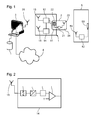
- Figure 1 is a schematic view of a communication system including a smartcard 2, a smartcard receiving device 1, a user terminal 3 and a contactless communicating device 5.
- the smartcard 2 includes a plastic card 24 embedding a smartcard chip 21.
- the smartcard chip 21 is an integrated microcontroller comprising a central processing unit, a random access memory, a ROM memory and an EEPROM memory (not illustrated).
- the smartcard 2 is adapted to store sensitive information such as cryptographic keys or software routines, in order to perform ciphering or authentication processes.
- the smartcard 2 is a dual interface smartcard.
- the smartcard is provided with a contact interface 22 and with a remote communication interface 23.
- the contact interface 22 is for instance compliant with the ISO 7816 standard requirements.
- the remote communication interface 23 is for instance a contactless communication interface. This contactless communication interface may be for instance compliant with the ISO 14443 standard requirements.
- the integrated microcontroller is connected to both communication interfaces 22 and 23 to perform transactions. The integrated microcontroller can handle only one communication at a time, either through the contact interface 22 or through the contactless interface 23.
- the smartcard 2 is a multi purpose smartcard, providing several authentication possibilities. The smartcard 2 notably allows a user authentication to access a computer network 4 through the user terminal 3 and allows the user to unlock the security door 5.
- the smartcard receiving device 1 is for instance an access badge.
- the smartcard receiving device 1 includes a remote communication interface 13, a contact interface 11 and a protocol bridge circuit 12.
- the remote communication interface 13 can be a wireless communication interface.
- the smartcard receiving device 1 further comprises an antenna 15 and a detector 14 for detecting a contactless communicating device adapted to communicate with the smartcard 2 through its contactless interface 23.
- the detector 14 is connected to the protocol bridge 12.
- the communication range provided by the communication interface 23 and its associated communication protocol may be lower (for instance at least 10 times lower) than the communication range provided by the communication interface 13 and its associated communication protocol.
- a contactless interface practically identifies a remote communication interface having a communication range reaching several centimeters.
- a wireless interface practically identifies a remote communication interface having a communication range reaching several meters to several tens of meters.
- the protocol bridge 12 performs functions known from someone skilled in the art: the protocol bridge 12 is designed to establish a transaction with a received smartcard 2 and to allow this smartcard 2 to communicate with wireless devices through the wireless interface 13.
- the use of the smartcard 2 for an access to the secured computer network 4 will now be disclosed.
- a user can access the secured computer network 4 through a user terminal 3.
- the user terminal 3 includes a wireless communication interface 31, for instance compliant with Bluetooth standards, such as recited in the IEEE 802.15 requirements.
- the wireless communication interface 31 may also comply with other standards, such as Wi-Fi standards.
- the user terminal 3 also includes a data storage device 32. Authentication tools are stored in the data storage device 32 and can be executed by the user terminal 3 to provide an access to the secured network 4. Authentication techniques to a secured network being known from someone skilled in the art, they will not be discussed further.
- the contact interface 22 is connected to the contact interface 11.
- the protocol bridge 12 detects the presence of the smartcard 2 either through a contact sensor or through exchanges between the contact interfaces 11 and 22.
- the user may request access to the secured network 4 using the user terminal 3.
- the receiving device for instance hosted in a pocket of the user, is in the communication range of the wireless interface 31.
- This request is sent through the wireless interface 31 and received on the wireless interface 13.
- the protocol bridge 12 establishes a transaction with smartcard 2 through its contact interface 11.
- the user terminal 3 and the smartcard 2 communicate through the protocol bridge 12.
- the protocol bridge 12 translates the data received from the smartcard 2 on the contact interface 11 into the protocol of its wireless interface 13.
- the protocol bridge 12 translates the data received from the user terminal 3 on the wireless interface 13 into the protocol of its contact interface 11.
- the protocol bridge 12 maintains the transaction with the smartcard 2 as long as the device 1 is in vicinity of the wireless interface 31. During this transaction, the smartcard 2 is unable to process another transaction.
- the access to the secured network 4 is maintained while the device 1 is still in vicinity of the wireless interface 31.
- the device 1 is adapted to interrupt the transaction between the smartcard 2 and the device 1, in order to allow the smartcard 2 to perform a transaction with another remote communicating device, a contactless device.
- the antenna 15 is tuned to receive signals originating from a contactless device communicating using a specific communication protocol, compliant to the ISO 14443 standard requirements in the present case.
- the detector 14 is designed to detect the presence of such a contactless device in vicinity of the device 1. In the case of the ISO 14443 standard, the detection range amounts several centimeters.
- the proximity of a contactless device is assessed as a request to carry out a new transaction using the contactless interface 23 of the smartcard 2.
- the detector 14 sends a signal to the protocol bridge 12.
- the protocol bridge 12 receives this signal, it interrupts the transaction between the smartcard 2 and the device 1. Once this transaction is interrupted, the smartcard 2 is able to establish a new transaction with the contactless device.
- the contactless device is a door 5.
- the door 5 is provided with a contactless communication interface 51, adapted to communicate with the contactless interface 23 of the smartcard 2.
- the contactless communication interface 51 is connected to a control circuit 52.
- the control circuit 52 controls an electronic lock 53.
- the control circuit 52 can thereby selectively open or lock the door 5.
- the door 5 can thereby prevent persons to leave/enter a restricted area before they are validly authenticated.
- the door 5 is detected by the detector 14 as a communicating device with which a transaction with the smartcard 2 is requested. This transaction can be performed to authenticate the user carrying his smartcard 2 once the transaction between the smartcard 2 and the device 1 is interrupted.
- the detector 14 advantageously receives a signal having a modulation frequency corresponding to the modulation frequency of the communication protocol of the contactless interface 51. The amplitude of this signal is determined. The determined amplitude is compared to a detection threshold. If the amplitude of the signal is superior to this threshold, the detector 14 indicates to the protocol bridge 12 that a contactless device has been detected.
- This threshold can be set quite high, in order to avoid interrupting the transaction between the smartcard 2 and the device 1 if the user does not intend to cross the door 5 and be authenticated by this door. The transaction between the smartcard 2 and the device 1 can be automatically interrupted if the contactless interface 51 is detected by the detector 14.
- FIG. 2 is a schematic view of an embodiment of a detector circuit 14 that can be included in the device 1.
- the detector circuit 14 includes a band-pass filter 141 connected to the antenna 15.
- the band-pass filter 141 keeps a frequency band including the modulation frequency corresponding to the modulation frequency of the contactless interface 51.
- the band-pass filter 141 filters out the frequency bands that do not correspond to that modulation frequency.
- the filtered signal is applied on the input of a rectifier 142.
- the rectified signal is advantageously applied on the input of a smoothing circuit 143.
- the smoothed voltage is applied on an input of a comparator 144.
- the smoothed voltage is compared to a threshold T applied on another input of the comparator 144. If the smoothed signal is superior to the threshold T, a detection signal is generated and applied to the protocol bridge 12.
- the detection range of the antenna 15 is advantageously significantly lower than the communication range of the interface 13, in order to avoid unwanted transaction interruptions.
- the threshold T can be notably set as a function of the amplitude of this signal.
- the threshold T can be set proportional to the signal originating from the wireless interface 31.
- the invention has been disclosed in relation with a badge reader as the receiving device 1.
- the invention also applies with other kinds of receiving devices, such as a mobile phone or a personal data assistant.
Landscapes
- Engineering & Computer Science (AREA)
- General Physics & Mathematics (AREA)
- Physics & Mathematics (AREA)
- Business, Economics & Management (AREA)
- Theoretical Computer Science (AREA)
- Microelectronics & Electronic Packaging (AREA)
- Accounting & Taxation (AREA)
- Strategic Management (AREA)
- General Business, Economics & Management (AREA)
- Computer Networks & Wireless Communication (AREA)
- Artificial Intelligence (AREA)
- Computer Vision & Pattern Recognition (AREA)
- Mobile Radio Communication Systems (AREA)
Priority Applications (4)
| Application Number | Priority Date | Filing Date | Title |
|---|---|---|---|
| EP10306486A EP2469484A1 (fr) | 2010-12-22 | 2010-12-22 | Dispositif de réception de carte intelligente pour fournir une communication à distance avec des supports de commutation |
| US13/997,252 US9558603B2 (en) | 2010-12-22 | 2011-12-15 | Smartcard receiving device for providing a remote communication with switching means |
| PCT/EP2011/072972 WO2012084698A1 (fr) | 2010-12-22 | 2011-12-15 | Dispositif récepteur de carte à puce pour assurer une communication à distance à l'aide d'un moyen de commutation |
| EP11802700.2A EP2656331A1 (fr) | 2010-12-22 | 2011-12-15 | Dispositif récepteur de carte à puce pour assurer une communication à distance à l'aide d'un moyen de commutation |
Applications Claiming Priority (1)
| Application Number | Priority Date | Filing Date | Title |
|---|---|---|---|
| EP10306486A EP2469484A1 (fr) | 2010-12-22 | 2010-12-22 | Dispositif de réception de carte intelligente pour fournir une communication à distance avec des supports de commutation |
Publications (1)
| Publication Number | Publication Date |
|---|---|
| EP2469484A1 true EP2469484A1 (fr) | 2012-06-27 |
Family
ID=43827137
Family Applications (2)
| Application Number | Title | Priority Date | Filing Date |
|---|---|---|---|
| EP10306486A Withdrawn EP2469484A1 (fr) | 2010-12-22 | 2010-12-22 | Dispositif de réception de carte intelligente pour fournir une communication à distance avec des supports de commutation |
| EP11802700.2A Ceased EP2656331A1 (fr) | 2010-12-22 | 2011-12-15 | Dispositif récepteur de carte à puce pour assurer une communication à distance à l'aide d'un moyen de commutation |
Family Applications After (1)
| Application Number | Title | Priority Date | Filing Date |
|---|---|---|---|
| EP11802700.2A Ceased EP2656331A1 (fr) | 2010-12-22 | 2011-12-15 | Dispositif récepteur de carte à puce pour assurer une communication à distance à l'aide d'un moyen de commutation |
Country Status (3)
| Country | Link |
|---|---|
| US (1) | US9558603B2 (fr) |
| EP (2) | EP2469484A1 (fr) |
| WO (1) | WO2012084698A1 (fr) |
Cited By (1)
| Publication number | Priority date | Publication date | Assignee | Title |
|---|---|---|---|---|
| FR3015736A1 (fr) * | 2013-12-23 | 2015-06-26 | Orange | Transmission et traitement de donnees relatives a une transaction sans contact |
Families Citing this family (5)
| Publication number | Priority date | Publication date | Assignee | Title |
|---|---|---|---|---|
| JP6138068B2 (ja) * | 2014-02-07 | 2017-05-31 | 東芝テック株式会社 | 商品販売データ処理装置及びプログラム |
| US10025963B2 (en) * | 2014-06-30 | 2018-07-17 | Symbol Technologies, Llc | System for, and method of, detecting the presence of a mobile communication device in proximity to an imaging reader and for automatically configuring the reader to read an electronic code displayed on the device upon such detection |
| US20170011015A1 (en) * | 2015-07-08 | 2017-01-12 | Ebay Inc. | Content extraction system |
| US12197974B2 (en) * | 2022-06-08 | 2025-01-14 | Oracle International Corporation | Logical java card runtime environment |
| US12538130B2 (en) | 2022-09-20 | 2026-01-27 | Oracle International Corporation | Systems and methods for running multiple logical secure elements on the same secure hardware |
Citations (4)
| Publication number | Priority date | Publication date | Assignee | Title |
|---|---|---|---|---|
| US20030189096A1 (en) * | 2002-04-08 | 2003-10-09 | Nokia Corporation | Mobile terminal featuring smart card interrupt |
| US20090036166A1 (en) * | 2007-07-31 | 2009-02-05 | Hong-Kai Yen | Combi-SIM card framework of electronic purse combining non-contacting transceiver of mobile device |
| JP2010044739A (ja) * | 2008-07-17 | 2010-02-25 | Rizon Kk | 複合機能icカードおよび指先ガイド付きリーダ/ライタ装置 |
| EP2172877A1 (fr) * | 2008-10-02 | 2010-04-07 | Oberthur Technologies | Dispositif électronique et gestion de communication sans fils contribuant à un tel dispositif et un équipement hôte |
Family Cites Families (17)
| Publication number | Priority date | Publication date | Assignee | Title |
|---|---|---|---|---|
| IL119943A (en) * | 1996-12-31 | 2000-11-21 | On Track Innovations Ltd | Contact/contactless data transaction card |
| US7472834B2 (en) * | 2003-07-09 | 2009-01-06 | Stmicroelectronics S.A. | Dual-mode smart card |
| US20050077348A1 (en) * | 2003-08-11 | 2005-04-14 | Colin Hendrick | Intelligent ID card holder |
| KR100560768B1 (ko) * | 2003-09-05 | 2006-03-13 | 삼성전자주식회사 | 듀얼 인터페이스 집적회로 카드 |
| DE10356284A1 (de) * | 2003-11-28 | 2005-07-07 | Skidata Ag | Datenträger |
| FR2864292B1 (fr) * | 2003-12-17 | 2006-03-31 | Gemplus Card Int | Maintien en fonction pleinement simultanee d'un objet a interface duale |
| SG149044A1 (en) * | 2003-12-19 | 2009-01-29 | Vodafone Plc | Information display method, mobile information apparatus, and noncontact communication device |
| KR101053185B1 (ko) * | 2005-02-24 | 2011-08-01 | 삼성전자주식회사 | 스마트 카드 및 그것의 혼합모드 제어방법 |
| US20070040017A1 (en) * | 2005-08-22 | 2007-02-22 | Douglas Kozlay | Wireless biometric cardholder apparatus, method, & system |
| DE602007007068D1 (de) * | 2006-04-05 | 2010-07-22 | Nxp Bv | Verfahren zur dynamischen Zuweisung von Kontakten einer Teilnehmer-Chipkarte in einem mobilen Endgerät sowie entsprechendes Programm und mobiles Endgerät |
| DE102006021087A1 (de) * | 2006-05-05 | 2007-11-08 | Giesecke & Devrient Gmbh | Simultaner Schnittstellenbetrieb |
| EP3471070B1 (fr) * | 2007-01-03 | 2025-10-01 | Assa Abloy Ab | Porte-carte numérique configurable |
| EP2135359A4 (fr) * | 2007-03-16 | 2011-07-27 | Lg Electronics Inc | Exécution d'applications, sans contact en mode sans batterie |
| EP2073152A1 (fr) * | 2007-12-17 | 2009-06-24 | Gemplus | Système avertisseur pour signaler la présence d'une communication radiofréquence et procédé de fabrication |
| JP2011029944A (ja) * | 2009-07-27 | 2011-02-10 | Funai Electric Co Ltd | 携帯機器および携帯機器の無線通信部 |
| US8219145B2 (en) * | 2009-09-03 | 2012-07-10 | Micro Mobio Corporation | Universal radio card for wireless devices |
| US8196131B1 (en) * | 2010-12-17 | 2012-06-05 | Google Inc. | Payment application lifecycle management in a contactless smart card |
-
2010
- 2010-12-22 EP EP10306486A patent/EP2469484A1/fr not_active Withdrawn
-
2011
- 2011-12-15 EP EP11802700.2A patent/EP2656331A1/fr not_active Ceased
- 2011-12-15 WO PCT/EP2011/072972 patent/WO2012084698A1/fr not_active Ceased
- 2011-12-15 US US13/997,252 patent/US9558603B2/en not_active Expired - Fee Related
Patent Citations (4)
| Publication number | Priority date | Publication date | Assignee | Title |
|---|---|---|---|---|
| US20030189096A1 (en) * | 2002-04-08 | 2003-10-09 | Nokia Corporation | Mobile terminal featuring smart card interrupt |
| US20090036166A1 (en) * | 2007-07-31 | 2009-02-05 | Hong-Kai Yen | Combi-SIM card framework of electronic purse combining non-contacting transceiver of mobile device |
| JP2010044739A (ja) * | 2008-07-17 | 2010-02-25 | Rizon Kk | 複合機能icカードおよび指先ガイド付きリーダ/ライタ装置 |
| EP2172877A1 (fr) * | 2008-10-02 | 2010-04-07 | Oberthur Technologies | Dispositif électronique et gestion de communication sans fils contribuant à un tel dispositif et un équipement hôte |
Cited By (2)
| Publication number | Priority date | Publication date | Assignee | Title |
|---|---|---|---|---|
| FR3015736A1 (fr) * | 2013-12-23 | 2015-06-26 | Orange | Transmission et traitement de donnees relatives a une transaction sans contact |
| WO2015097402A1 (fr) * | 2013-12-23 | 2015-07-02 | Orange | Transmission et traitement de données relatives a une transaction sans contact |
Also Published As
| Publication number | Publication date |
|---|---|
| US20140015639A1 (en) | 2014-01-16 |
| EP2656331A1 (fr) | 2013-10-30 |
| US9558603B2 (en) | 2017-01-31 |
| WO2012084698A1 (fr) | 2012-06-28 |
Similar Documents
| Publication | Publication Date | Title |
|---|---|---|
| EP2064649B1 (fr) | Établissement d'une connexion en champ proche | |
| US9558603B2 (en) | Smartcard receiving device for providing a remote communication with switching means | |
| US9198037B2 (en) | Identification processing apparatus and mobile device using the same | |
| US9633300B2 (en) | Apparatus having communication means and a receiving member for a chip card | |
| EP2717553A1 (fr) | Dispositif de communication portable en champ proche | |
| CN102165467B (zh) | 用于根据授权来控制非接触式接口设备的方法和通信系统 | |
| US8700827B2 (en) | Matching method, system and device for data exchange between a communication object and a processing unit | |
| US10176313B2 (en) | Method and apparatus for invoking fingerprint identification device, and mobile terminal | |
| CN105825562A (zh) | 一种开锁装置及开锁方法 | |
| CN103023539A (zh) | 一种实现电子设备功能开启的方法及系统 | |
| EP2391967B1 (fr) | Dispositif sécurisé protégé par mot de passe | |
| US20120185932A1 (en) | Sensing and Secure Processing | |
| CN105574373B (zh) | 移动设备、用于使交易便利的方法以及系统 | |
| US20130091553A1 (en) | Method and apparatus for determining input | |
| US11500989B2 (en) | Method of managing priority in the context of a secure element domain with multiple interfaces, electronic device and communication system | |
| CN104573765B (zh) | 智能卡信息处理方法及装置 | |
| KR100991883B1 (ko) | 지문인식 스마트카드 시스템 및 그의 제어방법 | |
| EP1784798A2 (fr) | Authentification a courte portee | |
| CN107393106B (zh) | 门禁数据写入方法、nfc源设备、门禁控制方法和系统 | |
| EP2750091A1 (fr) | Procédé pour commander une transaction sans contact | |
| KR100706946B1 (ko) | 듀얼 인터페이스 rf칩 및 그를 이용한 듀얼 인터페이스방법 | |
| CN107464312A (zh) | 一种智能开锁系统 | |
| KR101342305B1 (ko) | 비 접촉식 카드 다중 프로토콜 통합 관리 알에프아이디 시스템 | |
| KR200423656Y1 (ko) | Pc인터페이스형 rf카드 무선 리더기 | |
| CN105373751A (zh) | 一种非接触式智能卡的控制方法、设备及系统 |
Legal Events
| Date | Code | Title | Description |
|---|---|---|---|
| AK | Designated contracting states |
Kind code of ref document: A1 Designated state(s): AL AT BE BG CH CY CZ DE DK EE ES FI FR GB GR HR HU IE IS IT LI LT LU LV MC MK MT NL NO PL PT RO RS SE SI SK SM TR |
|
| AX | Request for extension of the european patent |
Extension state: BA ME |
|
| PUAI | Public reference made under article 153(3) epc to a published international application that has entered the european phase |
Free format text: ORIGINAL CODE: 0009012 |
|
| STAA | Information on the status of an ep patent application or granted ep patent |
Free format text: STATUS: THE APPLICATION IS DEEMED TO BE WITHDRAWN |
|
| 18D | Application deemed to be withdrawn |
Effective date: 20130103 |