EP2469983A2 - Spectre pour vision mésopique - Google Patents
Spectre pour vision mésopique Download PDFInfo
- Publication number
- EP2469983A2 EP2469983A2 EP11193962A EP11193962A EP2469983A2 EP 2469983 A2 EP2469983 A2 EP 2469983A2 EP 11193962 A EP11193962 A EP 11193962A EP 11193962 A EP11193962 A EP 11193962A EP 2469983 A2 EP2469983 A2 EP 2469983A2
- Authority
- EP
- European Patent Office
- Prior art keywords
- light
- lighting arrangement
- wavelength
- wavelength region
- spectrum
- Prior art date
- Legal status (The legal status is an assumption and is not a legal conclusion. Google has not performed a legal analysis and makes no representation as to the accuracy of the status listed.)
- Granted
Links
Images




Classifications
-
- H—ELECTRICITY
- H05—ELECTRIC TECHNIQUES NOT OTHERWISE PROVIDED FOR
- H05B—ELECTRIC HEATING; ELECTRIC LIGHT SOURCES NOT OTHERWISE PROVIDED FOR; CIRCUIT ARRANGEMENTS FOR ELECTRIC LIGHT SOURCES, IN GENERAL
- H05B45/00—Circuit arrangements for operating light-emitting diodes [LED]
- H05B45/20—Controlling the colour of the light
Definitions
- the present invention relates to a lighting arrangement emitting light of a predefined spectrum, in particular to a lighting arrangement emitting light of an enhanced spectrum for mesopic vision.
- LED lighting arrangements have been developed which enable the minimization of the electrical power consumption compared to the above-mentioned illumination devices. Moreover, the luminance of these LED lighting arrangements is considerably higher. Thereby, it is known to provide blue LEDs coated with a suitable phosphor in order to convert at least a portion of the emitted blue light into light of a longer wavelength, thus enabling the provision of a white light source.
- both, the conventional and the known LED light sources are however not optimally designed with respect to the sensitivity of the human eye.
- Light provided by a lighting device having a pedefined spectral distribution hits photoreceptors in the retina of the human eye, namely the "rods” and the “cones".
- the rods are used for vision at reduced light levels, i.e. at so-called scotopic levels.
- the rods are extremely sensitive to light, but provide achromatic vision.
- the other type of photoreceptors of the human eye, the cones provide colour vision at photopic levels of illumination, but are less sensitive.
- the light level during daytime corresponds to photopic levels such that the cones suppress the rods. Howevoer, in case of reduced levels of illumination and thus, at mesopic levels, the rods become more dominant.
- the rods are most sensitive for light having a relative short wavelength, i.e. about 505nm, whereas the cones are most sensitive for light having a wavelength of about 555nm.
- a melanopsin-associated photoreceptive system exists in the retina that conveys information for accessory visual functions such as for example the pupillary light reflex.
- the human eye comprises spectral sensitivity characteristics which change with the provided illumination intensity respectively the provided light level. Thereby, different ranges of wavelength of light lead to specific reactions within the human eye.
- WO2006/132533 A2 relates to a lighting arrangement which provides an improved visibility compared with conventional utility lighting.
- the lighting arrangement is designed to emit light in a first wavelength region and light in a second wavelength region.
- the first wavelength region comprises wavelengths of 500-550 nm.
- the second wavelength region comprises wavelengths of 560-610 nm.
- the lighting unit is designed to generate light having a dominant wavelength from the first wavelength region in such a way that the eye sensitivity of the human eye is dominated by rods.
- WO 2009/013317 A1 relates to a lighting arrangement for illuminating an area under mesopic conditions.
- the lighting arrangement has one or more LEDs emitting substantially monochromatic light in a first wavelength region.
- the lighting arrangement further has one or more LEDs emitting substantially monochromatic light in a second wavelength region.
- the combination of LEDs is such that, in use, the light provided by the lighting arrangement has a ratio of scotopic to photopic light (S/P-ratio) greater than 2.
- the lighting arrangement described in the prior art can improve vision at low illumination levels, further improvement is desired.
- the present invention particularly aims at providing a lighting arrangement emitting light of a particularly desired spectral distribution which helps the human eye to achieve an improved ability to see at mesopic conditions.
- the present invention seeks to address the above-described problems.
- the invention also aims at other objects and particularly the solution of other problems as will appear in the rest of the present description.
- the present invention proposes a lighting arrangement comprising a supporting element having at least one blue LED light source being at least partially covered with colour conversion layer and designed to emit a light of at least a first wavelength region, and at least one red LED based light source being designed to emit light of at least a second wavelength region.
- the spectrum of the emitted light by the lighting arrangement is adapted to a predefined spectrum for mesopic vision, the spectrum having a first intensity peak at a wavelength of 440 to 480nm and a second intensity peak at a wavelength of 600 to 650nm.
- the spectrum comprises an intensity peak at about 440 to 480nm.
- the emitted spectrum comprises a further intensity peak at about 600 to 650nm.
- the adaption of the spectral distribution of the light emitted by the at least one blue and red LED source is meant, in order to match the spectral sensitivity of the human eye at a mesopic level of illumination.
- the lighting arrangement comprises a plurality of blue LED light sources.
- the ratio of the number of the blue and red LED light sources respectively is between 3.5 to 1 and 5 to 1.
- the ratio of the number of the blue and red LED light sources respectively is 5 to 1.
- the blue LED light sources are preferably blue LED dice.
- the blue LED dice preferably emit light of a wavelength between 440 and 480nm.
- the blue LED dice are at least partially covered with a LuAG: Ce 3+ phosphor. Accordingly, at least a portion of the emitted monochromatic light of the blue LED dice is converted to light of a longer wavelength. In particular, the light emitted by the blue LED dice is at least partially converted to light of greenish colour, i.e. to a wavelength of about 520 to 570nm.
- a Cerium (Ce 3+ ) doped LuAG phosphor is available e.g. from Merck Chemicals, Darmstadt, Germany.
- the blue LED dice may as well be at least partially covered by any green, greenish-yellow, or yellow colored light emitting phosphor(s) like garnets such as YAG (doped with Ce 3+ ), orthosilicates such as BOSE (doped with Eu 2+ ) or CaSr 2 O 4 (doped with Ce 3+ ) . Accordingly, at least a portion of the emitted monochromatic light of the blue LED dice is converted to light of a longer wavelength, in particular to light of green, greenish-yellow, or yellow colour and thus, to a wavelength of about 550 to 590nm.
- any green, greenish-yellow, or yellow colored light emitting phosphor(s) like garnets such as YAG (doped with Ce 3+ ), orthosilicates such as BOSE (doped with Eu 2+ ) or CaSr 2 O 4 (doped with Ce 3+ ) . Accordingly, at least a portion of the emitted monochromat
- the red LED light source is constituted by a red LED die. Accordingly, a monochromatic light source is provided which is designed to emit a light of a predefined wavelength that preferably lies between 605 and 635nm.
- the red LED light source is constituted by a blue LED die being covered with a colour conversion layer that converts the light emitted by the blue LED die at least partially to light of a wavelength between 610 and 700nm.
- the colour conversion layer preferably comprises a nitride comprising phosphor like SiONs, SiAlNs (e.g. CaAlSiN 3 :Eu 2+ as most widely spread red nitride compound nowadays) SiAlONs, Silicon oxynitrides, and carbonitrides.
- the colour conversion layer is preferably applied to the respective LEDs by means of generally known methods such as for example a dispensing process.
- the colour conversion layer is preferably provided as an encapsulant to the respective LED.
- the colour conversion layer may as well be provided as a globe top to the respective LED.
- the phosphor layer could be directly deposited onto the surface of the LED die as a thin film.
- a colour conversion agent may be present within a provide epoxy, silicone or epoxy-silicone resin material.
- the lighting arrangement according to the present invention preferably emits a light having a resulting temperature between 4200 and 4800 Kelvin. More preferably, the resulting temperature lies between 4300 and 4700 Kelvin.
- the colour rendering index R A of the lighting arrangement is preferably greater than 70, more preferably, the colour rendering index R A is greater than 73.
- the lighting arrangement is designed to emit light of a predefined spectral distribution.
- the at least one blue and red LED light source are preferably arranged on the same supporting element.
- a mesopic spectrum of light is provided such that the mesopic responsiveness of the human eye is enhanced.
- an improved quality of the light perceived by the human eye is provided.
- a relatively high scotopic to photopic light ratio (S/P-ratio) higher than 2 of the lighting arrangement is obtained.
- the aim of such a spectrum to be provided is to stimulate the rods of the human eye in such a way that a specifically desired ratio between scotopic and photopic vision is obtained. It is further an aim to provide a particular amount of red light in the spectrum, since red light enables the provision of contrast in the foveal area of the human eye. Furthermore, the pupil size of the human eye has an influence on the mesopic vision of the human observer, which thus has to be considered.
- the spectral distribution of the light emitted by the lighting arrangement preferably comprises an intensity peak at a wavelength of 440 to 480nm, preferably 440 to 460nm.
- the scotopic cones and rods of the human eye are particularly stimulated.
- the mesopic vision of the human observer is enhanced.
- the spectral distribution of the emitted light preferably comprises an intensity peak at a wavelength of 600 to 650nm, preferably at 620nm.
- the ability of the human eye to perceive a sharp image and to see contrast is particularly enhanced.
- the intensity of the emitted light at a wavelength of 470 to 490nm is about 1.5 to 6 times smaller compared to the intensity in the area of 440 to 480nm.
- this particular wavelength region is referred to as Melanopsin area that has influence on the pupil size of the human eye. Thereby, it is desired to minimize the intensity of the provided light within this wavelength region in order to positively influence the pupil size of the human eye for mesopic vision.
- the intensity of the emitted light lies between 50 and 85% of the light emitted in the wavelength region of 440 to 480nm.
- the mesopic cones and rods are particularly stimulated.
- the intensity of the emitted light at a wavelength of 530 to 600nm is preferably 30 to 65% of the light intensity in the area of 440nm to 480nm.
- the invention enables to increase the light output of the lighting arrangement, whereby at the same time, the colour oversaturation effect is decreased.
- an enhanced and almost ideal mesopic spectrum of the emitted white light is provided by preferably using blue LED dice with particularly chosen colour conversion layers and a smaller amount of red light.
- the lighting arrangement may further comprise an electricity supply that is connectable to the lighting unit thereof.
- the LEDs of the lighting unit are preferably electrically connected in series.
- each string preferably comprises a predefined mixture of blue and red LED sources.
- three parallel strings are provided. "Mono-colored" LED strings comprising only one color could be applied as well.
- the lighting arrangement of the invention may further comprise a processing device for regulating the intensity and/or the direction of light emitted by the lighting arrangement.
- the lighting arrangement of the invention may comprise a plurality of lighting units according to the invention.
- the invention relates to a method for mimic a predefined mesopic spectrum by means of a lighting arrangement comprising at least a blue LED light source and a red LED based light source, the method comprising the steps of:
- Figure 1 shows a schematic top view of a preferred embodiment of a lighting arrangement according to the present invention.
- the lighting arrangement comprises a supporting element 2 supporting a lighting array respectively a lighting unit 1 which comprises of a predefined number of diodes 3.
- the lighting unit 1 comprises a number of 5 blue LEDs 3a and at least one red LED 3b.
- the respective LEDs are conventional LEDs that emit substantially monochromatic light in a first and second wavelength region, respectively.
- the total number of the LEDs 3 may however vary in order to provide a predefined spectral distribution of the emitted light.
- the ratio of the number of blue and red LEDs 3a, 3b lies between 3,5 to 1 and 5 to 1, more preferably between 4 to 1 and 5 to 1.
- the LEDs 3a, 3b are preferably covered by an encapsulant such as for example silicone resin material 4.
- the blue LEDs 3a are preferably covered by encapsulant 4 comprising a predefined amount of colour conversion particles 5a.
- the colour conversion particles 5a are preferably garnet phosphor particles such as e.g. YAG. Hence, at least a portion of the blue light emitted by the blue LED dice 3a is converted to a yellow light. Accordingly, the lighting unit 1 provides a white light source.
- the blue LEDs 3a are preferably covered by encapsulant 4 comprising phosphor particles that at least partially convert the emitted light of the blue LEDs to green and/or greenish-yellow light.
- the phosphor particles are LuAG (doped with Ce 3+ ) phosphor particles.
- another blue LED 3a is provided, said particular LED being covered by an encapsulant 4 comprising phosphor particles which at least partially convert the emitted light of the blue LED to red light.
- the phosphor particles are preferably nitride comprising phosphor particles.
- the amount of colour conversion particles 5a within the provided silicone resin 4 and the amount of the provided LEDs 3a, 3b is preferably selected such that a predefined spectrum of the emitted light is obtained, said spectrum being designed to support the human eye to achieve an improved to visualization ability under mesopic conditions.
- the spectral distribution of the emitted light will be discussed in greater details with reference to figures 2a and 4 .
- Figure 1b schematically shows a side view of lighting arrangement according to figure 1a .
- the LEDs 3 are covered by the encapsulation 4 which is preferably arranged hemispherical. Said hemispherical or dome-shaped encapsulations could be globe-tops. Accordingly, light emitted by the LEDs 3 is emitted in a planar distribution pattern perpendicular to the surface 6 of the supporting element 2. Thereby, the light emitted by the LEDs 3 produces a generally uniform conical pattern of predefined angle, e.g. 150 to 160°.
- Figures 2a and 2b relate to a preferred embodiment of the invention according to which the lighting unit 1 as shown in figure 1a and 1b comprises a number of 15 blue LEDs 3a that are covered by a silicone encapsulant comprising YAG phosphor particles, and three red LEDs 3b.
- the blue LEDs 3a and the red LEDs 3b and the provided colour conversion agent 5a are arranged to produce a particular spectral power distribution of the emitted light as shown in figure 2a .
- the produced spectrum 10 of the lighting arrangement has a first peak 11 within the wavelength region of between 440 to 460nm.
- the intensity (or spectral power distribution) of the emitted light is preferably at a minimum 13.
- the light intensity of said minimum in this wavelength region is about 1.5 to 6 times, more preferably, 2 to 4 times smaller compared to the intensity in the first peak located between 440 to 480nm of the emitted light spectrum 10. Accordingly, the pupil size of the human eye is prevented from negatively influencing the mesopic vision of the observer.
- the intensity of the emitted light shows a maximum 14 as an intermediate peak at about 530nm.
- the intensity of the emitted light within this region is preferably between 50 to 90%, more preferably between 60 and 70%, of the light intensity in the wavelength region of 440nm to 480nm.
- the spectrum preferably comprises an intermediate minimum 15.
- the minimum 15 is preferably has an intensity which is about 70 to 90%, more preferably between 75 to 85% of the intensity of the intermediate peak 14.
- the spectrum preferably comprises a peak 12 at around 620 nm.
- the light intensity of this peak is preferably 110 to 150%, more preferably between 120 and 140% of the light intensity of the peak 11 in the wavelength region between 440 to 480nm.
- Figure 2b relates to a graph showing the MacAdam ellipse according to CIE1931 of the light emitted by the preferred embodiment as outlined above.
- the emitted light is light with chromaticity x-coordinates between 0.3600 and 0.3850, and with chromaticity y-coordinates between 0.3760 and 0.4000.
- the colour temperature of the emitted light is preferably 4500K.
- the light flux of the emitted light is preferably between 2120 and 2170 lumen.
- Figures 3 relate to another preferred embodiment according to the present invention, in which the lighting unit 1 as shown in figure 1a and 1b comprises a number of 18 blue LEDs 3a that are covered with a silicone encapsulant comprising phosphor particles.
- the lighting unit 1 as shown in figure 1a and 1b comprises a number of 18 blue LEDs 3a that are covered with a silicone encapsulant comprising phosphor particles.
- a number of 15 blue LEDs 3a are covered with silicone resin comprising YAG phosphor
- a number of three blue LEDs 3a are covered with silicone encapsulant comprising a red light emitting nitride comprising phosphor.
- the encapsulant may comprise light scattering particles.
- no red LEDs are present.
- the blue LEDs covered with nitride phosphor constitute red LED light sources.
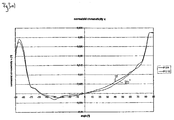
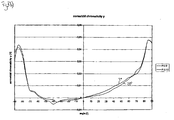
- Figure 3 relates to a graph 22, 22' showing the correlated colour temperature (CCT) of the light emitted by the lighting arrangement according to this embodiment of the invention.
- CCT correlated colour temperature
- Figure 4 refers to a spectral power distribution of light emitted by a further preferred embodiment of the present invention, in which blue LEDs covered with a greenish light emitting phosphor and red LEDs are provided.
- the lighting arrangement comprises a total number of 14 blue LEDs 3a that are covered by an encapsulant comprising a green light emitting phosphor, preferably a LuAG phosphor.
- the lighting arrangement further comprises a number of 4 red LEDs 3b.
- the exact number of LED light sources provided at the supporting element of the lighting arrangement may vary in order to obtain a predefined spectral power distribution of the emitted light according to figure 4 .
- the produced spectrum of the lighting arrangement has a first peak 11 within the wavelength region of between 440 to 460nm.
- the intensity of the emitted light comprises a minimum 17.
- the light intensity within this wavelength region is about 1.5 to 2 times smaller compared to the intensity in the wavelength range of 440 to 460nm of the emitted light spectrum. Accordingly, the pupil size of the human eye is prevented from negatively influencing the mesopic vision of the observer.
- the intensity of the emitted light comprises an intermediate peak 18 at about 510nm.
- the light intensity is about 50 to 80% of the light intensity of the wavelength region of 450 to 460nm.
- a minimum light intensity 19 is provided at a wavelength region between 580 and 600nm. Thereby, the minimum 19 is about 20 to 40%, more preferably 25 to 35% of the intensity peak 12 provided in the wavelength range of 610 and 630nm.
- the intensity peak 12 of the spectrum 10, 10' is about 120 to 160%, more preferably between 130 and 145% of the light intensity of the peak located between 440 to 460nm.
- Spectral power distribution curves represented by figure 4 have the advantage that in the wavelength region of 500-550 and especially at shorter wavelengths around 505nm, where the rods under mesopic conditions are dominant, provides higher intensity values in comparison with the one shown by figure 2a .
Landscapes
- Led Device Packages (AREA)
Applications Claiming Priority (2)
| Application Number | Priority Date | Filing Date | Title |
|---|---|---|---|
| DE102010063830 | 2010-12-22 | ||
| DE102011005689A DE102011005689A1 (de) | 2010-12-22 | 2011-03-17 | Spektrum für mesopisches bzw. Dämmerungssehen |
Publications (3)
| Publication Number | Publication Date |
|---|---|
| EP2469983A2 true EP2469983A2 (fr) | 2012-06-27 |
| EP2469983A3 EP2469983A3 (fr) | 2015-01-21 |
| EP2469983B1 EP2469983B1 (fr) | 2016-03-09 |
Family
ID=45350701
Family Applications (1)
| Application Number | Title | Priority Date | Filing Date |
|---|---|---|---|
| EP11193962.5A Not-in-force EP2469983B1 (fr) | 2010-12-22 | 2011-12-16 | Spectre pour vision mésopique |
Country Status (2)
| Country | Link |
|---|---|
| EP (1) | EP2469983B1 (fr) |
| DE (1) | DE102011005689A1 (fr) |
Cited By (2)
| Publication number | Priority date | Publication date | Assignee | Title |
|---|---|---|---|---|
| NL2011375C2 (en) * | 2013-09-03 | 2015-03-04 | Gemex Consultancy B V | Spectrally enhanced white light for better visual acuity. |
| US12490357B2 (en) | 2021-09-14 | 2025-12-02 | Signify Holding B.V. | Light generating system |
Families Citing this family (1)
| Publication number | Priority date | Publication date | Assignee | Title |
|---|---|---|---|---|
| CN111189535B (zh) * | 2020-01-19 | 2021-02-09 | 广州市轩士佳电子科技有限公司 | 传感器用的led校准光源和灯具 |
Citations (2)
| Publication number | Priority date | Publication date | Assignee | Title |
|---|---|---|---|---|
| WO2006132533A2 (fr) | 2005-06-10 | 2006-12-14 | Lemnis Lighting Ip Gmbh | Systeme d'eclairage et source lumineuse a l'etat solide |
| WO2009013317A1 (fr) | 2007-07-26 | 2009-01-29 | Lemnis Lighting Patent Holding B.V. | Arrangement d'éclairage |
Family Cites Families (3)
| Publication number | Priority date | Publication date | Assignee | Title |
|---|---|---|---|---|
| US5015924A (en) * | 1989-04-14 | 1991-05-14 | The United States Of America As Represented By The United States Department Of Energy | Pupillary efficient lighting system |
| JP4745184B2 (ja) * | 2006-10-03 | 2011-08-10 | スタンレー電気株式会社 | 照明装置 |
| DE202007019100U1 (de) * | 2007-09-12 | 2010-09-02 | Lumitech Produktion Und Entwicklung Gmbh | LED-Modul, LED-Leuchtmittel und LED-Leuchte für die energieeffiziente Wiedergabe von weißem Licht |
-
2011
- 2011-03-17 DE DE102011005689A patent/DE102011005689A1/de not_active Withdrawn
- 2011-12-16 EP EP11193962.5A patent/EP2469983B1/fr not_active Not-in-force
Patent Citations (2)
| Publication number | Priority date | Publication date | Assignee | Title |
|---|---|---|---|---|
| WO2006132533A2 (fr) | 2005-06-10 | 2006-12-14 | Lemnis Lighting Ip Gmbh | Systeme d'eclairage et source lumineuse a l'etat solide |
| WO2009013317A1 (fr) | 2007-07-26 | 2009-01-29 | Lemnis Lighting Patent Holding B.V. | Arrangement d'éclairage |
Cited By (6)
| Publication number | Priority date | Publication date | Assignee | Title |
|---|---|---|---|---|
| NL2011375C2 (en) * | 2013-09-03 | 2015-03-04 | Gemex Consultancy B V | Spectrally enhanced white light for better visual acuity. |
| WO2015034350A1 (fr) | 2013-09-03 | 2015-03-12 | Gemex Consultancy B.V. | Lumière blanche au spectre amélioré pour une meilleure acuité visuelle |
| CN105723146A (zh) * | 2013-09-03 | 2016-06-29 | 詹麦克斯咨询有限公司 | 用于更好的视觉敏锐度的光谱增强的白光 |
| US10161572B2 (en) | 2013-09-03 | 2018-12-25 | Gemex Consultancy B.V. | Spectrally enhanced white light for better visual acuity |
| CN105723146B (zh) * | 2013-09-03 | 2019-07-23 | 詹麦克斯咨询有限公司 | 用于更好的视觉敏锐度的光谱增强的白光 |
| US12490357B2 (en) | 2021-09-14 | 2025-12-02 | Signify Holding B.V. | Light generating system |
Also Published As
| Publication number | Publication date |
|---|---|
| DE102011005689A1 (de) | 2012-06-28 |
| EP2469983B1 (fr) | 2016-03-09 |
| EP2469983A3 (fr) | 2015-01-21 |
Similar Documents
| Publication | Publication Date | Title |
|---|---|---|
| US12123554B2 (en) | Multi-channel systems for providing tunable light with high color rendering and biological effects | |
| JP6763071B2 (ja) | 白色発光装置および照明装置 | |
| US12123582B2 (en) | Systems and methods for providing tunable warm white light | |
| EP3791430B1 (fr) | Dispositifs d'éclairage à semi-conducteurs convertis par luminophores fournissant une distribution de puissance spectrale avec une meilleure luminosité perçue | |
| US10701775B2 (en) | Methods for generating melatonin-response-tuned white light with high color rendering | |
| US9799243B2 (en) | Lighting devices including solid state emitter groups for illuminating printed material with enhanced vibrancy | |
| ES2958094T3 (es) | Luz blanca enriquecida con cian | |
| JPWO2017135255A1 (ja) | 近視抑制物品用光源および近視抑制物品用光源の使用方法 | |
| US20240090096A1 (en) | Switchable systems for white light with high color rendering and biological effects | |
| KR20210045356A (ko) | 발광 장치 | |
| US11102863B2 (en) | Multi-channel white light device for providing tunable white light with high color rendering | |
| EP2469983B1 (fr) | Spectre pour vision mésopique | |
| US11627647B2 (en) | Systems and methods for providing tunable warm white light | |
| EP2830093A1 (fr) | Module à DEL comprenant un indice de rendu de couleur élevé | |
| US20200260546A1 (en) | Multi-channel white light device for providing tunable white light with high color rendering | |
| KR102298935B1 (ko) | Led 장치의 제조 방법 | |
| US20260117938A1 (en) | Lighting Systems for Providing Tunable Light with High Color Rendering | |
| CN113261121A (zh) | Led模块 |
Legal Events
| Date | Code | Title | Description |
|---|---|---|---|
| AK | Designated contracting states |
Kind code of ref document: A2 Designated state(s): AL AT BE BG CH CY CZ DE DK EE ES FI FR GB GR HR HU IE IS IT LI LT LU LV MC MK MT NL NO PL PT RO RS SE SI SK SM TR |
|
| AX | Request for extension of the european patent |
Extension state: BA ME |
|
| PUAI | Public reference made under article 153(3) epc to a published international application that has entered the european phase |
Free format text: ORIGINAL CODE: 0009012 |
|
| PUAL | Search report despatched |
Free format text: ORIGINAL CODE: 0009013 |
|
| AK | Designated contracting states |
Kind code of ref document: A3 Designated state(s): AL AT BE BG CH CY CZ DE DK EE ES FI FR GB GR HR HU IE IS IT LI LT LU LV MC MK MT NL NO PL PT RO RS SE SI SK SM TR |
|
| AX | Request for extension of the european patent |
Extension state: BA ME |
|
| RIC1 | Information provided on ipc code assigned before grant |
Ipc: H05B 33/08 20060101AFI20141215BHEP |
|
| 17P | Request for examination filed |
Effective date: 20150323 |
|
| RBV | Designated contracting states (corrected) |
Designated state(s): AL AT BE BG CH CY CZ DE DK EE ES FI FR GB GR HR HU IE IS IT LI LT LU LV MC MK MT NL NO PL PT RO RS SE SI SK SM TR |
|
| GRAP | Despatch of communication of intention to grant a patent |
Free format text: ORIGINAL CODE: EPIDOSNIGR1 |
|
| INTG | Intention to grant announced |
Effective date: 20151022 |
|
| GRAS | Grant fee paid |
Free format text: ORIGINAL CODE: EPIDOSNIGR3 |
|
| GRAA | (expected) grant |
Free format text: ORIGINAL CODE: 0009210 |
|
| AK | Designated contracting states |
Kind code of ref document: B1 Designated state(s): AL AT BE BG CH CY CZ DE DK EE ES FI FR GB GR HR HU IE IS IT LI LT LU LV MC MK MT NL NO PL PT RO RS SE SI SK SM TR |
|
| REG | Reference to a national code |
Ref country code: GB Ref legal event code: FG4D |
|
| REG | Reference to a national code |
Ref country code: AT Ref legal event code: REF Ref document number: 780314 Country of ref document: AT Kind code of ref document: T Effective date: 20160315 Ref country code: CH Ref legal event code: EP |
|
| REG | Reference to a national code |
Ref country code: IE Ref legal event code: FG4D |
|
| REG | Reference to a national code |
Ref country code: DE Ref legal event code: R096 Ref document number: 602011023810 Country of ref document: DE |
|
| REG | Reference to a national code |
Ref country code: CH Ref legal event code: NV Representative=s name: WEINMANN ZIMMERLI, CH |
|
| REG | Reference to a national code |
Ref country code: LT Ref legal event code: MG4D |
|
| REG | Reference to a national code |
Ref country code: NL Ref legal event code: MP Effective date: 20160309 |
|
| PG25 | Lapsed in a contracting state [announced via postgrant information from national office to epo] |
Ref country code: HR Free format text: LAPSE BECAUSE OF FAILURE TO SUBMIT A TRANSLATION OF THE DESCRIPTION OR TO PAY THE FEE WITHIN THE PRESCRIBED TIME-LIMIT Effective date: 20160309 Ref country code: ES Free format text: LAPSE BECAUSE OF FAILURE TO SUBMIT A TRANSLATION OF THE DESCRIPTION OR TO PAY THE FEE WITHIN THE PRESCRIBED TIME-LIMIT Effective date: 20160309 Ref country code: NO Free format text: LAPSE BECAUSE OF FAILURE TO SUBMIT A TRANSLATION OF THE DESCRIPTION OR TO PAY THE FEE WITHIN THE PRESCRIBED TIME-LIMIT Effective date: 20160609 Ref country code: GR Free format text: LAPSE BECAUSE OF FAILURE TO SUBMIT A TRANSLATION OF THE DESCRIPTION OR TO PAY THE FEE WITHIN THE PRESCRIBED TIME-LIMIT Effective date: 20160610 Ref country code: FI Free format text: LAPSE BECAUSE OF FAILURE TO SUBMIT A TRANSLATION OF THE DESCRIPTION OR TO PAY THE FEE WITHIN THE PRESCRIBED TIME-LIMIT Effective date: 20160309 |
|
| PG25 | Lapsed in a contracting state [announced via postgrant information from national office to epo] |
Ref country code: PL Free format text: LAPSE BECAUSE OF FAILURE TO SUBMIT A TRANSLATION OF THE DESCRIPTION OR TO PAY THE FEE WITHIN THE PRESCRIBED TIME-LIMIT Effective date: 20160309 Ref country code: SE Free format text: LAPSE BECAUSE OF FAILURE TO SUBMIT A TRANSLATION OF THE DESCRIPTION OR TO PAY THE FEE WITHIN THE PRESCRIBED TIME-LIMIT Effective date: 20160309 Ref country code: LT Free format text: LAPSE BECAUSE OF FAILURE TO SUBMIT A TRANSLATION OF THE DESCRIPTION OR TO PAY THE FEE WITHIN THE PRESCRIBED TIME-LIMIT Effective date: 20160309 Ref country code: LV Free format text: LAPSE BECAUSE OF FAILURE TO SUBMIT A TRANSLATION OF THE DESCRIPTION OR TO PAY THE FEE WITHIN THE PRESCRIBED TIME-LIMIT Effective date: 20160309 Ref country code: RS Free format text: LAPSE BECAUSE OF FAILURE TO SUBMIT A TRANSLATION OF THE DESCRIPTION OR TO PAY THE FEE WITHIN THE PRESCRIBED TIME-LIMIT Effective date: 20160309 Ref country code: NL Free format text: LAPSE BECAUSE OF FAILURE TO SUBMIT A TRANSLATION OF THE DESCRIPTION OR TO PAY THE FEE WITHIN THE PRESCRIBED TIME-LIMIT Effective date: 20160309 |
|
| PG25 | Lapsed in a contracting state [announced via postgrant information from national office to epo] |
Ref country code: IS Free format text: LAPSE BECAUSE OF FAILURE TO SUBMIT A TRANSLATION OF THE DESCRIPTION OR TO PAY THE FEE WITHIN THE PRESCRIBED TIME-LIMIT Effective date: 20160709 Ref country code: EE Free format text: LAPSE BECAUSE OF FAILURE TO SUBMIT A TRANSLATION OF THE DESCRIPTION OR TO PAY THE FEE WITHIN THE PRESCRIBED TIME-LIMIT Effective date: 20160309 |
|
| PG25 | Lapsed in a contracting state [announced via postgrant information from national office to epo] |
Ref country code: SK Free format text: LAPSE BECAUSE OF FAILURE TO SUBMIT A TRANSLATION OF THE DESCRIPTION OR TO PAY THE FEE WITHIN THE PRESCRIBED TIME-LIMIT Effective date: 20160309 Ref country code: PT Free format text: LAPSE BECAUSE OF FAILURE TO SUBMIT A TRANSLATION OF THE DESCRIPTION OR TO PAY THE FEE WITHIN THE PRESCRIBED TIME-LIMIT Effective date: 20160711 Ref country code: SM Free format text: LAPSE BECAUSE OF FAILURE TO SUBMIT A TRANSLATION OF THE DESCRIPTION OR TO PAY THE FEE WITHIN THE PRESCRIBED TIME-LIMIT Effective date: 20160309 Ref country code: RO Free format text: LAPSE BECAUSE OF FAILURE TO SUBMIT A TRANSLATION OF THE DESCRIPTION OR TO PAY THE FEE WITHIN THE PRESCRIBED TIME-LIMIT Effective date: 20160309 Ref country code: CZ Free format text: LAPSE BECAUSE OF FAILURE TO SUBMIT A TRANSLATION OF THE DESCRIPTION OR TO PAY THE FEE WITHIN THE PRESCRIBED TIME-LIMIT Effective date: 20160309 |
|
| REG | Reference to a national code |
Ref country code: DE Ref legal event code: R097 Ref document number: 602011023810 Country of ref document: DE |
|
| PG25 | Lapsed in a contracting state [announced via postgrant information from national office to epo] |
Ref country code: IT Free format text: LAPSE BECAUSE OF FAILURE TO SUBMIT A TRANSLATION OF THE DESCRIPTION OR TO PAY THE FEE WITHIN THE PRESCRIBED TIME-LIMIT Effective date: 20160309 Ref country code: BE Free format text: LAPSE BECAUSE OF FAILURE TO SUBMIT A TRANSLATION OF THE DESCRIPTION OR TO PAY THE FEE WITHIN THE PRESCRIBED TIME-LIMIT Effective date: 20160309 |
|
| PLBE | No opposition filed within time limit |
Free format text: ORIGINAL CODE: 0009261 |
|
| STAA | Information on the status of an ep patent application or granted ep patent |
Free format text: STATUS: NO OPPOSITION FILED WITHIN TIME LIMIT |
|
| PG25 | Lapsed in a contracting state [announced via postgrant information from national office to epo] |
Ref country code: DK Free format text: LAPSE BECAUSE OF FAILURE TO SUBMIT A TRANSLATION OF THE DESCRIPTION OR TO PAY THE FEE WITHIN THE PRESCRIBED TIME-LIMIT Effective date: 20160309 |
|
| 26N | No opposition filed |
Effective date: 20161212 |
|
| PG25 | Lapsed in a contracting state [announced via postgrant information from national office to epo] |
Ref country code: BG Free format text: LAPSE BECAUSE OF FAILURE TO SUBMIT A TRANSLATION OF THE DESCRIPTION OR TO PAY THE FEE WITHIN THE PRESCRIBED TIME-LIMIT Effective date: 20160609 |
|
| REG | Reference to a national code |
Ref country code: FR Ref legal event code: PLFP Year of fee payment: 6 |
|
| PGFP | Annual fee paid to national office [announced via postgrant information from national office to epo] |
Ref country code: CH Payment date: 20170331 Year of fee payment: 6 |
|
| PG25 | Lapsed in a contracting state [announced via postgrant information from national office to epo] |
Ref country code: SI Free format text: LAPSE BECAUSE OF FAILURE TO SUBMIT A TRANSLATION OF THE DESCRIPTION OR TO PAY THE FEE WITHIN THE PRESCRIBED TIME-LIMIT Effective date: 20160309 |
|
| PGFP | Annual fee paid to national office [announced via postgrant information from national office to epo] |
Ref country code: AT Payment date: 20170406 Year of fee payment: 6 |
|
| PG25 | Lapsed in a contracting state [announced via postgrant information from national office to epo] |
Ref country code: MC Free format text: LAPSE BECAUSE OF FAILURE TO SUBMIT A TRANSLATION OF THE DESCRIPTION OR TO PAY THE FEE WITHIN THE PRESCRIBED TIME-LIMIT Effective date: 20160309 |
|
| REG | Reference to a national code |
Ref country code: IE Ref legal event code: MM4A |
|
| REG | Reference to a national code |
Ref country code: AT Ref legal event code: UEP Ref document number: 780314 Country of ref document: AT Kind code of ref document: T Effective date: 20160309 |
|
| PG25 | Lapsed in a contracting state [announced via postgrant information from national office to epo] |
Ref country code: LU Free format text: LAPSE BECAUSE OF NON-PAYMENT OF DUE FEES Effective date: 20161216 |
|
| PG25 | Lapsed in a contracting state [announced via postgrant information from national office to epo] |
Ref country code: IE Free format text: LAPSE BECAUSE OF NON-PAYMENT OF DUE FEES Effective date: 20161216 |
|
| REG | Reference to a national code |
Ref country code: FR Ref legal event code: PLFP Year of fee payment: 7 |
|
| PG25 | Lapsed in a contracting state [announced via postgrant information from national office to epo] |
Ref country code: CY Free format text: LAPSE BECAUSE OF FAILURE TO SUBMIT A TRANSLATION OF THE DESCRIPTION OR TO PAY THE FEE WITHIN THE PRESCRIBED TIME-LIMIT Effective date: 20160309 Ref country code: HU Free format text: LAPSE BECAUSE OF FAILURE TO SUBMIT A TRANSLATION OF THE DESCRIPTION OR TO PAY THE FEE WITHIN THE PRESCRIBED TIME-LIMIT; INVALID AB INITIO Effective date: 20111216 |
|
| PG25 | Lapsed in a contracting state [announced via postgrant information from national office to epo] |
Ref country code: MK Free format text: LAPSE BECAUSE OF FAILURE TO SUBMIT A TRANSLATION OF THE DESCRIPTION OR TO PAY THE FEE WITHIN THE PRESCRIBED TIME-LIMIT Effective date: 20160309 Ref country code: TR Free format text: LAPSE BECAUSE OF FAILURE TO SUBMIT A TRANSLATION OF THE DESCRIPTION OR TO PAY THE FEE WITHIN THE PRESCRIBED TIME-LIMIT Effective date: 20160309 |
|
| REG | Reference to a national code |
Ref country code: CH Ref legal event code: PL |
|
| REG | Reference to a national code |
Ref country code: AT Ref legal event code: MM01 Ref document number: 780314 Country of ref document: AT Kind code of ref document: T Effective date: 20171216 |
|
| PG25 | Lapsed in a contracting state [announced via postgrant information from national office to epo] |
Ref country code: MT Free format text: LAPSE BECAUSE OF NON-PAYMENT OF DUE FEES Effective date: 20161216 |
|
| REG | Reference to a national code |
Ref country code: DE Ref legal event code: R084 Ref document number: 602011023810 Country of ref document: DE |
|
| PG25 | Lapsed in a contracting state [announced via postgrant information from national office to epo] |
Ref country code: AL Free format text: LAPSE BECAUSE OF FAILURE TO SUBMIT A TRANSLATION OF THE DESCRIPTION OR TO PAY THE FEE WITHIN THE PRESCRIBED TIME-LIMIT Effective date: 20160309 |
|
| PG25 | Lapsed in a contracting state [announced via postgrant information from national office to epo] |
Ref country code: LI Free format text: LAPSE BECAUSE OF NON-PAYMENT OF DUE FEES Effective date: 20171231 Ref country code: CH Free format text: LAPSE BECAUSE OF NON-PAYMENT OF DUE FEES Effective date: 20171231 Ref country code: AT Free format text: LAPSE BECAUSE OF NON-PAYMENT OF DUE FEES Effective date: 20171216 |
|
| REG | Reference to a national code |
Ref country code: DE Ref legal event code: R079 Ref document number: 602011023810 Country of ref document: DE Free format text: PREVIOUS MAIN CLASS: H05B0033080000 Ipc: H05B0045000000 |
|
| REG | Reference to a national code |
Ref country code: DE Ref legal event code: R081 Ref document number: 602011023810 Country of ref document: DE Owner name: TRIDONIC GMBH & CO KG, AT Free format text: FORMER OWNER: TRIDONIC JENNERSDORF GMBH, JENNERSDORF, AT |
|
| PGFP | Annual fee paid to national office [announced via postgrant information from national office to epo] |
Ref country code: FR Payment date: 20211227 Year of fee payment: 11 |
|
| PGFP | Annual fee paid to national office [announced via postgrant information from national office to epo] |
Ref country code: GB Payment date: 20221220 Year of fee payment: 12 |
|
| P01 | Opt-out of the competence of the unified patent court (upc) registered |
Effective date: 20230530 |
|
| PG25 | Lapsed in a contracting state [announced via postgrant information from national office to epo] |
Ref country code: FR Free format text: LAPSE BECAUSE OF NON-PAYMENT OF DUE FEES Effective date: 20221231 |
|
| PGFP | Annual fee paid to national office [announced via postgrant information from national office to epo] |
Ref country code: DE Payment date: 20231227 Year of fee payment: 13 |
|
| GBPC | Gb: european patent ceased through non-payment of renewal fee |
Effective date: 20231216 |
|
| PG25 | Lapsed in a contracting state [announced via postgrant information from national office to epo] |
Ref country code: GB Free format text: LAPSE BECAUSE OF NON-PAYMENT OF DUE FEES Effective date: 20231216 |
|
| PG25 | Lapsed in a contracting state [announced via postgrant information from national office to epo] |
Ref country code: GB Free format text: LAPSE BECAUSE OF NON-PAYMENT OF DUE FEES Effective date: 20231216 |
|
| REG | Reference to a national code |
Ref country code: DE Ref legal event code: R119 Ref document number: 602011023810 Country of ref document: DE |
|
| PG25 | Lapsed in a contracting state [announced via postgrant information from national office to epo] |
Ref country code: DE Free format text: LAPSE BECAUSE OF NON-PAYMENT OF DUE FEES Effective date: 20250701 |