EP2471398A1 - Talon de patin avec insert - Google Patents
Talon de patin avec insert Download PDFInfo
- Publication number
- EP2471398A1 EP2471398A1 EP10425397A EP10425397A EP2471398A1 EP 2471398 A1 EP2471398 A1 EP 2471398A1 EP 10425397 A EP10425397 A EP 10425397A EP 10425397 A EP10425397 A EP 10425397A EP 2471398 A1 EP2471398 A1 EP 2471398A1
- Authority
- EP
- European Patent Office
- Prior art keywords
- heel
- insert
- shoe
- pad according
- housing
- Prior art date
- Legal status (The legal status is an assumption and is not a legal conclusion. Google has not performed a legal analysis and makes no representation as to the accuracy of the status listed.)
- Granted
Links
Images




Classifications
-
- A—HUMAN NECESSITIES
- A43—FOOTWEAR
- A43B—CHARACTERISTIC FEATURES OF FOOTWEAR; PARTS OF FOOTWEAR
- A43B5/00—Footwear for sporting purposes
- A43B5/16—Skating boots
- A43B5/1641—Skating boots characterised by the sole ; characterised by the attachment of the skate
- A43B5/1658—Skating boots characterised by the sole ; characterised by the attachment of the skate provided with resilient means in the sole or between the chassis and the sole
-
- A—HUMAN NECESSITIES
- A43—FOOTWEAR
- A43B—CHARACTERISTIC FEATURES OF FOOTWEAR; PARTS OF FOOTWEAR
- A43B13/00—Soles; Sole-and-heel integral units
- A43B13/02—Soles; Sole-and-heel integral units characterised by the material
- A43B13/026—Composites, e.g. carbon fibre or aramid fibre; the sole, one or more sole layers or sole part being made of a composite
-
- A—HUMAN NECESSITIES
- A43—FOOTWEAR
- A43B—CHARACTERISTIC FEATURES OF FOOTWEAR; PARTS OF FOOTWEAR
- A43B13/00—Soles; Sole-and-heel integral units
- A43B13/37—Sole and heel units
-
- A—HUMAN NECESSITIES
- A43—FOOTWEAR
- A43B—CHARACTERISTIC FEATURES OF FOOTWEAR; PARTS OF FOOTWEAR
- A43B21/00—Heels; Top-pieces or top-lifts
- A43B21/36—Heels; Top-pieces or top-lifts characterised by their attachment; Securing devices for the attaching means
- A43B21/52—Interchangeable heel parts without special attachments
-
- A—HUMAN NECESSITIES
- A43—FOOTWEAR
- A43B—CHARACTERISTIC FEATURES OF FOOTWEAR; PARTS OF FOOTWEAR
- A43B3/00—Footwear characterised by the shape or the use
- A43B3/24—Collapsible or convertible
- A43B3/246—Collapsible or convertible characterised by the sole
Definitions
- the invention relates to a skate, ice skates type or wheels. It also relates to an assembly comprising such a skate and several inserts for its heel. It also relates to a method of manufacturing such a pad.
- the figure 1 illustrates an ice skate according to the state of the art. It comprises a shoe 1 attached to a frame 3 comprising a blade for sliding on the ice. During skating, a skater transmits a significant portion of the forces exerted to the chassis 3 via the heel 2 of the shoe 1. This property of transmission of the efforts from the skater's leg to the blade of the skate, the through the heel 2 of the shoe, represents an important element to define the performance of the shoe.
- a first solution of the state of the art for manufacturing a shoe shoe comprises a step of manufacturing a sole comprising a heel by injection of plastic material. This solution gives a uniform heel in a single material.
- a second solution of the state of the art is to manufacture a leather sole comprising a heel formed by several superimposed leather layers.
- an object of the present invention is to provide another skate solution that satisfies all or some of the preceding needs, not reproducing all or part of the disadvantages of the state of the art.
- a portion of the heel can be easily modified because manufactured in a multitude of variants through the insertion of at least one insert that can have multiple mechanical characteristics and / or aesthetic aspects varied.
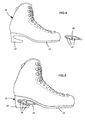
- FIGs 2 and 3 represent a shoe shoe 10 according to a first embodiment of the invention.
- This shoe comprises a monolithic assembly comprising a sole 13 and a portion 14 of the heel 12, advantageously obtained by a plastic injection process.
- This portion 14 of the heel 12 forms a housing 16 comprising an opening 17 in the front surface of the heel 12 for receiving an insert 15.
- figure 2 illustrates the shoe in which the insert 15 is not inserted in this housing 16.
- the insert 15 has a length representing approximately three-quarters of the length of the heel 12, a height representing substantially half the height of the heel 12, and a width equal to that of the heel 12 so that the insert 15 comes form a part of each side surface of the heel 12, visible from the outside and forming an aesthetic effect at the heel of the shoe, as shown on the figure 3 .
- the insert 15 can be in different materials.
- the insert may be in an elastic material to provide a damping property to the shoe of the shoe.
- the insert may be elastomer, rubber, or flexible plastic for example.
- the insert may be in a rigid material, to promote the transmission of the efforts of the skater to his skate.
- the insert may be in a rigid material, for example metal or rigid plastic, possibly reinforced with fibers.
- the insert can naturally be permanently fixed in the heel of the shoe, for example by gluing, or by mechanical means such as screwing for example.
- the same skate shoes will be made with several different inserts in the factory, which will give skaters a wider range of shoes with different performances and varied aesthetics, for a lower cost.
- FIGS. 4 and 5 illustrate a second embodiment of the invention in which an insert 15 is in a non-full, perforated form.
- this insert is obtained by an extrusion process, is made of extruded metal, such as aluminum, and thus has through hollow portions 18.
- it can be a plastic section and the hollow portions 18 are not necessarily traversing.
- This solution has the advantage of reducing the overall weight of the pad, while offering an interesting performance.
- the insert 15 has a substantially triangular front portion which comes to conform to the shape of the sole 13 beyond the initial heel 12, which makes it possible to offer a property of damping and / or transmission of stresses. progressive way on a wider surface of the sole of the shoe.
- the Figures 6 to 8 represent a third embodiment of the invention, wherein the insert 15 extends over a greater length than in the two previous embodiments so as to come up to the rear surface of the heel, to be visible from the outside.
- This solution has the advantage of offering a different aesthetic appearance, visible on three surfaces of the heel, while providing a mechanical property on a larger surface of the heel and to allow a greater influence on the adaptability of the performance of one skate.
- the Figures 9 and 10 represent a fourth embodiment of the invention, wherein the sole 13 and the heel 12 are obtained by separate elements, assembled by any means, such as a bonding.
- the shoe comprises a thin sole 13, for example leather or plastic, which extends from the front of the shoe to heel.
- the latter comprises a first portion 14, made of leather or plastic, forming a housing 16 for receiving an insert 15 as explained in the preceding embodiments.
- the insert 15 does not extend over the entire surface of the heel.
- this part of the heel thus offers continuity that extends from the sole of the shoe, at the level of the upper part of the heel, to the lower end of the heel, in contact with the frame of the shoe, which is in the same material.
- the concept of the invention can be implemented with other shoe geometries, with a heel and / or an insert having other shapes.
- the sole and the heel can be obtained by a single part or several assembled parts, and in different materials, such as plastic or leather.
- a portion of this insert may come at the lower surface of the heel, in direct contact with the frame of the shoe, and / or at the upper surface of the heel, in contact with the sole of the shoe.
- Part of the insert can be visible on at least one side face, on a front face, and / or a rear face.
- the insert can be inserted by another surface than the front part of the heel, as from a side or rear face.
- the shoe thus described is suitable for use on all types of pads, for example ice skates or roller skates.
- the invention also relates to a method of manufacturing a shoe which comprises the production of a shoe heel comprising a first step of manufacturing a portion of the heel forming a housing, a second step of manufacturing an insert, then a third step of insertion of the insert within this housing of the heel.
- this method may comprise the manufacture of several different inserts for the same pad, to allow a skater to have the choice between several inserts of different mechanical and / or aesthetic properties.
- the invention also relates to an assembly comprising a pad and at least two different inserts adapted for positioning in the heel of his shoe.
Landscapes
- Health & Medical Sciences (AREA)
- General Health & Medical Sciences (AREA)
- Physical Education & Sports Medicine (AREA)
- Chemical & Material Sciences (AREA)
- Engineering & Computer Science (AREA)
- Materials Engineering (AREA)
- Footwear And Its Accessory, Manufacturing Method And Apparatuses (AREA)
Abstract
Description
- L'invention concerne un patin, de type patins à glace ou à roulettes. Elle porte aussi sur un ensemble comprenant un tel patin et plusieurs inserts pour son talon. Elle porte aussi sur un procédé de fabrication d'un tel patin.
- La
figure 1 illustre un patin à glace selon l'état de la technique. Il comprend une chaussure 1 fixée sur un châssis 3 comprenant une lame pour glisser sur la glace. Lors du patinage, un patineur transmet une partie importante des efforts exercés jusqu'au châssis 3 par l'intermédiaire du talon 2 de la chaussure 1. Cette propriété de transmission des efforts depuis la jambe du patineur jusqu'à la lame du patin, au travers du talon 2 de la chaussure, représente un élément important pour définir la performance du patin. - Une première solution de l'état de la technique pour fabriquer une chaussure de patin comprend une étape de fabrication d'une semelle comprenant un talon par injection de matériau plastique. Cette solution donne un talon uniforme dans un seul matériau.
- Une seconde solution de l'état de la technique consiste à fabriquer une semelle en cuir comprenant un talon formé par plusieurs couches en cuir superposées.
- Dans toutes ces solutions existantes, la transmission des efforts du patineur au travers du talon de la chaussure est donc uniforme, et prédéfinie une fois pour toutes. Or, différents patineurs ont des techniques de patinage différentes nécessitant des chaussures aux propriétés adaptées différentes. De plus, un même patineur peut parfois avoir besoin de chaussures aux propriétés différentes selon le type de patinage qu'il souhaite pratiquer à un instant donné. Enfin, un patineur souhaite généralement une chaussure agréable esthétiquement, voire d'esthétique personnalisée. Les solutions existantes ne répondent pas de manière satisfaisante à ces besoins puisque lorsque la structure d'une chaussure de patin est définie, elle est fabriquée à grande échelle et vendue aux patineurs, qui possèdent alors tous les mêmes patins.
- Ainsi, un objet de la présente invention consiste à proposer une autre solution de patin répondant à tout ou partie des besoins précédents, ne reproduisant pas tout ou partie des inconvénients de l'état de la technique.
- Selon le concept de l'invention, une partie du talon peut être facilement modifiée car fabriquée selon une multitude de variantes grâce à l'insertion d'au moins un insert qui peut présenter des caractéristiques mécaniques multiples et/ou des aspects esthétiques variés.
- L'invention est plus précisément définie par les revendications.
- Ces objets, caractéristiques et avantages de la présente invention seront exposés en détail dans la description suivante d'un mode d'exécution particulier fait à titre non-limitatif en relation avec les figures jointes parmi lesquelles :
- La
figure 1 représente une vue de côté d'un patin de l'état de la technique. - Les
figures 2 et 3 représentent une vue de côté d'un patin selon un premier mode d'exécution de l'invention. - Les
figures 4 et 5 représentent une vue de côté d'un patin selon un second mode d'exécution de l'invention. - Les
figures 6 et 7 représentent une vue de côté d'un patin selon un troisième mode d'exécution de l'invention. - La
figure 8 représente une vue en perspective du patin selon le troisième mode d'exécution de l'invention. - Les
figures 9 et 10 représentent une vue de côté d'un patin selon un quatrième mode d'exécution de l'invention. - Pour une raison de simplification des figures, le châssis du patin ne sera pas représenté. D'autre part, les mêmes références vont être utilisées pour désigner des éléments similaires dans les différents modes d'exécution de l'invention.
- Les
figures 2 et 3 représentent une chaussure 10 de patin selon un premier mode d'exécution de l'invention. Cette chaussure comprend un ensemble monolithique comprenant une semelle 13 et une partie 14 du talon 12, obtenu avantageusement par un procédé d'injection de matière plastique. Cette partie 14 du talon 12 forme un logement 16 comprenant une ouverture 17 dans la surface avant du talon 12 destiné à recevoir un insert 15. Lafigure 2 illustre la chaussure dans laquelle l'insert 15 n'est pas inséré dans ce logement 16. - L'insert 15 présente une longueur représentant environ les trois-quarts de la longueur du talon 12, une hauteur représentant sensiblement la moitié de la hauteur du talon 12, et une largeur égale à celle du talon 12 de sorte que l'insert 15 vienne former une partie de chaque surface latérale du talon 12, visible depuis l'extérieur et formant un effet esthétique au niveau du talon de la chaussure, comme cela est représenté sur la
figure 3 . - L'insert 15 peut se trouver dans différents matériaux. Selon une première réalisation, l'insert peut-être dans un matériau élastique pour apporter une propriété d'amortissement à la chaussure du patin. Pour cela, l'insert peut être en élastomère, en caoutchouc, ou en plastique souple par exemple.
- En variante, l'insert peut se trouver dans un matériau rigide, pour favoriser la transmission des efforts du patineur vers son patin. Pour cela, l'insert peut-être dans un matériau rigide, par exemple en métal ou en plastique rigide, éventuellement renforcé par des fibres.
- D'autre part, selon une réalisation avantageuse, l'insert est fixé de manière amovible au sein du talon 12. Cette fixation amovible peut se faire par un simple clipsage. Ce dernier peut être obtenu en profitant de la propriété élastique de la partie 14 du talon autour du logement 16. Cette fixation amovible de l'insert permet de l'échanger facilement, et offre les avantages suivants :
- il est possible de choisir l'insert aux propriétés mécaniques adaptées au type de patinage souhaité et d'adapter le comportement et la performance de son patin ;
- il est aussi possible de modifier l'esthétique de son patin, de le personnaliser.
- En variante, l'insert peut naturellement être fixé de manière définitive dans le talon de la chaussure, par exemple par un collage, ou par un moyen mécanique comme un vissage par exemple. Dans ce cas, les mêmes chaussures de patin seront fabriquées avec plusieurs inserts différents en usine, ce qui offrira aux patineurs une plus grande gamme de chaussures aux performances différentes et à l'esthétique variée, pour un moindre coût.
- Les
figures 4 et 5 illustrent un second mode d'exécution de l'invention dans lequel un insert 15 se présente sous une forme non pleine, ajourée. Avantageusement, cet insert est obtenu par un procédé d'extrusion, est en métal extrudé, comme de l'aluminium, et présente ainsi des parties creuses traversantes 18. En variante, il peut être un profilé plastique et les parties creuses 18 ne sont pas obligatoirement traversantes. Cette solution présente l'avantage de réduire le poids global du patin, tout en offrant une performance intéressante. En remarque, l'insert 15 présente une partie avant sensiblement triangulaire qui vient épouser la forme de la semelle 13 au-delà du talon 12 initial, ce qui permet d'offrir une propriété d'amortissement et/ou de transmission d'efforts de manière progressive sur une surface plus large de la semelle de la chaussure. - Les
figures 6 à 8 représentent un troisième mode d'exécution de l'invention, dans lequel l'insert 15 s'étend sur une longueur plus importante que dans les deux modes d'exécution précédents de sorte de venir jusqu'à la surface arrière du talon, pour être visible de l'extérieur. Cette solution présente l'avantage d'offrir un aspect esthétique différent, visible sur trois surfaces du talon, tout en apportant une propriété mécanique sur une plus grande surface du talon et de permettre une influence plus importante sur l'adaptabilité de la performance d'un patin. - Les
figures 9 et 10 représentent un quatrième mode d'exécution de l'invention, dans lequel la semelle 13 et le talon 12 sont obtenus par des éléments distincts, assemblés par tout moyen, comme par exemple un collage. Dans cette solution, la chaussure comprend une semelle fine 13, par exemple en cuir ou plastique, qui s'étend depuis l'avant de la chaussure jusqu'au talon. Ce dernier comprend une première partie 14, en cuir ou plastique, formant un logement 16 pour recevoir un insert 15 tel qu'explicité dans les modes d'exécution précédent. - Dans tous les cas, l'insert 15 ne s'étend pas sur toute la surface du talon. Avantageusement, il reste une partie continue, sensiblement verticale, de la structure du talon 12 qui ne présente pas d'insert dans une partie arrière du talon, pour garantir une transmission d'efforts maîtrisée, pas trop variable, qui reste suffisamment proche des talons traditionnels et des chaussures existantes. Selon une réalisation avantageuse, cette partie du talon offre donc une continuité qui s'étend de la semelle du patin, au niveau de la partie supérieure du talon, jusqu'à l'extrémité inférieure du talon, en contact avec le châssis du patin, qui se trouve dans un même matériau. Ensuite, l'ajout d'un insert tel que décrit précédemment permet de modifier de manière maîtrisée le comportement global du patin, permet une modification suffisante de sa performance pour apporter une adaptation sensible de son comportement sans trop remettre en cause son comportement usuel, qui pourrait déconcerter un patineur.
- L'insertion de l'insert par la surface avant du talon permet son maintien lors du patinage puisque le poids du patineur exerce une force de compression du talon qui participe à ce maintien.
- Bien entendu, le concept de l'invention peut être implémenté avec d'autres géométries de chaussure, avec un talon et/ou un insert présentant d'autres formes. La semelle et le talon peuvent être obtenus par une seule partie ou plusieurs parties assemblées, et dans différents matériaux, comme du plastique ou du cuir. Une partie de cet insert peut venir au niveau de la surface inférieure du talon, en contact direct sur le châssis du patin, et/ou au niveau de la surface supérieure du talon, en contact avec la semelle de la chaussure. Une partie de l'insert peut être visible sur au moins une face latérale, sur une face avant, et/ou une face arrière. L'insert peut être inséré par une autre surface que la partie avant du talon, comme depuis une face latérale ou arrière. D'autre part, il est possible d'imaginer une implémentation avec plusieurs inserts au sein du talon. D'autres modes d'exécution peuvent facilement être obtenus par la simple combinaison des modes d'exécution décrits précédemment.
- La chaussure ainsi décrite est adaptée pour une utilisation sur tout type de patins, par exemple des patins à glace ou des patins à roulettes.
- L'invention porte aussi sur un procédé de fabrication d'un patin qui comprend la fabrication d'un talon de chaussure comprenant une première étape de fabrication d'une partie du talon formant un logement, une seconde étape de fabrication d'un insert, puis une troisième étape d'insertion de l'insert au sein de ce logement du talon.
- Selon un mode d'exécution de l'invention, ce procédé peut comprendre la fabrication de plusieurs inserts différents pour un même patin, pour permettre à un patineur d'avoir le choix entre plusieurs inserts de propriétés mécaniques et/ou esthétiques différentes. Ainsi, l'invention porte aussi sur un ensemble comprenant un patin et au moins deux inserts différents adaptés pour un positionnement dans le talon de sa chaussure.
- Finalement, la solution retenue permet donc à la fois d'améliorer la performance d'un patin, tout en améliorant son esthétique.
Claims (16)
- Patin comprenant une chaussure (10) avec un talon (12), caractérisé en ce que le talon (12) de la chaussure (10) comprend au moins un insert (15) qui ne s'étend pas sur toute la surface du talon (12).
- Patin selon la revendication précédente, caractérisé en ce que le talon (2) comprend, dans une partie arrière, au moins une partie s'étendant sur toute sa hauteur qui ne comprend pas d'insert.
- Patin selon l'une des revendications précédentes, caractérisé en ce qu'une partie (14) du talon (12) comprend une ouverture (17) dans sa partie avant par laquelle l'insert (15) est inséré.
- Patin selon l'une des revendications précédentes, caractérisé en ce que l'insert (15) s'étend dans la largeur du talon (12) de sorte d'être visible sur au moins une surface latérale du talon.
- Patin selon l'une des revendications précédentes, caractérisé en ce que la longueur de l'insert (15) est inférieure à celle du talon (12) de sorte qu'il ne s'étend pas jusqu'à l'extrémité arrière ou avant du talon (12).
- Patin selon l'une des revendications 1 à 4, caractérisé en ce que l'insert (15) s'étend dans la longueur du talon (12) de sorte d'être visible sur au moins une face arrière du talon (12).
- Patin selon l'une des revendications précédentes, caractérisé en ce que l'insert (15) est plein et dans un matériau élastique comme un élastomère, un caoutchouc ou un plastique souple.
- Patin selon l'une des revendications 1 à 6, caractérisé en ce que l'insert (15) est plein et en matériau rigide comme un plastique rigide, un plastique renforcé par des fibres, ou un métal.
- Patin selon l'une des revendications 1 à 6, caractérisé en ce que l'insert (15) comprend des parties creuses (18), traversantes ou non, en métal ou en plastique.
- Patin selon l'une des revendications précédentes, caractérisé en ce que le talon (12) comprend deux parties, une première partie injectée formant une semelle (13) et une partie (14) du talon comprenant un logement (16) et une seconde partie consistant en un insert (15) intégré dans le logement (16) de la première partie.
- Patin selon l'une des revendications 1 à 9, caractérisé en ce que le talon (12) comprend trois parties, une première partie formant une fine semelle (13), une seconde partie formant une partie (14) du talon comprenant un logement (16) et une troisième partie consistant en un insert (15) intégré dans le logement (16) de la seconde partie.
- Patin selon l'une des revendications précédentes, caractérisé en ce que l'insert (15) du talon (12) est amovible.
- Patin selon la revendication précédente, caractérisé en ce que l'insert (15) est fixé de manière amovible par clipsage dans le talon (12).
- Patin selon l'une des revendications précédentes, caractérisé en ce qu'il est un patin à glace ou à roulettes.
- Ensemble comprenant un patin selon l'une des revendications précédentes, caractérisé en ce qu'il comprend au moins deux inserts (15) distincts adaptés pour une fixation amovible dans un logement (16) du talon (12) du patin.
- Procédé de fabrication d'un patin selon l'une des revendications 1 à 14, caractérisé en ce qu'il comprend une première étape de fabrication d'une partie (14) d'un talon (12) comprenant un logement (16), une seconde étape de fabrication d'un insert (15), puis une troisième étape d'insertion de l'insert (15) au sein du logement (16) pour compléter le talon (12) de la chaussure (10) du patin.
Priority Applications (1)
| Application Number | Priority Date | Filing Date | Title |
|---|---|---|---|
| EP10425397.6A EP2471398B1 (fr) | 2010-12-28 | 2010-12-28 | Talon de patin avec insert |
Applications Claiming Priority (1)
| Application Number | Priority Date | Filing Date | Title |
|---|---|---|---|
| EP10425397.6A EP2471398B1 (fr) | 2010-12-28 | 2010-12-28 | Talon de patin avec insert |
Publications (2)
| Publication Number | Publication Date |
|---|---|
| EP2471398A1 true EP2471398A1 (fr) | 2012-07-04 |
| EP2471398B1 EP2471398B1 (fr) | 2016-06-29 |
Family
ID=44041490
Family Applications (1)
| Application Number | Title | Priority Date | Filing Date |
|---|---|---|---|
| EP10425397.6A Active EP2471398B1 (fr) | 2010-12-28 | 2010-12-28 | Talon de patin avec insert |
Country Status (1)
| Country | Link |
|---|---|
| EP (1) | EP2471398B1 (fr) |
Cited By (1)
| Publication number | Priority date | Publication date | Assignee | Title |
|---|---|---|---|---|
| US11484771B2 (en) | 2021-02-22 | 2022-11-01 | Enjineering Enterprise, Inc. | Insertable skate outsole shim for increased attack angle |
Citations (6)
| Publication number | Priority date | Publication date | Assignee | Title |
|---|---|---|---|---|
| BE815142A (fr) * | 1974-05-16 | 1974-09-16 | Chaussure de patinage en matiere synthetique. | |
| FR2427068A1 (fr) * | 1978-05-29 | 1979-12-28 | Delery Marc | Chaussure de patinage |
| WO1981001359A1 (fr) * | 1979-11-17 | 1981-05-28 | G Spreng | Patin a roulettes avec deux paires de roulettes |
| US5974696A (en) * | 1997-01-24 | 1999-11-02 | Sport Maska Inc. | Skate boot having an outsole with a rigid insert |
| US20050127621A1 (en) * | 2001-01-12 | 2005-06-16 | Jacques Durocher | In-line roller skate with vibration absorption system |
| WO2007113595A2 (fr) * | 2006-04-01 | 2007-10-11 | C & J Clark International Limited | Unite semelle et assise plantaire destinees a une chaussure |
-
2010
- 2010-12-28 EP EP10425397.6A patent/EP2471398B1/fr active Active
Patent Citations (6)
| Publication number | Priority date | Publication date | Assignee | Title |
|---|---|---|---|---|
| BE815142A (fr) * | 1974-05-16 | 1974-09-16 | Chaussure de patinage en matiere synthetique. | |
| FR2427068A1 (fr) * | 1978-05-29 | 1979-12-28 | Delery Marc | Chaussure de patinage |
| WO1981001359A1 (fr) * | 1979-11-17 | 1981-05-28 | G Spreng | Patin a roulettes avec deux paires de roulettes |
| US5974696A (en) * | 1997-01-24 | 1999-11-02 | Sport Maska Inc. | Skate boot having an outsole with a rigid insert |
| US20050127621A1 (en) * | 2001-01-12 | 2005-06-16 | Jacques Durocher | In-line roller skate with vibration absorption system |
| WO2007113595A2 (fr) * | 2006-04-01 | 2007-10-11 | C & J Clark International Limited | Unite semelle et assise plantaire destinees a une chaussure |
Cited By (1)
| Publication number | Priority date | Publication date | Assignee | Title |
|---|---|---|---|---|
| US11484771B2 (en) | 2021-02-22 | 2022-11-01 | Enjineering Enterprise, Inc. | Insertable skate outsole shim for increased attack angle |
Also Published As
| Publication number | Publication date |
|---|---|
| EP2471398B1 (fr) | 2016-06-29 |
Similar Documents
| Publication | Publication Date | Title |
|---|---|---|
| EP0886539B1 (fr) | Chassis renforce pour patin a roulettes | |
| EP0490043B1 (fr) | Ski pour sport d'hiver comprenant une embase, un raidisseur et un support pour fixations | |
| EP0465794B1 (fr) | Ski à face supérieure nervurée | |
| FR2693379A1 (fr) | Ski nervure muni d'un support. | |
| EP1175925A1 (fr) | Planche de glisse | |
| EP0774283B2 (fr) | Châssis pour patin et procédé de fabrication | |
| FR2743989A1 (fr) | Semelle pour chaussure de sport | |
| EP0995468A1 (fr) | Châssis de patin en ligne équipé d'une barre anti-torsion | |
| WO1996041547A1 (fr) | Chaussure destinee a la pratique d'un sport de glisse presentant un axe amovible | |
| EP1374956A1 (fr) | Engin de glisse comprenant deux parois | |
| EP1314459B1 (fr) | Perfectionnement pour planche de glisse sur neige | |
| EP0796570B1 (fr) | Chaussure de surf | |
| EP2471398B1 (fr) | Talon de patin avec insert | |
| WO1998002217A1 (fr) | Article de glisse, notamment patin a roues en ligne comportant un chassis a corps creux | |
| EP0936044A1 (fr) | Procédé de fabrication d'un élément rigide de structure d'un article de sport | |
| EP1559452B1 (fr) | Planche de glisse sur neige pour enfants et procédé de fabrication | |
| EP2537567B1 (fr) | Planche de glisse sur neige comportant un trou traversant partiellement obturé | |
| EP1025768A1 (fr) | Chaussure de ski | |
| EP1279419B1 (fr) | Ski Alpin | |
| FR2918573A1 (fr) | Arceau arrriere pour un dispositif de fixation de snowboard. | |
| FR2897275A1 (fr) | Planche de glisse sur neige comprenant deux elements complementaires associes a un organe de liaison | |
| FR2986436A1 (fr) | Planche de glisse sur neige | |
| FR3016528A1 (fr) | Planche de glisse sur neige, et ensemble comportant une telle planche de glisse et une bande de materiau anti-recul | |
| FR2819690A1 (fr) | Chaussure pour raquette a neige avec son insert | |
| FR2808698A1 (fr) | Ski prevu pour la pratique du ski alpin |
Legal Events
| Date | Code | Title | Description |
|---|---|---|---|
| AK | Designated contracting states |
Kind code of ref document: A1 Designated state(s): AL AT BE BG CH CY CZ DE DK EE ES FI FR GB GR HR HU IE IS IT LI LT LU LV MC MK MT NL NO PL PT RO RS SE SI SK SM TR |
|
| AX | Request for extension of the european patent |
Extension state: BA ME |
|
| PUAI | Public reference made under article 153(3) epc to a published international application that has entered the european phase |
Free format text: ORIGINAL CODE: 0009012 |
|
| 17P | Request for examination filed |
Effective date: 20130103 |
|
| 17Q | First examination report despatched |
Effective date: 20130416 |
|
| GRAP | Despatch of communication of intention to grant a patent |
Free format text: ORIGINAL CODE: EPIDOSNIGR1 |
|
| INTG | Intention to grant announced |
Effective date: 20160211 |
|
| RAP1 | Party data changed (applicant data changed or rights of an application transferred) |
Owner name: ROSSIGNOL LANGE S.R.L. |
|
| GRAS | Grant fee paid |
Free format text: ORIGINAL CODE: EPIDOSNIGR3 |
|
| GRAA | (expected) grant |
Free format text: ORIGINAL CODE: 0009210 |
|
| AK | Designated contracting states |
Kind code of ref document: B1 Designated state(s): AL AT BE BG CH CY CZ DE DK EE ES FI FR GB GR HR HU IE IS IT LI LT LU LV MC MK MT NL NO PL PT RO RS SE SI SK SM TR |
|
| REG | Reference to a national code |
Ref country code: GB Ref legal event code: FG4D Free format text: NOT ENGLISH |
|
| REG | Reference to a national code |
Ref country code: CH Ref legal event code: EP |
|
| REG | Reference to a national code |
Ref country code: AT Ref legal event code: REF Ref document number: 808384 Country of ref document: AT Kind code of ref document: T Effective date: 20160715 |
|
| REG | Reference to a national code |
Ref country code: IE Ref legal event code: FG4D Free format text: LANGUAGE OF EP DOCUMENT: FRENCH |
|
| REG | Reference to a national code |
Ref country code: DE Ref legal event code: R096 Ref document number: 602010034277 Country of ref document: DE |
|
| REG | Reference to a national code |
Ref country code: LT Ref legal event code: MG4D |
|
| PG25 | Lapsed in a contracting state [announced via postgrant information from national office to epo] |
Ref country code: FI Free format text: LAPSE BECAUSE OF FAILURE TO SUBMIT A TRANSLATION OF THE DESCRIPTION OR TO PAY THE FEE WITHIN THE PRESCRIBED TIME-LIMIT Effective date: 20160629 Ref country code: LT Free format text: LAPSE BECAUSE OF FAILURE TO SUBMIT A TRANSLATION OF THE DESCRIPTION OR TO PAY THE FEE WITHIN THE PRESCRIBED TIME-LIMIT Effective date: 20160629 Ref country code: NO Free format text: LAPSE BECAUSE OF FAILURE TO SUBMIT A TRANSLATION OF THE DESCRIPTION OR TO PAY THE FEE WITHIN THE PRESCRIBED TIME-LIMIT Effective date: 20160929 |
|
| REG | Reference to a national code |
Ref country code: NL Ref legal event code: MP Effective date: 20160629 |
|
| PG25 | Lapsed in a contracting state [announced via postgrant information from national office to epo] |
Ref country code: LV Free format text: LAPSE BECAUSE OF FAILURE TO SUBMIT A TRANSLATION OF THE DESCRIPTION OR TO PAY THE FEE WITHIN THE PRESCRIBED TIME-LIMIT Effective date: 20160629 Ref country code: GR Free format text: LAPSE BECAUSE OF FAILURE TO SUBMIT A TRANSLATION OF THE DESCRIPTION OR TO PAY THE FEE WITHIN THE PRESCRIBED TIME-LIMIT Effective date: 20160930 Ref country code: SE Free format text: LAPSE BECAUSE OF FAILURE TO SUBMIT A TRANSLATION OF THE DESCRIPTION OR TO PAY THE FEE WITHIN THE PRESCRIBED TIME-LIMIT Effective date: 20160629 Ref country code: RS Free format text: LAPSE BECAUSE OF FAILURE TO SUBMIT A TRANSLATION OF THE DESCRIPTION OR TO PAY THE FEE WITHIN THE PRESCRIBED TIME-LIMIT Effective date: 20160629 Ref country code: HR Free format text: LAPSE BECAUSE OF FAILURE TO SUBMIT A TRANSLATION OF THE DESCRIPTION OR TO PAY THE FEE WITHIN THE PRESCRIBED TIME-LIMIT Effective date: 20160629 Ref country code: NL Free format text: LAPSE BECAUSE OF FAILURE TO SUBMIT A TRANSLATION OF THE DESCRIPTION OR TO PAY THE FEE WITHIN THE PRESCRIBED TIME-LIMIT Effective date: 20160629 |
|
| REG | Reference to a national code |
Ref country code: AT Ref legal event code: MK05 Ref document number: 808384 Country of ref document: AT Kind code of ref document: T Effective date: 20160629 |
|
| REG | Reference to a national code |
Ref country code: FR Ref legal event code: PLFP Year of fee payment: 7 |
|
| PG25 | Lapsed in a contracting state [announced via postgrant information from national office to epo] |
Ref country code: CZ Free format text: LAPSE BECAUSE OF FAILURE TO SUBMIT A TRANSLATION OF THE DESCRIPTION OR TO PAY THE FEE WITHIN THE PRESCRIBED TIME-LIMIT Effective date: 20160629 Ref country code: RO Free format text: LAPSE BECAUSE OF FAILURE TO SUBMIT A TRANSLATION OF THE DESCRIPTION OR TO PAY THE FEE WITHIN THE PRESCRIBED TIME-LIMIT Effective date: 20160629 Ref country code: IS Free format text: LAPSE BECAUSE OF FAILURE TO SUBMIT A TRANSLATION OF THE DESCRIPTION OR TO PAY THE FEE WITHIN THE PRESCRIBED TIME-LIMIT Effective date: 20161029 Ref country code: SK Free format text: LAPSE BECAUSE OF FAILURE TO SUBMIT A TRANSLATION OF THE DESCRIPTION OR TO PAY THE FEE WITHIN THE PRESCRIBED TIME-LIMIT Effective date: 20160629 Ref country code: EE Free format text: LAPSE BECAUSE OF FAILURE TO SUBMIT A TRANSLATION OF THE DESCRIPTION OR TO PAY THE FEE WITHIN THE PRESCRIBED TIME-LIMIT Effective date: 20160629 |
|
| PG25 | Lapsed in a contracting state [announced via postgrant information from national office to epo] |
Ref country code: AT Free format text: LAPSE BECAUSE OF FAILURE TO SUBMIT A TRANSLATION OF THE DESCRIPTION OR TO PAY THE FEE WITHIN THE PRESCRIBED TIME-LIMIT Effective date: 20160629 Ref country code: SM Free format text: LAPSE BECAUSE OF FAILURE TO SUBMIT A TRANSLATION OF THE DESCRIPTION OR TO PAY THE FEE WITHIN THE PRESCRIBED TIME-LIMIT Effective date: 20160629 Ref country code: ES Free format text: LAPSE BECAUSE OF FAILURE TO SUBMIT A TRANSLATION OF THE DESCRIPTION OR TO PAY THE FEE WITHIN THE PRESCRIBED TIME-LIMIT Effective date: 20160629 Ref country code: PT Free format text: LAPSE BECAUSE OF FAILURE TO SUBMIT A TRANSLATION OF THE DESCRIPTION OR TO PAY THE FEE WITHIN THE PRESCRIBED TIME-LIMIT Effective date: 20161031 Ref country code: PL Free format text: LAPSE BECAUSE OF FAILURE TO SUBMIT A TRANSLATION OF THE DESCRIPTION OR TO PAY THE FEE WITHIN THE PRESCRIBED TIME-LIMIT Effective date: 20160629 |
|
| REG | Reference to a national code |
Ref country code: DE Ref legal event code: R097 Ref document number: 602010034277 Country of ref document: DE |
|
| PLBE | No opposition filed within time limit |
Free format text: ORIGINAL CODE: 0009261 |
|
| STAA | Information on the status of an ep patent application or granted ep patent |
Free format text: STATUS: NO OPPOSITION FILED WITHIN TIME LIMIT |
|
| PG25 | Lapsed in a contracting state [announced via postgrant information from national office to epo] |
Ref country code: BE Free format text: LAPSE BECAUSE OF NON-PAYMENT OF DUE FEES Effective date: 20161231 Ref country code: DK Free format text: LAPSE BECAUSE OF FAILURE TO SUBMIT A TRANSLATION OF THE DESCRIPTION OR TO PAY THE FEE WITHIN THE PRESCRIBED TIME-LIMIT Effective date: 20160629 |
|
| 26N | No opposition filed |
Effective date: 20170330 |
|
| REG | Reference to a national code |
Ref country code: CH Ref legal event code: PL |
|
| GBPC | Gb: european patent ceased through non-payment of renewal fee |
Effective date: 20161228 |
|
| PG25 | Lapsed in a contracting state [announced via postgrant information from national office to epo] |
Ref country code: SI Free format text: LAPSE BECAUSE OF FAILURE TO SUBMIT A TRANSLATION OF THE DESCRIPTION OR TO PAY THE FEE WITHIN THE PRESCRIBED TIME-LIMIT Effective date: 20160629 Ref country code: BG Free format text: LAPSE BECAUSE OF FAILURE TO SUBMIT A TRANSLATION OF THE DESCRIPTION OR TO PAY THE FEE WITHIN THE PRESCRIBED TIME-LIMIT Effective date: 20160929 |
|
| PG25 | Lapsed in a contracting state [announced via postgrant information from national office to epo] |
Ref country code: MC Free format text: LAPSE BECAUSE OF FAILURE TO SUBMIT A TRANSLATION OF THE DESCRIPTION OR TO PAY THE FEE WITHIN THE PRESCRIBED TIME-LIMIT Effective date: 20160629 |
|
| REG | Reference to a national code |
Ref country code: IE Ref legal event code: MM4A |
|
| PG25 | Lapsed in a contracting state [announced via postgrant information from national office to epo] |
Ref country code: LI Free format text: LAPSE BECAUSE OF NON-PAYMENT OF DUE FEES Effective date: 20161231 Ref country code: LU Free format text: LAPSE BECAUSE OF NON-PAYMENT OF DUE FEES Effective date: 20161228 Ref country code: CH Free format text: LAPSE BECAUSE OF NON-PAYMENT OF DUE FEES Effective date: 20161231 |
|
| PG25 | Lapsed in a contracting state [announced via postgrant information from national office to epo] |
Ref country code: GB Free format text: LAPSE BECAUSE OF NON-PAYMENT OF DUE FEES Effective date: 20161228 Ref country code: IE Free format text: LAPSE BECAUSE OF NON-PAYMENT OF DUE FEES Effective date: 20161228 |
|
| REG | Reference to a national code |
Ref country code: FR Ref legal event code: PLFP Year of fee payment: 8 |
|
| REG | Reference to a national code |
Ref country code: BE Ref legal event code: MM Effective date: 20161231 |
|
| PG25 | Lapsed in a contracting state [announced via postgrant information from national office to epo] |
Ref country code: CY Free format text: LAPSE BECAUSE OF FAILURE TO SUBMIT A TRANSLATION OF THE DESCRIPTION OR TO PAY THE FEE WITHIN THE PRESCRIBED TIME-LIMIT Effective date: 20160629 Ref country code: HU Free format text: LAPSE BECAUSE OF FAILURE TO SUBMIT A TRANSLATION OF THE DESCRIPTION OR TO PAY THE FEE WITHIN THE PRESCRIBED TIME-LIMIT; INVALID AB INITIO Effective date: 20101228 |
|
| PG25 | Lapsed in a contracting state [announced via postgrant information from national office to epo] |
Ref country code: TR Free format text: LAPSE BECAUSE OF FAILURE TO SUBMIT A TRANSLATION OF THE DESCRIPTION OR TO PAY THE FEE WITHIN THE PRESCRIBED TIME-LIMIT Effective date: 20160629 Ref country code: MK Free format text: LAPSE BECAUSE OF FAILURE TO SUBMIT A TRANSLATION OF THE DESCRIPTION OR TO PAY THE FEE WITHIN THE PRESCRIBED TIME-LIMIT Effective date: 20160629 |
|
| PG25 | Lapsed in a contracting state [announced via postgrant information from national office to epo] |
Ref country code: MT Free format text: LAPSE BECAUSE OF FAILURE TO SUBMIT A TRANSLATION OF THE DESCRIPTION OR TO PAY THE FEE WITHIN THE PRESCRIBED TIME-LIMIT Effective date: 20160629 |
|
| PG25 | Lapsed in a contracting state [announced via postgrant information from national office to epo] |
Ref country code: AL Free format text: LAPSE BECAUSE OF FAILURE TO SUBMIT A TRANSLATION OF THE DESCRIPTION OR TO PAY THE FEE WITHIN THE PRESCRIBED TIME-LIMIT Effective date: 20160629 |
|
| PGFP | Annual fee paid to national office [announced via postgrant information from national office to epo] |
Ref country code: DE Payment date: 20201209 Year of fee payment: 11 Ref country code: IT Payment date: 20201214 Year of fee payment: 11 |
|
| REG | Reference to a national code |
Ref country code: DE Ref legal event code: R119 Ref document number: 602010034277 Country of ref document: DE |
|
| PG25 | Lapsed in a contracting state [announced via postgrant information from national office to epo] |
Ref country code: DE Free format text: LAPSE BECAUSE OF NON-PAYMENT OF DUE FEES Effective date: 20220701 |
|
| PG25 | Lapsed in a contracting state [announced via postgrant information from national office to epo] |
Ref country code: IT Free format text: LAPSE BECAUSE OF NON-PAYMENT OF DUE FEES Effective date: 20211228 |
|
| P01 | Opt-out of the competence of the unified patent court (upc) registered |
Effective date: 20230530 |
|
| PGFP | Annual fee paid to national office [announced via postgrant information from national office to epo] |
Ref country code: FR Payment date: 20251230 Year of fee payment: 16 |