EP2471583A2 - Système, procédé et programme de contrôle d'affichage - Google Patents
Système, procédé et programme de contrôle d'affichage Download PDFInfo
- Publication number
- EP2471583A2 EP2471583A2 EP11160191A EP11160191A EP2471583A2 EP 2471583 A2 EP2471583 A2 EP 2471583A2 EP 11160191 A EP11160191 A EP 11160191A EP 11160191 A EP11160191 A EP 11160191A EP 2471583 A2 EP2471583 A2 EP 2471583A2
- Authority
- EP
- European Patent Office
- Prior art keywords
- virtual camera
- virtual
- view
- angle
- image
- Prior art date
- Legal status (The legal status is an assumption and is not a legal conclusion. Google has not performed a legal analysis and makes no representation as to the accuracy of the status listed.)
- Granted
Links
Images









Classifications
-
- A—HUMAN NECESSITIES
- A63—SPORTS; GAMES; AMUSEMENTS
- A63F—CARD, BOARD, OR ROULETTE GAMES; INDOOR GAMES USING SMALL MOVING PLAYING BODIES; VIDEO GAMES; GAMES NOT OTHERWISE PROVIDED FOR
- A63F13/00—Video games, i.e. games using an electronically generated display having two or more dimensions
- A63F13/50—Controlling the output signals based on the game progress
- A63F13/52—Controlling the output signals based on the game progress involving aspects of the displayed game scene
- A63F13/525—Changing parameters of virtual cameras
-
- A—HUMAN NECESSITIES
- A63—SPORTS; GAMES; AMUSEMENTS
- A63F—CARD, BOARD, OR ROULETTE GAMES; INDOOR GAMES USING SMALL MOVING PLAYING BODIES; VIDEO GAMES; GAMES NOT OTHERWISE PROVIDED FOR
- A63F13/00—Video games, i.e. games using an electronically generated display having two or more dimensions
- A63F13/50—Controlling the output signals based on the game progress
- A63F13/52—Controlling the output signals based on the game progress involving aspects of the displayed game scene
- A63F13/525—Changing parameters of virtual cameras
- A63F13/5252—Changing parameters of virtual cameras using two or more virtual cameras concurrently or sequentially, e.g. automatically switching between fixed virtual cameras when a character changes room or displaying a rear-mirror view in a car-driving game
-
- H—ELECTRICITY
- H04—ELECTRIC COMMUNICATION TECHNIQUE
- H04N—PICTORIAL COMMUNICATION, e.g. TELEVISION
- H04N13/00—Stereoscopic video systems; Multi-view video systems; Details thereof
- H04N13/10—Processing, recording or transmission of stereoscopic or multi-view image signals
- H04N13/106—Processing image signals
- H04N13/128—Adjusting depth or disparity
-
- H—ELECTRICITY
- H04—ELECTRIC COMMUNICATION TECHNIQUE
- H04N—PICTORIAL COMMUNICATION, e.g. TELEVISION
- H04N13/00—Stereoscopic video systems; Multi-view video systems; Details thereof
- H04N13/20—Image signal generators
- H04N13/275—Image signal generators from three-dimensional [3D] object models, e.g. computer-generated stereoscopic image signals
-
- H—ELECTRICITY
- H04—ELECTRIC COMMUNICATION TECHNIQUE
- H04N—PICTORIAL COMMUNICATION, e.g. TELEVISION
- H04N13/00—Stereoscopic video systems; Multi-view video systems; Details thereof
- H04N13/30—Image reproducers
- H04N13/356—Image reproducers having separate monoscopic and stereoscopic modes
- H04N13/359—Switching between monoscopic and stereoscopic modes
-
- A—HUMAN NECESSITIES
- A63—SPORTS; GAMES; AMUSEMENTS
- A63F—CARD, BOARD, OR ROULETTE GAMES; INDOOR GAMES USING SMALL MOVING PLAYING BODIES; VIDEO GAMES; GAMES NOT OTHERWISE PROVIDED FOR
- A63F13/00—Video games, i.e. games using an electronically generated display having two or more dimensions
- A63F13/25—Output arrangements for video game devices
- A63F13/26—Output arrangements for video game devices having at least one additional display device, e.g. on the game controller or outside a game booth
-
- A—HUMAN NECESSITIES
- A63—SPORTS; GAMES; AMUSEMENTS
- A63F—CARD, BOARD, OR ROULETTE GAMES; INDOOR GAMES USING SMALL MOVING PLAYING BODIES; VIDEO GAMES; GAMES NOT OTHERWISE PROVIDED FOR
- A63F13/00—Video games, i.e. games using an electronically generated display having two or more dimensions
- A63F13/80—Special adaptations for executing a specific game genre or game mode
- A63F13/803—Driving vehicles or craft, e.g. cars, airplanes, ships, robots or tanks
-
- A—HUMAN NECESSITIES
- A63—SPORTS; GAMES; AMUSEMENTS
- A63F—CARD, BOARD, OR ROULETTE GAMES; INDOOR GAMES USING SMALL MOVING PLAYING BODIES; VIDEO GAMES; GAMES NOT OTHERWISE PROVIDED FOR
- A63F13/00—Video games, i.e. games using an electronically generated display having two or more dimensions
- A63F13/90—Constructional details or arrangements of video game devices not provided for in groups A63F13/20 or A63F13/25, e.g. housing, wiring, connections or cabinets
- A63F13/92—Video game devices specially adapted to be hand-held while playing
-
- A—HUMAN NECESSITIES
- A63—SPORTS; GAMES; AMUSEMENTS
- A63F—CARD, BOARD, OR ROULETTE GAMES; INDOOR GAMES USING SMALL MOVING PLAYING BODIES; VIDEO GAMES; GAMES NOT OTHERWISE PROVIDED FOR
- A63F2300/00—Features of games using an electronically generated display having two or more dimensions, e.g. on a television screen, showing representations related to the game
- A63F2300/30—Features of games using an electronically generated display having two or more dimensions, e.g. on a television screen, showing representations related to the game characterized by output arrangements for receiving control signals generated by the game device
- A63F2300/301—Features of games using an electronically generated display having two or more dimensions, e.g. on a television screen, showing representations related to the game characterized by output arrangements for receiving control signals generated by the game device using an additional display connected to the game console, e.g. on the controller
-
- A—HUMAN NECESSITIES
- A63—SPORTS; GAMES; AMUSEMENTS
- A63F—CARD, BOARD, OR ROULETTE GAMES; INDOOR GAMES USING SMALL MOVING PLAYING BODIES; VIDEO GAMES; GAMES NOT OTHERWISE PROVIDED FOR
- A63F2300/00—Features of games using an electronically generated display having two or more dimensions, e.g. on a television screen, showing representations related to the game
- A63F2300/60—Methods for processing data by generating or executing the game program
- A63F2300/66—Methods for processing data by generating or executing the game program for rendering three dimensional images
-
- H—ELECTRICITY
- H04—ELECTRIC COMMUNICATION TECHNIQUE
- H04N—PICTORIAL COMMUNICATION, e.g. TELEVISION
- H04N13/00—Stereoscopic video systems; Multi-view video systems; Details thereof
- H04N13/30—Image reproducers
- H04N13/302—Image reproducers for viewing without the aid of special glasses, i.e. using autostereoscopic displays
- H04N13/305—Image reproducers for viewing without the aid of special glasses, i.e. using autostereoscopic displays using lenticular lenses, e.g. arrangements of cylindrical lenses
-
- H—ELECTRICITY
- H04—ELECTRIC COMMUNICATION TECHNIQUE
- H04N—PICTORIAL COMMUNICATION, e.g. TELEVISION
- H04N13/00—Stereoscopic video systems; Multi-view video systems; Details thereof
- H04N13/30—Image reproducers
- H04N13/302—Image reproducers for viewing without the aid of special glasses, i.e. using autostereoscopic displays
- H04N13/31—Image reproducers for viewing without the aid of special glasses, i.e. using autostereoscopic displays using parallax barriers
Definitions
- the present invention relates to a display control program, a display control method, and a display control system.
- the present invention particularly relates to a display control program, a display control method, and a display control system for performing stereoscopically visible display.
- Japanese Laid-Open Patent Publication No. 2003-107603 discloses a technique for performing stereoscopic display, in which technique two virtual cameras are set within a three dimensional virtual space and images including subjects for the respective virtual cameras such as virtual objects are rendered based on the virtual cameras.
- the stereoscopic effect can be enhanced by increasing a distance between the two virtual cameras.
- the stereoscopic display can be switched to planar display by setting the distance between the two virtual cameras to 0.
- the rendering is performed by using the same virtual cameras regardless of whether the display is stereoscopic display or planar display.
- a main object of the present invention is to provide a display control program, a display control method, and a display control system, which are novel.
- the present invention may have the following exemplary features to attain the object mentioned above.
- the display control program causes a computer of a display control apparatus to act as: adjustment means for adjusting a degree of stereopsis; virtual camera control means for setting an angle of view of a virtual camera in accordance with the degree of stereopsis adjusted by the adjustment means; and rendering means for rendering a virtual object placed in a virtual space, based on the virtual camera of which the angle of view has been set by the virtual camera control means.
- degree of stereopsis refers to the degree of effect by which a user feels, when viewing a screen, that the virtual space extends in a direction perpendicular to the screen.
- the angle of view of the virtual camera is changed and the virtual object placed in the virtual space is rendered with the changed angle of view.
- a change in stereoscopic effect can be accentuated by a change in the angle of view of the virtual camera.
- the virtual camera control means may set the angle of view of the virtual camera to a first angle of view if the degree of stereopsis is adjusted to a first value by the adjustment means, and set the angle of view of the virtual camera to a second angle of view if the degree of stereopsis is adjusted to a second value by the adjustment means.
- the rendering means may render a stereoscopically visible image if the angle of view of the virtual camera is set to the first angle of view by the virtual camera control means, and render a planarly visible image if the angle of view of the virtual camera is set to the second angle of view by the virtual camera control means.
- the first value may be greater than the second value
- the first angle of view may be greater than the second angle of view
- the virtual camera control means may increase the angle of view of the virtual camera in accordance with an increase in the degree of stereopsis adjusted by the adjustment means.
- the virtual camera control means may change a distance between a pair of virtual cameras in accordance with the degree of stereopsis adjusted by the adjustment means, and the rendering means may render a stereoscopically visible image by rendering, based on the pair of virtual cameras, an image for left eye and an image for right eye, in each of which the virtual object is captured.
- the virtual camera control means may increase the distance between the pair of virtual cameras in accordance with an increase in the degree of stereopsis adjusted by the adjustment means.
- the pair of virtual cameras may each be a perspective-projection virtual camera. If the degree of stereopsis is adjusted to a minimum value by the adjustment means, the virtual camera control means may set the angle of view of each of the pair of perspective-projection virtual cameras to a minimum value such that the angle of view is set close to an angle of view for orthogonal projection, and set the distance between the pair of perspective-projection virtual cameras to zero or a value close to zero.
- the virtual camera control means may change a distance from the virtual object to the virtual camera in accordance with the degree of stereopsis adjusted by the adjustment means.
- the virtual camera control means may move the virtual camera, such that the greater the degree of stereopsis adjusted by the adjustment means, the closer the virtual camera is to the virtual object.
- the display control method includes: an adjustment step of adjusting a degree of stereopsis; a virtual camera control step of setting an angle of view of a virtual camera in accordance with the degree of stereopsis adjusted in the adjustment step; and a rendering step of rendering a virtual object placed in a virtual space, based on the virtual camera of which the angle of view has been set in the virtual camera control step.
- the display control system includes: adjustment means for adjusting a degree of stereopsis; virtual camera control means for setting an angle of view of a virtual camera in accordance with the degree of stereopsis adjusted by the adjustment means; and rendering means for rendering a virtual object placed in a virtual space, based on the virtual camera of which the angle of view has been set by the virtual camera control means.
- the display control program causes a computer of a display control apparatus to act as: adjustment means for adjusting a degree of stereopsis; virtual camera control means for setting a type of virtual camera in accordance with the degree of stereopsis adjusted by the adjustment means; and rendering means for rendering a virtual object placed in a virtual space, based on the virtual camera of which the type has been set by the virtual camera control means.
- the virtual camera control means may set a first virtual camera if the degree of stereopsis is adjusted to a first value by the adjustment means, and set a second virtual camera which is a different type of virtual camera from the first virtual camera if the degree of stereopsis is adjusted to a second value by the adjustment means.
- the rendering means may render, based on the first virtual camera, a stereoscopically visible image in which the virtual object is captured, and render, based on the second virtual camera, a planarly visible image in which the virtual object is captured.
- the term “stereoscopically visible image” refers to an image that is generated to show a virtual object in a stereoscopic manner (i.e., in a manner that allows a user to feel as if the virtual object was placed at the front or at the back of the screen), such that the user can view the virtual object with naked eyes or through glasses or head-mounted display.
- the term “stereoscopically visible image” refers to multiple images that are obtained by rendering a virtual object with respective different viewpoints, or refers to an image that results from combining such multiple images.
- planarly visible image refers to an image that is generated to show a virtual object in a planar manner (i.e., in a manner that does not make the user feel as if the virtual object was placed at the front or at the back of the screen).
- rendering of a planarly visible image and rendering of a stereoscopically visible image are performed by using different types of virtual cameras, respectively.
- a difference in appearance between a planarly visible image and a stereoscopically visible image can be accentuated by changing the type of virtual camera to be used.
- the virtual camera control means may set a perspective-projection virtual camera if the degree of stereopsis is adjusted to the first value by the adjustment means, and set one of an orthogonal-projection virtual camera and a pseudo orthogonal-projection virtual camera if the degree of stereopsis is adjusted to the second value by the adjustment means.
- the rendering means may render, based on the perspective-projection virtual camera, a stereoscopically visible image in which the virtual object is captured, and render, based on one of the orthogonal-projection virtual camera and the pseudo orthogonal-projection virtual camera, a planarly visible image in which the virtual object is captured.
- a perspective-projection virtual camera in the case of rendering a stereoscopically visible image, a perspective-projection virtual camera is used, whereas in the case of rendering a planarly visible image, an orthogonal-projection virtual camera or a pseudo orthogonal-projection virtual camera (i.e., a perspective-projection virtual camera of which the angle of view is similar to one for orthogonal projection) is used. Accordingly, the stereoscopic effect that is obtained in a case where a stereoscopically visible image is displayed is much greater than that obtained in a case where a planarly visible image is displayed.
- planar display may maintain the way the images look in the existing application software, and the stereoscopic display may allow a user to feel the sense of depth realized by perspective projection in addition to the sense of depth realized by parallax. In this manner, the stereoscopic effect can be accentuated.
- the first value may be greater than the second value.
- the virtual camera control means may set an angle of view of the perspective-projection virtual camera in accordance with the degree of stereopsis adjusted by the adjustment means, and the rendering means may render, based on the perspective-projection virtual camera of which the angle of view has been set by the virtual camera control means, a stereoscopically visible image in which the virtual object is captured.
- the virtual camera control means may set an angle of view of the perspective-projection virtual camera to a minimum value if the degree of stereopsis is adjusted to a minimum value by the adjustment means, such that the angle of view of the perspective-projection virtual camera is set close to an angle of view for orthogonal projection, and increase the angle of view of the perspective-projection virtual camera in accordance with an increase in the degree of stereopsis adjusted by the adjustment means.
- the virtual camera control means may set a distance between a pair of perspective-projection virtual cameras in accordance with the degree of stereopsis adjusted by the adjustment means, and the rendering means may render a stereoscopically visible image by rendering, based on the pair of perspective-projection virtual cameras, an image for left eye and an image for right eye, in each of which the virtual object is captured.
- the rendering means may render a stereoscopically visible image by rendering, based on a pair of perspective-projection virtual cameras, an image for left eye and an image for right eye, in each of which the virtual object is captured, and if the degree of stereopsis is adjusted to the second value by the adjustment means, the rendering means may render, based on a single orthogonal-projection virtual camera, a planarly visible image in which the virtual object is captured.
- the virtual camera control means may increase a distance between the pair of perspective-projection virtual cameras in accordance with an increase in the degree of stereopsis adjusted by the adjustment means.
- the virtual camera control means may change a distance from the virtual object to the virtual camera in accordance with the degree of stereopsis adjusted by the adjustment means.
- the virtual camera control means may move the virtual camera, such that the greater the degree of stereopsis adjusted by the adjustment means, the closer the virtual camera is to the virtual object.
- the display control method includes: an adjustment step of adjusting a degree of stereopsis; a virtual camera control step of setting a type of virtual camera in accordance with the degree of stereopsis adjusted in the adjustment step; and a rendering step of rendering a virtual object placed in a virtual space, based on the virtual camera of which the type has been set in the virtual camera control step.
- the display control system includes: adjustment means for adjusting a degree of stereopsis; virtual camera control means for setting a type of virtual camera in accordance with the degree of stereopsis adjusted by the adjustment means; and rendering means for rendering a virtual object placed in a virtual space, based on the virtual camera of which the type has been set by the virtual camera control means.
- the present invention provides a display control program, a display control method, and a display control system, which are novel.
- FIG. 1 and FIG. 2A to 2D are each a plan view showing an outer appearance of a game apparatus 10.
- the game apparatus 10 is a hand-held game apparatus, and is configured to be foldable as shown in FIG. 1 and FIG. 2A to 2D .
- FIG. 1 shows the game apparatus 10 in an opened state
- FIG. 2A to 2D show the game apparatus 10 in a closed state.
- FIG. 1 is a front view of the game apparatus 10 in the opened state.
- the game apparatus 10 is capable of capturing an image by means of an imaging section, displaying the captured image on a screen, and storing data of the captured image.
- the game apparatus 10 is also capable of executing a game program that is stored in an exchangeable memory card or a game program that is received from a server or another game apparatus, and displaying on the screen an image generated by computer graphics processing, such as an image captured by a virtual camera set in a virtual space.
- the game apparatus 10 includes a lower housing 11 and an upper housing 21 as shown in FIG. 1 and FIG. 2A to FIG. 2D .
- the lower housing 11 and the upper housing 21 are connected to each other so as to be openable and closable (i.e., foldable).
- the lower housing 11 includes a lower LCD (Liquid Crystal Display) 12, a touch panel 13, operation buttons 14A to 14L, an analog stick 15, an LED 16A and an LED 16B, an insertion opening 17, and a microphone hole 18.
- LCD Liquid Crystal Display
- the lower LCD 12 is accommodated in the lower housing 11.
- the number of pixels of the lower LCD 12 may be, for example, 320 dots ⁇ 240 dots (the horizontal line ⁇ the vertical line).
- the lower LCD 12 is a display device for displaying an image in a planar manner (not in a stereoscopically visible manner), which is different from an upper LCD 22 described below.
- an LCD is used as a display device in the present embodiment, any other display device such as a display device utilizing EL (Electro Luminescence) may be used, for example.
- a display device having any resolution may be used as the lower LCD 12.
- the game apparatus 10 includes the touch panel 13 as an input device.
- the touch panel 13 is mounted on the screen of the lower LCD 12.
- a resistive film type touch panel is used as the touch panel 13.
- the touch panel 13 is not limited to a resistive film type touch panel, but may be any type of touch panel.
- a touch panel of electrostatic capacitance type may be used as the touch panel 13.
- the touch panel 13 has the same resolution (detection accuracy) as that of the lower LCD 12. However, the resolution of the touch panel 13 and the resolution of the lower LCD 12 need not be the same.
- the insertion opening 17 (indicated by dashed lines in FIG. 1 and FIG.
- the insertion opening 17 may be used for accommodating a stylus pen 28 which is used for performing an operation on the touch panel 13. Although an input on the touch panel 13 is usually performed by using the stylus pen 28, a finger of a user may be used for performing an input on the touch panel 13, in addition to the stylus pen 28.
- the operation buttons 14A to 14L are each an input device for performing a predetermined input. As shown in FIG. 1 , among the operation buttons 14A to 14L, a cross button 14A (a direction input button 14A), a button 14B, a button 14C, a button 14D, a button 14E, a power button 14F, a selection button 14J, a HOME button 14K, and a start button 14L are provided at the inner side surface (the main surface) of the lower housing 11.
- the cross button 14A is cross-shaped, and includes buttons for indicating up, down, left, right directions.
- buttons 14A to 14E, the selection button 14J, the HOME button 14K, and the start button 14L are assigned respective functions, as necessary, in accordance with a program executed by the game apparatus 10.
- the cross button 14A is used for selection operation and the like, and the operation buttons 14B to 14E are used for, for example, determination operation and cancellation operation.
- the power button 14F is used for powering the game apparatus 10 on/off.
- the analog stick 15 is a device for indicating a direction.
- the analog stick 15 has a keytop which is configured to slide parallel to the inner side surface of the lower housing 11.
- the analog stick 15 acts in accordance with a program executed by the game apparatus 10. For example, when a game in which a predetermined object appears in a three-dimensional virtual space is executed by the game apparatus 10, the analog stick 15 acts as an input device for moving the predetermined object in the three-dimensional virtual space. In this case, the predetermined object moves in a direction in which the keytop of the analog stick 15 is slid. It should be noted that any component that enables an analog input by being tilted by a predetermined amount in any direction among up, down, left, right, and diagonal directions may be used as the analog stick 15.
- the microphone hole 18 is provided in the inner side surface of the lower housing 11. Under the microphone hole 18, a microphone 42 (see FIG. 4 ), which will be described below, is provided as a sound input device, and the microphone 42 detects a sound from the outside of the game apparatus 10.
- FIG. 2A is a left side view of the game apparatus 10 in the closed state.
- FIG. 2B is a front view of the game apparatus 10 in the closed state.
- FIG. 2C is a right side view of the game apparatus 10 in the closed state.
- FIG. 2D is a rear view of the game apparatus 10 in the closed state.
- an L button 14G and an R button 14H are provided at the upper side surface of the lower housing 11.
- the L button 14G and the R button 14H can act as as shutter buttons (image capturing instruction buttons) of the imaging section, for example.
- a sound volume button 14I is provided at the left side surface of the lower housing 11.
- the sound volume button 14I is used for adjusting the sound volume of a speaker of the game apparatus 10.
- a cover 11C is provided at the left side surface of the lower housing 11 in an openable and closable manner. Inside the cover 11C, a connector (not shown) is provided for electrically connecting between the game apparatus 10 and an external data storage memory 45.
- the external data storage memory 45 is detachably attached to the connector.
- the external data storage memory 45 is used for, for example, saving (storing) data of an image captured by the game apparatus 10.
- an insertion opening 11D through which an external memory 44 having a game program stored therein is inserted, is provided at the upper side surface of the lower housing 11.
- a connector (not shown) for electrically connecting between the game apparatus 10 and the external memory 44 in a detachable manner is provided inside the insertion opening 11D.
- a predetermined game program is executed when the external memory 44 is connected to the game apparatus 10.
- a first LED 16A for notifying the user of the power ON/OFF state of the game apparatus 10 is provided at the lower side surface of the lower housing 11, and a second LED 16B for notifying the user whether wireless communication of the game apparatus 10 is currently established is provided at the right side surface of the lower housing 11.
- the game apparatus 10 is capable of performing wireless communication with other devices, and the second LED 16B is lit up while the wireless communication is established.
- the game apparatus 10 has a function of connecting to a wireless LAN by a method compliant with, for example, IEEE 802.11b/g standard.
- a wireless switch 19 for enabling/disabling the wireless communication function is provided at the right side surface of the lower housing 11 (see FIG. 2C ).
- a rechargeable battery (not shown) which is the power source for the game apparatus 10 is accommodated in the lower housing 11, and the battery can be charged through a terminal provided at a side surface (for example, the upper side surface) of the lower housing 11.
- the upper housing 21 includes the upper LCD (Liquid Crystal Display) 22, an outer imaging section 23 (an outer imaging section (left) 23 a and an outer imaging section (right) 23b), an inner imaging section 24, a 3D adjustment switch 25, and a 3D indicator 26.
- LCD Liquid Crystal Display
- the upper LCD 22 is accommodated in the upper housing 21.
- the number of pixels of the upper LCD 22 may be, for example, 800 dots ⁇ 240 dots (the horizontal line ⁇ the vertical line).
- the upper LCD 22 is a liquid crystal display device, a display device utilizing EL (Electro Luminescence) or the like may be used instead.
- a display device having any resolution may be used as the upper LCD 22.
- the upper LCD 22 is a display device capable of displaying a stereoscopically visible image.
- an image for left eye and an image for right eye are displayed by using substantially the same display area.
- the upper LCD 22 may be a display device using a method in which the image for left eye and the image for right eye are alternately displayed in the horizontal direction in predetermined units (for example, every other line).
- a display device using a method in which the image for left eye and the image for right eye are alternately displayed for a predetermined time period may be used.
- the upper LCD 22 is a display device capable of displaying an image which is stereoscopically visible with naked eyes.
- a lenticular lens type display device or a parallax barrier type display device is used for enabling the image for left eye and the image for right eye, which are alternately displayed in the horizontal direction, to be separately viewed by the left eye and the right eye, respectively.
- the upper LCD 22 of a parallax barrier type is used.
- the upper LCD 22 displays, by using the image for right eye and the image for left eye, an image (a stereoscopic image) which is stereoscopically visible with naked eyes. That is, the upper LCD 22 allows a user to view, by means of a parallax barrier, the image for left eye with the user's left eye and the image for right eye with the user's right eye.
- the upper LCD 22 may disable the parallax barrier.
- an image can be displayed in a planar manner (i.e., it is possible to display an image not in the above-described stereoscopically visible manner but in a planarly visible manner; specifically, a display mode is used in which the same displayed image is viewed by both left and right eyes).
- the upper LCD 22 is a display device capable of switching between a stereoscopic display mode for displaying a stereoscopically visible image and a planar display mode for displaying an image in a planar manner (i.e., for displaying a planarly visible image).
- the switching of the display mode is performed by the 3D adjustment switch 25, which will be described below.
- the outer imaging section 23 Two imaging sections (23a and 23b) provided at the outer side surface (the back surface reverse of the main surface at which the upper LCD 22 is provided) 21D of the upper housing 21 are collectively referred to as the outer imaging section 23. Both directions in which the outer imaging section (left) 23 a and the outer imaging section (right) 23b capture images, respectively, extend outward from the outer side surface 21D and are both normal to the outer side surface 21D.
- the outer imaging section (left) 23a and the outer imaging section (right) 23b can be used as a stereo camera in accordance with a program executed by the game apparatus 10.
- Each of the outer imaging section (left) 23a and the outer imaging section (right) 23b includes an imaging device (such as a CCD image sensor or a CMOS image sensor) having the same predetermined resolution, and a lens.
- the lens may have a zooming mechanism.
- the inner imaging section 24 is provided at the inner side surface (the main surface) 21B of the upper housing 21, and acts as an imaging section which captures an image in a direction that extends inward from and normal to the inner side surface.
- the inner imaging section 24 includes an imaging device (such as a CCD image sensor and a CMOS image sensor) having a predetermined resolution, and a lens.
- the lens may have a zooming mechanism.
- the 3D adjustment switch 25 is a slide switch, and is used for switching the display mode of the upper LCD 22 as described above. Further, the 3D adjustment switch 25 is used for adjusting the stereoscopic effect of a stereoscopically visible image (stereoscopic image) that is displayed on the upper LCD 22 (i.e., used for adjusting the degree of stereopsis).
- the 3D adjustment switch 25 has slider 25a which is slidable to any position in a predetermined direction (in the longitudinal direction along the right side surface).
- the display mode of the upper LCD 22 is set in accordance with the position of the slider 25a. Also, the appearance of a stereoscopic image in the display (i.e., the degree of stereopsis) is adjusted in accordance with the position of the slider 25a.
- FIG. 3A to FIG. 3C show a state where the slider 25a of the 3D adjustment switch 25 slides.
- FIG. 3A shows a state where the slider 25a of the 3D adjustment switch 25 is located at the lowermost position (a third position).
- FIG. 3B is shows a state where the slider 25a of the 3D adjustment switch 25 is located (at a first position) above the lowermost position.
- FIG. 3C shows a state where the slider 25a of the 3D adjustment switch 25 is located at the uppermost position (a second position).
- the upper LCD 22 is set to the planar display mode, and a planarly visible image is displayed on the screen of the upper LCD 22 (here, the upper LCD 22 may remain set to the stereoscopic display mode, and a single image may be used as both the image for left eye and the image for right eye to perform planar display).
- the slider 25a is located between the first position shown in FIG. 3B (i.e., the position above the lowermost position) and the second position shown in FIG. 3C (i.e., the uppermost position)
- the upper LCD 22 is set to the stereoscopic display mode.
- a stereoscopically visible image is displayed on the screen of the upper LCD 22.
- the appearance of a stereoscopic image is adjusted in accordance with the position of the slider 25a.
- the 3D indicator 26 indicates whether the upper LCD 22 is in the stereoscopic display mode.
- the 3D indicator 26 is an LED, and is lit up when the stereoscopic display mode of the upper LCD 22 is enabled.
- the 3D indicator 26 may be lit up only in a case where program processing for displaying a stereoscopically visible image is performed when the upper LCD 22 is in the stereoscopic display mode.
- speaker holes 21E are formed in the inner side surface of the upper housing 21. A sound from a below-described speaker 43 is outputted through the speaker holes 21E.
- FIG. 4 is a block diagram showing an internal configuration of the game apparatus 10.
- the game apparatus 10 includes, in addition to the components described above, electronic components such as an information processing section 31, a main memory 32, an external memory interface (external memory I/F) 33, an external data storage memory I/F 34, an internal data storage memory 35, a wireless communication module 36, a local communication module 37, a real-time clock (RTC) 38, an acceleration sensor 39, a power supply circuit 40, an interface circuit (I/F circuit) 41, and the like.
- These electronic components are mounted on an electronic circuit board, and accommodated in the lower housing 11 (or the upper housing 21).
- the information processing section 31 is information processing means which includes a CPU (Central Processing Unit) 311 for executing a predetermined program, a GPU (Graphics Processing Unit) 312 for performing image processing, and the like.
- the CPU 311 of the information processing section 31 executes a program stored in a memory (for example, the external memory 44 connected to the external memory I/F 33 or the internal data storage memory 35) inside the game apparatus 10, thereby performing processing in accordance with the program.
- the program executed by the CPU 311 of the information processing section 31 may be obtained from another device through communication with the other device.
- the information processing section 31 further includes a VRAM (Video RAM) 313.
- the GPU 312 of the information processing section 31 generates an image in accordance with an instruction from the CPU 311 of the information processing section 31, and renders the image in the VRAM 313.
- the GPU 312 of the information processing section 31 outputs the image rendered in the VRAM 313, to the upper LCD 22 and/or the lower LCD 12, and the image is displayed on the upper LCD 22 and/or the lower LCD 12.
- the main memory 32, the external memory I/F 33, the external data storage memory I/F 34, and the internal data storage memory 35 are connected to the information processing section 31.
- the external memory I/F 33 is an interface for detachably connecting to the external memory 44.
- the external data storage memory I/F 34 is an interface for detachably connecting to the external data storage memory 45.
- the main memory 32 is volatile storage means used as a work area and a buffer area for (the CPU 311 of) the information processing section 31. That is, the main memory 32 temporarily stores various types of data used for the aforementioned processing based on a program, and temporarily stores a program obtained from the outside (i.e., from the external memory 44, another device, or the like), for example.
- a PSRAM Pseudo-SRAM
- the external memory 44 is nonvolatile storage means for storing a program executed by the information processing section 31.
- the external memory 44 is structured as, for example, a read-only semiconductor memory.
- the information processing section 31 can load a program stored in the external memory 44. Predetermined processing is performed when the program loaded by the information processing section 31 is executed.
- the external data storage memory 45 is structured as a non-volatile readable and writable memory (for example, a NAND flash memory), and is used for storing predetermined data. For example, images captured by the outer imaging section 23 and/or images captured by another device are stored in the external data storage memory 45.
- the information processing section 31 can load an image stored in the external data storage memory 45, and display the image on the upper LCD 22 and/or the lower LCD 12.
- the internal data storage memory 35 is structured as a non-volatile readable and writable memory (for example, a NAND flash memory), and is used for storing predetermined data. For example, data and/or programs downloaded via the wireless communication module 36 by wireless communication are stored in the internal data storage memory 35.
- a non-volatile readable and writable memory for example, a NAND flash memory
- the wireless communication module 36 has a function of connecting to a wireless LAN by a method compliant with, for example, IEEE 802.11b/g standard.
- the local communication module 37 has a function of performing wireless communication with the same type of game apparatus by a predetermined communication method (for example, communication based on a unique protocol or infrared communication).
- the wireless communication module 36 and the local communication module 37 are connected to the information processing section 31.
- the information processing section 31 can perform data transmission to and data reception from another device via the Internet by using the wireless communication module 36, and perform data transmission to and data reception from the same type of another game apparatus by using the local communication module 37.
- the acceleration sensor 39 is connected to the information processing section 31.
- the acceleration sensor 39 detects magnitudes of acceleration (linear acceleration) in the directions of respective straight lines along three axes (xyz axes).
- the acceleration sensor 39 is provided inside the lower housing 11.
- the direction along the longer sides of the lower housing 11 is defined as an x-axial direction
- the direction along the shorter sides of the lower housing 11 is defined as a y-axial direction
- the direction perpendicular to the inner side surface (the main surface) of the lower housing 11 is defined as a z-axial direction.
- the acceleration sensor 39 detects the magnitudes of linear acceleration in the respective axial directions.
- the acceleration sensor 39 is, for example, an electrostatic capacitance type acceleration sensor.
- the acceleration sensor 39 may be an acceleration sensor for detecting the magnitude of acceleration in one axial direction or two-axial directions.
- the information processing section 31 is capable of detecting the orientation and motion of the game apparatus 10 by receiving data (acceleration data) that indicates acceleration detected by the acceleration sensor 39.
- the RTC 38 and the power supply circuit 40 are connected to the information processing section 31.
- the RTC 38 counts time, and outputs the time to the information processing section 31.
- the information processing section 31 calculates the current time (date) based on the time counted by the RTC 38.
- the power supply circuit 40 controls power from the power source (i.e., the rechargeable battery accommodated in the lower housing 11 as described above) of the game apparatus 10, and supplies the power to each component of the game apparatus 10.
- the I/F circuit 41 is connected to the information processing section 31.
- the microphone 42 and the speaker 43 are connected to the I/F circuit 41.
- the speaker 43 is connected to the I/F circuit 41 through an amplifier which is not shown.
- the microphone 42 detects a voice uttered by a user, and outputs a sound signal to the I/F circuit 41, accordingly.
- the amplifier amplifies a sound signal from the I/F circuit 41, and a resultant sound is outputted from the speaker 43.
- the touch panel 13 is connected to the I/F circuit 41.
- the I/F circuit 41 includes a sound control circuit for controlling the microphone 42 and the speaker 43 (amplifier), and a touch panel control circuit for controlling the touch panel.
- the sound control circuit performs A/D conversion and D/A conversion on sound signals, and also converts sound signals into a predetermined form of sound data.
- the touch panel control circuit generates a predetermined form of touch position data based on a signal outputted from the touch panel 13, and outputs the touch position data to the information processing section 31.
- the touch position data indicates coordinates of a position, on an input surface of the touch panel 13, at which an input has been performed.
- the touch panel control circuit reads a signal outputted from the touch panel 13 and generates touch position data once in every predetermined period.
- the information processing section 31 obtains the touch position data to recognize a position, on the touch panel 13, at which an input has been performed.
- Operation buttons 14 include the above-described operation buttons 14A to 14L, and are connected to the information processing section 31.
- the operation buttons 14 output, to the information processing section 31, operation data indicating input states of the respective operation buttons 14A to 14L (i.e., indicating whether the operation buttons 14A to 14L have been pressed).
- the information processing section 31 obtains the operation data from the operation buttons 14 to perform processing in accordance with the inputs performed via the operation buttons 14.
- the lower LCD 12 and the upper LCD 22 are connected to the information processing section 31.
- the lower LCD 12 and the upper LCD 22 each display an image in accordance with an instruction from (the GPU 312 of) the information processing section 31.
- the information processing section 31 causes the upper LCD 22 to display a stereoscopic image (i.e., a stereoscopically visible image).
- the information processing section 31 is connected to an LCD controller (not shown) of the upper LCD 22, and causes the LCD controller to set the parallax barrier to ON or OFF.
- the parallax barrier is set to ON in the upper LCD 22
- an image for right eye and an image for left eye which are stored in the VRAM 313 of the information processing section 31, are outputted to the upper LCD 22.
- the LCD controller alternately repeats reading of pixel data of the image for right eye for one line in the vertical direction, and reading of pixel data of the image for left eye for one line in the vertical direction, thereby reading, from the VRAM 313, the image for right eye and the image for left eye.
- an image to be displayed is divided into images for right eye and images for left eye, each of which is a rectangle-shaped image having one line of pixels aligned in the vertical direction. Then, an image, in which the rectangle-shaped images for right eye that are obtained through the division and the rectangle-shaped images for left eye that are obtained through the division are alternately arranged, is displayed on the screen of the upper LCD 22.
- a user views the image through the parallax barrier in the upper LCD 22, so that the images for right eye are viewed by the user's right eye and the images for left eye are viewed by the user's left eye. In this manner, a stereoscopically visible image is displayed on the screen of the upper LCD 22.
- the outer imaging section 23 and the inner imaging section 24 are connected to the information processing section 31.
- the outer imaging section 23 and the inner imaging section 24 each capture an image in accordance with an instruction from the information processing section 31, and output data of the captured image to the information processing section 31.
- the 3D adjustment switch 25 is connected to the information processing section 31.
- the 3D adjustment switch 25 transmits, to the information processing section 31, an electrical signal in accordance with the position of the slider 25a.
- the 3D indicator 26 is connected to the information processing section 31.
- the information processing section 31 controls lighting-up of the 3D indicator 26.
- the information processing section 31 lights up the 3D indicator 26 when the upper LCD 22 is in the stereoscopic display mode.
- the game apparatus 10 has the internal configuration as described above.
- FIG. 5 shows an example of a game image that is displayed on the upper LCD 22 of the game apparatus 10 when the planar display mode is selected by the 3D adjustment switch 25 (i.e., a game image that is displayed when the slider 25a of the 3D adjustment switch 25 is adjusted to the third position (see FIG. 3A ) by the user).
- the upper LCD 22 displays the rider riding the motorbike on the auto race course, obstacles on the auto race course, spectator stands, and the like.
- a virtual space is rendered by using an orthogonal-projection virtual camera (i.e., the virtual space is projected onto a predetermined plane by orthogonal projection).
- an orthogonal-projection virtual camera i.e., the virtual space is projected onto a predetermined plane by orthogonal projection.
- a planarly visible image is generated.
- the generated planarly visible image is displayed on the upper LCD 22.
- Such images generated by orthogonal projection were often used in video games in the past. Such images lack a sense of depth and verisimilitude.
- a perspective-projection virtual camera may be used in the planar display mode.
- the angle of view of the perspective-projection virtual camera may be set to 0 or a value close to 0. This allows the perspective-projection virtual camera to be used as an orthogonal-projection virtual camera or a pseudo orthogonal-projection virtual camera.
- planar display In the case of upgrading an existing video game (e.g., a video game of the past) to one capable of both planar display and stereoscopic display, it is desired in the planar display to keep the way the images look in the existing video game, rather than improving the verisimilitude of the images, to allow the user to feel nostalgic.
- an existing video game e.g., a video game of the past
- planar display it is desired in the planar display to keep the way the images look in the existing video game, rather than improving the verisimilitude of the images, to allow the user to feel nostalgic.
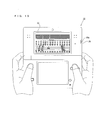
- FIG. 7 shows an example of a game image that is displayed on the upper LCD 22 of the game apparatus 10 when the stereoscopic display mode is selected by the 3D adjustment switch 25 and the degree of stereopsis is set to the maximum value (i.e., a game image that is displayed when the slider 25a of the 3D adjustment switch 25 is adjusted to the second position (see FIG. 3C ) by the user).
- two perspective-projection virtual cameras i.e., a right virtual camera and a left virtual camera
- two images i.e., an image for right eye and an image for left eye
- the generated image for right eye and image for left eye are combined into a stereoscopically visible image, and the stereoscopically visible image is displayed on the upper LCD 22.
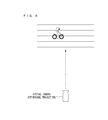
- the virtual space is rendered by using two virtual cameras that are placed with a distance therebetween. This generates parallax between the image for right eye and the image for left eye. As a result, the parallax allows the user feel a sense of depth as shown in FIG. 9 .
- image rendering is performed by perspective projection. Therefore, the sense of depth and verisimilitude increase as compared to those of an image rendered by orthogonal projection.
- FIG. 10 shows an example of a game image that is displayed by the upper LCD 22 of the game apparatus 10 in a case where the stereoscopic display mode is selected by the 3D adjustment switch 25 and the degree of stereopsis is set to substantially the middle value between the minimum value and the maximum value (i.e., a game image that is displayed in a case where the user sets the slider 25a of the 3D adjustment switch 25 to substantially the middle position between the first position (see FIG. 3B ) and the second position ( FIG. 3C ).
- the distance between the right virtual camera and the left virtual camera and the angle of view of each virtual camera are both smaller than in a case where the degree of stereopsis is set to the maximum value.
- the parallax between the image for right eye and the image for left eye is reduced, accordingly. Therefore, as shown in FIG. 11 , the sense of depth the user feels owing to the parallax is reduced as compared to a case where the degree of stereopsis is set to the maximum value.
- the angle of view of each virtual camera is reduced, the sense of depth the user feels owing to the perspective projection is reduced, accordingly.
- the degree of stereopsis is determined in accordance with a 3D volume value which is based on an output signal from the 3D adjustment switch 25.
- the 3D volume value is a real number in the range of 0.0 to 1.0, for example.
- the 3D volume value is 0.0.
- the 3D volume value is 1.0.
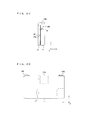
- the 3D volume value may be 0.0 when the slider 25a is in the third position (see FIG. 3A ); the 3D volume value may be a positive value close to 0.0 when the slider 25a is in the first position (see FIG. 3B ); the closer the slider 25a is to the second position (see FIG. 3C ) from the first position, the greater may be the 3D volume value; and the 3D volume value may be 1.0 when the slider 25a is in the second position.
- the right virtual camera and the left virtual camera may be used as pseudo orthogonal-projection virtual cameras (i.e., the distance between these virtual cameras is set to 0 or a value close to 0 and the angle of view of each virtual camera is set to a value close to 0).
- the pseudo orthogonal-projection virtual cameras i.e., one of the right virtual camera and the left virtual camera
- only one of the pseudo orthogonal-projection virtual cameras may be used to display a planarly visible image on the upper LCD 22.
- a stereoscopically visible image that is similar to a planarly visible image may be generated by using both the pseudo orthogonal-projection virtual cameras (i.e., both the right virtual camera and the left virtual camera).
- the angle of view of each of the right virtual camera and the left virtual camera and the distance between the right virtual camera and the left virtual camera are determined in accordance with the above-described 3D volume value.
- the angle of view of each of the right virtual camera and the left virtual camera is a predetermined minimum angle of view Amin when the 3D volume value is 0.0.
- the greater the 3D volume value the greater the angle of view.
- the angle of view is a predetermined maximum angle of view Amax.
- the distance between the right virtual camera and the left virtual camera is a predetermined minimum distance Dmin (which is 0 or a value close to 0).
- Dmin which is 0 or a value close to 0
- the greater the 3D volume value the greater the distance.
- the 3D volume value is 1.0, the distance is a predetermined maximum distance Dmax.
- m3DVol (0.0f to 1.0f) represents the 3D volume value
- mFov2Len represents a distance from a rendering target (i.e., a virtual object) to the virtual camera in a case where the 3D volume value is minimum
- mMaxFov represents the angle of view of the virtual camera in a case where the 3D volume value is maximum. It should be noted that if the angle of view of the virtual camera is simply increased, then the size of the rendering target displayed on the screen decreases.
- the greater the angle of view of the virtual camera i.e., an angle of view setting value shown below
- the smaller the virtual camera coordinates i.e., the virtual camera is placed closer to the rendering target. In this manner, the size of the rendering target displayed on the screen is maintained.
- Angle of view setting value 1.0f+(mMaxFov ⁇ m3DVol)
- Virtual camera coordinates mFov2Len/angle of view setting value-((angle of view setting value ⁇ angle of view coefficient)/mFov2Len)
- the setting of a perspective-projection virtual camera is determined based on calculation results of the above formulas.
- each of the minimum angle of view and the minimum distance is a value close to 0 so that, when the user operates the slider 25a to switch the display mode from the planar display mode to the stereoscopic display mode (or from the stereoscopic display mode to the planar display mode), the appearance of a displayed image changes smoothly.
- a virtual camera of which the angle of view is close to 0 may be called a pseudo orthogonal-projection virtual camera.
- 3C that is, a switch having characteristics similar to the following: the third position, which corresponds to the planar display mode, and the first position, at which the degree of stereopsis in the stereoscopic display mode is the minimum value, are adjacent to each other; and the more distant the slider 25a is from the third position, the greater the degree of stereopsis in the stereoscopic display mode.
- the same perspective-projection virtual cameras may be used for both the stereoscopic display mode and the planar display mode.
- the angle of view of each perspective-projection virtual camera may be set to the minimum value for the purpose of using each perspective-projection virtual camera as an orthogonal-projection virtual camera or as a pseudo orthogonal-projection virtual camera.
- the angle of view of each perspective-projection virtual camera may be increased in accordance with an increase in the degree of stereopsis.
- an image for left eye rendered based on the left virtual camera and an image for right eye rendered based on the right virtual camera change as shown in FIG. 13 in accordance with a change in the 3D volume value.
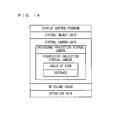
- FIG. 14 shows an example of a program and data that are stored in the main memory 32 of the game apparatus 10.
- the main memory 32 stores a display control program, virtual object data, virtual camera data, 3D volume value, operation data, and the like.
- the display control program is a program for generating a planarly visible image and a stereoscopically visible image as described above. For example, at the start of the game, the display control program is loaded from the external memory 44 or the like into the main memory 32 together with the virtual object data which is described below.
- the virtual object data relates to a virtual object in a virtual space.
- the virtual object data indicates, for example, the shape and color of the virtual object.
- the virtual object data also contains data indicating the position and orientation of the virtual object in the virtual space. These data are updated at any time in accordance with the progress in the game.
- the virtual camera data relates to the virtual cameras which are used to render the virtual space.
- the virtual camera data contains, for example, data indicating the position and orientation of each virtual camera.
- the virtual camera data contains data relating to an orthogonal-projection virtual camera used in generating a planarly visible image and data relating to perspective-projection virtual cameras (i.e., the right virtual camera and the left virtual camera) used in generating a stereoscopically visible image.
- the data relating to the perspective-projection virtual cameras contains: the angle of view of the right virtual camera and the angle of view of the left virtual camera; and the distance between the right virtual camera and the left virtual camera (or positional coordinates of the right virtual camera and positional coordinates of the left virtual camera).
- the 3D volume value is obtained at any time based on an output signal from the 3D adjustment switch 25, and stored in the main memory 32.
- the operation data is obtained at any time based on output signals from input devices such as the operation buttons 14, and stored in the main memory 32.
- FIG. 15 is a flowchart showing a flow of processing which the CPU 311 performs based on the display control program.
- step S11 in FIG. 15 the CPU 311 places virtual objects (ground, obstacles, rider, and spectator stands) in the virtual space.
- the CPU 311 determines, based on an output signal from the 3D adjustment switch 25, whether the stereoscopic display mode is currently selected (i.e., whether the slider 25a is located at a position between the first position (see FIG. 3B ) and the second position (see FIG. 3C )). If the stereoscopic display mode is currently selected, the processing proceeds to step S13. Otherwise (i.e., if the planar display mode is currently selected), the processing proceeds to step S16.
- the CPU 311 obtains the 3D volume value based on an output signal from the 3D adjustment switch 25.
- the CPU 311 determines, based on the obtained 3D volume value, the angle of view of each of the pair of perspective-projection virtual cameras (i.e., the right virtual camera and the left virtual camera) and the distance between the right virtual camera and the left virtual camera (or the positional coordinates of the right virtual camera and the positional coordinates of the left virtual camera). These may be determined by referring to a table as shown in FIG. 12 , or by using predetermined formulas as described above.
- the CPU 311 renders images (an image for right eye and an image for left eye) by using the pair of perspective-projection virtual cameras.
- the GPU 312 performs this rendering process in accordance with a rendering instruction from the CPU 311.
- the images generated in this manner are combined as necessary and then displayed at a predetermined timing on the upper LCD 22 in a stereoscopic manner.
- the CPU 311 uses a single orthogonal-projection virtual camera to render an image.
- the GPU 312 performs this rendering process in accordance with a rendering instruction from the CPU 311.
- the image generated in this manner is displayed at a predetermined timing on the upper LCD 22 in a planar manner.
- the CPU 311 obtains operation data based on output signals from the operation buttons 14 or the like.
- the CPU 311 controls a virtual object (in the present embodiment, the rider) based on the obtained operation data.
- step S 19 the CPU 311 determines whether the game has ended. If the game has ended, the execution of the display control program is ended. Otherwise, the processing returns to step S12.
- perspective-projection virtual cameras are used in the stereoscopic display mode, and an orthogonal-projection virtual camera is used in the planar display mode. Accordingly, as compared to the planar display mode, the stereoscopic effect for the user is enhanced in the stereoscopic display mode which allows the user to feel not only the sense of depth realized by parallax but also the sense of depth realized by perspective projection.
- the angle of view of each virtual camera changes in accordance with the degree of stereopsis (i.e., in accordance with the position of the slider 25a). This allows the user to feel, when the degree of stereopsis changes, not only a change in the sense of depth realized by parallax but also a change in the sense of depth realized by perspective projection. In this manner, changes in the stereoscopic effect can be accentuated.
- the perspective-projection virtual cameras may be used in both the stereoscopic display mode and the planar display mode.
- the planar display mode by setting the angle of view of each perspective-projection virtual camera to the minimum value, each perspective-projection virtual camera can be used as an orthogonal-projection virtual camera or a pseudo orthogonal-projection virtual camera.
- the angle of view of each perspective-projection virtual camera is increased in accordance with an increase in the degree of stereopsis.
- the virtual space is rendered by using an orthogonal-projection virtual camera in the planar display mode.
- the virtual space in the planar display mode, may be rendered by using a perspective-projection virtual camera of which the angle of view is similar to one for orthogonal projection (i.e., a pseudo orthogonal-projection virtual camera).
- the distance between a pair of virtual cameras used in the stereoscopic display mode may be set to 0 (i.e., the positional coordinates of the right virtual camera and the positional coordinates of the left virtual camera may be set to be identical with each other). Then, only one of these virtual cameras may be used to render the virtual space.
- a pair of perspective-projection virtual cameras is used in the stereoscopic display mode.
- a single perspective-projection virtual camera may be used in the stereoscopic display mode in such a manner that the position of the single perspective-projection virtual camera is moved as necessary to render two images (i.e., an image for right eye and an image for left eye), the respective viewpoints of which are different from each other.
- the above embodiment describes an example where the virtual cameras are switched between the orthogonal-projection type used in the planar display mode and the perspective-projection type used in the stereoscopic display mode (i.e., switching between two types of cameras).
- the present invention is not limited thereto. Without switching the virtual cameras, changing virtual camera parameters (e.g., the angle of view and the like) between the planar display mode and the stereoscopic display mode will suffice. This allows the sense of depth realized by parallax to be changed between the planar display mode and the stereoscopic display mode, and in addition, allows the appearance of a displayed image to be changed in accordance with the virtual camera parameters.
- multiple types of perspective-projection virtual cameras, each type having a different angle of view may be prepared. Based on an obtained 3D volume value, a corresponding type of perspective-projection virtual camera may be set.
- the above embodiment describes an example where the game, which the user plays by operating a rider, is executed.
- any application software that is not game software may be executed.
- the above embodiment describes an example where a CPU (i.e., the CPU 311) performs processing of the display control program.
- a CPU i.e., the CPU 3111
- at least a part of the processing of the display control program may be realized solely by hardware components.
- the above embodiment describes a handheld game apparatus which includes a display device (i.e., the upper LCD 22) capable of stereoscopic display.
- a display device i.e., the upper LCD 22
- any information processing apparatus or system e.g., a stationary game apparatus, desktop PC, laptop PC, or mobile phone
- a display device capable of stereoscopic display may be used.
- the above embodiment describes an example where a single CPU (i.e., the CPU 311) performs processing of the display control program.
- the processing of the display control program may be distributed to a plurality of processors.
- the plurality of processors may be included in a single information processing apparatus (or system), or may be separately provided in a plurality of information processing apparatuses (or systems), respectively, such as a server apparatus and a client apparatus.
Landscapes
- Engineering & Computer Science (AREA)
- Multimedia (AREA)
- Signal Processing (AREA)
- Testing, Inspecting, Measuring Of Stereoscopic Televisions And Televisions (AREA)
- Processing Or Creating Images (AREA)
Applications Claiming Priority (1)
| Application Number | Priority Date | Filing Date | Title |
|---|---|---|---|
| JP2010294536A JP5876983B2 (ja) | 2010-12-29 | 2010-12-29 | 表示制御プログラム、表示制御装置、表示制御方法および表示制御システム |
Publications (3)
| Publication Number | Publication Date |
|---|---|
| EP2471583A2 true EP2471583A2 (fr) | 2012-07-04 |
| EP2471583A3 EP2471583A3 (fr) | 2014-07-09 |
| EP2471583B1 EP2471583B1 (fr) | 2020-11-18 |
Family
ID=45771674
Family Applications (1)
| Application Number | Title | Priority Date | Filing Date |
|---|---|---|---|
| EP11160191.0A Active EP2471583B1 (fr) | 2010-12-29 | 2011-03-29 | Système, procédé et programme de contrôle d'affichage |
Country Status (3)
| Country | Link |
|---|---|
| US (1) | US20120169717A1 (fr) |
| EP (1) | EP2471583B1 (fr) |
| JP (1) | JP5876983B2 (fr) |
Cited By (2)
| Publication number | Priority date | Publication date | Assignee | Title |
|---|---|---|---|---|
| CN109976533A (zh) * | 2019-04-15 | 2019-07-05 | 珠海天燕科技有限公司 | 显示控制方法及装置 |
| CN111372661A (zh) * | 2017-09-29 | 2020-07-03 | 索尼互动娱乐有限责任公司 | 用好友虚拟形象增强虚拟现实视频游戏 |
Families Citing this family (7)
| Publication number | Priority date | Publication date | Assignee | Title |
|---|---|---|---|---|
| US10607398B2 (en) * | 2016-07-04 | 2020-03-31 | Colopl, Inc. | Display control method and system for executing the display control method |
| JP7301567B2 (ja) * | 2019-03-20 | 2023-07-03 | 任天堂株式会社 | 画像表示システム、画像表示プログラム、画像表示装置、および画像表示方法 |
| JP7349808B2 (ja) * | 2019-03-20 | 2023-09-25 | 任天堂株式会社 | 画像表示システム、画像表示プログラム、画像表示装置、および画像表示方法 |
| US11430198B1 (en) * | 2020-01-10 | 2022-08-30 | Apple Inc. | Method and device for orientation-based view switching |
| US20240212268A1 (en) * | 2021-05-11 | 2024-06-27 | Sony Group Corporation | Information processing apparatus, information processing method, and recording medium |
| CN113611181B (zh) * | 2021-07-09 | 2023-06-13 | 中国舰船研究设计中心 | 一种虚拟仿真场景的立体显示方法及装置 |
| CN115278202B (zh) * | 2022-07-29 | 2024-10-18 | 联想(北京)有限公司 | 显示方法及装置 |
Citations (1)
| Publication number | Priority date | Publication date | Assignee | Title |
|---|---|---|---|---|
| JP2003107603A (ja) | 2001-09-28 | 2003-04-09 | Namco Ltd | 立体視画像生成装置、立体視画像生成情報および情報記憶媒体 |
Family Cites Families (18)
| Publication number | Priority date | Publication date | Assignee | Title |
|---|---|---|---|---|
| US5687410A (en) * | 1994-10-14 | 1997-11-11 | Nikon Corporation | Information setting apparatus of camera |
| JP3579162B2 (ja) * | 1995-06-29 | 2004-10-20 | 松下電器産業株式会社 | 立体cg画像生成装置 |
| US6005607A (en) * | 1995-06-29 | 1999-12-21 | Matsushita Electric Industrial Co., Ltd. | Stereoscopic computer graphics image generating apparatus and stereoscopic TV apparatus |
| JPH0990277A (ja) * | 1995-09-28 | 1997-04-04 | Terumo Corp | 立体画像表示装置 |
| JP2001346226A (ja) * | 2000-06-02 | 2001-12-14 | Canon Inc | 画像処理装置、立体写真プリントシステム、画像処理方法、立体写真プリント方法、及び処理プログラムを記録した媒体 |
| JP2003067784A (ja) * | 2002-07-30 | 2003-03-07 | Canon Inc | 情報処理装置 |
| US20060203085A1 (en) * | 2002-11-28 | 2006-09-14 | Seijiro Tomita | There dimensional image signal producing circuit and three-dimensional image display apparatus |
| JP4118146B2 (ja) * | 2003-01-09 | 2008-07-16 | 三洋電機株式会社 | 立体画像処理装置 |
| JP4378118B2 (ja) * | 2003-06-27 | 2009-12-02 | 学校法人早稲田大学 | 立体映像呈示装置 |
| JP4212987B2 (ja) * | 2003-08-26 | 2009-01-21 | シャープ株式会社 | 立体画像表示装置、立体画像表示方法、その方法をコンピュータに実行させるためのプログラム及びそのプログラムを記録した記録媒体 |
| JP2006107213A (ja) * | 2004-10-06 | 2006-04-20 | Canon Inc | 立体画像印刷システム |
| JP4489610B2 (ja) * | 2005-01-28 | 2010-06-23 | 株式会社 日立ディスプレイズ | 立体視可能な表示装置および方法 |
| KR100667810B1 (ko) * | 2005-08-31 | 2007-01-11 | 삼성전자주식회사 | 3d 영상의 깊이감 조정 장치 및 방법 |
| JP4610634B2 (ja) * | 2008-05-16 | 2011-01-12 | シャープ株式会社 | 画像処理方法、その方法を実現するためにコンピュータにより実行されるプログラム、及びそのプログラムを記録した記録媒体 |
| JP4513905B2 (ja) * | 2008-06-27 | 2010-07-28 | ソニー株式会社 | 信号処理装置、信号処理方法、プログラム及び記録媒体 |
| JP2010154422A (ja) * | 2008-12-26 | 2010-07-08 | Casio Computer Co Ltd | 画像処理装置 |
| JP5266126B2 (ja) * | 2009-03-31 | 2013-08-21 | 富士フイルム株式会社 | 画像表示装置および方法並びにプログラム |
| US9350978B2 (en) * | 2009-05-29 | 2016-05-24 | Two Pic Mc Llc | Method of defining stereoscopic depth |
-
2010
- 2010-12-29 JP JP2010294536A patent/JP5876983B2/ja active Active
-
2011
- 2011-03-29 EP EP11160191.0A patent/EP2471583B1/fr active Active
- 2011-04-07 US US13/081,911 patent/US20120169717A1/en not_active Abandoned
Patent Citations (1)
| Publication number | Priority date | Publication date | Assignee | Title |
|---|---|---|---|---|
| JP2003107603A (ja) | 2001-09-28 | 2003-04-09 | Namco Ltd | 立体視画像生成装置、立体視画像生成情報および情報記憶媒体 |
Cited By (4)
| Publication number | Priority date | Publication date | Assignee | Title |
|---|---|---|---|---|
| CN111372661A (zh) * | 2017-09-29 | 2020-07-03 | 索尼互动娱乐有限责任公司 | 用好友虚拟形象增强虚拟现实视频游戏 |
| CN111372661B (zh) * | 2017-09-29 | 2024-04-19 | 索尼互动娱乐有限责任公司 | 用好友虚拟形象增强虚拟现实视频游戏 |
| CN109976533A (zh) * | 2019-04-15 | 2019-07-05 | 珠海天燕科技有限公司 | 显示控制方法及装置 |
| CN109976533B (zh) * | 2019-04-15 | 2022-06-03 | 珠海天燕科技有限公司 | 显示控制方法及装置 |
Also Published As
| Publication number | Publication date |
|---|---|
| EP2471583B1 (fr) | 2020-11-18 |
| US20120169717A1 (en) | 2012-07-05 |
| JP2012142804A (ja) | 2012-07-26 |
| EP2471583A3 (fr) | 2014-07-09 |
| JP5876983B2 (ja) | 2016-03-02 |
Similar Documents
| Publication | Publication Date | Title |
|---|---|---|
| US9445084B2 (en) | Computer-readable storage medium having stored therein display control program, display control apparatus, display control system, and display control method | |
| EP2395766B1 (fr) | Support de stockage disposant d'un programme d'affichage d'image stéréoscopique stocké sur celui-ci, dispositif d'affichage d'image stéréoscopique, système d'affichage d'image stéréoscopique et procédé d'affichage d'image stéréoscopique | |
| EP2394715B1 (fr) | Programme, système et procédé d'affichage d'images | |
| EP2471583B1 (fr) | Système, procédé et programme de contrôle d'affichage | |
| EP2391138B1 (fr) | Dispositif électronique portable | |
| EP2508233B1 (fr) | Programme de traitement d'informations, appareil de traitement d'informations, système de traitement d'informations et procédé traitement d'informations | |
| EP2434458A2 (fr) | Programme, appareil, système et procédé de traitement d'images pour la réalité mixte | |
| EP2482561A1 (fr) | Dispositif électronique portable | |
| US20120293549A1 (en) | Computer-readable storage medium having information processing program stored therein, information processing apparatus, information processing system, and information processing method | |
| US20120079426A1 (en) | Computer-readable storage medium having display control program stored therein, display control apparatus, display control system, and display control method | |
| EP2466440A2 (fr) | Programme de contrôle d'affichage, appareil de contrôle d'affichage, système de contrôle d'affichage et procédé de contrôle d'affichage | |
| US20120306868A1 (en) | Storage medium having stored therein an image generation program, image generation method, image generation apparatus and image generation system | |
| US20120133641A1 (en) | Hand-held electronic device | |
| JP2012074881A (ja) | 立体視表示制御プログラム、立体視表示制御システム、立体視表示制御装置、および、立体視表示制御方法 | |
| US9113144B2 (en) | Image processing system, storage medium, image processing method, and image processing apparatus for correcting the degree of disparity of displayed objects | |
| US8872891B2 (en) | Storage medium, information processing apparatus, information processing method and information processing system | |
| JP2012175358A (ja) | 表示制御プログラム、表示制御装置、表示制御方法及び表示制御システム |
Legal Events
| Date | Code | Title | Description |
|---|---|---|---|
| AK | Designated contracting states |
Kind code of ref document: A2 Designated state(s): AL AT BE BG CH CY CZ DE DK EE ES FI FR GB GR HR HU IE IS IT LI LT LU LV MC MK MT NL NO PL PT RO RS SE SI SK SM TR |
|
| AX | Request for extension of the european patent |
Extension state: BA ME |
|
| PUAI | Public reference made under article 153(3) epc to a published international application that has entered the european phase |
Free format text: ORIGINAL CODE: 0009012 |
|
| PUAL | Search report despatched |
Free format text: ORIGINAL CODE: 0009013 |
|
| AK | Designated contracting states |
Kind code of ref document: A3 Designated state(s): AL AT BE BG CH CY CZ DE DK EE ES FI FR GB GR HR HU IE IS IT LI LT LU LV MC MK MT NL NO PL PT RO RS SE SI SK SM TR |
|
| AX | Request for extension of the european patent |
Extension state: BA ME |
|
| RIC1 | Information provided on ipc code assigned before grant |
Ipc: A63F 13/45 20140101AFI20140616BHEP Ipc: H04N 13/00 20060101ALI20140616BHEP |
|
| 17P | Request for examination filed |
Effective date: 20150109 |
|
| RBV | Designated contracting states (corrected) |
Designated state(s): AL AT BE BG CH CY CZ DE DK EE ES FI FR GB GR HR HU IE IS IT LI LT LU LV MC MK MT NL NO PL PT RO RS SE SI SK SM TR |
|
| STAA | Information on the status of an ep patent application or granted ep patent |
Free format text: STATUS: EXAMINATION IS IN PROGRESS |
|
| 17Q | First examination report despatched |
Effective date: 20171107 |
|
| REG | Reference to a national code |
Ref country code: DE Ref legal event code: R079 Ref document number: 602011069317 Country of ref document: DE Free format text: PREVIOUS MAIN CLASS: A63F0013100000 Ipc: A63F0013525000 |
|
| RIC1 | Information provided on ipc code assigned before grant |
Ipc: A63F 13/525 20140101AFI20200526BHEP Ipc: A63F 13/5252 20140101ALI20200526BHEP Ipc: A63F 13/26 20140101ALI20200526BHEP |
|
| GRAP | Despatch of communication of intention to grant a patent |
Free format text: ORIGINAL CODE: EPIDOSNIGR1 |
|
| STAA | Information on the status of an ep patent application or granted ep patent |
Free format text: STATUS: GRANT OF PATENT IS INTENDED |
|
| INTG | Intention to grant announced |
Effective date: 20200716 |
|
| GRAS | Grant fee paid |
Free format text: ORIGINAL CODE: EPIDOSNIGR3 |
|
| GRAA | (expected) grant |
Free format text: ORIGINAL CODE: 0009210 |
|
| STAA | Information on the status of an ep patent application or granted ep patent |
Free format text: STATUS: THE PATENT HAS BEEN GRANTED |
|
| AK | Designated contracting states |
Kind code of ref document: B1 Designated state(s): AL AT BE BG CH CY CZ DE DK EE ES FI FR GB GR HR HU IE IS IT LI LT LU LV MC MK MT NL NO PL PT RO RS SE SI SK SM TR |
|
| REG | Reference to a national code |
Ref country code: GB Ref legal event code: FG4D |
|
| REG | Reference to a national code |
Ref country code: CH Ref legal event code: EP |
|
| REG | Reference to a national code |
Ref country code: IE Ref legal event code: FG4D |
|
| REG | Reference to a national code |
Ref country code: DE Ref legal event code: R096 Ref document number: 602011069317 Country of ref document: DE |
|
| REG | Reference to a national code |
Ref country code: AT Ref legal event code: REF Ref document number: 1335101 Country of ref document: AT Kind code of ref document: T Effective date: 20201215 |
|
| REG | Reference to a national code |
Ref country code: AT Ref legal event code: MK05 Ref document number: 1335101 Country of ref document: AT Kind code of ref document: T Effective date: 20201118 |
|
| REG | Reference to a national code |
Ref country code: NL Ref legal event code: MP Effective date: 20201118 |
|
| PG25 | Lapsed in a contracting state [announced via postgrant information from national office to epo] |
Ref country code: NO Free format text: LAPSE BECAUSE OF FAILURE TO SUBMIT A TRANSLATION OF THE DESCRIPTION OR TO PAY THE FEE WITHIN THE PRESCRIBED TIME-LIMIT Effective date: 20210218 Ref country code: PT Free format text: LAPSE BECAUSE OF FAILURE TO SUBMIT A TRANSLATION OF THE DESCRIPTION OR TO PAY THE FEE WITHIN THE PRESCRIBED TIME-LIMIT Effective date: 20210318 Ref country code: RS Free format text: LAPSE BECAUSE OF FAILURE TO SUBMIT A TRANSLATION OF THE DESCRIPTION OR TO PAY THE FEE WITHIN THE PRESCRIBED TIME-LIMIT Effective date: 20201118 Ref country code: FI Free format text: LAPSE BECAUSE OF FAILURE TO SUBMIT A TRANSLATION OF THE DESCRIPTION OR TO PAY THE FEE WITHIN THE PRESCRIBED TIME-LIMIT Effective date: 20201118 Ref country code: GR Free format text: LAPSE BECAUSE OF FAILURE TO SUBMIT A TRANSLATION OF THE DESCRIPTION OR TO PAY THE FEE WITHIN THE PRESCRIBED TIME-LIMIT Effective date: 20210219 |
|
| PG25 | Lapsed in a contracting state [announced via postgrant information from national office to epo] |
Ref country code: IS Free format text: LAPSE BECAUSE OF FAILURE TO SUBMIT A TRANSLATION OF THE DESCRIPTION OR TO PAY THE FEE WITHIN THE PRESCRIBED TIME-LIMIT Effective date: 20210318 Ref country code: AT Free format text: LAPSE BECAUSE OF FAILURE TO SUBMIT A TRANSLATION OF THE DESCRIPTION OR TO PAY THE FEE WITHIN THE PRESCRIBED TIME-LIMIT Effective date: 20201118 Ref country code: BG Free format text: LAPSE BECAUSE OF FAILURE TO SUBMIT A TRANSLATION OF THE DESCRIPTION OR TO PAY THE FEE WITHIN THE PRESCRIBED TIME-LIMIT Effective date: 20210218 Ref country code: SE Free format text: LAPSE BECAUSE OF FAILURE TO SUBMIT A TRANSLATION OF THE DESCRIPTION OR TO PAY THE FEE WITHIN THE PRESCRIBED TIME-LIMIT Effective date: 20201118 Ref country code: LV Free format text: LAPSE BECAUSE OF FAILURE TO SUBMIT A TRANSLATION OF THE DESCRIPTION OR TO PAY THE FEE WITHIN THE PRESCRIBED TIME-LIMIT Effective date: 20201118 Ref country code: PL Free format text: LAPSE BECAUSE OF FAILURE TO SUBMIT A TRANSLATION OF THE DESCRIPTION OR TO PAY THE FEE WITHIN THE PRESCRIBED TIME-LIMIT Effective date: 20201118 |
|
| REG | Reference to a national code |
Ref country code: LT Ref legal event code: MG9D |
|
| PG25 | Lapsed in a contracting state [announced via postgrant information from national office to epo] |
Ref country code: HR Free format text: LAPSE BECAUSE OF FAILURE TO SUBMIT A TRANSLATION OF THE DESCRIPTION OR TO PAY THE FEE WITHIN THE PRESCRIBED TIME-LIMIT Effective date: 20201118 |
|
| PG25 | Lapsed in a contracting state [announced via postgrant information from national office to epo] |
Ref country code: LT Free format text: LAPSE BECAUSE OF FAILURE TO SUBMIT A TRANSLATION OF THE DESCRIPTION OR TO PAY THE FEE WITHIN THE PRESCRIBED TIME-LIMIT Effective date: 20201118 Ref country code: RO Free format text: LAPSE BECAUSE OF FAILURE TO SUBMIT A TRANSLATION OF THE DESCRIPTION OR TO PAY THE FEE WITHIN THE PRESCRIBED TIME-LIMIT Effective date: 20201118 Ref country code: SK Free format text: LAPSE BECAUSE OF FAILURE TO SUBMIT A TRANSLATION OF THE DESCRIPTION OR TO PAY THE FEE WITHIN THE PRESCRIBED TIME-LIMIT Effective date: 20201118 Ref country code: SM Free format text: LAPSE BECAUSE OF FAILURE TO SUBMIT A TRANSLATION OF THE DESCRIPTION OR TO PAY THE FEE WITHIN THE PRESCRIBED TIME-LIMIT Effective date: 20201118 Ref country code: EE Free format text: LAPSE BECAUSE OF FAILURE TO SUBMIT A TRANSLATION OF THE DESCRIPTION OR TO PAY THE FEE WITHIN THE PRESCRIBED TIME-LIMIT Effective date: 20201118 Ref country code: CZ Free format text: LAPSE BECAUSE OF FAILURE TO SUBMIT A TRANSLATION OF THE DESCRIPTION OR TO PAY THE FEE WITHIN THE PRESCRIBED TIME-LIMIT Effective date: 20201118 |
|
| REG | Reference to a national code |
Ref country code: DE Ref legal event code: R097 Ref document number: 602011069317 Country of ref document: DE |
|
| PG25 | Lapsed in a contracting state [announced via postgrant information from national office to epo] |
Ref country code: DK Free format text: LAPSE BECAUSE OF FAILURE TO SUBMIT A TRANSLATION OF THE DESCRIPTION OR TO PAY THE FEE WITHIN THE PRESCRIBED TIME-LIMIT Effective date: 20201118 |
|
| PLBE | No opposition filed within time limit |
Free format text: ORIGINAL CODE: 0009261 |
|
| STAA | Information on the status of an ep patent application or granted ep patent |
Free format text: STATUS: NO OPPOSITION FILED WITHIN TIME LIMIT |
|
| 26N | No opposition filed |
Effective date: 20210819 |
|
| PG25 | Lapsed in a contracting state [announced via postgrant information from national office to epo] |
Ref country code: MC Free format text: LAPSE BECAUSE OF FAILURE TO SUBMIT A TRANSLATION OF THE DESCRIPTION OR TO PAY THE FEE WITHIN THE PRESCRIBED TIME-LIMIT Effective date: 20201118 Ref country code: NL Free format text: LAPSE BECAUSE OF FAILURE TO SUBMIT A TRANSLATION OF THE DESCRIPTION OR TO PAY THE FEE WITHIN THE PRESCRIBED TIME-LIMIT Effective date: 20201118 Ref country code: IT Free format text: LAPSE BECAUSE OF FAILURE TO SUBMIT A TRANSLATION OF THE DESCRIPTION OR TO PAY THE FEE WITHIN THE PRESCRIBED TIME-LIMIT Effective date: 20201118 Ref country code: AL Free format text: LAPSE BECAUSE OF FAILURE TO SUBMIT A TRANSLATION OF THE DESCRIPTION OR TO PAY THE FEE WITHIN THE PRESCRIBED TIME-LIMIT Effective date: 20201118 |
|
| REG | Reference to a national code |
Ref country code: CH Ref legal event code: PL |
|
| PG25 | Lapsed in a contracting state [announced via postgrant information from national office to epo] |
Ref country code: SI Free format text: LAPSE BECAUSE OF FAILURE TO SUBMIT A TRANSLATION OF THE DESCRIPTION OR TO PAY THE FEE WITHIN THE PRESCRIBED TIME-LIMIT Effective date: 20201118 Ref country code: ES Free format text: LAPSE BECAUSE OF FAILURE TO SUBMIT A TRANSLATION OF THE DESCRIPTION OR TO PAY THE FEE WITHIN THE PRESCRIBED TIME-LIMIT Effective date: 20201118 |
|
| REG | Reference to a national code |
Ref country code: BE Ref legal event code: MM Effective date: 20210331 |
|
| PG25 | Lapsed in a contracting state [announced via postgrant information from national office to epo] |
Ref country code: LI Free format text: LAPSE BECAUSE OF NON-PAYMENT OF DUE FEES Effective date: 20210331 Ref country code: LU Free format text: LAPSE BECAUSE OF NON-PAYMENT OF DUE FEES Effective date: 20210329 Ref country code: CH Free format text: LAPSE BECAUSE OF NON-PAYMENT OF DUE FEES Effective date: 20210331 Ref country code: IE Free format text: LAPSE BECAUSE OF NON-PAYMENT OF DUE FEES Effective date: 20210329 |
|
| PG25 | Lapsed in a contracting state [announced via postgrant information from national office to epo] |
Ref country code: IS Free format text: LAPSE BECAUSE OF FAILURE TO SUBMIT A TRANSLATION OF THE DESCRIPTION OR TO PAY THE FEE WITHIN THE PRESCRIBED TIME-LIMIT Effective date: 20210318 |
|
| PG25 | Lapsed in a contracting state [announced via postgrant information from national office to epo] |
Ref country code: BE Free format text: LAPSE BECAUSE OF NON-PAYMENT OF DUE FEES Effective date: 20210331 |
|
| PG25 | Lapsed in a contracting state [announced via postgrant information from national office to epo] |
Ref country code: HU Free format text: LAPSE BECAUSE OF FAILURE TO SUBMIT A TRANSLATION OF THE DESCRIPTION OR TO PAY THE FEE WITHIN THE PRESCRIBED TIME-LIMIT; INVALID AB INITIO Effective date: 20110329 Ref country code: CY Free format text: LAPSE BECAUSE OF FAILURE TO SUBMIT A TRANSLATION OF THE DESCRIPTION OR TO PAY THE FEE WITHIN THE PRESCRIBED TIME-LIMIT Effective date: 20201118 |
|
| P01 | Opt-out of the competence of the unified patent court (upc) registered |
Effective date: 20230428 |
|
| PG25 | Lapsed in a contracting state [announced via postgrant information from national office to epo] |
Ref country code: MK Free format text: LAPSE BECAUSE OF FAILURE TO SUBMIT A TRANSLATION OF THE DESCRIPTION OR TO PAY THE FEE WITHIN THE PRESCRIBED TIME-LIMIT Effective date: 20201118 |
|
| PG25 | Lapsed in a contracting state [announced via postgrant information from national office to epo] |
Ref country code: MT Free format text: LAPSE BECAUSE OF FAILURE TO SUBMIT A TRANSLATION OF THE DESCRIPTION OR TO PAY THE FEE WITHIN THE PRESCRIBED TIME-LIMIT Effective date: 20201118 |
|
| PG25 | Lapsed in a contracting state [announced via postgrant information from national office to epo] |
Ref country code: TR Free format text: LAPSE BECAUSE OF FAILURE TO SUBMIT A TRANSLATION OF THE DESCRIPTION OR TO PAY THE FEE WITHIN THE PRESCRIBED TIME-LIMIT Effective date: 20201118 |
|
| PGFP | Annual fee paid to national office [announced via postgrant information from national office to epo] |
Ref country code: GB Payment date: 20260209 Year of fee payment: 16 |
|
| PGFP | Annual fee paid to national office [announced via postgrant information from national office to epo] |
Ref country code: DE Payment date: 20260204 Year of fee payment: 16 |
|
| PGFP | Annual fee paid to national office [announced via postgrant information from national office to epo] |
Ref country code: FR Payment date: 20260209 Year of fee payment: 16 |