EP2472645A2 - Procédé de fabrication d'une batterie lithium-ion polymère, pile de batterie et pile lithium-ion polymère comprenant celle-ci - Google Patents
Procédé de fabrication d'une batterie lithium-ion polymère, pile de batterie et pile lithium-ion polymère comprenant celle-ci Download PDFInfo
- Publication number
- EP2472645A2 EP2472645A2 EP10822253A EP10822253A EP2472645A2 EP 2472645 A2 EP2472645 A2 EP 2472645A2 EP 10822253 A EP10822253 A EP 10822253A EP 10822253 A EP10822253 A EP 10822253A EP 2472645 A2 EP2472645 A2 EP 2472645A2
- Authority
- EP
- European Patent Office
- Prior art keywords
- electrolyte
- battery cell
- battery
- cell
- lithium ion
- Prior art date
- Legal status (The legal status is an assumption and is not a legal conclusion. Google has not performed a legal analysis and makes no representation as to the accuracy of the status listed.)
- Granted
Links
Images

Classifications
-
- H—ELECTRICITY
- H01—ELECTRIC ELEMENTS
- H01M—PROCESSES OR MEANS, e.g. BATTERIES, FOR THE DIRECT CONVERSION OF CHEMICAL ENERGY INTO ELECTRICAL ENERGY
- H01M10/00—Secondary cells; Manufacture thereof
- H01M10/04—Construction or manufacture in general
- H01M10/049—Processes for forming or storing electrodes in the battery container
-
- H—ELECTRICITY
- H01—ELECTRIC ELEMENTS
- H01M—PROCESSES OR MEANS, e.g. BATTERIES, FOR THE DIRECT CONVERSION OF CHEMICAL ENERGY INTO ELECTRICAL ENERGY
- H01M50/00—Constructional details or processes of manufacture of the non-active parts of electrochemical cells other than fuel cells, e.g. hybrid cells
- H01M50/60—Arrangements or processes for filling or topping-up with liquids; Arrangements or processes for draining liquids from casings
-
- B—PERFORMING OPERATIONS; TRANSPORTING
- B05—SPRAYING OR ATOMISING IN GENERAL; APPLYING FLUENT MATERIALS TO SURFACES, IN GENERAL
- B05D—PROCESSES FOR APPLYING FLUENT MATERIALS TO SURFACES, IN GENERAL
- B05D1/00—Processes for applying liquids or other fluent materials
- B05D1/18—Processes for applying liquids or other fluent materials performed by dipping
-
- H—ELECTRICITY
- H01—ELECTRIC ELEMENTS
- H01M—PROCESSES OR MEANS, e.g. BATTERIES, FOR THE DIRECT CONVERSION OF CHEMICAL ENERGY INTO ELECTRICAL ENERGY
- H01M10/00—Secondary cells; Manufacture thereof
- H01M10/05—Accumulators with non-aqueous electrolyte
- H01M10/052—Li-accumulators
-
- H—ELECTRICITY
- H01—ELECTRIC ELEMENTS
- H01M—PROCESSES OR MEANS, e.g. BATTERIES, FOR THE DIRECT CONVERSION OF CHEMICAL ENERGY INTO ELECTRICAL ENERGY
- H01M10/00—Secondary cells; Manufacture thereof
- H01M10/05—Accumulators with non-aqueous electrolyte
- H01M10/052—Li-accumulators
- H01M10/0525—Rocking-chair batteries, i.e. batteries with lithium insertion or intercalation in both electrodes; Lithium-ion batteries
-
- H—ELECTRICITY
- H01—ELECTRIC ELEMENTS
- H01M—PROCESSES OR MEANS, e.g. BATTERIES, FOR THE DIRECT CONVERSION OF CHEMICAL ENERGY INTO ELECTRICAL ENERGY
- H01M10/00—Secondary cells; Manufacture thereof
- H01M10/05—Accumulators with non-aqueous electrolyte
- H01M10/056—Accumulators with non-aqueous electrolyte characterised by the materials used as electrolytes, e.g. mixed inorganic/organic electrolytes
- H01M10/0564—Accumulators with non-aqueous electrolyte characterised by the materials used as electrolytes, e.g. mixed inorganic/organic electrolytes the electrolyte being constituted of organic materials only
- H01M10/0565—Polymeric materials, e.g. gel-type or solid-type
-
- H—ELECTRICITY
- H01—ELECTRIC ELEMENTS
- H01M—PROCESSES OR MEANS, e.g. BATTERIES, FOR THE DIRECT CONVERSION OF CHEMICAL ENERGY INTO ELECTRICAL ENERGY
- H01M10/00—Secondary cells; Manufacture thereof
- H01M10/05—Accumulators with non-aqueous electrolyte
- H01M10/058—Construction or manufacture
-
- H—ELECTRICITY
- H01—ELECTRIC ELEMENTS
- H01M—PROCESSES OR MEANS, e.g. BATTERIES, FOR THE DIRECT CONVERSION OF CHEMICAL ENERGY INTO ELECTRICAL ENERGY
- H01M10/00—Secondary cells; Manufacture thereof
- H01M10/42—Methods or arrangements for servicing or maintenance of secondary cells or secondary half-cells
- H01M10/44—Methods for charging or discharging
- H01M10/446—Initial charging measures
-
- H—ELECTRICITY
- H01—ELECTRIC ELEMENTS
- H01M—PROCESSES OR MEANS, e.g. BATTERIES, FOR THE DIRECT CONVERSION OF CHEMICAL ENERGY INTO ELECTRICAL ENERGY
- H01M4/00—Electrodes
- H01M4/02—Electrodes composed of, or comprising, active material
- H01M4/04—Processes of manufacture in general
- H01M4/0438—Processes of manufacture in general by electrochemical processing
- H01M4/044—Activating, forming or electrochemical attack of the supporting material
- H01M4/0445—Forming after manufacture of the electrode, e.g. first charge, cycling
- H01M4/0447—Forming after manufacture of the electrode, e.g. first charge, cycling of complete cells or cells stacks
-
- H—ELECTRICITY
- H01—ELECTRIC ELEMENTS
- H01M—PROCESSES OR MEANS, e.g. BATTERIES, FOR THE DIRECT CONVERSION OF CHEMICAL ENERGY INTO ELECTRICAL ENERGY
- H01M50/00—Constructional details or processes of manufacture of the non-active parts of electrochemical cells other than fuel cells, e.g. hybrid cells
- H01M50/10—Primary casings; Jackets or wrappings
- H01M50/116—Primary casings; Jackets or wrappings characterised by the material
- H01M50/117—Inorganic material
- H01M50/119—Metals
-
- H—ELECTRICITY
- H01—ELECTRIC ELEMENTS
- H01M—PROCESSES OR MEANS, e.g. BATTERIES, FOR THE DIRECT CONVERSION OF CHEMICAL ENERGY INTO ELECTRICAL ENERGY
- H01M50/00—Constructional details or processes of manufacture of the non-active parts of electrochemical cells other than fuel cells, e.g. hybrid cells
- H01M50/10—Primary casings; Jackets or wrappings
- H01M50/14—Primary casings; Jackets or wrappings for protecting against damage caused by external factors
-
- H—ELECTRICITY
- H01—ELECTRIC ELEMENTS
- H01M—PROCESSES OR MEANS, e.g. BATTERIES, FOR THE DIRECT CONVERSION OF CHEMICAL ENERGY INTO ELECTRICAL ENERGY
- H01M50/00—Constructional details or processes of manufacture of the non-active parts of electrochemical cells other than fuel cells, e.g. hybrid cells
- H01M50/60—Arrangements or processes for filling or topping-up with liquids; Arrangements or processes for draining liquids from casings
- H01M50/609—Arrangements or processes for filling with liquid, e.g. electrolytes
-
- Y—GENERAL TAGGING OF NEW TECHNOLOGICAL DEVELOPMENTS; GENERAL TAGGING OF CROSS-SECTIONAL TECHNOLOGIES SPANNING OVER SEVERAL SECTIONS OF THE IPC; TECHNICAL SUBJECTS COVERED BY FORMER USPC CROSS-REFERENCE ART COLLECTIONS [XRACs] AND DIGESTS
- Y02—TECHNOLOGIES OR APPLICATIONS FOR MITIGATION OR ADAPTATION AGAINST CLIMATE CHANGE
- Y02E—REDUCTION OF GREENHOUSE GAS [GHG] EMISSIONS, RELATED TO ENERGY GENERATION, TRANSMISSION OR DISTRIBUTION
- Y02E60/00—Enabling technologies; Technologies with a potential or indirect contribution to GHG emissions mitigation
- Y02E60/10—Energy storage using batteries
-
- Y—GENERAL TAGGING OF NEW TECHNOLOGICAL DEVELOPMENTS; GENERAL TAGGING OF CROSS-SECTIONAL TECHNOLOGIES SPANNING OVER SEVERAL SECTIONS OF THE IPC; TECHNICAL SUBJECTS COVERED BY FORMER USPC CROSS-REFERENCE ART COLLECTIONS [XRACs] AND DIGESTS
- Y02—TECHNOLOGIES OR APPLICATIONS FOR MITIGATION OR ADAPTATION AGAINST CLIMATE CHANGE
- Y02P—CLIMATE CHANGE MITIGATION TECHNOLOGIES IN THE PRODUCTION OR PROCESSING OF GOODS
- Y02P70/00—Climate change mitigation technologies in the production process for final industrial or consumer products
- Y02P70/50—Manufacturing or production processes characterised by the final manufactured product
-
- Y—GENERAL TAGGING OF NEW TECHNOLOGICAL DEVELOPMENTS; GENERAL TAGGING OF CROSS-SECTIONAL TECHNOLOGIES SPANNING OVER SEVERAL SECTIONS OF THE IPC; TECHNICAL SUBJECTS COVERED BY FORMER USPC CROSS-REFERENCE ART COLLECTIONS [XRACs] AND DIGESTS
- Y10—TECHNICAL SUBJECTS COVERED BY FORMER USPC
- Y10T—TECHNICAL SUBJECTS COVERED BY FORMER US CLASSIFICATION
- Y10T29/00—Metal working
- Y10T29/49—Method of mechanical manufacture
- Y10T29/49002—Electrical device making
- Y10T29/49108—Electric battery cell making
- Y10T29/4911—Electric battery cell making including sealing
-
- Y—GENERAL TAGGING OF NEW TECHNOLOGICAL DEVELOPMENTS; GENERAL TAGGING OF CROSS-SECTIONAL TECHNOLOGIES SPANNING OVER SEVERAL SECTIONS OF THE IPC; TECHNICAL SUBJECTS COVERED BY FORMER USPC CROSS-REFERENCE ART COLLECTIONS [XRACs] AND DIGESTS
- Y10—TECHNICAL SUBJECTS COVERED BY FORMER USPC
- Y10T—TECHNICAL SUBJECTS COVERED BY FORMER US CLASSIFICATION
- Y10T29/00—Metal working
- Y10T29/49—Method of mechanical manufacture
- Y10T29/49002—Electrical device making
- Y10T29/49108—Electric battery cell making
- Y10T29/49115—Electric battery cell making including coating or impregnating
Definitions
- the present invention relates to a pouch type lithium ion polymer battery and a method for manufacturing the same, and more particularly, to a method for injecting electrolyte into the interior of a battery cell.
- a lithium ion polymer battery is manufactured by packaging an outer edge of a folded cell with a packing material of an aluminum pouch.
- a battery cell is put into the aluminum pouch and an electrolyte is injected thereinto, which are then activated, subjected to a degassing process, and finally sealed.
- electrolyte present on an inner wall face of a sealed portion of the pouch is sealed together (agglutination sealing of electrolyte), or when sealing is finally made simultaneously with a vacuum suction, gas phase molecules of the electrolyte infiltrate into the sealed portion through diffusion simultaneously in the event of the vacuum suction.
- a microcrack or a defect caused by the electrolyte molecules smeared on the sealed portion serves as a current passage with the exterior to cause a local dielectric breakdown (or microcrack) or drastically degrades a sealing strength.
- EP 0994519 has proposed a method of filling a battery cell with electrolyte in which electrolyte is injected through a nozzle connected to a top portion of the wound battery cell to thus impregnate the electrolyte in the cell.
- Korean Laid Open Publication No. 10-0686838 discloses a lithium secondary battery in which a plurality of projections in a mesh form are configured to have different heights at a lower insulating plate to increase mobility of electrolyte, thus improving impregnation of the electrolyte.
- the problem of adhesive sealing of electrolyte cannot be satisfactorily solved.
- the necessity of preparing a method for effectively injecting electrolyte still remains.
- Korean Registered No. 10-0824869 shows off advantages in that because a degassing process is omitted in the process of manufacturing a polymer or angular type battery, time and process can be shortened, the packing material can be diversified for the polymer type battery and the angular type battery can be compressed.
- this patent has a problem in that a polymer pouch that degrades a cell performance due to the increase in HF within a cell is used, instead of a polymer packing material having a dual-layer structure, because moisture infiltration occurs excessively.
- an effect of preventing an adhesive sealing with electrolyte caused in the existing heat fusion method and preventing a shortened cell life span due to dielectric breakdown cannot be expected.
- an object of the present invention is to prevent a wetting phenomenon of electrolyte on an inner wall of a pouch in case of sealing for packaging of a battery cell in a process of manufacturing a lithium ion polymer battery, thus implementing a complete sealing and increasing a sealing strength.
- Another object of the present invention is to provide a method for simply manufacturing a battery by omitting a degassing process.
- a method for manufacturing a lithium ion polymer battery by packaging a battery cell within a packing material, wherein the battery cell is immersed in an electrolytic bath to allow the electrolyte to be impregnated into the battery cell.
- the entirety of a battery cell body part including a negative electrode, a positive electrode, and a separator may be immersed in the electrolytic bath.
- the electrolyte impregnation may include a wetting process performed under a pressure of 90 KPa to 100 KPa.
- a forming process may be performed in a state in which the battery cell is taken out of the electrolytic bath and mounted, and the forming process may be performed at an SOC (State of Charge) 30% to SOC 50%.
- SOC State of Charge
- the battery cell may be activated and the activate battery cell may be inserted into a pouch and then sealed.
- an electrolyte aging process is performed so that the electrolyte within the battery cell can reach a certain amount of electrolyte impregnation.
- the aging process may be performed at 19°C to 25°C.
- a process of removing extra electrolyte from the battery cell may be performed in the aging process.
- a battery cell including a negative electrode, a positive electrode, and a separator, wherein a jelly type electrolyte is contained in the interior of the cell.
- a lithium ion polymer battery manufactured by inputting a battery cell into a packing material and then vacuum-sealing it.
- a charge and discharge efficiency of the battery cell ranges from 99.7% to 99.9%, and an electrolyte leakage amount of the battery cell ranges from 0.2% to 0.5%.
- the battery cell in injecting electrolyte, the battery cell is immersed in the electrolytic bath to allow the electrolyte to be impregnated between air gaps in the interior of the battery cell, whereby the electrolyte can be impregnated simultaneously, and thereafter, as the battery cell is activated, the electrolyte is settled down between the air gaps in the interior of the battery cell.
- the electrolyte covers or smears the sealed portion does not occur.
- the possibility in which the electrolyte covers or smears the sealed portion of the packing material is eliminated, and all the faces are sealed under the same conditions, so a sealing strength more than requirements can be satisfied.
- an insulation resistance breakdown otherwise caused by a microcrack or a defect due to adhesive sealing of electrolyte can be prevented.
- a folded cell of a completed battery is put into a packing material and packaged, electrolyte is injected, an activation process is performed, the packing material is open to exhaust gas generated during the activation process, and then a sealing operation is finally performed.
- an electrolyte wetting phenomenon occurs at an inner wall of the packing material in the process of injecting the electrolyte, or gaseous/liquid electrolyte may be spread due to a pressure difference caused by a vacuum suction in the final sealing operation after the cell is open in the degassing process, and in this process, a current passage may be generated between the interior and exterior of the cell due to the electrolyte covering or smearing a sealed portion of the packing material.
- electrolyte is impregnated in a battery cell through an incubation and packaging method to thereby maintain a sealing strength of the same conditions on every face of a pouch to be sealed and eliminate the degassing process.
- the present invention provides a method for manufacturing a pouch type battery in which a battery cell is immersed in an electrolyte-filled electrolytic bath for a certain period of time in the process of manufacturing a pouch type battery, to thus allow the electrolyte to be impregnated into the interior of the battery cell.
- a folded cell is completed according to a stacking and folding method or a jelly rolling method in the same manner and then fixed in an electrolyte-filled electrolytic bath, for which electrolyte setting, forming and aging processes are performed, and then, the cell is taken out and adjusted to reach a defined amount of electrolyte impregnation.
- the wetting process is a process of providing a driving force to allow the injected electrolyte to be well impregnated into the interior of an electrode, a separator or between bicells.
- the wetting process for inducing the impregnation can be omitted, and if the wetting process is performed, a wetting time can be shortened.
- the wetting process is performed at a pressure of 90 KPa to 100 KPa in a vacuum chamber.
- the electrolyte cannot be easily introduced into the battery cell, and if the wetting process is performed at a pressure higher than 100 KPa, the electrolyte would be excessively introduced to make electrolyte within the battery cell to be released.
- the wetting process is performed for 30 minutes, and in this case, preferably, the wetting process is performed for a certain period of time (e.g., five minutes) and then repeatedly performed after a relatively short time of recess (e.g., one minute), rather than being continuously performed, whereby the wetting process can be smoothly performed.
- a certain period of time e.g., five minutes
- a relatively short time of recess e.g., one minute
- the forming process refers to an activation process in which current is first applied.
- the forming process is performed in a state in which the battery cell is taken out of the electrolytic bath and mounted when a designed amount of electrolyte is reached.
- the forming process is performed at an SOC (State of Charge) 30% to SOC 50%.
- SOC State of Charge
- the forming process is performed at below SOC 30%, an SEI (Solid Electrolyte Interface) film is less generated, and conversely, if the forming process is performed at above SOC 50%, the SEI film is more generated to hamper a smooth forming process.
- the aging process refers to a process for stabilizing the battery.
- the aging process is performed at 19°C to 25°C in a state that the battery cell is mounted. For example, if the aging process is performed at below 19°C, the electrolyte is not well impregnated, and if the aging process is performed at above 25°C, an active material is likely to be eluted.
- a method for measuring an electrolyte impregnation amount is used as the most direct method.
- the difference between the weight of the cell and the mounting stand before the battery cell is immersed in the electrolytic bath and the weight of the cell and the mounting stand after the battery cell is immersed in the electrolytic bath corresponds to the amount of the impregnated electrolyte, and when the amount of the impregnated electrolyte reaches a designed amount of electrolyte, it is determined that the electrolyte impregnation is completed, and the activation process is performed.
- the impedance of the cell is measured in real time.
- a capacitance value obtained from the impedance when the impregnation is completed tends to be saturated, which indirectly verifies the impregnation completion.
- the completed battery cell has a form of a dry cell in which the electrolyte is seated in a jelly state.
- the dry cell is put in a packing material and then vacuum-sealed.
- the electrolyte When the electrolyte is injected into the battery cell by using a separate electrolytic bath and packed with a packing material according to the incubation and packaging method as described above, the probability that the electrolyte will cover or smear the sealed portion of the packing material in the electrolyte injection step or in the final sealing process to lower the sealing strength or break the insulation resistance can be remarkably reduced and a complete sealing can be implemented.
- the entirety of the body part of the battery cell is impregnated in the electrolyte.
- the body part of the cell including the negative electrode, the positive electrode, and the separator, excluding a positive electrode tap and a negative electrode tap protruded from the uppermost portion of the battery cell, is fully immersed in the electrolyte. According to this method, the electrolyte can be simultaneously absorbed into the entire body of the battery cell.
- the electrolyte can be evenly impregnated into the upper, lower, left and right portions of the cell, and in addition, the electrolyte can be impregnated from an outermost angle of the cell to the central portion within a short time.
- the pressurizing or vacuum-pressurizing process which is generally performed to spread the electrolyte in the electrolyte injection step can be omitted.
- the impregnation of the battery cell may vary depending on the size of a cell or the density of electrolyte, and the cell is immersed in the electrolytic bath for approximately two hours, the activation process is performed, and then, the cell is placed on a mounting stand or an empty bath to allow the electrolyte to flow down or vaporize, thus eliminating extra electrolyte.
- the electrolyte which has permeated through the air gaps within the battery cell can be fixed in the form of a jelly within the cell and, at the same time, the electrolyte within the battery cell is adjusted to reach a defined impregnation amount. Then, the electrolyte is settled down within the battery cell, so although the vacuum suction is performed in the follow-up pouch sealing processing, the electrolyte can be prevented from covering or smearing the sealed portion.
- the activation process of the battery cell may be performed in the state in which the battery cell is impregnated in the electrolytic bath. Namely, rather than performing the process of injecting the battery cell and the electrolyte into the pouch, temporarily sealing them, performing an activation reaction, opening the pouch and performing degassing, the battery cell is immersed in the electrolytic bath and, when the electrolytic is impregnated in the interior of the battery cell to a degree, an activation process is immediately performed. Then, gas generated during the activation process is immediately gone in the air, so the degassing process is not necessary.
- the process of positioning the battery cell in a vacuum state and performing pressurization or the like in order to allow electrolyte to be easily wet when the electrolyte is generally injected is not required.
- the prevent invention provides the battery cell characterized to be immersed in the electrolytic bath for a certain time to allow the electrolyte to be evenly impregnated over the entire cell.
- the battery cell is a dry cell in which electrolyte is settled down in a jelly form within the cell through the simultaneous impregnation, activation and aging process.
- the present invention provides a lithium ion polymer battery completed by vacuum-sealing the dry cell with a packing material.
- Electrolyte (Electrolytic salts: LiPF 6 ; solvent: EMC/DMC/DEC/EC; additive: PS, VC, FEC) was put in an electrolytic bath, in which a battery cell (15Ah class) was put such that an electrode part is entirely immersed, and then left for two hours at room temperature.
- a battery cell (15Ah class) was put such that an electrode part is entirely immersed, and then left for two hours at room temperature.
- the battery cell was activated through a cycle reaction of 1 cycle at 1.5 A and 3hr.
- the battery cell was taken out of the electrolytic bath and left on a mounting stand for one hour at room temperature.
- the thusly completed battery cell was put in an aluminum pouch (D-EL408H2 grade, DNP) and vacuum-sealed (upper and lower portions, 180°C, 2.5s, 95kPa).
- Electrolyte was injected according to the conventional method, and wetting, forming, and degassing operations were performed thereon. Finally, packaging was performed to manufacture a battery cell.
- Charge and discharge testing was performed on the battery cells manufactured according to Embodiment and Comparative Example, in which a discharge capacity was measured on the basis of a charge capacity of 15Ah several times. The measurement results showed that a discharge capacity according to Embodiment ranged from 14.95Ah to 14.99Ah, and a discharge capacity according to Comparative Example ranged from 14.75Ah to 14.80Ah. Charge and discharge efficiency (discharge capacity/charge capacity * 100) was calculated on the basis of the discharge capacities of Embodiment and Comparative Example to obtain 99.7% to 99.9% and 98.3% to 98.7%, respectively.
- the reason for the remarkable difference in the charge and discharge efficiency is because, in the case of impregnating the battery cell in the electrolytic bath filled with electrolyte according to the present invention, impregnation and wetting were performed evenly compared with the related art, minimizing an initial irreversible part.
- lithium is precipitated from a separator overall due to wetting deficiency caused by the defective impregnation of the battery cell, which results in an increase in the thickness and a capacity deficiency. In this case, reaction marks actually remain unevenly on the surface of the electrode.
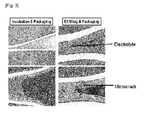
- FIGS. 2 and 3 show captured sectional images of sealed portions of the battery cells manufactured according to Embodiment and Comparative Example. It is noted from FIGS. 2 and 3 that the battery cell manufactured according to manufacturing method of the present invention does not have such electrolyte leakage and microcrack discovered from the battery cell according to Comparative Example. For example, when 60g of electrolyte was impregnated according to the method of Comparative Example, sealing was performed simultaneously when vacuumizing was performed, so electrolyte was trapped and electrolyte salt was present at a sealed portion, resulting in 2g to 3g of electrolyte leakage amount (3% to 5%).
Landscapes
- Chemical & Material Sciences (AREA)
- Chemical Kinetics & Catalysis (AREA)
- Electrochemistry (AREA)
- General Chemical & Material Sciences (AREA)
- Engineering & Computer Science (AREA)
- Manufacturing & Machinery (AREA)
- Inorganic Chemistry (AREA)
- Physics & Mathematics (AREA)
- Condensed Matter Physics & Semiconductors (AREA)
- Dispersion Chemistry (AREA)
- General Physics & Mathematics (AREA)
- Materials Engineering (AREA)
- Secondary Cells (AREA)
Applications Claiming Priority (2)
| Application Number | Priority Date | Filing Date | Title |
|---|---|---|---|
| KR20090095030 | 2009-10-07 | ||
| PCT/KR2010/006865 WO2011043608A2 (fr) | 2009-10-07 | 2010-10-07 | Procédé de fabrication d'une batterie lithium-ion polymère, pile de batterie et pile lithium-ion polymère comprenant celle-ci |
Publications (3)
| Publication Number | Publication Date |
|---|---|
| EP2472645A2 true EP2472645A2 (fr) | 2012-07-04 |
| EP2472645A4 EP2472645A4 (fr) | 2013-10-16 |
| EP2472645B1 EP2472645B1 (fr) | 2015-07-01 |
Family
ID=43857288
Family Applications (1)
| Application Number | Title | Priority Date | Filing Date |
|---|---|---|---|
| EP10822253.0A Active EP2472645B1 (fr) | 2009-10-07 | 2010-10-07 | Procédé de fabrication d'une batterie lithium-ion polymère, pile de batterie et batterie lithium-ion polymère comprenant celle-ci |
Country Status (5)
| Country | Link |
|---|---|
| US (1) | US10727471B2 (fr) |
| EP (1) | EP2472645B1 (fr) |
| KR (1) | KR101082496B1 (fr) |
| CN (1) | CN102576853B (fr) |
| WO (1) | WO2011043608A2 (fr) |
Cited By (3)
| Publication number | Priority date | Publication date | Assignee | Title |
|---|---|---|---|---|
| DE102022001427B3 (de) | 2022-04-25 | 2023-06-29 | Mercedes-Benz Group AG | Verfahren zum Einbringen von Elektrolyt |
| DE102022004413A1 (de) | 2022-11-25 | 2024-05-29 | Mercedes-Benz Group AG | Verfahren zum Einbringen von Elektrolyt |
| GB2638482A (en) * | 2024-02-26 | 2025-08-27 | Jaguar Land Rover Ltd | A method of manufacturing a battery cell for a vehicle |
Families Citing this family (16)
| Publication number | Priority date | Publication date | Assignee | Title |
|---|---|---|---|---|
| JP5510410B2 (ja) * | 2011-08-02 | 2014-06-04 | 株式会社Gsユアサ | 電池 |
| CN104584306A (zh) * | 2012-11-08 | 2015-04-29 | 株式会社Lg化学 | 二次电池的制造方法 |
| CN104584305A (zh) | 2012-11-08 | 2015-04-29 | 株式会社Lg化学 | 制造二次电池的方法 |
| WO2016019924A1 (fr) | 2014-08-08 | 2016-02-11 | Techtronic Industries Company Limited | Poche de batterie, cellule de batterie et procédé de fabrication d'une poche ou d'une cellule de batterie |
| EP3353844B1 (fr) | 2015-03-27 | 2022-05-11 | Mason K. Harrup | Solvants entièrement inorganiques pour électrolytes |
| US10707531B1 (en) | 2016-09-27 | 2020-07-07 | New Dominion Enterprises Inc. | All-inorganic solvents for electrolytes |
| DE102016225173A1 (de) * | 2016-12-15 | 2018-06-21 | Robert Bosch Gmbh | Verfahren und System zur Herstellung einer Batteriezelle |
| CN106848177A (zh) * | 2017-03-08 | 2017-06-13 | 江西迪比科股份有限公司 | 一种锂离子二次电池的注液工艺 |
| KR102447619B1 (ko) * | 2017-09-18 | 2022-09-27 | 주식회사 엘지에너지솔루션 | 지그를 이용한 고정 과정을 포함하는 파우치형 전지셀 제조방법 |
| EP3486985A1 (fr) * | 2017-11-16 | 2019-05-22 | Technische Universität München | Cellule électrochimique, ainsi que procédé et dispositif pour sa fabrication |
| CN208819975U (zh) | 2018-02-27 | 2019-05-03 | 创科(澳门离岸商业服务)有限公司 | 具有安全保护功能的软包电池 |
| EP3958354A4 (fr) * | 2019-05-10 | 2022-08-31 | LG Energy Solution, Ltd. | Procédé de fabrication d'anode |
| CN112635930B (zh) * | 2020-12-22 | 2023-02-07 | 东莞东阳光科研发有限公司 | 一种锂硫软包电池的注液方法 |
| CN112909347A (zh) * | 2021-03-10 | 2021-06-04 | 沁新集团(天津)新能源技术研究院有限公司 | 锂离子电池制备方法和制备锂离子电池的设备 |
| CN113161621A (zh) * | 2021-03-10 | 2021-07-23 | 沁新集团(天津)新能源技术研究院有限公司 | 锂离子电池的制备方法 |
| US12308402B2 (en) * | 2022-01-28 | 2025-05-20 | GM Global Technology Operations LLC | Battery direct recycling |
Family Cites Families (23)
| Publication number | Priority date | Publication date | Assignee | Title |
|---|---|---|---|---|
| US5460904A (en) * | 1993-08-23 | 1995-10-24 | Bell Communications Research, Inc. | Electrolyte activatable lithium-ion rechargeable battery cell |
| ZA963605B (en) * | 1995-06-07 | 1996-11-19 | Duracell Inc | Process for improving lithium ion cell |
| KR970031033A (ko) * | 1995-11-24 | 1997-06-26 | 윤종용 | 전극 조립체의 제조방법 |
| KR100212180B1 (ko) * | 1996-03-15 | 1999-08-02 | 윤덕용 | 핫차징에 의한 ni/mh 2차전지의 활성화 처리방법 |
| JP4027447B2 (ja) * | 1996-04-24 | 2007-12-26 | 株式会社ルネサステクノロジ | 半導体装置の製造方法 |
| US6007945A (en) * | 1996-10-15 | 1999-12-28 | Electrofuel Inc. | Negative electrode for a rechargeable lithium battery comprising a solid solution of titanium dioxide and tin dioxide |
| JP4057674B2 (ja) * | 1997-06-03 | 2008-03-05 | 株式会社東芝 | 電池製造装置及び電池製造方法 |
| US6171723B1 (en) * | 1997-10-10 | 2001-01-09 | 3M Innovative Properties Company | Batteries with porous components |
| US6387561B1 (en) | 1998-10-13 | 2002-05-14 | Ngk Insulators, Ltd. | Electrolyte-solution filling method and battery structure of lithium secondary battery |
| JP2000231915A (ja) * | 1999-02-12 | 2000-08-22 | Hitachi Maxell Ltd | ポリマー電解質電池の製造方法 |
| KR100367284B1 (ko) * | 1999-02-22 | 2003-01-09 | 티디케이가부시기가이샤 | 2차전지 및 그 제조방법 |
| KR20020019008A (ko) * | 2000-02-04 | 2002-03-09 | 다니구찌 이찌로오, 기타오카 다카시 | 전지 제조방법 및 이를 이용한 전지 |
| US6790243B2 (en) * | 2000-02-11 | 2004-09-14 | Comsat Corporation | Lithium-ion cell and method for activation thereof |
| JP2001332304A (ja) * | 2000-05-24 | 2001-11-30 | Sony Corp | 電解質およびそれを用いた電池 |
| JP4060549B2 (ja) * | 2001-06-19 | 2008-03-12 | Tdk株式会社 | 電気化学素子の外装体 |
| AU2003302519A1 (en) * | 2002-11-29 | 2004-06-23 | Mitsui Mining And Smelting Co., Ltd. | Negative electrode for non-aqueous electrolyte secondary cell and method for manufacture thereof, and non-aqueous electrolyte secondary cell |
| KR100563055B1 (ko) * | 2003-08-19 | 2006-03-24 | 삼성에스디아이 주식회사 | 권취형 전극 조립체 및 이를 구비한 이차 전지 |
| KR100686838B1 (ko) | 2005-07-12 | 2007-02-26 | 삼성에스디아이 주식회사 | 리튬 이차전지 |
| KR100793011B1 (ko) | 2007-02-16 | 2008-01-08 | 에스케이에너지 주식회사 | 리튬이차전지의 제조방법 |
| KR100824869B1 (ko) * | 2007-05-04 | 2008-04-23 | 삼성에스디아이 주식회사 | 리튬 폴리머 전지의 제조방법 및 리튬 폴리머 전지 |
| JP5319899B2 (ja) * | 2007-08-23 | 2013-10-16 | 株式会社東芝 | 非水電解液電池 |
| US20100192362A1 (en) * | 2008-09-11 | 2010-08-05 | A123 System, Inc. | Split Charge Forming Process for Battery |
| CN101504995A (zh) * | 2009-02-11 | 2009-08-12 | 中信国安盟固利新能源科技有限公司 | 一种提高锰酸锂锂离子电池稳定性能和循环性能的方法 |
-
2010
- 2010-10-07 EP EP10822253.0A patent/EP2472645B1/fr active Active
- 2010-10-07 KR KR1020100097904A patent/KR101082496B1/ko active Active
- 2010-10-07 CN CN201080045500.7A patent/CN102576853B/zh active Active
- 2010-10-07 WO PCT/KR2010/006865 patent/WO2011043608A2/fr not_active Ceased
- 2010-12-29 US US12/980,713 patent/US10727471B2/en active Active
Cited By (3)
| Publication number | Priority date | Publication date | Assignee | Title |
|---|---|---|---|---|
| DE102022001427B3 (de) | 2022-04-25 | 2023-06-29 | Mercedes-Benz Group AG | Verfahren zum Einbringen von Elektrolyt |
| DE102022004413A1 (de) | 2022-11-25 | 2024-05-29 | Mercedes-Benz Group AG | Verfahren zum Einbringen von Elektrolyt |
| GB2638482A (en) * | 2024-02-26 | 2025-08-27 | Jaguar Land Rover Ltd | A method of manufacturing a battery cell for a vehicle |
Also Published As
| Publication number | Publication date |
|---|---|
| CN102576853B (zh) | 2015-08-26 |
| WO2011043608A3 (fr) | 2011-07-14 |
| KR20110037921A (ko) | 2011-04-13 |
| EP2472645A4 (fr) | 2013-10-16 |
| WO2011043608A2 (fr) | 2011-04-14 |
| KR101082496B1 (ko) | 2011-11-11 |
| US10727471B2 (en) | 2020-07-28 |
| US20110097630A1 (en) | 2011-04-28 |
| EP2472645B1 (fr) | 2015-07-01 |
| CN102576853A (zh) | 2012-07-11 |
Similar Documents
| Publication | Publication Date | Title |
|---|---|---|
| EP2472645B1 (fr) | Procédé de fabrication d'une batterie lithium-ion polymère, pile de batterie et batterie lithium-ion polymère comprenant celle-ci | |
| KR100793011B1 (ko) | 리튬이차전지의 제조방법 | |
| US8752573B2 (en) | Non-aqueous electrolyte secondary battery with filling function, and non-aqueous electrolyte secondary battery and non-aqueous electrolyte filling device used therefor | |
| EP4471927A1 (fr) | Batterie secondaire cylindrique à électrolyte non aqueux | |
| EP2273599B1 (fr) | Batterie secondaire et son procédé de fabrication | |
| JP2011192523A (ja) | 二次電池の製造方法およびガス抜き装置 | |
| US20230361391A1 (en) | Cylindrical non-aqueous electrolyte secondary cell | |
| JP4880811B2 (ja) | 電池の製造方法 | |
| JP3631407B2 (ja) | 非水電解質二次電池 | |
| EP3993134B1 (fr) | Procédé pour déterminer un degré de mouillage à l'aide d'un test à faible courant | |
| US11121373B2 (en) | Method for manufacturing electrochemical device, and electrochemical device | |
| JP2013114987A (ja) | 電池の内圧測定方法 | |
| JP2003004579A (ja) | 密封性検査装置 | |
| US20110126400A1 (en) | Method of manufacturing lithium secondary battery | |
| JP2010262867A (ja) | 二次電池の製造方法 | |
| JP2017098114A (ja) | 密閉型電池の製造方法 | |
| KR102391601B1 (ko) | 원통형 에너지 저장장치용 전극의 리튬화 방법 | |
| JP2021093318A (ja) | 電池の製造方法 | |
| KR101408623B1 (ko) | 파우치형 리튬 이온 폴리머 전지 및 그 제조방법 | |
| CN113381119B (zh) | 一种电池制作方法以及电池 | |
| KR20240028022A (ko) | 파우치형 전지셀의 포메이션 방법 및 이를 포함하는 활성화 방법 | |
| JP2021118039A (ja) | 非水電解液二次電池の製造方法 | |
| KR20180081911A (ko) | 진공을 이용한 전해액 주액 방법 | |
| US20220149438A1 (en) | Non-aqueous electrolyte secondary battery and method for manufacturing non-aqueous electrolyte secondary battery | |
| JP7763209B2 (ja) | 非水電解液二次電池の製造方法 |
Legal Events
| Date | Code | Title | Description |
|---|---|---|---|
| PUAI | Public reference made under article 153(3) epc to a published international application that has entered the european phase |
Free format text: ORIGINAL CODE: 0009012 |
|
| 17P | Request for examination filed |
Effective date: 20120316 |
|
| AK | Designated contracting states |
Kind code of ref document: A2 Designated state(s): AL AT BE BG CH CY CZ DE DK EE ES FI FR GB GR HR HU IE IS IT LI LT LU LV MC MK MT NL NO PL PT RO RS SE SI SK SM TR |
|
| DAX | Request for extension of the european patent (deleted) | ||
| A4 | Supplementary search report drawn up and despatched |
Effective date: 20130918 |
|
| RIC1 | Information provided on ipc code assigned before grant |
Ipc: H01M 10/058 20100101ALN20130912BHEP Ipc: H01M 10/44 20060101ALN20130912BHEP Ipc: H01M 10/052 20100101ALN20130912BHEP Ipc: H01M 10/04 20060101ALN20130912BHEP Ipc: H01M 4/04 20060101ALN20130912BHEP Ipc: H01M 10/0565 20100101ALN20130912BHEP Ipc: H01M 2/02 20060101ALN20130912BHEP Ipc: H01M 2/36 20060101AFI20130912BHEP |
|
| 17Q | First examination report despatched |
Effective date: 20140528 |
|
| RIC1 | Information provided on ipc code assigned before grant |
Ipc: H01M 2/36 20060101AFI20140930BHEP Ipc: H01M 10/058 20100101ALN20140930BHEP Ipc: H01M 10/052 20100101ALN20140930BHEP Ipc: H01M 4/04 20060101ALN20140930BHEP Ipc: H01M 2/02 20060101ALN20140930BHEP Ipc: H01M 10/0565 20100101ALN20140930BHEP Ipc: H01M 10/04 20060101ALN20140930BHEP Ipc: H01M 10/44 20060101ALN20140930BHEP |
|
| GRAP | Despatch of communication of intention to grant a patent |
Free format text: ORIGINAL CODE: EPIDOSNIGR1 |
|
| RIC1 | Information provided on ipc code assigned before grant |
Ipc: H01M 10/058 20100101ALN20150323BHEP Ipc: H01M 10/04 20060101ALN20150323BHEP Ipc: H01M 4/04 20060101ALN20150323BHEP Ipc: H01M 2/02 20060101ALN20150323BHEP Ipc: H01M 10/44 20060101ALN20150323BHEP Ipc: H01M 10/0565 20100101ALN20150323BHEP Ipc: H01M 10/052 20100101ALN20150323BHEP Ipc: H01M 2/36 20060101AFI20150323BHEP |
|
| INTG | Intention to grant announced |
Effective date: 20150424 |
|
| GRAS | Grant fee paid |
Free format text: ORIGINAL CODE: EPIDOSNIGR3 |
|
| GRAA | (expected) grant |
Free format text: ORIGINAL CODE: 0009210 |
|
| AK | Designated contracting states |
Kind code of ref document: B1 Designated state(s): AL AT BE BG CH CY CZ DE DK EE ES FI FR GB GR HR HU IE IS IT LI LT LU LV MC MK MT NL NO PL PT RO RS SE SI SK SM TR |
|
| REG | Reference to a national code |
Ref country code: GB Ref legal event code: FG4D |
|
| REG | Reference to a national code |
Ref country code: AT Ref legal event code: REF Ref document number: 734435 Country of ref document: AT Kind code of ref document: T Effective date: 20150715 Ref country code: CH Ref legal event code: EP |
|
| REG | Reference to a national code |
Ref country code: IE Ref legal event code: FG4D |
|
| REG | Reference to a national code |
Ref country code: DE Ref legal event code: R096 Ref document number: 602010025635 Country of ref document: DE |
|
| REG | Reference to a national code |
Ref country code: FR Ref legal event code: PLFP Year of fee payment: 6 |
|
| REG | Reference to a national code |
Ref country code: AT Ref legal event code: MK05 Ref document number: 734435 Country of ref document: AT Kind code of ref document: T Effective date: 20150701 |
|
| REG | Reference to a national code |
Ref country code: NL Ref legal event code: MP Effective date: 20150701 |
|
| REG | Reference to a national code |
Ref country code: LT Ref legal event code: MG4D |
|
| PG25 | Lapsed in a contracting state [announced via postgrant information from national office to epo] |
Ref country code: GR Free format text: LAPSE BECAUSE OF FAILURE TO SUBMIT A TRANSLATION OF THE DESCRIPTION OR TO PAY THE FEE WITHIN THE PRESCRIBED TIME-LIMIT Effective date: 20151002 Ref country code: NO Free format text: LAPSE BECAUSE OF FAILURE TO SUBMIT A TRANSLATION OF THE DESCRIPTION OR TO PAY THE FEE WITHIN THE PRESCRIBED TIME-LIMIT Effective date: 20151001 Ref country code: LV Free format text: LAPSE BECAUSE OF FAILURE TO SUBMIT A TRANSLATION OF THE DESCRIPTION OR TO PAY THE FEE WITHIN THE PRESCRIBED TIME-LIMIT Effective date: 20150701 Ref country code: LT Free format text: LAPSE BECAUSE OF FAILURE TO SUBMIT A TRANSLATION OF THE DESCRIPTION OR TO PAY THE FEE WITHIN THE PRESCRIBED TIME-LIMIT Effective date: 20150701 Ref country code: FI Free format text: LAPSE BECAUSE OF FAILURE TO SUBMIT A TRANSLATION OF THE DESCRIPTION OR TO PAY THE FEE WITHIN THE PRESCRIBED TIME-LIMIT Effective date: 20150701 |
|
| PG25 | Lapsed in a contracting state [announced via postgrant information from national office to epo] |
Ref country code: RS Free format text: LAPSE BECAUSE OF FAILURE TO SUBMIT A TRANSLATION OF THE DESCRIPTION OR TO PAY THE FEE WITHIN THE PRESCRIBED TIME-LIMIT Effective date: 20150701 Ref country code: SE Free format text: LAPSE BECAUSE OF FAILURE TO SUBMIT A TRANSLATION OF THE DESCRIPTION OR TO PAY THE FEE WITHIN THE PRESCRIBED TIME-LIMIT Effective date: 20150701 Ref country code: PT Free format text: LAPSE BECAUSE OF FAILURE TO SUBMIT A TRANSLATION OF THE DESCRIPTION OR TO PAY THE FEE WITHIN THE PRESCRIBED TIME-LIMIT Effective date: 20151102 Ref country code: IS Free format text: LAPSE BECAUSE OF FAILURE TO SUBMIT A TRANSLATION OF THE DESCRIPTION OR TO PAY THE FEE WITHIN THE PRESCRIBED TIME-LIMIT Effective date: 20151101 Ref country code: PL Free format text: LAPSE BECAUSE OF FAILURE TO SUBMIT A TRANSLATION OF THE DESCRIPTION OR TO PAY THE FEE WITHIN THE PRESCRIBED TIME-LIMIT Effective date: 20150701 Ref country code: HR Free format text: LAPSE BECAUSE OF FAILURE TO SUBMIT A TRANSLATION OF THE DESCRIPTION OR TO PAY THE FEE WITHIN THE PRESCRIBED TIME-LIMIT Effective date: 20150701 Ref country code: ES Free format text: LAPSE BECAUSE OF FAILURE TO SUBMIT A TRANSLATION OF THE DESCRIPTION OR TO PAY THE FEE WITHIN THE PRESCRIBED TIME-LIMIT Effective date: 20150701 Ref country code: AT Free format text: LAPSE BECAUSE OF FAILURE TO SUBMIT A TRANSLATION OF THE DESCRIPTION OR TO PAY THE FEE WITHIN THE PRESCRIBED TIME-LIMIT Effective date: 20150701 |
|
| REG | Reference to a national code |
Ref country code: DE Ref legal event code: R097 Ref document number: 602010025635 Country of ref document: DE |
|
| PG25 | Lapsed in a contracting state [announced via postgrant information from national office to epo] |
Ref country code: DK Free format text: LAPSE BECAUSE OF FAILURE TO SUBMIT A TRANSLATION OF THE DESCRIPTION OR TO PAY THE FEE WITHIN THE PRESCRIBED TIME-LIMIT Effective date: 20150701 Ref country code: EE Free format text: LAPSE BECAUSE OF FAILURE TO SUBMIT A TRANSLATION OF THE DESCRIPTION OR TO PAY THE FEE WITHIN THE PRESCRIBED TIME-LIMIT Effective date: 20150701 Ref country code: SK Free format text: LAPSE BECAUSE OF FAILURE TO SUBMIT A TRANSLATION OF THE DESCRIPTION OR TO PAY THE FEE WITHIN THE PRESCRIBED TIME-LIMIT Effective date: 20150701 Ref country code: IT Free format text: LAPSE BECAUSE OF FAILURE TO SUBMIT A TRANSLATION OF THE DESCRIPTION OR TO PAY THE FEE WITHIN THE PRESCRIBED TIME-LIMIT Effective date: 20150701 Ref country code: CZ Free format text: LAPSE BECAUSE OF FAILURE TO SUBMIT A TRANSLATION OF THE DESCRIPTION OR TO PAY THE FEE WITHIN THE PRESCRIBED TIME-LIMIT Effective date: 20150701 |
|
| PLBE | No opposition filed within time limit |
Free format text: ORIGINAL CODE: 0009261 |
|
| STAA | Information on the status of an ep patent application or granted ep patent |
Free format text: STATUS: NO OPPOSITION FILED WITHIN TIME LIMIT |
|
| PG25 | Lapsed in a contracting state [announced via postgrant information from national office to epo] |
Ref country code: LU Free format text: LAPSE BECAUSE OF FAILURE TO SUBMIT A TRANSLATION OF THE DESCRIPTION OR TO PAY THE FEE WITHIN THE PRESCRIBED TIME-LIMIT Effective date: 20151007 Ref country code: RO Free format text: LAPSE BECAUSE OF FAILURE TO SUBMIT A TRANSLATION OF THE DESCRIPTION OR TO PAY THE FEE WITHIN THE PRESCRIBED TIME-LIMIT Effective date: 20150701 |
|
| REG | Reference to a national code |
Ref country code: CH Ref legal event code: PL |
|
| 26N | No opposition filed |
Effective date: 20160404 |
|
| PG25 | Lapsed in a contracting state [announced via postgrant information from national office to epo] |
Ref country code: MC Free format text: LAPSE BECAUSE OF FAILURE TO SUBMIT A TRANSLATION OF THE DESCRIPTION OR TO PAY THE FEE WITHIN THE PRESCRIBED TIME-LIMIT Effective date: 20150701 |
|
| REG | Reference to a national code |
Ref country code: IE Ref legal event code: MM4A |
|
| PG25 | Lapsed in a contracting state [announced via postgrant information from national office to epo] |
Ref country code: LI Free format text: LAPSE BECAUSE OF NON-PAYMENT OF DUE FEES Effective date: 20151031 Ref country code: CH Free format text: LAPSE BECAUSE OF NON-PAYMENT OF DUE FEES Effective date: 20151031 |
|
| PG25 | Lapsed in a contracting state [announced via postgrant information from national office to epo] |
Ref country code: SI Free format text: LAPSE BECAUSE OF FAILURE TO SUBMIT A TRANSLATION OF THE DESCRIPTION OR TO PAY THE FEE WITHIN THE PRESCRIBED TIME-LIMIT Effective date: 20150701 |
|
| REG | Reference to a national code |
Ref country code: FR Ref legal event code: PLFP Year of fee payment: 7 |
|
| PG25 | Lapsed in a contracting state [announced via postgrant information from national office to epo] |
Ref country code: IE Free format text: LAPSE BECAUSE OF NON-PAYMENT OF DUE FEES Effective date: 20151007 |
|
| PG25 | Lapsed in a contracting state [announced via postgrant information from national office to epo] |
Ref country code: BE Free format text: LAPSE BECAUSE OF FAILURE TO SUBMIT A TRANSLATION OF THE DESCRIPTION OR TO PAY THE FEE WITHIN THE PRESCRIBED TIME-LIMIT Effective date: 20150701 |
|
| PG25 | Lapsed in a contracting state [announced via postgrant information from national office to epo] |
Ref country code: BG Free format text: LAPSE BECAUSE OF FAILURE TO SUBMIT A TRANSLATION OF THE DESCRIPTION OR TO PAY THE FEE WITHIN THE PRESCRIBED TIME-LIMIT Effective date: 20150701 Ref country code: SM Free format text: LAPSE BECAUSE OF FAILURE TO SUBMIT A TRANSLATION OF THE DESCRIPTION OR TO PAY THE FEE WITHIN THE PRESCRIBED TIME-LIMIT Effective date: 20150701 Ref country code: HU Free format text: LAPSE BECAUSE OF FAILURE TO SUBMIT A TRANSLATION OF THE DESCRIPTION OR TO PAY THE FEE WITHIN THE PRESCRIBED TIME-LIMIT; INVALID AB INITIO Effective date: 20101007 |
|
| PG25 | Lapsed in a contracting state [announced via postgrant information from national office to epo] |
Ref country code: CY Free format text: LAPSE BECAUSE OF FAILURE TO SUBMIT A TRANSLATION OF THE DESCRIPTION OR TO PAY THE FEE WITHIN THE PRESCRIBED TIME-LIMIT Effective date: 20150701 Ref country code: NL Free format text: LAPSE BECAUSE OF FAILURE TO SUBMIT A TRANSLATION OF THE DESCRIPTION OR TO PAY THE FEE WITHIN THE PRESCRIBED TIME-LIMIT Effective date: 20150701 |
|
| PG25 | Lapsed in a contracting state [announced via postgrant information from national office to epo] |
Ref country code: TR Free format text: LAPSE BECAUSE OF FAILURE TO SUBMIT A TRANSLATION OF THE DESCRIPTION OR TO PAY THE FEE WITHIN THE PRESCRIBED TIME-LIMIT Effective date: 20150701 Ref country code: MT Free format text: LAPSE BECAUSE OF FAILURE TO SUBMIT A TRANSLATION OF THE DESCRIPTION OR TO PAY THE FEE WITHIN THE PRESCRIBED TIME-LIMIT Effective date: 20150701 |
|
| REG | Reference to a national code |
Ref country code: FR Ref legal event code: PLFP Year of fee payment: 8 |
|
| PG25 | Lapsed in a contracting state [announced via postgrant information from national office to epo] |
Ref country code: MK Free format text: LAPSE BECAUSE OF FAILURE TO SUBMIT A TRANSLATION OF THE DESCRIPTION OR TO PAY THE FEE WITHIN THE PRESCRIBED TIME-LIMIT Effective date: 20150701 |
|
| REG | Reference to a national code |
Ref country code: FR Ref legal event code: PLFP Year of fee payment: 9 |
|
| PG25 | Lapsed in a contracting state [announced via postgrant information from national office to epo] |
Ref country code: AL Free format text: LAPSE BECAUSE OF FAILURE TO SUBMIT A TRANSLATION OF THE DESCRIPTION OR TO PAY THE FEE WITHIN THE PRESCRIBED TIME-LIMIT Effective date: 20150701 |
|
| REG | Reference to a national code |
Ref country code: DE Ref legal event code: R079 Ref document number: 602010025635 Country of ref document: DE Free format text: PREVIOUS MAIN CLASS: H01M0002360000 Ipc: H01M0050600000 |
|
| REG | Reference to a national code |
Ref country code: DE Ref legal event code: R081 Ref document number: 602010025635 Country of ref document: DE Owner name: LG ENERGY SOLUTION LTD., KR Free format text: FORMER OWNER: LG CHEM. LTD., SEOUL, KR Ref country code: DE Ref legal event code: R081 Ref document number: 602010025635 Country of ref document: DE Owner name: LG ENERGY SOLUTION, LTD., KR Free format text: FORMER OWNER: LG CHEM. LTD., SEOUL, KR |
|
| P01 | Opt-out of the competence of the unified patent court (upc) registered |
Effective date: 20230512 |
|
| REG | Reference to a national code |
Ref country code: GB Ref legal event code: 732E Free format text: REGISTERED BETWEEN 20230824 AND 20230831 |
|
| REG | Reference to a national code |
Ref country code: DE Ref legal event code: R081 Ref document number: 602010025635 Country of ref document: DE Owner name: LG ENERGY SOLUTION, LTD., KR Free format text: FORMER OWNER: LG ENERGY SOLUTION LTD., SEOUL, KR |
|
| PGFP | Annual fee paid to national office [announced via postgrant information from national office to epo] |
Ref country code: GB Payment date: 20250922 Year of fee payment: 16 |
|
| PGFP | Annual fee paid to national office [announced via postgrant information from national office to epo] |
Ref country code: FR Payment date: 20250925 Year of fee payment: 16 |
|
| PGFP | Annual fee paid to national office [announced via postgrant information from national office to epo] |
Ref country code: DE Payment date: 20250922 Year of fee payment: 16 |